Chapter 9: Financial Management
No business can be started or run without money. A trader needs funds to buy stock, a manufacturer to buy machinery, and every firm needs cash to pay wages, bills and suppliers while it waits for customers to pay. Arranging this money, however, is only half the task. A firm must also decide where to invest it, from which sources to raise it, and how much of its profit to hand back to its owners.
In 2007 Tata Steel acquired Corus, a large European steel producer, in a deal worth about 12 billion US dollars. The amount was raised through a combination of borrowing and owners’ funds, with some of it coming from profits retained within the group. That single choice altered the mix of borrowed and owned money in the company, and with it the cost of its funds and the risk it carried. Decisions of this kind, taken by every firm on a smaller scale every year, decide whether a business grows steadily or runs into trouble.
This chapter explains the meaning of business finance and financial management, its objectives, the three financial decisions, financial planning, capital structure, and the management of fixed and working capital.

Fig. 9.0 – Inside an integrated steel plant.
9.1 Meaning of Business Finance
Almost nothing a business does is free. Land has to be bought or rented, machines have to be installed, workers have to be paid, and goods have to be purchased long before customers pay for them. The money required for carrying out business activities is called business finance.
Finance is not needed only once, at the start. It is required to establish a business, to run it from day to day, to modernise it when its methods grow outdated, to expand it when demand rises, and to diversify it when the firm enters a new line of activity. A business entity therefore needs finance at every stage of its life.
Where Business Finance Is Used
Purchase of tangible assets — machinery, factories, buildings, offices and similar physical property that the firm uses over many years.
Purchase of intangible assets — trademarks, patents, technical expertise and similar rights that have value but no physical form.
Day-to-day operations — buying raw material, paying bills and salaries, and carrying the gap until cash is collected from customers.
Because money is needed at each of these points, the availability of adequate finance is crucial for the survival and growth of a business. A firm that cannot pay its suppliers or its workers on time will lose their confidence, however sound its products may be. A firm that has more funds than it can use profitably wastes them. Arranging the right amount of finance, at the right time and at a reasonable cost, is therefore a basic business responsibility.
9.2 Financial Management
All finance comes at some cost. Money raised from a lender carries interest, and money raised from owners carries the expectation of a return. Since no source of funds is free, the funds a business raises have to be handled with care. Financial management is concerned with the optimal procurement of finance as well as its optimal usage.
Procurement is optimal when the firm has compared the different sources available to it in terms of what each costs and what risk each brings, and has then chosen the combination that suits its situation. A loan may be cheap but must be repaid on a fixed date; owners’ funds carry no such compulsion but are costlier. Comparing sources on both counts, rather than on cost alone, is what makes the choice a considered one.
Usage is optimal when the finance so procured is invested in a manner that the returns from the investment exceed the cost at which the procurement has taken place. If a firm raises funds at a cost of ten per cent and earns eight per cent on them, the activity destroys value however successful it may look in terms of sales.
What Financial Management Aims At
Reducing the cost of the funds procured, so that a larger part of the earnings is left with the business.
Keeping the risk arising from the use of those funds under control.
Achieving effective deployment of the funds, that is, placing them in activities that yield well.
Ensuring the availability of enough funds whenever they are required, so that commitments are not missed.
Avoiding idle finance, since money lying unused still costs the business something.
The future of a business depends a great deal on the quality of its financial management. Two firms in the same industry, with similar products and similar customers, can end up in very different positions simply because one arranged and used its funds better than the other.
9.2.1 Importance of Financial Management
The role of financial management cannot be over-emphasised, since it has a direct bearing on the financial health of a business. The financial statements of a firm, such as the Balance Sheet and the Profit and Loss Account, reflect its financial position and its financial health. Almost every item appearing in these statements is affected, directly or indirectly, by some financial management decision taken earlier.
Some prominent examples of the aspects being affected are as follows.
The size and the composition of fixed assets of the business — a decision to invest a sum of Rs. 100 crores in fixed assets would raise the size of the fixed assets block by exactly that amount, and would also change the kind of assets the firm holds.
The quantum of current assets and its break-up into cash, inventory and receivables — with an increase in the investment in fixed assets there is a commensurate increase in the working capital requirement, since a larger plant needs more material and holds more stock. In addition, decisions about credit and inventory management affect the amount of debtors and inventory, which in turn affect the total current assets as well as their composition.
The amount of long-term and short-term funds to be used — financial management involves a decision about the proportion in which the two are used. An organisation wanting to hold more liquid assets would raise relatively more amount on a long-term basis. There is thus a choice between liquidity and profitability, the underlying assumption being that current liabilities cost less than long-term liabilities.
Break-up of long-term financing into debt, equity and other sources — of the total long-term finance, the proportions to be raised by way of debt and equity are themselves a financial management decision. The amounts of debt, equity share capital and preference share capital appearing in the Balance Sheet are all affected by it.
All items in the Profit and Loss Account, such as interest, expenses and depreciation — a higher amount of debt means a higher interest expense in future, and the use of more equity may entail a higher payment of dividends. An expansion of business, which is itself the result of an investment decision, is likely to affect virtually every item in the profit and loss account.
It can thus be stated that the financial statements of a business are largely determined by financial management decisions taken earlier, and that future financial statements will depend upon past as well as current financial decisions. The overall financial health of a business is therefore determined by the quality of its financial management. Good financial management aims at the mobilisation of financial resources at a lower cost and the deployment of these resources in the most lucrative activities available to the firm.
9.3 Objectives of Financial Management
Every business function needs a yardstick against which its decisions can be judged. For finance, that yardstick is the wealth of the owners. The primary aim of financial management is to maximise shareholders’ wealth, which is referred to as the wealth maximisation concept.
The funds of a company belong to its shareholders. The manner in which those funds are invested, and the return earned on them, determines the market value of the company’s shares. Maximising shareholders’ wealth therefore means maximising the market value of the equity shares of the company. The market price of a company’s shares is linked to the three basic financial decisions, which are discussed in the next section.
How Share Price Responds To A Decision
The market price of an equity share increases if the benefit from a decision exceeds the cost involved in it. All financial decisions aim at ensuring that each decision is efficient and adds some value, and such value additions tend to increase the market price of shares. Decisions of this kind prove gainful from the point of view of the shareholders, who gain when the value of their shares in the market rises.
The reverse also holds. Those decisions which result in a decline in the share price are poor financial decisions, because they have taken more value out of the business than they have brought in. The objective of financial management can therefore be stated as maximising the current price of the equity shares of the company, that is, maximising the wealth of its owners.
This single test applies on both sides of the finance function. When a decision is taken about investment in a new machine, the aim is to ensure that the benefits from the investment exceed the cost, so that some value addition takes place. When finance is procured, the aim is to reduce the cost of that finance, so that the value addition is even higher.
In fact, in all financial decisions, major or minor, the ultimate objective guiding the decision-maker is that some value addition should take place. Those avenues of investment, modes of financing and ways of handling the various components of working capital must be identified which will ultimately lead to an increase in the price of the equity share. This can happen only through efficient decision-making, and decision-making is efficient if, out of the various alternatives available, the best one is selected.
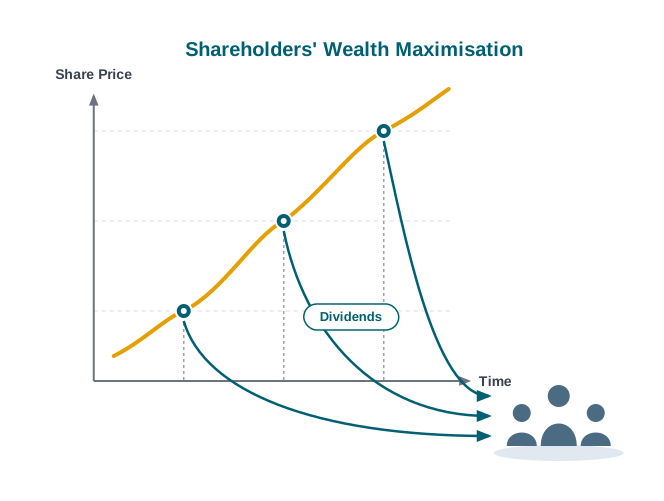
Fig. 9.1 – The wealth maximisation concept.
9.4 Financial Decisions
Financial management is concerned with the solution of three major issues relating to the financial operations of a firm. These correspond to three questions: where should the firm’s funds be invested, from where should those funds be raised, and how much of the profit earned should be given back to the owners. In a financial context, answering them means selecting the best investment alternative and the best financing alternative available. The finance function is therefore concerned with three broad decisions, which are explained below and summarised in Fig. 9.2.
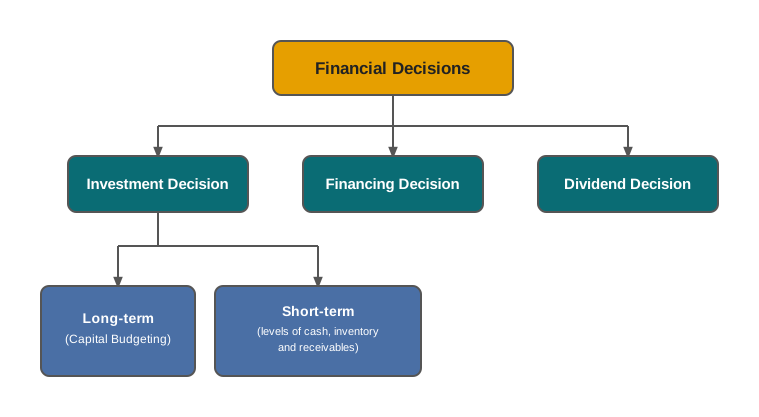
Fig. 9.2 – The three financial decisions.
9.4.1 Investment Decision
A firm’s resources are scarce in comparison to the uses to which they can be put. There is always more that a business could do than it has money to do. A firm therefore has to choose where to invest these resources, so that they are able to earn the highest possible return for its investors. The investment decision relates to how the firm’s funds are invested in different assets.
An investment decision can be long-term or short-term. A long-term investment decision is also called a capital budgeting decision. It involves committing finance on a long-term basis, for example, making an investment in a new machine to replace an existing one, acquiring a new fixed asset, or opening a new branch.
Such decisions are very crucial for any business, since they affect its earning capacity in the long run. The size of assets, the profitability and the competitiveness of a firm are all affected by capital budgeting decisions. Moreover, these decisions normally involve huge amounts of investment and are irreversible except at a huge cost. Once a plant has been built, a business cannot easily undo the decision; it is often almost impossible to wriggle out of it. For this reason such decisions need to be taken with the utmost care, and by those who understand them comprehensively. A wrong capital budgeting decision normally has the capacity to severely damage the financial fortune of a business.
Short-term investment decisions, also called working capital decisions, are concerned with the levels of cash, inventory and receivables the firm should carry. These decisions affect the day-to-day working of a business, and they affect both its liquidity and its profitability. Efficient cash management, inventory management and receivables management are the essential ingredients of sound working capital management.
9.4.1.1 Factors Affecting Capital Budgeting Decision
A number of projects are often available to a business to invest in. Each project has to be evaluated carefully and, depending upon the returns, a particular project is either selected or rejected. If there is only one project under consideration, its viability is judged in terms of its rate of return on the investment and the comparability of that return with the industry’s average. The following factors affect capital budgeting decisions.
Cash flows of the project — when a company takes an investment decision involving a huge amount, it expects the project to generate cash flows over a period. These cash flows are in the form of a series of cash receipts and payments over the life of the investment. The amount of these cash flows should be carefully analysed before a capital budgeting decision is taken.
The rate of return — the most important criterion is the rate of return of the project. These calculations are based on the expected returns from each proposal and the assessment of the risk involved. Suppose there are two projects, A and B, carrying the same risk, with a rate of return of 10 per cent and 12 per cent respectively. Under normal circumstances, project B should be selected.
The investment criteria involved — the decision to invest in a particular project involves a number of calculations regarding the amount of investment, the interest rate, the cash flows and the rate of return. There are different techniques to evaluate investment proposals, which are known as capital budgeting techniques. These techniques are applied to each proposal before a particular project is selected.
9.4.2 Financing Decision
The financing decision is about the quantum of finance to be raised from various long-term sources. Short-term sources are studied separately under the heading of working capital management.
This decision involves the identification of the various sources available to the firm. The main sources of funds for a firm are shareholders’ funds and borrowed funds. Shareholders’ funds refer to the equity capital and the retained earnings of the business. Borrowed funds refer to the finance raised through debentures or other forms of debt. A firm has to decide the proportion of funds to be raised from either source, based on their basic characteristics.
Those characteristics differ in an important way. Interest on borrowed funds has to be paid regardless of whether or not a firm has earned a profit, and the borrowed funds themselves have to be repaid at a fixed time. The risk of default on such payments is known as financial risk, and it has to be considered by a firm that may not always have enough earnings to make these fixed payments. Shareholders’ funds, on the other hand, involve no commitment regarding the payment of returns or the repayment of capital. A firm therefore needs a judicious mix of both debt and equity in making its financing decision, the sources being debt, equity, preference share capital and retained earnings.
The cost of each type of finance has to be estimated, since some sources are cheaper than others. Debt, for example, is considered to be the cheapest of all the sources, and the tax deductibility of interest makes it cheaper still. The associated risk is also different for each source: it is necessary to pay interest on debt and to redeem the principal amount on maturity, whereas there is no such compulsion to pay any dividend on equity shares. There is thus some amount of financial risk in debt financing, and the overall financial risk depends upon the proportion of debt in the total capital.
The fund-raising exercise itself costs something. This cost is called floatation cost, and it too must be considered while evaluating different sources. The financing decision is thus concerned with how much is to be raised from which source, and this decision determines the overall cost of capital and the financial risk of the enterprise.
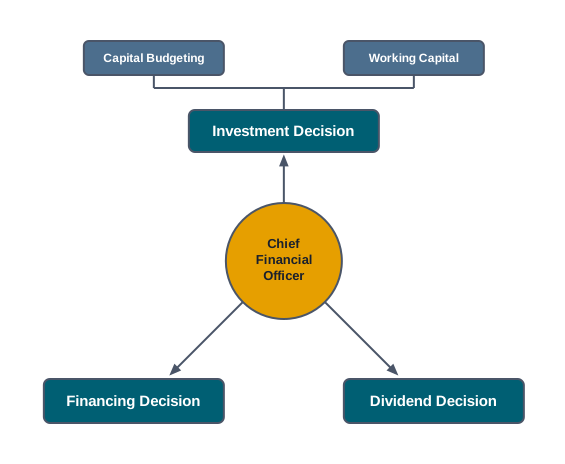
Fig. 9.3 – Financial decisions of a firm.
9.4.2.1 Factors Affecting Financing Decision
The financing decision is affected by various factors. The important ones among them are as follows.
Cost — the cost of raising funds through different sources is different. A prudent financial manager would normally opt for the source which is the cheapest.
Risk — the risk associated with each of the sources is different, and the source chosen must be one whose risk the firm can carry.
Floatation costs — the higher the floatation cost, the less attractive the source becomes.
Cash flow position of the company — a stronger cash flow position may make debt financing more viable than funding through equity, since the firm can be confident of meeting the fixed payments.
Fixed operating costs — if a business has high fixed operating costs, such as building rent, insurance premium and salaries, it must reduce its fixed financing costs. Hence lower debt financing is better in such a case. Similarly, if the fixed operating cost is less, more of debt financing may be preferred.
Control considerations — the issue of more equity may lead to a dilution of the management’s control over the business. Debt financing has no such implication. Companies afraid of a takeover bid would therefore prefer debt to equity.
State of capital market — the health of the capital market may also affect the choice of the source of funds. During the period when the stock market is rising, more people invest in equity. A depressed capital market, however, may make the issue of equity shares difficult for any company.
9.4.3 Dividend Decision
The third important decision that every financial manager has to take relates to the distribution of dividend. A dividend is that portion of profit which is distributed to shareholders. The decision involved here is how much of the profit earned by the company, after paying tax, is to be distributed to the shareholders and how much of it should be retained in the business.
The two uses of profit pull in different directions. The dividend constitutes the current income of the shareholders, while re-investment as retained earnings increases the firm’s future earning capacity. The extent of retained earnings also influences the financing decision of the firm, because to the extent that profits are re-invested, the firm does not need to raise funds from outside. The dividend decision should therefore be taken keeping in view the overall objective of maximising the shareholders’ wealth.
9.4.3.1 Factors Affecting Dividend Decision
How much of the profits earned by a company will be distributed and how much will be retained in the business is affected by many factors. Some of the important ones are discussed below.
Amount of earnings — dividends are paid out of current and past earnings. Earnings are therefore a major determinant of the decision about dividend.
Stability of earnings — other things remaining the same, a company having stable earnings is in a better position to declare higher dividends. As against this, a company having unstable earnings is likely to pay a smaller dividend.
Stability of dividends — companies generally follow a policy of stabilising the dividend per share. An increase in dividends is generally made only when there is confidence that the earning potential has gone up, and not merely because the earnings of the current year are higher. In other words, the dividend per share is not altered if the change in earnings is small or is seen to be temporary in nature.
Growth opportunities — companies having good growth opportunities retain more money out of their earnings so as to finance the required investment. The dividend in growth companies is therefore smaller than that in non-growth companies.
Cash flow position — the payment of dividend involves an outflow of cash. A company may be earning a profit but may still be short of cash, since profit and cash are not the same thing. The availability of enough cash in the company is necessary for the declaration of dividend.
Shareholders’ preference — while declaring dividends, managements must keep in mind the preferences of the shareholders in this regard. If the shareholders in general desire that at least a certain amount is paid as dividend, the company is likely to declare the same. There are always some shareholders who depend upon a regular income from their investments.
Taxation policy — the choice between the payment of dividend and the retention of earnings is, to some extent, affected by the difference in the tax treatment of dividends and capital gains. If tax on dividend is higher, it is better to pay less by way of dividends; if tax rates are relatively lower, higher dividends may be declared. Though dividends are free of tax in the hands of the shareholders, a dividend distribution tax is levied on companies. Under the present tax policy, shareholders are likely to prefer higher dividends.
Stock market reaction — investors in general view an increase in dividend as good news, and stock prices react positively to it. Similarly, a decrease in dividend may have a negative impact on the share price. The possible impact of dividend policy on the equity share price is therefore one of the important factors considered by the management while taking a decision about it.
Access to capital market — large and reputed companies generally have easy access to the capital market and may therefore depend less on retained earnings to finance their growth. Such companies tend to pay higher dividends than smaller companies, which have relatively low access to the market.
Legal constraints — certain provisions of the Companies Act place restrictions on payouts as dividend. Such provisions must be adhered to while declaring the dividend.
Contractual constraints — while granting loans to a company, the lender sometimes imposes certain restrictions on the payment of dividends in future. Companies are required to ensure that the dividend does not violate the terms of the loan agreement in this regard.
9.5 Financial Planning
Financial planning is essentially the preparation of a financial blueprint of an organisation’s future operations. Its objective is to ensure that enough funds are available at the right time.
Both shortage and excess create problems. If adequate funds are not available, the firm will not be able to honour its commitments and carry out its plans; a machine ordered may have to be cancelled, or wages may fall due before the money to pay them has been arranged. If, on the other hand, excess funds are available, they will unnecessarily add to the cost and may encourage wasteful expenditure. Financial planning seeks a proper matching of the requirement of funds and their availability.
It must be kept in mind that financial planning is not equivalent to, or a substitute for, financial management. Financial management aims at choosing the best investment and financing alternatives by focusing on their costs and benefits, and its objective is to increase the shareholders’ wealth. Financial planning, on the other hand, aims at smooth operations by focusing on fund requirements and their availability in the light of the financial decisions already taken.
An example makes the link clear. If a capital budgeting decision is taken, the operations of the firm are likely to be at a higher scale, and the amount of expenses and revenues is likely to increase. The financial planning process then tries to forecast all the items which are likely to undergo change. It enables the management to foresee the fund requirements, both the quantum and the timing. Likely shortages and surpluses are forecast, so that the necessary activities are taken in advance to meet those situations.
9.5.1 Objectives of Financial Planning
Financial planning strives to achieve the following twin objectives.
To ensure availability of funds whenever required — this includes a proper estimation of the funds required for different purposes, such as the purchase of long-term assets or the meeting of day-to-day expenses of the business. Apart from this, there is a need to estimate the time at which these funds are to be made available, since money needed in March is of little use if it arrives in June. Financial planning also tries to specify the possible sources of these funds.
To see that the firm does not raise resources unnecessarily — excess funding is almost as bad as inadequate funding, because idle money still carries a cost. Even if there is some surplus money, good financial planning would put it to the best possible use, so that the financial resources are not left idle and do not unnecessarily add to the cost.
9.5.2 Types And Period Of Financial Plans
Financial planning takes into consideration the growth, performance, investments and requirement of funds of a business for a given period. It includes both short-term as well as long-term planning. Long-term planning relates to long-term growth and investment, and focuses on capital expenditure programmes. Short-term planning covers a short-term financial plan called a budget.
Typically, financial planning is done for three to five years. For longer periods it becomes more difficult and less useful, because the estimates on which it rests grow unreliable. Plans made for periods of one year or less are termed budgets. Budgets are an example of a financial planning exercise carried out in greater detail, and they include a detailed plan of action for a period of one year or less.
The Planning Process
Financial planning usually begins with the preparation of a sales forecast. Suppose a company is making a financial plan for the next five years. It will start with an estimate of the sales which are likely to happen in those five years. Based on these, the financial statements are prepared, keeping in mind the requirement of funds for investment in fixed capital and working capital.
The expected profits during the period are then estimated, so that an idea can be formed of how much of the fund requirement can be met internally, that is, through retained earnings after dividend payouts. This results in an estimation of the requirement for external funds. Further, the sources from which this external requirement can be met are identified, and cash budgets are made incorporating these factors. The sequence is summarised in Fig. 9.4.
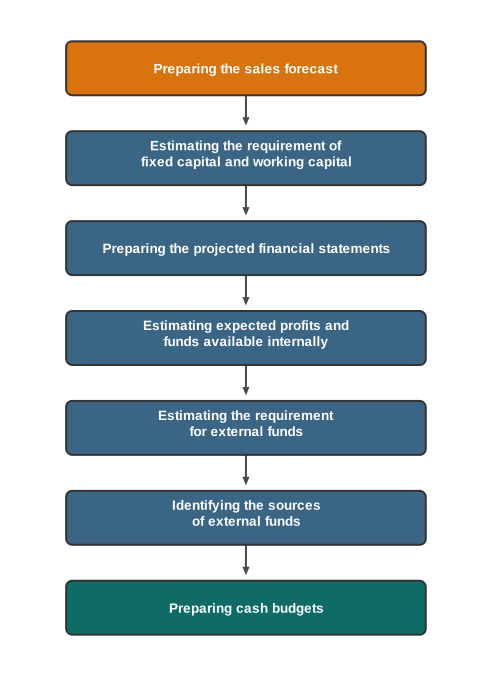
Fig. 9.4 – Steps in the financial planning process.
9.5.3 Importance of Financial Planning
Financial planning is an important part of the overall planning of any business enterprise. It aims at enabling the company to tackle the uncertainty in respect of the availability and timing of funds, and it helps in the smooth functioning of an organisation. Its importance can be explained as follows.
It helps in forecasting what may happen in future under different business situations, and by doing so it helps the firm to face the eventual situation in a better way. For example, a growth of 20 per cent in sales may be predicted, but the growth rate may eventually turn out to be 10 per cent or 30 per cent. Many items of expenses would be different in these three situations. By preparing a blueprint of all three, the management may decide in advance what must be done in each. This preparation of alternative financial plans to meet different situations is of immense help in running the business smoothly.
It helps in avoiding business shocks and surprises, and helps the company in preparing for the future.
It helps in co-ordinating various business functions, such as the sales and production functions, by providing clear policies and procedures.
Detailed plans of action prepared under financial planning reduce waste, duplication of efforts and gaps in planning.
It tries to link the present with the future.
It provides a link between investment and financing decisions on a continuous basis.
By spelling out detailed objectives for various business segments, it makes the evaluation of actual performance easier.
9.6 Capital Structure
One of the important decisions under financial management relates to the financing pattern of a business, that is, the proportion in which different sources are used in raising funds. On the basis of ownership, the sources of business finance can be broadly classified into two categories, namely ‘owners’ funds’ and ‘borrowed funds’.
Owners’ funds consist of equity share capital, preference share capital, and reserves and surpluses or retained earnings. Borrowed funds can be in the form of loans, debentures and public deposits, and may be raised from banks, other financial institutions, debentureholders and the public.
Capital structure refers to the mix between owners’ funds and borrowed funds. In the discussion that follows, these two are referred to simply as equity and debt. Capital structure can be calculated as the debt-equity ratio, that is, Debt ÷ Equity, or as the proportion of debt out of the total capital, that is, Debt ÷ (Debt + Equity).
Why The Mix Matters
Debt and equity differ significantly in their cost and in their riskiness for the firm, as was seen in Table 9.1. The cost of debt is lower than the cost of equity, because the lender’s risk is lower than the equity shareholder’s risk. The lender earns an assured return and gets a repayment of capital, and therefore requires a lower rate of return. In addition, interest paid on debt is a deductible expense for the computation of tax liability, whereas dividends are paid out of after-tax profit. An increased use of debt is therefore likely to lower the overall cost of capital of the firm, provided that the cost of equity remains unaffected.
Debt is cheaper but is more risky for a business, because the payment of interest and the return of principal are obligatory. Any default in meeting these commitments may force the business to go into liquidation. There is no such compulsion in the case of equity, which is therefore considered riskless for the business. A higher use of debt increases the fixed financial charges of a business, and as a result increases its financial risk.
The capital structure of a company thus affects both its profitability and its financial risk. A capital structure is said to be optimal when the proportion of debt and equity is such that it results in an increase in the value of the equity share. In other words, all decisions relating to capital structure should emphasise increasing the shareholders’ wealth.
9.6.1 Financial Leverage and Trading on Equity
The proportion of debt in the overall capital is also called financial leverage. Financial leverage is computed as D ÷ E, or as D ÷ (D + E), where D is the debt and E is the equity.
As the financial leverage increases, the cost of funds declines, because of the increased use of cheaper debt, but the financial risk increases at the same time. The impact of financial leverage on the profitability of a business can be seen through EBIT-EPS analysis, that is, an analysis of earnings before interest and taxes against earnings per share.
Where Leverage Helps
Consider Company X Ltd., which uses total funds of Rs. 30 lakh, borrows at 10 per cent per annum, pays tax at 30 per cent, and earns an EBIT of Rs. 4 lakh. Three situations are considered. There is no debt in Situation I, that is, the business is unlevered. Debt of Rs. 10 lakh and Rs. 20 lakh is assumed in Situations II and III respectively.
The company earns Rs. 0.93 per share if it is unlevered. With debt of Rs. 10 lakh its EPS is Rs. 1.05, and with a still higher debt of Rs. 20 lakh its EPS rises to Rs. 1.40. The EPS rises with higher debt because the cost of debt is lower than the return the company is earning on the funds employed. The company is earning a Return on Investment of 13.33 per cent, that is, EBIT ÷ Total Investment × 100, or 4 lakh ÷ 30 lakh × 100. This is higher than the 10 per cent interest it is paying on the debt funds.
With a higher use of debt, this difference between the Return on Investment and the cost of debt increases the EPS. This is a situation of favourable financial leverage. In such cases companies often employ more of the cheaper debt to enhance the EPS, and such a practice is called trading on equity.
Where Leverage Hurts
Now consider Company Y Ltd. All the details are the same, except that the company is earning a profit before interest and taxes of only Rs. 2 lakh.
In this example the EPS of the company is falling with the increased use of debt. This is because the company’s rate of return on investment is less than the cost of debt. The Return on Investment for Company Y is 2 lakh ÷ 30 lakh × 100, that is, 6.67 per cent, whereas the interest rate on debt is 10 per cent. In such cases the use of debt reduces the EPS. This is a situation of unfavourable financial leverage, and trading on equity is clearly unadvisable in such a situation.
Even in the case of Company X, a reckless use of trading on equity is not recommended. An increase in debt may enhance the EPS, but, as pointed out earlier, it also raises the financial risk. Ideally, a company must choose that risk-return combination which maximises the shareholders’ wealth. The debt-equity mix that achieves this is the optimum capital structure.
9.6.2 Factors Affecting the Choice of Capital Structure
Deciding about the capital structure of a firm involves determining the relative proportion of various types of funds, and this depends on various factors. Debt, for example, requires regular servicing, since the payment of interest and the repayment of principal are obligatory on a business. In addition, a company planning to raise debt must have sufficient cash to meet the increased outflows arising from it. The important factors which determine the choice of capital structure are as follows.
Cash flow position — the size of the projected cash flows must be considered before borrowing. Cash flows must not only cover the fixed cash payment obligations but must also leave a sufficient buffer. It must be kept in mind that a company has cash payment obligations for normal business operations, for investment in fixed assets, and for meeting the debt service commitments, that is, the payment of interest and the repayment of principal.
Interest coverage ratio — the interest coverage ratio refers to the number of times the earnings before interest and taxes of a company covers its interest obligation. It is calculated as ICR = EBIT ÷ Interest. The higher the ratio, the lower shall be the risk of the company failing to meet its interest payment obligations. However, this ratio is not an adequate measure by itself, since a firm may have a high EBIT but a low cash balance, and since repayment obligations apart from interest are also relevant.
Debt service coverage ratio — this ratio takes care of the deficiencies referred to in the interest coverage ratio. The cash profits generated by the operations are compared with the total cash required for the service of the debt and the preference share capital. It is calculated as (Profit after tax + Depreciation + Interest + Non-cash expenses) ÷ (Preference dividend + Interest + Repayment obligation). A higher debt service coverage ratio indicates a better ability to meet cash commitments, and consequently the company’s potential to increase the debt component in its capital structure.
Return on Investment — if the Return on Investment of a company is higher, it can choose to use trading on equity to increase its EPS, that is, its ability to use debt is greater. It has already been observed in the case of Company X that a firm can use more debt to increase its EPS, whereas in the case of Company Y the use of higher debt reduces the EPS, because that firm is earning a Return on Investment of only 6.67 per cent, which is lower than its cost of debt. This shows that the Return on Investment is an important determinant of a company’s ability to use trading on equity, and thus of its capital structure.
Cost of debt — a firm’s ability to borrow at a lower rate increases its capacity to employ higher debt. More debt can therefore be used if debt can be raised at a lower rate.
Tax rate — since interest is a deductible expense, the cost of debt is affected by the tax rate. The firms in the examples above borrow at 10 per cent, and since the tax rate is 30 per cent, the after-tax cost of debt is only 7 per cent. A higher tax rate thus makes debt relatively cheaper and increases its attraction as compared with equity.
Cost of equity — stock owners expect a rate of return from the equity which is commensurate with the risk they are assuming. When a company increases debt, the financial risk faced by the equity holders increases, and consequently their desired rate of return may increase. It is for this reason that a company cannot use debt beyond a point. If debt is used beyond that point, the cost of equity may go up sharply and the share price may decrease in spite of an increased EPS. Consequently, for the maximisation of shareholders’ wealth, debt can be used only up to a level.
Floatation costs — the process of raising resources also involves some cost. A public issue of shares and debentures requires considerable expenditure, whereas getting a loan from a financial institution may not cost so much. These considerations may also affect the choice between debt and equity, and hence the capital structure.
Risk consideration — as discussed earlier, the use of debt increases the financial risk of a business. Apart from the financial risk, every business has some operating risk, also called business risk, which depends upon fixed operating costs. Higher fixed operating costs result in higher business risk, and vice versa. The total risk depends upon both the business risk and the financial risk. If a firm’s business risk is lower, its capacity to use debt is higher, and vice versa.
Flexibility — if a firm uses its debt potential to the full, it loses the flexibility to issue further debt. To maintain flexibility, it must maintain some borrowing power to take care of unforeseen circumstances.
Control — debt normally does not cause a dilution of control. A public issue of equity may reduce the management’s holding in the company and make it vulnerable to a takeover. This factor influences the choice between debt and equity especially in companies in which the current holding of the management is on the lower side.
Regulatory framework — every company operates within a regulatory framework provided by the law. A public issue of shares and debentures, for example, has to be made under the guidelines of the Securities and Exchange Board of India, and raising funds from banks and other financial institutions requires the fulfilment of other norms. The relative ease with which these norms can be met, or the procedures completed, may also have a bearing upon the choice of the source of finance.
Stock market conditions — if the stock markets are bullish, equity shares are more easily sold even at a higher price, and the use of equity is often preferred by companies in such a situation. During a bearish phase, however, a company may find the raising of equity capital more difficult and may opt for debt. Stock market conditions thus often affect the choice between the two.
Capital structure of other companies — a useful guideline in capital structure planning is the debt-equity ratio of other companies in the same industry, since there are usually some industry norms which may help. Care must however be taken that the company does not follow the industry norms blindly. If the business risk of a firm is higher, for instance, it cannot afford the same financial risk and should go in for low debt. The management must therefore know what the industry norms are and whether it is following them or deviating from them, and adequate justification must be there in both cases.
9.7 Fixed Capital
Every company needs funds to finance its assets and its activities. That investment has to be made in two kinds of assets, fixed assets and current assets, and the two behave very differently.
Fixed assets are those which remain in the business for more than one year, and usually for very much longer, for example plant and machinery, furniture and fixture, land and building, and vehicles. The decision to invest in fixed assets must be taken very carefully, as the investment is usually quite large and such decisions, once taken, are irrevocable except at a huge loss. Such decisions, as seen earlier, are called capital budgeting decisions.
Current assets are those assets which, in the normal routine of the business, get converted into cash or cash equivalents within one year, for example inventories, debtors and bills receivables. These are dealt with in the next section.
Fixed capital refers to investment in long-term assets. The funds locked up in a factory building or a machine are not available for anything else, and they will come back to the business only slowly, through the earnings the asset generates over many years.
9.7.1 Management of Fixed Capital
The management of fixed capital involves the allocation of a firm’s capital to different projects or assets with long-term implications for the business. These decisions are called investment decisions or capital budgeting decisions, and they affect the growth, profitability and risk of the business in the long run. The long-term assets so acquired last for more than one year.
Fixed capital must be financed through long-term sources of capital, such as equity or preference shares, debentures, long-term loans and the retained earnings of the business. Fixed assets should never be financed through short-term sources, because a short-term source has to be repaid within a year while the asset will return its value over many years. A firm that matches a long-lived asset with a short-lived source of funds invites a repayment crisis.
Investment in these assets would also include expenditure on acquisition, expansion, modernisation and replacement. Such decisions include the purchase of land, building, plant and machinery, the launching of a new product line, or investment in advanced techniques of production. Major expenditures such as those on an advertising campaign or a research and development programme, where the benefit is expected to arise over several years, are also examples of capital budgeting decisions.
Why These Decisions Matter
The management of fixed capital, or investment or capital budgeting decisions, are important for the following reasons.
Long-term growth — these decisions have a bearing on the long-term growth of the firm. The funds invested in long-term assets are likely to yield returns in the future, and these will affect the future prospects of the business.
Large amount of funds involved — these decisions result in a substantial portion of capital funds being blocked in long-term projects. These investments are therefore planned only after a detailed analysis is undertaken, which may involve decisions such as where to procure the funds from and at what rate of interest.
Risk involved — fixed capital involves the investment of huge amounts, and it affects the returns of the firm as a whole in the long term. Investment decisions involving fixed capital therefore influence the overall business risk complexion of the firm.
Irreversible decisions — these decisions, once taken, are not reversible without incurring heavy losses. Abandoning a project after a heavy investment has been made is quite costly in terms of waste of funds. Such decisions should therefore be taken only after carefully evaluating each detail, or else the adverse financial consequences may be very heavy.
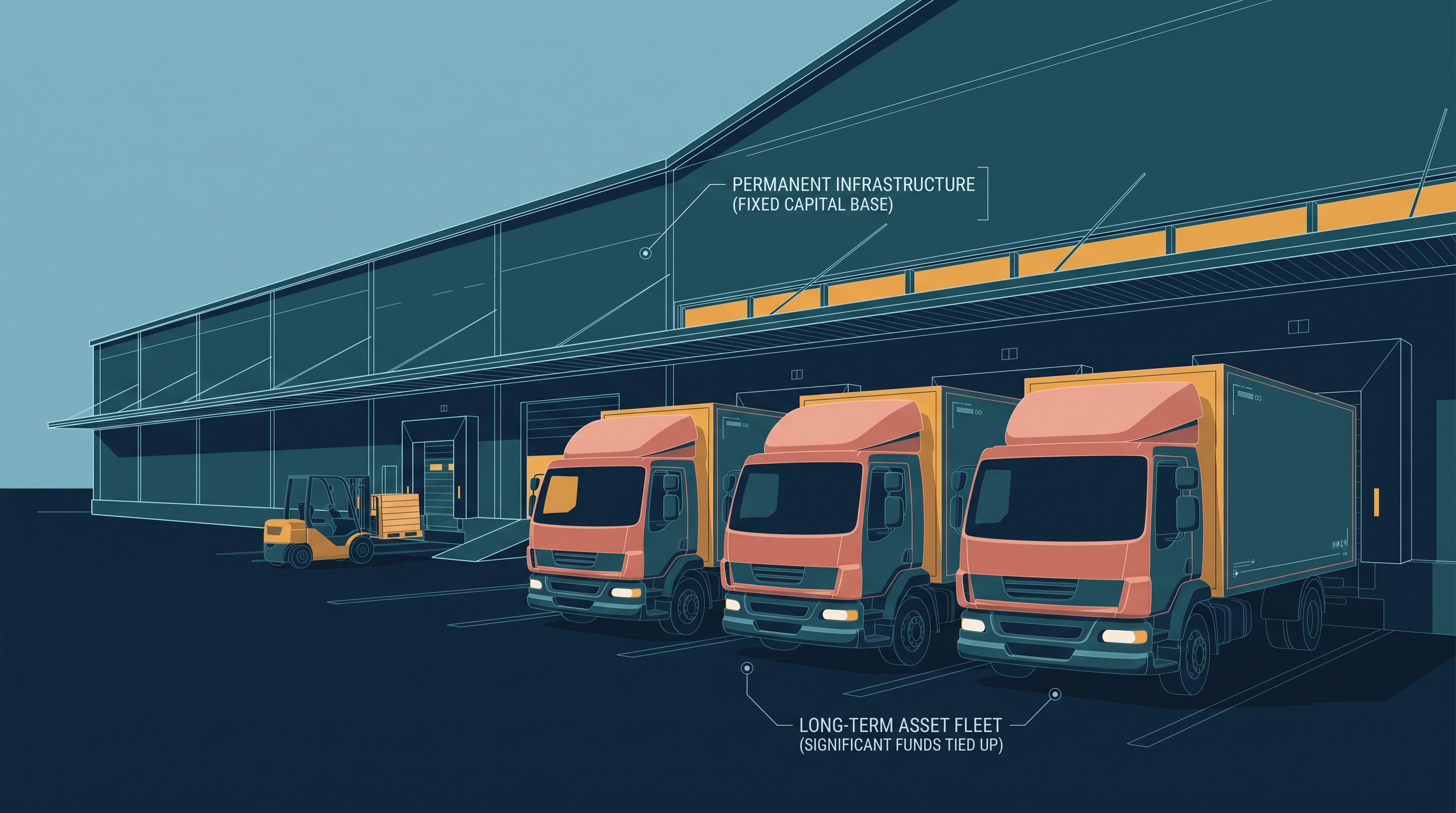
Fig. 9.5 – Fixed assets of a business.
9.7.2 Factors Affecting the Requirement of Fixed Capital
Nature of business — the type of business has a bearing upon the fixed capital requirement. For example, a trading concern needs a lower investment in fixed assets compared with a manufacturing organisation, since it does not require to purchase plant and machinery.
Scale of operations — a larger organisation operating at a higher scale needs a bigger plant and more space, and therefore requires a higher investment in fixed assets when compared with a small organisation.
Choice of technique — some organisations are capital intensive whereas others are labour intensive. A capital-intensive organisation requires a higher investment in plant and machinery as it relies less on manual labour, and the requirement of fixed capital for such organisations would be higher. Labour intensive organisations, on the other hand, require less investment in fixed assets, and hence their fixed capital requirement is lower.
Technology upgradation — in certain industries assets become obsolete sooner, and consequently their replacements become due faster. A higher investment in fixed assets may therefore be required in such cases. For example, computers become obsolete faster and are replaced much sooner than, say, furniture. Organisations which use assets that are prone to obsolescence require higher fixed capital to purchase such assets.
Growth prospects — higher growth of an organisation generally requires a higher investment in fixed assets. Even when such growth is only expected, a company may choose to create higher capacity in order to meet the anticipated higher demand quicker. This entails a larger investment in fixed assets and consequently a larger fixed capital.
Diversification — a firm may choose to diversify its operations for various reasons, and with diversification the fixed capital requirement increases. For example, if a textile company is diversifying and starting a cement manufacturing plant, its investment in fixed capital will obviously increase.
Financing alternatives — a developed financial market may provide leasing facilities as an alternative to outright purchase. When an asset is taken on lease, the firm pays lease rentals and uses it, and by doing so it avoids the huge sums required to purchase it. The availability of leasing facilities may thus reduce the funds required to be invested in fixed assets, thereby reducing the fixed capital requirement. Such a strategy is specially suitable in high risk lines of business.
Level of collaboration — at times certain business organisations share each other’s facilities. For example, a bank may use another bank’s ATM, or some of them may jointly establish a particular facility. This is feasible if the scale of operations of each one of them is not sufficient to make full use of the facility. Such collaboration reduces the level of investment in fixed assets for each one of the participating organisations.
9.8 Working Capital
Apart from the investment in fixed assets, every business organisation needs to invest in current assets. This investment facilitates the smooth day-to-day operations of the business. A factory cannot run on machinery alone; it also needs material in store, cash to pay wages, and the patience to wait while customers settle their bills.
Current assets are usually more liquid than fixed assets but contribute less to the profits of the business. Examples of current assets, in the order of their liquidity, are as follows.
Cash in hand and cash at bank
Marketable securities
Bills receivable
Debtors
Finished goods inventory
Work in progress
Raw materials
Prepaid expenses
These assets are expected to get converted into cash or cash equivalents within a period of one year, and they provide liquidity to the business. An asset is more liquid if it can be converted into cash quicker and without a reduction in its value.
Insufficient investment in current assets may make it more difficult for an organisation to meet its payment obligations. These assets, however, provide little or low return, since cash lying in a bank account and stock lying in a godown earn almost nothing by themselves. Hence a balance needs to be struck between liquidity and profitability.
Current liabilities are those payment obligations which are due for payment within one year, such as bills payable, creditors, outstanding expenses and advances received from customers.
Some part of the current assets is usually financed through short-term sources, that is, through current liabilities. The rest is financed through long-term sources, and this part is called net working capital. Thus NWC = CA – CL, that is, net working capital equals current assets minus current liabilities. Net working capital may therefore be defined as the excess of current assets over current liabilities.
9.8.1 Factors Affecting the Working Capital Requirements
Nature of business — the basic nature of a business influences the amount of working capital required. A trading organisation usually needs a smaller amount of working capital compared to a manufacturing organisation, because there is usually no processing and therefore no distinction between raw materials and finished goods. Sales can be effected immediately upon the receipt of materials, and sometimes even before that. In a manufacturing business, however, raw material needs to be converted into finished goods before any sale becomes possible. Other factors remaining the same, a trading business therefore requires less working capital. Similarly, service industries, which usually do not have to maintain inventory, require less working capital.
Scale of operations — for organisations which operate on a higher scale of operation, the quantum of inventory and debtors required is generally high. Such organisations therefore require a large amount of working capital as compared to organisations which operate on a lower scale.
Business cycle — different phases of business cycles affect the requirement of working capital by a firm. In the case of a boom, sales as well as production are likely to be larger and therefore a larger amount of working capital is required. As against this, the requirement for working capital will be lower during a period of depression, as sales as well as production will be small.
Seasonal factors — most businesses have some seasonality in their operations. In the peak season, because of the higher level of activity, a larger amount of working capital is required. As against this, the level of activity as well as the requirement for working capital will be lower during the lean season.
Production cycle — the production cycle is the time span between the receipt of raw material and its conversion into finished goods. Some businesses have a longer production cycle while some have a shorter one. The duration and the length of the production cycle affects the amount of funds required for raw materials and expenses. Consequently, the working capital requirement is higher in firms with a longer processing cycle and lower in firms with a shorter processing cycle.
Credit allowed — different firms allow different credit terms to their customers. These depend upon the level of competition that a firm faces as well as the credit worthiness of its clientele. A liberal credit policy results in a higher amount of debtors, increasing the requirement of working capital.
Credit availed — just as a firm allows credit to its customers, it may also get credit from its suppliers. To the extent it avails of credit on purchases, the working capital requirement is reduced, since the firm is using its suppliers’ money for that period.
Operating efficiency — firms manage their operations with varied degrees of efficiency. For example, a firm managing its raw materials efficiently may be able to manage with a smaller balance, which is reflected in a higher inventory turnover ratio. Similarly, a better debtors turnover ratio may be achieved by reducing the amount tied up in receivables, and a better sales effort may reduce the average time for which finished goods inventory is held. Such efficiencies may reduce the level of raw materials, finished goods and debtors, resulting in a lower requirement of working capital.
Availability of raw material — if the raw materials and other required materials are available freely and continuously, lower stock levels may suffice. If, however, raw materials do not have a record of uninterrupted availability, higher stock levels may be required. In addition, the time lag between the placement of an order and the actual receipt of the materials, also called lead time, is relevant. The larger the lead time, the larger the quantity of material to be stored and the larger shall be the amount of working capital required.
Growth prospects — if the growth potential of a concern is perceived to be higher, it will require a larger amount of working capital, so that it is able to meet higher production and sales targets whenever required.
Level of competition — a higher level of competitiveness may necessitate larger stocks of finished goods, in order to meet urgent orders from customers. This increases the working capital requirement. Competition may also force the firm to extend the liberal credit terms discussed earlier.
Inflation — with rising prices, larger amounts are required even to maintain a constant volume of production and sales. The working capital requirement of a business thus becomes higher with a higher rate of inflation. It must, however, be noted that an inflation rate of 5 per cent does not mean that every component of working capital will change by the same percentage. The actual requirement shall depend upon the rates of price change of the different components, such as raw material, finished goods and labour cost, as well as their proportion in the total requirement.
9.9 Summary
Business finance — the money required for carrying out business activities is called business finance. Almost all business activities require some finance. Finance is needed to establish a business, to run it, to modernise it, to expand it and to diversify it.
Financial management — financial management is concerned with the optimal procurement as well as the optimal usage of finance. For optimal procurement, the different available sources of finance are identified and compared in terms of their costs and associated risks, and the finance so procured is then invested so that the returns exceed the cost.
Objectives — the primary aim of financial management is to maximise shareholders’ wealth, which is referred to as the wealth maximisation concept. The market price of a company’s shares is linked to the three basic financial decisions.
Financial decisions — financial decision-making is concerned with three broad decisions, namely the investment decision, the financing decision and the dividend decision.
Financial planning — financial planning is essentially the preparation of a financial blueprint of an organisation’s future operations. Its objective is to ensure that enough funds are available at the right time.
Objectives of financial planning — financial planning strives to achieve two objectives: to ensure the availability of funds whenever these are required, and to see that the firm does not raise resources unnecessarily.
Importance of financial planning — financial planning is an important part of the overall planning of any business enterprise. It aims at enabling the company to tackle the uncertainty in respect of the availability and timing of funds, and it helps in the smooth functioning of an organisation.
Capital structure — one of the important decisions under financial management relates to the financing pattern, that is, the proportion in which different sources are used in raising funds. On the basis of ownership, the sources of business finance are broadly classified into ‘owners’ funds’ and ‘borrowed funds’. Capital structure refers to the mix between owners’ funds and borrowed funds.
Factors affecting capital structure — deciding about the capital structure of a firm involves determining the relative proportion of various types of funds. This depends on cash flow position, interest coverage ratio, debt service coverage ratio, return on investment, cost of debt, tax rate, cost of equity, floatation costs, risk consideration, flexibility, control, regulatory framework, stock market conditions, and the capital structure of other companies.
Fixed capital — fixed capital refers to investment in long-term assets. Its management involves the allocation of the firm’s capital to different projects or assets with long-term implications for the business. These decisions are called investment decisions or capital budgeting decisions, and they affect the growth, profitability and risk of the business in the long run.
Factors affecting fixed capital — the requirement of fixed capital is affected by the nature of business, scale of operations, choice of technique, technology upgradation, growth prospects, diversification, financing alternatives and level of collaboration.
Working capital — apart from the investment in fixed assets, every business organisation needs to invest in current assets. This investment facilitates the smooth day-to-day operations of the organisation. Current assets are usually more liquid but contribute less to the profits than fixed assets.
Factors affecting working capital — the requirement of working capital is affected by the nature of business, scale of operations, business cycle, seasonal factors, production cycle, credit allowed, credit availed, operating efficiency, availability of raw material, growth prospects, level of competition, and the rate of inflation.
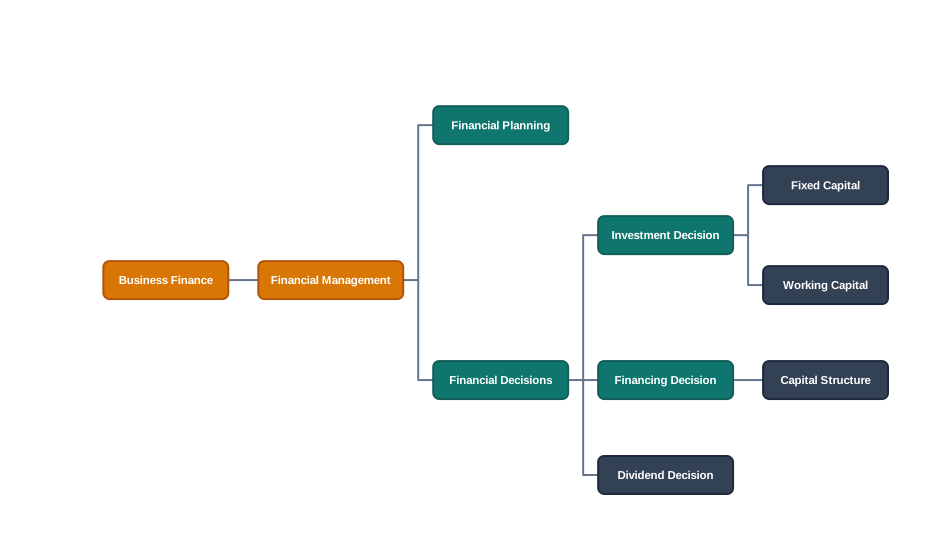
Fig. 9.6 – How the chapter fits together.
9.10 Key Terms
Business Finance The money required for carrying out business activities, from establishing a business to running, modernising, expanding and diversifying it.
Financial Management The management function concerned with the optimal procurement of finance and its optimal usage in the business.
Wealth Maximisation The objective of increasing the market value of the equity shares of a company, and thereby the wealth of its shareholders.
Investment Decision The decision relating to how the funds of a firm are invested in different assets, long-term as well as short-term.
Capital Budgeting Decision A long-term investment decision committing the finance of a firm to fixed assets or projects whose benefits arise over several years.
Financing Decision The decision about the quantum of finance to be raised from various long-term sources, and the proportion in which each is used.
Financial Risk The chance that a firm would fail to meet its payment obligations of interest, preference dividend and repayment of principal when they fall due.
Floatation Cost The cost incurred by a firm in the process of raising funds from a particular source.
Dividend That portion of the profit of a company which is distributed to its shareholders.
Dividend Decision The decision about how much of the profit earned, after tax, is to be distributed to shareholders and how much is to be retained in the business.
Financial Planning The process of estimating the fund requirement of a business and specifying the sources of those funds, in the form of a blueprint of future operations.
Budget A short-term financial plan containing a detailed plan of action for a period of one year or less.
Capital Structure The mix between owners’ funds and borrowed funds used by a business to finance its assets and operations.
Debt-Equity Ratio The ratio of the debt of a firm to its equity, used to express its capital structure.
Financial Leverage The proportion of debt in the overall capital of a firm, computed as D ÷ E or D ÷ (D + E).
Trading On Equity The increase in profit earned by the equity shareholders due to the presence of fixed financial charges like interest.
Optimum Capital Structure That debt-equity mix which gives the risk-return combination maximising the wealth of the shareholders.
Fixed Assets Assets which remain in the business for more than one year, such as land, buildings, plant and machinery and vehicles.
Fixed Capital The investment of a firm in long-term assets, financed through long-term sources of capital.
Current Assets Assets which, in the normal routine of the business, get converted into cash or cash equivalents within one year.
Current Liabilities Payment obligations of a business which are due for payment within one year.
Working Capital The investment of a firm in its current assets, which supports the day-to-day operations of the business.
Net Working Capital The excess of current assets over current liabilities, that is, the part of current assets financed through long-term sources.
9.11 NCERT Questions
Very Short Answer Type
- What is meant by capital structure?
- State the two objectives of financial planning.
- Name the concept of financial management which increases the return to equity shareholders due to the presence of fixed financial charges.
- Amrit is running a ‘transport service’ and earning good returns by providing this service to industries. Giving reason, state whether the working capital requirement of the firm will be ‘less’ or ‘more’.
- Ramnath is into the business of assembling and selling of televisions. Recently he has adopted a new policy of purchasing the components on three months credit and selling the complete product in cash. Will it affect the requirement of working capital? Give reason in support of your answer.
Short Answer Type
- What is financial risk? Why does it arise?
- Define current assets. Give four examples of such assets.
- What are the main objectives of financial management? Briefly explain.
- Financial management is based on three broad financial decisions. What are these?
- Sunrises Ltd., dealing in readymade garments, is planning to expand its business operations in order to cater to the international market. For this purpose the company needs an additional Rs. 80,00,000 for replacing machines with modern machinery of higher production capacity. The company wishes to raise the required funds by issuing debentures. The debt can be issued at an estimated cost of 10 per cent. The EBIT for the previous year of the company was Rs. 8,00,000 and total capital investment was Rs. 1,00,00,000. Suggest whether the issue of debentures would be considered a rational decision by the company. Give reason to justify your answer.
- How does working capital affect both the liquidity as well as the profitability of a business?
- Aval Ltd. is engaged in the business of export of canvas goods and bags. In the past, the performance of the company had been up to expectations. In line with the latest demand in the market, the company decided to venture into leather goods, for which it required specialised machinery. For this, the Finance Manager Prabhu prepared a financial blueprint of the organisation’s future operations to estimate the amount of funds required and the timings, with the objective of ensuring that enough funds are available at the right time. He also collected the relevant data about the profit estimates in the coming years. By doing this, he wanted to be sure about the availability of funds from the internal sources of the business. For the remaining funds, he is trying to find out alternative sources from outside.
- Identify the financial concept discussed in the above paragraph. Also state the objectives to be achieved by the use of the financial concept so identified.
- ‘There is no restriction on payment of dividend by a company.’ Comment.
Long Answer Type
- What is working capital? Discuss five important determinants of working capital requirement.
- ‘Capital structure decision is essentially optimisation of risk-return relationship.’ Comment.
- ‘A capital budgeting decision is capable of changing the financial fortunes of a business.’ Do you agree? Give reasons for your answer.
- Explain the factors affecting the dividend decision.
- Explain the term ‘Trading on Equity’. Why, when and how can it be used by a company?
- ‘S’ Limited is manufacturing steel at its plant in India. It is enjoying a buoyant demand for its products, as economic growth is about 7–8 per cent and the demand for steel is growing. It is planning to set up a new steel plant to cash in on the increased demand. It is estimated that it will require about Rs. 5000 crores to set up and about Rs. 500 crores of working capital to start the new plant.
- Describe the role and objectives of financial management for this company.
- Explain the importance of having a financial plan for this company. Give an imaginary plan to support your answer.
- What are the factors which will affect the capital structure of this company?
- Keeping in mind that it is a highly capital-intensive sector, what factors will affect the fixed and working capital? Give reasons in support of your answer.
9.12 Check Your Concepts
- Why is debt considered cheaper than equity, even though its use increases the risk carried by a business?
- Distinguish between fixed capital and working capital on any four bases.
- Distinguish between financial planning and financial management on any three bases.
- What happens to the earnings per share of a company that borrows heavily when its return on investment falls below the rate of interest on that debt? Explain the reason.
- Why should fixed assets never be financed through short-term sources of funds?
- Arrange the following steps of the financial planning process in the correct sequence: estimating the requirement for external funds; preparing the sales forecast; preparing cash budgets; estimating the requirement of fixed capital and working capital; identifying the sources of external funds.
- Identify the term: the cost incurred by a company in the process of raising funds from a particular source.
- Assertion: A company earning a high profit may still be unable to declare a dividend. Reason: The payment of dividend involves an outflow of cash, and profit and cash are not the same thing. Choose the correct option.
- Both assertion and reason are true, and the reason is the correct explanation of the assertion.
- Both assertion and reason are true, but the reason is not the correct explanation of the assertion.
- The assertion is true but the reason is false.
- The assertion is false but the reason is true.
- Why does a trading concern generally require less fixed capital as well as less working capital than a manufacturing concern?
- Match the following factors with the decision they primarily affect:
| Column A | Column B |
|---|---|
| a. lead time in receiving raw material | i. capital budgeting decision |
| b. floatation cost of a public issue | ii. financing decision |
| c. stability of earnings | iii. dividend decision |
| d. irreversibility of the outlay | iv. working capital requirement |
- Why does an increase in the use of debt beyond a certain level cause the share price to fall in spite of a rise in earnings per share?
- What happens to the working capital requirement of a firm during a period of rising prices, and why does it not rise in the same proportion for every component of working capital?
9.13 Case-Based Questions
- Tanmay Instruments Ltd. manufactures precision measuring devices. Its machines become outdated within four years and have to be replaced. The company is planning to double its capacity in anticipation of higher demand, and is also considering taking its testing equipment on lease instead of buying it outright.
- Identify any three factors affecting the requirement of fixed capital that are at work in this situation.
- Explain how the leasing option would affect the company’s fixed capital requirement.
- Harith Foods Ltd. earns a return of 9 per cent on the funds it employs. It has approached a bank for a term loan carrying interest at 12 per cent, in order to finance a new packaging unit. The company has high fixed operating costs and its earnings vary sharply from year to year.
- State, with reason, whether the company should raise the funds through the term loan.
- Name and explain any two other factors affecting the choice of capital structure that support your answer.
- Sneh Handlooms Ltd. buys yarn once every six months because supplies are irregular, keeps a large stock of finished cloth to meet urgent orders from competing dealers, and allows its dealers four months to pay. Its production process takes almost three months from yarn to finished cloth.
- Identify any four factors affecting the working capital requirement that are visible in this case.
- State whether the working capital requirement of this company will be high or low, and give one reason.