Chapter 1: Human Geography: Nature And Scope
For as long as anyone remembered, the people of the ridge had read the mountain the way others read a face. They knew which slope loosened after three days of rain, which spring dried in May, which stand of trees held the soil in place. They built low, cut little, and moved when the ground told them to. They feared the mountain, and in fearing it they survived it.
Then the road came, and with it everything a road brings. Slopes were sliced for houses that clung to the cut like shelves. Concrete replaced the old trees. Rooms stayed warm through winters that once drove families to a single hearth; fruit arrived in trucks from the warm plains far below. Comfort had been wrestled from a hard place, and it felt like freedom.
One August night the rain did not stop. By morning a length of hillside — homes, road and all — had slid into the valley below. Was this the mountain’s fury, or the bill for a warning ignored? The old families had read the slope and obeyed it. The new town had read only its own plans.
Geography asks which reading was right — and whether there is a third way, between obeying nature and defying it.
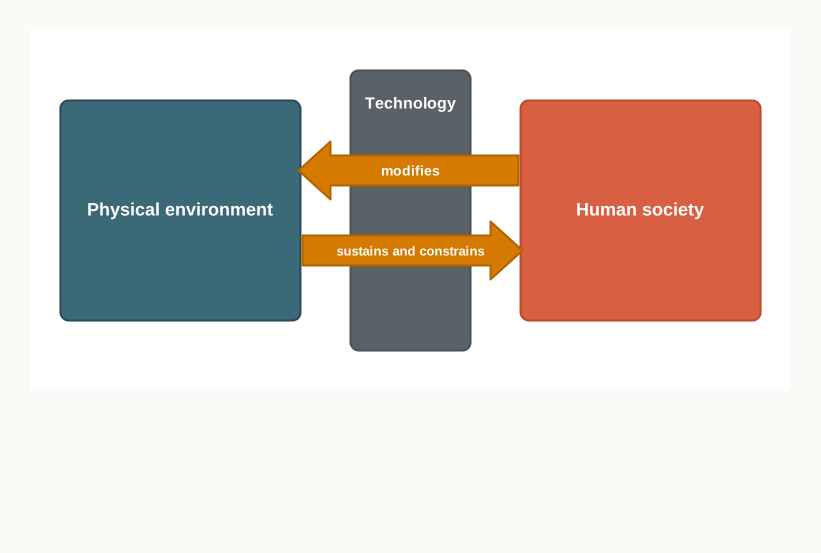
Fig. 1.0 – The two-way interaction between nature and human society.
1.1 Geography, Nature And Human Beings
You met geography once before, in Class 11, where you studied it as a single discipline that treats the earth as the home of human beings. Human geography is one of its two great branches. It grows from the same root as the rest of geography and keeps the parent’s habits of mind. Geography is integrative, pulling many kinds of evidence together; it is empirical, resting on what can be observed; and it is practical, meant to be used. Because its reach is this wide, almost any event or phenomenon that varies across space and time can be studied geographically.
The other branch is physical geography, which studies the physical environment — landforms, soils, climate, water, natural vegetation and wildlife. Human geography studies something different: people, and the works of people, spread across that same environment.
Two Halves Of One Earth
Look closely at the earth’s surface and you will find it made of two things woven together. One is nature, the physical environment. The other is life, including human beings and everything they build and do. Try listing the physical and the human components of your own surroundings — the hills and the streets, the weather and the buildings — and the two categories appear at once. Physical geography takes the first; human geography takes the second.
More precisely, human geography studies the relationship between the physical or natural world and the human world. It asks where human activity is distributed, how those patterns came about, and why different parts of the world differ so much in their social and economic life. This definition comes from the geographers Agnew, Livingstone and Rogers. Behind it lies the core concern of all geography: to understand the earth as the home of human beings, and to study every element that has sustained them.
The Old Debates
Because geography stands with one foot in nature and one in human life, scholars argued for a long time about what kind of subject it really is. These arguments are its dualism — a habit of splitting the discipline into opposed pairs.
Should geography be nomothetic, a law-making subject that searches for general theories, the way physics does? Or should it be idiographic, a describing subject that captures what is unique about each place? A nomothetic study looks for rules that hold everywhere; an idiographic one records what makes a single place unlike any other. Then a second pair: should the subject be organised regionally, studying one area completely with all its features at once, or systematically, following a single theme — population, say, or industry — across many places? And a third: should geographical phenomena be read through theory, or through history and institutions?
These were genuine debates, and the chapter settles them plainly. The dichotomy between physical and human geography is not a very useful one. Nature and human life are inseparable elements of a single system, and geography understands them best when it holds them together rather than apart. That holistic view is the ground the rest of this chapter stands on.
Nature And Human, Intertwined
How closely are the two braided together? Closely enough that our very language reaches for the human body to describe the earth. We speak of the ‘face’ of the earth, the ‘eye’ of a storm, the ‘mouth’ of a river, the ‘snout’ or nose of a glacier, the ‘neck’ of an isthmus and the ‘profile’ of a soil. Regions, villages and towns are called ‘organisms’; German geographers described the state or country as a ‘living organism’; and roads, railways and waterways are called the ‘arteries of circulation’. You might collect such expressions from your own language too. When our words for the land are the words for the body, a fair question follows: can nature and human really be separated when they are this intertwined?
How Human Geography Has Been Defined
Geographers have answered that question in different ways, and their definitions repay holding side by side, because each stresses a different truth.
Ratzel called human geography ‘the synthetic study of relationship between human societies and earth’s surface’. The keyword here is synthesis — the pulling of many strands into one account.
Ellen C. Semple defined it as ‘the study of the changing relationship between the unresting man and the unstable earth’. Her keyword is dynamism: neither the earth nor the people upon it ever stand still.
Paul Vidal de la Blache described it as a ‘conception resulting from a more synthetic knowledge of the physical laws governing our earth and of the relations between the living beings which inhabit it’. His definition offers a new conception of the interrelationships between the earth and human beings.
1.2 Nature Of Human Geography
Human geography studies the inter-relationship between two environments: the physical environment given by nature, and the socio-cultural environment that human beings create. Neither stands alone. The two act on each other without pause, through mutual interaction, and it is that interaction — not either side by itself — that human geography sets out to explain.
You already know the elements of the physical environment from Class 11: landforms, soils, climate, water, natural vegetation and the wide variety of flora and fauna. Now list the things human beings have made on the stage this environment provides — houses, villages, cities, road and rail networks, industries, farms, ports, and the countless items of daily use. All of these together are our material culture, built from resources drawn from the physical environment. And the traffic runs both ways: humans have greatly modified the physical environment, and the modified environment has, in turn, shaped human lives.
1.2.1 Naturalisation Of Humans And Humanisation Of Nature
Technology, The Bridge
Human beings meet their physical environment through a tool-kit: technology. What matters is not so much what people produce, but the tools and techniques with which they produce it. Technology is a measure of a society’s cultural development — the further its understanding reaches, the more it can do.
Crucially, technology follows knowledge of nature, not the other way round. Human beings could build tools only after they grasped natural laws. Understanding friction and heat let us make fire. Reading the secrets of DNA and genetics let us defeat many diseases. Mastering the laws of aerodynamics let us fly faster. Each advance in understanding nature loosened nature’s grip a little more.
When Nature Ruled
In the earliest stage of this relationship, nature held the upper hand. Technology was weak and social development was simple, so human beings bent to the dictates of nature and adapted to whatever it demanded. This condition — a small, low-technology society facing the strong forces of nature — is called environmental determinism: the idea that the natural environment largely determines how people live. The human being of this stage was a naturalised human, one who listened to nature, feared its fury, and worshipped it.
Benda’s story shows the direct relationship between an economically simple society and nature. Read about other such societies and you find the same pattern everywhere: nature is a powerful presence, worshipped, revered and conserved. These communities depend directly on nature for the resources that sustain them, and for them the physical environment becomes ‘Mother Nature’.
When Humans Reshaped Nature
With the passage of time, people begin to understand their environment and the forces at work in it. As society and culture develop, they build better and more efficient technology. Slowly they move from a state of necessity, where nature dictates, to a state of freedom, where they can choose. They begin to create possibilities out of the resources around them.
The mark of this new power is the cultural landscape — the landscape as reshaped by human activity. Its imprints are everywhere: health resorts on the highlands, vast urban sprawls, fields, orchards and pastures across the plains and rolling hills, ports along the coasts, shipping routes across the oceans, and satellites out in space. Earlier scholars called this outlook possibilism: nature offers opportunities, and human beings take them up, so that nature is slowly humanised and comes to bear the imprints of human effort.
What made Kari’s life possible is technology, which let the people of Trondheim overcome the constraints nature imposed on them. Such examples are not hard to find, and each one shows the same thing: with the right tools, a hostile environment can be turned into a comfortable one.
The Middle Path
Between the two extremes stands a third idea. The geographer Griffith Taylor proposed a middle path — a Madhyam Marg — between environmental determinism and possibilism. He called it neodeterminism, or stop and go determinism. The name borrows the logic of a traffic signal: red means stop, amber gives a gap to get set, and green means go. Neither is there absolute necessity, as determinism claims, nor absolute freedom, as possibilism claims.
The lesson is that human beings can conquer nature only by obeying it. They must respond to the red signals, and may go ahead with development when nature permits the change. Possibilities can be created, but only within limits that do not damage the environment; there is no free run without accidents.
The proof of this is written across the modern world. The ‘free run’ that developed economies attempted — modification without limit — set off a chain of damage: the greenhouse effect, depletion of the ozone layer, global warming, receding glaciers and degrading land. Push nature past its limits and it answers back. Neodeterminism tries to hold the balance, dissolving the either/or choice between total control and total surrender.
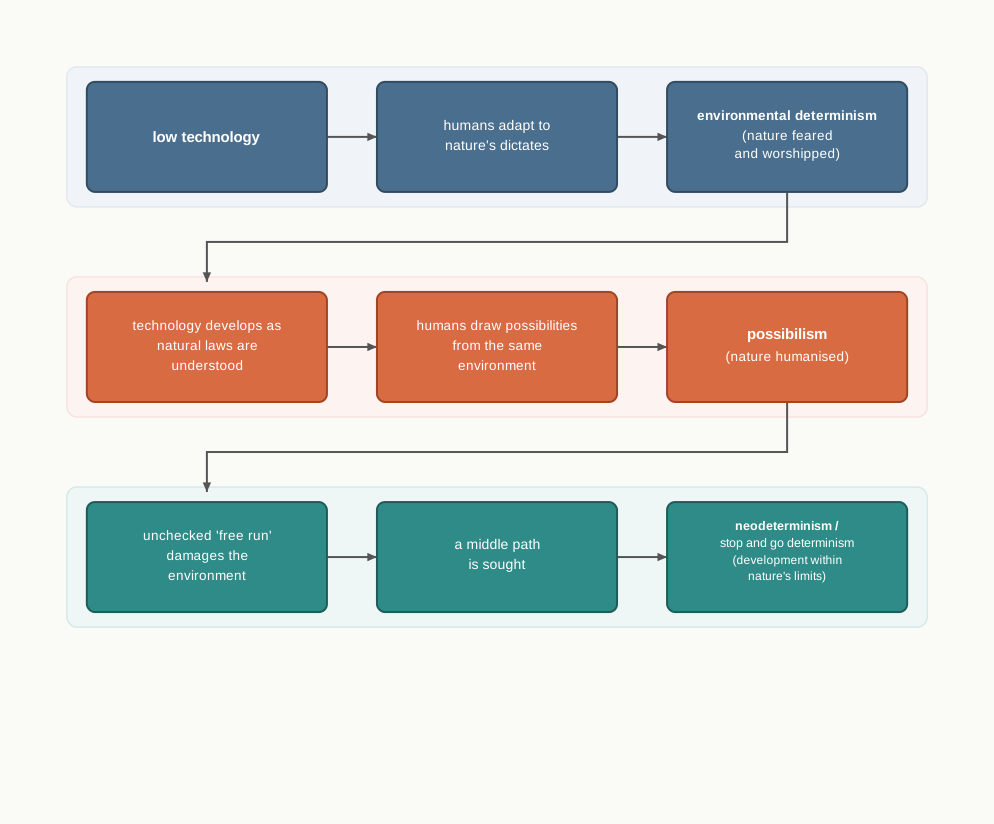
Fig. 1.1 – Shifting balance between nature and human society.
1.2.2 Fields And Sub-fields Of Human Geography
How The Discipline Grew
Human geography did not always look as it does now; its approach changed as the world and its questions changed. In the early colonial period, imperial and trade interests drove the exploration of new lands, and geographers wrote encyclopaedic descriptions of the areas they found. In the later colonial period the focus shifted to regional analysis, describing every aspect of a region on the belief that understanding the parts in full would reveal the whole.
Between the 1930s and the inter-War years came areal differentiation, which asked what made each region unique and different from others. From the late 1950s to the late 1960s, geographers turned to spatial organisation, using computers and statistics and even borrowing the laws of physics to find mappable patterns in human activity — a phase known as the quantitative revolution. In the 1970s, unhappiness with the cold, dehumanised feel of that approach gave rise to three new schools of thought, which tied geography back to social and political reality. By the 1990s, post-modernism questioned grand universal theories and insisted that each local context be understood in its own right. Table 1.1 sets out these stages together.
The Fields Today
Because human geography explains the relationship between every element of human life and the space it occupies, it naturally reaches into other subjects. It is highly inter-disciplinary, keeping a close interface with the sister disciplines of the social sciences to understand the human presence on the earth. As knowledge expands, new sub-fields keep branching off. Table 1.2 lays out the main fields, their sub-fields, and the social-science partner each one leans on — read across any row to see which outside discipline a field draws from.
These fields show how far human geography now reaches — from the health of a population to the pattern of its elections, from the wealth beneath the ground to the routes of world trade. Yet every one of them returns to the single question the chapter began with: how do human beings and their environment shape each other across space?
1.3 Summary
Geography treats the earth as the home of human beings. Human geography is the branch that studies the relationship between the physical or natural world and the human world — where human activity is spread, how those patterns arose, and why parts of the world differ in their social and economic life.
Geographers long argued over the discipline’s dualisms: nomothetic (law-making) versus idiographic (describing), regional versus systematic, theory versus history. In the end the split between physical and human geography proves unhelpful, because nature and human life are inseparable and are best seen whole.
Human geography studies the mutual interaction of the physical environment and the socio-cultural environment. Human beings build their material culture from nature’s resources and modify the environment, which in turn shapes them.
Technology mediates this interaction. It measures a society’s cultural development and follows from understanding natural laws — friction and heat gave fire, genetics defeated diseases, aerodynamics gave flight.
Under environmental determinism, when technology is weak, nature dictates the terms; the naturalised human listens to nature, fears its fury and worships it.
Under possibilism, as technology grows, people move from a state of necessity to a state of freedom, create possibilities, and humanise nature, leaving their imprints as the cultural landscape.
Neodeterminism, Griffith Taylor’s stop and go determinism, is the middle path: freedom to develop, but only within nature’s limits. The unchecked ‘free run’ of developed economies brought the greenhouse effect, ozone depletion, global warming, receding glaciers and degrading land.
The discipline’s approaches changed over time — exploration and description, regional analysis, areal differentiation, spatial organisation (the quantitative revolution), the humanistic, radical and behavioural schools of the 1970s, and post-modernism in the 1990s.
Human geography is highly inter-disciplinary. Its fields — social, urban, political, population, settlement and economic geography — branch into many sub-fields, each interfacing with a sister discipline of the social sciences.
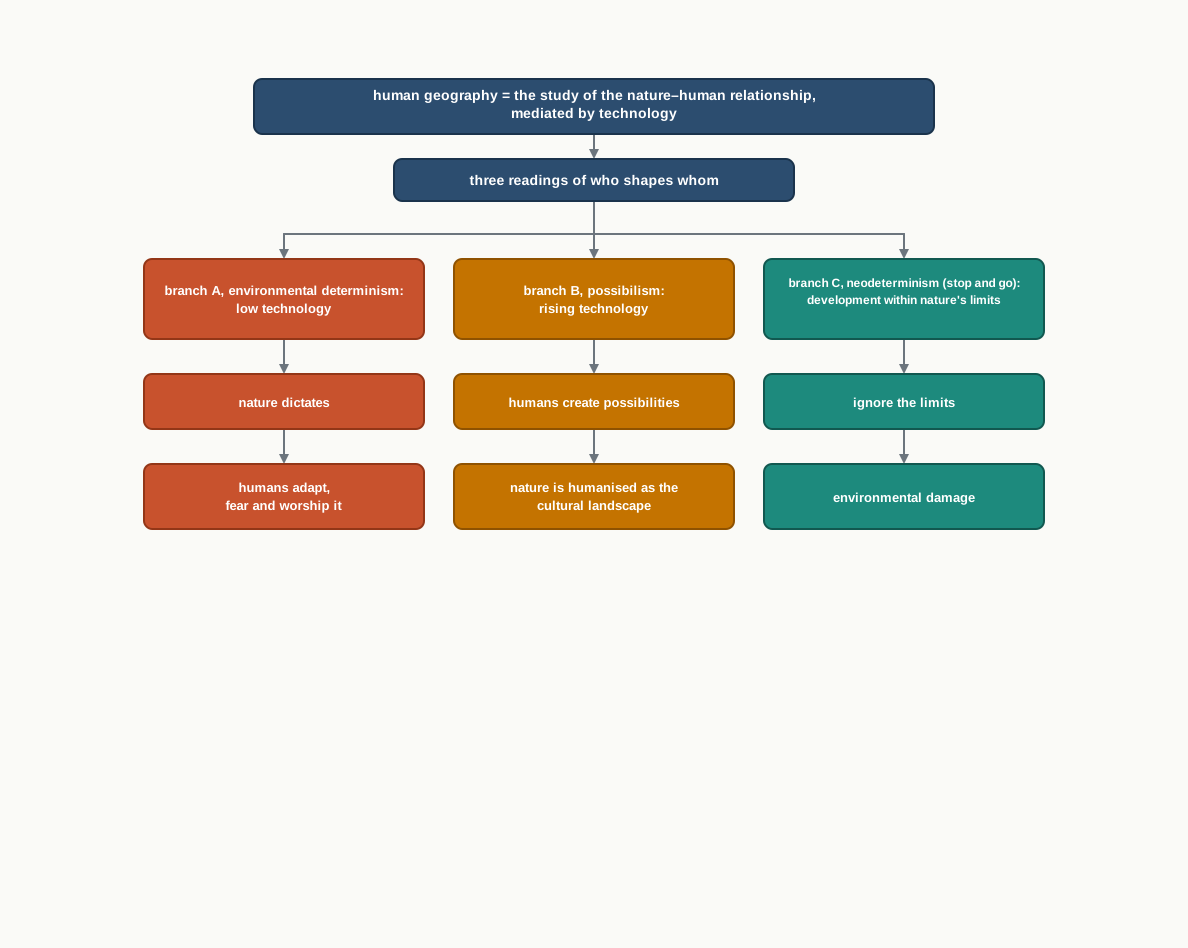
Fig. 1.2 – Three geographical readings of the nature–human relationship.
What This Chapter Cannot Tell You
The chapter offers frameworks, not measurements. Determinism, possibilism and neodeterminism are ways of seeing the nature–human relationship; they do not measure how much technology a given society holds, nor mark the exact point where safe modification turns into damage.
Its two life-stories, Benda’s and Kari’s, are illustrations chosen to make a contrast vivid — they are not survey data, and no single life stands for a whole society. Table 1.2 names the fields of human geography and the disciplines they draw on, but it does not tell you what any of those fields has actually found.
1.4 NCERT Questions
- Which one of the following statements does not describe geography?
- an integrative discipline
- study of the inter-relationship between humans and environment
- subjected to dualism
- not relevant in the present time due to the development of technology
- Which one of the following is not a source of geographical information?
- traveller’s accounts
- old maps
- samples of rock materials from the moon
- ancient epics
- Which one of the following is the most important factor in the interaction between people and environment?
- human intelligence
- people’s perception
- technology
- human brotherhood
- Which one of the following is not an approach in human geography?
- Areal differentiation
- Spatial organisation
- Quantitative revolution
- Exploration and description
- Define human geography. (about 30 words)
- Name some sub-fields of human geography. (about 30 words)
- How is human geography related to other social sciences? (about 30 words)
- Explain naturalisation of humans. (not more than 150 words)
- Write a note on the scope of human geography. (not more than 150 words)
1.5 Check Your Concepts
- The chapter shows two opposite ways of living with nature through Benda and Kari. Explain what ‘humanisation of nature’ means, and how it differs from the naturalisation of humans.
- What is neodeterminism, and why did Griffith Taylor compare it to a traffic signal?
- The chapter warns that ‘there is no free run without accidents.’ List the environmental consequences it links to the unchecked free run of the developed economies.
- The chapter says technology follows a knowledge of nature. Using the chapter’s own examples, explain how understanding natural laws led to new technology.
- Using Table 1.1, arrange these approaches in the order they appeared: spatial organisation, exploration and description, areal differentiation, regional analysis. Which one is known as the quantitative revolution?
- Geographers say the split between physical and human geography is ‘not a very valid one’. Give the chapter’s reason for this view.
- Using Table 1.2, name the sister discipline that each of these interfaces with: Electoral Geography, Medical Geography, and Gender Geography.
- The 1970s saw three new schools of thought emerge in human geography. Briefly distinguish the welfare, radical and behavioural schools.