Chapter 5: Secondary Activities
Walk into any shop and pick up the first thing your hand lands on — a pen, a comb, a cup. Each began as something almost worthless: dug from the ground, cut from a forest, or grown in a field. On its own, none of it could do much. Then it passed through a factory, and somewhere between the raw end and the shelf it gained value it did not have before. That gain is the whole business of secondary activity — taking what nature offers and transforming it into something worth more.
Now ask a harder question. That factory could have stood almost anywhere on Earth, yet it stands in exactly one place. Why there? Someone chose the spot, and not by accident. They weighed the cost of bringing raw material in against the cost of sending the product out. They looked for cheap power, willing workers, a road to the market, perhaps a government offer of land. Every factory you have ever seen is the answer to a sum in costs — and the world map of industry is that sum, worked out millions of times over.
So there are two puzzles here, not one: how a raw material becomes a product, and why the factory that makes it sits where it sits. This chapter is about both.
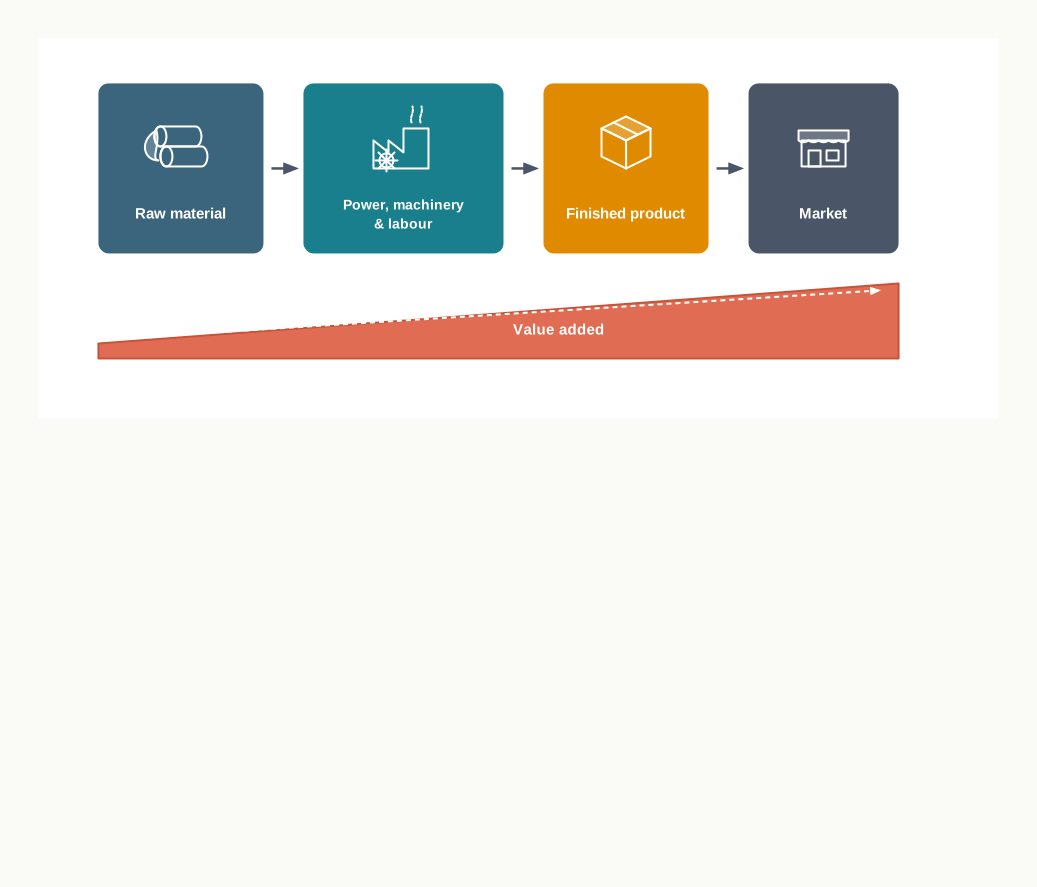
Fig. 5.0 – Value addition through manufacturing.
5.1 Manufacturing
All economic activity — whether primary (drawing resources straight from nature), secondary (processing them), tertiary (providing services) or quaternary (handling knowledge and information) — turns on the same task: obtaining and using the resources a society needs to survive.
Secondary activities are the ones that add value to natural resources by transforming raw materials into more valuable products. Cotton in the boll has little use on its own; spun into yarn it becomes worth more and can be made into clothes. Iron ore cannot be used straight from the mine; converted into steel it gains value and can be turned into machines and tools.
The same is true of most materials from the farm, the forest, the mine and the sea — the value is added by working on them. Secondary activities are therefore the ones concerned with manufacturing, processing and construction, that is, the infrastructure industries.
Manufacturing spans a full array of production, from handicrafts, to moulding iron and steel, to stamping out plastic toys, to assembling delicate computer components or space vehicles. Across all of these, three things are shared: the application of power, the mass production of identical products, and specialised labour working in factory settings to turn out standardised goods.
Manufacturing can run on modern power and machinery, or it can stay simple and largely hand-driven. In many developing economies — what the chapter calls the ‘Third World’ — a great deal of manufacturing is still ‘manufacture’ in the word’s literal sense, made by hand in small units. Because these countless small producers are hard to count in full, the discussion here leans on the more organised, ‘industrial’ kind of activity, which uses less complicated systems of production.
What Manufacturing Means
Manufacturing literally means ‘to make by hand’, but it now covers goods ‘made by machines’ as well. At its core it is a process that transforms raw materials into finished goods of higher value, for sale in local or distant markets.
An industry, more precisely, is a geographically located manufacturing unit that keeps books of accounts and records under a management system. Because the word industry is so broad, it is often used as a synonym for manufacturing: when we say ‘steel industry’ or ‘chemical industry’, we picture factories and processes.
But not every secondary activity happens in a factory. What we now call the ‘entertainment industry’ or the tourism industry uses the same word without any factory at all. To keep matters clear, the longer expression ‘manufacturing industry’ is used when the factory sense is meant.
5.1.1 Characteristics Of Modern Large Scale Manufacturing
Modern large scale manufacturing carries a set of features that mark it out from older, smaller ways of making things.
5.1.1.1 Specialisation Of Skills/Methods Of Production
Under the older ‘craft’ method, a factory produces only a few pieces, each made-to-order, so the cost of every piece is high. Mass production works the other way. It turns out large quantities of standardised parts, with each worker repeating a single task over and over.
The difference is one of range against volume. The craft method gives variety and made-to-order work at high unit cost; mass production gives sameness and huge volume at low unit cost. Both make goods, but they answer different demands.
5.1.1.2 Mechanisation
Mechanisation means using gadgets and machines to accomplish tasks that hands once did. Automation is the advanced stage of mechanisation: the manufacturing process runs without the aid of human thinking during production. Automatic factories, fitted with feedback and closed-loop computer control systems in which machines are built to ‘think’, have sprung up all over the world.
5.1.1.3 Technological Innovation
Technological innovation, pursued through a research and development strategy, is an important part of modern manufacturing. It matters for quality control, for eliminating waste and inefficiency, and for combating pollution.
5.1.1.4 Organisational Structure And Stratification
Modern manufacturing is marked by complex machine technology and by extreme specialisation and division of labour, so that more goods are produced with less effort and at low cost. To run at a large scale it also needs vast capital, large organisations, and an executive bureaucracy to hold it all together.
5.1.1.5 Uneven Geographic Distribution
The major concentrations of modern manufacturing have grown up in only a few places, together covering less than 10 per cent of the world’s land area. The nations holding them have become the centres of economic and political power.
Yet in terms of the ground they actually cover, manufacturing sites are far less conspicuous than farmland, and packed onto much smaller areas, because their processes run at much greater intensity. The same patch of land does far more work as a factory than as a farm.
The chapter makes this concrete with a single block of land in the American corn belt, and the numbers are worth working through carefully.
Manufacturing therefore packs far more work, and far more people, onto far less land than farming does, because its processes are so much more intense. That is why the world’s manufacturing can sit on less than a tenth of the land and still hold so large a share of its wealth and power: a factory’s footprint is small, but its output, employment and value are large. Note the scale, though — the figure is an average across one 2.5 sq km block, and it hides how tightly or loosely the actual buildings and workers are packed within it.
Where To Build
Having seen how concentrated industry is, the natural next question is why it settles where it does. The chapter puts that question directly to the reader.
Industries maximise profits by keeping costs down, so they should be built at the points where production costs are lowest. Several factors pull on that choice, and they are taken in turn below.
5.1.2 Access To Market
The existence of a market for its goods is the single most important factor in where an industry locates. A market here means people who both have a demand for the goods and have the purchasing power — the ability to pay — to buy them at a place.
Remote areas with few people offer only small markets. The developed regions of Europe, North America, Japan and Australia offer large global markets, because the purchasing power of their people is very high. The densely populated regions of South and South-east Asia also provide large markets. A few industries, such as aircraft manufacturing, and the arms industry, sell to a global market of their own.
5.1.3 Access To Raw Material
Raw material should be cheap and easy to transport. Industries that work on cheap, bulky and weight-losing material — material that sheds much of its weight during processing, such as ores — locate close to the source, so that they are not paying to haul away weight they will only throw off. Iron and steel, sugar and cement industries are of this kind.
Perishability pulls in the same direction. Where the raw material spoils quickly, the industry must sit close to it. Agro-processing plants and dairies, for this reason, are set up close to the sources of farm produce and milk supply respectively.
5.1.4 Access To Labour Supply
Labour supply is an important factor in the location of industries, and some kinds of manufacturing still require skilled labour. But increasing mechanisation, automation and flexibility in industrial processes have steadily reduced how far an industry depends on the number of workers it can find.
5.1.5 Access To Sources Of Energy
Industries that use a great deal of power tend to be located close to the source of energy supply; the aluminium industry, which is very power-hungry, is a clear example. Earlier, coal was the main source of energy. Today, hydroelectricity and petroleum are also important sources for many industries.
5.1.6 Access To Transportation And Communication Facilities
Speedy and efficient transport, to carry raw materials to the factory and to move finished goods to the market, is essential for industry to develop. The cost of transport plays an important part in where industrial units are placed. Western Europe and eastern North America, with their highly developed transport systems, have always drawn industries to cluster there.
Modern industry is inseparably tied to transportation. Improvements in transport have led to integrated economic development and to regional specialisation of manufacturing, as places begin to make what they are best placed to make. Communication is also an important need, for the exchange and management of information.
5.1.7 Government Policy
Governments adopt ‘regional policies’ to promote ‘balanced’ economic development. To spread industry more evenly, they deliberately set up industries in particular areas that might not otherwise have attracted them.
5.1.8 Access To Agglomeration Economies/Links Between Industries
Many industries benefit from being near a leader-industry and near other industries. These benefits are called agglomeration economies — the savings that come from the linkages that exist between different industries, such as one plant’s output feeding another’s input. All of these factors, market, raw material, labour, energy, transport, policy and linkages, operate together to settle where an industry finally stands.
Not every industry feels these pulls strongly. Footloose industries can be located in a wide variety of places, because they do not depend on any specific raw material, weight-losing or otherwise. They largely rely on component parts that can be obtained anywhere, produce in small quantity, and employ only a small labour force. They are generally not polluting, and the one factor that really matters to them is accessibility by a road network.
5.1.9 Classification Of Manufacturing Industries
Manufacturing industries can be sorted in four different ways at once — by their size, by their inputs or raw materials, by their output or product, and by their ownership. Fig. 5.1 lays out the full scheme as a branching tree.
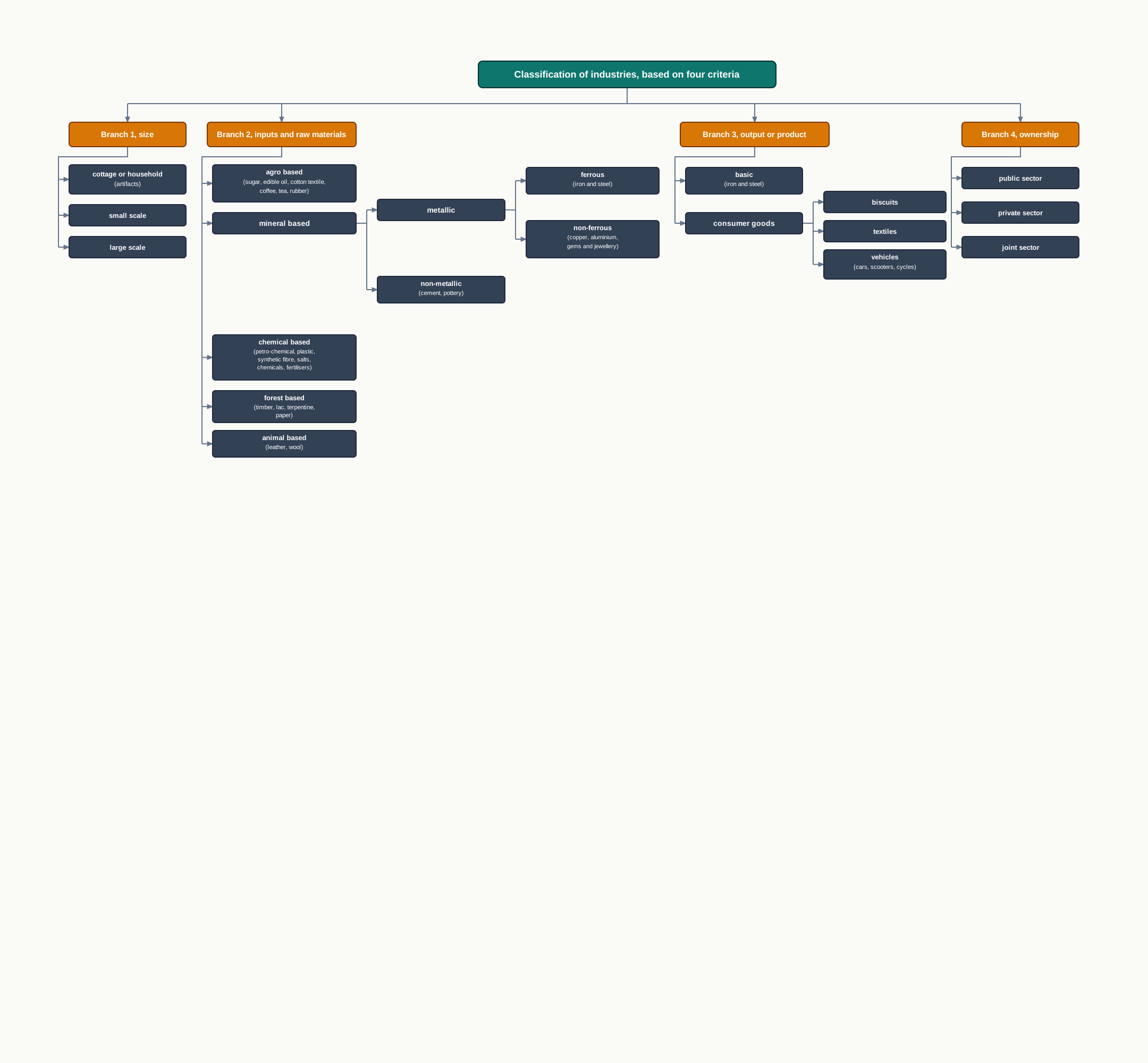
Fig. 5.1 – Classification of manufacturing industries.
5.1.9.1 Industries Based On Size
The size of an industry is set by three things together: the amount of capital invested in it, the number of workers it employs, and the volume of production it turns out. On this basis, industries fall into three groups — household or cottage, small-scale, and large-scale — which the sections that follow take up one by one.
5.2 Household Industries Or Cottage Manufacturing
Household or cottage manufacturing is the smallest manufacturing unit of all. Artisans use local raw materials and simple tools to make everyday goods in their own homes, helped by their family members or by part-time labour. What they make may be consumed within the same household, sold in the local village market, or exchanged by barter.
Because this kind of work has low commercial significance, and because most of the tools are devised locally, neither capital nor transportation weighs heavily on it. It is production close to the ground, for people close by.
The everyday products of this sector are wide-ranging. They include foodstuffs, fabrics, mats, containers, tools, furniture, shoes and figurines from wood taken from the forest; leather goods such as shoes and straps; and pottery and bricks made from local clays and stones. Goldsmiths make jewellery of gold, silver and bronze, and many artefacts and crafts are worked from bamboo and wood gathered locally in the forests.
The chapter shows this way of making things through three photographs of workers in India’s north-east.
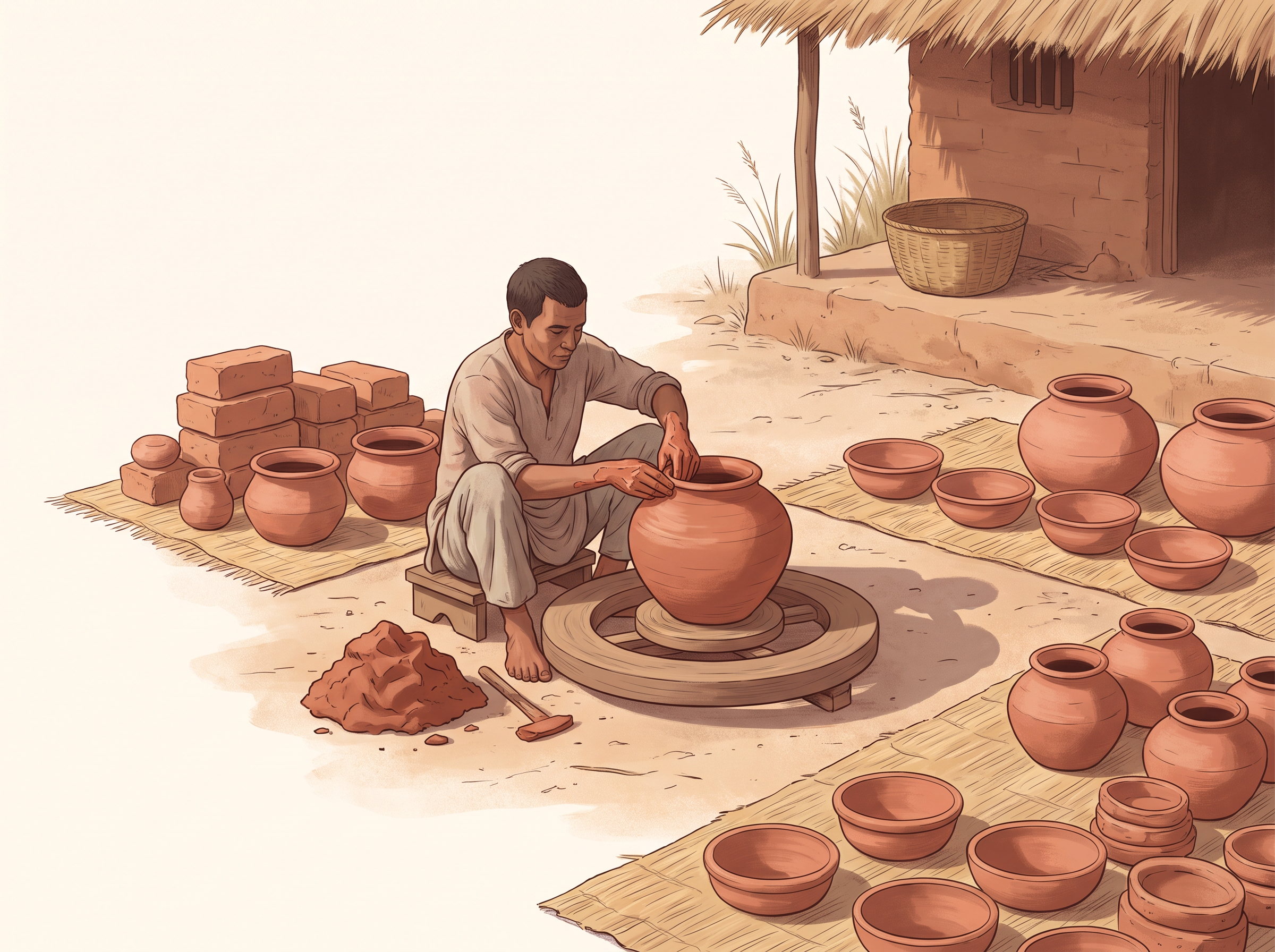
Fig. 5.2 (a) – Household pottery industry in Nagaland.
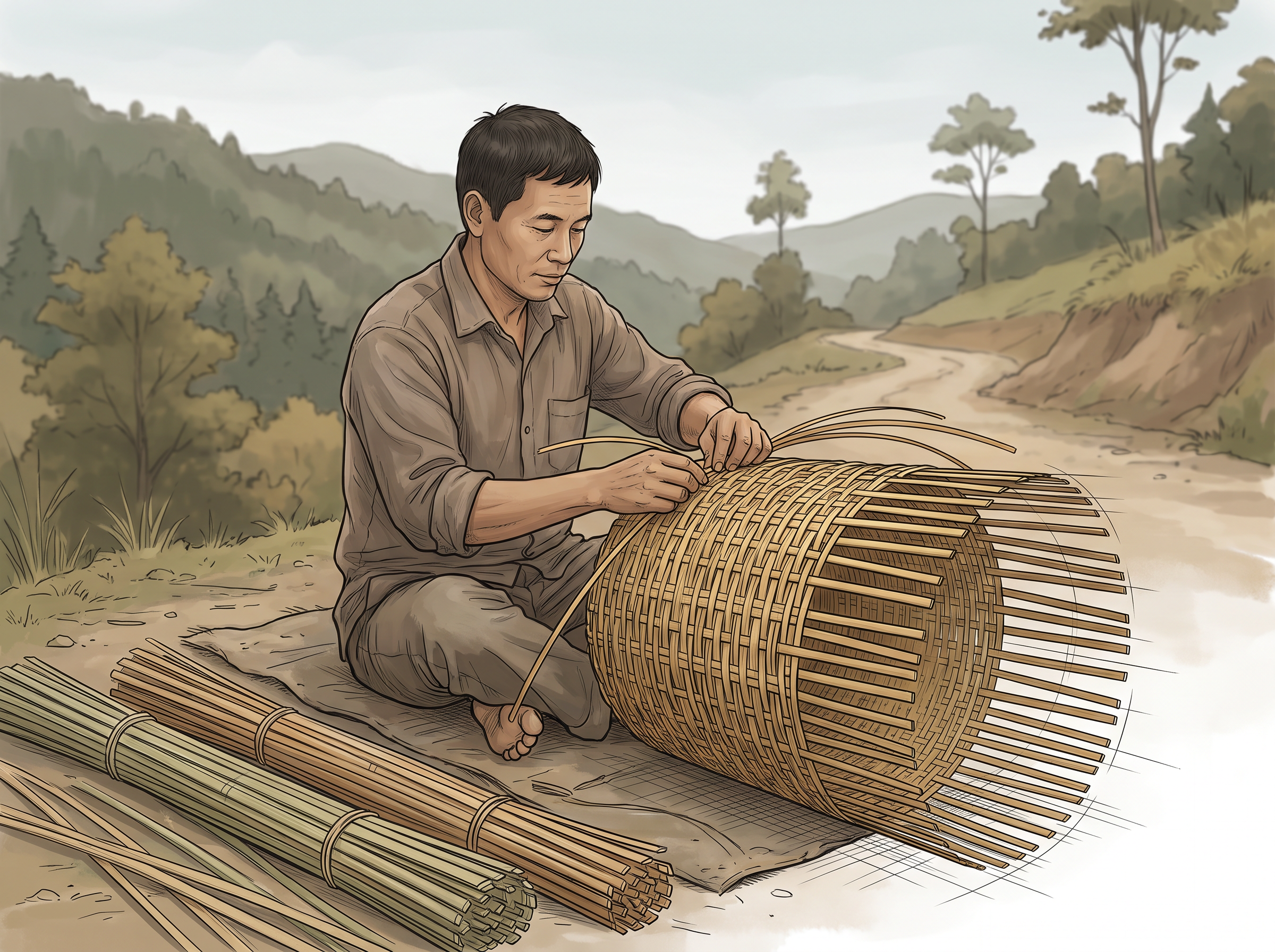
Fig. 5.2 (b) – Bamboo basket weaving in Arunachal Pradesh.
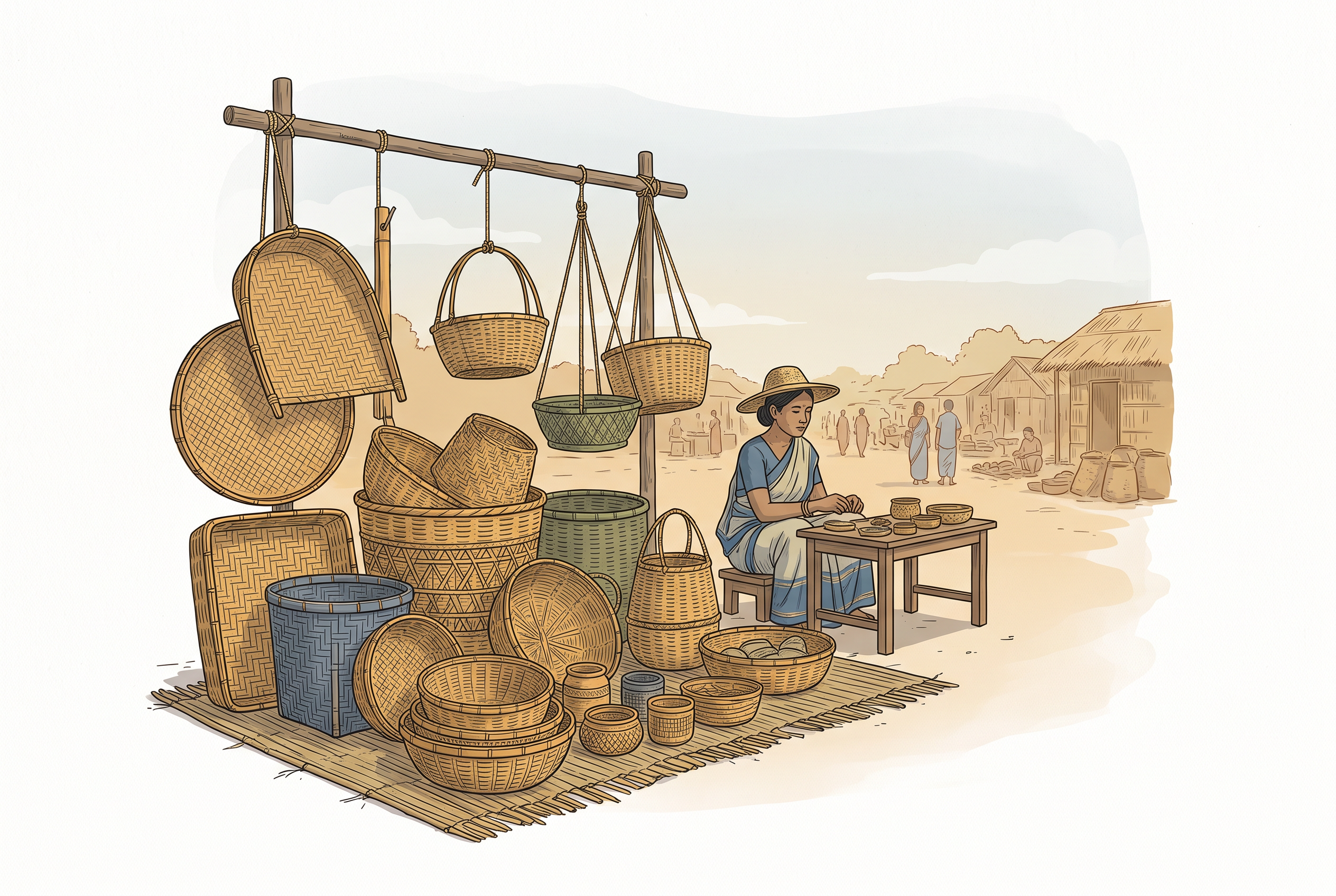
Fig. 5.3 – Cottage industry products in Assam.
5.2.1 Small Scale Manufacturing
Small scale manufacturing is set apart from household industry by two things: its production techniques, and its place of manufacture — a workshop that stands outside the home or cottage of the producer. It still uses local raw material, but adds simple power-driven machines and semi-skilled labour.
Its real importance is what it does for people. It provides employment and raises local purchasing power, putting money into the hands of workers who then spend it nearby. This is why countries such as India, China, Indonesia and Brazil have deliberately built up labour-intensive small scale manufacturing, as a way of giving their large populations work.
5.2.2 Large Scale Manufacturing
Large scale manufacturing is the opposite in almost every dimension. It draws on a large market, various raw materials, enormous energy, specialised workers, advanced technology, assembly-line mass production, and large capital. This way of making things developed only in the last 200 years, first in the United Kingdom, in north-eastern U.S.A. and in Europe. From there it has now diffused — spread outward — to almost all over the world.
Looked at through this large scale system, the world’s major industrial regions fall into two broad types. The first are the traditional large-scale industrial regions, thickly clustered in a few of the more developed countries. The second are the high-technology large-scale industrial regions, which have diffused outward to reach less developed countries as well.
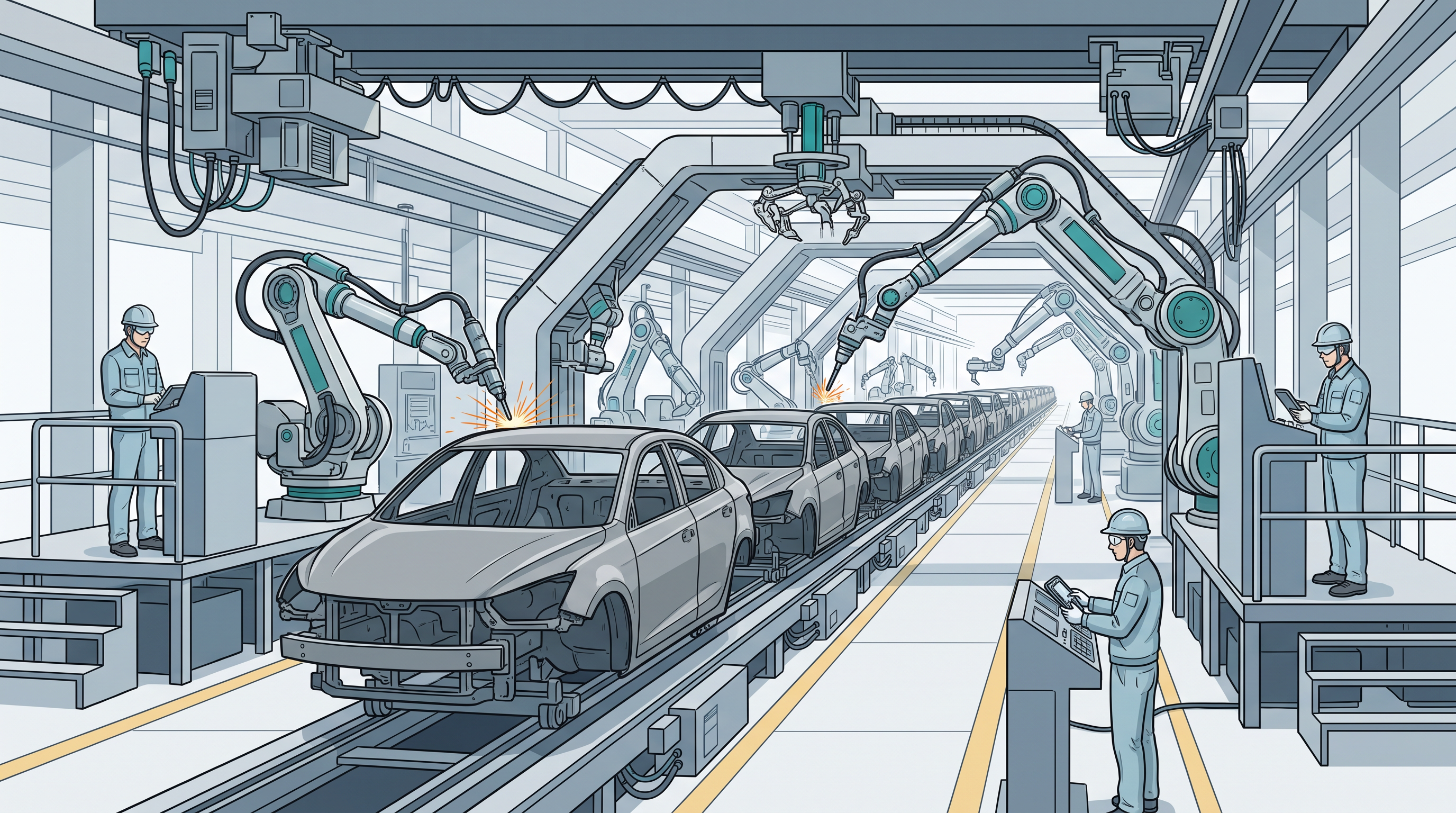
Fig. 5.4 – Passenger car assembly line in Japan.
5.2.3 Industries Based On Inputs/Raw Materials
The second way to classify industry is by the raw material it feeds on. On this basis, industries are grouped as agro-based, mineral based, chemical based, forest based, and animal based. Each takes its name from where its raw material comes from.
5.2.3.1 Agro Based Industries
Agro processing is the processing of raw materials from the field and the farm into finished products for rural and urban markets. The major agro-processing industries are food processing, sugar, pickles, fruit juices, beverages such as tea, coffee and cocoa, spices, oils and fats, textiles from cotton, jute and silk, and rubber.
Some of this farming is now run on an industrial scale, and has a name of its own. Agri-business is commercial farming carried out on an industrial scale, often financed by businesses whose main interests lie outside agriculture — large corporations in the tea plantation business, for instance. Agri-business farms are mechanised, large in size, highly structured and reliant on chemicals, so much so that they may be described as ‘agro-factories’.
The tea plantation is a good place to see agro-processing at work, because the factory sits right inside the garden.
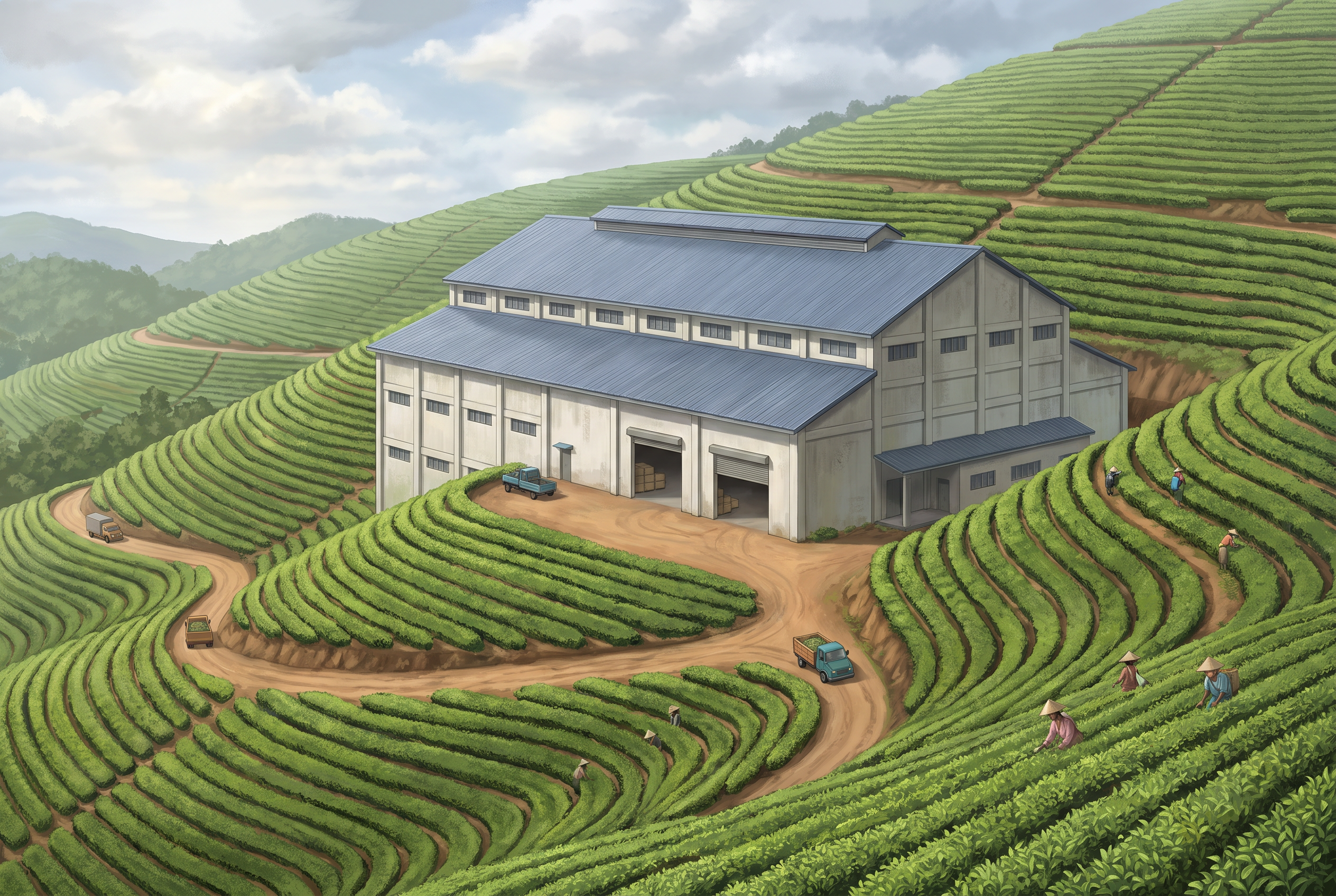
Fig. 5.5 – Tea garden and factory in the Nilgiri hills.
5.2.3.1.1 Food Processing
Food processing is one branch of agro processing, and it covers canning, producing cream, fruit processing and confectionery. Some of its preserving techniques — drying, fermenting and pickling — have been known since ancient times. But before the Industrial Revolution these had only limited use, enough to meet the modest demands of that earlier age.
5.2.3.2 Mineral Based Industries
Mineral based industries use minerals as their raw material. Some draw on ferrous metallic minerals, which contain iron: the iron and steel industry is the leading example. Others use non-ferrous metallic minerals, which contain no iron, such as the aluminium, copper and jewellery industries. Still others use non-metallic minerals, such as the cement and pottery industries.
The distinction runs down the branch. Ferrous minerals carry iron and feed the iron and steel industry; non-ferrous minerals carry other metals like aluminium and copper; and non-metallic minerals, like the limestone behind cement, carry no metal at all.
5.2.3.3 Chemical Based Industries
Chemical based industries use natural chemical minerals as their starting material. Mineral oil, or petroleum, is used in the petro-chemical industry, and the salts, sulphur and potash industries also draw on natural minerals. Chemical industries can also be based on raw materials obtained from wood and coal. Synthetic fibre and plastic are further examples of chemical based products.
5.2.3.4 Forest Based Raw Material Using Industries
The forests supply many major and minor products that industries use as raw material. Timber goes to the furniture industry; wood, bamboo and grass go to the paper industry; and lac, a resin, goes to the lac industries.
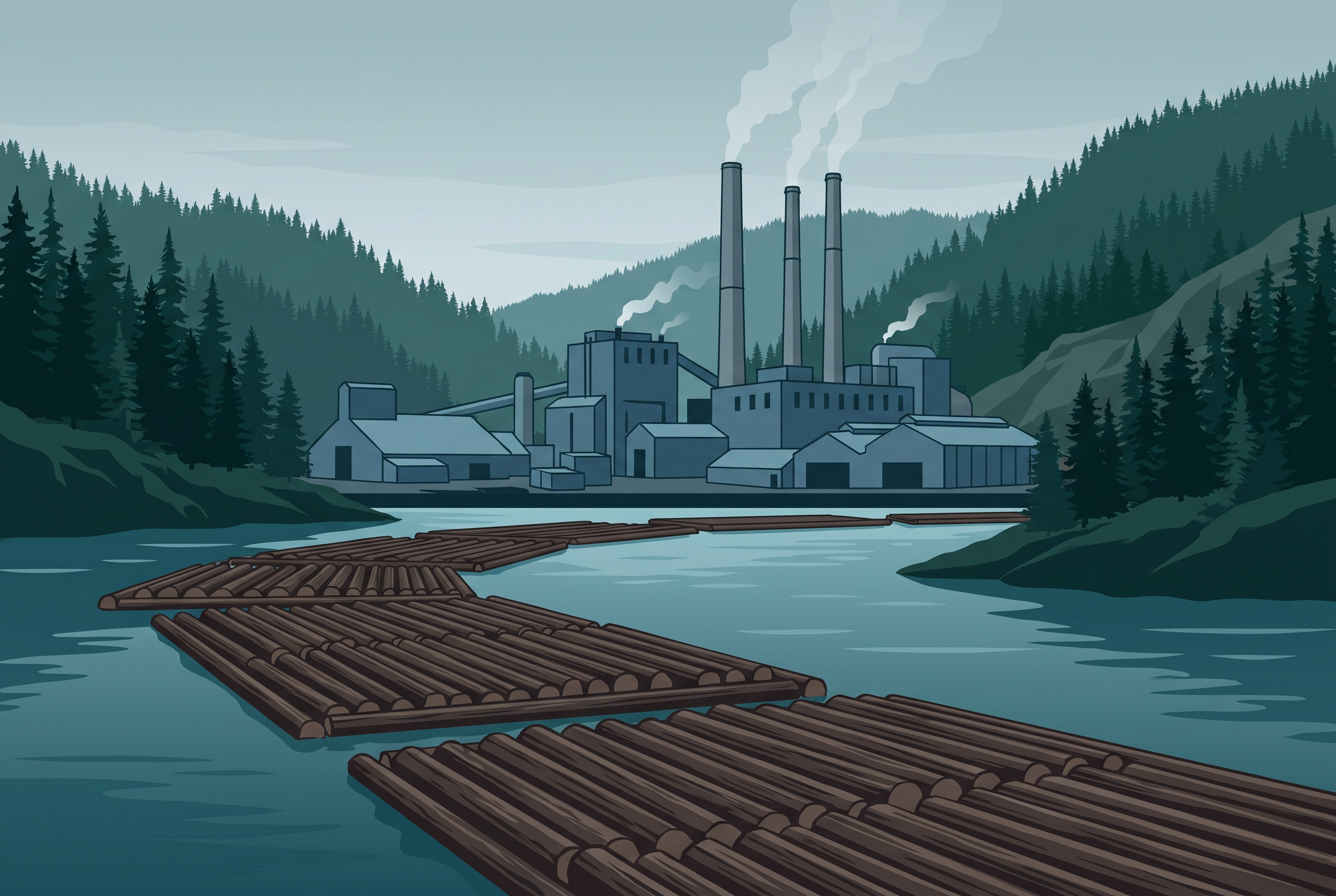
Fig. 5.6 – Pulp mill in Ketchikan, Alaska.
5.2.3.5 Animal Based Industries
Some industries take their raw material from animals. Leather for the leather industry, and wool for woollen textiles, are both obtained from animals. Ivory, too, is obtained from the tusks of elephants.
5.2.4 Industries Based On Output/Product
The last way to classify industry is by what it turns out. Think of the machines and tools made of iron or steel: the raw material for those machines is iron and steel, which is itself an industry. Industries whose products are used to make other goods — that is, used as raw materials by other industries — are called basic industries.
The link is a short chain: iron and steel feed the machines that the textile industry needs, and those machines in turn help make the cloth and clothes that people wear.
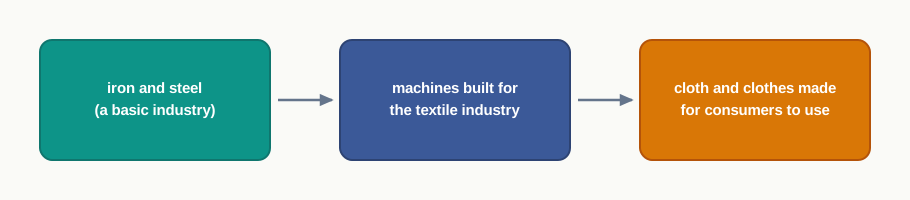
Fig. 5.7 – Basic industries feeding consumer industries.
At the other end sit the consumer goods industries, which make goods that people consume directly. Industries producing breads and biscuits, tea, soaps and toiletries, paper for writing, and televisions are all of this kind. For that reason they are also called non-basic industries: their output goes to the buyer, not back into another factory.
5.3 Industries Based On Ownership
The final way to classify industry is by who owns it. On this basis, industries fall into three groups: public sector, private sector, and joint sector.
Public sector industries are owned and managed by governments. In India there were a number of Public Sector Undertakings, or PSUs — companies set up and run by the state. Socialist countries, where the state holds most of the economy, have many such state-owned industries, while mixed economies run both public and private sector enterprises side by side.
Private sector industries are owned by individual investors and managed by private organisations. In capitalist countries, where private ownership is the rule, industries are generally owned in this way.
Joint sector industries are managed by joint stock companies, or sometimes by the private and public sectors together, which jointly establish and run the industry. It is worth pausing to see whether you can name a few industries of this joint kind.
5.3.1 Concept Of High Technology Industry
High technology, or simply high-tech, is the latest generation of manufacturing activity. It is best understood as the application of intensive research and development (R and D) effort, leading to the manufacture of products of an advanced scientific and engineering character.
Its workforce looks different from an old factory’s. Professional, white-collar workers — the office and laboratory staff — make up a large share of it, and these highly skilled specialists greatly outnumber the actual production, or blue-collar, workers on the floor. Robotics on the assembly line, computer-aided design and manufacturing (CAD), electronic controls of smelting and refining processes, and the constant development of new chemical and pharmaceutical products are all notable examples of high-tech at work.
Because the work is done by specialists in offices and labs rather than by crowds on an assembly floor, the landscape it creates is unlike the old industrial one.
Neatly spaced, low, modern, dispersed office-plant-lab buildings — rather than massive assembly structures, factories and storage yards — mark the high-tech industrial landscape. Planned business parks for high-tech start-ups have now become part of many regional and local development schemes.
When high-tech industries are regionally concentrated, self-sustained and highly specialised, they are given a special name: they are called technopolies. The Silicon Valley near San Francisco, in California, and the Silicon Forest near Seattle, in the north-western United States, are two well-known examples. One might reasonably ask whether some technopolies are now developing in India as well.
Taken together, all of this makes manufacturing a large force in the world economy. Iron and steel, textiles, automobiles, petrochemicals and electronics are among the world’s most important manufacturing industries.
5.4 Summary
- Secondary activities add value to natural resources by transforming raw materials into more valuable products; they cover manufacturing, processing and construction industries.
- Manufacturing applies power, mass-produces identical goods, and uses specialised labour in factory settings; the term ‘manufacturing industry’ is used when the factory sense is meant.
- Modern large-scale manufacturing is marked by specialised, mass-production methods, by mechanisation and automation, by technological innovation through research and development, and by complex organisation needing vast capital.
- Manufacturing is very unevenly spread, concentrated on less than 10 per cent of the world’s land, because its processes are far more intense than farming’s.
- Industries locate where production costs are lowest; the main pulls are access to market, to raw material, to labour, to energy, to transport and communication, to helpful government policy, and to agglomeration economies.
- Footloose industries escape most of these pulls, depending mainly on accessibility by road.
- Industries are classified four ways: by size, by inputs or raw materials, by output or product, and by ownership.
- By size, they run from household or cottage industry (smallest, home-based, local materials), through small-scale (a workshop, semi-skilled labour, power-driven machines), to large-scale (large market, energy, capital and assembly lines) — a form grown over the last 200 years and now spread worldwide.
- By raw material, they are agro-based, mineral based (ferrous, non-ferrous or non-metallic), chemical based, forest based, and animal based.
- By product, basic industries make the raw material that other industries use, while consumer goods industries make goods people use directly.
- By ownership, they are public sector, private sector or joint sector.
- High technology industry, driven by intensive research and development and staffed by more white-collar than blue-collar workers, forms dispersed office-lab landscapes; where it is regionally concentrated and highly specialised, it forms technopolies.
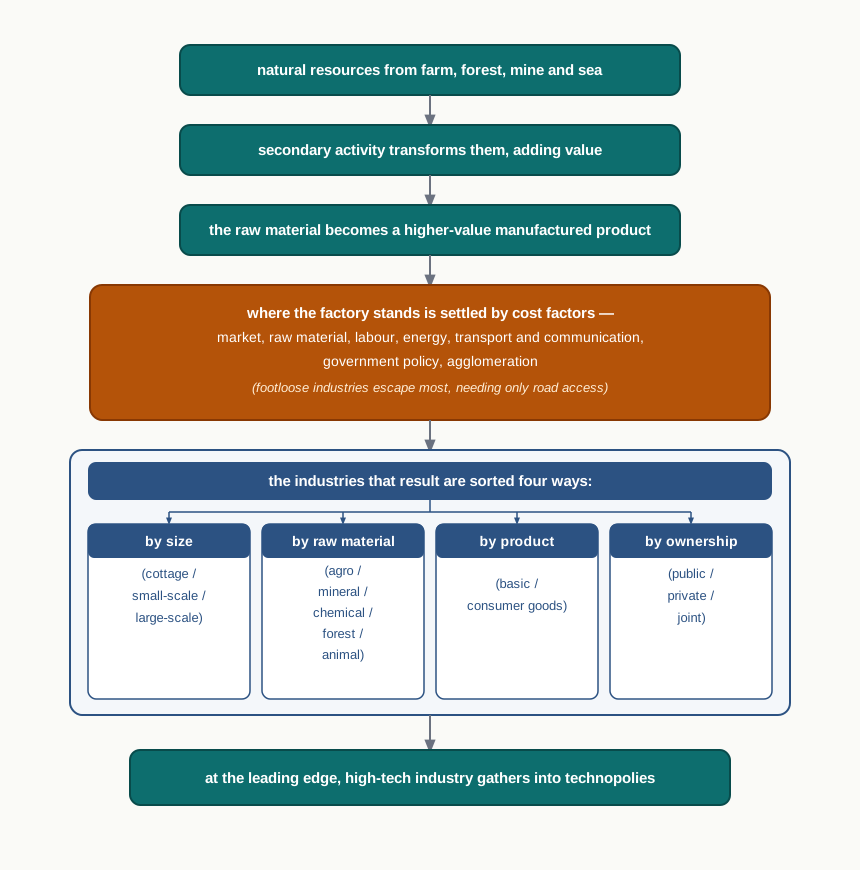
Fig. 5.8 – The manufacturing location and classification process.
What This Chapter Cannot Tell You
The chapter lists the factors that pull an industry to a site, but it never weighs them for any real factory, so it cannot tell you which factor actually decided any particular location. It names technopolies like the Silicon Valley and the Silicon Forest without explaining why they grew exactly where they did. And its figures — the ‘less than 10 per cent of land’, the corn-belt comparison — are broad averages that hide how crowded or how spread any single site really is.
5.5 NCERT Questions
- Which one of the following statements is wrong?
- Cheap water transport has facilitated the jute mill industry along the Hugli.
- Sugar, cotton textiles and vegetable oils are footloose industries.
- The development of hydro-electricity and petroleum reduced, to a great extent, the importance of coal energy as a locational factor for industry.
- Port towns in India have attracted industries.
- In which one of the following types of economy are the factors of production owned individually?
- Capitalist
- Mixed
- Socialist
- None
- Which one of the following types of industries produces raw materials for other industries?
- Cottage Industries
- Small-scale Industries
- Basic Industries
- Footloose Industries
- Which one of the following pairs is correctly matched?
- Automobile industry … Los Angeles
- Shipbuilding industry … Lusaka
- Aircraft industry … Florence
- Write A Short Note (About 30 Words)
- High-Tech industry
- Manufacturing
- Footloose industries
- Differentiate between primary and secondary activities. (about 150 words)
- Discuss the major trends of modern industrial activities especially in the developed countries of the world. (about 150 words)
- Explain why high-tech industries in many countries are being attracted to the peripheral areas of major metropolitan centres. (about 150 words)
- Africa has immense natural resources and yet it is industrially the most backward continent. Comment. (about 150 words)
- Find out the meaning of the terms bio-degradable and non-biodegradable. Which kind of material is better to use? Why?
- Look around and make a list of the global brands, their logos and products.
5.6 Check Your Concepts
- Using the classification tree in Fig. 5.1, name the four bases on which manufacturing industries are classified. Then give one industry each that is ferrous mineral based, non-ferrous mineral based, and non-metallic mineral based.
- Household or cottage industry and small-scale manufacturing are not same thing. Distinguish between them, using the differences the chapter draws in production technique and in the place where the work is carried on.
- Sugar mills, dairies and other agro-processing plants are usually set up close to their sources of raw material. Explain why, using the ideas of weight-losing material and of perishability.
- Iron and steel is a basic industry, but the clothes on a shop shelf are consumer goods. Trace, in order, the chain of industries by which iron and steel finally reaches a consumer as a finished good, using the example the chapter gives.
- Earlier, coal was the main source of industrial energy, and industries clustered on the coalfields. Explain how the arrival of hydroelectricity and petroleum loosened this pull, and say what this shows about how a single location factor can weaken over time.
- The chapter states that a 2.5 sq km block of the corn belt supports about 50–100 persons as farmland, but could support thousands as factory land. Work out roughly how many times more people the land can carry as factories, explain what this reveals about the intensity of manufacturing, and state one thing this comparison does not tell you.