Chapter 3: Human Development
Band Aceh, on the northern tip of Sumatra in Indonesia, had grown for decades into a busy coastal city. On the morning of 26 December 2004, an earthquake beneath the Indian Ocean sent a wall of water across the coast. Within minutes, whole neighbourhoods of Band Aceh were gone.
Two satellite photographs taken six months apart — one in June 2004, one that December — show the same shoreline twice. First a dense grid of streets and rooftops. Then bare ground and open water where the streets had been. A city that had been getting bigger every year had, overnight, become smaller.
Geographers have a plain way of describing this. The city’s growth had turned negative. Growth measures change in size or quantity, and that change can point up or down. But notice what the word growth does not tell you. It says nothing about whether the people of Band Aceh could read, or reach a doctor, or earn enough to live with dignity — before the wave or after it.
A place can grow without its people’s lives improving at all. A place can lose size while its survivors rebuild lives that are healthier and freer than before. That gap — between a place getting bigger and its people getting to live fuller lives — is where this chapter begins. It asks a harder question than ‘how large?’ It asks whether people are actually able to choose the lives they have reason to value.
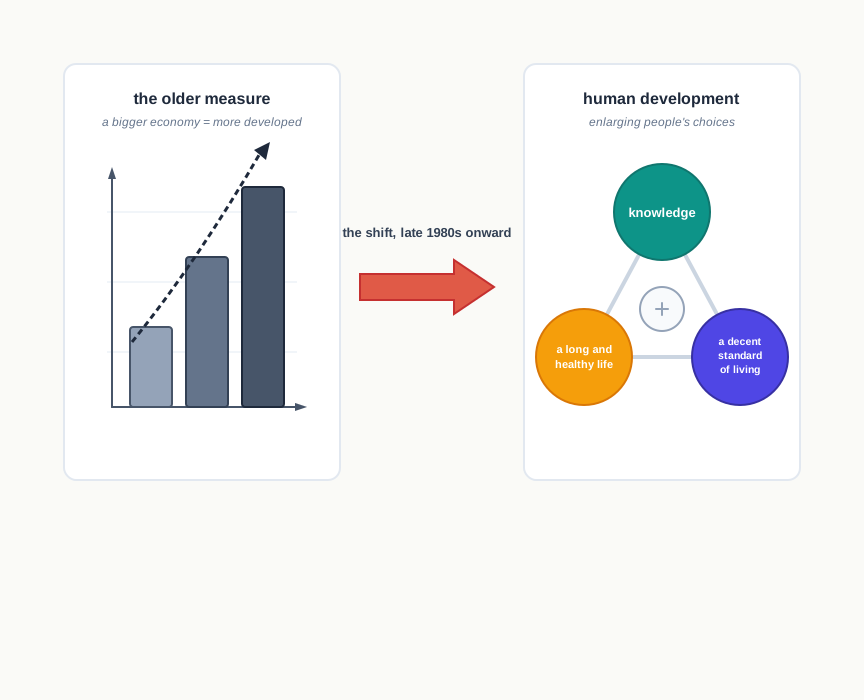
Fig. 3.0 – Development as enlarging choices rather than economic growth.
3.1 Growth And Development
You already know the words ‘growth’ and ‘development’. Look around and almost everything you can see — and much that you cannot — grows and develops: plants, cities, ideas, nations, relationships, and you yourself. This chapter takes up one form of change in particular, the human development of nations and communities, and asks what the two words really mean.
Two Words That Are Not The Same
Both growth and development describe change over time, but they are not the same change. Growth is a change in size or quantity. It is value-neutral, meaning it carries no judgement of good or bad, and it can take a positive sign (an increase) or a negative sign (a decrease).
Development is different. It is a qualitative change — a change in quality — and it is always value-positive, meaning it counts as development only when conditions actually get better. Development happens only when something is added to, or improves on, what was there before.
The link between the two runs one way and loosely. Development needs positive growth to build on, so it cannot happen while things only shrink. Yet positive growth on its own does not guarantee development. A place can get bigger without anyone’s life getting better.
When Growth Is Not Development
Take a city whose population rises from one lakh to two lakhs (a lakh is one hundred thousand). We can fairly say the city has grown. But if its housing, its basic services and its other conditions stay exactly as they were, then twice as many people now share the same inadequate provision. The city has grown; it has not developed. It helps to try this yourself: sketch or describe one case of growth without development, and one of growth with development.
Growth can even run the other way. Cities usually expand year on year, but they can also shrink. The satellite photographs in Fig. 3.1 show Band Aceh, a coastal city on the northern tip of Sumatra in Indonesia, six months apart in 2004. Between June and December, the tsunami that struck the coast erased whole neighbourhoods, and the city’s built-up size fell sharply — negative growth. It is worth asking whether sudden disasters are the only thing that can shrink a city, or whether slower forces can do it too.
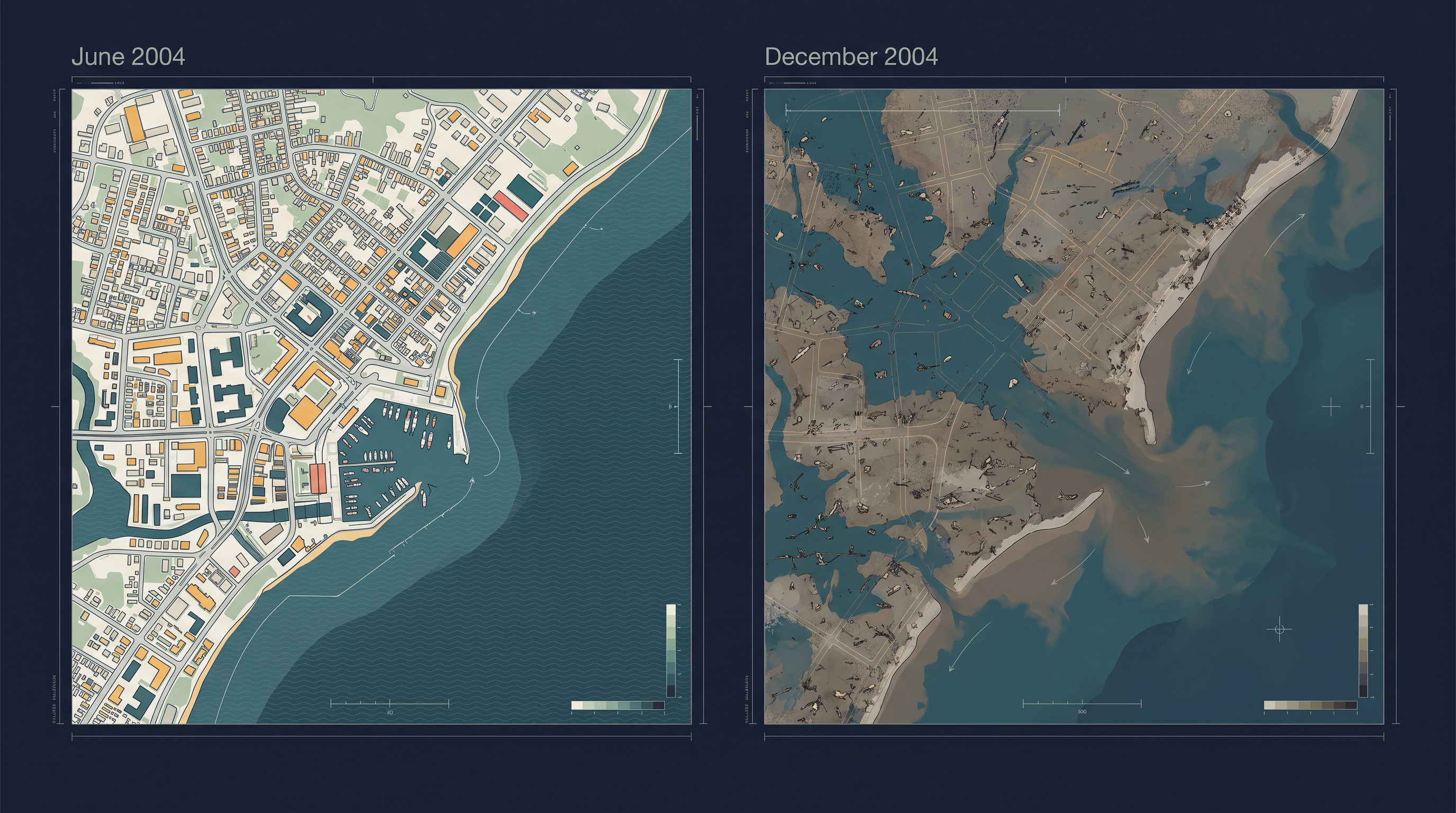
Fig. 3.1 – Band Aceh before and after the December 2004 tsunami.
From The Size Of The Economy To The Lives Of People
For many decades, a country’s development was measured only by its economic growth. The bigger the economy, the more developed the country was judged to be — even when that larger economy changed little in the lives of most of its people. A nation could look more developed on paper while ordinary lives stayed exactly where they were.
The idea that development is really about something else — the quality of life people enjoy, the opportunities open to them and the freedoms they hold — is not new. But it was set out clearly for the first time only in the late 1980s and early 1990s. It came from the work of two South Asian economists, Mahbub-ul-Haq and Amartya Sen.
The People At The Centre
The concept of human development — development that enlarges people’s choices and improves their lives — was introduced by Dr Mahbub-ul-Haq. In this view people are not a by-product of development; they are its whole point. Their choices are not fixed but keep changing, and the basic goal is to build conditions in which people can lead meaningful lives.
Haq, a Pakistani economist known for his vision and compassion, created the Human Development Index in 1990. He built it to measure development in terms of people leading long, healthy lives with dignity. The United Nations Development Programme (UNDP), the UN body that works on development across member countries, has used his concept to publish a Human Development Report every year since 1990. Haq had a habit of thinking past the world as it is — he was fond of George Bernard Shaw’s idea that one should not only ask why things are as they are, but also imagine things that have never existed and ask why not.
His close friend and collaborator Amartya Sen, who later won the Nobel Prize, put freedom at the centre. Sen saw development as an increase in freedom, or equally a decrease in unfreedom — the removal of the things that stop people acting. His work traces how social and political institutions either widen or narrow that freedom, and he showed that expanding freedom is not only the aim of development but one of its strongest engines. Working under Haq’s lead on the first Human Development Reports, the two economists built an alternative view that has permanently moved people to the centre of the debate.
What Makes A Life Meaningful
The goal, then, is a meaningful life — not merely a long one, but a life with purpose. That means being healthy, being able to develop one’s talents, taking part in society, and being free to pursue one’s own goals. A young person who wants good health, who wants to finish school and go to college, who wants to make something of herself, is describing exactly this.
Put two lives side by side and the difference becomes sharp. Someone who expects, a year from now, to be dead or in prison is cut off from almost every choice. A scientist working to find a cheaper, more effective cure for a disease like cancer is using talent, purpose and freedom all at once. What makes the second life fuller is not income alone but the range of real choices it holds.
This is also why widening choices for those who have fewest matters so much. The Government of India runs the Beti Bachao Beti Padhao programme to address the falling child sex ratio — the shrinking number of girls compared with boys among young children — and to keep girls in school. Its promise is not simply more girls, but more girls able to lead meaningful lives. It is worth discussing how staying in school changes the choices open to a girl for the rest of her life.
Capability And The Freedom To Choose
Leading a long and healthy life, gaining knowledge, and having enough means to live decently are the most important aspects of human development. So the three key areas are health, education and access to resources, and suitable indicators have been developed to measure each of them.
Very often, though, people cannot make even basic choices. They may lack knowledge, face material poverty, meet social discrimination, or be failed by inefficient institutions. Each of these strips away capability — a person’s real ability and freedom to make a choice and act on it. Where capability in health, education or resources is missing, choices shrink with it.
The examples are ordinary and hard. An uneducated child cannot choose to become a doctor, because the lack of schooling has already closed that door. A poor person often cannot choose medical treatment for an illness, because the lack of resources decides it for them.
Building people’s capabilities in health, education and access to resources is therefore how their choices are enlarged. To feel this concretely, you might act out a short scene showing how a shortage of income, education or health quietly removes a choice a person would otherwise have had.
3.2 The Four Pillars Of Human Development
Just as any building rests on pillars, the idea of human development rests on four supporting concepts: equity, sustainability, productivity and empowerment (Fig. 3.2). Weaken any one of them and the whole structure weakens. Together they turn the general aim — enlarging people’s choices — into something a society can actually work towards.
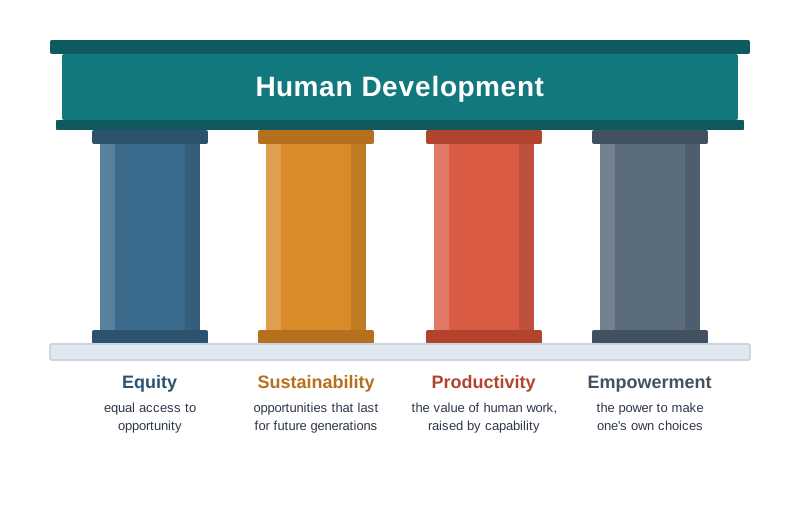
Fig. 3.2 – The four pillars of human development.
Equity
Equity means making access to opportunities equal for everybody. The opportunities open to a person should not depend on their gender, race or income — or, in the Indian case, their caste. Yet this ideal is very often missed, and not in one society alone but in almost every society.
One way to see equity failing is to ask which groups most of a country’s school dropouts come from. The answer usually points straight to who is being left out. In India, large numbers of women, and of people from socially and economically backward groups, drop out of school. Once knowledge is out of reach, their choices narrow — which is exactly what a lack of equity does.
You can see the same pattern close up. Talk to a vegetable vendor in your neighbourhood and ask whether she went to school, whether she dropped out, and why. Her answer will often trace her limited choices and freedom back to her gender, caste and income.
Sustainability
Sustainability means continuity in the availability of opportunities. For human development to be sustainable, each generation must inherit the same chances as the one before it. That requires using all resources — environmental, financial and human — with the future in mind, because misusing any of them leaves fewer opportunities for those who come next.
Sending girls to school shows the idea clearly. If a community does not treat the schooling of its girls as important, those girls lose opportunities as they grow up, their career choices are sharply curtailed, and the loss reaches into every other part of their lives. So each generation carries a duty: to pass on to the next at least the range of choices it received.
Productivity
Productivity here has a specific meaning — the productivity of human work, of human labour. It is not raised mainly by machines or money but by building people’s capabilities, because it is people who are the real wealth of a nation. When a society adds to people’s knowledge or improves their health, their work becomes more effective, and productivity rises with it.
Empowerment
Empowerment means having the power to make your own choices, and that power comes from greater freedom and greater capability. It does not appear on its own; it needs good governance and people-oriented policies to bring it about. Empowering the socially and economically disadvantaged matters most of all, because they begin with the least power to choose.
3.3 Approaches To Human Development
There is no single way to think about human development, and over the years several have competed for attention. Four of the most important are the income approach, the welfare approach, the minimum needs approach and the capability approach. Table 3.1 sets them side by side.
Where Each One Places The Person
Reading down the table, one difference matters more than the rest: where each approach places the person.
The income approach, the oldest of the four, treats income as a stand-in for everything else. More income is taken to mean more freedom, and so more development. It is simple, but it measures the means and quietly assumes the end.
The welfare approach turns attention to people’s well-being and asks the government to spend heavily on it. Yet it casts people as passive recipients — targets of development done for them, rather than partners doing it themselves.
The minimum needs approach, first proposed by the International Labour Organisation — the United Nations agency for work and workers — narrows the focus to six essentials: health, education, food, water supply, sanitation and housing. It sets the question of choice aside altogether, concentrating instead on delivering those needs to particular sections of people.
The capability approach, linked to Prof. Amartya Sen, turns the others around. Its claim is that development means building people’s capabilities in health, education and access to resources, so that people can make their own choices. Here the person is not a recipient at all, but an agent.
3.4 Measuring Human Development
How do you turn something as broad as human development into a number you can compare across countries? The answer is the human development index, or HDI, which ranks countries by their record in the three key areas — health, education and access to resources. From that record, each country earns a score somewhere between 0 and 1.
Three Dimensions, One Score
Each of the three areas is captured by a chosen indicator. Life expectancy at birth — the average number of years a newborn can expect to live — stands for health, because a higher figure means people have a greater chance of long, healthy lives. Knowledge is represented by two measures together: the adult literacy rate, the share of adults who can read and write, and the gross enrolment ratio, the share of children enrolled in school. Between them they show how easy or hard it is to reach knowledge in a country. Access to resources is measured by purchasing power, expressed in US dollars — in effect, what a person’s income can actually buy.
Each of these three dimensions is given a weightage of one-third, and the HDI is simply their weighted sum:
\[\text{HDI} = \tfrac{1}{3}(\text{health}) + \tfrac{1}{3}(\text{education}) + \tfrac{1}{3}(\text{resources})\]
Here health is scored from life expectancy in years, education from the literacy rate and the enrolment ratio, and resources from purchasing power in US dollars. Each dimension is turned into a score, weighted a third, and the three are added. The result is a single value between 0 and 1, carrying no unit of its own.
The figure below shows the three measures folding into one.
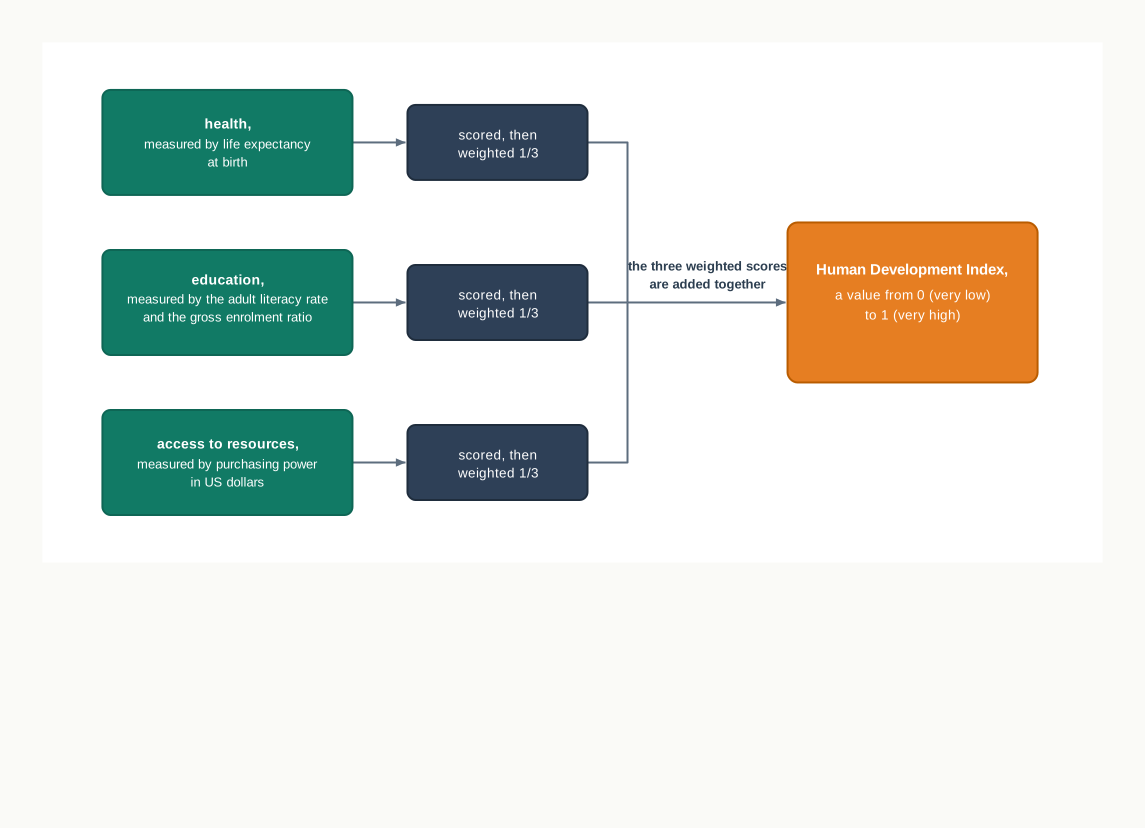
Fig. 3.3 – The Human Development Index calculation.
The closer a score sits to 1, the higher the level of human development. A score of 0.983 would count as very high, while a score of 0.268 would mark a very low level.
What The Index Leaves Out
The HDI measures attainments — it reflects what a country has actually achieved in the key areas. That is useful, but on its own it is not the most reliable measure, and the reason matters: it says nothing about distribution. A single national score cannot tell you whether those attainments are spread across the whole population or held by a fortunate few.
The Human Poverty Index
To see what the HDI hides, it helps to look at a companion measure. The human poverty index is related to the HDI, but where the HDI measures attainment, the poverty index measures the shortfall in human development — what is missing, rather than what has been reached.
It is a non-income measure, built from concrete deprivations: the probability of not surviving to the age of 40, the adult illiteracy rate, the number of people without access to clean water, and the number of small children who are underweight. Because it counts these directly, the human poverty index is often more revealing than the HDI. Read together, the two give an accurate picture of a country’s human development.
These two are the main indices the United Nations Development Programme relies on, and each year its Human Development Report sets out a rank-wise list of member countries by their level of human development.
Measuring Beyond The Index
The HDI is not the last word, and some countries measure progress in quite different terms. Bhutan, a small Himalayan kingdom lying between India and China, is the only country to officially adopt Gross National Happiness (GNH) as the measure of its progress. It treats material and technological advance cautiously, weighing the harm they might do to the environment and to Bhutanese cultural and spiritual life. The message is plain: material progress must not come at the cost of happiness. GNH pushes us to count the spiritual, non-material and qualitative sides of development too.
A wider debate hides here. Should a country be judged by its roads, its hospitals, and its GDP and GNP — broad measures of the size of its economy — or by its people’s satisfaction, employment, happiness and health? The two lists pull in different directions, and the choice of what to count quietly shapes what a country will try to achieve.
For that reason, the ways of measuring human development are constantly being refined, and researchers keep searching for new elements to capture. They have found links between a region’s human development and its levels of corruption and political freedom, and there is discussion of building a political freedom index and of listing the most corrupt countries. What other links to human development can you think of?
3.5 International Comparisons
Comparing human development across countries throws up some surprising results. The size of a country’s territory and its per capita income are not directly related to its human development. Per capita income — a country’s total income divided by the number of people, so income per head — often points one way while human development points another. Smaller countries have frequently done better than larger ones, and relatively poorer nations have ranked above richer neighbours.
Sri Lanka, an island nation just south of India, and Trinidad and Tobago, a twin-island country in the Caribbean off the coast of northern South America, both rank higher than India on the human development index, despite having smaller economies. The same pattern shows up inside India itself.
This quietly overturns the oldest assumption in the chapter — that a richer place must be the more developed one. What sets Kerala apart is not the size of its economy but where its resources have gone: into the health and education that widen people’s real choices. Income is a means; human development is the end, and the two need not rise together.
Four Groups On One Scale
On the basis of the human development scores they earn, countries can be sorted into four groups. Table 3.2 sets out the bands and how many countries fall into each.
The Very High And High Groups
Countries with very high human development score above 0.800. According to the Human Development Report of 2025, this band holds 74 countries; Table 3.3 lists the top ten among them.
Plot these ten on a world map and a pattern jumps out.
Map
Map 3.A1 Caption: The ten highest-ranked countries on the 2025 Human Development Index, most of them clustered in Europe. Brief: A world political map with the ten countries of Table 3.3 marked and labelled — Iceland, Norway, Switzerland, Denmark, Germany, Sweden, Australia, Hongkong (China SAR), the Netherlands and Belgium; the European members drawn clustered so the pattern is visible; India shown with its full extent as officially defined; the key to show only the marked countries and no HDI shading of any other country, since the chapter gives no data for them.
Many of these countries were once imperial powers, and their social diversity is not very high. A large number sit in Europe and belong to the industrialised western world — though a striking number of non-European countries have reached the list too. Just below, the high band holds 50 countries. Here, providing education and healthcare is a leading government priority, and it shows: heavy investment in the social sector, in people, and in good governance is what sets this group apart. It is worth finding out what share of a country’s income goes to these sectors, and what else these countries have in common.
The Medium And Low Groups
The medium band is a large and varied group of 53 countries. Most emerged after the Second World War — some as former colonies, many others after the break-up of the erstwhile Soviet Union, the former USSR, around 1990. A good number have been climbing fast by adopting more people-oriented policies and reducing social discrimination. Their social diversity tends to be higher than that of the top groups, and many have lived through political instability and social uprisings in their recent past.
At the bottom, 26 countries record low human development. Most are small nations caught in political turmoil and social instability — civil war, famine, or a heavy burden of disease. Their human development needs are urgent, and only carefully thought-out policies can begin to meet them.
Why Regions Stay High Or Low
International comparisons can throw up striking results, and they are often misread. People sometimes blame a region’s low human development on the culture of its people — claiming, say, that a country scores low because of the religion its people follow or the community they belong to. Such explanations are misleading, and they should be set aside.
To understand why a region keeps reporting low or high human development, look instead at how its government spends. Countries with high human development invest more in the social sector, are generally free of political turmoil, and share their resources far more equitably. Places with low human development tend to spend more on defence than on social sectors — a pattern found where political instability runs deep and accelerated economic development has never managed to start.
3.6 Summary
- Growth is a change in quantity and is value-neutral; development is a change in quality and is always value-positive. Positive growth does not always bring development.
- For decades, development was measured only by economic growth: the bigger the economy, the more developed a country was assumed to be — even when most people’s lives did not improve.
- Human development, introduced by Mahbub-ul-Haq, is development that enlarges people’s choices; Amartya Sen tied it to expanding people’s freedom. People, not output, are at its centre.
- A meaningful life is one with purpose — being healthy, gaining knowledge, and having the means for a decent living. Health, education and access to resources are the key areas.
- Choices depend on capabilities; where health, education or resources are missing, a person’s choices shrink with them.
- Human development rests on four pillars: equity (equal access), sustainability (opportunities that last across generations), productivity (people as the real wealth of a nation), and empowerment (the power to choose).
- There are four approaches to human development — the income, welfare, minimum needs and capability approaches — differing mainly in how far they treat people as active choosers rather than passive recipients.
- The Human Development Index ranks countries on a 0 to 1 scale, drawing on health (life expectancy at birth), education (adult literacy and gross enrolment) and access to resources (purchasing power), each weighted one-third.
- The HDI measures attainments but says nothing about distribution; the Human Poverty Index measures the shortfall and is often more revealing. Read together, they give a fuller picture.
- Measurement keeps evolving, and some countries look beyond income altogether — Bhutan measures its progress by Gross National Happiness.
- Territory size and per capita income are not directly tied to human development: smaller or poorer places can rank higher than larger or richer ones.
- Countries fall into four groups — very high, high, medium and low. High-HD countries invest in the social sector and tend to be politically stable; low-HD countries often spend more on defence and face instability.
- Blaming low human development on people’s culture or religion is misleading; the real explanation lies in government spending, political freedom and the equitable distribution of resources.
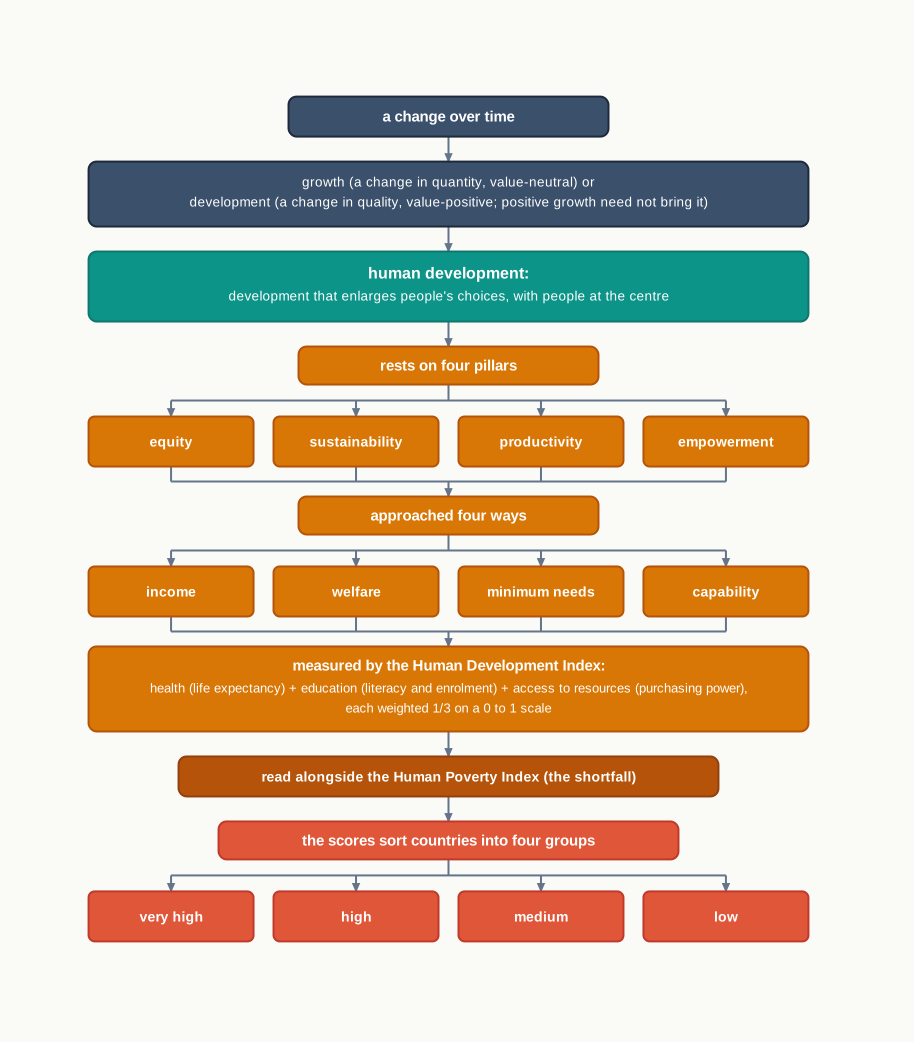
Fig. 3.4 – Summary of human development concepts.
What This Chapter Cannot Tell You
A single national HDI score hides how development is shared inside a country — a high average can rest on top of deep inequality, which is exactly why the Human Poverty Index is read beside it. The scores and the four-group boundaries are snapshots for one year, so a country can shift between groups as its policies change. And each dimension is captured by a chosen indicator, which is only a stand-in — no index can hold everything that makes a life meaningful.
3.7 NCERT Questions
- Which one of the following best describes development?
- an increase in size
- a constant in size
- a positive change in quality
- a simple change in the quality
- Which one of the following scholars introduced the concept of Human Development?
- Prof. Amartya Sen
- Ellen C. Semple
- Dr Mahbub-ul-Haq
- Ratzel
- What are the three basic areas of human development? (about 30 words)
- Name the four main components of human development. (about 30 words)
- How are countries classified on the basis of the human development index? (about 30 words)
- What do you understand by the term human development? (not more than 150 words)
- What do equity and sustainability refer to within the concept of human development? (not more than 150 words)
3.8 Check Your Concepts
- Growth and development both describe change over time. Using an example of your own, explain how a place can grow without developing.
- Using Table 3.2, state the score band that defines the ‘medium’ level of human development, and name the group that contains the fewest countries.
- The NCERT exercise asks about equity and sustainability. Explain the other two pillars — productivity and empowerment — and say what each one contributes to human development.
- The Human Development Index combines three dimensions into a single score. Name the indicator used for each dimension, and explain how the three are brought together into one number between 0 and 1.
- Distinguish between the Human Development Index and the Human Poverty Index. Why is the poverty index often said to be more revealing than the HDI?
- Sri Lanka ranks above India, and Kerala above Punjab and Gujarat, on human development, even though their incomes are lower. What does this tell you about the relationship between per capita income and human development?
- Two countries record the same HDI score. Explain why this does not necessarily mean that their people are equally well off.
- It is sometimes claimed that a country has low human development because of its people’s culture or religion. Explain why this claim is misleading, and which factors better explain why a region reports high or low human development.