Chapter 5: Mineral And Energy Resources
In 1956, the only place in India where oil came out of the ground was Digboi, a small town in upper Assam, in the far north-east of the country. Everywhere else, India bought from abroad the fuel that ran its trains, trucks and factories. That year the government set up the Oil and Natural Gas Commission and sent geologists out to read the rock for oil trapped beneath the surface.
The most daring part of the search led them out to sea. Oil forms only in sedimentary rock, laid down grain by grain over millions of years, and such rock stretched far out under the Arabian Sea where no eye could reach it. In 1973, about 160 kilometres off the coast of Mumbai, a drill bit struck oil beneath the sea floor. The field was named Mumbai High, and production began there in 1976.
Nothing about that oil was placed there by chance. It sat exactly where ancient geology had trapped it — just as India’s iron ore sits locked in the old crystalline rocks of the peninsula, and scarcely at all beneath the fertile plains of the north. A resource is found where a process, running over unimaginable stretches of time, happened to leave it. To find a mineral, you first have to learn to read the rock that holds it.
Map
Map 5.A1 Caption: Most of India’s major mineral resources lie to the east of a line joining Mangaluru and Kanpur. Brief: Outline map showing the full extent of India as officially defined. Mark Mangaluru on the south-western coast and Kanpur in the north; draw the straight line linking the two. Lightly shade the region lying to the east and south of this line, where the chapter says most major mineral resources are concentrated. Label the peninsular plateau. Key to show the dividing line and the mineral-rich zone only. Do not mark individual mines.
5.1 Types Of Mineral Resources
India holds a rich variety of mineral resources, and the reason lies in its rocks. The country has a varied geological structure — many different kinds and ages of rock making up the land — and different rocks hold different minerals.
Most of India’s valuable minerals belong to the pre-Palaeozoic age, the oldest and longest stretch of Earth’s geological past. They are locked mainly in the metamorphic and igneous rocks of peninsular India. Igneous rock forms when molten material cools and hardens; metamorphic rock forms when an existing rock is remade deep down by heat and pressure. Peninsular India — the ancient, stable plateau block that makes up the southern part of the country — is built largely of these two rock types.
The vast alluvial plain of north India is a different story. This is the flat, fertile lowland built up by rivers dropping their silt, or alluvium, over long ages. It is devoid of minerals of economic use, because the mineral-bearing rock lies buried far below a young, soft cover of river-laid soil.
Mineral resources give a country the base it needs for industrial development. Almost every industry begins with a raw material taken from the ground, which is why a nation’s mineral wealth shapes what it can make.
So what exactly is a mineral? A mineral is a natural substance, of organic or inorganic origin, with a definite chemical composition and definite physical properties. Because its make-up is fixed, each mineral can be told apart from the others and put to a particular use.
How Minerals Are Classified
On the basis of their chemical and physical properties, minerals fall into two broad families: metallic and non-metallic. Each family then divides further, as the classification tree in Fig. 5.0 sets out.
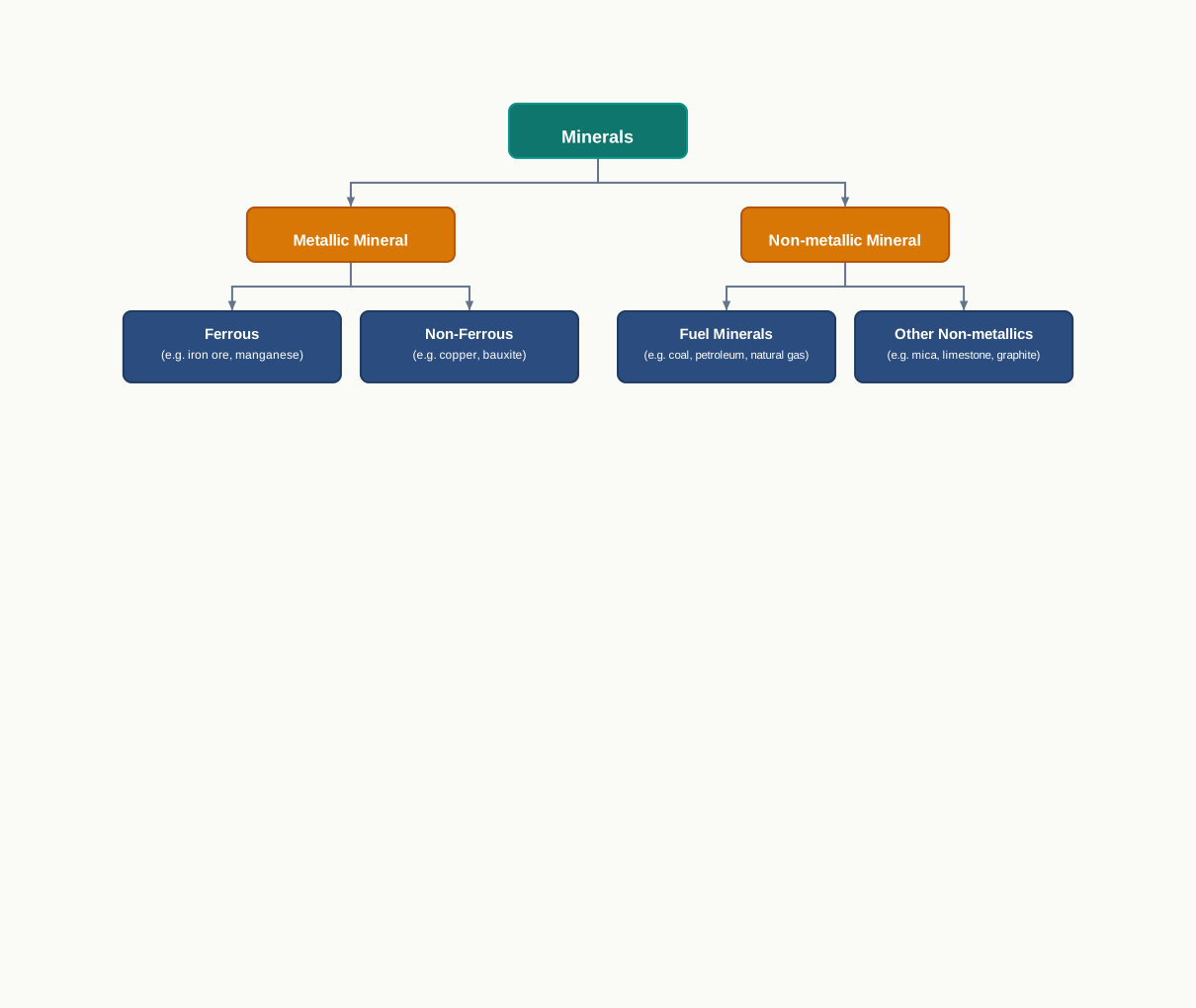
Fig. 5.0 – Classification of minerals by chemical and physical properties.
Metallic minerals are the sources of metals — iron ore, copper and gold each yield a metal when processed. They divide into ferrous and non-ferrous. A ferrous mineral contains iron: iron ore itself is ferrous, and so is manganese, which is used alongside iron. A non-ferrous mineral contains no iron; copper and bauxite are examples.
Non-metallic minerals come in two kinds, sorted by how they formed. Some are organic in origin — the fossil fuels, also called mineral fuels, which formed from the buried remains of plants and animals over long ages. Coal and petroleum are the main ones. Others are inorganic in origin, such as mica, limestone and graphite.
How Minerals Behave
Minerals share three characteristics worth holding onto. First, they are unevenly distributed over space: a mineral is concentrated in a few places and absent from most others, never spread evenly across the land.
Second, there is an inverse relationship between quality and quantity. High-grade mineral, the kind worth most, is scarce; low-grade mineral is far more plentiful. The better the ore, the less of it there tends to be.
Third, every mineral is exhaustible. Minerals take vast geological time to form and cannot be replenished at the moment we need them. There is no second crop, as there is with wheat or rice — once a deposit is dug out, it is gone. For that reason minerals have to be used with care and not misused.
5.2 Distribution Of Minerals In India
Minerals are not scattered evenly across India. Most of the metallic minerals occur in the peninsular plateau region, held in the old crystalline rocks that make up that ancient block. This is the same rock story from the last section: metals sit where the oldest rocks lie.
The fuels follow their own pattern. Over 97 per cent of India’s coal reserves occur in the valleys of the Damodar, Sone, Mahanadi and Godavari rivers, which drain eastern and central India. Petroleum reserves lie in the sedimentary basins of Assam and Gujarat, and in Mumbai High, the off-shore region in the Arabian Sea. A sedimentary basin is a low area where layers of sediment piled up and hardened into rock, and it is in such rock that oil forms and collects. Newer reserves have been located in the Krishna-Godavari and Kaveri basins.
Put together, this spread has a striking edge to it. Most of India’s major mineral resources occur to the east of a line joining Mangaluru and Kanpur, as Map 5.A1 shows. West of that line, the alluvial and desert country holds far less.
Within this broad picture, minerals are generally concentrated in three broad belts, with only sporadic occurrences here and there in isolated pockets. The three belts, taken in turn, are the north-eastern plateau, the south-western plateau, and the north-western region.
5.2.1 The North-Eastern Plateau Region
This belt covers the Chhotanagpur plateau in Jharkhand, the Odisha plateau, West Bengal and parts of Chhattisgarh — a stretch of eastern India. It is the richest and most diversified of the three belts, carrying a variety of minerals together: iron ore, coal, manganese, bauxite and mica.
That single fact — so many minerals in one region — explains why India’s major iron and steel industry grew up here rather than somewhere else.
5.2.2 The South-Western Plateau Region
This belt extends over Karnataka, Goa, the contiguous uplands of Tamil Nadu, and Kerala. It is rich in ferrous metals and bauxite, and it also holds high-grade iron ore, manganese and limestone.
Its one clear weakness is fuel. The belt lacks coal deposits, except for the brown coal, or lignite, at Neyveli in Tamil Nadu. That absence matters, because an iron-rich region without its own coal cannot smelt as freely as one that has both. This belt is also less diversified than the north-eastern belt — it does not carry the same wide mix of minerals.
A few local riches stand out. Kerala has deposits of monazite and thorium, both used in nuclear fuel, along with bauxite clay. Goa has iron ore deposits.
5.2.3 The North-Western Region
This belt runs along the Aravali range in Rajasthan — an old, worn line of hills crossing the state — and into part of Gujarat. Its minerals are associated with the Dharwar system of rocks, an ancient group that hosts many of India’s metallic ores. Copper and zinc have been the major minerals here.
Rajasthan is also rich in building stones — sandstone, granite and marble — and has extensive deposits of gypsum, a soft mineral used in plaster and cement, and of Fuller’s earth, a natural absorbent clay. Dolomite and limestone from the belt provide the raw materials for the cement industry. Gujarat is known for its petroleum deposits, and both Gujarat and Rajasthan have rich sources of salt.
The Himalayan Belt
Beyond the three main belts, the Himalayas form another mineral belt. Copper, lead, zinc, cobalt and tungsten are known to occur here, on both the eastern and the western parts of the range. The Assam valley, in the north-east, has mineral oil deposits, and, as noted, further oil is found in the off-shore areas near the Mumbai coast at Mumbai High.
In the sections that follow, the chapter turns from this overview to the spatial pattern of each important mineral in turn — where it is mined, and why it is found there.
5.3 Ferrous Mineral
Ferrous minerals are those that contain iron. Iron ore, manganese and chromite — chromite being an ore of chromium — are the main ones, and together they provide a strong base for the development of metallurgical industries, the industries that extract and work metals. India is well-placed in ferrous minerals, both in the reserves it holds in the ground and in the amount it produces.
5.3.1 Iron Ore
India is endowed with fairly abundant resources of iron ore, and it holds the largest reserve of iron ore in Asia. The two main types of ore found in the country are haematite and magnetite, the two chief iron-bearing minerals. Indian iron ore is in great demand in the international market because of its superior quality.
There is a locational advantage worth noting. The iron ore mines occur in close proximity to the coal fields in the north-eastern plateau region. Because smelting iron demands both ore and coal, having the two near each other lowers the cost of getting them together — an advantage that shaped where the steel plants stand.
The chapter maps this pattern in Fig. 5.1, which marks the ore fields, the mines, the exporting ports and manganese all on one sheet.
Map
Fig. 5.1 Caption: India’s ferrous metallic minerals — iron ore and manganese — together with the ports that export iron ore. Brief: Outline map showing the full extent of India as officially defined. Use four separate key symbols for iron ore fields (shaded), iron ore mines, iron ore exporting ports, and manganese. Mark the mining clusters named in the text across Odisha, Jharkhand, Chhattisgarh, Karnataka, Maharashtra, Telangana, Andhra Pradesh, Tamil Nadu and Goa; mark the exporting ports of Marmagao, Paradwip and Vishakhapatnam. Key to show the four categories only.
About 95 per cent of the total reserves of iron ore lie in eight states: Odisha, Jharkhand, Chhattisgarh, Karnataka, Goa, Telangana, Andhra Pradesh and Tamil Nadu. In Odisha, the ore occurs in a series of hill ranges in Sundergarh, Mayurbhanj and Jhar, with important mines at Gurumahisani, Sulaipet, Badampahar (Mayurbhanj), Kiruburu (Kendujhar) and Bonai (Sundergarh).
Jharkhand has some of the oldest iron ore mines, and most of its iron and steel plants stand around them. The important mines of Noamundi and Gua lie in the Poorbi and Pashchimi — East and West — Singhbhum districts. The belt runs on into Chhattisgarh, to Durg, Dantewara and Bailadila, where Dalli and Rajhara in Durg are among the country’s important iron ore mines.
In Karnataka, deposits occur in the Sandur-Hospet area of Ballari district, in the Baba Budan hills and at Kudremukh in Chikkamagaluru district, and in parts of Shivamogga, Chitradurg and Tumakuru. Further mining regions lie in the districts of Chandrapur, Bhandara and Ratnagiri in Maharashtra, Karimnagar and Warangal in Telangana, Kurnool, Cuddapah and Anantapur in Andhra Pradesh, and Salem and Nilgiris in Tamil Nadu. Goa, too, has emerged as an important producer.
A newspaper report noted that iron ore mining in India was drawing in several new players, both large and small — a sign of rising interest in the resource.
5.3.2 Manganese
Manganese is an important raw material for the smelting of iron ore — smelting being the heating of ore to release the metal — and it is also used for manufacturing ferro alloys, which are alloys of iron with another metal that go into making steel. Manganese deposits are found in almost all geological formations, though they are mainly associated with the Dharwar system.
Madhya Pradesh and Odisha are the leading producers. The major mines in Odisha lie in the central part of the country’s iron ore belt, particularly in Bonai, Kendujhar, Sundergarh, Gangpur, Koraput, Kalahandi and Bolangir. Sitting inside the ore belt puts this manganese close to where iron is smelted.
The manganese belt of Madhya Pradesh runs through the Balaghat-Chhindwara-Nimar-Mandla and Jhabua districts. Karnataka is another major producer, with mines at Dharwar, Ballari, Belagavi, North Canara, Chikkmagaluru, Shivamogga, Chitradurg and Tumakuru. Maharashtra is also an important producer, mining manganese in Nagpur, Bhandara and Ratnagiri.
Here the geography works the other way. The disadvantage of the Maharashtra mines is that they sit far from the steel plants that need the manganese — so the ore must travel, adding cost. Telangana, Goa and Jharkhand are other, minor producers.
5.4 Non-Ferrous Minerals
Non-ferrous minerals are the metallic minerals that carry no iron. India is poorly endowed with them, with one clear exception — bauxite. This scarcity will matter again later, when the chapter turns to conservation.
5.4.1 Bauxite
Bauxite is the ore from which aluminium is manufactured. It is found mainly in tertiary deposits — that is, in rocks of the Tertiary, a relatively young geological period — and it is associated with laterite rocks, occurring extensively on the plateau and hill ranges of peninsular India and also in the coastal tracts of the country.
There is a process behind that association. Laterite is a rock formed where a hot, wet climate weathers the ground so severely that most of the material is washed away, leaving aluminium and iron behind. Bauxite, being the aluminium ore, gathers within this laterite — which is why it sits on the plateaus, hills and coasts of the peninsula rather than anywhere at random.
Odisha happens to be the largest producer of bauxite, with Kalahandi and Sambalpur the leading areas and Bolangir and Koraput increasing their output. The patlands — flat plateau uplands — of Lohardaga in Jharkhand have rich deposits.
Gujarat, Chhattisgarh, Madhya Pradesh and Maharashtra are other major producers. Bhavnagar and Jamnagar in Gujarat hold major deposits. Chhattisgarh has bauxite in the Amarkantak plateau, while the Katni-Jabalpur area and Balaghat in Madhya Pradesh have important deposits. In Maharashtra, Kolaba, Thane, Ratnagiri, Satara, Pune and Kolhapur are important producers. Tamil Nadu, Karnataka and Goa are minor producers.
5.4.2 Copper
Copper is an indispensable metal in the electrical industry, used for making wires, electric motors, transformers and generators. The reason lies in its properties: it is ductile, so it can be drawn out into thin wire, and malleable, so it can be hammered into shape. It is also alloyable — it mixes readily with other metals — and it is added to gold to give jewellery its strength.
Both copper and bauxite are mapped together in Fig. 5.2, which shows how limited India’s non-ferrous deposits really are.
Map
Fig. 5.2 Caption: India’s non-ferrous minerals — the copper and bauxite deposits. Brief: Outline map showing the full extent of India as officially defined. Use two key symbols, one for copper and one for bauxite. Mark copper at Khetri, Alwar, Bhilwara and Udaipur in Rajasthan, at Singhbhum and Hazaribagh, and at Balaghat; mark bauxite at Katni, Amarkantak, Bilaspur, Maikala Hill and Koraput. Key to show copper and bauxite only.
The copper deposits mainly occur in Singhbhum district in Jharkhand, Balaghat district in Madhya Pradesh, and the Jhunjhunu and Alwar districts in Rajasthan. Minor producers are Agnigundala in Guntur district of Andhra Pradesh, Chitradurg and Hasan districts of Karnataka, and South Arcot district of Tamil Nadu.
5.5 Non-Metallic Minerals
Among the non-metallic minerals produced in India, mica is the important one. The others — limestone, dolomite and phosphate — are extracted mainly for local consumption rather than for wide trade.
5.5.1 Mica
Mica is used mainly in the electrical and electronic industries. What makes it useful is a physical property: it can be split into very thin sheets that are at once tough and flexible. Sheets that thin, yet strong enough not to crack, can be layered and shaped inside electrical and electronic parts where an ordinary material would fail.
Mica in India is produced in Jharkhand, Andhra Pradesh, Telangana and Rajasthan, followed by Tamil Nadu, West Bengal and Madhya Pradesh. In Jharkhand, high-quality mica is obtained from a belt in the lower Hazaribagh plateau, extending about 150 km in length and about 22 km in width.
Those two figures let us picture the belt’s size for ourselves.
An area of roughly 3,300 km² is larger than many whole districts. That tells us the mica here is not a pinpoint deposit but a broad zone stretched across the plateau — which is part of why Jharkhand ranks first for it. The figure is only an estimate, though: a real mineral belt is never a neat rectangle, so 3,300 km² is a sense of scale, not an exact measured area.
In Andhra Pradesh, Nellore district produces the best-quality mica. In Rajasthan, the mica belt runs about 320 km from Jaipur to Bhilwara and around Udaipur. Mica deposits also occur in the Mysuru and Hasan districts of Karnataka; in Coimbatore, Tiruchirapalli, Madurai and Kanniyakumari in Tamil Nadu; in Alleppey in Kerala; in Ratnagiri in Maharashtra; and in Purulia and Bankura in West Bengal.
5.6 Energy Resources
Mineral fuels are essential for the generation of power, which agriculture, industry, transport and every other sector of the economy depends on. The main mineral fuels are coal, petroleum and natural gas — together called fossil fuels — along with the minerals used for nuclear energy. These are the conventional sources of energy, and they share one hard fact: they are exhaustible resources, finite and unable to renew themselves.
India’s conventional energy resources are mapped together in Fig. 5.3, which brings coal, oil, gas and the main gas pipeline onto a single sheet.
Map
Fig. 5.3 Caption: India’s conventional energy resources — coal, oil, natural gas and the main gas pipeline. Brief: Outline map showing the full extent of India as officially defined. Use five key symbols: coal fields (shaded), coal mines, oil fields, major natural gas reserves, and the HVJ (Hazira-Vijaipur-Jagdishpur) natural gas pipeline drawn as a line. Mark the coal mines and fields of the Damodar valley and central-eastern India, the oilfields of Assam, Gujarat and Mumbai High, the major gas reserves, and the pipeline route across western and northern India. Key to show the five categories only.
5.6.1 Coal
Coal is one of India’s important minerals, used mainly in the generation of thermal power — electricity made by burning fuel to raise steam — and in the smelting of iron ore. It occurs in rock sequences of two geological ages: the very old Gondwana rocks and the younger tertiary deposits.
About 80 per cent of India’s coal is of the bituminous type and of non-coking grade. Non-coking coal is not suited to making the coke that steel-making needs, so most of it goes to thermal power stations to be burned for electricity rather than to steel plants.
The most important Gondwana coal fields lie in the Damodar Valley, within the Jharkhand-Bengal coal belt. The important fields here are Raniganj, Jharia, Bokaro, Giridih and Karanpura. Jharia is the largest coal field, followed by Raniganj. Other river valleys carrying coal are the Godavari, Mahanadi and Sone.
The most important coal-mining centres are Singrauli in Madhya Pradesh (part of the Singrauli field lies in Uttar Pradesh), Korba in Chhattisgarh, Talcher and Rampur in Odisha, Chanda–Wardha, Kamptee and Bander in Maharashtra, Singareni in Telangana and Pandur in Andhra Pradesh.
Tertiary coals occur in the north-east — in Assam, Arunachal Pradesh, Meghalaya and Nagaland. They are extracted from Darangiri, Cherrapunji, Mewlong and Langrin in Meghalaya; Makum, Jaipur and Nazira in upper Assam; Namchik–Namphuk in Arunachal Pradesh; and Kalakot in Jammu and Kashmir. Besides these, brown coal, or lignite, occurs in the coastal areas of Tamil Nadu, Puducherry, Gujarat and Jammu and Kashmir.
5.6.2 Petroleum
Crude petroleum is made of hydrocarbons — compounds of hydrogen and carbon — in both liquid and gaseous states, varying in chemical composition, colour and specific gravity, which is a measure of how dense the oil is compared with water. It is an essential source of energy for all internal combustion engines, the engines that burn fuel inside themselves to drive automobiles, railways and aircraft. Its many by-products are processed in petrochemical industries into fertiliser, synthetic rubber, synthetic fibre, medicines, vaseline, lubricants, wax, soap and cosmetics. Petroleum is so valued that it is often called liquid gold, for its scarcity and its wide range of uses.
Crude petroleum occurs in sedimentary rocks of the tertiary period. Oil exploration and production was taken up systematically only after the Oil and Natural Gas Commission was set up in 1956. Until then, Digboi in Assam was the only oil-producing region, but the picture changed after 1956, and new deposits have since been found at the extreme western and eastern edges of the country.
In Assam, Digboi, Naharkatiya and Moran are important oil-producing areas. The major oilfields of Gujarat are Ankaleshwar, Kalol, Mehsana, Nawagam, Kosamba and Lunej. Mumbai High, which lies 160 km off Mumbai, was discovered in 1973, and production began there in 1976. Oil and natural gas have also been found in exploratory wells in the Krishna-Godavari and Kaveri basins on the east coast.
The chapter maps where the crude is turned into usable products in Fig. 5.4.
Map
Fig. 5.4 Caption: India’s oil refineries. Brief: Outline map showing the full extent of India as officially defined. Mark the oil refineries named on the sheet with a single symbol — including Digboi, Numaligarh, Guwahati, Bongaigaon, Barauni, Haldia, Paradwip, Vishakhapatnam, Tatipaka, Chennai, Nagapattinam, Cochin, Mangaluru, Mumbai, Vadinar, Jamnagar, Koyali, Bina, Mathura, Panipat and Bathinda. Key to show oil refineries only.
Oil straight from the wells is crude oil, full of impurities; it cannot be used as it is and must first be refined. India has two kinds of refinery. A field-based refinery stands at the oilfield itself, as at Digboi. A market-based refinery stands instead near the consuming market, as at Barauni. The two locations answer different questions — refine the oil where it comes out of the ground, or refine it where its products will be used.
5.6.3 Natural Gas
Natural gas is found together with petroleum deposits and is released when crude oil is brought to the surface. It serves as both a domestic and an industrial fuel. It is burned in the power sector to generate electricity, used for heating in industry, and taken as a raw material by the chemical, petrochemical and fertiliser industries.
As gas infrastructure and local city gas distribution networks have spread, natural gas has also emerged as a preferred transport fuel — compressed natural gas, or CNG — and as a cooking fuel piped into homes as PNG. India’s major gas reserves lie in Mumbai High and its allied fields along the west coast, supplemented by finds in the Cambay basin of Gujarat. Along the east coast, new reserves have been discovered in the Krishna-Godavari basin.
5.7 Non-Conventional Energy Sources
Fossil fuel sources — coal, petroleum, natural gas — and nuclear energy all draw on exhaustible raw materials. The sustainable alternatives are the renewable energy sources: solar, wind, hydro, geothermal and biomass. These are more equitably distributed across the country and are environment-friendly. Once the initial cost of setting them up is met, non-conventional sources promise more sustained, eco-friendly and cheaper energy.
5.7.1 Nuclear Energy Resources
Nuclear energy has emerged as a viable source in recent times. The important minerals used to generate it are uranium and thorium. Uranium deposits occur in the Dharwar rocks, and uranium ores are known along the Singhbhum copper belt in Jharkhand. Uranium is also found in the Udaipur, Alwar and Jhunjhunu districts of Rajasthan, Durg district of Chhattisgarh, Bhandara district of Maharashtra and Kullu district of Himachal Pradesh.
Thorium is mainly obtained from monazite and ilmenite — two minerals in the beach sands along the coast of Kerala and Tamil Nadu. The world’s richest monazite deposits occur in the Palakkad and Kollam districts of Kerala, near Vishakhapatnam in Andhra Pradesh, and in the Mahanadi river delta in Odisha.
The organisation behind India’s nuclear effort took shape in stages. The Atomic Energy Commission was established in 1948, but real progress came only after the Atomic Energy Institute was set up at Trombay in 1954, which was renamed the Bhabha Atomic Research Centre in 1967. The important nuclear power projects are Tarapur (Maharashtra), Rawatbhata near Kota (Rajasthan), Kalpakkam (Tamil Nadu), Narora (Uttar Pradesh), Kaiga (Karnataka) and Kakarapara (Gujarat).
5.7.2 Solar Energy
Sun rays tapped in photovoltaic cells — cells that turn sunlight directly into electricity — give what is known as solar energy. Two processes are considered very effective for tapping it: photovoltaics, using the light, and solar thermal technology, using the sun’s heat.
Solar thermal technology has some advantages over other non-renewable sources: it is cost-competitive, environment-friendly and easy to construct. Solar energy is 7 per cent more effective than coal- or oil-based plants and 10 per cent more effective than nuclear plants. It is used most in appliances such as heaters, crop dryers and cookers.
The western part of India has the greater potential for solar development, especially in Gujarat and Rajasthan. The reason is climatic: the dry western belt has clear skies and strong, steady sunshine for much of the year, which is exactly what a solar plant needs.
5.7.3 Wind Energy
Wind energy is an absolutely pollution-free and inexhaustible source. The mechanism is simple: the kinetic energy of moving wind — the energy carried by anything in motion — is passed through turbines and converted into electrical energy.
The permanent wind systems, such as the trade winds and the westerlies, and the seasonal winds like the monsoon, have all been used as sources of energy. Besides these, local winds and land and sea breezes can also drive electricity generation. India has already started generating wind energy, and favourable conditions for it exist in Rajasthan, Gujarat, Maharashtra and Karnataka.
5.7.4 Tidal And Wave Energy
Ocean currents are a store-house of almost infinite energy. From as far back as the seventeenth and eighteenth centuries, efforts were made to build a more efficient energy system from the ceaseless tidal waves and ocean currents.
Large tidal waves are known to occur along the west coast of India, so the country has great potential for developing tidal energy along its coasts. So far, however, this potential has not yet been put to use.
5.7.5 Geothermal Energy
When magma — the molten rock from the Earth’s interior — comes up towards the surface, it releases tremendous heat. This heat energy can be tapped and converted into electrical energy. The hot water that gushes out through geyser wells, a geyser being a spring that throws out hot water and steam, is also used to generate thermal energy.
This is popularly known as geothermal energy, and it is now seen as one of the key sources that can be developed as an alternative. Hot springs and geysers have been used since medieval times. In India, a geothermal energy plant has been commissioned at Manikaran in Himachal Pradesh.
5.7.6 Bio-Energy
Bio-energy is energy derived from biological products, including agricultural residues and municipal, industrial and other wastes. It is a promising source that can be converted into electrical energy, heat energy, or gas for cooking. Along the way it also processes waste and garbage, turning a problem into power.
The gains are wide. Bio-energy can improve the economic life of rural areas in developing countries, reduce environmental pollution, enhance self-reliance and ease the pressure on fuel wood. One project that converts municipal waste into energy is at Okhla in Delhi.
News reports in recent years have tracked India’s fast-growing solar capacity and its steady move into newer energy sources.
5.8 Conservation Of Mineral Resources
Sustainable development asks us to hold two goals together: the pursuit of economic growth and the care of the environment. Sustainable development means meeting the needs of today without using up the resources that future generations will need. Traditional ways of using resources generate enormous quantities of waste and create other environmental problems, which is why sustainable development calls for protecting resources for the generations to come. The need to conserve is urgent.
Conservation works along several lines at once. First, the inexhaustible sources — solar power, wind, wave and geothermal energy — should be developed to replace the exhaustible ones, so that finite fuels are spared.
Second, in the case of metallic minerals, using scrap metals allows metals to be recycled — melted down from discarded material and used again. This matters most for copper, lead and zinc, non-ferrous metals in which India’s reserves are meagre; recycling stretches a small reserve much further.
Third, substitutes — other materials used in place of a scarce metal — can lower how much of it we consume. And fourth, the export of strategic and scarce minerals, the ones a country most depends on, must be reduced, so that the existing reserve lasts for a longer period.
5.9 Summary
India’s mineral wealth is set by its geology. Most valuable minerals belong to very old rocks and lie in the metamorphic and igneous rocks of peninsular India, while the young alluvial plains of the north are devoid of minerals of economic use.
A mineral is a natural substance, of organic or inorganic origin, with a definite chemical and physical make-up. Minerals split into metallic (ferrous and non-ferrous) and non-metallic (fuel minerals and other non-metallics).
Minerals are unevenly spread, show an inverse link between quality and quantity, and are exhaustible — they cannot be replenished once used.
Most major minerals lie east of a line joining Mangaluru and Kanpur, concentrated in three broad belts: the north-eastern plateau (the richest and most diversified), the south-western plateau (ferrous metals and bauxite, but short of coal), and the north-western region (copper, zinc and building stones).
Ferrous minerals feed metallurgical industries. India holds Asia’s largest iron ore reserve, in haematite and magnetite, close to the coal belt; manganese, used in smelting and ferro alloys, comes mainly from Madhya Pradesh and Odisha.
India is poor in non-ferrous minerals except bauxite, the ore of aluminium, which forms in laterite. Copper, valued for being ductile and malleable, is limited and mined chiefly in Jharkhand, Madhya Pradesh and Rajasthan.
Among non-metallic minerals, mica leads, valued for splitting into thin, tough, flexible sheets for the electrical and electronic industries.
The conventional energy sources — coal, petroleum, natural gas and nuclear — are exhaustible. Coal comes from Gondwana and tertiary rocks; petroleum from tertiary sedimentary basins in Assam, Gujarat, Mumbai High and the eastern basins; natural gas alongside petroleum.
The non-conventional sources — nuclear, solar, wind, tidal and wave, geothermal and bio-energy — are cleaner and, apart from nuclear, inexhaustible, and are being developed to replace finite fuels.
Because minerals are finite, conservation is urgent: recycle metals from scrap, use substitutes, curb exports of scarce minerals, and develop inexhaustible energy.
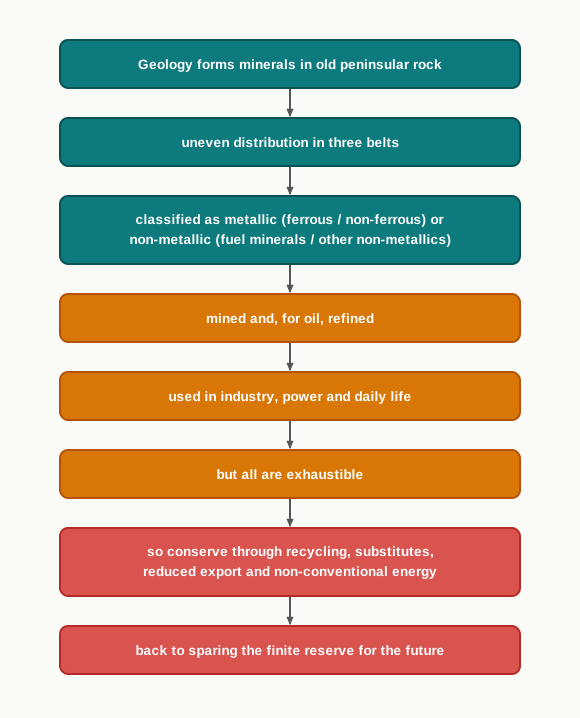
Fig. 5.5 – The lifecycle and conservation of mineral resources.
What This Chapter Cannot Tell You
The chapter maps where minerals occur, but a symbol on a map shows location, not size or grade — a large mine and a small one carry the same mark. It names leading producers without giving how much each yields, so the ranking is by place, not by measured tonnage. And it describes India’s potential in solar, wind and tidal energy without telling us how much of that potential has actually been turned into power.
5.10 NCERT Questions
- In which one of the following States are the major oil fields located?
- Assam
- Bihar
- Rajasthan
- Tamil Nadu
- At which one of the following places was the first atomic power station started?
- Kalpakkam
- Narora
- Rana Pratap Sagar
- Tarapur
- Which one of the following is a non-renewable source of energy?
- Hydel
- Solar
- Thermal
- Wind power
- Give an account of the distribution of mica in India. (30 words)
- What is nuclear power? Mention the important nuclear power stations in India. (30 words)
- Name a non-ferrous metal. Discuss its spatial distribution. (30 words)
- What are non-conventional sources of energy? (30 words)
- Write a detailed note on the petroleum resources of India. (150 words)
- Write an essay on hydel power in India. (150 words)
5.11 Check Your Concepts
- Using the classification shown in Fig. 5.0, place each of these minerals in its category — iron ore, copper, coal and mica — stating whether it is metallic or non-metallic, and its sub-type.
- Study Fig. 5.1. State what the four symbols in its key represent. What does a single iron-ore-mine symbol not tell you about the mine it marks?
- About 80 per cent of India’s coal is bituminous and of non-coking grade. Explain what ‘non-coking’ means and where such coal is mainly used.
- India has two types of oil refinery, field-based and market-based. Explain how they differ, and name the chapter’s example of each.
- The chapter gives the high-grade mica belt of Jharkhand as about 150 km long and about 22 km wide. Treating it as a rectangle, work out its approximate area, showing each step.
- Why did India’s major iron and steel industry develop in the north-eastern plateau? Answer in terms of the minerals that occur together there.
- Bauxite is associated with laterite. Explain why this link means bauxite is found on the plateaus, hills and coasts of the peninsula rather than anywhere at random.
- India’s reserves of copper, lead and zinc are described as meagre. Which of the chapter’s conservation measures matter most for these metals, and why?