Chapter 1: Judiciary
In 1979, a lawyer named Kapila Hingorani read a newspaper report about the jails of Bihar. It described men and women who had been locked up while waiting for their trial to begin — and who were still waiting, years later. Some had been inside longer than the maximum sentence they would have received had they been convicted. They were poor. They could not afford a lawyer. Nobody had come to court for them, so nobody had noticed. She did something that, at the time, was unusual. She was not one of the prisoners. Nothing had been done to her. Yet she filed a petition in the Supreme Court of India under Article 32 on their behalf, and the Court agreed to hear it. A bench led by Justice P.N. Bhagwati held that a trial delayed this long was no trial at all, that the right to a speedy trial was part of the right to life and personal liberty under Article 21, and that a person too poor to hire a lawyer must be given one at the State’s expense. Thousands of undertrial prisoners walked out of jail. A newspaper report had become a court order — because a court was willing to listen to someone who was not the victim.
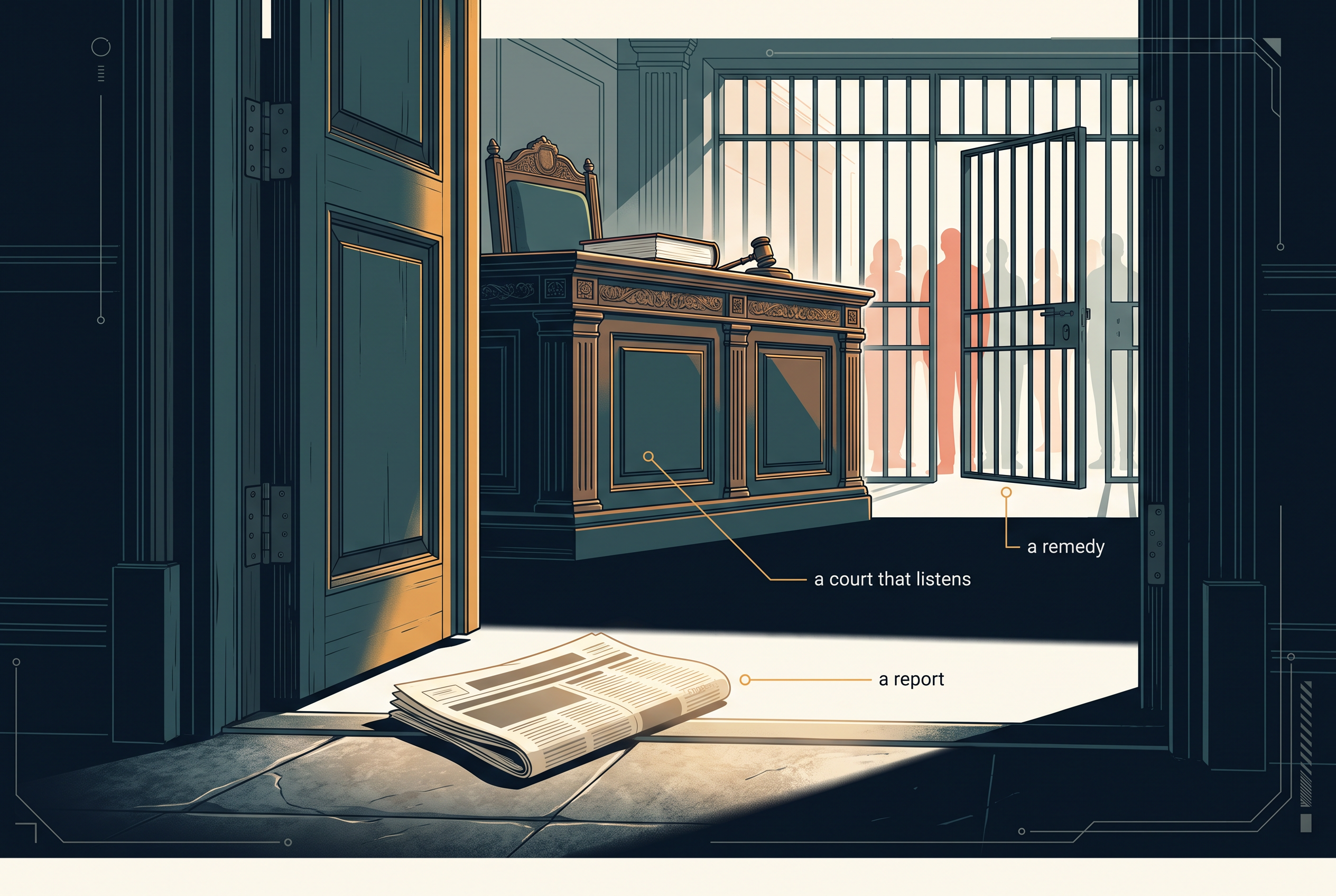
Fig. 1.0 – The origin of Public Interest Litigation.
You cannot answer these questions yet. By the end of this chapter, you will be able to answer every one of them.
1.1 Structure and Hierarchy of Courts in India
The Constitution of India lays down the framework of the country’s judicial system. India follows a federal system of government, which means that the power to make laws is divided between the Centre and the States. Parliament legislates on some subjects, State legislatures on others, and both on a few shared subjects.
You might expect that a country which splits its law-making power in two would also split its courts in two — one set of courts for Central laws and another for State laws. That is exactly what happens in some federations, such as the United States. India chose differently.
Our Constitution establishes a single integrated judiciary: one connected chain of courts that administers both Central and State laws. The Supreme Court sits at the top, High Courts below it at the State level, and district and subordinate courts below them. A district court in Rajasthan therefore applies a law made by Parliament and a law made by the Rajasthan legislature in the same courtroom, on the same day, without any difficulty about which court is competent to do so.
The reason for this choice is practical. A single hierarchy means one final interpreter of the law for the whole country, which keeps the law uniform and prevents the confusion of one set of courts contradicting another. It also means an ordinary litigant does not have to first work out which judicial system her dispute belongs to before she can file a case at all.
Alongside this chain of courts, the Constitution and Parliament have created specialised tribunals to decide sector-specific claims — labour disputes, consumer complaints, service matters of government employees. These do not replace the courts; they supplement them. Tribunals are taken up in detail later in this chapter.
The full hierarchy, from the Supreme Court down to the Munsif Court, is shown in Fig. 1.1. Study the two branches carefully — notice that the civil and criminal sides run parallel to each other all the way down.
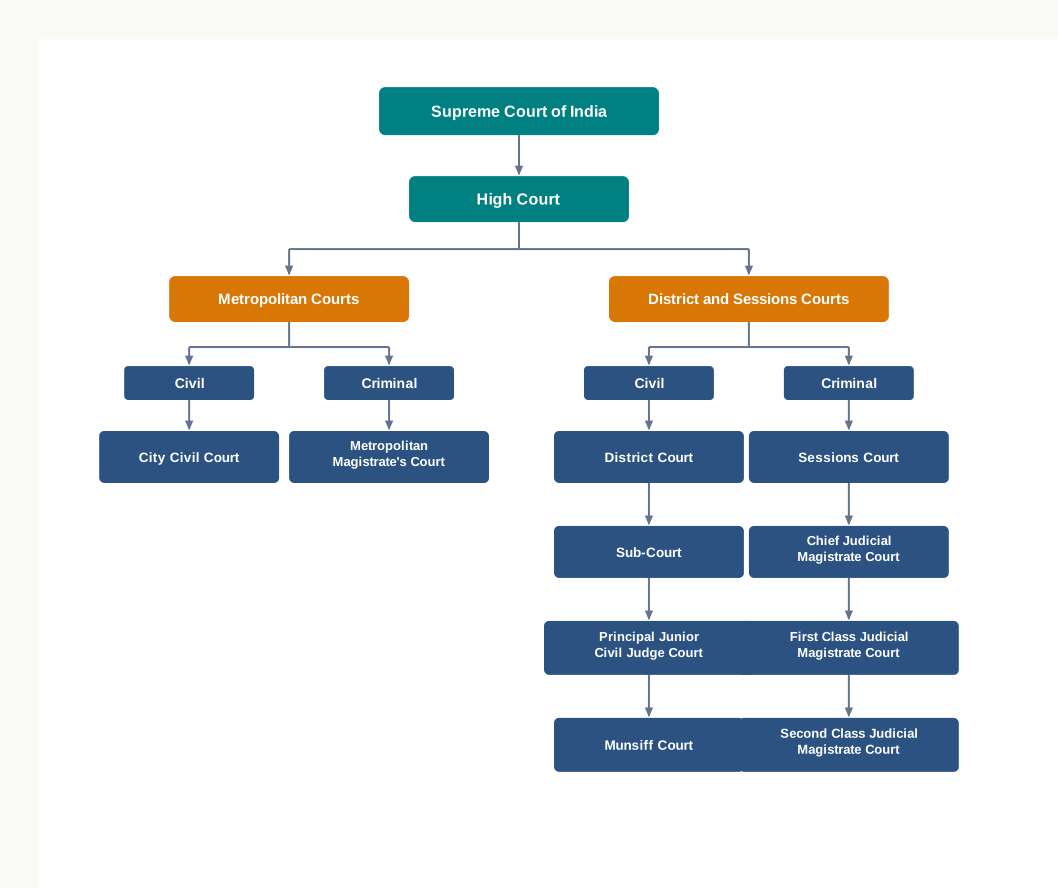
Fig. 1.1 – Hierarchy of courts in India.
1.1.1 The Supreme Court of India
The Supreme Court of India came into being on 28 January 1950, two days after the Constitution took effect. It replaced two institutions of the colonial era that had stood at the apex of the Indian court system: the Federal Court of India, and the Judicial Committee of the Privy Council, which had sat in London and heard final appeals from India.
That second replacement mattered a great deal. Until 1950, the last word on an Indian dispute could be spoken by judges sitting several thousand kilometres away, appointed by a foreign government. From 1950, the last word belonged to a court in New Delhi, established by a Constitution that Indians had given themselves.
The Constitution as it stood in 1950 provided for a Supreme Court with a Chief Justice and seven judges — eight in all. The framers did not fix this number permanently. They granted Parliament the power to increase the strength of the Court as the volume of work grew, so that the size of the Court could follow the needs of the country without requiring a constitutional amendment each time.
Parliament has used that power repeatedly. At present the sanctioned strength of the Supreme Court is 34 judges, including the Chief Justice of India.
1.1.2 High Courts
India has 25 High Courts at the State and Union Territory level. A High Court may have jurisdiction over a single State, over a Union Territory, or over a group of States and Union Territories together — the Bombay High Court, for instance, covers Maharashtra along with Goa and certain Union Territories.
The word jurisdiction will recur constantly in this chapter, so fix its meaning now. Jurisdiction is simply the legal authority of a court to hear and decide a particular matter. A court without jurisdiction over your dispute cannot help you, however strong your case may be.
Below each High Court lies a hierarchy of lower courts, functioning as civil courts and criminal courts, along with the specialised tribunals.
The Madras High Court at Chennai, the Bombay High Court at Mumbai, the Calcutta High Court at Kolkata and the Allahabad High Court at Allahabad are the first four High Courts in India. The Andhra High Court and the Telangana High Court are the newest, established on 1 January 2019 in accordance with the Andhra Pradesh Reorganisation Act, 2014.
1.1.3 District and Subordinate Courts
The courts that function below the High Courts are popularly known as the subordinate judiciary. They comprise the district courts and the subordinate courts.
Each State is divided into judicial districts, and each judicial district is presided over by a District and Sessions Judge. This is one officer wearing two labels. The same judge is called a District Judge when presiding over a civil case, and a Sessions Judge when presiding over a criminal case. Where the district court sits in a city that the State government has designated a metropolitan area, the judge is called a Metropolitan Sessions Judge. Depending on the workload of the district, District Judges may work alongside Additional District Judges.
The District Judge is the highest judicial authority below a High Court judge. The district court is not only a court of first instance; it also holds appellate jurisdiction over the subordinate courts below it, meaning it can hear appeals against their decisions, and it exercises supervision over them.
Below the district court, the courts on each side run in their own ladder. On the civil side, in ascending order, they are the Junior Civil Judge Court, the Principal Junior Civil Judge Court and the Senior Civil Judge Court (also called sub-Courts). On the criminal side, in ascending order, they are the Second Class Judicial Magistrates Court, the First Class Judicial Magistrate Court and the Chief Judicial Magistrate Court.
Apart from the subordinate courts, District Munsiff Courts also form part of this hierarchy. They are the lowest in order among courts handling matters of a civil nature and function below the subordinate courts. They are usually controlled by the District Court of the respective district.
Every civil court in this ladder can hear money claims only up to a certain value. That limit is called its pecuniary limit, and these limits are notified by the respective State Governments. This is why a small claim over an unpaid deposit does not begin in the High Court and a large commercial dispute does not begin in a Munsiff Court — the value of the claim itself decides where the case must start.
1.2 Salient Features of the Indian Judiciary
Two features shape the Indian judiciary more than any others. The first concerns where our law comes from. The second concerns how a case is actually conducted once it reaches a courtroom. Both were inherited from British practice, and both explain a great deal about why Indian courts behave the way they do.
1.2.1 India as a Common Law Jurisdiction
Taking its precedence from the British tradition of common law, India has adopted a similar model. Under this scheme, the decisions, orders and judgments developed by judges help in the creation and development of laws and legal principles.
The key consequence is this: a judgment is not merely the settlement of one dispute between two parties. Once a higher court decides a point of law, that decision becomes a binding precedent for all subordinate courts in the hierarchy. The next judge faced with the same legal question is not free to start afresh — she must follow what the higher court has already laid down.
Consider why a legal system would want this. If every judge could decide the same question differently, two people in identical situations could receive opposite results depending on which courtroom they walked into. Precedent removes that arbitrariness. It also lets a citizen — and her lawyer — predict with some confidence what the law will do, which is what makes it possible to plan one’s affairs at all.
Precedent does something else as well. Legislatures cannot foresee every situation, and there are gaps in the law where no statute speaks. There are also situations where a law is needed but the legislature or the executive has simply not acted. Courts play a vital role in creating law in precisely those spaces. Thus, apart from administering civil and criminal justice, courts and judges serve a vital function in the federal set-up of the country.
Opposed to this model is the civil law system, followed in countries such as Germany, Russia and Continental Europe. The main difference between common law and civil law is with respect to the source of law. Under common law, the judiciary can make law through the judicial decisions of courts. Under civil law, only the legislature or the executive has the power to create laws and rules; the judge’s task is confined to applying the written code to the facts.
This salient feature — India’s following of a common law model — further strengthens the role of courts in India. It is the reason a Supreme Court judgment can change the legal position of the entire country overnight, without Parliament passing a single line of new law.
1.2.2 Adversarial Model of Dispute Resolution
Courts in India follow the adversarial system of adjudication, as opposed to the inquisitorial model followed in several civil law countries.
In an adversarial model, the role of the lawyers representing the parties becomes vital. Lawyers of the opposing parties present their cases before a neutral judge, who in turn provides a decision based on the merits of the case as presented by the lawyers. The judge does not go looking for evidence. She sits as an umpire between two contesting versions of the truth, and decides which side has made out its case on the material placed before her.
The reasoning behind this arrangement is that a judge who has personally investigated a matter may find it difficult to remain neutral about what her own investigation turned up. Keeping the judge away from the gathering of evidence is meant to keep her impartial when the time comes to weigh it.
In the inquisitorial system, on the other hand, judges are far more pro-active in adjudicating the matter. Rather than acting as neutral judges, they have the right to inquire and probe into the matter, much like the police. Here the role of the lawyers representing the parties and the role of the judge cumulatively become important in determining the manner in which a civil case or a criminal trial proceeds.
The choice of model has a direct effect on what a student of law must learn to do. In an adversarial system, a case is won or lost on how well the relevant facts are identified, marshalled and argued. A point that is never raised is a point the judge will usually never consider — which is why the ability to spot the legally relevant fact in a mass of ordinary facts is the single most valuable skill this subject can teach you.
1.3 Legal Officers in India
The government is not only the maker and enforcer of law; it is also, very often, a party to litigation. It is sued by citizens, it prosecutes offenders, it defends its own legislation in court, and it constantly needs advice on whether what it proposes to do is lawful at all.
For this reason, certain legal offices exist at the Union and State level to advise the executive wing of the government. These law officers derive their mandate either from the Constitution itself or from other statutory enactments and rules.
Note the distinction carefully, because examiners test it. A judge decides disputes; a law officer advises and represents one of the parties — the government. The two roles are entirely separate, even though both are filled by senior members of the legal profession.
1.3.1 Attorney General of India
The Attorney General is the first legal officer of the country.
The Attorney General of India is appointed by the President of India under Article 76 of the Constitution, which states that he can hold office during the pleasure of the President. The Attorney General must be a person qualified to be appointed as a Judge of the Supreme Court — that is, a person possessing adequate legal practice, or one who has served as a judge for the duration the Constitution requires.
The first Attorney General of India was M. C. Setalvad.
The words during the pleasure of the President are worth pausing on. They mean the office carries no fixed tenure and no security of tenure of the kind judges enjoy. This is deliberate. The Attorney General is the government’s own lawyer, and a government must be able to choose counsel it trusts. It is precisely because this office is not independent of the executive that the independence of the judiciary — dealt with in the next section — has to be protected so carefully.
Duties and powers
The Attorney General gives advice to the Government of India upon such legal matters as are referred or assigned to him by the President. He also performs such other duties of a legal character as are referred or assigned to him by the President, or conferred on him by or under the Constitution or any other law.
In the performance of his official duties, the Attorney General has the following rights:
- He has the right of audience in all courts in the territory of India — that is, he may appear and argue before any court in the country.
- He has the right to speak in, or to take part in the proceedings of, both the Houses of Parliament and their joint sittings, but without a right to vote.
- He has the right to speak in, or to take part in the meeting of, any committee of Parliament of which he is named a member, but again without a right to vote.
- He enjoys all the privileges and immunities that are available to a member of Parliament.
The pattern in points (b) and (c) tells you what the office is for. The Attorney General may be present in Parliament and may speak there, because Parliament may need legal guidance while it is legislating. He may not vote, because he is not an elected representative. He advises the law-making process; he does not participate in the political decision itself.
In the discharge of his functions, the Attorney General is assisted by a Solicitor General and four Additional Solicitors General. The positions of the Solicitor General and the Additional Solicitors General are not recognised in the Constitution. They are governed instead through rules enacted by Parliament — which is an example of a legal office deriving its mandate from statute rather than from the Constitution, as mentioned at the start of this section.
1.3.2 Advocate General
Similar to the Attorney General of India, the position of Advocate General exists at the State level. An Advocate General is a senior law officer who acts as legal adviser to the State Government.
According to Article 165 of the Constitution, the Advocate General is appointed by the Governor of the respective State. The Advocate General is the chief legal advisor of the State and performs duties of a legal character, including representing the State before the courts, either through himself or herself or through the law officers or pleaders appointed by the State.
The qualification required for appointment as an Advocate General is similar to that of a judge of a High Court. The office of an Advocate General is held during the pleasure of the Governor, who also determines the nature of the remuneration for the Advocate General.
Additional Advocate Generals are also appointed to assist the office of the Advocate General.
If a question asks you to name two constitutional offices whose function is to advise and represent the government on legal matters, these two are the answer — and the marks lie in citing Article 76 and Article 165 alongside the names.
1.4 Independence of the Judiciary
The judiciary in India derives its powers and functions from the Constitution, which till date remains the fundamental legal text for the functioning of Indian democracy. Every power a court exercises — to hear a case, to strike down a law, to order a government to act — can be traced back to a provision of that document.
Article 50 of the Indian Constitution lays down the rule of independence of the judiciary, directing that the judiciary be kept separate from the executive. It is a Directive Principle of State Policy, which means it is a standing instruction to the State rather than a right a citizen can enforce in court — but the entire structure of protections described in this section has been built around it.
Independence of the judiciary is understood as the judiciary’s autonomous status, separate from the executive and legislative wings of the government. It helps in the maintenance of the rule of law, ensures good governance, and creates a free and fair society.
The independent status of the judiciary and the roles to be performed by it can be understood as two sides of the same coin. The judiciary is given certain tasks; independence is what makes those tasks possible. Take the independence away, and the roles collapse — a court that can be punished for its judgments cannot honestly deliver them.
1.4.1 Why the Judiciary is Given a Special Status
First, the judiciary is the watch-dog of a democracy. It monitors and maintains the checks and balances over the other arms of the government. The judiciary emerges as a mediator whenever any organ of the government exercises ‘excess power’ that tends to violate a larger societal interest or an individual interest.
Consider the police. The Indian police have extensive powers for crime detection and for gathering evidence to prosecute criminals. It is common and entirely proper for the police to interrogate suspects in order to gather the best evidence of the crime. But such powers should not impinge upon the rights of the accused or the suspect. An accused cannot be coerced into giving a statement pointing to his or her own guilt.
The judiciary steps in exactly where these delicate interests are at loggerheads. The line between the legitimate exercise of a State organ’s power and its excess is often a thin one, and drawing that line, case by case, is what makes the role of the judiciary vital.
Second, constitutional freedoms must be interpreted by someone free of external pressure. Freedoms such as the freedom to speak in public or to assemble peacefully must be interpreted in accordance with the true constitutional philosophy, and so the judiciary has been kept free from any external pressure. This becomes particularly important when the judiciary is interpreting a conflict between the government of the day and members of civil society who have peacefully articulated their opinions on a social issue — for example, on crime against women.
Notice the difficulty here. One party to the dispute is the government itself. If the government could decide the tenure or the salary of the judge hearing that dispute, the outcome would never be free of suspicion, however honest the judge happened to be. Independence protects the credibility of the decision, not merely the comfort of the judge.
Third, the judiciary acts as the guardian of fundamental rights granted by the Constitution to every citizen. Independence of the judiciary was carved out during the formation of the Indian Constitution, at a time when India was transitioning from a feudal to a democratic order. It was done to translate the well-knit provisions of the extensive rights guaranteed under the Constitution into the lives of average citizens. Our Constitution grants us rights such as:
- Civil and political rights — for example, the right to life, and the right to freedom from discrimination based on religion, race, caste, sex or place of birth.
- Economic, social and cultural rights — for example, the freedom to practise any religion, and the protection of the interests of minorities.
An independent and impartial judiciary has empowered Indian citizens and performed this role. The clearest illustration is the expanded meaning the Court has given to Article 21, which speaks in general terms of the right to life and personal liberty.
Within that freedom, the Supreme Court has held that a street vendor has a right to carry on his trade on the streets, because selling on the street is linked to his livelihood and daily living, which is protected under Article 21. Similarly, the Supreme Court has held that those who are aged, disabled and destitute — men and women alike — have a right to food, which is most essential for their survival, and that the State has a corresponding duty to provide it.
Both of these rights have been read into the general right under Article 21. That phrase is worth understanding, because it describes how a large part of Indian constitutional law now works. The drafters did not write the words ‘livelihood’ or ‘food’ into the list of enforceable fundamental rights. The Court, interpreting what a right to life must mean if it is to mean anything at all, held that these are contained within it. They are now available to citizens as matters of right. This has been possible only through the interpretive and rule-making function of the courts in India — and in performing it, the Court is doing precisely the job it was given at the time of the drafting of the Constitution.
Fourthly, independence of the judiciary is vital for respect for due process of law.
Only an independent judiciary can make this concept operational, because due process is a demand made upon the State, and only a body outside the State’s control can enforce it. In the domain of criminal law, independence of the judiciary is linked to the granting of a fair trial to the accused. This becomes extremely important even when the accused are foreign nationals, or persons who have committed crimes against the State, such as terrorists.
That last point often surprises students, so it is worth stating plainly. A fair trial is not a reward given to people we approve of. It is the method by which a court establishes whether the accusation is true at all. Abandon it for the accused we dislike, and it ceases to be available to anyone.
Therefore, independence of the judiciary remains a vital and core principle even in a modern democracy.
1.4.2 Provisions Relating to the Judges
Independence of the judiciary is not a matter of good intentions. It rests on concrete provisions, because independence of the individual judge is what ultimately secures independence of the institution. The following legal provisions mandate a judge’s independence and impartiality.
- Security of tenure. Once appointed, judges are provided with security of tenure till they reach the age of retirement. This age remains 62 years for High Court judges and 65 years for Supreme Court judges. Judges are not allowed to practise as advocates in the same or equivalent courts after their retirement. For example, a retired High Court judge may practise in the Supreme Court, but is prevented from practising in the same or any other High Court. This ensures that ex-judges practising at the bar do not influence the decisions of a bench with whom they may have a presumed familiarity.
- Difficulty of removal. Judges cannot be easily removed from office except for proven misbehaviour and incapacity. The legal process is kept stringent precisely in order to secure the tenure of judges.
- Protected salaries. The salaries and allowances of judges are fixed and are not subject to the vote of the legislature. Judges derive their salaries from the Consolidated Fund of India in the case of the Supreme Court, and from the Consolidated Fund of the State in the case of the High Courts. Their emoluments cannot be altered to their disadvantage except in the event of a financial emergency.
- Immunity of judicial conduct from discussion. The judicial conduct of judges has been kept immune from examination by other constitutional organs. The conduct of judges of both the Supreme Court and the High Courts cannot be discussed in Parliament or in a State legislature, except when a motion for the removal of a judge is being presented to the President.
- Control over its own establishment. The Supreme Court of India has been authorised to have its own establishment and to have complete control over it. It is further authorised to make appointments of the officers and staff of the court and to determine their service conditions.
Read these five together and a single design becomes visible. Each one removes a specific lever that the executive or the legislature might otherwise have used against a judge — the threat of dismissal, the threat of a pay cut, the threat of public censure in the House, control over the court’s own staff.
Therefore one can conclude that independence of the judiciary is not a courtesy extended by the government of the day. It is a constitutionally conferred protection.
1.5 Role of the Supreme Court of India
The Indian judiciary comprises the Supreme Court, the High Courts, the subordinate courts and other tribunals. The role of these courts, along with their composition, powers and procedures for functioning, has been elaborated in the Constitution.
The Supreme Court of India primarily exercises the role of an adjudicator and an interpreter. As an adjudicator it settles disputes; as an interpreter it says what the Constitution and the laws mean. Both roles are explained through the different jurisdictions vested in the Court, and each jurisdiction answers a different question: who may come to this Court, with what, and in what circumstances.
Fig. 1.2 sets out the jurisdictions covered in this section. Keep it beside you as you read, because the differences between them are exactly what examiners test.
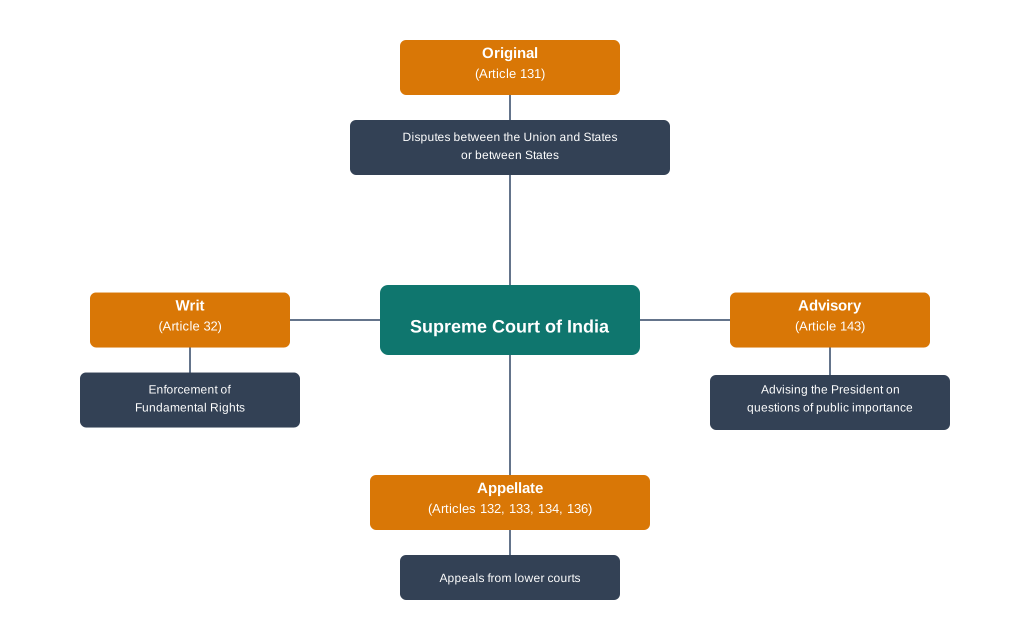
Fig. 1.2 – Jurisdictions of the Supreme Court of India.
1.5.1 Original Jurisdiction
The Supreme Court’s role as an adjudicator and interpreter can be understood first through the original jurisdiction vested in it. Original jurisdiction means the power to hear a dispute at the first instance — the case begins in the Supreme Court itself rather than travelling up to it on appeal.
Under Article 131 of the Constitution, the Supreme Court is granted original jurisdiction in disputes between the units of the Indian federation.
Read the provision carefully and three separate conditions emerge.
First, notice the words to the exclusion of any other court. No other court in India may entertain such a dispute at all. A quarrel between two State governments cannot be filed in a district court or a High Court.
Second, the dispute must involve some question of law or fact on which the existence or extent of a legal right can be adjudicated. A political disagreement between two governments, however bitter, is not enough. There must be a legal right at stake. For example, a dispute between two States over the sharing of river waters or other natural resources can be brought directly to the Supreme Court under its original jurisdiction, because each State asserts a legal entitlement to the resource.
Third, note the proviso. Disputes arising out of a treaty, agreement, covenant or similar instrument executed before the commencement of the Constitution and still in operation are excluded, as are disputes under instruments that themselves say this jurisdiction shall not apply. A proviso like this one is where marks are usually lost — students state the rule and forget that the Constitution itself carves an exception out of it.
1.5.2 Writ Jurisdiction under Article 32
Article 32 of the Constitution gives the Supreme Court a further and extensive original jurisdiction: the enforcement of the fundamental rights of citizens through directions, orders and writs. This is popularly known as the writ jurisdiction of the Court.
The Court is empowered to issue directions, orders or writs, including writs in the nature of habeas corpus, mandamus, prohibition, quo warranto and certiorari, to enforce fundamental rights.
Why does the Constitution place this power in Part III itself, alongside the rights? Because a right without a remedy is merely a promise. If your fundamental right is violated and no court can be moved quickly to undo the violation, the right exists on paper and nowhere else. Article 32 gives every person a direct route to the highest court in the country for that single purpose.
1.5.3 Appellate Jurisdiction
Appellate jurisdiction is the power to hear an appeal against the decision of a lower court. Ordinarily, the appellate jurisdiction of the Supreme Court is invoked by a certificate granted by the High Court — a formal statement by the High Court that the case is fit to go up.
An appeal to the Supreme Court may be made against any judgement, decree or final order of a High Court in both civil and criminal cases. Like the exercise of original jurisdiction, these cases must involve a substantial question of law as to the interpretation of the Constitution. Substantial questions of law, as noted above, connote questions of law or fact on which the existence or extent of legal rights can be adjudicated.
Appeal in Constitutional Matters: Under Article 132(1) of the Constitution of India, an appeal shall lie to the Supreme Court from any judgment, decree or final order of a High Court, whether in civil, criminal or other proceedings, if the High Court certifies under Article 134-A that the case involves a substantial question of law as to the interpretation of this Constitution.
Appeal in Civil cases: Article 133 provides that an appeal shall lie to the Supreme Court from any judgment, decree or final order in a civil proceeding of a High Court only if the High Court certifies under Article 134-A:
- that the case involves a substantial question of law of general importance; and
- that in the opinion of the High Court the said question needs to be decided by the Supreme Court.
Both conditions must be satisfied. The word ‘and’ between them is doing real work — a question of general importance which the High Court considers it has settled adequately does not carry a certificate.
Appeal in Criminal Cases: Article 134 provides that an appeal shall lie to the Supreme Court from any judgment, final order or sentence in a criminal proceeding of a High Court. This appeal can arise in two ways: without a certificate of the High Court, and with a certificate of the High Court. An appeal lies without the certificate if the High Court:
- has on appeal reversed an order of acquittal of an accused person and sentenced him to death; or
- has withdrawn for trial before itself any case from any court subordinate to its authority and has, in such trial, convicted the accused person and sentenced him to death.
Look at what these two situations have in common: a death sentence, imposed in circumstances where the accused has effectively lost the benefit of one round of judicial opinion — either an acquittal was reversed, or the case never passed through the ordinary trial court at all. Where the stake is a human life and the ordinary layers of scrutiny have been compressed, the Constitution refuses to let access to the highest court depend on anyone’s permission.
Special Leave to Appeal: Under certain special circumstances, an appeal may lie directly to the Supreme Court from any Court in India under Article 136 of the Constitution. This is the Special Leave Petition, or Special Leave to Appeal. According to Article 136, an appeal can be made to the Supreme Court directly from any order, decision, decree or judgment given by any court or tribunal in India. This power of the Supreme Court is discretionary — the Court may or may not allow special leave to appeal to any person.
That discretion is the whole point of Article 136. It is a safety valve, not a right of appeal. It allows the Court to reach into any proceeding anywhere in the country where justice appears to have miscarried, while leaving the Court free to refuse the thousands of petitions that raise no such question.
1.5.4 Advisory Jurisdiction
The Supreme Court’s advisory jurisdiction may be sought by the President under Article 143 of the Constitution. This procedure is termed a Presidential Reference and is recognised as the ‘advisory jurisdiction’ of the Court.
Article 143 provides that if at any time it appears to the President that:
- a question of law or fact has arisen, or is likely to arise; and
- the question is of such a nature and of such public importance that it is expedient to obtain the opinion of the Supreme Court upon it,
he or she may refer the question for the advisory opinion of the Court, and the Court may, after such hearing as it thinks fit, report to the President its opinion thereon.
This jurisdiction is different in kind from everything discussed so far. There are no opposing parties, nobody has been wronged, and no relief is granted. The government is asking, in advance, whether a course it is contemplating is constitutionally sound — which can prevent an unconstitutional law from ever being enacted, and save years of litigation afterwards.
In In re Kerala Education Bill (1958), the Supreme Court laid down the following principles:
- The Supreme Court has, under clause (1) of Article 143, a discretion in the matter, and in a proper case and for good reason it may refuse to express any opinion on the question submitted to it.
- It is for the President to decide what question should be referred to the Court; and if the President does not entertain any serious doubt on the other provisions, it is not for any party to say that doubts arise out of them as well.
- The advisory opinion of the Supreme Court is not binding on courts, because it is not a law within the meaning of Article 141.
But in In re Special Courts Bill (1979), the Supreme Court held that its advisory opinions are binding on all courts in the territory of India. It also held that the Supreme Court is under a duty under Article 143 to give its advisory opinion where the questions referred to it are not vague and not of a political nature.
1.5.5 The Supreme Court as an Activist
The Supreme Court of India is considered the sentinel on the qui vive — the sentry on the alert — and protects the fundamental and constitutional rights of the people. There have been several instances where the higher courts have taken cognizance of a matter of social, political or economic importance on their own behest, or on the basis of a letter or any other submission placed before the court.
Public Interest Litigation
So far we have seen the constitutional routes that permit the Supreme Court to adjudicate and advise: disputes coming up from the subordinate courts, individuals exercising writ jurisdiction, and references from the President of India. Each of these assumes something that, for a great many Indians, is simply not true — that the person whose rights have been violated is able to reach a court herself.
In recent years, the Supreme Court has relaxed its rule of locus standi and has permitted public-spirited citizens and civil society organisations to approach the Court on behalf of victims, for better administration of justice.
The Court has also, on its own initiative, started cases of public importance, called suo motu actions. It has, for instance, summoned and reprimanded State authorities for their apathy and lack of diligence in running child care homes. All of this has been possible through the judicial activism of the Supreme Court, exercised through Public Interest Litigation. This extraordinary jurisdiction has been invoked either through writs or even by writing letters to judges, and its modalities are maintained under the guidelines for PIL laid down by the Court.
The first ever PIL in India is listed as Hussainara Khatoon v. State of Bihar, and dates back to 1979 — the case with which this chapter opened. Since then, PILs have encompassed a wide range of issues: socio-economic rights such as freedom from bonded labour; legal entitlements such as the right to food and the right to work; environmental issues such as clean air and water; and political reforms such as the disclosure of assets by members of the executive and the manner in which the government disburses natural resources.
The progress of PIL has thus come to include a great variety of subjects. Yet certain common characteristics run through these litigations:
- PILs can be termed non-adversarial litigation, in that they do not pit the interest of one party against the other. Rather than following traditional litigation of an adversary character, PILs are recognised as tools for social change.
- PILs are based on the tenets of citizen standing and representative standing, which expand the right of third parties to approach the Court.
- PIL is, from its inception, modelled on a remedial nature, aiming at a dynamic, welfare-oriented model of judiciary. PIL thus brings the Directive Principles — whose claims cannot be brought directly before the courts — into the domain of fundamental rights under Part III of the Constitution, which can be invoked before the courts as a matter of right by citizens. In this way PILs create new rights and laws within the realm of the State, and democratise the citizen’s access to justice, thereby strengthening democracy in India.
- PIL further strengthens the role of the judiciary as a monitor and watch-dog agency. The fear of being dragged to court through a PIL has improved the quality of several social institutions in the country, such as jails, protective homes and mental asylums.
Note how characteristic (a) sits in tension with what you learned in Section 1.2. The Indian system is adversarial; PIL is not. That is precisely why PIL was treated as extraordinary, and why the Court had to lay down guidelines to control it.
However, with the advent and growth of PILs, they have also been misused for private gains, and have led to frivolous litigation on unnecessary issues. They have also been criticised for judicial over-reach — for the judiciary stepping into the shoes of the legislature.
‘Suo motu’ action
Suo motu is a Latin term which means ‘on its own motion’.
Suo motu power allows a court to initiate legal action on its own cognizance of a matter, without any petition being filed or any interest being brought before it. Courts have initiated proceedings on the basis of media reports, telegrams and letters received from aggrieved people, taking suo motu cognizance of the issue.
One of the most prominent forms of India’s suo motu power is the power to punish for contempt of court under Article 129 of the Constitution of India and the Contempt of Courts Act, 1971.
During the Covid pandemic, a three-judge bench of the Supreme Court took suo motu cognizance of the non-availability of mid-day meals for children caused by the closure of schools, and issued notices to all State Governments and Union Territories. The Court noticed that the non-supply of nutritional food to children, as well as to lactating and nursing mothers, could lead to large-scale malnourishment, that children and mothers in rural and tribal areas were particularly prone to it, and that such malnutrition could weaken their immune systems and make them more likely to catch the infection. In order to take control of the situation, the Court issued directions to the competent authorities to do the needful.
The courts have increasingly used this power to intervene in instances of violation of fundamental rights, or to scrutinise government action and inaction.
1.5.6 Provision of Legal Aid
An adversarial system, as you saw in Section 1.2, decides a case on the strength of what the lawyers put before the judge. That places a litigant without a lawyer at a crippling disadvantage — which is why legal aid is not charity but a structural necessity of the system.
A person is entitled to free legal aid from the Supreme Court Legal Aid Committee if he or she:
- is in receipt of an annual income of less than Rs. 5,00,000/- , where the case is before the Supreme Court; or
- belongs to a Scheduled Caste or Scheduled Tribe; or
- is a victim of a natural calamity; or
- is a woman or a child; or
- is a mentally ill or otherwise disabled person; or
- is an industrial workman; or
- is in custody, including custody in a protective home.
The aid granted by the Committee includes the cost of preparing the matter and all applications connected with it, in addition to providing an Advocate to prepare and argue the case.
Persons belonging to the middle income group — that is, citizens whose gross income does not exceed Rs. 12,00,000/- per annum — are eligible to get legal aid from the Supreme Court Middle Income Group Legal Aid Society, on nominal payments. The scheme is self-supporting: the applicant pays a service charge and a fee fixed by a schedule, which is far below what the same counsel would ordinarily cost.
The two schemes together answer a practical difficulty. Free legal aid reaches those below the income ceiling, and a litigant comfortably able to pay hires counsel in the ordinary way — but between the two lies a large group who are neither poor enough for free aid nor able to afford Supreme Court litigation. The Middle Income Group Scheme exists for exactly that gap.
1.5.7 Amicus Curiae
Amicus curiae, literally translated from Latin, means ‘friend of the court’.
If a petition is received from a jail, or in any other criminal matter where the accused is unrepresented, an Advocate is appointed as amicus curiae by the Court to defend and argue the case of the accused. In civil matters too, the Court may appoint an Advocate as amicus curiae if it thinks it necessary in the case of an unrepresented party. The Court can also appoint an amicus curiae in any matter of general public importance, or in which the interest of the public at large is involved.
Notice the difference from an ordinary lawyer. An amicus curiae is appointed by the Court and assists the Court; the party has not hired her and does not instruct her. The purpose is to ensure that the judge hears both sides of an argument properly presented, because in an adversarial system a case argued on one side only is a case decided on half the material.
1.6 Role of the High Courts and Lower Courts
The High Courts function as organs of judicial administration at the State level. Similarly, the lower courts function as centres of civil and criminal justice at the district level. The lower courts, as explained in Section 1.1, comprise the district and subordinate courts.
Courts of first instance and courts of appeal
District Courts are usually courts of first instance — the courts where litigants first come with their disputes. As you have already seen, these courts have set territorial and pecuniary limits when accepting cases of a civil nature. A similar hierarchy exists in the criminal courts at the subordinate level.
Once matters are adjudicated by these courts, they proceed to the High Courts on appeal.
This produces a division of labour that runs through the whole system and is worth fixing firmly in mind. Subordinate courts are mainly vested with the establishment of facts. The appellate courts deal with the interpretation of statutes and the correct application of law.
Why divide the work this way? Because the two tasks need different things. Deciding what actually happened requires hearing witnesses, watching them testify and examining documents first-hand — which only the trial court is placed to do. Deciding what the law means requires consistency across the whole country, which only a court sitting above the trial courts can supply. This is also why an appellate court will rarely disturb a finding of fact but will readily correct a finding of law.
Fig. 1.3 sets out what each level of the hierarchy can do.
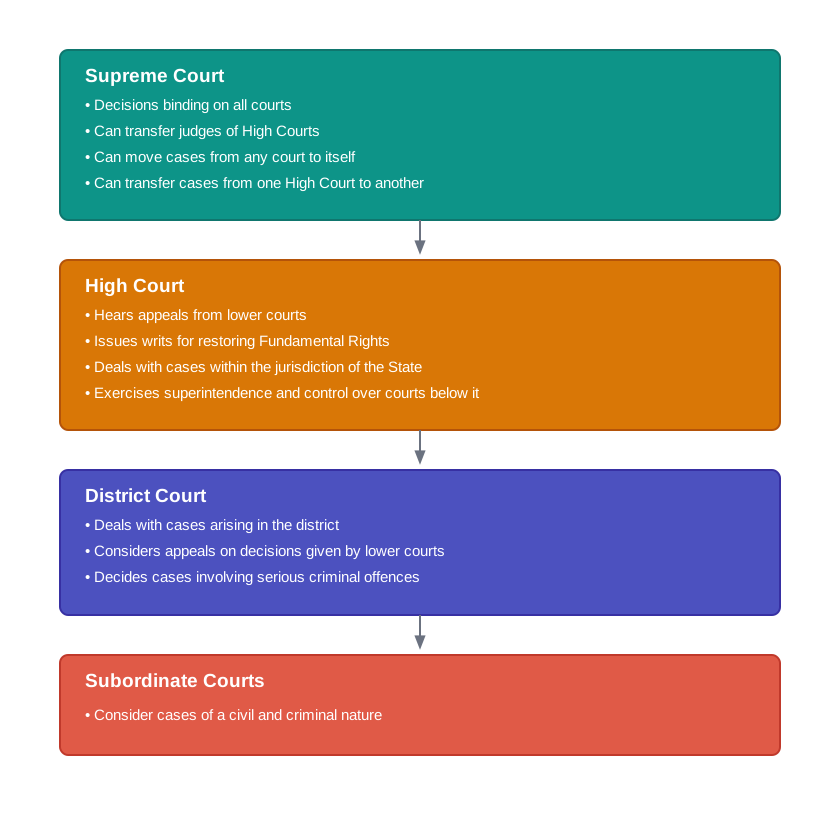
Fig. 1.3 – Powers at each level of the judicial hierarchy.
Writ jurisdiction of the High Courts
The High Courts have the power to issue, within their jurisdiction, directions, orders or writs — including writs in the nature of habeas corpus, mandamus, prohibition, quo warranto and certiorari — for the enforcement of Fundamental Rights and for any other purpose. This power is conferred by Article 226 of the Constitution.
This writ jurisdiction is similar to that of the Supreme Court of India, and the five writs are the same five you met in Section 1.5. But the closing words of Article 226 make the High Court’s power wider in one important respect, and that difference is a favourite of examiners.
The role of the High Court also becomes similar to that of the Supreme Court in the exercise of public interest litigation — a High Court may likewise entertain a PIL from a public-spirited person within its jurisdiction.
Power of superintendence
Each High Court has powers of superintendence over all courts within its jurisdiction. In exercise of this power it can:
- call for records from such courts;
- make and issue general rules, and prescribe forms, to regulate their practice and proceedings; and
- determine the manner and form in which book entries and accounts shall be kept.
Superintendence is administrative supervision, not appeal. A litigant does not invoke it; the High Court exercises it on its own, to keep the courts below it functioning properly. It is what makes the district judiciary of a State a system rather than a collection of unconnected courtrooms.
Courts of record
The Supreme Court and the High Courts are called courts of record.
The expression carries two distinct powers, and it is a common error to remember only one of them.
As a Court of Record, the Supreme Court has two powers:
- Its judgements, proceedings and acts are recorded for perpetual memory and testimony. These records are admitted to be of evidentiary value and cannot be questioned when produced before any court. They are recognised as legal precedents and legal references.
- It has the power to punish for contempt of court, either with simple imprisonment for a term up to six months, or with a fine, or with both.
As a Court of Record, the High Court has two powers:
- Its judgements, proceedings and acts are recorded for perpetual memory and testimony. These records are admitted to be of evidentiary value and cannot be questioned when produced before any subordinate court. They are recognised as legal precedents and legal references.
- It has the power to punish for contempt of court, either with simple imprisonment, or with a fine, or with both.
1.7 Appointment of Judges
Everything said in Section 1.4 about judicial independence depends on one prior question: who chooses the judges? A court cannot be independent of the executive if the executive alone decides who sits on it. This section deals with what the Constitution says about appointment, and then with what actually happens in practice — and the gap between the two is one of the most interesting features of Indian constitutional law.
1.7.1 The Constitutional Mandate
The method of appointment of judges to the Supreme Court, the High Courts and the District Courts is enshrined in the Constitution of India.
Judges of the Supreme Court
According to Article 124 of the Constitution, every judge of the Supreme Court shall be appointed by the President after consultation with such of the Judges of the Supreme Court and of the High Courts in the States as the President may deem necessary. The Article also provides that in the case of the appointment of a judge other than the Chief Justice of India, the Chief Justice must be consulted.
The Article further provides the qualifications required to become a judge of the Supreme Court. A person must satisfy the first condition and any one of the three that follow:
- Citizenship of India; and
- has been for at least five years a Judge of a High Court, or of two or more High Courts in succession; or
- has been for at least ten years an advocate of a High Court, or of two or more such Courts in succession; or
- is, in the opinion of the President, a distinguished jurist.
Clause (d) is worth pausing on. It allows a person who has never been a judge and never practised as an advocate — a legal scholar, for instance — to be appointed directly to the highest court in the country. The framers wanted the door left open for exceptional legal minds who had spent their careers in the study rather than in the courtroom.
Judges of the High Courts
Similarly, the procedure for the appointment of judges of the High Courts is enshrined in Article 217 of the Constitution. This Article prescribes that every Judge of a High Court shall be appointed by the President after consultation with the Chief Justice of India and the Governor of the State; and, in the case of the appointment of a Judge other than the Chief Justice, the Chief Justice of the High Court concerned.
The qualifications of a High Court judge are:
- Citizenship of India; and
- has for at least ten years held a judicial office in India; or
- has for at least ten years been an advocate in a High Court, or of two or more such Courts in succession.
District Judges
For the district and subordinate courts — the lower judiciary in India — the procedure for appointment is mentioned in Article 233 of the Constitution. The appointment of district judges in any State shall be made by the Governor of the State in consultation with the High Court exercising jurisdiction in relation to that State.
The qualifications for appointment as District Judge are:
- being a member of the judicial service of the State; or
- being a person who has had a minimum of seven years of practice as a lawyer at the bar.
Notice that the High Court must be consulted even though the appointment is made by the Governor. That consultation is not a formality — it is the point at which the judiciary is given a say over entry into its own lower ranks, and it is a small but real instance of the separation the Constitution is trying to maintain.
1.7.2 Current Practice in the Appointment of Judges
Despite a clear constitutional mandate, the appointment of judges in practice remains a complex process. At present, appointments to the Supreme Court and the High Courts follow the collegium model — a judicial creation, developed through case law, which is not constitutionally mandated.
How did a system that appears nowhere in the constitutional text come to govern appointments to the highest courts? The answer lies in a long tussle between the executive and the judiciary.
The origin of the tussle
The issue of appointment has always been linked to the independence of the judiciary. As early as 1958, the 14th Law Commission Report, under the chairmanship of M. C. Setalvad — India’s first Attorney General, whom you met in Section 1.3 — noted that the executive was appointing or rejecting judges contrary to what the judiciary had suggested, creating awkward situations. The report highlighted that several appointments were being made on political, regional, communal or other grounds, with the result that the fittest candidates were never appointed. The Commission therefore suggested strengthening the process of consultation between the executive and the judiciary.
The heart of the dispute is a single word in Article 124: consultation. Does consulting the Chief Justice mean merely asking his view before doing as one pleases, or does it mean being bound by that view? Three decisions of the Supreme Court, popularly known as the Three Judges Cases, answered that question — and answered it differently each time.
The Three Judges Cases
- The First Judges case (1981) gave primacy to the Executive. It held that the Chief Justice of India’s recommendation to the President could be refused for cogent reasons. This gave vast powers to the Executive in making judicial appointments for the next twelve years.
- The Second Judges case (1993) modified this position. The judgment held that the Chief Justice of India has primacy in the matter of appointments to the Supreme Court and the High Courts, and that an appointment ‘has to be in conformity with the final opinion of the Chief Justice of India’, while emphasising the desirability of the Chief Justice consulting other judges. The executive element in the appointment process was reduced to a minimum and political influence eliminated. This decision, rendered by a nine-judge bench, was supported by only five judges; the other four did not concur with the majority opinion. The years that followed witnessed some confusion in the process of appointment, as the Chief Justice made some unilateral appointments and the role of the President was reduced to a mere approval.
- The Presidential reference of 1998 — the 1998 advisory decision — emphasised the role of ‘consultation’ and held that the process of appointment of judges to the Supreme Court and the High Courts is an ‘integrated participatory consultative process’. The Chief Justice of India firms up his opinion after consultation with a plurality of judges; his opinion is formed by a body of senior judges.
Trace the movement across the three decisions and you can see the collegium being built. In 1981 the executive decided. In 1993 the Chief Justice decided. In 1998 the Court settled on something in between the two — not one judge’s opinion and not the government’s preference, but the collective view of a group of senior judges, formed through a defined consultative process. That group is the collegium.
The Collegium System for Supreme Court Judges
Under the collegium model for the appointment of judges of the Supreme Court, the Chief Justice of India consults the four senior-most judges of the Supreme Court.
The Collegium System for High Court Judges
For High Courts, the collegium comprises the Chief Justice of the High Court and the two senior-most judges of that High Court.
Appointment of the Chief Justice of India
The Chief Justice of India is the senior-most judge of the Supreme Court. Seniority is determined on the basis of the date of appointment to the Supreme Court. If two judges are appointed to the Court on the same day, the judge who takes the oath first is the senior judge.
The seniority principle. According to this principle, the senior-most judge of the Supreme Court is appointed as the Chief Justice of India. The principle is an unwritten convention, called the ‘seniority principle’ in legal, academic and judicial parlance. It aims to safeguard the judiciary’s independence from any sort of political interference.
The logic is simple and rather elegant. If the next Chief Justice is decided by a rule that nobody can influence — the calendar — then no judge has any reason to please the government in the hope of promotion, and the government has no lever to offer.
The Constitution of India, under Article 124(2), grants power to the President of India to appoint, in consultation with the outgoing Chief Justice, the next Chief Justice, who will serve until reaching the age of sixty-five or being removed by impeachment. As per convention, the name suggested by the incumbent Chief Justice is almost always that of the next senior-most judge in the Supreme Court. The suggestion is forwarded by the Union Law Minister to the Prime Minister, who then advises the President.
Appointment of Chief Justices of the High Courts
The Chief Justice of a High Court is appointed in accordance with the policy of having Chief Justices from outside the respective States — a practice meant to insulate the head of a State’s judiciary from local pressures and associations.
The Collegium takes the call on the elevation. High Court judges are recommended by a Collegium comprising the Chief Justice of India and the two senior-most judges. The proposal, however, is initiated by the outgoing Chief Justice of the High Court concerned, in consultation with two senior-most colleagues. The recommendation is sent to the Chief Minister, who advises the Governor to send the proposal to the Union Law Minister.
1.8 Retirement and Removal of Judges
A judge leaves office in one of two ways. Either she reaches the age the law fixes for retirement, or she is removed. The first is automatic and requires nobody’s decision. The second is deliberately made so difficult that it has never been carried through to completion in the history of independent India — and, as Section 1.4 explained, that difficulty is itself a guarantee of judicial independence.
1.8.1 Retirement of Judges
The retirement age for a Supreme Court judge is 65 years. Similarly, a High Court judge continues in office till the retirement age, which is 62 years. The age of retirement of District Court judges is determined by their respective State Governments under special service rules.
Two proposals to raise these ages deserve mention:
- The Venkatachaliah Report — the Report of the National Commission to Review the Working of the Constitution, 2002 — recommended that the retirement age of the judges of the High Courts should be increased to 65 years, and that of the judges of the Supreme Court to 68 years.
- The Constitution (114th Amendment) Bill was introduced in 2010 to increase the retirement age of High Court judges to 65. However, it was not taken up for consideration in Parliament and lapsed with the dissolution of the 15th Lok Sabha.
The argument for raising the retirement age
Several reasons have been advanced for increasing the retirement age of judges in India:
- The judge-population ratio in India is among the lowest in the world. It is necessary to increase the number of judges in the pool to enable the judiciary to deal with the enormous pendency of cases.
- Legislations already provide for retired High Court and Supreme Court judges to man tribunals till the age of 70 as chairman and 65 as members. If a retired judge is considered fit to head a tribunal at 68, there is no obvious reason why the same judge should have been retired from the court at 62.
- One aspect that has not been factored in is that as the Indian economy grows, the ratio of litigation to population will increase exponentially. Advanced economies such as Australia, Canada, France, the United States, the United Kingdom and Japan have much higher litigation-to-population ratios.
- Several senior lawyers with the requisite expertise and experience decline to accept judgeship because of the lower retirement age of 62, especially in the High Courts. With an enhanced age, this problem could be rectified, as advocates would have a greater incentive to give up their individual legal practice and take up the role of a judge.
- The relatively early retirement age in India is often linked to the declining quality of judicial service and to the inability of a judge to properly effectuate the stipulated judicial workload.
Positive consequences
Raising the retirement age is said to bring the following benefits:
- Senior serving judges will bring with them years of experience.
- It will ensure the continued presence of a strong talent pool of experienced judges.
- New judges can be appointed without displacing existing judges.
- It will address the problem of mounting arrears.
- It will be a buffer against the impending litigation explosion.
- It will render post-retirement assignments unattractive and, as a consequence, strengthen the rule of law and the independence of the judiciary, both of which are crucial to sustaining democracy.
Point (f) repays a moment’s thought, because it connects directly to Section 1.4. A judge who retires at 62 with many working years ahead of her may reasonably hope for a post-retirement appointment — and such appointments are usually in the gift of the government. The concern is not that any particular judge is influenced, but that the arrangement creates an opening for influence at all. A longer tenure on the bench narrows that opening.
Way forward
India faces the perennial issue of a backlog of cases, and increasing the age of judges will certainly help in addressing it. The retirement age of judges of the Supreme Court and the High Courts could be increased, but with the option of quitting before reaching the age of superannuation — a practice prevailing in Zimbabwe, where a top court judge is appointed to retire at 65 but may opt to continue till 70.
Moreover, merely increasing the retirement age of judges is not a solution to the problems of the Indian judiciary. Other issues must also be addressed: the lack of transparency, particularly in the appointment of judges; the position of undertrials among the accused; and the lack of information and interaction between people and the courts.
1.8.2 Removal of Judges
Judges of the Supreme Court and the High Courts can be removed through a process called impeachment. The process for removal is the same for both the Supreme Court and the High Courts.
Article 124(4) enshrines the guidelines for the removal of a sitting Supreme Court judge. The procedure for removal of a Supreme Court judge is guided by Article 124(4) of the Constitution of India and by the Judges (Inquiry) Act, 1968. Article 218 of the Constitution of India provides for the impeachment of High Court judges.
Judges can be removed on two grounds only:
- incapacity; and
- proven misbehaviour.
Read that definition against the grounds. Political disagreement with a judgment is not a ground. An unpopular decision is not a ground. Nothing short of proved misbehaviour or incapacity will do — which is exactly what makes it safe for a judge to decide against the government of the day.
The procedure
Look closely at step (d). Two majorities are required in each House, not one. A motion may command a majority of everyone present and still fail, if that number falls short of half the total membership of the House. A question that turns on this double requirement is a standard way of testing whether a student has read the provision or merely memorised the phrase ‘two-thirds majority’.
Removal of judges at the district level
As to the removal of judges in the lower judiciary, a District Judge or an Additional District Judge can be removed from office by the State Government in consultation with the High Court.
That record tells you something important. In several of these instances the judge resigned before the process could run its course. The procedure has therefore functioned less as a punishment actually inflicted than as a standing pressure — which is close to what a constitutional safeguard is meant to be.
1.9 Tribunals
Section 1.1 mentioned, in passing, that specialised tribunals exist alongside the courts to decide sector-specific claims. This section takes up what they are, where they come from, and why a country that already has a complete hierarchy of courts felt the need to create them.
What are tribunals?
Tribunals are semi-judicial bodies involved in dispute resolution. They function as semi-judicial or quasi-judicial bodies because they consist of administrative officers, or of judges without a legal background, rather than exclusively of judges. Yet they function in a judicial capacity: they hear relevant legal matters and settle claims between the parties. They complement and supplement the role of courts in maintaining law and justice in society.
Note the word supplement carefully. It is the word the Constitution’s scheme depends on. Tribunals are not a parallel judiciary and they are not a substitute for courts; they take a defined category of disputes off the courts’ hands so that both can work faster.
Constitutional basis
Tribunals were not part of the original Constitution. They were incorporated into the Indian Constitution by the 42nd Amendment Act, 1976.
- Article 323-A deals with Administrative Tribunals.
- Article 323-B deals with tribunals for other matters.
The 42nd Amendment Act thus ushered in the era of the ‘tribunalisation of the Indian judiciary’. Further, the enactment of the Administrative Tribunals Act, 1985 took the constitutional objective forward and set up the Central Administrative Tribunal (CAT) and the State Administrative Tribunals.
The CAT was set up pursuant to the Act of the legislature in 1985. These tribunals exercise jurisdiction over the service matters of the employees covered by the Act — questions of promotion, transfer, seniority, disciplinary action and similar disputes between government employees and their employer. Appeals against the orders of the administrative tribunals lie before the Division Bench of the concerned High Court.
Under Article 323-B, Parliament and the State legislatures are authorised to provide for the establishment of tribunals for the adjudication of disputes relating to the following matters:
- taxation;
- foreign exchange and export;
- industrial and labour disputes;
- land reforms laws;
- ceiling on urban property;
- election disputes of members of Parliament and State legislatures;
- production, procurement, supply and distribution of foodstuffs and essential goods;
- rent and tenancy issues.
Run your eye down that list and the common thread appears: every item is a field where disputes arise in very large numbers and turn on technical knowledge — tax computation, industrial relations, tenancy records. These are precisely the disputes that clog an ordinary court and that a specialised body can decide faster and better.
Why tribunals work faster
The tribunals are procedurally flexible, and this flexibility increases their efficiency. For example, the Administrative Tribunals Act, 1985 allows aggrieved persons to appear directly before the tribunals — that is, without engaging a lawyer, which is itself a considerable saving of cost and time.
The overall objectives of the tribunals are to provide speedy and inexpensive justice to litigants. Since the government is a major litigant in the courts, and government-related litigation has added to the delay and pendency of cases, tribunals over the past two decades have significantly contributed to supplementing the role of the courts in the adjudication of service disputes.
The tribunals, however, are not meant to replace the courts.
Tribunals in operation
Tribunals have been constituted either under a specific constitutional mandate enshrined in the Constitution of India, or through legal enactments — that is, a law passed by the legislature. Their creation aims at increasing efficiency in resolving disputes and reducing the burden on the courts. Examples include:
- the Central Administrative Tribunal (CAT), for resolving the grievances and disputes of central government employees;
- the State Administrative Tribunals (SAT), for State government employees;
- the Telecom Dispute Settlement Appellate Tribunal (TDSAT), for resolving disputes in the telecom sector in India; and
- the National Green Tribunal (NGT), for disputes involving environmental issues.
Some of these tribunals function alongside regulators. Regulators are specialised government agencies that oversee compliance with the law in the relevant government sectors. For example, TDSAT functions alongside the regulator TRAI — the Telecom Regulatory Authority of India — in formulating rules and policy for resolving telecom disputes in India.
The distinction is worth keeping straight: a regulator frames and enforces the rules for a sector, while a tribunal decides disputes that arise under them.
1.10 Courts and Judicial Review
The powers of judicial review allow the judiciary to safeguard the checks and balances between the organs of government, and to ensure the separation of powers of the other two branches. Courts have the power of judicial review to declare a law unconstitutional if it has been enacted in breach of that demarcation.
Put plainly: a legislature may pass a law, and a court may then hold that the law is void because the Constitution did not permit it to be passed. That is an extraordinary power for an unelected body to hold over an elected one, and its origin is worth knowing.
Where the idea came from
The concept dates back to a landmark decision of the Supreme Court of the United States, delivered in 1803, in which Chief Justice John Marshall applied the principle for the first time. It later became one of the most important judicial principles in the world.
The reasoning behind judicial review is easier to grasp once you see the alternative. If a Constitution says that Parliament may not pass a certain kind of law, and Parliament passes it anyway, someone has to decide whether the Constitution or the statute prevails. If nobody can decide, then the limits written into the Constitution are advice rather than law. Judicial review makes them law.
The meaning of judicial review
The extent of the power varies between countries.
- In some countries, such as the United States, France and Canada, judicial review allows the court to invalidate or nullify a law, or an act of the legislature or the executive, if it is found to be contrary to the constitution.
- In the United Kingdom, judicial review powers are restricted; the courts do not have the authority to nullify or invalidate legislation passed by Parliament.
- Other countries may place different kinds of restrictions on their courts, and may allow review of only one branch of government.
Judicial review in the Indian scheme
India, which is based on the parliamentary form of government, follows a system of separation of powers among the three branches of government as prescribed in the Indian Constitution:
- The executive branch consists of the President, the Prime Minister and the bureaucracy.
- The legislative branch includes both Houses of Parliament — the Lok Sabha and the Rajya Sabha.
- In the judiciary, the Supreme Court is the final authority for interpreting the Constitution, and the judiciary is independent of the other two branches.
The Constitution provides checks and balances so that no one branch exercises supremacy over the others, or misuses the powers given to it. In this way each branch places a check on the others whenever there is an encroachment or a conflict of powers, and the concentration of power in any single branch is prevented. Fig. 1.4 shows how these checks run between the three organs.
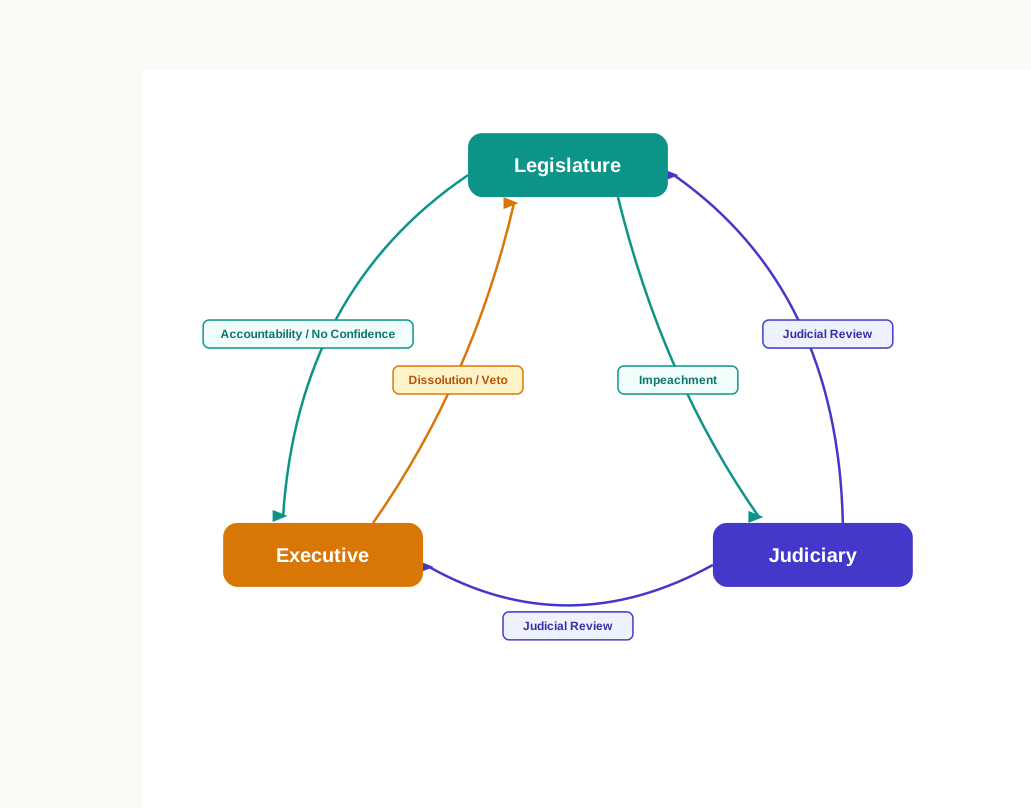
Fig. 1.4 – Separation of powers and checks and balances in India.
Two features of the Indian position should be fixed now, because the next two sections build on them. First, judicial review here is not merely a judicial invention as it was in the United States — it rests on express provisions of the Constitution, which you will meet in Section 1.12. Second, the power belongs to the High Courts as well as to the Supreme Court, so it is exercised in every State and not only in Delhi.
The obvious objection to judicial review is that it lets unelected judges overrule elected representatives. The Indian answer is that judges are not overruling the representatives; they are enforcing a document the representatives themselves are bound by. But that answer only pushes the question one step further back — what if Parliament amends the Constitution itself? That is precisely the problem the next section takes up.
1.11 Doctrine of Basic Structure
The doctrine of Basic Structure is an evolution of the judiciary, and has been regarded as an important element of judicial review.
The doctrine invalidates any constitutional amendment that destroys or harms a basic or essential feature of the Constitution — features such as secularism, democracy and federalism. The Supreme Court has also held judicial review itself to be a basic structure or feature of the Constitution; as a result, it can nullify any constitutional amendment that abolishes or disregards judicial review in matters concerning the fundamental rights of citizens.
The concept was introduced by the judiciary in order to tide over a spate of amendments which were eroding the basic elements of the Indian Constitution. The doctrine comes into play when it is felt that the executive and the legislature have transgressed the boundary defined by the Constitution, which underlies the spirit of separation of powers.
Notice the problem the doctrine was invented to solve. Section 1.10 ended with a question: judicial review lets a court strike down a law that violates the Constitution, but what happens if Parliament amends the Constitution itself? If the amending power were unlimited, any limit on Parliament could be removed simply by amending away the limit — and the Constitution would offer no protection that a temporary majority could not withdraw. The basic structure doctrine is the Supreme Court’s answer to that possibility.
Evolution of the basic structure concept
The concept did not arrive fully formed. It evolved over more than two decades, through a series of landmark judgments in which the Court changed its position more than once. Fig. 1.5 traces that development.
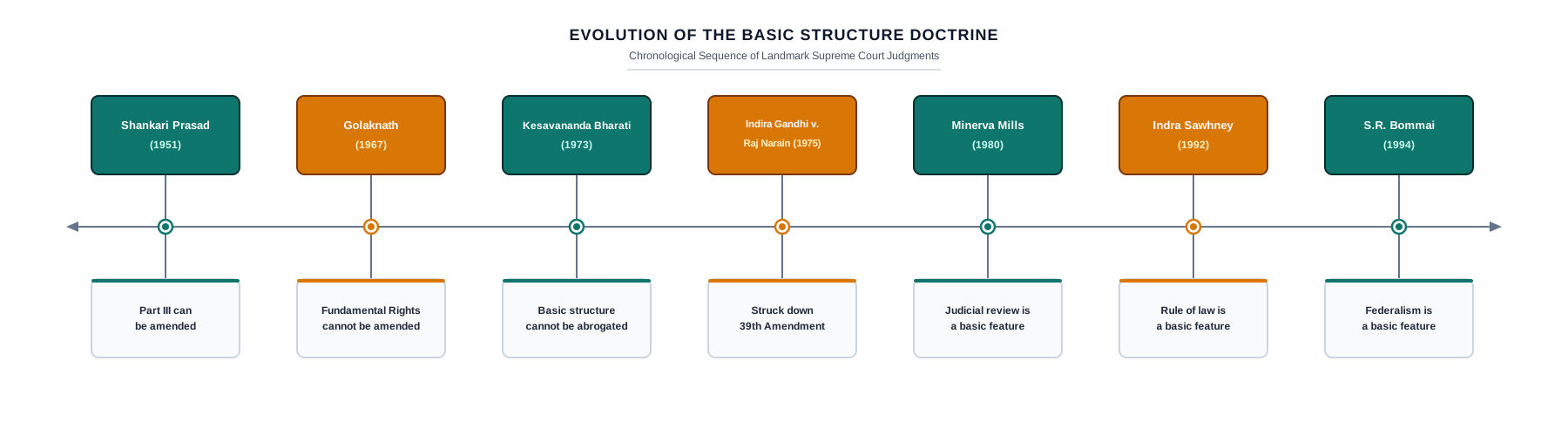
Fig. 1.5 – Timeline of the basic structure doctrine’s evolution.
Shankari Prasad case (1951)
In this case, the Supreme Court held that Parliament’s power of amending the Constitution under Article 368 included the power to amend the Fundamental Rights guaranteed in Part III as well.
Golaknath case (1967)
In this case, the Court reversed its earlier stance that the Fundamental Rights can be amended. Its reasoning ran as follows:
- Fundamental Rights are not amenable to Parliamentary restriction, as stated in Article 13, and to amend the Fundamental Rights a new Constituent Assembly would be required.
- Article 368 gives the procedure to amend the Constitution, but does not confer on Parliament the power to amend it. This case conferred upon the Fundamental Rights a ‘transcendental position’.
- The majority judgement called upon the concept of implied limitations on the power of Parliament to amend the Constitution. On this view, the Constitution gives a place of permanence to the fundamental freedoms of citizens.
- In giving themselves the Constitution, the people had reserved these rights for themselves.
The distinction in point (b) is a fine one and worth slowing down over. A provision that tells you how to do something is not the same as a provision that tells you that you may do it. Article 368 lays down majorities and procedures; the Court in Golaknath held that it does not, by itself, grant the power the procedure is meant to exercise.
Kesavananda Bharati case (1973)
Read across that table and you can see the Court settling on a middle position. Golaknath protected the Fundamental Rights completely, but at the cost of making the Constitution rigid. Kesavananda Bharati returned the amending power to Parliament in full, while placing beyond its reach not a list of Articles but the essential character of the document.
Indira Nehru Gandhi v. Raj Narain case (1975)
Here, the Supreme Court applied the theory of basic structure and struck down Clause (4) of Article 329-A, which had been inserted by the 39th Amendment in 1975, on the ground that it was beyond Parliament’s amending power as it destroyed the Constitution’s basic features.
The 39th Amendment Act was passed by Parliament during the Emergency period. This Act placed the election of the President, the Vice President, the Prime Minister and the Speaker of the Lok Sabha beyond the scrutiny of the judiciary. The 39th Amendment was upheld by four of the five judges on the bench, but only after they overturned the portion of the amendment that aimed to limit the judiciary’s ability to rule in the election dispute then before it.
Minerva Mills case (1980)
- This case again strengthened the Basic Structure doctrine. The judgement struck down two changes made to the Constitution by the 42nd Amendment Act, 1976, declaring them violative of the basic structure.
- The judgement makes it clear that the Constitution, and not Parliament, is supreme.
- The Court added two features to the list of basic structure features: judicial review, and the balance between Fundamental Rights and the Directive Principles of State Policy.
- The judges ruled that a limited amending power is itself a basic feature of the Constitution.
Indra Sawhney v. Union of India (1992)
- The Supreme Court examined the scope and extent of Article 16(4), which provides for the reservation of jobs in favour of backward classes. It upheld the constitutional validity of 27% reservation for Other Backward Classes, subject to certain conditions — exclusion of the creamy layer, no reservation in promotion, and a total reserved quota not exceeding 50%.
- Here, the rule of law was added to the list of basic features of the Constitution.
S. R. Bommai case (1994)
- In this judgement, the Supreme Court sought to curb the blatant misuse of Article 356, which concerns the imposition of President’s Rule on States.
- In this case there was no question of a constitutional amendment at all, and yet the concept of the basic structure doctrine was applied.
- The Supreme Court held that the policies of a State government directed against an element of the basic structure of the Constitution would be a valid ground for the exercise of the central power under Article 356.
The settled position
The Supreme Court’s judgments frequently mention the sovereign, democratic and secular nature of the polity, the rule of law, the independence of the judiciary and the fundamental rights of citizens as crucial components of the Constitution.
One certainty has emerged from this long tussle between Parliament and the judiciary: all legislation and all constitutional amendments are now subject to judicial review, and laws that violate the fundamental framework are likely to be overturned by the Supreme Court. In essence, Parliament’s ability to alter the Constitution is limited, and all constitutional amendments are ultimately decided upon, scrutinised and interpreted by the Supreme Court.
Thus, after the decisions of the Supreme Court in the Kesavananda Bharati case, the Indira Gandhi election case and the Minerva Mills case, it can be concluded that Parliament’s power to amend the Constitution is limited, and that in the exercise of its constituent power Parliament cannot violate the Basic Structure of the Constitution.
1.12 Scope of Judicial Review in India
Judicial review is one of the essential features of the Indian Constitution. It has helped preserve the constitutional principles and values, and constitutional supremacy itself.
The power of judicial review is available to the Supreme Court and to the High Courts of the different States, in matters of both legislative and administrative actions. Note both halves of that sentence. The power is not confined to Delhi — a High Court exercises it too. And it is not confined to laws — the decisions of officials are equally open to review.
With respect to judicial review of executive or administrative actions, courts have employed doctrines such as proportionality, legitimate expectation, reasonableness, and the principles of natural justice.
Essentially, the scope of judicial review in the courts in India has developed with respect to three issues, shown in Fig. 1.6:
- protection of fundamental rights as guaranteed in the Constitution;
- matters concerning the legislative competence between the Centre and the States; and
- fairness in executive acts.
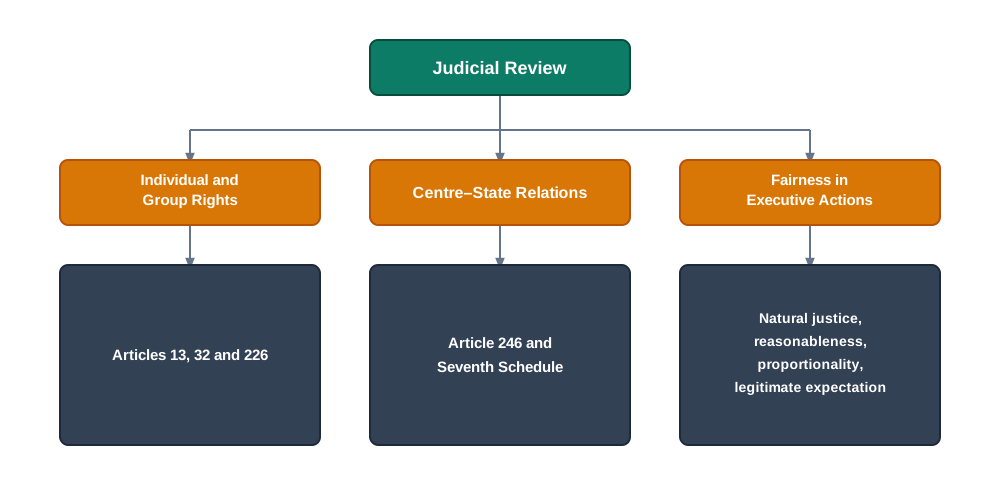
Fig. 1.6 – The three heads of judicial review in India.
1.12.1 Individual and Group Rights
Article 13(2) of the Constitution of India provides the foundation for this first head.
Two features of this provision deserve attention. First, it is a prohibition addressed to the State itself — a law of this kind is void from the moment it is made, not merely unwise. Second, the words to the extent of the contravention mean that the whole statute need not fall; only the offending portion does, where the rest can stand independently.
This Article explicitly confers the power of judicial review on the courts in matters of fundamental rights. Without it, a court asked to set aside a law violating Part III would have to argue its way to that power, as Chief Justice Marshall had to in Marbury v. Madison. In India it is written into the text.
Furthermore, Article 32 offers the Supreme Court the power to enforce fundamental rights, and gives every person the right to move the Supreme Court for the enforcement of those rights. It was of Article 32 that Dr B. R. Ambedkar, the chairman of the drafting committee of the Constituent Assembly, famously said that it is the heart and soul of the Constitution — the one Article without which the rest of Part III would be a list of good intentions.
From this Article the Supreme Court derives its authority to issue directions, orders or writs in the nature of habeas corpus, mandamus, prohibition, quo warranto and certiorari, each of which was explained in Section 1.5. Like Article 32, Article 226 is a parallel provision for the High Courts in the States, allowing similar writs to be instituted there for the enforcement of fundamental rights, as you saw in Section 1.6.
The courts, through their judicial review practice, have also liberalised the doctrine of locus standi — the right to appear before, or petition, a court — for the enforcement of the fundamental rights of those who lack access to courts by reason of poverty or of social and economic disabilities. This method led to the development of Public Interest Litigation or Social Action Litigation (PIL or SAL), whereby any public-spirited person can petition, or write letters to, the courts on behalf of victims of human rights violations or other aggrieved parties.
1.12.2 Centre–State Relations
Judicial review has also been used in matters concerning legislative competence with regard to Centre–State relations.
Article 246 of the Constitution divides law-making power between Parliament and the State legislatures by reference to three lists in the Seventh Schedule:
- Parliament has exclusive power to make laws with respect to the matters itemised in the Union List (List I of the Seventh Schedule);
- both Parliament and the legislature of any State have power to make laws with respect to matters enumerated in the Concurrent List (List III); and
- the legislature of any State has exclusive power to make laws with respect to matters listed in the State List (List II).
This Article delivers a clear division of law-making powers, as well as room for intersection between the Centre and the States.
But a written division does not enforce itself. A State legislature may pass a law that in substance deals with a Union subject; Parliament may legislate on something that belongs to the States. Somebody must decide, when the question is raised, which list a particular law really falls under. Judicial review helps demarcate the legislative competencies, and ensures that the Centre does not exert its supremacy over State matters, and likewise that the States do not encroach upon matters within the ambit of the Centre.
This is the head of judicial review that keeps Indian federalism working. Recall from Section 1.1 that although law-making power is divided, the judiciary is a single integrated system — and it is precisely because the same hierarchy of courts serves both Centre and States that it can hold the boundary between them impartially.
1.12.3 Fairness in Executive Actions
In matters of executive or administrative action, the judicial review practice of the courts has often employed doctrines such as the principles of natural justice, reasonableness, proportionality and legitimate expectation.
The most frequently applied of these is a rule of natural justice expressed in a Latin phrase.
This phrase is an established principle in Indian legal practice, and it was applied by the Supreme Court in several cases, including the landmark decision in Maneka Gandhi v. Union of India.
That last row is the point students most often miss. The words of Article 21 were never changed. What changed was the meaning the Court gave them — a demonstration, once again, of the common law method described in Section 1.2.
The place of the judiciary in India
The judiciary in India enjoys a very significant position, since it has been made the guardian and custodian of the Constitution.
It is not only a watchdog against the violation of fundamental rights guaranteed under the Constitution; it also insulates all persons — Indians and foreigners alike — against discrimination, abuse of State power and arbitrariness.
The judiciary has often been described as the defensive armour of a country, its Constitution and its laws. If that armour were stripped of its onerous functions, the door would stand wide open to nullification, anarchy and convulsion. Every protection studied in this chapter — the hierarchy of courts, the independence of judges, the writs, the tribunals subject to High Court scrutiny, judicial review, the basic structure — exists to keep that armour in place.
1.13 Summary
- India has a federal system of government, but a single integrated judiciary that administers both Central and State laws.
- The hierarchy runs from the Supreme Court, to the High Courts, to the district and subordinate courts, with specialised tribunals supplementing the courts.
- The Supreme Court of India came into being on 28 January 1950, replacing the Federal Court of India and the Judicial Committee of the Privy Council.
- The Constitution in 1950 provided for a Chief Justice and seven judges, and empowered Parliament to increase that number; the sanctioned strength today is 34 judges including the Chief Justice of India.
- India has 25 High Courts, each having jurisdiction over a State, a Union Territory, or a group of States and Union Territories.
- The Madras, Bombay, Calcutta and Allahabad High Courts are the first four High Courts in India; the Andhra and Telangana High Courts, established on 1 January 2019 under the Andhra Pradesh Reorganisation Act, 2014, are the newest.
- Each State is divided into judicial districts presided over by a District and Sessions Judge — called a District Judge in a civil case and a Sessions Judge in a criminal case.
- Below the district court, the civil side runs from the Junior Civil Judge Court up to the Senior Civil Judge Court, and the criminal side from the Second Class Judicial Magistrates Court up to the Chief Judicial Magistrate Court.
- District Munsiff Courts are the lowest courts handling civil matters, and the pecuniary limits of civil courts are notified by the respective State Governments.
- India is a common law jurisdiction, which means that judicial decisions themselves make law and become binding precedents for subordinate courts; under a civil law system, only the legislature or executive can create law.
- Indian courts follow the adversarial model, in which the lawyers present the case and the judge decides as a neutral umpire, unlike the inquisitorial model in which the judge actively investigates.
- The Attorney General of India, appointed by the President under Article 76, is the first legal officer of the country and is assisted by a Solicitor General and four Additional Solicitors General.
- The Advocate General of a State is appointed by the Governor under Article 165 and is the chief legal advisor of the State.
- Article 50 lays down the independence of the judiciary, which is protected through five safeguards:
- security of tenure until retirement, with a bar on practising in the same or equivalent courts afterwards;
- removal only for proven misbehaviour or incapacity, through a stringent process;
- salaries charged on the Consolidated Fund and not alterable to a judge’s disadvantage except in a financial emergency;
- immunity of judicial conduct from discussion in Parliament or a State legislature, except during removal proceedings;
- the Supreme Court’s control over its own establishment and staff.
- Under Article 131, the Supreme Court has exclusive original jurisdiction in disputes between the Government of India and the States, or between States, where a legal right is in question.
- Article 32 gives the Supreme Court an extensive original jurisdiction to enforce fundamental rights through the writs of habeas corpus, mandamus, prohibition, quo warranto and certiorari.
- Appeals reach the Supreme Court under Article 132 in constitutional matters, Article 133 in civil matters and Article 134 in criminal matters, ordinarily on a certificate of the High Court granted under Article 134-A.
- Under Article 136, the Supreme Court may grant special leave to appeal from any order of any court or tribunal in India, and this power is discretionary.
- Under Article 143 the President may seek the Supreme Court’s advisory opinion by a Presidential Reference.
- Public Interest Litigation became possible when the Court relaxed the rule of locus standi, allowing public-spirited persons to approach it on behalf of victims; the first PIL was Hussainara Khatoon v. State of Bihar in 1979.
- Suo motu means ‘on its own motion’, and allows a court to initiate proceedings without any petition being filed.
- Free legal aid is available from the Supreme Court Legal Aid Committee to the categories of persons the scheme specifies, and an unrepresented accused may be given an Advocate appointed by the Court as amicus curiae.
- High Courts issue writs under Article 226 for the enforcement of fundamental rights and for any other purpose, which makes their writ jurisdiction wider in scope than that under Article 32.
- Each High Court exercises powers of superintendence over all courts within its jurisdiction.
- The Supreme Court and the High Courts are courts of record, whose proceedings are preserved as permanent record of evidentiary value and which can punish for contempt of court.
- Judges are appointed under Article 124 (Supreme Court), Article 217 (High Courts) and Article 233 (district judges), each Article prescribing its own qualifications and consulting authorities.
- In present practice, appointments to the Supreme Court and the High Courts follow the collegium system, developed through the Three Judges Cases and not mentioned in the Constitution.
- The seniority principle, by which the senior-most judge of the Supreme Court becomes the Chief Justice of India, is an unwritten convention that protects the judiciary from political interference.
- The retirement age is 65 years for a Supreme Court judge and 62 years for a High Court judge; the Venkatachaliah Report, 2002 recommended raising these to 68 and 65, and the Constitution (114th Amendment) Bill of 2010 lapsed.
- A judge of the Supreme Court or a High Court may be removed only for incapacity or proven misbehaviour, under Article 124(4) read with the Judges (Inquiry) Act, 1968, and Article 218 for High Court judges.
- Removal requires a notice signed by 100 members of the Lok Sabha or 50 members of the Rajya Sabha, an inquiry by a Committee constituted under Section 3(2) of the Judges (Inquiry) Act, 1968, adoption of the motion in each House by a majority of its total membership and by two-thirds of members present and voting, and finally an order of the President.
- Tribunals are quasi-judicial bodies introduced by the 42nd Amendment Act, 1976 through Article 323-A for administrative matters and Article 323-B for certain other matters.
- The Administrative Tribunals Act, 1985 set up the Central Administrative Tribunal and the State Administrative Tribunals; appeals from them lie to a Division Bench of the concerned High Court.
- In L. Chandra Kumar v. Union of India, a seven-judge bench held that tribunals do not take away the exclusive jurisdiction of the courts and that their decisions remain open to scrutiny by the High Courts.
- Judicial review is the power of a court to examine a legislative or executive act and determine whether it is incompatible with the Constitution; the principle was first applied in Marbury v. Madison, 1803.
- The Doctrine of Basic Structure holds that Parliament may amend any part of the Constitution but cannot destroy its basic features, and was settled in Kesavananda Bharati v. State of Kerala, 1973.
- The doctrine evolved through Shankari Prasad (1951), Golaknath (1967), Kesavananda Bharati (1973), Indira Nehru Gandhi v. Raj Narain (1975), Minerva Mills (1980), Indra Sawhney (1992) and S. R. Bommai (1994).
- Minerva Mills added judicial review and the balance between Fundamental Rights and the Directive Principles to the list of basic features, and held that a limited amending power is itself a basic feature.
- The scope of judicial review in India has developed around three issues:
- protection of fundamental rights, under Article 13(2), Article 32 and Article 226;
- legislative competence between the Centre and the States, under Article 246 and the Seventh Schedule;
- fairness in executive action, through doctrines such as natural justice, reasonableness, proportionality and legitimate expectation.
- In Maneka Gandhi v. Union of India, 1978, the Supreme Court held that Articles 14, 19 and 21 form the Golden Triangle, that a procedure established by law must be just, fair and reasonable, and that the maxim audi alteram partem had been violated when a passport was impounded without a hearing.
1.14 Key Terms
Integrated judiciary — a single connected hierarchy of courts that administers both Central and State laws.
Jurisdiction — the authority given by law to a court to hear and decide a case, which may be limited by subject matter, territory or the amount claimed.
Subordinate judiciary — the district and subordinate courts functioning below the High Courts.
Pecuniary limit — the maximum value of a money claim that a particular civil court is competent to hear, notified by the State Government.
Common law — a legal system in which judicial decisions themselves develop the law and bind lower courts, as distinct from a system where only the legislature can create law.
Precedent — a decision of a higher court on a point of law which lower courts in the same hierarchy are bound to follow.
Civil law system — a system in which only the legislature or the executive can create law, and the judge applies the written code to the facts.
Adversarial system — a system of adjudication in which the opposing lawyers present the case and a neutral judge decides on the material placed before her.
Inquisitorial system — a system in which the judge is pro-active and may herself inquire and probe into the matter.
Attorney General of India — the first legal officer of the country, appointed by the President under Article 76 to advise and represent the Government of India.
Advocate General — the chief legal advisor of a State, appointed by the Governor under Article 165.
Independence of the judiciary — the constitutional position by which courts decide cases free from control or pressure by the executive and the legislature, secured through protections of tenure, salary and conduct.
Due process of law — the requirement that the State respect all legal rights owed to a person and conform to norms of fairness before depriving her of life, liberty or property.
Original jurisdiction — the power of a court to hear a dispute at the first instance rather than on appeal.
Writ jurisdiction — the power of the Supreme Court under Article 32, and of the High Courts under Article 226, to issue writs for the enforcement of rights.
Habeas corpus — a writ ordering the release of a person who is unlawfully detained.
Mandamus — a writ ordering a public authority to perform its legal duty.
Prohibition — a writ preventing a subordinate court from continuing with a case beyond its jurisdiction.
Quo warranto — a writ directing a person to vacate an office wrongfully occupied.
Certiorari — a writ removing a case from a subordinate court so that its proceedings come before the higher court.
Appellate jurisdiction — the power of a court to hear an appeal against the decision of a lower court.
Certificate of the High Court — the certification granted under Article 134-A that a case is fit to be taken to the Supreme Court under Article 132, 133 or 134.
Special Leave Petition — a petition under Article 136 asking the Supreme Court to grant leave to appeal from any order of any court or tribunal in India, which the Court may allow at its discretion.
Presidential Reference — a question of law or fact of public importance referred by the President to the Supreme Court under Article 143 for its advisory opinion.
Locus standi — the right of a party to appear before a court and be heard.
Public Interest Litigation (PIL) — litigation brought by a public-spirited person or organisation on behalf of persons unable to approach the court themselves, or in a matter affecting the public at large.
Suo motu — ‘on its own motion’; a court taking up a matter on its own initiative without any petition being filed.
Legal aid — free or subsidised legal assistance provided to eligible persons, including the cost of preparing the case and the services of an Advocate.
Amicus curiae — ‘friend of the court’; an Advocate appointed by the court to assist it, often to argue the case of an unrepresented party.
Superintendence — the administrative supervision each High Court exercises over all courts within its jurisdiction.
Court of record — a court whose judgments and proceedings are preserved as permanent record of evidentiary value and which has the power to punish for contempt.
Contempt of court — conduct that disobeys or disrespects the authority of a court, punishable with simple imprisonment or fine or both.
Collegium — the body of senior judges whose recommendations govern the appointment and elevation of judges under present practice, evolved through the Three Judges Cases and not mentioned in the Constitution.
Seniority principle — the unwritten convention that the senior-most judge of the Supreme Court is appointed Chief Justice of India.
Impeachment — the process by which a judge of the Supreme Court or a High Court is removed for incapacity or proven misbehaviour, under Article 124(4) read with the Judges (Inquiry) Act, 1968.
Tribunal — a body created by the Constitution or a statute to adjudicate disputes in a specified field, functioning in a judicial capacity but outside the regular hierarchy of courts.
Quasi-judicial body — a body which is not a court but must nonetheless act judicially when deciding matters affecting the rights of persons.
Regulator — a specialised government agency that frames and enforces rules for compliance in a particular sector.
Judicial review — the power of a court to examine a legislative or executive act and determine whether it is incompatible with the Constitution.
Separation of powers — the constitutional arrangement by which legislative, executive and judicial functions are placed in different organs, each checking the others.
Doctrine of Basic Structure — the doctrine that Parliament may amend any part of the Constitution but cannot destroy its basic or essential features.
Legislative competence — the authority of Parliament or a State legislature to make law on a given subject, determined by the Union, State and Concurrent Lists of the Seventh Schedule under Article 246.
Audi alteram partem — ‘listen to the other side’; the rule of natural justice that no decision may be made against a person without giving her a fair opportunity to be heard.
Golden Triangle — the combined operation of Article 14, Article 19 and Article 21, which a law depriving a person of personal liberty must satisfy.
Post-decisional hearing — a hearing granted after a decision has been taken, where urgency made a prior hearing impracticable.
Procedure established by law — the requirement in Article 21 that a law be validly made and its procedure followed, which after Maneka Gandhi v. Union of India must also be just, fair and reasonable.
1.15 Points to Ponder
The Supreme Court and the High Courts are courts of record, and their proceedings are preserved permanently. Why should a democracy insist that the reasoning of its courts be written down and kept, rather than simply the result of each case?
India chose a single integrated judiciary even though law-making power is divided between the Centre and the States. What might have gone wrong if separate sets of courts had been created for Central and State laws?
In an adversarial system, a point that a lawyer never raises is usually a point the judge never considers. Is that fair to a litigant whose lawyer is less skilled than her opponent’s — and what does the system offer to reduce that inequality?
The collegium system appears nowhere in the Constitution, yet it governs appointments to the highest courts. Is a practice built entirely on judicial interpretation a sound basis for choosing judges?
Judges are protected from removal, from salary cuts and even from discussion in Parliament. Every one of these protections also makes a judge harder to hold to account. Where should the balance between independence and accountability lie?
No judge in India has ever been removed through a completed impeachment, though proceedings have been initiated more than once. Does this show that the safeguard works as intended, or that it is too difficult to use?
Public Interest Litigation allows a stranger to bring a case for someone she has never met. What is gained by relaxing the rule that only the injured person may sue — and what might be lost?
Courts hearing PILs have ordered the relocation of factories, the fuel that buses may use, and the supply of meals to children. Are these judicial decisions, or policy decisions that belong to elected governments?
Free legal aid exists because an adversarial trial is unfair to a person without a lawyer. Yet most eligible people never claim it. What would have to change for a right of this kind to reach the people it was written for?
Tribunals were created to deliver speedy and inexpensive justice in technical fields. If a tribunal decides faster than a court, should its decisions still be open to challenge before a High Court?
The phrase ‘basic structure’ appears nowhere in the Constitution, and its contents have been settled by judges case by case. Is that a strength of the doctrine or a weakness?
In Maneka Gandhi v. Union of India, the words of Article 21 did not change — only their meaning did. Should the meaning of a constitutional provision be capable of growing in this way, or should change come only through amendment?
India’s retirement ages for judges are lower than those in most Western democracies, and post-retirement appointments are usually in the government’s gift. What effect might the prospect of such an appointment have on a serving judge, and how could that concern be addressed?
Article 32 was described by Dr B. R. Ambedkar as the heart and soul of the Constitution. What does it say about a Constitution that its drafters gave the highest place not to a right itself, but to the remedy for enforcing rights?
1.16 Textbook Questions
Fill in the blank: The Judges of the High Court are appointed by the …………… . (Governor / President / Prime Minister)
Fill in the blank: At present there are …………… High Courts in India. (21 / 25 / 28)
Fill in the blank: The retirement age of the Judges of a High Court is …………… years. (60 / 65 / 62)
Besides being an adjudicator and an interpreter, the Supreme Court performs another function under Article 143 of the Indian Constitution. Identify and explain this function of the Supreme Court of India.
The power of judicial review is available to the Supreme Court and to the High Courts of the States in matters of both administrative and legislative action. How far has the principle of judicial review been successful in ensuring fairness in executive actions? Discuss with reference to a decided case.
Can impeachment proceedings be initiated against a sitting judge? If yes, explain the grounds and the procedure for impeachment. How many times has this process been carried through successfully in the history of the Indian judiciary?
What are tribunals? How do they play an instrumental role in rendering dispute resolution more effective?
Elucidate the current practice for the appointment of members of the higher judiciary in India.
List any two constitutional offices endowed with the function of advising and representing the government on legal matters.
1.17 Objective Questions
The Supreme Court of India came into being on:
- 26 January 1950
- 28 January 1950
- 15 August 1947
- 26 November 1949
The two institutions replaced by the Supreme Court of India in 1950 were:
- the Federal Court of India and the Privy Council’s Judicial Committee
- the Calcutta High Court and the Federal Court of India
- the Judicial Committee of the Privy Council and the Central Administrative Tribunal
- the Federal Court of India and the Allahabad High Court
A judge of a district court is called a ‘Sessions Judge’ when he or she:
- presides over a civil case
- presides over a criminal case
- sits in a metropolitan area
- hears an appeal from a Munsiff Court
Under which Article does the Supreme Court exercise exclusive original jurisdiction in a dispute between two States?
- Article 32
- Article 131
- Article 136
- Article 143
The writ issued to order the release of a person who has been unlawfully detained is:
- mandamus
- certiorari
- habeas corpus
- quo warranto
A Special Leave Petition is filed under:
- Article 132
- Article 133
- Article 134
- Article 136
The advisory jurisdiction of the Supreme Court is invoked by:
- the Prime Minister
- the President
- the Attorney General
- the Chief Justice of India
The Attorney General of India is appointed under:
- Article 76
- Article 124
- Article 165
- Article 217
Which of the following is NOT a qualification prescribed for appointment as a judge of the Supreme Court?
- Citizenship of India
- Five years as a judge of a High Court
- Ten years as an advocate of a High Court
- Seven years of practice as a lawyer at the bar
Under the collegium system, the Chief Justice of India consults, for appointments to the Supreme Court:
- two senior-most judges of the Supreme Court
- four senior-most judges of the Supreme Court
- the Union Minister of Law and Justice
- all sitting judges of the Supreme Court
A motion for the removal of a judge may be initiated in the Rajya Sabha by a signed notice of at least:
- 50 members
- 100 members
- two-thirds of the members
- one-third of the members
The Inquiry Committee in removal proceedings against a judge is constituted under:
- Article 218 of the Constitution
- Section 3(2) of the Judges (Inquiry) Act, 1968
- Article 124(4) of the Constitution
- Section 14(2) of the Administrative Tribunals Act, 1985
Tribunals were incorporated into the Constitution by:
- the 39th Amendment Act, 1975
- the 42nd Amendment Act, 1976
- the Administrative Tribunals Act, 1985
- the 114th Amendment Bill, 2010
An appeal against an order of the Central Administrative Tribunal lies to:
- the Supreme Court directly
- a Division Bench of the concerned High Court
- the District Court
- the Union Minister of Law and Justice
The case in which the principle of judicial review was applied for the first time is:
- Kesavananda Bharati v. State of Kerala
- Marbury v. Madison
- Maneka Gandhi v. Union of India
- L. Chandra Kumar v. Union of India
Which case added ‘rule of law’ to the list of basic features of the Constitution?
- Minerva Mills
- S. R. Bommai
- Indra Sawhney v. Union of India
- Golaknath
Articles 14, 19 and 21 are together described as:
- the Basic Structure
- the Golden Triangle
- the Seventh Schedule
- the Directive Principles
Assertion (A): The Supreme Court’s writ jurisdiction under Article 32 is narrower in one respect than the High Court’s writ jurisdiction under Article 226. Reason (R): Article 226 permits a High Court to issue writs for the enforcement of Fundamental Rights and for any other purpose.
Assertion (A): A judge of the Supreme Court cannot be removed merely because Parliament disagrees with her judgments. Reason (R): Removal is permitted only on the grounds of incapacity and proven misbehaviour, and only after an inquiry and a special majority in both Houses.
Assertion (A): The collegium system is not mentioned anywhere in the Constitution of India. Reason (R): The collegium was evolved by the Supreme Court through its interpretation of the word ‘consultation’ in Articles 124 and 217.
Assertion (A): Parliament cannot use its amending power to abolish judicial review in matters concerning fundamental rights. Reason (R): Judicial review has been held to be a part of the basic structure of the Constitution.
Assertion (A): Tribunals do not take away the exclusive jurisdiction of the courts. Reason (R): Tribunals are procedurally flexible and allow aggrieved persons to appear directly before them.
Assertion (A): In Maneka Gandhi’s case, the Supreme Court held that impounding a passport under the Passport Act, 1967 is itself unconstitutional. Reason (R): The petitioner in that case was given no opportunity of being heard and no valid reasons for the impounding of her passport.
Assertion (A): The salaries of Supreme Court judges are charged on the Consolidated Fund of India. Reason (R): Judicial independence requires that a judge’s emoluments not depend on the vote of the legislature.
1.18 Check Your Concepts
India divides law-making power between the Centre and the States, yet has only one set of courts. Explain why the Constitution chose a single integrated judiciary, and state two problems this choice avoids.
Distinguish between a common law system and a civil law system on the basis of the source of law and the role of the judge.
Distinguish between the adversarial and the inquisitorial models of dispute resolution. Which model do Indian courts follow, and what does that mean for the role of a lawyer?
What is a precedent? Explain why a legal system that binds judges to earlier decisions is thought to be fairer than one that does not.
A person wishes to file a civil suit claiming a small sum of money. Explain how the pecuniary limit of a court decides where that suit must be filed.
The same officer may be described as a District Judge, a Sessions Judge or a Metropolitan Sessions Judge. Explain what determines which title applies.
Arrange the following civil courts in ascending order and name the court that stands lowest in the hierarchy: Senior Civil Judge Court, District Munsiff Court, Junior Civil Judge Court, Principal Junior Civil Judge Court, District Court.
Arrange the following criminal courts in ascending order: First Class Judicial Magistrate Court, Sessions Court, Second Class Judicial Magistrates Court, Chief Judicial Magistrate Court.
Distinguish between the Attorney General of India and the Advocate General of a State on at least four bases.
The Attorney General may speak in either House of Parliament but may not vote there. Explain the reasoning behind this arrangement.
State the five provisions that secure the independence of judges in India, and explain how each one removes a possible means of pressure on a judge.
Why does the Constitution permit the emoluments of judges to be reduced during a financial emergency, when it protects them at all other times?
What would happen to the enforcement of Fundamental Rights if Article 32 did not exist? Answer with reference to the relationship between a right and its remedy.
Identify the provision: under which Article does the Supreme Court have exclusive original jurisdiction in a dispute between the Government of India and a State, and what condition must such a dispute satisfy?
State the proviso to Article 131 and explain what kinds of disputes it excludes from the Supreme Court’s original jurisdiction.
Match each writ to the situation it addresses: (a) a person unlawfully detained; (b) an officer refusing to perform a legal duty; (c) a person holding a public office he is not qualified for; (d) a subordinate court proceeding beyond its jurisdiction.
In two situations an appeal lies to the Supreme Court in a criminal matter without a certificate of the High Court. State both, and explain what the two have in common.
Distinguish between an appeal under Article 133 and a special leave petition under Article 136.
Why is the power under Article 136 described as discretionary, and what purpose does that discretion serve?
Explain the advisory jurisdiction of the Supreme Court under Article 143. State two principles laid down in In re Kerala Education Bill (1958).
What is locus standi? Explain how relaxing this rule made Public Interest Litigation possible.
State any three characteristics of Public Interest Litigation, and explain how PIL differs from ordinary adversarial litigation.
Give any three categories of letter-petitions that will ordinarily be entertained as a PIL under the Supreme Court’s guidelines, and any two categories that will not.
What is suo motu action? Give one example of a matter in which the Supreme Court has exercised this power.
Arrange in the correct order the steps a person must take to obtain legal aid from the Supreme Court Legal Aid Committee.
Distinguish between a lawyer engaged by a party and an amicus curiae appointed by the court.
Compare the writ jurisdiction of the Supreme Court under Article 32 with that of a High Court under Article 226. In what respect is the High Court’s power wider?
What is meant by the power of superintendence of a High Court? Explain how it differs from the power to hear an appeal.
What is a court of record? State the two powers that flow from that status.
State the qualifications prescribed for appointment as a judge of the Supreme Court. Explain why the first qualification must be read together with any one of the others rather than with all of them.
Correct the error: ‘The collegium system for appointing judges is laid down in Article 124 of the Constitution, which provides that the Chief Justice of India shall consult two senior-most judges of the Supreme Court.’
Trace the shift in the balance of power over judicial appointments across the First Judges case (1981), the Second Judges case (1993) and the Presidential reference of 1998.
What is the seniority principle in the appointment of the Chief Justice of India? Explain how an unwritten convention can protect judicial independence.
Why are Chief Justices of High Courts appointed from outside the State concerned?
Arrange the steps in the removal of a Supreme Court judge in the correct order, and state the special majority required at the voting stage.
Article 124(4) requires two different majorities in each House. State both, and explain what each one guards against.
State any three arguments advanced in favour of raising the retirement age of judges in India, and one argument that may be made against it.
Distinguish between a court and a tribunal on the bases of origin, composition, jurisdiction and procedure.
Distinguish between Article 323-A and Article 323-B with respect to subject matter and the authority competent to establish the tribunal.
What is the difference between a regulator and a tribunal? Illustrate your answer with the example given in the chapter.
Identify the provision: which Article divides law-making power between Parliament and the State legislatures, and what are the three Lists it operates through?
Explain why the doctrine of Basic Structure was needed, given that the courts already possessed the power of judicial review.
State the trigger for the Basic Structure doctrine and its limit. Why is it wrong to say that the doctrine prevents Parliament from amending the Constitution?
Minerva Mills held that a limited amending power is itself a basic feature. Explain why this holding matters for the survival of the doctrine.
In S. R. Bommai no constitutional amendment was in question, and yet the basic structure doctrine was applied. Explain how this was possible.
Distinguish between ‘procedure established by law’ and ‘due process of law’. What did Maneka Gandhi v. Union of India change about the relationship between the two in India?
What does the maxim audi alteram partem require? Explain what a post-decisional hearing is and when it becomes appropriate.
Correct the error: ‘Under Article 13(2), a law that violates a Fundamental Right is void in its entirety, and the whole statute must therefore be struck down.’
1.19 Case-Based Questions
- Rehana buys a second-hand scooter from a dealer in her district for Rs. 40,000. The scooter turns out to have a forged registration certificate, and the dealer refuses to refund her money. She wants to sue him for the amount. A friend tells her to file the case directly in the High Court, because the High Court is more powerful and will decide faster.
- Explain, with reference to pecuniary limits, why Rehana cannot simply choose the court she prefers.
- In which court would her suit ordinarily begin, and who fixes the pecuniary limits of that court?
- Rehana’s suit is decided against her by the court of first instance. Trace the route by which her case could travel upwards, naming the court at each stage.
- Would your answer to (a) change if, instead of suing the dealer for the money, Rehana alleged that a State law regulating second-hand vehicle sales violated her Fundamental Rights? Give reasons.
- Vikram is arrested and charged with a serious offence. His family earns about Rs. 9,000 a year and cannot afford a lawyer. On the first date of hearing, Vikram appears in court alone and is told to present his own defence. The trial proceeds and he is convicted. On appeal, the High Court reverses his acquittal on a connected charge and sentences him to death.
- Identify two ways in which the law could have ensured that Vikram was represented by a lawyer at his trial.
- Explain why the absence of a lawyer is a particularly serious problem in an adversarial system.
- Can Vikram appeal to the Supreme Court without a certificate of the High Court? State the provision and the exact circumstance that permits it.
- Would your answer to (c) be different if the High Court had sentenced him to five years’ imprisonment instead? Give reasons.
- A newspaper reports that residents of a village have been drinking water contaminated by effluent from a nearby factory, and that several children have fallen ill. The residents are poor, mostly illiterate, and none of them has approached any court. Sunita, a law student in a city 200 kilometres away, writes a letter to the Supreme Court setting out the report and asking for directions.
- Under the traditional rule of locus standi, could Sunita bring this matter to court? Explain what has changed to make it possible.
- Identify the category in the Supreme Court’s PIL guidelines under which such a letter-petition would ordinarily be entertained.
- Suppose the Court had itself read the same newspaper report and taken up the matter without any letter being written. What is this power called, and what does it mean?
- Sunita’s classmate says that Sunita should instead file the matter as a personal grievance, since her own relatives live in the village. Explain how this fact could affect whether the petition is entertained as a PIL.
- Meera, a clerk in a Central Government department, is denied a promotion. She believes the departmental rules were applied wrongly to her service record. She wants a quick and inexpensive remedy and has been told she cannot afford a lawyer.
- Which body would decide her dispute, and under which statute was it established?
- Explain one procedural feature of that body which makes it particularly suitable for Meera’s situation.
- Meera loses. Where does an appeal against that decision lie, and which case settled this position?
- Would your answer to (a) change if Meera were an employee of a State Government department instead? Give reasons.
- A State Government cancels Ashok’s trading licence by an order that gives no reasons and is served on him without any notice or hearing. The order says the cancellation is ‘in the public interest’. Ashok’s business shuts down the same day.
- Name and explain the maxim that the State appears to have violated.
- Ashok wishes to challenge the order. Which court can he approach, under which Article, and why is that Article wider in scope than Article 32 for his purpose?
- The State argues that the licence was cancelled under a validly enacted statute, and that the statute prescribes no hearing. Explain, with reference to a decided case, why this argument may not succeed.
- Suppose the cancellation had been made in an emergency where a prior hearing was genuinely impossible. What remedy did the Supreme Court recognise for such a situation?
- Parliament passes a constitutional amendment providing that no court shall examine the validity of any law relating to the conduct of national elections. A petitioner challenges the amendment before the Supreme Court.
- Can a constitutional amendment be challenged at all? State the doctrine that permits this and the case in which it was settled.
- Identify the basic feature that this amendment appears to damage, and name the case that added that feature to the list.
- The Government argues that Parliament’s power under Article 368 extends to every part of the Constitution. Explain how the Supreme Court has answered this argument.
- Suppose instead the amendment had only changed the number of judges on the Supreme Court. Would the doctrine apply? Give reasons.
- Two neighbouring States are in dispute over the sharing of water from a river that flows through both. Each asserts a legal right to a fixed share under a written agreement executed in 1946, which continues in operation. One State files a suit in the High Court of its own capital city; the other files a petition directly in the Supreme Court.
- Which court has jurisdiction over a dispute between two States, and under which Article?
- Explain the significance of the words ‘to the exclusion of any other court’ for the suit filed in the High Court.
- Identify the proviso to that Article, and explain how the date of the agreement affects the answer.
- Would your answer change if the dispute arose out of an agreement executed in 1985 instead? Give reasons.
- A judge of a High Court is accused of accepting money to decide a case in a particular way. A member of the Lok Sabha proposes that the judge be dismissed immediately by an order of the Union Law Minister, arguing that no judge guilty of such conduct should be allowed to sit for another day.
- Explain why the judge cannot be removed in the manner proposed, and state the only two grounds on which a judge may be removed.
- Set out, in order, the steps that must be followed for the removal of a High Court judge, naming the provision that governs each stage.
- How many members must sign the notice of motion, and does the answer differ between the two Houses?
- A colleague argues that this stringent process protects corrupt judges. Explain the reason the Constitution nevertheless makes removal so difficult.
1.20 Landmark Cases & Maxims
State the principle settled in Marbury v. Madison (1803), and explain how the Court arrived at it while refusing the relief the petitioner had asked for.
State the principle laid down in Kesavananda Bharati v. State of Kerala (1973). Why is it said that this decision rejected both of the earlier positions taken by the Court?
Identify the case in which the Supreme Court first held that Parliament’s power to amend the Constitution under Article 368 extended to the Fundamental Rights, and the case in which that position was reversed.
Which case struck down Clause (4) of Article 329-A, and what did that clause seek to place beyond the scrutiny of the judiciary?
Name the two features added to the list of basic structure features in Minerva Mills (1980), and state what the Court held about the amending power itself.
Which case added the rule of law to the list of basic features of the Constitution, and what was the principal question the Court was examining in that case?
State the principle settled in L. Chandra Kumar v. Union of India. Which forum did the Court hold could scrutinise the decisions of tribunals?
State three propositions established in Maneka Gandhi v. Union of India (1978) concerning Article 21.
Identify the case referred to in this chapter as the first Public Interest Litigation in India, the year it was decided, and the two rights the Court read into Article 21 in deciding it.
Which decision held that policies of a State government directed against an element of the basic structure would be a valid ground for the exercise of central power under Article 356?
State two principles laid down in In re Kerala Education Bill (1958) regarding the advisory jurisdiction of the Supreme Court, and state how the position was stated differently in In re Special Courts Bill (1979).
Match each maxim or expression in Column A to the situation it governs in Column B.
| Column A | Column B |
|---|---|
| a. audi alteram partem | i. A court appoints an Advocate to argue the case of an unrepresented accused. |
| b. suo motu | ii. A court initiates proceedings on the basis of a newspaper report, without any petition. |
| c. amicus curiae | iii. An authority cancels a benefit without giving the affected person any hearing. |
| d. locus standi | iv. A public-spirited organisation asks to be heard on behalf of persons who cannot approach the court themselves. |
Give the literal meaning and the legal meaning of audi alteram partem, and name the case studied in this chapter in which it was applied.
Which authority governs each of the following fact situations? (a) A tribunal’s order is challenged as final and unappealable. (b) A constitutional amendment removes judicial review over a class of laws. (c) A passport is impounded without any hearing. (d) A citizen writes a letter to a judge on behalf of prisoners awaiting trial.
Explain the expression ‘sentinel on the qui vive’ as applied to the Supreme Court, and give one example from the chapter of the Court acting in that character.
Name the three decisions collectively known as the Three Judges Cases by the year in which each was decided, and state in one sentence what each settled about judicial appointments.