Chapter 10: Human Rights in India
In 1948, in the shadow of a war that had killed millions, a small group of people sat down to write a single page that would try to speak for every human being alive. They were drafting what became the Universal Declaration of Human Rights. One of them was an Indian delegate, Hansa Mehta. When the draft of the very first article was read out, it began: “All men are born free and equal.” Hansa Mehta objected. If the sentence said men, she argued, governments would one day read it to mean exactly that — and half the world would be left outside the door. The words were changed. The Declaration adopted in December 1948 opens instead with “All human beings are born free and equal in dignity and rights.” Two words. An entire planet’s worth of difference. That is what human rights work looks like from the inside: not slogans, but the patient business of making sure a rule cannot be twisted against the people it was written to protect. A little over a year later, India gave itself a Constitution that carried the same instinct — a list of rights that a citizen can take to court, and a State that must answer for breaking them. This chapter is about that machinery: where human rights came from, how India wrote them into law, and what happens when they are denied.

Fig. 10.0 – From the UDHR to the Constitution of India.
By the end of this chapter you will be able to answer each of these questions yourself.
10.1 Understanding Rights and Human Rights
Where the Idea Came From
The idea that a human being deserves to be treated with dignity is much older than any modern legal system. Long before Parliaments and courts existed, religious traditions and philosophical writings were already saying something similar, each in its own language and from its own point of view.
Traditions such as Christianity, Islam, Hinduism, Buddhism and Confucian thought all speak of ‘respect’ and ‘well-being’ for others. Each of them, in its own way, says that human beings must conduct themselves in particular ways towards one another. What runs through all of them is the same instinct: a person is owed something simply for being a person.
These principles were commonly understood as basic and unalienable — that is, they were seen as belonging to a human being from the start, and not as favours that someone had handed over and could take back.
Modern society did not invent this instinct. What it did was give the instinct a legal shape. It took the scattered moral rules about respecting human dignity and well-being and formulated them as human rights — rules that a State can be held to, and not merely moral advice.
How the Story Began
The origin of human rights is usually traced back to the year 539 BC, when the troops of Cyrus the Great conquered Babylon. What Cyrus did after winning the war was unexpected. He freed the slaves and allowed them to return home, and he declared that all people had the right to choose their own religion.
Notice what makes this remarkable. A victorious king had every power to do as he liked with the people he had conquered. Instead, he announced limits on his own authority. That is the shape every human rights guarantee has taken ever since — power accepting a boundary it did not have to accept.
Progress after that was neither quick nor steady. In the 20th century, during the Second World War, the world saw barbarous acts that outraged the conscience of mankind. The scale of the cruelty forced a realisation: leaving human dignity to the goodwill of individual rulers had failed, and it had failed catastrophically.
In December 1948 this resulted in the adoption of the Universal Declaration of Human Rights (UDHR) by the then newly established United Nations, which recognised human rights to be the foundation for freedom, justice and peace. The next section takes up the Declaration in detail.
What is a Right?
Before going further, the word ‘right’ itself needs pinning down, because students often use it loosely to mean anything they want.
A ‘right’ is a moral or legal entitlement to have or do something. Put slightly differently, a right is a justified claim on others. The phrase is worth pausing over. A claim is not a right merely because you make it strongly; it becomes a right when it is justified — accepted by society and affirmed by statute.
This also explains why every right has a matching duty sitting opposite it. If you have a right not to be assaulted, everyone else carries a duty not to assault you. Rights are entitlements or claims of all, recognised and protected through duties and obligations, and the State ensures that the human rights of all are guaranteed.
Rights include human rights and fundamental rights. These two are related but not identical, and Section 10.3 sets out exactly how they differ.
What Makes a Right a Human Right?
Human rights are the basic rights we have because we exist as human beings. This single sentence carries the whole idea, so read it slowly: the qualification for holding a human right is being human. Nothing else. These are not granted by any State. A State can recognise them, protect them, or violate them — but it cannot be the source of them, because they were not the State’s to hand out in the first place.
It follows that human rights belong to all human beings irrespective of nationality, race, caste, creed, gender and so on. All individuals enjoy the same human rights, without any discrimination.
Human rights are the safeguards a human being seeks in order to live with dignity and equality. Because of this, they carry two defining characteristics:
- They are universal — the principle of universality means that we are all equally entitled to our human rights.
- They are inalienable — they should not be taken away, except in specific situations and according to due process. For instance, the right to liberty may be restricted if a person is found guilty of a crime by a court of law.
That second point is where most students slip. ‘Inalienable’ does not mean ‘absolute’. It means a right cannot be casually stripped away; it can be limited only in defined situations and only by a fair legal process. The exception is narrow and it is guarded.
Human rights rest on values that keep society fair, just and equal. Examples include the right to life, the right to health and the right to freedom from torture. More broadly, they are the basic rights that ensure fairness, equality, freedom and respect to all people, and they work to abolish unjust practices such as exploitation, discrimination and inequality.
Human rights also include most fundamental rights, such as the right to life and the rights to food, education, work, health and liberty. Which of these India has made enforceable in its own courts, and which remain moral claims, is the question the rest of this chapter answers.
10.2 International Human Rights and the UDHR
In 1948, the United Nations General Assembly adopted the Universal Declaration of Human Rights (UDHR) as ‘a common standard of achievement for all peoples and nations.’
Read that description carefully, because it explains what the Declaration was meant to do. Until then, how a government treated the people inside its own borders was largely its own business. The UDHR changed the conversation. It set out a standard that every nation could be measured against, in one document, in language ordinary people could read.
What the Declaration Covers
The rights the UDHR defines are wide-ranging. They include fundamental, civil, political, economic, social and cultural rights. Among them are freedom of speech, assembly, conscience and religion; the right to education; the right to livelihood and a decent standard of living; the right to life, liberty and security of person; the right to equality; and freedom from all forms of discrimination, including discrimination based on gender and race.
Grouping them helps. Some of these rights ask the State to leave a person alone — do not silence her, do not jail her without cause. Others ask the State to do something for her — build the school, run the hospital, protect the wage. The first group is usually called civil and political rights, the second economic, social and cultural rights. The Declaration deliberately carries both, as shown in Fig. 10.1, because a person who is free to speak but has nothing to eat is not meaningfully free.
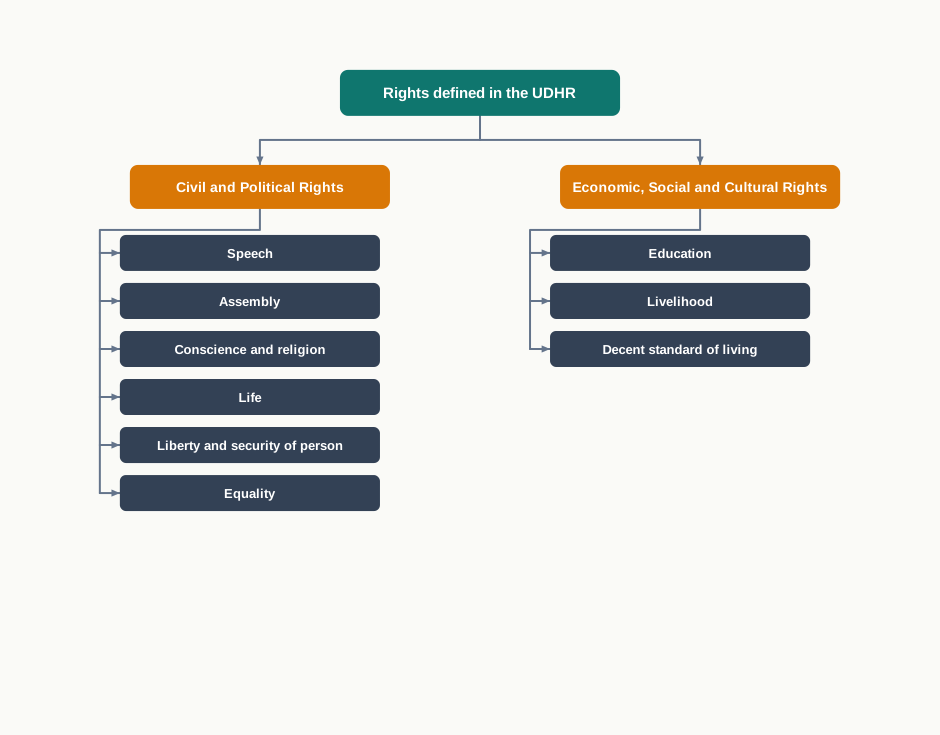
Fig. 10.1 – Rights defined in the UDHR.
Universality — the Cornerstone
The principle of universality of human rights is the cornerstone of international human rights law. Everything else in the system is built on it. If human rights applied only to some nations, or only to citizens of certain countries, the word ‘universal’ in the Declaration’s title would be empty and every State could excuse itself by claiming its own traditions were different.
The Universal Declaration of Human Rights has been embraced by almost all member States of the United Nations. All member States have committed to respect and protect the basic human rights values provided in it.
A Declaration, Not a Court Order
One point often confuses students, so it is worth stating plainly. A declaration is a solemn statement of agreed standards; it is not a statute that an individual can sue upon directly in a national court. Its force comes from acceptance — from States adopting it, writing its content into their own constitutions and laws, and being answerable when they fall short of it.
That is precisely what India did. The rights the Declaration lists — equality, life and liberty, freedom of speech, freedom of religion, protection from exploitation — reappear a little over a year later inside Part III of the Constitution of India, this time in a form that a person can carry to court. How a universally accepted human right becomes an enforceable Indian right is the subject of the next section.
10.3 Fundamental Rights and Human Rights Compared
What are Fundamental Rights?
Fundamental Rights are the basic rights of the citizens of a country. In India they are enshrined in the Constitution, and — this is the part that matters most — they are enforceable in a court of law. If there is any kind of violation of a fundamental right, a person can approach the court for protection of that right.
That last sentence is the whole difference between a moral claim and a legal one. A human right tells you what you are owed. A fundamental right tells you where to go when you do not get it.
How the Two Differ
The main difference between fundamental rights and human rights is that fundamental rights are specific to a particular country, whereas human rights have worldwide acceptance.
Because fundamental rights are written by each country for itself, their exact content may vary slightly from one country to another. A right guaranteed in the Indian Constitution may be worded differently, or protected more or less strongly, in the constitution of another State. Human rights carry no such border. They travel with the person.
The two sets of rights are not rivals. They protect the same thing from two directions — human rights supply the standard, fundamental rights supply the remedy. Together, Fundamental Rights and Human Rights are important to create a better environment for people and to help them preserve their dignity.
10.4 Sustainable Development Goals and Human Rights
The Sustainable Development Goals (SDGs) are the set of development targets agreed by the member States of the United Nations in 2015, to be worked towards by 2030. They cover poverty, hunger, health, education, equality, environment and much else.
The SDGs and human rights are interlinked. Over 90 percent of the goals of the SDGs relate to human rights obligations. This overlap is not a coincidence — the two are describing the same thing in different vocabulary. What development policy calls a target, human rights law calls an entitlement.
The practical consequence is important. When a State makes progress towards achieving the SDGs, it moves forward to fulfil its human rights obligations at the same time. A government that reduces hunger is not merely hitting a development number; it is delivering on the right to food.
A few SDGs that are directly linked to human rights are shown in Fig. 10.2:
- No Poverty — connected to the right to an adequate standard of living.
- Zero Hunger — connected to the right to food.
- Gender Equality — connected to the right to equality and freedom from discrimination.
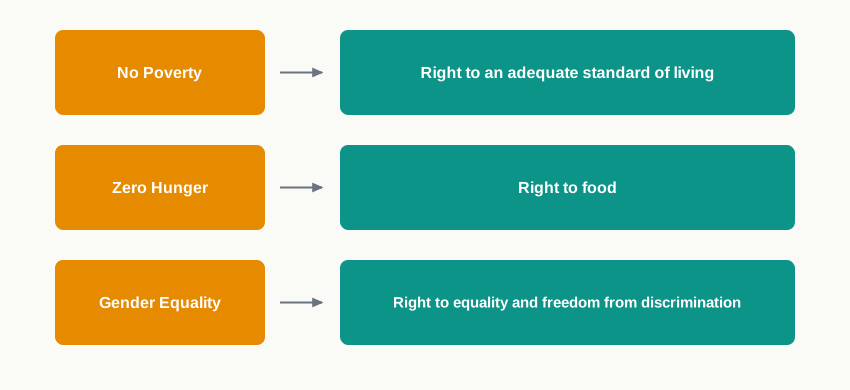
Fig. 10.2 – Links between SDGs and human rights.
10.5 The Constitutional Framework and the Preamble
In India, human rights are rooted in its Constitution, just as they are in the United States, South Africa and many other countries. This is what the previous section pointed towards — a universally accepted claim becomes an enforceable Indian right by being written into the Constitution.
The Indian constitutional human rights framework involves four parts, shown together in Fig. 10.3:
- The Preamble
- Fundamental Rights — Part III of the Constitution contains the Fundamental Rights
- Directive Principles — Part IV of the Constitution contains the Directive Principles
- Fundamental Duties — Part IV(A) contains the Fundamental Duties
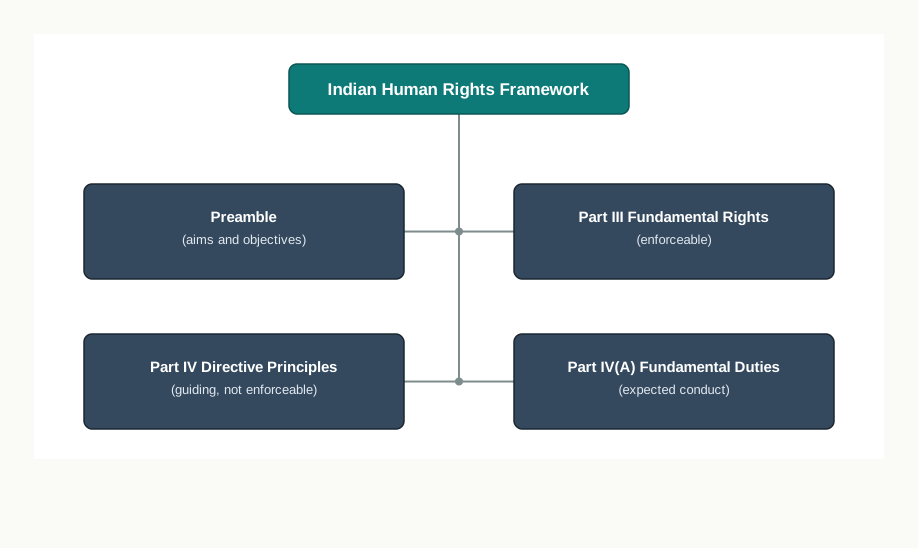
Fig. 10.3 – The Indian human rights framework.
Each part does a different job, and it helps to hold the division in mind from the start. The Preamble states what the Constitution is trying to achieve. Part III gives rights a person can enforce in court. Part IV tells the State what to work towards. Part IV(A) tells citizens what is expected of them. The rest of this chapter takes them in that order.
The Preamble
The Constitution of India begins with the Preamble, affirming its aims, objectives and guiding principles. It is short, but it is not decoration. When a provision of the Constitution is vague or ambiguous, the principles laid out in the Preamble are used to interpret it — that is, the Preamble tells a court what the Constitution was trying to do, so that the court can choose the reading that fits that purpose.
The Preamble also proclaims the rights and freedoms whose detailed provisions are then contained in various parts and clauses of the Constitution, aimed ‘to secure to all its citizens’ those rights and freedoms. The promise is made at the opening; the machinery to deliver it follows in the Parts that come after.
The Basic Structure
The Preamble carries features that belong to what courts call the ‘basic structure’ of the Constitution. The doctrine of basic structure takes away the amendment power of Parliament with regard to certain features of the Constitution — such as democracy, the rule of law, secularism, separation of powers and judicial review. Some of these features appear in the Preamble itself.
Why should any part of a Constitution be beyond amendment? Because a Constitution that could be amended out of existence would protect nothing. If a temporary majority in Parliament could remove judicial review, or abolish free elections, every right in Part III would last only as long as the government of the day found it convenient.
10.6 Fundamental Rights – Part III of the Constitution
Articles 12-35 in Part III of the Constitution contain the provisions on fundamental rights. Fundamental rights are largely civil and political rights — that is, they mostly protect a person’s freedom and standing as a citizen rather than promising material benefits, which is the work Part IV takes up later.
The fundamental rights in India consist of the following rights, grouped as shown in Fig. 10.4:
- Right to equality — Articles 14-18
- Right to freedom — Articles 19-22
- Right against exploitation — Articles 23-24
- Right to freedom of religion — Articles 25-28
- Cultural and educational rights — Articles 29-30
- Right to constitutional remedies — Article 32
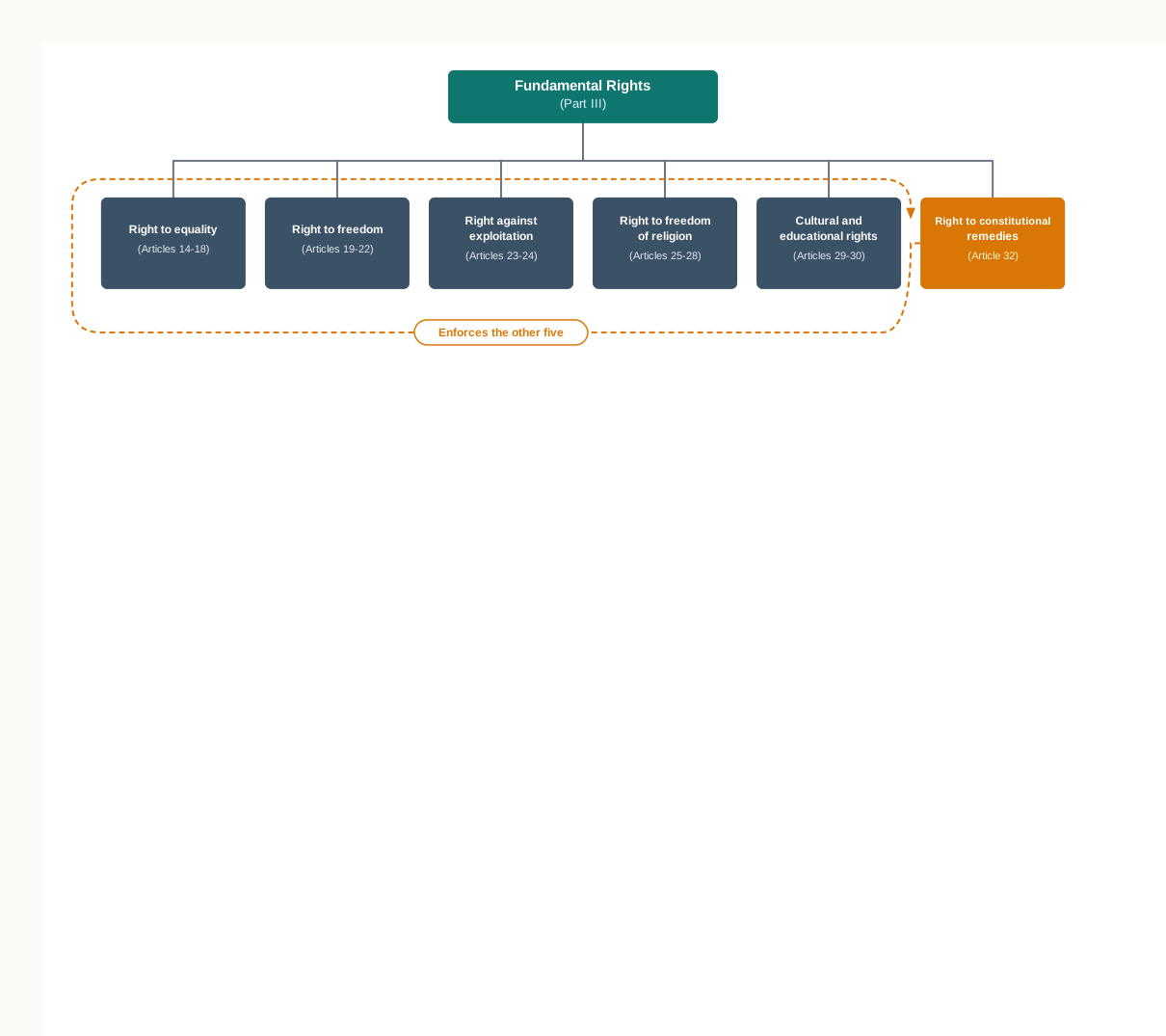
Fig. 10.4 – The six groups of Fundamental Rights.
Sections 10.7 to 10.13 take each of these six groups in turn.
What Makes Them ‘Fundamental’
Several features set these rights apart from ordinary legal rights.
They are enforceable by the higher courts in India. An ordinary right is enforced by whichever court has jurisdiction; a fundamental right can be taken to the constitutional courts.
Article 32 provides the right to those aggrieved, whose fundamental rights have been violated or denied, to petition the Supreme Court for the enforcement of fundamental rights. This is examined in detail in Section 10.13.
Article 13 elevates the authority of fundamental rights. It ensures that the State or other competent authority does not make laws — including ordinances, orders, bye laws, rules, regulations, notifications, customs or usages — that contradict, take away or breach the fundamental rights.
Notice how wide that list is, because this is where students lose marks. A violation is not confined to an Act passed by Parliament. A municipal bye law, a departmental notification, even a long-standing custom can be struck down if it collides with Part III. Article 13 is what makes fundamental rights superior to ordinary law rather than merely equal to it.
They are mostly enforceable against the State, and in some cases against private persons. The right to freedom of speech and expression is an example of the first kind — it operates against the State. The prohibition of employment of children below the age of fourteen years in factories, mines and places of hazardous activities is an example of the second, since it binds private employers as well.
Who Counts as the ‘State’?
If most fundamental rights operate against the State, then everything turns on how widely that word is read. A narrow reading would let governments escape simply by acting through a company or a board they control.
The term ‘State’ includes the Government, Parliament, State Legislatures, District Boards, Panchayats, Municipalities, and other authorities or organisations that are an instrument or agency of the State — such as Indian Oil Limited, the Karnataka State Road Transportation Authority, the Delhi Jal Board, and so on.
For the purposes of Part III of the Constitution, the State therefore comprises the following:
- Government and Parliament of India, that is, the Executive and Legislature of the Union
- Government and Legislature of each State, that is, the Executive and Legislature of the various States of India
- All local or other authorities within the territory of India
- All local and other authorities who are under the control of the Government of India
10.7 Right to Equality – Articles 14–18
The first group of fundamental rights runs from Article 14 to Article 18. Together they promise something simple to state and difficult to deliver: that the law will not sort people into favourites.
Article 14 – Equality before Law
Article 14 provides to all persons the right to equality before the law and the equal protection of the laws within the territory of India.
The two phrases are not saying the same thing twice. Equality before the law means that the law treats everyone alike without regard to rank, status or background — a minister and a mechanic stand on the same footing before a court. Equal protection of the laws means that persons in similar situations must be dealt with similarly by the law.
Notice the word person, not citizen. Article 14 protects everyone within India’s territory, including non-citizens.
The Equality Principle
Although Article 14 guarantees equality before the law, that does not mean absolute equality. The application of the equality principle cannot be universal or general in character. The same law cannot apply to every person equally and similarly, because different situations may require different treatment.
The principle of equality means that one uniform law cannot be applied to all equally, as some may not be similarly placed as others. So ‘equality’ treats equals similarly and unequals differently.
Therefore the same law may not apply to everyone but only to a class of people. The State is entitled to make a reasonable classification for the purposes of legislation and to treat all persons in one class on an equal footing.
For example, the Prohibition of Child Marriage Act, 2006 prescribes the marriageable age of girls as 18 years and that of boys as 21 years, which restricts a minor from getting married. This example draws a distinction based on age in relation to the question of prohibiting child marriage — and age is plainly relevant to whether a person is mature enough to marry.
Article 15 – Discrimination and Access to Public Places
Article 15 is based on the equality principle. It prohibits the State from discriminating against any citizen on grounds only of religion, race, caste, sex, place of birth, or any of them.
It goes further than the State, though. It also prohibits anyone, as well as the State, from using these grounds to restrict any citizen from entering shops, public restaurants, hotels and places of public entertainment, or from using wells, tanks, bathing ghats, roads and places of public resort.
That second limb explains why Article 15 mattered so much in practice. Exclusion in India rarely arrived as a written rule; it arrived as a shopkeeper’s refusal or a village well that some families were not allowed to draw from. The Article reaches those refusals directly.
Article 16 – Reservation and Affirmative Action
Article 16 is also based on the equality principle of Article 14. It provides for equality of opportunity in matters of public or State employment, and bars discrimination against any citizen on grounds of religion, race, caste, sex, descent, place of birth, or residence.
However, this Article allows the State to provide reservation or affirmative action programmes for government jobs to backward classes such as the Scheduled Castes and Scheduled Tribes, who — because of historical and continued disadvantages based on caste, status and otherwise — have not been adequately represented in the services under the State.
Article 17 – Abolition of Untouchability
Under Article 17, ‘untouchability’ is abolished and its practice in any form is forbidden.
This Article is unusual in Part III, and the reason is worth understanding. It can be enforced against both the State and private individuals. Untouchability was not practised by governments alone; it was practised in villages, homes, temples and workplaces, and a right that bound only the State would have left the practice untouched where it actually happened.
The offence of untouchability is punishable in accordance with special laws such as:
- the Protection of Civil Rights Act, 1955, and
- the Scheduled Castes and the Scheduled Tribes (Prevention of Atrocities) Act, 1989.
The abolition of untouchability in Article 17 is made operational by these two special laws, which attempt to remove any form of harassment and abuse of ‘Dalits’ and ‘Adivasis’ by the State or by private individuals.
This is a pattern worth noticing early, because it repeats through the chapter: a constitutional Article announces the principle, and a statute supplies the machinery of punishment and enforcement. Without the statute, the principle would have no consequence attached to it.
Article 18 – Abolition of Titles
Article 18 deals with the abolition of titles. It states:
- No title, not being a military or academic distinction, shall be conferred by the State.
- No citizen of India shall accept any title from any foreign State.
- No person who is not a citizen of India shall, while he holds any office of profit or trust under the State, accept without the consent of the President any title from any foreign State.
- No person holding any office of profit or trust under the State shall, without the consent of the President, accept any present, emolument, or office of any kind from or under any foreign State.
The purpose behind this Article is easy to miss. Hereditary titles create a permanent ranking of people — a class that is born superior — and that is exactly what Articles 14 to 17 set out to abolish. Military and academic distinctions are excepted because they are earned for service or achievement and are not passed down to one’s children.
10.8 Right to Freedom – Article 19
The right to freedom runs from Article 19 to Article 22. Article 19 sets out the everyday freedoms of a citizen; Articles 20 to 22, taken up in the next section, protect a person caught up in the criminal justice system.
Article 19 prescribes and protects the following kinds of freedoms to all citizens:
- Freedom of speech and expression
- Freedom to assemble peaceably and without arms
- Freedom to form associations or unions
- Freedom to move freely throughout the territory of India
- Freedom to reside and settle in any part of the territory of India; and
- Freedom to practice any profession, or to carry on any occupation, trade or business
One word in that opening line deserves attention. These freedoms are guaranteed to citizens, unlike the equality guarantee of Article 14, which extends to any person within the territory of India.
Read the list together and a picture emerges of what an ordinary free life requires: to say what you think, to gather with others, to organise, to travel, to settle where you like, and to earn a living by work of your own choosing.
Reasonable Restrictions on Freedoms under Article 19
Article 19 also provides for ‘reasonable restrictions’ on these freedoms, which means that these rights are conditional. They are not absolute, and the Constitution says so on the face of it.
The State can ‘reasonably’ limit or take away the right to freedom of speech and expression when there is a threat to the sovereignty and integrity of India, or the security of the State, or friendly relations with foreign States, or public order, or decency or morality, or in relation to contempt of court, or defamation, or incitement to an offence.
For example, the State can prohibit someone from making inciting speeches that may provoke others to commit violence.
Two things follow from this, and both are commonly tested. First, the grounds are not interchangeable — a ground available against one freedom cannot be borrowed to curb another. Second, it is not enough for the State to name a ground; the restriction must actually be reasonable.
The chart below presents the various conditions under which the State can limit or take away freedoms.
| Freedoms | Restrictions (grounds) |
|---|---|
| Freedom of speech and expression | Sovereignty and integrity of India, or the security of the State, or friendly relations with foreign States, or public order, or decency or morality, or contempt of court, or defamation, or incitement to an offence |
| Freedom to assemble peaceably and without arms | Sovereignty and integrity of India, or public order |
| Freedom to form associations or unions | Sovereignty and integrity of India, or public order or morality |
| Freedom to move freely throughout the territory of India | Interests of the general public, or for the protection of the interests of any Scheduled Tribe |
| Freedom to reside and settle in any part of the territory of India | Interests of the general public, or for the protection of the interests of any Scheduled Tribe |
| Freedom to practice any profession, or to carry on any occupation, trade or business | Interests of the general public; or the State prescribed professional or technical qualifications; or State run trade, business, industry or service, that excludes participation of citizens or others either completely or partially |
When a Restriction Goes Too Far
At times the Supreme Court can invalidate the State’s restrictions if it finds them to be unreasonable. This is the safeguard that keeps ‘reasonable restriction’ from becoming a phrase a government can hide behind.
As an instance, the State cannot use restriction as an excuse because it is unable to maintain public order. Applying the restrictions listed above to the sale of a book because of a few unruly protesters is unreasonable, and breaches the author’s right to freedom of speech and expression.
That distinction is the heart of the whole Article. The question is never simply ‘did the speech cause trouble?’ but ‘is the trouble something this speech is legally responsible for?’
10.9 Human Rights and the Criminal Justice System – Articles 20–22
Articles 20, 21 and 22 protect a person at the point where the State is at its most powerful — when it accuses, arrests, tries and punishes. Together they supply the human rights framework to the criminal justice system.
Article 20 – Rights of Persons Accused of Crimes
Article 20 provides safeguards to persons who are accused of having committed crimes. It contains several distinct protections, and each is worth learning separately, because examination questions usually turn on identifying which one a fact situation attracts.
No conviction under a law that did not exist
Firstly, Article 20 provides that no person can be convicted for the commission or omission of an act that did not amount to an offence under any law in force at the time of that act.
The reason is straightforward. A person can only obey a rule that exists when he acts. Punishing someone today for what was perfectly lawful yesterday would make it impossible for anyone to keep on the right side of the law.
For example, the sodomy law under Section 377 of the Indian Penal Code (IPC) treated consensual homosexual conduct between same-sex adults as a criminal offence. Its history ran as follows:
- In 2009, Section 377 was declared invalid and unconstitutional by the Delhi High Court, to protect the rights to privacy, non-discrimination and liberty of lesbian, gay, bisexual and transgender people.
- In 2013, the Supreme Court reversed the High Court’s decision.
- In 2018, in Navtej Singh Johar v. Union of India, the Supreme Court overturned its own 2013 judgment and struck down Section 377 of the IPC as unconstitutional so far as it applied to consensual conduct between adults.
In this example, the sodomy law would not apply to consensual conduct that took place in 2011, when the Delhi High Court’s ruling held the field, but would apply to conduct that took place after the Supreme Court’s 2013 judgment and until 2018, when the law changed again. What governs a person is the law as it stood on the day of the act.
Therefore, Article 20 prohibits the retrospective application of criminal law.
No punishment heavier than the law allowed
Secondly, Article 20 provides that a person convicted of a crime should not receive a penalty greater than what was provided in the law in force at the time of the act constituting the offence.
If the punishment for an offence is increased next year, a person who committed that offence this year is sentenced under this year’s scale. Otherwise the State could raise penalties after the event, targeting people it wished to punish more severely.
No prosecution twice for the same offence
Thirdly, it provides another important right — no person shall be prosecuted and punished for the same offence more than once. This means that if someone commits an offence, that person should not be harassed and punished repeatedly for the same offence. This protection is known as the rule against double jeopardy.
Without it, a State that failed to secure a conviction could simply try again, and again, wearing a person down until something stuck.
No compulsion to be a witness against oneself
Fourthly, it states that no person accused of any offence shall be compelled to be a witness against himself. This provision safeguards the accused’s right against self-incrimination.
The line here is between choosing and being made to. An accused may give information based on his or her own knowledge if he or she chooses to, but cannot be forced to be a witness against himself or herself. It is for the prosecution to prove its case, not for the accused to supply the proof against himself.
The right to fair trial
Last, every accused has a right to a fair trial.
Article 21 – Right to Life and Personal Liberty
Article 21 is the most fundamental of all the rights in Part III. It is short, it is expansive, and it covers many other rights that are not separately written anywhere in the Constitution.
Read the opening word again — person. Article 21 applies to citizens as well as non-citizens.
The meaning of ‘right to life’ includes the right to human dignity, the right to the basic requirements of life, the right to participate in activities and expression, and the right to tradition, heritage and culture, among others. Life here does not mean mere animal existence; it means a life worth calling human.
‘Personal liberty’ means the various rights that provide for the personal liberty of a person — broadly, that everyone has the right to act as per his or her own will, freely.
The meaning of ‘right to life and personal liberty’ is broad and embraces many aspects, as set out in Fig. 10.5: human dignity, the basic necessities of life, engaging in activities and expression, tradition, heritage and culture, privacy, a pollution-free environment, livelihood, shelter, healthcare and medical provisions, protection against sexual harassment, protection against solitary confinement, legal aid, speedy trial, protection against delayed execution in capital punishment, protection against custodial violence, protection against bonded labour, and protection against cruel and unusual punishment.
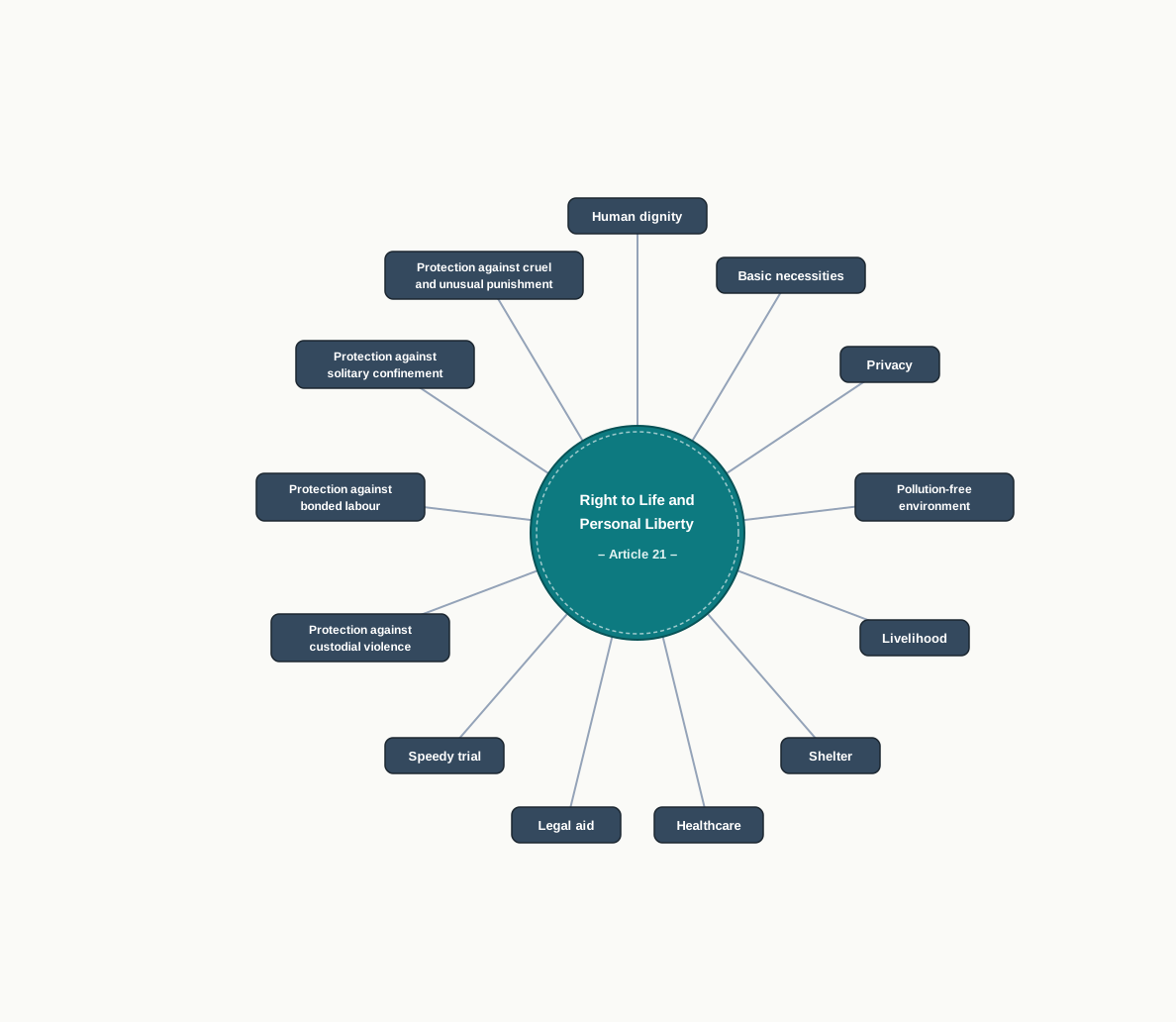
Fig. 10.5 – Implied rights under Article 21.
How life or liberty may be taken away
The second part of the Article describes how one’s right to life and personal liberty can be taken away.
A person can be deprived of the right to life or personal liberty only by procedure established by law. This means that any law which limits or takes away a person’s life and personal liberty must contain a procedure that is fair and reasonable, and not arbitrary.
This is worth pausing on, because it is a favourite of application-based questions. A student who writes only “there must be a law” has answered half the question. The law must also be fair; otherwise a State could pass an unjust procedure and claim compliance.
For example, criminal law prescribes the death penalty for certain crimes. This involves established procedures such as the following:
- the death penalty is awarded only in the ‘rarest of rare’ cases; and
- there should not be inordinate delay in executing a prisoner waiting on death row — prolonged delay in carrying out a death sentence is itself treated as a violation of Article 21 and can be a ground for commuting the sentence.
Article 21A – Right to Education
Article 21A states that ‘The State shall provide free and compulsory education to all children of the age of six to fourteen years in such manner as the State may, by law, determine.’
This Article provides for the right to education to all children between the ages of six and fourteen, and obliges the State to implement it.
How education became a fundamental right
The route by which this right arrived is a good illustration of how Part III and Part IV work on each other.
Prior to 2002, the Indian Constitution treated elementary education for children between the ages of six and fourteen as a policy goal in the Directive Principles of State Policy. Briefly put, Directive Principles are not enforceable in a court of law, as they are aspirational goals to be achieved over a period of time. Section 10.14 takes them up in full.
In 1992-93, however, the Supreme Court affirmed that depriving a person of education amounts to depriving that person of the right to life under Article 21, which is a fundamental right. This lifted elementary education from the status of a policy goal to that of a fundamental right, and thereby made it enforceable.
Accordingly, in 2002, Article 21A providing the right to elementary education was created as a fundamental right by the Constitution (Eighty-sixth Amendment) Act, 2002. The aim is to provide free and compulsory education to all children in the age group of six to fourteen years, in such manner as the State may, by law, determine.
The Right of Children to Free and Compulsory Education (RTE) Act, 2009
The Right of Children to Free and Compulsory Education Act, 2009, also known as the RTE Act, was enacted by the Parliament of India in 2009. It provides that every child has a right to free and compulsory education till completion of elementary education in a neighbourhood school.
This Act places a legal obligation on the State and Central Governments to implement the fundamental right of a child in accordance with the provisions of the RTE Act.
Here again is the pattern from Article 17: the Constitution declares the right, and a statute builds the machinery. Article 21A alone does not tell anyone which school a child may attend or who must pay; the RTE Act does.
However, implementing this right requires State financial and budgetary expenditure of enormous amounts to meet the demand created by a high illiteracy rate, which so far has been inadequate.
Article 22 – Protection against Arrest and Detention
Article 22 provides safeguards against arrest and detention in the following ways:
- No one can be detained in custody without being given the grounds for the arrest.
- The arrested and detained person has a right to consult, and to be defended by, a legal practitioner of his or her choice.
- A person who is arrested and detained in custody must be produced before the nearest magistrate within a period of twenty-four hours. The travel time is not counted towards the twenty-four hour time frame.
- No such person can be detained in custody beyond twenty-four hours without the authority of a magistrate.
Each safeguard closes a specific gap. Without (a), a person could be held without ever learning why. Without (b), he would face the State alone. Without (c) and (d), the police could keep a person indefinitely with no independent authority ever looking at the case.
Where these safeguards do not apply
The above safeguards do not apply to:
- a person from an enemy country; and
- persons arrested or detained under preventive detention laws.
Generally, preventive detention laws allow for detaining persons on suspicion — persons who have not been found guilty of any crime, but whose release may be detrimental to society, for instance because they may commit further crimes if released, or may adversely affect investigations by the State, or are mentally ill, and so on.
However, preventive detention laws can be misused, resulting in violations of the human rights of the person detained. This is the sharpest tension in the whole chapter: a power to hold someone who has been convicted of nothing sits uneasily beside Articles 20, 21 and 22, and that is precisely why its use is so closely watched.
Detention and arrest are not the same thing
Ordinarily you may think that being arrested is the same as being detained, but there is a difference between the two.
A person is arrested when he or she is charged with a crime. If the police have a reasonable suspicion that a person may have engaged in a crime, or may commit a crime, they may detain that person for questioning. When a person is detained for questioning, he or she is not charged with a crime. The main difference between detention and arrest is whether the accused is charged with a crime or not.
10.10 Right against Exploitation – Articles 23 and 24
The rights so far have been mostly about what the State may not do to a person. Articles 23 and 24 turn to something different — the ways in which one human being exploits another, often with the State nowhere in sight. This is why, as noted earlier, some fundamental rights operate against private persons as well.
Article 23 – Prohibition of Traffic in Human Beings and Forced Labour
Article 23 prohibits human trafficking, begar and forced labour.
What links these three is the treatment of a person as something to be used. In each of them, a human being’s labour, body or freedom is taken without genuine consent, or paid for at a level that makes the consent meaningless.
Begar was historically demanded from the poorest labourers, who had no realistic power to refuse. That is the feature the Constitution is targeting: not merely low wages, but service extracted from someone who is not free to say no.
What human trafficking involves
Trafficking is not a single act. It is best understood, as shown in Fig. 10.6, as a combination of three elements, all of which must be present together:
- Act — recruitment, transport, transfer, harbouring, or receipt of persons;
- Means — threat or use of force, coercion, abduction, fraud, deception, abuse of power or of vulnerability, or the giving of payments or benefits; and
- Purpose — exploitation, including prostitution of others, sexual exploitation, forced labour, slavery or similar practices, removal of organs, and other types of exploitation.

Fig. 10.6 – The three elements of human trafficking.
Learning trafficking as a three-part test is far more useful than memorising a list, because it tells you what to look for in a problem question. If a person was moved or harboured, and this was achieved through force, deception or the abuse of someone’s vulnerability, and it was done for the purpose of exploiting that person, all three elements are made out.
Other examples of human trafficking include forced labour, forced sex work, forced organ transplantation, forced surrogacy, being forced to work in factories, hazardous activities, and being forced into begging.
Article 24 – Prohibition of Employment of Children in Factories
Article 24 prohibits the employment of children below the age of fourteen years in factories, mining and other hazardous employment.
The purpose behind the provision is not hard to see once it is placed beside Article 21A. A child who is working in a factory is not in school, and the damage is permanent: lost schooling at that age is rarely recovered later, and hazardous work costs the child health as well. The two Articles are two halves of one policy — keep children out of dangerous work, and put them in classrooms.
Article 24 is also one of the clearest examples of a fundamental right that binds private persons. The factory owner who employs a twelve-year-old is not the State, but the prohibition reaches him directly.
10.11 Right to Freedom of Religion – Articles 25–28
Four Articles carry the right to freedom of religion. Read together, they do two jobs at once: they protect a person’s freedom to believe and practise, and they keep the State itself at a distance from religion.
Article 25 – Freedom of Conscience and Free Profession, Practice and Propagation of Religion
Under Article 25, all persons have the right to freedom of conscience and the freedom to profess, practise and propagate religion, as long as their acts do not threaten public order, morality and health.
The four words are worth separating. Conscience is what a person believes inwardly. Profess is to declare that belief. Practise is to act on it. Propagate is to spread it to others. The Article protects the whole chain, not merely private belief.
Where the limits bite
Since the right stops where public order, morality and health begin, disputes usually arise about what falls on which side of that line.
For example, on the issue of the use of loudspeakers for religious purposes, the Supreme Court has stated that no religion prescribes that prayers should be performed by disturbing the peace of others, nor does any religion preach that prayers should be offered through voice amplifiers or the beating of drums. In the name of religion, nobody can be permitted to add to noise pollution or violate noise pollution norms. Even if there is a religious practice of using voice amplifiers, it should not adversely affect the rights of others, including their right not to be disturbed in their activities. The Noise Pollution (Regulation and Control) Rules, 2000 are to be followed.
On the other side of the line, the wearing and carrying of kirpans is part of the profession of the Sikh religion and does not threaten public order, morality or health.
What the State may still do
Article 25 leaves the State with three specific powers:
- The State may regulate or restrict economic, financial, political or other secular activities that are associated with a religious practice.
- The State may provide for social welfare and reform in Hindu, Sikh, Jain or Buddhist religious institutions.
- The State may throw open religious institutions, such as temples, to all classes and sections of that religious society.
The distinction in (a) is the one students most often miss. Running a kitchen, managing money, employing staff and holding land are secular activities even when a religious body does them, and the ordinary law applies to them. Clause (c) links straight back to Article 17 — a temple closed to some castes was one of the sharpest forms of untouchability, and the Constitution deliberately left the State power to open it.
Article 26 – Freedom to Manage Religious Affairs
Article 25 protects the individual believer. Article 26 protects the religious community as a body.
Article 26 provides the right to every religious denomination, including its sub-sects or sects, to:
- establish and maintain institutions for religious and charitable purposes;
- manage its own affairs in matters of religion;
- own and acquire movable property (for example, vehicles and furniture) and immovable property (for example, a house or trees); and
- administer such property in accordance with law.
These rights are conditional. They should not endanger public order, morality and health.
Notice the careful wording of (b) and (d). A denomination manages its own affairs in matters of religion — that is its own business, and the State stays out. But it administers property in accordance with law — which is secular activity, and the ordinary law applies.
Article 27 – Freedom as to Payment of Taxes for Promotion of Any Particular Religion
Article 27 protects the taxpayer’s conscience. No person can be compelled to pay any tax whose proceeds are specifically set aside for the promotion or maintenance of any particular religion or religious denomination.
The reasoning is straightforward. Tax is compulsory. If the State could collect money from everybody and spend it on promoting one religion, then every citizen — including those of other faiths and those of none — would be made to fund a religion not their own. That is inconsistent with a State that is meant to stand at an equal distance from all faiths.
Two things fall outside this prohibition, and keeping them apart is the exam point. Article 27 bars a tax earmarked for a particular religion; it does not bar the State from charging a fee to meet the cost of regulating or administering a religious institution, and it says nothing about voluntary donations made by worshippers themselves.
Article 28 – Religious Instruction in Educational Institutions
Article 28 concerns freedom as to attendance at religious instruction or religious worship in certain educational institutions.
In plain terms, Article 28 prohibits religious instruction in educational institutions that are wholly maintained out of State funds. For example, government-run schools such as Sainik Schools and Kendriya Vidyalayas cannot impart religious instruction to students.
However, some educational institutions are exempted from this rule — those which are administered by the State but were established by endowments or trusts that require religious instruction to be given in them.
Furthermore, State-recognised or State-aided educational institutions cannot force any student to take part in any religious instruction, or to attend any religious worship conducted in such institutions, unless the student has given consent for it. In the case of minors, the guardian must have given consent.
The scheme becomes much easier to hold in mind once the four kinds of institutions are set side by side.
These provisions, and others, make India a secular state — not a State hostile to religion, but one that neither adopts a religion of its own nor uses public money and public institutions to advance one faith over another.
10.12 Cultural and Educational Rights – Articles 29–30
A guarantee of equality alone can quietly erase a small community. If everyone is treated identically, the language, script or culture of a group that is heavily outnumbered may simply disappear for want of anyone to sustain it. Articles 29 and 30 exist to prevent that.
Article 29 – Protection of Interests of Minorities
Article 29 gives any section of citizens having a distinct language, script or culture of its own the right to conserve it. In practice this protection matters most to minority sections of citizens, whose language or culture is plain at risk.
It also prohibits educational institutions maintained by the State, or receiving aid out of State funds, from denying admission to any citizen on grounds of religion, race, caste, or language.
Notice the shift between those two limbs. The first protects a group’s culture; the second protects an individual’s admission — and it protects any citizen, not only a member of a minority.
Article 30 – Right of Minorities to Establish and Administer Educational Institutions
Article 30 provides all minorities, whether based on religion or language, the right to establish and administer educational institutions of their choice.
It also prohibits the State from discriminating against educational institutions, while granting them aid, on grounds of religion or language.
The second limb is what makes the first one real. A right to open a school would mean little if the State could then withhold aid from every school run by a minority community, since the community would be paying twice — through taxes that fund other schools, and again to keep its own alive.
10.13 Right to Constitutional Remedies – Article 32
Every right studied so far raises the same practical question: what does a person actually do when the right is broken? Article 32 is the answer, and it is the reason the other rights are more than a list of good intentions.
Article 32 guarantees to those aggrieved, whose fundamental rights have been violated or denied, the right to petition directly to the Supreme Court for the enforcement of fundamental rights.
The word directly is doing heavy work. Unlike other matters, where a person must first exhaust the remedies available in the lower courts and work upwards, in matters of fundamental rights violation one can approach the Supreme Court straight away.
Similarly, Article 226 authorises the High Courts to take up matters of fundamental rights violations directly for their enforcement.
Why should this shortcut exist? Because a violated fundamental right is usually a continuing injury — a person is in custody, a demolition is about to happen, a licence has been refused. Making such a person climb the ordinary ladder of appeals would mean the right is vindicated long after the harm has finished being done.
Public Interest Litigation
Public Interest Litigation is also known as Social Action Litigation.
Article 32 allows for the practice of Public Interest Litigation, which is a process by which even letters written to the Supreme Court or the High Courts by public-spirited persons or organisations, alleging fundamental rights violations, are converted into petitions.
The author of such a letter alleges violations of the fundamental rights of the weaker sections of Indian society who are unable to approach the court themselves. These include people in custody, victims of police violence, forced bonded labourers, migrant and contracted labourers, child workers, rickshaw pullers, hawkers, pensioners, pavement dwellers and slum dwellers.
Courts can also act upon newspaper reports alleging fundamental rights violations of victims.
Look closely at that list of people and the purpose of the whole device becomes clear. The ordinary requirement is that the person whose right is injured must come to court himself. But the people whose rights are violated most often are precisely those least able to reach a court — a bonded labourer cannot travel to Delhi, and a person in custody cannot travel anywhere. Public Interest Litigation removes that obstacle, so that a right’s protection does not depend on the victim’s resources.
10.14 Directive Principles of State Policy – Articles 36–51
Articles 36-51 in Part IV of the Constitution lay down the guiding principles of governance for the State. These are called the ‘Directive Principles of State Policy’.
Part III told the State what it must not do. Part IV tells it what it should work towards. The two parts were written to be read together — a person cannot meaningfully use freedom of speech or freedom of movement while hungry, unwell, unschooled and unemployed.
Salient Features
Given below are a few salient features of the Directive Principles:
- It is the duty of the State to apply these principles in making laws and policies on social and human development.
- These principles are largely of the nature of economic and social rights, in contrast to the fundamental rights, which are largely civil and political.
- The provisions of the Directive Principles are not enforceable by any court of law, but they provide guidance in carrying out and drafting laws and policies regarding human and social development.
- The Supreme Court has raised the status of many provisions of the Directive Principles to that of fundamental rights, by holding that their denial also violates one’s right to life under Article 21.
- Directive Principles aim at promoting the welfare of the people. They intend to secure and protect the social, economic and political justice of citizens.
- These principles endeavour to minimise income inequalities, and to eliminate inequalities based on status, facilities and opportunities amongst both individuals and groups of people.
Point (c) is the one that puzzles students. If a principle cannot be enforced, what is it for? The answer is that it binds politically rather than judicially. A citizen cannot sue the State for failing to provide work, but the State cannot claim that providing work is none of its business — it is a constitutional duty, argued over in Parliament, in budgets and at elections.
What the Directive Principles Ask For
The Directive Principles guide the State to achieve various goals. They include the following:
- Right to adequate means of livelihood for both men and women.
- Equal pay for equal work for both men and women.
- Right to healthy working conditions for men, women and children.
- Protection to children against exploitation and against moral and material abandonment.
- Legal aid for securing justice, for those with economic or other disabilities.
- Village panchayats vested with powers and functions as units of self-government.
- Right to work, to education, and to public assistance in cases of unemployment, old age, sickness and disablement, and the like.
- Provision for just and humane conditions of work and for maternity relief.
- Living wage and conditions of work for agricultural, industrial and other workers that ensure a decent standard of life and the full enjoyment of leisure and of social and cultural opportunities.
- Promoting cottage industries on an individual or co-operative basis in rural areas.
- Participation of workers in the management of industries.
- Uniform civil code for the citizens — one uniform law for family law matters.
- Provision for early childhood care and education to children below the age of six years.
- Promotion of the educational and economic interests of Scheduled Castes, Scheduled Tribes and other weaker sections, and their protection from social injustice and all forms of exploitation.
- Raising the level of nutrition and the standard of living, improving public health, and prohibiting the consumption of intoxicating drinks and drugs injurious to health.
- Organisation of agriculture and animal husbandry in a modern and scientific way, preserving and improving breeds, and prohibiting the slaughter of cows.
- Protection and improvement of the environment and safeguarding of forests and wildlife.
- Protection of monuments and places and objects of artistic or national importance.
- Separation of the judiciary from the executive in the public services of the State.
- Promotion of international peace and security, maintaining just and honourable relations between nations, fostering respect for international law and treaty obligations, and encouraging the settlement of international disputes by arbitration.
Read the list as a whole and you can see the country the framers were describing — one where work is paid fairly, children are schooled, villages govern themselves, the poorest can still reach a court, and the environment survives the development.
When a Directive Principle Becomes Enforceable
The Supreme Court has raised the status of many provisions of the Directive Principles to that of fundamental rights, by holding that denying them also violates one’s right to life under Article 21. The mechanism is the expansive reading of Article 21 met in Section 10.9: if a person cannot live a life of dignity without a particular thing, then denying that thing denies the right to life itself.
| Directive Principle | Raised to a fundamental right, as it violates the right to life (Article 21) |
|---|---|
| Elementary education for children between the ages of six and fourteen was a policy goal provision. | Right to education for children between the ages of six and fourteen is now a fundamental right under Article 21A. |
Education was the first great example, decided in Mohini Jain, which Section 10.9 has already set out.
Right to livelihood
Another example is the right to livelihood — a Directive Principle that is often read along with the right to life as a fundamental right. The Supreme Court has frequently directed States to rehabilitate slum dwellers when they are evicted on grounds of encroachment.
Eviction without rehabilitation closer to the place of work amounts to a violation of the right to livelihood, and in turn of the right to life. Livelihood here can include basic shelter, food, education, occupation and medical care.
10.15 Fundamental Duties – Article 51A
Part IV(A) — Article 51A of the Constitution prescribes the fundamental duties of every citizen. Certain conduct and behaviour are expected of citizens.
This completes the picture the chapter began with. Part III gives the citizen rights against the State. Part IV gives the State goals to work towards. Part IV(A) turns and asks something of the citizen. A constitution that only handed out entitlements, and asked nothing in return, would be describing a society that could not actually function — every right a person holds is sustained by other people observing the corresponding restraint.
Salient Features
The salient features of the fundamental duties are given below:
- The fundamental duties cannot be enforced in a court of law for violation of the duties, and no one can be punished for violating them.
- Fundamental duties contain standards to be followed by the citizens.
- They remind citizens not to behave irresponsibly, and help build a free, democratic and strong society.
It may be possible that, just as with some provisions of the Directive Principles, courts may raise the status of these duties in the future — the route by which the right to education travelled from Part IV into Part III shows that such movement is not merely theoretical.
The Fundamental Duties
The fundamental duties of every citizen are:
- Respecting the Constitution and its institutions, the National Flag and the National Anthem.
- Cherishing and following the noble ideals of the national struggle for freedom.
- Upholding and protecting the sovereignty, unity and integrity of India.
- Defending the country and rendering national service when called upon to do so.
- Promoting harmony amongst religious, linguistic and regional diversities, and renouncing practices derogatory to the dignity of women.
- Valuing and preserving the rich heritage and culture.
- Protecting the natural environment, including forests, lakes, rivers and wildlife.
- Developing the scientific temper, humanism and the spirit of inquiry and reform.
- Safeguarding public property and abjuring violence.
- Striving for excellence and raising the nation to higher levels of endeavour and achievement.
- Providing opportunities for education to children by their parents, between the age of six and fourteen years.
Several of these duties are the mirror image of something already studied. Duty (k) sits opposite the right to education under Article 21A — the State must provide free and compulsory elementary education, and the parent must send the child to receive it, because a school with no children in it delivers nothing. Duty (e) sits opposite the equality guarantees of Articles 14 to 17, and duty (g) beside the Directive Principle on protecting the environment.
That is the design of the whole framework in one line: the Preamble states the purpose, Part III gives rights a person can enforce, Part IV sets the State’s goals, and Part IV(A) reminds the citizen that the arrangement asks something of everyone.
10.16 Summary
- A right is a moral or legal entitlement to have or do something, and is a justified claim on others — a claim accepted by society and affirmed by statute.
- Every right carries a matching duty, and rights include both human rights and fundamental rights.
- Human rights are the basic rights a person has simply for existing as a human being, and are not granted by any State.
- Human rights belong to all human beings irrespective of nationality, race, caste, creed or gender, without any discrimination.
- Human rights are universal, meaning all persons are equally entitled to them.
- Human rights are inalienable, meaning they cannot be taken away except in specific situations and according to due process — for example, liberty may be restricted when a person is found guilty of a crime by a court.
- The origin of human rights is traced to 539 BC, when Cyrus the Great freed the slaves after conquering Babylon and declared that all people could choose their own religion; the Cyrus Cylinder records this and is regarded as the first human rights declaration in history.
- The barbarous acts of the Second World War led the newly established United Nations to adopt the Universal Declaration of Human Rights (UDHR) in December 1948, recognising human rights as the foundation for freedom, justice and peace.
- The UDHR was adopted as a common standard of achievement for all peoples and nations, and defines the kinds of human rights applicable to all human beings.
- The rights defined in the UDHR include fundamental, civil, political, economic, social and cultural rights, such as freedom of speech, assembly, conscience and religion; the right to education; the right to livelihood and a decent standard of living; the right to life, liberty and security of person; the right to equality; and freedom from all forms of discrimination.
- The principle of universality of human rights is the cornerstone of international human rights law, and the UDHR has been embraced by almost all member States of the United Nations.
- Fundamental Rights are the basic rights of citizens of a country, written into its Constitution and enforceable in a court of law.
- Fundamental rights are country specific and may vary slightly from country to country, whereas human rights are universal and have worldwide acceptance.
- The Sustainable Development Goals and human rights are interlinked, and over 90 percent of the goals of the SDGs relate to human rights obligations, so progress towards the SDGs is also progress in fulfilling human rights obligations.
- In India, human rights are rooted in the Constitution, and the constitutional human rights framework has four parts:
- the Preamble;
- Fundamental Rights in Part III;
- Directive Principles in Part IV; and
- Fundamental Duties in Part IV(A).
- The Preamble affirms the aims, objectives and guiding principles of the Constitution, and is used to interpret provisions that are vague or ambiguous.
- The doctrine of basic structure takes away Parliament’s power to amend certain features of the Constitution, such as democracy, the rule of law, secularism, separation of powers and judicial review, some of which appear in the Preamble.
- Articles 12-35 in Part III contain the provisions on fundamental rights, which are largely civil and political rights.
- The fundamental rights fall into six groups:
- right to equality — Articles 14-18;
- right to freedom — Articles 19-22;
- right against exploitation — Articles 23-24;
- right to freedom of religion — Articles 25-28;
- cultural and educational rights — Articles 29-30; and
- right to constitutional remedies — Article 32.
- Article 13 ensures that the State does not make any law — including ordinances, orders, bye laws, rules, regulations, notifications, customs or usages — that contradicts, takes away or breaches the fundamental rights.
- Fundamental rights are mostly enforceable against the State, and in some cases against private persons, as with the prohibition of employment of children below fourteen years in factories, mines and hazardous activities.
- Article 12 defines ‘State’ for Part III to include the Government and Parliament of India, the Government and Legislature of each State, and all local or other authorities within the territory of India or under the control of the Government of India.
- Article 14 guarantees to every person equality before the law and the equal protection of the laws within the territory of India.
- Equality is not absolute equality — it treats equals similarly and unequals differently, and the State may make a reasonable classification for the purposes of legislation and treat all in one class on an equal footing.
- Article 15 prohibits discrimination against any citizen on grounds only of religion, race, caste, sex or place of birth, and also prohibits the use of these grounds to restrict access to shops, public restaurants, hotels, places of public entertainment, wells, tanks, bathing ghats, roads and places of public resort.
- Article 16 provides equality of opportunity in matters of public or State employment, while permitting the State to provide reservation or affirmative action for backward classes such as the Scheduled Castes and Scheduled Tribes.
- Article 17 abolishes untouchability and forbids its practice in any form, and is enforceable against both the State and private individuals.
- The offence of untouchability is punishable under special laws, namely the Protection of Civil Rights Act, 1955 and the Scheduled Castes and the Scheduled Tribes (Prevention of Atrocities) Act, 1989.
- Article 18 abolishes titles, other than military and academic distinctions, and restricts the acceptance of titles, presents, emoluments and offices from foreign States.
- Article 19 guarantees to all citizens six freedoms:
- freedom of speech and expression;
- freedom to assemble peaceably and without arms;
- freedom to form associations or unions;
- freedom to move freely throughout the territory of India;
- freedom to reside and settle in any part of the territory of India; and
- freedom to practise any profession, or to carry on any occupation, trade or business.
- The freedoms under Article 19 are conditional, and may be limited by reasonable restrictions on the grounds the Constitution itself lists for each freedom.
- Freedom of speech and expression may be restricted on grounds of the sovereignty and integrity of India, the security of the State, friendly relations with foreign States, public order, decency or morality, contempt of court, defamation, or incitement to an offence.
- The Supreme Court can invalidate a restriction imposed by the State if it finds the restriction to be unreasonable.
- Article 20 provides safeguards to persons accused of crimes and supplies the human rights framework to the criminal justice system, by guaranteeing that:
- no person is convicted for an act that was not an offence under the law in force at the time of the act;
- no person receives a penalty greater than that provided in the law in force at the time of the offence;
- no person is prosecuted and punished for the same offence more than once;
- no person accused of an offence is compelled to be a witness against himself; and
- every accused has a right to fair trial.
- Article 20 therefore prohibits the retrospective application of criminal law.
- Article 21 provides that no person shall be deprived of his life or personal liberty except according to procedure established by law, and it applies to citizens as well as non-citizens.
- The right to life under Article 21 has been read to include human dignity, the basic necessities of life, privacy, a pollution-free environment, livelihood, shelter, healthcare, legal aid, speedy trial, and protection against custodial violence, bonded labour, solitary confinement and cruel and unusual punishment.
- A procedure that deprives a person of life or personal liberty must itself be fair and reasonable and not arbitrary; the death penalty, for instance, is awarded only in the ‘rarest of rare’ cases, and inordinate delay in execution is itself a violation of Article 21.
- Article 21A requires the State to provide free and compulsory education to all children of the age of six to fourteen years, in such manner as the State may by law determine.
- Elementary education was originally only a Directive Principle, but the Supreme Court held in Mohini Jain that depriving a person of education deprives that person of the right to life under Article 21.
- Article 21A was inserted as a fundamental right by the Constitution (Eighty-sixth Amendment) Act, 2002.
- The Right of Children to Free and Compulsory Education Act, 2009 gives effect to Article 21A by providing every child a right to free and compulsory education till the completion of elementary education in a neighbourhood school, and places a legal obligation on the State and Central Governments.
- Article 22 provides safeguards against arrest and detention:
- no one may be detained in custody without being given the grounds for arrest;
- the arrested person may consult and be defended by a legal practitioner of his or her choice;
- the person must be produced before the nearest magistrate within twenty-four hours, excluding travel time; and
- no such person may be detained beyond twenty-four hours without the authority of a magistrate.
- These safeguards do not apply to a person from an enemy country, or to persons arrested or detained under preventive detention laws.
- Preventive detention laws allow detention on suspicion, without any finding of guilt, and can be misused, resulting in violations of the human rights of the person detained.
- Arrest and detention are not the same — a person is arrested when charged with a crime, whereas a person may be detained for questioning on reasonable suspicion without being charged.
- Article 23 prohibits human trafficking, begar and forced labour; begar is a practice in which a worker is forced to serve the master free of charge or at a nominal remuneration.
- Human trafficking consists of three elements taken together — an act, a means, and the purpose of exploitation.
- Article 24 prohibits the employment of children below the age of fourteen years in factories, mining and other hazardous employment.
- Article 25 gives all persons freedom of conscience and the freedom to profess, practise and propagate religion, subject to public order, morality and health.
- The State may regulate secular activities associated with religious practice, provide for social welfare and reform in Hindu, Sikh, Jain and Buddhist religious institutions, and throw open religious institutions to all classes and sections of that religious society.
- Article 26 gives every religious denomination the right to establish and maintain institutions for religious and charitable purposes, manage its own affairs in matters of religion, own and acquire property, and administer such property in accordance with law, subject to public order, morality and health.
- Article 27 prohibits compelling any person to pay a tax whose proceeds are specifically appropriated for the promotion or maintenance of any particular religion or sect.
- Article 28 prohibits religious instruction in educational institutions wholly maintained out of State funds, exempts institutions administered by the State but established under an endowment or trust requiring such instruction, and bars State-recognised or State-aided institutions from compelling any student to take part in religious instruction or worship without consent — in the case of minors, the guardian’s consent.
- Article 29 gives any section of citizens having a distinct language, script or culture the right to conserve it, and prohibits State-maintained or State-aided educational institutions from denying admission on grounds of religion, race, caste or language.
- Article 30 gives all minorities, whether based on religion or language, the right to establish and administer educational institutions of their choice, and bars the State from discriminating against such institutions while granting aid.
- Article 32 guarantees the right to petition the Supreme Court directly for the enforcement of fundamental rights, without first exhausting the remedies of the lower courts, and Article 226 authorises the High Courts to take up such matters directly.
- Public Interest Litigation, also called Social Action Litigation, allows even letters written by public-spirited persons or organisations alleging fundamental rights violations to be converted into petitions, and courts may also act upon newspaper reports.
- Public Interest Litigation exists chiefly for the weaker sections who cannot approach the court themselves, such as people in custody, victims of police violence, bonded and migrant labourers, child workers, hawkers, pensioners, pavement dwellers and slum dwellers.
- Articles 36-51 in Part IV lay down the Directive Principles of State Policy, which are largely economic and social rights and are not enforceable by any court, but guide the State in making laws and policies.
- The Supreme Court has raised the status of many Directive Principles to that of fundamental rights by holding that their denial also violates the right to life under Article 21.
- The Supreme Court in Olga Tellis v. Bombay Municipal Corporation, the ‘Pavement Dwellers Case’, held that the right to livelihood is borne out of the right to life and is part of Article 21, and that authorities must provide slum dwellers an alternative if their houses are to be demolished.
- Article 51A in Part IV(A) prescribes the fundamental duties of every citizen; they cannot be enforced in a court of law and no one can be punished for violating them, but they set standards of conduct for citizens.
10.17 Key Terms
Right — a moral or legal entitlement to have or do something; a justified claim on others, accepted by society and affirmed by statute.
Human rights — the basic standards that recognise and protect the dignity of every person, held simply by virtue of being human and not granted by any State.
Universality — the principle that all persons are equally entitled to their human rights, without discrimination.
Inalienable — incapable of being taken away, except in specific situations and according to due process of law.
Universal Declaration of Human Rights (UDHR) — the document adopted by the United Nations General Assembly in 1948 defining the human rights applicable to all human beings, as a common standard of achievement for all peoples and nations.
Civil and political rights — rights that protect a person’s freedom and standing as a citizen, such as speech, assembly, liberty and equality.
Economic, social and cultural rights — rights that require the State to provide or secure material conditions of life, such as education, livelihood and a decent standard of living.
Fundamental Rights — the basic rights of citizens written into Part III of the Constitution and enforceable in a court of law.
Sustainable Development Goals (SDGs) — the development targets agreed by United Nations member States, over 90 percent of whose goals relate to human rights obligations.
Preamble — the opening statement of the Constitution affirming its aims, objectives and guiding principles, used to interpret provisions that are vague or ambiguous.
Basic structure — those core features of the Constitution, such as democracy, the rule of law, secularism, separation of powers and judicial review, which Parliament cannot destroy by amendment.
State (Article 12) — for the purposes of Part III, the Government and Parliament of India, the Government and Legislature of each State, and all local or other authorities within the territory of India or under the control of the Government of India.
Equality before the law — the principle that the law applies to everyone alike, without regard to rank, status or background.
Equal protection of the laws — the principle that persons in similar situations must be treated similarly by the law.
Reasonable classification — the power of the State to legislate differently for different classes of persons, provided the classification rests on a real and relevant difference connected to the object of the law.
Untouchability — the practice abolished and forbidden in any form by Article 17, enforceable against both the State and private individuals.
Reasonable restrictions — the limits the State may place on the freedoms under Article 19, permitted only on the grounds the Constitution lists for each freedom and only to a reasonable extent.
Double jeopardy — the rule that no person shall be prosecuted and punished for the same offence more than once.
Self-incrimination — being made a witness against oneself; Article 20 forbids compelling an accused to do so.
Procedure established by law — the requirement that life or personal liberty may be taken away only by a procedure laid down in law which is itself fair, reasonable and not arbitrary.
Preventive detention — detention of a person on suspicion, without any finding of guilt, on the ground that release may be detrimental to society.
Arrest — taking a person into custody on being charged with a crime.
Detention — holding a person for questioning on reasonable suspicion, without charging that person with a crime.
Begar — a practice, Persian in origin, in which a worker is forced to serve the master free of charge or at a nominal remuneration; a form of forced labour.
Human trafficking — an act of recruitment, transport, transfer, harbouring or receipt of persons, carried out through force, coercion, fraud or abuse of vulnerability, for the purpose of exploitation.
Trust — a body registered under the Indian Trusts Act, 1882, run on the basis of no profit and no loss.
Secular state — a State which neither adopts a religion of its own nor uses public funds and public institutions to advance one faith over another.
Public Interest Litigation (Social Action Litigation) — a process by which a public-spirited person or organisation may move the Supreme Court or a High Court on behalf of others whose fundamental rights have been violated, in which even a letter may be treated as a petition.
Directive Principles of State Policy — the guiding principles of governance in Part IV of the Constitution, which the State must apply in making laws and policies but which are not enforceable by any court.
Right to livelihood — the means of living recognised as part of the right to life under Article 21.
Fundamental Duties — the standards of conduct expected of every citizen under Article 51A in Part IV(A), which are not enforceable in a court of law.
10.18 Points to Ponder
Do criminals have human rights?
If human rights belong to everyone simply for being human, why do so many of them remain out of reach for the poorest people in the country?
The Universal Declaration of Human Rights cannot be enforced in an Indian court. What, then, makes it matter?
Directive Principles cannot be enforced in any court. Does that make them weaker than fundamental rights, or does it make them a different kind of promise altogether?
Fundamental Duties carry no punishment for their breach. Would writing penalties into Article 51A make citizens more responsible, or would it change the nature of what a duty is?
Preventive detention allows a person who has been convicted of nothing to be held in custody. Can such a power ever sit comfortably beside Articles 20, 21 and 22?
Public Interest Litigation lets a stranger approach the court on behalf of someone who cannot. What are the risks of allowing this, and how might a court guard against them?
Article 25 protects the freedom to practise religion, but stops where public order, morality and health begin. Who should decide where that line falls, and on what basis?
Equality is said to treat equals similarly and unequals differently. Who decides which people are ‘similarly placed’, and what happens if that judgment is made wrongly?
Article 17 binds private individuals as well as the State. Should more fundamental rights work this way, given that much discrimination happens between private persons rather than at the hands of government?
10.19 Textbook Questions
- There are different ways in which one can see or understand human rights. Write your views in 200 words on any one of the following:
- Are human rights anti-majoritarian, that is, a protection of minorities from the domination of the majority?
- Are human rights a moral demand to resolve various kinds of injustices?
- Are human rights a tool for sloganeering and disruptions?
10.20 Objective Questions
The Universal Declaration of Human Rights was adopted by the United Nations General Assembly in:
- 1945
- 1948
- 1950
- 1966
The Cyrus Cylinder is associated with:
- The founding of the United Nations
- The first human rights declaration in history
- The abolition of untouchability in India
- The adoption of the Sustainable Development Goals
Which of the following best describes the difference between fundamental rights and human rights?
- Fundamental rights are moral claims; human rights are legal claims
- Fundamental rights are country specific; human rights are universal
- Fundamental rights apply to non-citizens only; human rights apply to citizens only
- Fundamental rights cannot be enforced; human rights can be enforced
The provisions on fundamental rights are contained in:
- Articles 12-35 in Part III
- Articles 36-51 in Part IV
- Article 51A in Part IV(A)
- Articles 14-18 in Part II
Which Article ensures that no law, ordinance, bye law, custom or usage may take away or breach the fundamental rights?
- Article 12
- Article 13
- Article 21
- Article 32
Under Article 12, the term ‘State’ does NOT include:
- Parliament of India
- A municipality
- A private trading company with no connection to the Government
- A body that is an instrument or agency of the State
Abolition of untouchability is provided for by:
- Article 15
- Article 16
- Article 17
- Article 18
Which of the following is NOT a listed ground for restricting the freedom of speech and expression under Article 19?
- Contempt of court
- Incitement to an offence
- Inconvenience to the Government of the day
- Friendly relations with foreign States
The rule that no person shall be prosecuted and punished for the same offence more than once is known as:
- Self-incrimination
- Double jeopardy
- Preventive detention
- Reasonable classification
A person arrested and detained in custody must be produced before the nearest magistrate within:
- Twelve hours
- Twenty-four hours
- Forty-eight hours
- Seventy-two hours
Article 21A guarantees free and compulsory education to children of the age of:
- Three to eight years
- Six to fourteen years
- Six to eighteen years
- Fourteen to eighteen years
Article 21A was inserted into the Constitution by:
- The Constitution (Forty-second Amendment) Act, 1976
- The Constitution (Eighty-sixth Amendment) Act, 2002
- The Right of Children to Free and Compulsory Education Act, 2009
- The Protection of Civil Rights Act, 1955
Begar is best described as:
- A tax collected for the maintenance of a religion
- Service forced from a worker free of charge or at a nominal remuneration
- Employment of children in hazardous industries
- Detention of a person on suspicion
Religious instruction is completely prohibited in an educational institution which is:
- Recognised by the State
- Aided out of State funds
- Wholly maintained out of State funds
- Administered by the State but established under a trust requiring such instruction
Public Interest Litigation is also known as:
- Social Action Litigation
- Preventive Litigation
- Class Action Petition
- Constitutional Review
The Directive Principles of State Policy are contained in:
- Articles 12-35
- Articles 19-22
- Articles 36-51
- Article 51A
The case popularly known as the ‘Pavement Dwellers Case’ recognised as part of Article 21 the right to:
- Education
- Livelihood
- Privacy
- Legal aid
Assertion (A): Human rights are said to be inalienable. Reason (R): Human rights can never be limited or restricted in any circumstance whatsoever.
Assertion (A): The State may reserve posts in public employment for the Scheduled Castes and Scheduled Tribes. Reason (R): Equality under Article 14 requires that equals be treated similarly and unequals differently.
Assertion (A): Article 17 can be enforced against private individuals and not only against the State. Reason (R): Untouchability was practised largely in social settings rather than by government action, so a right binding only the State would have left the practice untouched.
Assertion (A): Article 20 prohibits the retrospective application of criminal law. Reason (R): A person can only obey a law that was in force at the time of the act.
Assertion (A): Directive Principles are not enforceable in a court of law. Reason (R): Courts have never given effect to any Directive Principle in any manner.
Assertion (A): Article 32 allows a person to approach the Supreme Court directly. Reason (R): In matters of fundamental rights violation, a person need not first exhaust the remedies available in the lower courts.
Assertion (A): Fundamental Duties under Article 51A cannot be enforced in a court of law. Reason (R): Fundamental Duties set standards of conduct expected of citizens rather than creating punishable offences.
10.21 Check Your Concepts
Why is a right described as a ‘justified claim on others’ rather than simply as something a person wants?
Explain what it means to say that human rights are not granted by any State. What follows from this for a government that refuses to recognise them?
Distinguish between the universality and the inalienability of human rights.
A student writes: “Because human rights are inalienable, a convicted prisoner cannot be deprived of his liberty.” Correct the error in this statement and explain the correct position.
The Universal Declaration of Human Rights cannot be enforced directly in an Indian court. Why, then, is it significant for Indian law?
Distinguish between fundamental rights and human rights on the basis of meaning, scope, source and enforcement.
How are the Sustainable Development Goals connected to human rights obligations? Give one example from the goals discussed in the chapter.
State the four parts of the Indian constitutional framework on human rights, and state briefly what each part does.
What role does the Preamble play when a provision of the Constitution is vague or ambiguous?
State what the doctrine of basic structure holds, when it is triggered, and what its limit is.
Why does Article 13 matter to a student answering a question about the enforcement of fundamental rights? What kinds of measures does it cover besides Acts of Parliament?
A State-owned transport corporation refuses employment to a candidate on grounds of religion. Identify the provision that is attracted and explain why the corporation is bound by it.
What happens if a law classifies people into groups for the purpose of legislation? When is such a classification permissible and when does it become discrimination?
Distinguish between ‘equality before the law’ and ‘equal protection of the laws’.
A student writes: “Article 14 prohibits discrimination on grounds of religion, race, caste, sex or place of birth.” Correct the error and state which Article carries that list of grounds.
Article 16 bars discrimination on grounds of caste, yet permits reservation for Scheduled Castes and Scheduled Tribes. Explain why these two positions are not contradictory.
Why does Article 17 operate against private individuals as well as against the State? Name the two special laws that make the abolition of untouchability operational.
Why does Article 18 except military and academic distinctions from the abolition of titles?
State the six freedoms guaranteed by Article 19.
What is meant by a ‘reasonable restriction’? What two conditions must a restriction satisfy before it is valid?
The State bans a public meeting on the ground of decency or morality. Explain why the ground chosen creates a difficulty, using the table of freedoms and their grounds of restriction.
State the five protections given to persons accused of crimes under Article 20.
Distinguish between the rule against double jeopardy and the right against self-incrimination.
Why is it not enough for the State to point to a written procedure when it deprives a person of liberty? What further requirement does Article 21 impose?
Article 21 nowhere mentions livelihood, shelter or healthcare. Explain how these came to be treated as part of the right to life.
Trace the steps by which elementary education moved from being a Directive Principle to being a fundamental right.
What does the Right of Children to Free and Compulsory Education Act, 2009 add that Article 21A by itself does not provide?
Arrange the following in the correct order as they occur under Article 22, and state what happens at the branch point: production before the nearest magistrate; communication of the grounds of arrest; detention beyond twenty-four hours only on the magistrate’s authority; the right to consult a legal practitioner of one’s choice.
To whom do the safeguards under Article 22 not apply, and why is preventive detention regarded as a human rights concern?
Distinguish between arrest and detention.
State the three elements that must be present together for an act to amount to human trafficking, and explain why all three are required.
What is begar, and what feature of it makes it a form of forced labour rather than ordinary low-paid employment?
Why are Article 24 and Article 21A described as two halves of one policy?
Article 25 protects religious practice but allows the State to regulate secular activities associated with it. Give two examples of such secular activities.
Distinguish between the right protected by Article 25 and the right protected by Article 26.
What exactly does Article 27 prohibit? Explain the difference between a tax appropriated for a particular religion and a fee charged for administering a religious institution.
A State-aided college requires all students to attend a daily religious prayer. Identify the provision attracted and state what would change if the students had freely consented.
Distinguish, on the question of religious instruction, between an institution wholly maintained out of State funds and one administered by the State but established under a trust requiring such instruction.
Distinguish between Article 29 and Article 30 on the basis of who holds the right and what each protects.
Why does Article 32 allow a person to bypass the lower courts? What would be lost if this shortcut did not exist?
Distinguish between Article 32 and Article 226.
What problem does Public Interest Litigation solve, and for whom? Name any four categories of persons on whose behalf such litigation is typically brought.
State four salient features of the Directive Principles of State Policy.
Distinguish between Fundamental Rights and Directive Principles on the basis of location, nature, enforceability and function.
If Directive Principles cannot be enforced in court, explain how a claim founded on one of them can nevertheless succeed. Illustrate with the right to livelihood.
State three salient features of the Fundamental Duties, and explain why the absence of punishment does not make them pointless.
Identify the fundamental duty that corresponds to the right guaranteed by Article 21A, and explain how the two work together.
10.22 Case-Based Questions
- Ravi is picked up by the police on a Monday evening from a bus stand. He is told nothing about why he is being taken away. He asks to telephone a lawyer and is refused. He is kept at the police station and produced before a magistrate on Thursday morning. The police station and the court are in the same locality.
- Identify the safeguards under Article 22 that appear to have been breached, and state the provision each rests on.
- Does it make any difference to your answer that Ravi has not yet been charged with any offence?
- Would your answer change if the police station were located twelve hours’ travel away from the nearest magistrate? Explain.
- Which fact in the problem does the most work in deciding the outcome?
- A State law reserves a number of seats in a government polytechnic for students who have studied in schools located in remote hill districts of the State. Meera, who studied in the State capital, is denied admission although her marks are higher than those of some admitted students. She says the law violates her right to equality.
- State the test a court would apply to decide whether this classification is valid.
- Identify the difference on which the classification rests and state whether it appears connected to the object of the law.
- Would your answer change if the seats had instead been reserved for students belonging to one religion? Explain, naming the provision breached.
- A village committee passes a resolution that families of a particular caste may not draw water from the common village tank, and that a tea stall in the village must serve them in separate cups. The tank is maintained by the panchayat; the tea stall is privately owned.
- Identify the constitutional provisions attracted by each of the two decisions.
- The tea stall owner argues that fundamental rights operate only against the State. Is this a good defence here? Give reasons.
- Name the two special laws under which the offence of untouchability is punishable.
- A religious body holds an annual festival and uses loudspeakers late into the night at volumes far above the permitted limits for a residential area. Residents of a nearby hospital colony complain. The organisers say the festival is an essential part of their faith and that Article 25 protects it. The municipal authority also proposes to levy a special tax on all residents of the ward, the proceeds of which will be used to maintain the festival’s temple.
- How would you assess the organisers’ Article 25 defence to the loudspeaker complaint?
- Which set of rules is relevant to the noise question, and why does applying them not amount to religious discrimination?
- Is the proposed special tax constitutional? Identify the provision that governs it and explain your answer.
- Twelve-year-old Sunita is found working in a small unit that packs fireworks. She is paid a daily wage, and her employer says her parents agreed to the arrangement because the family needs the income. She has not attended school for two years.
- Identify the fundamental right that the employment breaches, and state why the parents’ agreement does not save it.
- Which constitutional provision and which statute govern Sunita’s schooling, and what obligation do they place on the State?
- Would your answer to (a) change if Sunita were fifteen and the work were in a shop selling stationery? Explain what changes and what does not.
- A municipal body begins clearing a settlement of daily-wage workers built along a road, giving two days’ notice and offering no alternative accommodation. The residents have lived and worked in the area for many years. None of them can afford to travel to the High Court, but a social organisation writes a letter to the Court describing what is happening.
- Identify the fundamental right the residents can rely on, and explain how a matter of livelihood becomes a question under Article 21.
- Name the case that established this position and state the principle it settled.
- Can the Court act on the organisation’s letter? Name and explain the device involved.
- What obligation, if any, does the municipal body owe the residents before demolition?
- A linguistic minority community runs a school of its own, teaching in its own language and script. The State government refuses the school a grant that it gives to other schools in the district, saying the school teaches in a minority language. The school also admits students from outside the community, and later refuses admission to one such applicant on the ground of his caste.
- Identify the provision breached by the State’s refusal of the grant.
- Identify the provision attracted by the school’s refusal of admission, and state whether it matters that the school is a minority institution.
- Explain, using this problem, the difference between the right protected by Article 29 and the right protected by Article 30.
- Anil posts a video criticising a State government’s handling of a flood relief programme. A small crowd gathers outside his house in protest, and the district administration orders him to take the video down, saying it may disturb public order. In a second post, Anil calls on his followers to gather at a named house and “teach the family a lesson”.
- Is the order to take down the first video a reasonable restriction? Identify the listed grounds available under Article 19 and explain your answer.
- Does the second post stand on the same footing? Identify the ground that applies to it.
- State the principle that decides which of the two posts may be restricted, and identify the fact that separates them.
10.23 Landmark Cases & Maxims
State the principle settled in Kesavananda Bharati v. State of Kerala, and explain what it means for Parliament’s power to amend the Constitution.
Parliament passes a constitutional amendment removing the power of courts to review the validity of laws. Which authority governs the challenge to this amendment, and what would be the likely outcome? Give reasons.
State the principle settled in Mohini Jain v. State of Karnataka, and explain how that principle later took the shape of a separate Article in Part III.
State the principle settled in Olga Tellis v. Bombay Municipal Corporation, and state the duty it places on authorities when dwellings are to be demolished.
A worker is evicted from a settlement near his place of work and offered no alternative, with the result that he loses his employment. Identify the authority that governs his claim and state the right he would rely on.
A private college demands a very large sum from a student as a condition of admission, far above what it charges others. Identify the authority that governs this situation and state the principle it applies.
Match each doctrine in Column A to the situation it governs in Column B, and state the trigger for each:
| Column A | Column B |
|---|---|
| a. Doctrine of Basic Structure | i. A statute lays down a summary process for detaining a person, with no opportunity to be heard. |
| b. Doctrine of Reasonable Classification | ii. A constitutional amendment alters the separation of powers. |
| c. Procedure established by law | iii. A law grants a benefit only to persons above a certain age. |
State the principle established by the 2018 decision of the Supreme Court concerning consensual conduct between adults, and explain what it illustrates about the rule against retrospective criminal liability under Article 20.
A fundamental right is violated by a State authority. Identify which provision the aggrieved person would invoke to reach the Supreme Court directly, and which provision would take the same matter to a High Court.