Chapter 14: Legal Services
In the late 1970s, a lawyer in Delhi read a newspaper report about the prisons of Bihar and could not let it go. The report described men and women who had been arrested years earlier, put inside a jail, and then simply forgotten. Their cases had never come to trial. Some had already spent longer behind bars waiting for a trial than the maximum sentence they could have received if they had been convicted. They were not serving a punishment. They were waiting for a hearing that never came. A petition was filed in the Supreme Court on their behalf, and the case became known as Hussainara Khatoon v. State of Bihar. What the Court found was uncomfortable. These prisoners were not being held because the law was harsh. They were being held because nobody had spoken for them. They had no lawyer. They did not know they could ask for bail. They could not read the papers filed against them. The law gave them rights on paper, but poverty had made those rights unusable. The Supreme Court held that a trial cannot be called fair if the accused stands alone against the State only because they cannot afford a lawyer, and directed that free legal assistance be provided at the cost of the State.
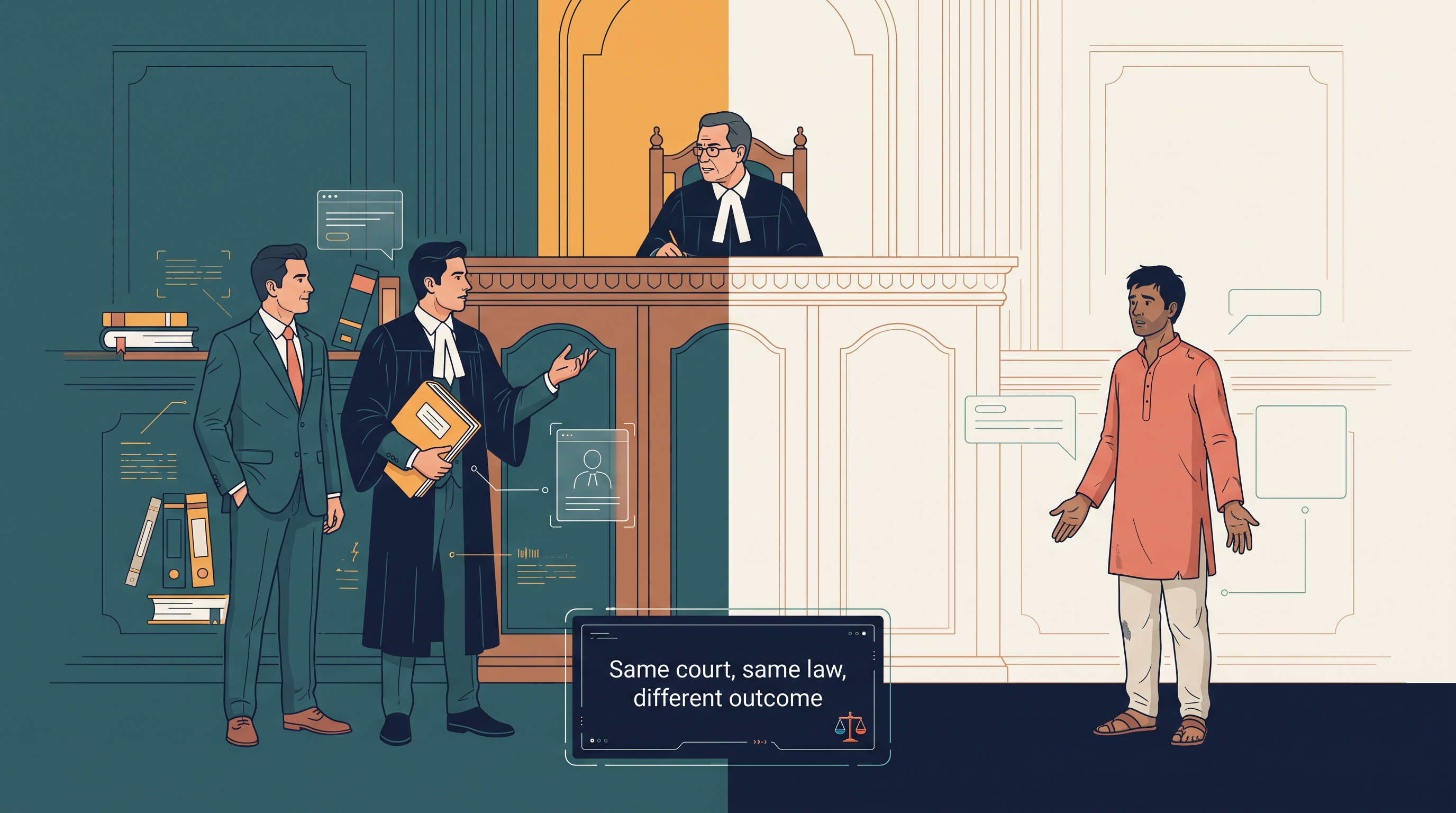
Fig. 14.0 – The imbalance of unrepresented litigation.
This chapter will answer each of these questions.
14.1 Introduction: The Meaning of Legal Aid
A right that a person cannot enforce is not much of a right. A tenant who has been thrown out unlawfully, a worker whose wages have been withheld, a woman whose maintenance has been stopped — each of them has law on their side. What they may not have is the money to reach a court and the skill to argue there.
The French thinker Charles de Montesquieu made this point long before modern legal systems existed. In the state of nature, he wrote, all human beings are born equal, but they cannot remain equal; society takes that equality away from them, and they recover it only through the protection of the laws. Equality, in other words, is not something a society simply has. It is something the legal system has to keep supplying.
Legal aid is the arrangement by which the legal system supplies it. According to Encyclopedia Britannica, ‘legal aid’ means giving persons of limited means grants, or advice and counsel either free or for a nominal fee, so that they can be represented in court in civil and criminal matters. Its purpose is to build a bridge between the poor and the rich so that both can seek justice on equal terms in a court of law.
The idea behind it is simple. No one should be shut out of legal advice and legal help merely because they cannot pay for it. Legal aid to the poor rests on humanitarian considerations, and the whole aim of these provisions is to help those who are socially and economically backward.
The Legal Background
In a participatory democracy, citizens must be able to trust the institution that decides their disputes. That trust depends on two things: that the judiciary is impartial and independent, and that people are properly represented before it. An independent judiciary is the guardian of individual rights in a democratic society, but it can only guard the rights of those who are able to reach it. Making arrangements so that ordinary people are adequately represented in court is therefore not a favour to them. It is an indispensable part of the principle of equality itself.
Think of what citizens give up when they live under a legal system. They accept limits on their own freedom in exchange for peaceful coexistence. In return, they expect that when a conflict arises — between two citizens, or between a citizen and the State — there is a place to take it that is independent of undue influence, that is trustworthy, and that has authority over all the parties so that the dispute can be settled peacefully. It is the responsibility of the State to see that this fair and impartial justice reaches the doorstep of the poor and the economically weaker sections, free of cost, whatever their caste, creed, religion or geographical position.
What Happens When Courts Are Out of Reach
The fundamental value of the Indian system of justice is that the stability of society depends on people being able to obtain access to courts readily. The court system is the one mechanism that everybody recognises and accepts for resolving disputes peacefully.
That is why denial of access is dangerous rather than merely unfortunate. When people cannot take a dispute to court, the dispute does not disappear. It moves into other arenas — the strong settle it themselves, and the result is vigilantism and violence. Access to justice, seen this way, protects not only the individual litigant but public order.
The Human Rights Foundation
Free legal aid does not rest only on sympathy for the poor. Its socio-legal foundations lie in human rights and human dignity. If human rights are to mean anything in practice, a legal system must recognise the principle of equality and must actually ensure access to justice.
These foundations are not purely Indian either. They are reflected in the legal obligations written into international treaties and regional treaties, and in the work of the bodies that monitor how States comply with those treaties, whether through international machinery or through national legal systems. We shall see later in this chapter how those international instruments treat free legal services.
14.2 Access to Justice in the Indian Legal System
Legal aid in India did not appear out of nowhere. It grew as an answer to a particular problem — the kind of court system the country inherited. Understanding that system explains why free legal aid became necessary at all.
The system India follows today is the adversarial system, brought in during the colonial era. In an adversarial system, the court does not investigate the matter itself. Two opposing sides present their own versions, each represented by a lawyer, and the judge decides between them as a neutral umpire. The quality of the presentation therefore matters enormously — and presentation is exactly what a person without a lawyer cannot manage.
The arrival of this system made access to justice harder in one specific way. It ended the era of informal dispute settlement that had been common in Indian society, setting aside the way justice was dispensed in the indigenous mode. The pre-British system was accessible because it was neither technical nor formal, and it was conducted in a language the parties themselves understood. The new system was technical, formal, and conducted in a language most litigants did not know.
The Supreme Court made this point directly.
The scholar B. Sivarammaya applied to Indian conditions a famous observation of the French writer Anatole France — that the majesty of the law treats a millionaire and a pauper sleeping under a bridge alike. The remark is sarcastic, not admiring. Treating two very unequal people by exactly the same formal rule does not produce equal justice; it produces a rule that only one of them can actually use. Sivarammaya’s point was that this held good for the dispensation of justice by courts modelled on adversarial systems.
The conclusion follows from the diagnosis. In an adversarial system, the poor are represented by advocates appointed by the government, so that they too have equal representation in a court of law. This arrangement is one of the most important features of a true democracy.
Three separate sources of law now support free legal aid in India — the Constitution, criminal procedure law, and international law, as set out in Fig. 14.1.
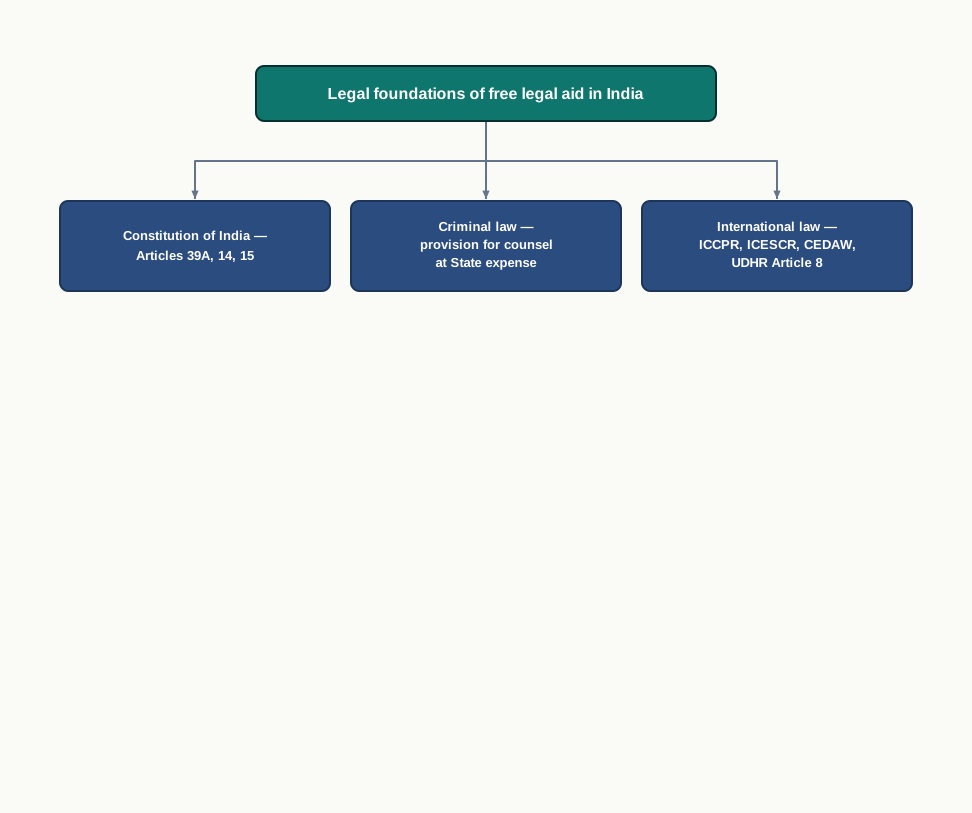
Fig. 14.1 – Legal foundations of free legal aid in India.
14.2.1 Legal Aid under the Indian Constitution
The Constitution as originally adopted said nothing specifically about free legal aid. That changed with the Constitution (Forty-second Amendment) Act, 1976, which inserted Article 39-A.
Article 39-A does two things. It tells the State to secure that the working of the legal system promotes justice on the basis of equal opportunity. And it tells the State, in particular, to provide free legal aid — through legislation, through schemes, or in any other way — so that no citizen is denied the opportunity of securing justice because of economic or other disabilities.
Notice the width of that last phrase. The Article does not speak only of poverty. “Economic or other disabilities” covers a person who cannot read the language of the court, a person with a disability that makes attending court difficult, a person held in custody who cannot walk into a lawyer’s office. Money is the commonest barrier, not the only one.
The wording of Article 39-A restates the kind of equality that promotes access to justice for all by creating equal opportunity. That this constitutional guarantee has been violated more often than observed is visible in many cases brought before the courts, including the apex court. One crucial reason is that a technical application of statutory law or of a constitutional obligation is not enough. Only a fair procedure can deliver equality and access to justice in practice.
Article 39-A does not stand alone. As envisaged under Article 15 of the Constitution of India, the State shall not discriminate against any citizen on grounds of religion, race, caste, sex, place of birth or any of them; and based on this cardinal principle, no citizen shall, on those grounds only, be subject to any disability. Article 14 of the Constitution of India provides that the State shall not deny to any person equality before the law or the equal protection of the laws within the territory of India.
Read together, these three Articles carry a single idea. Article 14 promises equality before the law, Article 15 forbids discrimination in reaching it, and Article 39-A directs the State to pay for the help that makes the promise real.
14.2.2 Free Legal Aid under Criminal Law
Criminal law is where the imbalance between the two sides is sharpest. The prosecution is conducted by the State, with its own lawyers and its own resources. On the other side may stand a single person who has never seen the inside of a courtroom. If that person has no lawyer, the contest is not a contest.
Indian criminal procedure recognised this only narrowly at first. Section 340(1) of the Code of Criminal Procedure, 1898, provided that if a man was charged with an offence punishable with death, the court could provide him with counsel upon his request. The limits are worth noticing: it applied only to the gravest charge, only if the accused asked, and the court merely could provide counsel.
An amendment in the Code of Criminal Procedure, 1973 facilitated the statutory implementation of free legal aid. Section 304(1) of the CrPC provides that in a trial before the Court of Session, where the accused does not have sufficient means to engage a pleader, the court shall assign a pleader for his defence at the expense of the State. A pleader here simply means a lawyer entitled to appear and argue on another’s behalf.
Three things changed between 1898 and 1973. The provision is no longer confined to offences punishable with death. The court does not wait to be asked, but acts when it appears that the accused lacks the means. And the court’s duty is expressed as a command rather than a discretion.
14.2.3 Free Legal Aid under International Law
International law approaches free legal services from the perspective of human rights. An explicit provision for legal services is incorporated in the International Covenant on Civil and Political Rights (ICCPR).
India has ratified the ICCPR, which came into force in 1976, and is bound by the international obligation to provide free legal assistance as the Covenant requires. To ratify a treaty means formally to accept it as binding on the country. But a treaty does not automatically become enforceable law inside India. The Indian Supreme Court has adopted the method of giving effect to international legal obligations where those obligations exist expressly in the Indian legal system. The Court has also recognised international legal obligations as part of the law of the land where Indian law can be harmoniously interpreted as being in conformity with international law.
Several other treaties point in the same direction without saying so in as many words. The International Covenant on Economic, Social and Cultural Rights (ICESCR), the Convention on Elimination of Discrimination Against Women (CEDAW), and the International Convention on Elimination of All Forms of Racial Discrimination may all be interpreted as implicitly referring to the need for free legal services, because each of them aims at an effective legal remedy and at access to justice. A remedy that a person cannot afford to pursue is not an effective remedy.
Beyond treaties, a number of declarations and principles adopted by the United Nations speak of an effective legal remedy, and free legal services in genuine cases form an essential component of it. Article 8 of the Universal Declaration of Human Rights (UDHR) provides that everyone has the right to an effective remedy by the competent national tribunals for acts violating the fundamental rights granted by the constitution or by law.
The UDHR occupies an unusual position. Being a General Assembly resolution, some international law scholars describe it as soft law — a declaration carrying lofty idealistic notions about human rights rather than binding force. Soft law means a text that States are expected to respect but cannot ordinarily be sued upon. Even so, the UDHR creates right-centric obligations of a norm-creating character for the members of the international community: it sets the standard against which national systems are judged, and States that fall short of it must explain themselves.
14.3 The Legal Services Authorities Act, 1987
Article 39-A told the State to provide free legal aid by suitable legislation or schemes. For nearly three decades after Independence the country tried to do it by schemes. This section traces why schemes were not enough, and what changed when Parliament finally passed a law.
14.3.1 Brief History
The idea was first put on record officially in 1958. The 14th Law Commission of India Report on Reform of Judicial Administration, 1958 mooted the idea of the State providing free legal aid to the poor. The Report divided the work between two shoulders: the legal community would carry the responsibility of administering legal aid schemes, and the State would fund legal representation for the accused in criminal proceedings, in appeals, and in jails.
The first attempt came two years later. In 1960, the Union Government initiated the National Legal Aid Scheme. It faced financial shortages and died a natural death. The lesson was an important one — a legal aid programme that depends on whatever funds happen to be available each year cannot survive.
In 1973, in the second phase, the Union Government constituted a committee under the chairmanship of Justice Krishna Iyer to develop a legal aid scheme for the states. The Committee devised a strategy in a decentralised mode, with legal aid committees at every level — district, state and centre. Decentralisation mattered because the person who needs legal aid is rarely near the capital; help has to exist where the litigant lives.
In 1980, a committee was constituted at the national level to oversee and supervise legal aid programmes throughout the country, under the Chairmanship of Justice P.N. Bhagwati, then a Judge of the Supreme Court of India. This Committee came to be known as CILAS — the Committee for Implementing Legal Aid Schemes — and it began monitoring legal aid activities throughout the country. Fig. 14.2 sets out this sequence.
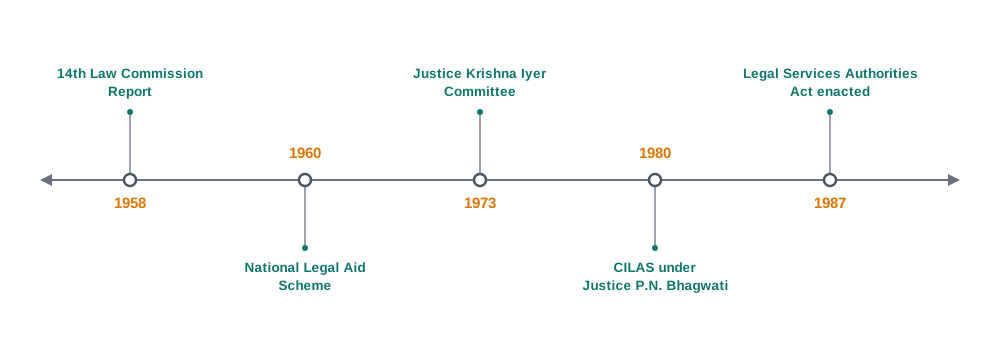
Fig. 14.2 – Timeline of legal aid in India.
Notice what all these efforts had in common. Each was a committee or a scheme, which meant each depended on administrative goodwill and could be discontinued. In 1987, the Legal Services Authorities Act was enacted to give a statutory base to legal aid programmes throughout the country on a uniform pattern. Parliament enacted the Legal Services Authorities Act, 1987 to provide free legal aid to certain categories of citizens.
A statutory base changes three things at once. Legal aid stops being a favour and becomes an entitlement that a person can claim. The bodies that provide it are created by law and cannot simply be wound up. And the same pattern applies across every State, instead of varying with each government’s enthusiasm.
What the Preamble Promises
The preamble of the Legal Services Authorities Act, 1987 states: ‘An Act to constitute legal services authorities to provide free and competent legal services to the weaker sections of the society to ensure that opportunities for securing justice are not denied to any citizen by reason of economic or other disabilities, and to organize lok adalats to secure that the operation of the legal system promotes justice on a basis of equal opportunity.’
Two words in that preamble deserve attention. The services must be free, and they must be competent. Assigning a lawyer who does not prepare the case would satisfy the first requirement and defeat the whole purpose. Legal aid is meant to give the litigant a real lawyer, not a formality.
The preamble also carries the Act’s second limb. The introduction of Lok Adalats added a new chapter to the justice dispensation system of this country and succeeded in providing a supplementary forum where litigants could settle their disputes conciliatorily — that is, by agreement reached with the help of a neutral third person, rather than by a contested judgment. A Lok Adalat is a supplementary forum, not a replacement for the courts.
Society is progressing rapidly and the reflections of that change can be found on all fronts. Given the socio-economic changes of recent decades, the Preamble sets forth the need to address the grievances of the weaker sections of society. Nobody should be denied justice for being poor or disabled, and the evils in the social hierarchy should not affect anyone who is seeking justice.
14.3.2 Entitlement to Legal Services
Sections 12 and 13 of the Legal Services Authorities Act, 1987 deal with the criteria of eligibility for legal services.
Section 12 answers the question who may claim. It lists eight categories, and a person who has to file or defend a case is entitled to legal services under the Act if he or she falls into any one of them. The categories are these.
- A member of a Scheduled Caste or Scheduled Tribe.
- A victim of trafficking in human beings or of begar — that is, forced labour taken without payment — as referred to in Article 23 of the Constitution.
- A woman or a child.
- A person with disability, as defined in the Act’s own reference to the disability legislation.
- A person in circumstances of undeserved want, such as a victim of a mass disaster, ethnic violence, caste atrocity, flood, drought, earthquake or industrial disaster.
- An industrial workman.
- A person in custody, including custody in a protective home, a juvenile home, or a psychiatric hospital or psychiatric nursing home.
- A person whose annual income falls below the prescribed limit.
Read the list again and one thing stands out. Only the last category depends on income at all. The first seven turn on the person’s situation — their social position, their vulnerability, the fact that they are locked up and cannot walk out to find a lawyer. The Act’s premise is that poverty is the commonest barrier to justice, but not the only one, and that some disadvantages cannot be measured in rupees.
The wording of clause (h) repays close reading, because students often misread it as fixing a permanent income limit. It does not. It sets a floor figure and then allows a higher amount to be prescribed — by the State Government for cases before other courts, and by the Central Government for cases before the Supreme Court. Parliament deliberately left the ceiling adjustable, because an income figure fixed in a statute in 1987 would become meaningless as prices and wages changed, and amending an Act every few years is slow work. A student answering a question on this provision should state the statutory figures and then state the prescribing power, because the second half is what keeps the first half alive.
Clause (g) and clause (d) also name older statutes, since they refer to the legislation that was in force when the Act was passed. Several of those statutes have since been replaced by newer laws on disability, on juvenile justice and on mental health, but the substance of the categories — a person with a disability, a child in a juvenile home, a person in a psychiatric institution — is unchanged.
Section 12 tells us who qualifies. Section 13 adds the two practical conditions that follow. First, a person covered by Section 12 is entitled to legal services if the concerned Authority is satisfied that the person has a prima facie case to prosecute or to defend — meaning a case that appears arguable on the face of it. Public money is not spent on a claim that has nothing in it. Second, for the income category, an affidavit made by the person about their own income is ordinarily treated as sufficient, unless the Authority has reason to disbelieve it. That second rule matters more than it looks: demanding documentary proof of income from a daily-wage earner would defeat the very provision meant to help them.
14.4 Legal Services: Meaning and Types
So far we have seen who is entitled to legal aid. The next question is what exactly they are entitled to. “Free legal aid” is easily imagined as a free lawyer and nothing more, but a free lawyer is of little use to someone who cannot pay the court fee that gets the case admitted in the first place.
The Act therefore uses the wider expression legal services. Under Section 2(c) of the Legal Services Authorities Act, 1987, legal services means any service in the conduct of a case or other legal proceeding before any court, authority or tribunal, and the giving of advice on any legal matter.
Notice the second half of that definition. Advice on a legal matter counts as a legal service even where there is no case at all. That single clause is what allows the whole system of pre-litigation help discussed later in this chapter.
14.4.1 What Free Legal Services Include
The free legal services provided under the Act include the following.
- Payment of court fee, process fees and all other charges payable or incurred in connection with any legal proceedings.
- Providing the service of lawyers in legal proceedings.
- Obtaining and supplying certified copies of orders and other documents in legal proceedings.
- Preparation of the appeal, and of the paper book, including the printing and translation of documents in legal proceedings.
Each of these removes a different obstacle. Court fees and process fees are what a litigant must pay simply to have the machinery move — to file the case, to have a summons served on the other side. Certified copies matter because a court will not act on an ordinary photocopy of its own order; an appeal cannot even be filed without a certified copy of the judgment appealed against. The paper book is the compiled set of documents an appellate court reads, and preparing it costs money in printing and, where the documents are in another language, in translation.
Litigation as a Last Resort
Litigation is not a luxury, but it should be used as a last resort. This caution has a particular edge in criminal cases. There, the prosecution is initiated by the State, and when legal aid is also provided to the accused, the expenditure of both sides is being managed by the State. It is sometimes criticised that legal aid in criminal cases encourages litigation.
Free legal services also include the provision of aid and advice to beneficiaries so that they can access the benefits available under welfare statutes and schemes framed by the Central Government or the State Government, and so that access to justice is secured in any other manner. A person entitled to a pension, a ration entitlement or a compensation scheme may need nothing more than help with the correct application. Helping them get it is legal service too, and it keeps a dispute out of court altogether.
14.4.2 The Two Types of Legal Services
Legal services can be broadly categorised into two types.
- Pre-litigation legal services.
- Post-litigation legal services.
The dividing line is the filing of the case. Everything done to prevent a dispute from becoming a case, or to help a person before one exists, falls on the pre-litigation side. Everything done once proceedings have begun falls on the post-litigation side. The next section takes up each in turn.
14.5 Pre-litigation and Post-litigation Legal Services
These days the number of litigations is increasing day by day, which works against the smooth administration of justice. Courts that are already carrying more cases than they can hear cannot give quick attention to any of them, so every new case slows down the ones already waiting.
For a long time, the emphasis in legal aid was placed only on post-litigation assistance — help given after a case had been filed. It is now being realised that pre-litigation legal services are more useful than post-litigation legal services. The reason is straightforward: a dispute that is settled or avoided before it reaches a court costs the parties less, costs the State less, and does not add to the pendency in the courts.
The pre-litigation legal services include the following.
- Legal education — teaching people what the law on a subject actually is, so that they understand their position before they act on it.
- Legal advice — telling a particular person, on their particular facts, what their rights are and what their options are.
- Legal awareness — spreading the knowledge that rights and remedies exist at all, and that free help is available to enforce them.
- Pre-litigation settlement — helping the two sides resolve the dispute by agreement before any case is filed.
Post-litigation services include all those services that an Advocate is required to render to his client. Once a case has been filed, the work is the ordinary work of conducting litigation — drafting the pleadings, appearing on each date, examining witnesses, arguing the matter, and carrying it in appeal where necessary. Under legal aid, that work is done by an advocate whom the legal services institution assigns, and the client pays nothing for it.
14.6 The National Legal Services Authority
A statute that promises free legal services must also create somebody to deliver them. A person who needs a lawyer cannot write to Parliament. There has to be an office, at a place they can reach, with the power to assign a lawyer and to pay for the case. That is what the Legal Services Authorities Act, 1987 built.
The constitutional backing has already been seen. Article 39A provides for free legal aid to the poor and weaker sections of society and ensures justice for all. Articles 14 and 22(1) of the Constitution also make it obligatory for the State to ensure equality before the law and a legal system that promotes justice on the basis of equal opportunity for all. Article 22(1) is worth pausing on, because it is the one that speaks at the moment of arrest: a person who is arrested has the right to consult, and to be defended by, a legal practitioner of his choice. That right is of little value to someone who cannot pay a practitioner, which is exactly the gap legal aid fills.
The Act was passed by Parliament in 1987, but it came into force on 9th November 1995. Its object was to establish a uniform nationwide network for providing free and competent legal services to the weaker sections of society on the basis of equal opportunity.
14.6.1 The Structure of Legal Services Institutions
The National Legal Services Authority (NALSA) has been constituted under the Legal Services Authorities Act, 1987 to monitor and evaluate the implementation of legal aid programmes, and to lay down policies and principles for making legal services available under the Act.
Below NALSA the network follows the shape of the court system itself, so that a legal services institution exists wherever a court exists. In every State, a State Legal Services Authority has been constituted, and in every High Court, a High Court Legal Services Committee. District Legal Services Authorities and Taluk Legal Services Committees have been constituted in the districts and in most of the taluks. Their task is to give effect to the policies and directions of NALSA, to provide free legal services to the people, and to conduct Lok Adalats in the State. For proceedings in the highest court, the Supreme Court Legal Services Committee has been constituted to administer and implement the legal services programme insofar as it relates to the Supreme Court of India. The complete structure is shown in Fig. 14.3.
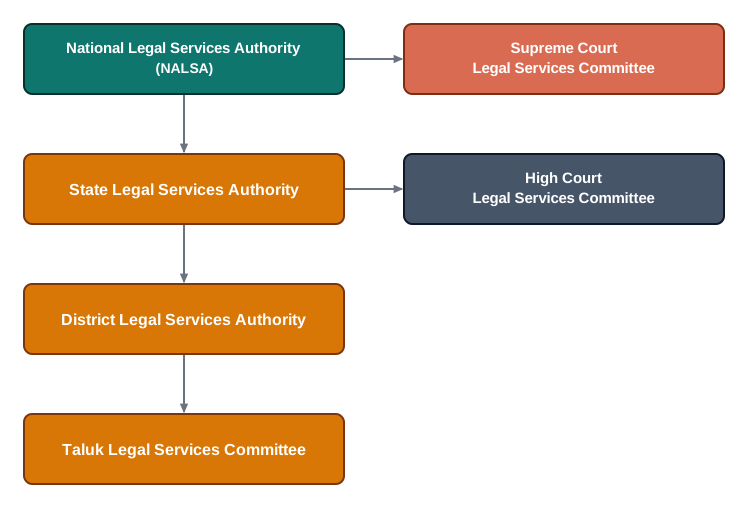
Fig. 14.3 – Hierarchy of legal services institutions.
The division of work between the apex body and the rest is a division between policy and delivery. NALSA lays down policies, principles and guidelines, and frames effective and economical schemes for the State Legal Services Authorities to implement the Legal Services Programmes throughout the country. The institutions on the ground then carry them out.
Primarily, the State Legal Services Authorities, District Legal Services Authorities, Taluk Legal Services Committees and similar bodies have been asked to discharge the following main functions on a regular basis.
- To provide free and competent legal services to the eligible persons.
- To organise Lok Adalats for the amicable settlement of disputes.
- To organise legal awareness camps in rural areas.
Read those three functions together and the design becomes visible. The first is post-litigation help, the second is settlement without a contested trial, and the third is pre-litigation awareness. The same institution works at all three stages, which is why a person can walk into a District Legal Services Authority either with a case already filed against them or with nothing more than a question.
14.6.2 NALSA Regulations, 2010
A statute can create authorities and state objects, but it cannot sensibly lay down the working detail of how a panel of lawyers is to be chosen, or what such lawyers may and may not do. That detail is left to regulations made under the Act itself.
In 2010, the National Legal Services Authority of India adopted the National Legal Services Authority (Free and Competent Legal Services) Regulations, in exercise of its power under Section 29 of the Legal Services Authorities Act, 1987. The Regulations apply to the Legal Service Committees of the Supreme Court and the High Courts, and to those of the States, districts and taluks. Their broad features fall under three heads.
Selection of Panel Lawyers
The legal services institution is vested with the authority to invite applications from legal practitioners who have the requisite professional experience, asking them to indicate the types of cases they may be entrusted with. The panel is then prepared by the Executive Chairman of the legal services institution, in consultation with the Attorney-General for the Supreme Court, the Advocate-General for the High Courts, the Government Pleader for districts and taluks, and the President of the Bar Association.
A legal practitioner must have three years or more of experience at the bar to be considered for empanelment, and personal traits such as competence, integrity, suitability and experience are also considered. Separate panels are maintained for different types of cases, so that a matter goes to a lawyer who actually practises in that field. The Regulations also provide for retainer lawyers.
The Regulations also govern what happens once a lawyer is on the panel. A panel lawyer who wishes to withdraw from a case entrusted to him must communicate this to the Member Secretary, and the Member Secretary may permit him to do so. The panel lawyer is barred from taking any fee, remuneration or other valuable consideration from any person for whom legal services are rendered under the Regulations or the Act. And a panel lawyer may be withdrawn from a case, or his name removed from the panel, on account of not performing his duties satisfactorily, or for acting against the object and purpose of the Act or the Regulations.
Payment of Fee
The Regulations specify the rules regarding payment of fees to panel lawyers. Such fees are to be paid in accordance with the State regulations, without any delay, on receipt of the completion of proceedings. The Regulations also suggest a periodic revision of the honorarium payable for the different types of services provided by panel lawyers in legal aid cases.
The reason for both rules is the same as the reason for the word “competent” in the Act’s preamble. Fees that arrive years late, or that stay frozen at an old figure, drive able lawyers away from legal aid work, and the person who suffers is the litigant assigned whoever remains.
Senior Advocates
The services of senior advocates may be availed if the Chairman of the legal services institution forms an opinion to that effect. This is confined to two situations: cases of great public importance, and cases where a serious threat to the life and liberty of the applicant exists. The restriction reflects a simple allocation of scarce resources — the most expensive counsel are reserved for the matters where the stakes, for the individual or for the public, are highest.
14.8 When Legal Aid Can Be Denied or Withdrawn
Legal aid is an entitlement, but it is not unconditional. Public money and a lawyer’s time are being spent on a person’s case, and the system needs some way of stopping that spending when it is not warranted. The Act and the schemes therefore provide for aid being refused at the start, and for aid being taken back later.
The two situations are different and should not be confused. Legal aid can be denied at the initial stage, before the application for legal aid is accepted. It can also be withdrawn at a later stage, after the application has already been accepted.
Legal aid can be denied or withdrawn in the following circumstances.
- Legal aid can be denied if a person is found ineligible under Section 12 of the Legal Services Authorities Act, 1987.
- Legal aid can be withdrawn if the aided person, who applied under the income category, is found to possess sufficient means.
- Legal aid can be withdrawn where the aided person obtained legal services by misrepresentation or fraud.
- Legal aid can be withdrawn where the aided person does not cooperate with the Legal Services Authority or Committee, or with the legal services advocate.
- Legal aid can be withdrawn where the person engages a legal practitioner other than the one assigned by the Legal Services Authority or Committee.
- Legal aid can be withdrawn in the event of the death of the aided person, except in the case of civil proceedings where the right or liability survives.
- Legal aid can be withdrawn where the application for legal service, or the matter in question, is found to be an abuse of the process of law or of legal services.
Reading the Grounds Together
Only the first ground is a ground of denial, and it is really a restatement of eligibility: a person who does not fall within any category in Section 12 was never entitled to legal services, so there is nothing to grant. Every other ground operates on someone who has already been granted aid.
The remaining grounds fall into recognisable groups. Grounds (b) and (c) deal with a person who should not have been given aid — either because their means turn out to be sufficient, or because they obtained the service by misrepresentation or fraud in the first place. Grounds (d) and (e) deal with the conduct of the aided person once aid has begun: an advocate cannot conduct a case for a client who will not cooperate, and a person who has engaged a lawyer of their own no longer needs a lawyer at State expense. Ground (g) protects the system itself, by allowing aid to be stopped where the proceeding is an abuse of the process of law or of legal services. Ground (f) is different in kind — it recognises simply that the person for whose benefit the aid existed is no longer there.
14.10 Summary
- Legal aid means providing legal advice, assistance and representation, free or for a nominal fee, to persons of limited means in civil and criminal matters.
- Its purpose is to build a bridge between the rich and the poor so that lack of funds does not prevent anyone from seeking or defending their rights.
- Access to courts is essential to the stability of society, because a dispute that cannot reach a court does not disappear — it moves into other arenas and produces vigilantism and violence.
- India follows the adversarial system, in which two opposing sides present their own cases and the judge decides between them; the system therefore works badly for a party who has no lawyer.
- In M.H. Hoskot v. State of Maharashtra, (1978) 3 SCC 544, the Supreme Court observed that a judicature based on the Anglo-American model must collaborate lawyer-power by providing free legal aid to certain categories of persons.
- Free legal aid in India rests on three legal foundations:
- the Constitution of India;
- criminal procedure law;
- international law.
- Article 39-A was inserted by the Constitution (Forty-second Amendment) Act, 1976, and directs the State to provide free legal aid so that opportunities for securing justice are not denied to any citizen by reason of economic or other disabilities.
- Article 39-A is supported by Article 14, which guarantees equality before the law and equal protection of the laws, by Article 15, which forbids discrimination on grounds of religion, race, caste, sex or place of birth, and by Article 22(1), which gives an arrested person the right to be defended by a legal practitioner of his choice.
- Under criminal procedure law, Section 340(1) of the Code of Criminal Procedure, 1898 allowed a court to provide counsel only where a man was charged with an offence punishable with death, and only on his request.
- Section 304(1) of the Code of Criminal Procedure, 1973 widened this: in a trial before the Court of Session, where the accused is unrepresented and it appears he has not sufficient means, the court shall assign a pleader for his defence at the expense of the State.
- Under international law, the International Covenant on Civil and Political Rights (ICCPR) carries an explicit provision for legal services, and India, having ratified it, is bound to provide free legal assistance as the Covenant requires.
- The ICESCR, CEDAW and the International Convention on Elimination of All Forms of Racial Discrimination may be read as implicitly requiring free legal services, since each aims at an effective legal remedy.
- Article 8 of the Universal Declaration of Human Rights provides that everyone has the right to an effective remedy by the competent national tribunals for acts violating their fundamental rights, although the UDHR, being a General Assembly resolution, is described by some scholars as soft law.
- Legal aid in India developed through four stages before it became law:
- the 14th Law Commission of India Report on Reform of Judicial Administration, 1958, which first mooted State-funded legal aid;
- the National Legal Aid Scheme of 1960, which failed for want of funds;
- the committee under Justice Krishna Iyer in 1973, which proposed a decentralised structure;
- CILAS in 1980, under Justice P.N. Bhagwati, which monitored legal aid activities nationally.
- The Legal Services Authorities Act, 1987 gave legal aid a statutory base on a uniform pattern throughout the country, and came into force on 9th November 1995.
- The preamble of the Act promises free and competent legal services to the weaker sections, and also provides for the organisation of Lok Adalats.
- Section 12 of the Act lists eight categories of persons entitled to legal services:
- a member of a Scheduled Caste or Scheduled Tribe;
- a victim of trafficking in human beings or begar under Article 23 of the Constitution;
- a woman or a child;
- a person with disability;
- a person in circumstances of undeserved want, such as a victim of a mass disaster, ethnic violence, caste atrocity, flood, drought, earthquake or industrial disaster;
- an industrial workman;
- a person in custody, including in a protective home, a juvenile home or a psychiatric hospital or nursing home;
- a person whose annual income is below the limit fixed under the Act.
- Only clause (h) of Section 12 depends on income; the other seven categories qualify irrespective of what the person earns.
- Clause (h) sets the income figures at rupees nine thousand for courts other than the Supreme Court and rupees twelve thousand for the Supreme Court, and allows a higher amount to be prescribed by the State Government and the Central Government respectively.
- Section 13 adds that a person entitled under Section 12 receives legal services if the Authority is satisfied there is a prima facie case, and that an affidavit of income is ordinarily sufficient proof for the income category.
- Senior citizens are not a separate category under Section 12; their eligibility depends on the Rules framed by the respective State Governments.
- Under Section 2(c) of the Act, legal services means any service in the conduct of a case or other proceeding before a court, tribunal or authority, and the giving of advice on any legal matter.
- Free legal services include:
- payment of court fee, process fees and all other charges in connection with legal proceedings;
- the service of lawyers in legal proceedings;
- obtaining and supplying certified copies of orders and other documents;
- preparation of the appeal and the paper book, including printing and translation of documents.
- Free legal services also include aid and advice to help beneficiaries obtain benefits under welfare statutes and schemes of the Central or State Government.
- Legal services are of two types — pre-litigation legal services and post-litigation legal services — the dividing line being the filing of the case.
- Pre-litigation legal services include legal education, legal advice, legal awareness and pre-litigation settlement, and are now regarded as more useful than post-litigation services because they prevent disputes from becoming cases.
- Post-litigation services include all the services an advocate renders to his client once proceedings have begun.
- The National Legal Services Authority (NALSA) is constituted under the Act to monitor and evaluate legal aid programmes and to lay down policies and principles for making legal services available.
- The network below NALSA follows the court structure:
- a State Legal Services Authority in every State;
- a High Court Legal Services Committee in every High Court;
- District Legal Services Authorities in the districts;
- Taluk Legal Services Committees in most taluks;
- the Supreme Court Legal Services Committee for matters before the Supreme Court.
- These institutions perform three main functions on a regular basis:
- providing free and competent legal services to eligible persons;
- organising Lok Adalats for the amicable settlement of disputes;
- organising legal awareness camps in rural areas.
- The National Legal Services Authority (Free and Competent Legal Services) Regulations were adopted in 2010 under Section 29 of the Legal Services Authorities Act, 1987, and apply to the Legal Service Committees of the Supreme Court, the High Courts, the States, districts and taluks.
- Under the Regulations, the panel of lawyers is prepared by the Executive Chairman in consultation with the Attorney-General, the Advocate-General, the Government Pleader and the Bar Association President, as the case may be.
- A legal practitioner needs three years or more of experience at the bar for empanelment, separate panels are maintained for different types of cases, and the panel is reconstituted every three years without disturbing ongoing work.
- A panel lawyer is barred from taking any fee, remuneration or other valuable consideration from a person for whom legal services are rendered, and may be removed for unsatisfactory performance or for acting against the object of the Act or the Regulations.
- The Regulations require that fees to panel lawyers be paid in accordance with State regulations without delay on completion of proceedings, and suggest periodic revision of the honorarium.
- The services of senior advocates may be availed only where the Chairman of the legal services institution forms that opinion, in cases of great public importance or where a serious threat to the life and liberty of the applicant exists.
- The Legal Services Authorities (Amendment) Act, 2002 was passed because litigation-oriented legal services could not bring out the desired results, and it introduced:
- the establishment of Permanent Lok Adalats for disputes concerning public utility services at the pre-litigation stage;
- pre-litigation conciliation and settlement pertaining to public utility services.
- ‘Public utility service’ covers transport by air, road or water; postal, telegraph or telephone service; supply of power, light or water; public conservancy or sanitation; service in a hospital or dispensary; and insurance service, besides any service notified as such by the Central or State Government in the public interest.
- A Permanent Lok Adalat assists the parties to reach an amicable settlement independently and impartially, and every party must cooperate in good faith and produce the evidence and documents directed.
- If the parties agree, they sign the settlement agreement and the Permanent Lok Adalat passes an award in its terms; if they fail to agree, the Permanent Lok Adalat decides the dispute itself on merit.
- The Permanent Lok Adalat is guided by the principles of natural justice, objectivity, fair play and equity, and is not bound by the Code of Civil Procedure, 1908 or the Indian Evidence Act, 1872.
- The award of a Permanent Lok Adalat is final and is deemed to be a decree of a civil court.
- Legal aid can be denied at the initial stage, before the application is accepted, if the person is found ineligible under Section 12.
- Legal aid already granted can be withdrawn where:
- a person in the income category is found to possess sufficient means;
- the services were obtained by misrepresentation or fraud;
- the aided person does not cooperate with the Authority or Committee or with the legal services advocate;
- the person engages a legal practitioner other than the one assigned;
- the aided person dies, except in civil proceedings where the right or liability survives;
- the application or the matter is found to be an abuse of the process of law or of legal services.
- Human rights that cannot be enforced because of poverty are meaningless, which is why access to justice is described as sine qua non for social justice.
- Since a declaration of rights is worthless without a guarantee of enforcement, the right to legal aid is said to stand first among human rights, because it is what makes the other rights usable by the poor.
14.11 Key Terms
Legal aid — legal advice, assistance and representation given free of cost or for a nominal fee to persons of limited means, in civil and criminal matters.
Access to justice — the practical ability of a person to reach a court or other forum and obtain a remedy, rather than merely holding a right on paper.
Adversarial system — a system in which two opposing parties present their own cases through their lawyers and the judge decides between them as a neutral umpire, without investigating the matter himself.
Directive Principles of State Policy — constitutional directions to the State which a court cannot enforce directly, but which are fundamental in the governance of the country and guide the making and reading of law.
Pleader — a lawyer entitled to appear and argue a case on another person’s behalf.
Ratification — the formal act by which a country accepts a treaty as binding upon it.
Soft law — a text, such as a General Assembly declaration, that States are expected to respect but which cannot ordinarily be enforced against them in the way a binding treaty can.
CILAS — the Committee for Implementing Legal Aid Schemes, constituted in 1980 under Justice P.N. Bhagwati to oversee and monitor legal aid activities throughout the country.
Lok Adalat — a supplementary forum organised under the Legal Services Authorities Act, 1987 in which disputes are settled conciliatorily rather than by a contested judgment.
Begar — forced labour extracted from a person without payment, prohibited by Article 23 of the Constitution.
Undeserved want — a condition of need that a person has not brought upon themselves, such as that of a victim of a mass disaster, caste atrocity, flood, drought, earthquake or industrial disaster.
Prima facie case — a case that appears arguable on the face of it, which the Authority must be satisfied exists before legal services are granted under Section 13.
Legal services — under Section 2(c) of the Legal Services Authorities Act, 1987, any service in the conduct of a case or other proceeding before a court, tribunal or authority, and the giving of advice on any legal matter.
Court fee — the fee payable to the court for filing and pursuing a case, which is borne by the legal services institution for an aided person.
Certified copy — an official copy of a court’s order or record, authenticated by the court, without which an appeal cannot ordinarily be filed.
Paper book — the compiled set of documents placed before an appellate court, the printing and translation of which is covered by free legal services.
Pre-litigation legal services — services given before any case is filed, comprising legal education, legal advice, legal awareness and pre-litigation settlement.
Post-litigation legal services — all the services an advocate is required to render to his client once proceedings have begun.
National Legal Services Authority (NALSA) — the apex body constituted under the Legal Services Authorities Act, 1987 to lay down policies and principles for legal services and to monitor and evaluate legal aid programmes.
State Legal Services Authority — the legal services institution constituted in every State to give effect to NALSA’s policies and provide free legal services within the State.
District Legal Services Authority — the legal services institution constituted in a district to provide free legal services and conduct Lok Adalats there.
Supreme Court Legal Services Committee — the body constituted to administer and implement the legal services programme insofar as it relates to the Supreme Court of India.
Panel lawyer — a legal practitioner empanelled by a legal services institution, from whom counsel is assigned to aided persons, and who may take no fee from the person aided.
Empanelment — the placing of a legal practitioner on the panel of a legal services institution, for which three years or more of experience at the bar is required.
Retainer lawyer — a lawyer engaged on a continuing basis by a legal services institution, as provided for by the NALSA Regulations, 2010.
Honorarium — the payment made to a panel lawyer for legal aid work, which the Regulations require to be revised periodically.
Permanent Lok Adalat — a standing forum established under the Legal Services Authorities (Amendment) Act, 2002 to settle disputes concerning public utility services at the pre-litigation stage.
Public utility service — a transport, postal, telegraph or telephone service, a supply of power, light or water, a system of public conservancy or sanitation, a service in a hospital or dispensary, an insurance service, or any other service so notified by the Central or State Government.
Conciliation — a process in which a neutral third person helps the parties reach a settlement by agreement instead of having the dispute decided against one of them.
Natural justice — the basic fairness requirements of any decision-making process: that both sides be heard, and that the decision be made without bias.
Award — the decision of a Permanent Lok Adalat, which is final and deemed to be a decree of a civil court.
Decree — the formal expression of a civil court’s decision, which can be executed against the party bound by it.
Denial of legal aid — refusal of legal aid at the initial stage, before the application has been accepted, where the applicant is found ineligible under Section 12.
Withdrawal of legal aid — the stopping of legal services already granted, on any of the grounds recognised after an application has been accepted.
Sine qua non — an indispensable condition; something without which the result cannot follow.
Social justice — the securing of fair treatment and real opportunity for the weaker sections of society, of which access to justice is treated as an essential condition.
14.12 Points to Ponder
The preamble of the Legal Services Authorities Act, 1987 promises legal services that are both free and competent. Which of these two promises is harder for a State to keep, and how would you go about measuring whether the second one is being kept at all?
Seven of the eight categories in Section 12 apply irrespective of income. Is it right that a wealthy person who falls within one of those categories should receive legal services at the cost of the State, or should every category carry an income test?
In a criminal trial where the accused is aided, the State pays for the prosecution and for the defence. Is this a fair use of public money, or does it point to something important about what a criminal trial is meant to be?
The income figures written into Section 12(h) are those of 1987, and the working limits today come from what the Governments have prescribed. Is it better for a statute to carry a figure that must be updated by rule, or should Parliament amend the figures in the Act itself?
A panel lawyer may take nothing from the aided person and receives only an honorarium from the institution. What effect does the size and timeliness of that honorarium have on the quality of legal aid, and what would you change?
Article 39-A sits among the Directive Principles and cannot be enforced directly against the government. Would placing free legal aid among the Fundamental Rights change anything in practice, or is the difficulty elsewhere?
The award of a Permanent Lok Adalat is final, with no appeal, and it may be passed even where the parties never agreed. Is finality a fair price to pay for speed in disputes over essential services?
Pre-litigation services are now regarded as more useful than post-litigation services. Could an emphasis on settling disputes early ever work against a poor litigant who has a strong claim and should be pressing it in court?
A right that a person does not know about is a right that will never be used. If you were asked to design a legal awareness programme for your own school or locality, what would you tell people first, and how would you reach those least likely to attend a camp?
The services of a senior advocate may be availed only on the opinion of the Chairman of the legal services institution, in cases of great public importance or where life and liberty are seriously threatened. Who is best placed to judge that a case meets this test, and what risks does concentrating that decision in one office carry?
It is said that the right to legal aid stands first among human rights, because without it the other rights cannot be enforced. Do you agree that a right of enforcement should rank above the rights it enforces?
14.13 Textbook Questions
Discuss the main provisions for free legal aid under the Indian Constitution.
Mention any four categories of persons entitled to free legal aid under the Legal Services Authorities Act, 1987.
How has the amendment of the Legal Services Authorities Act in 2002 widened its scope by establishing Permanent Lok Adalats?
Discuss three main provisions of the National Legal Services Authority (Free and Competent Legal Services) Regulations, 2010.
14.14 Objective Questions
The Article inserted in the Constitution to provide for equal justice and free legal aid is—
- Article 14
- Article 15
- Article 39-A
- Article 23
Article 39-A was inserted into the Constitution by—
- the Constitution (Forty-second Amendment) Act, 1976
- the Constitution (Forty-fourth Amendment) Act, 1978
- the Legal Services Authorities Act, 1987
- the Legal Services Authorities (Amendment) Act, 2002
The Legal Services Authorities Act, 1987 came into force on—
- 26th January 1950
- 9th November 1995
- 1st July 1987
- 2nd October 2002
The categories of persons entitled to legal services are listed in—
- Section 2(c) of the Legal Services Authorities Act, 1987
- Section 12 of the Legal Services Authorities Act, 1987
- Section 22 of the Legal Services Authorities Act, 1987
- Section 29 of the Legal Services Authorities Act, 1987
Under Section 12, the income test applies only to a person falling within—
- clause (a)
- clause (c)
- clause (f)
- clause (h)
The National Legal Services Authority (Free and Competent Legal Services) Regulations, 2010 were adopted in exercise of the power conferred by—
- Section 12 of the Legal Services Authorities Act, 1987
- Section 13 of the Legal Services Authorities Act, 1987
- Section 29 of the Legal Services Authorities Act, 1987
- Article 39-A of the Constitution
For empanelment as a panel lawyer, a legal practitioner must have experience at the bar of—
- one year or more
- three years or more
- seven years or more
- ten years or more
Under the NALSA Regulations, 2010, the panel of lawyers has to be reconstituted every—
- year
- two years
- three years
- five years
The Committee for Implementing Legal Aid Schemes (CILAS), constituted in 1980, functioned under the chairmanship of—
- Justice Krishna Iyer
- Justice P.N. Bhagwati
- the Attorney-General for India
- the Chief Justice of India
Permanent Lok Adalats were established by—
- the Legal Services Authorities Act, 1987
- the Legal Services Authorities (Amendment) Act, 2002
- the NALSA Regulations, 2010
- the Code of Civil Procedure, 1908
Which of the following is NOT a public utility service within the meaning of the 2002 Amendment?
- Transport service for the carriage of goods by road
- Service in a hospital or dispensary
- Insurance service
- Sale of furniture by a private showroom
The award of a Permanent Lok Adalat is—
- a recommendation that the parties may accept or reject
- final and deemed to be a decree of a civil court
- binding only if both parties have signed a settlement agreement
- subject to a further appeal to the District Court
Article 8 of the Universal Declaration of Human Rights provides for—
- the abolition of court fees
- the right to an effective remedy by the competent national tribunals
- the right to free legal aid in criminal trials
- the establishment of legal services authorities
Assertion (A): Article 39-A cannot by itself be enforced in a court against the government. Reason (R): Article 39-A is one of the Directive Principles of State Policy.
Assertion (A): A woman is entitled to legal services under the Legal Services Authorities Act, 1987 whatever her annual income may be. Reason (R): Section 12 makes a woman or a child a category in its own right, and the income limit attaches only to clause (h).
Assertion (A): A panel lawyer may not accept any fee or other valuable consideration from the person to whom legal services are rendered. Reason (R): The panel lawyer is paid an honorarium by the legal services institution for legal aid work.
Assertion (A): A Permanent Lok Adalat can bring a public utility service dispute to a conclusion even where the parties do not settle. Reason (R): Where the parties fail to reach an agreement, the Permanent Lok Adalat decides the dispute on merit.
Assertion (A): The death of an aided person does not always bring legal aid in a civil proceeding to an end. Reason (R): In a civil proceeding the right or liability in question may survive the death of the party.
Assertion (A): Pre-litigation legal services are now regarded as more useful than post-litigation legal services. Reason (R): A dispute resolved before a case is filed does not add to the number of cases pending in the courts.
14.15 Check Your Concepts
Why is free legal aid described as an obligation of the State rather than as charity given to poor litigants?
Explain why denying people access to the courts is dangerous for society as a whole, and not merely unfortunate for the individual litigant.
Give two reasons why the adversarial system made access to justice harder than the system that existed before it.
State the four services that fall within pre-litigation legal services, and explain how legal education differs from legal advice.
Distinguish between pre-litigation legal services and post-litigation legal services on any three bases.
Distinguish between denial of legal aid and withdrawal of legal aid.
State the categories of persons entitled to legal services under Section 12 of the Legal Services Authorities Act, 1987.
Identify the provision that governs each of the following: the categories of persons entitled to legal services; the requirement of a prima facie case; the power under which the NALSA Regulations, 2010 were made.
Correct the error in the following statement and rewrite it accurately: ‘Article 39-A has been part of the Constitution since 1950 and is a Fundamental Right that a citizen may enforce directly in court.’
Correct the error in the following statement and rewrite it accurately: ‘A Permanent Lok Adalat can only record what the parties have agreed; if they do not agree, the matter must be taken to a civil court.’
Arrange the following steps in the correct order and explain why each comes where it does: the panel is reconstituted; applications are invited from legal practitioners; the Executive Chairman prepares the panel in consultation with the specified officers; eligibility of three years’ experience at the bar is checked.
Why does the Act speak of ‘legal services’ rather than simply of providing a free lawyer? What would an aided litigant lose if only a lawyer were provided?
The preamble of the Legal Services Authorities Act, 1987 promises legal services that are free and competent. Why does the second word matter as much as the first?
What happens if an aided person, dissatisfied with the pace of the case, engages a private advocate of his own? Identify the ground that applies and explain the reasoning behind it.
Why does clause (h) of Section 12 allow a higher amount to be prescribed instead of fixing a final income figure in the statute itself?
Only one of the eight categories in Section 12 depends on income. What does this tell you about how the Act understands the barriers to justice?
Why is a Permanent Lok Adalat not bound by the Code of Civil Procedure, 1908 and the Indian Evidence Act, 1872, and what governs its proceedings instead?
What is the significance of the award of a Permanent Lok Adalat being deemed to be a decree of a civil court?
The State and District Legal Services Authorities discharge three main functions on a regular basis. Explain how these three functions cover different stages in the life of a dispute.
In which two situations may the services of a senior advocate be availed under the NALSA Regulations, 2010, and why is the availability restricted in this way?
Under the Code of Criminal Procedure, 1898, a court could provide counsel to an accused only in limited circumstances. State those limits, and explain how the position was widened by later criminal procedure law.
Legal aid efforts between 1958 and 1987 took the form of schemes and committees. What changed when legal aid was given a statutory base? State three changes.
Explain the meaning of sine qua non, and explain why access to justice is described as sine qua non for social justice.
Why is a panel lawyer barred from taking any fee from the person to whom legal services are rendered, when the institution is already paying him an honorarium?
What is the effect of Section 13 permitting an affidavit of income to be treated as sufficient? Explain what would happen to applicants if documentary proof of income were insisted upon instead.
14.16 Case-Based Questions
- Sunita and her brother Vikas both work as accountants in the same firm and earn identical salaries, well above the income limit prescribed in their State. Sunita wishes to file a case against their landlord for wrongfully withholding her security deposit. Vikas wishes to file a similar case of his own against the same landlord. Both approach the District Legal Services Authority for free legal services.
- Is Sunita entitled to legal services under the Legal Services Authorities Act, 1987? Give reasons with reference to the relevant clause of Section 12.
- Is Vikas entitled to the same? Explain why his position differs from his sister’s.
- Would your answer regarding Vikas change if he had been employed as an industrial workman on the same salary? State the clause you rely on.
- Assuming Sunita is granted legal services, name any three of the specific costs the legal services institution would bear on her behalf.
- The electricity supply to Rehana’s home is disconnected by the distribution company, which claims she has not paid a bill she says she paid three months ago. She has not filed any case anywhere. A neighbour tells her that her only option is a civil suit, which will take years.
- Is the neighbour correct? Identify the forum Rehana may approach and the Act under which it was established.
- Explain, with reference to the statutory definition, why a dispute about supply of power falls within the jurisdiction of that forum.
- Suppose the forum conducts conciliation proceedings and the distribution company refuses to settle. What happens to Rehana’s dispute then?
- Would your answer to (a) be different if Rehana had already filed a civil suit against the company on the same claim? Explain the fact that makes the difference.
- Mahesh applies for free legal services under the income category and files an affidavit stating that his annual income is below the prescribed limit. Legal aid is granted and an advocate is assigned to him. Three months later, the Legal Services Authority learns that Mahesh owns a transport business and that the affidavit understated his income substantially.
- Is this a case of denial of legal aid or of withdrawal of legal aid? Explain the difference.
- State two grounds on which legal aid could be stopped on these facts.
- If Mahesh’s affidavit had been truthful but his business had begun earning far more after legal aid was granted, would any ground still apply? Which one, and why?
- Ganga is granted free legal services in a matrimonial dispute, and an advocate from the panel is assigned to her. The advocate tells her that he will file the case promptly if she pays him a modest amount separately, since the honorarium he receives from the institution is small and reaches him late.
- Is the advocate permitted to accept this payment? State the rule that applies and the source of that rule.
- What consequences may follow for the advocate under the NALSA Regulations, 2010?
- The advocate’s complaint about low and delayed payment is not baseless. What do the Regulations themselves say about the payment of fees to panel lawyers?
- Explain why permitting such payments, even with the client’s consent, would defeat the object of the Legal Services Authorities Act, 1987.
- Devi is an industrial workman who has been injured at her factory. She cannot read the documents her employer has asked her to sign, does not know whether she has any claim, and has not approached anyone. A legal awareness camp is held in her village by the District Legal Services Authority.
- Which category or categories of Section 12 does Devi fall within? Does her income matter on these facts?
- The help Devi receives at the camp — being told what her rights are and what her options are — falls within which type of legal service? Name the type and explain the dividing line.
- Which of the three regular functions of the District Legal Services Authority is being performed by holding the camp?
- If Devi later decides to pursue a claim and the matter reaches the High Court, which legal services institution would handle her matter at that stage?
14.17 Landmark Cases & Maxims
State the principle settled by the Supreme Court in M.H. Hoskot v. State of Maharashtra, (1978) 3 SCC 544, and explain why the Court’s observation about the Anglo-American model of dispensing justice matters for legal aid.
In Hussainara Khatoon v. State of Bihar, the Supreme Court was concerned with undertrial prisoners who had spent long periods in jail without a lawyer and without a trial. State the principle that emerged from the case, and identify the constitutional guarantee it supports.
Match the term in Column A with the situation in Column B that it governs.
| Column A | Column B |
|---|---|
| a. Prima facie case | i. A Permanent Lok Adalat decides a dispute on merit although it is not bound by the Code of Civil Procedure, 1908 or the Indian Evidence Act, 1872. |
| b. Natural justice | ii. A person who has been made to work without payment claims entitlement to legal services under Section 12. |
| c. Begar | iii. The Legal Services Authority examines whether the applicant has an arguable claim before granting legal services. |
| d. Sine qua non | iv. Access to justice is treated as the condition without which social justice cannot exist at all. |
B. Sivarammaya applied to Indian conditions the observation of Anatole France that the majesty of the law treats a millionaire and a pauper sleeping under a bridge alike. Explain why this observation is a criticism of the adversarial system rather than praise of it.
Identify the constitutional provision that governs each of the following situations: a person who is arrested wishes to be defended by a legal practitioner of his choice; a citizen claims that a law denies him equality before the law; a citizen alleges discrimination on the ground of caste alone; the State is directed to provide free legal aid so that justice is not denied by reason of economic or other disabilities.
It is said that M.H. Hoskot identified the cause of the problem of unequal justice rather than merely its symptom. Explain what the cause was, and state what the Court said the system must do about it.