Chapter 4: Law of Torts
Ananya is seventeen. On a Sunday afternoon she is walking through a shopping mall when she steps on a patch of spilled floor cleaner. There is no warning sign anywhere near it. She slips, falls hard, and fractures her wrist. As she is helped up, a security guard notices an unbilled lipstick in her jacket pocket — she had picked it up to look at it and forgotten to put it back. The guard takes her to a back room, shuts the door, and keeps her there for nearly an hour while he “makes enquiries”. Later that evening, the store’s social media page puts up a post about “a girl caught stealing today”, along with a photograph clear enough for her classmates to recognise her. The police register no case. No one is arrested. No one is prosecuted. By the standards of criminal law, nothing has happened at all. And yet, in one afternoon, Ananya has suffered a broken wrist, an hour of confinement she never agreed to, and a reputation her school will talk about for months. Does the law have anything to say to her? It does — and almost all of it lives in a branch called the law of torts.
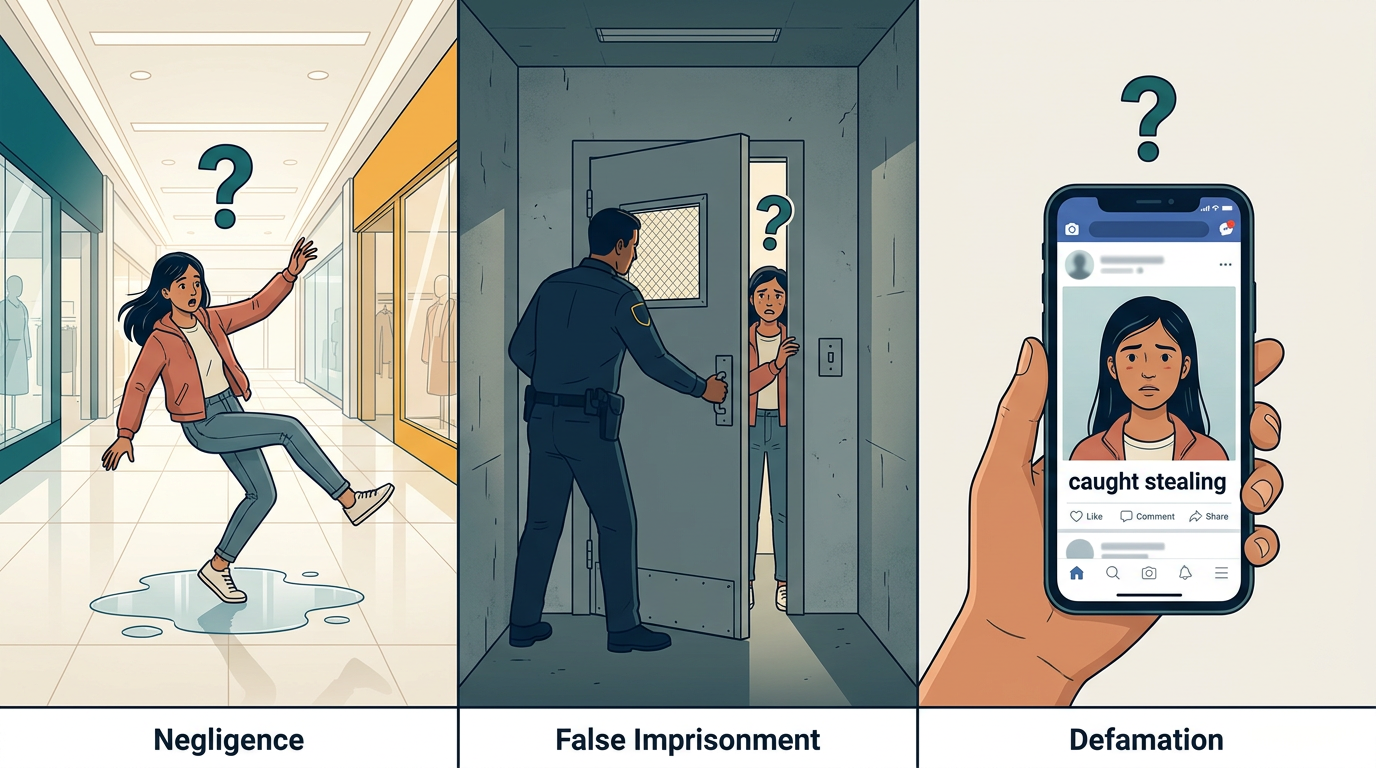
Fig. 4.0 – Three civil harms and the question of a legal remedy.
This chapter will answer each of these questions.
4.1 Meaning and Nature of Tort
At its simplest, a tort is a wrong. The word comes from the Latin tortum, which means twisted or crooked — the idea being that the wrongdoer’s conduct has bent away from the straight line of behaviour the law expects of everyone.
In law the word carries a narrower and more precise sense. A tort is a civil wrong, an act by one person — done either on purpose or by accident — that causes injury or harm to another, and for which the injured person can go to a civil court and ask for damages, or for a court order such as an injunction. An injunction is simply a direction from a court telling a person to stop doing something, or to undo something already done.
Notice two things in that definition, because both are easy to miss. First, the wrong may be accidental; the law of torts does not wait for bad intention before it acts. Second, the person who has suffered must take the initiative and sue. Nobody prosecutes on her behalf.
Sir John Salmond, an English legal scholar, put it more technically. A tort, he said, is a civil wrong for which the remedy is a common law action for unliquidated damages, and which is not exclusively a breach of contract, or a breach of trust, or some other merely equitable obligation. The last part of his definition works by exclusion: it tells us what a tort is not, and so marks off tort from the neighbouring areas of law that also produce civil claims.
Why Tort Law Exists
M.C. Setalvad, the first Attorney General of India, described the law of torts as an instrument for making people adhere to standards of reasonable behaviour and respect the rights and interests of one another.
That single sentence explains simple purpose behind the whole subject. Society cannot function if a person may drive carelessly, spread lies about a neighbour, or store dangerous chemicals in a crowded building and then say, “prove I broke a statute.” Tort law fills that space. It sets a minimum standard of conduct owed to people generally, and attaches a price to falling below it.
If tort law did not exist, an injured person would be left with only two unhappy options — accept the loss silently, or take revenge. Tort law replaces both with a claim in court.
The Remedy: Compensation, Not Punishment
Damages in tort are essentially compensatory. The court’s aim is to place the claimant, so far as money can, in the position she would have been in had the wrongful act never been done. It is not trying to make the defendant suffer.
Because of this aim, the remedy is usually in the nature of unliquidated damages. There is no price list for a fractured wrist or a ruined reputation. The amount is worked out by the court on the facts of the case, not read off a formula agreed in advance.
Occasionally a court goes beyond compensation and awards punitive damages — an amount in excess of what is needed to make good the loss, given where the conduct deserves to be marked out. This is the exception, not the rule.
The Three Elements of a Tort
Every claim in tort is built on the same three-part structure, shown in Fig. 4.1. If any one of the three is missing, the claim fails, however unfair the situation may feel.
- Wrongful act — the defendant did something the law treats as a breach of a duty owed to people generally.
- Damage — that act caused injury or harm to the claimant.
- Remedy — the law provides relief for that harm, usually damages, sometimes an injunction.
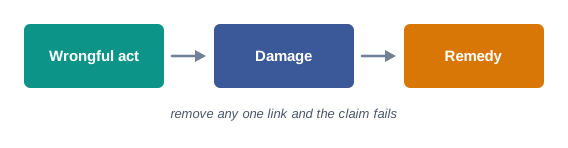
Fig. 4.1 – The three elements of a tort.
Learning to test a fact situation against these three elements, one at a time, is the single most useful habit in this chapter. Most application-based questions in this subject are built so that one element is doubtful, and the marks lie in spotting which one.
4.2 Distinction Between Tort, Crime and Breach of Contract
A tort is a civil wrong, and the emphasis falls on the word civil. It is worth being clear about how a civil wrong differs from a criminal wrong, because the two differ not only in what they forbid but in how the case is fought and what the court finally does.
Tort and Crime
In a criminal case, the State steps in. It is the State that initiates proceedings, in a criminal court, on behalf of the victim, and if the accused is found guilty the court punishes him. The victim is an important witness, but the case is not hers to run.
A civil action, such as a tort suit, works the other way round. The person aggrieved — or, where she has died, her representatives or survivors — takes the wrongdoer to a civil court herself. What she normally asks for is compensation in the form of monetary damages, and sometimes some other relief, such as an injunction.
The purposes diverge accordingly. A tort case aims at compensating the victim; a criminal case often ends in punishment, such as a prison sentence. Injunctions belong to the first world, not the second: a court may order a wrongdoer to stop harming the victim, or restrain him from trespassing on the victim’s property.
The same set of facts can produce both at once. Being sued in tort does not save a person from prosecution, and being prosecuted does not free him from paying damages; the two proceedings run in different courts and answer different questions.
Tort and Breach of Contract
Tort must also be marked off from breach of contract, and the differences here are more technical.
A tort is a civil wrong in which the remedy is an action for damages. A breach of contract is the breaking of a promise, and the primary remedy is performance of the contract — the law’s first instinct is to see that the promise is actually kept.
Damages in tort are always unliquidated. In a breach of contract they are liquidated, meaning the amount is either fixed in the contract itself or worked out by applying the terms the parties agreed to. The two sides knew each other’s obligations in advance and could put a figure on failure; strangers on a road could not.
Motive may be taken into consideration in tort. In a breach of contract, motive is irrelevant — the promise was either kept or it was not, and why it was broken does not change that.
The duty differs too. In tort, the duty is owed towards persons generally: a driver owes care to everyone on the road, none of whom he has ever met. In a contract, the duty is owed towards a specific person or persons — those who are party to the agreement.
Finally, damages in tort may be compensatory, or exemplary damages may also be awarded. In a breach of contract the nature of damages is compensatory.
4.3 Sources of the Law of Torts
Tort is mostly a Common Law subject. The law of torts did not grow out of a statute or an Act passed by Parliament. It grew out of centuries of judicial decisions — decisions of English courts, and of courts in other countries that follow the Common Law system, such as India, Canada, Australia and the United States of America.
Common Law here does not mean ordinary or everyday law. It means judge-made law: rules built up case by case, each decision adding to or refining what the earlier ones laid down. The tool that makes this possible is precedent.
This is why a rule laid down in an English case in the nineteenth century can still be argued in an Indian court today. Decisions of English courts are not binding on Indian courts, but they carry persuasive value, and Indian judges have drawn on them heavily in building this branch of law.
Why Tort Has No Single Statute
In India, as in other jurisdictions, criminal law and contract law rest on statutes. Contracts are governed by the Indian Contract Act, 1872, and offences are set out in the penal code enacted by Parliament. There is no equivalent for tort — no single statute, and no group of statutes, that comprehensively deals with tort law as a separate area of law.
The difference shows up in how a lawyer works. A lawyer handling a contract matter would ordinarily open the Contract Act or the Sale of Goods Act to find the rules that might apply to a given fact situation. A tort lawyer cannot simply open a statute and find the answer. She has to work through the case law, including applicable precedents from other jurisdictions, to establish that a tortious wrong exists at all.
To summarise: the law of torts draws on both statutes and case law, and cannot be traced to a single source.
The Move Towards Statute
In many jurisdictions, including India, there is now a move to enact statutes on tortious wrongs that were formerly governed only by case law. Two Indian examples matter for this chapter. Automobile accidents are covered by the Motor Vehicles Act, 1988 (as amended), and harm caused to consumers of goods and services is covered by the Consumer Protection Act (as amended).
The reason for the shift is practical. Proving a tort case from precedent alone is slow and expensive, and the people who most often need it — an injured pedestrian, a buyer stuck with a dangerous product — are the least able to afford a long trial. A statute can lay down who is liable, what must be proved, and where the claim is to be filed, and can create a specialised forum to hear it quickly.
4.4 Kinds of Wrongful Acts
In a tort case, the person who has been harmed goes to court and says that the other side committed a wrongful act, or is liable for the injury she has suffered. Two words recur in this branch of law: the plaintiff or claimant is the person bringing the case, and the defendant or wrong-doer is the person answering it. Both sets of words mean the same thing and are used interchangeably in this chapter.
Three Kinds of Wrongs
Primarily, there are three kinds of wrongs in tort law. The wrongful act may occur in any of the following ways.
- Intentionally, that is, the defendant meant to do the act that caused the harm.
- Negligently on the part of the wrong-doer, that is, he was careless rather than deliberate.
- Or the defendant is strictly liable for the wrongful act, in which case neither intention nor carelessness has to be shown at all.
This three-fold division, set out in Fig. 4.2, is the backbone of the rest of the chapter, and it is worth seeing what the division actually turns on. It is not about how serious the harm is, or how much money is claimed. It is about the defendant’s state of mind — and, in the third category, about the law deciding that his state of mind does not matter.
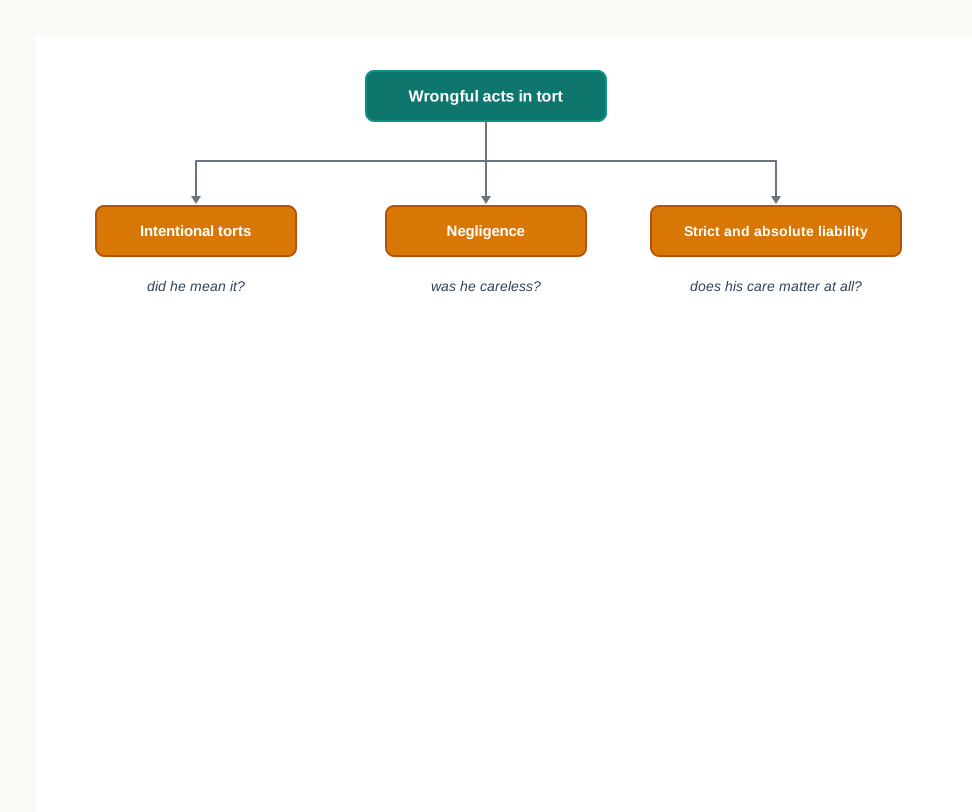
Fig. 4.2 – Classification of wrongful acts in tort.
The practical importance of this is that it decides what the claimant must prove. In an intentional tort she must show purpose; in negligence she must show a failure to take reasonable care; under strict liability she need show neither, only that the harm arose from the activity the law has singled out. A student who can place a fact situation in the right category has already done most of the work of answering the question.
The Wrongs Themselves
A tort, as we have seen, can be intentional or accidental. The wrongful acts it covers include the following, and some of them are discussed later in this chapter.
- Battery and assault — physical or mental injury to the claimant.
- Nuisance — an act which is harmful or offensive to the public or to an individual.
- Defamation — where the claimant’s reputation is injured.
- Property damage.
- Trespass — to the claimant’s land or property.
- Negligence — careless behaviour.
The list is not closed; these are examples, not the whole of tort law.
These tortious wrongs may also have aspects that overlap with other fields of law, such as criminal law and contract law, and examples of that overlap appear in the chapters on those subjects. In this chapter we are concerned only with some of the basic features of the law of torts in relation to these wrongs.
4.5 Intentional Torts
An intentional tort requires the claimant to show that the defendant caused the injury on purpose. That is the first hurdle, and it is not the only one. She must also show that she suffered a particular consequence or injury, and that it was the defendant’s actions that caused that consequence or injury.
Different intentional torts deal in different consequences and different intents. The intent needed to commit a battery is not the intent needed to commit a false imprisonment, and the harm the law is protecting against is different in each. Depending on the context and the situation, there are various kinds of intentional torts — assault, battery, false imprisonment, unlawful harassment, invasion of privacy and so on.
Many of these also have aspects of criminal law. Hitting a person is an offence as well as a tort. But treating such conduct as a tort too increases the possibility of higher compensation, because a criminal court is set up to punish, not to make good what the victim has lost. The kinds of intentional torts are explained below.
Battery and Assault
The tort of battery occurs when the defendant makes an intentional and direct application of physical force to the claimant with the intent to cause harm or offence. Both intent and causation are required for the tort of battery to occur — the defendant must have meant it, and it must be his act that produced the contact.
The act of touching need not always be done with the defendant’s hands. It could be anything touching the plaintiff, such as throwing hot water at someone.
The tort of assault works on the mind rather than the body. It occurs when the defendant intends to create in the claimant’s mind a reasonable apprehension — a feeling of anxiety or fear — of an imminent harmful or offensive touching, and this actually causes the claimant to suffer a reasonable apprehension of imminent harm.
For example, if the defendant throws an iron ball at the claimant and misses his head because the claimant moves his head away from the direction of the ball, this amounts to assault. Nothing touched him, but he was made to fear that something would. The perception of the claimant is what matters here.
The same point can be pushed further. If the defendant points an unloaded gun at the claimant, who does not know that it is unloaded and believes he is about to be shot, this amounts to assault. There was never any real danger, but the claimant’s apprehension was reasonable on what he knew. So assault can take place without battery.
Likewise, battery can take place without assault. Someone may hit another person from behind. The blow lands, so there is contact and harm, but the victim never saw it coming and so never apprehended anything.
False Imprisonment
The intentional tort of false imprisonment is satisfied whenever there is an intent to unlawfully confine or restrain the claimant in a bounded area, and this actually causes the claimant to be knowingly confined or restrained in a bounded area unlawfully. What the law is protecting here is liberty of movement, and the restraint must be total.
For example, the defendant intentionally locks the claimant in the classroom without having the legal authority to do so, and the claimant knows he is trapped.
Two refinements matter. Sometimes courts allow actual harm to substitute for awareness of the imprisonment — so even if the claimant is unaware that he is trapped but suffers injury, the tort of false imprisonment is satisfied. And in every case the claimant must not have been trapped willingly and consensually; a person who agrees to stay cannot later complain that he was confined.
Trespass to Land
The tort of trespass to land occurs when the defendant has the intent to interfere with the possession of land belonging to the claimant.
This is done by physically invading the property of the claimant without the claimant’s approval or consent. The invasion can happen with objects or by people — the defendant need not walk on the land himself if he sends something onto it. It includes invasion of some area of the air above the land and some area below the land. For example, the defendant may litter the claimant’s land, or may create a drainage outlet below the land of the claimant.
Notice that the tort protects possession, not ownership. A tenant in possession of a flat can sue a trespasser even though the flat belongs to a landlord.
Trespass to Chattels
The tort of trespass to chattel occurs when the defendant has the intent to, and does, interfere with the lawful possession of goods belonging to the claimant. A chattel simply means moveable personal property — a bicycle, a laptop, a set of tools — as opposed to land.
This is done when the defendant uses or intermeddles with a chattel that was in the possession of the claimant and causes significant or perpetual dispossession, deprivation of use, or damage as to the condition, quality or value of the chattel, or causes some other harm to the claimant’s legally secured interest.
For example, if the defendant paints the car of the claimant that was parked on the side of the street, without the consent of the claimant while the claimant was away, this amounts to trespass to chattels.
Conversion
The tort of conversion is somewhat related to the tort of trespass to chattels, and the two are easily confused. Conversion is defined as an act of wilful interference, without lawful justification, with any chattel in a manner inconsistent with the right of another, whereby that other is deprived of the use and possession of it.
It occurs when the defendant intentionally uses or intermeddles with the chattel of the claimant in such a serious way that it becomes fair to ask for compensation or money payment for the total prior value of the chattel. In other words, the defendant is forced to buy the chattel for a purchase price based on its original value. This is why it is said that the remedy in conversion is a forced sale.
Conversion applies in many situations, including where the chattel is taken, transferred to someone else, changed, misused or damaged.
The difference between the two torts is therefore one of degree, and the remedy follows the degree. Where the interference is serious enough to amount to taking the thing away from its owner altogether, the law stops repairing and makes the defendant pay for the whole of it.
Unlawful Harassment and Intentional Infliction of Emotional Distress
The defendant may be held liable for any act of deliberate physical harm to the victim even when no battery or assault is involved. The harm here reaches the body through the mind. For example, if the defendant lies to the claimant that the latter’s son has met with a road accident, and this causes nervous shock to the claimant resulting in illness, this constitutes the tort of unlawful harassment.
Sexual harassment may also amount to the tort of unlawful harassment. For example, if one person follows another, sends unwanted messages or makes unwanted phone calls, then although there is no violence and no threat of violence involved, this act amounts to a tort of harassment.
This last point is worth pausing on, because it is the one students most often get wrong. The absence of violence does not mean the absence of a wrong. Persistent unwanted contact is itself the injury the law recognises here.
Defamation
Defamation is defined as the publication of a statement which tends to lower a person in the estimation of the right-thinking members of society generally, and tends to make them shun or avoid that person. It can also be defined as any intentional false communication, either written or spoken, that harms a person’s reputation, decreases the respect, regard or confidence in which a person is held, or induces disparaging, hostile or disagreeable opinions or feelings against a person.
The word publication does the quiet work in that definition. A statement must reach someone other than the person it is about. An insult delivered privately, heard by nobody else, injures feelings but not reputation, and reputation is what this tort protects.
It is interesting to note that defamation can be both a tort and a crime.
Criminal defamation is the act of offending or defaming a person by committing a crime or offence. For criminal defamation, the liable person can be prosecuted, and it is studied under the penal code as a criminal act.
Civil defamation involves no criminal offence, but the claimant can sue the wrongdoer for compensation. It is studied under the law of torts as a civil wrong.
English law divides actions for defamation into libel and slander.
Libel refers to causing defamation in a permanent form, that is, in writing or pictures. It is recognised as an offence under English Criminal Law.
Slander, on the other hand, refers to causing defamation in a transient form, such as spoken words or gestures. Slander is actionable under the law of torts in English law.
The distinction was drawn in an age of newsprint, and a student today should be able to see why it has become harder to apply. A message forwarded on a phone is spoken in tone but permanent in form, and it reaches more people in an hour than a printed notice once reached in a year.
4.6 Negligence
Negligence is defined as the breach of the duty to take care which results in damages. Put more plainly, the wrong-doer or defendant has been careless in a way that harms the interest of the victim or claimant.
Nothing here turns on ill will. The defendant in a negligence case usually meant no harm at all; he simply failed to take the care that the situation demanded, and someone was injured because of it. This is what makes negligence the widest and most frequently used tort of all — most harm in daily life is caused by carelessness rather than by design.
The standard of care expected is not fixed at one level for everyone. Consider a defendant who is carrying out construction work on her premises. She owes a duty of care towards the claimant, and towards anyone in proximity. How much care she owes depends on the circumstances — whether the claimant was on the site itself or in the neighbourhood, and whether the claimant was a lawful visitor or a trespasser.
The Three Elements of Negligence
Generally, in order to argue successfully that the defendant has been negligent, the victim or claimant must establish three elements against the defendant in a tort of negligence case.
- The defendant owes a duty of care to the victim.
- There has been a breach of that duty of care on the part of the defendant.
- The breach of the duty to care resulted in the harm suffered by the claimant.
All three must be established. A careless defendant who owed the claimant no duty is not liable; a defendant who owed a duty and broke it, but caused no harm, is not liable either. Let us consider these elements here.
Duty of Care
The duty of care principle is best explained through an actual case.
The decision was not unanimous, and the anxiety of the judges in the minority is worth knowing, because it is the objection every negligence claim has to answer. Their worry was that if manufacturers whose goods are distributed across a whole country were made answerable to any member of the public for the contents of every bottle leaving their works, they would face claims they could not possibly investigate or answer. The majority’s reply was the test of reasonable foreseeability itself: liability is not limitless, because it stops at the persons a reasonable manufacturer would foresee being harmed.
This principle applies to a great many fact situations. To give another example, a landlord owes a duty of care with reasonable foresight to his tenants, and should ensure that no hazardous substance such as petrol is stored by him in the basement of the apartment where the tenants stay.
Breach of Duty of Care
Once the duty of care is proven, the claimant must then establish that the duty of care was broken — that is, that the defendant was unsuccessful in fulfilling the duty of care in accordance with the standard of reasonableness.
The standard is that of reasonable conduct or reasonable foresight. The act need not be flawless. The law does not ask whether the defendant could conceivably have done better; it asks whether he did what a reasonable person in his position would have done.
In the case of Donoghue v. Stevenson discussed above, the court held that manufacturers of products owe a duty of reasonable care to the consumers who use the products. Similarly, the standard of duty of reasonable care will vary based on the peculiar fact situation of every case.
That variation is not vagueness. It is the reason a single test can govern a surgeon, a school bus driver and a shopkeeper: each is measured against what is reasonable for someone doing that work in those circumstances.
Harm to the Claimant
The third element asks whether the breach actually produced damage. In Donoghue v. Stevenson, the negligence on the part of the manufacturer of the soft drink resulted in the illness or injury to the claimant. In the landlord example given above, the apartment catches fire because of the petrol stored in the basement, causing damage to the tenants.
The next case takes the same three elements and applies them to a product assembled from parts bought elsewhere — a situation any student who owns a phone or rides in a car should recognise.
The case also sets out what must be proved to establish a duty of care in relation to ultimate purchasers.
- The nature of the product must be such that it is likely to place life and limb in danger if negligently made. This knowledge of danger must be probable, not merely possible.
- There must be knowledge that, in the usual course of events, the danger will be shared by people other than the buyer. This may be inferred from the nature of the transaction and the proximity or remoteness of the relation.
Read those two conditions closely, because they are where marks are won and lost. The first sets a threshold of seriousness: a badly made wheel can kill, a badly made paperweight generally cannot. The second extends the circle of protected persons beyond the buyer, to the passengers and pedestrians who will predictably be exposed to the same danger.
4.7 No-Fault Liability: Strict Liability and Absolute Liability
In fault-based liability, the legal right of the claimant is violated due to a mistake of the defendant, and the defendant is liable to pay compensation. Everything in this chapter so far has worked that way — an intentional tort needs purpose, and negligence needs carelessness.
However, there are certain situations where the defendant is liable to pay compensation even if the violation of the claimant’s right is not done by the defendant, but there is a violation of the claimant’s right. This is known as no-fault liability. In short, liability arising without any fault is a no-fault liability.
The reason the law does this becomes obvious once you ask who could realistically prove fault in such cases. A villager whose fields are poisoned by seepage from a chemical plant cannot inspect the plant, cannot read its maintenance records, and cannot say which valve failed. If she had to prove carelessness, she would lose every time. No-fault liability moves the burden to the person who chose to bring the danger into being and who profits from it.
No-fault liability covers two kinds of liability, shown in Fig. 4.3.
- Strict Liability
- Absolute Liability
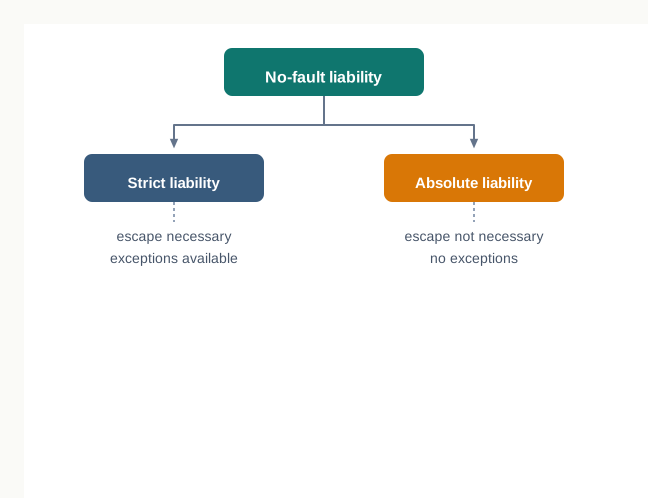
Fig. 4.3 – Kinds of no-fault liability.
Strict Liability
Strict liability is a standard of liability under which a person is legally responsible for the consequences of an activity even in the absence of fault or criminal intent from the defendant.
Under the strict liability rule, if the defendant possesses anything that is inherently dangerous — anything falling within the ultrahazardous description — the defendant is then strictly liable for any damages caused by such possession, no matter how careful the defendant is in safeguarding it. The claimant does not have to establish any sort of or level of blame attributable to the defendant based on the intention or the degree of carelessness.
The rule evolved in the year 1868, in a case that arose between two neighbours in England.
In the above case, three basic principles regarding strict liability were established.
- Dangerous thing — a non-natural use of the land.
- Escape — the escape of the water from Rylands’ land.
- Liability — as the thing escaped, it caused damage.
Each of the three principles has to be present, and each is a place where an examination fact situation can be turned. Water stored in a household tank for ordinary domestic use is not a non-natural use of land. A thing that causes harm without ever leaving the defendant’s premises has not escaped. And a thing that escapes but injures nobody produces no liability, because there is no damage.
The general rule with respect to ultra-hazardous activity is that when the defendant carries out or keeps an unusually hazardous situation or activity on his or her building, or involves himself in an activity that offers an inevitable danger of injury to the claimant or to his or her property, the defendant could be responsible for the damage caused even if the defendant has exercised reasonable care to prevent the harm.
Exceptions to Strict Liability
The rule is strict, but it is not without limits. Five defences are recognised.
- Plaintiff’s own fault — when the cause of the damage is an act or default of the claimant himself, no remedy would be available to the plaintiff in that case.
- Act of God — when the escape is caused directly by natural causes without any human intervention, the defendant can use act of God as a defence.
- Mutual benefit — when there is express or implied consent of the plaintiff to the presence of the source of damage or danger, and there is also no negligence on the part of the defendant, the defendant will not be held liable.
- Act of stranger — when the cause of harm is the act of a stranger or third party. Here it should be noted that this third party is neither the servant of the defendant nor a person over whom the defendant has any control.
- Statutory act — if the act is one of the government or of a corporation done under statutory authority, that too is a defence.
Absolute Liability
In India, a related principle of absolute liability was introduced by the Supreme Court in the aftermath of two instances of gas leaks from factories, which killed thousands and injured lakhs.
The first was the Bhopal gas leak disaster of 1984, where a factory of the Union Carbide Corporation located in Bhopal had a major leakage of the gas methyl isocyanate that killed 2260 people and injured around 600,000.
In the second incident, in 1985 in Delhi, a factory of the Shri Ram Foods and Fertilizer Industries leaked oleum gas. One person died, a few others were hospitalised, and the leak created huge panic among the residents.
It was against this background that the Supreme Court reconsidered whether the nineteenth-century rule from Rylands v. Fletcher, with its list of exceptions, was adequate for industrial India.
Where an industry or enterprise is engaged in an inherently dangerous activity from which it is deriving commercial gain, and that activity is capable of causing catastrophic damage, the industry officials are absolutely liable to pay compensation to the aggrieved parties. The industry cannot plead that all safety measures were taken care of, or that there was no negligence on its part. It will not be allowed any exceptions, nor can it take up any defence such as act of God or act of stranger.
The basic principles of absolute liability, as they emerge from the decision, are the following.
- Enterprise — the activity is carried on with a commercial objective.
- Hazardous or inherently dangerous activity.
- Escape is not necessary.
The third principle deserves attention, because it is the one that most often decides a case. Under Rylands v. Fletcher, a worker poisoned inside the factory gate could not use the rule at all, since nothing had escaped. Under absolute liability the location of the harm is irrelevant. The duty is owed to those inside the factory and those living around it alike.
Differences Between Strict Liability and Absolute Liability
- Strict liability arises in cases in which the court holds the defendant liable to pay compensation for the loss incurred by the claimant, even if such losses are neither intentionally nor negligently suffered. However, when there is an injury caused to a workman in the course of employment, the court holds the employer responsible for providing compensation, and here it is immaterial who caused the injury; in most cases the employer has to pay. This is described as absolute liability.
- Strict liability is applicable to persons, whereas absolute liability is applicable to enterprises, that is, commercial undertakings.
- In strict liability, the escape of hazardous or dangerous components from the premises of the owner is necessary. But escape is not necessary in absolute liability.
- In the case of strict liability, the defendant has certain exceptions that he or she can use to prevent himself from liability. But no exceptions are provided to the defendant in the case of absolute liability. This means that if any person suffers damage due to the hazardous element, the defendant would be absolutely liable for it.
- The compensation is as per the nature and quantum of damages incurred in the case of strict liability. In absolute liability, the quantum of damages relies on the magnitude and financial capability of the organisation.
The last row explains why the two rules exist side by side. Strict liability asks what the claimant lost. Absolute liability asks, in addition, what it will take to make a large and profitable enterprise treat safety as non-negotiable — which is why the size and financial capacity of the organisation enter the calculation at all.
4.8 Kinds of Harm Protected by Tort Law
The chapter has moved through the wrongs. It is worth closing by turning the picture around and looking at the interests those wrongs protect — the many ways in which a claimant may suffer injury, gathered here in one place and shown in Fig. 4.4.
Reading the subject this way is useful in an examination. A fact situation rarely announces which tort it involves. It tells you what the claimant lost, and from that loss you work backwards to the wrong.
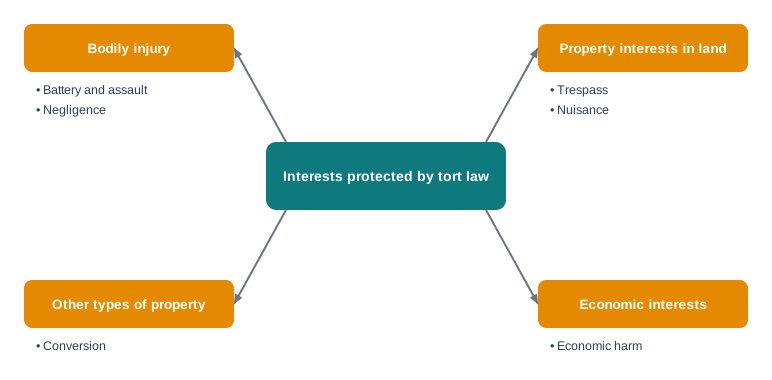
Fig. 4.4 – Interests protected by tort law.
- Property interests in land — the law of tort protects the claimant’s interests in her landed property by preventing intentional intrusions or trespass of the property by the defendant or wrong-doer. The claimant may also suffer harm through damage caused by the carelessness or negligence of the defendant. And when the defendant interferes with the claimant’s right to enjoy his or her land, the defendant commits the tort of nuisance.
- Other types of property — tort law prohibits the deliberate taking away of tangible property, which amounts to the tort of conversion. Damage to property may also occur due to carelessness or negligence.
- Bodily injury — tort law protects the claimant against any harm to his or her interests of bodily integrity. The torts of battery and assault apply to any intentional harm caused to the body. Harm may also be caused by negligence, as well as by a breach of statutory duty such as traffic laws, health laws and so on. Mental distress is an element in bodily injury, which raises the compensation payable to the victim.
- Economic interests — to a lesser extent, economic interests are also protected by the law of tort. Injury caused by an intentional act as well as by negligence can cause economic harm to the claimant.
Notice how the same interest can be invaded in more than one way. Land can be harmed by a deliberate intrusion, by carelessness, or by an ongoing interference with its enjoyment — three different torts, one protected interest. This is why identifying the interest first, and the wrong second, is the more reliable method.
Conclusion
To conclude, it can be said that unlike a crime, the law of torts does not aim to punish the wrongdoer. Rather, it aims to help the aggrieved person reach the position he or she was in before the cause of action arose. It thus seeks to provide restorative justice.
That single aim explains almost every rule in this chapter — why damages are unliquidated and assessed on the facts, why the remedy is compensation rather than imprisonment, and why the law is willing to impose liability without fault where the alternative would be leaving an innocent person to carry a loss she had no way of avoiding.
4.9 Summary
- The word tort comes from the Latin tortum, meaning twisted or crooked, and in ordinary sense means a wrong.
- In law, a tort is a civil wrong — intentional or accidental — that causes injury or harm to another, for which the injured person may claim damages or an injunction in a civil court.
- According to Sir John Salmond, a tort is a civil wrong for which the remedy is a common law action for unliquidated damages, and which is not exclusively a breach of contract, a breach of trust, or some other merely equitable obligation.
- M.C. Setalvad, the first Attorney General of India, described the law of torts as an instrument for making people adhere to standards of reasonable behaviour and respect the rights and interests of one another.
- Damages in tort are essentially compensatory, and aim to place the claimant in the position she would have been in had the wrongful act not been done.
- The remedy is usually in the nature of unliquidated damages — a sum that cannot be foreseen or assessed by a fixed or pre-decided formula. Occasionally courts also grant punitive damages, in excess of the compensation.
- The three fundamental elements of a tort are:
- wrongful act;
- damage;
- remedy.
- Tort differs from crime: in a criminal case the State prosecutes in a criminal court and the object is punishment, while in a tort suit the aggrieved person sues in a civil court and the object is compensation.
- Tort differs from breach of contract on five bases:
- the remedy in tort is an action for damages, while the primary remedy for breach of contract is performance of the contract;
- damages in tort are always unliquidated, while in breach of contract they are liquidated;
- motive may be taken into consideration in tort, but is irrelevant in breach of contract;
- in tort the duty is owed towards persons generally, while in contract it is owed towards specific persons;
- damages in tort may be compensatory or exemplary, while in breach of contract they are compensatory.
- Tort is mostly a Common Law subject, built not from a statute but from centuries of judicial decisions in England and in other Common Law countries, including India.
- There is no single statute, and no group of statutes, that comprehensively deals with tort law as a separate area of law; the subject draws on both statutes and case law and cannot be traced to a single source.
- Some tortious wrongs are now covered by statute — automobile accidents by the Motor Vehicles Act, 1988 (as amended), and harm to consumers of goods and services by the consumer protection legislation.
- There are primarily three kinds of wrongs in tort law: the wrongful act may be intentional, or negligent on the part of the wrong-doer, or one for which the defendant is strictly liable.
- An intentional tort requires the claimant to show that the defendant caused the injury on purpose, that she suffered a particular consequence or injury, and that the defendant’s actions caused it.
- Battery is the intentional and direct application of physical force to the claimant with intent to cause harm or offence; both intent and causation are required.
- Assault is an act intended to create in the claimant’s mind a reasonable apprehension of imminent harmful or offensive touching; assault can occur without battery, and battery without assault.
- False imprisonment is the intentional and unlawful confinement of the claimant in a bounded area, amounting to total restraint of liberty; the claimant must not have been confined willingly and consensually.
- Trespass to land is an intentional physical invasion of the claimant’s land without consent, and extends to some area of air above and some area below the land.
- Trespass to chattels is intentional interference with the lawful possession of goods, while conversion is a wilful interference so serious that the owner is deprived of use and possession altogether; the remedy in conversion is a forced sale.
- Unlawful harassment covers deliberate harm caused without any battery or assault, including nervous shock caused by a lie, and sexual harassment such as following a person or sending unwanted messages or calls.
- Defamation is the publication of a statement that tends to lower a person in the estimation of right-thinking members of society generally; it can be both a tort and a crime.
- English law divides defamation into libel, which is in permanent form such as writing or pictures, and slander, which is in transient form such as spoken words or gestures.
- Negligence is the breach of a duty to take care which results in damage, and requires the claimant to establish three elements:
- that the defendant owed her a duty of care;
- that the defendant breached that duty;
- that the breach resulted in the harm she suffered.
- In Donoghue v. Stevenson, the court held that a manufacturer owes a duty of care to those who are reasonably foreseeable as being affected by the product.
- The standard of care is that of reasonable conduct or reasonable foresight; the act need not be flawless, and the standard varies with the facts of each case.
- In MacPherson v. Buick Motor Co., the manufacturer of a finished product was held responsible for a defective component it had failed to inspect, and two conditions were laid down for establishing a duty towards ultimate purchasers:
- the nature of the product must be such that it is likely to place life and limb in danger if negligently made, the danger being probable and not merely possible;
- there must be knowledge that in the usual course of events the danger will be shared by people other than the buyer.
- No-fault liability is liability that arises without any fault on the defendant’s part, and covers strict liability and absolute liability.
- Strict liability makes a person responsible for the consequences of an activity even in the absence of fault or criminal intent, and was laid down in Rylands v. Fletcher in 1868.
- The three principles established in that case are:
- a dangerous thing, brought onto the land in a non-natural use of it;
- escape of that thing from the defendant’s land;
- liability, because the escape caused damage.
- Five exceptions are available to strict liability:
- plaintiff’s own fault;
- act of God;
- mutual benefit;
- act of stranger;
- statutory act.
- Absolute liability was introduced in India by the Supreme Court after the Bhopal gas leak disaster of 1984 and the oleum gas leak in Delhi in 1985.
- In M.C. Mehta v. Union of India, Chief Justice P.N. Bhagwati held that an enterprise engaged in a hazardous or inherently dangerous industry owes an absolute and non-delegable duty to the community, and must be absolutely liable to compensate for harm caused, whatever care it took.
- The basic principles of absolute liability are:
- an enterprise with a commercial objective;
- a hazardous or inherently dangerous activity;
- escape is not necessary.
- Strict liability applies to persons, requires escape, and admits exceptions; absolute liability applies to enterprises, requires no escape, and admits no exception or defence.
- Compensation in strict liability follows the nature and quantum of the damage, while in absolute liability the quantum depends on the magnitude and financial capability of the organisation.
- The interests protected by tort law are property interests in land, other types of property, bodily injury and, to a lesser extent, economic interests.
- Unlike a crime, the law of torts does not aim to punish the wrongdoer but to restore the aggrieved person to the position she was in before the cause of action arose, and so seeks to provide restorative justice.
4.10 Key Terms
Tort — a civil wrong, intentional or accidental, that causes injury or harm to another, for which the injured person may claim damages or an injunction in a civil court.
Injunction — a court order directing a person to stop doing something, or to undo something already done.
Damages — money awarded by a court to compensate a person for the harm she has suffered.
Unliquidated damages — a sum of money that cannot be foreseen or assessed by a fixed or pre-decided formula, and is therefore assessed by the court on the facts of the case.
Liquidated damages — damages whose amount is fixed in advance by the parties or worked out from the terms they agreed to, as in a breach of contract.
Punitive damages — damages awarded in excess of the compensation required, also referred to as exemplary damages.
Plaintiff (claimant) — the person who brings a case to court complaining of a wrong done to her.
Defendant (wrong-doer) — the person against whom the case is brought.
Common Law — judge-made law, built up case by case through judicial decisions rather than through statute.
Precedent — a decision of a court laying down a legal principle, which courts are expected to follow in later cases raising the same question.
Intentional tort — a tort in which the claimant must show that the defendant caused the injury on purpose.
Battery — the intentional and direct application of physical force to another person, with intent to cause harm or offence.
Assault — an act by which the defendant intentionally causes the claimant to reasonably apprehend an imminent harmful or offensive touching.
False imprisonment — the intentional and unlawful confinement of a person within a bounded area, amounting to a total restraint of liberty.
Trespass to land — an intentional physical invasion of land in the possession of another, without that person’s consent.
Chattel — moveable personal property, as distinguished from land.
Trespass to chattels — intentional interference with the lawful possession of goods belonging to another, causing dispossession, deprivation of use, or damage.
Conversion — a wilful interference with a chattel, without lawful justification and inconsistent with another’s right, which deprives that person of its use and possession; the remedy is a forced sale.
Unlawful harassment — deliberate conduct causing harm to another without any battery or assault, including nervous shock and sexual harassment.
Defamation — publication of a statement that tends to lower a person in the estimation of right-thinking members of society generally, and to make them shun or avoid that person.
Libel — defamation in a permanent form, such as writing or pictures.
Slander — defamation in a transient form, such as spoken words or gestures.
Negligence — the breach of a duty to take care, which results in damage to the claimant.
Duty of care — the obligation owed to those persons whom one can reasonably foresee as being potentially harmed by one’s act or omission.
Breach of duty of care — failure to fulfil the duty of care in accordance with the standard of reasonable conduct or reasonable foresight.
Reasonable foreseeability — the test that fixes both whom a duty of care is owed to and how far liability extends.
No-fault liability — liability to pay compensation that arises without any fault on the part of the defendant.
Strict liability — responsibility for the consequences of an activity even in the absence of fault or intent, arising where a dangerous thing brought onto land escapes and causes damage.
Non-natural use of land — a use of land out of the ordinary, which brings a dangerous thing onto it and attracts the rule in Rylands v. Fletcher.
Act of God — an escape caused directly by natural causes without any human intervention, available as a defence to strict liability.
Act of stranger — harm caused by a third party who is neither the defendant’s servant nor under the defendant’s control, available as a defence to strict liability.
Absolute liability — the liability of an enterprise engaged in a hazardous or inherently dangerous activity to compensate all those harmed by it, with no escape required and no exception available.
Non-delegable duty — a duty that a person cannot pass on to anyone else, and for the breach of which he remains answerable however the work was done.
Nuisance — an act harmful or offensive to the public or to an individual, which interferes with a person’s right to the use and enjoyment of land.
Restorative justice — an approach that seeks to restore the injured person to the position she was in before the wrong, rather than to punish the wrong-doer.
4.11 Points to Ponder
Tort law asks the careless person to pay, not to be punished. Does compensation alone do enough to stop the same carelessness from being repeated?
Damages in tort are unliquidated, so a court decides what an injury is worth. Is it possible to put a fair money value on a lost year of health, or on a damaged reputation — and who should decide it?
A person injured by a stranger’s carelessness must find a lawyer, pay court fees and wait for a judgment. Does the promise of tort law reach people who cannot afford to pursue it?
Assault is committed the moment a person is made to fear harm, even if nothing touches him. Why does the law treat fear itself as an injury worth compensating?
English law divides defamation into libel and slander according to whether the statement is permanent or fleeting. Does that division still make sense in an age when a spoken remark can be recorded, forwarded and stored forever?
Defamation is both a civil wrong and a criminal offence. Should the possibility of prosecution exist at all where compensation is already available, given how it may affect what people feel free to say?
The standard in negligence is that of the reasonable person. Who is this reasonable person, and is it fair to measure a first-year driver, a village shopkeeper and a specialist surgeon against the same idea?
Strict liability allows a defendant to escape by proving an act of God or an act of a stranger, while absolute liability allows no escape at all. Is a rule that admits no defence just, or is it justified by the scale of harm hazardous industry can cause?
Under absolute liability, the quantum of compensation may depend on the financial capability of the organisation. Does this mean two victims with identical injuries may receive very different sums, and can that be defended?
The victims of an industrial gas leak are usually the people living closest to the plant, who are often the poorest. What does this tell us about who bears the risks of industrial growth, and what should the law do about it?
Tort law grew from judicial decisions rather than from statute. Is it better for these rules to develop slowly through cases, or should Parliament codify the law of torts as it has codified contract and criminal law?
4.12 Textbook Questions
Define the law of tort. What is the difference between tort law and criminal law?
What are the sources of tort law?
What is an intentional tort? Explain at least three different kinds of intentional tort.
What is the tort of negligence, and how does duty of care relate to negligence?
What is the principle of strict liability? Give one example.
Some basic principles regarding strict liability were established in Rylands v. Fletcher. Discuss these principles.
There are certain exceptions to strict liability which are not available in a case of absolute liability. List these exceptions.
Discuss the main differences between strict liability and absolute liability, with the help of relevant case law.
What are the objectives behind having tort law?
Explain the meaning of the following terms:
- Unliquidated damages
- Defamation
- Conversion
4.13 Objective Questions
The word ‘tort’ is derived from the Latin word tortum, which means:
- wrongdoer
- twisted or crooked
- compensation
- breach of promise
Damages in a tort action are described as unliquidated because:
- they are always higher than the loss suffered
- they are fixed by the parties before the wrong occurs
- they cannot be assessed by a fixed or pre-decided formula
- they are payable only after a criminal conviction
Which of the following is not one of the three fundamental elements of a tort?
- Wrongful act
- Damage
- Remedy
- Punishment
In a tort suit, proceedings are initiated by:
- the State, on behalf of the victim
- the aggrieved person or her representatives
- the police, after registering a case
- the court, on its own motion
In which of the following is motive relevant?
- Breach of contract only
- Tort only
- Both tort and breach of contract
- Neither tort nor breach of contract
The law of torts in India is drawn primarily from:
- a single comprehensive statute passed by Parliament
- judicial decisions of Common Law courts
- the Indian Contract Act, 1872
- rules framed by State governments
A points an unloaded gun at B, who does not know it is unloaded and believes he is about to be shot. A has committed:
- battery only
- assault only
- both assault and battery
- neither, since there was no real danger
The remedy in the tort of conversion is described as:
- an injunction
- restitution of the chattel
- a forced sale
- specific performance
Defamation in a permanent form, such as writing or pictures, is called:
- slander
- libel
- nuisance
- conversion
Which case established that a manufacturer owes a duty of care to those reasonably foreseeable as being affected by the product?
- Rylands v. Fletcher
- Donoghue v. Stevenson
- M.C. Mehta v. Union of India
- MacPherson v. Buick Motor Co.
Which of the following is not an exception to strict liability?
- Act of God
- Act of stranger
- Mutual benefit
- Commercial gain of the defendant
Escape of the dangerous thing from the defendant’s premises is:
- necessary in both strict and absolute liability
- necessary in strict liability but not in absolute liability
- necessary in absolute liability but not in strict liability
- not necessary in either
Absolute liability applies to:
- any individual who keeps a dangerous thing on his land
- an enterprise engaged in a hazardous or inherently dangerous activity
- only government departments
- only foreign companies operating in India
Interference with a person’s right to the use and enjoyment of her land amounts to the tort of:
- conversion
- trespass to chattels
- nuisance
- false imprisonment
Assertion (A): A person may be liable in tort even though he never intended to cause any harm. Reason (R): Negligence is established by showing a breach of the duty to take care that results in damage, without any need to prove intention.
Assertion (A): The same act may lead both to a prosecution in a criminal court and to a suit in a civil court. Reason (R): A criminal proceeding aims at punishing the offender, while a tort suit aims at compensating the victim.
Assertion (A): A claimant who was confined but stayed of her own free will cannot succeed in an action for false imprisonment. Reason (R): False imprisonment requires a total restraint of liberty that the claimant did not consent to.
Assertion (A): In Rylands v. Fletcher, the defendant was held liable even though the negligent work had been done by an independent contractor. Reason (R): A person who brings a dangerous thing onto his land answers for its escape regardless of the care he took or of who carried out the work.
Assertion (A): An enterprise that has taken every reasonable safety precaution may still be made to pay compensation for harm caused by its hazardous activity. Reason (R): The duty owed by such an enterprise is absolute and non-delegable, and the defences available in strict liability do not apply to it.
Assertion (A): A statement that injures a person’s feelings but is heard by nobody else is not defamation. Reason (R): Defamation requires publication, because the interest the tort protects is reputation in the estimation of others.
4.14 Check Your Concepts
Why does the law of torts allow a claim even where the defendant meant no harm at all?
State the three fundamental elements of a tort, and explain what happens to a claim if the second element is missing.
Why are damages in tort unliquidated while damages for breach of contract are liquidated? Explain the reason behind the difference.
Distinguish between a tort and a crime on the basis of who brings the proceedings, the court approached and the object of the proceeding.
Distinguish between tort and breach of contract on the basis of the duty owed and the relevance of motive.
“A tort lawyer cannot simply open a statute to find the answer.” Explain what this tells us about the sources of tort law.
Why has Parliament enacted statutes covering road accidents and consumer harm when both were already actionable as torts?
What does a claimant have to prove in an intentional tort that she does not have to prove in a case of strict liability?
Explain, with one example of each, how assault can occur without battery and battery without assault.
Why is the perception of the claimant important in the tort of assault?
What happens if a person who was locked in a room was unaware of the confinement but suffered injury as a result of it? Explain the rule that applies.
State the essentials of the tort of false imprisonment.
A tenant, not the owner, sues a person who walks across the flat she has rented. Can she succeed? Give reasons.
Distinguish between trespass to chattels and conversion, and explain why the remedy in conversion is described as a forced sale.
Why does the law treat persistent unwanted messages and phone calls as a tort even though no violence is used or threatened?
What is the significance of the word ‘publication’ in the definition of defamation?
Distinguish between libel and slander, and explain one difficulty in applying this distinction to messages circulated online.
State the three elements of negligence and arrange them in the order in which a court would examine them.
Correct the following statement and give reasons: “In negligence, the defendant is liable only if his conduct was flawless in every respect.”
Correct the following statement and give reasons: “Escape of the dangerous thing must be proved in every case of absolute liability.”
Why does the standard of care in negligence vary from case to case? Does this make the standard uncertain?
What are the two conditions laid down for establishing a duty of care towards ultimate purchasers of a product?
Why is it said that no-fault liability shifts the burden onto the person who created the danger? What problem of proof does this solve?
State the three principles of strict liability, and explain what happens if the use of the land was an ordinary domestic one.
List the exceptions available to strict liability, and explain why a defendant may blame a stranger but not his own contractor.
Why did the Supreme Court consider the rule of strict liability inadequate for hazardous industry in India?
Explain what is meant by an “absolute and non-delegable duty” owed by a hazardous enterprise.
Distinguish between strict liability and absolute liability on any four bases.
Why does the quantum of compensation in absolute liability take into account the financial capability of the organisation?
Identify the interest protected by tort law in each of the following, and name the tort involved:
- a neighbour running a loudspeaker at night;
- a bicycle taken away and sold by a stranger;
- a shopper injured by a falling display board.
Why is the law of torts described as providing restorative justice rather than punishment?
4.15 Case-Based Questions
- A housing society engages a contractor to repair the overhead water tank on the roof of its building. The contractor leaves the tank’s outlet valve loose. Over a weekend the tank empties, water seeps down the outer wall and floods the ground-floor workshop of Farida, who runs a tailoring business in the adjoining building. Her machines and stock are ruined. The society says it hired a reputed contractor, that the work was inspected by an engineer, and that it did not know the valve had been left loose.
- Which rule of liability applies to the society, and what are the three principles a court would look for?
- Does the society’s argument that the work was done by an independent contractor help it? Give reasons.
- Would the answer change if the water had never left the society’s building and had only damaged its own basement? Explain.
- Suppose the tank burst because of an exceptionally severe earthquake. Which defence becomes available, and why?
- A chemical unit operating on the edge of a small town treats and stores an industrial solvent for sale to paint manufacturers. A storage line develops a fault and vapour spreads through the plant and the settlement next to it. Two workers inside the plant and several residents outside are hospitalised. The unit produces its maintenance records, safety audits and staff training certificates, and argues that it followed every prescribed standard and that the fault could not have been detected.
- Which principle of liability governs the unit, and which decision of the Supreme Court laid it down?
- Does the unit’s evidence of safety measures and absence of negligence assist it? Give reasons.
- The workers were harmed inside the plant and nothing escaped as far as they were concerned. Does this affect their claim? Explain.
- On what basis would a court decide the amount of compensation payable here?
- Kabir, a Class XII student, is stopped at the gate of a library by a staff member who believes he has taken a reference book. The staff member takes him to an office, shuts the door and tells him he will not be allowed to leave until the librarian arrives. Kabir waits for forty minutes. The book is later found on a shelf. On the same evening, the library’s page posts a notice naming Kabir and describing him as a student caught removing books, and several of his classmates see it.
- Which intentional tort was committed when Kabir was kept in the office, and what must be established for it?
- Would it make a difference if the staff member had asked Kabir to wait and he had chosen to stay while the shelves were checked? Explain.
- Identify the tort involved in the notice, and state which form of defamation it takes.
- If the notice had been shown to nobody but Kabir himself, would that tort still be made out? Give reasons.
- Sunita leaves her motorcycle with a mechanic for a service. The mechanic, without telling her, lends the motorcycle to his cousin for a week’s use. During that week the cousin repaints it in a different colour. When Sunita returns, the mechanic hands the vehicle back, repainted and with the odometer showing an extra six hundred kilometres.
- Which tort is committed by repainting the motorcycle without Sunita’s consent?
- Suppose instead that the cousin had sold the motorcycle to a stranger who has since left the city. Which tort would then be committed, and what remedy would follow?
- Explain, using this fact situation, how the seriousness of the interference decides which of the two torts applies.
- A company assembles pressure cookers and buys the safety valves from an outside supplier. It does not test the valves before assembly. A valve on one cooker fails while Devika is cooking; steam escapes with force and scalds her, and also injures her younger brother standing in the doorway. The company argues that it did not manufacture the valve and that Devika bought the cooker from a retail shop, not from the company.
- Which tort is alleged, and which three elements must Devika establish?
- Does the absence of any dealing between Devika and the company defeat her claim? Refer to the principle established in an English decision on this point.
- Her brother bought nothing at all. On what basis can he claim?
- Would the company’s position improve if it had tested every valve to the prescribed standard and the defect was one no test could reveal? Explain.
- A school hires a bus for a field trip. The driver, running late, overtakes on a bend and the bus grazes a scooter, and the rider falls and fractures his arm. The State begins a prosecution against the driver for rash driving. The rider separately files a suit claiming compensation for his treatment, his damaged scooter and the two months of work he has lost.
- Explain how the same act gives rise to two different proceedings, and state the object of each.
- In which court would each proceeding be brought, and who initiates it?
- Why are the damages claimed by the rider described as unliquidated?
- Suppose the scooter rider had swerved in time and suffered no injury or damage at all, though the driving was equally rash. Which of the two proceedings survives, and why?
4.16 Landmark Cases & Maxims
State the principle settled in Donoghue v. Stevenson, and explain to whom a duty of care is owed under it.
State the rule laid down in Rylands v. Fletcher, and name the three principles it rests on.
State the principle laid down in M.C. Mehta v. Union of India, and explain what makes the duty it describes non-delegable.
What did the court hold in MacPherson v. Buick Motor Co. about a manufacturer who buys a component from another manufacturer?
Match the cases in Column A with the principles in Column B:
| Column A | Column B |
|---|---|
| a. Donoghue v. Stevenson | i. A hazardous enterprise is absolutely liable, and no exception or defence is available to it. |
| b. Rylands v. Fletcher | ii. A manufacturer owes a duty of care to those reasonably foreseeable as being affected by its product. |
| c. M.C. Mehta v. Union of India | iii. A maker of a finished product must test the components it puts into that product. |
| d. MacPherson v. Buick Motor Co. | iv. A person who brings a dangerous thing onto his land is liable if it escapes and causes damage, whatever care he took. |
Identify the authority that governs each of the following, and give one reason for your choice:
- a stored gas cylinder leaks from a godown and damages the neighbouring shop;
- a fertiliser plant’s hazardous emission injures both its workers and the residents around it;
- a packaged food item sold in sealed cartons makes a consumer ill.
Two cases in this chapter concern harm caused by a defective product. State how the question decided in each differed from the other.
The word ‘tort’ comes from the Latin tortum. State its literal meaning, and explain how that meaning describes what the law of torts regulates.
A factory owner defends a claim by proving that the escape of a dangerous substance was caused entirely by an outsider over whom he had no control. Which authority is he relying on, which defence is this, and in which of the two kinds of no-fault liability would the defence fail?