In 2017, a military court in Pakistan sentenced an Indian national, Kulbhushan Jadhav, to death. India protested that Pakistan had never allowed Indian consular officers to meet him, as the Vienna Convention on Consular Relations, 1963 requires when a foreign national is arrested. Now consider the problem this created. India could not send its police into Pakistan. Pakistan was not going to be tried in an Indian court, and no Indian statute binds a foreign government. There is no world police force and no world parliament. So where does a country go when its complaint is against another country? India went to the International Court of Justice at The Hague — the World Court. In 2019 the Court ruled in the Jadhav Case (India v. Pakistan) that Pakistan had breached its obligations, and directed it to grant consular access and to allow effective review and reconsideration of the conviction and sentence. Pakistan was not dragged there by any police force. It appeared because it, like India, had accepted the Court’s jurisdiction. That single fact tells you almost everything about how international law works. It binds states not by force from above, but by consent, custom and treaty between equals — and yet, as this case shows, it is real law with real consequences.
Q1. If there is no world police force and no world parliament, what makes international law “law” at all? Q2. Where do the rules of international law actually come from, if no legislature enacts them? Q3. What is the difference between a dispute between two countries and a dispute between two private persons living in different countries? Q4. When India signs a treaty, does it automatically become binding law inside India? Q5. Which international court hears disputes between states, and which one puts individuals on trial for crimes like genocide?
By the end of this chapter, you will be able to answer each of these questions.
12.1 Introduction
Every state has its own body of law. These are its domestic laws, and they regulate the conduct of the people who live within its territory. They govern private life, social life, commercial dealings and every other kind of activity an individual engages in — from getting married, to buying a flat, to running a company, to being tried for an offence.
The same internal laws do a second job as well. They regulate the conduct and affairs of the state machinery itself: how Parliament legislates, how the police investigate, how courts decide, how the government exercises its powers. In the language of international law, this entire internal legal system of a country is called its municipal law.
Municipal law is the internal or domestic law of a state — the whole body of law it makes and applies within its own territory, governing both its people and its own organs of government.
The word “municipal” here has nothing to do with a municipal corporation or local body. It is simply the term international lawyers use for national law, to keep it distinct from the law that operates between nations.
Where domestic law runs out
Municipal law works well as long as the dispute stays inside one country. But suppose the dispute is between two or more states. Which body of law governs their conduct towards each other? No state’s Parliament can legislate for another state, and no state’s courts can ordinarily summon another state before them.
A second problem arises even between private parties. If a contract is signed between a business in India and a business in Germany, or if a couple married in one country seeks divorce in another, which country’s courts should hear the matter, and whose law should they apply? Here too, the domestic law of a single country cannot supply a complete answer by itself.
The world therefore needs a framework through which relations between states can be built and disputes of this kind can be settled. That framework is International Law, and it is the subject of this chapter.
12.2 Historical Evolution of International Law
The term ‘International Law’ was first coined by the English philosopher Jeremy Bentham in 1780. Bentham was looking for a name for the body of rules that operates between nations rather than inside them, and the name he gave it has stuck ever since.
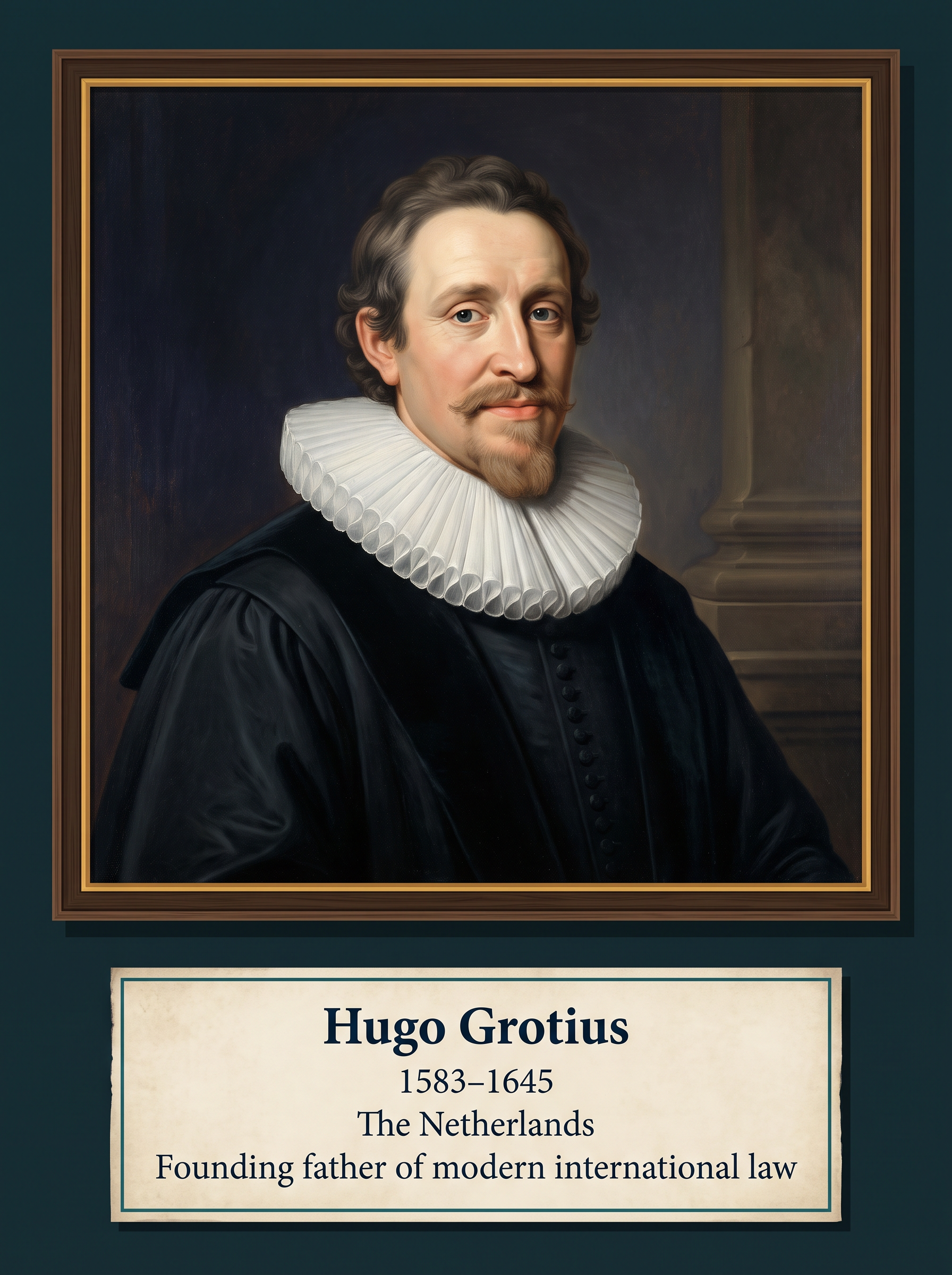
The law itself, however, is much older than its name. The Dutch jurist Hugo Grotius (1583–1645) is considered to be the founding father of modern international law, and his writing has greatly influenced the development of this field. A jurist is a scholar of law — someone who studies and writes about legal principles rather than a judge who decides cases — and Grotius’s influence came from the force of his reasoning at a time when Europe had no shared authority to settle quarrels between kingdoms.
Grotius emphasised the freedom of the high seas, arguing that the ocean beyond a country’s coast could not be owned by any one nation and must remain open to all. His great work On the Law of War and Peace (1625) set out the idea that even nations at war are bound by rules. Look at Fig. 12.1 and note the period he belonged to.
His argument on the seas rapidly gained acceptance amongst the northern European powers, who were then on a mission to explore the world and colonise it. That acceptance is worth pausing over, because it shows something about how international law grows: these powers adopted the rule not out of charity but because open sea routes suited their own trading and naval interests. Rules between states often take hold when enough states find it useful to follow them.
Who “created” international law — Bentham or Grotius? Neither created it, and students often confuse the two. Bentham gave the subject its modern name in 1780; Grotius, more than a century earlier, laid the intellectual foundations of the modern discipline. Naming and founding are different contributions.
Older roots, European shaping
The origin of international law is embedded in history and can be traced to cooperative agreements between peoples in the ancient Middle East. Long before the modern state existed, neighbouring kingdoms were making treaties of peace, arranging the exchange of prisoners, and granting safe passage to envoys — all recognisably the same activity that treaties perform today.
The essential structure of international law, however, was mapped out during the European Renaissance. This was the period in which Europe settled into separate sovereign states, each claiming supreme authority within its own borders and none accepting any superior above it. Once that pattern was fixed, a law between equals — rather than a law handed down to subjects — became both necessary and possible.
12.3 International Law and Domestic Law
International law is an independent system of law. It exists outside the legal orders of particular states — it is not a branch of Indian law, or of German law, or of any other national system, and no single country’s Parliament can amend it.
Because of this, it differs from domestic legal systems in a number of important respects:
- The United Nations General Assembly consists of representatives of 193 member countries. Although it has the outward appearance of a legislature, it has no power to issue binding laws.
- The resolutions passed by the General Assembly serve merely as recommendations, except in certain cases — such as determining the UN budget, admitting new members to the UN, and electing new judges to the International Court of Justice (ICJ) along with the Security Council.
- The international court system does not have absolute jurisdiction. In contentious cases, the ICJ’s jurisdiction requires the consent of the particular states that are involved.
- There is no international police force and no system of law enforcement, and there is no supreme executive authority.
- The UN Security Council may authorise the use of force in specific cases to compel states to comply with its decisions, but only where there is a prior act or threat of aggression. Any such enforcement action can be vetoed by any of the Security Council’s five permanent members — China, France, Russia, the United Kingdom and the United States. The forces involved must be assembled from member states on an ad hoc basis, as there is no standing UN military.
Two of these words need unpacking. To veto is to block a decision single-handedly: one permanent member voting against an enforcement resolution defeats it, however many others support it. And ad hoc means “for this purpose alone” — troops are contributed by member states for a particular operation and go home afterwards, because the UN keeps no army of its own.
Why these differences matter
Compare this with the position inside India. Parliament enacts a statute and it binds everyone whether they agree or not. If it is broken, the police investigate without asking the accused for permission, courts take jurisdiction without the accused consenting to be tried, and the sentence is carried out by the machinery of the State. Every one of those features is missing at the international level.
For this reason, it is often said that international law is a weak law as compared to municipal law. But “weak” here means something specific — it is weak in enforcement, not empty of content.
Unlike municipal law, international law functions in a decentralised manner. All states consider themselves independent and sovereign, which means each claims supreme authority within its own territory and accepts no superior above it. The rules of conduct that exist between nations are therefore based on customs built up over hundreds of years, on international agreements, and on treaties. There is a common consent of the community of nations for the enforcement of the rules and principles governing international conduct.
That last idea is the key to the whole subject. Municipal law works downwards, from an authority to its subjects. International law works sideways, between equals who have agreed to be bound.
International Law vs Municipal Law
| Who it governs |
Primarily states, and also international organisations and individuals |
Persons and institutions within one country |
| Law-making body |
No world legislature; rules arise from treaties, custom and common consent |
A legislature such as Parliament, whose enactments bind |
| Nature of obligation |
Largely consent-based; a state is bound because it has agreed |
Binding whether or not the individual agrees |
| Jurisdiction of courts |
The ICJ needs the consent of the states involved in contentious cases |
Courts exercise jurisdiction without the parties’ consent |
| Enforcement machinery |
No international police force; Security Council action possible but subject to veto |
Police, prosecution and executive machinery of the State |
| Structure |
Decentralised, horizontal, between sovereign equals |
Centralised, vertical, from authority to subject |
Q1. If there is no world police force and no world parliament, what makes international law “law” at all?
A. It is law because the community of nations commonly consents to be bound by it and treats its rules as legally obligatory, not merely as good manners. Its rules come from long-standing custom, from treaties states have agreed to, and from general principles — and states follow them even without a police force above them. What international law lacks is not the quality of being law, but the centralised enforcement machinery that municipal law enjoys.
Is it “true law”? Two classic views
This weakness in enforcement produced a long-running debate among jurists about whether international law deserves the name “law” at all.
As per Oppenheim’s view, international law is true law. According to Austin’s view, international law is not true law, because any rule which is not enacted by a superior or legislative authority cannot be regarded as law.
Is international law “true law”? The question is whether a rule can be law when no superior authority commands it and no police force enforces it. On Austin’s side, law by definition is the command of a sovereign backed by a sanction; since no sovereign stands above states, the rules between them are better described as international morality or positive morality than as law. On Oppenheim’s side, a rule is law if the community concerned accepts it as legally binding, and states plainly do — they plead international law before courts, defend themselves in its language, and treat a breach as a wrong rather than a mere discourtesy; enforcement is weaker, but weakness of sanction is not absence of law. In practice the debate has been settled by conduct rather than by argument: states, courts and international organisations today treat international law as law, while acknowledging that its enforcement remains its weakest point.
12.4 International Law and International Relations
International law is a distinct part of international relations. International relations is the wider study of how states deal with one another — through diplomacy, trade, alliances, aid and conflict. International law is the legal portion of that relationship: the part made up of binding rules rather than of policy, preference or friendship.
States normally conform to the relevant rules and principles of international law while responding to any international situation, if and when it arises. One reason is reputational. States are conscious of not being viewed negatively by the international community, because a country seen as unreliable finds it harder to attract investment, negotiate trade terms or build alliances.
Reciprocity and self-interest
The rules of international law are based on reciprocity or self-interest. Reciprocity means that a state observes a rule towards others because it expects the same treatment in return — protect foreign diplomats, and your own diplomats abroad are protected.
A breach of international rules by a state may therefore result in a loss of its credibility, and that may affect it in its future relations with other states. For instance, if a state violates a treaty to its own advantage, it may induce other states to breach other treaties. This may ultimately cause harm to the very state that first violated the treaty, because the practice of keeping one’s word is a shared asset, and the first breach spends it.
When international rules and principles are followed by states, the result is a value of certainty, predictability, and a sense of common purpose in international affairs. Shipping companies can plan routes, exporters can price contracts and neighbouring states can demobilise troops precisely because the rules are expected to hold.
Globalisation and the growth of international law
Globalisation in the 1980s resulted in an increase in international and regional organisations, both in number and in influence. This in turn has resulted in the expansion of international law to cover the rights and obligations of international organisations, which are now subjects of the system in their own right and not merely meeting rooms for states.
New international law is now frequently created through processes that require near-universal consensus. Instead of two states quietly settling a point between themselves, a large conference works towards a text most of the world can accept.
For instance, in the area of the environment, bilateral negotiations — negotiations between two states — have been supplemented and at times replaced by multilateral ones involving many states at once. This transforms the process of individual state consent into community acceptance. The consensus-building process of this kind has produced various environmental agreements and the Law of the Sea treaty (1982).
The Kyoto Protocol is an international treaty aimed at combating global warming. It was adopted in Kyoto, Japan, in 1997 and took effect in 2005. It called upon participating countries to reduce their emissions of greenhouse gases and carbon dioxide emissions.
Notice the eight-year gap between adoption in 1997 and entry into force in 2005. A treaty text agreed at a conference does not become binding law the moment it is signed; it waits until enough states have completed their own procedures for accepting it. You will see why in the section on the sources of international law.
Equal in principle, unequal in practice
International law as a system is complex. In principle it is ‘horizontal’, being founded upon the concept of the equality of states, which is one of the basic principles of international law. A horizontal system is one in which no participant sits above another — unlike the vertical arrangement of a domestic legal system, where the legislature sits above the citizen.
But in reality, some states continue to be more important than others in creating and maintaining international law. Economic weight, military strength and a permanent seat on the Security Council all give certain states greater influence over which rules emerge and which are enforced. Equality of states is a legal principle, not a description of the world.
12.5 Meaning and Nature of International Law
Before the definitions, one point of vocabulary. Every country is referred to as a ‘state’ in International Law. So when this chapter speaks of a state, it means a country such as India, Japan or Brazil — not a state of the Indian Union such as Rajasthan or Kerala.
From Bentham’s definition to the modern one
According to Bentham’s classic definition, international law is a collection of rules governing relations between states. That definition served well in his time, but it omits two vital elements of modern international law: individuals and international organisations.
Both omissions matter. An individual can today be tried before an international court for genocide, and an international organisation can hold rights and owe duties of its own. A definition limited to state-to-state relations would leave all of that out.
International law is also called the law of nations. In its modern sense, it is a framework of rules and principles binding the relations between states, governing their conduct amongst themselves and with other international entities that are legally recognised, and also governing matters between citizens of different nations. It is a system of treaties and agreements between nations that governs how nations interact with other nations, with the citizens of other nations, and with the businesses of other nations.
International law, or the law of nations, is the body of rules and principles that binds states in their relations with one another, with legally recognised international entities, and in matters involving the citizens and businesses of other nations.
Consent as the foundation
International law is a form of law which relies on consent-based governance to a great extent. States are not ordinarily obliged to abide by it unless they expressly consent to a particular course of conduct. A treaty binds the states that have accepted it, and does not bind a state that has stayed out of it.
Certain aspects, however, are exceptions to the consent requirement — such as the principles of customary international law, and jus cogens.
jus cogens Literal meaning: ‘compelling law’. Legal meaning: Norms from which no derogation is permitted by way of particular agreements. These are norms of customary international law so fundamental that they cannot be altered by treaty, and a treaty that conflicts with them cannot stand. In use: The prohibitions on slavery and on genocide are treated as norms of this kind. Two states could not lawfully agree between themselves to permit either.
The word “derogation” simply means departing from a rule or watering it down. To say that no derogation is permitted is to say that states cannot contract out of the rule, however willing both of them may be. This is what makes jus cogens unusual in a system otherwise built on consent: here, agreement is not enough.
The two branches
International Law is therefore categorised into:
- Public International Law
- Private International Law
This division is shown in Fig. 12.2, and the two branches are taken up in the two sections that follow.
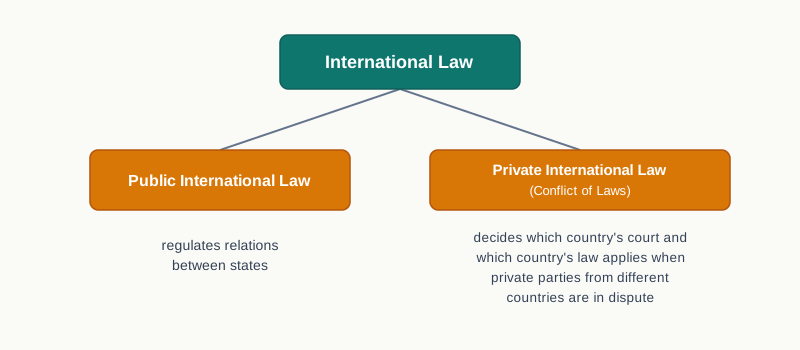
The study of public international law is distinguished from the field of conflict of laws, or private international law, which is concerned with the rules of municipal law or domestic law of states of different countries where foreign elements are involved. In other words, one branch looks outward at the relations between countries; the other looks inward at a country’s own law and asks how it should handle a dispute that crosses a border.
12.6 Public International Law
Public International Law is the law that regulates relations between states. It is different from other types of law because it is concerned with interstate regulation — that is, it deals with regulating the conduct of one state towards another.
It is not concerned with relations between private entities, whether legal persons or natural persons, and it is not concerned with the domestic laws of any country. A natural person is a human being; a legal person is an entity such as a company or a society, which the law treats as a person capable of holding rights and owing duties. A dispute between two such persons, even across borders, is not the business of public international law.
Public International Law is the branch of international law that regulates the conduct of states towards one another, and not the relations of private persons or the domestic law of any country.
The primary objective of Public International Law is to provide a framework of rules and regulations which help in fostering stable and organised international relations. Its value lies in making the behaviour of states reasonably predictable, so that trade, travel, communication and peace can be planned upon.
Where it applies
The subject once dealt largely with war, peace and diplomacy. Some of the key areas where public international law is applicable today are set out below.
| Peace and security |
Human rights |
Finance |
Airspace |
| Trade |
Intellectual Property |
Development |
Sea |
| Weapons |
Bio-diversity |
Science and security |
Fisheries |
| International Crimes |
Climate change |
Extradition |
Natural resources |
Two entries in that list are worth a line each, since they are easily misread. Extradition is the formal surrender by one state to another of a person accused or convicted of an offence in the requesting state — the process by which an accused who has fled abroad can be sent back for trial. Airspace concerns the control a state exercises over the sky above its territory, and the rules under which foreign aircraft may pass through it.
The range of subjects concerned with international law has widened considerably. Almost every area in which states must act together — a pandemic, a satellite launch, a fishing ground, a warming ocean — now has a body of international rules attached to it.
The World Trade Organization (WTO)
One of the global international organisations that deals with trade between nations is the World Trade Organisation (WTO). From the early days of the Silk Road to the creation of the General Agreement on Tariffs and Trade (GATT) and the birth of the WTO, trade has played an important role in supporting economic development and promoting peaceful relations among nations.
The World Trade Organisation was established in 1995 and is located in Geneva, Switzerland. It has 166 members, representing 98 per cent of world trade.
The WTO is the only global international organisation dealing with the rules of trade between nations. It is an intergovernmental organisation — an organisation whose members are governments rather than individuals or companies — that regulates and facilitates international trade.
At its heart are the WTO agreements, negotiated and signed by the bulk of the world’s trading nations and ratified in their parliaments. The goal is to help producers of goods and services, exporters and importers conduct their business.
There are a number of ways of looking at the World Trade Organization:
- It is an organisation for trade opening.
- It is a forum for governments to negotiate trade agreements.
- It is a place for them to settle trade disputes.
- It operates a system of trade rules.
Essentially, the WTO is a place where member governments try to sort out the trade problems they face with each other. Notice how neatly it illustrates public international law at work: its members are states, its rules bind those states, and a dispute over an import duty is settled by an agreed procedure rather than by retaliation.
12.7 Private International Law
Private International Law, often referred to as ‘Conflict of Laws’, is a set of rules and principles that govern interstate interactions and transactions of private parties. It is a body constituted of conventions, model laws, the domestic laws of states, and secondary legal sources.
The name “conflict of laws” describes the problem it solves. When a transaction touches two countries, two legal systems may each have something to say about it, and they may not say the same thing. Private international law does not abolish that conflict; it tells a court how to choose.
Private International Law, or Conflict of Laws, is the set of rules that decides which country’s court should hear a dispute involving a foreign element, and which country’s law that court should apply to it.
Private international law commonly involves issues like:
- which jurisdiction should be permitted to hear the case, and
- the law concerning which jurisdiction should be applied to the issues in the case.
These two questions are separate, and students frequently merge them. The first asks where the matter is to be tried. The second asks whose law the trial court must apply once it has taken up the matter — and the answer need not be the law of the country where the court sits.
For example, in marriage laws there is a conflict of laws with respect to marriage-related issues between couples belonging to different jurisdictions. The questions about which legal system and which norms should apply form part of private international law.
An Indian citizen living in Singapore marries a Singaporean citizen there, and later files for divorce in an Indian court. Two questions arise before any question of divorce is reached: does the Indian court have jurisdiction at all, and if it does, is the validity of the marriage to be tested by Indian law or by Singapore law? Private international law supplies the rules for both answers. Change one fact — say the couple had also registered the marriage in India, or one spouse is now permanently resident in India — and the answer to the jurisdiction question may change with it. This is why identifying the connecting facts matters more than reciting the rule.
Public International Law vs Private International Law
| Meaning |
A set of rules which governs the intercourse between nations by determining the rights and obligations of the governments of the nations |
Certain rules and regulations which are established or agreed upon by private citizens of different nations who enter into transactions, and which would govern them if a dispute were to arise |
| Parties involved |
States and international entities |
Private persons — individuals and businesses — with a foreign element in their dispute |
| Question it answers |
What may a state lawfully do towards another state? |
Which country’s court hears the case, and which country’s law applies? |
| Where the dispute goes |
International forums such as the ICJ, or forums created by treaty |
The domestic courts of one country or the other |
| Also known as |
The law of nations |
Conflict of laws |
Q3. What is the difference between a dispute between two countries and a dispute between two private persons living in different countries?
A. A dispute between two countries belongs to public international law: the parties are states, the rights and duties are those of governments, and the forum is an international one such as the ICJ. A dispute between two private persons across borders belongs to private international law: the parties are individuals or businesses, the case is heard by an ordinary domestic court, and the real questions are which country’s court may hear it and which country’s law that court must apply.
Bodies that harmonise private laws
There are certain international bodies which have been working towards harmonising the private laws of different countries and bringing uniformity in their application. If states adopt broadly similar rules, the conflict itself shrinks, and cross-border business becomes cheaper and safer.
The bodies include organisations such as the:
- Hague Conference on Private International Law — convened by the government of the Netherlands, originating back to 1893, and focusing on developing conventions on a wide array of aspects of private law.
- International Centre on the Settlement of Investment Disputes (ICSID).
- International Institute for Unification of Private Law (UNIDROIT).
- United Nations Commission for International Trade Law (UNCITRAL) — which works towards developing model laws and guides regarding international trade and commercial laws, including the UNCITRAL Arbitration Rules, and so on.
A model law is worth distinguishing from a treaty. A treaty binds the states that accept it. A model law binds nobody; it is a ready-made text that a country may enact into its own statute book if it wishes, and its usefulness lies in many countries choosing to enact much the same thing.
Conventions and model laws in practice
Some of the international conventions and model laws in the sphere of private international law which have gained more traction in recent times are the:
- United Nations Convention on Contracts for the Sale of International Goods (CISG) — also referred to as the Vienna Convention on sale of goods. It is a multilateral treaty which provides options for avoiding choice of law issues by supplying a framework of accepted substantive rules with respect to contract disputes. It is considered one of the most influential documents in private international law, and is nowadays deemed to be incorporated into any otherwise applicable domestic laws, unless expressly excluded.
- UNCITRAL Model Law on International Commercial Arbitration — which has provided a framework for domestic laws on international arbitration and is being adopted by an increasing number of countries, with India joining the list in 1996.
- Geneva Convention on the execution of foreign arbitral awards, and so on.
Notice what the CISG does. Instead of leaving a court to decide whether Indian or French law governs a sale, it offers one agreed set of substantive rules for both parties — removing the choice-of-law question rather than answering it.
Class activity: international law and current events
The aim of this activity is to foster an understanding of the importance of international law to the day-to-day international events that appear in newspapers. You will learn from concrete examples how people’s lives are affected by international law.
- Bring newspapers to class. Look through them and find at least three articles, issues, stories, photographs or words related to international law. The topics could relate to an international business deal, environmental protection, human rights, war or conflict, refugees, and so on.
- Write a summary of each article, issue, story, photograph or word you have chosen.
- Identify the law, convention, act or statute that would apply to the issue. For example, an article about racism can be linked to the International Convention on the Elimination of All Forms of Racial Discrimination. Reliable sources such as UN.org can be used to find the relevant conventions.
- Record your findings in a table with three columns — the topic, your summary, and the international law applied — using these six topic rows: children or youth; international business deal; environmental protection; human rights; war or conflict; refugees.
- Present any one item you found interesting, identify the international law that applies to it, and answer the questions below.
The questions to be answered in your presentation are:
- Why do some international laws apply to the issue at hand while others might be ignored?
- How do countries enforce international law within their own country — for example, Canada or India?
- Do all countries enforce international law?
- Why might some countries choose not to enforce international law?
- What happens if international law is not applied by countries?
- Why is international law needed?
- Do you think international law helps to resolve the issues it is supposed to?
12.8 Sources of International Law
A source of law within a domestic legal system is easy enough to determine. Within the domestic system it is not too difficult a process: one may look at the various legislations or statutes provided for by the legislature, and if there is a lacuna in the statute — a gap the legislature has not covered — one may look at the decisions of the domestic courts.
But it is not so easy to pinpoint the sources of international law. There is no world legislature whose enactments can be listed, and no single law-making authority whose output one can consult.
Yet the most authoritative source of international law is Article 38(1) of the Statute of the International Court of Justice. It provides for what a court deciding disputes relating to international law shall apply.
Statute of the International Court of Justice, Article 38(1) The Court, whose function is to decide in accordance with international law such disputes as are submitted to it, shall apply: (a) international conventions, whether general or particular, establishing rules expressly recognized by the contesting states; (b) international custom, as evidence of a general practice accepted as law; (c) the general principles of law recognized by civilized nations; (d) subject to the provisions of Article 59, judicial decisions and the teachings of the most highly qualified publicists of the various nations, as subsidiary means for the determination of rules of law.
The expression “civilized nations” belongs to the language of 1945, when the Statute was drawn up, and is today read simply as referring to the general principles common to legal systems everywhere. A “publicist”, in this provision, does not mean a publicity agent — it means a leading scholar of international law.
Primary and secondary sources
Article 38(1) divides the sources of international law into those of a primary and a secondary nature.
The primary sources, which the Court will consider in its decisions, include conventions (or treaties), customary law, and general principles recognised by civilized nations. Therefore treaties, customs and principles of law are the ‘primary sources’ of international law.
Judicial decisions and the teachings of publicists are sometimes referred to as ‘secondary sources’, or as evidence of international law. They do not create the rule; they help a court find out what the rule already is.
Q2. Where do the rules of international law actually come from, if no legislature enacts them?
A. They come from the sources listed in Article 38(1) of the Statute of the International Court of Justice — treaties that states have agreed to, international custom accepted as law, and the general principles of law recognised by legal systems generally. Judicial decisions and the writings of leading scholars are used as subsidiary means to establish what those rules are. No parliament makes international law; states make it, by agreement and by settled practice.
The third source: general principles
As per Article 38(1), the third source of international law is the ‘general principles of law’ recognised by ‘civilized’ nations. General principles of law are used primarily to fill gaps when treaties or customary international law do not provide a rule of decision — although it is unclear what these general principles of law actually are.
They could be general principles of justice, principles of natural law, analogies drawn from private law, principles of comparative law, or general conceptions of international law. Ideas such as good faith, or the rule that no one may be a judge in their own cause, are of this kind: they appear in almost every legal system, and so may fairly be treated as common to all.
The general principles of law are also found in textbooks, general surveys or manuals, treatises and encyclopedias.
It has been suggested by scholars that as new treaties and customary law develop to address areas of international concern not previously covered, the significance of general principles will fade, as these gaps in international law are filled.
Why Article 38(1) governs generally
Though Article 38(1) is technically limited in application to the International Court of Justice, it is widely accepted as enumerating the general norm on sources of international law. The reasoning is straightforward: the function of the Court is to decide disputes submitted to it in accordance with international law, and all members of the United Nations are ipso facto parties to the Statute of the Court. A provision that tells the world’s principal court where international law is to be found is, in practice, a statement of where international law is to be found.
Ipso facto is a Latin phrase which means ‘by the fact itself’. It means that a specific consequence follows as a direct result of the action in question, without anything further needing to be done. A country that joins the United Nations becomes a party to the Statute of the ICJ ipso facto — by that very act, and without a separate agreement.
Although the provisions of the Statute of the ICJ do not suggest any hierarchy among the sources, they are generally applied in the following order in case of disputes.
Treaties
A treaty — also called an international convention or a charter — refers to a legally binding, written agreement in which states agree to act in a particular manner as specified in the agreement.
Treaties are often complex documents, particularly those involving more than two parties, because they are binding upon all of them and are to be entered into in good faith. Good faith here means honest performance: a state must not accept a treaty with the intention of defeating its purpose.
Agreements between different nations that are made without the intention of creating binding obligations are not considered treaties, however they may have political effects. This is the point that separates a treaty from a joint statement or a declaration of friendship — the presence or absence of an intention to be legally bound.
A treaty need not be one consolidated document, but may consist of more than one related document. Treaties may be drafted between states by their leaders or by government departments, depending on the circumstances.
Adopting a binding treaty
There are a number of stages involved in order to convert a final draft into a binding treaty. The final text has to be ‘adopted’ in an international conference by way of a two-thirds majority.
Adoption, however, settles only the text. It does not by itself bind any state. A state becomes bound only when it expresses its consent to be bound, and there are three common methods of doing so.
Making a treaty binding on a state Governing provision: Article 38(1)(a), Statute of the International Court of Justice, recognises international conventions as a source of law; the stages below describe how such a convention comes into being and binds a state. Steps: (a) The text is negotiated and a final draft is prepared, either by state leaders or by government departments. (b) The final text is ‘adopted’ in an international conference by a two-thirds majority — at this stage the wording is settled, but no state is yet bound. (c) Each state then expresses its consent to be bound, by one of three routes → consent by signature, or consent by exchange of instruments, or consent by ratification. (d) Where ratification is the route, the state’s own constitutional requirement must be satisfied — assent by the President of the State, or a vote of a majority in the legislature, depending on the country. Outcome: The treaty becomes binding on those states that have expressed their consent. It does not bind a state that has stayed out of it, and adoption of the text alone binds nobody.
Consent by signature. In certain cases, treaties may be given force by way of the signatures of representatives who have been given full powers — that is, written authorisation from their state enabling them to take decisions on its behalf.
Consent by exchange of instruments. In some scenarios, consent may be recorded by way of exchanging certain instruments, that is, documents which contain the terms agreed to by both sides, where these instruments provide that upon such exchange they will come into effect.
Consent by ratification. Ratification is simply understood to be the act by which a state establishes its consent to be bound by a treaty on the international plane.
This method was initiated as a measure to ensure that the representative who signed a treaty had due authority, by seeing whether the state itself agrees to ‘ratify’ the same. A negotiator abroad may sign; ratification is the state at home confirming that the signature speaks for it.
Ratification differs from country to country, but usually requires a sign that the state consents to follow the provisions of the treaty. This could be established by:
- assent by the President of the State, or
- a vote of a majority in the legislature.
In multilateral treaties, involving a number of countries, ratification is usually the most preferred method of expressing assent, with one party collecting the ratifications of the others. Treaties are generally considered to be the most accepted source of international law, as they are in written form and have been explicitly assented to by the states party to the dispute.
Customary International Law
The second source of international law is international custom. Along with general principles of law and treaties, custom is considered a primary source of international law. Article 38(1)(b) of the Statute directs the Court to apply international custom, as evidence of a general practice accepted as law.
Customary international law consists of rules that come from ‘a general practice accepted as law’, and it exists independently of treaty law. It refers to binding legal rules that have developed at the global or regional level through continued practice.
Customary international law is important in current times when there is armed conflict, because it fills gaps in treaty law and thus strengthens the protection offered to victims. A state that has not signed a particular convention may still be bound by the customary rule that has grown alongside it.
The two elements of custom
An observed custom is extremely fluid and could be derived from the law of nature or from the mutual consent of states. Custom is usually derived by sifting through many layers and evidences of state practice and opinio juris.
Customary international law is comprised of two elements:
- consistent and general international practice by states — the widespread repetition of similar international acts over time (State practice), and
- a subjective acceptance of the practice as law by the international community — the requirement that the acts must occur out of a sense of obligation (opinio juris).
Opinio juris is the shortened form of the Latin phrase opinio juris sive necessitatis, meaning ‘an opinion of law or necessity’. It is a state’s own understanding that what it is doing is legally obligatory — the belief that an action was carried out as a legal obligation and not merely as a matter of habit, courtesy or convenience.
Opinio juris serves an important function: it prevents generally unwanted general practice from becoming customary law. Without it, every convenient habit of states would harden into a binding rule, and no state could change a practice without breaking the law.
International custom generally refers to a description of state practice, but only such practice as is accepted by the states themselves as legally required. It develops from a general and consistent practice of states followed by them from a sense of legal obligation. Once a certain practice is understood to be customary law, states are obliged to act as the rule of customary international law prescribes.
The test of the existence of a customary rule of law is the extent to which it is observed in the practice and behaviour of states. In short, to determine the existence and content of a rule of customary international law, it is necessary to ascertain whether there is a general practice among the states concerned that is accepted by them as law among themselves.
The North Sea Continental Shelf cases confirmed that both state practice (the objective element) and opinio juris (the subjective element) are essential pre-requisites for the formation of a rule of customary law. This is consistent with Article 38(1)(b) of the Statute of the ICJ.
North Sea Continental Shelf cases (Germany v. Denmark; Germany v. Netherlands), ICJ, 1969 Facts: Denmark and the Netherlands each submitted a dispute with Germany to the International Court of Justice concerning the delimitation of areas of the continental shelf in the North Sea, which were rich in oil and gas. The three states could not agree on the method by which the boundaries between their shelf areas should be drawn. Issue: Was the delimitation method contended for binding on Germany as a rule of customary international law, and what must be shown before a practice becomes such a rule? Held: The Court held that the formation of customary international law requires two things together — state practice, the objective element, and opinio juris, the subjective element. State practice must show widespread and representative participation, and the practice of those states whose interests are specially affected by the custom is especially relevant. Uniform and consistent practice is necessary to demonstrate opinio juris. Why it matters: It is the standard authority on how customary international law comes into existence, and it dispelled the idea that the duration of a practice — the number of years it has been followed — is an essential factor. A short practice, if widespread, consistent and accompanied by a sense of legal obligation, can create custom.
Many other materials have been drawn upon to identify and cover more and more customs and practices in the international domain, such as:
- unsigned treaties, and
- United Nations declarations.
International customary law is probably the most disputed and discussed source of international law. For example, it is not clear when a particular state practice becomes a legally binding state practice. It is also unclear how one can identify a rule of international custom, or how one can prove its existence.
Decisions of the ICJ
Article 59 of the Statute of the ICJ states that the decision of the Court has no binding force except between the parties and in respect of that particular case.
The Court may have jurisdiction to decide cases in which the parties agree to appear before it, on their own behest, and agree to be bound by its decision. Since decisions of the ICJ have no binding force except on the parties to the dispute, past decisions of the ICJ are not binding as precedent.
This is a real difference from Indian courts, where a decision of the Supreme Court binds all courts below it in later cases. At the international level there is no such rule of binding precedent.
However, the ICJ does refer to its past opinions when deciding new cases. The Court tends to examine its previous decisions, determine which of them should not be applied, and rarely departs from the relevant case law. Consistency, in other words, is achieved by practice rather than by compulsion.
The Court may also serve as a forum if provided for in a treaty between parties, and in certain cases it is compulsory to refer particular disputes to it.
The Court may also give advisory opinions under Articles 65–68 of the Statute of the ICJ. These are not binding, but are merely referrals to the ICJ to understand the point of law on the matter.
Also, Article 38 of the Statute of the International Court of Justice mentions judicial decisions as a ‘subsidiary means for the determination of rules of law’.
There are many who feel that a departure from the current system is necessary, as these sources are outdated. However, for the time being, these remain the prevalent sources for the purpose of international law.
12.9 International Human Rights
International human rights pose a variety of questions under the framework of international law. The rights themselves are widely agreed upon; the difficulties lie elsewhere. There are various problems relating to enforcement and to sanctions — that is, to what actually happens when a state violates the rights of people within its own borders.
The Second World War had a profound impact on the development of human rights law. The scale of what had been done to civilians made it clear that a system was needed to protect human rights, and that leaving the matter entirely to each state’s own conscience had failed. This led to a wide spurt of activism and literature on the subject, and to the treaties described below.
The Peace Palace Library is located in The Hague, Netherlands, and is one of the oldest libraries dedicated to international law. It has collected international law publications since 1913. Its main objective is to serve the institutions residing in the Peace Palace, including the International Court of Justice, the Permanent Court of Arbitration and The Hague Academy of International Law. The library is open to all scholars and students of international law.
Key conventions and treaties
Article 4 of the International Covenant on Civil and Political Rights (ICCPR) states that there are certain rights which are said to be non-derogable, and which constitute a special place in the hierarchy of rights, such as the right to life, freedom of thought and the prohibition of slavery.
A non-derogable right is a right that a state may not suspend or cut back even during an emergency. Ordinary rights may be restricted in exceptional situations; a non-derogable right may not, whatever the circumstances.
Also, there are certain rights that have entered the framework of customary international law — the prohibition of torture, of genocide and of slavery, and the principles of non-discrimination. These have become inalienable rights that do not require any specific treaty to be given effect to. A state cannot escape them by pointing out that it never signed the relevant convention, because their force comes from custom rather than from consent to a text.
One of the most influential documents in this regard is the Universal Declaration of Human Rights, which deals with various provisions, a few of them being:
- liberty of a person (Article 3);
- prohibitions on torture (Article 5);
- equality before law (Article 7);
- socio-economic rights such as the right to work and equal pay (Article 23);
- the right to social security (Article 25).
While the Universal Declaration of Human Rights is not a binding document per se, there have been many instances where it has been referred to in cases of the International Court of Justice, and it remains an extremely important document for the purpose of international human rights.
If the Universal Declaration is not binding, why does it matter? Because influence in international law does not depend on binding force alone. The Declaration has shaped the text of later treaties, been relied upon by courts, and supplied the language in which states themselves now argue about rights — and several of its standards have since hardened into customary international law, which does bind.
Another such arrangement was The Vienna Declaration and Programme of Action (1993). It emphasised that all human rights were universal, indivisible, interdependent and interrelated. The point being made was that a state cannot offer its people one set of rights while denying another — civil liberties and socio-economic rights stand or fall together.
This led to the creation of the post of the UN High Commissioner for Human Rights, who would principally be responsible for UN human rights activities. The High Commissioner can make recommendations to other UN bodies and can also coordinate between them.
There are several other key legislations and arrangements, such as:
- the Convention on the Prevention and Punishment of the Crime of Genocide;
- the International Convention on the Elimination of All Forms of Racial Discrimination, which, read with the provisions of the Universal Declaration of Human Rights, gives rise to a host of enforceable rights in both treaty and customary international law.
Bodies that oversee human rights
There are various bodies working in this field, of which the most prominent is the Commission on Human Rights, which has been known as the Human Rights Council since 2006. It looks into matters of human rights issues.
The Human Rights Council continues the work of the previously set up Commission, broadening its framework by spreading its area over a wider field. However, the Human Rights Council has faced criticism on its political selectivity and its failure to objectively review the issues in certain countries — the complaint being that which situations get examined can depend on the diplomatic weight of the state concerned.
Given the primacy of human rights even in domestic legislatures all over the world, it is almost no surprise that international human rights law is given such a high degree of importance in the world of international law.
Obligations owed to everyone
Generally, human rights violations are dealt with by the state or country in which they occur. However, there are certain human rights, established under treaty, that may constitute erga omnes obligations for the state parties.
erga omnes Literal meaning: ‘towards all’. Legal meaning: An obligation owed by a state to the international community as a whole, and not merely to the particular state it has dealt with. Because every state has a legal interest in its observance, any state may take action in respect of a breach, regardless of whether the violation occurred within its own jurisdiction. In use: Obligations arising from the prohibition of genocide and of slavery are treated as being of this character — all states have a shared interest in the elimination of such grave violations.
This is one of the most empowering features of international human rights law. It does away with the borders and limitations of a domestic body, and allows the international community to seek an active role in protecting the rights of the citizens of other countries. Under ordinary rules, only an injured state may complain of a breach; here, the injury is treated as one to all.
12.10 International Law and Municipal Law
Can international law be directly applied in the domestic jurisdiction? This is the practical question on which a great deal turns, because a rule that binds a state in The Hague is of limited use to a citizen unless it can also be relied upon in a court at home.
The interplay between municipal and international law is complex. Some authors believe that international law and the law of the domestic jurisdiction — that is, the municipal law of the country — do not intersect at all, and are completely different entities which cannot affect or overrule each other. However, in practice it seems that this does not hold true. The two systems meet constantly, and courts have had to work out rules for what happens when they collide.
Principles governing the conflict
There are some principles that are clear so far as this conflict between international law and domestic law is concerned.
- Municipal law cannot serve as a defence to a breach of international law — that is, a state cannot use its own domestic law to justify breaching an international obligation.
- Neither can a state say that its consent to a treaty has been invalidated by way of a change in its municipal law.
- Similarly, the International Court of Justice has stated that a lack of domestic legislation cannot be brought up as a defence where there is an international obligation on the state not to do a certain act.
- There have been various cases holding that international law prevails over domestic law; however, that does not mean that domestic legislations carry no force.
- Some international treaties require that countries adopt domestic legislation in line with the international obligations they have already agreed to.
The reasoning behind the first three is the same, and it is worth grasping rather than memorising. If a state could escape an international obligation by amending its own statute book, every treaty would be worthless — any party could release itself at will by passing a law at home. International law therefore refuses to look at the domestic statute as an excuse, while leaving that statute fully effective for domestic purposes.
State A signs a treaty undertaking not to export a certain hazardous chemical. Two years later its Parliament passes a law expressly permitting that export, and a company exports under that law. State A is still in breach of the treaty on the international plane, because it cannot plead its own legislation as a defence. Within State A, however, the company has acted lawfully and cannot be punished under the domestic law as it stands — which is why the second half of the rule matters: domestic legislation continues to carry force at home. Change one fact — suppose the treaty had been implemented by an earlier Indian-style enabling statute which the new law repealed — and the state’s international breach would be the same, but its own courts would then have had a provision to apply.
Owing to requirements of the kind described in point (e), there is a blurring of the distinction between international and municipal law, and domestic courts have also started analysing the international obligations of states in domestic disputes.
How countries apply international law
Each country has its own method of dealing with the application of international law to jurisdiction. There is no single world rule on this; it is decided by each state’s own constitution and practice.
- The provisions of international law are often used to supplement various propositions of domestic law when the two are concurrent with each other.
- However, whenever there is a dispute between international and domestic law, the supremacy of either depends mainly on the forum where the case is being contested.
- International forums generally give preference to treaty law and other international sources.
- Domestic forums give preference to the statutes of their own jurisdiction.
That third and fourth point together explain something students often find puzzling — how the same dispute can be decided differently depending on where it is brought. The rule is not that one system is always superior; it is that each forum applies the law of its own system first.
The position in the United Kingdom
In countries such as the United Kingdom, there is a doctrine of transformation, which states that before any international agreement can be considered applicable domestically, it must be transformed into municipal law.
Under the Doctrine of Transformation, a treaty does not by itself become part of the domestic law of a country. It applies domestically only once the legislature passes a domestic statute containing provisions corresponding to the international obligation. Until that statute is passed, the treaty binds the state internationally but cannot be enforced in its own courts.
This means that the provisions of the treaty need to be transformed into local law by passing a domestic legislation with provisions concurrent with the international obligations.
The position in the United States of America. In the United States, customary international law is treated as federal law, and if the federal courts determine it to be binding, it is binding on the state courts as well. However, no act of the legislature may be invalidated merely on the basis of a violation of customary international law. The US Supreme Court believes that respectful consideration should be given to the interpretation of international treaties, but a domestic rule to the contrary would be given supremacy over those provisions.
Read the two positions together and a pattern appears. Neither country lets international law override its own legislature. The United Kingdom keeps treaties out of domestic law until Parliament acts; the United States lets custom in as federal law, but not far enough to strike down a statute. Where India stands is the subject of the next section.
12.11 International Law and India
The Constitution of India speaks directly to this question in two places, and the two provisions do different jobs. One states an aspiration; the other confers a power.
Article 51 of the Indian Constitution specifically states that the State shall endeavour to ‘foster respect for international law and treaty obligations in the dealings of organized peoples with one another’. It sits among the Directive Principles of State Policy, which guide the State in making law but are not themselves enforceable in a court.
Constitution of India, Article 51 The State shall endeavour to — (c) foster respect for international law and treaty obligations in the dealings of organised peoples with one another.
Under Article 253 of the Constitution of India, Parliament and the Union of India have the power to implement treaties, and can even interfere in the powers of the state government in order to give effect to the provisions of an international treaty. This is a significant departure from the ordinary division of legislative subjects: a matter that would normally belong to a State Legislature can be legislated upon by Parliament if it is doing so to implement an international agreement.
Read together, the two Articles give India both a duty of respect towards international law and the machinery to translate a treaty into enforceable Indian law when it chooses to.
How India applies international law
In India, a treaty is ordinarily entered into and ratified by the assent of the executive alone — the Union Government — without any separate action by Parliament, unless the treaty itself requires ratification by way of an act of the legislature.
That, however, deals only with India’s position on the international plane. Whether the treaty can then be enforced inside India is a further question, and the courts have answered it in stages.
In the landmark case of Kesavananda Bharati v. State of Kerala, it was observed that the court must interpret the provisions of the Constitution in the light of the Charter of the United Nations. International law thus entered Indian adjudication first as an aid to interpretation, rather than as a source of rights on its own.
Q4. When India signs a treaty, does it automatically become binding law inside India?
A. No. Ratification by the executive binds India internationally, but it does not by itself create rights and duties enforceable in Indian courts. Where the treaty would restrict the rights of citizens or modify existing law, Parliament must pass a legislative measure under its power in Article 253. Where the treaty only enlarges rights and nothing in domestic law contradicts it, the courts have been willing to apply its principles directly.
The evolution of the courts’ approach
There has been an evolution in the philosophy of the role of international treaties to which India is party in relation to the Indian Constitution. India has dealt with the interplay of international law as fits the need of the day.
The governing distinction is this: while any restriction of rights requires an amendment by the legislature, enhancing or broadening the scope of such rights is allowed, as long as there is nothing to the contrary or similar in domestic law.
Maganbhai Ishwarbhai Patel v. Union of India Facts: The case concerned the effect within India of an international settlement affecting territory, and raised the question whether the executive could give effect to such an agreement without legislation. Issue: When does a treaty or international agreement entered into by the executive require a legislative measure before it can operate in India? Held: The Court held that if a treaty or international agreement restricts the rights of citizens or modifies the laws of the State, a legislative measure is required. Where no such right is restricted, no legislation is needed for the executive to act upon the agreement. Why it matters: It supplies the test that Indian courts still apply — look at what the treaty does to existing rights. Restrict or modify, and Parliament must speak; leave rights untouched or enlarge them, and the executive act suffices.
The base example makes the test concrete. Suppose India is a party to an international agreement to stop the killing of a particular species of turtle. That agreement restricts the right to trade of certain fishermen by prohibiting the killing of the turtle. If the treaty is to be enforced in India, the Indian Parliament must pass domestic legislation prohibiting the killing of that species — because a right is being restricted. If, instead, the agreement had merely committed India to provide additional welfare benefits to fishing communities, no legislative measure would have been necessary to act upon it.
Two further propositions follow from this position:
- It is very clear in Indian law that international treaties cannot, on their own, override domestic law.
- Hence, treaties which are not enabled by the legislature will not have the same force in law where there is a contradictory law provided for.
The word “contradictory” is the hinge. Where Indian law says nothing on the point, or says the same thing, the treaty has room to operate. Where Indian law says the opposite, the domestic statute prevails in Indian courts until Parliament changes it.
Where treaties have been applied directly
Two decisions show the courts using treaties to fill silence rather than to overrule statute.
In Sheela Barse v. Secretary, Children’s Aid Society, the Supreme Court held that India had ratified conventions regarding the protection of children, and that this placed an obligation on the State Government to implement those principles. This was a case in which there were no contradictory laws, and as the conventions were supplementing the law already in force, the Court held that the treaty could be applied directly to Indian law.
The most far-reaching of these cases was Vishaka v. State of Rajasthan, in which the Indian courts used the provisions of the Convention on the Elimination of All Forms of Discrimination against Women (CEDAW) to create legally binding obligations regarding sexual harassment.
Vishaka v. State of Rajasthan, AIR 1997 SC 3011 Facts: A petition was brought before the Supreme Court concerning the safety of women at the workplace, at a time when Indian law contained no statutory framework dealing with sexual harassment at work. Issue: In the absence of any domestic legislation on the subject, could the Court draw upon India’s international obligations to lay down enforceable standards? Held: The Court held that it could. Reading the Fundamental Rights together with India’s obligations under CEDAW, it laid down binding guidelines requiring employers to prevent and redress sexual harassment at the workplace, to operate until Parliament legislated on the subject. Why it matters: It is the clearest Indian example of an international convention being used to create legally binding obligations at home. It shows both the reach of the technique and its limit — the Court acted because there was a gap in domestic law to fill, not because the convention could displace an existing statute.
Therefore, India has dealt with the interplay of international law as fits the need of the day: treaties are respected under Article 51, implemented through Article 253 where rights are affected, and applied directly by the courts where domestic law is silent and the treaty only strengthens existing rights.
12.12 Dispute Resolution
In the domestic scenario, disputes may be resolved in various ways — by an application to a court, or through mediation, conciliation or even arbitration.
In international law there may be disputes regarding a large number of issues relating to treaties or to some of the basic covenants of international law. Treaties often employ mediation, arbitration and other such dispute resolution mechanisms to arrive at an agreeable decision.
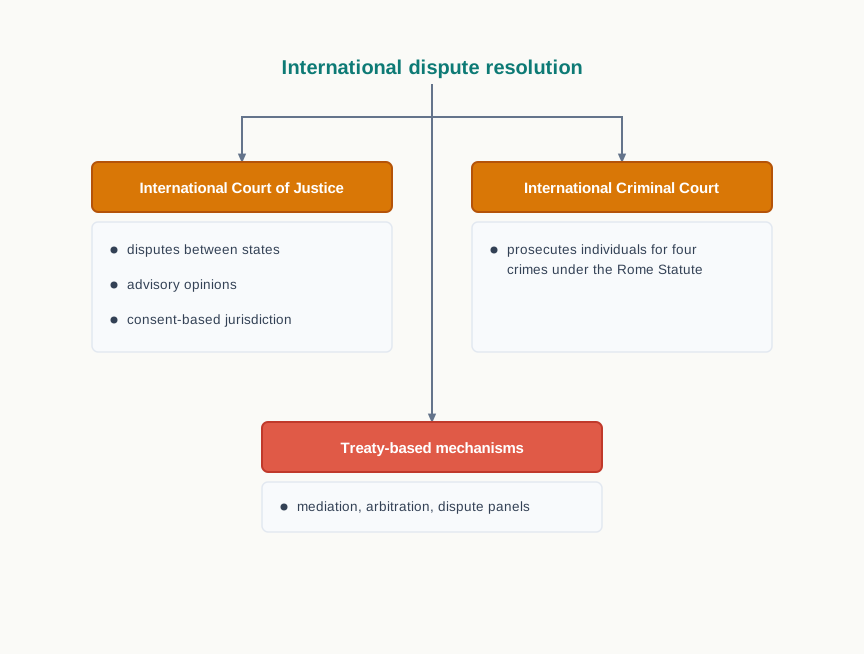
In the event that such disputes arise between states, or even between individuals and the state, there are certain institutions and mechanisms in place to resolve them. The two principal institutions are described below, and Fig. 12.3 sets out the division of work between them.
The International Court of Justice
The International Court of Justice, also known as the World Court, is the principal judicial organ of the United Nations. It settles legal disputes submitted to it by states in accordance with international law, and gives advisory opinions on international legal issues referred by UN bodies and agencies.
The Statute of the ICJ forms part of the founding arrangements of the United Nations, and the Court came into being at The Hague, Netherlands, in 1946.
All members of the UN are party to the Statute of the ICJ by default, owing to Article 93 of the United Nations Charter, and non-members may also become parties under that Article.
The judgment of the ICJ is final, binding on the parties to the case, and without appeal. There is no higher court to which a losing state can go.
The ICJ has no enforcement powers of its own. But if states do not comply with a judgment, the Security Council — the organ of the UN primarily responsible for maintaining peace and security — may take action. Recall from earlier in this chapter that such action can be blocked by the veto of any permanent member, which is precisely where the enforcement weakness of international law shows itself most plainly.
Jurisdiction of the ICJ
The ICJ is thus one of the primary means of dispute resolution available for international disputes, where the parties are agreeable to settling them of their own accord. Its jurisdiction can arise in three ways.
Bringing a dispute before the International Court of Justice Governing provision: Article 93 of the United Nations Charter; the Statute of the International Court of Justice, including Articles 65–68 for advisory opinions. Steps: (a) Confirm that the parties are states, since only states may be parties in contentious cases before the Court. (b) Establish the basis of jurisdiction, which may arise in any one of three ways → the parties agree to appear before the Court on their own behest and to be bound by its decision; or a treaty between them provides that the Court shall be the forum; or, in certain cases, reference to the Court is compulsory in respect of particular disputes. (c) Where the matter is not a dispute between states but a question of law referred by a UN body or agency, the request takes the separate route of an advisory opinion under Articles 65–68. (d) The Court hears the matter and delivers its decision. Outcome: A judgment in a contentious case is final, binding on the parties and without appeal; an advisory opinion is not binding and is merely a referral to the Court to understand the point of law on the matter. Neither carries any enforcement machinery of the Court’s own.
Notice how much rests on consent. A state that has not accepted the Court’s jurisdiction in any of these ways simply cannot be brought before it, however strong the complaint against it may be.
The International Criminal Court
The International Criminal Court (ICC) is a tribunal set up through the Rome Statute, which was adopted in 1998 and came into force in 2002. It has the power to exercise its jurisdiction over persons for the most serious crimes of international concern, and is complementary to national criminal jurisdictions.
The word “complementary” carries real weight. The ICC does not replace national courts; it steps in where the national system is unable or unwilling to prosecute. This is also the sharpest contrast with the ICJ — the ICC tries individual persons, not states.
The ICC has been set up with the purpose of prosecuting criminals for four major crimes:
- Crimes against Humanity;
- Genocide;
- War Crimes;
- the Crime of Aggression.
Genocide means the deliberate killing of a large number of people belonging to a particular nation or ethnic group, carried out with the aim of destroying that nation or group. It is the intention to destroy the group as such that distinguishes genocide from other grave crimes.
The ICC may prosecute for crimes committed in a country which accepts the jurisdiction of the Court. Thus, only if countries agree to submit to that jurisdiction can the ICC take up cases in which the person who has committed the crime is a national of the country, or in which the crime was committed in the territory of that country.
Cases may be referred by the country directly to the ICC, or taken up through the Prosecutor of the ICC, who is the person appointed to try cases on behalf of the Court.
The ICC’s jurisdiction is limited to the criminal matters listed under the Rome Statute. The divide between the two courts is similar to the divide between civil and criminal courts in the domestic context; however, the jurisdiction of the ICC is more restricted than that of ordinary criminal courts, because it is confined to four defined crimes and operates only where a state has accepted its jurisdiction.
International Court of Justice vs International Criminal Court
| Established by |
The Statute of the ICJ, forming part of the UN arrangements; the Court sitting from 1946 |
The Rome Statute, adopted in 1998 and in force from 2002 |
| Status |
Principal judicial organ of the United Nations |
A separate tribunal, not an organ of the UN |
| Who can be a party |
States |
Individual persons accused of crimes |
| Subject matter |
Legal disputes between states; advisory opinions for UN bodies |
Crimes against humanity, genocide, war crimes and the crime of aggression |
| Basis of jurisdiction |
Consent of the states involved, a treaty provision, or compulsory reference |
Acceptance of jurisdiction by the state of the accused’s nationality or where the crime was committed |
| Relation to national courts |
Decides matters national courts cannot |
Complementary — steps in where national criminal jurisdiction does not act |
Q5. Which international court hears disputes between states, and which one puts individuals on trial for crimes like genocide?
A. The International Court of Justice hears disputes between states and gives advisory opinions to UN bodies; its parties are countries, and its jurisdiction depends on their consent. The International Criminal Court tries individual persons for four crimes under the Rome Statute — crimes against humanity, genocide, war crimes and the crime of aggression — and acts only where the national criminal system does not.
Other dispute resolution mechanisms
Often the treaties entered into by the states themselves lay down the procedure to be followed in case of a dispute. For instance, the General Agreement on Trade and Tariffs provides for a dispute resolution panel within its own provisions.
Treaties frequently employ mediation, arbitration and other such mechanisms to arrive at an agreeable decision. The attraction is the same as in domestic practice — the parties keep control of the process, and a negotiated outcome is easier for a sovereign state to accept than an imposed one.
The United Nations has even created its own forum to deal with issues related to investment disputes, in association with the World Bank.
These are some of the dispute resolution mechanisms available to resolve international disputes. There are numerous other forums that can be created, all of which depend on agreements between the parties and on the provisions of the treaties concerned. The ICJ’s enabling provisions are also wide enough to deal with most disputes that may arise between member states.
12.13 Summary
- Municipal law is the internal or domestic law of a state, governing both its people and its own organs of government within its territory.
- International law supplies the framework that municipal law cannot, because no state’s legislature can bind another state and no state’s courts can ordinarily summon another state.
- The term ‘International Law’ was coined by Jeremy Bentham in 1780, while Hugo Grotius (1583–1645) is regarded as the founding father of modern international law.
- Grotius argued for the freedom of the high seas, and his work On the Law of War and Peace (1625) established that even nations at war are bound by rules.
- The origins of international law lie in cooperative agreements between peoples of the ancient Middle East, but its essential structure was mapped out during the European Renaissance.
- International law differs from domestic law in several respects:
- the UN General Assembly, though it looks like a legislature, cannot issue binding laws;
- its resolutions are only recommendations, except on matters such as the UN budget, admission of members and election of ICJ judges;
- the ICJ’s jurisdiction in contentious cases requires the consent of the states involved;
- there is no international police force and no supreme executive authority;
- Security Council enforcement action requires a prior act or threat of aggression and can be vetoed by any of the five permanent members.
- International law is therefore called a weak law compared to municipal law, but it is weak in enforcement rather than empty of content.
- It functions in a decentralised, horizontal manner among sovereign equals, resting on custom, treaties and the common consent of the community of nations.
- According to Oppenheim’s view international law is true law, while according to Austin’s view it is not, since it is not enacted by a superior or legislative authority.
- States generally comply because the rules rest on reciprocity and self-interest, and a breach costs a state its credibility in future dealings.
- Globalisation in the 1980s increased the number and influence of international organisations, and new international law is now often created through processes requiring near-universal consensus.
- In International Law every country is referred to as a ‘state’, and the subject is also called the law of nations.
- Bentham’s classic definition treated international law as rules governing relations between states, but it omits two modern elements — individuals and international organisations.
- International law is largely consent-based, the main exceptions being customary international law and jus cogens, which are norms permitting no derogation by agreement.
- International Law is categorised into Public International Law and Private International Law.
- Public International Law regulates the conduct of states towards one another and is not concerned with private persons or with the domestic law of any country.
- The World Trade Organisation, established in 1995 and located in Geneva, is the only global organisation dealing with the rules of trade between nations.
- Private International Law, or Conflict of Laws, decides which country’s court may hear a dispute with a foreign element, and which country’s law that court must apply.
- Bodies such as the Hague Conference on Private International Law, ICSID, UNIDROIT and UNCITRAL work towards harmonising the private laws of different countries.
- Instruments such as the CISG, the UNCITRAL Model Law on International Commercial Arbitration (adopted by India in 1996) and the Geneva Convention on the execution of foreign arbitral awards have gained wide acceptance.
- Article 38(1) of the Statute of the International Court of Justice is the most authoritative statement of the sources of international law.
- Treaties, customs and general principles of law are the primary sources, while judicial decisions and the teachings of publicists are secondary sources or evidence of the law.
- General principles of law are used mainly to fill gaps where treaties and customary international law provide no rule of decision.
- A treaty is a legally binding written agreement between states; an agreement made without the intention of creating binding obligations is not a treaty.
- A final treaty text is ‘adopted’ at an international conference by a two-thirds majority, but a state becomes bound only when it expresses consent, by signature, by exchange of instruments, or by ratification.
- Ratification is the act by which a state establishes its consent to be bound on the international plane, and is the preferred method in multilateral treaties.
- Customary international law requires two elements together:
- consistent and general state practice, the objective element;
- opinio juris, the belief that the practice is followed as a legal obligation.
- The North Sea Continental Shelf cases confirmed this dual requirement and established that the duration of a practice is not an essential factor in forming custom.
- Under Article 59 of the Statute, an ICJ decision binds only the parties and only in that case, so past decisions are not binding precedent, though the Court rarely departs from them.
- The ICJ may also give advisory opinions under Articles 65–68 of its Statute, which are not binding.
- The Second World War drove the development of international human rights law, and Article 4 of the ICCPR identifies certain rights as non-derogable.
- The prohibitions of torture, genocide and slavery, and the principle of non-discrimination, have entered customary international law and need no specific treaty to take effect.
- The Universal Declaration of Human Rights is not binding per se, but has been referred to in ICJ cases and remains the most influential human rights document.
- The Vienna Declaration and Programme of Action (1993) affirmed that all human rights are universal, indivisible, interdependent and interrelated, and led to the creation of the post of UN High Commissioner for Human Rights.
- The Commission on Human Rights has been known as the Human Rights Council since 2006, and has faced criticism for political selectivity.
- Erga omnes obligations are owed to the international community as a whole, so any state may act in respect of such grave violations, wherever they occur.
- A state cannot plead its own municipal law, or the absence of domestic legislation, as a defence to a breach of international law.
- Where international and domestic law conflict, supremacy depends largely on the forum: international forums prefer treaty law, domestic forums prefer their own statutes.
- Under the United Kingdom’s doctrine of transformation, a treaty applies domestically only after it has been transformed into municipal law by domestic legislation.
- In the United States customary international law is federal law, but no legislative act may be invalidated merely for violating it.
- Article 51 of the Indian Constitution directs the State to endeavour to foster respect for international law and treaty obligations.
- Article 253 empowers Parliament to legislate to implement treaties, even on matters otherwise within the powers of the state governments.
- In India a treaty is ordinarily ratified by executive assent, but it does not by itself override domestic law.
- Maganbhai Ishwarbhai Patel v. Union of India laid down that a legislative measure is required where a treaty restricts the rights of citizens or modifies existing law, and is not required where no right is restricted.
- Sheela Barse v. Secretary, Children’s Aid Society applied ratified conventions on the protection of children directly, there being no contradictory domestic law.
- Vishaka v. State of Rajasthan used the provisions of CEDAW to create legally binding obligations on sexual harassment at the workplace.
- The International Court of Justice is the principal judicial organ of the United Nations; its judgments are final, binding on the parties and without appeal, but it has no enforcement powers of its own.
- All UN members are party to the Statute of the ICJ by virtue of Article 93 of the United Nations Charter.
- The International Criminal Court, established under the Rome Statute, tries individuals for crimes against humanity, genocide, war crimes and the crime of aggression, and is complementary to national criminal jurisdictions.
- Treaties themselves often provide dispute resolution machinery, such as mediation, arbitration or a dispute resolution panel of the kind found in the General Agreement on Trade and Tariffs.
12.14 Key Terms
Municipal law — the internal or domestic law of a state, governing both its people and its own organs of government within its territory.
State — in international law, a country such as India or Japan, and not a state of the Indian Union.
Sovereign — having supreme authority within one’s own territory and accepting no superior above it.
Jurist — a scholar of law who studies and writes about legal principles, as distinguished from a judge who decides cases.
Veto — the power of a permanent member of the UN Security Council to block a decision single-handedly, however many other members support it.
Ad hoc — for a particular purpose alone, as with UN forces assembled from member states for one operation.
International law — the body of rules and principles binding states in their relations with one another, with recognised international entities, and in matters involving the citizens and businesses of other nations; also called the law of nations.
Jus cogens — ‘compelling law’; norms of customary international law from which no derogation is permitted by particular agreements, and which cannot be altered by treaty.
Derogation — departing from a rule or cutting it down, whether by agreement or in an emergency.
Public International Law — the branch of international law that regulates the conduct of states towards one another.
Private International Law — also called Conflict of Laws; the rules deciding which country’s court may hear a dispute with a foreign element and which country’s law that court must apply.
Natural person — a human being, as distinguished from an entity treated as a person by law.
Legal person — an entity such as a company or society which the law treats as a person capable of holding rights and owing duties.
Intergovernmental organisation — an organisation whose members are governments rather than individuals or companies, such as the WTO.
Extradition — the formal surrender by one state to another of a person accused or convicted of an offence in the requesting state.
Model law — a ready-made legislative text that binds no state, but which any state may enact into its own statute book to bring its law into line with others.
Primary sources — treaties, customs and the general principles of law, which the ICJ applies as the law itself.
Secondary sources — judicial decisions and the teachings of publicists, used as subsidiary means for determining rules of law.
Publicist — a leading scholar of international law whose writings are used as evidence of what the law is.
Treaty — a legally binding written agreement in which states agree to act in a particular manner as specified in the agreement.
Adoption of a treaty — the settling of the final text at an international conference by a two-thirds majority, which binds no state by itself.
Full powers — written authorisation from a state enabling its representative to take decisions on its behalf.
Ratification — the act by which a state establishes its consent to be bound by a treaty on the international plane.
Customary international law — binding legal rules developed at global or regional level through continued practice, existing independently of treaty law.
State practice — the objective element of custom, being the widespread repetition of similar international acts over time by states.
Opinio juris — the subjective element of custom, being a state’s belief that the practice is carried out as a legal obligation.
Ipso facto — ‘by the fact itself’; a consequence following directly from an act, without anything further being needed.
Advisory opinion — a non-binding opinion of the ICJ on a point of law, given under Articles 65–68 of its Statute on a reference from a UN body or agency.
Non-derogable right — a right that a state may not suspend or restrict even during an emergency.
Erga omnes — ‘towards all’; an obligation owed to the international community as a whole, breach of which any state may act upon.
Doctrine of Transformation — the rule, followed in countries such as the United Kingdom, that a treaty applies domestically only after being transformed into municipal law by domestic legislation.
Genocide — the deliberate killing of a large number of people belonging to a particular nation or ethnic group, with the aim of destroying that nation or group.
Complementary jurisdiction — the principle that the International Criminal Court does not replace national courts, but exercises jurisdiction where the national system does not act.
12.15 Points to Ponder
If a rule is regularly obeyed but cannot be enforced against a powerful violator, is it still law? Consider Austin’s view and Oppenheim’s view before you decide.
International law is founded on the equality of states, yet five states hold a veto over enforcement action. Can a system be called horizontal while such a power exists within it?
The ICJ can hear a dispute only if the states involved consent. Does this protect sovereignty, or does it allow a state to escape accountability simply by refusing to appear?
The Universal Declaration of Human Rights is not binding, yet it is among the most influential legal documents ever written. What does this tell you about where the authority of law really comes from?
Erga omnes obligations allow one state to act against grave violations committed inside another. Where should the line be drawn between protecting people and interfering in a country’s internal affairs?
In Vishaka v. State of Rajasthan the Court used an international convention to lay down binding rules where Parliament had not legislated. Was this the judiciary filling a gap, or the judiciary doing the legislature’s work?
A state cannot plead its own law as a defence to breaching a treaty, yet its own courts must apply that law. Is it fair to hold a state responsible for an obligation its citizens cannot enforce at home?
The International Criminal Court can act only where a state has accepted its jurisdiction. What does this mean for victims in countries that have not done so?
Bodies such as UNIDROIT and UNCITRAL work to make the private laws of different countries more alike. What is gained by such uniformity, and what might be lost when a country’s own legal traditions give way to a common text?
The North Sea Continental Shelf cases held that a practice need not be old to become custom. Should a rule that binds every state be capable of forming in only a few years?
12.16 Textbook Questions
Distinguish between Public International Law and Private International Law.
What is the role of the UN High Commissioner for Human Rights?
Explain the various sources of International Law.
What happens in case of a conflict between a treaty provision and a domestic law?
Explain the existing dispute resolution mechanisms in International Law.
At an international conference aimed at framing a resolution on an environmental issue among the member countries, the Indian representative gave consent subject to approval by the Indian Parliament. On considering the matter, Parliament refused to give its assent, and the terms of the resolution were therefore not implemented in India.
- Identify the mode of entering into the treaty that was opted for in the given situation.
- Analyse the circumstances in which it would have been binding on the Indian representative to give assent to the resolution.
12.17 Objective Questions
The term ‘International Law’ was first coined in 1780 by:
- Hugo Grotius
- Jeremy Bentham
- John Austin
- L. Oppenheim
The jurist regarded as the founding father of modern international law is:
- Jeremy Bentham
- John Austin
- Hugo Grotius
- L. Oppenheim
According to Austin’s view, international law is not true law because:
- it is not written down in a single document
- it is not enacted by a superior or legislative authority
- states frequently disobey it
- it applies only to states and not to individuals
Which of the following is a matter on which a resolution of the UN General Assembly is more than a mere recommendation?
- Condemning an act of aggression
- Determining the UN budget
- Recommending a change in a member state’s domestic law
- Declaring a treaty void
Enforcement action authorised by the UN Security Council may be vetoed by:
- a two-thirds majority of the General Assembly
- the International Court of Justice
- any one of its five permanent members
- the UN High Commissioner for Human Rights
‘Jus cogens’ means:
- by the fact itself
- towards all
- compelling law
- an opinion of law or necessity
Private International Law is also known as:
- the law of nations
- conflict of laws
- customary international law
- municipal law
The World Trade Organisation was established in:
- 1945, at The Hague
- 1982, at Vienna
- 1995, at Geneva
- 2002, at Rome
Under Article 38(1) of the Statute of the International Court of Justice, which of the following is a secondary source of international law?
- International conventions
- International custom
- General principles of law
- The teachings of the most highly qualified publicists
The final text of a treaty is ‘adopted’ at an international conference by:
- a simple majority
- a two-thirds majority
- unanimity of all states present
- the consent of the depositary state alone
The subjective element required for the formation of customary international law is:
- state practice
- Opinio juris
- ratification
- adoption
Which provision of the Statute of the ICJ lays down that a decision of the Court has no binding force except between the parties and in respect of that particular case?
- Article 38
- Article 59
- Article 93
- Articles 65–68
The Commission on Human Rights has been known as the Human Rights Council since:
- 1993
- 2002
- 2006
- 2015
The provision of the Indian Constitution empowering Parliament to legislate for implementing treaties is:
- Article 51
- Article 93
- Article 253
- Article 38
Which of the following is NOT one of the four crimes prosecuted by the International Criminal Court?
- Genocide
- War crimes
- The crime of aggression
- Breach of a trade treaty
Assertion (A): The Universal Declaration of Human Rights has influenced the development of international human rights law. Reason (R): The Universal Declaration of Human Rights is a binding treaty enforceable against every state.
Assertion (A): A state cannot plead its own municipal law as a defence to a breach of international law. Reason (R): If a state could escape a treaty obligation by amending its own statute, every treaty could be defeated at will by the party bound by it.
Assertion (A): The International Court of Justice cannot hear a contentious case unless the states involved have consented to its jurisdiction. Reason (R): International law is largely consent-based, and there is no supreme executive authority above states.
Assertion (A): A practice followed by states for a short period may still become a rule of customary international law. Reason (R): The North Sea Continental Shelf cases held that the duration of a practice is not an essential factor in the formation of custom.
Assertion (A): In India, ratification of a treaty by the executive does not by itself make the treaty enforceable in Indian courts. Reason (R): Where a treaty restricts the rights of citizens or modifies existing law, a legislative measure is required.
Assertion (A): Obligations erga omnes allow a state to act in respect of grave violations committed outside its own jurisdiction. Reason (R): Such obligations are owed to the international community as a whole, and all states share an interest in their observance.
12.18 Check Your Concepts
Why is international law described as a ‘weak law’ when compared with municipal law? Explain what exactly is weak about it.
State any four respects in which international law differs from domestic legal systems.
Distinguish between Public International Law and Private International Law on the basis of the parties involved, the question each answers, and the forum in which the dispute is decided.
Why is Bentham’s classic definition of international law considered incomplete today? Name the two elements it leaves out.
International law is said to rest on consent. What are the exceptions to this consent requirement, and why do they exist?
What happens if two states enter into a treaty that conflicts with a norm of jus cogens?
Identify the provision that is the most authoritative statement of the sources of international law, and list the sources it directs the Court to apply.
Distinguish between the primary and the secondary sources of international law, and explain why judicial decisions are placed in the second category.
When are general principles of law resorted to, and why do some scholars believe their importance will fade over time?
Arrange the following stages in the correct order, from the drafting of a text to a state becoming bound by it: expression of consent to be bound; negotiation of a final draft; ratification according to the state’s own constitutional requirement; adoption of the text by a two-thirds majority at an international conference.
State the three methods by which a state may express its consent to be bound by a treaty, and explain briefly how each works.
Why was the requirement of ratification introduced, when the treaty has already been signed by a representative of the state?
An agreement is entered into between two countries, but neither intends it to create binding obligations. Is it a treaty? Give reasons for your answer.
State the two elements required for the formation of a rule of customary international law, and explain what each contributes.
What would follow if state practice alone, without opinio juris, were enough to create customary international law?
Why is customary international law described as the most disputed source of international law? Give two difficulties that arise in identifying it.
Correct the error in the following statement and explain your correction: “A decision of the International Court of Justice binds all states, in the same way that a decision of the Supreme Court binds all courts in India.”
If past decisions of the ICJ are not binding, why does the Court rarely depart from them?
Distinguish between a judgment of the ICJ in a contentious case and an advisory opinion given by it.
What is meant by a non-derogable right? Give two examples from the International Covenant on Civil and Political Rights.
The Universal Declaration of Human Rights is not a binding document. Why, then, is it treated as one of the most important documents in international human rights law?
Explain the meaning of erga omnes obligations, and state how they change the ordinary rule about who may complain of a violation.
Why can a state not rely on its own municipal law, or on the absence of domestic legislation, as a defence to a breach of international law?
Explain the Doctrine of Transformation. What is the position of a treaty in such a country before the domestic legislation is passed?
Compare the way the United Kingdom and the United States each deal with the application of international law within their own legal systems.
What is the difference between the role of Article 51 and that of Article 253 of the Constitution of India in the working of international law in India?
India ratifies a convention that enlarges an existing right of citizens, and no Indian law says anything to the contrary. Is a legislative measure needed before Indian courts can apply it? State the test the courts apply.
Distinguish between the International Court of Justice and the International Criminal Court on the basis of who may be a party, the subject matter, and the basis of jurisdiction.
What is meant by saying that the jurisdiction of the International Criminal Court is ‘complementary’ to national criminal jurisdictions?
The ICJ’s judgment is final and binding, yet the Court has no enforcement powers. What happens if a state does not comply, and what limits that remedy?
12.19 Case-Based Questions
- At an international conference, the representative of Country P signs a convention on the protection of migratory birds. The convention states that it will come into force for each state upon ratification. Country P’s Constitution requires a vote of its legislature before ratification, and its legislature has not yet voted. Meanwhile, the government of Country P begins clearing a wetland covered by the convention.
- Is Country P bound by the convention at this stage? Give reasons.
- Which method of expressing consent to be bound applies here, and how does it differ from consent by signature?
- Would your answer to (a) change if the convention had provided that it takes effect upon signature alone? Explain.
- Country X ratifies a treaty undertaking not to export a particular hazardous chemical. Three years later, its Parliament passes a statute expressly permitting that export. A company registered in Country X exports the chemical under that statute. Country Y, a party to the same treaty, complains before an international forum.
- Can Country X rely on its own statute as a defence to the breach? State the principle involved.
- Can the company be punished under the domestic law of Country X as it stands? Explain.
- Identify which forum would prefer which body of law if the same dispute were argued (i) before an international forum and (ii) before a domestic court of Country X.
- An Indian citizen working in Country Z marries a citizen of Country Z there. The marriage is registered only in Country Z. Some years later, the Indian spouse returns to India permanently and files a petition in an Indian court seeking a declaration that the marriage is void.
- Which branch of international law governs the questions raised by these facts?
- State the two distinct questions the Indian court must decide before it can rule on the validity of the marriage.
- Identify the fact in the passage that is most likely to affect the answer to the first of those two questions, and explain why.
- For about eight years, most coastal states have followed an identical practice of giving advance notice before conducting naval exercises near another state’s waters. Country M has never given such notice and has publicly stated that it regards the practice as a matter of courtesy only. In a dispute, Country N argues that the practice has become a rule of customary international law binding on Country M.
- State the two elements Country N must establish, and which authority sets out this dual requirement.
- Does the fact that the practice is only eight years old defeat Country N’s argument? Give reasons.
- What is the legal significance of Country M’s public statement that the practice is only a courtesy?
- Country A and Country B are in dispute over the boundary of an offshore area rich in minerals. Country A wishes to take the matter to the International Court of Justice. There is no treaty between them providing for reference to the Court, and Country B refuses to appear. Country A also asks whether the UN General Assembly can obtain the Court’s opinion on the legal principles involved.
- Can the ICJ decide the dispute in these circumstances? State the rule that governs the answer.
- Name the three ways in which the Court’s jurisdiction in a contentious case may arise.
- If the General Assembly obtains the Court’s opinion, will that opinion bind Country B? Identify the provisions under which such an opinion is given.
- India ratifies an international convention requiring member states to ensure safe working conditions for domestic workers. Some of the convention’s provisions restrict the freedom of employers to terminate employment; others merely require the State to provide additional welfare facilities. No existing Indian statute contradicts either set of provisions. A petition is filed asking the courts to enforce the convention directly.
- Which of the two sets of provisions requires a legislative measure before it can operate in India, and why?
- Name the constitutional provision under which Parliament would enact such a measure.
- Identify the decided case in which the Supreme Court applied an international convention directly because domestic law was silent, and state the principle it laid down.
- Would the answer to (a) change if an Indian statute already permitted employers to terminate employment freely? Explain.
12.20 Landmark Cases & Maxims
State the principle settled by the North Sea Continental Shelf cases regarding the formation of customary international law.
Which idea about the formation of custom did the North Sea Continental Shelf cases dispel, and what did the Court say instead about the criteria for establishing state practice?
In Maganbhai Ishwarbhai Patel v. Union of India, what test did the Court lay down for deciding whether a treaty requires a legislative measure before it can operate in India?
State the principle applied in Sheela Barse v. Secretary, Children’s Aid Society, and identify the feature of the domestic law that made it possible for the Court to apply the convention directly.
Which convention did the Supreme Court rely upon in Vishaka v. State of Rajasthan, and what obligations did the Court create by doing so?
In Kesavananda Bharati v. State of Kerala, what observation was made about the manner in which the provisions of the Constitution are to be interpreted, so far as international law is concerned?
Two states agree by treaty to permit a practice amounting to slavery within a disputed territory. Identify the maxim that governs this situation and state its effect on the treaty.
A state has followed a practice for many years, but openly says that it does so out of convenience and not out of any legal duty. Which maxim is decisive here, and what is the consequence for the formation of custom?
A country becomes a member of the United Nations and, without signing any further document, finds itself a party to the Statute of the International Court of Justice. Name the Latin expression that describes this consequence, and state the provision of the UN Charter that produces it.
Grave violations of human rights are committed in Country R. Country S, which is in no way connected with those events, seeks to take action in respect of them. Identify the maxim relied upon and explain how it alters the ordinary rule about who may complain of a breach.
Match the maxim or expression in Column A with its meaning in Column B:
| a. Jus cogens |
i. Towards all — an obligation owed to the international community as a whole |
| b. Opinio juris |
ii. By the fact itself — a consequence following directly from an act |
| c. Erga omnes |
iii. Compelling law — a norm permitting no derogation by agreement |
| d. Ipso facto |
iv. The belief that a practice is followed as a legal obligation |
A treaty binding Country T internationally cannot be enforced in its own courts because its legislature has passed no corresponding statute. Name the doctrine that explains this position and state the country whose practice the chapter gives as an example of it.
Identify which authority or provision governs each of the following, and give a one-line reason: (a) a state arguing that an ICJ decision in an earlier dispute binds it in a fresh dispute; (b) a UN body seeking the ICJ’s opinion on a point of law; (c) a state claiming that it is a party to the Statute of the ICJ merely by being a UN member.