Chapter 2: Alternative Dispute Resolution in India (ADR)
Two friends, Ilyas and Nandini, start a small printing workshop together. For a year everything works. Then a large order goes wrong, money is lost, and each blames the other. Ilyas wants his investment back. Nandini says he never put in the hours he promised. They stop speaking. Ilyas walks into a lawyer’s office and says the obvious thing: I want to file a case.
The lawyer asks him one question first. How long can you wait?
Because that is the part nobody tells you. Indian courts carry a backlog running into crores of cases. A civil suit of this size may take years to reach judgment, and more years if it is appealed. Ilyas will pay court fees, lawyer’s fees and travel. He will lose working days. And when the judgment finally comes, the workshop he was fighting over may no longer exist.
The lawyer then turns to the partnership deed the two friends signed on day one, and points to a clause neither of them read carefully. It says that any dispute between them will be settled by arbitration.
That single clause changes everything. It sends their quarrel out of the courtroom queue and into a faster, private, cheaper forum — one of several the Indian legal system now offers.
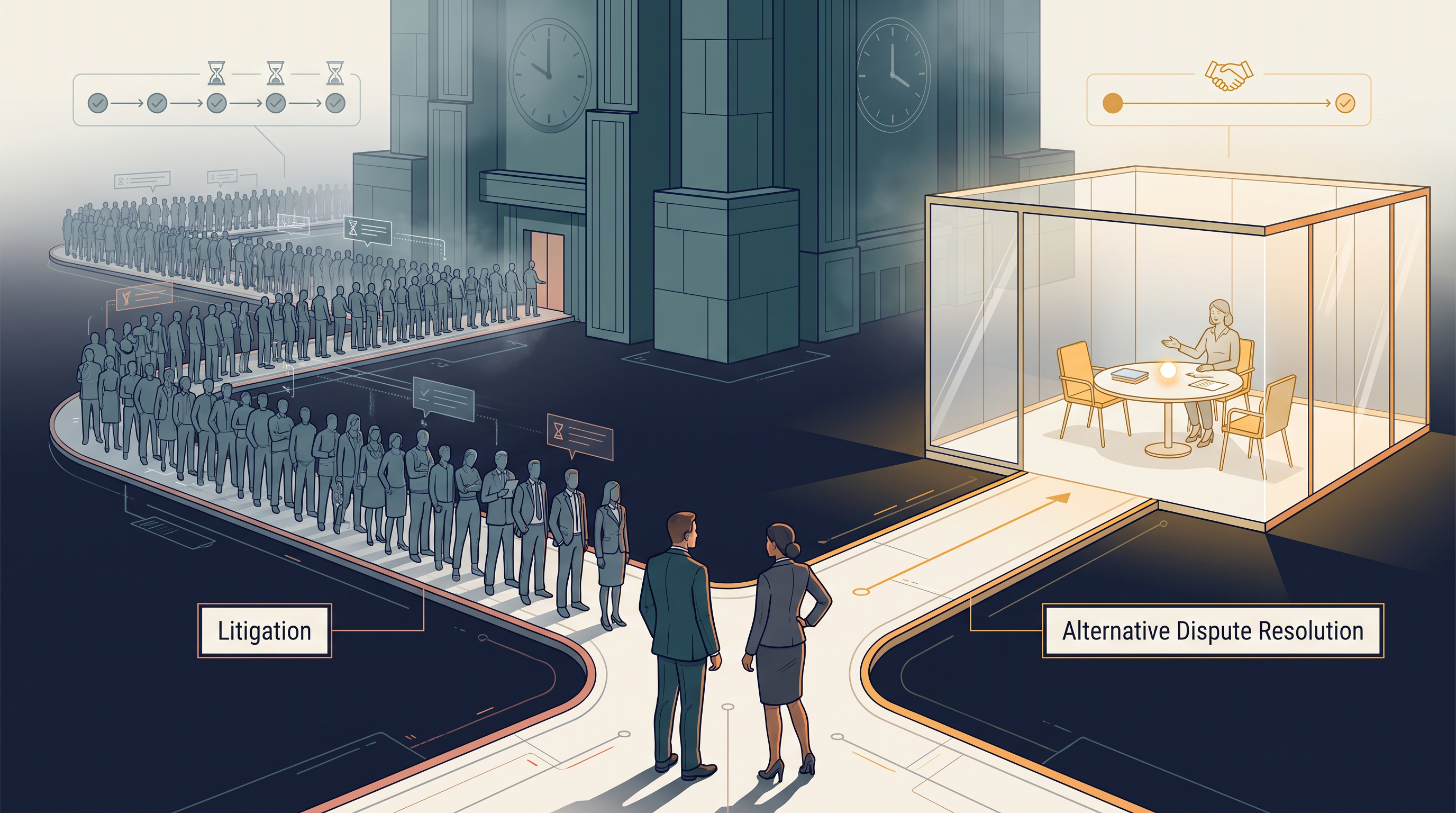
Fig. 2.0 – The choice between litigation and Alternative Dispute Resolution.
This chapter will answer each of these questions.
2.1 Adversarial and Inquisitorial Systems
Every legal system in the world can be placed broadly in one of two models: the adversarial model and the inquisitorial model. Both aim at the same thing — delivering justice. They differ in how they get there.
The difference lies in one question: who drives the case? Does the court sit back and let the two sides fight it out, or does the judge step in and run the search for the truth? Because this single choice decides the role of the judge, the role of the lawyers, and even the way evidence reaches the court, the classification is worth understanding before we study anything else in this chapter.
The word you will meet repeatedly here is adjudication — the act of a neutral authority deciding a dispute and declaring who is right in law. Both models are methods of adjudication. Let us look at each, and then at the differences between them.
In an Adversarial System
The parties in a legal proceeding build their own theory of the case and gather the evidence that supports their claims. If Ilyas says money was misused, it is for Ilyas to produce the bank statements that show it.
The parties are assisted by their lawyers, who take a proactive role in delivering justice to the litigants. The lawyer is not merely a form-filler; the lawyer decides what to argue, which witness to call and which document to place before the court.
Lawyers gather evidence and also take part in cross-examination — the questioning of the other side’s witness, by the opposing lawyer, to test whether that witness is telling the truth — and in the scrutiny of evidence presented by the other disputing party.
The role of the judge or decision maker is rather passive. The judge decides the claims based solely on the evidence and arguments the parties and their lawyers have placed before the court. What the parties do not bring, the judge does not go looking for.
In an Inquisitorial System
Here the picture is reversed. The judge or decision maker takes centre stage in dispensing justice.
The role of the judge is active: he or she determines the facts and the issues actually in dispute, rather than accepting the version of the dispute that the lawyers have framed.
The judge also decides the manner in which evidence must be presented before the court. For example, the judge may direct that a particular form of evidence be produced — oral evidence (a witness statement), documentary evidence (correspondence between the parties through letters or emails), or a combination of both.
The judge then evaluates the evidence presented and decides upon the legal claims. Because the judge intervenes at every stage and investigates rather than waits, this model of adjudication is also known as the interventionist or investigative model.
Further, in such a system less reliance is placed on cross-examination and on the other techniques lawyers use to test the evidence of opposing counsel. The testing of evidence is largely the judge’s job, not a contest between two advocates.
Where Each Model Is Followed
The adversarial system is generally adopted in common law countries — countries whose legal system grew out of English law, where decisions of higher courts serve as binding authority for later cases. The major common law jurisdictions include the UK, the U.S, Australia and India.
Continental Europe, on the other hand, follows the civil law system — those systems deriving from Roman law or the Napoleonic Code, where the law is set out in comprehensive written codes — and it has adopted the inquisitorial system.
This is why an Indian courtroom looks the way it does. Our procedure came through the English courts during the colonial period, and with it came the adversarial habit of leaving the case in the hands of the parties.
Having understood the basic framework of the two models, we can now weigh what each of them does well and where each of them falls short.
2.2 Advantages and Disadvantages of the Two Systems
Neither model is perfect. Each buys something valuable at a price, and the price is paid by real litigants. Reading the two lists below with that in mind is what turns this section from a memory exercise into legal reasoning — and it also explains why India, an adversarial country, has had to build an entire parallel system of alternative dispute resolution alongside its courts.
Advantages of the Adversarial System
The main advantages of an adversarial system include:
The use of cross-examination can be an effective way to test the credibility of the witnesses presented. A witness who has invented a version rarely survives close questioning by a lawyer who knows the file.
The parties may be more willing to accept the results when they are given effective control over the process. A person who chose the arguments and produced the evidence finds it harder to say afterwards that he was never heard.
Disadvantages of the Adversarial System
The disadvantages of an adversarial system are the following:
The cost of the justice system falls upon the parties. This creates an in-built discrimination amongst litigants. Parties with better resources can access justice by hiring competent lawyers and presenting sophisticated evidence, which may not be immediately available to parties who lack those resources. Accessibility and affordability of justice are therefore important challenges for the adversarial system of dispute resolution.
The role of lawyers and the procedural formalities — for example, cross-examination — may prolong the trial and lead to delays in several matters.
Judges play a less active role. A judge is not duty bound to ascertain the truth, but only to evaluate the matter on the basis of the evidence presented before him or her.
Read (a) and (c) together and the deeper problem point appears. If the outcome depends on what the parties manage to place before the court, and the judge will not go beyond that, then the party who can afford the better lawyer is not merely more comfortable — he is more likely to win. That is why cost in an adversarial system is not only an economic question but a question of equality before the law.
Advantages of the Inquisitorial System
The main advantages of an inquisitorial system include:
The system offers procedural efficiency, as the active role of judges prevents delays and prolonged trials. The judge sets the pace instead of waiting for the lawyers to set it.
The system preserves equality between the parties, as even the stronger party — with more resources and expert lawyers — may not be able to influence the judges. Since the court itself decides what evidence is needed, a well-funded party gains less from out-spending the other side.
Disadvantages of the Inquisitorial System
The disadvantages of this model include:
Since the judge steps into the shoes of an investigator, he or she can no longer remain neutral and evaluate the case with an open mind. A judge who has spent weeks building a theory of the facts has, in a sense, already taken a side.
There may be a lack of an incentive structure for judges to involve themselves in proper fact finding. The model depends heavily on the diligence of the individual judge, and offers little to guarantee it.
Notice how the two lists mirror each other. The adversarial system’s great strength — the parties control the case — is exactly what makes it slow and expensive. The inquisitorial system’s great strength — the judge controls the case — is exactly what puts the judge’s neutrality at risk. There is no costless choice here; every legal system simply decides which risk it would rather carry.
For India, the disadvantages listed above are not theoretical. Cost, delay and formality are the everyday experience of the ordinary litigant, and it is precisely this experience that created the demand for a different route to justice — the subject of the rest of this chapter.
2.3 Introduction to Alternative Dispute Resolution
Meaning and Scope
Alternative Dispute Resolution, usually shortened to ADR, is an attempt to devise a machinery capable of providing an alternative to the conventional methods of resolving disputes in the court system. In plainer words, it is a way of settling a legal dispute without fighting it out through a full trial.
The word that carries the weight here is alternative. ADR does not abolish courts and does not replace them. It offers a second road to the same destination — a binding, respectable end to a quarrel — for the very large number of disputes that do not actually need a judge, a witness box and three years of hearings.
ADR refers to the use of non-adversarial techniques of adjudication of legal disputes. Recall from Section 2.1 what the adversarial model looks like: two sides, two lawyers, a contest, a passive judge. ADR techniques deliberately step away from that design. Instead of a contest to be won, the dispute is treated as a problem to be solved, usually with the help of a neutral third person the parties themselves have chosen.
ADR Is Older Than Our Courts
It is tempting to think of ADR as a modern invention brought in to fix a modern backlog. In India the opposite is true. The history of ADR in India pre-dates the modern adversarial model of the Indian judiciary.
The modern Indian judiciary was introduced with the advent of the British colonial era. The English courts and the English legal system influenced the practice of Indian courts, advocates and judges, and courts in India were established so as to have in place a uniform legal system on the lines of the English Courts.
However, even before the advent of such formalistic models of courts and judiciary, the Indian legal system was characterised by several native ADR techniques.
The Vedic age in India witnessed the flourishing of specialised tribunals such as:
Kula — for disputes of the family, community, tribe, castes and races.
Shreni — for internal disputes in business and in corporations of artisans.
Puga — for associations of traders and branches of commerce.
In these institutions, interest-based negotiations dominated, with a neutral third party seeking to identify the underlying needs and concerns of the parties in dispute. That phrase is worth pausing on. An interest-based negotiation asks what each side actually needs — a working relationship, a payment, a repaired reputation — rather than only what each side is legally entitled to demand. It is the same instinct that drives mediation today.
Similarly, the ‘People’s courts’ or Panchayat continued to be at the centre of dispute resolution in villages.
From Voluntary Practice to Statutory Recognition
Alternative Dispute Resolution, which at one point of time was considered a voluntary action on the part of the parties, has now obtained statutory recognition. Two enactments matter most: the Arbitration and Conciliation Act, 1996 and the Legal Services Authorities Act, 1987.
The difference this makes is large. So long as ADR was purely voluntary, a party who changed his mind could simply walk away and file a suit, and the settlement he had agreed to was worth no more than a private promise. Once ADR is recognised by statute, the process has legal backing and its outcome can be enforced.
The incorporation of ADR mechanisms under Section 89 of the Code of Civil Procedure, 1908 is one more radical step taken by the legislature for promoting ADR in India.
Section 89 CPC — Settlement of Disputes Outside the Court
Section 89 does something a statute rarely does: it allows a court that already has a case on its file to send that case out of the courtroom. Where the judge can see that the dispute contains the elements of a settlement acceptable to both sides, the judge formulates the terms of settlement, gives them to the parties for their observations, may reformulate those terms after hearing the parties, and then refers the matter to one of four routes.
The purpose of this section is to enable the courts to legally refer matters to ADR, so that cases can be disposed of expediently and the backlog reduced.
Notice what the provision does not say. It does not order the parties to settle, and it does not decide the dispute. It only opens a door and points at four rooms. If the parties walk through and settle, the case ends; if they do not, the suit returns to the ordinary trial process. All four of those routes — arbitration, conciliation, Lok Adalat and mediation — are studied in detail later in this chapter.
In the modern era, several new and sophisticated forms of ADR techniques have developed. The different forms of ADR models and techniques are discussed in the subsequent parts of the chapter.
2.4 Problems Faced by Courts
Section 2.2 looked at what is wrong with the adversarial model. This section looks at something narrower and more practical: what is wrong with the working conditions of our courts today. The law courts are confronted with the following problems.
The lack of an adequate number of courts and judges, which creates an inadequacy within the justice delivery system. Cases arrive faster than the system has judges to hear them.
The increasing litigation in India, due to an increasing population, the complexity of laws, and the obsolete continuation of some pre-existing legal statutes. Old statutes that no longer suit present conditions generate disputes that better drafting would have prevented.
The increasing cost of litigation in prosecuting or defending a case — rising court fees, lawyer’s fees and incidental expenses such as travel, documentation and repeated adjournments.
Delay in disposal of cases, resulting in huge pendency in all the courts.
These four problems feed each other. Too few judges causes delay; delay lengthens each case; longer cases cost more; and higher cost pushes the weaker party towards giving up a good claim rather than pursuing it. This is the practical meaning of the familiar saying that justice delayed is justice denied — a remedy that arrives after the business has closed or the litigant has died is not really a remedy at all.
It is against this background that the benefits of ADR, taken up next, should be read.
2.5 Benefits of ADR
The ADR techniques are a speedier, informal and cheaper mode of dispensing justice when compared to the conventional judicial procedure. Each of the benefits set out below answers, quite directly, one of the problems listed in Section 2.4. The following are the benefits of ADR.
It is less time consuming. People resolve their disputes expeditiously, in a short period, as compared to courts. There is no waiting for a date, no adjournment because a witness did not appear, and no queue of older cases ahead.
It is less costly than litigation. A shorter process means fewer appearances, fewer fees and fewer incidental expenses.
It is free from the technicalities of courts, as informal ways are applied in resolving disputes. A claim is not thrown out because it was filed in the wrong format; the focus stays on the substance of the dispute.
It can be used at any time, even when a case is already pending before a court of law. However, taking recourse to ADR as soon as the dispute arises may confer maximum advantages on the parties, since less money and less goodwill have been spent by then.
It provides a more convenient forum. The parties can choose the time, the place and the procedure for conducting the dispute redressal process they prefer. In a court, all three are fixed for them.
Where the dispute is technical in nature, the parties can select an expert who possesses the relevant legal and technical expertise, instead of relying on a judge who must be a generalist.
ADR even allows disputes to be referred to non-lawyers. Several disputes of a technical character — for example, disputes concerning the regulation of the construction industry — are usually referred to engineers rather than lawyers. ADR rests on more direct participation by the disputants themselves, rather than being run by lawyers and judges. This type of involvement is believed to increase people’s satisfaction with the outcome, as well as their compliance with the settlement reached.
That last point deserves a moment. Satisfaction and compliance are not the same thing as a legally correct result, but they matter enormously in practice. A party who helped shape the outcome usually performs it. A party who had an outcome imposed on him after a contest he did not control often looks for the next appeal.
In the light of the apparent need for it and the benefits it provides, ADR has emerged as a successful alternative to court trials. Further, the rise of the ADR movement in India indicates that it is contributing tremendously towards reviving the litigant’s faith in justice delivery mechanisms.
2.6 Arbitration
Arbitration is the most court-like of all the ADR techniques. A neutral person hears both sides and then decides — and that decision binds the parties, just as a judgment would. What makes it an alternative is not the absence of a decision-maker, but the fact that the parties chose him themselves, out of court, on their own terms.
2.6.1 The Governing Law
The law relating to arbitration is contained in the Arbitration and Conciliation Act, 1996. It came into force on the 25th day of January, 1996.
The 1996 Act goes much beyond the scope of its predecessor, the Arbitration Act of 1940. It provides for domestic arbitration, for international commercial arbitration, and also for the enforcement of foreign arbitral awards. It contains, in addition, the then-new feature on conciliation. More recently, the Arbitration and Conciliation (Amendment) Act, 2015 came into force to meet the requirements of alternative resolutions.
The Arbitration and Conciliation Act of 1996 is thus the relevant legislation governing the process of arbitration in India. The statute provides an elaborate, codified recognition of the concept of arbitration, and it has been shaped substantially by movements of judicial reform and conflict management across the world.
In this regard a special reference must be made to an international instrument: the United Nations Commission on International Trade Law (UNCITRAL) Model Law on International Commercial Arbitration, 1985. A Model Law is not a treaty that binds a country; it is a template that countries are invited to adopt so that their laws resemble one another. After it was adopted, the United Nations General Assembly recommended that all countries give due consideration to the said Model Law, in order to bring uniformity in the law and practice of international arbitration. The Indian Arbitration and Conciliation Act of 1996 is similarly modelled on the UNCITRAL Model Law.
Why does uniformity matter so much here? Because arbitration is the preferred mechanism for cross-border commercial disputes. A company in Japan contracting with a company in India needs to know in advance that the arbitration will run on rules it recognises. If every country wrote its own unrelated rules, no one would risk the contract.
2.6.2 Meaning of Arbitration
The term arbitration is derived from the nomenclature of Roman law. In substance, arbitration is a private arrangement by which parties take their dispute to a less adversarial, less formal and more flexible forum, and abide by the judgment of a selected person, instead of carrying it to the established courts of justice.
Three ideas are packed into that sentence, and each is doing work. It is private, so it happens outside the court system. It rests on selection, so the decision-maker is chosen by the parties rather than assigned by the state. And it involves abiding by the decision — the parties agree in advance to be bound, which is exactly what separates arbitration from mediation and conciliation later in this chapter.
2.6.3 The Process of Arbitration
Arbitration follows a recognisable sequence, from the first notice to the final award.
Step 1 — Notice. The aggrieved party sends a notice to the defaulting party initiating arbitration.
Step 2 — Choose an arbitrator. The parties in an arbitration have the freedom to select a qualified expert, known as an arbitrator. Arbitration can be reached by either of two routes:
Arbitration agreement — an agreement whereby parties agree to submit their present or future disputes and differences to arbitration. This may be in writing or through other means of communication.
Court referral to arbitration — if a party to the dispute approaches the court despite the presence of an arbitration agreement, the other party may raise a claim before the court. The court must then refer the dispute back to arbitration, if arbitration had previously been agreed by the parties. This method of initiating arbitration is known as court referral to arbitration.
Step 3 — Statement of Claim. These are the initial documents filed by the claimant, listing the issues raised for resolution in the arbitration. It performs the same function that a plaint performs in a civil suit: it tells the tribunal and the other side exactly what is being claimed.
Step 4 — Statement of Counter-Claim. This is the respondent’s reply to the claim presented by the claimant.
Step 5 — Proceedings start. The parties decide the place and time to meet. The process of dispute resolution through arbitration is confidential, unlike court proceedings, which are open to the public. This feature makes arbitration especially popular for commercial disputes, since business secrets revealed during the process are protected and preserved. Companies can also maintain their commercial reputation, because they can prevent the general public or their customers from discovering the details of their ongoing legal disputes.
Step 6 — Award. The decision rendered by an arbitrator is known as an arbitral award.
Similar to a judgment given by a judge, the arbitral award is binding on the disputing parties. Once an arbitral award is rendered, it is recognised and enforced — that is, given effect to — in the same manner as a court-pronounced judgment or order.
In addition to the award itself, the arbitrator holds power and authority to grant interim measures, like a judge in court. These are in the nature of temporary relief, granted while proceedings are ongoing, in order to preserve and protect certain rights of the parties until the final award is rendered. An arbitral award therefore holds several similarities with a court order or judgment.
However, unlike a judgment rendered by a judge in court, the award does not hold precedential value for future arbitrations. Courts follow the doctrine of stare decisis — literally, stand by the decision — under which a ruling of a higher court binds courts below it in later cases. Arbitrators are free to base their decisions on their own conception of what is fair and just. Thus, unlike judges, they are not strictly required to follow the law or the reasoning of earlier decisions.
Point (c) is where students most often go wrong. An arbitral award is binding on the parties to that arbitration and on nobody else. It settles their dispute; it does not settle the law.
2.6.3.1 Setting Aside of an Arbitral Award
An arbitral award rendered in an arbitration may be struck down or invalidated by the courts. This is the safety valve of the whole system: because an arbitrator’s decision binds without a right of appeal on the merits, the law must provide some route to undo an award that was produced unfairly.
The grounds of such invalidation are deliberately limited to the following:
incapacity of a party to enter into the arbitration agreement in the first place;
improper appointment of the arbitrator;
the dispute falling outside the terms of the arbitration agreement;
bias on the part of the arbitrator;
the award violating public policy at large.
Read the list again and notice what is not on it. There is no ground of “the arbitrator got the facts wrong” or “the arbitrator misread the contract”. A court hearing a challenge is not sitting in appeal over the award. It is asking a narrower question — was this a fair process by a properly appointed and unbiased arbitrator, within the scope of what the parties agreed to arbitrate? That narrowness is intentional. If courts could reopen the merits, arbitration would become merely the first round of litigation, and its entire advantage in speed would disappear.
2.6.4 Types of Arbitration
Arbitration is classified on several different bases — where the proceedings are held, who runs them, and where the parties come from. The six recognised types are shown together in Fig. 2.1.
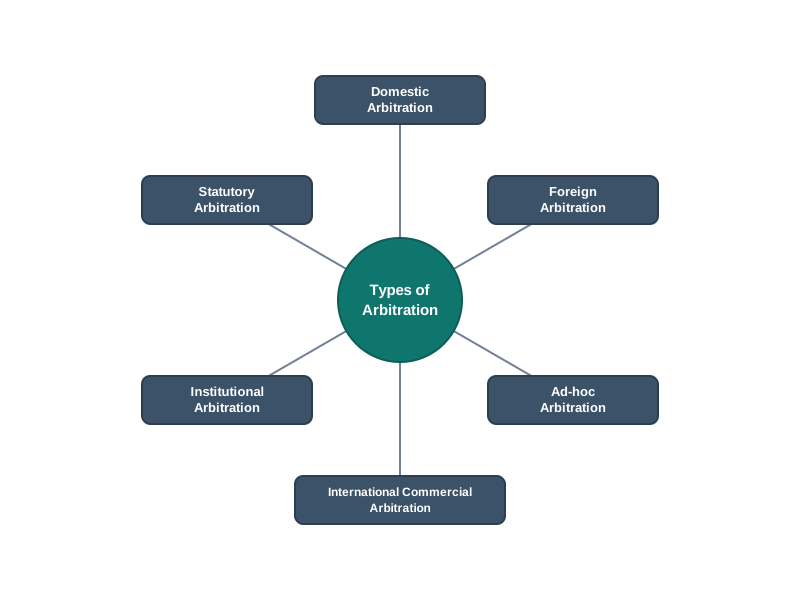
Fig. 2.1 – Types of arbitration.
Domestic Arbitration — arbitration in which the arbitral proceedings are held in India, both the parties to the dispute belong to India, and the dispute is decided in accordance with the substantive and procedural laws of India.
Foreign Arbitration — an arbitration where the arbitral proceedings are conducted in a place outside India, but the arbitral award is required to be enforced in India.
Ad-hoc Arbitration — an arbitration governed by the parties themselves, without recourse to a formal arbitral institution. It may be domestic or international in character. Ad-hoc arbitration means that the arbitration is not to be conducted according to the rules of an arbitral institution. Since the parties have no obligation to submit their arbitration to institutional rules, they are free to state their own rules of procedure.
Institutional Arbitration — an arbitration where the parties select a particular institution, which in turn takes the arbitration forward by selecting an arbitrator and laying out the rules applicable within the arbitration, such as the mode of obtaining evidence. There are several institutions that govern arbitration. A prominent example is the London Court of International Arbitration (LCIA), which has offices across the world, including in New Delhi, India.
Statutory Arbitration — this type of arbitration emanates from an enactment of Parliament or a State Legislature. Here the parties have no option but to abide by the law of the land; the consent of the parties is not necessary, and it is a compulsory form of arbitration. For example, the Defence of India Act, 1971 is one such legislation that mandates recourse to arbitration in case of any dispute arising within the Act.
International Commercial Arbitration — an arbitration in which at least one of the disputing parties is a resident or body corporate of a country other than India. Arbitration with the government of a foreign country is also considered to be international commercial arbitration. This form of arbitration has been defined specifically under Section 2(1)(f) of the Arbitration and Conciliation Act, 1996.
The distinction between (c) and (e) is worth fixing firmly, because they sit at opposite ends of the same scale. Ad-hoc arbitration is arbitration at its most voluntary — the parties write even the procedure themselves. Statutory arbitration is arbitration at its least voluntary — the statute imposes it whether the parties wanted it or not.
2.6.5 Arbitration Before the Courts
Some of the most important developments in Indian arbitration law have come not from Parliament but from the Supreme Court, working out how far Indian courts may reach into an arbitration.
The Arbitration and Conciliation Act, 1996 has ushered in a new era of dispute resolution for domestic and commercial legal issues. On these lines, the Supreme Court of India has affirmed that the Act was introduced in order to attract the international mercantile community.
The same approach appears in Fuerst Day Lawson Ltd v. Jindal Exports Ltd, where the Supreme Court observed that the object of the Arbitration and Conciliation Act of 1996 is to provide a speedy and alternative solution to the dispute and to avoid protraction of litigation, and that the provisions of the Act have to be interpreted accordingly.
2.7 Mediation
2.7.1 Meaning and Types
Mediation is a method of ADR in which the parties appoint a neutral third party who facilitates the mediation process, in order to assist the parties in achieving an acceptable, voluntary agreement. Mediation is premised on the voluntary will of the parties, and it is a flexible and informal technique of dispute resolution.
The key word is facilitates. The neutral person in mediation does not decide anything. He or she creates the conditions in which two people who have stopped talking usefully can start again — separating the shouting from the actual problem, and helping each side see what the other truly needs.
Where does mediation sit among the other techniques? It is more formal than negotiation, but less formal than arbitration or litigation. Unlike litigation, and similarly to arbitration, mediation is relatively inexpensive, fast and confidential.
Mediation and arbitration also differ on the ground of the nature of the outcome rendered. The outcome of mediation does not have the same binding character as an arbitral award. However, though non-binding in itself, such resolution agreements may be incorporated into a legally binding contract, which is then binding on the parties who execute that contract.
This is a point students frequently state carelessly in the examination. It is not accurate to say that a mediated settlement can never be enforced. What is accurate is that the mediator’s involvement does not by itself make anything binding — the binding force comes from the parties’ own agreement, once it is reduced to a contract they have executed.
Kinds of Mediation
Mediation can be classified into the following categories.
Evaluative mediation — this is focused on providing the parties with an evaluation of their case and directing them towards settlement. During an evaluative mediation, where the parties agree that the mediator should do so, the mediator will express a view on what might be a fair or reasonable settlement. The evaluative mediator has somewhat of an advisory role: he or she evaluates the strengths and weaknesses of each side’s arguments and makes some predictions about what would happen should the parties go to court.
Facilitative mediation — facilitative mediators typically do not evaluate a case or direct the parties towards a particular settlement. Instead, the facilitative mediator facilitates the conversation. These mediators act as the guardian of the process, not of the content or the outcome. During a facilitative mediation session, the parties in dispute control both what will be discussed and how their issues will be resolved. Unlike the transformative mediator, the facilitative mediator is focused on helping the parties find a resolution to their dispute, and further provides a structure and an agenda for the discussion.
Transformative mediation — this practice is focused on supporting shifts in empowerment and recognition, by allowing and encouraging deliberation, decision-making and perspective-taking. A competent transformative mediator works with a micro-focus on communication, identifying opportunities for empowerment and recognition as those opportunities appear in the parties’ own conversations, and responding in ways that give the parties an opening to choose what, if anything, to do with them.
Mediation with arbitration — mediation has sometimes been used to good effect when coupled with arbitration, particularly binding arbitration, in a process called ‘mediation/arbitration’. The process begins as a standard mediation, but if the mediation fails, the mediator becomes an arbiter.
Online Mediation — online mediation employs online technology to give disputants access to mediators and to each other, despite geographic distance, disability or other barriers to meeting directly.
Notice how (a), (b) and (c) form a scale of how far the neutral person will go. The evaluative mediator will tell you what your case is worth. The facilitative mediator will not, but will run the conversation. The transformative mediator will not even run the conversation, only watch for moments where the parties can shift their own understanding of the dispute.
The mediation–arbitration hybrid in (d) is more appropriate in civil matters where the rules of evidence or jurisdiction are not themselves in dispute. It resembles, in some respects, criminal plea bargaining and Confucian judicial procedure, in which the judge also plays the role of prosecutor.
Despite their benefits, mediation/arbitration hybrids can pose significant ethical and process problems for mediators. Many of the options and successes of mediation relate to the mediator’s unique role as someone who wields no coercive power over the parties or the outcome. If parties know that the mediator might later sit as the judge of their dispute, that awareness could distort the process — a party will hesitate to admit a weakness in confidence to a person who may soon be deciding against him. Using a different individual as the arbiter addresses this concern.
2.7.2 Process of Mediation
The neutral third party facilitating the process of mediation is known as a mediator. Mediation does not follow a uniform set of rules, though mediators typically set out at the outset the rules that the mediation will observe. Successful mediation reflects not only the parties’ willingness to participate but also the mediator’s skill. There is no uniform set of rules for mediators to become licensed, and rules vary from state to state regarding the requirements for mediator certification.
Broadly speaking, mediation may be triggered in three ways.
Parties may agree to resolve their claims through a pre-agreed mediation agreement, without initiating formal judicial proceedings. This is known as pre-litigation mediation. Pre-litigation mediation is not yet governed by any law in India.
Parties may agree to mediate at the beginning of formal court proceedings, popularly known as court referrals. This is governed by Section 89 of the Code of Civil Procedure.
Mediation may be resorted to after formal court proceedings have started, or even post trial, that is, at the appellate stage.
The three routes tell you something important: there is almost no stage of a dispute at which mediation is closed off. A dispute can go to mediation before a case is filed, at the moment it is filed, in the middle of a trial, or even after judgment while an appeal is pending.
Which Disputes Suit Mediation
Under Indian law, the following categories have been held to be most suited for mediation:
contractual disputes, including money claims;
disputes arising from strained relationships, from matrimonial disputes to partnership disputes;
disputes which need a continuity of relationship, such as a neighbour’s easement rights;
consumer disputes.
The thread running through this list is relationship. Where the two sides will still have to deal with each other after the dispute ends — as spouses, as partners, as neighbours, as a shopkeeper and a regular customer — a judgment that declares one of them the loser solves the legal question and damages everything else. Mediation is designed for exactly that situation.
Consider a suburban homeowner who finds that the formal legal system offers no realistic way to deal with his neighbour’s overly bright driveway lights shining into his bedroom window. Such a dispute can, however, be mediated. Mediation gives the participants an opportunity to raise and discuss any issues they might wish to settle.
It might turn out, in the course of that mediation, that the neighbour lit his driveway because the homeowner’s dog kept going onto his lawn, or because the homeowner’s tree was encroaching on his property. Because mediation can handle any number of outstanding grievances at once, it offers a way to discuss and solve the problems underlying a dispute, and so to create a genuinely lasting peace. A court could only have decided the question of the lights.
Disputes Excluded from Mediation
Not everything can be mediated, and the Supreme Court has expressly clarified the ambit of mediation.
2.8 Conciliation
Part III of the Arbitration and Conciliation Act, 1996 deals with conciliation. Conciliation means the settling of disputes without litigation.
Conciliation is a process by which the discussion between the parties is kept going through the participation of a conciliator. That phrase — kept going — captures the heart of it. Disputes usually harden not because a settlement is impossible but because the conversation has stopped. The conciliator’s first job is to keep it alive.
Conciliation is a process similar to mediation, in that the parties, of their own free will, appoint a neutral third party to resolve their disputes. Both are voluntary, both are informal, and both end in an agreement rather than an imposed verdict.
How a Conciliator Differs from a Mediator
The key difference between mediation and conciliation lies in the role of the neutral third party.
A mediator merely performs a facilitative role and provides a platform for the parties to reach a mutually agreeable solution. The role of a conciliator goes beyond that of a mediator. A conciliator may be interventionist, in the sense that he or she may suggest potential solutions to the parties in order to resolve their claims and disputes.
The last row is the practically important one. A conciliated settlement carries statutory force of its own; a mediated settlement borrows its force from contract. That single difference decides how easily a party can enforce what was agreed.
The Settlement Agreement
If the parties reach agreement on the settlement of a dispute, a written settlement agreement is drawn up and signed by the parties. If the parties so request, the conciliator may draw up the settlement agreement, or assist the parties in drawing it up.
When the parties have signed the settlement agreement, it becomes final and binding on the parties, and on persons claiming under them respectively.
Read Section 73(3) carefully and notice the words persons claiming under them. The agreement binds not only the two signatories but anyone whose rights flow from them — an heir, a successor in business, an assignee of the contract. A settlement that could be undone by simply transferring the property to a relative would be worth nothing.
The settlement agreement has the same status and effect as an arbitral award. This means it is treated as a decree of the court and is enforceable as such — a decree being the formal expression of a court’s decision that finally determines the rights of the parties, which the losing party can be compelled to obey through execution proceedings.
Conciliation Elsewhere in the Law
Conciliation is also governed by Section 89, a provision inserted by the 2002 amendment of the Code of Civil Procedure, 1908. The Code is the primary legislation governing the method, procedure and legal practice relating to civil disputes.
Section 89 CPC, however, does no more than refer to conciliation. The process and the methods within conciliation have been described in the Arbitration and Conciliation Act, 1996. In other words, the CPC opens the door; the 1996 Act furnishes the room.
Further, the Industrial Disputes Act, 1947 also provides for conciliation as a viable means of resolving disputes in the labour sector. This is worth noting for a practical reason: when a factory or workplace dispute arises between workers and management, conciliation is not merely one option among many — it is built into the statutory machinery for settling industrial disputes.
2.9 Lok Adalat
The concept of Lok Adalat, the People’s Court, is an innovative Indian contribution to global legal jurisprudence. The name says exactly what it is: Lok stands for people and Adalat means court. India has a long tradition and history of such methods being practised in society at the grass roots level.
From Panchayat to Lok Adalat
In ancient times disputes were referred to panchayats, which were established at the village level. Panchayats used to resolve disputes through arbitration, and this proved to be a very effective alternative to litigation.
The very concept of settling a dispute through mediation, negotiation or the arbitral process — known as the decision of the Nyaya-Panchayat — has been conceptualised and institutionalised in the philosophy of the Lok Adalat. It involves people who are directly or indirectly affected by dispute resolution.
The evolution of the movement called Lok Adalat was part of a strategy with two aims: to relieve the heavy burden on the courts of pending cases, and to give relief to the litigants who were standing in a queue to get justice. Both aims should be read against the problems you studied in Section 2.4. A Lok Adalat does not merely divert one case away from a judge; it closes that case permanently, because a settlement leaves nothing to appeal.
Composition and Jurisdiction
The modern institution of Lok Adalat is presided over by a sitting or retired judicial officer as the chairman, usually with two other members — a lawyer and a social worker, as shown in Fig. 2.2.
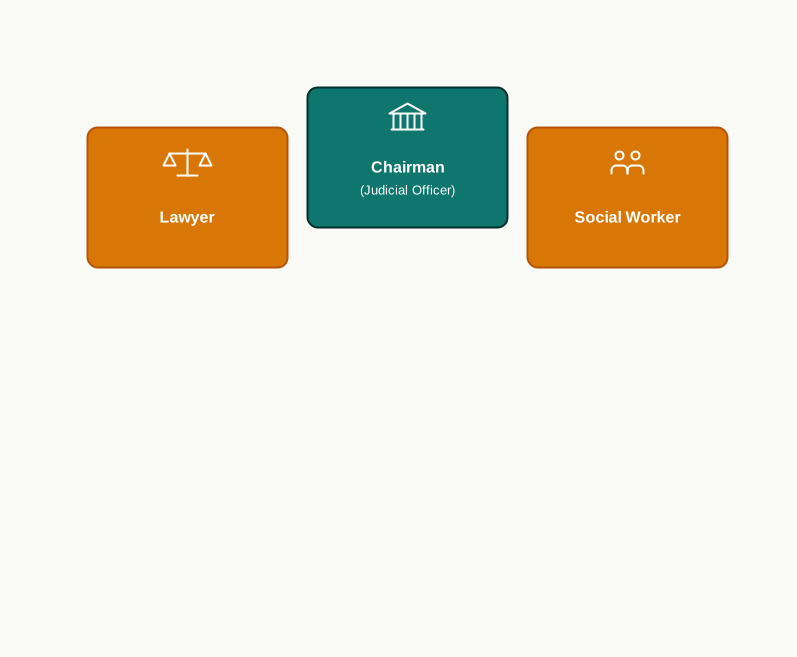
Fig. 2.2 – Composition of a Lok Adalat bench.
The presence of a social worker on the bench is not decoration. It signals that a Lok Adalat is not attempting a trial. It is attempting a settlement that the parties can live with, and that requires an understanding of their circumstances as much as of the law.
A Lok Adalat has jurisdiction to settle:
any matter pending before any court; and
matters at the pre-litigative stage, that is, disputes which have not yet been formally instituted in any court of law.
Such matters may be in the nature of civil disputes or compoundable criminal disputes. A compoundable offence is one that the law permits to be settled with the consent of the complainant — typically the less serious offences, where the wrong is felt mainly by the individual concerned. Serious offences are non-compoundable precisely because the wrong is treated as a wrong against society, which no private party is entitled to forgive on society’s behalf.
The salient features of a Lok Adalat are participation, accommodation, fairness, voluntariness, neighbourliness, transparency, efficiency and lack of animosity.
Benefits of a Lok Adalat
The benefits of a Lok Adalat include the following.
There is no court fee. Even if the case has already been filed in the regular court, the fee already paid will be refunded if the dispute is settled at the Lok Adalat.
There is no strict application of the procedural laws, and the disputing parties can directly interact with the judges — without a lawyer speaking for them and without the formalities of examination and cross-examination.
The decision of a Lok Adalat is binding on the parties, and its order is capable of execution through legal process.
Benefit (c) is what makes the Lok Adalat different from an ordinary compromise talk. A settlement reached here is not a gentleman’s promise; it can be enforced.
Look at that list of successful categories and a pattern appears. These are disputes where the legal question is usually simple and the real obstacle is delay: how much compensation, how much arrears, how much outstanding loan. Where the parties are not far apart on principle but only on figures, a single day before a Lok Adalat can achieve what years of hearings would not.
2.10 Ombudsman
An indigenous Swedish, Danish and Norwegian term, Ombudsman is etymologically rooted in the word “umboosrnaor”, essentially meaning representative.
That meaning explains the whole institution. An ombudsman is not a judge and not a regulator. He is a representative — someone placed between a powerful organisation and the ordinary individual who has been let down by it, whose task is to take the individual’s complaint seriously when the organisation itself has not.
What an Ombudsman Does
Whether appointed by a legislature, by the executive, or by an organisation, the typical duties of an ombudsman are to investigate complaints and attempt to resolve them, usually through recommendations — which may or may not be binding — or through mediation.
Ombudsmen sometimes also aim to identify systemic issues leading to poor service or breaches of people’s rights. This is an important part of the office. A court decides the case before it and nothing more. An ombudsman who receives two hundred similar complaints about the same practice can point out that the practice itself is the problem, and recommend that it be changed.
At the national level, most ombudsmen have a wide mandate to deal with the entire public sector, and sometimes with elements of the private sector as well — for example, contracted service providers. Further redress depends on the laws of the country concerned, but this typically involves financial compensation.
Ombudsmen in India
The Government of India has designated several ombudsmen — sometimes called the Chief Vigilance Officer (CVO) — for the redress of grievances and complaints from individuals in the banking, insurance and other sectors serviced by both private and public bodies and corporations.
For example, the Central Vigilance Commission (CVC) was set up on the recommendation of the Santhanam Committee (1962–64). The CVC has been conceived to be the apex vigilance institution, free of control from any executive authority. It monitors all vigilance activity under the Central Government, and advises various authorities in Central Government organisations in planning, executing, reviewing and reforming their vigilance work.
The words free of control from any executive authority carry the real weight here. An anti-corruption body that reports to the very officials it may have to investigate would be worthless. Independence is not a courtesy extended to such institutions; it is the condition on which they can function at all.
The Banking Ombudsman
The Banking Ombudsman Scheme is an expeditious and inexpensive forum for bank customers, for the resolution of complaints relating to certain services rendered by banks. Presently the Banking Ombudsman Scheme 2006 (as amended up to 1 July 2017) is in operation.
The Banking Ombudsman is a senior official appointed by the Reserve Bank of India to redress customer complaints against deficiency in certain banking services, covered under the grounds of complaint specified in the Scheme.
Note the two limits built into that sentence. The complaint must concern a deficiency in service, and it must fall within the grounds the Scheme itself specifies. A customer who is simply unhappy with a bank’s commercial decision — say, its refusal to grant him a loan — has not identified a deficiency in service, and the ombudsman is not the forum for that grievance.
The Insurance Ombudsman
The Insurance Ombudsman is appointed by the Council for Insurance Ombudsman, in terms of the Insurance Ombudsman Rules, 2017 (as amended from time to time). The Insurance Ombudsman is empowered to receive and consider complaints alleging deficiency in the performance required of an insurer — including its agents and intermediaries — or of an insurance broker.
The Advantage of the Office
The major advantage of an ombudsman is that he or she examines complaints from outside the offending institution, thus avoiding the conflicts of interest inherent in self-policing.
2.11 Lokpal and Lokayukta
A Lokpal, meaning caretaker of the people, is an ombudsman in India. The Lokayukta, meaning appointed by the people, is a similar anti-corruption ombudsman organisation in the Indian states.
The two together complete the design you studied in Section 2.10. The Banking and Insurance Ombudsmen handle a citizen’s complaint about service. The Lokpal and the Lokayuktas handle a citizen’s complaint about corruption — and they do so at the two levels at which government operates in India, the Union and the States.
The Statute and Its Reach
The institutions of Lokpal and Lokayukta were given formal recognition by the passing of The Lokpal and Lokayuktas Act, 2013. The legislation aims to combat acts of bribery and corruption of public servants — a term that has been given a fairly wide interpretation in the Act. The Act applies to public servants both in and outside India.
It is important to note that the Act includes within its purview even the current and former Prime Ministers of India. That inclusion is subject to an exception and to a safeguard, and both need to be stated precisely.
The exception is subject-matter based. The Lokpal cannot inquire into allegations against the Prime Minister in matters pertaining to international relations, external and internal security, public order, atomic energy and space.
The safeguards are procedural. At least two-thirds of the members of the Lokpal must approve of such an inquiry. Any such inquiry shall be held in camera — that is, in closed proceedings, not in open sitting — and if the Lokpal comes to the conclusion that the complaint deserves to be dismissed, the records of the inquiry shall not be published or made available to anyone.
Why does the law build in this much protection? Because an allegation against a head of government is a weapon as much as it is a complaint. Once made public, it damages the office whether or not it is true. The Act therefore allows the inquiry, but insulates it — a large majority must agree to begin it, and a dismissed complaint leaves no public trace to be used against the person accused.
Besides the Prime Minister, the Act brings within its purview any person who is, or has been, a Minister of the Union, and any person who is, or has been, a Member of either House of Parliament.
There is, however, one clear limit. The Lokpal shall not inquire into any matter involved in, arising from, or connected with, any allegation of corruption against a Member of either House of Parliament in respect of anything said, or a vote given, by him or her in Parliament or in any committee thereof, covered under the provisions contained in clause (2) of Article 105 of the Constitution. Article 105(2) confers parliamentary privilege — the immunity that protects what a member says and how a member votes inside the House, so that debate remains free.
With respect to the bureaucracy, the Act covers any Group ‘A’, ‘B’, ‘C’ or ‘D’ official, or equivalent, from amongst the public servants defined in the Prevention of Corruption Act, 1988, whether serving or having served in connection with the affairs of the Union.
The Act also provides for the manner in which public servants must declare their assets. Asset declaration is a quiet but powerful tool: it creates a baseline record against which unexplained wealth can later be measured.
Composition of the Lokpal
According to the Act, the Lokpal shall consist of the following, as shown in Fig. 2.3.
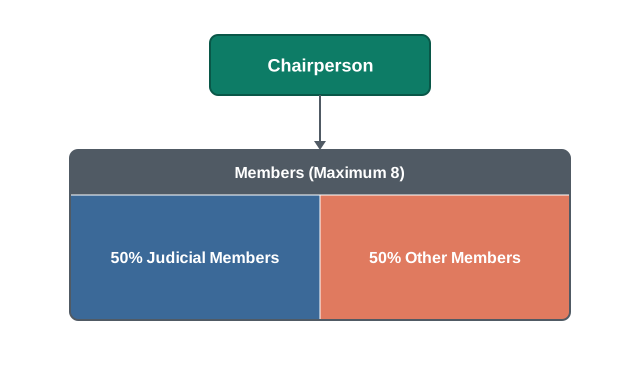
Fig. 2.3 – Composition of the Lokpal.
A chairperson who has been a Chief Justice of India, or is or has been a Judge of the Supreme Court, or is an eminent judicial member of impeccable integrity and outstanding ability, having special knowledge and expertise of not less than 25 years in matters relating to anti-corruption policy, public administration, vigilance or finance.
Members, whose total number shall not exceed 8, out of whom 50 per cent shall be Judicial Members.
The reservation of half the seats for Judicial Members is deliberate. The Lokpal must weigh evidence and decide whether an allegation stands, which is judicial work; but corruption cases also require an understanding of administration and finance, which is why the remaining seats are open to expertise of another kind.
Powers of the Lokpal
The powers of the Lokpal are extensive, and equivalent to the superintendence, inquiry and investigative powers of the police and of the Central Vigilance Commission.
The Lokpal shall consist of an inquiry wing and a prosecution wing, to take the necessary steps in the prosecution of public servants in relation to offences committed under the Prevention of Corruption Act, 1988. The distinction between the two wings matters: the inquiry wing establishes whether there is a case, and the prosecution wing takes that case to court.
Further, the Lokpal can recommend to the government that special courts be created to decide cases arising from the Prevention of Corruption Act, 1988. Special courts exist for a simple reason — a corruption case that waits its turn behind every other case in the ordinary court list loses much of its value as a deterrent.
Lokayuktas in the States
Likewise, the Lokpal and Lokayuktas Act, 2013 provides for the establishment of a Lokayukta in every State, in order to deal with complaints of corruption against public functionaries. The Act provides that all States must institute Lokayuktas within one year from the date of the commencement of the Act.
It is important to note that even before the enactment of this Act, some States in India — for example, Delhi, Karnataka and Kerala — already had the institution of the Lokayukta in place. The 2013 Act therefore did not invent the Lokayukta; it made universal an institution that several States had already found useful.
2.12 ADR and the Road Ahead
Alternative Dispute Resolution is, in the end, an attempt to devise a machinery capable of providing an alternative to the conventional methods of resolving disputes. Having studied each of those methods in turn, it is worth standing back and asking an honest question: is the alternative working?
Why the Alternative Was Needed
Courts have become overcrowded with litigants. Because of the large pendency of cases in the courts, litigants have to face so much loss of time and money that when relief is at long last obtained, it may no longer be worth the cost.
That sentence deserves a slow reading, because it describes a particular kind of failure. The litigant in such a case has not lost. He has won — and the victory has arrived too late to be of any use to him. A legal system can fail its users without ever giving a wrong judgment.
The Tribunals and Forums Were Not Enough
A large number of quasi-judicial and administrative tribunals have been created for quicker relief. A quasi-judicial body is one that is not a court, but which decides disputes and determines rights in a court-like manner, following the essentials of fair procedure. All these tribunals and forums are, in a way, an alternative method of dispute redressal.
But even such tribunals and forums have become overcrowded, with the result that they are not able to provide relief within good time.
Many tribunals in service matters have been able to provide relief only when the aggrieved employee has already retired from his position. Relief in terms of money, which he may ultimately get, may not be worth the service period lost. A promotion wrongly denied and granted fifteen years later is not the same remedy as a promotion granted on time.
Consumer Forums came into being to provide quick, effective and costless relief to buyers of goods and hirers of services. But persons suffering from poor quality of merchandise and services in the market turned out to be so great in number that the Consumer Redressal Forums and Commissions have proved to be inadequate to the volume of complaints.
Heavy pendency causes long delays. In a large number of cases a delayed consumer remedy serves no purpose at all — a refund on a defective appliance that arrives four years later has lost most of its value to the buyer. Thus official consumer remedies have also lost their swiftness. Furthermore, they are not able to provide any remedy for non-consumer matters.
Notice the pattern that runs through all three examples. Each of these forums was itself created as a faster alternative to the ordinary courts, and each has in time acquired the very problem it was built to escape. Volume, not design, is what defeats them. This is the strongest argument for ADR proper: arbitration, mediation, conciliation and Lok Adalat do not add another queue, because they do not depend on a single permanent institution processing every dispute in the country.
What Remains to Be Built
There thus remains the need for an alternative remedy which will not be bogged down by costs and delays. The institutional framework for providing these services is not yet fully developed.
All that can be said is that ADR is now rapidly developing its own national institutions, its own body of experience, and its own theoretical and practical development — while at the same time offering a simpler approach to cross-border dispute resolution.
That last phrase points outward. As Indian businesses contract with parties abroad and foreign investment flows in, disputes increasingly cross national borders, and no single country’s courts can comfortably resolve them. This is precisely the gap that arbitration, built on the UNCITRAL model you studied in Section 2.6, was designed to fill.
2.13 Summary
- Every legal system belongs broadly to one of two models — the adversarial model or the inquisitorial model.
- In an adversarial system the parties build their own case, gather their own evidence and are assisted by lawyers who cross-examine the other side’s witnesses, while the judge remains passive and decides only on the material placed before the court.
- In an inquisitorial system the judge is active: he determines the facts and issues, decides the manner in which evidence is presented, and evaluates it himself. It is also called the interventionist or investigative model.
- The adversarial system is followed in common law countries such as the UK, the U.S, Australia and India; the inquisitorial system is followed in the civil law countries of continental Europe, whose law derives from Roman law or the Napoleonic Code.
- The advantages of the adversarial system are:
- cross-examination is an effective way to test the credibility of witnesses;
- parties who control the process are more willing to accept the result.
- The disadvantages of the adversarial system are:
- the cost falls on the parties, creating in-built discrimination between rich and poor litigants;
- the role of lawyers and procedural formalities prolong trials and cause delay;
- the judge is not duty bound to ascertain the truth, only to evaluate the evidence presented.
- The advantages of the inquisitorial system are procedural efficiency and the preservation of equality between parties of unequal means.
- The disadvantages of the inquisitorial system are that the judge, having become an investigator, may lose neutrality, and that there may be no incentive structure ensuring proper fact finding.
- Alternative Dispute Resolution (ADR) is machinery providing an alternative to the conventional court system, using non-adversarial techniques of adjudication.
- ADR in India is older than the modern adversarial courts, which came with British rule; the Vedic age had specialised tribunals:
- Kula, for disputes of family, community, tribe, castes and races;
- Shreni, for internal disputes in business and corporations of artisans;
- Puga, for associations of traders and branches of commerce.
- ‘People’s courts’ or Panchayats continued to be at the centre of dispute resolution in villages.
- ADR, once purely voluntary, now has statutory recognition through the Arbitration and Conciliation Act, 1996 and the Legal Services Authorities Act, 1987.
- Section 89 of the Code of Civil Procedure, 1908 allows a court to formulate terms of settlement and refer a pending matter for arbitration, conciliation, judicial settlement including Lok Adalat, or mediation, so that cases are disposed of expediently and the backlog is reduced.
- The courts face four recurring problems:
- an inadequate number of courts and judges;
- increasing litigation due to population, complexity of laws and obsolete statutes;
- the increasing cost of prosecuting or defending a case;
- delay in disposal, resulting in huge pendency.
- ADR is speedier, informal and cheaper than conventional judicial procedure; it is free from technicalities, may be used at any stage, allows the parties to choose the time, place and procedure, and permits selection of a technical expert or even a non-lawyer as the neutral.
- The law relating to arbitration is contained in the Arbitration and Conciliation Act, 1996, which replaced the Arbitration Act of 1940 and is modelled on the UNCITRAL Model Law on International Commercial Arbitration, 1985.
- Arbitration is a private arrangement by which parties take a dispute to a less adversarial, less formal and more flexible forum, and abide by the decision of a person selected by them.
- The process of arbitration runs through six steps: notice, choice of arbitrator, statement of claim, statement of counter-claim, commencement of confidential proceedings, and the award.
- Arbitration may be initiated either under an arbitration agreement, or by court referral where a party approaches the court despite that agreement.
- An arbitral award is binding on the parties and enforceable like a court judgment; the arbitrator may also grant interim measures, but the award carries no precedential value for future arbitrations.
- An arbitral award may be set aside by a court only on limited grounds:
- incapacity of a party to enter into the arbitration agreement;
- improper appointment of the arbitrator;
- the dispute falling outside the terms of the arbitration agreement;
- bias on the part of the arbitrator;
- the award violating public policy at large.
- Arbitration is of six types — domestic, foreign, ad-hoc, institutional, statutory, and international commercial arbitration, the last being defined under Section 2(1)(f) of the Arbitration and Conciliation Act, 1996.
- In Bharat Aluminium Company Limited v. Kaiser Aluminium Technical Service, Inc. the Supreme Court drew the distinction between the seat and the venue of an arbitration and held that Part I of the Act applies only to arbitrations seated in India, departing from Bhatia International v. Bulk Trading S.A. & Anr.
- In Konkan Railways Corp. Ltd. v. M/s Mehul Construction Co. the Supreme Court held that the Act must be interpreted with its object in mind — resolving disputes as expeditiously as possible with minimum court intervention.
- Mediation is a voluntary and informal process in which a neutral mediator facilitates discussion so that the parties reach an acceptable agreement; the mediator does not impose a decision.
- A mediated outcome is not binding in itself, but may be incorporated into a legally binding contract that binds the parties who execute it.
- Mediation is of five kinds — evaluative, facilitative, transformative, mediation with arbitration, and online mediation.
- Mediation may be triggered in three ways:
- by a pre-agreed mediation agreement before any court proceedings, called pre-litigation mediation;
- by court referral at the beginning of formal proceedings, under Section 89 of the Code of Civil Procedure;
- after proceedings have started, or even post trial at the appellate stage.
- Contractual disputes including money claims, disputes from strained relationships, disputes needing continuity of relationship, and consumer disputes are most suited for mediation.
- In Afcons Infrastructure Ltd. v. Cherian Varkey Construction Co. (P) Ltd. the Supreme Court excluded representative suits, election disputes, criminal offences and cases against minors and the mentally challenged from the scope of mediation.
- Conciliation is dealt with in Part III of the Arbitration and Conciliation Act, 1996 and means the settling of disputes without litigation, with a conciliator keeping the discussion between the parties going.
- The key difference between mediation and conciliation lies in the role of the neutral: a mediator is purely facilitative, while a conciliator may be interventionist and suggest possible solutions.
- Under Section 73(2), a settlement agreement is drawn up and signed by the parties, and the conciliator may draw it up or assist in drawing it up if requested; under Section 73(3), once signed it is final and binding on the parties and persons claiming under them.
- A conciliated settlement agreement has the same status and effect as an arbitral award and is treated as a decree of the court, as held in Haresh Dayaram Thakur v. State of Maharashtra.
- Conciliation is also referred to in Section 89 of the Code of Civil Procedure, 1908, and the Industrial Disputes Act, 1947 provides for conciliation in the labour sector.
- A Lok Adalat, or People’s Court, is an Indian contribution to global legal jurisprudence, institutionalising the older tradition of the Panchayat and the Nyaya-Panchayat.
- A Lok Adalat is presided over by a sitting or retired judicial officer as chairman, usually with two other members — a lawyer and a social worker.
- A Lok Adalat may settle any matter pending before any court, and also matters at the pre-litigative stage, being civil disputes or compoundable criminal disputes.
- The benefits of a Lok Adalat are:
- no court fee, with refund of fee already paid if a filed case is settled there;
- no strict application of procedural law, and direct interaction between the parties and the judges;
- a decision binding on the parties and executable through legal process.
- An ombudsman is an officer who investigates complaints against an institution and attempts to resolve them by recommendation or mediation, and who may also identify systemic failures in service or in the protection of rights.
- India has several ombudsmen, including the Central Vigilance Commission, set up on the recommendation of the Santhanam Committee (1962–64) as the apex vigilance institution free of control from any executive authority.
- The Banking Ombudsman is a senior official appointed by the Reserve Bank of India to redress customer complaints about deficiency in banking services; the Insurance Ombudsman is appointed by the Council for Insurance Ombudsman under the Insurance Ombudsman Rules, 2017.
- The major advantage of an ombudsman is that complaints are examined from outside the offending institution, avoiding the conflict of interest inherent in self-policing.
- The Lokpal is the anti-corruption ombudsman at the Union level and the Lokayukta at the State level, both given formal recognition by The Lokpal and Lokayuktas Act, 2013.
- The Lokpal’s purview extends to current and former Prime Ministers, except in matters of international relations, external and internal security, public order, atomic energy and space; such an inquiry needs the approval of at least two-thirds of the members, is held in camera, and if the complaint is dismissed its records are not published.
- The Lokpal also covers Union Ministers, Members of either House of Parliament, and Group ‘A’ to ‘D’ officials, but cannot inquire into corruption allegations concerning anything said or a vote given in Parliament, covered by clause (2) of Article 105 of the Constitution.
- The Lokpal consists of a chairperson, who has been a Chief Justice of India or a Judge of the Supreme Court or an eminent judicial member with not less than 25 years of expertise, and not more than 8 members, of whom 50 per cent are Judicial Members.
- The Lokpal has an inquiry wing and a prosecution wing for offences under the Prevention of Corruption Act, 1988, and may recommend the creation of special courts for such cases.
- Every State must institute a Lokayukta within one year of the commencement of the Act; some States, such as Delhi, Karnataka and Kerala, had Lokayuktas even earlier, Maharashtra being the first in 1971.
- Tribunals, forums and consumer redressal bodies were themselves created as faster alternatives, but have become overcrowded in turn, which is why a genuine alternative remedy — free of cost and delay, and workable across borders — is still being built.
2.14 Key Terms
Adjudication — the act of a neutral authority deciding a dispute and declaring who is right in law.
Adversarial system — a model of justice in which the parties build their own case and produce their own evidence, while the judge remains passive and decides on what is placed before the court.
Cross-examination — the questioning of a witness by the opposing party’s lawyer, in order to test whether that witness is telling the truth.
Inquisitorial system — a model of justice in which the judge actively determines the facts and issues and decides how evidence is to be presented; also called the interventionist or investigative model.
Common law — a legal system derived from English law, in which decisions of higher courts serve as binding authority in later cases.
Civil law system — a legal system derived from Roman law or the Napoleonic Code, in which the law is set out in comprehensive written codes.
Alternative Dispute Resolution (ADR) — machinery for resolving legal disputes by non-adversarial techniques, outside the conventional trial process of the courts.
Kula — an ancient Indian tribunal for disputes of family, community, tribe, castes and races.
Shreni — an ancient Indian tribunal for internal disputes in business and in corporations of artisans.
Puga — an ancient Indian tribunal for associations of traders and branches of commerce.
Panchayat — the village-level ‘people’s court’ that has traditionally been at the centre of dispute resolution in Indian villages.
Arbitration — a private arrangement by which parties refer their dispute to a forum chosen by them and agree to be bound by the decision of a person they select.
UNCITRAL Model Law — the model law on international commercial arbitration adopted in 1985, offered to countries as a template so that arbitration law is broadly uniform across jurisdictions; the Indian Act of 1996 is modelled on it.
Arbitrator — the qualified expert selected by the parties to hear and decide their dispute in arbitration.
Arbitration agreement — an agreement by which parties agree to submit their present or future disputes to arbitration, in writing or through other means of communication.
Court referral to arbitration — the process by which a court refers a dispute back to arbitration where a party has approached the court in spite of an existing arbitration agreement.
Statement of Claim — the initial documents filed by the claimant, listing the issues to be resolved in the arbitration.
Statement of Counter-Claim — the respondent’s reply to the claim presented by the claimant.
Arbitral award — the decision rendered by an arbitrator, binding on the parties and enforceable like a court judgment, but carrying no precedential value.
Interim measures — temporary relief granted while proceedings are ongoing, to preserve and protect the rights of the parties until the final award is rendered.
Stare decisis — the doctrine, meaning stand by the decision, under which the ruling of a higher court binds courts below it in later cases; it does not apply to arbitral awards.
Seat of arbitration — the legal place of the arbitration, which determines which country’s courts supervise it, as distinguished from the venue where hearings are physically held.
Domestic arbitration — arbitration held in India between Indian parties, decided under the substantive and procedural laws of India.
Foreign arbitration — arbitration conducted outside India where the award is required to be enforced in India.
Ad-hoc arbitration — arbitration governed by the parties themselves, without recourse to any arbitral institution, with the parties free to frame their own rules of procedure.
Institutional arbitration — arbitration in which the parties select an institution that appoints the arbitrator and lays down the applicable rules.
Statutory arbitration — a compulsory form of arbitration mandated by an enactment of Parliament or a State Legislature, where the consent of the parties is not necessary.
International commercial arbitration — arbitration in which at least one party is a resident or body corporate of a country other than India, defined under Section 2(1)(f) of the Arbitration and Conciliation Act, 1996.
Mediation — a voluntary and informal process in which a neutral mediator facilitates discussion so that the parties may reach a mutually acceptable agreement.
Mediator — the neutral third party who facilitates a mediation, guarding the process without deciding the outcome.
Evaluative mediation — mediation in which the mediator, with the parties’ agreement, evaluates the strengths and weaknesses of each side and expresses a view on a fair settlement.
Facilitative mediation — mediation in which the mediator guards the process and provides structure, but does not evaluate the case or direct the parties to any particular settlement.
Transformative mediation — mediation focused on shifts in empowerment and recognition, allowing the parties themselves to deliberate, decide and take each other’s perspective.
Mediation with arbitration — a hybrid process that begins as a standard mediation, in which the mediator becomes an arbiter if the mediation fails.
Online mediation — mediation conducted through online technology, giving parties access to a mediator and to each other despite distance, disability or other barriers.
Pre-litigation mediation — mediation undertaken under a pre-agreed mediation agreement, before any formal judicial proceedings are initiated.
Conciliation — a voluntary process under Part III of the Arbitration and Conciliation Act, 1996 in which a conciliator keeps discussion going and may suggest possible solutions, so that the dispute is settled without litigation.
Conciliator — the neutral third party in a conciliation, who may be interventionist and propose terms of settlement to the parties.
Settlement agreement — the written agreement signed by parties who have settled through conciliation, final and binding on them and on persons claiming under them.
Decree — the formal expression of a court’s decision that finally determines the rights of the parties, enforceable through execution proceedings.
Lok Adalat — the People’s Court, a forum where pending and pre-litigation disputes are settled by conciliation, with the settlement binding on the parties and executable through legal process.
Pre-litigative stage — the stage at which a dispute has arisen but has not yet been formally instituted in any court of law.
Compoundable offence — a criminal offence that the law permits to be settled with the consent of the complainant.
Ombudsman — an officer appointed to investigate complaints against an institution and attempt their resolution by recommendation or mediation, and to identify systemic failures.
Central Vigilance Commission (CVC) — the apex vigilance institution of the Central Government, free of control from any executive authority, set up on the recommendation of the Santhanam Committee (1962–64).
Banking Ombudsman — a senior official appointed by the Reserve Bank of India to redress customer complaints of deficiency in specified banking services.
Insurance Ombudsman — an officer appointed by the Council for Insurance Ombudsman under the Insurance Ombudsman Rules, 2017 to consider complaints of deficiency in the performance required of an insurer, its agents and intermediaries, or an insurance broker.
Lokpal — the anti-corruption ombudsman at the Union level, established under The Lokpal and Lokayuktas Act, 2013.
Lokayukta — the anti-corruption ombudsman at the State level, dealing with complaints of corruption against public functionaries of that State.
In camera — a proceeding held in closed session rather than in open court.
Quasi-judicial body — a body that is not a court but decides disputes and determines rights in a court-like manner, following the essentials of fair procedure.
2.15 Points to Ponder
If the cost of an adversarial trial falls on the parties, and the better-resourced party can hire the better lawyer, can such a system honestly claim to treat both sides as equal before the law? What would have to change for that claim to hold?
India inherited the adversarial model from English courts. Would any part of our justice delivery — criminal trials, public interest litigation, family disputes — work better on an inquisitorial design? What would be lost in the exchange?
ADR is described as an alternative to courts. Is it also a substitute for them? Consider what would be lost to the law itself if most disputes were settled privately and never produced a reported judgment.
Arbitration is confidential, and that confidentiality is one of its main attractions for companies. But it also means the public never learns that a company’s product injured someone. Where should the line between privacy and public interest be drawn?
An arbitral award can be set aside only on very narrow grounds, and never simply because the arbitrator got the facts wrong. Is that a fair bargain for a party who has lost an arbitration?
The Vedic-age Kula, Shreni and Puga settled disputes within a community, by people who knew both parties. Modern ADR values the neutrality of a stranger. Which is more likely to produce a settlement people actually keep?
Mediation is said to suit disputes where the parties must continue to deal with each other. Should family and matrimonial disputes therefore go to mediation first, before any court is approached? What safeguards would such a rule need?
Afcons Infrastructure Ltd. excludes criminal offences from mediation because a crime is a wrong against the state, not only against the victim. Yet compoundable offences can be settled at a Lok Adalat. How do you reconcile the two positions?
A Lok Adalat charges no court fee and refunds fee already paid. Is removing the cost of settling enough to persuade a party who benefits from delay to settle at all?
An ombudsman usually makes recommendations rather than binding orders. Does an institution whose findings can be politely ignored still serve a purpose?
The Lokpal may inquire into a former or serving Prime Minister, but only with the approval of two-thirds of its members, in camera, and with the records suppressed if the complaint is dismissed. Do these safeguards protect the office from false allegations, or do they shield the powerful from scrutiny?
Tribunals, consumer forums and special courts were each created to be faster than the ordinary courts, and each has become congested in turn. Is the real problem the design of our institutions, or the volume of disputes society generates?
Access to justice is often measured in the number of cases decided. What else would you measure, if you wanted to know whether ordinary people can actually get their disputes resolved in India?
2.16 Textbook Questions
Ram and Sikander agreed in writing to resolve any disputes arising out of their contract by way of arbitration. A dispute then arose between them, and Ram filed a case in court. Will the court stay the legal proceedings filed by Ram? Discuss.
Mr Hari and his friend Mr Suresh entered into a partnership deed to carry on the business of creative designing. A year after starting a successful partnership firm, creative differences arose between them and created a rift. To help resolve the dispute, Mr Sharma, the secretary of a reputed firm, is facilitating them so that they achieve an acceptable agreement. Which dispute resolution method is Mr Sharma resorting to? Explain.
Sita and Reena are business partners. A dispute arose between them, and both agreed to submit it to Mr Bajaj, a senior member of a law firm. Sita subsequently came to know that Reena and Mr Bajaj are related to each other. Can Sita challenge the authority of Mr Bajaj as an arbitrator? Discuss.
What is the meaning of Ombudsman? Identify equivalent institutions within India, and discuss their roles and limitations.
A dispute arose between Rakesh and his employer regarding an incident of injustice to Rakesh by some senior members of the management during the course of his employment. They appointed Mr Kumar to resolve the dispute. Mr Kumar not only facilitated the conversation but also suggested potential solutions. Identify and explain the role played by Mr Kumar.
A Lokpal is an ombudsman in India, while a Lokayukta is a similar anti-corruption ombudsman organisation in the Indian States.
- Elaborate on the scope of The Lokpal and Lokayuktas Act, 2013.
- Explain the composition of the Lokpal under the Act.
The concept of Lok Adalat is an innovative Indian contribution to global legal jurisprudence. Analyse the features of Lok Adalat that make it a suitable forum for alternative dispute resolution.
2.17 Objective Questions
In which system of justice does the judge play a passive role, deciding only on the evidence and arguments placed before the court?
- Inquisitorial system
- Adversarial system
- Interventionist system
- Investigative system
The inquisitorial model of adjudication is also known as the:
- accusatorial model
- interventionist or investigative model
- consensual model
- facilitative model
Which of the following is a disadvantage of the adversarial system?
- The judge steps into the shoes of an investigator and loses neutrality
- There is no incentive structure for judges to undertake proper fact finding
- The cost of the justice system falls upon the parties, creating in-built discrimination
- The stronger party is unable to influence the judge
In the Vedic age, disputes of family, community, tribe, castes and races were dealt with by:
- Shreni
- Puga
- Kula
- Nyaya-Panchayat
Which of the following is NOT one of the four routes to which a court may refer a matter under Section 89 of the Code of Civil Procedure, 1908?
- Arbitration
- Conciliation
- Judicial settlement including Lok Adalat
- Negotiation
The Arbitration and Conciliation Act, 1996 is modelled on:
- the Napoleonic Code
- the UNCITRAL Model Law on International Commercial Arbitration, 1985
- the English Arbitration Act
- the Arbitration Act of 1940
The decision rendered by an arbitrator is known as:
- a decree
- an arbitral award
- a settlement agreement
- an interim measure
Which of the following is NOT a ground on which an arbitral award may be set aside by a court?
- Bias on the part of the arbitrator
- Incapacity of a party to enter into the arbitration agreement
- The arbitrator’s misreading of the evidence on record
- The award violating public policy at large
An arbitration governed by the parties themselves, without recourse to any arbitral institution, is called:
- institutional arbitration
- statutory arbitration
- ad-hoc arbitration
- foreign arbitration
International commercial arbitration has been defined specifically under which provision?
- Section 2(1)(f) of the Arbitration and Conciliation Act, 1996
- Section 2(7) of the Arbitration and Conciliation Act, 1996
- Section 34 of the Arbitration and Conciliation Act, 1996
- Section 89 of the Code of Civil Procedure, 1908
In which case did the Supreme Court hold that Part I of the Arbitration and Conciliation Act, 1996 applies only to arbitrations having their seat in India?
- Bhatia International v. Bulk Trading S.A. & Anr.
- Bharat Aluminium Company Limited v. Kaiser Aluminium Technical Service, Inc.
- Konkan Railways Corp. Ltd. v. M/s Mehul Construction Co.
- Haresh Dayaram Thakur v. State of Maharashtra
A mediator who evaluates the strengths and weaknesses of each side’s arguments and predicts what a court would do is practising:
- facilitative mediation
- transformative mediation
- evaluative mediation
- online mediation
Which of the following was excluded from the scope of mediation in Afcons Infrastructure Ltd. v. Cherian Varkey Construction Co. (P) Ltd.?
- Contractual disputes involving money claims
- Consumer disputes
- Election disputes
- Matrimonial disputes
Conciliation is dealt with in which Part of the Arbitration and Conciliation Act, 1996?
- Part I
- Part II
- Part III
- Part IV
Under Section 73(3) of the Arbitration and Conciliation Act, 1996, a signed settlement agreement is final and binding on:
- the parties alone
- the parties and persons claiming under them respectively
- the conciliator and the parties
- the parties, but only after a court records it
A Lok Adalat is usually presided over by a sitting or retired judicial officer as chairman, along with:
- two other judicial officers
- a lawyer and a social worker
- two social workers
- a lawyer and a government official
Which of the following statements about a Lok Adalat is correct?
- Court fee is charged at half the ordinary rate
- Its decision is only a recommendation to the parties
- Its order is capable of execution through legal process
- It can settle only matters already pending in court
The Central Vigilance Commission was set up on the recommendation of the:
- Law Commission of India
- Santhanam Committee
- Malimath Committee
- Council for Insurance Ombudsman
The total number of members of the Lokpal shall not exceed:
- 4
- 6
- 8
- 10
Which State was the first in India to introduce the institution of Lokayukta?
- Karnataka
- Kerala
- Maharashtra
- Gujarat
Assertion (A): In an adversarial system, a judge is not duty bound to ascertain the truth. Reason (R): In such a system the parties gather and present the evidence, and the judge evaluates only what is placed before the court.
Assertion (A): An arbitral award does not have precedential value for future arbitrations. Reason (R): Arbitrators are free to decide according to their own conception of what is fair and just, and are not strictly bound to follow the reasoning of earlier decisions.
Assertion (A): The grounds for setting aside an arbitral award are deliberately kept narrow. Reason (R): If courts could reopen the merits of an award, arbitration would become merely the first round of litigation and lose its advantage of speed.
Assertion (A): The outcome of a mediation is not binding in the same way as an arbitral award. Reason (R): A mediator has no authority to impose a decision, and a mediated resolution acquires binding force only when incorporated into a contract executed by the parties.
Assertion (A): A conciliator may suggest possible solutions to the parties. Reason (R): The role of a conciliator may be interventionist, unlike that of a mediator, who performs a purely facilitative role.
Assertion (A): Criminal offences are excluded from the scope of mediation. Reason (R): A criminal offence is treated as a wrong against the state and not merely against the individual victim, so it cannot be disposed of by private agreement.
Assertion (A): Court fee already paid is refunded if a pending case is settled at a Lok Adalat. Reason (R): The law seeks to ensure that the cost already incurred never becomes a reason for a party to continue litigating rather than settle.
Assertion (A): The Central Vigilance Commission is free of control from any executive authority. Reason (R): An institution that reports to the very officials it may have to investigate cannot function as an independent vigilance body.
Assertion (A): The Lokpal cannot inquire into anything said or a vote given by a Member of Parliament in the House. Reason (R): Such matters are covered by the parliamentary privilege contained in clause (2) of Article 105 of the Constitution.
Assertion (A): Tribunals and consumer redressal bodies were created as faster alternatives to the ordinary courts. Reason (R): These bodies have remained free of pendency and continue to deliver relief within a short time.
2.18 Check Your Concepts
Why is the judge described as passive in an adversarial system, when he is the one who finally decides the case?
Distinguish between the adversarial and inquisitorial systems on the basis of the role of the judge, the role of the lawyers, and control over the evidence.
The adversarial system is said to have an in-built discrimination amongst litigants. Explain what causes this, and why it is a question of equality and not merely of expense.
State any two advantages and any two disadvantages of the inquisitorial system.
Why does the same feature — the judge taking an active role — appear as both an advantage and a disadvantage of the inquisitorial system?
Correct the error in the following statement and explain your correction: “India, being a common law country, follows the inquisitorial system, in which the judge determines the facts and issues himself.”
What is meant by describing ADR as a set of non-adversarial techniques? Illustrate your answer with reference to any one ADR method studied in this chapter.
Name the three specialised tribunals of the Vedic age and state the kind of dispute each dealt with.
Why does it matter that ADR moved from being a purely voluntary practice to being recognised by statute? What could a party do before that recognition that it cannot do now?
Identify the provision that permits a court to refer a pending matter for settlement outside the court, and list the four routes to which it may refer the matter.
Arrange the following steps of Section 89 of the Code of Civil Procedure, 1908 in the correct order: reformulation of the terms of settlement; reference to an ADR method; receiving the observations of the parties; the court forming the opinion that elements of a settlement exist; formulating the terms of settlement.
State the four problems faced by the law courts, and explain how each of them makes the other three worse.
“ADR can be used at any time, but recourse to it as soon as a dispute arises confers maximum advantage.” Why should that be so?
Why does the flexibility to appoint a non-lawyer as the neutral matter so much in technical disputes? Give an example of a dispute where it would make a real difference, and one where it would not.
State the six steps in the process of arbitration, in order.
What is court referral to arbitration, and when does it become necessary?
Distinguish between a Statement of Claim and a Statement of Counter-Claim.
Why is confidentiality regarded as one of the strongest attractions of arbitration for commercial parties?
What are interim measures, and why must an arbitrator have the power to grant them before the final award?
An arbitral award is binding like a judgment, yet it creates no precedent. Explain this apparent contradiction.
State the grounds on which an arbitral award may be set aside. What is the significance of the fact that an error in appreciating the evidence is not among them?
Distinguish between ad-hoc arbitration and statutory arbitration on the basis of consent, source and choice of procedure.
What is the difference between the seat and the venue of an arbitration, and why did that distinction decide the outcome in the BALCO case?
Why did the Supreme Court in Konkan Railways Corp. Ltd. v. M/s Mehul Construction Co. say that the object of the Act must be borne in mind while interpreting any of its provisions? How does that reasoning support the narrow grounds for setting aside an award?
Distinguish between mediation and arbitration on the basis of the role of the neutral third party and the binding effect of the outcome.
“A mediated settlement can never be enforced.” Correct this statement.
Distinguish between evaluative, facilitative and transformative mediation.
What ethical problem arises in the mediation–arbitration hybrid, and how can it be addressed?
State the three ways in which mediation may be triggered.
What is the common thread running through the categories of dispute held most suited for mediation under Indian law?
Why are representative suits and cases against minors excluded from the scope of mediation? Answer with reference to what mediation depends on in order to work.
Distinguish between a mediator and a conciliator, and explain which of the two settlements is easier for a party to enforce, and why.
What happens once the parties sign a settlement agreement in conciliation? Refer to the status it acquires and to the persons it binds.
Identify the statute that provides for conciliation as a means of resolving disputes in the labour sector.
Why is a social worker included on the bench of a Lok Adalat alongside a judicial officer and a lawyer?
What is a compoundable offence, and why can a Lok Adalat settle such an offence but not a serious one?
State the benefits of a Lok Adalat, and explain which of them a party who has already filed a suit would value most.
What happens if a dispute referred to a Lok Adalat is not settled there?
Beyond deciding individual complaints, an ombudsman may identify systemic issues. Why is a court unable to perform that function?
A customer is refused a loan by his bank and wishes to complain to the Banking Ombudsman. Will the complaint be entertained? Explain what the Ombudsman’s jurisdiction actually covers.
Why is it essential that an ombudsman examines complaints from outside the institution complained against?
State the safeguards that apply when the Lokpal inquires into an allegation against a Prime Minister, and explain the purpose behind each of them.
Why is the Lokpal barred from inquiring into anything said or a vote given by a Member of Parliament in the House?
Explain the composition of the Lokpal, and state why half the members must be Judicial Members.
Distinguish between the Lokpal and a Lokayukta.
Tribunals and consumer redressal bodies were themselves created as alternatives to the ordinary courts. Why has this not solved the problem of delay, and what does that suggest about where the real solution lies?
2.19 Case-Based Questions
- Meherbanu runs a bakery and orders a commercial oven from Kalyan Equipment Pvt. Ltd. The purchase agreement, signed by both parties, contains a clause stating that any dispute arising out of the agreement shall be referred to arbitration in Jaipur. The oven fails within two months. Meherbanu, impatient with the company’s replies, files a civil suit for damages in the local court. Kalyan Equipment appears and points to the clause.
- What is the name given to the method by which the dispute now returns to arbitration, and what must the court do?
- Would your answer change if the agreement contained no such clause and Kalyan Equipment merely said in court that it preferred arbitration? Give reasons.
- State two advantages Meherbanu will gain from arbitration that a trial would not have given her.
- Two textile exporters, Jerome and Farida, refer a payment dispute to arbitration and jointly appoint Mr Venkatesan, an experienced trade consultant, as the sole arbitrator. The proceedings conclude and an award is passed in Farida’s favour. A week later, Jerome discovers that Mr Venkatesan had been a paid adviser to Farida’s firm throughout the previous financial year, a fact never disclosed to him.
- On which ground may Jerome apply to have the award set aside?
- Jerome also argues that the arbitrator misread three of his invoices and reached the wrong figure. Will that argument succeed? Explain why the grounds for setting aside are kept narrow.
- Suppose instead that Jerome had known of the advisory relationship before the arbitration began and had raised no objection. How would that fact affect his position?
- An Indian software company and a Singapore-based client enter into a contract governed by Indian law. The arbitration clause provides that the seat of arbitration shall be Singapore, though the parties agree to hold two of the hearings in Bengaluru for convenience. A dispute arises, the tribunal in Singapore passes an award, and the Indian company applies to a court in Bengaluru to set that award aside.
- Distinguish between the seat and the venue of an arbitration on these facts.
- Applying the principle laid down in Bharat Aluminium Company Limited v. Kaiser Aluminium Technical Service, Inc., will the Indian court have supervisory jurisdiction over the award?
- Would the position have been different if the clause had named Bengaluru as the seat and Singapore merely as the venue of hearings? Explain.
- Is this an international commercial arbitration? Justify your answer.
- Ravneet and her elder brother Tejas jointly inherit a shop and fall into a bitter disagreement about how the rental income should be divided. They approach a neutral third person, Ms Dhanalakshmi, who meets them over several sittings. She does not express any opinion on who is right; she sets an agenda, keeps the conversation going, and lets the two of them work out the terms themselves. They arrive at an arrangement and sign it as an agreement.
- Identify the ADR method being used and the kind of mediation Ms Dhanalakshmi is practising.
- Is the arrangement they signed binding on them? Explain the source of its binding force.
- Suppose Ms Dhanalakshmi had instead proposed a specific division of the rent and urged both to accept it. Which ADR method would that be, and how would the status of the resulting agreement differ?
- A housing society and one of its residents, Mr Iqbal, are in dispute over a water pipeline that runs beneath his portion of the garden. Both sides expect to continue living in the same complex for years. Along with this dispute, a separate complaint is pending in which the society has accused Mr Iqbal’s seventeen-year-old son of damaging a common security camera, and the society has also filed an election petition challenging the result of the last managing committee election.
- Which of these three disputes is best suited for mediation, and why?
- Applying Afcons Infrastructure Ltd. v. Cherian Varkey Construction Co. (P) Ltd., which of them fall outside the scope of mediation, and on what reasoning in each case?
- Explain why the fact that the parties will continue to be neighbours is legally relevant to the choice of forum.
- Sushmita’s scooter is damaged when a truck reverses into it, and she files a motor accident claim in court. Two years later the case has not been heard, and she has already paid court fee. The court refers the matter to a Lok Adalat, where the insurer offers a figure Sushmita is willing to accept, and the matter is settled the same day.
- What happens to the court fee Sushmita has already paid?
- Is the settlement arrived at binding on the insurer, and how can Sushmita enforce it if the amount is not paid?
- Suppose Sushmita had refused the offer and no settlement had been reached. What would happen to her case?
- Sushmita had not yet filed any case when the accident occurred. Could she have gone to a Lok Adalat even then? Give reasons.
- Bhaskar, a retired schoolteacher, finds that a bank has debited an annual fee from his savings account for a service he never applied for, and his written complaint to the branch goes unanswered. In the same month, his health insurer rejects a hospitalisation claim on grounds Bhaskar believes to be baseless, and an agent of the insurer admits he had never explained the exclusion clause at the time of sale. Bhaskar is unwilling to spend money on a lawyer.
- To which forum should Bhaskar take the banking grievance, and who appoints that officer?
- To which forum should he take the insurance grievance, and under which rules is that officer appointed?
- Explain why the agent’s admission is legally relevant to the second complaint.
- State the major advantage Bhaskar gains by going to an ombudsman rather than to the bank’s own internal grievance cell.
- A complaint is filed alleging that a serving Union Minister accepted money to award a departmental contract. A second complaint alleges that a Member of Parliament, while speaking during a debate in the House, made statements favouring a company in return for payment. A third complaint concerns a Group ‘B’ official of a Union ministry who is alleged to have demanded a bribe for clearing a file.
- Which of these three complaints can the Lokpal inquire into, and which cannot?
- Identify the constitutional provision that governs your answer to the second complaint, and explain the purpose behind it.
- Under which Act would the Lokpal’s prosecution wing proceed against the persons found liable?
- If the same three allegations concerned officials of a State government instead, which institution would deal with them?
2.20 Landmark Cases & Maxims
State the principle settled by the Supreme Court in Bharat Aluminium Company Limited v. Kaiser Aluminium Technical Service, Inc. regarding the application of Part I of the Arbitration and Conciliation Act, 1996.
Which earlier decision did the Supreme Court depart from in the BALCO case, and what had that earlier decision held about arbitrations conducted outside India?
After BALCO, Indian courts could not grant interim relief where the seat of arbitration was outside India. Which amending Act altered that position, and by amending which provision of the Arbitration and Conciliation Act, 1996?
Which authority laid down that the object of the Arbitration and Conciliation Act, 1996 — resolving disputes expeditiously with minimum court intervention — must be borne in mind while interpreting any of its provisions?
Fuerst Day Lawson Ltd v. Jindal Exports Ltd is cited for a proposition very close to that in Konkan Railways Corp. Ltd. v. M/s Mehul Construction Co. State what that proposition is.
Name the case in which the Supreme Court clarified the categories of dispute that fall outside the ambit of mediation, and list those categories.
A dispute is filed on behalf of an entire class of affected residents, and the parties ask to be referred to mediation. Which authority governs the outcome, and what would that authority require the court to hold?
State the principle established in Haresh Dayaram Thakur v. State of Maharashtra concerning the status of a settlement agreement arrived at in conciliation.
Two parties settle through conciliation and sign a written agreement, but one of them later refuses to perform it and argues that the other must file a fresh suit. Which authority answers this argument, and how?
State the literal and the legal meaning of the maxim stare decisis, and explain why it applies to the judgment of a court but not to an arbitral award.
An arbitrator decides a dispute in a particular way. A year later, a different arbitrator in a different arbitration between other parties is shown that earlier award and asked to follow it. Which doctrine is being invoked, and is the second arbitrator bound? Give reasons.
By what name was the practice of submitting a dispute to the decision of private persons recognised under Roman law, and what does the term mean?
An inquiry by the Lokpal into an allegation against a Prime Minister is required to be held in camera. Explain the meaning of the expression and the reason for the requirement.
Match each authority in Column A with the principle in Column B.
| Column A | Column B |
|---|---|
| a. Bharat Aluminium Company Limited v. Kaiser Aluminium Technical Service, Inc. | i. A conciliated settlement agreement has the same status and effect as an arbitral award and is treated as a decree of the court. |
| b. Afcons Infrastructure Ltd. v. Cherian Varkey Construction Co. (P) Ltd. | ii. The Act must be interpreted so as to resolve disputes expeditiously with the minimum intervention of a court of law. |
| c. Haresh Dayaram Thakur v. State of Maharashtra | iii. Part I of the Act applies only to arbitrations having their seat or place in India. |
| d. Konkan Railways Corp. Ltd. v. M/s Mehul Construction Co. | iv. Representative suits, election disputes, criminal offences and cases against minors and the mentally challenged are excluded from the scope of mediation. |