Chapter 3: Law of Contracts
Amritlal needed five kilograms of rice, and he did not want to walk all the way to the market for it. His next-door neighbour had rice. Amritlal had mangoes. So the two of them settled it between themselves: ten kilograms of mangoes for five kilograms of rice. Both men went home satisfied — and Amritlal stayed satisfied for about a day. It was not mango season. Mangoes were scarce and expensive; rice was plentiful and cheap. He had handed over far more value than he had received, and there was nothing he could do about it afterwards. For most of human history, this was simply how goods moved. One useful thing was swapped for another, with no common measure of what anything was worth. Barter worked, but it was rough justice: value depended on who was hungrier, who knew the season better, and who could argue harder. Money changed that. Once there was a medium of exchange that everyone in a place valued alike, a transaction could be made definite — this much of that, for this much of this, delivered on this date. A definite transaction of that kind, one the law will stand behind, is what we call a contract. You make them constantly without noticing: buying a phone, booking a cab, recharging a data pack, tapping ‘I agree’ before an app will install.
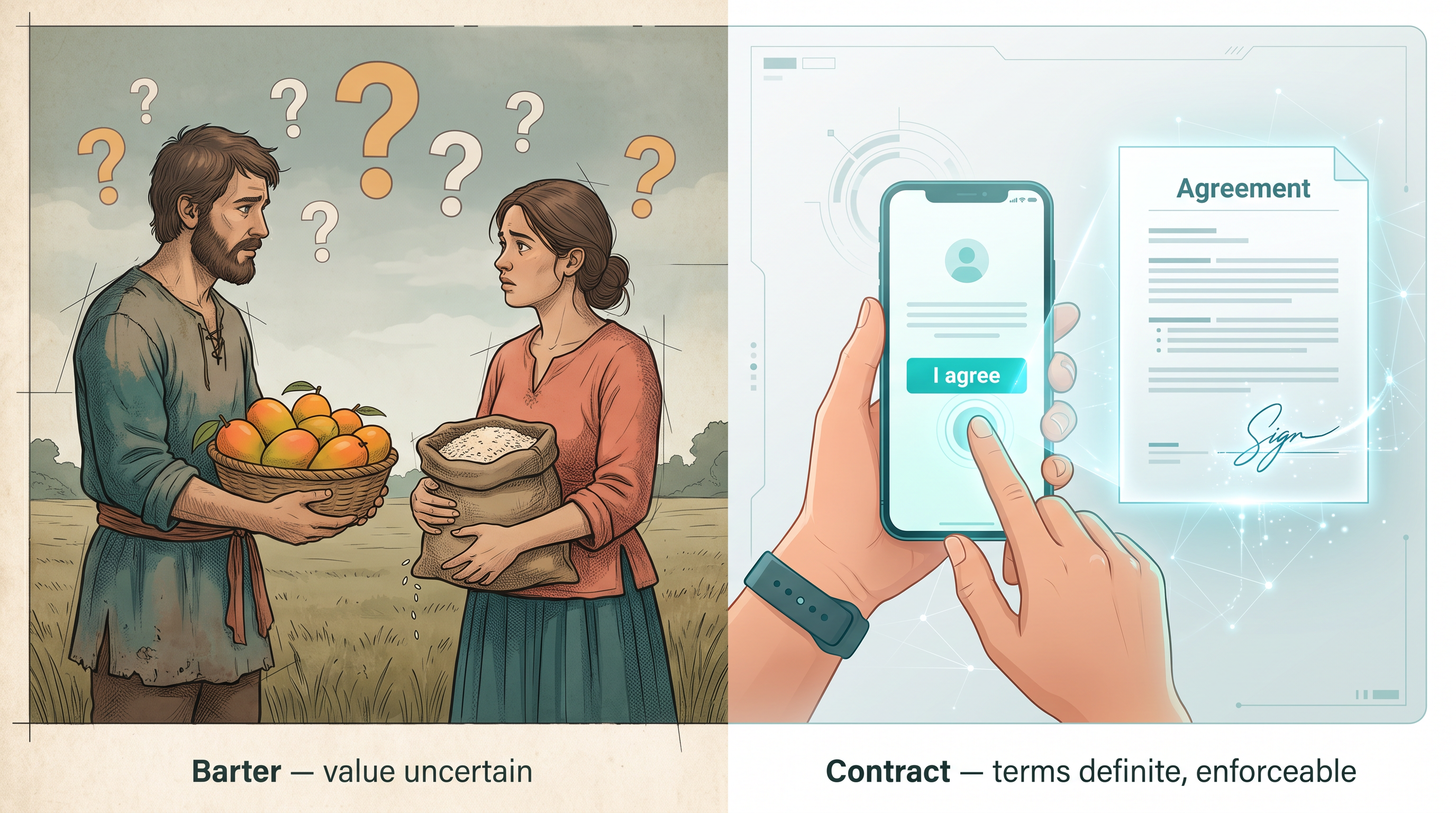
Fig. 3.0 – Barter versus enforceable contracts.
This chapter will answer each of these questions as you work through it.
3.1 Introduction to Contracts
Contracts are an important part of commercial law, because almost every commercial transaction begins with an agreement or a contract. Before goods change hands or a service is performed, two people must first settle between themselves what each will do for the other. That settlement is where the law of contracts starts.
You do not have to run a business to be part of this. Think of ordinary things you did this week — buying groceries, eating at a restaurant, paying for an internet connection, picking up clothes in a sale. Each of these is a transaction in which one side gives something and the other side gives something in return.
Transactions of this kind, involving the sale and purchase of goods or the exchange of services, have become an ordinary part of daily life, and all of them involve contracts.
Why the law gets involved
An agreement matters because it fixes three things: what each party is entitled to receive, what each party is bound to do, and what each party must answer for if things go wrong. In legal language, it determines the rights, obligations and liabilities of the parties.
Without that, every dispute would come down to who remembers the bargain more conveniently. The law supplies a common set of rules instead, so that both sides know in advance where they stand.
In India, the law governing contracts is the Indian Contract Act, 1872.
3.2 Formation of a Contract
Under the Indian Contract Act, 1872 — which from here on we will call the ICA — a contract is an agreement that is enforceable by law. That definition sits in Section 2(h), and every word of it does work.
‘Enforceable by law’ is the key phrase. It means that if one side does not keep its part of the bargain, the other side can go to a court and ask the court to do something about it. An arrangement that a court will not touch may still be an arrangement — it is simply not a contract.
This tells us something important at once: not every agreement is a contract. Agreements are made all day long, and only some of them cross into the territory the law protects. To cross that line, an agreement must satisfy certain conditions.
How an agreement begins
Before we reach those conditions, notice how an agreement itself comes into being. One party makes a proposal, or an offer. The other party accepts it. That combination — a proposal by one side and its acceptance by the other — is what produces an agreement. Section 3.4 examines each half of this closely.
The conditions an agreement must satisfy
An agreement becomes a contract only if it meets the criteria the ICA lays down:
- Competent parties: the parties to the agreement must be competent to enter into a contract.
- Lawful consideration and lawful object: there must be a lawful object and lawful consideration in respect of the agreement.
- Free consent: there must be free consent of the parties — that is, consent free from coercion, undue influence, fraud, misrepresentation and mistake at the time they enter into the agreement.
- Not expressly declared void by law: the agreement must not be one that the law in force at the time of entering into it has declared to be void.
Each of these has its own section later in this chapter, so do not worry if a term such as consideration or free consent is unfamiliar right now. What matters here is that all four must be present together. Miss one, and the agreement does not become a contract.
These four conditions come from Section 10 of the ICA.
Agreements and contracts compared
Because of Section 10, the relationship between the two runs only one way. Every contract began life as an agreement, so all contracts are agreements. But an agreement that fails on lawful consideration, or on lawful object, or on any of the other conditions, never becomes enforceable — so it stays an agreement and nothing more. Fig. 3.1 shows this relationship as two circles, one sitting inside the other.
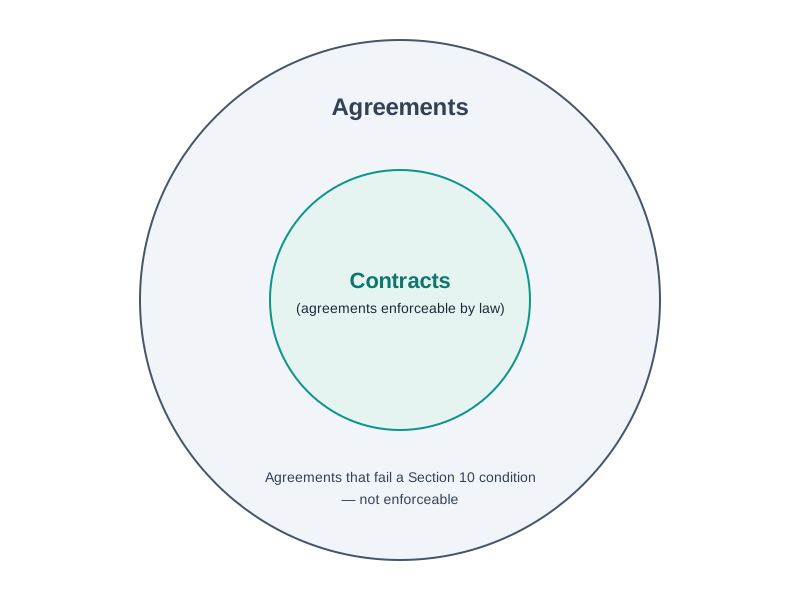
Fig. 3.1 – The relationship between agreements and contracts.
This is why the rule is generally stated in one line:
All contracts are agreements, but all agreements are not contracts.
3.3 Intention to Create a Legal Relationship
Section 10 lists the conditions an agreement must satisfy, but courts have added one more that runs underneath all of them. The parties must have intended their arrangement to be a legal one — something a court could be asked to enforce — and not merely a promise made on trust, affection or good manners.
This requirement is easy to overlook because it is rarely stated out loud. Nobody says, “I intend this to be legally binding,” when ordering a taxi, and nobody says, “I do not intend this to be legally binding,” when promising a cousin a lift to the station. Courts therefore read the intention from the setting in which the promise was made.
How courts read intention
Where an arrangement is made between family members or friends, in an ordinary domestic or social setting, courts ordinarily treat it as a moral undertaking rather than a legal one. Where an arrangement is made in a business or commercial setting, between parties dealing at arm’s length, courts ordinarily treat it as intended to be legally binding.
The leading authority on the point arose out of a promise between a husband and a wife.
Notice what the case does not say. It does not say the husband behaved well, and it does not say a promise between spouses can never be enforced. It says that on these facts, in this setting, the parties were not creating rights they expected a court to police.
For an examination, the skill being tested is fact-spotting. When a problem describes a promise, look first at who made it to whom and in what setting. A promise between family members over household arrangements points away from a contract; the same promise recorded in writing as part of a business dealing points towards one.
3.4 Offer and Acceptance
The offer, which the ICA calls a proposal, is the first step in the formation of a contract. When one person signifies to another his willingness to do or not to do something, and does so in order to obtain that other person’s assent, he has made an offer.
Two words in that sentence are doing quiet work. ‘Signifies’ means the willingness must be shown to the other person, not merely felt privately. And the willingness must be expressed with a view to getting the other person’s agreement — an idle remark that you would not mind selling your bicycle one day is not an offer, because it is not aimed at obtaining anybody’s assent.
The person making the proposal or offer is called the offeror. The person to whom the offer is made is called the offeree. And, carrying forward what Section 3.3 established, the offer must be made with an intention to create a legal relationship — an offer made in jest or as a family courtesy takes the arrangement nowhere.
Acceptance
An offer by itself binds nobody. It becomes operative only when the offeree assents to it. That assent or consent, given by the offeree to the offer, is acceptance.
Acceptance need not be formal or elaborate. Saying ‘yes’ or ‘ok’ is acceptance. So is clicking ‘I agree’ on an offer displayed on a website. What matters is that the offeree has signified assent to the offer as it stands.
An offer, once accepted, becomes a promise, and that promise — supported by what each side gives in return — is an agreement. This is the relationship shown in Fig. 3.2.
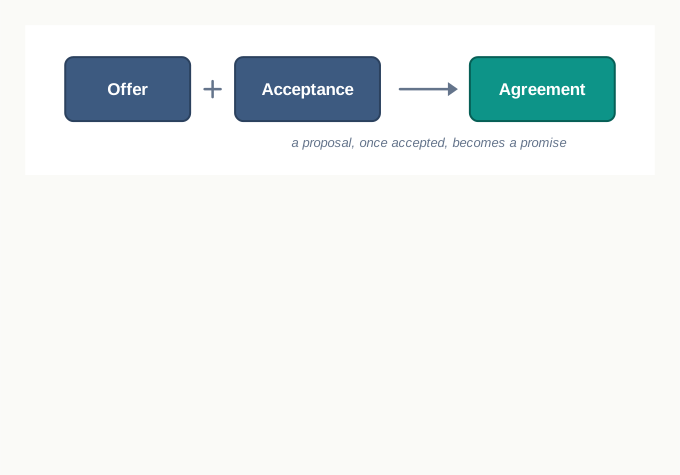
Fig. 3.2 – Formation of an agreement.
What an offer and acceptance must satisfy
An offer and an acceptance must both be definite and certain. If the offer or the acceptance is not clear enough for a court to say what exactly was agreed, no contract can be concluded from it and it is treated as invalid. An offer to sell “some of my land at a fair price” fixes neither the land nor the price, so there is nothing to enforce.
Both must also be communicated to the other person in order to be valid. An offer nobody has heard of cannot be accepted, and an acceptance nobody has been told of ordinarily creates nothing. Communication in electronic form, or over email, counts as communication just as a letter or a spoken word does.
An offer does not last forever. It lapses by revocation or withdrawal, and any offer can be revoked before it has been accepted. The moment of acceptance is therefore the dividing line: withdraw the offer a minute before, and there was never an agreement; withdraw it a minute after, and you are asking to be released from a contract that already exists.
General offer
An offer is usually made to a particular person. But it can also be made to the public at large — to the whole world — and such an offer is called a general offer. It is perfectly valid. Anyone who comes forward and fulfils its conditions accepts it.
The point was settled in a famous English case about a patent medicine.
This is why reward notices work. A notice on a school board promising Rs. 2,000 to whoever returns a lost laptop is a general offer, and the student who returns the laptop has accepted it by doing so — without ever having told anyone in advance that she meant to look for it.
3.5 Consideration
Consideration is an important element in a contract, and a contract without it is not valid. In the simplest terms, consideration means ‘something in return’ for the offer. It is the price each side pays for what the other side has promised.
That price need not be money. Consideration can take the form of an act — doing something the other party wants done — or a forbearance, which means giving up something you were otherwise free to do. A promise not to sue over a disputed debt is a forbearance, and it can be perfectly good consideration.
Why an agreement without consideration fails
The general rule is that an agreement made without consideration is void and cannot be enforced by law. The reason is worth stating plainly: in such an arrangement one party is getting something from the other without giving anything back. There must always be mutual consideration — each party must give and also take.
If the law enforced one-sided promises, every casual generosity would become a debt. Consideration is the test the law uses to separate a bargain, which it will enforce, from a gift or a kindness, which it leaves to the conscience of the person who promised it.
The exception for natural love and affection
There are exceptions to this general rule. The best known is that an agreement made out of natural love and affection between parties standing in a near relation to each other is not void merely for want of consideration — provided it is put in writing and registered. All three conditions must be present together: the near relationship, the writing, and the registration. Drop any one of them and the promise falls back under the general rule.
The qualities consideration must have
Consideration need not be adequate, but it must be real. The law asks whether something of value passed, not whether the exchange was a shrewd one.
Consideration may be past, present or future — that is, it may have been given before the promise, at the time of the promise, or promised for a later date. And it must not be illegal, immoral or opposed to public policy; consideration of that kind is no consideration at all in the eyes of the law.
One further requirement decides more cases than students expect. The act relied on as consideration must have been done at the desire of the promisor. Work done at somebody else’s request, however valuable it turns out to be for the promisor, is not consideration for the promisor’s promise.
3.6 Capacity to Contract
One of the essentials of a valid contract mentioned under Section 10 ICA is that the parties must be competent to contract. Competence is not about intelligence or business sense. It is a legal status: the law asks whether this person is of the class it treats as able to bind himself.
The following are not competent to contract:
- Minors — persons who are less than 18 years of age;
- Persons with unsound mind;
- Persons disqualified by law — alien enemies, foreign sovereigns and the like.
The thinking behind each is protective rather than punitive. A minor may not yet judge a bargain for what it is; a person of unsound mind may not understand it at all; and an alien enemy or a foreign sovereign is placed outside the ordinary contracting relationship for reasons of state rather than personal capacity.
Who is a minor under Indian law?
It was the Indian Majority Act, 1875 that laid down the age of majority as 18 years, except in cases where a guardian had been appointed by the Court, where it was 21 years. An amendment to that Act has since fixed the age of majority at 18 years for all cases.
So the line today is clean: below 18, a minor; 18 and above, a major.
A minor’s agreement
The ICA says who is not competent to contract, but it does not say in so many words whether an agreement made by a minor is void or voidable. That gap left room for argument, and courts examined the nature of a minor’s agreement case by case, on the facts before them and in the light of the general principles of equity and natural justice.
Two expressions in that case are worth pausing on. Void ab initio means the agreement was a nullity from the moment it was made, not something that became invalid later. And the defendant’s argument about the minor being prevented from pleading his own minority was an argument of estoppel — the rule that a person who has led another to believe something may not afterwards deny it. Estoppel did not help the moneylender, because he had not been misled: he knew the true position.
Where a minor can still gain
Saying that a minor cannot be bound is not the same as saying he can never benefit. The protection exists for him, so it is not turned against him. Where a contract is for the minor’s benefit and he has already performed his side of it, the law does not allow the other party to escape by pointing to the minor’s age.
A stranger to the contract as beneficiary
A contract is ordinarily enforced by the parties who made it. But a person for whose benefit a contract was made may sometimes succeed on it, and the standard of care owed can rise with the nature of the establishment involved.
3.7 Free Consent
Consent is an important criterion while entering into a contract. When two persons agree upon the same thing in the same sense, they are said to consent. That is what Section 13 of the ICA lays down.
The phrase “the same thing in the same sense” is doing all the work. Two people can both say yes and still not have consented, if each was saying yes to a different thing.
Consent must also be free
Consent by itself is not enough. It must be free consent — that is, consent not caused by coercion, undue influence, misrepresentation, fraud or mistake. Section 14 of the ICA sets out this requirement.
If consent is obtained through the influence of any one of these, the consent so obtained is not free. The agreement was reached, but it was reached because one party’s judgment was overborne, deceived or mistaken, and the law does not treat such a yes as a real yes.
What happens to the contract
Where consent has been obtained by coercion, undue influence, fraud or misrepresentation, the contract becomes voidable at the option of the party whose consent was not free. Voidable means that this party may avoid enforcement of the contract — set it aside — but need not. If it suits him, he can hold the other side to it instead. The choice belongs to the injured party alone.
3.8 Types of Contracts and Agreements
We have already seen that all agreements are not contracts. The relationship also works the other way in practice. An agreement may satisfy every condition at the moment it is made and become a contract at its inception, and then, because one of those essential conditions changes later, the contract ceases to be enforceable under the law and becomes void. And where the consent obtained for an agreement was not free, the contract is voidable at the option of the party whose consent was affected.
The ICA does not itself define validity or enforceability as a concept. It is through the various judgements of the courts that the enforceability of contracts came to be decided on the basis of their validity. Contracts are therefore classified on the basis of validity or enforceability, as shown in Fig. 3.3.
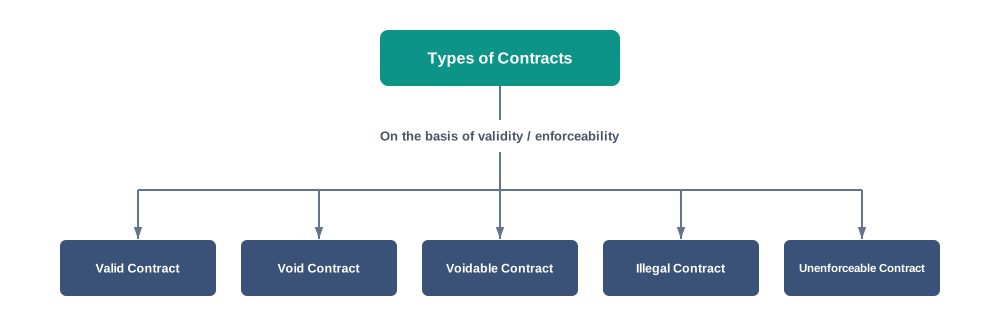
Fig. 3.3 – Classification of contracts by validity.
A valid contract is one that satisfies every condition of Section 10 and can be enforced in full. An unenforceable contract is one that is otherwise proper but cannot be enforced in court because some technical requirement — such as writing, registration or stamping — has not been met. The three that need closer study are the void, the voidable and the illegal.
Void and voidable contracts
These two are confused more often than any other pair in this chapter, and the confusion is expensive in an examination. A void contract binds nobody; a voidable contract binds both sides unless and until the injured party chooses to escape it.
Read the last row slowly, because it is where the two really part company. A void contract is finished; nothing the parties do afterwards can revive it. A voidable contract is alive and can be made permanently good — simply by the injured party doing nothing for long enough, or by his going ahead with it after the pressure or deception has ended.
Contingent contracts and wagering agreements
Both of these turn on an uncertain future event, which is exactly why students mix them up. The difference lies in what that event is doing in the arrangement.
In a contingent contract, the parties have a real underlying interest and the uncertain event merely decides whether the obligation becomes due. In a wagering agreement, the uncertain event is the whole point: the parties have no interest in it beyond winning or losing the bet.
Notice the test hidden in the two examples. In the first, the jersey is the real subject of the promise and the match result only decides whether the promise falls due. In the second, nothing exists between X and Y except the bet itself — neither is buying, selling or supplying anything. That is what makes it a wager, and wagers are void.
Illegal or unlawful agreements
According to Section 10 ICA, a contract must be made for a lawful consideration and a lawful object. If either the consideration or the object is an action or omission prohibited by law, the result is an illegal contract.
Agreements entered into for any unlawful or illegal object or consideration cannot be enforced under the law and are therefore void (Section 23 ICA; Section 24 deals separately with the case where only part of the consideration or object is unlawful).
The illegality need not be there from the start. There is a possibility that the object or the consideration with which the contract was formed initially later turns unlawful or illegal, in which case the contract becomes void from that point.
An agreement may also be struck down not because it breaks a specific prohibition but because enforcing it would damage something the law protects. So an agreement by which A promises to pay B ₹ 1,000 as a penalty if B’s minor daughter is not given to A in marriage is opposed to public policy, and is not enforceable.
3.9 Discharge of Contract
A contract creates mutual obligations between the parties. When those mutual obligations are fulfilled, the contract comes to an end, and it is then said to be discharged. In other words, discharge means the termination of the contractual relations of the parties to the contract.
Discharge is not always a happy ending. A contract can also be brought to an end because performance has become impossible, because the law has stepped in, or because one side has broken it. What all these have in common is that the parties are no longer bound to each other under that contract. Fig. 3.4 sets out the six routes.
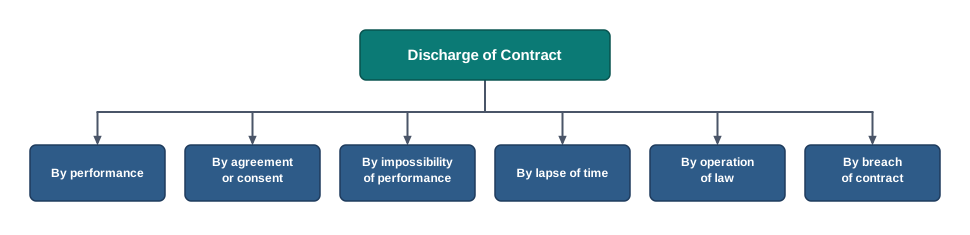
Fig. 3.4 – Modes of discharge of a contract.
A contract may be discharged in the following ways:
- Discharge by performance;
- Discharge by agreement or consent;
- Discharge by impossibility of performance;
- Discharge by lapse of time;
- Discharge by operation of law;
- Discharge by breach of contract.
3.9.1 Discharge by Performance
When the parties to a contract perform their obligations and fulfil their promises, the contract gets discharged by performance. This is the ordinary and intended way for a contract to end: everybody did what they said they would, and there is nothing left to enforce.
For example, A offers to sell his dining set to B for ₹ 10,000. B pays A the ₹ 10,000 and A delivers the dining set. The contract is discharged by performance, because both parties fulfilled their promises.
3.9.2 Discharge by Agreement or Consent
Sometimes the parties do not perform their obligations in full or in part, as the case may be, and instead agree between themselves to bring the contract to an end or to change it. Where they do this by mutual consent, the contract gets discharged by novation, rescission, alteration, merger, waiver or remission.
- Novation — a new contract is substituted for an old contract.
- Rescission — certain terms or all the terms of a contract are cancelled.
- Alteration — the parties, by consent, change one or more terms of an existing contract, the contract itself continuing in its altered form.
- Merger — certain terms of a contract, or all the terms of a contract, are merged into another contract with the consent of the parties.
- Waiver — a party gives up, by his own consent, a right he holds under the contract, and the other side is released to that extent.
- Remission — acceptance is made to a promise, but not on the complete terms.
Novation is the one students find hardest, because it involves three people and two debts disappearing at once.
Alteration works differently, because the original contract survives. A enters into an agreement with B for buying certain machine parts for their project; before the agreement ends, A and B change certain terms of the agreement and include those changed terms in it. The contract goes on, but on new terms. Rescission, by contrast, cancels terms rather than replacing them, and where all the terms are cancelled the contract is simply wiped out.
Merger joins two contracts into one. A enters into a contract with B for the supply of 50 bags of wheat on a specified date. A later realises that he needs 10 bags of mixed pulses at the same time. A and B merge the two contracts, so that 50 bags of wheat and 10 bags of mixed pulses are to be supplied on the same date and at the same place.
Remission means accepting less than what was promised, in full settlement. A owes B ₹ 5,000. A pays ₹ 2,000 and B accepts it in full satisfaction of the whole debt. The old debt is discharged, though to a lesser fulfilment of the promise — and B cannot later change his mind and sue for the remaining ₹ 3,000.
3.9.3 Discharge by Impossibility of Performance
Performance of a contract can become impossible, with or without the knowledge of the parties to the contract. Where that happens, the contract may later become unenforceable under the law by reason of impossibility of performance.
It can become impossible to perform the contract subsequently, after the parties have already entered into it. This is known as supervening impossibility, and it is dealt with in Section 56 ICA. The word ‘supervening’ is the key: the difficulty arrived after the contract was made, and neither party brought it about.
Supervening impossibility takes place by the following:
- destruction of the subject matter;
- death or incapacity;
- non-existence of a state of things having an effect directly or indirectly on the contract;
- outbreak of war;
- change or amendments in law.
3.9.4 Discharge by Lapse of Time
Time is very significant while entering into a contract. If the contract is not performed within the specified time, and the other party does not resort to any action within the limitation period, then he is deprived of his remedy and the contract gets discharged by lapse of time.
The limitation period is the window the law allows for bringing an action. The right does not disappear because the promise was kept; it disappears because the injured party sat on it. This is a rule about diligence, and it is a common trap in case-based questions — always check the dates before deciding that a party has a remedy.
3.9.5 Discharge by Operation of Law
Sometimes a contract ends not because either party wanted it to, but because the law attaches that consequence to an event. The following are instances where a contract gets discharged by operation of law:
- death of either of the parties;
- insolvency;
- merger;
- unauthorized alteration of the terms of the agreement.
The last of these is worth noticing. Where one party alters the terms without the other’s authority, the law does not reward him by holding the other to the altered bargain — the contract is discharged instead.
3.9.6 Discharge by Breach of Contract
Breach means failure to perform the obligation by a party. When a party to a contract does not perform his part of the obligation, so that the contract becomes broken, the person who suffers because of the breach is entitled to receive compensation or damages from the party who has breached the contract (Section 73).
Breach is therefore a form of discharge with a sting in it. The contract ends, but the party at fault does not walk away free — he carries a liability to compensate.
3.10 Remedies in Case of Breach
A remedy implies a relief given by law, either to ensure the enforcement of contractual rights or to provide sufficient compensation for non-performance. A right without a remedy would be an empty promise: the law’s answer to a broken contract is what makes the contract worth making in the first place.
In matters of breach of contract, the remedies available are:
- Damages;
- Specific performance.
Damages
Damages are the most common remedy available to the injured party. They entitle him to recover money compensation for the losses suffered due to the breach. In India, this remedy is covered in Section 73 ICA.
The idea behind damages is restoration, not punishment. The court is trying to put the injured party, so far as money can do it, in the position he would have been in had the contract been performed.
Specific performance
Money is not always an adequate answer. The purpose of a contract is to enforce the rights of the parties, and so, in the event of a breach, the promisee can instead request the performance of the specific obligations that were promised to him. This remedy asks the court to compel the defaulting party to do what he undertook to do, rather than to pay for not doing it.
Sometimes the remedy sought lies between the two: the injured party wants the work put right and claims the cost of doing so.
3.11 Summary
- A contract is an agreement enforceable by law [Section 2(h), ICA].
- An agreement comes into being when one party makes a proposal or offer and the other party accepts it.
- All contracts are agreements, but all agreements are not contracts.
- Under Section 10 ICA, an agreement becomes a contract only if it satisfies the following conditions:
- the parties are competent to contract;
- the consideration and the object are lawful;
- the consent of the parties is free;
- the agreement is not one expressly declared void by the law in force.
- Courts additionally require that the parties intended to create a legal relationship.
- Balfour v. Balfour established that an arrangement between a husband and wife, made in a domestic setting, carries only a moral obligation and is not a contract.
- An offer is made when one person signifies to another his willingness to do or abstain from doing something, with a view to obtaining that other’s assent [Section 2(a), ICA].
- The person making the offer is the offeror; the person to whom it is made is the offeree.
- Acceptance is the assent given by the offeree to the offer [Section 2(b), ICA], and saying ‘yes’, ‘ok’ or clicking ‘I agree’ on a website amounts to acceptance.
- An offer and an acceptance must both be definite and certain, and both must be communicated; communication by electronic means or email is valid communication.
- An offer lapses by revocation or withdrawal, and any offer can be revoked before it is accepted.
- An offer may be made to the world at large, and is then called a general offer.
- Carlill v. Carbolic Smoke Ball Co. established that in a general offer the acceptance need not be communicated; fulfilling the conditions of the offer is itself acceptance.
- Consideration means ‘something in return’ for the offer, and may take the form of an act or a forbearance.
- An agreement made without consideration is generally void, because one party would be getting something without giving anything in return.
- An agreement made out of natural love and affection is an exception, provided that:
- the parties stand in a near relation to each other;
- the agreement is in writing;
- the agreement is registered.
- Consideration need not be adequate, but it must be real.
- Consideration may be past, present or future, and must not be illegal, immoral or opposed to public policy.
- Consideration must move at the desire of the promisor, as held in Durga Prasad v. Baldeo.
- The following persons are not competent to contract:
- minors, that is, persons below 18 years of age;
- persons of unsound mind;
- persons disqualified by law, such as alien enemies and foreign sovereigns.
- The Indian Majority Act, 1875 fixed the age of majority at 18 years, and after amendment it is 18 years in all cases.
- Mohori Bibee v. Dharmodas Ghose held that an agreement made by a minor is void ab initio.
- A contract that is beneficial to a minor, and which the minor has performed, remains enforceable at the minor’s instance.
- Klaus Mittelbachert v. East India Hotels Ltd. shows that a person for whose benefit a contract was made may succeed on it even without a direct contract, and that a five-star establishment owes an extra degree of care.
- Consent means that two or more persons agree upon the same thing in the same sense — consensus ad idem [Section 13, ICA].
- Consent is free when it is not caused by coercion, undue influence, misrepresentation, fraud or mistake [Section 14, ICA].
- Where consent is caused by coercion, undue influence, fraud or misrepresentation, the contract is voidable at the option of the party whose consent was not free.
- Contracts are classified on the basis of validity or enforceability as valid, void, voidable, illegal and unenforceable.
- A void contract [Section 2(j), ICA] ceases to be enforceable and can never afterwards become valid.
- A voidable contract [Section 2(i), ICA] remains enforceable until avoided, and may become valid by lapse of time, affirmation, ratification, waiver or acquiescence.
- A contingent contract is a contract to do or not to do something depending on the happening or non-happening of a future uncertain event, and is defined under Section 31 ICA.
- A wagering agreement is a bet in which the parties have no interest beyond winning or losing, and Section 30 ICA declares such agreements void.
- An agreement whose consideration or object is unlawful cannot be enforced and is void under Section 23 ICA.
- An agreement opposed to public policy is not enforceable.
- Discharge means the termination of the contractual relations between the parties.
- A contract may be discharged in the following ways:
- by performance;
- by agreement or consent;
- by impossibility of performance;
- by lapse of time;
- by operation of law;
- by breach of contract.
- Discharge by agreement or consent takes place through novation, rescission, alteration, merger, waiver or remission.
- Impossibility arising after the contract is made is called supervening impossibility [Section 56, ICA].
- Supervening impossibility may arise from destruction of the subject matter, death or incapacity, non-existence of a state of things affecting the contract, outbreak of war, or a change or amendment in law.
- A contract is discharged by lapse of time when the injured party does not act within the limitation period and thereby loses his remedy.
- A contract is discharged by operation of law on the death of either party, on insolvency, on merger, or on unauthorized alteration of the terms of the agreement.
- Breach means the failure of a party to perform his obligation, and the party who suffers is entitled to compensation from the party in breach (Section 73, ICA).
- The remedies available for breach of contract are damages and specific performance.
- Damages are money compensation for the loss suffered because of the breach, and are covered in Section 73 ICA.
- Specific performance allows the promisee to ask that the specific obligations under the contract be actually performed.
3.12 Key Terms
Contract — an agreement which is enforceable by law [Section 2(h), ICA].
Agreement — the result of a proposal made by one party and its acceptance by the other.
Enforceable by law — capable of being taken to a court, which can be asked to compel performance or award compensation.
Intention to create a legal relationship — the requirement that the parties meant their arrangement to give rise to legal rights and duties, and not merely a moral or social obligation.
Offer (proposal) — signifying to another one’s willingness to do or abstain from doing something, with a view to obtaining that other’s assent [Section 2(a), ICA].
Offeror — the person who makes the offer.
Offeree — the person to whom the offer is made.
Acceptance — the assent given by the offeree to the offer made to him [Section 2(b), ICA].
Promise — a proposal that has been accepted.
General offer — an offer made to the public at large, which anyone may accept by fulfilling its conditions.
Consideration — something given or done in return for a promise; the price for which the other party’s promise is bought.
Forbearance — giving up something one was otherwise free to do, which can serve as good consideration.
Competence to contract — the legal capacity to bind oneself by a contract, which minors, persons of unsound mind and persons disqualified by law do not have.
Minor — a person who is less than 18 years of age.
Void ab initio — void from the very beginning, so that the agreement never came into legal existence at all.
Estoppel — the rule that a person who has led another to believe something may not afterwards deny it.
Consent — two or more persons agreeing upon the same thing in the same sense [Section 13, ICA].
Consensus ad idem — a meeting of minds on the same subject matter, on the same terms, in the same sense.
Free consent — consent not caused by coercion, undue influence, misrepresentation, fraud or mistake [Section 14, ICA].
Voidable contract — a contract enforceable at the option of one party only, who may either affirm it or set it aside [Section 2(i), ICA].
Void contract — a contract which has ceased to be enforceable by law and cannot thereafter become valid [Section 2(j), ICA].
Valid contract — a contract that satisfies every condition of Section 10 ICA and is enforceable in full.
Unenforceable contract — a contract that cannot be enforced in court because some technical requirement, such as writing or registration, has not been met.
Illegal or unlawful agreement — an agreement whose consideration or object is prohibited by law, and which is therefore void under Section 23 ICA.
Contingent contract — a contract to do or not to do something depending upon the happening or non-happening of a future uncertain event [Section 31, ICA].
Wagering agreement — a bet on an uncertain event in which the parties have no interest beyond winning or losing, declared void by Section 30 ICA.
Discharge of contract — the termination of the contractual relations between the parties to a contract.
Novation — the substitution of a new contract for an old one, with the consent of all parties concerned.
Rescission — the cancellation of certain terms or of all the terms of a contract.
Alteration — a change made by consent to one or more terms of a contract, the contract continuing in its altered form.
Merger — the combining of the terms of one contract into another contract with the consent of the parties.
Waiver — the giving up by a party, of his own accord, of a right he holds under the contract.
Remission — acceptance of a lesser performance in full satisfaction of the promise.
Supervening impossibility — impossibility of performance arising after the contract has been made, which discharges the contract [Section 56, ICA].
Limitation period — the period the law allows for bringing an action, after which the injured party loses his remedy.
Breach of contract — the failure of a party to perform his obligation under the contract.
Remedy — the relief given by law to enforce a contractual right or to compensate for non-performance.
Damages — money compensation recoverable for the loss suffered because of a breach of contract (Section 73, ICA).
Specific performance — a remedy by which the court directs the party in breach actually to perform the obligations he undertook.
3.13 Points to Ponder
Balfour v. Balfour treats a husband’s promise to support his wife as a moral obligation rather than a legal one. What would be gained, and what would be lost, if the law enforced promises made within a family in the same way it enforces promises made in business?
The law says consideration need not be adequate. Is that fair to a person who agrees to a poor bargain because he is in urgent need of money, and is there any point at which inadequacy should begin to matter?
A minor’s agreement is void from the very beginning, which protects the minor. Does that protection also make shopkeepers and service providers reluctant to deal with young people at all, and if so, is that a price worth paying?
Most people tap ‘I agree’ without reading a single line of the terms. Can consent given in that way really be described as agreeing upon the same thing in the same sense?
Terms in a mobile plan, an insurance policy or an app agreement are written entirely by one side and offered on a take-it-or-leave-it basis. Should the law examine such contracts more closely for free consent than it examines a bargain negotiated between equals?
‘Opposed to public policy’ is not defined anywhere in the ICA, and what offends public policy in one generation may not offend it in the next. Is such an open-ended category a strength or a weakness in the law?
Supervening impossibility discharges a contract, but a contract that has merely become far more expensive to perform is still binding. Where should the line between the two be drawn, and who should bear the loss when circumstances change dramatically?
When money cannot buy a substitute for what was promised, damages leave the injured party with cash and without the thing he wanted. Should specific performance be the ordinary remedy for breach rather than the exceptional one?
A party who waits too long loses his remedy through lapse of time, even though the other side clearly broke the contract. Does the limitation period serve justice, or does it mainly serve convenience?
Contract law assumes two parties who are free to walk away from a bargain they dislike. How well does that assumption hold for a tenant, a daily-wage worker or a small supplier dealing with a much larger party?
3.14 Textbook Questions
Ramesh sells his bike to his friend Suresh for a consideration of ₹ 50,000, whereas the market price of the bike is ₹ 65,000. Examine whether the agreement is enforceable under the law of contract.
D, a minor, borrowed a sum of money from M by executing a mortgage of his property in favour of M. D later sued for cancellation of the mortgage. Is the contract of mortgage valid? Can M recover the sum advanced to D?
Apexx Chemicals entered into an agreement with Moonled Pharma Ltd. to supply it with 16 units of calcium and 8 units of magnesium powder for its medicine unit. By the time Apexx Chemicals had supplied 12 units of calcium and 4 units of magnesium, the government restricted the free sale of chemicals used in life-saving drugs, and every dealer was required to have his supply sanctioned by the government up to a maximum of 10 units of each chemical. Apexx Chemicals found it difficult to complete the order, and Moonled Pharma Ltd. brought a suit against Apexx Chemicals for breach of contract. Will the suit succeed? Analyse by referring to the relevant provisions.
X enters into a contract with Y to pay him ₹ 10,000 if the books are delivered to him by Friday. This is an example of a contingent contract. Explain why.
3.15 Objective Questions
A contract is defined as an agreement enforceable by law under which provision of the Indian Contract Act, 1872?
- Section 2(a)
- Section 2(b)
- Section 2(h)
- Section 2(j)
Which of the following is not a condition laid down in Section 10 of the Indian Contract Act, 1872?
- The parties must be competent to contract
- The consideration and object must be lawful
- The agreement must be in writing and registered
- The consent of the parties must be free
The person to whom an offer is made is called the
- promisor
- offeror
- offeree
- promisee
Acceptance is defined under which provision of the Indian Contract Act, 1872?
- Section 2(a)
- Section 2(b)
- Section 2(e)
- Section 2(i)
Which case established that an offer may be made to the world at large?
- Balfour v. Balfour
- Carlill v. Carbolic Smoke Ball Co.
- Durga Prasad v. Baldeo
- Mohori Bibee v. Dharmodas Ghose
In a general offer, acceptance
- must always be communicated to the offeror in writing
- must be communicated within a reasonable time
- takes place by fulfilling the conditions stated in the offer
- cannot take place at all, since the offer is void
An agreement made out of natural love and affection is valid without consideration only if
- it is made between friends and put in writing
- it is made between parties in a near relation, in writing, and registered
- it is made in the presence of two witnesses
- the amount promised is a small one
In Durga Prasad v. Baldeo, the plaintiff’s claim to commission failed because
- the consideration was inadequate
- the agreement had not been registered
- the construction was carried out at the desire of the District Collector and not of the defendant
- the plaintiff was a minor at the time
The age of majority in India is fixed by the
- Indian Contract Act, 1872
- Indian Majority Act, 1875
- Indian Succession Act, 1925
- Guardians and Wards Act, 1890
In Mohori Bibee v. Dharmodas Ghose, the Court held that an agreement made by a minor is
- valid
- voidable at the option of the minor
- void ab initio
- unenforceable only if the other party knew of the minority
Consent, meaning that two persons agree upon the same thing in the same sense, is defined in
- Section 10 ICA
- Section 13 ICA
- Section 23 ICA
- Section 31 ICA
Where consent has been obtained by coercion, the contract is
- void from the beginning
- voidable at the option of the party whose consent was not free
- voidable at the option of either party
- valid, since the agreement was in fact signed
A contingent contract is defined under
- Section 30 ICA
- Section 31 ICA
- Section 56 ICA
- Section 73 ICA
Wagering agreements are
- defined and declared valid by Section 30 ICA
- defined by Section 31 ICA and enforceable
- not defined by the ICA, but declared void by Section 30 ICA
- enforceable if both parties are majors
Impossibility of performance arising after the contract has been made is known as
- initial impossibility
- supervening impossibility
- commercial hardship
- anticipatory breach
Acceptance of a smaller sum in full satisfaction of a larger debt is an example of discharge by
- novation
- merger
- remission
- rescission
Which of the following is not listed as an instance of discharge by operation of law?
- Death of either of the parties
- Insolvency
- Unauthorized alteration of the terms of the agreement
- Outbreak of war
Compensation for loss caused by breach of contract is provided for in
- Section 23 ICA
- Section 56 ICA
- Section 73 ICA
- Section 2(j) ICA
Assertion (A): All agreements are not contracts. Reason (R): An agreement becomes a contract only when it satisfies the conditions laid down in Section 10 of the Indian Contract Act, 1872.
Assertion (A): In Balfour v. Balfour, the wife’s claim to recover the arrears failed. Reason (R): An agreement between a husband and a wife can never be enforced in a court of law.
Assertion (A): An agreement made by a minor is void from the very beginning. Reason (R): A minor can never enforce a contract, even one that is for his benefit and which he has fully performed.
Assertion (A): Consideration need not be adequate. Reason (R): Courts examine whether each party has made a profitable bargain before enforcing a contract.
Assertion (A): A void contract can never afterwards become valid. Reason (R): A voidable contract may become valid by lapse of time, affirmation, ratification or waiver.
Assertion (A): In a wagering agreement, the uncertain future event decides who wins. Reason (R): In a contingent contract, the uncertain future event is only collateral to the contract.
3.16 Check Your Concepts
Why is it correct to say that all contracts are agreements but all agreements are not contracts? Explain with reference to Section 10 ICA.
State the four conditions an agreement must satisfy under Section 10 ICA before it becomes a contract.
Arrange the following in the correct order in which a contract is formed, and state at which stage the agreement first comes into existence: acceptance by the offeree; testing the agreement against Section 10; a proposal made by one party; the agreement becoming enforceable as a contract.
Why do courts require an intention to create a legal relationship when Section 10 does not expressly mention it?
What happens if two people sign the same document but each believes the sale concerns a different property? Which requirement of a valid contract fails, and what is the effect on the agreement?
Distinguish between an offer and an invitation to treat by explaining why a statement that one would not mind selling one’s bicycle someday is not an offer.
Why must an offer and an acceptance be definite and certain? Give an example of an offer that would fail this test.
Until what moment can an offer be revoked, and why does the law fix that particular moment as the dividing line?
Identify the provision: which section of the ICA defines a proposal, and which section defines acceptance?
Correct the error in the following statement and explain your correction: “In a general offer, the offeree must communicate his acceptance to the offeror before he begins to fulfil the conditions of the offer.”
Why does the law insist on mutual consideration? What would follow if agreements without consideration were freely enforceable?
Explain the difference between consideration that is inadequate and consideration that is not real, and state the effect of each on the contract.
What are the three conditions that must all be present for an agreement made out of natural love and affection to be valid without consideration?
Why did the plaintiff’s claim fail in Durga Prasad v. Baldeo even though he had spent a large sum on constructing the shops? What single change in the facts would have produced the opposite result?
Who are the persons not competent to contract, and what is the common purpose behind excluding each of them?
In Mohori Bibee v. Dharmodas Ghose, why did the plea of estoppel not help the moneylender?
If a minor’s agreement is void from the beginning, how can a contract that is beneficial to a minor still be enforced? Explain the reasoning behind this position.
Distinguish between a void contract and a voidable contract on the bases of legal provision, nature, claim for damages and subsequent validity.
Correct the error in the following statement and explain your correction: “Where consent has been caused by a mistake of both parties as to a fact essential to the agreement, the contract is voidable at the option of the party who was mistaken.”
Distinguish between a contingent contract and a wagering agreement, and explain the test you would apply to tell them apart on a given set of facts.
What happens if the object of a contract was lawful when the contract was made but becomes unlawful later?
Name the six ways in which a contract may be discharged, and state which of them leaves one party liable to compensate the other.
Distinguish between novation and alteration, and explain why novation requires the consent of every party concerned.
Correct the error in the following statement and explain your correction: “In rescission, the parties change certain terms of the contract and continue with it in its changed form.”
State the circumstances in which supervening impossibility arises under Section 56 ICA, and explain why a contract that has merely become more expensive to perform is not discharged.
Why does a party lose his remedy through lapse of time even though the other side clearly broke the contract?
Distinguish between damages and specific performance, and state when an injured party would prefer the second to the first.
3.17 Case-Based Questions
- Meera loses a bag containing her school project files. She puts up a notice on her colony’s board offering ₹ 5,000 to anyone who returns the bag with the files intact. Three days later, having given up hope, she takes the notice down. On the fourth day, Rahul, who had read the notice on the first day, brings her the bag with every file inside and asks for the ₹ 5,000. Meera refuses, saying she had already removed the notice and that she never made any promise to Rahul personally.
- Was Meera’s notice an offer, and if so, of what kind?
- Meera says no contract could arise because the notice was not addressed to Rahul. Is she right? Support your answer with a decided case.
- Does the removal of the notice before Rahul returned the bag affect his claim? Explain the rule about revocation of an offer.
- Would your answer to (c) change if Rahul had returned the bag on the second day? Give reasons.
- Ishita is seventeen years and four months old. She pays a dealer ₹ 22,000 in full for a second-hand laptop she needs for her board practicals. When she arrives to collect it, the dealer refuses to hand it over, saying that a contract with a minor is void and that he is therefore free to sell the laptop to someone else. In a separate transaction the same month, Ishita borrows ₹ 8,000 from a neighbour by mortgaging a gold chain given to her by her grandmother. She now wants the mortgage cancelled.
- Is Ishita competent to contract? Identify the provision and the statute that fixes the age of majority.
- Can the dealer escape delivering the laptop on the ground that Ishita is a minor? Give reasons.
- Can the neighbour resist cancellation of the mortgage, and can he recover the ₹ 8,000 he advanced? Support your answer with a decided case.
- Would the position regarding the laptop be different if Ishita had not yet paid the ₹ 22,000 and the dealer sued her for the price? Explain.
- Devendra supplies vegetables to a large restaurant. The restaurant’s manager tells him that unless he signs a fresh agreement cutting his rates by half, the manager will lodge a false complaint of theft against Devendra’s son. Frightened, Devendra signs the agreement that evening. He supplies vegetables at the reduced rate for two months and is paid on time throughout. In the third month he refuses to supply at that rate, and the restaurant sues him on the agreement.
- Was Devendra’s consent to the fresh agreement free? Identify the provision that defines free consent.
- What is the legal status of the agreement — void, voidable or valid? State who has the right to decide its fate.
- Devendra continued to supply for two months after signing. How might that fact affect his ability to escape the agreement?
- Would the position be different if, instead of threatening a false complaint, the manager had simply refused to buy from anyone who would not accept the lower rate? Give reasons.
- Two arrangements are made on the same day in a small town. In the first, Vikram agrees to pay Sameer ₹ 40,000 for a consignment of mangoes, the payment to be made only if the consignment reaches the town’s mandi by 30 June. In the second, Vikram and his friend Aslam agree that if the monsoon reaches the district before 15 June, Aslam will pay Vikram ₹ 5,000, and if it does not, Vikram will pay Aslam ₹ 5,000. Neither of them grows anything or has any other interest in the rains.
- Classify each of the two arrangements and identify the provision of the ICA that applies to each.
- Explain the role played by the uncertain future event in each arrangement, and why that role decides the classification.
- Which of the two can be enforced in a court, and which cannot? Give reasons.
- Would the second arrangement change its character if Vikram were a farmer whose standing crop depended on the monsoon? Discuss.
- The Sharma family books a banquet hall for a wedding on 12 December and pays an advance of ₹ 1,50,000. On 20 November, a fire that nobody could have prevented destroys the hall completely. The owner refuses to return the advance, saying that a contract is a contract and that the family should have insured itself. He also mentions that even if the hall had survived, the sudden rise in the price of decorations would have made the booking unprofitable for him.
- Has the contract been discharged? Name the mode of discharge and the provision that governs it.
- List any two circumstances, other than the one in these facts, in which supervening impossibility arises.
- Is the owner liable for failing to provide the hall on 12 December? Give reasons.
- Suppose the hall had not burned down and the owner had cancelled the booking only because decorations had become costly. Would the contract be discharged in that case? Explain the difference.
- Nikhil, a carpenter, agrees to build a bookshelf for Priya to a design she has drawn herself, using a particular wood, for ₹ 30,000, of which she pays ₹ 20,000 in advance. Nikhil delivers a bookshelf of the right size but made of a cheaper wood and without the design’s carved panels. Priya finds that having the panels added and the wood replaced will cost ₹ 12,000. In an unrelated transaction, Priya has also agreed to buy from Nikhil an old carved almirah that once belonged to his grandfather, and Nikhil now refuses to deliver it, offering to return her money instead.
- Has Nikhil breached the contract for the bookshelf? Identify the provision under which Priya may claim compensation.
- What is the measure of what Priya can recover for the bookshelf, and why is she not entitled to the whole of her advance?
- Which remedy should Priya seek in respect of the almirah, and why would money compensation be inadequate there?
- Would your answer to (c) be different if the almirah were a mass-produced item still available in the market? Give reasons.
3.18 Landmark Cases & Maxims
State the principle settled in Balfour v. Balfour and explain the setting in which that principle is applied.
State the three contentions raised by the company in Carlill v. Carbolic Smoke Ball Co. and the principle the Court laid down in rejecting them.
State the principle established in Durga Prasad v. Baldeo about the direction from which consideration must move.
State the principle laid down by the Privy Council in Mohori Bibee v. Dharmodas Ghose, and explain one practical consequence of that principle for a person who lends money to a minor.
What does Klaus Mittelbachert v. East India Hotels Ltd. tell us about the position of a person who is not a party to a contract but for whose benefit it was made?
Identify the authority that governs each of the following fact situations, and state the principle you would apply:
- A supermarket advertises that it will pay ₹ 2,000 to any customer who finds a cheaper price for the same product elsewhere in the city, and a customer produces such a price.
- A father promises his daughter a monthly allowance while she studies in another city, and later stops paying it.
- A shopkeeper promises a commission to a person who had built a market stall at the municipality’s request, and then refuses to pay it.
- A jeweller lends money to a sixteen-year-old against a pledge, knowing his age, and now wants his money back.
Give the literal meaning and the legal meaning of consensus ad idem, and state what follows when it is absent.
Explain the expression void ab initio and state why an agreement that is void ab initio cannot be ratified after the party attains majority.
Match the case or maxim in Column A with the proposition it stands for in Column B:
| Column A | Column B |
|---|---|
| a. Balfour v. Balfour | i. An agreement made by a minor is void from the very beginning. |
| b. Carlill v. Carbolic Smoke Ball Co. | ii. The parties must agree upon the same thing in the same sense. |
| c. Durga Prasad v. Baldeo | iii. A domestic arrangement carries a moral obligation, not a legal one. |
| d. Mohori Bibee v. Dharmodas Ghose | iv. An act done at the desire of a third person is not consideration for the promisor’s promise. |
| e. consensus ad idem | v. An offer may be made to the world at large, and fulfilling its conditions is acceptance. |
A student writes in an examination: “In Carlill v. Carbolic Smoke Ball Co., the Court held that an advertisement can never amount to an offer.” Identify the error and state the correct principle.
Two of the cases in this chapter turned on whether a party could rely on the other side’s legal disability or on a promise made in a private setting. Name the two cases and explain what each of them decided about who may enforce a promise.