Chapter 5: Property Law
On a Sunday morning, the Sharma family finally take possession of the house they saved eleven years to buy. The price is paid, the keys change hands, the seller signs a plain paper receipt, and a garland goes up on the doorframe. For three weeks it feels like the happiest decision they have ever made. Then the questions begin. A neighbour mentions, almost casually, that the seller’s brother had gone to court over this very house — and that the suit was already pending on the day the Sharmas paid. A second surprise follows: the mature teak trees along the boundary wall, which the family had assumed came with the land, were cut and carted away by the seller the week before possession. And when Mr Sharma goes to have the house recorded in his name at the municipal office, the clerk asks for a registered sale deed. He does not have one. He has a receipt. Nothing about this story is unusual. Property is the single largest thing most Indian families ever own, and it is also the subject of the largest share of civil litigation in the country. The law that decides who owns what, from which moment, and on what paper is not decoration — it is the difference between a home and a lawsuit.
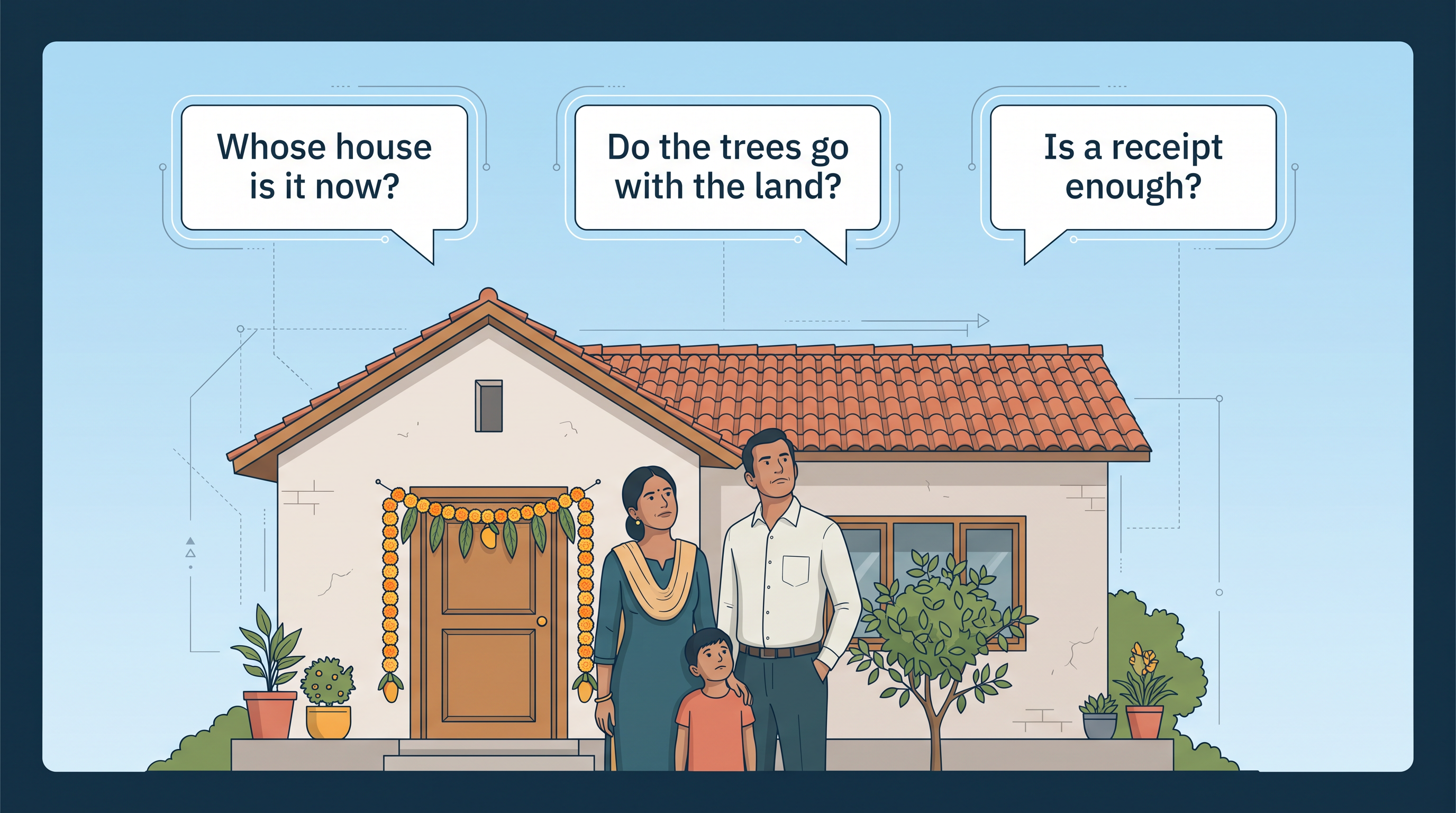
Fig. 5.0 – Questions after buying a house.
Every one of these questions has a settled legal answer, and this chapter will take you to each of them in turn.
5.1 Introduction
Before there was a statute
Property has always changed hands in India — sold, gifted, leased, divided among heirs. What did not exist, for a very long time, was a single written law telling everyone how it must be done. Before the British period, each community was governed by its own customary law in matters relating to transfer of property. A dispute in one region might be decided on rules that a court in another region had never heard of.
When the formal litigation system was established, this gap became a practical problem. There was no legislation in this area at all, so to begin with, the English judges applied the common law of England along with the rules of equity, justice and good conscience. “Equity, justice and good conscience” simply meant that where no written rule covered the dispute, the judge decided it on principles of basic fairness — a useful stopgap, but not a substitute for a law that everyone can read in advance.
Why a statute became necessary
Two difficulties followed. First, English property rules were unsuited to Indian conditions — they had grown out of a different system of landholding, a different social structure and different forms of family ownership. Second, the resulting conflict between judges’ decisions left the law uncertain. This was too important a branch of law to leave unsettled, and the need for clarity of rules made legislation necessary.
The drafting began in 1870. The Transfer of Property Act saw the light of the day in 1882, and it provided the basic principles for transfer of both movable and immovable properties. It was based primarily on the English law of ‘Real Property’, but it attempted to mould those principles to suit the Indian conditions rather than copy them.
What the Act covers today
A second enactment followed for a different job. The Sale of Goods Act, 1930 was passed to deal with transfer of movable property by sale — so a phone, a car or a sack of grain is bought and sold under that Act, not under the Transfer of Property Act.
That leaves the Transfer of Property Act, 1882 doing two things at once. It contains the general principles of transfer of property, and it contains detailed rules with respect to specific transfer of immovable property by sale, exchange, mortgage, lease and gift. Most of this chapter is about that second half — land, houses and the interests that attach to them.
5.2 Types of Property
The word property has not been defined in the Act. That silence is deliberate rather than careless. Property has a very wide meaning and includes properties of all descriptions, and a tight definition in one statute would only have left something out.
Three broad kinds of property
The word covers movable properties such as cases, books, and so on. It covers immovable properties also, such as lands or houses. And it covers intangible properties — things you cannot pick up or stand on, such as ownership, tenancy and copyrights. An intangible property is still property: a copyright can be sold, licensed and inherited exactly as a house can, even though nobody can point to it on a map. Fig. 5.1 sets out this three-way division.
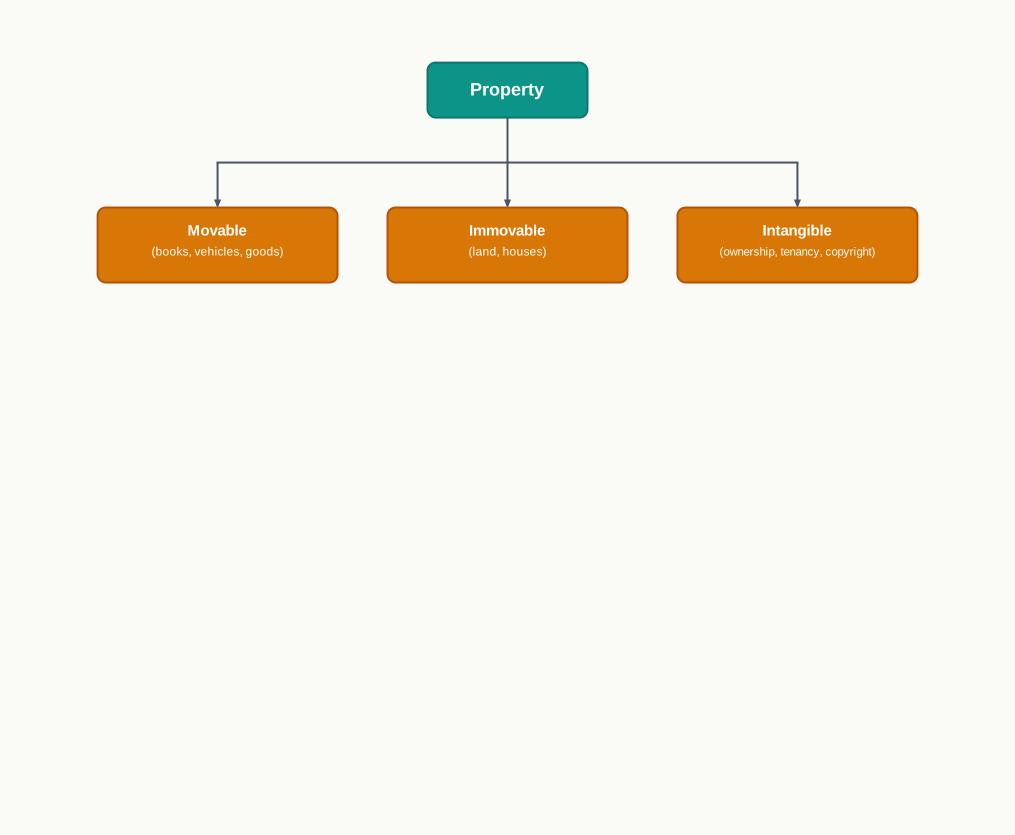
Fig. 5.1 – Classification of property.
Most of the disputes in this chapter turn on the line between the first two. That line matters because a different set of formalities, and often a different Act altogether, applies on each side of it.
What Section 3 leaves out
As per Section 3, the immovable property does not include standing timber, growing crop and grass. These three exclusions look odd at first — timber, crops and grass all grow out of the soil — so each needs to be taken separately.
Standing timber: standing timbers are trees fit for use for building or repairing houses. The word standing timber includes Babool Tree, Shisham, Peepal, Banyan, Teak, Bamboo, and similar trees. The fruit-bearing trees like Mango, Jackfruit, Jamun and the like are not standing timber, and they are immovable properties, as the court held in Fatimabibi v. Arrfana Begum. The reason is straightforward: a mango tree is valued for the fruit it will keep producing while it stands, so it is meant to remain attached to the soil.
Growing crop: it includes all vegetable growths which have no existence apart from their produce, such as pan leaf, sugarcane and the like. Nobody buys a sugarcane field for the stalks to stay where they are; the whole point of the crop is that it will be harvested.
Grass: grass is a movable property, but if it is a right to cut grass, it would be an interest in land and hence forms immovable property. Notice the shift. The blades themselves are movable, but a right to keep entering someone’s land and cutting the grass there is a benefit arising out of that land, and benefits arising out of land are immovable property.
The test is intention, not the tree
Whether trees can be regarded as movable or immovable depends upon the circumstances of the case. If the intention is that trees should continue to have the benefit of further sustenance or nutriment by the soil (land) — for example, by enjoying their fruits — then such tree is immovable property. But if the intention is to cut them down sooner or later for the purpose of utilizing the wood for building or other industrial purposes, they would be timber and accordingly be regarded as movable property.
The same reasoning appears in Marshall v. Green, where there was a sale of trees which were to be cut and taken away, and the Court held that the sale was not that of immovable property. The trees were sold as wood, not as part of the land.
How other statutes define it
The Transfer of Property Act may be silent on the meaning of property, but other statutes are not, and courts read them together.
As per Section 3(25), General Clauses Act, 1897, immovable property shall include land, benefits to arise out of land, and things attached to the earth, or permanently fastened to anything attached to the earth.
In the case of Sukry Kurdepa v. Goondakull, the court explained that movability may be defined to be a capacity in a thing of suffering alteration of place. On the other hand, if a thing cannot change its place without injury to the quality, it is immovable. This is a useful practical test for a student: ask whether the thing can be moved without being damaged or losing what makes it valuable. A ceiling fan can be unscrewed and carried away intact; a well sunk into the ground cannot.
Two more statutes carry their own definitions, and both are worth knowing because each is written for a different purpose.
That definition is drawn as widely as possible, because a law aimed at benami holdings cannot afford loopholes. The Sale of Goods Act takes the opposite approach and defines the word narrowly, for its own limited field.
The distinction there is easy to miss. A pawnbroker holding your watch as security has a special property in it — a limited interest, good enough to hold the watch until the loan is repaid. You retain the general property, which is ownership itself. Only the general property passes in a sale.
Movable and immovable compared
Everything so far can be gathered into one comparison. This is the table most board questions on this section are built from.
The last row is the one to carry forward. Once you have decided which side of the line a thing falls on, you have also decided which Act governs the transaction — and that is where the rest of this chapter begins.
5.3 Transfer of Property
Transfer of property is an act of conveying property from one person to another, in the present or future. Matters relating to the property are governed by the Transfer of Property Act, 1882 in India.
The object of the Transfer of Property Act is to regulate the transfer of property between living persons. It shall also serve as the code of contract law governing immovable property — which is to say that when people deal in land or houses, the Act supplies the rules that a contract for such property must satisfy.
The Act provides clarity on the subject: it is a systematic and uniform law on the transfer of immovable property in India. Before it, the answer to a question about a sale of land could depend on which court you were standing in. After it, the same rules apply across the country.
Two routes by which property changes hands
Property does not only move by agreement. The transfer of property may also take place by inheritance and succession, and the laws relating to such transfer are governed by the respective religious laws or practices, as the case may be. When a grandfather dies and his house passes to his heirs, nobody signs a sale deed — the property moves by operation of law.
The Transfer of Property Act is not concerned with that route. It deals with transfer by the act of the parties themselves. Fig. 5.2 shows the two routes side by side so that the boundary of this chapter is clear.
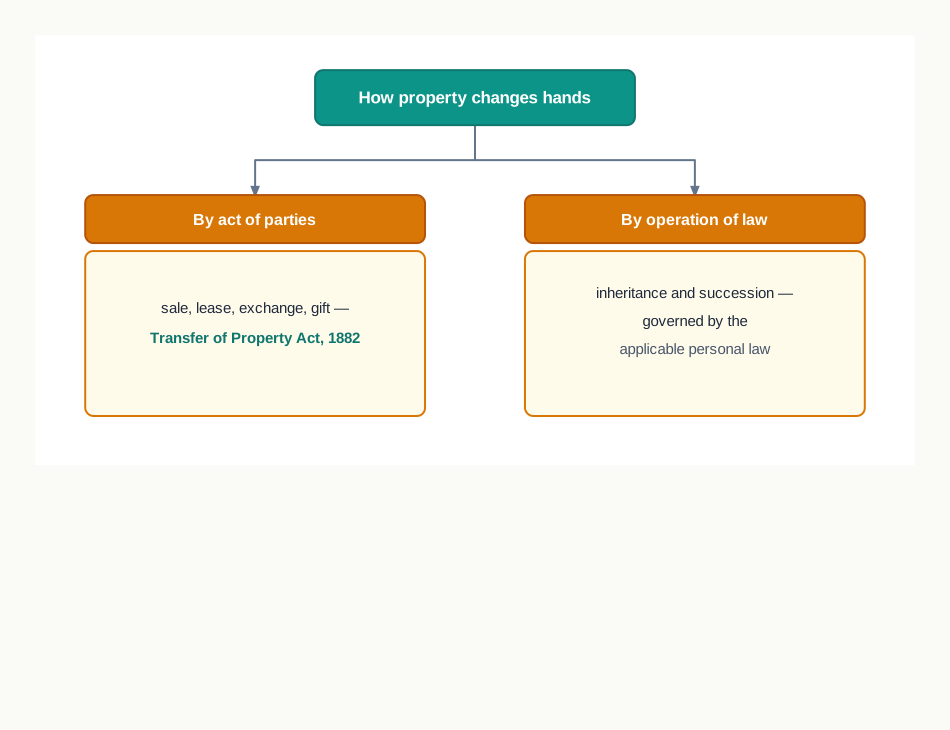
Fig. 5.2 – How property changes hands.
Transfer may be by agreement between the parties, that is, by contract; or it may be by will or by succession. In this chapter we are dealing with transfer by agreement between parties.
Who can transfer property?
Any person who is competent to contract and authorized to dispose of property can make a transfer. Two separate requirements are hidden in that one sentence, and a student who reads them as one will lose marks.
Being competent to contract means being a person above 18 years of age, having a sound mind, and not disqualified by any law in force. Being authorized to dispose of property means being the owner of the property, or any person authorized to sell the property, such as an agent holding a power of attorney. A perfectly sane adult cannot sell a house that is not his and that he has no authority to sell.
The person who transfers the property is called the transferor, and the person to whom the transfer is made is called the transferee. According to Section 8 of the Transfer of Property Act, 1882, by transferring property the transferor transfers all rights in a property.
Read the provision closely and you will see its limit. It passes all the interest the transferor is then capable of passing — no more. A person who owns half a house can transfer half a house, however confidently the deed is worded.
Essentials of a valid transfer
With regard to the law of property, a transfer is a process of conveying the rights and liabilities with respect to a property by one person to another. It is therefore with the formation of an agreement culminating into a contract that the transfer of property takes place. Every rule you learn about a valid contract is working in the background here.
The following are the essentials for a valid transfer of property:
In a transfer of property, the transfer should be between two or more living persons.
The property that is going to be transferred should be free from encumbrances — hindrances of any form, such as an unpaid loan secured on the property — and should be of a transferable nature.
The transfer should not be:
for an unlawful object or an unlawful consideration;
involving a person legally disqualified to be a transferor or transferee.
The transferor who transfers the property must:
be competent to make the transfer;
be entitled to the transferable property;
be authorized to dispose of the property if the property is not his own property.
The transfer should be made according to the appropriate mode of transfer. Necessary formalities like registration, attestation and the like should be complied with.
In the case of a conditional transfer, where an interest is created on the fulfillment of a condition, the condition should not be illegal, immoral, impossible or opposed to public policy.
Each of these exists to stop a particular kind of mischief. The living-persons requirement keeps this Act separate from the law of wills. The transferable-nature requirement stops people from selling what the law says cannot be sold. The condition requirement stops a transferor from using a gift as a lever to make somebody do something the law forbids.
5.4 The Process of Transfer
Knowing that a transfer is valid in principle is not enough. The law also prescribes how it must be carried out, and a transaction that skips a step can fail even though both sides were honest and both were satisfied. Five things have to be attended to.
Mode of transfer
The mode of transfer of property varies according to the value of the property. If the value of the property is Rs. 100 and upwards, then transfer has to be made by a registered instrument. If the property is tangible and the value of the property is less than Rs. 100, then the transfer may be made by delivery of the property. For intangible property, transfer has to be made only by a registered instrument.
A registered instrument is simply a document, entered in the official records, which contains the record of the owner of the property — shares and bonds are everyday examples of property that changes hands this way.
The reason for tying the mode to the value is practical. Small tangible things move constantly and it would paralyse ordinary life to demand paperwork for each one. Anything of real value, and anything intangible that cannot be handed over at all, needs a written record that a stranger can later inspect.
Attestation
A registered instrument must be attested at least by two witnesses to the transfer. The definition of attestation is given in Section 3 of the Transfer of Property Act, 1882. Attestation means affixing the signature to the instrument for the transfer of property; the witnesses should mark their signature too on the instrument, with the intention to attest.
The intention behind including this provision was to ensure that the transfer was done with the free will of the executant. A witness who signs without watching anything, or who signs a blank page, has not attested — he has only written his name. That is why the intention to attest is part of the definition and not a technicality.
Registration
Registration of the instrument is an essential legal formality. During registration, the parties to the transfer must be present to affix their signatures to the document and complete the transaction with regard to immovable property. While doing so, the document for transfer must mention clearly the rights, obligations and liabilities of the parties to the transfer.
Registration shall take place by finally affixing a seal of the Registrar’s office, which shall be subsequently included in the official records.
Registration is the step that turns a private arrangement into a public fact. Once the deed sits in the Registrar’s records, any future buyer, bank or court can check who owns the property and on what terms. Without it, ownership rests on whatever paper the parties happen to have kept in a cupboard.
Mutation
Once a property has been transferred by way of relinquishment, sale, or gift deed in the “name” of the recipient, it is also important to have the transfer recorded in the municipal records by way of mutation.
Students routinely confuse mutation with registration, and the confusion is worth clearing up. Registration records the document in the Registrar’s office. Mutation updates the revenue or municipal record so that property tax, water charges and utility bills are raised in the new owner’s name. Mutation follows the transfer; it does not create it.
Payment of fee
Stamp duty on transfer is payable as per applicable state laws. Stamp duty is a state subject, which is why the rate on the same transaction differs from one state to another, and why buyers are told to check the local rate before budgeting for a purchase.
5.5 Doctrine of Election
Sometimes a single document does two things at once: it gives a person something, and it also takes something from him. The question the law then has to answer is whether he may keep the pleasant half and refuse the unpleasant half. The answer is no, and the rule that says so is the Doctrine of Election.
According to the principle of the Doctrine of Election [Section 35 of the TPA], if a person to the transfer gets two selections — a benefit and a burden — then he has to accept both the benefit and the burden, or none. He cannot accept the benefit and reject the burden in a single transaction. In other words, while claiming the advantage of an instrument, the burden of the instrument should also be accepted.
To elect, here, simply means to choose. The person is not being punished; he is being made to choose once, for the whole instrument, instead of picking through it clause by clause.
The trigger is the words in the same transaction. If a person receives a gift under one document and, quite separately, has a claim made against him under another, there is nothing to elect between. The doctrine bites only where the giving and the taking are parts of one instrument.
The equity behind the rule
The Doctrine of Election is based on the principle of equity that one cannot take what is beneficial to him and disapprove that which is against him under the same instrument. A person cannot accept a thing and reject another in the same instrument. In simple words, where a person takes some benefit under a deed or instrument, he must also bear its burden.
This is not a technical trap. It exists because a transferor who packs several things into one document is making a single, connected arrangement, and allowing the other side to unpick the favourable parts would let him rewrite the bargain after the event.
How the courts have explained it
The principle of the Doctrine of Election was explained by the House of Lords in the leading case of Cooper v. Cooper.
5.6 Doctrine of Lis Pendens
The Doctrine of lis pendens is embodied in Section 52 of the Transfer of Property Act, 1882. Lis pendens literally means a pending suit.
The doctrine states that a property under a pending suit should not be transferred to a third party during the pending suit in such a way that it affects the rights of any party concerned with the property. That means no new interest should be created by way of transfer of a property during the pendency of a suit relating to it.
Think about why such a rule is needed at all. If two people are fighting in court over the ownership of a plot, and one of them can quietly sell it to an outsider while the case is still running, the eventual winner would be handed a judgment about a plot that now belongs to a stranger. The court’s decision would be worth very little.
The object of the doctrine
The objective of the doctrine of lis pendens is to subjugate all parties to a pending litigation of a property to the authoritative decision of the Court. The doctrine reflects the control which a court acquires over property involved in a pending suit until its final judgment.
Put plainly, the property is not frozen out of existence — it is placed under the shadow of the court. When a suit or litigation is pending on an immovable property, then that immovable property cannot be transferred in a way that defeats the outcome of the suit.
When does the doctrine apply?
To constitute lis pendens, the following conditions should be satisfied:
A suit or proceeding involving the immovable property should be pending;
The right to the immovable property must be in question in the suit or proceeding;
The property in litigation should be transferred;
The transferred property should affect the rights of the other person to the transfer.
Each condition is a fact a student must learn to look for. Notice that it is not enough that a case is going on between the same two people about something; the right to that particular immovable property must itself be what the court is deciding. A money suit between the same parties would not attract the doctrine.
How the Supreme Court has read Section 52
The Supreme Court in Dev Raj Dogra and others v. Gyan Chand Jain and others interpreted the meaning of Section 52 of the Transfer of Property Act and laid down the pre-conditions as follows:
A suit or a proceeding in which any right to immovable property must be directly and specifically in question, must be pending;
The suit or the proceeding shall not be a collusive one;
Such property, during the pendency of such a suit or proceeding, cannot be transferred or otherwise dealt with by any party to the suit or proceeding so as to affect the right of any other party thereto under any decree or order which may be passed therein, except under the authority of the Court. In other words, any transfer of such property, or any dealing with such property, during the pendency of the suit is prohibited except under the authority of the Court, if such transfer or dealing by any party to the suit or proceeding affects the right of any other party to the suit or proceeding under any order or decree which may be passed in the said suit or proceeding.
Two of these deserve a second look. The second pre-condition — that the suit must not be a collusive one — exists because parties have been known to file a friendly, arranged suit purely to lock up a property and keep genuine claimants away. The doctrine protects real litigation, not staged litigation.
The third carries an important escape route: except under the authority of the Court. A party who has a genuine reason to sell during a pending suit is not without a remedy; he may apply to the court, and a transfer permitted by the court does not fall foul of Section 52.
The transfer is not void
It is easy to read the doctrine as saying that a sale made during litigation is simply wiped out. That is not what the section does.
The Supreme Court observed in Hardev Singh v. Gurmail Singh that Section 52 of the Act does not declare a pendente lite transfer by a party to the suit as void or illegal, but only makes the pendente lite purchaser bound by the decision of the pending litigation. The expression pendente lite means “during the litigation”. The buyer’s deed is real; what he cannot do is stand outside the case and claim that the decree does not concern him.
Thus, if during the pendency of any suit in a court of competent jurisdiction, in which any right of an immovable property is in question, such immovable property cannot be transferred by any party to the suit so as to affect the rights of any other party to the suit under any decree that may be made in such a suit.
5.7 Modes of Transfer of Immovable Property
Having seen who may transfer property, and what stops a transfer from taking effect, we come to the forms a transfer can take. The Transfer of Property Act, 1882 recognises several modes, and four of them are dealt with here: sale, lease, exchange and gift.
The four differ on one simple axis — what moves out, and what comes back in return. Keep that question in mind as you read, because it is the axis on which most examination questions on this section are built.
5.7.1 Sale
Sale means a transfer of ownership of the property in exchange for a price [Section 54 of the TPA]. Ownership here means the full bundle of rights over a thing, including the right to possess it, use it, and dispose of it as the owner pleases.
The seller is the person who transfers the property, and the buyer is the person to whom the property is transferred. The consideration in a sale is usually money. Consideration simply means what each side gives in return for what it gets; in a sale, the law requires that return to be money and nothing else.
The following are the essentials for a sale to be valid:
There should be two different parties — the seller and the buyer;
Both the parties should be competent to transfer;
The property to be transferred should be in existence;
Consideration for the transfer should be money;
The contract should be in accordance with law.
The first essential is worth pausing on. A person cannot sell to himself, because a sale needs two parties whose interests are on opposite sides of the transaction. The third matters just as much: a house not yet built is not property in existence, and an agreement about it is an agreement to sell in the future, not a completed sale.
5.7.2 Lease
A lease under the Transfer of Property Act is a contract by which one party transfers the right to enjoy the land, property, services and the like to another for a specified time, usually in return for a periodic payment, but which does not constitute a sale [Section 105 of the TPA]. A lease can be done only of immovable property.
A lease is a transfer of the right to enjoy a property for a specific period of time in consideration of a price. The lessor is the person who lets out the property for lease, that is, the transferor; and the lessee is the person to whom the property is leased, that is, the transferee in a lease.
Notice what does not move in a lease. Ownership stays with the lessor throughout. What passes to the lessee is the right to enjoy the property for the agreed period, after which it returns to the lessor. That single difference explains almost everything else about a lease.
Sub-lease
The lessee can also sub-let the lease, and the relation between the lessee and the sub-lessee will be that of the lessor and lessee.
A sublease is the renting of property by a tenant to a third party for a portion of the tenant’s existing lease contract. Even if a tenant subleases a property, the original tenant is still liable for the obligations stated in the lease agreement, such as the payment of rent each month.
Subleasing with the consent of the landlord is legal in India. If the agreement allows the tenant to sublease, the tenant can sublease a portion of the property to a third party. When a tenant whose name is on the lease rents out a room, a portion of the property, or all of the property to another, it is referred to as subleasing, or subletting. The subtenant must pay rent and comply with the lease terms, but the principal tenant remains ultimately responsible for the lease.
The rule to carry away is that a sub-lease creates a second relationship without dissolving the first. The landlord’s tenant is still his tenant, and still answerable to him, whatever arrangement that tenant has made with somebody else.
5.7.3 Exchange
When two persons transfer the ownership of one thing for the ownership of another, it is called exchange [Section 118 of the TPA]. A transfer of property in completion of an exchange can be made only in the manner provided for the transfer of such property by sale — which is why an exchange of immovable property needs the same formalities of writing and registration that a sale would need.
The rights and liabilities of the parties to an exchange shall be those of the rights and liabilities of the buyer to the extent of receiving, and those of the seller to the extent of giving. Each party is therefore wearing two hats at once, and that is the only structural difference from a sale.
5.7.4 Gift
A transfer of ownership of property that is made voluntarily and without consideration is called a gift [Section 122 of the TPA]. The person making the transfer is called the donor, and the person to whom it is made is called the donee.
Two conditions are doing the real work in that sentence. The transfer must be voluntary, which is why a gift extracted by pressure is not a gift at all; and it must be without consideration, which is what separates a gift from every other mode in this section.
A gift also requires acceptance. The donee must accept the gift during the lifetime of the donor and while the donor is still capable of giving. If the donee expires before accepting the gift, it becomes void.
The four modes compared
Everything in this section can now be set side by side. Read the table by column, and ask of each mode: what moves, and what comes back?
5.8 Summary
- Before the British period, each community in India was governed by its own customary law in matters relating to transfer of property.
- In the absence of legislation, the English judges applied the common law of England and the rules of equity, justice and good conscience to property disputes.
- Those rules were unsuited to Indian conditions, and the resulting conflict and need for clarity made legislation necessary.
- Drafted in 1870, the Transfer of Property Act came into being in 1882 and provided the basic principles for transfer of both movable and immovable properties.
- The Sale of Goods Act, 1930 was passed separately to deal with the transfer of movable property by sale.
- The Transfer of Property Act, 1882 contains the general principles of transfer of property and detailed rules for the transfer of immovable property by sale, exchange, mortgage, lease and gift.
- The word property is not defined in the Act, but it has a very wide meaning and covers:
- movable property, such as cases and books;
- immovable property, such as lands and houses;
- intangible property, such as ownership, tenancy and copyrights.
- As per Section 3, immovable property does not include standing timber, growing crop and grass.
- Standing timbers are trees fit for use for building or repairing houses, such as Babool, Shisham, Peepal, Banyan, Teak and Bamboo.
- Fruit-bearing trees like Mango, Jackfruit and Jamun are not standing timber and are immovable property.
- Growing crop includes all vegetable growths which have no existence apart from their produce, such as pan leaf and sugarcane.
- Grass is movable property, but a right to cut grass is an interest in land and is therefore immovable property.
- Whether a tree is movable or immovable depends on the intention of the parties — a tree left to draw nutriment from the soil is immovable, while a tree meant to be felled for its wood is timber and therefore movable.
- As per Section 3(25) of the General Clauses Act, 1897, immovable property includes land, benefits to arise out of land, and things attached to the earth or permanently fastened to anything attached to the earth.
- Section 2(c) of the Benami Transactions (Prohibition) Act, 1988 defines property as property of any kind, whether movable or immovable, tangible or intangible, including any right or interest in such property.
- Section 2(11) of the Sale of Goods Act, 1930 defines property as the general property in goods, and not merely a special property.
- Movable and immovable property differ on movement, on the manner of transfer, on whether registration is compulsory, and on the Act that governs the transfer.
- Transfer of property is an act of conveying property from one person to another, in the present or future, and the object of the Act is to regulate transfer between living persons.
- Transfer of property may also take place by inheritance and succession, which are governed by the respective religious laws or practices and not by this Act.
- A person can transfer property only if he is competent to contract — above 18 years of age, of sound mind and not disqualified by any law in force — and is authorised to dispose of the property.
- The person who transfers is the transferor and the person to whom the transfer is made is the transferee.
- According to Section 8 of the Transfer of Property Act, 1882, by transferring property the transferor passes all the interest he is then capable of passing, along with the legal incidents of the property.
- The essentials of a valid transfer of property are:
- the transfer must be between two or more living persons;
- the property must be free from encumbrances and of a transferable nature;
- the transfer must not be for an unlawful object or unlawful consideration, and must not involve a person legally disqualified to be a transferor or transferee;
- the transferor must be competent to make the transfer, entitled to the transferable property, and authorised to dispose of it if it is not his own;
- the transfer must follow the appropriate mode, with formalities such as registration and attestation complied with;
- in a conditional transfer, the condition must not be illegal, immoral, impossible or opposed to public policy.
- The mode of transfer depends on the value of the property — immovable property of Rs. 100 and upwards requires a registered instrument, tangible property below that value may pass by delivery, and intangible property requires a registered instrument in every case.
- A registered instrument must be attested by at least two witnesses, and attestation is defined in Section 3 of the Transfer of Property Act, 1882.
- Attestation exists to ensure that the transfer was made with the free will of the executant, which is why the witnesses must sign with the intention to attest.
- Registration is an essential legal formality; the parties must be present to sign, the document must state the rights, obligations and liabilities of the parties, and the Registrar’s seal brings it into the official records.
- Section 17 of the Registration Act, 1908 deals with the documents that are compulsory to be registered.
- Mutation is the recording of the transfer in the municipal records; it follows the transfer and does not by itself create title.
- Stamp duty on a transfer is payable as per the applicable state laws.
- Under the Doctrine of Election in Section 35 of the Transfer of Property Act, 1882, a person who receives a benefit and a burden under the same instrument must accept both or reject both.
- The Doctrine of Election rests on the equitable maxim quod approbo non reprobo — that which I approve, I cannot disapprove.
- The doctrine was explained by the House of Lords in Cooper v. Cooper, and it applies to every instrument and to all types of property.
- The Doctrine of lis pendens is embodied in Section 52 of the Transfer of Property Act, 1882, and lis pendens literally means a pending suit.
- The doctrine comes from the maxim ut lite pendente nihil innovetur — nothing new should be introduced in a pending litigation.
- Its object is to subject all parties to a pending litigation to the authoritative decision of the Court, and it reflects the control a court acquires over the property until final judgment.
- To constitute lis pendens:
- a suit or proceeding involving the immovable property must be pending;
- the right to the immovable property must be in question in that suit or proceeding;
- the property in litigation must be transferred;
- the transfer must affect the rights of the other person to the transfer.
- In Dev Raj Dogra and others v. Gyan Chand Jain and others, the Supreme Court held that the right to the immovable property must be directly and specifically in question, that the suit must not be a collusive one, and that the property cannot be dealt with so as to affect another party’s rights except under the authority of the Court.
- In Hardev Singh v. Gurmail Singh, the Supreme Court observed that Section 52 does not declare a pendente lite transfer void or illegal, but only binds the pendente lite purchaser to the decision in the pending litigation.
- A sale under Section 54 of the Transfer of Property Act, 1882 is a transfer of ownership in exchange for a price in money, made between a seller and a buyer.
- The essentials of a valid sale are:
- two different parties, the seller and the buyer;
- both parties competent to transfer;
- the property must be in existence;
- the consideration must be money;
- the contract must be in accordance with law.
- A lease under Section 105 of the Transfer of Property Act, 1882 transfers only the right to enjoy immovable property for a specified time, usually for a periodic payment, and ownership remains with the lessor.
- The person who lets out the property is the lessor and the person to whom it is leased is the lessee.
- A lessee may sub-let, and the relation between the lessee and the sub-lessee is that of lessor and lessee; the principal tenant nonetheless remains liable to the landlord under the original lease.
- An exchange under Section 118 of the Transfer of Property Act, 1882 is the mutual transfer of ownership of one thing for the ownership of another, and it must be made in the manner provided for transfer by sale.
- Each party to an exchange has the rights and liabilities of a buyer to the extent of what he receives and of a seller to the extent of what he gives.
- A gift under Section 122 of the Transfer of Property Act, 1882 is a transfer of ownership made voluntarily and without consideration by the donor to the donee.
- A gift must be accepted during the lifetime of the donor and while he is still capable of giving; if the donee dies before accepting, the gift becomes void.
5.9 Key Terms
Equity, justice and good conscience — the principles of basic fairness that English judges in India applied to property disputes where no written rule covered the case.
Property — a term not defined in the Transfer of Property Act, 1882, covering things of every description, whether movable, immovable or intangible, and any right or interest in them.
Movable property — property that can easily be transported from one place to another without changing its shape, capacity, quantity or quality.
Immovable property — land, benefits to arise out of land, and things attached to the earth or permanently fastened to anything attached to the earth, but not standing timber, growing crop or grass.
Intangible property — property that has no physical form, such as ownership, tenancy or copyright.
Standing timber — trees fit for use in building or repairing houses, such as Babool, Shisham, Peepal, Banyan, Teak and Bamboo, which are excluded from immovable property.
Growing crop — vegetable growths that have no existence apart from their produce, such as pan leaf and sugarcane.
General property — full ownership of goods, which is what passes to the buyer in a sale under the Sale of Goods Act, 1930.
Special property — a limited interest in goods short of ownership, such as that of a person holding goods as security.
Transfer of property — an act by which a living person conveys property to another, in the present or in the future.
Transferor — the person who transfers the property.
Transferee — the person to whom the transfer is made.
Competent to contract — being above 18 years of age, of sound mind, and not disqualified by any law in force.
Encumbrance — a hindrance of any form attaching to property, such as an unpaid loan secured on it, which must be cleared for a valid transfer.
Instrument — the written document by which a transfer of property is made.
Attestation — the signing of an instrument by at least two witnesses, each of whom has seen the executant sign or received his personal acknowledgement, and each signing in his presence with the intention to attest.
Executant — the person who signs and gives effect to the instrument of transfer.
Registration — the recording of the contents of a document in the official records of the Registrar’s office, compulsory for the documents listed in Section 17 of the Registration Act, 1908.
Mutation — the recording of a completed transfer in the municipal or revenue records in the name of the new holder.
Stamp duty — the fee payable on a transfer of property under the applicable state law.
Doctrine of Election — the rule in Section 35 of the Transfer of Property Act, 1882 that a person taking a benefit under an instrument must also accept the burden it imposes, or reject the instrument altogether.
Quod approbo non reprobo — that which I approve, I cannot disapprove; the maxim underlying the Doctrine of Election.
Lis pendens — literally, a pending suit; the doctrine in Section 52 of the Transfer of Property Act, 1882 that property in dispute may not be dealt with so as to affect another party’s rights under the decree.
Ut lite pendente nihil innovetur — nothing new should be introduced in a pending litigation; the maxim from which the Doctrine of lis pendens emerged.
Pendente lite — during the litigation; a pendente lite purchaser is bound by the decision in the pending suit.
Collusive suit — a suit filed by arrangement between the parties rather than as genuine litigation, which does not attract the Doctrine of lis pendens.
Sale — a transfer of ownership of property in exchange for a price in money, under Section 54 of the Transfer of Property Act, 1882.
Consideration — what each party gives in return for what it receives in a transaction.
Lease — a transfer of the right to enjoy immovable property for a specified time, usually for a periodic payment, under Section 105 of the Transfer of Property Act, 1882.
Lessor — the person who lets out the property on lease.
Lessee — the person to whom the property is leased.
Sub-lease — the letting out of leased property by the lessee to a third party, the principal tenant remaining liable under the original lease.
Sub-lessee — the person to whom the lessee sub-lets the property.
Exchange — the mutual transfer of ownership of one thing for the ownership of another, under Section 118 of the Transfer of Property Act, 1882.
Gift — a transfer of ownership made voluntarily and without consideration, under Section 122 of the Transfer of Property Act, 1882.
Donor — the person who makes a gift.
Donee — the person to whom a gift is made.
5.10 Points to Ponder
The Transfer of Property Act, 1882 was drafted to replace customary rules that varied from community to community. What is gained when one uniform law replaces many local customs, and is anything of value lost along with them?
The law treats a teak tree as movable and a mango tree as immovable, though both are rooted in the same soil. Is a test based on the intention of the parties a sensible way to decide such questions, or does it make ownership harder to predict?
Registration protects buyers by making transactions public. Does the same publicity have costs — for privacy, or for people who cannot easily reach a Registrar’s office — and how should the law balance them?
A monetary threshold of Rs. 100 was fixed for compulsory registration in a very different economy. What does an unrevised figure like this tell you about how statutes age, and what should a legislature do about it?
Attestation requires witnesses who actually watch the executant sign. In practice, witnesses often sign as a formality. Does a safeguard that is routinely treated as paperwork still protect anyone?
The Doctrine of Election tells a person he may not keep the benefit and refuse the burden. Is this fairness, or is it hard on someone who genuinely wants only part of what an instrument offers?
Under the Doctrine of lis pendens, a buyer who knew nothing of a pending case is still bound by the decree. Where should the law place the risk — on the innocent buyer, or on the party whose rights the suit is meant to protect?
Property disputes take years to decide in Indian courts. How does the delay itself change the practical meaning of doctrines like lis pendens for an ordinary family?
A gift is valid only if it is voluntary. How should a court tell a genuine gift within a family from one made under quiet pressure, when both look identical on paper?
A lease gives possession without ownership. For a person who cannot afford to buy, is the law of leases a real protection or only a temporary shelter, and what would strengthen it?
Digital land records and online registration are spreading across states. What could such systems fix in the process you studied in this chapter, and what new risks might they create?
5.11 Textbook Questions
X is the owner of mango groves where mangoes of exceptional quality are produced by hybrid methods, and he is one of the largest exporters of mangoes. Till the year 2020 he was engaged in exporting mangoes. Because of a setback to his business during Covid, from 2021 he shifted to selling mango wood in local markets. Identify whether there is any difference in the type of property he has been dealing with in 2020 and in 2021 respectively.
A has a matter pertaining to the title of an immovable property situated at Bangalore with B. The matter is sub judice in the court of the Civil Judge at Bangalore. During the pendency of the suit, A’s mother was to be operated upon for open heart surgery, and to meet the financial need A sold this property situated at Bangalore to C. Decide the validity of the transfer made by A to C, and explain the requisites of the principle of law involved.
Manan and Ketan enter into an agreement of lease of property for a tenure of 24 months at a consideration of Rs. 9,000 per month. Ketan is expected to return the property at the expiry of this term in the condition in which he received it. Ketan is transferred to another city for a short span and sub-lets the property to Manoj for a sum of Rs. 10,000. Manoj carries out such alterations as would depreciate the property. Decide whether Ketan is authorised to make such a transfer by sub-lease. Also highlight the remedy available to Manan.
Elucidate the importance of attestation as an important step preceding registration.
5.12 Objective Questions
The Transfer of Property Act was drafted in 1870 and came into being in the year:
- 1872
- 1882
- 1897
- 1908
The transfer of movable property by sale is dealt with by:
- the Transfer of Property Act, 1882
- the Registration Act, 1908
- the Sale of Goods Act, 1930
- the General Clauses Act, 1897
As per Section 3 of the Transfer of Property Act, 1882, immovable property does not include:
- land and houses
- standing timber, growing crop and grass
- benefits arising out of land
- things permanently fastened to the earth
Which of the following is treated as immovable property?
- A teak tree agreed to be felled within a month
- A bamboo clump sold as building material
- A mango tree kept for its fruit
- A cut log lying in a timber yard
A right to cut grass on another person’s land is:
- movable property, because grass is movable
- immovable property, because it is an interest in land
- intangible property outside the Act altogether
- a growing crop under Section 3
The definition of immovable property as including land, benefits to arise out of land, and things attached to the earth is found in:
- Section 3(25) of the General Clauses Act, 1897
- Section 2(c) of the Benami Transactions (Prohibition) Act, 1988
- Section 2(11) of the Sale of Goods Act, 1930
- Section 8 of the Transfer of Property Act, 1882
Under Section 2(11) of the Sale of Goods Act, 1930, “property” means:
- any right or interest in goods
- a special property in goods
- the general property in goods, and not merely a special property
- possession of goods for a limited purpose
A registered instrument must be attested by at least:
- one witness
- two witnesses
- three witnesses
- no witness, if the parties are present
The documents that are compulsory to be registered are dealt with by:
- Section 8 of the Transfer of Property Act, 1882
- Section 17 of the Registration Act, 1908
- Section 35 of the Transfer of Property Act, 1882
- Section 3 of the Transfer of Property Act, 1882
Recording a completed transfer in the municipal records in the name of the new holder is called:
- attestation
- registration
- mutation
- relinquishment
Stamp duty on a transfer of property is payable:
- at a uniform rate fixed by the Transfer of Property Act, 1882
- as per the applicable state laws
- only where the property exceeds Rs. 2 lakhs in value
- only on gifts of immovable property
The Doctrine of Election is embodied in:
- Section 35 of the Transfer of Property Act, 1882
- Section 52 of the Transfer of Property Act, 1882
- Section 54 of the Transfer of Property Act, 1882
- Section 105 of the Transfer of Property Act, 1882
The maxim quod approbo non reprobo means:
- nothing new should be introduced in a pending litigation
- that which I approve, I cannot disapprove
- let the buyer beware
- no one can transfer a better title than he has
The Doctrine of lis pendens is embodied in:
- Section 35 of the Transfer of Property Act, 1882
- Section 52 of the Transfer of Property Act, 1882
- Section 118 of the Transfer of Property Act, 1882
- Section 122 of the Transfer of Property Act, 1882
A transfer of property made during the pendency of a suit is:
- void from the beginning
- illegal and punishable
- valid, but the purchaser is bound by the decision in the suit
- valid only if the buyer had no notice of the suit
In a sale under Section 54 of the Transfer of Property Act, 1882, the consideration must be:
- money
- another property
- rent paid periodically
- anything the parties agree upon
In a lease, the person to whom the property is leased is called the:
- lessor
- lessee
- donee
- transferor
A transfer of ownership of one thing for the ownership of another is:
- a sale
- a lease
- an exchange
- a gift
If the donee dies before accepting the gift, the gift:
- takes effect in favour of the donee’s heirs
- becomes void
- becomes voidable at the option of the donor
- is converted into a sale
Assertion (A): The Sale of Goods Act, 1930 was passed as a separate enactment. Reason (R): The Transfer of Property Act, 1882 contains detailed rules for specific transfers of immovable property, while the transfer of movable property by sale is dealt with separately.
Assertion (A): A mango tree standing in an orchard is immovable property, but a teak tree agreed to be cut and carried away is not. Reason (R): Whether a tree is movable or immovable depends on whether the parties intend it to continue drawing nutriment from the soil or to be felled for its wood.
Assertion (A): A person of sound mind and above 18 years of age can always make a valid transfer of property. Reason (R): A transferor must be competent to contract as well as entitled to the property or authorised to dispose of it.
Assertion (A): Witnesses to an instrument must sign with the intention to attest. Reason (R): Attestation exists to ensure that the transfer was made with the free will of the executant.
Assertion (A): Mutation of a property in the municipal records by itself confers ownership on the person named. Reason (R): Mutation records a completed transfer for revenue purposes and follows the transfer rather than creating it.
Assertion (A): A person who takes a benefit under an instrument must also bear the burden imposed by the same instrument. Reason (R): No one can approbate and reprobate the same transaction.
Assertion (A): The Doctrine of lis pendens does not apply where the suit is a collusive one. Reason (R): The doctrine exists to subject parties to genuine litigation to the authoritative decision of the Court.
Assertion (A): In a lease, ownership of the property passes to the lessee for the term of the lease. Reason (R): A lease transfers only the right to enjoy the property for a specified time in consideration of a price.
5.13 Check Your Concepts
Why did the application of English property rules by judges in India make a separate Indian statute necessary?
The Transfer of Property Act, 1882 does not define the word “property”. Explain why the absence of a definition has not weakened the Act.
Distinguish between movable and immovable property on the bases of movement, transfer, registration and the governing statute.
Grass is movable property, but a right to cut grass is immovable property. Explain the reasoning behind this distinction.
State the test used to decide whether trees are movable or immovable property, and identify the fact that decides the answer in a given case.
Distinguish between the general property and a special property in goods, with an example of each.
Identify the provision which lays down that immovable property includes land, benefits to arise out of land, and things attached to the earth. Name the Act and the section.
What happens if a transferor is competent to contract but has no authority to dispose of the property he is transferring? Explain why competence alone is not enough.
State the essentials of a valid transfer of property.
Why does the Transfer of Property Act, 1882 confine itself to transfers between living persons? What kind of transfer is left out, and which law governs it?
Explain the limit contained in Section 8 of the Transfer of Property Act, 1882 on what a transferor can pass to a transferee.
Arrange the following steps in the correct order and name each: payment of stamp duty; mutation; attestation by two witnesses; determining the appropriate mode of transfer; presentation of the instrument for registration.
What happens if a person buys a house of Rs. 5 lakhs and takes only a signed receipt from the seller? Explain the difficulty this creates.
Distinguish between registration and mutation, and state which of the two creates title.
A witness signs an instrument without having seen the executant sign it and without receiving any acknowledgement from him. Has the instrument been validly attested? Give reasons.
Correct the error in the following statement and explain the correction: “Stamp duty on the transfer of property is fixed uniformly for the whole of India by the Transfer of Property Act, 1882.”
Explain the Doctrine of Election, and state the one fact that must be present before the doctrine can be applied at all.
A person receives a house under one deed and, under an entirely separate deed executed months later, is asked to give up a plot of land. Does the Doctrine of Election apply? Give reasons.
State the conditions that must be satisfied to constitute lis pendens.
Correct the error in the following statement and explain the correction: “A sale made during the pendency of a suit relating to the property is void.”
Why does the Doctrine of lis pendens exclude collusive suits from its protection?
What course is open to a party who has a genuine need to sell property while a suit relating to it is pending?
State the essentials of a valid sale, and explain why a sale cannot be made to oneself.
Distinguish between a sale and a lease with reference to what is transferred and what is received in return.
Distinguish between an exchange and a gift.
A tenant sub-lets a flat with the landlord’s consent, and the sub-tenant stops paying rent. Whom can the landlord proceed against, and why?
Why must a transfer in completion of an exchange be made in the manner provided for a transfer by sale?
What happens to a gift if the donee dies before accepting it? Identify the provision and explain the reasoning behind the rule.
A father transfers his shop to his son and describes the transaction as a gift, but the son agrees in return to pay the father Rs. 10,000 every month. Identify the mode of transfer this actually amounts to, and give reasons.
5.14 Case-Based Questions
- Rukmini owns a two-acre plot on the edge of a town. Along one boundary stand fifteen shisham trees; in the middle of the plot are eight guava trees that the family has harvested every season for twenty years. In March she signs one agreement with a furniture workshop, which is to fell the shisham trees and carry away the wood within sixty days. In April she signs a second agreement allowing a neighbour to pick and sell the guavas for the next six seasons, the trees remaining rooted where they are.
- Classify the subject matter of each of the two agreements as movable or immovable property, giving reasons.
- Which single fact decides the classification in each case?
- If the furniture workshop had agreed instead to leave the shisham trees standing and tap them for gum each year, would your answer to (a) change? Explain.
- Ibrahim agrees to buy a small house from Devender for Rs. 12 lakhs. Devender hands over the keys, Ibrahim pays the full amount, and Devender writes out a receipt which two neighbours sign at the bottom. Neither neighbour was present when Devender signed, and both were told only that “some paperwork” needed a signature. No document is presented at the Registrar’s office. Two years later Devender’s creditor claims the house.
- Was the mode of transfer adopted by the parties the correct one for a property of this value? Identify the rule that applies.
- Has the document been validly attested? Give reasons drawn from the definition of attestation.
- Explain what registration would have given Ibrahim that the receipt does not.
- Would the position have been different if the house had been worth Rs. 80 and had been a tangible movable article handed over on the spot? Explain.
- Sarita and her cousin Pramod are in litigation before a competent civil court over the ownership of a shop. While the suit is pending, Pramod sells the shop to Nadeem, who inspects the shop, pays the full price and gets a registered sale deed. Nadeem has no knowledge of the suit. The court later decides the title in Sarita’s favour.
- Identify the doctrine that applies, and state the provision in which it is embodied.
- Is the sale to Nadeem void? State the correct legal position and the authority for it.
- Does Nadeem’s lack of knowledge of the pending suit alter the outcome? Give reasons.
- What step could Pramod have taken before selling that would have kept the transfer outside the bar? Explain.
- By a single registered instrument, Harbans transfers his warehouse to his nephew Aman and, in the same instrument, directs that a plot of land belonging to Aman shall pass to Harbans’s daughter. Aman wishes to keep the warehouse but refuses to part with his plot.
- Identify the doctrine that governs Aman’s position and the section in which it is contained.
- State the choice the law gives Aman and what follows from each choice.
- Name the maxim on which the doctrine rests and state its meaning.
- Suppose the warehouse had been given to Aman by one instrument, and the direction about his plot had come in a wholly separate instrument executed a year later. Would the doctrine still apply? Give reasons.
- Vaishali leases her ground-floor flat to Tarun for three years at Rs. 14,000 a month, the lease deed expressly permitting Tarun to sub-let with her written consent. Tarun obtains that consent and sub-lets the flat to Ojas at Rs. 18,000 a month. Ojas falls four months behind on the rent and knocks down an internal wall without asking anyone.
- Identify the relationship between Vaishali and Tarun, and between Tarun and Ojas, naming the parties correctly.
- Whom can Vaishali hold answerable for the unpaid rent, and why?
- Explain what Tarun received under the lease that Vaishali did not part with.
- Would your answer to (b) change if the lease deed had contained no permission to sub-let and Vaishali had never consented? Explain.
- Meenakshi, aged 74, executes a registered deed transferring her flat to her neighbour Farhan, describing it as a gift made out of affection and taking nothing in return. Farhan is away on work when the deed is executed and writes to her a week later saying he accepts the flat with gratitude. In a second, unrelated transaction the same month, Meenakshi transfers her old car to her nephew, who transfers his motorcycle and a sum of Rs. 20,000 to her in return.
- Identify the mode of transfer in each of the two transactions, with the section that governs it.
- Is the transfer of the flat complete? State the condition that must be satisfied and whether it is satisfied here.
- Explain why the second transaction is not a sale.
- Suppose Farhan had died before writing his letter of acceptance. What would be the legal position of the transfer of the flat, and why?
5.15 Landmark Cases & Maxims
State the principle settled in Shantabai v. State of Bombay, AIR 1958 SC 532, and explain the test it laid down for deciding whether trees are movable or immovable property.
Which authority holds that fruit-bearing trees such as mango, jackfruit and jamun are not standing timber but immovable property? State the principle it settled.
In Marshall v. Green, trees were sold to be cut and taken away. State what the Court held and how the decision fits the intention test.
State the explanation of movability given in Sukry Kurdepa v. Goondakull, and apply it to decide whether a ceiling fan and a well sunk into the ground are movable or immovable.
State the principle laid down in Madam Pillai v. Badar Kali on the effect of an oral transfer of land.
Which case explained the principle underlying the Doctrine of Election before the House of Lords, and what did it hold about the instruments and the types of property to which the doctrine applies?
State the pre-conditions for the application of Section 52 of the Transfer of Property Act, 1882 laid down by the Supreme Court in Dev Raj Dogra and others v. Gyan Chand Jain and others.
State the observation of the Supreme Court in Hardev Singh v. Gurmail Singh on the effect of a pendente lite transfer, and explain why the observation matters to a purchaser.
Give the literal and the legal meaning of quod approbo non reprobo, and name the doctrine it supports.
Give the meaning of ut lite pendente nihil innovetur and state the section of the Transfer of Property Act, 1882 that gives it statutory form.
What does the expression pendente lite mean, and what is the position of a pendente lite purchaser?
A brother accepts a house left to him by a deed which, in the same document, requires him to give up his share in a family shop. He wishes to keep the house and retain the shop. Match the maxim that applies to this situation and explain its application.
A landowner sells a disputed field while a suit about its ownership is pending before a competent court. Identify the doctrine and the authority that governs the buyer’s position, and state what the buyer takes.
A contractor buys standing bamboo from a farmer, to be cut and removed within three months. Identify the authority that governs the classification of the subject matter, and state whether the contractor is dealing in movable or immovable property.