Chapter 6: Intellectual Property Law
In 1995, a United States patent was granted for the use of turmeric to heal wounds. To anyone in India this was puzzling. Putting haldi on a cut is what grandmothers have done for centuries. It appears in old Ayurvedic writing, it is on every kitchen shelf from Kerala to Kashmir, and nobody in India had ever thought of it as somebody’s private property. India’s Council of Scientific and Industrial Research decided to challenge the patent — and the argument it made was a narrow, technical one. It did not argue that the patent was unfair, or that turmeric belonged to India. It argued that the claimed invention was not new. CSIR placed before the American patent office old Sanskrit texts and published papers showing that this use of turmeric was already known to the world. In 1997, the patent was revoked. Nothing about turmeric changed that day. What changed was a legal record — a confirmation that something already known to everyone cannot be fenced off and owned by one person. That single idea, novelty, is one of the conditions a patent must satisfy. Around it sits a whole family of laws that decide who owns a song, a logo, a medicine, a sweet named after a region, or the shape of a cold drink bottle.

Fig. 6.0 – Forms of intellectual property.
This chapter will answer each of these questions.
6.1 Meaning of Intellectual Property and Intellectual Property Rights
Property You Cannot Touch
Most property you have studied so far can be seen and handled. A field, a house, a motorcycle, a gold chain — each of these occupies space, and the law protects the owner by protecting possession of the thing itself.
Intellectual property is different. It is intangible property, which means it has no physical body at all. It comes into existence through human intellect — through thinking, imagining, designing and inventing. It refers to the creation of the mind, or the products of human intellect, such as inventions, designs, artistic work, names, symbols and images.
This is easier to grasp with a concrete example. A student writes a poem in a notebook. Two quite separate things now exist. One is the notebook, which is ordinary movable property; if a friend takes it, that is a wrong against the notebook’s owner. The other is the poem itself — the arrangement of words that the student thought up. That poem is not tied to any one notebook. It can be copied into a hundred notebooks, printed in a magazine, or posted online, and it will still be the same poem. Intellectual property law protects that second thing.
The Bundle of Rights
The term Intellectual Property Rights (IPR) refers to the bundle of rights conferred by law on a creator or owner of intellectual property. These are the rights given to persons over the creations of their minds.
Calling it a “bundle” is deliberate. A creator does not receive one single right, but a set of separate rights that can be used independently — the right to make copies, the right to sell, the right to allow someone else to use the work, the right to stop a stranger from using it. Each strand of the bundle can be kept, given away, or sold on its own. An author may permit a publisher to print her novel while keeping the right to have it filmed.
These rights usually give the creator an exclusive right over the use of his or her creation for a certain period of time. Exclusive means that the creator can use the creation and can keep everybody else out. But notice the second half of the sentence: for a certain period of time. Intellectual property rights are not permanent. They run for a fixed term, after which the creation becomes free for everyone to use.
Why the Law Grants These Rights
Intellectual property rights seek to protect the interests of creators by rewarding their mental labour and allowing them to retain property rights over their creations. Creators and inventors are thus allowed to benefit from their creations.
Behind this lies a practical problem. Creation is expensive and slow — a medicine may take a decade of research, a novel may take years of writing — while copying is quick and nearly free. If anyone could copy a new medicine the day it was launched, few would spend the money to develop one. The law therefore steps in and holds the copyists back for a limited period, so that the person who did the work gets the first benefit of it.
The main reason for granting these rights is to encourage inventions and creations that promote social, economic, scientific and cultural development of society. That is the point worth holding on to. The reward to the individual creator is the method; the growth of society is the purpose.
The Two Branches of Intellectual Property
Intellectual property is divided into two categories, as shown in Fig. 6.1.
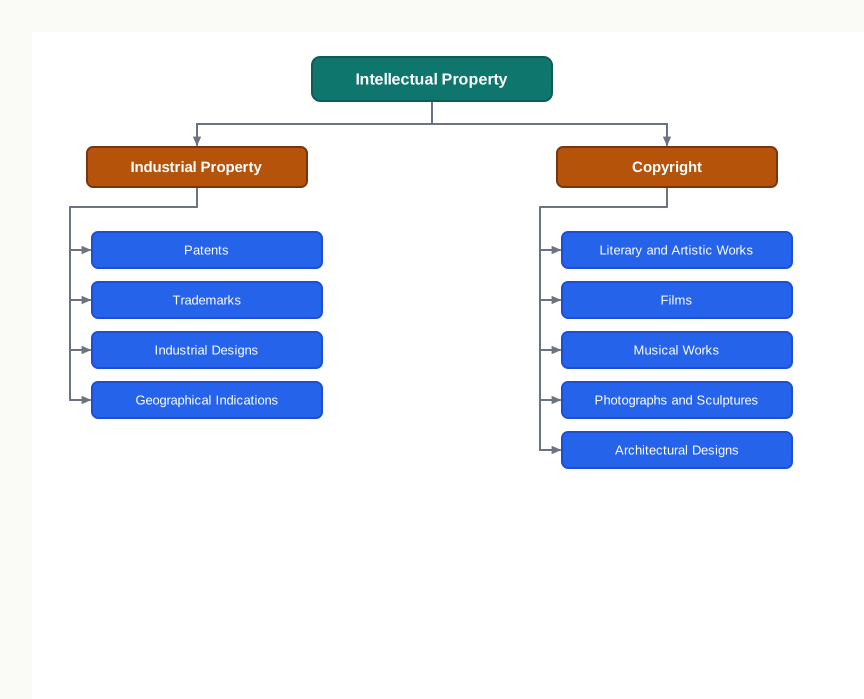
Fig. 6.1 – The two branches of intellectual property.
- Industrial property — this includes inventions (patents), trademarks, industrial designs, and geographic indications of source; and
- Copyright — this includes literary and artistic works such as novels, poems and plays, films, musical works, artistic works such as drawings, paintings, photographs and sculptures, and architectural designs.
The division follows the world the creation belongs to. Industrial property covers creations that enter trade and industry — a machine, a brand name, the shape of a product, the link between a product and the place it comes from. Copyright covers creations of literature and art, whether printed, performed, filmed or recorded. Each of the sections that follow in this chapter takes up one member of these two families.
6.2 International Conventions Shaping Indian IPR
Why a National Law Needs an International Backing
An intellectual property right is created by the law of one country and, by itself, stops at that country’s border. A patent granted in India binds people in India. It does not, on its own, stop a factory in another country from copying the same invention.
This was a real difficulty from the moment trade became international. An Indian author’s novel could be reprinted abroad without payment; a foreign inventor could find his machine freely copied here. No single country could solve this by passing its own law, because the problem lay outside its reach.
The answer was a series of international agreements in which countries promised each other how they would treat one another’s creators. India’s intellectual property statutes are written to keep the promises India has made in these agreements. That is why a chapter on Indian law begins with treaties.
National Treatment: The Idea That Runs Through All of Them
One principle appears in every instrument studied below, and it is the one most often asked about in examinations. It is the principle of National Treatment.
The idea is simple. A member country must treat creators from other member countries exactly as it treats its own. It need not give foreigners any special advantage, and it may not give them any disadvantage either. A German inventor’s application in India is examined by the same standard as an Indian inventor’s.
Watch how this principle grows as you move from convention to convention — it starts with industrial property, extends to literary and artistic works, and is later joined by further principles that make protection easier to obtain.
The Paris Convention for the Protection of Industrial Property
The Paris Convention was adopted on 20 March, 1883 in Paris and was enforced on 7 July, 1884. It is the older of the two great conventions and deals with industrial property — inventions, trademarks and industrial designs.
It rests on two principles.
- National Treatment — in the context of legal protection for industrial property, this principle requires each member country of the Paris Convention to provide equal legal protection for the inventions of nationals from other member countries, as it would for its own nationals.
- Framework of Priority — the Paris Convention also upholds the principle of “priority framework”, allowing an inventor to protect their invention simultaneously in various countries.
The second principle solves a practical problem that would otherwise defeat inventors. Patent applications must be filed country by country, and preparing them takes time. Without a priority framework, an inventor who filed in India first would find that the very act of filing had made the invention publicly known, so that a later application in another country could be refused for want of novelty. The priority framework treats the later applications as though they had been made on the date of the first one.
The Berne Convention for the Protection of Literary and Artistic Works
The Berne Convention was adopted on 9 September, 1886 and came into force on 4 December, 1887. The Berne Convention was originally signed in 1886 at Berne in Switzerland. Where Paris deals with industry, Berne deals with books, plays, music, paintings and films.
It carries three principles.
- National Treatment — any work originating in a contracting state, including works of authors who are nationals of that state or works first published in that state, should receive the same legal protection in every other contracting state as the latter state grants to its own nationals.
- Automatic Protection — legal protection should not be subject to compliance with any formalities.
- Independence of Protection — legal protection should be independent of the existence of protection in the country of origin of the work.
Automatic protection is the principle that shapes everyday copyright most directly. An author does not have to register her work, deposit a copy, or print any notice before the law will protect her. Protection attaches the moment the work is created. This is why, in the section on copyright that follows, you will find that registration in India is optional.
Independence of protection completes the arrangement. If a work has, for some reason, lost protection in the country where it was first published, that does not automatically strip it of protection elsewhere. Each contracting state decides the fate of the work under its own law.
The Universal Copyright Convention (UCC)
The Universal Copyright Convention was established in the year 1952. It was created for countries that were not willing to accept the full demands of Berne, particularly the demand that protection be automatic. It rests on three principles.
- National Treatment — the UCC adheres to the principle of national treatment rather than automatic protection, which implies that contracting countries are not obligated to provide foreign works with automatic protection if the national requirements are not met.
- The term of the Work — under the UCC, original literary, artistic and scientific works are eligible for protection. To provide reasonable notice of the copyright claim, a copyright notice should accompany the work. The UCC stipulates that protection for a work lasts for the duration of the author’s lifetime and an additional 25 years following the author’s death.
- Minimum Rights — as per the UCC’s provisions, the contracting countries must provide a specific set of “minimum rights” to the lawful owner of the work, provided they do not create any conflict with the “spirit” of the convention.
Notice the contrast that the second principle draws with Berne. Under the UCC a copyright notice is expected to accompany the work, and a country may insist that its own formalities be met. This is the point at which the two systems part company, and it is worth remembering when a question asks you to compare them.
The World Intellectual Property Organisation (WIPO)
The conventions above create obligations. Someone has to administer them, and that is the work of the World Intellectual Property Organisation.
The WIPO Convention, which is the primary instrument of the World Intellectual Property Organisation, was signed on July 14, 1967, in Stockholm. It came into effect in 1970 and was subsequently amended in 1979. In 1974, the WIPO became one of the specialized agencies of the United Nations (UN) system.
The WIPO had two primary objectives, which were:
- to promote the legal protection of intellectual property worldwide; and
- to facilitate administrative cooperation between the intellectual property unions created by treaties administered by the WIPO.
The second objective is less obvious than the first but does a great deal of quiet work. Each convention creates a “union” of member countries with its own procedures and paperwork. Bringing these under one administration means an applicant is not dealing with a different, unconnected system for every treaty.
6.3 Brief Historical Perspective
From World Trade to Intellectual Property
The conventions studied in the previous section grew out of a concern for creators. The next great step came from a different direction altogether — trade.
With the establishment of the World Trade Organization (WTO), the importance and role of intellectual property protection was crystallized in the Trade-Related Aspects of Intellectual Property Rights (TRIPS) Agreement. It was negotiated at the end of the Uruguay Round of the General Agreement on Tariffs and Trade (GATT) treaty in 1994.
The shift of forum mattered. Trading nations had begun to treat weak intellectual property protection as a trade problem: a country whose law allowed free copying was, in effect, giving its own manufacturers an advantage. Placing intellectual property inside the world trading system meant that the obligations came with the WTO’s machinery behind them, and not merely with a promise between signatories.
What TRIPS Requires
The TRIPS Agreement came into effect on 1 January 1995 and is the most comprehensive multilateral agreement on intellectual property. It encompasses all forms of intellectual property and aims at harmonizing and strengthening standards of protection and providing effective enforcement of intellectual property rights at both national and international levels.
Three words in that sentence carry the weight. Harmonizing means bringing the laws of different countries closer together, so that a creator does not face an entirely different system in every market. Strengthening means setting a floor below which a member’s protection may not fall. Enforcement means that having a law on paper is not enough — a member must also provide the courts, procedures and remedies through which a right can actually be asserted.
The Indian Legislations
India being signatory to the TRIPS Agreement has passed several legislations for the protection of intellectual property rights to meet the international obligations. Some of these legislations are listed below.
- the Trade Marks Act, 1999;
- the Designs Act, 2000;
- the Copyright Act, 1957 (as amended);
- the Patents Act, 1970 (as amended);
- the Geographical Indications of Goods (Registration and Protection) Act, 1999; and
- the Protection of Plant Varieties and Farmers’ Rights Act, 2001.
Two of these are older than TRIPS itself. The Copyright Act, 1957 and the Patents Act, 1970 were not written to meet the agreement; they were amended so that they would. The rest were enacted in the years immediately after 1995, which is why so many Indian intellectual property statutes carry dates clustered around the turn of the century.
The Story of Indian Patent Law
Patent law has the longest history of the group, and it is worth following in order, as set out in Fig. 6.2.
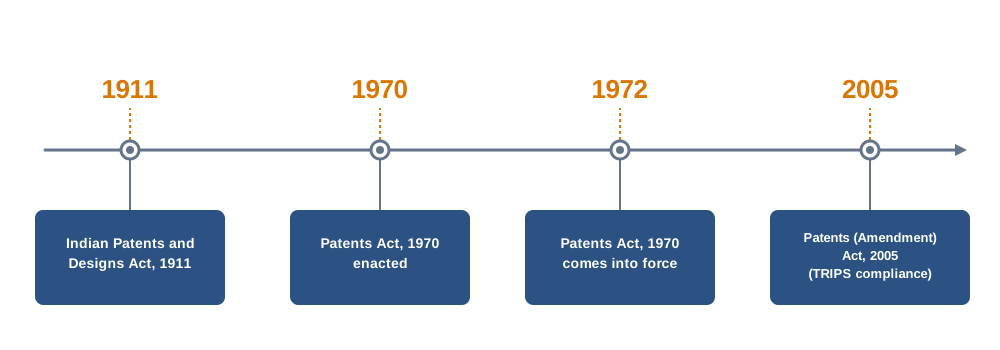
Fig. 6.2 – Timeline of Indian patent law.
The history of Patent law dates back to 1911. Around this time the Indian Patents and Designs Act, 1911 was enacted. The present act governing patents law in India, the Patents Act, 1970, came into force in 1972. It amended and consolidated the existing law relating to Patents in India.
To consolidate a law means to gather the scattered rules on a subject into one statute, so that a person looking for the law on patents has one place to look. The 1970 Act did this, and it remains the governing statute today.
The Act went through an amendment in 2005 to be compliant with the TRIPS agreement, by the Patents (Amendment) Act, 2005. Through this amendment product patent was extended to all fields of technology including food, drugs, chemicals, and micro-organisms.
That last change is the one to understand rather than memorise. Before 2005, in fields such as medicines, Indian law allowed a patent over the process by which a substance was made, but not over the substance itself. A rival manufacturer who found a different route to the same medicine could make and sell it lawfully. After 2005, the product itself could be patented, and reaching it by a different route no longer helped.
6.4 Copyright
What Copyright Protects
Copyright is a right given by the law to creators of literary, dramatic, musical and artistic works and producers of cinematograph films and sound recordings. It is a bundle of rights including rights of reproduction, communication to the public, adaptation and translation of the work.
Two things in that sentence deserve attention. The first is the list of people protected: not only authors, composers and painters, but also the producers of films and sound recordings — the persons who put together the money and organisation that made the film or the recording possible.
The second is that this protection is automatic. It arises upon creation of the work and does not depend on registration. The moment a poem is written down or a song is recorded, copyright exists in it. Nobody has to be informed, no fee has to be paid, and no office has to approve anything.
The Scope of Protection under the Copyright Act, 1957
In India, the law relating to copyright is governed by the Copyright Act, 1957. To get the protection of copyright a work must be original. Mere ideas, knowledge or concepts are not copyrightable. Having said that, copyright protects the original expression of information and ideas.
This is the single most important line in the whole of copyright law, and it repays slow reading. What the law protects is not the idea but the expression of it — the particular words, notes, lines or images in which the idea has been worked out.
Take a familiar example. The idea of a school story in which a lonely child discovers she has unusual powers belongs to nobody. A hundred writers may use it, and each is free to do so. But the sentences one of those writers actually put on the page are hers, and copying those sentences is an infringement. The idea is common property; the expression is not.
The reason for drawing the line here is not hard to see. If ideas could be owned, the first person to think of a courtroom drama or a sad love song would be able to shut everybody else out of the subject, and creation would stop rather than grow.
Copyright can be claimed by either the creator, or the person who has inherited the rights of ownership from the original creator, or an agent who is allowed to act on behalf of the creator. So the person suing over an infringement need not always be the author personally — it may be an heir who received the rights, or a publisher acting on the author’s behalf.
Work
All subject matters protected by copyright are called protected works. Section 2(y) of the Act defines ‘work’. It includes the categories shown in Fig. 6.3.

Fig. 6.3 – Categories of protected works.
Reading the definition closely tells you something useful: the categories are closed. A creation that does not fall within one of the listed kinds of work is not protected by copyright at all, however clever or valuable it may be. This is why the question “which category of work is this?” is always the first question in a copyright problem.
When Is a Work Protected by Copyright?
A work is protected by copyright when:
- it falls within the category of ‘work’ under the Act;
- the work must be recorded or fixed in material form (tangible form); and
- the work must be original.
All three conditions must be satisfied together. Failing any one of them defeats the claim, so it is worth pausing on the second and third.
Fixation in material form means the work must exist in some recorded shape — written, printed, painted, filmed, recorded, typed into a computer. A song a student hums to himself in the corridor and never writes down or records is not protected, because there is nothing fixed for the law to attach to. The moment he records it on his phone, there is.
Originality does not mean that the work must be brilliant, novel, or unlike anything before it. It means the work must have originated from the author rather than being copied from somewhere else, and that the author must have applied some skill and judgment of his own. Just how much skill and judgment is enough is a question that has come before the courts, and you will meet the leading Indian answer to it at the end of this section.
Registration of Copyright
Is it necessary to register a work to claim copyright? No. Acquisition of copyright is automatic and it does not require any formality.
However, the certificate of registration of copyright and the entries made therein serve as prima facie evidence in a court of law with reference to a dispute relating to ownership of copyright. Prima facie evidence means evidence that is accepted as sufficient to establish the fact unless it is disproved — it does not settle the matter for ever, but it puts the burden of showing otherwise on the person who disputes it.
That is the practical value of registration. Suppose two people each claim to have written the same song. Neither needed to register in order to own copyright, but the one holding a registration certificate walks into court with a dated official record of the claim, and the other must produce something better.
As for the procedure, copyright comes into existence as soon as a work is created and no formality is required to be completed for acquiring copyright. However, facilities exist for having the work registered in the Register of Copyrights.
Term of Copyright
Is copyright protected in perpetuity? No. It is protected for a limited period of time.
The general rule is that copyright lasts for 60 years. What differs between kinds of work is not the length of the term but the date from which the sixty years are counted.
- In the case of original literary, dramatic, musical and artistic works, the 60-year period is counted from the year following the death of the author.
- In the case of cinematograph films, sound recordings, photographs, posthumous publications, anonymous and pseudonymous publications, works of government and works of international organisations, the 60-year period is counted from the date of publication.
The distinction is a sensible one. Where there is a known individual author whose life the work is tied to, the term follows that life and then runs on for sixty years for the benefit of the family. Where there is no identifiable author to measure by — a film, a government report, an anonymous publication — the law needs a fixed starting point, and publication supplies it.
Rights of the Owner of a Copyright
The bundle of rights mentioned at the start of this section divides into two groups: economic rights and moral rights.
Economic Rights
Economic rights allow the rights’ owner to derive financial reward from the use of their works by others. Within this category are other rights such as the following.
- Right to reproduce the work — reproduction is an act of copying from the previously finished works or giving it a differential form by adding, editing or modifying the same. Such right shall exclusively be exercised by the owner of the work and shall not be infringed by any other person, since the act of reproduction of the work may economically make benefits to its owner.
- Right to distribute in market — the owner of the copyrighted work also has a right to distribute it in the market and make money out of it. The act of distribution may be in the form of sale, lending for free or for a consideration, rental, or free distribution by way of gift.
- Right to communication to the public — it means letting or making the product or work available to the public by way of broadcasting, simulcasting or webcasting.
- Right of adaptation — conversion, alteration, transcription or rearranging a copyrighted work means and includes the right of adaptation.
- Right to translate — the owner of the copyrighted work has a right to translate his work to any other languages.
Because each of these is a separate right, each can be dealt with separately. An author may sell the right to publish her novel in print, permit a studio to adapt it into a web series, license a radio station to broadcast a reading of it, and allow a translation into Tamil — four different arrangements, four different payments, all from one work. This is exactly what makes the bundle valuable.
Moral Rights
A moral right would stand a step ahead of an economic right. Moral rights are personal ties between an author and their work. They afford control over the creation and protect against modification or alteration, preserving the work’s integrity. They include the following.
- Right of paternity — the right of an owner of copyright to claim, and to prevent others from claiming, the ownership of his copyrighted work is said to be a right of paternity.
- Right of integrity — the right of the owner of the copyright to protect the reputation of his own work from exploitation is the right of integrity.
- Right to retraction — retraction is an act of taking back the previous assertion made.
The phrase “a step ahead of an economic right” is the key to this whole idea. Economic rights can be sold; once sold, the money is the author’s return and the buyer may exploit the work. Moral rights are different in kind. They express the fact that a work carries its maker’s name and reputation, and that connection does not end simply because the work has changed hands. The case below settled that point in India.
Why Is This Protection Required in Modern Society?
Copyright is required in modern society to provide legal protection for creators of original works, such as literature, music, software and art. This protection helps to ensure that creators are fairly compensated for their work and that their work is not used or copied without permission. Copyright also promotes creativity and innovation by giving creators the exclusive right to control the use and distribution of their works.
Copyright plays a role in stopping plagiarism by providing legal protection for original works and giving creators exclusive rights to control the use and distribution of their work. When someone is found to have plagiarized, they can be held liable for copyright infringement, which can result in legal action, fines and other consequences.
However, it is important to note that not all instances of plagiarism are necessarily copyright infringement, as copyright law only applies to original works that are fixed in a tangible form. Plagiarism and infringement are related but not identical. Plagiarism is passing off someone else’s work as your own — a wrong against honesty, dealt with by schools, universities and employers. Infringement is the use of a protected work without the owner’s permission — a wrong against the law, dealt with by courts. Copying a classmate’s unrecorded idea in a class discussion may be plagiarism without being infringement; reproducing a protected novel with full acknowledgment of the author may be infringement without being plagiarism.
How Much Originality Is Enough?
Earlier in this section, originality was described as requiring skill and judgment of the author’s own. The Supreme Court examined exactly how much is needed in the following case.
6.5 Patent
What Is a Patent?
A patent is a legal document which is issued by the government to the inventor. The patent grants an inventor absolute and exclusive ownership right over the invention, and the freedom to use and sell the invention for a stipulated time period.
Stated more fully, it is a statutory right for an invention granted for a limited period of time to the patentee by the Government, in exchange of full disclosure of his invention, for excluding others from making, using, selling or importing the patented product, or the process for producing that product for those purposes, without his consent.
The words in exchange of full disclosure describe a bargain, and the whole of patent law rests on it. An inventor who has found something new has two choices. He can keep it secret, in which case nobody can copy it but nobody can learn from it either, and the knowledge may die with him. Or he can publish it in full — explaining the invention so completely that a skilled person could work it — and in return the State gives him the exclusive right to work it for a limited period. Society gets the knowledge immediately; the inventor gets the market for a while. When the period ends, everyone may use both.
Notice also what the right actually consists of. A patent is a right to exclude others. It is not, in itself, a permission to do as one likes: a patented medicine still needs regulatory approval before it can be sold, and a patented device must still comply with safety law.
The person who holds a patent is called the patentee. Since the right is granted by a particular government, it operates only within that country’s territory — a point already met in connection with the Paris Convention’s framework of priority.
The Term of a Patent
The term of every patent granted in India is 20 years from the date of filing of the application.
Two details in that sentence are commonly missed in examinations. The first is that the term is uniform — it does not vary with the field of technology or the value of the invention. The second is that it runs from the date of filing, not from the date on which the patent is finally granted. Examination of a patent application takes time, and those years are counted within the twenty. An inventor whose application takes four years to be granted has sixteen years of protection left.
Which Act Governs the Patent System in India?
The patent system in India is governed by the Patents Act, 1970 (No. 39 of 1970) as amended by the Patents (Amendment) Act, 2005 and the Patents Rules, 2003.
The pairing of an Act with Rules is worth understanding, as the same pattern appears across this chapter. The Act lays down the substance of the law — what may be patented, for how long, and with what consequences. The Rules, made by the Government under the authority of the Act, set out the working detail — the forms, the fees, the time limits, the manner of filing. The Act is comparatively hard to change, since it requires Parliament; the Rules can be revised as administration requires.
What Can Be Patented?
Before getting an idea patented, the inventor must ensure its patentability. There are three requirements which are required to be fulfilled for an idea to qualify as a patentable matter.
- Novelty — the invention must contain one or more unique and new elements.
- Non-obviousness — simple or obvious changes to an existing invention cannot be called an invention. The invention must be a notable change in the field. The particular feature must add to existing technical knowledge, that is, in terms of uniqueness and commercial viability.
- Industrial application — the invention must have some utility. The invention is patentable if it is capable of commercialization.
These three are cumulative, not alternative. An idea that fails any one of them cannot be patented, however strongly it satisfies the other two, and this is precisely how patent problems are set in examinations.
Novelty asks a question about the world: has this been done or disclosed before, anywhere? Non-obviousness asks a question about a skilled person: granted that this exact thing is new, would a person already working in that field have arrived at it as a matter of course? Industrial application asks a question about use: can this actually be made and used, or is it merely an interesting theory?
The middle requirement is the one students find hardest, so consider it slowly. Suppose an existing bicycle has a plastic handle grip and an inventor makes the identical grip in rubber. Nobody has made that precise grip before, so it is arguably new. But a person who works with bicycles would think of trying rubber without any inventive effort at all. The change is new without being inventive, and non-obviousness is the requirement that catches it.
The purpose of patent law is to encourage scientific research, new technology, and industrial progress.
6.6 Trademark
Marks and What They Do
A ‘Mark’ is a distinguishing symbol which any person can use to exert public attention or to create some kind of impression in the minds of the people.
A trademark is a brand entity which has the capability to distinguish one’s goods and services from another person’s goods and services. That capacity to distinguish is the heart of the concept. Copyright asks whether a work is original and a patent asks whether an invention is new, but a trademark asks a quite different question — does this sign tell buyers whose goods these are?
A trademark includes a word, a design, a logo, the shape of goods, their packaging and a combination of colours, as set out in Fig. 6.4.

Fig. 6.4 – Forms of trademarks.
Trademark rights in India are statutorily protected by the Trade Marks Act, 1999.
The Function of a Trademark
A trademark performs four functions.
- It identifies the goods or services and its origin.
- It guarantees its unchanged quality.
- It advertises the goods or services.
- It creates an image for the goods or services.
These four are worth reading as the story of a single purchase. A shopper reaching for a familiar packet of biscuits knows from the mark alone who made them (identification of origin), expects them to taste as they did last month (guarantee of unchanged quality), was reminded of them by the mark on a hoarding (advertisement), and associates the mark with a certain idea of the product — dependable, premium, meant for children (image).
The second function explains why trademark law protects the public as much as the trader. If anyone could put a well-known mark on their own goods, a buyer would have no way of knowing what she was actually buying. The mark would stop carrying information, and the shopper would be the one deceived. Protecting the trader’s mark and protecting the consumer from being misled are the same act.
Who Benefits from a Trademark?
The Registered Proprietor of a trademark — that is, the person in whose name the mark stands entered in the register — can create, establish and protect the goodwill of his products or services. Goodwill is the value that attaches to a business because of its reputation among customers: the reason a buyer chooses one shop or one brand over an identical rival.
The registered proprietor can also stop other traders from unlawfully using his trademark, sue for damages, and secure destruction of infringing goods and or labels.
That last remedy is a strong one and repays a moment’s thought. Ordering the destruction of the offending goods and labels does something that damages alone cannot: it takes the imitations out of the market altogether, so they cannot resurface and continue to mislead buyers after the case is over.
Trade Name
A trade name is the official name under which a company operates and is also known as a “doing business as” name or an assumed name.
A trademark, on the other hand, is the name, symbol, logo, slogan or sound that a business uses to market its products and services. It is a unique identifier that helps consumers differentiate the products and services of one company from those of another.
Both trade names and trademarks are important elements of a company’s brand and play a crucial role in building and protecting the company’s reputation and identity.
The Difference between a Trade Name and a Trademark
A trade name does not provide brand name protection on its own, but registering it is an important step in protecting the name. A trademark provides protection for a brand name and helps to distinguish a company’s products and services from those of others.
In many cases, a company’s trade name becomes its trademark, such as the example of Google. Registering a trademark offers additional protection and helps to secure the brand’s identity.
6.7 Trade Secret
Information Kept Deliberately Out of Sight
Every form of intellectual property studied so far is obtained by telling the world something. A patent is granted in exchange for full disclosure; a trademark is registered so that buyers may see it; a copyright attaches to a work that is meant to be read, heard or watched.
A trade secret works the other way round. Its whole value lies in the fact that nobody else knows it, and it survives only for as long as that remains true.
Trade secrets can include a wide range of confidential information that is important for the success and survival of a business. This information can be in the form of strategies, designs, client databases, formulas, programs, or any other confidential information that must be kept secret to maintain the competitive advantage of the business.
A customer list built up over twenty years, the recipe for a soft drink, the pricing model a firm uses when bidding for contracts — none of these is an invention or a work of art, yet each may be worth more to the business than anything it could register.
How the Law Defines a Trade Secret
Two definitions are worth knowing, and they approach the same idea from slightly different directions.
The Trade Related Aspects of Intellectual Property Rights (TRIPs) Agreement from the same year defines trade secrets as information which is kept secret, has a commercial value, and where the owner of the information takes reasonable steps to keep it secret.
Compare the two carefully, because the difference is the point most often tested. The Indian definition looks at the information itself — is it valuable, is it out of the public domain, would disclosure hurt? The TRIPs definition adds a duty on the owner: reasonable steps must actually be taken to keep the information secret. A business that leaves its formula on an unlocked notice board cannot later complain that its secret has been stolen, because it never treated the information as a secret in the first place.
How Trade Secrets Are Protected in India
There is no specific legislation that provides protection for trade secrets in India. This is the striking feature of this branch — there is no Trade Secrets Act to place beside the Copyright Act, 1957 or the Patents Act, 1970.
Protection therefore comes from three other directions.
- Trade secrets can be protected under various provisions of different statutes, such as Section 27 of the Indian Contract Act, 1872.
- Indian courts have recognized trade secret protection based on equity principles and common law remedies for breach of confidence and breach of contract.
- Businesses include restrictive clauses in their service contracts. This helps to secure the confidentiality of the firm’s trade secrets and prevent unauthorized disclosure.
The place of Section 27 needs a word of caution, because it cuts both ways. That provision declares agreements in restraint of trade to be void. An employer therefore cannot use a contract to stop a former employee from earning a living in the same line of work. What the employer can do is bind the employee not to disclose or use the firm’s confidential information, and it is through such clauses, read alongside the law of breach of confidence, that trade secrets are enforced.
This is why the third route matters so much in practice. Where there is no statute to fall back on, the contract a business writes for its own employees becomes the main instrument of protection, and a firm that neglects to include a confidentiality clause has very little to rely on afterwards.
The last two rows explain the choice a business actually faces. A patent gives a strong right but for a limited time and at the price of publishing the invention to the world. A trade secret costs nothing to obtain and may last indefinitely, but it collapses the moment the information gets out — and it gives no remedy at all against a competitor who works the same thing out honestly for himself.
6.8 Geographical Indication
A Name That Belongs to a Place
A geographical indication (GI) is a legal designation that identifies a product as originating from a specific region or geographical location and having certain qualities, characteristics, or reputation that are unique to that place.
It is a name or sign used on certain products which corresponds to the geographic origin of the product. GI protects the product’s authenticity and quality, and helps consumers identify the product’s origin and reputation.
The relationship between objects and place becomes so well known that any reference to that place is reminiscent of goods originating there, and vice versa. That two-way association is what the law is recognising. Say the name of the place and people think of the product; see the product and people think of the place.
In India, the Geographical Indications of Goods (Registration and Protection) Act, 1999 provides for registration and better protection of geographical indications relating to goods.
Why the Place Matters
Behind every geographical indication lies a claim that the product could not simply be made anywhere. The soil, the climate, the water, the raw material available locally, or a technique passed down by craftspeople of that region give the product qualities that a factory elsewhere cannot reproduce, however carefully it copies the design.
This makes a geographical indication different in an important way from the intellectual property studied earlier in this chapter. A patent or a copyright belongs to one identified creator. A geographical indication does not belong to any single producer at all — it is held for the benefit of the whole community of producers in that region who make the goods in the traditional way. A weaver in the region may use the indication; a manufacturer outside it may not, even if the cloth looks identical.
The protection therefore works in two directions at once. It preserves the livelihood and reputation of the producers of that region, and it protects the buyer who is paying a higher price precisely because she believes the product came from there.
Examples
- Phulkari Handicraft — Punjab, Haryana, Rajasthan
- Warli Painting — Maharashtra, Gujarat, Daman & Diu
- Malabar Robusta Coffee — Kerala & Karnataka
- Darjeeling Tea — West Bengal
- Pochampally Ikkat — Telangana
Notice that some of these cover more than one State. A geographical indication follows the region in which the craft or crop actually belongs, and that region need not stop at a State boundary.
Geographical Origin
Geographical origin refers to the specific place or region where a product or item originates from. This can include the location where raw materials are sourced, where production takes place, or where a particular process or technique is used to create the product.
Geographical origin can have a significant impact on the quality, reputation, and cultural identity of a product, and is often used as a way of distinguishing and promoting products with unique characteristics and qualities. In some cases, geographical origin is also protected by intellectual property laws, such as geographical indications.
Keep the two expressions apart. Geographical origin is a fact about where a product comes from, and every product has one. A geographical indication is a legal right, and it exists only where that origin has been recognised and registered under the Act. Every registered geographical indication rests on a geographical origin; most geographical origins never become geographical indications.
6.9 Designs
What Is a Design?
Design intellectual property refers to original and unique creations of the mind that can be used commercially. The Designs Act, 2000 is the law relating to the protection of designs in India. The law helps creators earn recognition and financial benefits for their products, and also helps prevent others from using their creations without permission.
A design right protects the original and aesthetically unique appearance of a manufactured item, as long as it is new and not obvious. Shape, colour, line, pattern and the like are covered under Designs, and any design invented by a person shall be protected by Designs.
What a Design Right Does Not Cover
This type of protection only covers the ornamental aspects and does not extend to the functional or structural elements. That single sentence is the dividing line of the whole subject, and it places design law neatly between two branches you have already studied.
A patent protects how a thing works. A design protects how a thing looks. If a company invents a bottle cap that seals better than any before it, the sealing mechanism is a matter for patent law; the curved, fluted outline of the bottle is a matter for design law. The same object may attract both, but for different features.
This also explains why the law refuses protection where appearance and function cannot be separated. A design may not be eligible for registration if it lacks individual character, if it is considered offensive, or if its appearance is solely dictated by its function.
The last of these is the one worth pausing on. If a shape is the only shape in which the article could work, protecting that shape would in practice hand one manufacturer a monopoly over the function itself — and functions are the business of patent law, with its stricter conditions and its fixed term. The design register is not a shortcut around those conditions.
Grounds on Which Registration May Be Refused
The three criteria used to assess the registrability of a design, and to ensure that it meets the necessary standards for protection under intellectual property law, may be gathered together as follows.
- The design lacks individual character.
- The design is considered offensive.
- The appearance of the design is solely dictated by its function.
Examples of designs in everyday use include the design of the wrapper of a biscuit or chocolate, the design of a car, and the design of the shape of a cold drink bottle.
The last example shows how closely this branch runs alongside trademark law. The shape of goods and their packaging may serve as a trademark, as noted earlier in this chapter, but the two rights answer different questions. A design asks whether the appearance is new and original; a trademark asks whether the shape tells buyers whose goods these are. A newly launched bottle can be registered as a design on the day it is made, whereas a shape becomes a trademark only when the public has come to read it as a sign of origin.
6.10 Conclusion
Why Society Grants These Rights
Intellectual property rights are exclusive rights given to individuals for a limited time period, allowing them to exploit income from cultural expressions and inventions. Proponents of IPR provide three commonly accepted reasons for society to grant such privileges.
- When someone creates a new product, it takes a lot of time, money and effort. It is only natural for the inventor or organisation to want to own exclusive rights to the invention, so that others cannot benefit from it without permission.
- It encourages creativity and innovation by granting economic benefits to the creator.
- It promotes economic growth through competition and protection of rights.
Read together, the three reasons move outward from the individual to society. The first is about fairness to the person who did the work. The second is about what that fairness produces — more work of the same kind, because creating becomes worth the risk. The third is about the economy as a whole, where protected rights allow firms to compete on what they have actually built rather than on who can copy fastest.
Managing Intellectual Property Today
These rights are necessary to protect global intellectual property rights in today’s world. The management of intellectual property (IP) and intellectual property rights (IPR) is a complex task that requires a combination of functions and strategies, aligned with both national laws and international agreements. It can no longer be solely approached from a national perspective.
The reason should now be familiar from the earlier sections of this chapter. A right is granted country by country, but goods, films, software and brands move across borders freely. A business that protects its work only at home has protected it only at home, which is why the conventions studied in this chapter matter as much to a small Indian firm as to a multinational.
Forms of IPR can vary and require varying approaches, including specialized knowledge in areas such as science, engineering, medicine, law, finance, marketing and economics. This is one of the few branches of law in which the lawyer alone is rarely enough — assessing whether an invention is obvious needs an engineer, and valuing a brand needs an accountant.
The handling and management of these forms of IPR involve different strategies and require consideration of their social, economic, technical and political impacts. A decision about how strongly to protect medicines, seeds or software is never only a legal decision; it touches public health, farming and access to knowledge.
The Pressure of a Faster World
The rapid pace of technological advancement, globalization and intense competition have made it necessary to protect innovations through IPRs like patents, trademarks, copyrights and trade secrets.
Each of the branches named there answers a different need, and this chapter has taken them one by one — a patent for the invention, a trademark for the sign that identifies its maker, copyright for the work of literature or art, a trade secret for what is deliberately never disclosed, a geographical indication for the goods that belong to a region, and a design for the appearance of a manufactured article.
Despite these measures, infringement of intellectual property rights still occurs. Having a right is not the same as having it respected, and the gap between the two is where enforcement does its work. The government has laws in place to prevent such violations and is taking action to enforce them.
6.11 Summary
- Intellectual property is intangible property that comes into existence through human intellect, covering creations of the mind such as inventions, designs, artistic work, names, symbols and images.
- Intellectual property rights are the bundle of rights conferred by law on the creator or owner of intellectual property, usually giving an exclusive right over the use of the creation for a certain period of time.
- These rights reward the creator’s mental labour, and their main purpose is to encourage inventions and creations that promote the social, economic, scientific and cultural development of society.
- Intellectual property is divided into two categories:
- industrial property, which includes inventions (patents), trademarks, industrial designs and geographic indications of source; and
- copyright, which includes literary and artistic works such as novels, poems and plays, films, musical works, drawings, paintings, photographs, sculptures and architectural designs.
- National Treatment, the principle common to all the international instruments, requires a member country to give the nationals of other member countries the same protection it gives its own nationals.
- The Paris Convention for the Protection of Industrial Property was adopted on 20 March, 1883 and enforced on 7 July, 1884, and rests on two principles:
- National Treatment; and
- Framework of Priority, allowing an inventor to protect an invention simultaneously in various countries.
- The Berne Convention for the Protection of Literary and Artistic Works was adopted on 9 September, 1886 and came into force on 4 December, 1887, and rests on three principles:
- National Treatment;
- Automatic Protection, so that protection is not subject to any formalities; and
- Independence of Protection from protection in the country of origin.
- The Universal Copyright Convention (UCC) was established in 1952 and adheres to national treatment rather than automatic protection, expects a copyright notice to accompany the work, protects a work for the author’s lifetime and a further 25 years after death, and requires contracting countries to provide a set of minimum rights.
- The WIPO Convention was signed on July 14, 1967 in Stockholm, came into effect in 1970 and was amended in 1979; in 1974 WIPO became a specialized agency of the United Nations.
- WIPO had two primary objectives:
- to promote the legal protection of intellectual property worldwide; and
- to facilitate administrative cooperation between the intellectual property unions created by treaties administered by WIPO.
- The TRIPS Agreement was negotiated at the end of the Uruguay Round of the GATT treaty in 1994 and came into effect on 1 January 1995; it is the most comprehensive multilateral agreement on intellectual property and aims at harmonizing and strengthening standards of protection and providing effective enforcement.
- As a signatory to TRIPS, India has enacted the Trade Marks Act, 1999, the Designs Act, 2000, the Copyright Act, 1957 (as amended), the Patents Act, 1970 (as amended), the Geographical Indications of Goods (Registration and Protection) Act, 1999 and the Protection of Plant Varieties and Farmers’ Rights Act, 2001.
- Indian patent law began with the Indian Patents and Designs Act, 1911; the Patents Act, 1970 came into force in 1972 and was amended in 2005 for TRIPS compliance, extending product patents to all fields of technology including food, drugs, chemicals and micro-organisms.
- Copyright is the bundle of rights given by law to creators of literary, dramatic, musical and artistic works and to producers of cinematograph films and sound recordings, and it arises automatically on creation without any need for registration.
- In India copyright is governed by the Copyright Act, 1957, under which a work must be original; mere ideas, knowledge or concepts are not copyrightable, but the original expression of information and ideas is protected.
- Copyright can be claimed by the creator, by a person who has inherited the rights of ownership, or by an agent allowed to act on behalf of the creator.
- Section 2(y) of the Copyright Act, 1957 defines ‘work’ to include literary, dramatic, musical and artistic works, cinematograph films and sound recordings.
- A work is protected by copyright only when all three conditions are satisfied:
- it falls within the category of ‘work’ under the Act;
- it is recorded or fixed in material form; and
- it is original.
- Registration of copyright is not necessary, but the certificate of registration and the entries in the Register of Copyrights serve as prima facie evidence in a court of law in a dispute about ownership.
- Copyright is not perpetual; the general rule is a term of 60 years, counted:
- from the year following the death of the author, in the case of original literary, dramatic, musical and artistic works; and
- from the date of publication, in the case of cinematograph films, sound recordings, photographs, posthumous publications, anonymous and pseudonymous publications, works of government and works of international organisations.
- The economic rights of a copyright owner allow financial reward from the use of the work by others, and include the right to reproduce the work, the right to distribute it in the market, the right of communication to the public, the right of adaptation and the right to translate.
- The moral rights of an author stand a step ahead of economic rights and include the right of paternity, the right of integrity and the right to retraction.
- In Amarnath Sehgal v. Union of India, 117 (2005) DLT 717, the Delhi High Court held that moral rights cannot be taken away from the author even if the work is sold, and that destroying or altering the work violates those rights.
- In Eastern Book Company & Others v. D.B. Modak & Another, AIR 2008 SC 809, the Supreme Court held that the publisher’s own inputs into reported judgments required skill and judgment in great measure and were protected by copyright, thereby settling the standard of originality in India.
- Not all plagiarism is copyright infringement, because copyright law applies only to original works that are fixed in a tangible form.
- A patent is a statutory right granted by the Government to an inventor for a limited period, in exchange for full disclosure of the invention, excluding others from making, using, selling or importing the patented product or the process for producing it without the patentee’s consent.
- The term of every patent granted in India is 20 years from the date of filing of the application.
- The patent system in India is governed by the Patents Act, 1970 (No. 39 of 1970), as amended by the Patents (Amendment) Act, 2005, and the Patents Rules, 2003.
- An idea qualifies as patentable matter only if it satisfies all three requirements:
- novelty, meaning the invention contains one or more unique and new elements;
- non-obviousness, meaning it is a notable change in the field and not a simple or obvious change to what already exists; and
- industrial application, meaning it has utility and is capable of commercialization.
- The purpose of patent law is to encourage scientific research, new technology and industrial progress.
- A trademark is a brand entity capable of distinguishing one person’s goods and services from another’s, and includes a word, design, logo, shape of goods, packaging and combination of colours; trademark rights in India are protected by the Trade Marks Act, 1999.
- A trademark performs four functions:
- it identifies the goods or services and their origin;
- it guarantees unchanged quality;
- it advertises the goods or services; and
- it creates an image for the goods or services.
- The Registered Proprietor of a trademark can create, establish and protect the goodwill of his products or services, stop other traders from unlawfully using the mark, sue for damages and secure destruction of infringing goods and labels.
- A trade name is the official name under which a company operates and does not by itself provide brand name protection, whereas a trademark protects the brand name and distinguishes the company’s products and services from those of others; a trade name may also become the company’s trademark.
- A trade secret is any information with commercial value which is not available in the public domain and the disclosure of which would cause significant harm to the owner, as recognised by the Delhi High Court in Burlington Home Shopping Pvt. v. Rajnish Chibber, 1995 (35) DRJ 335.
- The TRIPs Agreement defines a trade secret as information which is kept secret, has commercial value, and in respect of which the owner takes reasonable steps to keep it secret.
- There is no specific legislation protecting trade secrets in India; they are protected under provisions such as Section 27 of the Indian Contract Act, 1872, through equity principles and common law remedies for breach of confidence and breach of contract, and through restrictive clauses in service contracts.
- A geographical indication identifies a product as originating from a specific region and having qualities, characteristics or a reputation unique to that place; the Geographical Indications of Goods (Registration and Protection) Act, 1999 provides for its registration and better protection in India.
- Examples of geographical indications include Phulkari Handicraft (Punjab, Haryana, Rajasthan), Warli Painting (Maharashtra, Gujarat, Daman & Diu), Malabar Robusta Coffee (Kerala & Karnataka), Darjeeling Tea (West Bengal) and Pochampally Ikkat (Telangana).
- Geographical origin is the place or region a product comes from, including where raw materials are sourced, where production takes place or where a particular process is used, and in some cases it is also protected by intellectual property laws such as geographical indications.
- The Designs Act, 2000 protects the original and aesthetically unique appearance of a manufactured item, covering shape, colour, line and pattern, but only its ornamental aspects and not its functional or structural elements.
- A design may not be eligible for registration if it lacks individual character, is considered offensive, or if its appearance is solely dictated by its function.
- Three commonly accepted reasons are given for society granting intellectual property rights:
- creating a new product takes time, money and effort, so the creator should own exclusive rights to it;
- it encourages creativity and innovation by granting economic benefits to the creator; and
- it promotes economic growth through competition and protection of rights.
- Intellectual property management can no longer be approached from a purely national perspective, and despite the laws in place, infringement of intellectual property rights still occurs.
6.12 Key Terms
Intellectual property — intangible property that comes into existence through human intellect, covering creations of the mind such as inventions, designs, artistic work, names, symbols and images.
Intangible property — property that has no physical body, so that what is owned is the creation itself and not the object in which it happens to be recorded.
Intellectual property rights (IPR) — the bundle of rights conferred by law on the creator or owner of intellectual property.
Bundle of rights — a set of separate rights over one creation, each of which can be kept, licensed or sold independently of the others.
Exclusive right — the right of the owner to use the creation and to keep everybody else out of that use, granted for a certain period of time.
Industrial property — the branch of intellectual property covering inventions (patents), trademarks, industrial designs and geographic indications of source.
Copyright — the bundle of rights given by law to creators of literary, dramatic, musical and artistic works and to producers of cinematograph films and sound recordings, arising automatically on creation.
National Treatment — the principle that a member country must give the nationals of other member countries the same legal protection it gives to its own nationals.
Framework of Priority — the Paris Convention principle allowing an inventor to protect an invention simultaneously in various countries.
Automatic Protection — the Berne Convention principle that legal protection is not subject to compliance with any formalities.
Independence of Protection — the Berne Convention principle that protection in one contracting state does not depend on the existence of protection in the country of origin of the work.
Minimum Rights — the set of rights the UCC requires contracting countries to provide to the lawful owner of a work, provided they do not conflict with the spirit of the convention.
World Intellectual Property Organisation (WIPO) — the organisation established by the WIPO Convention of 1967 to promote the legal protection of intellectual property worldwide and to facilitate cooperation between the intellectual property unions.
TRIPS Agreement — the Trade-Related Aspects of Intellectual Property Rights Agreement, in effect from 1 January 1995, the most comprehensive multilateral agreement on intellectual property.
Product patent — a patent over the substance or product itself, as distinct from a patent over the process by which it is made; extended in India to all fields of technology by the 2005 amendment.
Work — the subject matter protected by copyright, defined by Section 2(y) of the Copyright Act, 1957 to include literary, dramatic, musical and artistic works, cinematograph films and sound recordings.
Originality — the requirement that a work must have originated from the author through his or her own skill and judgment, rather than being copied from another source.
Fixation in material form — the requirement that a work must be recorded in some tangible shape before copyright can attach to it.
Prima facie evidence — evidence accepted as sufficient to establish a fact unless it is disproved, which is the effect given to a certificate of registration of copyright.
Register of Copyrights — the official register in which a work may optionally be entered, though copyright itself arises without registration.
Economic rights — the rights that allow a copyright owner to derive financial reward from the use of the work by others, namely reproduction, distribution, communication to the public, adaptation and translation.
Moral rights — the personal rights an author retains in the work independently of the economic rights, comprising paternity, integrity and retraction.
Right of paternity — the right of the owner of copyright to claim ownership of the work and to prevent others from claiming it.
Right of integrity — the right of the owner of copyright to protect the reputation of the work from exploitation.
Right to retraction — the right to take back a previous assertion made.
Plagiarism — passing off another person’s work as one’s own, which may or may not amount to copyright infringement.
Patent — a statutory right granted by the Government to an inventor for a limited period, in exchange for full disclosure of the invention, to exclude others from making, using, selling or importing it without consent.
Patentee — the person to whom a patent has been granted.
Novelty — the requirement that an invention must contain one or more unique and new elements.
Non-obviousness — the requirement that an invention must be a notable change in the field and not a simple or obvious change to what already exists.
Industrial application — the requirement that an invention must have utility and be capable of commercialization.
Mark — a distinguishing symbol used to attract public attention or create an impression in the minds of people.
Trademark — a mark capable of distinguishing one person’s goods and services from another’s, including a word, design, logo, shape of goods, packaging or combination of colours.
Registered Proprietor — the person in whose name a trademark stands registered, entitled to protect its goodwill and to act against unlawful use.
Goodwill — the value that attaches to a business because of its reputation among customers.
Trade name — the official name under which a company operates, also called a “doing business as” or assumed name.
Trade secret — any information with commercial value which is not available in the public domain and the disclosure of which would cause significant harm to its owner.
Geographical indication (GI) — a name or sign identifying goods as originating from a particular region and possessing qualities, characteristics or a reputation unique to that place.
Geographical origin — the specific place or region a product comes from, including where its raw materials are sourced, where it is produced, or where the technique used to make it belongs.
Design — the new and original ornamental appearance of a manufactured article, covering shape, colour, line and pattern but not its functional or structural elements.
6.13 Points to Ponder
Copyright protects the expression of an idea but never the idea itself. What would happen to writers, film-makers and musicians if the law had drawn that line the other way?
A patent is granted in exchange for full disclosure of the invention. Is this a fair bargain from society’s point of view, and who gains more from it — the inventor or the public?
Copyright in a literary work lasts for sixty years after the author’s death. Is such a long term necessary to reward the author, or does it mainly benefit those who inherit or buy the right?
Moral rights stay with the author even after the work has been sold. Should a person who has paid for a painting or a sculpture be free to do as he likes with the object he owns?
India has no separate statute for trade secrets, and protection depends largely on the contract a business writes for its employees. Does this leave employees at a disadvantage, and what would a dedicated law need to balance?
A geographical indication belongs to a community of producers rather than to any one person. What difficulties can arise when a right has no single owner to assert it?
Downloading a film without paying is an infringement, yet it is done routinely by people who would never take a book from a shop. Why does the law’s authority weaken when the property is intangible?
Intellectual property rights are granted country by country, while goods, films and software move across borders freely. Is a national system of protection still workable, and what does that mean for a small Indian business?
Traditional knowledge — a herbal remedy, a weaving technique, a recipe — often has no identifiable inventor and no date of creation. Which of the branches studied in this chapter, if any, is well suited to protecting it?
Every intellectual property right keeps others out for a period of time in order to encourage creation. If a right were made permanent, would creation increase or stop?
6.14 Textbook Questions
What is meant by Intellectual Property? Why does intellectual property need to be promoted and protected?
Discuss the concept of National Treatment and its evolution through the various international Conventions on Intellectual Property Rights.
Describe Copyright and the works protected under the Copyright Act, 1957.
You are an author who has written a novel in Hindi. The novel has become immensely popular, and now podcasters, serial producers and YouTubers are trying to adapt the story to be telecast on various forms of media. There are also some authors who want to translate your novel into English. Discuss how you will negotiate in this situation, given the economic rights you hold as a copyright owner.
There was a recent dispute between the States of Odisha and West Bengal over the origin of the ever-popular sweet dish ‘Rasgulla’. Both States argued that the ‘Rasgulla’ had been invented in their respective States. However, the Registrar of the Chennai GI office gave the GI tag to the Banglar Rasogulla of West Bengal. This caused a rift between the States, as both were competing to get the GI tag for rasgulla for their respective States. In light of the above case, discuss:
- What rights does a geographical indication provide? How would Odisha be adversely affected by the order of the Chennai GI office?
- For which types of products can GI tags be used?
Valganciclovir hydrochloride is a medicine that is stable when stored in solid form under normal conditions. The applicant tried to make a liquid form of the medicine, but it was unstable for the required shelf life. The applicant therefore focused on a powder form that could be mixed with water to make a liquid form. The powder form was very similar to the solid form, and the patent claim was rejected. Discuss why the patent claim was rejected, in view of the essential ingredients of a successful patent claim.
6.15 Objective Questions
The term of every patent granted in India is:
- 14 years from the date of grant
- 20 years from the date of filing of the application
- 20 years from the date of grant
- 60 years from the date of publication
‘Work’ is defined under which provision of the Copyright Act, 1957?
- Section 2(a)
- Section 2(o)
- Section 2(y)
- Section 13
The Paris Convention for the Protection of Industrial Property was adopted on:
- 20 March, 1883
- 7 July, 1884
- 9 September, 1886
- 4 December, 1887
Which principle of the Berne Convention states that legal protection shall not be subject to compliance with any formalities?
- National Treatment
- Automatic Protection
- Independence of Protection
- Framework of Priority
Under the Universal Copyright Convention, protection for a work lasts for the author’s lifetime and a further:
- 10 years
- 25 years
- 50 years
- 60 years
The WIPO Convention was signed in 1967 at:
- Paris
- Berne
- Geneva
- Stockholm
The TRIPS Agreement came into effect on:
- 1 January 1994
- 1 January 1995
- 14 July 1967
- 1 April 2005
Which of the following is a moral right of an author?
- Right to reproduce the work
- Right of integrity
- Right to translate
- Right to distribute in market
In the case of a cinematograph film, the 60-year term of copyright is counted from:
- the year following the death of the producer
- the date of registration
- the date of publication
- the date the film was completed
Which of the following is NOT one of the three requirements of patentability?
- Novelty
- Non-obviousness
- Industrial application
- Registration in the Register of Copyrights
Trademark rights in India are statutorily protected by:
- the Designs Act, 2000
- the Trade Marks Act, 1999
- the Copyright Act, 1957
- the Patents Act, 1970
In India, trade secrets are protected mainly through:
- a dedicated Trade Secrets Act
- registration with the Registrar of Trade Secrets
- provisions such as Section 27 of the Indian Contract Act, 1872, equity principles and contractual clauses
- the Geographical Indications of Goods (Registration and Protection) Act, 1999
Pochampally Ikkat is a registered geographical indication of:
- West Bengal
- Telangana
- Kerala
- Maharashtra
A design may be refused registration if:
- it is new
- its appearance is solely dictated by its function
- it consists of a pattern of colours
- it is applied to a manufactured article
The Patents Act, 1970 came into force in the year:
- 1911
- 1970
- 1972
- 2005
Assertion (A): It is not necessary to register a work in order to claim copyright in it. Reason (R): Copyright is acquired automatically as soon as the work is created, and registration only serves as prima facie evidence of ownership.
Assertion (A): The term of a patent in India runs from the date on which the patent is granted. Reason (R): Examination of a patent application takes time, and the years spent in examination are not counted against the patentee.
Assertion (A): A person who thinks of the plot of a school story cannot stop another writer from using the same plot. Reason (R): Copyright does not protect mere ideas, knowledge or concepts, but only the original expression of information and ideas.
Assertion (A): A trade name enjoys exactly the same protection as a trademark. Reason (R): A trade name is the official name under which a company operates and is also known as a “doing business as” name.
Assertion (A): A geographical indication cannot be assigned to a manufacturer outside the region it names. Reason (R): The right rests on the link between the goods and the place they come from, and is held for the benefit of the producers of that region.
Assertion (A): An author who has sold his sculpture can still object if the buyer mutilates it. Reason (R): Moral rights are personal to the author and are not lost merely because the work has been sold.
6.16 Check Your Concepts
Why does copyright protect the expression of an idea but not the idea itself? What would happen to writers and film-makers if the rule were reversed?
A student composes a tune in his head and hums it every day for a month, but never writes it down or records it. Is it protected by copyright? Give reasons.
State the three conditions that must all be satisfied before a work is protected by copyright.
Identify the provision of the Copyright Act, 1957 that defines ‘work’, and list the categories of work it includes.
Distinguish between the economic rights and the moral rights of a copyright owner.
Correct the error in the following statement and explain your correction: “An author must register her work in the Register of Copyrights before she can claim copyright in it.”
If registration is not compulsory, why do authors and publishers still register their works?
Why is copyright granted for a limited period rather than in perpetuity?
Explain why the sixty-year term is counted from the year following the author’s death in the case of a novel, but from the date of publication in the case of a sound recording.
Distinguish between plagiarism and copyright infringement, giving one example of conduct that amounts to one but not the other.
What standard of originality did the Supreme Court apply in Eastern Book Company & Others v. D.B. Modak & Another, AIR 2008 SC 809, and why did the copyright not extend to the text of the judgments themselves?
A sculptor sells a sculpture to a buyer, who later cuts it into pieces to fit a new location. Which right of the sculptor is in question, and does the sale defeat it?
State the three requirements of patentability, and explain why an idea that satisfies two of them still cannot be patented.
Arrange in order the questions an inventor must ask when testing whether an idea is patentable, and state what happens if the idea fails at the first of them.
Why is the twenty-year term of a patent counted from the date of filing rather than from the date of grant?
Explain the bargain that lies behind the grant of a patent. What does the inventor give, and what does society receive?
A manufacturer changes the plastic handle of an existing tool to a rubber handle and applies for a patent. Which requirement of patentability is likely to defeat the claim, and why?
Correct the error in the following statement and explain your correction: “A patent granted in India entitles the patentee to stop others from selling the invention anywhere in the world.”
Why was the extension of product patents to all fields of technology in 2005 significant for medicines?
Distinguish between a patent and a trade secret on the basis of disclosure, duration, and the effect of independent discovery by a competitor.
State the four functions of a trademark, and explain which of them protects the buyer rather than the trader.
Why is the remedy of destruction of infringing goods and labels considered stronger than an award of damages alone?
Distinguish between a trade name and a trademark, and explain how a trade name may also become a trademark.
What happens to a business that treats information as valuable but takes no steps to keep it secret? Answer with reference to the way a trade secret is defined.
Explain how Section 27 of the Indian Contract Act, 1872 both assists and limits an employer who wishes to protect the firm’s confidential information.
Why is there a greater need for well-drafted service contracts in the case of trade secrets than in the case of patents or copyright?
Distinguish between a trademark and a geographical indication on the basis of who may use the right and whether it can be transferred.
Why does a geographical indication protect the buyer as well as the producers of the region?
Distinguish between geographical origin and a geographical indication. Does every product with a geographical origin have a geographical indication?
Why is a design refused registration when its appearance is solely dictated by its function? What would follow if such designs were registrable?
The same cold drink bottle may involve a patent, a design and a trademark. Identify which feature of the bottle each of these three rights would protect.
Why does the principle of National Treatment appear in the Paris Convention, the Berne Convention and the Universal Copyright Convention alike?
An inventor files a patent application in India and intends to file in three other countries over the next few months. How does the Framework of Priority assist her, and what problem would she face without it?
Distinguish between the Berne Convention and the Universal Copyright Convention on the question of formalities.
Why did intellectual property protection become a subject of the world trading system through the TRIPS Agreement, rather than remaining only with the earlier conventions?
6.17 Case-Based Questions
- Ishita, a Class XII student, writes a long poem and posts it on her blog on 3 March. A coaching institute prints the poem in a booklet it sells to its students, naming Ishita as the author at the foot of the page. It does not ask her permission and does not pay her anything. When she objects, the institute replies that she never registered her poem anywhere, that it has given her full credit, and that in any case she is a school student and not a professional writer.
- Is Ishita’s poem protected by copyright, and from what moment? Deal specifically with the institute’s argument about registration.
- Does naming her as the author answer her complaint? Distinguish plagiarism from infringement in your answer.
- Which of Ishita’s economic rights has the institute used?
- Would your answer change if Ishita had only recited the poem aloud at a school function and never written it down or recorded it? Give reasons.
- A team of engineering students designs a low-cost solar dryer for farmers. In April they demonstrate the working model at a public science fair, and a local newspaper carries a full description of how it works, including the drawings the team supplied. In September the team applies for a patent. During examination, an objection is raised. The team argues that nobody else has ever built the dryer and that they are the original inventors.
- Which requirement of patentability is in difficulty here, and why does being the original inventor not answer the objection?
- If a patent were eventually granted in December of the following year, from which date would the twenty-year term be counted?
- The team hopes to sell the dryer in a neighbouring country as well. Explain why an Indian patent would not assist them there, and which international principle addresses this problem.
- “Anand Mithai Bhandar” has sold sweets in a town for forty years under a registered trademark consisting of its name in a distinctive orange script inside an oval. A new shop opens two streets away, registers itself as a company under the name “Anand Sweets and Snacks Private Limited”, and paints its board in the same orange script inside the same oval shape. Customers begin walking into the new shop believing it to be a branch of the old one, and complain to the old shop when the sweets disappoint them.
- Which function of a trademark has been defeated here, and how is the buying public affected?
- Distinguish between the new shop’s trade name and the old shop’s trademark. Does registering the company name give the new shop the right to use the script and the oval?
- State the remedies available to the Registered Proprietor of the older mark.
- Would your answer change if the new shop used its own name in an entirely different script, colour and get-up? Give reasons.
- Meera works for a firm that supplies packaged spices to hotels. Over six years she builds up a list of the firm’s hotel clients, their order patterns and the discounts each is given. The list is kept on a shared office computer that has no password, and copies are freely printed and left on desks. Meera resigns and joins a competitor, taking a copy of the list with her. Her contract with the old firm contained a clause saying she would not work in the spice trade anywhere in India for five years after leaving, but said nothing about confidential information.
- Would the client list qualify as a trade secret? Answer with reference to both the definitions of a trade secret studied in this chapter, and say which of them the firm’s own conduct makes difficult to satisfy.
- Is the five-year clause enforceable against Meera? Refer to Section 27 of the Indian Contract Act, 1872.
- What clause should the firm have included instead, and why would it stand on a different footing?
- The weavers of a particular district have made a distinctive silk cloth for generations, using a technique passed down within the community and yarn dyed with local water that gives the cloth its characteristic sheen. The name of the district has become the name of the cloth. A large mill in another State begins producing a machine-made cloth of the same pattern and sells it under the district’s name at half the price. A trader in the district also asks the weavers’ association to sell it the exclusive right to use the name.
- What is a geographical indication, and why is this cloth a suitable subject for one?
- Can the mill in the other State lawfully use the district’s name on its cloth? Give reasons.
- Can the weavers’ association sell the exclusive right to the trader? Explain how this differs from the position of a trademark proprietor.
- How are buyers of the cloth affected by the mill’s conduct?
- A furniture company launches a table lamp. Its base is a hollow cone, chosen by the designer purely because she liked the look of it, since any number of shapes would have held the lamp equally well. Inside the lamp is a newly developed switch that dims the light by sensing the movement of a hand. A rival company begins selling a lamp with an identical cone base but an ordinary switch, and markets it with a printed catalogue that reproduces, word for word, the description the first company wrote for its own website.
- Which right protects the cone base, and which protects the dimming switch? Explain the difference between what each right covers.
- Would the cone base still be registrable if the cone were the only shape in which the lamp could stand upright? Give reasons.
- What is the legal position regarding the catalogue description copied from the website?
6.18 Landmark Cases & Maxims
State the principle settled by the Delhi High Court in Amarnath Sehgal v. Union of India, 117 (2005) DLT 717, and explain what it establishes about the position of an author after the work has been sold.
Which decision settled the standard of originality required for copyright protection in India? State the standard in your own words and name the court that laid it down.
State the definition of a trade secret that comes from Burlington Home Shopping Pvt. v. Rajnish Chibber, 1995 (35) DRJ 335, and identify the three elements it contains.
A State government commissions a well-known artist to paint a mural in a public building. Years later, the building is redecorated and the mural is painted over without informing the artist. Which authority studied in this chapter governs the artist’s complaint, and what would he have to establish?
A publisher prepares an edition of High Court judgments, adding its own paragraph numbering, cross-references and notes on which judges concurred and which dissented. A rival reproduces the whole edition, including those additions, and argues that judgments belong to the public. Which authority governs this dispute, and how far does the publisher’s copyright extend?
A person formerly associated with a mail-order business sets up a competing venture and uses a copy of the old firm’s customer database. Which authority governs this situation, and on what basis was relief granted in that case?
Identify the Act that governs each of the following:
- the logo painted on a bakery’s delivery van;
- a newly invented water purifier;
- a variety of coffee named after the region where it is grown;
- the ornamental shape of a perfume bottle; and
- a screenplay written for a film.
Match the case in Column A with the principle it settled in Column B.
| Column A | Column B |
|---|---|
| a. Amarnath Sehgal v. Union of India | i. Confidential information of commercial value, kept out of the public domain, is protected |
| b. Eastern Book Company & Others v. D.B. Modak & Another | ii. Moral rights survive the sale of the work and are violated by its destruction or alteration |
| c. Burlington Home Shopping Pvt. v. Rajnish Chibber | iii. Originality requires the exercise of skill and judgment, not mere mechanical labour |
- Two of the three decisions studied in this chapter were given by the Delhi High Court and one by the Supreme Court. Name each case, name the court, and state in one line what each contributed to Indian intellectual property law.