Chapter 9: Criminal Laws in India
It is close to two in the morning. Two young men are standing in a narrow lane outside a locked electronics showroom. One of them is holding a torch and a short iron rod. The shutter has not been touched. There is no broken lock, no missing stock, no damage of any kind. A constable on night patrol notices them, asks a few questions he is not satisfied with, and takes them to the police station.
At the station, one of them sits with his head down and mutters to his friend, “We should never have come here at all.” A constable standing a few feet away hears him say it.
Now think about what a court would have to decide. Has any crime been committed here? Nothing was taken and nothing was broken. Does carrying a rod and standing outside a shop at night, by itself, make a person guilty of something? Suppose one of them says he came only because he badly needed money for his mother’s treatment — does that reason change his legal position? And what about that muttered sentence the constable overheard? Is it a confession the court can act on, or merely an unhappy remark made by a frightened boy?
Criminal law has a worked-out answer to every one of these questions.

Fig. 9.0 – The difference between preparation and an attempt.
You cannot answer these questions yet. By the end of this chapter, you will be able to answer every one of them.
9.1 What Do We Understand by Crime?
The word ‘crime’ points to an unlawful act — an act that the law forbids and for which the state can punish the person who does it.
Crime as a concept is so broad that there is no single, universally accepted definition of it. Lawyers, judges and writers have offered many, and none of them covers every situation neatly. For the sake of convenience, therefore, several countries take a different route: instead of defining crime in the abstract, they provide statutory definitions of various kinds of unlawful activities, each of which can then be identified as a crime.
This leads to a common principle that runs through criminal law everywhere. Unless an activity is prohibited by law, it does not qualify as a crime. An act may be selfish, dishonest or deeply unpopular, but if no law in force forbids it, no court can convict anyone for it. Notice how much this principle protects you: it means a person can be punished only for breaking a rule that already existed and could be known in advance.
Why a Crime Is Treated as a Wrong Against the State
Incidents of crime hurt not only the individual who suffers them, but also the state. A theft in a market is a loss to the shopkeeper, but it is also a blow to the ordinary confidence on which every shopkeeper in that market depends. That wider injury is the reason such acts are forbidden and punishable by law, and the reason the case is brought by the state rather than left to the victim to pursue alone.
The body of laws which deal with imposing punishments on crimes is known as Criminal Law. It is this body of law that tells us which acts are forbidden, and what follows for the person who commits them.
9.2 Objectives of Criminal Law
Punishment is the sharpest power the state holds over an individual, so it needs a reason. Asking what punishment is for is not a philosophical luxury — it decides how long a sentence should be, whether a first-time offender should go to prison at all, and whether the victim gets anything back.
As the social structure has changed, society has witnessed a series of punishment theories, and these theories have undergone radical changes from the traditional to the modern level, carrying with them some crucial problems. The writer Kenny made the point bluntly: the theories of criminal punishment current among our judges and legislators have never settled into a form that could be called either coherent or even stable. Different theories are pulled out at different moments, and they do not always agree with one another.
The anthropologist Malinowski approached the same question from another direction. In his view, every legally effective institution works as a means of cutting short an illegal or intolerable state of affairs, of restoring the equilibrium in social life, and of giving vent to the feelings of oppression and injustice felt by individuals. Punishment, on this view, is society’s way of closing a wound and settling an unbalanced situation before it spreads.
Five objectives are widely accepted for the enforcement of criminal law by punishments: retribution, deterrence, incapacitation, rehabilitation and restoration. These objectives vary across jurisdictions — different countries, and even different statutes within one country, lean on different objectives.
Retribution: Righting the Balance
This theory basically deals with the ‘righting of balance’. If a criminal has done a wrong towards a person or property, he needs to be given a penalty in a manner which balances out the wrong done. For example, if a person has committed murder, he can be delivered capital punishment to balance out the suffering caused to the victim and his or her family.
The reasoning here looks backwards, at what was already done, rather than forwards at what the punishment might achieve. That is also the standing objection to it: the balance it speaks of cannot really be measured, and a sentence fixed by it does nobody any future good.
Deterrence: Preventing the Next Offence
Deterrence serves as a major tool in maintaining the general law and order in society, especially from the perspective of crime. Criminal acts are penalised so as to deter individuals from repeating them, or even from entering into them in the first place.
Notice that deterrence works on two audiences at once. It is aimed at the offender, so that he does not do it again, and at everybody else watching, so that they do not begin. This is why the certainty of being caught matters as much as the severity of the sentence — a harsh punishment that is almost never imposed deters very little.
Incapacitation: Separating the Offender
The objective of this theory is to segregate criminals from the rest of society. For the crimes committed, they suffer a kind of banishment by staying in prisons, and in some cases they are also subject to capital punishment.
The aim is simple and practical: a person who is removed from ordinary society cannot commit further offences within it. Nothing in this theory is concerned with changing the offender — only with keeping others out of his reach.
Rehabilitation: Reforming the Offender
Rehabilitation aims at transforming an offender into a valuable member of society. Its primary goal is to prevent further offence by convincing the offender that their conduct was wrong.
This objective explains a great deal of what happens after conviction — prison education, vocational training, counselling, and probation for young or first-time offenders. It treats the sentence as a period of work on the person, not merely as time taken away from him.
Restoration: Repairing the Victim’s Loss
This is a victim-oriented theory of punishment. The goal is to repair, through state authority, any injury inflicted upon the victim by the offender. For example, one who embezzles will be required to repay the amount improperly acquired.
Restoration is commonly combined with other main goals of criminal justice, and it is closely related to concepts in the civil law — that is, returning the victim to his or her original position before the injury. It is the only one of the five objectives that asks what the person who suffered actually receives at the end of the case.
Ignorance of the Law Is No Excuse
One rule runs underneath all five objectives, and it surprises students the first time they meet it. If a wrongdoer says that he was ignorant of the consequences of the act done by him, he would not be excused. Everybody is supposed to know the law of the land. A lack of knowledge, or a mistake about what the law required, does not excuse the act, and liability arises in such cases all the same.
The reason is practical rather than harsh. If not knowing the law were a defence, the person who took care to find out what the law said would be worse off than the person who never bothered, and the state would have to prove what was inside each accused person’s head about the statute book before it could prove anything else.
9.3 The Principal Criminal Laws of India
Criminal law in India is not contained in a single book. It is broadly covered by the following legislations:
- the Indian Penal Code, 1860;
- the Criminal Procedure Code, 1973;
- the Indian Evidence Act, 1872.
These three do different jobs, and it helps to see the division of labour before studying any of them closely, as set out in Fig. 9.1.
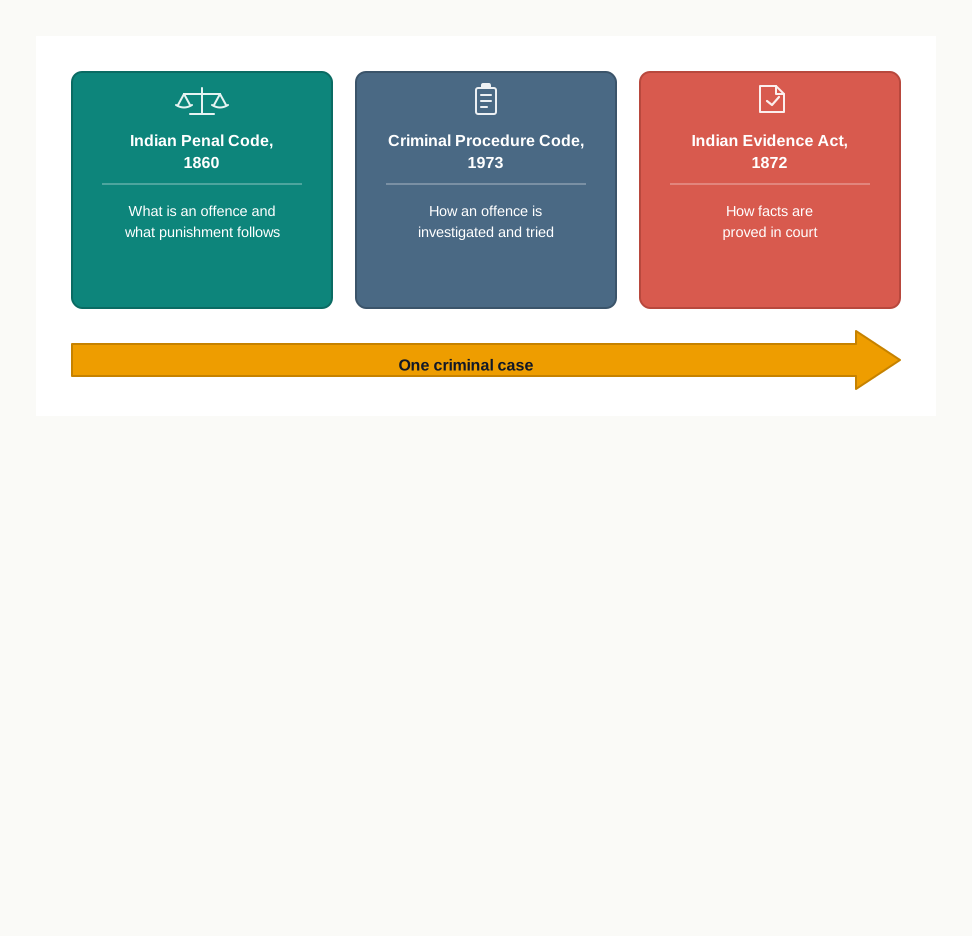
Fig. 9.1 – The principal criminal laws of India.
The Indian Penal Code tells us what is forbidden. It defines offences such as murder, theft and assault, and fixes the punishment for each. The Criminal Procedure Code tells us how the state proceeds against a person accused of one of those offences — the route from investigation to trial. The Indian Evidence Act tells us what can be used as proof along the way, and how the court is to be satisfied of a fact.
A single case runs through all three. The offence a person is charged with comes from the Penal Code; the manner in which he is investigated, arrested and tried comes from the Criminal Procedure Code; and whether a particular statement or document can be placed before the judge at all is decided by the Evidence Act. Each of the three is taken up in turn in the sections that follow.
9.4 Fundamental Elements of a Crime
Every crime is built out of two elements:
- mens rea, or guilty intention;
- actus reus, or the illegal act or omission.
To be classified as a crime, the act of doing something bad (actus reus) must usually be accompanied by the intention to do something bad (mens rea). A crime is said to exist usually when both these elements are present. Fig. 9.2 shows how the two fit together.
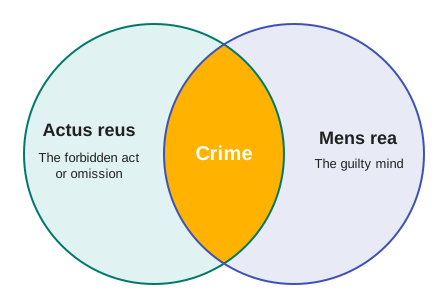
Fig. 9.2 – The fundamental elements of a crime.
The principle behind both elements is embedded in a Latin maxim: actus non facit reum nisi mens sit rea. It means that an act does not make one guilty unless the mind is also legally blameworthy. In other words, for a physical act to be termed a crime, it must be accompanied by the necessary mental element. Unless this mental element is present, no act is usually criminal in nature. So all crimes have a physical element and a mental element, usually called actus reus and mens rea respectively.
Read that maxim carefully, because it cuts both ways. A guilty mind with no act is not a crime, and an act with no guilty mind is usually not a crime either. The prosecution has to establish both.
What Is Actus Reus?
The word actus connotes a ‘deed’, which is a physical result of human conduct. The word reus means ‘forbidden by law’. Put together, actus reus in common parlance means a ‘guilty act’.
It is made up of three constituent parts:
- an action or a conduct;
- the result of that action or conduct;
- such act or conduct being prohibited by law.
Therefore, one can say that actus reus is an act which is bad or prohibited, blameworthy or culpable. The third part is the one students most often forget, and it is the one that decides most difficult cases.
Now, there are certain unique situations when the act in itself may appear to be a criminal act, and yet it cannot be termed actus reus. An executioner’s job is to hang — there is no actus reus. An army man kills as a part of his duty — again, no actus reus. In each case the first two parts are present: there is conduct, and there is a result as grave as a death. What is missing is the third part. The law does not prohibit that conduct in those circumstances; it authorises it. Without the third part, the physical element of a crime is simply not made out.
Does Actus Reus Include Omissions?
An omission is nothing but inaction, or not doing something. The question is whether merely failing to act can supply the physical element of a crime. The Penal Code answers it directly.
Section 32 of the Indian Penal Code clarifies that acts which may be considered as crime include “illegal omissions”. But mere moral omissions of not doing something would not complete the requirement of actus reus.
The word doing the work in that section is illegal. An omission becomes illegal when the person was under a legal duty to act — a duty arising from his job, his office, or a relationship the law recognises. Where there is no such duty, there may well be a moral failing, but there is no actus reus, and therefore no crime.
What Is Mens Rea?
Mens rea generally means ‘ill intention’, a guilty mind or intent. Its constituents are:
- there must be a mind at fault, or an intention, to constitute a crime;
- the act becomes criminal when the actor does it with a guilty mind.
The same physical act can therefore fall on either side of the line depending on the state of mind behind it. Causing injury to an assailant in self-defence is not a crime; but the moment injury is caused with the intent to take revenge, the act becomes criminal. The blow may look identical to a witness. The law does not treat it as identical.
Therefore, for any crime to exist, the physical element of crime needs to be complemented by the mental element.
The concept of mens rea evolved in England during the 17th century. During this period, the judges began to hold that an act alone could not create criminal liability unless it was accompanied by a guilty state of mind.
In India, the word mens rea, as such, is not defined in the Indian Penal Code, but its essence is reflected in almost all the provisions of the Code. You will see it in the words the Code uses — dishonestly, fraudulently, voluntarily, knowingly, with intent. Each of these is a description of a state of mind that the prosecution must establish. For framing a charge for an offence under the Penal Code, the traditional rule of the existence of mens rea is to be followed.
When a Statute Excludes Mens Rea
This rule has been reiterated by the Supreme Court of India in the case below — but the same case also marks out the important exception to it.
The Court’s reasoning is worth stating in full, because students often take the case to mean the opposite of what it says. The Court said that even though mens rea is an essential requirement to commit a crime, the statutory provision can nevertheless exclude the mental element. The express words of the statute can exclude mens rea as an essential ingredient of the crime. This may be done for various reasons — for instance, to promote public welfare and activities, or to eradicate social evils. Where a statute imposes strict liability in this way, the effect is to place the burden of care on the person himself, so that his own caution assists the state in enforcing the law.
Two conditions are worth noting for exam purposes. The exclusion must be absolutely clear, and it must be necessary to save the object of the statute. A court will not read mens rea out of an offence merely because proving intention is inconvenient for the prosecution.
9.5 Distinction between Intention and Motive
As we have seen, intention — the mental element — is one of the foremost requirements in order to make someone liable for a crime. But a common misconception is that motive and intention are the same concepts when it comes to crime. They are not, and the difference decides real cases. It is therefore important to understand the fine distinction between these two terms.
What “Intentionally” Means in Criminal Law
The meaning of doing an act intentionally in criminal law is something that is done wilfully, and not accidentally or mistakenly. The person doing the act is well aware of the consequences or the outcomes of his action or omission. That is all that is required for affixing criminal liability.
It does not matter, as we say in ordinary language, whether an act was done with good intent or bad intent. If the act which is prohibited (actus reus) is done wilfully, knowingly, or with awareness of the resulting consequences, then the same will cause liability in criminal law.
This is a narrower idea than the one the word carries in daily speech. When a student says “I didn’t intend any harm”, she usually means she wished no one ill. Criminal law is not asking about her wishes. It is asking whether she meant to do the act, and whether she knew what would follow from it.
Motive: The Reason Behind the Act
Motive, on the other hand, is the ulterior objective behind doing an act. It is the driving force behind intention or the commission of an act. Where intention asks what did the person mean to do, motive asks why did he want to do it at all.
The criminal law does not take motive into account in affixing criminal liability or in determining criminal culpability. This is the reason why the criminal law does not care whether one has stolen a loaf of bread to feed a starving person, or stolen medicine to save someone’s life, as long as it is a prohibited act, done knowingly.
That sounds severe, and in a sense it is meant to be. If motive could excuse an act, every accused person would arrive in court with a sympathetic explanation, and the same offence would be a crime for one person and not for another depending on how moving his story was. Motive is not ignored altogether, though. It is relevant as evidence — it helps explain why a particular person would have done the act, and it often forms part of the prosecution’s story. What it cannot do is convert a prohibited act into a lawful one, or a lawful act into an offence.
In board examinations this distinction is most often tested as a “distinguish between” question, or hidden inside a case-based problem where the fact pattern gives the accused a sympathetic reason for acting. The mark is earned by saying plainly that the reason is motive, that motive is not an ingredient of the offence, and then going on to test intention separately.
9.6 Stages of Crime
Any crime has a few key stages to it. Ordinarily, the first two stages — intention and preparation — do not give rise to any form of criminal liability. This implies that merely having an intention to commit a criminal act is not punishable, nor is making preparation for the same. Liability in criminal law arises when one goes beyond the stage of preparation and attempts to do the forbidden act.
That threshold is the single most important idea in this section. Everything before it is, as a rule, outside the reach of the criminal law; everything from it onwards is inside.
Intention
The first stage in committing a crime is to have criminal intent, and this is known as the mental stage. The law does not take notice of an intention: a mere intention to commit an offence, not followed by any act, cannot constitute an offence.
The obvious reason for not prosecuting the accused at this stage is that it is very difficult for the prosecution to prove the guilty mind of a person. There is nothing to point to — no conduct, no object bought, no step taken. A legal system that punished intention alone would have to convict people on the strength of what others believed they were thinking.
Preparation
The second stage refers to arranging all the essential steps to carry out the intended criminal act. Preparation is not unlawful in itself, since it is difficult to prove that the essential preparations were made for the commission of the crime. Buying a knife, hiring a vehicle or studying a building’s layout are all perfectly lawful acts in themselves, and the same acts are consistent with a dozen innocent explanations.
However, in some exceptional circumstances, mere preparation is also punished.
Preparation When Punishable
When the offence is regarded as a serious offence, preparation to commit offences is penalised under the Indian Penal Code. A few of them are mentioned below:
- collecting arms etc., with intention of waging war against the Government of India (Section 122 of IPC);
- preparing Indian coins or Government stamps for counterfeiting (Sections 233 to 235, 255, and 257 of IPC);
- possession of counterfeit coin, counterfeit Government stamp or false weight or measure (Sections 242, 243, 259, 266 of IPC);
- making preparations to commit dacoity (Section 399 of IPC).
Look at what these four have in common. In each, the harm that would follow if the plan succeeded is so grave, or so hard to undo, that the law does not wait for the attempt. Waging war against the state, corrupting the currency and organised dacoity are all offences where the state’s interest is in stopping the plan early rather than punishing it late.
Attempt
The third stage in the conduct of a crime is “attempt”, and it is punishable. Criminal liability arises only when the crime has reached the stage which has gone beyond preparation and has entered into the domain of attempt.
Section 511 of the IPC does not define the term “attempt”, although it does impose a penalty for attempting to commit an offence. The working test the courts use is the one the base idea suggests: after making the necessary preparations, an attempt is a direct step towards the commission of a crime.
The words direct step are doing the work. Preparation arranges the means; attempt begins to use them. A person who buys a duplicate key has prepared; a person who puts that key into the lock of another’s house has taken a direct step, and has attempted.
Commission of the Crime
Committing the crime is the final step in the process. If the accused succeeds in his attempt, he commits a crime and will be found guilty of it. If he fails, he will only be charged with attempting. If the crime is complete, the offender will be tried and punished as per the specific provisions provided in the Indian Penal Code.
Notice that success and failure change the charge, not the guilt. The person who tried and failed is not innocent; he is guilty of an attempt, which the Code punishes in its own right.
How the Penal Code Is Organised
As mentioned above, the Indian Penal Code covers the substantial part of criminal law in India. It defines various common criminal offences — murder, theft, assault and a number of others — and also stipulates appropriate punishments for each offence. For instance, the offence of “theft” is defined in Section 378 of the IPC, and the punishment for it in the section that follows.
In other words, a crime of theft is committed if someone intends to take someone else’s property and indeed takes that property without the other person’s consent. Merely intending to take somebody’s property, without actually going ahead with the act, does not amount to theft.
That last sentence is the stages of crime appearing inside a single definition, which is why theft is such a useful offence to learn the stages on.
Different crimes carry different punishments according to the severity of the offence. For instance, the punishment for murder is either death or life imprisonment.
This is the way that most of the IPC is organised: first, a definition of an offence is provided, and next the punishment for that offence is stipulated. Once you see that pattern, a great many sections of the Code become easier to read, because you know what each one is trying to do.
9.7 Crimes under Special and Local Laws
Certain acts are to be considered criminal acts even when they are not to be found in the Indian Penal Code. This is because they have been identified as crimes in Special and Local Laws.
The Penal Code was written to cover the general run of wrongdoing — offences against the person, against property, against public order. It was never meant to cover every activity the state might later need to regulate. As new dangers and new industries appeared, Parliament and the State Legislatures dealt with them through separate statutes, each carrying its own offences and punishments. A special law is one made for a particular subject, such as narcotics or arms; a local law applies only to a particular area or State.
An illustrative list of such statutes is given below.
- Arms Act, 1959;
- Narcotic Drugs & Psychotropic Substances Act, 1985;
- Gambling Act, 1867;
- Excise Act, 1944;
- Prohibition Act;
- Explosives Act, 1884 and Explosive Substances Act, 1908;
- Immoral Traffic (Prevention) Act, 1956;
- Railways Act, 1989;
- Registration of Foreigners Act, 1930;
- Protection of Civil Rights Act, 1955;
- Indian Passport Act, 1967;
- Essential Commodities Act, 1955;
- Terrorist & Disruptive Activities (Prevention) Act;
- Antiquities & Art Treasures Act, 1972;
- Dowry Prohibition Act, 1961;
- Child Marriage Restraint Act, 1929;
- Indecent Representation of Women (Prohibition) Act, 1986;
- Copyright Act, 1957;
- Sati Prevention Act, 1987;
- SC/ST (Prevention of Atrocities) Act, 1989;
- Forest Act, 1927;
- other crimes not specified above under Special and Local Laws, including cyber laws under the Information Technology Act, 2000.
Read down that list and you will notice how varied the subjects are — weapons, drugs, forests, antiquities, dowry, caste-based atrocities, copyright, online conduct. What holds them together is not the kind of harm involved but the drafting choice behind them: in each case the legislature decided that the subject needed a statute of its own rather than a few more sections in the Penal Code.
Two practical points follow from this, and both matter for answering questions. First, an act can be a crime in India without appearing anywhere in the Penal Code, so “it is not in the Code” is never a complete answer to whether something is an offence. Second, when you are asked to identify the provision that governs a fact situation, look first at the subject matter — if it involves a firearm, a controlled substance, protected forest produce or an online communication, the governing law is likely to be one of these special statutes rather than the Code.
9.8 The Criminal Procedure Code, 1973
The object of the Criminal Procedure Code is to provide a mechanism for the investigation and trial of offenders.
It lays down the rules for the conduct of investigation into offences by the police, and for proceedings in court against any person who has committed an offence under any criminal law — whether it is the Indian Penal Code or a crime classified under any other law. You have already met the outline of this machinery in Part I of Legal Studies in Class XI.
Think of the difference this way. The Penal Code tells a police officer that a particular act is an offence. The Criminal Procedure Code tells him what he may then do about it — whether he can arrest without a warrant, how the investigation must be recorded, which magistrate the accused must be produced before, and which court will finally try the case. Without it, the Penal Code would be a list of prohibitions with no way of enforcing any of them.
Types of Offences Covered
All such offences are covered by the Criminal Procedure Code as are mentioned in the Indian Penal Code. As already seen, the legal meaning of an act, and whether an act will constitute a criminal offence or not, is provided in the Penal Code. The procedure for initiating a proceeding or prosecution for a criminal offence is provided in the Criminal Procedure Code.
The Code provides the manner and the place where the investigation, inquiry and trial of an offence shall take place. Those three words are not interchangeable, and it is worth separating them now: investigation is what the police do to collect the material; inquiry is what a magistrate does short of a trial; trial is the proceeding that ends in conviction or acquittal.
The Burden of Proof and the Golden Thread
Most accused persons do not lead defence evidence in India. Students often find this surprising — surely a person accused of a crime would want to prove his innocence? The reason lies in where the law places the burden.
In India, the burden is cast on the prosecution to prove the offence, and the degree of proof required in a criminal trial is “proof beyond reasonable doubt”. This is quite a high standard that the prosecution must meet. It is not enough for the prosecution to assert that the accused has committed the offence. The judge must be convinced beyond reasonable doubt that it was in fact the accused who committed the offence.
Because the burden sits there and never shifts on its own, an accused person does not have to prove anything at all. He can simply test the prosecution’s case and argue that it falls short. This was known as the “golden thread principle of criminal law”, and the idea is currently recognised in the criminal law of several common law nations, including the United Kingdom, Canada, South Africa, the United States of America, and India.
While the presumption of the accused’s innocence is a long-standing principle enshrined in common law and upheld by Indian law as well, it is worth noting that it is not expressly stated in any statute. It is an accepted concept in Indian criminal law rather than a written rule.
Reverse Onus Clauses
Jurists have developed a rebuttal to the presumption of innocence, under which an accused may be presumed guilty at first instance and the burden of proof is on the defence to establish the accused’s innocence, or to raise a reasonable doubt as to his guilt. Reverse onus clauses shift the burden of proof from the prosecution to the defendant when the prosecution has shown certain essential facts.
Read the second half of that definition carefully, because it is the condition that makes such a clause workable. The burden does not begin with the accused. The prosecution must first establish the basic facts the statute specifies; only then does the burden move across. A reverse onus clause is a shift in the middle of a trial, not a presumption of guilt from the start.
When the Presumption of Innocence Is Displaced
There are certain categories of infractions to the existence of the golden rule. In certain situations, the burden of proof is placed on the accused to present evidence supporting his innocence, or to raise a plausible doubt about his guilt. The accused is prima facie considered guilty — that is, guilty on the face of it, unless he shows otherwise.
In India, the presumption of innocence is overturned in two situations:
- when a specific statute explicitly reverses the burden of proof;
- when the accused files an appeal against a lower court’s decision — because at that stage he stands convicted, and the assumption he argues against is one of guilt rather than of innocence.
Dowry death is the most well-known instance of a reverse onus provision in our country. In dowry death cases, the accused is believed to be in a guilty mental state, establishing a presumption of guilt rather than the ordinary presumption of innocence.
The reason the law makes this exception is worth stating plainly, and it also shows what triggers the provision. Deaths of this kind happen inside a household, where the only people who know what took place are the very people who would be accused. If the ordinary burden applied, the prosecution would almost never be able to prove what happened behind a closed door. The provision therefore requires the prosecution to establish the surrounding facts first, and only then asks the accused to explain. It is an exception built for a situation where the evidence lies entirely on one side.
9.9 The Indian Evidence Act, 1872
The Indian Evidence Act stipulates how facts can be proved through evidence. The function of the law of evidence is to lay down rules according to which the facts of a case can be proved or disproved before a court of law. The Evidence Act lays down the rules of evidence for the purposes of the guidance of the courts.
This is the third of the three questions a criminal case raises. The Penal Code asks what the offence is, the Criminal Procedure Code asks how the case is to be conducted, and the Evidence Act asks what the court may actually look at before deciding.
The Evidence Act helps the judges to separate the ‘wheat from the chaff’, and plays a crucial role in the establishment of facts during the court proceedings. What evidence can be admitted, how it can be admitted, and how the burden of proof has to be discharged are all matters governed by the Evidence Act.
The Three Foundational Principles
The main principles which form the foundation of the law of evidence are:
- evidence must be confined to the matter at hand;
- hearsay evidence must not be admitted;
- best evidence must be given in all cases.
Each of these is doing a job, and it is worth knowing which. The first keeps a trial from wandering — a court hears what bears on the dispute before it and nothing else, however interesting the rest may be. The second excludes hearsay, which means a witness repeating what somebody else told him rather than what he himself saw or heard; such a statement cannot be tested by cross-examining the person who originally said it, so the law will not usually receive it. The third requires that the best available proof of a fact be produced — the original document rather than a copy of it, the eyewitness rather than the person the eyewitness spoke to.
One of the main objectives of the Evidence Act is to prevent inaccuracy in the admissibility of evidence, and to introduce a more correct and uniform rule of practice. A judge in one district and a judge in another must apply the same rules about what may be placed before them, or the outcome of a case would depend on where it happened to be tried.
How the Act Is Arranged
The Act is divided into three parts:
- Part I — relevancy of facts, or what facts may or may not be proved. These are dealt with in detail in Sections 5 to 55.
- Part II — how the relevant facts are to be proved. This part deals with matters which need not be proved under law, and also with how facts-in-issue or relevant facts are proved through oral and documentary evidence (Sections 56 to 100).
- Part III — by whom and in what manner the evidence must be produced. It deals with the procedure for the production of evidence and the effects of evidence (Sections 101 to 167).
The order is logical rather than arbitrary. Before a court can ask how a fact is to be proved, it must first know whether that fact is one the law allows to be proved at all — and only after both questions are settled does it matter who must bring the proof into court. The sections that follow take up one part of this scheme in detail: admissions and confessions, which belong to Part I.
9.10 Admission and Confession
Ordinarily the law is cautious about what one person says about another. It is far less cautious about what a person says against himself. People do not usually invent facts that damage their own case, so a statement of that kind carries a weight the law is willing to act on. The Evidence Act deals with such statements in two overlapping categories: admissions, and the narrower and graver category of confessions.
Sections 17 to 31 deal with admission generally, and include Sections 24 to 30, which deal with confession as distinguished from admission. Notice the arrangement before going further: the confession sections sit inside the block of admission sections. That placement is not an accident, and it decides how the two terms relate to each other.
What Is an Admission?
Section 17 of the Indian Evidence Act defines that an admission is a statement, either oral or documentary or contained in electronic form, which suggests an inference as to:
- any fact in issue, or
- a relevant fact.
Three things in that definition repay attention. The statement may be spoken, written, or held in electronic form — so a message typed into a phone qualifies as readily as a signature on a document. It need not admit anything outright; it is enough that it suggests an inference. And what it points to must be a fact in issue or a relevant fact — a stray remark about something the case does not turn on is not an admission at all.
Admissions are not confined to criminal cases. In fact they are most commonly met in civil proceedings, where a party’s own earlier statement about a boundary, a payment or a term of an agreement is put to him in court.
What Is a Confession?
The word “confession” appears for the first time in Section 24 of the Indian Evidence Act. This section comes under the heading of Admission, so it is clear that confessions are merely one species of admission.
The term “confession” is not defined in the Evidence Act. The definition courts and writers have relied on is the one given by Justice Stephen in his Digest of the Law of Evidence: a confession, he wrote, is an admission made at any time by a person charged with a crime, which either states that he committed the crime or suggests that inference.
So every confession is an admission, but not every admission is a confession. The relationship is one of genus and species: admission is the wider class, and confession is the particular kind of admission that is made by an accused person and points to his own guilt. This is why the word “admission” is the more comprehensive of the two terms, and why the Act could place the confession sections under the admission heading without any confusion.
The difference matters enormously in practice, because a confession is treated far more strictly. A statement that merely helps the other side is one thing; a statement by which a person hands the state its case against him is another, and the law surrounds it with safeguards.
Two rows in that table are the ones examiners return to. The fourth explains why a confession must be free and voluntary before a court will act on it — nothing that is conclusive proof can be allowed in on doubtful terms. The sixth is the only situation in which one person’s statement can be used against another in the same trial, and even that is confined to co-accused being tried together for the same offence.
9.11 Forms of Confession
A confession may occur in many forms. When it is made to the court itself, it will be called a judicial confession; and when it is made to anybody outside the court, it will be called an extra-judicial confession. The classification is set out in Fig. 9.3.
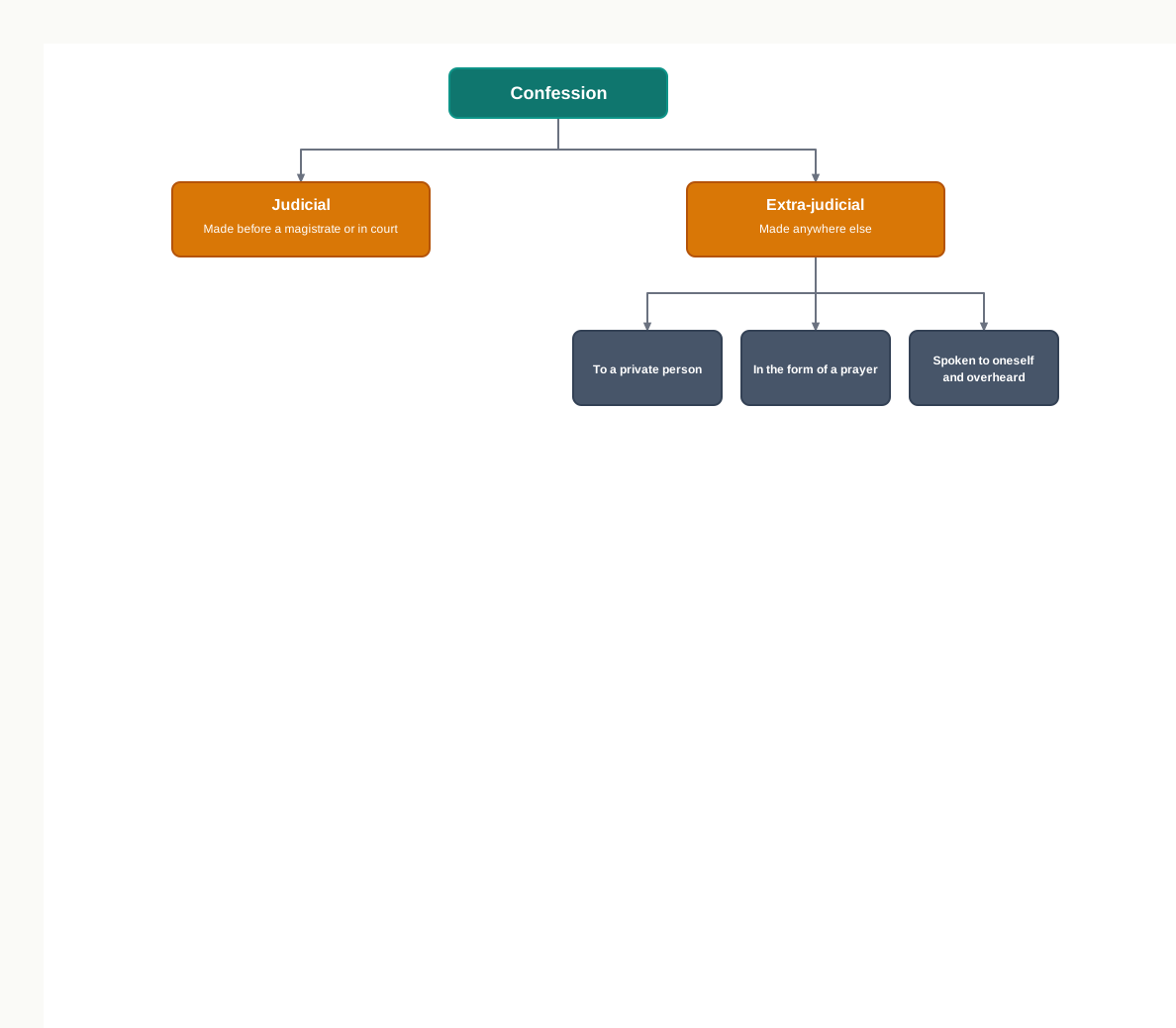
Fig. 9.3 – Forms of confession.
Judicial Confessions
Judicial confessions are made before a magistrate or in court, in the due course of legal proceedings. A judicial confession has been defined to mean a plea of guilty on arraignment, made before a court, if it is made freely by a person in a fit state of mind.
Every word in that definition is a safeguard. The confession must be made before a court, so there is a record of it. It must be made freely, so that a confession extracted by pressure counts for nothing. And it must come from a person in a fit state of mind, so that a person who is confused, frightened out of his senses or otherwise not in control of himself is not taken at his word.
Extra-Judicial Confessions
Extra-judicial confessions are made by the accused elsewhere than before a magistrate or in court. It is not necessary that the statements should have been addressed to any definite individual. It may have taken place in the form of a prayer. It may be a confession to a private person.
An extra-judicial confession has been defined to mean a free and voluntary confession of guilt, by a person in a fit state of mind, accused of a crime, made in the course of conversation with persons other than the judge or magistrate seized of the charge against him.
For example, a man after the commission of a crime may write a letter to his relative or friend expressing his grief over the matter. This may amount to a confession.
The category stretches further than most students expect. A confession may even consist of conversation to oneself, which may be produced in evidence if it is overheard by another.
Extra-judicial confession can be accepted, and can be the basis of a conviction, only if it passes the tests of credibility as laid down in the procedural laws. This is the practical difference between the two forms. A judicial confession is made on the record, before an authority whose duty is to check that it is voluntary. An extra-judicial confession comes to the court second-hand, through a witness who says he heard it — and the court must first satisfy itself that the words were really said, really understood, and really voluntary.
9.12 Dying Declaration
A dying declaration is a legal concept that refers to the statement which is made by a dying person explaining the circumstances of his death. It is a statement by a person who is conscious and knows that death is imminent, concerning what he believes to be the cause or the circumstances of his death.
The reason the law receives such a statement at all takes some explaining. You have already seen that hearsay is normally excluded, because the person who originally spoke cannot be cross-examined. A dying declaration is hearsay by that test — the one witness who could describe what happened is the very person who has died. The law makes an exception because of a belief about human nature: a dying declaration is considered credible and trustworthy evidence, based upon the general belief that most people who know that they are about to die “do not lie”. A person with nothing left to gain has little reason to invent.
Section 32 of the Indian Evidence Act deals with the admissibility of dying declarations. It deals with cases in which a statement of relevant fact, by a person who is dead or cannot be found and so on, is relevant. The first of those cases is the one that concerns us.
Two features of that provision are easy to read past and are regularly examined.
First, the statement may relate either to the cause of death or to any of the circumstances of the transaction which resulted in death. The second limb is much wider than first — it can take in what was happening before the fatal act, and why.
Second, the statement is relevant whether or not the maker was under an expectation of death at the time. This surprises students who have been told that a dying declaration is a statement by someone who knows he is dying. Under Section 32 that awareness is not a condition of relevance, and the declaration remains relevant whatever the nature of the proceeding in which the cause of death comes into question.
The Evidentiary Value of a Dying Declaration
If a conviction can rest on the words of a person who is not there to be questioned, the court’s scrutiny has to do the work that cross-examination would otherwise have done.
From that scrutiny, two requirements follow:
- the court must be satisfied that the deceased was in a fit state of mind to make the statement, that he had a clear opportunity to observe and identify his assailants, and that he was making the statement without any influence;
- once the court is satisfied that the dying declaration is true and voluntary, it can be sufficient to found the conviction even without any further corroboration.
Read those two together and the structure becomes clear. The conditions in (a) are the gate; (b) is what lies beyond it. A declaration that passes the gate needs nothing added to it.
The General Propositions
The courts have laid down the following general propositions on dying declarations:
- if the dying declaration is coherent, consistent and trustworthy, and appears to have been made voluntarily, a conviction can be based on it even if there is no corroboration;
- each case must go by its own facts;
- a dying declaration is not a weaker kind of evidence than any other piece of evidence;
- a dying declaration which has been properly recorded by a competent magistrate, in the form of questions and answers, and as far as practicable in the words of the maker of the declaration, is reliable.
Proposition (c) is the one to hold on to. A dying declaration is not a second-class substitute for live testimony that a court accepts reluctantly. It is ordinary evidence, weighed like any other — with the single difference that the checks a cross-examination would have supplied must instead be applied by the judge before acting on it. Proposition (d) explains why courts prefer a magistrate’s record: questions and answers show what the declarant was asked, and recording his own words keeps the statement from being smoothed into somebody else’s language.
9.13 Summary
- A crime is an unlawful act that is prohibited by law and made punishable by the state.
- There is no single, universally accepted definition of crime, so several countries instead provide statutory definitions of particular unlawful activities.
- Unless an activity is prohibited by law, it does not qualify as a crime, however wrong it may appear.
- A crime injures not only the individual victim but the state as well, which is why such acts are forbidden and punished by law.
- Criminal Law is the body of laws which deals with imposing punishments on crimes.
- Five objectives are widely accepted for the enforcement of criminal law by punishments, and these vary across jurisdictions:
- retribution — righting the balance for the wrong done;
- deterrence — discouraging the offender and others from committing offences;
- incapacitation — segregating the offender from the rest of society;
- rehabilitation — transforming the offender into a valuable member of society;
- restoration — repairing, through state authority, the injury inflicted on the victim.
- The maxim ignorantia juris non excusat means that ignorance of the law is no excuse, because everybody is supposed to know the law of the land.
- Criminal law in India is broadly covered by three legislations:
- the Indian Penal Code, 1860, which defines offences and their punishments;
- the Criminal Procedure Code, 1973, which provides the mechanism for investigation and trial;
- the Indian Evidence Act, 1872, which lays down how facts are proved in court.
- A crime is made up of two fundamental elements — actus reus, the illegal act or omission, and mens rea, the guilty intention.
- The maxim actus non facit reum nisi mens sit rea means that an act does not make one guilty unless the mind is also legally blameworthy.
- Actus reus is made up of three constituent parts:
- an action or a conduct;
- the result of that action or conduct;
- such act or conduct being prohibited by law.
- Where the law authorises the conduct, there is no actus reus — an executioner who hangs, or an army man who kills as part of his duty, commits no offence.
- Section 32 of the Indian Penal Code provides that words referring to acts extend also to illegal omissions, so an omission can supply the physical element of a crime.
- A merely moral omission does not complete the requirement of actus reus; the omission must be illegal, which means the person was under a legal duty to act.
- Mens rea means a guilty mind, and its constituents are that there must be a mind at fault, and that the act becomes criminal when the actor does it with a guilty mind.
- Mens rea is not defined in the Indian Penal Code, but its essence is reflected in almost all the provisions of the Code.
- In State of Maharashtra v. Mayer Hans George, AIR 1965 SC 722, the Supreme Court held that mens rea can be excluded from a statute by necessary implication only where it is absolutely clear that the object of the statute would otherwise be defeated.
- Intention means doing an act wilfully, and not accidentally or mistakenly, with awareness of its consequences; motive is the ulterior objective or reason behind the act.
- Criminal law does not take motive into account in affixing criminal liability, so a good reason for a prohibited act does not make it lawful.
- Establishing a sufficient motive is not a prerequisite for conviction, since many offences are committed without any known or prominent motive.
- A crime passes through four stages — intention, preparation, attempt and commission.
- Intention and preparation ordinarily give rise to no criminal liability; liability begins when the accused goes beyond preparation and attempts the forbidden act.
- For certain serious offences, mere preparation is itself punished under the Indian Penal Code:
- collecting arms with the intention of waging war against the Government of India (Section 122);
- preparing Indian coins or Government stamps for counterfeiting (Sections 233 to 235, 255 and 257);
- possession of counterfeit coin, counterfeit Government stamp or false weight or measure (Sections 242, 243, 259 and 266);
- making preparations to commit dacoity (Section 399).
- Section 511 of the Indian Penal Code does not define “attempt”, but imposes a penalty for attempting to commit an offence; an attempt is a direct step towards the commission of a crime.
- If the accused succeeds in his attempt he is guilty of the completed offence; if he fails, he is charged only with the attempt.
- The Indian Penal Code is organised so that a definition of an offence is given first, and the punishment for it next — as with theft, defined in Section 378 and punished under Section 379.
- Certain acts are crimes even though they are not found in the Indian Penal Code, because they have been identified as crimes in Special and Local Laws such as the Arms Act, 1959 and the Narcotic Drugs & Psychotropic Substances Act, 1985.
- The object of the Criminal Procedure Code is to provide a mechanism for the investigation and trial of offenders, and it provides the manner and place where investigation, inquiry and trial shall take place.
- The burden of proving the offence lies on the prosecution, and the degree of proof required in a criminal trial is proof beyond reasonable doubt — the golden thread principle of criminal law.
- A reverse onus provision shifts the burden of proof from the prosecution to the accused, once the prosecution establishes a fundamental truth that justifies the shift.
- The presumption of innocence is not expressly stated in any statute but is an accepted concept in Indian criminal law, and it is displaced in two situations:
- where a specific statute explicitly reverses the burden of proof;
- where the accused appeals against a lower court’s decision, since he then stands convicted.
- Dowry death is the best-known instance of a reverse onus provision in India.
- The Indian Evidence Act lays down the rules according to which the facts of a case may be proved or disproved before a court.
- The main principles forming the foundation of the law of evidence are:
- evidence must be confined to the matter at hand;
- hearsay evidence must not be admitted;
- best evidence must be given in all cases.
- The Indian Evidence Act is divided into three parts — relevancy of facts (Sections 5 to 55), how relevant facts are to be proved (Sections 56 to 100), and by whom and in what manner evidence must be produced (Sections 101 to 167).
- Section 17 of the Indian Evidence Act defines an admission as a statement, oral or documentary or contained in electronic form, which suggests an inference as to any fact in issue or relevant fact.
- The word “confession” first appears in Section 24 of the Indian Evidence Act and is nowhere defined in the Act; a confession is an admission by a person charged with a crime, stating or suggesting the inference that he committed it.
- A confession is only one species of admission, which is why “admission” is the more comprehensive term.
- A free and voluntary confession may be accepted as conclusive proof of the matters confessed, whereas admissions are not conclusive proof of the matters admitted.
- A confession always goes against the person making it, while an admission may be used on behalf of the person making it.
- By virtue of Section 30, the confession of an accused person is relevant against all his co-accused who are being tried with him for the same offence.
- A confession made before a magistrate or in court is a judicial confession; one made anywhere else is an extra-judicial confession.
- An extra-judicial confession need not be addressed to any definite person, may take the form of a prayer, and may even consist of words spoken to oneself and overheard.
- In Sahoo v. State of U.P., AIR 1966 SC 40, it was held that communication to another person is not necessary for the relevancy of a confession.
- An extra-judicial confession can form the basis of a conviction only if it passes the tests of credibility laid down in the procedural laws.
- A dying declaration is a statement made by a person, since deceased, as to the cause of his death or the circumstances of the transaction which resulted in it, and is trusted on the belief that a person who knows he is about to die does not lie.
- Section 32 of the Indian Evidence Act governs the admissibility of dying declarations, and such statements are relevant whether or not the maker was under expectation of death when he made them.
- In K. Ramachandra Reddy and Anr. v. The Public Prosecutor, AIR 1976 SC 1994, it was held that a dying declaration, not being made on oath or open to cross-examination, requires the strictest scrutiny, and the court must guard against tutoring, prompting or imagination.
- The court must be satisfied that the deceased was in a fit state of mind, had a clear opportunity to observe and identify his assailants, and made the statement without any influence.
- Once the court is satisfied that a dying declaration is true and voluntary, it can found a conviction even without further corroboration, and it is not a weaker kind of evidence than any other.
9.14 Key Terms
Crime — an unlawful act that is prohibited by law and made punishable by the state.
Criminal Law — the body of laws which deals with imposing punishments on crimes.
Retribution — the theory of punishment that seeks to right the balance by imposing a penalty proportionate to the wrong done.
Deterrence — the theory of punishment that penalises criminal acts so as to discourage the offender and others from committing them.
Incapacitation — the theory of punishment that seeks to segregate the offender from the rest of society.
Rehabilitation — the theory of punishment that aims at transforming an offender into a valuable member of society.
Restoration — the victim-oriented theory of punishment, which seeks to repair through state authority the injury inflicted on the victim.
Ignorantia juris non excusat — the maxim that ignorance of the law is no excuse, since everybody is supposed to know the law of the land.
Actus reus — the guilty act: an action or conduct, its result, and the prohibition of that act or conduct by law.
Mens rea — the guilty mind or ill intention with which a prohibited act is done.
Actus non facit reum nisi mens sit rea — the maxim that an act does not make one guilty unless the mind is also legally blameworthy.
Illegal omission — a failure to act by a person who was under a legal duty to act, which can supply the physical element of a crime.
Strict liability — liability imposed by a statute that has excluded mens rea, so that the act alone is punishable.
Intention — doing an act wilfully and not accidentally or mistakenly, with awareness of its consequences.
Motive — the ulterior objective or reason that drives a person to act, which is not an ingredient of any offence.
Preparation — the second stage of crime, in which the essential steps for the intended criminal act are arranged.
Attempt — the third stage of crime, being a direct step towards the commission of an offence, and the point at which criminal liability ordinarily begins.
Commission of crime — the final stage of crime, in which the offence is actually completed.
Theft — dishonestly moving movable property out of another’s possession, without that person’s consent and with the intention of taking it.
Special and Local Laws — statutes outside the Indian Penal Code that create offences for a particular subject or for a particular area.
Investigation — the collection of material relating to an offence by the police.
Inquiry — a proceeding conducted by a magistrate that falls short of a trial.
Trial — the proceeding in which an accused person is tried and which ends in conviction or acquittal.
Proof beyond reasonable doubt — the high standard of proof the prosecution must meet before an accused can be convicted.
Golden thread principle — the principle that the burden of proving the offence lies on the prosecution throughout a criminal trial.
Presumption of innocence — the accepted principle of Indian criminal law that an accused person is treated as innocent until the prosecution proves otherwise.
Reverse onus provision — a provision that shifts the burden of proof from the prosecution to the accused once the prosecution establishes a fundamental truth justifying the shift.
Prima facie — on the face of it, or as it appears at first sight, unless something is shown to the contrary.
Hearsay evidence — evidence of what a witness was told by another person rather than what he himself perceived, which is ordinarily not admitted.
Best evidence — the rule that the best available proof of a fact must be produced, such as an original document rather than a copy.
Admission — a statement, oral, documentary or in electronic form, which suggests an inference as to any fact in issue or relevant fact.
Confession — an admission made by a person charged with a crime, stating or suggesting the inference that he committed that crime.
Judicial confession — a confession made before a magistrate or in court in the due course of legal proceedings.
Extra-judicial confession — a free and voluntary confession of guilt made to anyone other than the judge or magistrate seized of the charge.
Dying declaration — a statement made by a person, since deceased, as to the cause of his death or the circumstances of the transaction which resulted in it.
9.15 Points to Ponder
Five objectives of punishment were studied in this chapter, and they do not always point the same way. If retribution suggests a long sentence and rehabilitation suggests a short one, which should a judge prefer, and why?
The law says that ignorance of the law is no excuse, and also that everybody is supposed to know the law of the land. Given how many statutes exist, is the second of these statements realistic — and if it is not, does the first remain fair?
Criminal law does not care whether a loaf of bread was stolen to feed a starving person. Consider what would be gained, and what would be lost, if motive were made an ingredient of an offence rather than kept out of it.
A person who attempts an offence and fails is punished less than one who succeeds, though both did everything they meant to do. Should the outcome, which often turns on chance, make that much difference to liability?
Preparation is generally not punished because preparatory acts are consistent with innocent purposes. Where a person’s plan is well documented on his phone, does that reasoning still hold, or does modern evidence weaken the case for the rule?
Strict liability offences convict people who did not know they were breaking the law. What justifies this in economic and regulatory statutes, and where would you draw the line beyond which it should not be allowed?
Reverse onus provisions ask the accused to explain rather than the state to prove. Think about the situations that make such provisions necessary, and the risk they create for a person who cannot explain because he genuinely does not know.
A dying declaration is accepted although it can never be tested by cross-examination, on the belief that a dying person does not lie. How much weight should a belief about human nature be allowed to carry in a criminal trial?
An extra-judicial confession may be proved through a witness who says he heard it. What practical dangers does this create, and how well do the tests of credibility answer them?
A great many offences now lie outside the Penal Code, in special and local laws. Does spreading criminal law across so many statutes make it harder for an ordinary person to know what is forbidden, and what could be done about that?
Criminal law treats a crime as a wrong against the state, and the victim is not the person who prosecutes. Consider whether the restoration objective is served well by this arrangement, and what a victim actually receives at the end of a criminal case.
9.16 Textbook Questions
A, who is accused of rape, felt pain in his chest while in police remand. He was admitted to a hospital, where a police constable was posted at the gate to keep watch on him. A confessed his guilt before another patient, X, who was in the same room, and the statement was overheard by the constable as well. The prosecution wants to use this statement of A as a “confession”. Discuss whether it can do so.
Vijay is accused of the murder of his friend, Ajay. Vijay, who had been missing since Ajay’s death, is alleged to have telephoned the police in a repentant mood, after consuming liquor at a hotel in a nearby city, confessing his crime. The prosecution wants to prove the alleged murder on the basis of this statement. Can the prosecution do so? Discuss.
State the correct proposition of law, together with the precautions that courts should take, in dealing with dying declarations.
X was convicted under Section 302 of the Indian Penal Code for the murder of his wife, Y. The judgement of the trial court is based on the dying declarations made by Y to a police officer and to the Metropolitan Magistrate who visited the hospital later on. Can the accused be convicted solely on the basis of the dying declaration given by Y? Explain with the help of a relevant case.
“Crime is a revolt against the whole society and an attack on the civilisation of the day.” Elucidate, and discuss the essential elements of crime.
Explain mens rea as an element of criminal liability. Is mens rea relevant in crimes of strict liability? Discuss with the help of decided case law.
9.17 Objective Questions
Which of the following is not one of the five objectives accepted for the enforcement of criminal law by punishments?
- Incapacitation
- Rehabilitation
- Conciliation
- Restoration
The theory of punishment that is victim-oriented, and which requires an offender who has embezzled money to repay the amount improperly acquired, is:
- retribution
- deterrence
- incapacitation
- restoration
The maxim actus non facit reum nisi mens sit rea means that:
- ignorance of the law is no excuse
- an act does not make one guilty unless the mind is also legally blameworthy
- no one may be punished twice for the same offence
- the burden of proof lies on the person who asserts a fact
Which of the following is not a constituent part of actus reus?
- An action or a conduct
- The result of that action or conduct
- The motive with which the act was done
- Such act or conduct being prohibited by law
Section 32 of the Indian Penal Code provides that words referring to acts done extend also to:
- moral omissions
- illegal omissions
- accidental acts
- acts done under a mistake of fact
An executioner who carries out a lawful sentence of death commits no offence because:
- he has no motive to cause harm
- the act is not prohibited by law, so there is no actus reus
- the offence is compounded by the state
- he acts under an order and is therefore not a person in law
In State of Maharashtra v. Mayer Hans George, AIR 1965 SC 722, the Supreme Court held that mens rea may be excluded from a statute:
- whenever the offence is a serious one
- whenever the accused is a foreign national
- only where it is absolutely clear that the object of the statute would otherwise be defeated
- only where the statute expressly says that intention is irrelevant
Which of the following statements about motive is correct?
- Motive is an essential ingredient of every offence
- A good motive makes a prohibited act lawful
- Establishing a sufficient motive is not a prerequisite for conviction
- Motive and intention mean the same thing in criminal law
Criminal liability in the ordinary course begins at the stage of:
- intention
- preparation
- attempt
- commission
Making preparations to commit dacoity is punishable under which section of the Indian Penal Code?
- Section 122
- Section 379
- Section 399
- Section 511
Section 511 of the Indian Penal Code:
- defines the term “attempt”
- imposes a penalty for attempting to commit an offence, without defining “attempt”
- defines the term “preparation”
- provides that preparation is always punishable
The offence of theft is defined in Section 378 of the Indian Penal Code, and the punishment for it is provided in:
- Section 377
- Section 379
- Section 380
- Section 399
The degree of proof required of the prosecution in a criminal trial in India is:
- preponderance of probabilities
- proof beyond reasonable doubt
- prima facie proof
- clear and convincing proof
A provision that shifts the burden of proof from the prosecution to the accused, once the prosecution establishes a fundamental truth justifying the shift, is called:
- a reverse onus provision
- a saving provision
- a penal provision
- a declaratory provision
Under the Indian Evidence Act, the relevancy of facts is dealt with in:
- Sections 5 to 55
- Sections 56 to 100
- Sections 101 to 167
- Sections 17 to 31
An admission is defined in which section of the Indian Evidence Act?
- Section 17
- Section 24
- Section 30
- Section 32
Which of the following is true of a confession as distinguished from an admission?
- It may be used on behalf of the person making it
- It is never conclusive proof of the matters confessed
- It always goes against the person making it
- It is made by a party in a civil proceeding
In Sahoo v. State of U.P., AIR 1966 SC 40, it was held that:
- a confession must always be made before a magistrate
- communication to another person is not necessary for the relevancy of a confession
- an extra-judicial confession can never found a conviction
- a confession made to a police officer is admissible if overheard
Under Section 32 of the Indian Evidence Act, a statement as to the cause of a person’s death is relevant:
- only if the maker was under expectation of death when he made it
- whether or not the maker was under expectation of death when he made it
- only if it was recorded by a magistrate
- only in a trial for murder
Assertion (A): A mere intention to commit an offence, not followed by any act, is not punishable. Reason (R): It is very difficult for the prosecution to prove the guilty mind of a person where nothing has been done.
Assertion (A): A bystander who makes no attempt to save a drowning stranger commits no offence. Reason (R): An omission amounts to actus reus only where the person was under a legal duty to act.
Assertion (A): A confession is only one species of admission. Reason (R): The provisions relating to confessions in the Indian Evidence Act occur under the heading “Admission”.
Assertion (A): In a criminal trial, the accused must establish his innocence. Reason (R): The golden thread principle places the burden of proving the offence on the prosecution throughout the trial.
Assertion (A): A dying declaration cannot found a conviction unless it is corroborated by other evidence. Reason (R): A dying declaration is not made on oath, and its truth cannot be tested by cross-examination.
Assertion (A): A person who steals medicine in order to save another’s life is guilty of theft. Reason (R): Criminal law does not take motive into account in affixing criminal liability.
9.18 Check Your Concepts
Why is a crime treated as a wrong against the state and not merely as a wrong against the person who suffered it?
An act may be dishonest and widely condemned, and still not be a crime. Explain why, and state the principle that decides the question.
Distinguish between retribution and deterrence as objectives of criminal law, and state which of the two looks backwards at the wrong already done.
Distinguish between incapacitation and rehabilitation, and explain what each seeks to achieve after conviction.
“Restoration is closely related to concepts in the civil law.” Explain this statement with an example.
Why does the law insist that ignorance of the law is no excuse? What would follow if the opposite rule were adopted?
State the three constituent parts of actus reus, and identify which of them is missing when an army man kills in the course of his duty.
What happens where a person does a prohibited act but without any guilty mind? Answer with reference to the maxim on which the rule rests.
Distinguish between a moral omission and an illegal omission, using the example of a person drowning in a swimming pool.
Why was it necessary for the Indian Penal Code to state expressly, in Section 32, that words referring to acts extend to illegal omissions?
Is mens rea always essential to criminal liability? Answer with reference to a decided case, and state the condition that must be satisfied before a statute is read as excluding it.
Correct the error in the following statement and give the correct position: “A person cannot be convicted unless the prosecution proves the motive behind his act.”
Distinguish between intention and motive on any four bases.
Arrange the four stages of a crime in order, and state the stage at which criminal liability ordinarily begins.
Why is preparation ordinarily not punished? Give two offences for which the Indian Penal Code punishes preparation itself, with their sections, and explain what those offences have in common.
What is the difference between preparation and attempt? Illustrate your answer with an example of your own, and identify the fact that carries the accused across the line.
Identify the provision: which section of the Indian Penal Code imposes a penalty for attempting to commit an offence, and does that section define the term “attempt”?
Correct the error in the following statement and give the correct position: “If the accused fails in his attempt, he cannot be punished at all.”
Explain how most of the Indian Penal Code is organised, using theft as your example and naming the sections involved.
Why can an act be a crime in India even though it is not found anywhere in the Indian Penal Code? Name three statutes under which such offences arise.
Distinguish between investigation, inquiry and trial.
Explain the golden thread principle of criminal law, and use it to explain why most accused persons in India do not lead defence evidence.
What happens when a statute contains a reverse onus provision? State the condition that must be satisfied before the burden shifts to the accused.
State the two situations in which the presumption of innocence is displaced in India.
State the three main principles forming the foundation of the law of evidence, and explain the purpose served by each.
Why is hearsay evidence ordinarily not admitted? Give an example of a statement that would be excluded on this ground.
Identify the provisions: which section of the Indian Evidence Act defines an admission, and in which section does the word “confession” first appear?
Distinguish between confession and admission on any four bases.
Explain the effect of Section 30 of the Indian Evidence Act on a person who is being tried along with the accused who made the confession.
Distinguish between a judicial confession and an extra-judicial confession, and state the additional requirement that applies before an extra-judicial confession can found a conviction.
Can words that a person mutters to himself amount to a confession? Answer with reference to a decided case, and state the limit the court placed on the use of such a statement.
A dying declaration is a form of hearsay. Why, then, does the law admit it?
State the precautions a court must take before acting on a dying declaration, and identify the two dangers it must guard against.
Correct the error in the following statement and give the correct position: “A dying declaration is a weaker kind of evidence and can never found a conviction without corroboration.”
9.19 Case-Based Questions
- Devan is angry with the owner of a warehouse and decides to break in. He buys a crowbar in the afternoon, waits until the compound is empty at night, and drives up to the gate. A patrolling guard finds him seated in his parked car outside the gate with the crowbar on the seat beside him. Nothing has been touched.
- Identify the stage of crime Devan has reached, and state whether he is criminally liable at that stage.
- Suppose instead that the guard had found him inside the compound with the crowbar already wedged under the shutter. Would your answer change, and which fact makes the difference?
- Suppose Devan and four others had been arranging to commit dacoity rather than to break into a warehouse. Would his position at the planning stage be the same? Refer to the relevant provision.
- Harish is employed as the gateman at a level crossing, and his duty is to close the gate before a train passes. One evening he leaves his post and does not close the gate. A vehicle crossing the track is struck, and a passenger is injured. Sohan, a farmer who was standing nearby and saw the train approaching, also did nothing.
- Can an omission supply the physical element of a crime? Refer to the relevant provision of the Indian Penal Code.
- Explain, with reasons, whether Harish and Sohan are in the same legal position.
- State the single factor that decides whether an omission is a moral omission or an illegal one.
- Sunita’s younger brother is unwell and she has no money for his medicines. She takes a strip of tablets from the counter of a chemist’s shop while the chemist is attending to another customer, and leaves without paying. She is stopped outside the shop.
- Applying Section 378 of the Indian Penal Code, state whether the offence of theft is made out, and identify each ingredient in the facts.
- Sunita says she took the tablets only to save her brother’s health. Does this assist her defence? Give reasons.
- Suppose the chemist had earlier told Sunita that she could take what she needed and pay later. Would your answer change, and which ingredient of the offence would be affected?
- A notification restricting the sale of a particular chemical is published and comes into force. Four days later, Bhaskar, who runs a hardware shop in a small town, sells a quantity of that chemical to a customer. He is prosecuted under the statute concerned, which is silent about intention. Bhaskar says he had not heard of the notification and meant no harm.
- Can Bhaskar rely on the fact that he did not know of the notification? Refer to the relevant maxim.
- Explain the condition that must be satisfied before a court will hold that a statute has excluded mens rea. Support your answer with a decided case.
- Would it make any difference to your answer if the statute expressly stated that the offence is committed “whether or not the seller had knowledge of the notification”? Give reasons.
- Imran is accused of setting fire to a godown. Three statements are placed before the court. First, he admitted his guilt before a Magistrate during the proceedings. Second, a village elder states that Imran had told him a week earlier that he had burnt the godown. Third, a nurse in a hospital ward states that she heard Imran, lying alone on his bed, say aloud that he had finished the godown and its owner’s arrogance together.
- Classify each of the three statements as a judicial or an extra-judicial confession.
- Is the third statement relevant in evidence even though it was addressed to nobody? Answer with reference to a decided case.
- State the additional test that the second and third statements must satisfy before a conviction can be based on them.
- Would the first statement have the same character if Imran had made it to the investigating officer instead of to the Magistrate? Give reasons.
- Kamla is knocked down by a car and is taken to hospital with serious injuries. Shortly after being admitted, and while fully conscious, she tells the doctor attending her that she clearly saw the driver and names him. She does not appear to believe that she is dying, and speaks calmly. She dies two days later.
- Is Kamla’s statement admissible as a dying declaration? Refer to Section 32 of the Indian Evidence Act and to the condition about expectation of death.
- Can the driver be convicted on the basis of this statement alone? State the requirements that must first be satisfied.
- Suppose the evidence had shown that Kamla was drifting in and out of consciousness, and that her husband had been sitting beside her supplying names when she was questioned. How would your answer change, and which dangers would the court be guarding against?
9.20 Landmark Cases & Maxims
State the principle settled by the Supreme Court in State of Maharashtra v. Mayer Hans George, AIR 1965 SC 722, and the condition that must be satisfied before a statute is treated as having excluded mens rea.
In Sahoo v. State of U.P., AIR 1966 SC 40, the accused was overheard muttering words admitting the offence, addressed to no one. State what the Court held on the relevancy of such a statement, and the limit it placed on the use that may be made of it.
State the principle laid down in Nathuni Yadav and Others v. State of Bihar, AIR 1997 SC 1808, on the proof of motive, and explain why the Court described motive as a difficult area for the prosecution.
State what the Supreme Court observed in K. Ramachandra Reddy and Anr. v. The Public Prosecutor, AIR 1976 SC 1994, about the scrutiny to be applied to a dying declaration, and name the two dangers the Court said a court must guard against.
What does In Re Sreerangayee demonstrate about the relationship between the reason for which a person acts and the elements that must be proved against her?
Match the case in Column A with the principle it settled in Column B.
| Column A | Column B |
|---|---|
| a. State of Maharashtra v. Mayer Hans George | i. Establishing a sufficient motive is not a prerequisite for conviction. |
| b. Sahoo v. State of U.P. | ii. A dying declaration is admissible but requires the strictest scrutiny, since it is not made on oath and cannot be tested by cross-examination. |
| c. Nathuni Yadav and Others v. State of Bihar | iii. Communication to another person is not necessary for the relevancy of a confession. |
| d. K. Ramachandra Reddy and Anr. v. The Public Prosecutor | iv. Mens rea may be excluded from a statute only where it is absolutely clear that the object of the statute would otherwise be defeated. |
- Match the maxim in Column A with the situation in Column B to which it applies.
| Column A | Column B |
|---|---|
| a. Ignorantia juris non excusat | i. A person performs a prohibited act by pure accident, with no fault of mind at all. |
| b. Actus non facit reum nisi mens sit rea | ii. A person admits doing the prohibited act, but says he had never heard of the provision that forbids it. |
Identify the authority that governs the following situation and state the principle you would apply: a trader is prosecuted under a statute that says nothing about intention, and pleads that he had no knowledge of the restriction he is said to have broken.
Identify the authority that governs the following situation and state the principle you would apply: a conviction rests on a statement made by a deceased person, which was recorded without the recording officer satisfying himself that the maker was in a fit state of mind.
Which maxim would you cite, and why, where an accused person argues that he should not be punished because he was unaware that the law of the land forbade what he did? State the maxim, its literal meaning and its legal meaning.