Chapter 11: Human Rights Violations: Complaint Mechanism (Quasi-Judicial Bodies)
A short news item appears on page four of a morning paper. A man picked up for questioning at a police station in a small town has died there overnight. His family says he was healthy when he was taken. The police say he fell ill. There is no FIR against any officer, no lawyer, no money for a court case, and no one in the family has ever been inside a courtroom. On any ordinary reading, the story ends there. It does not. Later that week the National Human Rights Commission takes notice of the report on its own — nobody has filed anything — and calls for a report from the State authorities. Officials who had answered to no one now have to explain themselves in writing, on record, to a body headed by a former judge of the Supreme Court. The Commission cannot convict the officers or send anyone to prison. What it can do is inquire, summon witnesses on oath, call for documents, and recommend that the State pay compensation and prosecute the public servant responsible. That is a strange kind of power — not quite a court, not quite a government department, and yet capable of forcing an answer out of the State. India has a whole set of such bodies, each built for a group of people the law has historically failed to protect.
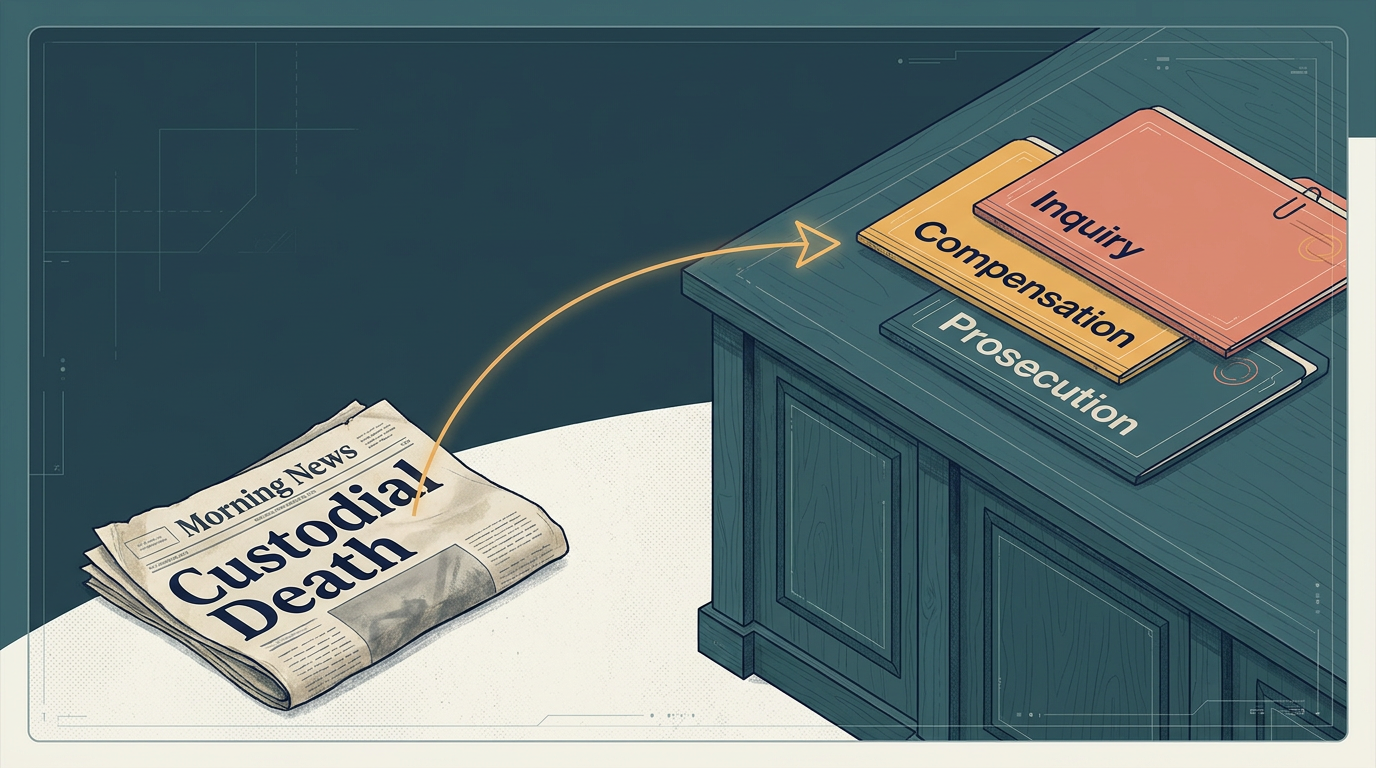
Fig. 11.0 – The Commission’s response to a news report.
This chapter will answer each of these questions.
11.1 Quasi-Judicial Bodies and the Human Rights Commissions
A person whose rights have been violated does not always end up in a courtroom. Courts are slow, expensive, and formal, and a great many disputes need something faster and more specialised. So the law creates a second kind of forum: bodies that are not courts, but are given some of the working powers of a court.
These are called quasi-judicial bodies. The prefix quasi means “as if” or “almost” — almost judicial. They are public administrative agencies that belong to the executive branch of the State, yet Parliament has given them authority similar to that of a court. They can hear a dispute, examine evidence, and decide the matter before them. Some of them can also impose a penalty on the party at fault; the human rights commissions studied in this chapter mostly recommend action rather than impose it, as later sections will show.
Familiar Examples
You have already met quasi-judicial bodies without necessarily calling them that. They include:
- the national and State human rights commissions;
- the Central and State Information Commissions, which decide appeals when an application for information is refused;
- the consumer redressal forums and commissions, which a buyer approaches over a defective product or a deficient service;
- the income tax tribunals, which hear disputes between a taxpayer and the tax department.
Notice what these have in common. Each deals with one defined subject, each is meant to be quicker and less formal than a civil suit, and each derives every power it has from the statute that set it up.
The National Human Rights Institutions
Among all quasi-judicial bodies, the most fundamental for our purposes are the national human rights institutions. India has six such national commissions, as shown in Fig. 11.1:
- the National Human Rights Commission (NHRC);
- the National Commission for Minorities;
- the National Commission for Women (NCW);
- the National Commission for Scheduled Castes;
- the National Commission for Scheduled Tribes; and
- the National Commission for Protection of Child Rights (NCPCR).
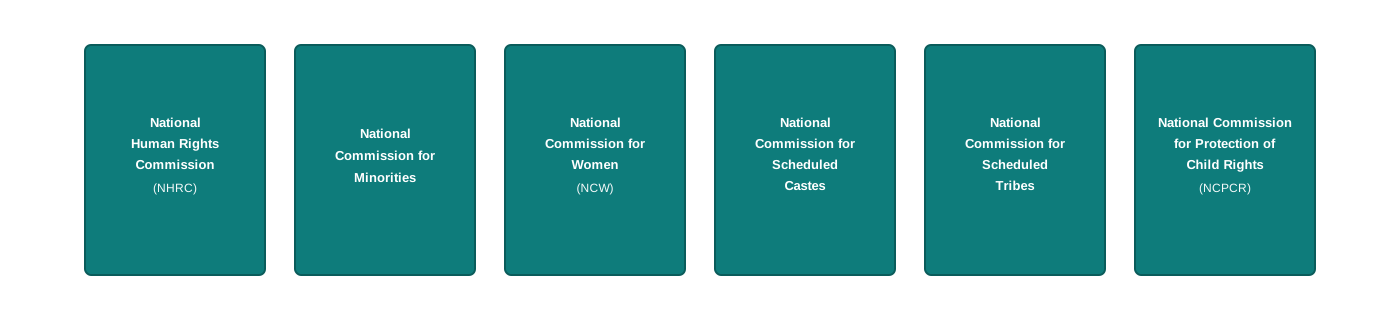
Fig. 11.1 – The six national human rights institutions.
Each of these is an independent or autonomous body, and each is expected to work transparently. Independence matters more here than anywhere else, because the complaint is usually against the State itself — a police officer, a jail official, a government department. A body that could be silenced by the very authority it is examining would be of no use to the victim.
Each is also created under its own specific legislation. There is no single law setting up all six. For example, the National Human Rights Commission and the State Human Rights Commissions are governed by the Protection of Human Rights Act, 1993. The other commissions have their own parent statutes, which the following sections take up one by one.
National and State: Two Levels of the Same Idea
Most of these commissions exist at two levels. The national commission has jurisdiction over the entire country. Alongside it, parallel State commissions take up human rights violations arising within their own State.
This two-level design is deliberate. A victim in a district town should not have to reach New Delhi to be heard, and a State body is closer to the local officials whose conduct is in question. The State commissions therefore complement the national commission rather than compete with it — which is also why, as you will see, a matter already pending before one of them is not normally taken up by the other.
11.2 National Human Rights Commission (NHRC)
11.2.1 Introduction
Human rights existed in the Constitution long before there was any commission to look after them. What did not exist was a body a poor or frightened person could approach quickly, without a lawyer and without a fee, when the State itself was the wrongdoer.
Parliament filled that gap by enacting a specific legislation, the Protection of Human Rights Act, 1993. That Act established the National Human Rights Commission as an independent institution, with powers and functions to promote and protect human rights.
Read those two verbs carefully, because they divide everything the Commission does. To protect is to act after the harm — inquire into a violation, and press for compensation and accountability. To promote is to act before it — review laws, inspect jails, spread awareness, so that fewer violations happen at all.
The same Act also provides for the constitution of State Human Rights Commissions at the State level. This was not an afterthought. Most violations of human rights are committed by officials working in a district somewhere, and a complaint mechanism that exists only in New Delhi is not really a complaint mechanism for the person it is meant to serve.
11.2.2 Constitution
The Commission is headed by a Chairperson, who is a person that has been the Chief Justice of the Supreme Court or a Judge of the Supreme Court. Alongside the Chairperson sit the other Members, as shown in Fig. 11.2.
- one Member who is, or has been, a Judge of the Supreme Court;
- one Member who is, or has been, the Chief Justice of a High Court; and
- Members appointed from amongst persons having knowledge of, or practical experience in, matters relating to human rights.
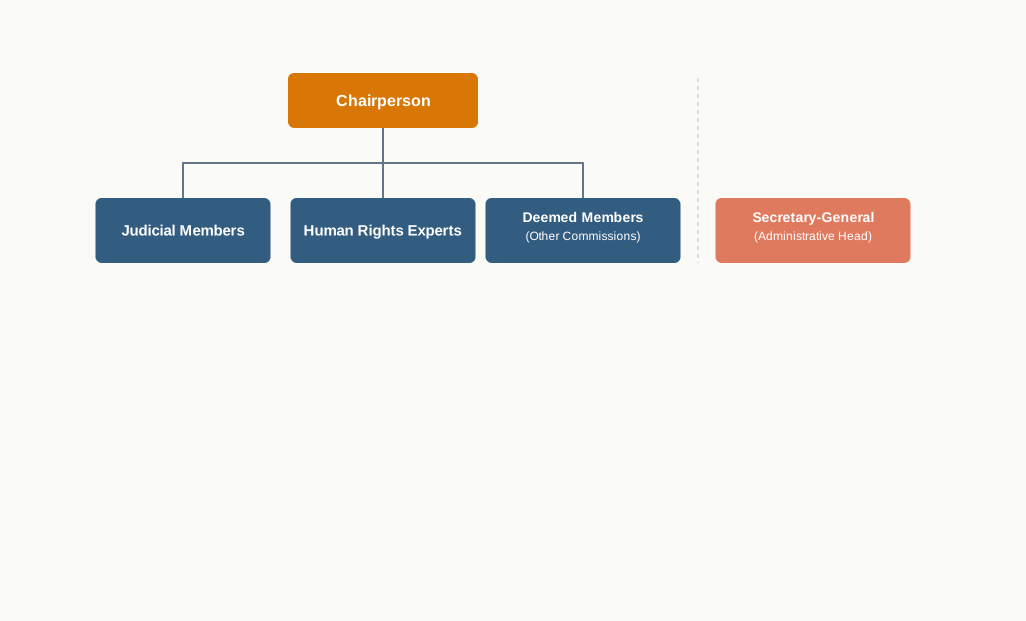
Fig. 11.2 – Composition of the National Human Rights Commission.
Notice the design behind that list. The judicial Members bring the habit of weighing evidence and reading a statute strictly; the expert Members bring field knowledge of how rights are actually violated on the ground. A commission made only of judges would be a second-rate court, and one made only of activists would carry no legal authority. The composition is a deliberate mixture of both.
The chairpersons of the other national commissions studied in this chapter are also deemed to be Members of the Commission for the discharge of several of its functions, so that the body handling human rights generally is directly linked to the bodies handling the rights of particular groups.
Besides the Chairperson and Members, there is a Secretary-General, who is the Chief Executive Officer of the Commission and largely discharges its administrative duties. The Secretary-General does not decide complaints; that separation keeps the deciding function distinct from the running of the office.
How Appointments Are Made
The Chairperson and the Members are appointed by the President of India, on the recommendation of a committee consisting of:
- the Prime Minister;
- the Speaker of the House of the People (Lok Sabha);
- the Minister of Home Affairs at the Centre;
- the Leader of the Opposition in the Lok Sabha;
- the Leader of the Opposition in the Council of States (Rajya Sabha); and
- the Deputy Chairman of the Rajya Sabha.
Look at who sits on that committee. Both the ruling side and the Opposition are represented, and both Houses are represented. A commission that will routinely examine the conduct of the government of the day cannot be filled by the government of the day alone — that is the whole point of the arrangement.
The committee is required to consult the Chief Justice of India whenever a sitting Judge of the Supreme Court or a sitting Chief Justice of a High Court is appointed to the Commission. A serving judge cannot simply be moved into an executive body without the head of the judiciary being consulted.
The government also appoints police officers and investigative staff, and other administrative, technical and scientific personnel, for the efficient functioning of the Commission. Without its own investigative wing, the Commission would have to depend entirely on the same departments whose conduct it is examining.
The National Commission is based in New Delhi. The State Commissions complement its working rather than duplicate it.
11.2.3 Functions of the Commission
Inquiry and Investigation
The first and most important function of the Commission is to conduct inquiry and investigation into the alleged violation of human rights, or abetment of such violation, or negligence in the prevention of such violation by a public servant.
Three separate things are covered there, and students routinely miss the last two.
- The official who committed the violation himself.
- The official who abetted it — that is, aided or supported the person who committed it.
- The official who was merely negligent, who did nothing while a violation he could have prevented took place.
The third is the widest. A jail superintendent who does not himself assault anyone, but ignores repeated reports that inmates are being assaulted, is squarely within the Commission’s reach.
An inquiry may begin in three ways. The complaint may be filed by the victim, or by his or her representative; a court may direct the Commission with a complaint; or the Commission may at times initiate inquiry and investigation on its own, which is called acting suo motu.
This power matters most for the people who need it most. Suo motu inquiry is especially useful when the victims belong to weaker sections of society and have limited access to justice delivery mechanisms — people who may not know that a commission exists, cannot afford to travel, or are too afraid of the local police to put anything in writing. Requiring a formal complaint in such cases would mean that the worst violations are the least likely to be examined.
11.2.4 Powers of the Commission
The Commission has the powers of a civil court. That single sentence carries a great deal, so it is worth unpacking. It means that when the Commission calls an official, the official is not free to ignore the summons; that evidence given before it is given on oath; and that it can reach documents which an ordinary complainant could never obtain.
In conducting an inquiry or investigation, the Commission can use various powers including the following:
- summon and enforce the attendance of witnesses and examine them on oath;
- ask for production of any document before itself;
- receive evidence on affidavits;
- request public record from any court or office; and
- examine witnesses or documents.
On Completion of Enquiry
Once the inquiry is completed, the Commission can make recommendations to the governmental authority in cases where any public servant is the perpetrator of the human rights violation. Its main options are these.
- The recommendation may include payment of compensation to the victims, or suggest initiation of proceedings for prosecution of the public servant.
- The Commission can also approach the Supreme Court or the High Court for directions and orders.
- The Commission may also ask the State authority to provide immediate interim relief to the victim.
The third of these deserves attention. A full inquiry takes months, and a family that has lost its earning member cannot wait that long. Interim relief is money paid at once, before the final finding, so that the remedy does not arrive too late to matter.
Intervening in Court Proceedings
The Commission may, with the permission of the court, intervene in court proceedings concerning human rights violations. It does not become the prosecutor; it appears to place the human rights dimension of the matter before the court.
For example, the Commission can request the Supreme Court to transfer pending riot cases out of a State in which the riots had happened, to ensure that the witnesses are not threatened in any manner and that evidence is not damaged. A trial held where the accused are locally powerful can be a trial in name only, and shifting it out of the State is sometimes the only way the witnesses will speak at all.
Inspection of Jails and Similar Institutions
The Commission may also visit any jail or other governmental institution where prisoners are lodged or detained, to study the living conditions of the inmates and make recommendations to the government.
This is a preventive power, not a complaint-based one. A prisoner is in the custody of the State, cut off from the outside world; unless somebody with authority walks in and looks, conditions inside remain invisible.
Awareness and Sensitisation
The remaining functions are about preventing violations rather than remedying them.
- The Commission can review various human rights laws, whether in the Constitution or in other statutes, and recommend measures to the government for their effective implementation.
- It can evaluate various factors, including acts of terrorism, which prevent the enjoyment of human rights, and recommend appropriate remedial measures to the government.
- It studies various international human rights laws and makes recommendations for their effective implementation at the domestic level, that is, within the State.
- It can undertake and promote research in the field of human rights, and spread human rights literacy among various sections of society.
- It can promote awareness of the safeguards available for the protection of human rights through publications, media, seminars, and other available means.
- Lastly, it can encourage and support the efforts of non-governmental organisations and institutions involved with human rights work.
The last one is easy to underrate. Non-governmental organisations reach villages, shelters and remand homes that no commission has the staff to reach, and a commission that works with them multiplies its own eyes and ears.
11.2.5 Complaint Mechanism
The complaint mechanism of the National Human Rights Commission is deliberately easy and straightforward. Every feature of it is designed to remove an obstacle that would otherwise keep a victim out.
Anyone aggrieved by a human rights violation, or their representative, can lodge a complaint with the Commission in any language. The complaint can be filed online through the Commission’s complaint portal, reachable from www.nhrc.nic.in, or by paper petition using the complaint format provided on the website. A paper complaint can be sent by post, by fax, or through e-mail. There is no fee for filing a complaint.
The complaint must be filed within a year of the occurrence of the human rights violation. Once the complaint is pending before the Commission, one can check the status of the complaint online.
What the Complaint Must Contain
The Commission has prescribed a format so that a complaint arrives with the information needed to act on it. The format asks for:
- Complainant’s details — name, sex, State, full address, district and pin code.
- Incident details — the place of the incident (village, town or city), State, district, and date of incident.
- Victim’s details — name of the victim, number of victims, State, full address, district, pin code, religion, caste (SC/ST/OBC/General), sex, age, and whether the victim is a disabled person.
- A brief summary of the facts or allegations of human rights violation involved.
- Whether the complaint is against members of the Armed Forces or Para-Military — yes or no.
- Whether a similar complaint has been filed before any court or State Human Rights Commission.
- Name, designation and address of the public servant against whom the complaint is being made.
- Name, designation and address of the authority or officials to whom that public servant is answerable.
- The prayer, or relief, if any, sought.
Every one of those columns does a job. The date of incident decides whether the complaint is within the one-year limit. The question about a pending court or State Commission proceeding decides whether the Commission can take up the matter at all. The name of the public servant and of the authority he answers to tells the Commission whom to call for a report. The question about the Armed Forces is asked because the Act lays down a separate and more limited procedure for complaints of that kind. And the prayer tells the Commission what the victim actually wants — compensation, prosecution, or protection.
Guidelines for Filing
The Commission’s own guidelines summarise the mechanism.
- A complaint may be made by the victim or by any other person on his behalf.
- It should be in writing, in English or Hindi or in any other language included in the Eighth Schedule of the Constitution, and only one set needs to be submitted.
- It may be sent by post, fax or e-mail.
- No fee is chargeable on such complaints.
- The complaint shall disclose (i) violation of human rights or abetment thereof; or (ii) negligence in the prevention of such violation, by a public servant.
- The jurisdiction of the Commission is restricted to violations of human rights alleged to have been committed within one year of the receipt of the complaint by the Commission.
- Documents enclosed in support of the allegations must be legible.
- The name of the victim, age, sex, religion or caste, State and district to which the incident relates, and the incident date should invariably be mentioned.
- The complaint should preferably be submitted in the prescribed format.
Complaints Not Ordinarily Entertained
The following types of complaint are not ordinarily entertainable:
- illegible complaints;
- vague, anonymous or pseudonymous complaints;
- complaints trivial or frivolous in nature;
- matters pending before a State Human Rights Commission or any other Commission;
- any matter after the expiry of one year from the date on which the act constituting the violation of human rights is alleged to have been committed;
- allegations not against any public servant;
- issues relating to a civil dispute, such as property rights or contractual obligations;
- issues relating to service matters;
- issues relating to labour or industrial disputes;
- allegations that do not make out any specific violation of human rights;
- matters sub judice before a court or tribunal; and
- matters already covered by a judicial verdict or by a decision of the Commission.
Group these and the logic becomes clear. Some are refused because the complaint is unusable — illegible, vague, anonymous, frivolous. Some are refused because the matter belongs to somebody else — a court, a tribunal, or another commission is already seised of it. Some are refused because the subject is outside the Commission’s mandate altogether — a property dispute, a service matter, an industrial dispute, or a grievance against a private person rather than a public servant. And one is refused simply because it is too late.
Complainants are encouraged, as far as possible, to use the prescribed format. The guidelines indicate the kind of information that would help in processing a complaint.
Try This in Class
Using the format set out above, prepare a complaint on any human rights violation — one you have imagined, or one you have read or heard about in the news. Follow the Commission’s guidelines while drafting it, and submit the completed draft to your teacher for evaluation. This is a classroom exercise only, and is not to be sent to the Commission.
11.3 National Commission for Minorities
11.3.1 Introduction
The National Human Rights Commission protects everyone. That is its strength and also its limitation, because some groups face a particular kind of harm — discrimination aimed at them precisely because of who they are — and a general body may not always see it. Parliament therefore created separate commissions for particular groups. The first of them studied here is the National Commission for Minorities.
The National Commission for Minorities Act, 1992 was enacted by Parliament to create the National Commission for Minorities, to safeguard the human rights of minorities, including protection against inequality and discrimination.
The rights themselves are not created by this Act. Minorities’ human rights are already enshrined in the Constitution, as well as in other laws enacted by Parliament and the State Legislatures. What the Act supplies is a body whose full-time job is to see whether those existing guarantees are actually working on the ground.
Who Counts as a Minority Here
The minorities referred to here are religious minorities. Six communities are covered:
- Muslims;
- Christians;
- Sikhs;
- Buddhists;
- Jains; and
- Zoroastrians (Parsis).
That definition explains something students often find puzzling. Whether a group is a minority is not decided by the Commission, and not decided by how small the group feels itself to be — it is decided by notification. A member of a religious community that has never been notified cannot bring the Commission into the picture, however genuine the grievance may be, though other remedies may still be open.
Many States have also instituted State Minorities Commissions, located in the respective State capitals. So a person belonging to a minority community can approach the State Commission as well as the National Commission for remedying human rights violations — the same two-level design you saw with the human rights commissions.
11.3.2 Constitution
The National Minorities Commission consists of a Chairperson, a Vice-Chairperson and five other Members. All of them are nominated by the Central Government from amongst persons of eminence, ability and integrity, and five of them, including the Chairperson, are drawn from the minority communities themselves.
Drawing the Commission from the communities it serves is not a courtesy. A body deciding whether a religious practice has been obstructed, or whether a minority institution has been treated unfairly, needs members who understand from the inside what the community’s practices and anxieties actually are.
11.3.3 Functions of the Commission
The functions of the Commission include the following:
- evaluating the progress of the development of Minorities;
- monitoring the working of the safeguards provided in the Constitution and in other laws enacted by Parliament and the State Legislatures;
- making recommendations for the effective implementation of safeguards for the protection of the interests of Minorities by the Central Government or the State Governments;
- looking into specific complaints regarding deprivation of rights and safeguards of the Minorities and taking up such matters with the appropriate authorities;
- initiating studies on problems arising out of any discrimination against Minorities and recommending measures for their removal;
- conducting studies, research and analysis on issues relating to the socio-economic and educational development of Minorities;
- suggesting appropriate measures in respect of any Minority to be undertaken by the Central Government or the State Governments; and
- making periodical or special reports to the Central Government on any matter pertaining to Minorities, and in particular the difficulties confronted by them.
Only one of these — clause (d) — deals with an individual complaint. The rest are about the condition of the community as a whole: measuring development, watching whether safeguards are being implemented, studying patterns of discrimination, and reporting to the government. This is worth registering before you read the complaint mechanism, because it explains why the Commission turns away so many individual grievances. It was never designed to be a substitute for the ordinary courts.
11.3.4 Powers
Like the National Human Rights Commission, the National Commission for Minorities is vested with the powers of a civil court.
When the Commission tries any suit or hears a complaint, it has the power to:
- summon and enforce the attendance of any person and examine him or her on oath;
- require the discovery and production of any document;
- receive evidence on affidavits;
- request any public record or copy from any court or office; and
- issue commissions for the examination of witnesses and documents.
The last of these is a device worth understanding. Where a witness or a document is far away, or the witness cannot travel, the Commission appoints someone to record that evidence on its behalf and send it back — so distance does not defeat the inquiry.
11.3.5 Complaint Mechanism
The most useful way to learn this Commission’s complaint mechanism is to learn the grounds on which it typically declines to admit a complaint. Six grounds recur.
- Firstly, it does not entertain or admit cases or complaints that do not relate to Minority status or rights.
- Secondly, the complaint should not be pending before another court or commission — that is, matters that are sub judice.
- Thirdly, where the complainant has not availed of the other ordinary judicial, quasi-judicial or administrative institutions available for redressal, the Commission does not admit the matter unless the complainant has reasonable justification.
- Fourthly, the complaint should not relate to events that are more than one year old.
- Fifthly, the complaint should not be vague, anonymous, pseudonymous or frivolous.
- Lastly, the Commission does not entertain complaints that are not directly addressed to it.
How and Where to Complain
Like the NHRC, the National Commission for Minorities can also take action suo motu, on the basis of newspaper reports or other findings.
Applications of complaints are required to be sent to the Commission, addressed directly to the Secretary, National Commission for Minorities, New Delhi. This is what the sixth ground above means in practice: a copy of a letter written to some other authority and merely marked to the Commission is not a complaint to the Commission.
The Commission does not charge any fee for lodging a complaint. Updated contact details are available on the Commission’s website at www.ncm.nic.in.
11.4 National Commission for Women (NCW)
11.4.1 Introduction
In 1992, the National Commission for Women was established under the National Commission for Women Act, 1990.
Read the two dates together and you learn something about how this subject works. Parliament passed the Act in 1990; the Commission itself came into existence in 1992. A statute creates the power to set up a body, but the body begins to function only when the government actually constitutes it — which is why a law and the institution it promises do not always arrive in the same year.
Women are not a minority, and they are not a group the Constitution places in a schedule. The reason a separate commission exists for them is different: the harms women face are spread across every community and every class, and they arise as much from practice and custom as from any single official decision. A body was needed that could look at the whole picture — laws, policies, complaints and conditions — rather than one grievance at a time.
11.4.2 Constitution
The Commission consists of a Chairperson and five Members, nominated by the Central Government from amongst persons of ability, integrity and standing who have had experience in any one of these areas:
- law or legislation;
- trade unionism;
- management of an industry potential of women;
- women’s voluntary organisations, including women activists;
- administration;
- economic development;
- health;
- education; or
- social welfare.
At least one Member each belongs to the Scheduled Castes and the Scheduled Tribes communities. The member-secretary takes care of the administrative matters.
Two features of that list deserve a second look. First, legal experience is only one qualification among nine — the Commission is meant to hear from people who have run women’s organisations, worked in health or education, or organised women workers, not only from lawyers. Second, the requirement of Scheduled Caste and Scheduled Tribe representation recognises that a woman may face disadvantage on more than one ground at the same time, and that a commission with no member from those communities would be poorly placed to see it.
11.4.3 Functions
The Commission has been charged with the following functions:
- to investigate and examine matters relating to the safeguards provided for women under the Constitution and other laws;
- to present annual and other reports to the Central Government about the working of the safeguards;
- to make recommendations to the Centre and the States for the effective implementation of safeguards for improving the conditions of women;
- to review provisions of the Constitution and other laws affecting women, and make recommendations about the remedial legislative measures required to address inadequacies or shortcomings in the laws;
- to take up cases with the appropriate authorities about violation of women’s human rights as provided in the Constitution and other laws;
- to look into complaints, and also take suo motu notice, of matters relating to deprivation of women’s rights, non-implementation of laws required to achieve equality and development, and non-compliance of policy decisions, guidelines or instructions pertaining to women’s welfare;
- to initiate special studies or investigations into specific problems or situations arising out of discrimination and atrocities against women, to identify the constraints, and to recommend strategies;
- to undertake promotional and educational research, to suggest ways of ensuring due representation of women in all spheres, and to identify factors responsible for impeding women’s advancement — such as lack of access to housing and basic services, and inadequate support services and technologies for reducing drudgery and occupational health hazards — and for increasing their productivity;
- to participate in and advise on the planning process of socio-economic development of women;
- to evaluate the progress of the development of women under the Union and any State;
- to inspect a jail, remand home, women’s institution, or other place of custody where women are kept as prisoners or otherwise, and take up remedial action with the concerned authorities if found necessary;
- to fund litigation involving issues affecting a large body of women; and
- to make periodical reports to the Government on any matter pertaining to women, and in particular the various difficulties under which women toil.
Reading the List as a Whole
Thirteen functions is a great deal to memorise, and memorising them separately is the wrong approach. They fall into four groups.
- Watching the law — examining safeguards, reviewing the Constitution and other laws, and recommending legislative change where the law itself is inadequate (clauses (a), (d)).
- Acting on grievances — taking up cases with the authorities, looking into complaints, taking suo motu notice, and initiating investigations into discrimination and atrocities (clauses (e), (f), (g)).
- Studying and advising — research, planning, evaluating development, and identifying the practical obstacles that hold women back (clauses (h), (i), (j)).
- Reporting and reaching in — reports to the Government, and inspection of jails, remand homes and other places of custody (clauses (b), (c), (k), (m)).
Clause (l) sits slightly apart and is easy to overlook, so it deserves a line of its own.
11.4.4 Powers
The Commission has investigating powers similar to those of a civil court. In particular, the Commission can:
- summon and enforce the attendance of any person and examine him or her on oath;
- require the discovery and production of any document;
- receive evidence on affidavits;
- request any public record or copy from any court or office; and
- issue commissions for the examination of witnesses and documents.
By now this list will look familiar. The same five powers recur in commission after commission, and that repetition is itself the point: whatever group a commission is built for, the working tools Parliament gives it to establish facts are the same, and none of them includes the power to convict or to punish.
11.5 National Commissions for Scheduled Castes and Scheduled Tribes
11.5.1 Introduction
The commissions studied so far were created by ordinary statutes. The two commissions in this section are different, and the difference is worth grasping before anything else: they are provided for in the Constitution itself.
Article 338 of the Constitution of India originally provided for the appointment of a Special Officer for the Scheduled Castes and Scheduled Tribes, to investigate all matters relating to the safeguards provided for the Scheduled Castes and Scheduled Tribes in the Constitution, and to report to the President.
That single office has since grown into two separate commissions, as shown in Fig. 11.3:
- the National Commission for Scheduled Castes, under Article 338; and
- the National Commission for Scheduled Tribes, under Article 338A.
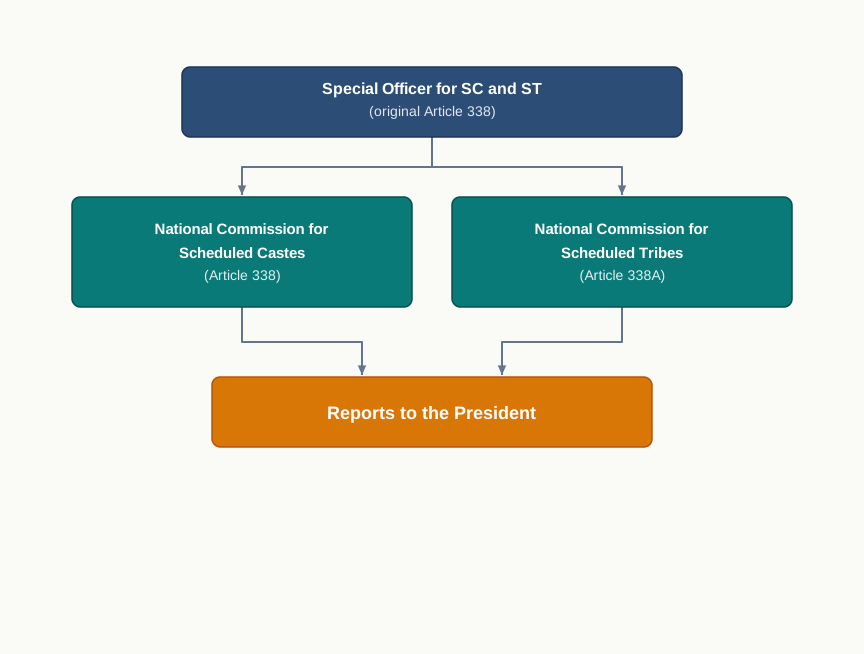
Fig. 11.3 – Evolution of the Commissions for Scheduled Castes and Scheduled Tribes.
The reason for the split is practical. The disadvantages faced by Scheduled Castes and by Scheduled Tribes are not the same. Caste-based exclusion is mainly about social disability — who may enter a temple, draw water from a well, or sit where in a classroom. Tribal disadvantage is largely about land, forest and displacement. One commission trying to do both was doing neither well.
Both are instituted to protect the human rights of Scheduled Castes and Scheduled Tribes, to prevent their exploitation, and to encourage and defend their social, educational, economic and cultural securities as provided in the Constitution and other legislations.
The Safeguards Being Monitored
For example, the State provides reservation, or affirmative action programmes, for government jobs to backward classes such as the Scheduled Castes and Scheduled Tribes, who — because of historical and continued disadvantages based on caste status and otherwise — have not been adequately represented in the services under the State.
Alongside such positive measures, there are protective laws. Examples of special laws for the protection of the Scheduled Castes and Scheduled Tribes include:
- the Protection of Civil Rights Act, 1955; and
- the Scheduled Castes and the Scheduled Tribes (Prevention of Atrocities) Act, 1989.
Between them, these two kinds of measure — a reservation policy and a protective statute — are precisely what the Commissions exist to keep watch over. A safeguard that exists on paper and is ignored in practice is the standing problem in this area, and monitoring is the answer the Constitution chose.
11.5.2 Functions
Both Commissions have similar powers and functions, as provided in Article 338, the central one being to investigate and monitor all matters relating to the safeguards provided for the Scheduled Castes and Scheduled Tribes in the Constitution and other laws. Their functions further include:
- to evaluate the working of the safeguards;
- to inquire into specific complaints with respect to the deprivation of rights and safeguards of the Scheduled Castes and Scheduled Tribes;
- to participate in and advise on the planning process of socio-economic development of the Scheduled Castes and Scheduled Tribes, and to evaluate the progress of their development under the Union and any State; and
- to present to the President, annually and periodically, reports on the working of the safeguards, together with recommendations for their effective implementation and for the protection, welfare and socio-economic development of the Scheduled Castes and Scheduled Tribes.
Note where those reports go. Not to a ministry, but to the President — and from there they are laid before Parliament. A finding that a safeguard is failing therefore becomes a public document that the government of the day has to answer for.
11.5.3 Powers
Just like the other human rights commissions, the two Commissions for Scheduled Castes and Scheduled Tribes have the powers of a civil court in trying a suit, and can:
- summon and enforce the attendance of any person from any part of India and examine him on oath;
- require the discovery and production of any document;
- receive evidence on affidavits;
- request any public record or copy from any court or office; and
- issue commissions for the examination of witnesses and documents.
Article 338 also mandates the Union and every State Government to consult the Commissions on all major policy matters affecting the Scheduled Castes and Scheduled Tribes.
11.5.4 Complaint Mechanism
The Commissions receive complaints from an individual or a group of persons alleging denial of the safeguards provided in the Constitution by an authority or an organisation. Having received such a complaint, the Commissions follow up with the authorities and organisations against whom the complaint is lodged.
That phrase — “by an authority or an organisation” — is the key to most problems set on this topic. The complaint must be about a safeguard being denied by a body that owed it, not about a private quarrel that happens to involve a person from a Scheduled Caste or Scheduled Tribe.
The websites of the Commissions are www.ncsc.nic.in for the Scheduled Castes and www.ncst.nic.in for the Scheduled Tribes.
11.6 National Commission for Protection of Child Rights (NCPCR)
11.6.1 Introduction
The National Commission for Protection of Child Rights is an Indian statutory body, established by an Act of Parliament — the Commission for Protection of Child Rights Act, 2005.
Children are the one group in this chapter who cannot complain for themselves. A worker can approach a commission, a woman can write a petition; a child in a hostel, a remand home or a factory usually cannot, and often does not even know that a right has been taken away. Everything distinctive about this Commission follows from that fact.
Two Principles the Commission Works On
The NCPCR emphasises the principle of universality and inviolability of child rights, and recognises the tone of urgency in all child-related policies of the country. For the Commission, the protection of all children in the 0 to 18 years age group is of equal importance.
Policies, of course, must define priority actions for the most vulnerable children — focusing on backward regions, on particular communities, or on children in certain circumstances. The Commission accepts this. What it warns against is stopping there.
Its reasoning runs as follows. If a policy addresses only some children, there is a fallacy of exclusion: many vulnerable children who do not fall within the defined or targeted categories are left out. When that happens in practice, the task of reaching out to all children gets compromised, and a societal tolerance of the violation of child rights continues. That tolerance then damages even the targeted programme, because a society that shrugs at some violations will shrug at others. The Commission therefore considers that it is only by building a larger atmosphere in favour of the protection of children’s rights that the targeted children become visible and gain the confidence to access their entitlements.
Two consequences follow, and the Commission states them expressly.
- Every right the child enjoys is seen as mutually reinforcing and interdependent. Therefore the question of gradation of rights does not arise — no right is ranked above another.
- A child enjoying all her rights in her eighteenth year depends on having had access to all her entitlements from the time she was born. Policy interventions therefore assume significance at every stage, and all the rights of children are of equal importance.
11.6.2 Functions
The functions of the National Commission for Protection of Child Rights are laid out in the Commission for Protection of Child Rights (CPCR) Act, 2005. The Commission shall perform all or any of the following functions:
- examine and review the safeguards provided by or under any law for the time being in force for the protection of child rights, and recommend measures for their effective implementation;
- present to the Central Government, annually and at such other intervals as the Commission may deem fit, reports upon the working of those safeguards;
- inquire into violation of child rights and recommend initiation of proceedings in such cases;
- examine all factors that inhibit the enjoyment of rights of children affected by terrorism, communal violence, riots, natural disaster, domestic violence, HIV/AIDS, trafficking, maltreatment, torture and exploitation, pornography and prostitution, and recommend appropriate remedial measures;
- look into matters relating to children in need of special care and protection — including children in distress, marginalised and disadvantaged children, children in conflict with law, juveniles, children without family and children of prisoners — and recommend appropriate remedial measures;
- study treaties and other international instruments, undertake periodical review of existing policies, programmes and other activities on child rights, and make recommendations for their effective implementation in the best interest of children;
- undertake and promote research in the field of child rights;
- spread child rights literacy among various sections of society, and promote awareness of the safeguards available for the protection of these rights through publications, the media, seminars and other available means;
- inspect, or cause to be inspected, any juvenile custodial home, or any other place of residence or institution meant for children, under the control of the Central Government or any State Government or any other authority, including any institution run by a social organisation, where children are detained or lodged for the purpose of treatment, reformation or protection, and take up remedial action with these authorities if found necessary;
- analyse existing law, policy and practice to assess compliance with the Convention on the Rights of the Child, undertake inquiries and produce reports on any aspects of policy or practice affecting children, and comment on proposed new legislation related to child rights;
- undertake formal investigation where concern has been expressed either by children themselves, or by a concerned person on their behalf;
- promote respect for, and serious consideration of, the views of children in its own work and in that of all Government Departments and Organisations dealing with children;
- produce and disseminate information about child rights;
- compile and analyse data on children; and
- promote the incorporation of child rights into the school curriculum, and into the training of teachers and of personnel dealing with children.
What This List Tells You
Three clauses are worth pausing on, because they are the ones examiners build questions around.
Clause (k) is unusual: a formal investigation may begin because children themselves have expressed concern. Most legal machinery treats a minor as someone to be spoken for; here the child’s own voice is a trigger, and clause (l) carries the same idea into the working of every government department.
Clause (i) reaches into places the outside world does not see, and it does so widely — not merely government-run homes, but any institution meant for children, including one run by a social organisation. An institution is not exempt from inspection merely because it is charitable.
Clause (j) ties Indian practice to the Convention on the Rights of the Child, the international instrument on child rights that India has accepted. The Commission’s job is to keep checking whether our law, policy and practice actually match what we have promised internationally.
11.6.3 Powers
The Commission may inquire into complaints, and take suo motu notice, of matters relating to:
- deprivation and violation of child rights;
- non-implementation of laws providing for the protection and development of children; and
- non-compliance of policy decisions, guidelines or instructions aimed at mitigating hardship to children and ensuring their welfare — and it may provide relief to such children, or take up the issues arising out of such matters with the appropriate authorities.
Beyond these, the Commission may perform such other functions as it may consider necessary for the promotion of child rights, and any other matter incidental to the above functions.
There is one clear limit. The Commission shall not enquire into any matter which is pending before a State Commission, or before any other Commission duly constituted under any law for the time being in force. You have now met this restriction in every commission in the chapter. It exists to prevent two bodies reaching contradictory conclusions on the same facts, and to stop a complainant from shopping between forums until one of them agrees with him.
11.6.4 Complaint Mechanism
One of the core mandates of the Commission is to inquire into complaints of violations of child rights. The Commission is also required to take suo motu cognisance of serious cases of violation of child rights, and to examine the factors that inhibit the enjoyment of rights of children.
Complaints may be made to the Commission in any language listed in the Eighth Schedule of the Constitution. Three rules govern them:
- no fee shall be chargeable on such complaints;
- the complaint shall disclose a complete picture of the matter leading to the complaint; and
- the Commission may seek further information or an affidavit, as may be considered necessary.
While making a complaint, one must ensure that it is:
- clear and legible, and not vague, anonymous or pseudonymous;
- genuine, and not trivial or frivolous;
- not related to civil disputes, such as property rights, contractual obligations and the like;
- not related to service matters;
- not pending before any other commission duly constituted under the law, and not sub judice before a court or tribunal;
- not already decided by the Commission; and
- not outside the purview of the Commission on any other ground.
Looking Back Across the Chapter
You have now studied six national commissions. They are built on a common pattern — created by law, independent of the department they examine, armed with the powers of a civil court, able to act suo motu, free to approach, closed to stale and sub judice matters, and empowered to recommend rather than to punish. What differs is the group each was built to protect, and therefore the kind of grievance each will recognise.
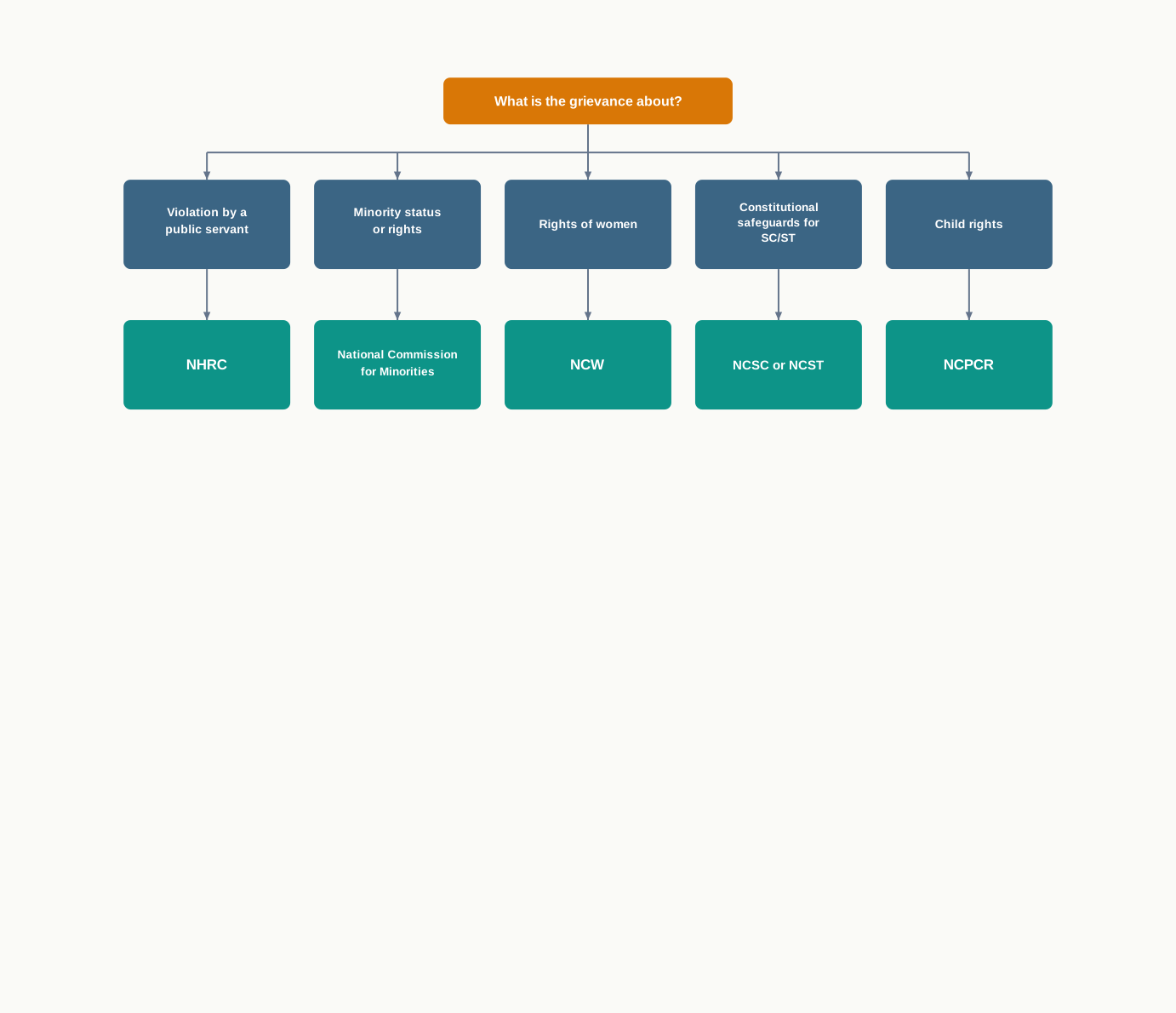
Fig. 11.4 – Choosing the appropriate national commission.
11.7 Summary
- A quasi-judicial body is a public authority in the executive branch which exercises powers similar to those of a court, without being a court.
- It draws every power it has from the statute that creates it, and can act only within the subject that statute assigns to it.
- Examples of quasi-judicial institutions include:
- the national and State human rights commissions;
- the Central and State Information Commissions;
- the consumer redressal forums and commissions; and
- the income tax tribunals.
- The most fundamental human rights bodies in India are six national commissions:
- the National Human Rights Commission (NHRC);
- the National Commission for Minorities;
- the National Commission for Women (NCW);
- the National Commission for Scheduled Castes;
- the National Commission for Scheduled Tribes; and
- the National Commission for Protection of Child Rights (NCPCR).
- These commissions are independent, autonomous and transparent bodies created under specific legislations to promote and protect human rights.
- A national commission has jurisdiction over the entire country, while the parallel State commissions take up human rights violations arising within their own State.
- The Protection of Human Rights Act, 1993 established the National Human Rights Commission and also provides for the constitution of State Human Rights Commissions.
- The NHRC is headed by a Chairperson, and its Members include judicial Members drawn from the Supreme Court and the High Courts, and Members having knowledge or practical experience of human rights.
- The Secretary-General is the Chief Executive Officer of the NHRC and discharges its administrative duties.
- The Chairperson and Members of the NHRC are appointed by the President of India on the recommendation of a committee consisting of:
- the Prime Minister;
- the Speaker of the Lok Sabha;
- the Minister of Home Affairs;
- the Leader of the Opposition in the Lok Sabha;
- the Leader of the Opposition in the Rajya Sabha; and
- the Deputy Chairman of the Rajya Sabha.
- The committee must consult the Chief Justice of India whenever a sitting Judge of the Supreme Court or a sitting Chief Justice of a High Court is appointed to the Commission.
- The NHRC inquires into the violation of human rights, abetment of such violation, or negligence in its prevention by a public servant.
- An inquiry may begin on a complaint by the victim or a representative, on a direction of a court, or suo motu — that is, on the Commission’s own motion.
- Suo motu inquiry matters most for victims from weaker sections who have limited access to justice delivery mechanisms.
- The NHRC has the powers of a civil court, and may:
- summon and enforce the attendance of witnesses and examine them on oath;
- ask for production of any document;
- receive evidence on affidavits;
- request public record from any court or office; and
- examine witnesses or documents.
- On completing an inquiry, the NHRC may recommend payment of compensation to the victim or the initiation of proceedings for prosecution of the public servant.
- It may also approach the Supreme Court or the High Court for directions and orders, and ask the State authority to provide immediate interim relief to the victim.
- With the permission of the court, the NHRC may intervene in court proceedings concerning human rights violations.
- It may visit any jail or other government institution where persons are detained, to study the living conditions of inmates and make recommendations.
- Its promotional work includes reviewing human rights laws, examining factors such as terrorism that prevent the enjoyment of human rights, studying international human rights instruments, promoting research and literacy, and encouraging non-governmental organisations.
- A complaint to the NHRC may be made in any language, needs no fee, and may be filed online or sent by post, fax or e-mail.
- The complaint must relate to a violation committed within one year, and its status can be checked online.
- The NHRC does not ordinarily entertain complaints that are illegible, vague, anonymous, pseudonymous, trivial or frivolous.
- It also does not entertain complaints that are more than one year old, are not against a public servant, relate to civil disputes, service matters or labour and industrial disputes, disclose no specific violation of human rights, are pending before another commission, are sub judice, or have already been decided.
- The National Commission for Minorities Act, 1992 created the National Commission for Minorities to safeguard the human rights of minorities, including protection against inequality and discrimination.
- For the purposes of that Act, a minority is a community notified as such by the Central Government; the notified religious minorities are Muslims, Christians, Sikhs, Buddhists, Jains and Zoroastrians (Parsis).
- The Commission consists of a Chairperson, a Vice-Chairperson and five Members, nominated by the Central Government from amongst persons of eminence, ability and integrity.
- Its functions include evaluating the development of minorities, monitoring safeguards, looking into specific complaints, initiating studies on discrimination, and reporting to the Central Government.
- Like the NHRC, it has the powers of a civil court and may act suo motu on newspaper reports or other findings.
- The National Commission for Minorities does not ordinarily admit a complaint that:
- does not relate to minority status or rights;
- is sub judice or pending before another commission;
- comes without the complainant having first used the ordinary judicial, quasi-judicial or administrative remedies, unless there is reasonable justification;
- relates to an event more than one year old;
- is vague, anonymous, pseudonymous or frivolous; or
- is not directly addressed to the Commission.
- Complaints to that Commission are addressed to its Secretary at New Delhi, and no fee is charged.
- The National Commission for Women was established in 1992 under the National Commission for Women Act, 1990.
- It consists of a Chairperson and five Members nominated by the Central Government from persons of ability, integrity and standing with experience in fields such as law, trade unionism, women’s organisations, administration, health, education or social welfare.
- At least one Member each belongs to the Scheduled Castes and the Scheduled Tribes, and a member-secretary looks after administrative matters.
- The NCW investigates safeguards for women, reviews laws affecting women, recommends remedial legislation, takes up cases with the authorities, and looks into complaints or takes suo motu notice.
- It also studies discrimination and atrocities against women, advises on planning, evaluates the progress of women’s development, and reports to the Government.
- It may inspect any jail, remand home, women’s institution or other place of custody where women are kept, and take up remedial action.
- It may fund litigation involving issues affecting a large body of women.
- The NCW has investigating powers similar to those of a civil court.
- Article 338 of the Constitution originally provided for a Special Officer for the Scheduled Castes and Scheduled Tribes to investigate the safeguards provided for them and report to the President.
- Two commissions now exist: the National Commission for Scheduled Castes under Article 338, and the National Commission for Scheduled Tribes under Article 338A.
- They protect the human rights of Scheduled Castes and Scheduled Tribes, prevent their exploitation, and defend their social, educational, economic and cultural securities.
- Examples of protective legislation in this field are the Protection of Civil Rights Act, 1955 and the Scheduled Castes and the Scheduled Tribes (Prevention of Atrocities) Act, 1989.
- Their functions include evaluating the working of safeguards, inquiring into specific complaints of deprivation of rights, advising on socio-economic planning, and presenting reports to the President.
- They have the powers of a civil court, and the Union and every State Government must consult them on all major policy matters affecting Scheduled Castes and Scheduled Tribes.
- These Commissions receive complaints from an individual or a group alleging denial of constitutional safeguards by an authority or an organisation, and follow up with the body complained against.
- The National Commission for Protection of Child Rights is a statutory body established under the Commission for Protection of Child Rights Act, 2005.
- It works on the principle of universality and inviolability of child rights, treating the protection of all children in the 0 to 18 years age group as equally important.
- Because every right of a child is mutually reinforcing and interdependent, the Commission does not accept any gradation of rights.
- Its functions include examining safeguards, inquiring into violations of child rights, examining the factors that inhibit children’s rights, looking into children in need of special care and protection, reviewing treaties and policies, promoting research and child rights literacy, inspecting institutions where children are lodged, assessing compliance with the Convention on the Rights of the Child, and promoting respect for the views of children.
- It may inquire into complaints and take suo motu notice of the deprivation and violation of child rights, the non-implementation of protective laws, and non-compliance with policy decisions meant for children’s welfare.
- It shall not enquire into a matter pending before a State Commission or any other duly constituted Commission.
- Complaints to the NCPCR may be made in any language listed in the Eighth Schedule, carry no fee, must disclose a complete picture of the matter, and may attract a demand for further information or an affidavit.
- A complaint to the NCPCR must not be vague, anonymous, trivial or frivolous, must not concern a civil dispute or a service matter, must not be pending elsewhere or sub judice, and must not already have been decided by the Commission.
- Across all these bodies the pattern is the same: they inquire, they establish facts with the powers of a civil court, and they recommend — they do not convict or punish.
11.8 Key Terms
Quasi-judicial body — a public authority in the executive branch which, under the statute that creates it, exercises powers similar to those of a court without being a court.
Statutory commission — a commission created by an ordinary Act of Parliament, such as the NHRC, the National Commission for Minorities, the NCW and the NCPCR.
Constitutional commission — a commission provided for in the Constitution itself, such as the National Commission for Scheduled Castes and the National Commission for Scheduled Tribes.
National human rights institution — an independent, autonomous body created by a specific legislation to promote and protect human rights, such as the six national commissions studied in this chapter.
National Human Rights Commission (NHRC) — the independent institution established under the Protection of Human Rights Act, 1993 to promote and protect human rights throughout the country.
State Human Rights Commission — the parallel commission constituted under the same Act at the State level, which takes up human rights violations arising within that State.
Secretary-General — the Chief Executive Officer of the NHRC, who discharges its administrative duties but does not decide complaints.
Public servant — a person holding office under the State, whose act, abetment or negligence is what a human rights complaint before the NHRC must be directed against.
Abetment — aiding or supporting the person who commits a violation, which the NHRC may inquire into just as it inquires into the violation itself.
Negligence in prevention — the failure of a public servant to prevent a violation he could have prevented, which is itself a ground of inquiry.
Suo motu — “on its own motion”; action taken by a court or commission of its own accord, without any request by the parties.
Powers of a civil court — the fact-finding powers each commission is given: to summon and examine witnesses on oath, require production of documents, receive evidence on affidavits, call for public records, and issue commissions for examining witnesses and documents.
Affidavit — a written statement of facts sworn to be true, which a commission may accept as evidence.
Issue commissions — to appoint a person to record the evidence of a distant witness or document on the commission’s behalf, so that distance does not defeat the inquiry.
Interim relief — immediate relief the Commission may ask a State authority to provide to a victim before the inquiry is complete.
Recommendation — the outcome a human rights commission produces; it directs the government’s attention and can be pressed before a court, but it is not itself a binding order.
Intervention in court proceedings — appearing in a pending case, with the permission of the court, to place the human rights dimension of the matter before it.
Eighth Schedule — the Schedule of the Constitution listing the languages in which a complaint may be made to these commissions.
Minority — for the purposes of the National Commission for Minorities Act, 1992, a community notified as such by the Central Government; the notified religious minorities are Muslims, Christians, Sikhs, Buddhists, Jains and Zoroastrians (Parsis).
Sub judice — “under a judge”; a matter that is under trial or under consideration by a judge or court, and therefore not open to parallel decision by a commission.
Member-secretary — the officer of the National Commission for Women who takes care of its administrative matters.
Special Officer — the office for which Article 338 originally provided, to investigate the safeguards for the Scheduled Castes and Scheduled Tribes and report to the President.
Safeguard — a protection provided for a group in the Constitution or in another law, whose working these commissions exist to monitor.
Universality and inviolability of child rights — the principle that the protection of every child in the 0 to 18 years age group is of equal importance and cannot be set aside.
Gradation of rights — the ranking of one right above another, which the NCPCR does not accept, since a child’s rights are mutually reinforcing and interdependent.
Fallacy of exclusion — the error, warned against by the NCPCR, of addressing only children in defined or targeted categories and thereby leaving out other vulnerable children.
Convention on the Rights of the Child — the international instrument on child rights against which the NCPCR assesses the compliance of Indian law, policy and practice.
11.9 Points to Ponder
A commission can inquire, summon and recommend, but it cannot convict or punish. Does that make it weaker than a court, or does it let the commission do things a court cannot?
Almost every complaint before these commissions is against the State. What arrangements in the law are meant to keep a commission independent of the very government it examines, and where might that independence still be fragile?
The one-year limitation exists so that inquiries are not based on cold, unverifiable facts. But the victims least able to complain in time — a prisoner, a bonded labourer, a frightened family — are often the ones the commissions exist for. How should the law balance the two?
Suo motu action depends heavily on what the media chooses to report. What kinds of violation are likely to be missed altogether by a mechanism that begins with a news item?
India has separate commissions for human rights, minorities, women, Scheduled Castes, Scheduled Tribes and children. Does having a specialised body for each group strengthen protection, or does it risk a victim being sent from one commission to another?
The National Commission for Minorities does not ordinarily admit a complaint unless the complainant has first tried the ordinary remedies. Is this a sensible filter, or an obstacle placed before people who already find the legal system hard to reach?
The NCW may fund litigation involving issues affecting a large body of women. Should a State-funded commission choose which cases get fought in court, and what should guide that choice?
The Constitution requires governments to consult the SC and ST Commissions on major policy matters, yet the advice given is not binding. What does a duty to consult actually achieve when the answer can be ignored?
The NCPCR refuses to grade one child right above another. Is that principle workable when a commission has limited staff and must decide what to take up first?
Complaints may be filed free of cost, online, in any Eighth Schedule language. What further barriers still stand between an ordinary person and a commission, and what would remove them?
If a commission’s recommendation for compensation or prosecution is quietly ignored by a government department, what should follow — and who should be responsible for seeing that it does?
11.10 Textbook Questions
Explain any one power or function of the National Human Rights Commission.
Who are the minorities whose interests the National Commission for Minorities intends to protect?
Ms. Bagchee is a Jewish woman who has married outside her community, because of which she is not allowed to perform certain religious customs. On what grounds could her complaint to the National Commission for Minorities be disqualified?
Ms. Nisha Joseph is a Christian, and her services were terminated without any substantial reason by a school managed by a State-run non-governmental organisation. What remedy is available to her for redressal of this issue?
Smt. Savitri is troubled by the exploitation faced by her daughter, who has a hearing and speech disability and has been abandoned by her husband and in-laws, allegedly because of those disabilities. Which forum can she approach for redressal, and what are that forum’s powers and functions?
Why were the National Commission for Scheduled Castes and the National Commission for Scheduled Tribes created?
Ravi avails of benefits as a member of a Scheduled Caste in his service under the Central Government. In a matter of promotion within his department, he moved the Central Administrative Tribunal. As the matter has been pending for a long time, he decides to seek speedier redressal and approaches the National Commission for Scheduled Castes. Decide whether the Commission will entertain the matter. Also set out the various grounds on which such a Commission can reject a complaint made to it.
11.11 Objective Questions
A quasi-judicial body is best described as:
- a court subordinate to the High Court
- a public authority in the executive branch exercising powers similar to a court
- a committee of Parliament that examines government policy
- a private tribunal chosen by the parties to a dispute
The National Human Rights Commission was established under:
- the National Commission for Minorities Act, 1992
- the Protection of Civil Rights Act, 1955
- the Protection of Human Rights Act, 1993
- Article 338 of the Constitution
Which of the following is NOT one of the powers of a civil court exercised by these commissions?
- Summoning a person and examining him on oath
- Requiring the production of any document
- Sentencing a public servant to imprisonment
- Receiving evidence on affidavits
A complaint to the NHRC must relate to a violation committed within:
- thirty days of the incident
- six months of the incident
- one year of the incident
- three years of the incident
The expression suo motu means:
- under a judge
- on its own motion
- let the buyer beware
- hear the other side
Which of these communities is NOT among the religious minorities listed for the purposes of the National Commission for Minorities?
- Sikhs
- Jains
- Zoroastrians (Parsis)
- Hindus
The National Commission for Women was established in the year:
- 1990
- 1992
- 1993
- 2005
The National Commission for Scheduled Tribes is provided for in:
- Article 338
- Article 338A
- Article 39A
- the Scheduled Castes and the Scheduled Tribes (Prevention of Atrocities) Act, 1989
The reports of the National Commission for Scheduled Castes are presented to:
- the Prime Minister
- the President
- the Chief Justice of India
- the Speaker of the Lok Sabha
The NCPCR was established under:
- the Commission for Protection of Child Rights Act, 2005
- the Protection of Human Rights Act, 1993
- the Convention on the Rights of the Child
- Article 338A of the Constitution
Which of the following complaints would ordinarily be entertained by the NHRC?
- A dispute between two neighbours over a boundary wall
- A pending departmental promotion matter of a government clerk
- An allegation that a jail official ignored repeated reports of assaults on inmates
- A complaint already decided by the Commission on the same facts
The member-secretary of the National Commission for Women is concerned with:
- deciding complaints filed before the Commission
- administrative matters of the Commission
- appointing the Chairperson of the Commission
- presenting the Commission’s reports to the President
Assertion (A): The NHRC can begin an inquiry even though no one has complained to it. Reason (R): The Commission has the power to act suo motu, that is, on its own motion, including on the basis of a media report.
Assertion (A): A matter that is sub judice before a court is not admitted by these commissions. Reason (R): Parallel proceedings on the same facts could produce contradictory conclusions and allow a complainant to shop between forums.
Assertion (A): The National Commission for Scheduled Castes and the National Commission for Scheduled Tribes cannot be abolished by an ordinary Act of Parliament. Reason (R): Both Commissions are provided for in the Constitution itself.
Assertion (A): The NCPCR does not accept any gradation of the rights of a child. Reason (R): The rights of a child are mutually reinforcing and interdependent, so no right can be treated as less important than another.
Assertion (A): A human rights commission cannot punish the public servant it finds responsible for a violation. Reason (R): A commission may only recommend compensation, interim relief or the initiation of proceedings, and may approach the Supreme Court or a High Court for directions.
11.12 Check Your Concepts
Why is a human rights commission described as “quasi-judicial” rather than as a court? Give two differences to support your answer.
Distinguish between a constitutional commission and a statutory commission, giving one example of each from this chapter.
A commission has no inherent powers. Explain what this means, and where its powers come from.
Why does the Protection of Human Rights Act, 1993 provide for State Human Rights Commissions in addition to the National Commission?
Explain why the committee that recommends appointments to the NHRC includes the Leader of the Opposition in both Houses.
The NHRC may inquire into a violation, its abetment, or negligence in its prevention by a public servant. Explain each of the three, and say which is the widest.
State the three ways in which an inquiry before the NHRC may begin.
Why is suo motu action said to be especially useful for victims from weaker sections of society?
State the five powers of a civil court that these commissions exercise while conducting an inquiry.
What is interim relief, and why does the law allow it before an inquiry is complete?
What happens if a government department simply ignores a recommendation of the NHRC? What step can the Commission take next?
Why is the power to inspect jails described as a preventive power rather than a complaint-based one?
Arrange the following steps in the correct order for filing a complaint with the NHRC: track the status of the complaint online; check that the incident falls within one year; prepare the complaint in the prescribed format; send it by post, fax, e-mail or online; attach legible supporting documents.
The NHRC’s complaint format asks for the date of the incident and asks whether a similar complaint is already before a court or a State Human Rights Commission. Explain what each of these two entries decides.
List any five categories of complaint that the NHRC does not ordinarily entertain, and group them according to the reason for refusal.
Identify the provision: under which Article of the Constitution does the National Commission for Scheduled Castes function, and under which Article does the National Commission for Scheduled Tribes function?
Correct the error: “The National Commission for Minorities decides which communities in India are minorities.” Rewrite the sentence correctly and explain the correction.
Correct the error: “A human rights commission can order the prosecution of a guilty public servant and impose a sentence upon him.” Rewrite the sentence correctly.
Why does the National Commission for Minorities ordinarily require a complainant to have used the other available remedies first? When may this requirement be relaxed?
Distinguish between a complaint that relates to minority status or rights and one that does not, using an example of your own.
Why does the National Commission for Women include at least one Member each from the Scheduled Castes and the Scheduled Tribes?
Explain the significance of the NCW’s power to fund litigation involving issues affecting a large body of women.
The Union and every State Government must consult the SC and ST Commissions on all major policy matters affecting these groups, although the advice is not binding. What purpose does a duty of consultation serve?
Why must a complaint to the National Commission for Scheduled Castes or Scheduled Tribes concern a denial of safeguards by an authority or an organisation?
Explain the “fallacy of exclusion” as the NCPCR understands it, and why the Commission argues that targeting only some children weakens protection for all.
Why does the NCPCR reject any gradation of the rights of a child?
State three requirements a complaint to the NCPCR must satisfy, and three grounds on which it will not be entertained.
Every commission in this chapter refuses to take up a matter already pending before another commission or a court. Give two reasons for this common rule.
Distinguish between the functions of a commission that are remedial and those that are promotional, using the NHRC as your example.
11.13 Case-Based Questions
- Ganesh, a daily-wage worker, was picked up for questioning by the local police in April and kept in the station for three days without being produced before a magistrate. He was released without any case being registered against him. Afraid of the same police station, his family said nothing at the time. In August of the following year, a social worker helped them write to the National Human Rights Commission. The letter was legible, gave the date of the incident, and named the officer concerned.
- Identify the ground on which the Commission is likely to decline this complaint.
- Would your answer change if the family had written to the Commission in November of the same year? Give reasons.
- Assume the complaint is within time and the allegation is established. State any two things the Commission may recommend.
- Ganesh’s family cannot afford a lawyer and speak only Bhojpuri. Do either of these facts prevent them from complaining to the Commission?
- Firoz belongs to a notified religious minority community. He applies for the renewal of his stall licence at the weekly municipal market. The renewal is refused, and the officer’s file note records that “stalls of this community should be relocated to the outer lane”. Firoz has not approached any other authority. He writes directly to the Secretary, National Commission for Minorities, New Delhi, enclosing a copy of the file note.
- Does the complaint relate to minority status or rights? Give reasons.
- Firoz has approached no other authority first. How does this affect the admissibility of his complaint, and what could still save it?
- Suppose instead that Firoz’s grievance was that a neighbouring stall-holder had encroached on his space by two feet. Would the Commission entertain that complaint? Why or why not?
- State any two powers the Commission may exercise while hearing his complaint.
- Rekha works at a State-run shelter for women. She reports to the National Commission for Women that residents of the shelter are not allowed to step out or to speak to visitors, and that complaints written by them are torn up by the staff. She also states that she has been transferred to a distant posting a week after making her report internally.
- Which function of the Commission allows it to look into the condition of the residents of the shelter?
- Rekha also wants the Commission to cancel her transfer order. Is this part of the complaint likely to be entertained? Give reasons.
- If newspapers had reported the same conditions and Rekha had never written at all, could the Commission still have acted? Name the power involved.
- Name any two powers of a civil court the Commission may use to establish what is happening inside the shelter.
- The families of a Scheduled Tribe hamlet are denied the use of a newly built village water point by the panchayat, which passes a resolution reserving it for “permanent residents of the main village”. The families have lived there for two generations. A group of them sends a joint complaint to the National Commission for Scheduled Tribes.
- Can a complaint be made by a group of persons rather than by one individual? Support your answer.
- Identify the safeguard alleged to have been denied, and by whom.
- Suppose the same families had already filed a petition on the same facts before the High Court, and it is being heard. How would this affect the Commission’s power to enquire?
- Under which Article of the Constitution does this Commission function, and to whom does it present its reports?
- A private residential coaching institute for children in Class VIII houses forty students. A visitor finds that the children work in the kitchen for three hours each evening, that their letters home are read by the warden before being posted, and that two children who complained were made to sit outside the class for a week. The visitor writes to the NCPCR in Marathi, without paying any fee.
- Can a complaint be made by a visitor rather than by the children or their parents? Refer to the relevant function of the Commission.
- Does the fact that the institute is privately run, and not a government institution, keep it outside the Commission’s power of inspection? Give reasons.
- The complaint is in Marathi and carries no fee. Does either fact affect its validity?
- State any two steps the Commission may take on this complaint, and one thing it cannot do.
11.14 Landmark Cases & Maxims
State the literal meaning and the legal meaning of the maxim suo motu, and give one situation from this chapter in which a commission acts on it.
State the literal meaning and the legal meaning of the maxim sub judice, and explain why a matter that is sub judice is not taken up by a commission.
Match the maxim or expression in Column A with the situation in Column B.
| Column A | Column B |
|---|---|
| a. Suo motu | i. A jail superintendent ignores repeated written reports that inmates are being assaulted. |
| b. Sub judice | ii. A commission opens an inquiry after a television bulletin reports a violation, though no one has complained. |
| c. Abetment | iii. An officer does not himself commit the violation but helps the person who does. |
| d. Negligence in prevention | iv. A complaint is refused because the same incident is already being heard by a court. |
Identify the governing authority: a woman detained in a remand home alleges that the conditions there are inhuman. Name the commission that may inspect the institution, and the Act under which it functions.
Identify the governing authority: a Scheduled Caste employee is denied a constitutional safeguard by a State department. Name the commission he may approach and the Article of the Constitution under which it functions.
Identify the governing authority: a child in a juvenile custodial home is denied schooling. Name the commission concerned and the Act that lays down its functions.
Name the Act under which each of the following functions: (a) the National Human Rights Commission; (b) the National Commission for Minorities; (c) the National Commission for Women; (d) the National Commission for Protection of Child Rights.
Two protective statutes are named in this chapter for the Scheduled Castes and Scheduled Tribes. State both, with their years, and explain what the commissions do in relation to them.
Which international instrument does the NCPCR use as the standard against which Indian law, policy and practice are assessed? State one function of the Commission connected with it.