Chapter 13: Legal Profession in India
Picture a litigant walking into an Indian district court in the 1950s, looking for someone to argue her case. She would have met not one kind of lawyer, but several. A mukhtar could handle certain matters. A pleader could appear in some courts but not others. A vakil stood a step above. A barrister, trained in England, carried a different status altogether. Each grade had been created at a different moment of British rule, each had its own qualification, and each had its own limits on where its holder could actually stand up and speak. A practitioner enrolled with one High Court could not simply walk into another and be heard. For an ordinary person, choosing a lawyer meant first decoding this maze of titles.
Then Parliament passed the Advocates Act, 1961. At a stroke, the old grades were abolished and folded into a single category: the advocate. One roll, one regulator, one code of professional conduct — and the right to appear before any court in India, up to and including the Supreme Court. Since 2010, a law graduate must also clear the All India Bar Examination before beginning practice.
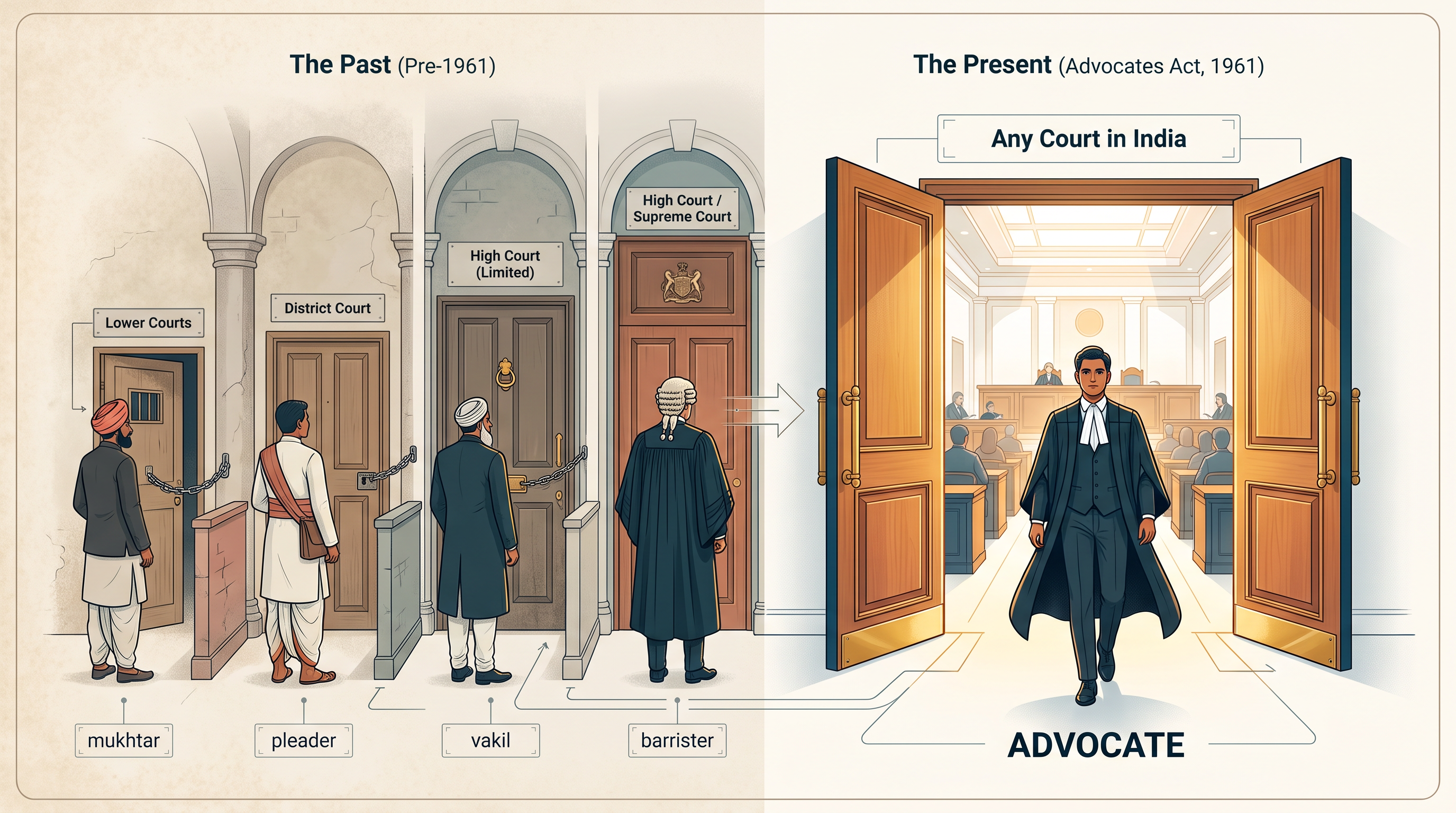
Fig. 13.0 – Consolidation of legal practitioners by the Advocates Act, 1961.
This chapter will answer each of these questions.
13.1 Evolution of the Legal Profession in India
The legal profession as we know it today — a trained, licensed body of professionals who represent others in court — is not ancient in India. It grew out of the colonial period, and it grew alongside the courts the British set up.
Its starting point is usually taken to be the Charter of 1726, under which Mayor’s Courts were established in the Presidency towns, including Madras and Calcutta. These courts followed English procedure, which meant that parties needed people trained to argue in that procedure. A class of court practitioners began to form around them.
Opening the Doors: The Act of 1846
For over a century after that, entry into practice depended heavily on who you were rather than what you knew. The turning point came with the Legal Practitioner’s Act, 1846. It threw the doors of the profession open to practitioners who were duly qualified, certified, and of good character.
Notice what that change did. It replaced background with qualification as the test of entry. From then on, a person could practise irrespective of nationality and religion — a genuinely significant shift at a time when such distinctions decided most public appointments.
One exclusion, however, survived. Women were still kept out of the legal profession altogether, no matter how well qualified they were. That bar was lifted only much later, by the Legal Practitioner’s (Women) Act, XXIII of 1923, which allowed women to practise in courts. How that bar was fought and finally removed is taken up in Section 13.8.
13.2 The Advocates Act, 1961 and the Single Category of Advocate
By the middle of the twentieth century, the law governing legal practitioners in India was scattered across several statutes, and the practitioners themselves were scattered across several grades. Parliament decided to clean this up in one go.
The Advocates Act was passed in 1961 with two clear objectives: to amend and consolidate the law relating to legal practitioners, and to provide for the constitution of the Bar Councils and an All-India Bar. “Consolidate” is the key word — one statute was to replace the patchwork, and one professional body was to replace the scattered arrangements that had grown up around individual High Courts.
One Category of Practitioner: the Advocate
The first and most visible change made by the Act was the abolition of the old categories. Vakils, barristers, pleaders of several grades, and mukhtars ceased to exist as separate classes. All of them were consolidated into a single category called “advocates”, who enjoy the right to practise in courts throughout India.
This is why the Act is said to recognise only one class of practitioners — the advocate. Advocates have been further classified as Senior Advocates and other Advocates, but that is a classification within the single class, not a return to the old grades. As Fig. 13.1 shows, the branches now sit under one trunk.
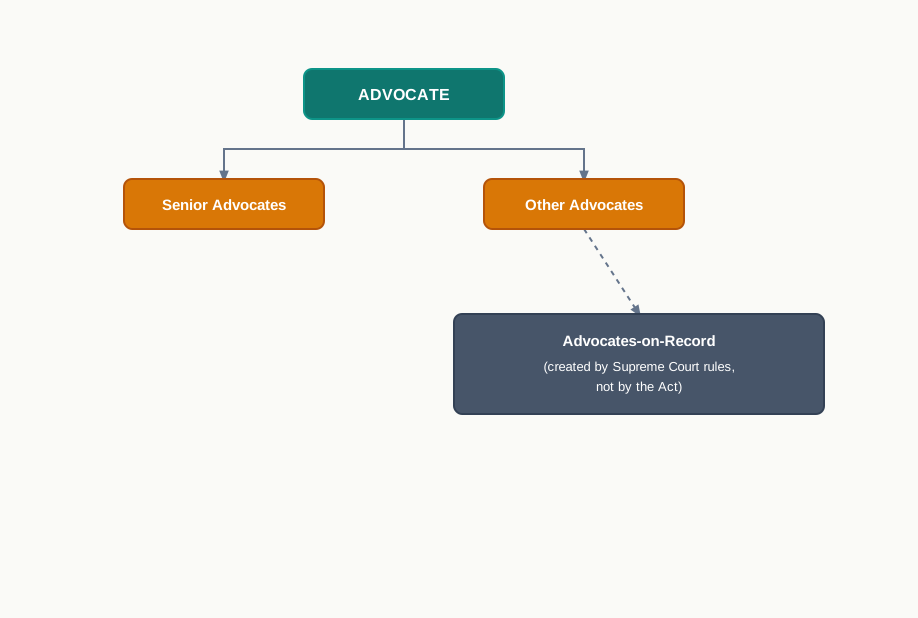
Fig. 13.1 – Classification of advocates.
The practical effect of the single category is a right of audience that travels with the advocate. An advocate on the State Rolls is entitled to practise as of right before any tribunal or authority of India, or any court, including the Supreme Court. Compare this with the position before 1961, where a practitioner’s rights stopped at the boundary of the court that had enrolled him.
Who May Be Enrolled
Because the title now carries such wide rights, the Act sets conditions for obtaining it. To be eligible for enrolment, an advocate must be:
- a citizen of India;
- at least 21 years of age; and
- the holder of an LLB degree from an Indian University.
Once enrolled, any advocate on the State Rolls is entitled to practise in all courts of India, including the Supreme Court.
There is one further requirement, added later. Since 2010, an advocate must also clear the All India Bar Examination in order to be able to start practice. The reason behind it is worth noticing: enrolment tests your degree and your eligibility, but not whether you can actually handle a matter. The examination is a minimum competence check placed between the degree and the client.
Foreign Nationals and Reciprocity
A foreign national may be enrolled on a reciprocal basis with the country of his citizenship, and his foreign degree may be recognised by the Council for the purpose. Reciprocity means a simple bargain: your country lets Indian lawyers practise there, so India lets your lawyers practise here.
In the absence of such reciprocity, foreign nationals cannot practise law in India. The Bar Council has released a list of foreign degrees that it recognises.
Senior Advocates
The Advocates Act makes a provision for two kinds of advocates, that is, Senior Advocates and advocates. The Supreme Court of India has, in exercise of its rule-making power, additionally made provision for the Advocate-on-Record. So one of the three comes from the statute’s own classification and one from the Supreme Court’s rules — a distinction students often miss.
Senior Advocates are designated as such by the Supreme Court of India or by any High Court. The Court can designate any advocate, with his consent, as Senior Advocate if in its opinion, by virtue of his ability and standing at the Bar or special knowledge or experience in law, the said advocate is deserving of such distinction (Section 16, Advocates Act, 1961).
Notice the two conditions built into that provision. The designation cannot be forced on an advocate — it needs his consent. And it is not applied for as a right; it rests on the Court’s opinion of ability, standing or special knowledge.
Designation brings restrictions as well as recognition. A Senior Advocate is not entitled to appear without an Advocate-on-Record in the Supreme Court, or without a junior in any other court or tribunal in India. He is not entitled to file a vakalatnama in any court or tribunal, or to accept instructions to draft pleadings or affidavits, advise on evidence, or do any drafting work of an analogous kind in any Court or Tribunal.
A vakalatnama is simply the document by which a client authorises a particular advocate to act for him in a case — the paper that formally puts a lawyer on the record. A designated Senior Advocate wears a gown with a “flap” at the back, which is how you can identify one in a courtroom.
The logic of these restrictions is that a Senior Advocate is meant to argue, not to run the file. The paperwork, the client contact and the filing stay with someone else, which keeps the two roles separate.
Advocates-on-Record
Only Advocates-on-Record are entitled to file any matter or document before the Supreme Court. They can also file an appearance or act for a party in the Supreme Court. No other High Court in India has a similar provision — this is a Supreme Court arrangement alone.
Two consequences follow from this arrangement. Only an Advocate-on-Record can file a vakalatnama in the Supreme Court on behalf of a client. And any correspondence by the Supreme Court is sent to the Advocate-on-Record — so the Court always has one identified person answerable for the conduct of the case.
This distinction is a standing favourite in board papers as a “distinguish between” question. The safest way to remember it is by function: the Senior Advocate argues, the Advocate-on-Record acts.
13.3 State Bar Councils
Having created a single all-India category of advocate, the Act needed machinery to admit people to it and to keep them in order. That machinery works at two levels — a Bar Council in each State, and the Bar Council of India above them. This section deals with the first.
Composition
The Act has created a State Bar Council in each State. Its composition has two parts. The Advocate General of the State is an ex officio member — that is, he sits on the Council by virtue of the office he already holds, without being elected or nominated to it. Alongside him sit members elected for a period of five years, ranging from 15 to 25 depending on the size of the State’s electorate of advocates.
The elected members are chosen by the advocates on the electoral roll of the State Bar Council itself, through proportional representation by means of the single transferable vote. This matters more than it looks. It makes the State Bar Council a self-governing professional body: lawyers regulate lawyers, rather than the government regulating them. That independence is the reason the profession can defend a client against the State without fear for its own licence.
The Roll of Advocates
Application for enrolment is made to the State Bar Council. Every State Bar Council shall prepare and maintain a roll of advocates, in which shall be entered the names and addresses of all who are admitted to be advocates on the roll of the State Bar Council under this Act on or after the appointed day. The “appointed day” is simply the date from which the relevant provision of the Act came into force.
Functions of State Bar Councils
The functions of a State Bar Council are—
- to admit persons as advocates on its roll;
- to prepare and maintain such roll;
- to entertain and determine cases of misconduct against advocates on its roll;
- to safeguard the rights, privileges and interests of advocates on its roll;
- to promote the growth of Bar Associations for the purposes of effective implementation of the welfare schemes;
- to promote and support law reform;
- to conduct seminars and organise talks on legal topics by eminent jurists and publish journals and papers of legal interest;
- to organise legal aid to the poor in the prescribed manner;
- to manage and invest the funds of the Bar Council;
- to provide for the election of its members;
- to visit and inspect Universities;
- to perform all other functions conferred on it by or under this Act;
- to do all other things necessary for discharging the aforesaid functions.
Read that list again and you will see it doing three different jobs at once. Some functions are regulatory — admitting advocates, maintaining the roll, and determining cases of misconduct. Some are representative — safeguarding the rights, privileges and interests of advocates on its roll. And some are public-facing — legal aid to the poor, support for law reform, and the inspection of Universities.
The third group is easy to skim past, but it is the reason a Bar Council is not merely a trade body. A body that admits members and also owes duties to the public must sometimes act against its own members’ immediate interests, which is exactly what a disciplinary function requires.
Funds
In addition, a State Bar Council may constitute one or more funds in the prescribed manner for the purpose of—
- giving financial assistance to organise welfare schemes for the indigent, disabled or other advocates;
- giving legal aid or advice in accordance with the rules made in this behalf;
- establishing law libraries.
A State Bar Council may receive any grants, donations, gifts or benefactions for all or any of the purposes specified above, which shall be credited to the appropriate fund or funds constituted under that sub-section.
Note whom the first purpose protects. Young advocates and those without steady briefs often earn very little in their early years, and an advocate who falls ill or is disabled has no employer to fall back on. The welfare fund exists because the profession is largely self-employed.
13.4 The Bar Council of India
The Indian legal profession includes both the practice of law and legal education. Those two things are usually regulated by different bodies in other professions and in other countries. In India they were deliberately placed in one pair of hands.
To regulate both, the Advocates Act established an All India Bar Council. The Attorney-General and the Solicitor General of India are its ex officio members. Each State Bar Council elects one member to it, and the Council elects its own Chairman and Vice Chairman.
Look closely at how that body is put together, shown in Fig. 13.2. Its members come up from the State Bar Councils, and its two highest officers are the Union Government’s own senior law officers. So the national body is neither a government department nor a body cut off from the States — it is built out of the profession, with the law officers sitting inside it.
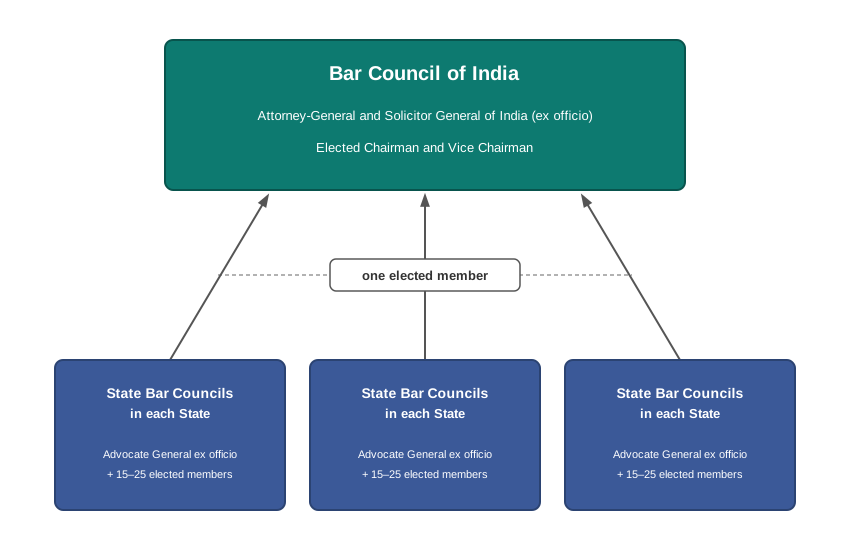
Fig. 13.2 – The two-tier Bar Council structure.
That history explains something about the 1961 Act. What the Chamier Committee thought impractical in 1923 — a Bar organised on an all-India basis — is exactly what the Advocates Act finally achieved thirty-eight years later.
The Regulatory Role
The Bar Council of India performs the regulatory function in two ways: by prescribing standards of professional conduct and etiquette, and by exercising disciplinary jurisdiction over the bar. The first tells advocates how they must behave; the second is the power to act when they do not.
It also sets standards for legal education and grants recognition to Universities whose degree in law will serve as qualification for enrolment as an advocate. This is a powerful lever. A University may run a law course, but if the Bar Council does not recognise its degree, that degree will not get a graduate on to any roll of advocates.
The Council regulates the content, syllabus and duration of the law degree, subject to which every University can lay down its own provisions. The Council has a Legal Education Committee for this purpose. State Council rules need to be approved by the Bar Council; however, the Central Government has overriding power to make rules.
The Representative Role
In addition, the Council performs certain representative functions by protecting the rights, privileges and interests of advocates, and through the creation of funds for providing financial assistance to organise welfare.
Holding both roles at once creates an obvious tension, and it is worth naming. The same body that speaks for advocates also disciplines them. That is the standard model for self-regulating professions, and it survives on the assumption that the profession values its own reputation enough to act against its worst members.
Statutory Functions
The regulatory and representative mandate of the Bar Council for the legal profession and legal education in India is reflected in its statutory functions, which are as follows—
- To lay down standards of professional conduct and etiquette for advocates.
- To lay down the procedure to be followed by its disciplinary committee and the disciplinary committees of each State Bar Council.
- To safeguard the rights, privileges and interests of advocates.
- To promote and support law reform.
- To deal with and dispose of any matter which may be referred to it by a State Bar Council.
- To promote legal education and to lay down standards of legal education. This is done in consultation with the Universities in India imparting legal education and the State Bar Councils.
- To recognise Universities whose degree in law shall be a qualification for enrolment as an advocate. The Bar Council of India visits and inspects Universities, or directs the State Bar Councils to visit and inspect Universities for this purpose.
- To conduct seminars and talks on legal topics by eminent jurists and publish journals and papers of legal interest.
- To organise legal aid to the poor.
- To recognise on a reciprocal basis the foreign qualifications in law obtained outside India for the purpose of admission as an advocate in India.
- To manage and invest the funds of the Bar Council.
- To provide for the election of its members who shall run the Bar Councils.
Several of these will look familiar, because the State Bar Councils carry similar functions. The difference is one of level, and it is the point students most often lose marks on.
A single sentence will hold this together in an examination: the State Bar Council puts you on the roll, and the Bar Council of India decides what it takes to get there.
13.5 Lawyers and Professional Ethics
An advocate holds a peculiar position. He is paid by a client, but he works inside a court, and the court depends on him telling the truth about the record. The rules of professional ethics exist to manage that double position.
The Bar Council of India Rules encompass professional standards for lawyers, as laid down by the Bar Council. The key duties and responsibilities of an Advocate can be grouped by whom they are owed to — the court, and the client.
Duties Towards the Court
An Advocate has a duty to act in a dignified manner and to respect the court. He must not communicate with a judge in private and impair impartiality. He must not act in an illegal manner towards the opposition. And he must refuse to represent clients who insist on adopting unfair means.
That last duty is the sharpest one, because it is the point at which the advocate must say no to the person paying him. In addition, being an officer of the Court, an Advocate is expected to uphold and maintain the values of the profession.
The reason behind the private-communication rule is worth spelling out. A judge decides between two sides, and must be seen to hear both. A quiet word in chambers, even if it contains nothing improper, destroys that appearance — so the rule bars the conduct rather than waiting to see whether it produced an unfair result.
Duties Towards the Client
An Advocate’s duties towards the client are these:
- to be bound to accept briefs;
- not to withdraw from service;
- not to appear in matters where he or she is a witness;
- not to suppress material or evidence;
- to maintain client confidentiality;
- not to instigate litigation;
- not to charge a contingency fee, that is, a fee depending on success or a favourable result in the matter;
- to ensure that his or her duties do not conflict with the client’s interests;
- not to negotiate directly with the opposing party, but only through the opposing advocate;
- to carry out legitimate promises made.
Two of these duties often surprise students. The bar on appearing where you are yourself a witness exists because the two roles cannot be held together — a witness’s job is to tell the court what he saw, an advocate’s job is to argue; one person doing both leaves the court unable to weigh either.
The bar on a contingency fee exists because a lawyer paid out of the winnings acquires a personal stake in the outcome. Once that happens, advice about settling, or about a weak point in the case, is no longer neutral advice.
What Happens on Breach
Breach of these rules and standards of conduct leads to disciplinary action against advocates, which may result in suspension or debarment. Suspension keeps an advocate off work for a stated period; debarment removes the name from the roll altogether — and, as Section 13.3 established, without a name on the roll there is no right to practise at all.
The full rules on professional standards are published by the Bar Council of India on its website, and are worth reading in the original.
13.6 Advertising by Lawyers
Almost every other service you can think of advertises. A dentist puts up a board, a coaching centre buys a hoarding, a hospital runs a campaign. The right of advocates to advertise their services or solicit clients, however, has been a controversial issue in the field of legal ethics and professionalism.
The Position in India
In India, advertising by lawyers has been strictly restricted by the Bar Council of India. An advocate is prohibited from promoting himself through—
- circulars;
- advertisements;
- touts;
- personal communications;
- interviews other than through personal relations;
- furnishing or inspiring newspaper comments; or
- producing his photographs to be published in connection with cases in which he has been engaged or concerned.
A “tout” is a person who hangs about a court or a police station and steers litigants towards a particular lawyer, usually for a cut. The last item on the list is easy to miss but tells you a good deal about the thinking: even a photograph of the advocate published alongside a case he argued is treated as self-promotion.
An amendment to this rule allows advocates to furnish certain information on their websites after intimating and taking approval from the Bar Council of India. However, only five pieces of information can be put up on the internet, that is—
- the name of the advocate or the firm;
- the contact details;
- details of enrolment with the Bar;
- his professional and academic qualification; and
- the areas of practice.
Read that list carefully and you will notice what it leaves out. There is no room for claims about success rates, no client testimonials, no comparison with other lawyers, and no fee offers. Everything permitted is a plain fact that can be verified; everything persuasive is excluded.
The Position in the United States
Different countries across the world allow advertising by lawyers to varying degrees. The position in the USA is different from that in India: lawyers there have a right to advertise, but subject to reasonable restrictions.
There are different rules of professional ethics for different states, and there is also the Model Rules of Professional Conduct, which serves as an indicative reference point. Three of its rules matter here:
- Rule 7.1 prohibits false and misleading communication about services.
- Rule 7.2 addresses advertising and referrals.
- Rule 7.3 articulates no-solicitation periods — for example, families and victims of mass disasters are off limits for 30–45 days.
Rule 7.3 repays a second look, because it shows a regulator solving a specific problem. A family that has just lost someone in a disaster is in no state to choose a lawyer. The rule buys them a period in which nobody may approach them.
Within those limits, lawyers in the US can provide information about class actions, can approach clients by handing out business cards, and can advertise on internet forums. For class actions, solicitation through referrals is permissible, and newspaper and magazine advertisements and even mass emails are permitted, as long as they are not misleading and no financial incentive is promised.
Personal injury advertisements are commonplace in the USA. Often known as “ambulance chasers”, these personal injury lawyers are robust in their advertising — on billboards, in newspapers, on flyers, and even in distasteful advertisements on television. Ambulance chasing is not representative of professional practice in India, since this class of lawyers is the sort who solicit business by lurking around hospitals, or by advertisements in newspapers and in Yellow Pages with toll-free numbers and “free” consultations.
The Debate, and Where Other Countries Stand
It is a matter of debate whether the Victorian tradition should be retained — the tradition within which law was considered to be a noble profession, and advertising was therefore prohibited so as not to tarnish the image of lawyers. The United Kingdom, from which that tradition came to India, has itself done away with the prohibition.
The comparative picture is mixed. Countries like the USA, the UK and France are more flexible with granting permission for legal advertisements, whereas Hong Kong, Singapore and Malaysia are moving towards progressive relaxation.
Malaysia is a useful example of regulation rather than prohibition. The Legal Profession (Publicity Rules), 2001, is a simple, comprehensive code that regulates advertisements in legal and non-legal directories, controls publication of journals, magazines, brochures and newsletters and interviews in the media, bars publicity through clients, and even regulates greeting cards.
In Hong Kong, lawyers are forbidden to advertise on television, radio and in the cinemas, but are permitted to advertise in print media. The line drawn there is one of medium rather than of message — broadcast persuasion is out, printed information is in.
13.7 Liberalisation and Globalisation of the Legal Profession
Liberalisation of the Legal Profession in India
It is the era of globalisation that called for the removal of barriers in trade and services in order to liberalise economies. Legal services were caught up in that movement along with everything else, and India has been working out its response ever since.
The first opening was small. It was in the 1990s that, for the first time ever, the Reserve Bank of India granted permission to three law firms to establish their liaison offices in India. A liaison office is not a place where legal practice is carried on; it is an office that maintains contact with clients and coordinates work done elsewhere.
Later, in 1995, the General Agreement on Trade in Services (GATS) under the World Trade Organisation came into force. Under GATS, a credible and reliable system for liberalising legal services was created, which applies to liberalising the legal profession and Corporate Legal Services also. It is therefore that legal advisory, legal documentation services, legal certification services, legal advisory and information services and other legal services were liberalised.
Notice which services those are. Every one of them is advisory or documentary work. None of them is appearance in court. That distinction — between advising and appearing — runs through this entire debate.
The Indian Bar did not welcome the change. The Bar Council of India has consistently passed several resolutions between 2002 and 2007 opposing the opening up of the Indian legal profession to foreign lawyers or foreign law firms.
The courts then took up the question, and did not answer it the same way. In 2011, in a judgement delivered by the Bombay High Court on a PIL filed by a non-profit organisation, Lawyers Collective, it was held that foreign law firms could not be permitted to set up liaison offices in India. However, contrary to this position, the Madras High Court, in response to a PIL filed by A.K. Balaji, permitted foreign lawyers to give advice to Indian clients in India on a “fly in and fly out” mode.
“Fly in and fly out” describes exactly what it sounds like: a foreign lawyer travels to India for a limited period, advises a client on foreign or international law, and leaves. There is no office, no enrolment, and no appearance before an Indian court.
Globalisation of the Legal Profession
“Globalisation” in its literal sense connotes the integration of the economy and legal structure of a nation with the world order.
The term “globalisation of law” refers to a utopian condition in which the whole world lives under a single set of legal rules. Such rules might be imposed by an international body, adopted by global consensus, or arrived at by parallel development in all parts of the globe. The word “utopian” is doing real work in that sentence — it signals that this is an idea being described, not a state of affairs that exists.
In today’s world of increasing international trade and inter-dependence, the need for transnational law has increased many folds. Since more and more countries open their economy, either partially or completely, there is a growing need to recognise and work towards a uniform system of law.
What This Means for a Law Graduate
As globalisation increases the flow of people and information across borders, there are increasing opportunities for trained lawyers. Typically, the opportunities are available in Common Law based jurisdictions such as the United States and the United Kingdom, and to an extent Australia and Canada.
Common Law jurisdictions share a legal method with India — judge-made precedent, adversarial trials, and much the same vocabulary — which is why an Indian law graduate finds the ground there familiar.
However, unlike many other professions, lawyers trained and licensed in one jurisdiction may not be licensed to practise in other jurisdictions. Lawyers trained in other jurisdictions will have to requalify in order to practise in the foreign jurisdictions.
The simple reason for this is that different countries have different legal systems, and laws are framed according to the social, political and civil conditions of the country. A doctor’s knowledge of the human body travels across borders unchanged; a lawyer’s knowledge of a statute stops at the border of the State that enacted it.
13.8 Women and the Legal Profession in India
Indian women were granted the right to take up the legal profession and practise as Advocates in the courts of law after the passing of the Legal Practitioners’ (Women) Act, XXIII of 1923, abolishing the bar on women from practising law.
That single sentence covers a long fight, and the fight is the instructive part.
Two Courts Say No
This right did not come easily to women in British India. In 1916, the Calcutta High Court, and in 1922, the Patna High Court, had held that women otherwise qualified were not entitled to be enrolled as Vakil or Pleader.
The Patna case shows how the refusal was reasoned.
Notice the reasoning chain, because it is exactly the kind of chain an examination question tests. Rule: only persons within the statute’s description may be enrolled. Application: the description was read as covering males. Result: a qualified woman was outside it. Change the statute’s words, and the outcome changes.
A Court Says Yes
The Allahabad High Court took the lead by enrolling Ms. Cornelia Sorabji as the first Indian lady Vakil of Allahabad High Court on 24 August 1921, by a decision of the English Committee of the Court (as the Administrative Committee was then called), consisting of Chief Justice Sir Edward Grimwood Mears.
So for a brief period the position differed from High Court to High Court — permitted in Allahabad, refused in Calcutta and Patna. That inconsistency is itself an argument for a single national statute, which is what finally came.
After the passing of the Legal Practitioners’ (Women) Act, XXIII of 1923, women were finally able to practise as lawyers in India.
The Position Today
Since then, although the number of women entering into the profession has increased, gender bias still pervades the profession. According to data tabled by the Law Ministry in Parliament in 2022, only 15.3 per cent of lawyers in India are women. However, recent studies have indicated that gender-based disadvantages are gradually being eliminated, especially in the corporate law sector.
Set that figure against what you know from Section 13.3. Nothing in the Advocates Act, 1961 or in the rules for enrolment now distinguishes between men and women; the legal barrier was removed a century ago. A gap of this size therefore tells you something important — that formal legal equality and actual participation are different things, and that removing a prohibition is not the same as removing an obstacle.
13.9 Legal Education in India, the USA and the UK
Every country decides for itself how a person becomes a lawyer, and the answers differ more than you might expect. This section looks at three systems — India, the United States and the United Kingdom — and at how each of them treats a lawyer who arrives from somewhere else.
Legal Education in India
Legal education in India is regulated by the Bar Council of India. The Bar Council of India prescribes the minimum standards of imparting legal education in India. You have already met this power in Section 13.4; here you see what it produced.
Preceding the liberalisation, in 1980, the BCI, the University Grants Commission, the Law Commission of India and various state governments have led to the establishment of various law schools in India. This revolution in legal education was pioneered by Prof. N.R. Madhava Menon, who was instrumental in setting up the first law school in India, the National Law School, Bangalore. At present there are 24 National Law Schools in India.
Two Routes to a Law Degree
There are two ways to obtain a degree to practise law and enrol with the Bar Council:
- a 3-year LL.B. programme, which requires a prior undergraduate degree; and
- a 5-year integrated B.A., LL.B. / BBA., LL.B. / B.Sc., LL.B. programme, which commences immediately after secondary school.
Some universities offer both the five-year and the three-year degree programmes.
The difference matters to a student in Class XII right now. The five-year route is entered straight after school; the three-year route is entered after finishing a different degree first. Both end at the same place — a law degree that qualifies its holder for enrolment.
The Bar Council of India recognises Universities whose degree in law shall be a qualification for enrolment as an advocate. It visits and inspects Universities, or directs the State Bar Councils to visit and inspect Universities for this purpose. The Bar Council releases a list of foreign degrees that it recognises.
Legal Education in the United States
In the United States, students first complete a four-year undergraduate degree in any discipline. They then write the Law School Admission Test (LSAT) examination. Thereafter, they can apply to a law school and enrol in a three-year J.D. (Juris Doctor) programme.
So law in the United States is entirely a postgraduate subject. There is no equivalent of India’s five-year integrated route straight from school.
The pedagogical method adopted in law schools involves the case study method as well as the Socratic Method. Under the case study method, students read decided judgments rather than textbook summaries, and work the rule out of the facts themselves. Under the Socratic Method, the teacher questions a student closely on those facts in front of the class, pushing the student to defend each step of the reasoning.
Licensing Requirements in the USA
Each state in the United States separately administers a mandatory Bar Exam. Typical first-time passage rates are: 72% (New York, 2009), 50% (CA, 2010), and 88% (MA 2008).
Bar applicants must also satisfy the character and fitness requirements of the state. Most states also have mandatory or minimum continuing legal education (CLE) requirements. CLE is professional education of lawyers that takes place after they are admitted to the Bar, and entails minimum hourly commitments which lawyers must undertake in order to maintain their licence.
The idea behind CLE is worth pausing on. A licence obtained at twenty-five would otherwise last a lifetime, no matter how much the law changed in between. CLE turns the licence into something that must be kept up rather than merely obtained.
Nearly all states require candidates to pass the Multistate Bar Examination (MBE) and the Multistate Professional Responsibility Examination (MPRE). Some states also require the passing of the Multistate Essay Examination (MEE) and/or the Multistate Performance Test (MPT).
Foreign Lawyers Practising in the US
As mentioned before, law graduates need to meet all requirements, including writing the Bar Examination of a particular State, to be eligible to practise in that State.
Foreign lawyers may appear for Bar Examinations in the US; however, laws from state to state vary in this matter. Students who have completed an LLM may qualify to sit the bar exam in California, New Hampshire, New York, Virginia and North Carolina. The criteria for eligibility to take the bar examination, or to otherwise qualify for bar admission, are set by each state’s bar association.
Interestingly, some states may allow some foreign-educated lawyers to take the bar examination without earning their degree locally. In such a case, however, foreign-educated lawyers must begin the process by getting their law degree reviewed and analysed by the American Bar Association (ABA). Once reviewed, the application is either accepted or deferred.
- If accepted, foreign lawyers are allowed to sit for that state’s bar exam in much the same way a domestic applicant would. In New York, one of the jurisdictions most open to foreign lawyers, this would allow foreign lawyers to sit for the bar without being required to complete any further law school study in the US.
- Even if deferred, applicants may be asked to complete course work at an ABA-approved college before sitting for the bar exam. This course work usually takes the form of a one-year LL.M programme at an ABA accredited school.
New York and California are the most popular states for foreign lawyers to give the Bar Examination, owing to the presence of a large number of international law firms involving transnational work, for which an international lawyer’s expertise is useful. These are also two of the most difficult bar Examinations to clear.
Foreign lawyers may also take up work as a Foreign Legal Consultant (FLC). As an FLC, it is possible to advise on home country law and international law, but not to appear in court. Notice how closely this resembles the Indian position discussed in Section 13.7 — advising is permitted, appearing is not.
FLCs are recognised in Alabama, Arizona, Connecticut, District of Columbia, Florida, Georgia, Hawaii, Illinois, Indiana, Michigan, Minnesota, Missouri, New Jersey, New York, Ohio, Oregon, Texas and Washington. California does not allow FLCs.
The American Bar Association (ABA)
At a federal level, the American Bar Association acts as a voluntary professional body for US lawyers. With over 400,000 members, it is the largest voluntary professional body in the world and has a significant international profile. Members of the legal profession in other countries can become international associates of the ABA.
The word “voluntary” is the one to hold on to. The ABA is not the American equivalent of the Bar Council of India, because nobody has to belong to it in order to practise.
Founded in 1878, the ABA supports the legal profession with practical resources for legal professionals, while improving the administration of justice, accrediting law schools, establishing model ethical codes, and more. Membership is open to lawyers, law students, and others interested in the law and the legal profession. Its goals include serving the members, improving the profession, eliminating bias and enhancing diversity, and advancing the rule of law.
One of its most important responsibilities is the creation and maintenance of a code of ethical standards for lawyers. The Model Code of Professional Responsibility, 1969 and the newer Model Rules of Professional Conduct, 1983 have been adopted in 49 states, D.C. and in the Virgin Islands. The only exception is the state of California. The ABA has been accrediting schools since 1923, and even publishes the internationally reputed ABA Journal.
Read that carefully: the ABA writes model codes, and the states choose to adopt them. It does not impose them. That is the difference between a model and a rule.
Regulation of the Legal Profession by State Bar Associations
Lawyers are regulated at state, not federal, level, by the state bar or the highest court. Bar associations in the US are divided into two categories: unified and non-unified.
In states with a unified bar, the responsibilities of regulating lawyers (admission, discipline and so on), along with activities to support their members as a professional body, lie with the State Bar Association. Membership is mandatory in order to practise in such states. There are 32 states with unified bars, including California, Texas and Florida.
In states with a non-unified bar, responsibility for admitting and regulating lawyers lies with the state Supreme Court or board of bar examiners. In such states, the state bar is a voluntary professional body with activities that can include professional development, lobbying, networking and charitable programmes. States with non-unified bars include New York, Washington D.C. and Illinois.
A unified bar is therefore the arrangement closest to India’s, where the State Bar Council both admits advocates and disciplines them, and where enrolment is compulsory before anyone may practise.
Legal Education in the United Kingdom
Legal education in the UK consists of a three-year LL.B., directly after secondary school. Graduates from fields other than law, and non-graduates, can become solicitors, but the LL.B. is the most straightforward path.
Clinical education continues after the LL.B., through the Legal Practice Course (LPC) and training contracts.
To become a Barrister, graduates are required to complete the Bar Vocational Course (BVC) instead of the LPC, and then seek a “pupillage” instead of a training contract. A pupillage is a period spent working under an established barrister, much as a junior advocate in India learns by working under a senior.
Though there are a number of differences between barristers and solicitors, the most significant one is that barristers can appear in all courts, while solicitors can only appear in higher courts if they qualify to become solicitor advocates. This split is exactly what India abolished in 1961, as you saw in Section 13.2 — a useful reminder that the single category of “advocate” was a deliberate choice, not an inevitable one.
Legal education in Scotland is slightly different from the rest of the UK, and LL.B. degrees awarded in other parts of the UK are not recognised as part of the qualification process in Scotland, and vice versa. So even within one country, a qualification does not automatically travel.
The Qualifying Law Degree
As stated, the most conventional route to becoming a lawyer is by reading law as an undergraduate. To qualify as a barrister or solicitor, students are required to obtain a “qualifying law degree”. For an LLB to meet the requirements of a qualifying law degree, the course must cover legal research skills and the seven foundation subjects:
- Obligations I (Contract Law);
- Obligations II (Tort Law);
- Foundations of Criminal Law;
- Foundations of Equity & the Law of Trusts;
- Foundations of the Law of the European Union;
- Foundations of Property Law;
- Foundations of Public Law.
The requirement for completion of the academic stage is a lower second class UK Honours degree.
Students who have not taken an undergraduate degree in law can still become lawyers. For students with undergraduate degrees in subjects besides law, it is possible to enrol in the Graduate Diploma in Law course (GDL), which is commonly known as the Common Professional Examination (CPE) or a conversion course. This is a one-year full-time or two-year part-time course, which covers the seven foundation subjects and results in an LLB on passing. Law firms do not look unfavourably on students with non-law undergraduate degrees when recruiting trainees.
Foreign Lawyers Practising in the UK
For qualified lawyers coming from outside England and Wales, it is still possible to practise. The Solicitors Regulation Authority (SRA) does not impose any formal experience requirements in order to re-qualify as solicitors in England and Wales. Some law firms may express their own requirements, which can differ from the SRA guidelines.
Candidates can take the Qualified Lawyers Transfer Scheme in order to qualify under this jurisdiction. Lawyers coming from EU Member States can rely on EU Directive 77/249 in this area, and European lawyers can practise to the same level as they could in their own country. However, it is not possible to be a barrister and solicitor simultaneously.
13.10 Opportunities for Law Graduates
Law is an exciting and challenging profession. Law graduates in India have various options and opportunities open to them after their graduation.
A law degree, in addition to being a professional degree, is now considered to be training in a discipline which trains the mind to think analytically and communicate systematically. That is why employers who will never send anyone to court still hire law graduates — the training itself is the qualification.
Following are some of the opportunities available to, and opted for by, graduates after they obtain their degrees in law. Fig. 13.3 gathers them into a single view.
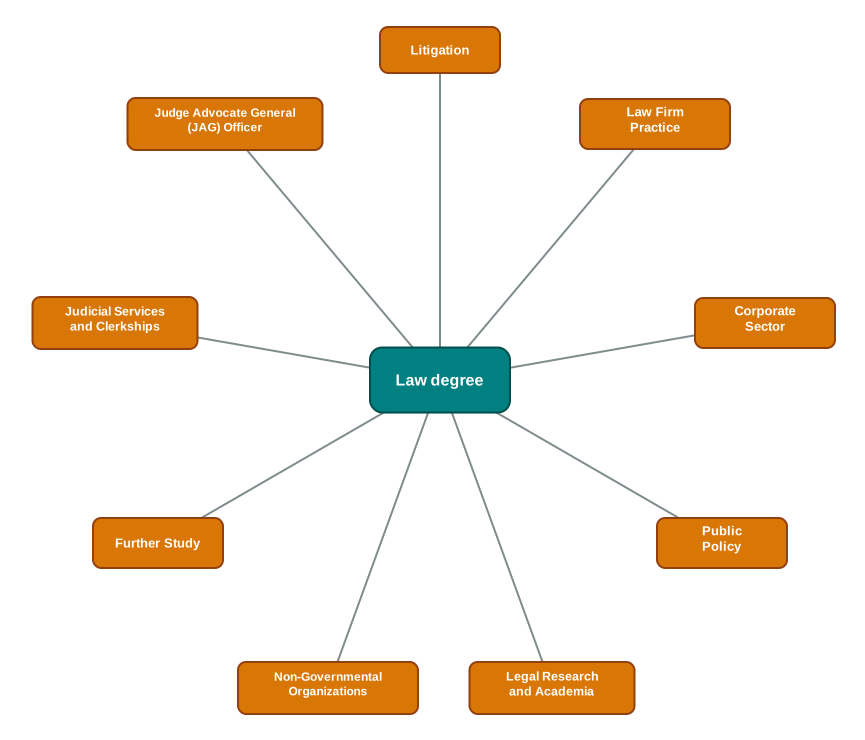
Fig. 13.3 – Career opportunities for law graduates.
- Litigation. Graduates may practise as an advocate in a court of law. This can be achieved by working under experienced advocates, or being attached to litigation departments of law firms or companies, in order to practise in the Courts of India.
This is the route that runs through everything you studied in Sections 13.2 and 13.3 — enrolment with a State Bar Council, the All India Bar Examination, and the professional duties that follow.
- Law Firm Practice. Law firms vary in size and practice areas. Law firms may range from boutique law firms specialising in specific areas of law (such as Intellectual Property Rights and Tax law), to mid-sized law firms, as well as large law firms which are full-service law firms with different practice groups such as general corporate, mergers and acquisitions, employment law, taxation, international trade, insurance, intellectual property, and project finance and infrastructure.
Transactional law at law firms typically involves practising in commercial and economic laws and advising on issues pertaining to a commercial transaction between two or more parties. This would usually include advising on the laws applicable to the transaction, drafting contracts and other documents, and helping clients with the commercial negotiations and the management and execution — that is, successful completion — of the transaction.
Notice that none of that work happens in a courtroom. Transactional lawyers try to make sure a dispute never arises, by writing the agreement carefully in the first place. Corporate lawyers would also advise on regulatory issues and legal compliance. Centres for Legal Process Outsourcing (LPOs) also have a lot of transnational transactional work.
- Corporate Sector. Large corporations often have an in-house legal practice. An in-house counsel will give legal advice to the company, have expertise in the business of the company, and be responsible for ensuring that the business of the company is being run in compliance with applicable laws, and when required will bring in external lawyers.
Several organisations such as commercial banks, multinational companies, investment firms, insurance companies, e-commerce ventures and media houses are hiring law graduates for managing their legal departments.
The difference between (b) and (c) is simply who the lawyer works for. A law firm lawyer has many clients; an in-house counsel has one — the company that employs her.
- Public Policy. Lawyers have an important role in formulating and advising on public policy. Several organisations employ law graduates for policy making and have institutionalised fellowships where law graduates can be Research Assistants.
For example, a law graduate interested in public policy can apply to serve as a Legislative Assistant under the Legislative Assistants to Members of Parliament (LAMP) Fellowship programme run by PRS Legislative Research. Institutions such as the Competition Commission of India and the Securities and Exchange Board of India also employ law graduates for policy making in the respective fields. Law firms have established Government Policy Departments where they employ law graduates for policy research.
Policy work asks a different question from litigation. Litigation asks what the law is; policy work asks what the law ought to be, and whether the rule being drafted will actually work when applied to millions of people.
- Legal Research and Academia. Graduates may attach themselves with Research Centres and think tanks. Law graduates may take up teaching and research as a profession.
At least a postgraduate degree in Law or related disciplines is expected to build a career in academics. Universities employ postgraduates in law as lecturers or Assistant Professors at the beginning of their careers. Short-term positions and opportunities as Visiting Professors or Adjunct Professors are also available in academia.
- Non-Governmental Organizations. Not-for-profit organisations, especially organisations with a social justice orientation, have positions for law graduates. These range from small grass-root level organisations to large well-funded organisations.
They may be general in nature, providing free legal aid, legal education and legal awareness, or more specialist organisations involved in areas such as women and child rights, environmental law, employment laws, consumer rights and public health.
Government institutions, government departments, statutory authorities, public sector undertakings and regulatory bodies also provide interesting opportunities to lawyers. Graduates may opt for jobs in the government sector in institutions such as the National Human Rights Commission, the Law Commission of India, and the National Commission for Women.
- Further study. Law is an interdisciplinary subject, and graduates may opt for further studies in related disciplines such as Business, Economics, Anthropology and Sociology.
Traditionally, law graduates pursue a Master of Laws (LL.M) degree, followed by research degrees such as M.Phil or Ph.D. A variety of opportunities are available in India and abroad for advanced studies in law.
- Judicial Services and clerkships. The court system provides several avenues to law graduates. The higher judiciary — that is, judges of the High Courts and the Supreme Court — have law clerks cum research assistants, who assist a judge in researching for cases, maintaining paperwork and similar work. Judicial clerks often sit in court hearings with the judges.
Graduates may also write the judicial services examination to take up positions in the Indian Judiciary. Qualifying candidates start in subordinate courts and may then progress to hold offices in the High Courts and even the Supreme Court of India.
A clerkship and a judicial services post are not the same thing, and students often confuse them. A law clerk assists a judge; a judicial officer is a judge.
- Judge Advocate General (JAG) Officer. The Judge Advocate General’s (JAG) Department is the legal branch of the Indian Army. It deals with military-related disciplinary cases and litigation, and assists in providing legal assistance to the army in human rights matters and the rule of law, among other things.
The department consists of legally qualified Army officers who are educated in military law and provide legal help to the military in all aspects. The department supports the Judge Advocate General, who is the legal and judicial chief of the army and advises the Chief of the Army Staff on legal matters.
The JAG’s Department is also responsible for emerging fields of military law, such as those related to cyber laws, space laws, terrorism and human rights violations. The service rendered in the JAG’s Department is considered to be judicial service as per the regulations for the Indian Army.
13.11 Summary
- The modern legal profession in India has its roots in the colonial period, beginning with the Mayor’s Courts established under the Charter of 1726.
- The Legal Practitioner’s Act, 1846 opened the profession to duly qualified, certified practitioners of good character, who could practise irrespective of nationality and religion.
- Women remained excluded until the Legal Practitioner’s (Women) Act, XXIII of 1923 allowed them to practise in courts.
- The Advocates Act, 1961 was passed to amend and consolidate the law relating to legal practitioners and to provide for the constitution of the Bar Councils and an All-India Bar.
- The Act abolished the old categories of practitioners — vakils, barristers, pleaders of several grades and mukhtars — and created a single category called advocates.
- An advocate on the State Rolls is entitled to practise as of right before any tribunal or authority of India, or any court, including the Supreme Court.
- To be eligible for enrolment, an advocate must be:
- a citizen of India;
- at least 21 years of age; and
- the holder of an LLB degree from an Indian University.
- Since 2010, an advocate must also clear the All India Bar Examination in order to start practice.
- A foreign national may be enrolled on a reciprocal basis with the country of his citizenship; in the absence of reciprocity, foreign nationals cannot practise law in India.
- Under Section 16 of the Advocates Act, 1961, an advocate may, with his consent, be designated as a Senior Advocate by the Supreme Court or a High Court, by virtue of his ability and standing at the Bar or special knowledge or experience in law.
- A Senior Advocate cannot appear without an Advocate-on-Record in the Supreme Court or without a junior elsewhere, cannot file a vakalatnama, and cannot accept instructions to draft pleadings or affidavits, advise on evidence or do analogous drafting work.
- The Advocate-on-Record is a category created not by the Advocates Act but by the rules of the Supreme Court, and only an Advocate-on-Record may file a matter, document or vakalatnama in the Supreme Court.
- A State Bar Council consists of the Advocate General of the State as an ex officio member and 15 to 25 members elected for five years by the advocates on its electoral roll.
- Application for enrolment is made to the State Bar Council, which prepares and maintains the roll of advocates.
- The functions of a State Bar Council are regulatory, representative and public-facing at the same time — admitting advocates and determining misconduct, safeguarding advocates’ interests, and organising legal aid to the poor and supporting law reform.
- A State Bar Council may constitute funds for welfare schemes for indigent or disabled advocates, for legal aid or advice, and for establishing law libraries.
- The Bar Council of India regulates both the practice of law and legal education, with the Attorney-General and the Solicitor General of India as ex officio members and one member elected by each State Bar Council.
- The Chamier Committee of 1923 led to the Indian Bar Councils Act, 1926; the Bar Council of India itself was established under the Advocates Act, 1961.
- The Bar Council of India prescribes standards of professional conduct and etiquette, exercises disciplinary jurisdiction over the bar, lays down standards of legal education, and recognises the Universities whose law degree qualifies a person for enrolment.
- State Bar Council rules require the approval of the Bar Council of India, and the Central Government has overriding power to make rules.
- An advocate’s duties towards the court include acting in a dignified manner, respecting the court, not communicating privately with a judge, and refusing to represent clients who insist on adopting unfair means.
- An advocate’s duties towards the client include accepting briefs, not withdrawing from service, not appearing where he or she is a witness, not suppressing material or evidence, maintaining confidentiality, and avoiding any conflict with the client’s interests.
- An advocate may not instigate litigation or charge a contingency fee, that is, a fee depending on success or a favourable result.
- Breach of the rules of professional conduct leads to disciplinary action, which may result in suspension or debarment.
- Advertising by lawyers is strictly restricted in India; an advocate may put only five specified items of information on a website, after intimating and taking approval from the Bar Council of India.
- In the USA lawyers may advertise subject to reasonable restrictions, governed state by state, with the Model Rules of Professional Conduct as an indicative reference point.
- Liberalisation of legal services began with RBI permission to three foreign law firms to open liaison offices in the 1990s and with GATS under the WTO coming into force in 1995.
- The Bombay High Court in 2011 held that foreign law firms could not set up liaison offices in India, while the Madras High Court permitted foreign lawyers to advise Indian clients on a “fly in and fly out” basis.
- Globalisation of law refers to a condition in which the whole world lives under a single set of legal rules, whether imposed by an international body, adopted by consensus, or reached by parallel development.
- A lawyer licensed in one jurisdiction is generally not licensed in another and must requalify, because legal systems differ according to the social, political and civil conditions of each country.
- Women were refused enrolment as Vakil or Pleader by the Calcutta High Court in 1916 and the Patna High Court in 1922, on the ground that the Legal Practitioner’s Act referred to males and not females.
- Cornelia Sorabji was enrolled as the first Indian lady Vakil of the Allahabad High Court on 24 August 1921, before the 1923 Act removed the bar nationally.
- According to data tabled by the Law Ministry in Parliament in 2022, only 15.3 per cent of lawyers in India are women.
- A law degree in India may be obtained through:
- a 3-year LL.B. programme after a prior undergraduate degree; or
- a 5-year integrated programme commencing immediately after secondary school.
- Legal education in the United States is entirely postgraduate: a four-year undergraduate degree, the LSAT, and a three-year J.D. taught through the case study and Socratic methods.
- Each American state administers its own Bar Exam, and most states require continuing legal education for a lawyer to maintain the licence.
- The American Bar Association is a voluntary body which accredits law schools and writes model ethical codes that states may choose to adopt.
- The United Kingdom divides the profession into solicitors and barristers, and a person cannot be both at the same time.
- Opportunities for law graduates in India include litigation, law firm practice, the corporate sector, public policy, legal research and academia, non-governmental organisations, further study, judicial services and clerkships, and the Judge Advocate General’s Department of the Indian Army.
13.12 Key Terms
Mayor’s Courts — the courts established in the Presidency towns under the Charter of 1726, around which the modern legal profession in India first took shape.
Advocate — a person whose name is entered on the roll of advocates maintained by a State Bar Council under the Advocates Act, 1961, and who is thereby entitled to practise law before any court, tribunal or authority in India.
All India Bar Examination — the examination which, since 2010, an enrolled advocate must clear in order to be able to start practice.
Reciprocity — the principle that a foreign national may be enrolled to practise in India only if Indian lawyers are permitted to practise in the country of that person’s citizenship.
Senior Advocate — an advocate designated as such, with his consent, by the Supreme Court or a High Court under Section 16 of the Advocates Act, 1961, by virtue of his ability and standing at the Bar or special knowledge or experience in law.
Vakalatnama — the document by which a client authorises a particular advocate to act for him in a case.
Advocate-on-Record — an advocate qualified under the rules of the Supreme Court who alone may file a matter, document or vakalatnama in the Supreme Court and act for a party there.
Ex officio member — a person who sits on a body by virtue of an office already held, without being elected or nominated to it.
State Bar Council — the body created in each State by the Advocates Act, 1961, which admits persons as advocates, maintains the roll, and determines cases of misconduct against advocates on its roll.
Roll of advocates — the official register maintained by a State Bar Council containing the names and addresses of every person admitted as an advocate on its roll.
Appointed day — the date from which the relevant provision of the Advocates Act, 1961 came into force.
Bar Council of India — the all-India body established under the Advocates Act, 1961 which regulates both the practice of law and legal education across the country.
Legal Education Committee — the committee through which the Bar Council of India discharges its functions relating to the content, syllabus and duration of the law degree.
Misconduct — conduct by an advocate in breach of the standards of professional conduct and etiquette, which a Bar Council may entertain and determine.
Suspension — a disciplinary order keeping an advocate from practising for a stated period.
Debarment — a disciplinary order removing an advocate’s name from the roll, and with it the right to practise.
Contingency fee — a fee depending on success or a favourable result in the matter, which an advocate in India is prohibited from charging.
Tout — a person who steers litigants towards a particular lawyer, usually for a share of the fee, and through whom an advocate is prohibited from promoting himself.
Model Rules of Professional Conduct — the code framed by the American Bar Association which serves as an indicative reference point for the rules of professional ethics of individual American states.
Liaison office — an office that maintains contact with clients and coordinates work carried on elsewhere, without legal practice being conducted there.
GATS — the General Agreement on Trade in Services under the World Trade Organisation, which came into force in 1995 and under which legal advisory, documentation, certification and information services were liberalised.
Fly in and fly out — the arrangement by which a foreign lawyer travels to India for a limited period to advise a client on foreign law, without an office, enrolment or appearance before an Indian court.
Globalisation of law — a condition in which the whole world lives under a single set of legal rules, whether imposed by an international body, adopted by global consensus, or reached by parallel development.
Socratic Method — the teaching method used in American law schools in which the teacher questions a student closely on the facts of a case, requiring each step of the reasoning to be defended.
Continuing legal education — professional education undertaken by a lawyer after admission to the Bar, for a prescribed minimum number of hours, as a condition of keeping the licence to practise.
Foreign Legal Consultant — a foreign lawyer recognised in certain American states to advise on home country law and international law, but not to appear in court.
American Bar Association — the voluntary professional body for lawyers in the United States, which accredits law schools and frames model ethical codes that states may choose to adopt.
Unified bar — an arrangement in which the State Bar Association both regulates lawyers and supports them as a professional body, membership being mandatory in order to practise.
Non-unified bar — an arrangement in which admission and regulation lie with the state Supreme Court or board of bar examiners, and the state bar is a voluntary professional body.
Qualifying law degree — in the United Kingdom, a law degree covering legal research skills and the seven foundation subjects, required in order to qualify as a barrister or solicitor.
Graduate Diploma in Law — the United Kingdom conversion course, also known as the Common Professional Examination, which covers the seven foundation subjects for graduates of other disciplines.
Solicitor — a lawyer in the United Kingdom who qualifies through the Legal Practice Course and a training contract, and who may appear in the higher courts only on qualifying as a solicitor advocate.
Barrister — a lawyer in the United Kingdom who qualifies through the Bar Vocational Course and a pupillage, and who may appear in all courts.
Pupillage — the period a prospective barrister spends working under an established barrister.
In-house counsel — a lawyer employed by a company to advise it and to ensure that its business is run in compliance with applicable laws.
Transactional law — practice in commercial and economic laws, advising on a commercial transaction between two or more parties, drafting the documents, and assisting through negotiation and completion.
Law clerk cum research assistant — a law graduate who assists a judge of a High Court or the Supreme Court with research and paperwork, and who often sits in court hearings with the judge.
Judge Advocate General’s Department — the legal branch of the Indian Army, which handles military disciplinary cases and litigation and advises on military law.
13.13 Points to Ponder
The Advocates Act, 1961 replaced several grades of practitioner with one category. Did India gain anything by abolishing the distinctions, or did it simply move them elsewhere — into Senior Advocates, Advocates-on-Record, and the informal hierarchy of the Bar?
The same Bar Councils that protect the rights and interests of advocates also sit in judgment on their misconduct. Can a profession be trusted to discipline itself, and what would be lost if an outside body did it instead?
An advocate is bound to accept briefs. Is there any point at which a lawyer should be free to refuse a client, and who should decide where that point lies?
A person who does not know that a legal remedy exists cannot ask for it. Does the near-total ban on advertising by advocates in India protect the public, or does it keep information away from the people who most need it?
Contingency fees are prohibited in India because they give the lawyer a stake in the outcome. But a client who cannot pay upfront may have no other way of bringing a case at all. How should the law balance these two concerns?
Foreign lawyers may advise Indian clients but not appear in Indian courts. Is the line between advising and appearing a sound one, and will it hold as more legal work moves online?
The bar on women practising law was removed in 1923, yet women were only 15.3 per cent of lawyers in India in 2022. What does this gap tell you about the difference between removing a prohibition and removing an obstacle?
The Bar Council of India regulates both entry into the profession and the content of legal education. Should the body that decides who may practise also decide what a law student is taught?
Legal education in India can begin straight after school, while in the United States it begins only after a full undergraduate degree. Which approach is likely to produce a better lawyer, and what does each system assume about what a lawyer needs to know?
Several of the careers described in this chapter involve no court appearance at all. If most law graduates never argue a case, should legal education continue to be built mainly around litigation?
A licence to practise medicine is respected across borders far more readily than a licence to practise law. What does that difference tell you about the nature of law itself?
13.14 Textbook Questions
Write short notes on the following:
- Women and the legal profession
- Professional ethics for lawyers
- Eligibility and qualification to practise as an Advocate in India
- Legal education in India
What changes did the Advocates Act, 1961 bring about in India?
Discuss the main points of difference between a Senior Advocate and an Advocate-on-Record.
Compare the rules regarding advertising by legal professionals in India and in other countries.
How is the Bar Council of India organised? What are its roles and functions? Trace the history of the Bar Council.
Compare the rules regarding entry of foreign lawyers in the United States and the United Kingdom.
13.15 Objective Questions
The modern legal profession in India is traced to the Mayor’s Courts established under the—
- Charter of 1726
- Legal Practitioner’s Act, 1846
- Indian Bar Councils Act, 1926
- Advocates Act, 1961
Which of the following categories of practitioner was NOT abolished by the Advocates Act, 1961?
- Vakil
- Mukhtar
- Advocate
- Pleader
The minimum age for enrolment as an advocate under the Advocates Act, 1961 is—
- 18 years
- 21 years
- 23 years
- 25 years
The All India Bar Examination became a requirement for advocates in the year—
- 1961
- 1995
- 2010
- 2022
Designation as a Senior Advocate is governed by—
- Section 16 of the Advocates Act, 1961
- the rules of the Bar Council of India alone
- the Indian Bar Councils Act, 1926
- a resolution of the State Bar Council
Which of the following may a Senior Advocate do?
- File a vakalatnama in a High Court
- Appear in the Supreme Court without an Advocate-on-Record
- Accept instructions to draft an affidavit
- Appear in a High Court along with a junior
The category of Advocate-on-Record was created by—
- the Advocates Act, 1961
- rules made by the Supreme Court of India
- the Bar Council of India Rules
- a notification of the Central Government
The ex officio member of a State Bar Council is the—
- Chief Justice of the High Court
- Advocate General of the State
- Attorney-General of India
- Solicitor General of India
The ex officio members of the Bar Council of India are the—
- Chief Justice of India and the Attorney-General
- Attorney-General and the Solicitor General of India
- Law Minister and the Attorney-General
- Advocates General of all the States
An advocate is prohibited from charging a contingency fee. A contingency fee means a fee—
- paid in advance before the matter begins
- charged for an urgent hearing
- depending on success or a favourable result in the matter
- shared with the opposing advocate
How many pieces of information may an advocate in India place on a website, after intimation to and approval from the Bar Council of India?
- Three
- Five
- Seven
- There is no limit
The General Agreement on Trade in Services (GATS) under the World Trade Organisation came into force in—
- 1990
- 1995
- 2002
- 2011
The bar on women practising law in India was abolished by the—
- Legal Practitioner’s Act, 1846
- Legal Practitioners’ (Women) Act, XXIII of 1923
- Indian Bar Councils Act, 1926
- Advocates Act, 1961
Cornelia Sorabji was enrolled as the first Indian lady Vakil of the—
- Calcutta High Court
- Patna High Court
- Allahabad High Court
- Bombay High Court
In the United States, a Foreign Legal Consultant may—
- appear in any state court
- advise on home country law and international law, but not appear in court
- practise the law of that state after two years
- be admitted without any review of the foreign degree
Which of the following is the most significant difference between a barrister and a solicitor in the United Kingdom?
- The length of the law degree
- The regulator that admits them
- The courts in which they may appear
- The subjects studied at the academic stage
Assertion (A): An advocate must not communicate with a judge in private about a matter being heard. Reason (R): A judge decides between two sides and must also be seen to have heard both.
Assertion (A): A woman who had obtained a B.L. degree was still refused enrolment as a Pleader in 1922. Reason (R): The Patna High Court held that the sections of the Legal Practitioner’s Act referred to males and not females.
Assertion (A): A Senior Advocate cannot file a vakalatnama in any court or tribunal. Reason (R): The role of a Senior Advocate is to argue the matter, while the conduct of the file stays with another advocate.
Assertion (A): The Bar Council of India can effectively decide which law degrees are worth obtaining. Reason (R): It recognises the Universities whose degree in law shall be a qualification for enrolment as an advocate.
Assertion (A): An advocate enrolled with the Bar Council of Rajasthan may appear before the Supreme Court of India. Reason (R): An advocate on the State Rolls is entitled to practise as of right before any court, tribunal or authority in India.
Assertion (A): An Indian advocate who moves to the United Kingdom must requalify before practising there. Reason (R): Different countries have different legal systems, and laws are framed according to the social, political and civil conditions of the country.
Assertion (A): The American Bar Association cannot compel any state to follow its ethical code. Reason (R): The American Bar Association is a voluntary professional body, and its Model Rules must be adopted by a state to take effect there.
13.16 Check Your Concepts
Why is the Legal Practitioner’s Act, 1846 treated as a turning point in the history of the legal profession in India? State what it changed about entry into the profession.
A woman with a law degree was refused enrolment as a Pleader in 1922 even though she met every stated qualification. Explain why a fresh statute was needed in 1923, when the 1846 Act had already opened the profession to all “duly qualified” persons.
State the two objectives with which the Advocates Act, 1961 was passed.
What problem was the Advocates Act, 1961 written to solve? Describe the position of a litigant looking for a lawyer before 1961, and explain how the single category of advocate improved it.
State the conditions of eligibility for enrolment as an advocate under the Advocates Act, 1961.
Enrolment already tests a person’s degree and eligibility. Why, then, was the All India Bar Examination added as a further requirement in 2010?
What happens if a foreign national from a country that does not permit Indian lawyers to practise there applies for enrolment as an advocate in India? Name the principle that governs the answer.
Section 16 of the Advocates Act, 1961 contains two conditions before an advocate can be designated a Senior Advocate. Identify both, and explain why each is there.
Distinguish between a Senior Advocate and an Advocate-on-Record on any four bases.
A Senior Advocate is not permitted to file a vakalatnama or to draft pleadings. Explain the reasoning behind these restrictions.
Arrange the following steps in the correct order for an advocate who wishes to become an Advocate-on-Record: appear for the examination conducted by the Supreme Court; practise for four years as an advocate; maintain a registered office and a registered clerk; complete one year’s training; intimate to the Supreme Court that training has begun.
Correct the error in the following statement and give the correct position: “The Advocates Act, 1961 recognises three classes of practitioners — Senior Advocates, Advocates-on-Record and other Advocates.”
Describe the composition of a State Bar Council. Who is its ex officio member, and how are the remaining members chosen?
The functions of a State Bar Council can be grouped as regulatory, representative and public-facing. Give one function from each group and explain what makes it belong there.
Why does a State Bar Council need power to constitute welfare funds for advocates, when most professionals rely on their employers for such support?
Distinguish between a State Bar Council and the Bar Council of India on any four bases.
The same body that safeguards the rights and interests of advocates also disciplines them. Explain the tension this creates, and the assumption on which self-regulation of a profession rests.
What happens to a University’s law degree if the Bar Council of India does not recognise it? Explain why this makes recognition such a powerful regulatory tool.
Identify the provision under which the Bar Council of India was established, and name the earlier Act that first provided for the constitution of Bar Councils in India.
State any five duties of an advocate towards the court.
Why is an advocate bound to accept briefs? Explain what would happen to access to justice if advocates could refuse clients freely.
An advocate agrees to accept a share of the property her client is fighting for, payable only if the suit succeeds. Identify what this arrangement is called, state whether it is permitted, and explain the reason for the rule.
Why is an advocate not permitted to appear in a matter in which he or she is a witness?
Distinguish between suspension and debarment as consequences of professional misconduct.
List the five pieces of information an advocate in India may place on a website. What do all five have in common, and what kind of content is excluded?
Rule 7.3 of the Model Rules of Professional Conduct in the United States creates a no-solicitation period after a mass disaster. What problem is this rule solving?
Compare the rules on advertising by lawyers in India and in the United States on any four bases.
Every legal service liberalised under GATS is advisory or documentary in nature. Why does the distinction between advising and appearing matter so much in the debate on foreign lawyers in India?
What is meant by the “fly in and fly out” mode? Explain how it differs from setting up a liaison office.
A qualified doctor’s expertise is accepted across borders far more readily than a qualified lawyer’s. Explain the reason the chapter gives for this difference.
Correct the error in the following statement and give the correct position: “Since the passing of the Legal Practitioners’ (Women) Act, XXIII of 1923, women have made up nearly half the lawyers in India.”
State the two routes by which a student in India may obtain a law degree that qualifies for enrolment with the Bar Council, and identify the point at which each route is entered.
Distinguish between the way legal education begins in India and the way it begins in the United States.
What is continuing legal education, and what problem does it solve that an entrance examination cannot?
Distinguish between a unified bar and a non-unified bar in the United States. Which of the two is closer to the Indian arrangement, and why?
The American Bar Association writes model ethical codes but cannot enforce them. Explain how a model differs from a rule, and how the Model Rules of Professional Conduct come to have effect in a state.
Distinguish between a barrister and a solicitor in the United Kingdom on any three bases.
What is a qualifying law degree in the United Kingdom, and how may a graduate of a subject other than law still become a lawyer there?
Distinguish between a law clerk cum research assistant and a judicial officer.
Distinguish between the work of a lawyer in a law firm and that of an in-house counsel in a company.
Transactional lawyers rarely see the inside of a courtroom. Explain what their work consists of, and why it is still legal practice.
13.17 Case-Based Questions
- Ishita, aged 22, is an Indian citizen who has just completed her five-year integrated B.A., LL.B. from a University in India whose law degree is recognised by the Bar Council of India. She applies for enrolment and her name is entered on the roll of a State Bar Council. Two weeks later she takes on her first client and appears for him in a district court. She has not yet appeared for the All India Bar Examination.
- Does Ishita satisfy the conditions of eligibility for enrolment? Refer to each condition in turn.
- Was she entitled to begin practice when she did? Give reasons.
- Her classmate Rehan, aged 22, holds a law degree from a foreign University and is a citizen of a country which does not permit Indian lawyers to practise there. Advise Rehan on whether he can be enrolled in India, and name the principle involved.
- Which body would Ishita apply to if she later wished her name to be entered on the roll, and which body decided that her University’s degree qualifies her at all?
- A company wishes to file an appeal in the Supreme Court of India. It engages Mr. Rao, a designated Senior Advocate of thirty years’ standing, and asks him to sign and file the vakalatnama, draft the petition, and appear at the hearing. Mr. Rao’s office declines to do the first two.
- Why did Mr. Rao’s office decline to file the vakalatnama and draft the petition?
- Who must the company additionally engage before its appeal can be filed, and what qualification must that person hold?
- If the same matter were being argued in a High Court instead of the Supreme Court, would Mr. Rao be able to appear alone? Give reasons.
- The company complains that the Supreme Court sends all its correspondence to someone other than Mr. Rao. Explain why.
- Advocate Meera is engaged by a client in a long-running property dispute. She agrees that she will charge nothing if the suit fails, and will take one-fifth of the property if it succeeds. During the case, she meets the judge socially and mentions in passing that her client’s case is a strong one. She also telephones the opposing party directly to suggest a settlement, without going through the opposing advocate.
- Identify each rule of professional conduct that Meera has breached, and state whether the duty breached was owed to the court or to the client.
- Explain the reasoning behind the prohibition on the fee arrangement she agreed to.
- Which body would entertain and determine a complaint of misconduct against Meera, and what consequences may follow?
- Would the position be different if Meera had agreed on a fixed fee payable whether the suit succeeded or failed? Give reasons.
- Advocate Farhan sets up a website carrying his name, contact details, enrolment details, academic qualifications and areas of practice. He also adds a page listing the cases he has won, with a testimonial from a satisfied client and a photograph of himself outside the court after a well-reported judgment. A newspaper then carries an interview with him about that judgment, arranged by his office.
- Which parts of Farhan’s website are permitted and which are not? Give reasons.
- What must an advocate do before placing even the permitted information on a website?
- Comment on the photograph and the newspaper interview with reference to the rules against self-promotion.
- Would Farhan’s conduct be treated differently if he were practising in the United States? Support your answer with the position there.
- A firm of lawyers qualified in Singapore is engaged by an Indian company on a cross-border commercial agreement. Two of its lawyers travel to Mumbai for ten days, advise the company on Singapore law and on the international contract, and return. Encouraged by the work, the firm then proposes to open a permanent office in Mumbai and to appear for the company in a suit filed in the Bombay High Court.
- Was the ten-day visit permissible? Name the mode of practice it describes.
- Advise the firm on its proposal to appear in the Bombay High Court, and explain the principle that decides the answer.
- What did the Bombay High Court hold in 2011 about foreign law firms setting up liaison offices in India?
- Explain why advising and appearing are treated so differently in this area of law.
- Anjali is in Class XII and wants to be a lawyer. Her cousin Vikram has already completed a B.Com. degree and is also considering law. Anjali’s uncle, a solicitor in London, tells them that in his country a person cannot be a barrister and a solicitor at the same time, and that the law degree there is taken straight after school.
- Which route into legal education is open to Anjali, and which to Vikram? State how long each takes.
- If Vikram had wished to study law in the United Kingdom instead, what course would have been open to him as a non-law graduate?
- Anjali says she would rather never enter a courtroom. Name any three opportunities open to a law graduate in India that involve no court appearance, and describe the work involved in one of them.
- Anjali’s uncle offers to help her practise in London once she qualifies in India. Explain why her Indian enrolment will not by itself allow this.
13.18 Landmark Cases & Maxims
State the principle settled by the Patna High Court in 1922 in the case of Ms. Hazra, and explain why that principle could only be changed by Parliament and not by another court.
In 1916 and again in 1922, two High Courts refused to enrol qualified women. Name both courts, state what each held, and identify the statute that finally removed the bar.
Which High Court took the lead by enrolling Cornelia Sorabji as its first Indian lady Vakil, in which year, and why is that enrolment significant given what the other High Courts were holding at the time?
A non-profit organisation files a public interest litigation challenging the setting up of liaison offices in India by foreign law firms. Name the organisation and the High Court that decided the matter in 2011, and state what was held.
Which High Court permitted foreign lawyers to advise Indian clients in India on a “fly in and fly out” basis, and on whose public interest litigation? State how this position differed from the 2011 decision.
A foreign law firm wishes to know whether it may open an office in India, advise an Indian client on foreign law during a short visit, and appear in an Indian High Court. Identify which authority governs each part of the question, and state the position on each.
Identify the Committee appointed by the Government of India in 1923 to address disparities in the legal profession, name its chairman, and state the statute enacted to give effect to its recommendations.
Match each situation in Column A with the authority or statute that governs it in Column B.
| Column A | Column B |
|---|---|
| a. An advocate seeks designation as a Senior Advocate. | i. Indian Bar Councils Act, 1926 |
| b. An advocate wishes to file a matter in the Supreme Court. | ii. Section 16, Advocates Act, 1961 |
| c. A woman is refused enrolment as a Pleader in 1922. | iii. Rules made by the Supreme Court of India |
| d. Bar Councils are first constituted in India. | iv. Legal Practitioner’s Act, as interpreted by the Patna High Court |
Explain the meaning of the expression “ex officio member”, and state who holds that position on a State Bar Council and on the Bar Council of India.
What is a vakalatnama, and which advocate alone may file one in the Supreme Court of India?