Chapter 3: Contemporary South Asia
On a brick wall at Jahangirnagar University in Savar, near Dhaka, there is a mural of a young man painted from behind. His back is bare. Written across it are the words ‘Let Democracy be Freed’.
The man is Noor Hossain. He carried that demand painted on his back, and he was killed by the police during pro-democracy protests against General Ershad in 1987. Bangladesh was then under a military ruler. Lt Gen H. M. Ershad had come to power after a military takeover, and the streets of Dhaka were filled with people asking for the right to choose their own government.
Noor Hossain did not see what followed. The people of Bangladesh kept rising in support of the demand for democracy, with students in the forefront. Ershad was forced to allow political activity on a limited scale. He was later elected President for five years. Mass public protests finally made him step down in 1990, and elections were held in 1991. Since then, representative democracy based on multi-party elections has been working in Bangladesh.
So the wall in Savar is not only a memorial. It is a record of an argument that has run through almost every country of this region since 1947: who has the right to rule — a king, a general, or the people who are ruled? And once that is settled inside each country, a second question waits outside its borders: how are these neighbours to live with one another?
Map
Map 3.A1 Caption: The seven countries this chapter calls South Asia, with Dhaka marked. Brief: Political map of South Asia showing Bangladesh, Bhutan, India, the Maldives, Nepal, Pakistan and Sri Lanka, each labelled. Mark Dhaka. Show the Himalayas to the north and label the Arabian Sea, the Bay of Bengal and the Indian Ocean. India must be shown in its full extent as officially defined by the Government of India, including Jammu and Kashmir and Ladakh; all boundaries must follow the official Indian position and nothing may be shown as disputed. Do not label Afghanistan, Myanmar or China as part of the region; show them only as adjoining territory if the frame requires it. Add no data or claim beyond the list of seven countries.
3.1 Overview
The last two chapters looked at the world as a whole after the Cold War. Now the gaze shifts closer to home, to our own region: South Asia.
For a long time, the world paid this region only passing attention. That changed when India and Pakistan joined the club of nuclear powers. Two neighbours with a long history of conflict now held the most destructive weapons in existence, and South Asia suddenly became the focus of global attention.
That attention settled, of course, on the conflicts. There are pending border disputes between the states of the region, and disputes over the sharing of river waters — which matters enormously where the same rivers cross several countries. Besides these, there are conflicts arising out of insurgency, ethnic strife and resource sharing. Insurgency means an armed revolt against a government by groups from within the country itself. Ethnic strife means conflict between communities defined by language, religion or descent. Together, these make the region very turbulent.
The Other Half Of The Picture
But turbulence is not the whole story, and the chapter refuses to leave it there. Many people in South Asia recognise a plain fact: this region can develop and prosper if the states of the region cooperate with each other. The same borders that are fought over could carry trade, water and people.
So this chapter has two subjects, not one. It tries to understand the nature of both conflict and cooperation among the countries of the region.
Why Start With Domestic Politics
There is one more decision the chapter makes at the outset, and it is worth noticing. Much of this conflict and cooperation is rooted in, or conditioned by, the domestic politics of these countries — by who rules them, and how.
A government that has seized power at home may need an enemy abroad to justify staying. A government fighting an armed revolt inside its borders will suspect the neighbour it thinks is sheltering the rebels. What happens between these states cannot be understood without knowing what is happening inside them.
That is why the chapter first introduces the region, and then the domestic politics of some of the big countries in it, before turning to the quarrels and the agreements between them.
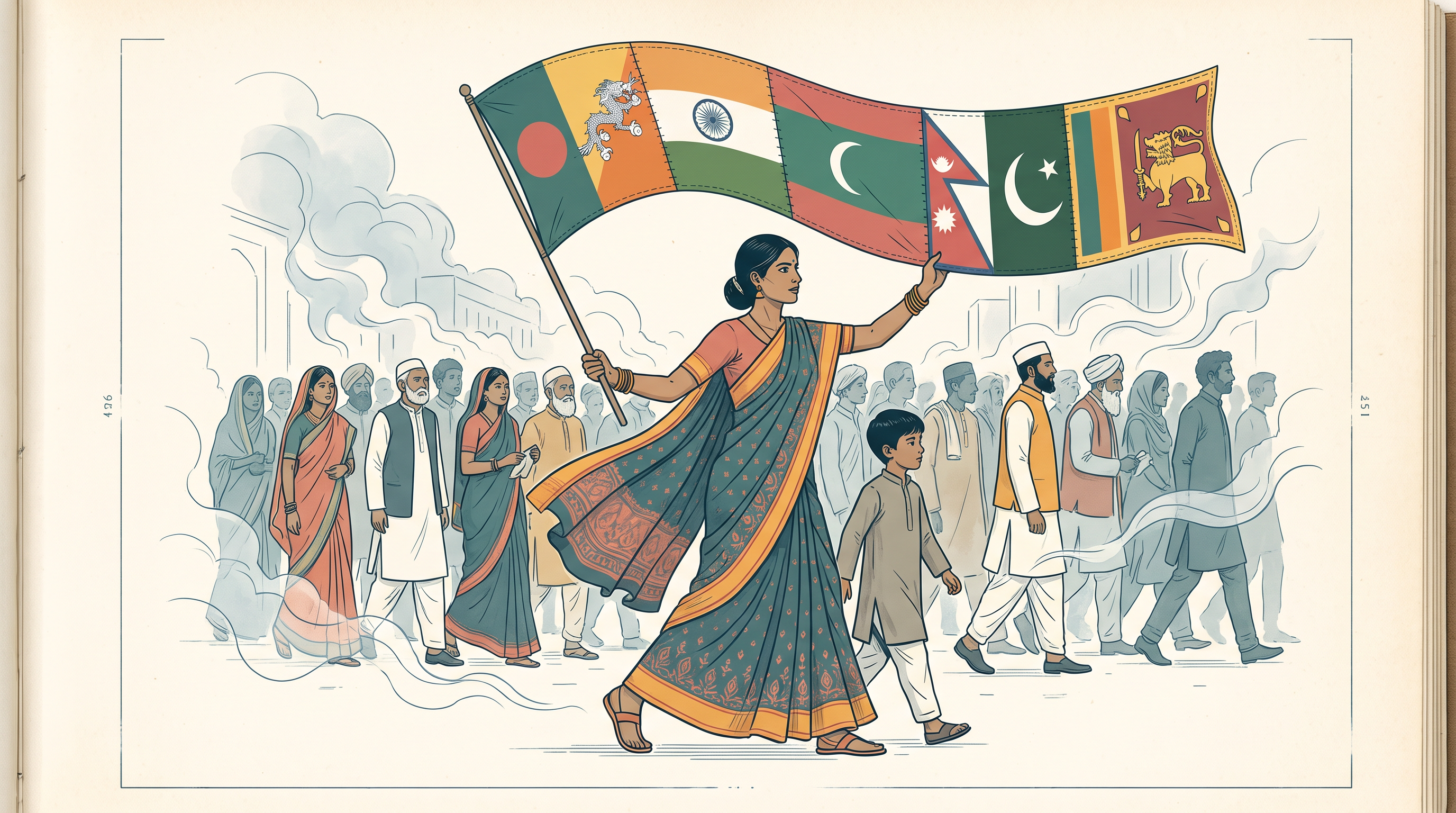
Fig. 3.0 – Adaptation of ‘Liberty Leading the People’ with South Asian flags. Inspiration: Subhas Rai, Himal Southasian.
The chapter opens with this image rather than with a photograph, and the choice is deliberate. Delacroix painted a figure of liberty leading a crowd forward through the smoke of a revolution in France in 1830. In this adaptation, the banner she carries is made up of the flags of South Asia.
The claim in the image is that the struggle for freedom and self-rule belongs to this region too, and that it is one struggle, shared across these borders. Whether that is true — whether these countries are really moving together, or only side by side — is precisely what the rest of the chapter asks you to judge.
3.2 What Is South Asia?
We are all familiar with the gripping tension of an India-Pakistan cricket match. We have also seen the goodwill and hospitality shown to visiting Indian and Pakistani fans by their hosts when they come to watch a match.
That double picture is not an accident of sport. It is symbolic of the larger pattern of South Asian affairs. Ours is a region where rivalry and goodwill, hope and despair, mutual suspicion and trust coexist — often in the same week, and sometimes in the same crowd.
So let us begin with an elementary question. What is South Asia?
The Seven Countries
The expression ‘South Asia’ usually includes the following countries: Bangladesh, Bhutan, India, the Maldives, Nepal, Pakistan and Sri Lanka. Four of them share a land border with India; Bhutan and Nepal are landlocked kingdoms of the Himalayan belt; Sri Lanka and the Maldives are island countries in the Indian Ocean to the south.
Geography gave this group a certain closure. The mighty Himalayas in the north, and the vast Indian Ocean, the Arabian Sea and the Bay of Bengal in the south, west and east respectively, provide a natural insularity to the region. Insularity here means being set apart, cut off by natural barriers from easy contact with the lands beyond. That separation is largely responsible for the linguistic, social and cultural distinctiveness of the sub-continent.
But the boundaries of the region are not as clear in the east and the west as they are in the north and the south. Mountains and oceans mark a line; open land does not. Afghanistan and Myanmar are often included in discussions of the region as a whole. China is an important player in South Asian affairs but is not considered to be a part of the region.
This should tell you something. A region is not a fact of nature that a map simply reports. It is a decision — made by scholars, governments and institutions, and made differently by different people. There is no fixed definition, and it is worth asking who does the deciding, and what interests are served by drawing the line in one place rather than another. In this chapter, we shall use ‘South Asia’ to mean the seven countries named above.
Thus defined, South Asia stands for diversity in every sense — of language, religion, terrain, wealth and political system — and yet constitutes one geo-political space: a set of countries whose politics, security and economies are so entangled that what happens in one is felt in the others.
One Region, Many Political Systems
The various countries in South Asia do not have the same kind of political systems. The region is a single space, but it is not a single story.
Despite many problems and limitations, Sri Lanka and India have successfully operated a democratic system since their independence from the British. You will study the evolution of democracy in India in the textbook that deals with politics in India since independence. It is, of course, possible to point out many limitations of India’s democracy. But we have to remember the fact that India has remained a democracy throughout its existence as an independent country. The same is true of Sri Lanka.
Pakistan and Bangladesh have experienced both civilian and military rulers. A military ruler is a general who takes over the government by force, usually by removing an elected one; a civilian ruler holds office through election. Of the two, Bangladesh has remained a democracy in the post-Cold War period — that is, in the years since the Cold War ended around 1991.
Pakistan’s path has been different. It began the post-Cold War period with successive democratic governments under Benazir Bhutto and Nawaz Sharif respectively. But it suffered a military coup in 1999. A coup is the seizure of power by the armed forces, usually overnight and without an election. Pakistan has been run by a civilian government again since 2008.
Nepal moved in the opposite direction. Till 2006, Nepal was a constitutional monarchy — a system in which a king remains head of state but is expected to rule within limits set by a constitution — and there was a standing danger of the king taking over executive powers. In 2008, the monarchy was abolished and Nepal emerged as a democratic republic, a state whose head is elected rather than born to the office.
From the experience of Bangladesh and Nepal, we can say that democracy is becoming an accepted norm in the entire region of South Asia.
The Two Smallest Countries
Similar changes are taking place in the two smallest countries of the region. Bhutan became a constitutional monarchy in 2008, and under the leadership of the king it emerged as a multi-party democracy. Note the unusual route: here the opening up was led from the throne, not forced against it.
The Maldives, the other island nation, was a Sultanate — a state ruled by a hereditary Muslim sovereign called a Sultan — till 1968, when it was transformed into a republic with a presidential form of government. In a presidential form of government, an elected President is both head of state and head of the executive, and does not depend on a majority in the legislature to stay in office.
In June 2005, the parliament of the Maldives voted unanimously to introduce a multi-party system. The Maldivian Democratic Party (MDP) dominates the political affairs of the island. The MDP won the 2018 Elections.
What The People Of The Region Think
So much for the governments. What about the governed?
Despite the mixed record of the democratic experience, the people in all these countries share the aspiration for democracy. A recent survey of the attitudes of the people in the five big countries of the region showed that there is widespread support for democracy in all these countries. Ordinary citizens, rich as well as poor, and belonging to different religions, view the idea of democracy positively and support the institutions of representative democracy. They prefer democracy over any other form of government, and they think that democracy is suitable for their country.
These are significant findings. It was earlier believed that democracy could flourish and find support only in prosperous countries of the world — that people struggling for food and work would trade their vote for bread. South Asia is not prosperous, and its people want the vote anyway. The two graphs below record what they said.
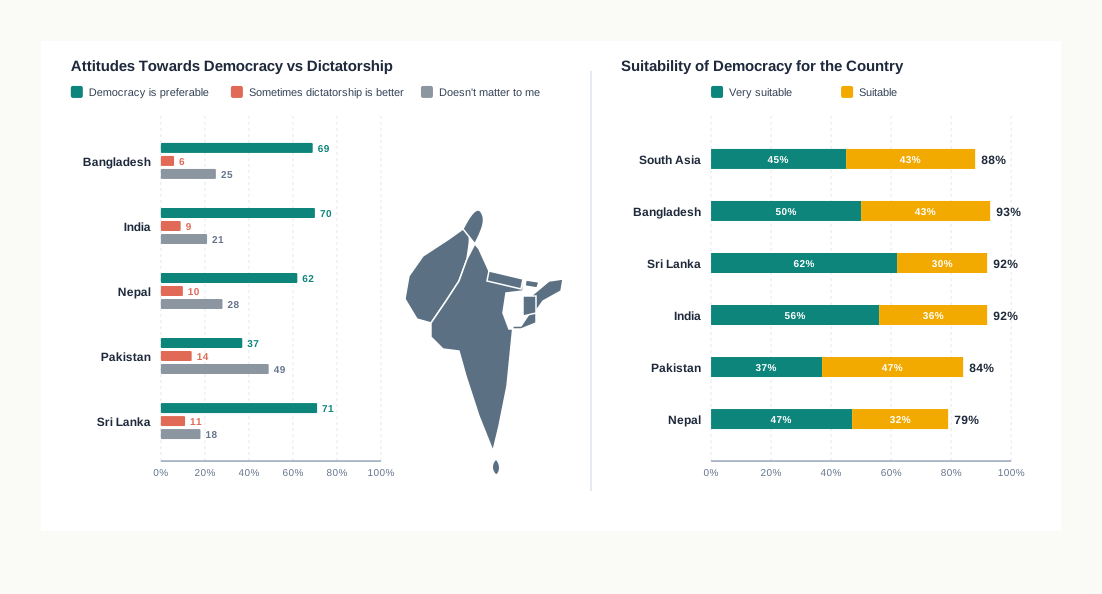
Fig. 3.1 – Support for democracy in five South Asian countries.
Read the first graph column by column. In Sri Lanka 71 out of every 100 people questioned said democracy is preferable, in India 70, in Bangladesh 69 and in Nepal 62. In Pakistan the figure is 37 — by far the lowest, and the reason the graph’s own headline says that democracy is preferred over dictatorship everywhere except in Pakistan.
But look further down the same column before you conclude anything. Only 14 in Pakistan said that dictatorship is sometimes better. The largest group, 49, said that the type of government does not matter to them. That is not enthusiasm for military rule. It is indifference, or exhaustion — and those are different things.
The second graph makes the point sharper. Asked whether democracy is suitable for their own country, 84 out of 100 in Pakistan said it was — a figure close to Nepal’s 79, and not far below India’s 92. Across South Asia the figure is 88. So the same population that is lukewarm about democracy in the abstract still thinks democracy fits their country.
Now the limit, and it matters. A survey records what people said to an interviewer at one moment, not what they will do, and not why they said it. It cannot tell you what any of them meant by the word ‘democracy’. It covers the five big countries only, so Bhutan and the Maldives are simply absent. And these interviews were published in 2007; opinion is not a fixed quantity. A number this clean is evidence of an attitude. It is not proof of a future.
Reading The Development Figures
Support for democracy is one measure of a region. How its people actually live is another. The table below sets South Asian countries against the world average and the average for developing countries.
Take the columns one at a time. Life expectancy at birth is the average number of years a newborn can expect to live if present conditions continue. South Asia’s figure, 69.3 years, sits below the world’s 72.2 and below the developing-country average of 70.7. Within the region the gap is wide: Sri Lanka is at 75.5 years and Pakistan at 66.6, a difference of \(75.5 - 66.6 = 8.9\) years of life.
Infant mortality rate counts deaths of children under one year for every 1,000 live births. Sri Lanka records 8.0; Pakistan records 64.2 — eight times as many. Gross enrolment ratio measures how many children are enrolled in secondary school as a share of the age group. Sri Lanka is at 98, Pakistan at 46. GDP per capita, the country’s yearly output divided by its population and adjusted so that prices can be compared across countries, runs from 11,669 PPP dollars in Sri Lanka to 2,433 in Nepal.
The HDI rank — the Human Development Index rank — combines income, education and health into a single ordering of countries, so a smaller number is a better position. Sri Lanka stands at 76, the best in the region; India at 130; Pakistan at 150. On almost every column, Sri Lanka leads South Asia and Pakistan trails it.
And now the limit. This table counts outcomes, not causes. It cannot tell you why Sri Lanka’s figures are so much better, and it certainly cannot tell you that democracy produced them — India and Sri Lanka have both been democracies throughout, and their columns look nothing alike.
Nor is the table as tidy as it looks. Its columns come from different years and different periods, so they are not strictly comparable. The poverty column is blank for Sri Lanka and for all three averages, so no regional comparison of poverty is possible from this table at all. Pakistan’s poverty figure of 6.1 is the lowest of the four countries shown, which sits oddly beside its position at the bottom of every other column — a reminder that a single income line drawn at $1.90 a day measures one thing only. Above all, a national average hides everyone inside it: the rich and the poor of the same country appear here as one number.
Why This Matters Beyond The Region
Return to the survey for a moment. It was long assumed that democracy was a luxury of prosperous societies. The people of South Asia, whose development figures you have just read, say otherwise. In that sense the South Asian experience of democracy has expanded the global imagination of democracy — it has widened the world’s sense of where democracy can live.
That is the region. Now let us look at the experience of democracy in each of the four big countries of the region other than India.
3.3 The Military And Democracy In Pakistan
Pakistan’s story since 1947 is not a straight line from army rule to elected rule. It is a swing, back and forth, and it is worth following in order.
The Swing Between Generals And Elections
After Pakistan framed its first constitution, General Ayub Khan took over the administration of the country and soon got himself elected. Notice the sequence: the takeover came first, the election afterwards. He had to give up office when there was popular dissatisfaction against his rule.
That gave way to a military takeover once again, this time under General Yahya Khan. During Yahya’s military rule, Pakistan faced the Bangladesh crisis, and after a war with India in 1971, East Pakistan broke away to emerge as an independent country called Bangladesh. What that crisis was, and why it ended in a new country, is the subject of the next section.
After this, an elected government under the leadership of Zulfikar Ali Bhutto came to power in Pakistan from 1971 to 1977. The Bhutto government was removed by General Zia-ul-Haq in 1977.
General Zia faced a pro-democracy movement from 1982 onwards, and an elected democratic government was established once again in 1988 under the leadership of Benazir Bhutto. In the period that followed, Pakistani politics centred around the competition between her party, the Pakistan People’s Party, and the Muslim League.
This phase of elective democracy lasted till 1999, when the army stepped in again and General Pervez Musharraf removed Prime Minister Nawaz Sharif. In 2001, General Musharraf got himself elected as the President — the same move Ayub Khan had made decades earlier.
Pakistan continued to be ruled by the army, though the army rulers have held some elections to give their rule a democratic image. That phrase deserves attention. An election held by a ruler who cannot be removed by it is a display, not a transfer of power. Since 2008, democratically elected leaders have been ruling Pakistan.
The sequence is set out in Fig. 3.2.
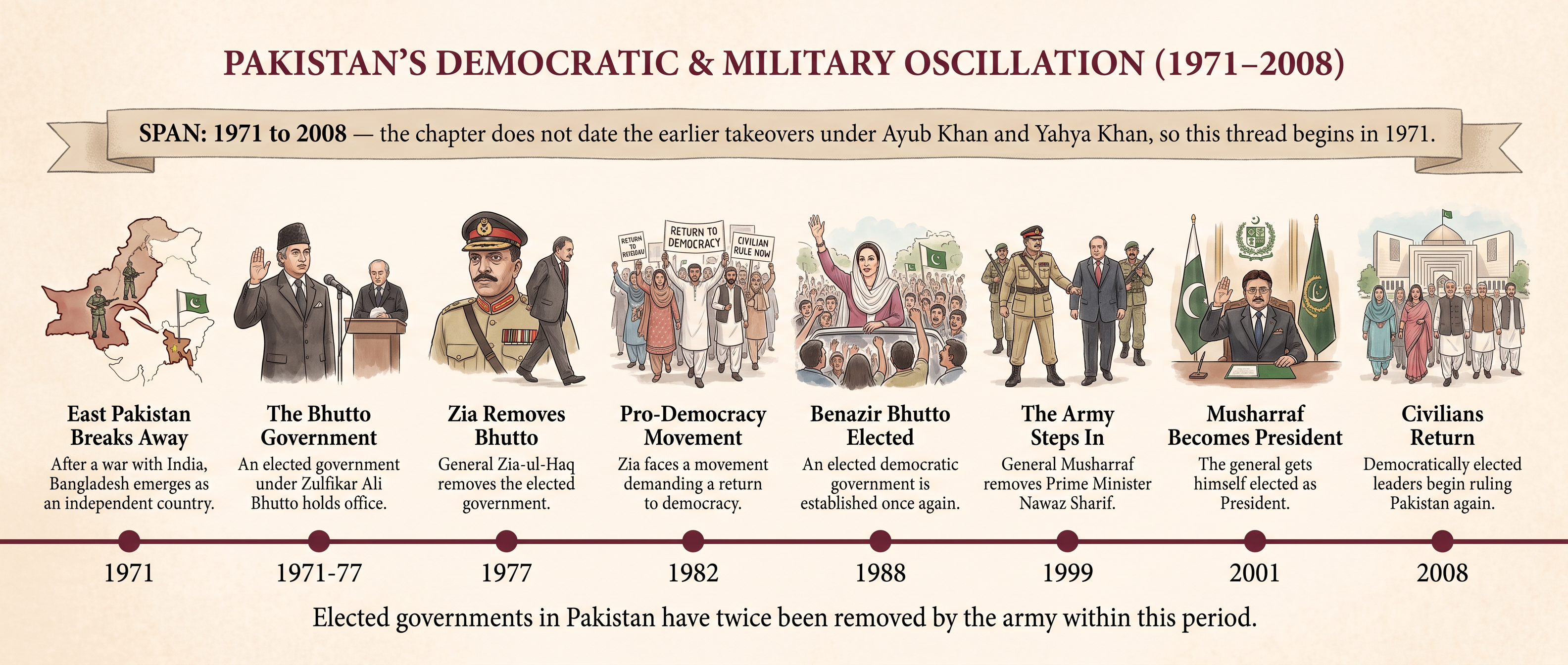
Fig. 3.2 – Elected Rule And Army Rule In Pakistan.
The Man In Two Chairs
The cartoon below was drawn while General Musharraf was in power, and it fixes on one fact: he was the President of the country and the army General at the same time.
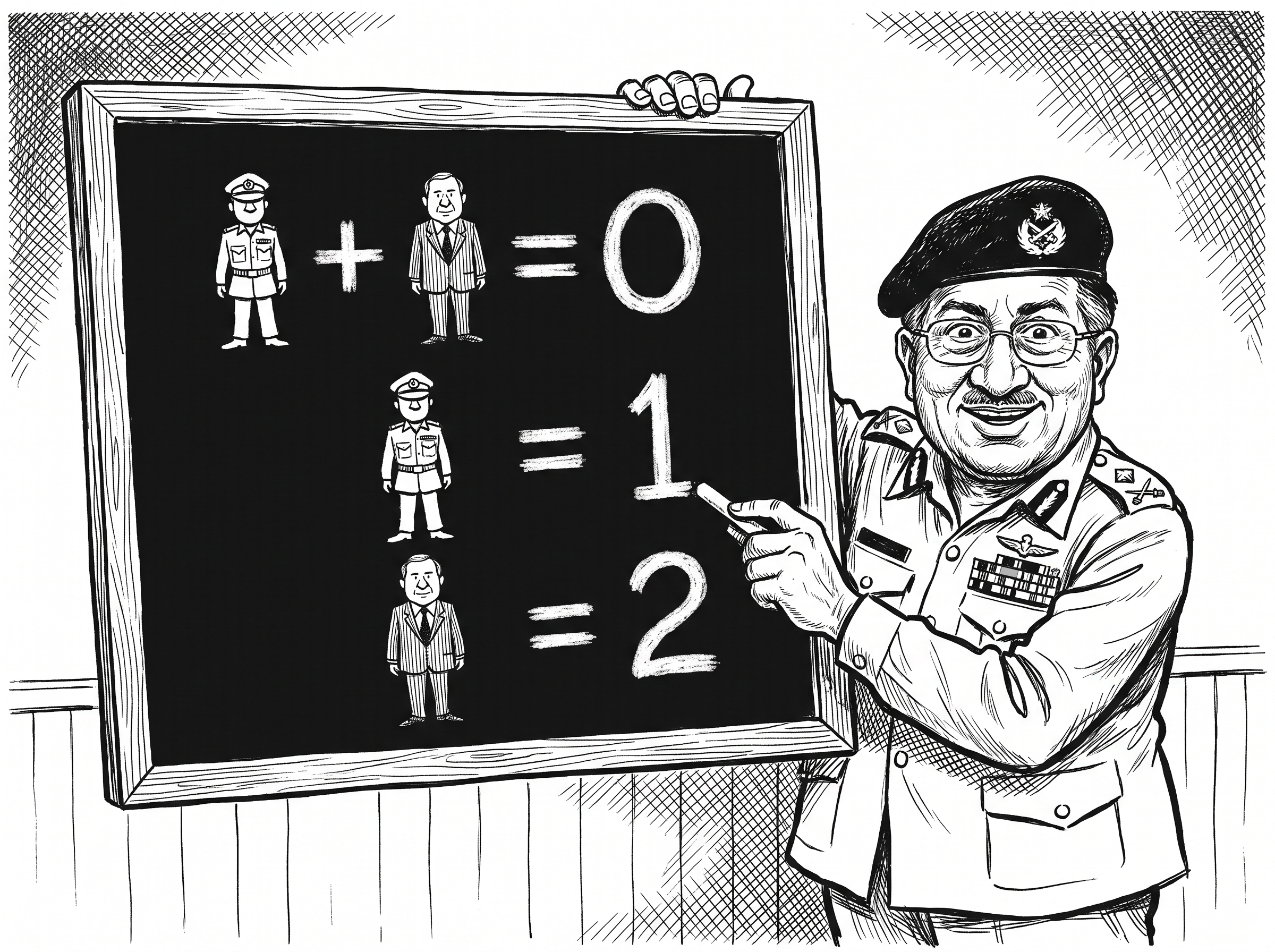
Fig. 3.3 – General Musharraf’s dual role. Inspiration: Surendra, The Hindu.
Work through what the cartoonist has done. The figures on the board are the two kinds of ruler Pakistan has had — generals and civilian politicians — and they are being added and subtracted like numbers. Whatever the sum, the man holding the chalk is satisfied with the answer, because he is on both sides of it. Remove the civilian and a ruler still remains. Add him back and one man is simply occupying two chairs.
The claim being made is that under Musharraf the distinction between civilian government and army rule had stopped meaning anything in Pakistan. The joke is in the boast: he is good at calculation because he has arranged the sums so that he cannot lose.
Now the limit. A cartoon makes one point in one image, and it cannot draw the counter-argument. This one cannot show you the pro-democracy sentiment that the chapter says exists in Pakistan, or its press, or its human rights movement. It cannot tell you whether the elections held under army rule had any content at all, or none. And it was published in The Hindu, an Indian newspaper: it is a neighbour’s verdict on Pakistan’s ruler, not a Pakistani one, and you should weigh it knowing that.
Why Democracy Has Not Held
Several factors have contributed to Pakistan’s failure in building a stable democracy. The chapter gives more than one, and you should resist the temptation to settle on a single villain.
The first is social. The military, the clergy — the body of religious leaders — and the landowning aristocracy, the small class of families that owns very large tracts of land and the influence that comes with it, are dominant in Pakistani society. That dominance has led to the frequent overthrow of elected governments and the establishment of military government. A party that wins an election does not thereby control the groups that actually hold power.
The second is external, and it is the shadow of India. Pakistan’s conflict with India has made the pro-military groups more powerful. Their argument runs like this: political parties and democracy in Pakistan are flawed; Pakistan’s security would be harmed by selfish-minded parties and chaotic democracy; and therefore the army’s stay in power is justified. Every quarrel with India strengthens that case.
Yet this is not the whole of Pakistan. While democracy has not been fully successful there, there has been a strong pro-democracy sentiment in the country. Pakistan has a courageous and relatively free press and a strong human rights movement.
The Part Played From Outside
There is a third factor, and it lies outside Pakistan altogether. The lack of genuine international support for democratic rule in Pakistan has further encouraged the military to continue its dominance.
The United States and other Western countries have encouraged the military’s authoritarian rule in the past — rule that concentrates power in a single leader or institution and is not answerable to the voters — and they did so for their own reasons. Given their fear of the threat of what they call ‘global Islamic terrorism’, and the apprehension that Pakistan’s nuclear arsenal might fall into the hands of these terrorist groups, the military regime in Pakistan has been seen as the protector of Western interests in West Asia and South Asia.
Read that carefully, because it cuts against a comfortable assumption. The powerful democracies of the world did not always press for democracy in Pakistan. Where they judged that a general served their interests better than an elected government would, they backed the general.
A Question Worth Sitting With
One last thought before we cross the border. It is often observed that Germany, split into two states after the Second World War and later reunited, could put its division behind it — while the people of India and Pakistan still cannot travel easily to each other’s country. If Germany could be reunited, why can the people of India and Pakistan not at least move more freely between their two countries?
Hold that question. This chapter will give you the material to answer it, but not a comfortable answer.
3.4 Democracy In Bangladesh
Bangladesh was a part of Pakistan from 1947 to 1971. It consisted of the partitioned areas of Bengal and Assam from British India.
Look at a map for a moment and the oddity becomes clear. One country, two wings, separated by the whole width of northern India. The two halves shared a religion and almost nothing else — not language, not culture, not distance.
An Election Won, A Result Denied
Then came the moment that decided everything. In the 1970 elections in the then Pakistan, the Awami League led by Sheikh Mujib won all the seats in East Pakistan and secured a majority in the proposed constituent assembly — the body meant to write a constitution — for the whole of Pakistan.
Read that result slowly. The party of the eastern wing had not merely won its own region. It had won the right to lead the country. And the government dominated by the West Pakistani leadership refused to convene the assembly. Sheikh Mujib was arrested.
An election had been held, and its verdict had been set aside. That is the point at which a political argument stops being political.
Under the military rule of General Yahya Khan, the Pakistani army tried to suppress the mass movement of the Bengali people. Thousands were killed by the Pakistan army. This led to a large scale migration into India, creating a huge refugee problem for India — a refugee being a person who flees across a border to escape violence or persecution at home.
The government of India supported the demand of the people of East Pakistan for their independence and helped them financially and militarily. This resulted in a war between India and Pakistan in December 1971 that ended in the surrender of the Pakistani forces in East Pakistan and the formation of Bangladesh as an independent country.
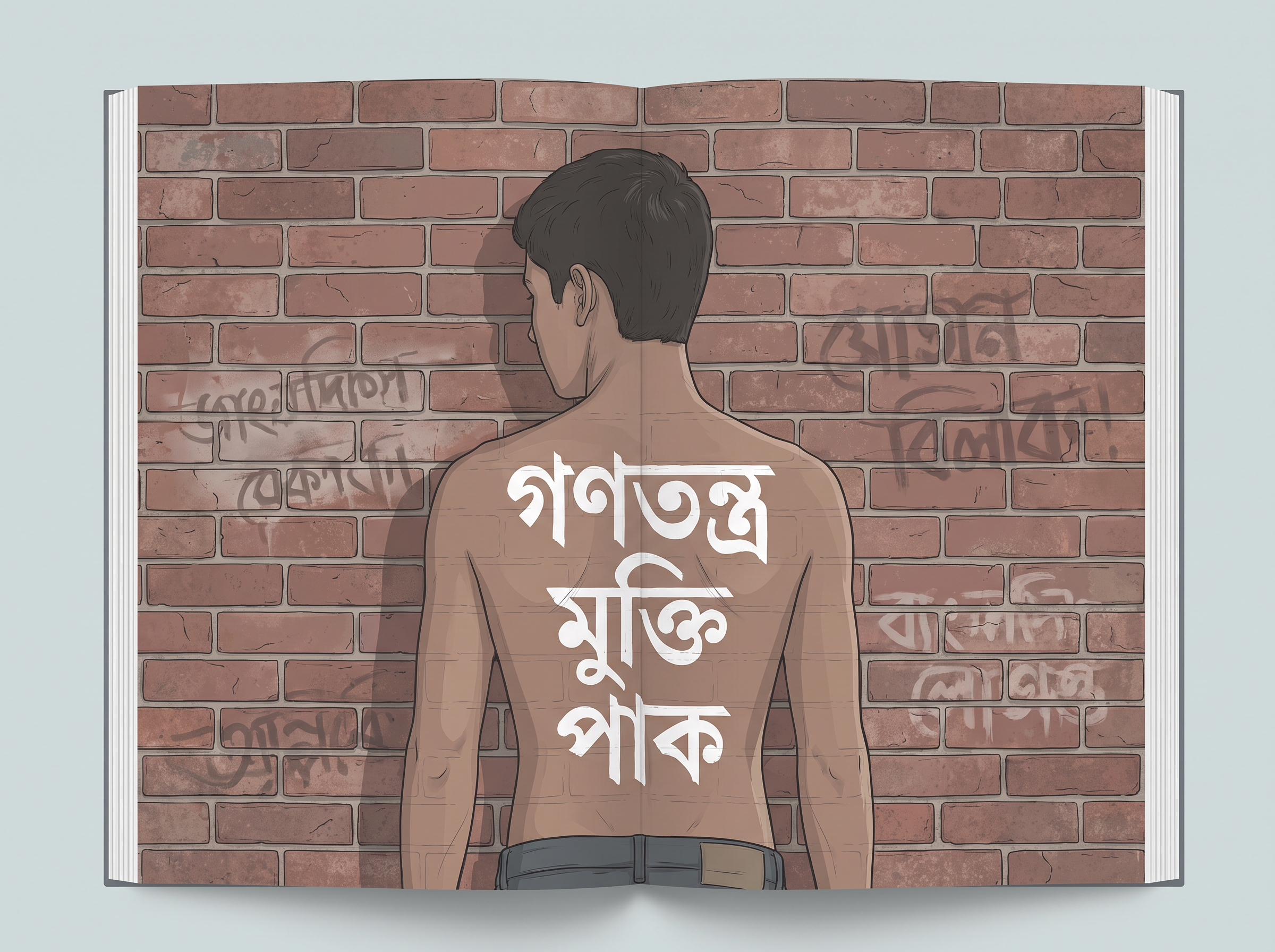
Fig. 3.4 – Mural of Noor Hossain at Jahangirnagar University.
The mural you met on the opening page of this chapter is painted on a university wall in Savar. It remembers a death that came sixteen years after independence — which tells you that winning a country and winning a democracy were, for Bangladesh, two separate struggles.
The Second Struggle
Bangladesh drafted its constitution declaring faith in secularism — the principle that the state does not favour any religion — along with democracy and socialism.
However, in 1975 Sheikh Mujib got the constitution amended to shift from the parliamentary to the presidential form of government. Under a parliamentary system the head of government must hold the confidence of the elected legislature and can be removed by it; the presidential form, as you saw in the case of the Maldives, does not work that way. He also abolished all parties except his own, the Awami League.
This led to conflicts and tensions. The leader of a movement for representation had left his country with one party and one man at the top. In a dramatic and tragic development, he was assassinated in a military uprising in August 1975.
The new military ruler, Ziaur Rahman, formed his own Bangladesh National Party and won elections in 1979. He too was assassinated, and another military takeover followed under the leadership of Lt Gen H. M. Ershad.
The people of Bangladesh soon rose in support of the demand for democracy. Students were in the forefront. Ershad was forced to allow political activity on a limited scale. He was later elected as President for five years.
Mass public protests made Ershad step down in 1990. Elections were held in 1991. Since then, representative democracy based on multi-party elections has been working in Bangladesh.
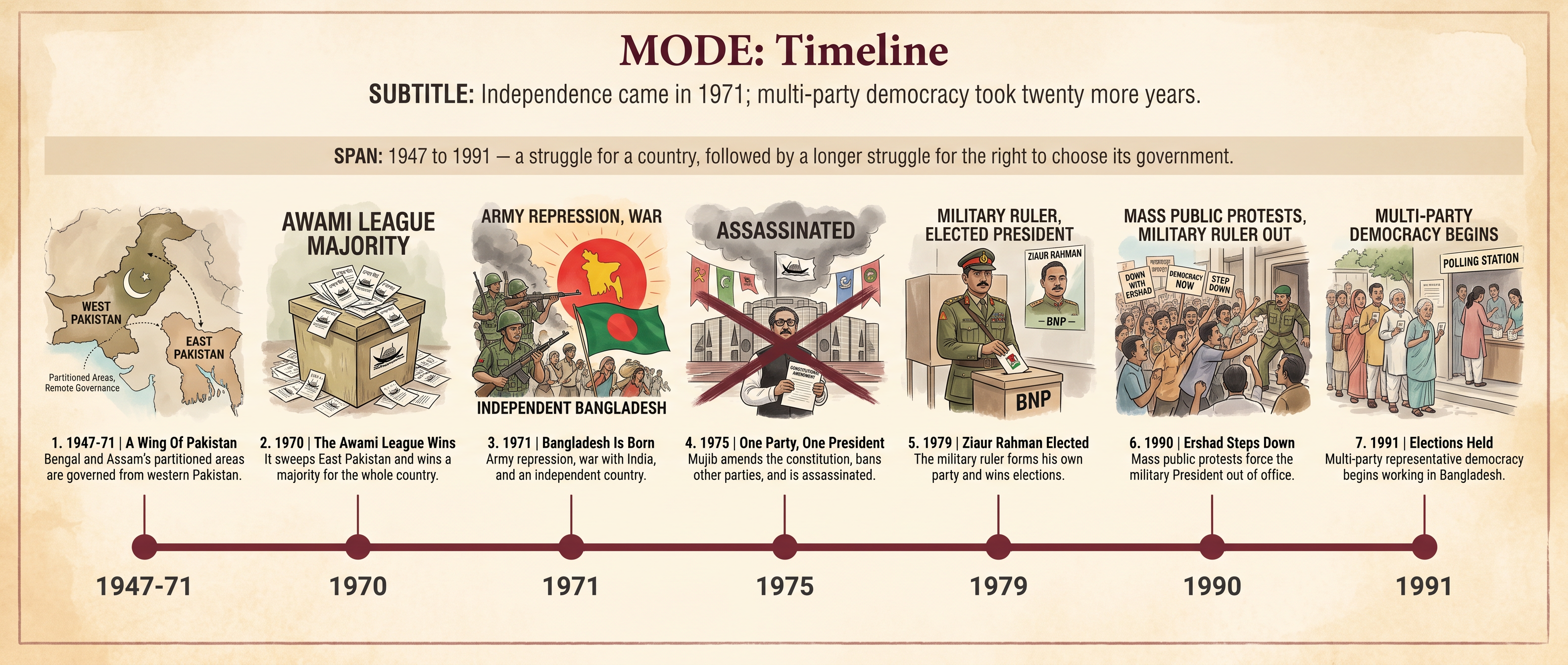
Fig. 3.5 – Bangladesh: From Wing To Country To Democracy.
3.5 Monarchy And Democracy In Nepal
Nepal was a Hindu kingdom in the past, and then a constitutional monarchy in the modern period for many years. On paper, that meant a king who ruled within limits. In practice, the limits were thin.
Throughout this period, political parties and the common people of Nepal wanted a more open and responsive system of government. But the king, with the help of the army, retained full control over the government and restricted the expansion of democracy in Nepal. Note where the army stands in this sentence. In Pakistan the generals removed the king’s equivalent; in Nepal the army kept the king in place.
A Constitution Won, And Then Undone
The king accepted the demand for a new democratic constitution in 1990, in the wake of a strong pro-democracy movement. That was a real victory, won in the streets.
However, democratic governments had a short and troubled career. Winning a constitution turned out to be easier than making it work.
During the nineties, the Maoists of Nepal were successful in spreading their influence in many parts of the country. They were a radical political movement that believed in armed insurrection — an armed uprising to overthrow the existing rulers — against the monarch and the ruling elite, the small group of families and officials who held wealth and power.
This led to a violent conflict between the Maoist guerrillas, fighters who avoid open battle and attack in small mobile groups, and the armed forces of the king. For some time, there was a triangular conflict among the monarchist forces, the democrats and the Maoists. Three sides, not two: the king wanted his powers, the parties wanted elections, and the Maoists wanted a revolution — and none of the three would accept the victory of either of the others.
In 2002, the king abolished the parliament and dismissed the government, thus ending even the limited democracy that existed in Nepal. The word ‘even’ is worth dwelling on. What Nepal had was not full democracy, and now that remnant was gone too.
April 2006
In April 2006, there were massive, country wide, pro-democracy protests. The struggling pro-democracy forces achieved their first major victory when the king was forced to restore the House of Representatives — the elected lower house of Nepal’s parliament — that had been dissolved in April 2002.
Look at what did the forcing. The largely non-violent movement was led by the Seven Party Alliance (SPA), the Maoists and social activists. An armed guerrilla movement and an alliance of parliamentary parties had put their disagreement aside long enough to stand in the same crowd.
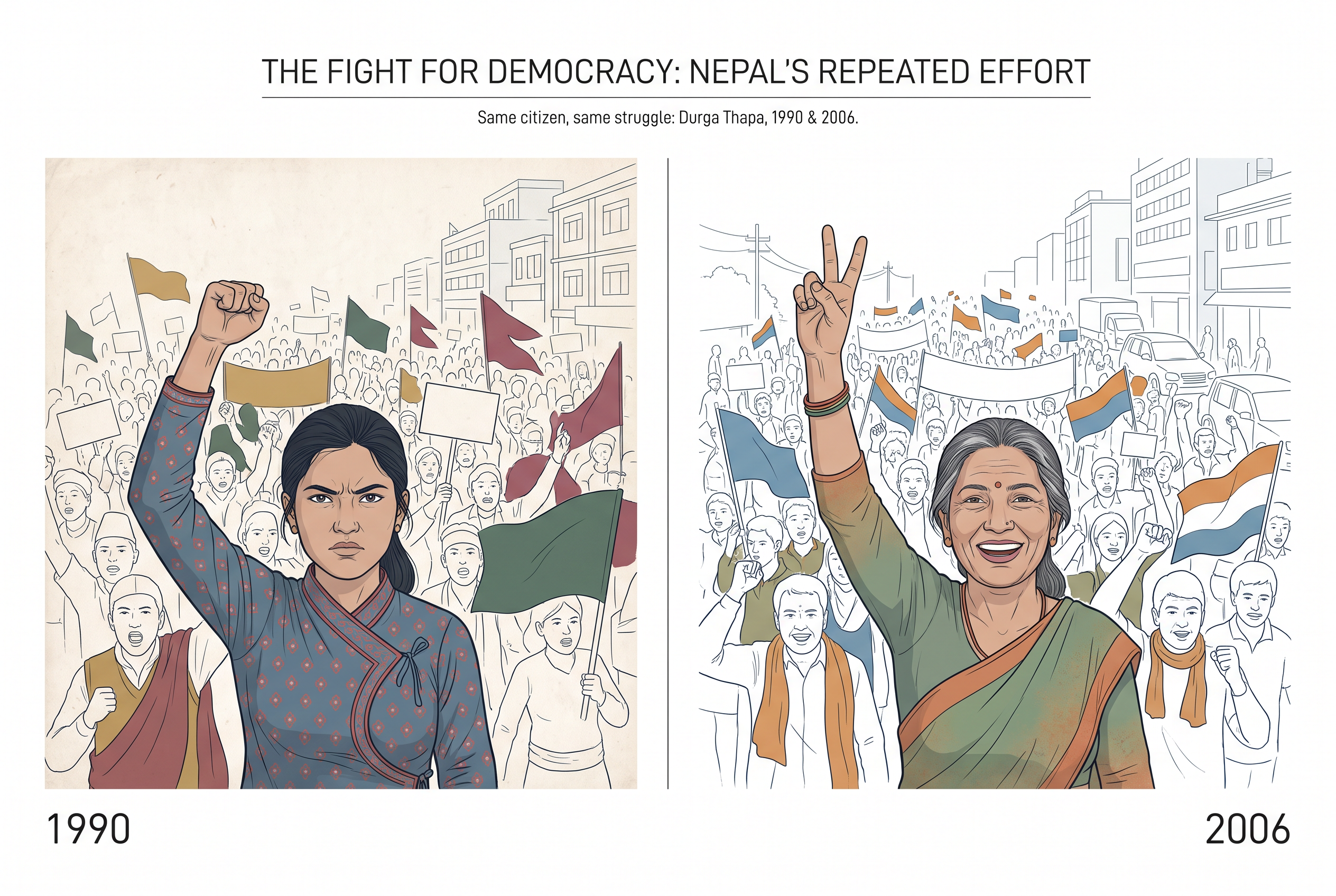
Fig. 3.6 – Democracy activist Durga Thapa in 1990 and 2006.
Two photographs, one person, sixteen years apart. It is easy to read Nepal’s story as a sequence of dates, and easy to find it stirring from a distance — a king humbled, a crowd in the street. Hold both photographs in view before you do. The same woman had to come back out and do it again, because the first victory did not hold. And in between lay a violent conflict in which people were killed. A movement that has to be fought twice is not an adventure. It is a cost.
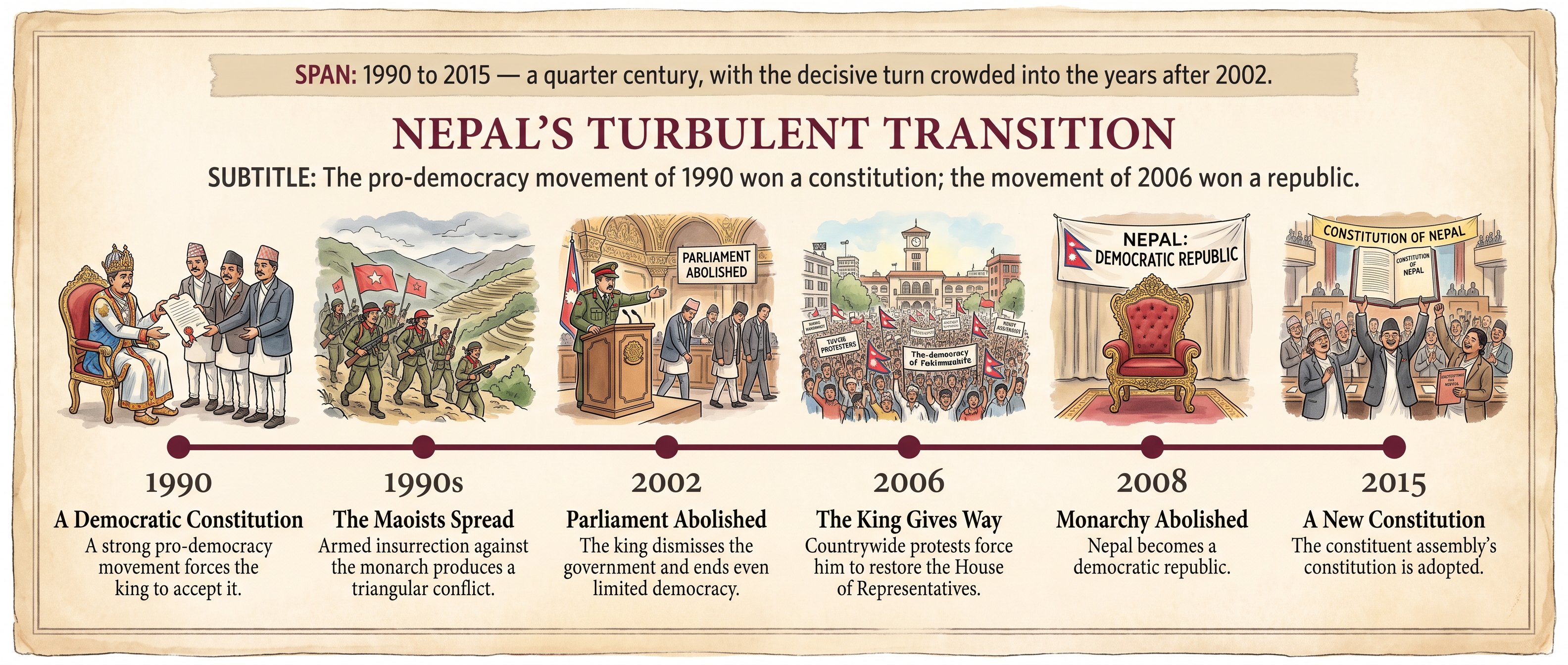
Fig. 3.7 – Nepal: From Kingdom To Republic.
Writing A Constitution, Settling An Argument
Nepal’s transition to democracy is almost complete. Nepal has undergone a unique moment in its history, because it formed a constituent assembly to draft the constitution for Nepal — the people’s own elected body, writing the rules of the state for themselves rather than receiving them from a king.
But an assembly does not make disagreement disappear. It gives it a room to happen in. Some sections in Nepal thought that a nominal monarchy — a king who reigns but does not rule — was necessary for Nepal to retain its link with the past.
The Maoist groups agreed to suspend armed struggle. They wanted the constitution to include the radical programmes of social and economic restructuring: a redistribution of land, wealth and status, not merely a change in who sits in office. All the parties in the SPA did not agree with this programme. The Maoists and some other political groups were also deeply suspicious of the Indian government and its role in the future of Nepal.
In 2008, Nepal became a democratic republic after abolishing the monarchy. In 2015, it adopted a new constitution.
3.6 Ethnic Conflict And Democracy In Sri Lanka
We have already seen that Sri Lanka, the island country off India’s southern coast, has retained democracy since its independence in 1948. No general has removed its government and no king has dissolved its parliament.
But it faced a serious challenge — not from the military or the monarchy, but from ethnic conflict: conflict between groups that define themselves by shared language, religion, descent or culture. In Sri Lanka that conflict led to a demand for secession, the breaking away of a region to form a separate country.
That is the point of placing Sri Lanka after Pakistan, Bangladesh and Nepal. It shows that a democracy can be threatened from a direction none of those three faced.
Majority And Minority After 1948
After its independence, politics in Sri Lanka — it was then known as Ceylon — was dominated by forces that represented the interest of the majority Sinhala community.
They were hostile to a large number of Tamils who had migrated from India to Sri Lanka and settled there. This migration continued even after independence.
The Sinhala nationalists thought that Sri Lanka should not give ‘concessions’ to the Tamils, because Sri Lanka belongs to the Sinhala people only. Look closely at the word ‘concessions’, in the chapter’s own quotation marks. To call a minority’s claim a concession is already to have decided that the country is not theirs — that whatever they receive is a favour granted, not a right owed.
The neglect of Tamil concerns led to militant Tamil nationalism.
From 1983
From 1983 onwards, the militant organisation, the Liberation Tigers of Tamil Eelam (LTTE), was fighting an armed struggle with the army of Sri Lanka in pursuit of their demand for a ‘Tamil Elam’, or separate country for the Tamilians of Sri Lanka. At one point of time, the northeastern part of Sri Lanka was controlled by the LTTE.
India Draws Closer, Then Pulls Back
The Sri Lankan problem involves people of Indian origin, and there was considerable pressure from the Tamil people in India to the effect that the Indian government should protect the interests of the Tamils in Sri Lanka.
This is worth noticing as a general feature of South Asia. A conflict inside one country reaches into the domestic politics of its neighbour, because the people fighting it have relatives, language and kinship across the border. No government in Delhi could treat the Tamil question as a purely foreign matter.
The government of India has from time to time tried to negotiate with the Sri Lankan government on the Tamil question. But in 1987, the government of India for the first time got directly involved.
The End Of The War, And What Survived It
The Sri Lankan crisis continued to be violent. However, international actors, particularly the Scandinavian countries of northern Europe such as Norway and Iceland, tried to bring the warring groups back to negotiations. Finally, the armed conflict came to an end, as the LTTE was vanquished in 2009.
The chapter prints a cartoon by Keshav, from The Hindu, drawn while the war was still on.
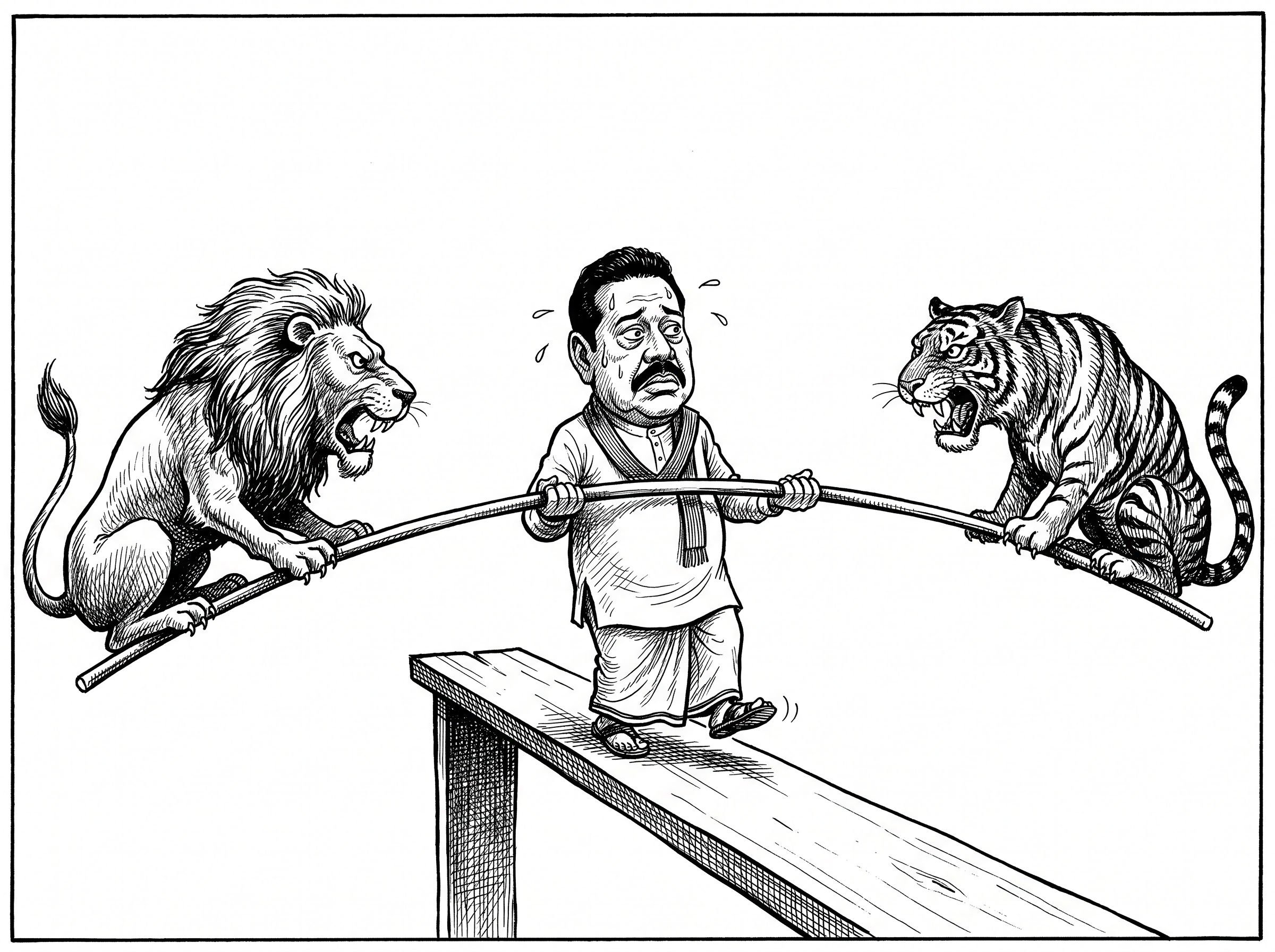
Fig. 3.8 – The Sri Lankan leadership’s balancing act. Inspiration: Keshav, The Hindu.
Decode the two animals first. The lion stands for the Sinhala hardliners and the tiger for the Tamil militants — and the tiger is a direct play on the name of the LTTE. The man in the middle is not fighting either of them. He is trying to walk a tightrope while carrying both, and the cartoonist’s claim is that any move towards one end tips him off the wire.
That is what the word ‘dilemma’ in the caption means. A leader who concedes to the Tamil militants loses the Sinhala hardliners, and a leader who satisfies the hardliners loses any chance of a negotiated peace.
Now the limit. The cartoon draws the leader’s problem, not the country’s. The Tamil and Sinhala civilians who had to live through the war are nowhere in the frame, and the two communities are reduced to two beasts. It is a sharp comment on the difficulty of negotiating; it is not evidence about who was right, what the Tamils were asking for, or what the war cost the people who did not choose it.
Growth In The Middle Of A War
One fact about Sri Lanka refuses to fit the story of a country consumed by conflict.
In spite of the conflict, Sri Lanka has registered considerable economic growth and recorded high levels of human development. It was one of the first developing countries to successfully control the rate of growth of population. It was the first country in the region to liberalise its economy — to reduce state controls and open it up to trade and private business. And it has had the highest per capita gross domestic product (GDP) — the total value of what a country produces, divided by its population — in the region for many years, right through the civil war.
Turn back to Table 3.1 and the numbers will look different to you now. Sri Lanka’s best-in-region figures for life expectancy, literacy and infant mortality were achieved by a country that was fighting an armed secessionist war for most of that period.
Despite the ravages of internal conflict, it has maintained a democratic political system. Both halves of that sentence are true at once, and neither cancels the other. A country can hold elections, educate its children and grow its economy, and still fail for decades to answer the question its minority is asking.
3.7 India-Pakistan Conflicts
Let us now move from domestic politics and take a look at some of the areas of conflict in the international relations in this region.
The post-Cold War era has not meant the end of conflicts and tensions in this region. We have already noted the conflicts around internal democracy or ethnic differences — the generals in Islamabad, the palace in Kathmandu, the war in Sri Lanka. But there are also some very crucial conflicts of an international nature: conflicts between states rather than inside them.
Given the position of India in this region, most of these conflicts involve India. That is not a moral fact about India. It is a geographical one, and we shall return to it in the next section.
Kashmir, And The Wars That Did Not Settle It
The most salient and overwhelming of these conflicts is, of course, the one between India and Pakistan.
Soon after the partition, the two countries got embroiled in a conflict over the fate of Kashmir. The Pakistani government claimed that Kashmir belonged to it. Wars between India and Pakistan in 1947-48 and 1965 failed to settle the matter.
The 1947-48 war resulted in the division of the province into Pakistan-occupied Kashmir and the Indian province of Jammu and Kashmir, divided by the Line of Control — the military line separating the areas held by each side, which is not an agreed international boundary.
In 1971, India won a decisive war against Pakistan — the war that produced Bangladesh, which you read about in section 3.4 — but the Kashmir issue remained unsettled. Three wars, and the question stood exactly where it had started.
A Question The Chapter Does Not Answer
A student reading this passage in the original book wrote in the margin that a discussion of Kashmir framed this way sounds like a property dispute between the rulers of India and Pakistan — and then asked: what do the Kashmiris feel about it?
That is a serious objection, and you should take it seriously. Read the account above again and notice whose voices appear in it: two governments, two armies, one line. The people who live along that line appear only as territory.
The chapter does not answer the question, and neither will this book pretend to. But knowing what a source leaves out is itself knowledge. Whenever a conflict is described entirely as a quarrel between two capitals, ask who was living in the place being quarrelled over, and whether anybody asked them.
The Arms Race And 1998
India’s conflict with Pakistan is also over strategic issues like the control of the Siachen glacier, high in the mountains, and over the acquisition of arms.
An arms race is what happens when each side builds weapons because the other is building them — so that both spend more and neither ends up safer. The arms race between the two countries assumed a new character in the 1990s, with both states acquiring nuclear weapons and missiles to deliver such arms against each other.
In 1998, India conducted a nuclear explosion in Pokhran. Pakistan responded within a few days by carrying out nuclear tests in the Chagai Hills.
Since then, India and Pakistan seem to have built a military relationship in which the possibility of a direct and full-scale war has declined. Read that sentence carefully. It says the possibility of one kind of war has declined. It does not say the conflict has ended.
What Each Government Accuses The Other Of
Both the governments continue to be suspicious of each other, and each blames the other for the violence on its own soil.
The Indian government has blamed the Pakistan government for using a strategy of low-key violence, by helping the Kashmiri militants with arms, training, money and protection to carry out terrorist strikes against India. The Indian government also believes that Pakistan had aided the pro-Khalistani militants — militants demanding a separate country called Khalistan — with arms and ammunitions during the period 1985-1995. Pakistan’s spy agency, the Inter Services Intelligence (ISI), is alleged to be involved in various anti-India campaigns in India’s northeast, operating secretly through Bangladesh and Nepal.
The government of Pakistan, in turn, blames the Indian government and its security agencies for fomenting trouble in the provinces of Sindh and Balochistan.
Notice the shape of this exchange. Each side charges the other with doing quietly what neither can now do openly. That is what ‘low-key violence’ means, and it is the form conflict takes when full-scale war has become too dangerous for either state to start.
The Treaty That Held
Not everything between the two countries has failed, and the exception is important.
India and Pakistan have also had problems over the sharing of river waters. Until 1960, they were locked in a fierce argument over the use of the rivers of the Indus basin — the rivers that rise in the mountains and flow through both countries, and on which the farmers of both depend.
Eventually, in 1960, with the help of the World Bank, an international body that lends to countries for development and that acted here as a broker, India and Pakistan signed the Indus Waters Treaty. That treaty has survived to this day, in spite of the various military conflicts in which the two countries have been involved.
Stop and take the measure of that. The same two states that fought wars in 1947-48, 1965 and 1971 went on sharing the water of the same rivers under an agreement signed in 1960. Conflict between states is not all-or-nothing. Cooperation can survive in one room of the house while another room is on fire.
There are still some minor differences about the interpretation of the Indus Waters Treaty and the use of the river waters.
Sir Creek
The two countries are not in agreement over the demarcation line in Sir Creek, in the Rann of Kutch — a stretch of salt marsh on the border between Gujarat and Pakistan.
The dispute seems minor. A line through a tidal creek in a marsh sounds like a matter for surveyors. But there is an underlying worry: how the dispute is settled may have an impact on the control of sea resources in the area adjoining Sir Creek. Where the line on land ends decides where the waters, and what lies beneath them, belong.
India and Pakistan are holding negotiations on all these issues.
Reading Fig. 3.9
The chapter prints a cartoon by Keshav, from The Hindu, on the state of those negotiations.
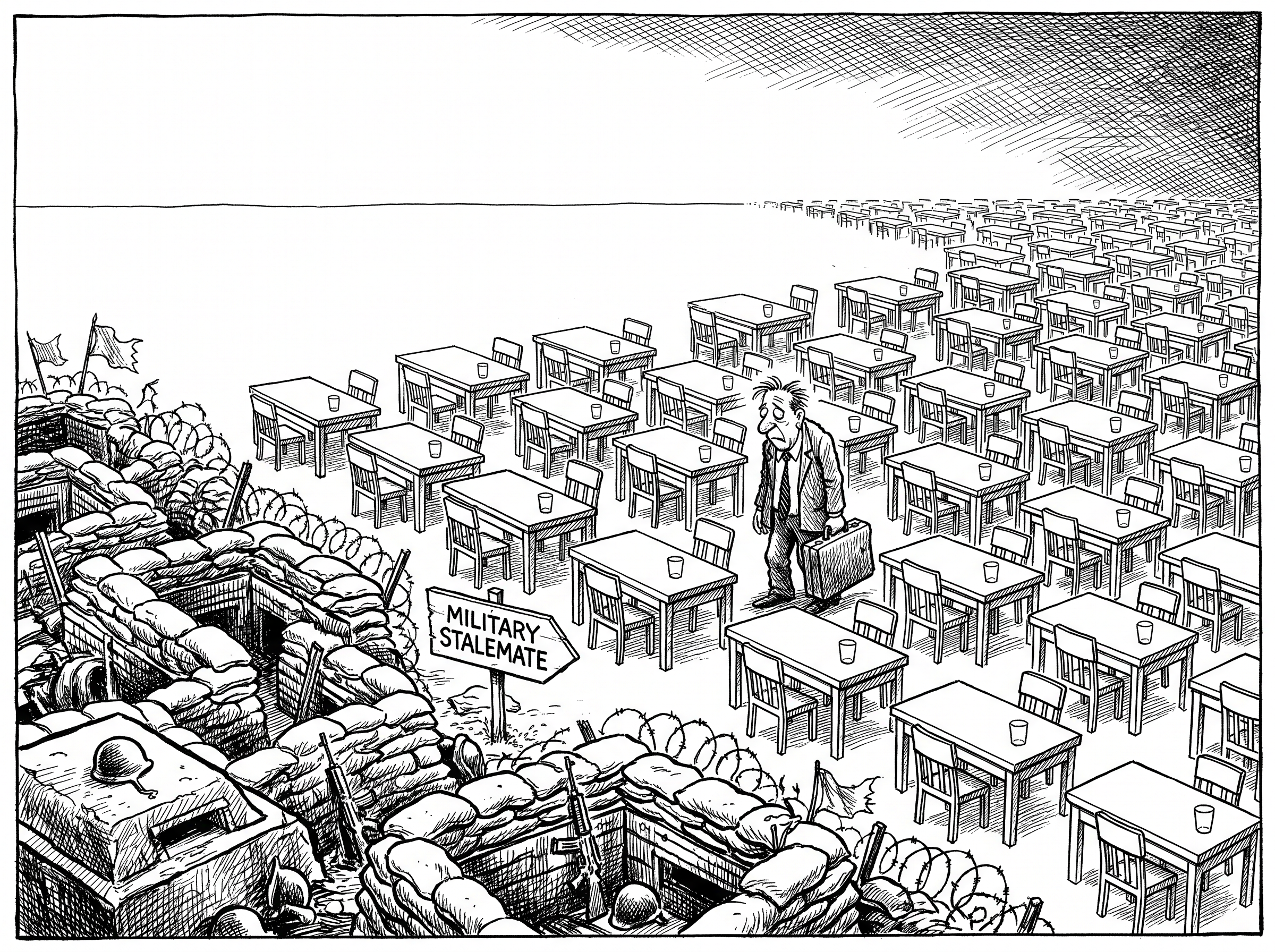
Fig. 3.9 – The maze of Indo-Pak negotiations. Inspiration: Keshav, The Hindu.
The joke turns on one repeated word: maze. The cartoonist grants that something has changed — the bunkers have become tables, and men are talking instead of shooting. That is real progress and he does not deny it.
But a maze is a place where you move a great deal and arrive nowhere. His claim is that the two countries have swapped one kind of endless deadlock for another, and that the sheer number of tables is itself the problem.
Now the limit, and it matters here more than anywhere. A cartoon is one artist’s opinion, drawn at one moment, and this one is dated by its own caption — ‘the current phase’. It cannot tell you whether the negotiations produced anything, and it takes no account of the one negotiation in this section that plainly did work: a water treaty signed in 1960 that has outlived three wars. Cartoons are sharpest when they are unfair, and that is exactly why they are evidence about opinion rather than about outcomes.
3.8 India And Its Other Neighbours
Pakistan is not India’s only difficult neighbour, and conflict is not the only thing India has with any of them. Every relationship in this section runs on two tracks at once — a list of grievances and a list of things the two countries do together anyway.
India And Bangladesh
The governments of India and Bangladesh have had differences over several issues, including the sharing of the Ganga and Brahmaputra river waters. Both rivers cross the border, and water that is used upstream cannot be used downstream. That is the whole shape of the quarrel.
The Indian government has been unhappy with Bangladesh’s denial of illegal immigration to India, with its support for anti-Indian Islamic fundamentalist groups, with Bangladesh’s refusal to allow Indian troops to move through its territory to northeastern India, and with its decision not to export natural gas to India or allow Myanmar to do so through Bangladeshi territory.
Look at that third item for a moment. India’s northeastern states are joined to the rest of the country by a narrow corridor of land that runs around Bangladesh. A route through Bangladeshi territory would be far shorter — which is why the refusal matters so much to Delhi, and why granting it feels to Dhaka like handing a neighbour’s army the keys to its roads.
Bangladeshi governments, for their part, have felt that the Indian government behaves like a regional bully — over the sharing of river waters, by encouraging rebellion in the Chittagong Hill Tracts in the country’s southeast, by trying to extract its natural gas, and by being unfair in trade. The two countries could not resolve their boundary dispute for a long while.
Despite their differences, India and Bangladesh do cooperate on many issues. Economic relations have improved considerably in the last 20 years. Bangladesh is a part of India’s Look East policy — called Act East since 2014 — which wants to link India up with Southeast Asia via Myanmar. On disaster management and environmental issues, the two states have cooperated regularly.
In 2015, they exchanged certain enclaves: pockets of one country’s territory that lay stranded inside the other, whose residents had for decades lived surrounded by a state that was not theirs. Efforts are on to broaden the areas of cooperation further, by identifying common threats and being more sensitive to each other’s needs.
India And Nepal
Nepal and India enjoy a very special relationship that has very few parallels in the world. A treaty between the two countries allows the citizens of the two countries to travel to and work in the other country without visas and passports.
Think about how unusual that is. Two sovereign states, and no document required at the border. Very few pairs of countries anywhere trust each other that far.
Despite this special relationship, the governments of the two countries have had trade-related disputes in the past. The Indian government has often expressed displeasure at the warm relationship between Nepal and China, and at the Nepal government’s inaction against anti-Indian elements.
Indian security agencies see the Maoist movement in Nepal as a growing security threat, given the rise of Naxalite groups — armed left-wing groups fighting the Indian state — in various Indian states, from Bihar in the north to Andhra Pradesh in the south.
Nepal’s complaints run the other way. Many leaders and citizens in Nepal think that the Indian government interferes in its internal affairs, has designs on its river waters and hydro-electricity, and prevents Nepal, a landlocked country with no coastline of its own, from getting easier access to the sea through Indian territory. For a landlocked state, every route to the ocean runs through somebody else’s country — and that gives the neighbour a grip on its trade.
Nevertheless, Indo-Nepal relations are fairly stable and peaceful. Despite differences, trade, scientific cooperation, common natural resources, electricity generation and interlocking water management grids hold the two countries together. There is a hope that the consolidation of democracy in Nepal will lead to improvements in the ties between the two countries.
A Negotiation To Try In Class
The original chapter sets a class exercise at exactly this point, and it is the best possible test of everything you have read so far. Here is how it runs.
Divide the classroom into eight groups — as many as the number of countries. The number of students in each group may vary, reflecting the size of the countries of South Asia. Name each group after a country, and hand each group a brief country profile. Besides the basic information, the profile should include a short note on the contentious issues and disputes among the South Asian countries. The issues could be those discussed in this chapter, or an issue of relevance that is not discussed in it.
Each group then selects an issue of its choice. The dispute could be bilateral, between two countries, or multilateral, involving several — and given the geographic peculiarity of the region, the issue could well be one that involves India. Each group must find out what initiatives the governments involved have actually taken, and the reasons for their failure in resolving the disputes. Students then assume the role of representing their respective countries and share their findings.
The book adds a set of ideas for the teacher. Pair up the countries that share a common issue or dispute — two groups where the issue is bilateral, more where it is multilateral. Bilateral examples include the Jammu and Kashmir dispute between India and Pakistan, and the migrant problem between India and Bangladesh; multilateral ones include the creation of a free trade zone, or tackling terrorism.
The groups should then negotiate on proposals and counter-proposals within a fixed time limit, while the teacher notes the outcome, keeping the focus on the areas of agreement and disagreement. Finally, link the outcome of the negotiation to the prevailing situation among the countries of South Asia. Talk about the difficulties involved in negotiating on a political issue, based on what you observed. Conclude by discussing why accommodating each other’s interest matters for the sake of peaceful coexistence.
Do the exercise honestly and you will discover something no summary can teach you: how hard it is to give ground in front of the people you represent.
India And Sri Lanka
The difficulties in the relationship between the governments of India and Sri Lanka are mostly over the ethnic conflict in the island nation. Indian leaders and citizens find it impossible to remain neutral when Tamils are politically unhappy and are being killed.
After the military intervention in 1987, which you studied in Case 3.A2, the Indian government now prefers a policy of disengagement in respect of Sri Lanka’s internal troubles. The lesson of the IPKF years was that a large neighbour which steps in militarily may end up fighting the people it went in to protect.
What replaced intervention was trade and aid. India signed a free trade agreement with Sri Lanka — an agreement to lower the taxes each charges on the other’s goods — which strengthened relations between the two countries. India’s help in reconstruction after the tsunami struck the region’s coasts has also brought the two countries closer.
India, Bhutan And The Maldives
India enjoys a very special relationship with Bhutan too, and does not have any major conflict with the Bhutanese government. The efforts made by the Bhutanese monarch to weed out the guerrillas and militants from northeastern India that operate in his country have been helpful to India.
India is involved in big hydroelectric projects in Bhutan, and remains the Himalayan kingdom’s biggest source of development aid. Notice that this relationship works in both directions: Bhutan gives India security on a difficult border, and India gives Bhutan power projects and money.
India’s ties with the Maldives remain warm and cordial. In November 1988, when some Tamil mercenaries — fighters who take up arms for payment rather than for a country — from Sri Lanka attacked the Maldives, the Indian air force and navy reacted quickly to the Maldives’ request to help stop the invasion. India has also contributed towards the island’s economic development, tourism and fisheries.
Set the Maldives beside Sri Lanka and a distinction appears. India was asked in by the Maldives, and its forces went home. It was not asked in by the Tamils of Sri Lanka in the same way, and its forces stayed for two years and left having failed. Being invited is not a detail.
The Big Neighbour Problem
You may have noticed by now that India has various problems with its smaller neighbours in the region. A student reading the original chapter put the question sharply: why is it that every one of our neighbours has a problem with India? Is there something wrong with our foreign policy — or is it just our size?
The chapter’s answer is that both parties to this relationship feel wronged, and that each has reasons.
Given India’s size and power, the smaller countries are bound to be suspicious of India’s intentions. The smaller countries fear that India wants to be a regionally-dominant power. The Indian government, on the other hand, often feels exploited by its neighbours. It does not like the political instability in these countries, fearing that instability can help outside powers to gain influence in the region.
A student reading the previous chapter asked a fair follow-up. If the chapter on the United States was called ‘US Hegemony’, why is this chapter not called ‘Indian Hegemony’? Before you answer, check the evidence in this section. Hegemony means a preponderance of power so great that others cannot balance it. India is the largest state here and it borders all the others — but Bangladesh refused it a road, Nepal keeps its own relations with China, and Sri Lanka made India take its troops home. Ask yourself whether a country that can be refused is a country that dominates.
Conflicts That Do Not Involve India
Not all conflicts in South Asia are between India and its neighbours.
Nepal and Bhutan have had disagreements in the past over the migration of ethnic Nepalese into Bhutan. Bangladesh and Myanmar have had disagreements over the movement of the Rohingyas from Myanmar into India and Bangladesh. Bangladesh and Nepal have had some differences over the future of the Himalayan river waters.
The major conflicts and differences, though, are between India and the others. That is partly because of the geography of the region, in which India is located centrally and is therefore the only country that borders the others. If you are the only state that touches everybody, you are the only state that can quarrel with everybody.
Reading Fig. 3.10
The chapter prints a cartoon by Surendra, from The Hindu, on the summit meetings of SAARC — the regional organisation you will study in the next section.
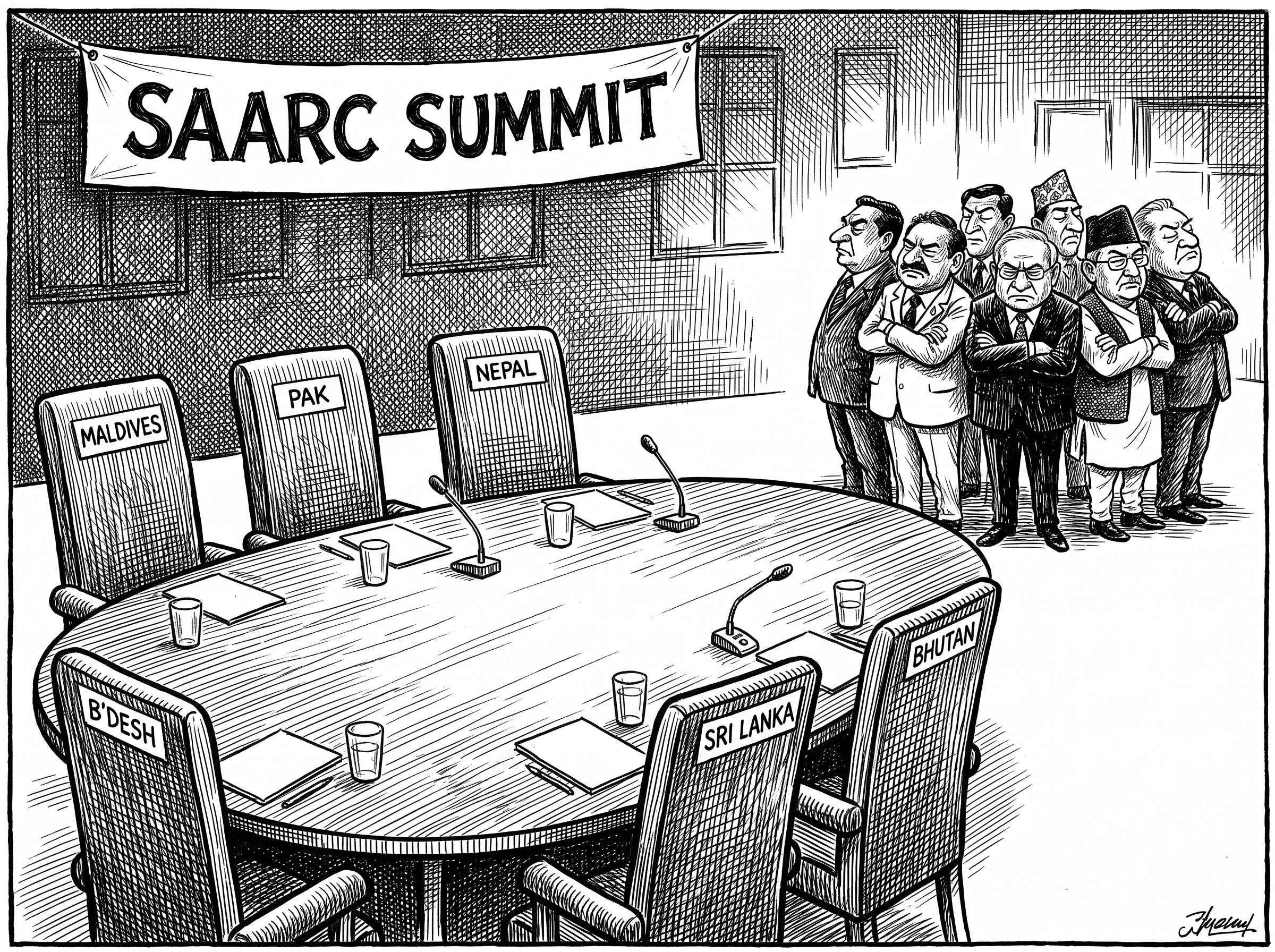
Fig. 3.10 – The empty table at the SAARC summit. Inspiration: Surendra, The Hindu.
Work through the drawing before you answer the question. Every chair is there. Every country has a place at the table, and the two largest — India and Pakistan — sit across it from each other. What is missing is anybody actually sitting down.
The cartoonist’s claim is about that gap: the machinery of regional cooperation exists, complete with a banner and a seating plan, while the cooperation itself does not happen. Now ask the question the chapter puts to you. What have the two largest members got to do with the empty chairs?
Then, as always, ask what the cartoon cannot tell you. It records an opinion about a summit, not a record of what SAARC has done or failed to do. The five smaller members are drawn as chairs and nothing more, so their own reasons never appear. And an artist who draws an empty table has already decided that nothing was achieved — which is a conclusion, not evidence. The next section is where you can test it.
3.9 Peace And Cooperation
Do the states of South Asia cooperate with each other? Or do they only keep fighting with each other?
After eight sections of coups, wars, insurgencies and accusations, you might expect the answer to be obvious. It is not. In spite of the many conflicts, the states of South Asia recognise the importance of cooperation and friendly relationship among themselves. The same governments that suspect one another also keep sitting down together.
SAARC
The South Asian Association for Regional Cooperation (SAARC) is a major regional initiative by the South Asian states to evolve cooperation through multilateral means — that is, through all the members acting together, rather than through separate two-country deals. It began in 1985.
Unfortunately, due to persisting political differences, SAARC has not had much success. That sentence is the chapter’s own verdict, and it is worth being precise about what it does and does not say. It does not say SAARC failed because the idea was bad, or because the region is too poor. It says the politics between the members kept getting in the way of the organisation they had themselves created.
SAARC members signed the South Asian Free Trade (SAFTA) agreement, which promised the formation of a free trade zone for the whole of South Asia.
SAFTA
A new chapter of peace and cooperation might evolve in South Asia if all the countries in the region allow free trade across the borders. That is the spirit behind the idea of SAFTA.
The Agreement was signed in 2004 and came into effect on 1 January 2006. SAFTA aims at lowering trade tariffs — the taxes a country charges on goods coming in from abroad. Lower the tariff and the neighbour’s goods become cheaper on your shelves; keep it high and your own producers are shielded from them. That is why a tariff is never only an economic decision.
Since students routinely confuse the two names, hold them apart. SAARC is the organisation; SAFTA is one agreement signed by its members. The first is a forum, the second is a promise about trade taxes.
Two Fears And A Shrug
Not everyone in the region wants SAFTA, and the objections come from opposite directions.
Some of our neighbours fear that SAFTA is a way for India to ‘invade’ their markets, and to influence their societies and politics through commercial ventures and a commercial presence in their countries. Note the word the chapter puts in quotation marks. The fear is not of Indian goods as such. It is that a market opened to a far larger economy stops being a market you control.
India thinks that there are real economic benefits for all from SAFTA, and that a region that trades more freely will be able to cooperate better on political issues. This is an old argument: countries that need each other’s business find war expensive, and so learn to settle their quarrels.
And some in India think that SAFTA is not worth the trouble, since India already has bilateral agreements with Bhutan, Nepal and Sri Lanka. Why negotiate with seven when three have already said yes?
A student reading the original chapter noticed something in all this and wrote it in the margin: every association seems to have emerged for trade — is trade more important than people-to-people relations? It is a fair challenge to the whole logic of SAFTA. Two peoples may travel, marry, study and watch cricket across a border and still be governed by states that will not lower a tariff; and two states may trade briskly while keeping their citizens apart. Which of the two actually builds peace is a question this chapter poses and does not close.
India And Pakistan: The Efforts That Are Not Reported
Although India-Pakistan relations seem to be a story of endemic conflict and violence, there have been a series of efforts to manage tensions and build peace.
The two countries have agreed to undertake confidence building measures — steps that make each side’s military behaviour more predictable to the other, so that an accident or a misreading does not become a war. The agreement of 1988 not to attack each other’s nuclear installations and facilities, which you can find in Fig. 3.11, is exactly this kind of measure.
Social activists and prominent personalities have collaborated to create an atmosphere of friendship among the people of both countries. Leaders have met at summits to understand each other better and to find solutions to the major problems between the two neighbours.
A number of bus routes have been opened up between the two countries. Trade between India and Pakistan had increased, and visas had been more easily granted. However, in recent times, the situation has changed.
That last sentence is short, and the chapter does not expand it. Read it as a warning against a comfortable story. Peace-building here has not been a steady climb. It has been a series of openings, some of which have since closed.
The Powers Outside The Region
No region exists in a vacuum. It is influenced by outside powers and events, no matter how much it may try to insulate itself from non-regional powers. China and the United States remain key players in South Asian politics.
Sino-Indian relations have improved significantly in the last ten years, but China’s strategic partnership with Pakistan remains a major irritant. The demands of development and globalisation — the growing flow of goods, money, people and ideas across national borders — have brought the two Asian giants closer, and their economic ties have multiplied rapidly since 1991.
American involvement in South Asia has rapidly increased after the Cold War. The US has had good relations with both India and Pakistan since the end of the Cold War, and increasingly works as a moderator in India-Pakistan relations — a third party that both sides will listen to, even when they will not listen to each other.
Economic reforms and liberal economic policies in both countries have greatly increased the depth of American participation in the region. The large South Asian diasporas in the US — the communities of South Asian origin settled there — and the huge size of the population and markets of the region also give America an added stake in the future of regional security and peace.
Reading Fig. 3.12 And 3.13
The chapter prints two cartoons together on this question, one drawn in India and one in Pakistan.
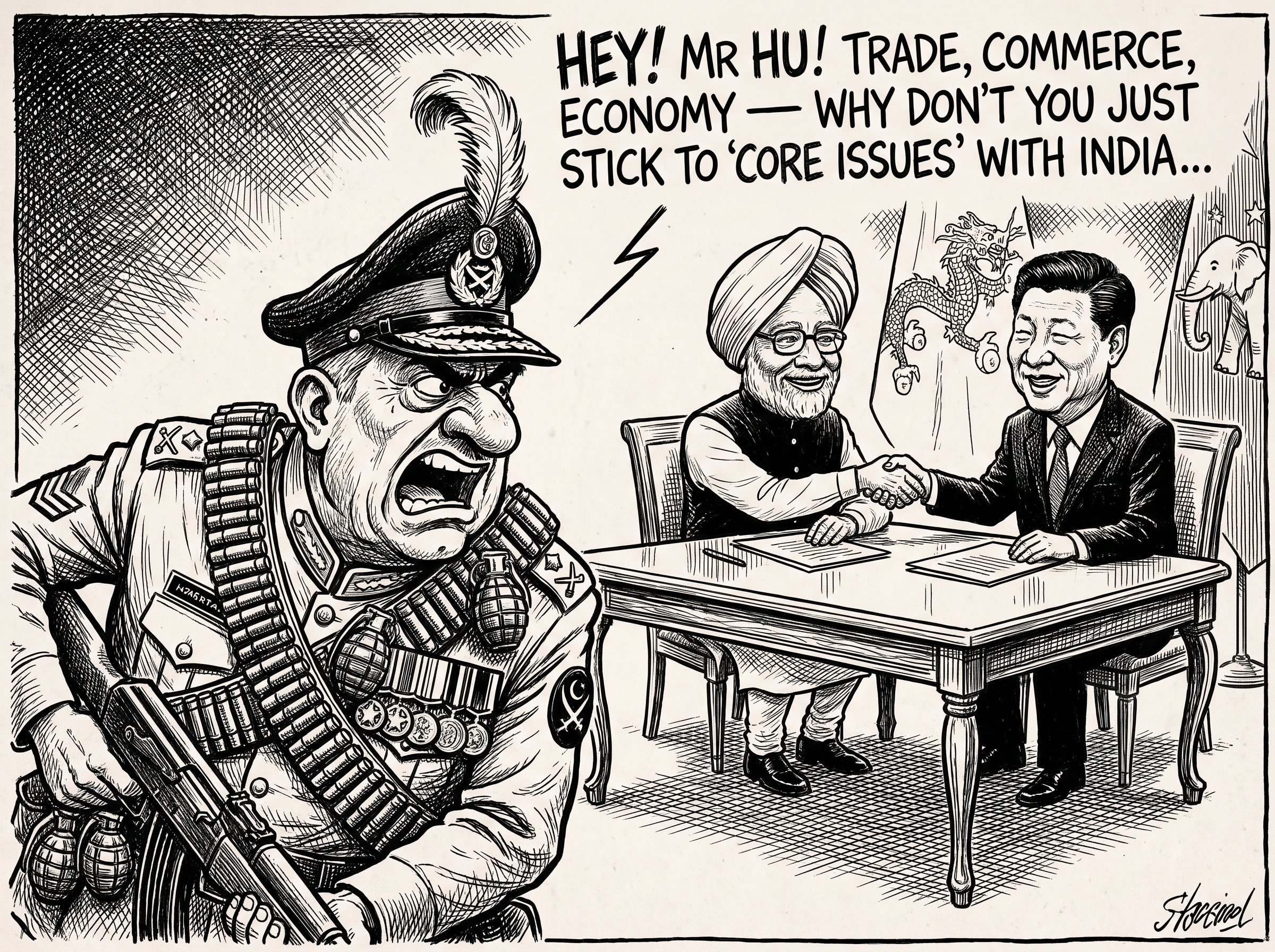
Fig. 3.12 – Pakistan reacts to Sino-Indian trade. Inspiration: Keshav, The Hindu.
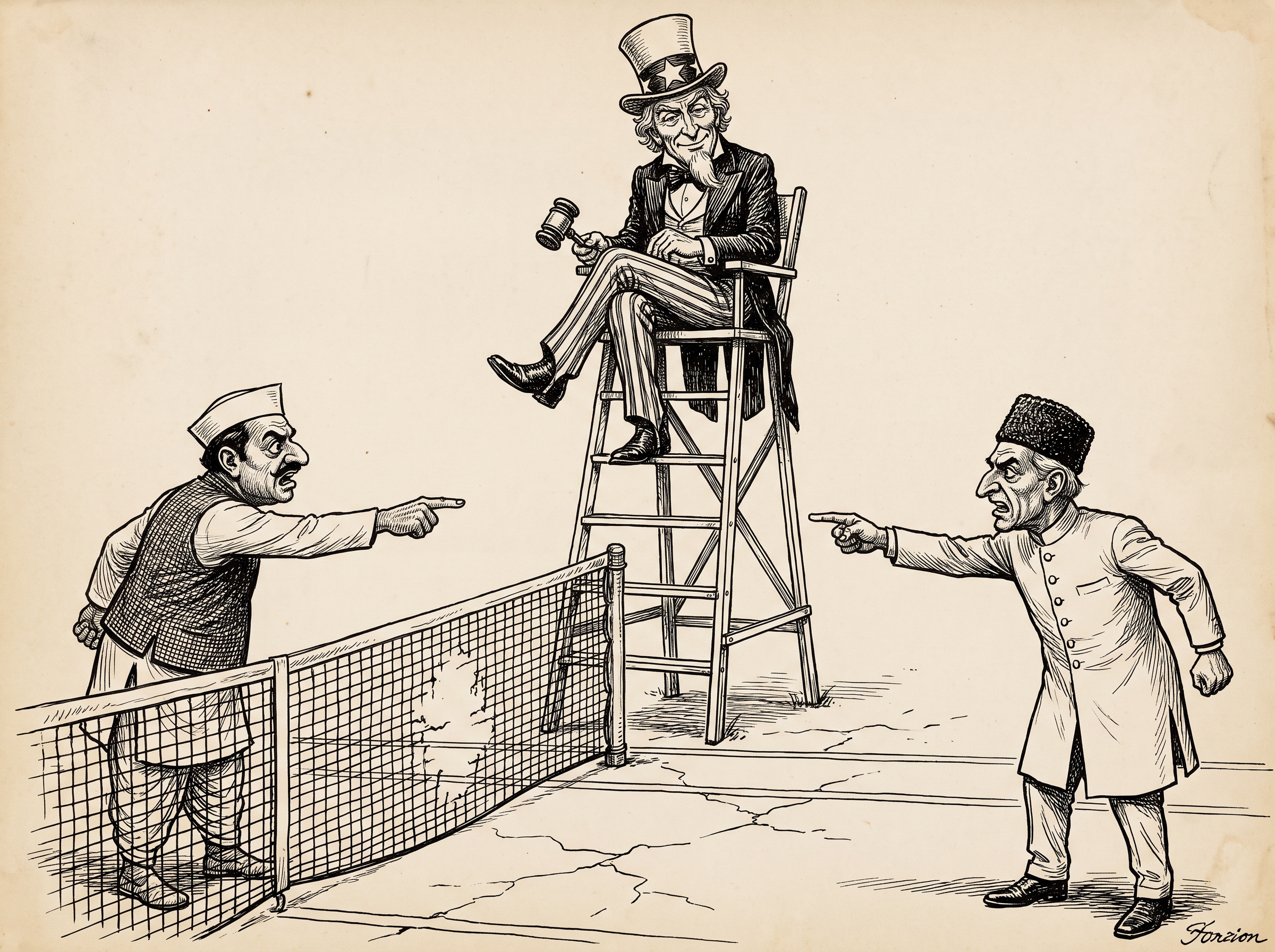
Fig. 3.13 – The US as umpire in South Asia. Inspiration: Pakistan Tribune.
Take the Indian cartoon first. It shows India and China doing business — trade, commerce, economy — and a Pakistani soldier objecting that China should be talking about the ‘core issues’ instead. The cartoonist’s claim is that Pakistan is unhappy to see its close partner drawn towards India by economics, and would rather keep the old political quarrels at the centre of the conversation.
The Pakistani cartoon uses a game. India and Pakistan face each other across a net, each blaming the other, and the United States sits above them as the umpire who will decide. The cartoonist’s claim is that the two countries have handed the judging of their own dispute to an outsider.
Now the question the chapter asks. What do the two have in common? Both are drawn about the same thing — an outside power that has become a player in a quarrel between two neighbours. Both treat that presence as a fact, and neither is happy about it. Cartoonists on opposite sides of a hostile border have arrived at the same uneasy observation from different chairs.
And now the limit, which is sharper here than anywhere in this chapter. A cartoon tells you what one artist thought would land with his readers on the morning it was printed. Two cartoons are not a survey of two nations. Neither drawing tells you what China or the United States actually did, whether American mediation helped or hurt, or what the citizens of either country wanted. What the pair does show — and it is worth a great deal — is that outside powers are felt as an intrusion on both sides of the line.
Who Decides What This Region Becomes
However, whether South Asia will continue to be known as a conflict prone zone, or will evolve into a regional bloc with some common cultural features and trade interests, will depend more on the people and the governments of the region than on any other outside power.
That is the sentence the whole chapter has been building towards, and it is a claim, not a fact. Test it.
3.10 Summary
The Chapter In Points
- South Asia, in this chapter, means seven countries: Bangladesh, Bhutan, India, the Maldives, Nepal, Pakistan and Sri Lanka. The Himalayas, the Indian Ocean, the Arabian Sea and the Bay of Bengal give the region a natural insularity, but its eastern and western edges are blurred — Afghanistan and Myanmar are often included, and China, though an important player, is not counted as part of the region.
- The region is diverse in every sense and yet constitutes one geo-political space, in which rivalry and goodwill, hope and despair, suspicion and trust coexist.
- The seven countries do not share one kind of political system. India and Sri Lanka have operated democracies since independence from the British; Pakistan and Bangladesh have known both civilian and military rulers; Nepal moved from monarchy to republic; Bhutan and the Maldives have both moved towards multi-party democracy.
- A survey of more than 19,000 citizens in five countries found widespread support for democracy among rich and poor alike — a finding that matters, because it was earlier believed that democracy could flourish only in prosperous countries.
- Pakistan’s difficulty in stabilising democracy has several causes together: the social dominance of the military, the clergy and the landowning aristocracy; the conflict with India, which strengthens pro-military groups; and the lack of genuine international support for democratic rule. Alongside this runs a strong pro-democracy sentiment, a relatively free press and a strong human rights movement.
- Bangladesh’s independence came out of the denial of an election result. The Awami League swept East Pakistan in 1970, the assembly was not convened, Sheikh Mujib was arrested, the army’s suppression drove refugees into India, and the December 1971 war ended in the birth of Bangladesh.
- Democracy in Bangladesh was narrowed from within in 1975 and taken away by generals afterwards — and was won back by mass protest, with students in the forefront, leading to Ershad’s fall in 1990 and elections in 1991.
- In Nepal, the obstacle to democracy was a king backed by the army. A pro-democracy movement won a constitution in 1990, the king dissolved parliament in 2002, countrywide protests in April 2006 forced him to restore the House of Representatives, the monarchy was abolished in 2008, and a constituent assembly’s constitution was adopted in 2015.
- Sri Lanka’s democracy survived without a coup, but faced ethnic conflict. Tamil claims were treated as ‘concessions’ by Sinhala nationalists, neglect produced militant Tamil nationalism, and from 1983 the LTTE fought for a separate country until it was vanquished in 2009. Through the war, Sri Lanka still recorded high growth and high human development.
- India and Pakistan have fought over Kashmir since partition. Wars in 1947-48 and 1965 failed to settle it, and the 1971 war left it unsettled. Both acquired nuclear weapons in the 1990s, and since the tests of 1998 the possibility of a direct, full-scale war has declined — while each government accuses the other of low-key violence.
- Cooperation between them has nonetheless survived: the Indus Waters Treaty of 1960 has outlasted every war since. Sir Creek and the interpretation of the treaty remain under negotiation.
- India’s relations with its other neighbours run on two tracks at once. There are quarrels with Bangladesh and Nepal, disengagement from Sri Lanka’s internal troubles after 1987, and close, untroubled ties with Bhutan and the Maldives.
- The smaller countries fear that India wants to be a regionally-dominant power; the Indian government feels exploited by its neighbours and fears that their instability lets outside powers in. Most conflicts involve India partly because geography puts it at the centre, bordering all the others — though Nepal and Bhutan, and Bangladesh and Myanmar, have had disagreements of their own.
- SAARC, begun in 1985, was meant to build cooperation through multilateral means but has not had much success, because political differences among its members persist. SAFTA, signed in 2004 and in effect from 1 January 2006, aims to lower tariffs — and is welcomed by India, feared by some neighbours, and dismissed as unnecessary by some Indians.
- Peace-building between India and Pakistan has been real but reversible: confidence building measures, summits, bus routes, easier visas and more trade — followed, in recent times, by a change in the situation.
- No region exists in a vacuum. China and the United States remain key players. But whether South Asia becomes a conflict prone zone or a regional bloc will depend more on the people and the governments of the region than on any outside power.
3.11 NCERT Questions
Identify the country:
- The struggle among pro-monarchy, pro-democracy groups and extremists created an atmosphere of political instability:
- A landlocked country with multi-party competition:
- The first country to liberalise its economy in the South Asian region:
- In the conflict between the military and pro-democracy groups, the military has prevailed over democracy:
- Centrally located and shares borders with most of the South Asian countries:
- Earlier the island had the Sultan as the head of state. Now, it’s a republic:
- Small savings and credit cooperatives in the rural areas have helped in reducing poverty:
- A landlocked country with a monarchy:
Which among the following statements about South Asia is wrong?
- All the countries in South Asia are democratic.
- Bangladesh and India have signed an agreement on river-water sharing.
- SAFTA was signed at the 12th SAARC Summit in Islamabad.
- The US and China play an influential role in South Asian politics.
What are some of the commonalities and differences between Bangladesh and Pakistan in their democratic experiences?
List three challenges to democracy in Nepal.
Name the principal players in the ethnic conflict in Sri Lanka. How do you assess the prospects of the resolution of this conflict?
Mention some of the recent agreements between India and Pakistan. Can we be sure that the two countries are well on their way to a friendly relationship?
Mention two areas each of cooperation and disagreement between India and Bangladesh.
How are the external powers influencing bilateral relations in South Asia? Take any one example to illustrate your point.
Write a short note on the role and the limitations of SAARC as a forum for facilitating economic cooperation among the South Asian countries.
India’s neighbours often think that the Indian government tries to dominate and interfere in the domestic affairs of the smaller countries of the region. Is this a correct impression?
3.12 Check Your Concepts
Look again at Table 3.1. Pick any two indicators on which Sri Lanka does better than Pakistan, and state the figures for both countries. Then answer the harder part: does this table tell you anything about why the two countries differ? Explain what the table measures and what it does not.
Fig. 3.1 shows that Pakistan is the exception in the region: only 37 out of 100 said democracy is preferable, and 49 said it does not matter to them. Using what section 3.3 says about Pakistan, suggest what might lie behind those figures. Then state one thing this survey cannot tell you, however many people were interviewed.
Fig. 3.9 shows Indo-Pak relations moving from a maze of bunkers to a maze of dialogue tables. What claim is the cartoonist making about the negotiations? Now use the Indus Waters Treaty of 1960 to argue against him.
Reconstruct, in order, the chain of events that runs from the 1970 elections in Pakistan to the formation of Bangladesh in December 1971. At which step in your chain did a demand for autonomy turn into a demand for independence, and why?
India and Pakistan fought wars in 1947-48, 1965 and 1971, yet the Indus Waters Treaty signed in 1960 has survived all of them. What does this suggest about the relationship between conflict and cooperation between two hostile states?
When Nepal formed a constituent assembly to draft its constitution, its parties did not agree on what the constitution should contain. Set out two of the disagreements the chapter records. What had all of them nevertheless accepted, and why does that matter?
Sri Lanka has maintained a democratic political system since 1948, and yet a demand for secession arose within it. Does this show that holding elections is enough to protect a minority? Argue your answer using only what this chapter tells you about Sri Lanka.