Chapter 5: Therapeutic Approaches
Viktor Frankl was a psychiatrist and neurologist in Vienna in the years before the Second World War. He had already begun to develop an unusual idea about human suffering: that what breaks a person is not hardship itself, but hardship that seems to mean nothing. Then the war came, and Frankl — a Jewish doctor — was imprisoned in Nazi concentration camps for several years. He lost his home, his work and most of his family.
What he did in those camps was, in its way, the work of a psychiatrist. He watched. He noticed that survival did not depend only on physical strength. Prisoners who could still hold on to some purpose — a person waiting for them, a piece of work left unfinished, a task they felt was theirs — endured differently from those for whom nothing remained to be lived for. Frankl kept reconstructing, from memory, a manuscript that had been taken from him. That unfinished book was one of his own reasons to go on.
After the war he returned to Vienna and built a system of therapy out of what he had seen. He called it logotherapy — therapy through meaning. Its claim is simple and demanding: a person can be helped to find meaning in their life, whatever their circumstances, and that meaning heals.
Frankl’s is only one answer. This chapter examines several — and they do not agree with one another.

Fig. 5.1 – The four therapeutic answers to psychological suffering.
This chapter will answer each of these questions.
5.1 Nature and Process of Psychotherapy
In the previous chapter you studied the major psychological disorders and the distress they cause — to the person who has the disorder, and often to those around them. The obvious next question is what can be done about that distress. This chapter takes up the methods that trained professionals use to help people who are struggling, and it begins with the most widely used of them: psychotherapy.
There is no single psychotherapy. There are many, and they differ sharply. Some are built around helping a person understand themselves better; others are far more action-oriented and set out to change what the person actually does. But every one of them is aimed at the same basic task — helping a person overcome a condition that is disabling their life. Whether a particular approach suits a particular person depends on several practical things: how severe the disorder is, how much distress it is causing to others, and how much time, effort and money the person can realistically commit.
Two features run through all of them. Every therapeutic approach is corrective and helping in nature — it exists to repair something and to support someone. And every one of them works through an interpersonal relationship between the therapist and the client. Beyond that, they part ways. Some are directive, meaning the therapist leads, interprets and advises — psychodynamic therapy is of this kind. Others are non-directive, meaning the therapist does not steer the client towards conclusions but creates the conditions in which the client arrives at their own — person-centred therapy is of this kind.
What psychotherapy is
Psychotherapy is a voluntary relationship between the person seeking help — the client — and the person trained to give it — the therapist. The word voluntary is doing real work in that sentence. Nobody can be therapised against their will; a client who does not want to be there cannot be treated.
The purpose of the relationship is to help the client solve the psychological problems they are facing. For that to be possible, the relationship must be built so that the client can trust the therapist and discuss problems freely — including problems they may never have said aloud to anyone.
Psychotherapies aim at three connected things: changing maladaptive behaviours, reducing the client’s sense of personal distress, and helping the client adapt better to their environment. Sometimes the environment itself is part of the problem. Where a person’s marital, occupational or social adjustment is inadequate, therapy may require that major changes be made in the person’s personal environment, not only in the person.
Four characteristics of all psychotherapeutic approaches
However different they look on the surface, all psychotherapeutic approaches share four characteristics.
First, there is systematic application of principles. A therapist is not improvising. Each system of therapy rests on a theory of why psychological problems arise, and the techniques used follow from that theory.
Second, psychotherapy can be practised only by persons who have received practical training under expert supervision. Not everybody can do it. An untrained person, however well-meaning, may unintentionally cause more harm than good — which is why sympathy and good intentions are not a substitute for training.
Third, the therapeutic situation involves a therapist and a client who seeks and receives help for emotional problems. The client is the focus of attention throughout the therapeutic process; the session is not about the therapist.
Fourth, the interaction of these two persons results in the formation and consolidation of the therapeutic relationship. This relationship is confidential, interpersonal and dynamic. It is central to any form of psychological therapy, and it is the vehicle through which change actually happens.
The goals of psychotherapy
Any single course of therapy will pursue a few of the following goals, not all of them. Taken together, they map out what psychotherapy is trying to achieve.
- Reinforcing the client’s resolve for betterment — strengthening the client’s own will to get better.
- Lessening emotional pressure.
- Unfolding the potential for positive growth.
- Modifying habits.
- Changing thinking patterns.
- Increasing self-awareness.
- Improving interpersonal relations and communication.
- Facilitating decision-making.
- Becoming aware of one’s choices in life.
- Relating to one’s social environment in a more creative and self-aware manner.
Notice that these goals are not all of the same kind. Some are about reducing something painful; others are about building something that was never there. Which goals a therapist emphasises depends on the system of therapy they work in — a point the next section develops.
5.1.1 Therapeutic Relationship
The special relationship between the client and the therapist is known as the therapeutic relationship, or the therapeutic alliance. It is worth being precise about what kind of relationship this is, because it is easily misunderstood. It is not a passing acquaintance, and it is not a permanent, lasting bond either. It sits deliberately between the two.
The alliance has two major components. The first is its contractual nature: two willing individuals, the client and the therapist, enter into a partnership aimed at helping the client overcome their problems. The second is its limited duration. The alliance lasts until the client becomes able to deal with their problems and take control of their own life — and then it ends. Therapy that never ends has failed at its own purpose.
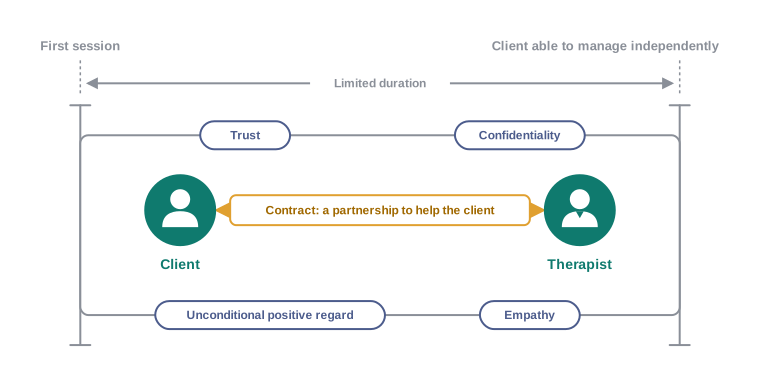
Fig. 5.2 – Properties and duration of the therapeutic alliance.
The properties of the alliance
As Fig. 5.2 indicates, this relationship has several unique properties. It is a trusting and confiding relationship. The high level of trust is what allows the client to unburden themselves — to confide psychological and personal problems that they may have carried alone for years.
The therapist actively encourages this by being accepting, empathic, genuine and warm. Through words and behaviour, the therapist conveys that they are not judging the client, and that they will go on showing the same positive feelings towards the client even if the client is rude, or confides all the ‘wrong’ things they may have done or thought about. This is unconditional positive regard — regard that carries no conditions, and is therefore not withdrawn when the client says something ugly.
The therapist also has empathy for the client. Empathy is different both from sympathy and from mere intellectual understanding of another person’s situation, and NCERT is careful to separate the three. In sympathy, one feels compassion and pity for another’s suffering but cannot feel as the other person feels. Intellectual understanding is colder still: the person grasps the situation but neither feels as the other feels nor feels sympathy. Empathy is present when one understands the plight of another person and feels as that person feels — understanding things from the other’s perspective, putting oneself in the other person’s shoes. Empathy is what enriches the therapeutic relationship and transforms it into a healing relationship.
Confidentiality and professional limits
The alliance also requires that the therapist keep strict confidentiality about the experiences, events, feelings and thoughts the client discloses. Nothing said in the session travels out of it. The therapist must not exploit the client’s trust and confidence in any way. And, finally, the relationship is a professional relationship, and must remain so — it does not become a friendship, and it does not become anything else.
These are not decorative rules. A client discloses material that could damage them if it were repeated, and does so only because the setting guarantees that it will not be. Remove the guarantee and the disclosure stops; remove the disclosure and therapy has nothing to work with.
5.2 Type of Therapies
Every psychotherapy sets out to remove human distress and to foster effective behaviour. That much they agree on. Beyond that shared purpose, they differ greatly — in their concepts, in their methods, and in their techniques. Two therapists trained in two different systems may listen to the same client describe the same problem and reach quite different conclusions about what the problem is.
Psychotherapies may be classified into three broad groups: the psychodynamic, the behaviour, and the existential psychotherapies. In chronological order, psychodynamic therapy emerged first, followed by behaviour therapy, while the existential therapies — also called the third force — emerged last.
The six parameters of classification
That classification is not arbitrary. It rests on six questions, and the three systems answer each of them differently. Read the six parameters as a set of interview questions you might put to a therapist; the answers reveal which system they belong to.
1. What is the cause which has led to the problem?
Psychodynamic therapy holds that intrapsychic conflicts — conflicts present within the psyche of the person — are the source of psychological problems. According to the behaviour therapies, psychological problems arise from the faulty learning of behaviours and cognitions. The existential therapies postulate that questions about the meaning of one’s life and existence are the cause of psychological problems.
2. How did the cause come into existence?
In psychodynamic therapy, unfulfilled desires of childhood and unresolved childhood fears lead to intrapsychic conflicts. Behaviour therapy postulates that faulty conditioning patterns, faulty learning, and faulty thinking and beliefs lead to maladaptive behaviours, which in turn lead to psychological problems. Existential therapy places importance on the present: it is the current feelings of loneliness, alienation, and a sense of futility about one’s existence that cause psychological problems.
Notice the difference in the direction each system looks. The first looks backwards into childhood, the second looks at a history of learning, and the third looks at the person’s life now.
3. What is the chief method of treatment?
Psychodynamic therapy uses free association and the reporting of dreams to draw out the thoughts and feelings of the client. This approach is then interpreted to the client, so that the client can confront and resolve the conflicts and thus overcome the problems.
Behaviour therapy identifies the faulty conditioning patterns and sets up alternative behavioural contingencies to improve behaviour. The cognitive methods employed within this type of therapy challenge the faulty thinking patterns of the client, so that the client can overcome psychological distress.
Existential therapy provides a therapeutic environment that is positive, accepting and non-judgmental. The client is able to talk about the problems, and the therapist acts as a facilitator. The client arrives at the solutions through a process of personal growth.
4. What is the nature of the therapeutic relationship between the client and the therapist?
Psychodynamic therapy assumes that the therapist understands the client’s intrapsychic conflicts better than the client does, and so it is the therapist who interprets the client’s thoughts and feelings back to them, so that the client gains an understanding of the same.
Behaviour therapy assumes that the therapist is able to discern the client’s faulty behaviour and thought patterns. It further assumes that the therapist is capable of finding out the correct behaviour and thought patterns, which would be adaptive for the client.
Both the psychodynamic and the behaviour therapies therefore assume that the therapist is capable of arriving at solutions to the client’s problems. The existential therapies stand in direct contrast. They emphasise that the therapist merely provides a warm, empathic relationship in which the client feels secure enough to explore the nature and causes of their problems by themselves. This is the practical meaning of the distinction between directive and non-directive therapy that you met in the previous section.
5. What is the chief benefit to the client?
Psychodynamic therapy values emotional insight as the important benefit the client derives from treatment. Emotional insight is present when the client understands their conflicts intellectually, is able to accept the same emotionally, and is able to change their emotions towards the conflicts. The client’s symptoms and distress reduce as a consequence of this emotional insight.
Behaviour therapy considers the chief benefit to be the change of faulty behaviour and thought patterns into adaptive ones. Instituting adaptive or healthy behaviour and thought patterns ensures reduction of distress and removal of symptoms.
The humanistic therapy values personal growth as the chief benefit. Personal growth is the process of gaining an increasing understanding of oneself, and of one’s aspirations, emotions and motives.
6. What is the duration of treatment?
The duration of classical psychoanalysis may continue for several years. However, several recent versions of psychodynamic therapies are completed in 10–15 sessions. Behaviour and cognitive behaviour therapies, as well as existential therapies, are shorter and are completed in a few months.
5.2.1 Behaviour Therapy
Behaviour therapy postulates that psychological distress arises because of faulty behaviour patterns or faulty thought patterns. It is therefore focused on the behaviour and thoughts of the client in the present. The past matters only to the extent that it explains where the faulty patterns came from. The past is not activated or relived. Only the faulty patterns are corrected, and they are corrected in the present.
The clinical application of learning-theory principles constitutes behaviour therapy. It is worth being precise about what it is not: it is not a single unified theory applied to every client regardless of what is wrong with them. It is a large set of specific techniques and interventions, and the client’s symptoms and clinical diagnosis are what guide the selection of the technique. The treatment of phobias, or of excessive and crippling fears, requires one set of techniques; anger outbursts require another. A client who is depressed will be treated differently from a client who is anxious.
The foundation of behaviour therapy is therefore threefold: formulating the dysfunctional or faulty behaviours, identifying the factors that reinforce and maintain those behaviours, and devising methods by which they can be changed.
Method of treatment
The client — who may present psychological distress, or physical symptoms that cannot be attributed to a physical disease — is interviewed with a view to analysing their behaviour patterns. This is called behavioural analysis, and it looks for three things: the malfunctioning behaviours, the antecedents of the faulty learning, and the factors that maintain or continue the faulty learning.
Malfunctioning behaviours are behaviours which cause distress to the client. Antecedent factors are the causes which predispose the person to indulge in that behaviour. Maintaining factors are the factors which lead to the persistence of the faulty behaviour. As Fig. 5.3 shows, the three form a chain — something sets the behaviour off, the behaviour occurs, and something about its consequences keeps it going.
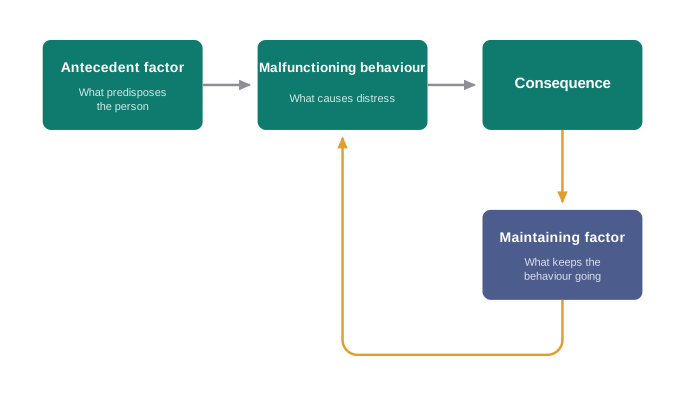
Fig. 5.3 – The behavioural analysis chain.
Take NCERT’s example. A young person has acquired the malfunctioning behaviour of smoking, and seeks help to be rid of it. Behavioural analysis, conducted by interviewing the client and the family members, reveals that he began smoking while preparing for the annual examination, and that he had reported relief from anxiety on smoking. The anxiety-provoking situation is thus the causative or antecedent factor. The feeling of relief is the maintaining factor that keeps him smoking. In the language of learning theory, the client has acquired the operant response of smoking, which is maintained by the reinforcing value of relief from anxiety.
Once the faulty behaviours causing distress have been identified, a treatment package is chosen. The aim of treatment is to extinguish or eliminate the faulty behaviours and substitute adaptive behaviour patterns in their place. The therapist does this by establishing antecedent operations and consequent operations.
Antecedent operations control behaviour by changing something that precedes the behaviour. The change can be made by increasing or decreasing the reinforcing value of a particular consequence, which is called an establishing operation.
An example makes this concrete. Suppose a child gives trouble at dinner and will not eat. An establishing operation would be to decrease the quantity of food served at tea time. This increases hunger at dinner, and thereby increases the reinforcing value of the food at dinner. Praising the child when they eat properly then encourages the behaviour. Here the antecedent operation is the reduction of food at tea time, and the consequent operation is praising the child for eating dinner. Together, they establish the response of eating dinner.
Behavioural techniques
A wide range of techniques is available for changing behaviour. Their principles are three: to reduce the arousal level of the client, to alter behaviour through classical or operant conditioning with different contingencies of reinforcement, and, where necessary, to use vicarious learning procedures.
Negative reinforcement and aversive conditioning are the two major techniques of behaviour modification. As you studied in Class XI, responses that lead organisms to get rid of painful stimuli, or to avoid and escape from them, provide negative reinforcement. One learns to put on woollen clothes, burn firewood, or use an electric heater to avoid unpleasant cold weather. One learns to move away from dangerous stimuli, because moving away is negatively reinforced.
Aversive conditioning refers to the repeated association of an undesired response with an aversive consequence. For example, a person seeking treatment for alcohol dependence is given a mild electric shock and asked to smell the alcohol. With repeated pairings, the smell of alcohol itself becomes aversive, because the pain of the shock has become associated with it, and the person gives up alcohol.
If an adaptive behaviour occurs only rarely, positive reinforcement is given to increase the deficit. If a child does not do homework regularly, the child’s mother may prepare the child’s favourite dish whenever the child does homework at the appointed time. The positive reinforcement of the favourite food increases the behaviour of doing homework on time.
Persons with behavioural problems can be given a token as a reward every time a wanted behaviour occurs. The tokens are collected and exchanged for a reward — an outing for a patient, a treat for a child. This is known as token economy.
Unwanted behaviour can be reduced and wanted behaviour increased at the same time, through differential reinforcement. One method is to give positive reinforcement for the wanted behaviour and negative reinforcement for the unwanted behaviour together. The other method is to positively reinforce the wanted behaviour and simply ignore the unwanted behaviour. The second method is less painful and equally effective — which is a good reason to prefer it.
Consider a girl who sulks and cries when she is not taken to the cinema on asking. The parent is instructed to take her to the cinema if she does not cry and sulk, and not to take her if she does. The parent is further instructed to ignore the girl when she cries and sulks. Over time the wanted behaviour of politely asking to be taken increases, and the unwanted behaviour of crying and sulking decreases.
Systematic desensitisation
You read about phobias, or irrational fears, in the previous chapter. Systematic desensitisation is a technique introduced by Wolpe for treating them.
The client is interviewed to elicit the fear-provoking situations. Then, together with the client, the therapist prepares a hierarchy of anxiety-provoking stimuli, with the least anxiety-provoking stimulus at the bottom of the hierarchy and the most severe at the top. Fig. 5.4 shows what such a hierarchy looks like for a person with a phobia of lizards.
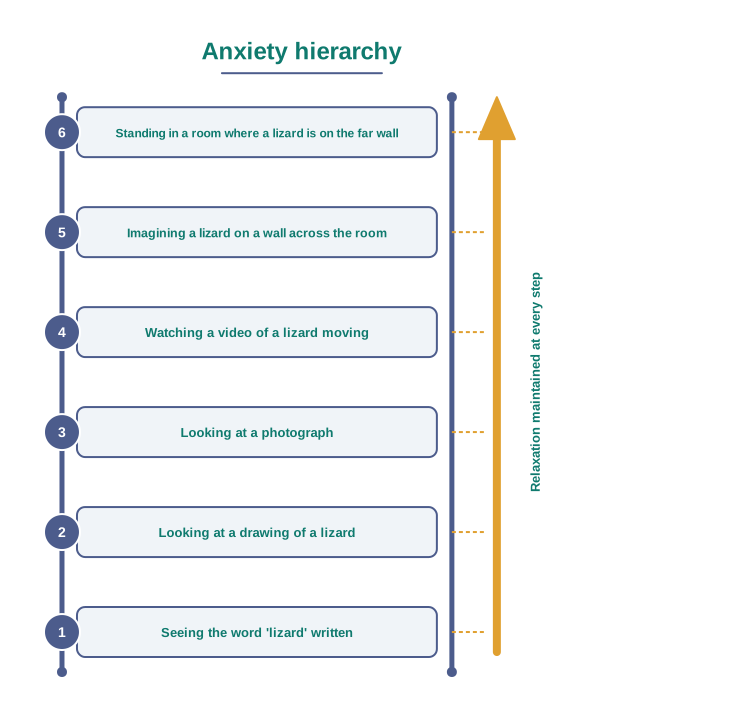
Fig. 5.4 – An anxiety hierarchy for systematic desensitisation.
The therapist first relaxes the client, and then asks the client to think about the least anxiety-provoking situation on the hierarchy. Relaxation procedures are used to bring the client into this relaxed state. The client is asked to stop thinking of the fearful situation the moment the slightest tension is felt. Over sessions, the client becomes able to imagine progressively more severe fear-provoking situations while still maintaining relaxation. The client is thus systematically desensitised to the fear.
The principle of reciprocal inhibition is what makes this work. The principle states that the presence of two mutually opposing forces at the same time inhibits the weaker force. Relaxation and anxiety are mutually opposing. So the relaxation response is first built up; a mildly anxiety-provoking scene is then imagined; and the anxiety, being the weaker of the two at that moment, is overcome by the relaxation. Because the client remains relaxed, they can tolerate progressively greater levels of anxiety.
Relaxation procedures
Anxiety is one of the most common expressions of the psychological distress for which a client seeks treatment. The behavioural therapist views anxiety as raising the client’s arousal level, and therefore as acting as an antecedent factor that causes the faulty behaviour. A client may smoke to reduce anxiety, may eat excessively, or may be unable to concentrate on study for long hours because of it. Reduce the anxiety, and the unwanted behaviours it drives — excessive eating, smoking — become less necessary.
Relaxation procedures are used to bring anxiety levels down. Two are commonly used: progressive muscular relaxation and meditation, both of which induce a state of relaxation.
In progressive muscular relaxation, the client is taught to contract individual muscle groups so as to become aware of tenseness or muscular tension. Once the client has learnt to tense a muscle group — the forearm, say — the client is asked to let go of the tension. The client is told that the tension is what they have at present, and that they must get into the opposite state. With repeated practice, the client learns to relax all the muscles of the body. Meditation is taken up later in this chapter.
Modelling
Modelling is the procedure in which the client learns to behave in a certain way by observing the behaviour of a role model — often the therapist, who initially acts as the role model. Vicarious learning, that is, learning by observing others, is used here. Through a process of rewarding small changes in behaviour, the client gradually comes to acquire the behaviour of the model.
There is a great variety of techniques in behaviour therapy — far more than can be listed here. The therapist’s skill lies not in knowing many techniques but in conducting an accurate behavioural analysis and then building a treatment package from the appropriate ones.
5.2.2 Cognitive Therapy
Cognitive therapy locates the cause of psychological distress somewhere quite different from behaviour therapy: in irrational thoughts and beliefs. Two clients may be sacked from the same job on the same day. One thinks, “That was a bad fit, I will find another.” The other thinks, “I always fail, and I always will.” The event is identical. The distress is not.
Rational Emotive Therapy
Albert Ellis formulated Rational Emotive Therapy (RET). Its central thesis is that irrational beliefs mediate between the antecedent events and their consequences — that is, the event does not produce the distress directly; the belief the person holds about the event does.
The first step in RET is the antecedent–belief–consequence (ABC) analysis. The antecedent events which caused the psychological distress are noted. The client is then interviewed to find the irrational beliefs which are distorting the present reality. Fig. 5.5 sets out the sequence.
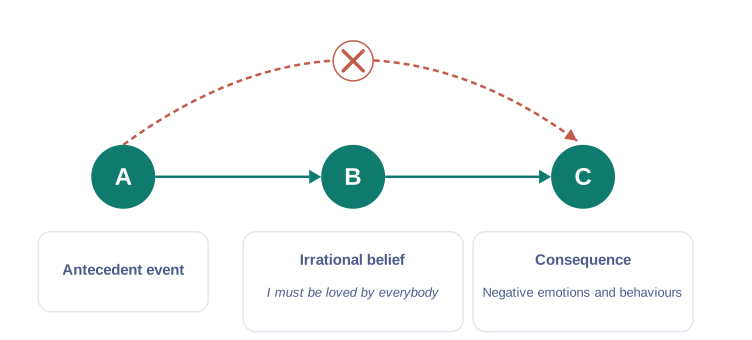
Fig. 5.5 – ABC analysis in Rational Emotive Therapy.
Irrational beliefs may not be supported by any empirical evidence in the environment. They are typically characterised by thoughts containing ‘musts’ and ‘shoulds’ — the insistence that things must and should be a particular way. Examples of irrational beliefs are, “One should be loved by everybody all the time”, and “Human misery is caused by external events over which one does not have any control.” This distorted perception of the antecedent event, caused by the irrational belief, leads to the consequence: negative emotions and negative behaviours. Irrational beliefs are assessed through questionnaires and interviews.
In the process of RET, the irrational beliefs are refuted by the therapist through a process of non-directive questioning. The nature of the questioning is gentle; it does not probe, and it does not direct. The questions make the client think more deeply into their own assumptions about life and about their problems. Gradually the client becomes able to change the irrational beliefs by changing their philosophy about life. The rational belief system replaces the irrational belief system, and psychological distress reduces.
Beck’s cognitive therapy
Another cognitive therapy is that of Aaron Beck. His theory of psychological distress characterised by anxiety or depression states that childhood experiences provided by the family and society develop core schemas — systems that include beliefs and action patterns in the individual.
A client who was neglected by their parents as a child, for instance, develops the core schema “I am not wanted”. The schema may lie quiet for years. Then, during the course of life, a critical incident occurs — the person is publicly ridiculed by a teacher in school. This incident triggers the core schema of “I am not wanted”, and negative automatic thoughts begin to develop.
Negative automatic thoughts are persistent irrational thoughts such as “nobody loves me”, “I am ugly”, “I am stupid”, “I will not succeed”. Such thoughts are characterised by cognitive distortions — ways of thinking which are general in nature but which distort reality in a negative manner. These patterns of thought are called dysfunctional cognitive structures, and they lead to errors of cognition about social reality. Fig. 5.6 shows the sequence.
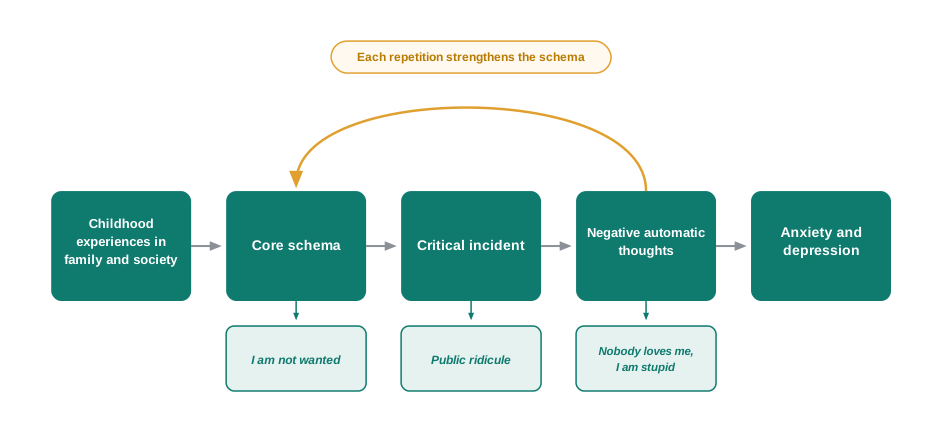
Fig. 5.6 – Beck’s model of dysfunctional cognitive structures.
The repeated occurrence of these thoughts leads to the development of feelings of anxiety and depression. The therapist responds with questioning — a gentle, non-threatening disputation of the client’s beliefs and thoughts. Examples of such questions would be, “Why should everyone love you?” and “What does it mean to you to succeed?” The questions make the client think in a direction opposite to that of the negative automatic thoughts. In doing so, the client gains insight into the nature of their dysfunctional schemas and becomes able to alter their cognitive structures. The aim of the therapy is to achieve this cognitive restructuring, which in turn reduces anxiety and depression.
Like behaviour therapy, cognitive therapy focuses on solving a specific problem of the client. But unlike psychodynamic therapy, it is open — the therapist shares their method with the client, rather than holding an interpretation in reserve. And it is short, lasting between 10 and 20 sessions.
Cognitive Behaviour Therapy
The most popular therapy at present is Cognitive Behaviour Therapy (CBT). Research into the outcome and effectiveness of psychotherapy has conclusively established CBT to be a short and efficacious treatment for a wide range of psychological disorders — anxiety, depression, panic attacks, and borderline personality among them.
CBT adopts a bio-psychosocial approach to the delineation of psychopathology. It combines cognitive therapy with behavioural techniques.
The rationale is that the client’s distress has its origins in three realms at once — the biological, the psychological and the social — and that a therapy which addresses only one of them is treating only part of the problem. So CBT addresses the biological aspects through relaxation procedures, the psychological ones through behaviour therapy and cognitive therapy techniques, and the social ones through environmental manipulations. Fig. 5.7 shows the three strands. This is what makes CBT a comprehensive technique: easy to use, applicable to a variety of disorders, and with proven efficacy.
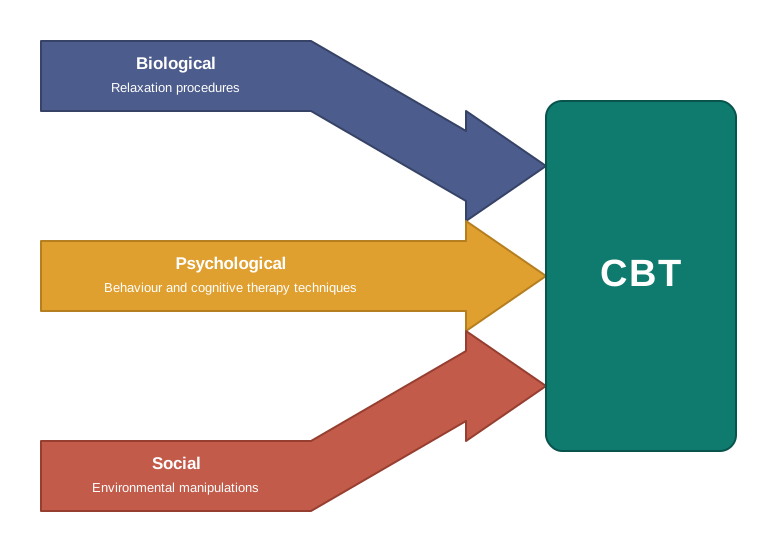
Fig. 5.7 – The bio-psychosocial approach of CBT.
5.2.3 Humanistic-existential Therapy
The humanistic-existential therapies postulate that psychological distress arises from feelings of loneliness, from alienation, and from an inability to find meaning and genuine fulfilment in life. This is a different picture of the human being from the one behind the therapies you have just read about. Here, human beings are motivated by the desire for personal growth and self-actualisation, and by an innate need to grow emotionally. When these needs are curbed by society and by the family, human beings experience psychological distress.
Self-actualisation is defined as an innate or inborn force that moves a person to become more complex, balanced and integrated. To become complex and balanced without becoming fragmented is the achievement in question. Integrated means having a sense of being whole — being a complete person, being in essence the same person in spite of the variety of experiences one is subjected to.
The comparison NCERT draws is worth holding on to: just as the lack of food or water causes distress, the frustration of self-actualisation also causes distress. Self-actualisation is treated here not as a luxury for the already comfortable, but as a need whose thwarting hurts.
How healing occurs
Healing occurs when the client is able to perceive the obstacles to self-actualisation in their life, and is able to remove them.
Self-actualisation requires free emotional expression. But the family and society curb emotional expression, because it is feared that a free expression of emotions can harm society by unleashing destructive forces. This curb is exactly what does the damage: by thwarting the process of emotional integration, it leads to destructive behaviour and negative emotions.
The therapy therefore creates a permissive, non-judgmental and accepting atmosphere, in which the client’s emotions can be freely expressed and complexity, balance and integration can be achieved. The fundamental assumption is that the client has both the freedom and the responsibility to control their own behaviour. The therapist is merely a facilitator and a guide; it is the client who is responsible for the success of the therapy.
The chief aim of the therapy is to expand the client’s awareness. Healing takes place through the client’s own understanding of their unique personal experience. The client initiates the process of self-growth, and it is through that process that healing takes place.
Existential Therapy
Victor Frankl, a psychiatrist and neurologist, propounded Logotherapy. Logos is the Greek word for soul, and logotherapy therefore means treatment for the soul.
Frankl calls the process of finding meaning even in life-threatening circumstances the process of meaning making. The basis of meaning making is a person’s quest for the spiritual truth of their own existence. Just as there is an unconscious which is the repository of instincts — you met this in the chapter on self and personality — there is, Frankl argues, a spiritual unconscious, which is the storehouse of love, of aesthetic awareness, and of the values of life.
Neurotic anxieties arise when the problems of life become attached to the physical, psychological or spiritual aspects of one’s existence. Frankl emphasised the role of spiritual anxieties in leading to meaninglessness, and such anxiety may therefore be called existential anxiety — that is, neurotic anxiety of spiritual origin.
The goal of logotherapy is to help patients find meaning and responsibility in their life, irrespective of their life circumstances. The therapist emphasises the unique nature of the patient’s life and encourages them to find meaning in it.
In logotherapy the therapist is open, and shares their own feelings, values and existence with the client. The emphasis is on the here and now. Transference — the client’s transfer of feelings from earlier relationships onto the therapist, so central to psychoanalysis — is actively discouraged. The therapist reminds the client of the immediacy of the present. The goal is to facilitate the client in finding the meaning of their own being.
Client-centred Therapy
Client-centred therapy was given by Carl Rogers. Rogers combined scientific rigour with the individualised practice of client-centred psychotherapy, and he brought into psychotherapy the concept of the self, with freedom and choice at the core of one’s being.
The therapy provides a warm relationship in which the client can reconnect with their disintegrated feelings. The therapist does three things. The therapist shows empathy — understanding the client’s experience as if it were their own. The therapist is warm. And the therapist holds unconditional positive regard — total acceptance of the client as they are.
You met both terms in the previous section; here their function becomes visible. Empathy sets up an emotional resonance between the therapist and the client. Unconditional positive regard means that the therapist’s warmth does not depend on what the client reveals or does in the sessions. It is this unconditional warmth that ensures the client feels secure and is able to trust the therapist — and a client who feels secure is a client who can afford to explore their own feelings.
The therapist then reflects the client’s feelings in a non-judgmental manner. Reflection is achieved by rephrasing the client’s statements — seeking simple clarifications that enhance the meaning of what the client has said. This process of reflection helps the client to become integrated. Personal relationships improve as adjustment increases. In essence, this therapy helps a client to become their real self, with the therapist working as a facilitator.
Gestalt Therapy
The German word gestalt means ‘whole’. This therapy was given by Freiderick (Fritz) Perls, together with his wife Laura Perls.
The goal of gestalt therapy is to increase an individual’s self-awareness and self-acceptance. The client is taught to recognise the bodily processes and the emotions that are being blocked out from awareness — the parts of the self that have been shut away, and whose absence is what makes the person less than whole. The therapist does this by encouraging the client to act out fantasies about their feelings and conflicts. This therapy can also be used in group settings.
5.2.4 Factors Contributing to Healing in Psychotherapy
Psychotherapy is a treatment of psychological distress. But what exactly in it does the healing? Several factors contribute, and it is worth separating them.
1. The techniques adopted by the therapist. A major factor in the healing is the technique used and the way the therapist implements it with the client. If the behavioural system and the CBT school are adopted to heal an anxious client, then the relaxation procedures and the cognitive restructuring themselves largely contribute to the healing.
2. The therapeutic alliance. The alliance formed between the therapist and the client has healing properties in its own right — because of the regular availability of the therapist, and because of the warmth and empathy the therapist provides.
3. Catharsis. At the outset of therapy, while the client is being interviewed in the initial sessions to understand the nature of the problem, they unburden the emotional problems they have been carrying. This process of emotional unburdening is known as catharsis, and it has healing properties. Some of the relief a client feels comes simply from having finally said it all aloud to someone.
4. Non-specific factors. Several factors associated with psychotherapy are called non-specific because they occur across different systems of psychotherapy, across different clients, and across different therapists — they are not the property of any one school. Some belong to the client and some to the therapist.
Non-specific factors attributable to the client are motivation for change, the expectation of improvement due to the treatment, and so on. These are called patient variables. Non-specific factors attributable to the therapist are a positive nature, the absence of unresolved emotional conflicts, and the presence of good mental health. These are called therapist variables.
5.2.5 Ethics in Psychotherapy
Because psychotherapy involves one person in distress placing their trust in another, professional psychotherapists are bound by ethical standards. Six of them are central.
- Informed consent needs to be taken.
- Confidentiality of the client should be maintained.
- Alleviating personal distress and suffering should be the goal of all attempts of the therapist.
- Integrity of the practitioner–client relationship is important.
- Respect for human rights and dignity.
- Professional competence and skills are essential.
Read alongside the techniques you have just studied, these standards stop being a list and become a set of limits on practice. Aversive conditioning without informed consent, a token economy that withholds what a person is entitled to, an interpretation offered by someone not competent to make it — each of these is a technique used outside its ethical bounds, and in each case the person harmed is the one who came for help.
5.2.6 Alternative Therapies
Alternative therapies are so called because they offer treatment possibilities alternative to conventional drug treatment or psychotherapy. There are many of them — yoga, meditation, acupuncture, herbal remedies, and others. In the past 25 years, yoga and meditation have gained considerable popularity as treatment programmes for psychological distress.
Yoga and meditation
Yoga is an ancient Indian technique, detailed in the Ashtanga Yoga of Patanjali’s Yoga Sutras. As the word is commonly used today, yoga refers either to the asanas or body-posture component alone, or to the breathing practices or pranayama, or to a combination of the two.
Meditation refers to the practice of focusing attention — on the breath, or on an object, or on a thought, or on a mantra. Attention here is focused on something. In Vipasana meditation, also known as mindfulness-based meditation, there is no fixed object or thought to hold the attention. The person instead passively observes the various bodily sensations and thoughts that are passing through their awareness.
What the evidence shows
Sudarshana Kriya Yoga (SKY) uses rapid breathing techniques to induce hyperventilation. It has been found to be a beneficial, low-risk and low-cost adjunct to the treatment of stress, anxiety, post-traumatic stress disorder (PTSD), depression, stress-related medical illnesses, substance abuse, and the rehabilitation of criminal offenders. SKY has been used as a public health intervention technique to alleviate PTSD in survivors of mass disasters.
Yoga techniques enhance well-being, mood, attention, mental focus and stress tolerance. Proper training by a skilled teacher and a 30-minute practice every day will maximise the benefits. Research conducted at the National Institute of Mental Health and Neurosciences (NIMHANS), India, has shown that SKY reduces depression. Further, patients with alcohol dependence who practise SKY have reduced depression and stress levels. Insomnia is treated with yoga: yoga reduces the time taken to fall asleep and improves the quality of sleep.
Kundalini Yoga, taught in the USA, has been found to be effective in the treatment of mental disorders. The Institute for Non-linear Science, University of California, San Diego, USA, has found that Kundalini Yoga is effective in the treatment of obsessive-compulsive disorder. Kundalini Yoga combines pranayama, or breathing techniques, with the chanting of mantras.
The prevention of repeated episodes of depression may be helped by mindfulness-based meditation, or Vipasana. This meditation would help patients to process emotional stimuli better, and hence to prevent biases in the processing of these stimuli — which is, in effect, a cognitive claim reached by a very different route.
5.3 Rehabilitation of the Mentally Ill
The treatment of psychological disorders has two components, not one: the reduction of symptoms, and the improvement of the level of functioning, or quality of life. It is tempting to assume the second follows automatically from the first. Often it does. Sometimes it does not.
In the case of milder disorders — generalised anxiety, reactive depression, or a phobia — a reduction of symptoms is associated with an improvement in the quality of life. Take away the panic before a lift, and the person uses the lift, goes to work, and gets on with living.
The case of severe mental disorders such as schizophrenia is different. Here, reduction of symptoms may not be associated with an improvement in the quality of life. Many people with such disorders continue to experience negative symptoms — disinterest, and a lack of motivation to do work or to interact with other people. The hallucinations may have stopped; the person may still be unable to hold a conversation, keep to a routine, or earn a living.
What rehabilitation aims at
This is why rehabilitation is required: to help such persons become self-sufficient. Its aim is to empower the person to become a productive member of society, to the extent possible. The phrase to the extent possible is doing honest work in that sentence — rehabilitation does not promise that every person will return to exactly the life they had, and it does not need to in order to be worth doing.
The techniques of rehabilitation
In rehabilitation, patients are given occupational therapy, social skills training, and vocational therapy. These are not alternatives to one another; they are stages, and as Fig. 5.8 shows, they follow a deliberate order.
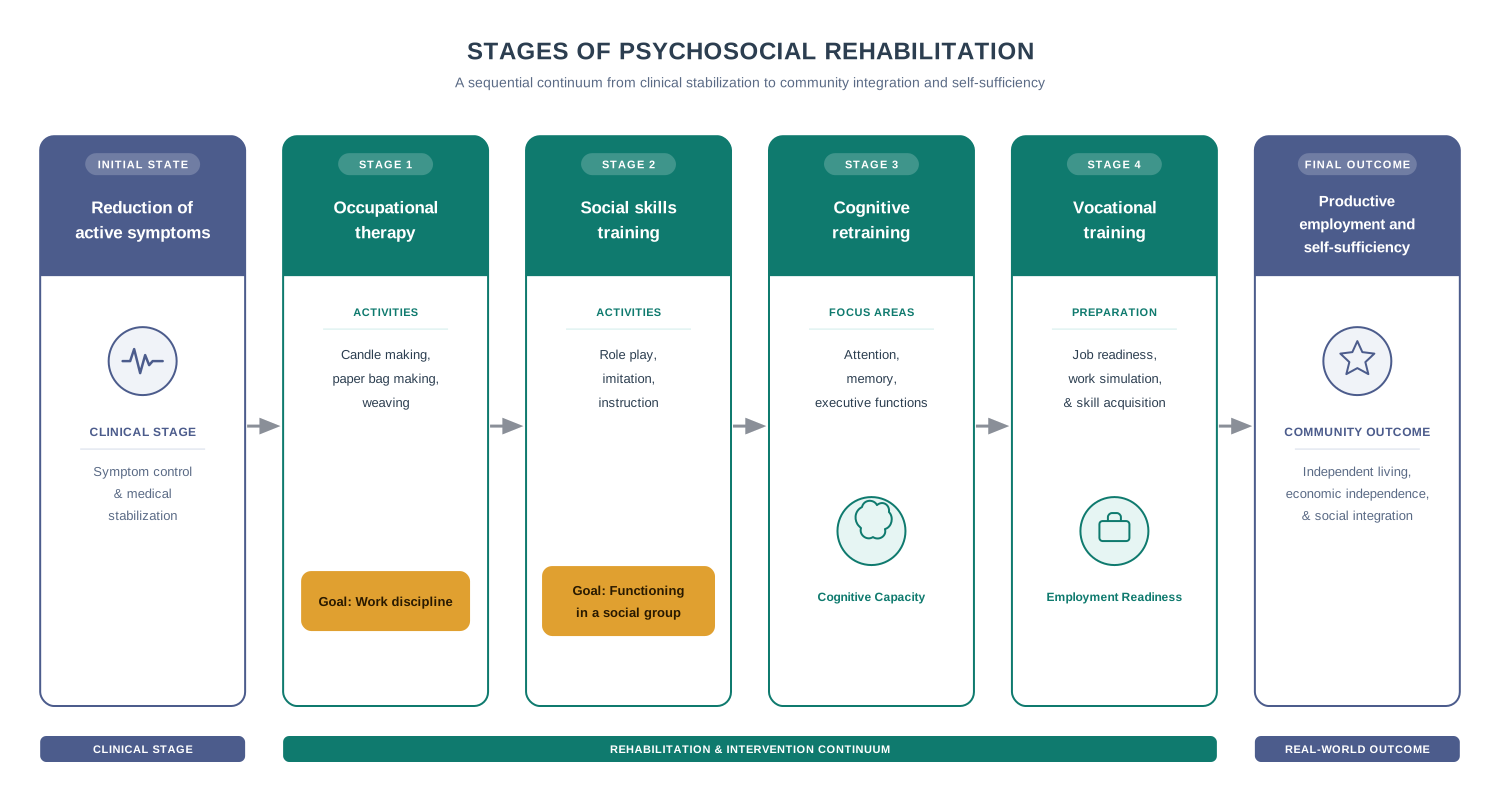
Fig. 5.8 – Stages of rehabilitation for severe mental disorders.
In occupational therapy, the patients are taught skills such as candle making, paper bag making and weaving. The point of these tasks is not the candle or the bag. It is to help the person form a work discipline — to sit down to a task, sustain it, and complete it, which is precisely the capacity that a long illness erodes.
Social skills training helps the patients to develop interpersonal skills, through role play, imitation and instruction. The objective is to teach the person to function in a social group again: to begin a conversation, to respond, to take a turn, to manage the ordinary business of being with other people.
Cognitive retraining is given to improve the basic cognitive functions of attention, memory and executive functions. These are the functions on which everything else rests. A person who cannot hold attention or plan a sequence of actions cannot take up employment, however willing they are.
After the person improves sufficiently, vocational training is given, in which they are helped to gain the skills necessary to undertake productive employment. Notice the ordering: vocational training comes last, and only once the earlier gains are in place. A person is not put in front of a job before work discipline, social functioning and basic cognitive capacities have been rebuilt — that would be to set them up to fail.
5.4 Summary
Psychotherapy is a treatment for the healing of psychological distress. It is not a single, homogeneous method: there are about 400 different types of psychotherapy.
Psychoanalysis, the behavioural, the cognitive and the humanistic-existential approaches are the important systems of psychotherapy, and there are many schools within each of these systems.
The three broad groups — psychodynamic, behaviour and existential — differ on six parameters: what caused the problem, how the cause arose, the chief method of treatment, the nature of the therapist–client relationship, the chief benefit to the client, and the duration of treatment.
An important component of psychotherapy is the clinical formulation — the statement of the client’s problem, and of the treatment, within the framework of a particular therapy.
The therapeutic alliance is the relationship between the therapist and the client in which the client has trust in the therapist and the therapist has empathy for the client. It is contractual and of limited duration, and it is the vehicle through which change happens.
Behaviour therapy treats psychological distress as the product of faulty learning. Behavioural analysis identifies malfunctioning behaviours, their antecedents and the factors that maintain them; treatment then uses techniques such as negative reinforcement, aversive conditioning, positive reinforcement, token economy, differential reinforcement, systematic desensitisation, relaxation procedures and modelling.
Cognitive therapy locates distress in irrational thoughts and beliefs. Ellis’s Rational Emotive Therapy works through the ABC analysis to refute irrational beliefs; Beck traces negative automatic thoughts back to core schemas triggered by a critical incident, and works towards cognitive restructuring.
Cognitive Behaviour Therapy, which adopts a bio-psychosocial approach and combines cognitive with behavioural techniques, is presently the most popular therapy and has been established as a short and efficacious treatment for a wide range of disorders.
The humanistic-existential therapies hold that distress arises from loneliness, alienation and a failure to find meaning, and that healing comes through personal growth and self-actualisation. They include Frankl’s logotherapy, Rogers’s client-centred therapy and the Perls’s gestalt therapy.
Healing in psychotherapy is contributed to by the therapist’s techniques, the therapeutic alliance, catharsis, and non-specific factors — the patient variables and therapist variables that operate across all systems of therapy.
Psychotherapists are bound by ethical standards, including informed consent, confidentiality, integrity of the practitioner–client relationship, respect for human rights and dignity, and professional competence.
The predominant mode of psychotherapy for adults with psychological distress is individual psychotherapy. A therapist must be professionally trained before embarking on the journey of psychotherapy.
Alternative therapies, such as some yogic and meditative practices, have been found to be effective in treating certain psychological disorders.
Rehabilitation of the mentally ill is necessary to improve their quality of life once their active symptoms have been reduced. It proceeds through occupational therapy, social skills training, cognitive retraining and, finally, vocational training.
5.5 Key Terms
Alternative therapy — A treatment possibility offered as an alternative to conventional drug treatment or psychotherapy, such as yoga, meditation, acupuncture or herbal remedies.
Behaviour therapy — A system of therapy which holds that psychological distress arises from faulty behaviour and thought patterns, and which applies learning-theory principles to correct those patterns in the present.
Client-centred therapy — Carl Rogers’s non-directive therapy, in which a relationship of warmth, empathy and unconditional positive regard enables the client to reconnect with disintegrated feelings and become their real self.
Cognitive behaviour therapy — The presently most popular therapy, which takes a bio-psychosocial view of distress and combines cognitive techniques with behavioural ones and with relaxation procedures.
Empathy — Understanding another person’s situation from their perspective and feeling as they feel; unlike sympathy, which looks on their suffering from outside.
Gestalt therapy — The therapy of Freiderick (Fritz) Perls and Laura Perls, which increases self-awareness and self-acceptance by restoring to awareness the bodily processes and emotions a person has blocked out.
Humanistic therapy — A therapy based on the view that people are motivated by an innate drive towards personal growth and self-actualisation, and that distress follows when this drive is curbed.
Psycho dynamic therapy — The system of therapy which traces psychological problems to intrapsychic conflicts arising from unfulfilled childhood desires and unresolved childhood fears, and which works through free association, dream reporting and interpretation towards emotional insight.
Psychotherapy — A voluntary relationship between a client seeking treatment and a trained therapist, whose purpose is to help the client solve their psychological problems by psychological means.
Rehabilitation — The process of helping a person whose active symptoms have been reduced to regain functioning and self-sufficiency, through occupational therapy, social skills training, cognitive retraining and vocational training.
Self-actualisation — An innate force that moves a person towards becoming more complex, balanced and integrated, without becoming fragmented.
Therapeutic alliance — The contractual relationship of limited duration between client and therapist, marked by trust, confidentiality, unconditional positive regard and empathy; it is the vehicle of change in therapy.
Unconditional positive regard — The therapist’s total acceptance of the client as they are, warmth that is not withdrawn whatever the client reveals or does in the sessions.
5.6 Points to Ponder
Your school runs on gold stars, house points, remarks and detentions. If this is a token economy, what behaviours is it actually reinforcing — and are they the behaviours the school believes it is reinforcing?
Think of someone in your life who has consistently shown you something close to unconditional positive regard — whose warmth did not depend on what you achieved or confessed. What did that make possible for you that would not otherwise have been possible? And can a relationship offer unconditional positive regard without ever offering criticism?
Behaviour therapy says the client’s problem is faulty learning; cognitive therapy says it is irrational belief; existential therapy says it is meaninglessness. Are these three rival answers to one question, or three different questions being asked about the same person?
Non-specific factors — the client’s motivation, the therapist’s steadiness, the sheer relief of being heard — heal across every system of therapy. If so much of the healing comes from factors no school owns, how much does the choice of therapy really matter?
Ellis’s therapist disputes a client’s belief that they must be loved by everybody. But some beliefs that cause distress are simply true — a person may really have been treated unjustly. Where is the line between an irrational belief that should be refuted and an accurate perception that should be respected?
Yoga and meditation are being tested today by the same outcome research used to test any psychotherapy. What is gained, and what might be lost, when a practice developed inside a philosophical tradition is measured as a clinical intervention?
Rehabilitation aims to make a person “a productive member of society to the extent possible”. Who decides what counts as productive — and what would it mean to recover well in a society that has already decided you cannot?
5.7 NCERT Questions
Describe the nature and scope of psychotherapy, and highlight the importance of the therapeutic relationship in psychotherapy.
What are the different types of psychotherapy? On what basis are they classified?
Discuss the various techniques used in behaviour therapy.
Explain, with the help of an example, how cognitive distortions take place.
Which therapy encourages the client to seek personal growth and actualise their potential? Write about the therapies that are based on this principle.
What are the factors that contribute to healing in psychotherapy? Enumerate some of the alternative therapies.
What are the techniques used in the rehabilitation of the mentally ill?
How would a social learning theorist account for a phobic fear of lizards or cockroaches? How would a psychoanalyst account for the same phobia?
What kind of problems is cognitive behaviour therapy best suited for?
5.8 Objective Questions
- Psychotherapy is best described as:
- an involuntary treatment administered by a physician
- a voluntary relationship between a client and a trained therapist
- a permanent friendship between two willing individuals
- a drug-based treatment for psychological disorders [1 mark]
- Which of the following is NOT one of the characteristics shared by all psychotherapeutic approaches?
- Systematic application of principles underlying a theory of therapy
- Practice restricted to persons trained under expert supervision
- The formation of a confidential, interpersonal and dynamic relationship
- The interpretation of dreams and free association [1 mark]
- The existential therapies are also known as the:
- first force
- second force
- third force
- fourth force [1 mark]
- Systematic desensitisation was introduced by:
- Albert Ellis
- Wolpe
- Aaron Beck
- Carl Rogers [1 mark]
- In Rational Emotive Therapy, the letter ‘B’ in the ABC analysis stands for:
- behaviour
- belief
- benefit
- bias [1 mark]
- Repeatedly pairing an undesired response with an unpleasant consequence is known as:
- negative reinforcement
- token economy
- aversive conditioning
- differential reinforcement [1 mark]
- The chief benefit that psychodynamic therapy claims for the client is:
- personal growth
- adaptive behaviour patterns
- emotional insight
- cognitive restructuring [1 mark]
- In rehabilitation, the training that is given only after the patient has improved sufficiently is:
- occupational therapy
- social skills training
- cognitive retraining
- vocational training [1 mark]
- Assertion (A): In systematic desensitisation, the client is first taught to relax before being asked to imagine a fear-provoking situation. Reason (R): According to the principle of reciprocal inhibition, the presence of two mutually opposing forces at the same time inhibits the weaker force.
- Both A and R are true, and R is the correct explanation of A.
- Both A and R are true, but R is not the correct explanation of A.
- A is true, but R is false.
- A is false, but R is true. [1 mark]
- Assertion (A): In severe disorders such as schizophrenia, a reduction of symptoms may not by itself improve the person’s quality of life. Reason (R): Negative symptoms such as disinterest and lack of motivation to work or to interact with people may persist after the active symptoms are controlled.
- Both A and R are true, and R is the correct explanation of A.
- Both A and R are true, but R is not the correct explanation of A.
- A is true, but R is false.
- A is false, but R is true. [1 mark]
- Assertion (A): The therapeutic alliance is a relationship of limited duration. Reason (R): The alliance lasts until the client becomes able to deal with their problems and take control of their own life.
- Both A and R are true, and R is the correct explanation of A.
- Both A and R are true, but R is not the correct explanation of A.
- A is true, but R is false.
- A is false, but R is true. [1 mark]
- Match the theorist in Column A with the therapy in Column B.
| Column A | Column B |
|---|---|
| a. Carl Rogers | i. Logotherapy |
| b. Albert Ellis | ii. Gestalt therapy |
| c. Victor Frankl | iii. Client-centred therapy |
| d. Freiderick (Fritz) Perls | iv. Rational Emotive Therapy |
[1 mark]
- Match the term in Column A with its description in Column B.
| Column A | Column B |
|---|---|
| a. Antecedent factors | i. Factors that lead to the persistence of the faulty behaviour |
| b. Maintaining factors | ii. Behaviours which cause distress to the client |
| c. Malfunctioning behaviours | iii. Emotional unburdening in the initial sessions |
| d. Catharsis | iv. Causes which predispose the person to indulge in the behaviour |
[1 mark]
Fill in the blank: The German word gestalt means ____________. [1 mark]
Fill in the blank: The persistent irrational thoughts such as “nobody loves me” or “I will not succeed”, which arise when a core schema is triggered, are called ____________ thoughts. [1 mark]
Fill in the blank: Non-specific factors in psychotherapy that are attributable to the client, such as motivation for change, are called ____________ variables. [1 mark]
True or false: Cognitive therapy is a closed therapy, in which the therapist does not share their method with the client. [1 mark]
True or false: In Vipasana meditation, attention is held on a fixed object or mantra. [1 mark]
True or false: Logotherapy actively discourages transference and emphasises the here and now. [1 mark]
5.9 Check Your Concepts
Define psychotherapy, and state why the relationship it involves is described as voluntary. [2 marks]
State any four goals that psychotherapies aim at. [2 marks]
What is meant by a token economy? Give one example. [2 marks]
Define self-actualisation as it is understood in the humanistic therapies. [2 marks]
List the three components of the ABC analysis used in Rational Emotive Therapy. [2 marks]
What is catharsis, and at what stage of therapy does it typically occur? [2 marks]
State any four ethical standards that a professional psychotherapist is expected to practise. [2 marks]
Differentiate between empathy and sympathy. [3 marks]
Differentiate between negative reinforcement and aversive conditioning, giving one example of each. [3 marks]
Explain the two components of the therapeutic alliance. [3 marks]
What are antecedent operations and consequent operations? Illustrate with the example of a child who refuses to eat dinner. [3 marks]
Distinguish between focused meditation and Vipasana meditation. [3 marks]
Why is it said that behaviour therapy is not a unified theory? Give reasons. [3 marks]
Arrange the following stages of rehabilitation in the order in which they are given, and explain why vocational training comes where it does: cognitive retraining, occupational therapy, vocational training, social skills training. [4 marks]
Explain the principle of reciprocal inhibition, and describe how systematic desensitisation makes use of it. [4 marks]
Explain, with an example, how a core schema, a critical incident and negative automatic thoughts are related in Beck’s account of psychological distress. [4 marks]
“Reduction of symptoms is not the same as improvement in quality of life.” Evaluate this claim with reference to milder disorders and to severe disorders. [4 marks]
What is behavioural analysis? Describe what a therapist looks for when conducting it, using the example of a person who has begun smoking during an examination period. [4 marks]
Describe the process of client-centred therapy, and evaluate the criticism that it offers no specific technique for a specific disorder. [4 marks]
Compare the psychodynamic, behaviour and existential therapies on the six parameters used to classify psychotherapies. [6 marks]
Describe Rational Emotive Therapy in full — its central thesis, its method, and one honest limitation. [6 marks]
What is Cognitive Behaviour Therapy? Explain its bio-psychosocial rationale, and discuss why it is presently the most widely used psychotherapy. [6 marks]
Discuss the humanistic-existential therapies. In your answer, explain the role of self-actualisation and describe the contributions of Victor Frankl, Carl Rogers and Freiderick (Fritz) Perls. [6 marks]
Discuss the factors that contribute to healing in psychotherapy. Why are some of these factors called non-specific? [6 marks]
Discuss the use of yoga and meditation as alternative therapies, and describe the evidence reported for their effectiveness. [6 marks]
5.10 Case-Based Questions
- Ritu is fifteen and refuses to enter the storeroom of her house, where she once saw a lizard. She now avoids the kitchen corridor as well, and has begun to leave the room if anyone even mentions lizards. Her school counsellor refers the family to a clinical psychologist, who interviews Ritu, draws up a list of lizard-related situations from the mildest to the most frightening, and teaches her a breathing and muscle-relaxation routine before any of these situations is discussed.
- Name the technique the psychologist is using, and name the therapist who introduced it.
- Explain the principle on which this technique works.
- Why is the relaxation training given before the hierarchy is used, rather than after? [4 marks]
- Arjun, a Class 12 student, was not selected for the school debate team. Since then he has stopped raising his hand in class and has withdrawn from his friends. In the counselling session he says, “If I am not the best at something, there is no point in doing it at all. Everyone must think well of me, or I am nothing.” The counsellor does not argue with him. Instead she asks, gently, “Why must everyone think well of you?” and “What would it actually mean if one person did not?”
- Identify the antecedent event, the belief and the consequence in Arjun’s case.
- Name the therapy the counsellor is practising and the theorist associated with it.
- The counsellor’s questions are described as non-directive. What does this mean, and why is questioning of this kind preferred to telling Arjun that he is being irrational? [6 marks]
- Meera has been coming for therapy for six weeks. She tells her therapist about a decision she is ashamed of, and watches carefully to see how the therapist reacts. The therapist neither approves nor disapproves; she rephrases what Meera has said, checks that she has understood it correctly, and remains as warm as she was at the start of the session. Meera later says that this was the first time she had told anyone the whole of it.
- Identify the two attitudes the therapist is displaying, and name the therapy and the theorist they belong to.
- Explain how the therapist’s response makes Meera’s disclosure possible.
- Meera’s relief at having finally spoken about the decision is itself a factor in healing. Name this factor. [6 marks]
- A 30-year-old man has been treated for schizophrenia for the past three years. His active symptoms are now well controlled and he is no longer distressed by them. Even so, he stays at home, rarely speaks to his family, and has not returned to work. He says he does not feel like doing anything. His treating team enrols him in a programme in which he is first given structured daily tasks such as paper bag making, then trained in conversation and turn-taking in a small group, then given exercises for attention and memory — and only later helped to prepare for employment.
- Why has the reduction of his symptoms not improved his quality of life?
- Name each of the four components of the programme he has been enrolled in, in the order given.
- A neighbour tells the family that “he will never be able to work now”. Explain, using the aim of rehabilitation, why this claim is both inaccurate and harmful. [6 marks]
- A residential facility for young people with behavioural difficulties introduces a system in which residents earn a card each time they complete a chore, arrive on time for a session, or help another resident. Ten cards can be exchanged for an outing on Sunday. Within a month, the staff notice that chores are completed far more reliably than before. A visiting parent objects that the residents are “only doing it for the outing”.
- Identify the behavioural technique being used, and explain how it works.
- The cards themselves have no value. Why, then, are they effective?
- Evaluate the parent’s objection, using what you know about how adaptive behaviour is established and maintained. [6 marks]