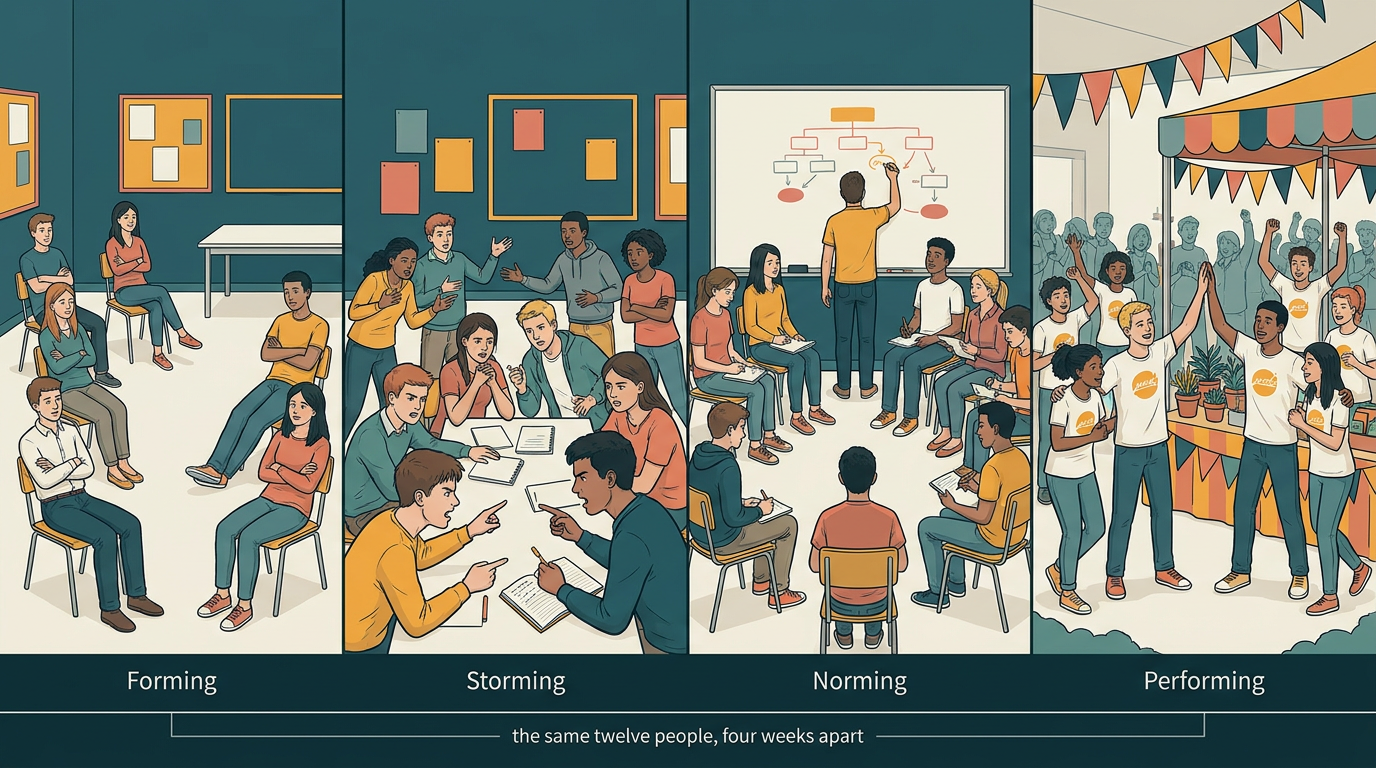
Every year, a school in a small town holds an inter-school cultural festival, and every year a fresh committee of twelve students is put together to run it. In the first week, nobody quite knows what to do. Students who have never spoken to one another sit in the same room, exchange careful smiles, and wait for somebody to begin. By the second week, the politeness has worn off. Two students both want to handle the stage, three argue about the budget, and one quietly stops coming. By the third week, something has settled. Without anyone writing it down, the group has decided that meetings begin at four, that phones stay in bags, and that the person who takes on a job finishes it. By the fourth week, the committee works almost without instructions.
Watch what happens next. In the joint rehearsals, the committee starts saying “we” about itself and “they” about the visiting schools. In the tug-of-war on sports day, some members pull with everything they have and some barely lean back, and nobody can tell who is who. And in the final meeting, a proposal that most members mildly supported at the start comes out, after an hour of discussion, as a decision far bolder than any single member had intended.
Nothing here is accidental. Each of these shifts is a well-documented psychological process, and this chapter is about all of them.
Q1. What makes your family or your class a group, while the people who gather at the site of a road accident are not one? Q2. Why do people who are pulling on the same rope often pull less hard than they would alone? Q3. Why does a warm, close-knit group sometimes take a decision that looks obviously mistaken from outside? Q4. Do groups take more balanced decisions than individuals, or more extreme ones? Q5. Why do we begin to see our own group as better than another group, even when the two groups were divided on a completely trivial basis?
Keep these five questions in mind as you read. Each one is answered somewhere in this chapter, at the point where the idea behind it is explained.
7.1 Introduction
Think for a moment about an ordinary day in your life and the number of people you deal with in it. In the morning, before leaving for school, you talk to members of your family. In school, you discuss topics, doubts and disagreements with your teachers and classmates. After school, you phone, visit or play with your friends.
In each of these situations you are not simply near other people — you are part of a group. That group gives you the support and comfort you need, and it also does something less obvious: it helps you grow. The way you speak, the standards you hold yourself to, the interests you develop, and even the opinions you think of as entirely your own have been shaped in the company of others.
What absence tells us
You can see this most clearly when the group is taken away. Have you ever spent a stretch of time somewhere far from your family, your school and your friends? How did it feel? Most people, asked this question, report the same thing — that something vital was missing, even when nothing was actually wrong. Belonging is not a decoration on our lives; it is part of how we function.
Our lives are shaped by the kind of group membership we have. This is exactly why the groups a person chooses matter so much. Groups can pull us towards responsibility, effort and concern for others, or away from all three, and being part of groups that influence us positively is one of the quieter conditions of becoming a good citizen.
The influence runs both ways
There is one more thing worth settling before we begin. It is easy to read a chapter like this one as a chapter about pressure — about how the group works on the individual. That is only half of it. Social influence is the process by which the presence, opinions or actions of other people change what a person thinks, feels or does; and the arrow points in both directions. Others influence us, and we, as individuals, are equally capable of changing others and, over time, the society we live in.
In this chapter we shall try to understand what groups actually are, how they take shape, what kinds of groups exist, and how they influence the behaviour of the people in them.
7.3 Type of Groups
Groups differ from one another in almost every way you can measure. Some have an enormous number of members, as a country does; some are very small, as a family is. Some are short-lived, like a committee formed for one occasion; some hold together for many years, like a religious group. Some are highly organised — the army and the police are examples — while others are organised only loosely, as the spectators at a match are.
Since people belong to several of these at once, it helps to sort them. The major types of groups are:
- primary and secondary groups
- formal and informal groups
- ingroup and outgroup.
7.3.1 Primary and Secondary Groups
The major difference between primary and secondary groups lies in how a person comes to be a member. Primary groups are pre-existing formations, usually given to the individual, whereas secondary groups are those the individual joins by choice. Family, caste and religion are primary groups; membership of a political party is an example of a secondary group.
The quality of the relationships differs accordingly. In a primary group there is face-to-face interaction, members are in close physical proximity, and they share warm emotional bonds. Primary groups are central to an individual’s functioning, and they play a very major role in developing the individual’s values and ideals during the early stages of development.
Secondary groups work differently. Here relationships among members are more impersonal, more indirect and less frequent — you may deal with fellow members only occasionally, and only about the matter that brought you together.
There is also a difference in how easily a person can move in and out. In a primary group the boundaries are less permeable: members do not have the option of choosing their membership. Secondary groups are far easier to leave, and easier to join, so a person can exit one and enter another without much difficulty.
Primary groups vs Secondary groups | Feature | Primary group | Secondary group | |—|—|—| | How membership arises | Pre-existing; usually given to the individual | Joined by the individual’s own choice | | Nature of interaction | Face-to-face, close physical proximity | Impersonal, indirect, less frequent | | Emotional bonds | Warm and close | Weaker and more task-based | | Role in development | Central to functioning; shapes values and ideals early in life | Peripheral to the development of basic values | | Permeability of boundaries | Less permeable; membership is not chosen | Easy to leave and to join another group | | Examples | Family, caste, religion | Membership of a political party |
7.3.3 Ingroup and Outgroup
Just as individuals compare themselves with other individuals in terms of what they have and what others have, they also compare the group they belong to with groups of which they are not members.
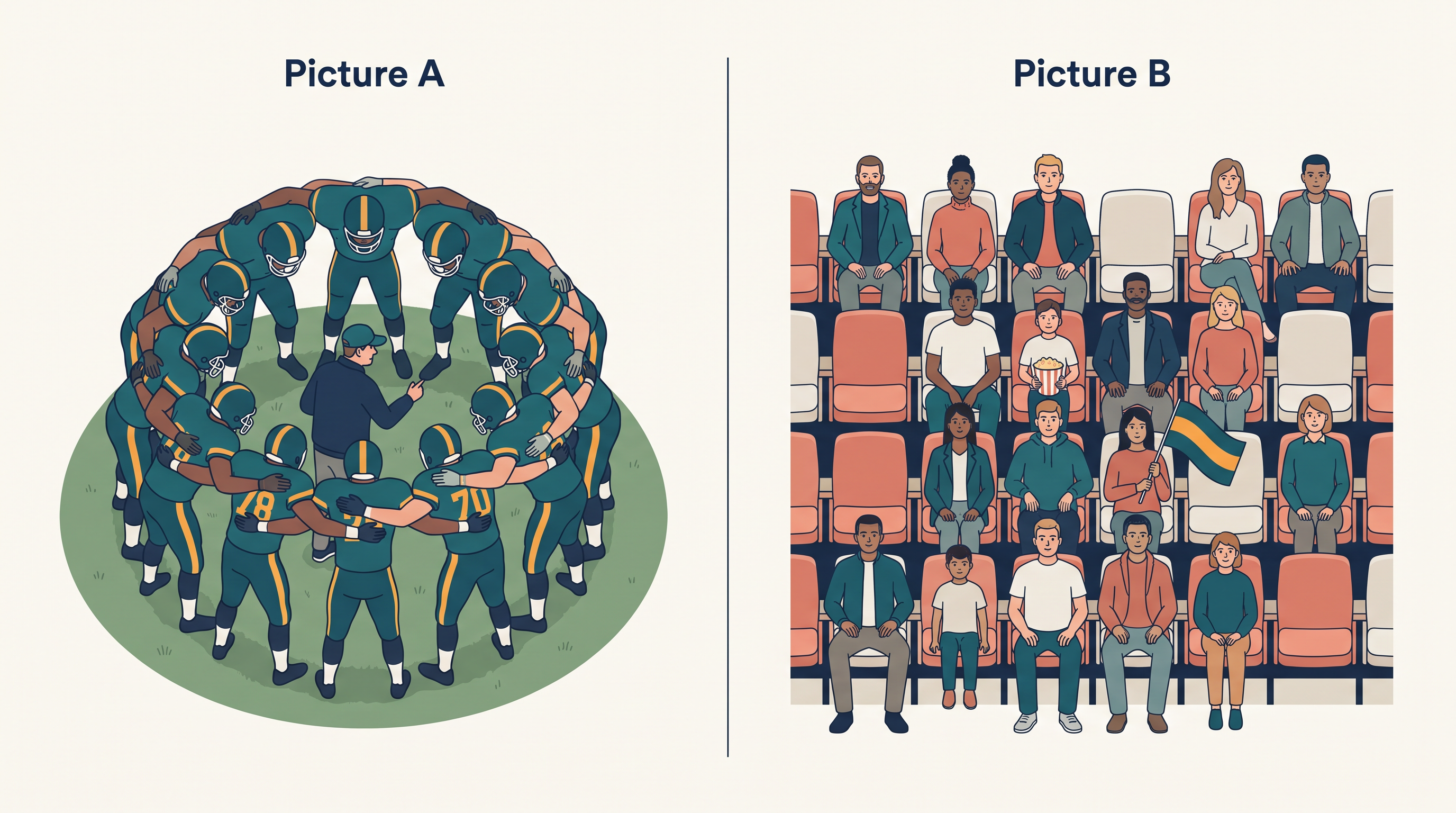
The term ingroup refers to one’s own group; outgroup refers to another group. In everyday speech the distinction is carried by two very small words: for ingroup members we use ‘we’, and for outgroup members we use ‘they’. By using they and we, a person is already categorising people as similar or different, as Fig. 7.4 shows.
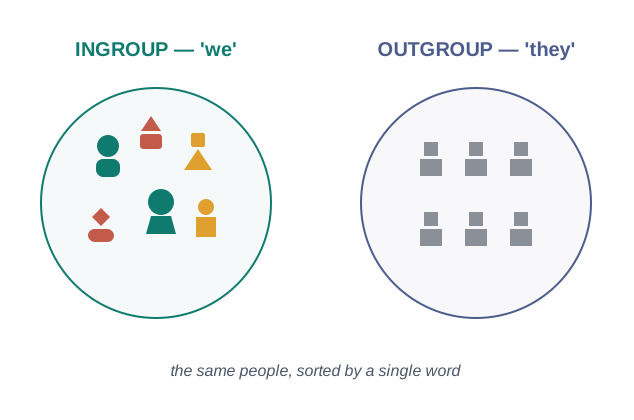
The consequences of this small act of sorting are not small. It has been found that persons in the ingroup are generally supposed to be similar to one another, are viewed favourably, and are credited with desirable traits. Members of the outgroup are viewed differently, and are often perceived negatively in comparison with ingroup members. These perceptions of ingroup and outgroup go on to affect our social lives.
How little it takes
You might expect such strong divisions to require a long history of rivalry between the groups. A famous line of experiments showed that they require almost nothing at all.
Tajfel and colleagues — the minimal group paradigm experiments Question: What are the minimal conditions needed for intergroup behaviour to appear — that is, how little does it take before people begin favouring their own group? Method: The minimal group paradigm was developed to answer this question. British schoolboys expressed their preference for paintings by two artists — Vassily Kandinsky and Paul Klee. The children were told that it was an experiment on decision-making. They knew the groups in which they had been placed (the Kandinsky group and the Klee group), but the identity of the other group members was hidden using code numbers. The children then distributed money between recipients identified only by code number and group membership. Sample distribution matrix: Ingroup member — 7 8 9 10 11 12 13 14 15 16 17 18 19 Outgroup member — 1 3 5 7 9 11 13 15 17 19 21 23 25 Finding: The groups had been created on a flimsy criterion — a preference for the paintings of one artist over another — which had no past history and no future. Yet the results showed that children favoured their own group. Meaning: Group favouritism does not require conflict, competition, or any real difference between groups. The bare fact of being categorised is enough. Note also that the children were told the study was about decision-making rather than about group bias, so they could not have agreed to what was actually being tested — a form of deception that would today require careful justification and a full debriefing.
Q5. Why do we begin to see our own group as better than another group, even when the two groups were divided on a completely trivial basis?
A. Because the division itself does the work. Once people have been sorted into ‘we’ and ‘they’, ingroup members are assumed to be similar, are viewed favourably and are credited with desirable traits, while outgroup members are viewed differently and often negatively. Tajfel’s minimal group experiments showed that this happens even when the basis of the division is as flimsy as a preference between two painters, and the members have never met.
studying intergroup bias in children Research on intergroup bias faces an uncomfortable problem: the phenomenon tends to disappear if participants know what is being studied, which is why such studies often involve some deception. That places a heavy obligation on the researcher. The deception must be genuinely necessary, participants must be told the truth afterwards in a full debriefing, and the study must not leave a child thinking worse of any real group than before. Where the participants are minors, the responsibility is greater still, since consent is given on their behalf by adults.
Categories we make ourselves
Although making these categorisations is common, it should be appreciated that the categories are not real. They are created by us. The line between one group and another feels like a fact about the world, but the minimal group experiments suggest that it is very often a fact about our own habits of sorting.
Some cultures respond to this by celebrating plurality, as has been the case in India. We have a unique composite culture, and it is reflected not only in the lives we live but also in our art, our architecture and our music.
plurality as a cultural achievement Much of the Western research tradition treats ingroup–outgroup division as a near-automatic outcome of categorisation, and then asks how its harmful effects may be reduced. The Indian experience adds something to that account. Where a culture is composite by history — where languages, faiths, cuisines and musical traditions have long been layered on one another — a person routinely holds several group memberships at once, and each of them makes a different set of people the ‘we’. Overlapping memberships of this kind are among the strongest checks on rigid ingroup–outgroup thinking, because no single boundary is allowed to become the only one that matters.
Think of an inter-institutional competition held in the recent past. Ask your friends to write a short paragraph about your own school and its students, and another about the other school and its students. List on the board the behaviour and characteristics attributed to your schoolmates, and those attributed to the students of the other school. Observe the differences and discuss them in class. Then look for the similarities as well — and discuss why those were harder to notice.
7.4 Influence of Group on Individual Behaviour
We have seen that groups are powerful, because they are able to influence the behaviour of the individuals within them. The question now is what the nature of that influence actually is. What impact does the presence of other people have on how well we perform?
Two situations have to be kept apart here, and the whole of this section turns on the difference between them. In the first, an individual performs an activity alone, but in the presence of others — this is the situation studied under social facilitation. In the second, an individual performs an activity along with others, as part of a larger group — this is the situation in which social loafing appears.
7.4.1 Social Loafing
Research on social facilitation suggests that the presence of others leads to arousal, and that this arousal can motivate individuals to enhance their performance if they are already good at whatever they are doing. But there is a condition attached, and it is easy to overlook. The enhancement occurs when a person’s efforts are individually evaluated — when it is visible who did what.
So what happens when that condition is removed? Suppose the efforts of individuals in a group are pooled, so that what you look at is the performance of the group as a whole. It has been found that individuals then work less hard in the group than they do when performing alone. This points to a phenomenon referred to as social loafing.
Social loafing is a reduction in individual effort when a person is working on a collective task — that is, a task in which the outputs of members are pooled with those of other group members.
The classic example is the game of tug-of-war. It is not possible for you to identify how much force each member of the team has been exerting, since all you can observe is the rope. Situations of this kind give group members the opportunity to relax and become free riders — to enjoy the outcome while contributing less than their share to it.
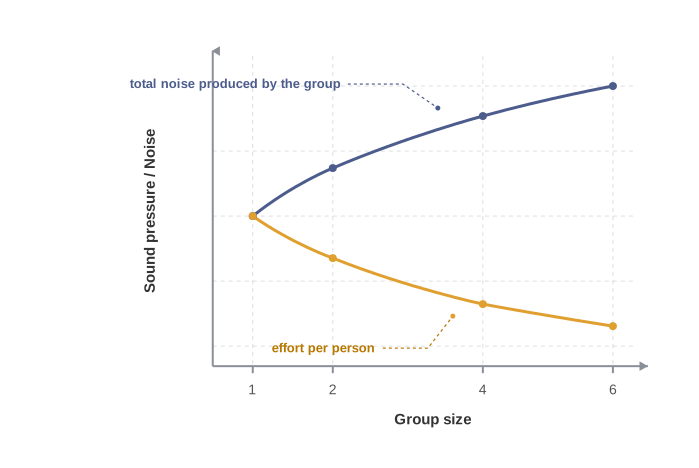
Latane and associates — clapping and cheering in groups Question: Does the effort an individual puts into a shared task fall as the size of the group increases? Method: Latane and his associates asked a group of male students to clap or cheer as loudly as possible, telling them that the experimenters were interested in knowing how much noise people make in social settings. The group size was varied: individuals performed either alone, or in groups of two, four and six. Finding: As group size increased, the total amount of noise rose — but the amount of noise produced by each participant dropped. In other words, each participant put in less effort as the group grew larger. Meaning: The reduction in effort is not caused by a shortage of ability or by fatigue; the same person who cheered loudly alone cheers less loudly in a six. What changes is the pooling of output, which makes each individual contribution invisible. This is the demonstration on which the concept of social loafing rests.
The pattern in Fig. 7.5 is worth studying closely, because the two lines move in opposite directions and students frequently read only one of them.
Q2. Why do people who are pulling on the same rope often pull less hard than they would alone?
A. Because their individual effort cannot be seen. In a tug-of-war, outputs are pooled, so no one can tell how much force any single member is exerting. Under those conditions people feel less responsible, know their contribution will not be evaluated separately, and quietly reduce their effort — the phenomenon of social loafing that Latane’s clapping and cheering experiments demonstrated.
Why social loafing occurs
Several explanations have been offered, and they are best read together, since they describe different aspects of the same loss of individual accountability.
- Group members feel less responsible for the overall task being performed, and therefore exert less effort.
- The motivation of members decreases, because they realise that their contributions will not be evaluated on an individual basis.
- The performance of the group is not going to be compared with that of other groups, so there is no external standard to work towards.
- There is improper coordination among members, or no coordination at all.
- Belonging to that particular group is not important to its members. The group is only an aggregate of individuals rather than something they identify with.
How social loafing may be reduced
Once you see why loafing occurs, the remedies almost write themselves. Each one restores something the collective task had removed.
- Making the efforts of each person identifiable.
- Increasing the pressure to work hard, by making group members committed to successful task performance.
- Increasing the apparent importance or value of the task.
- Making people feel that their individual contribution is important.
- Strengthening group cohesiveness, which increases the motivation for a successful group outcome.
Almost every school project assigned to a group of five reproduces the conditions for social loafing: one submission, one mark, and no way of telling who did what. Teachers who divide the work into named parts, ask each member to present the portion he or she prepared, or require a short account of who contributed what, are not being suspicious — they are applying the first and most effective remedy, making individual effort identifiable. The same logic runs through workplaces, where large pooled targets are usually broken down into individual ones for exactly this reason.
Social facilitation vs social loafing Both concern the effect of other people on performance, but the task is different. In social facilitation the individual performs alone in the presence of others and his or her effort is individually evaluated, so performance is often enhanced. In social loafing the individual performs as part of a group on a collective task where outputs are pooled and effort cannot be identified, so individual effort falls.
7.4.2 Group Polarisation
We all know that important decisions are taken by groups rather than by individuals acting alone. Whether a school is to be established in a village, for instance, is necessarily a group decision. We have also seen that when groups take decisions there is a fear that groupthink may occur.
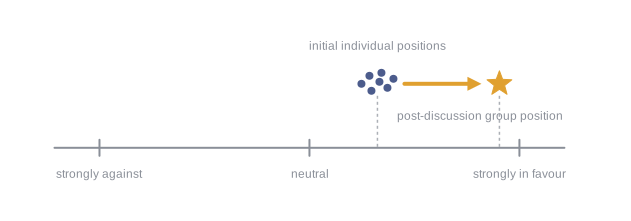
Groups show another tendency as well, referred to as group polarisation. It has been found that groups are more likely to take extreme decisions than individuals alone are.
Consider an employee who has been caught taking a bribe, or engaging in some other unethical act. Her or his colleagues are asked to decide what punishment should be given. They may let the person go scot-free, or they may decide to terminate her or his services — rather than imposing a punishment commensurate with the act. Whatever the group’s initial position was, that position becomes much stronger as a result of discussion within the group.
Group polarisation is the strengthening of a group’s initial position as a result of group interaction and discussion.
This tendency deserves to be taken seriously, because it may sometimes have dangerous repercussions. Groups can move from very weak to very strong decisions, ending up at positions that no member held when the discussion began.
Why group polarisation occurs
Take the question of whether capital punishment should exist. Suppose you favour capital punishment for heinous crimes. What would happen if you spent an hour discussing the issue with like-minded people? Your views would very probably come out stronger than they went in. This firm conviction arises for three reasons.
- In the company of like-minded people, you are likely to hear newer arguments favouring your own viewpoint. Each of these makes you more favourable towards the position you already held.
- When you find that others also favour capital punishment, you feel that this view has been validated by the public. This is a sort of bandwagon effect.
- When you find people holding views similar to your own, you are likely to perceive them as an ingroup. You begin identifying with the group, begin showing conformity to it, and as a consequence your views become strengthened.
group polarisation in a school decision A school’s discipline committee of six teachers meets to decide what action to take against a group of students who broke a window while playing. Before the meeting, each teacher, asked separately, favours a mild penalty — an apology and payment for the repair. During the discussion, one member describes an earlier incident, another points out that leniency last year was followed by more damage, and the tone hardens. The committee finally decides to suspend the students for a week. No teacher had wanted suspension at the start of the meeting. This illustrates group polarisation — the group’s initial leaning has been strengthened by discussion into a far more extreme decision.
Q4. Do groups take more balanced decisions than individuals, or more extreme ones?
A. More extreme ones, quite often. Because discussion among like-minded people supplies fresh arguments for the position already held, makes that position feel publicly validated, and encourages members to identify with the group and conform to it, the group’s initial leaning is strengthened rather than moderated. This is group polarisation, and it is why an important decision is safer when the discussion deliberately includes people who disagree.
With your teacher’s help, take a short five-item attitude scale on attitudes towards capital punishment. On the basis of the responses, divide the class into two groups — those in favour and those against. Seat the two groups in separate rooms and ask each to discuss a recent case in which a death sentence was given by a court. See how the discussion proceeds in each group. Afterwards, take the attitude scale again and examine whether positions in both groups have hardened compared with where they started.
7.5 Summary
A group is different from any other collection of people. Mutual interdependence, roles, status and expectations of one another are its main characteristics — which is why a family or a class is a group and a crowd at an accident site is not.
A group is an organised system of two or more individuals who interact, depend on one another, share common motives, hold a set of role relationships, and follow norms that regulate members’ behaviour.
People join groups because groups meet real needs: security, status, self-esteem, the satisfaction of psychological and social needs, goal achievement, and the supply of knowledge and information.
Group formation is facilitated by proximity, by similarity, and by common motives and goals. Nearness produces repeated contact; similarity brings consistency and validates our opinions; shared goals bring people together to achieve what none could achieve alone.
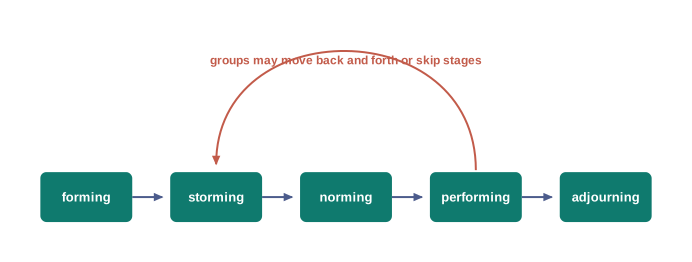
Tuckman suggested that groups develop through five stages — forming, storming, norming, performing and adjourning. Groups do not always move through them systematically; stages may overlap, repeat, or be skipped.
As members interact, groups develop a structure. Its four important elements are roles, norms, status (ascribed or achieved) and cohesiveness.
Generally, group work leads to beneficial results. Sometimes, however, in cohesive and homogeneous groups, the phenomenon of groupthink may occur, where the concern for unanimity overrides realistic appraisal of the decision being taken.
Groups are of different types: primary and secondary, formal and informal, and ingroup and outgroup. These are three cross-cutting classifications, so one group can be placed on all three.
Ingroup–outgroup categories are created by us rather than given by the world, and Tajfel’s minimal group experiments showed that even a trivial basis of division is enough to produce favouritism towards one’s own group.
Groups influence individual behaviour. Social facilitation and social loafing are two important influences of groups: effort tends to rise when it is individually evaluated and to fall when it is pooled and cannot be identified.
Groups are also more likely than individuals to take extreme decisions. This strengthening of a group’s initial position through discussion is called group polarisation.
7.6 Key Terms
Cohesiveness — The togetherness, binding or mutual attraction among group members, which makes them think, feel and act as one social unit.
Conflict — Disagreement among group members, typically over how the group’s goal is to be achieved, who is to control the group’s resources, and who is to perform which task.
Goal achievement — The attainment through collective effort of goals that an individual could not have attained alone; one of the main reasons people join groups.
Group — An organised system of two or more interacting and interdependent individuals who share common motives, hold a set of role relationships, and follow norms that regulate members’ behaviour.
Group formation — The process by which a collection of individuals becomes a group, made possible by contact and interaction and facilitated by proximity, similarity, and common motives and goals.
Groupthink — A faulty decision-making process in a highly cohesive group, where the concern for unanimity overrides the realistic appraisal of alternative courses of action.
Identity — The distinct character a group possesses because its members perceive themselves as belonging to it, which also marks that group off from other groups.
Ingroup — One’s own group, whose members are referred to as ‘we’, are assumed to be similar to oneself, and are generally viewed favourably.
Interdependence — The condition in which what one member of a group does has consequences for the other members.
Norms — The expected standards of behaviour and belief that are established, agreed upon and enforced by group members; a group’s unspoken rules.
Proximity — Nearness in space that brings people into repeated contact, giving them the chance to know one another’s interests and attitudes.
Roles — Socially defined expectations that a person in a given position is expected to fulfil, together with the typical behaviour that depicts that person in a given social context.
Social influence — The process by which the presence, behaviour or expectations of others change an individual’s thoughts, feelings and actions.
Social loafing — The reduction in an individual’s effort when working on a collective task in which outputs are pooled and individual contributions cannot be identified.
Status — The relative social position given to a group member by others, which may be ascribed (given, as by seniority) or achieved (earned through expertise or hard work).
Structure — The regularities that develop as group members interact, seen in the distribution of tasks, the responsibilities assigned to members, and members’ relative prestige.
7.7 Points to Ponder
If a group’s identity depends partly on its members believing the group exists, what happens to a group when its members stop believing in it? Is a group dissolved by a decision, or by a change of feeling?
Cohesiveness makes a group work well and also makes groupthink possible. Is there a way of keeping the first without risking the second, or is the risk simply the price of togetherness?
Tajfel’s schoolboys favoured their own group although the division between the groups was trivial. If a category can be created that easily, can it be dissolved just as easily — and what would it take?
We describe primary groups as ones we are born into and secondary groups as ones we choose. How much of that choice is real? Consider how far proximity and similarity decide which groups you were ever in a position to join.
In a group project, is a member who contributes less always loafing? What would you need to know before deciding whether a person is a free rider, and what does that tell you about judging effort you cannot see?
Group polarisation means that discussion often makes a group’s position more extreme rather than more balanced. Does this weaken the case for taking important decisions collectively — or strengthen the case for including people who disagree?
Identify any Test series in cricket that India played recently. Collect newspapers from that period and read the reviews of the matches and the comments made by Indian and by rival commentators. Do you see a difference between the two sets of comments? If you do, is it a difference in what was seen, or in how it was described?
7.8 NCERT Questions
Compare and contrast formal and informal groups, and ingroups and outgroups.
Are you a member of a particular group? Discuss what motivated you to join that group.
How does Tuckman’s stage model help you to understand the formation of groups?
How do groups influence our behaviour?
How can social loafing in groups be reduced? Think of any two incidents of social loafing you have seen in school, and describe how they were overcome.
7.9 Objective Questions
- A collection of people who happen to be present at a place by chance, with no structure and no feeling of belongingness, is called a
- team
- crowd
- primary group
- formal group [1 mark]
- Which of the following is NOT a characteristic of a group?
- Interdependence among members
- Common motives and goals
- Absence of any role relationships
- Interactions structured by norms [1 mark]
- The third stage in Tuckman’s model of group development is
- storming
- performing
- adjourning
- norming [1 mark]
- A university, whose functions and members’ roles are explicitly stated, is an example of a
- formal group
- informal group
- primary group
- crowd [1 mark]
- The status enjoyed by a person because of seniority rather than personal expertise is described as
- achieved status
- ascribed status
- role expectation
- social identity [1 mark]
- In the minimal group paradigm experiments, the schoolboys were divided on the basis of their
- academic performance
- preference for paintings by two artists
- house allotted in school
- age and height [1 mark]
- The feeling that a view must be correct because many others around us also hold it is referred to in this chapter as
- social facilitation
- the bandwagon effect
- social loafing
- adjourning [1 mark]
- Assertion (A): Members of a highly cohesive group sometimes take decisions that are clearly out of touch with reality. Reason (R): In such groups, the concern for unanimity can override the motivation to appraise courses of action realistically.
- Both A and R are true, and R is the correct explanation of A.
- Both A and R are true, but R is not the correct explanation of A.
- A is true, but R is false.
- A is false, but R is true. [1 mark]
- Assertion (A): Individual effort tends to fall as the size of a group performing a collective task increases. Reason (R): In a collective task, the outputs of members are pooled and individual contributions cannot be identified.
- Both A and R are true, and R is the correct explanation of A.
- Both A and R are true, but R is not the correct explanation of A.
- A is true, but R is false.
- A is false, but R is true. [1 mark]
- Assertion (A): Membership of a primary group is easy to give up and exchange for membership of another. Reason (R): In primary groups there is face-to-face interaction and members share warm emotional bonds.
- Both A and R are true, and R is the correct explanation of A.
- Both A and R are true, but R is not the correct explanation of A.
- A is true, but R is false.
- A is false, but R is true. [1 mark]
- Match the psychologist in Column A with the contribution in Column B.
| a. Tuckman |
i. Groupthink |
| b. Janis |
ii. Minimal group paradigm experiments |
| c. Tajfel |
iii. Five-stage model of group development |
| d. Latane |
iv. Experiments on clapping and cheering in groups |
[1 mark]
- Match the term in Column A with its meaning in Column B.
| a. Norms |
i. Togetherness and mutual attraction among members |
| b. Roles |
ii. Relative social position given to a member by others |
| c. Status |
iii. Expected standards of behaviour agreed upon and enforced by members |
| d. Cohesiveness |
iv. Socially defined expectations a person is expected to fulfil |
[1 mark]
Fill in the blank: The strengthening of a group’s initial position as a result of group interaction and discussion is called ______. [1 mark]
Fill in the blank: Repeated contact arising from nearness in space, which gives people a chance to know one another’s interests and attitudes, is termed ______. [1 mark]
State whether True or False: In a team, although there is a leader, members hold themselves responsible for the work. [1 mark]
State whether True or False: Groups always move through Tuckman’s five stages in a fixed order, without skipping or repeating any stage. [1 mark]
7.10 Check Your Concepts
Define a group, and state any two of its salient characteristics. [2 marks]
What is meant by social loafing? Give one example of a task on which it is likely to occur. [2 marks]
Define cohesiveness. State one consequence of extreme cohesiveness in a group. [2 marks]
List the three conditions that facilitate group formation. [2 marks]
Distinguish between ascribed status and achieved status, with one example of each. [2 marks]
Arrange the five stages of Tuckman’s model in their correct sequence, and name the stage at which intragroup conflict occurs. [2 marks]
Differentiate between a group and a team on any three points. [3 marks]
How does a crowd differ from a mob? Explain briefly. [3 marks]
Explain any three reasons why people join groups. [3 marks]
Give reasons why social loafing occurs. State any three explanations offered by psychologists. [3 marks]
Why does group polarisation occur? Explain the three reasons discussed in the chapter. [3 marks]
Differentiate between primary and secondary groups with respect to how membership arises, the nature of interaction, and the permeability of boundaries. [3 marks]
Explain, with an example of each, how proximity and similarity facilitate the formation of groups. [4 marks]
Describe the four elements of group structure, and explain why structure develops in a group at all. [4 marks]
Why is it said that ingroup and outgroup categories are created by us rather than given by the world? Support your answer with evidence from the minimal group paradigm experiments. [4 marks]
Explain any four ways in which social loafing may be reduced, and state what each of these measures restores to the situation. [4 marks]
Evaluate the claim that cohesiveness is always good for a group. Support your answer with reasons. [4 marks]
What would happen to the performance of an individual if her effort in a group task were made clearly identifiable? Explain your answer with reference to both social facilitation and social loafing. [4 marks]
Describe Tuckman’s stage model of group development in full. What does the model explain well, and what is its main limitation? [6 marks]
Discuss how groups influence individual behaviour, with reference to social facilitation, social loafing and group polarisation. [6 marks]
Describe the major types of groups discussed in this chapter, explaining the basis on which each pair is distinguished and giving one example of each type. [6 marks]
What is groupthink? Explain the conditions under which it is likely to occur and the ways in which it may be prevented. [6 marks]
7.11 Case-Based Questions
- Eleven students of Class XII are asked to organise their school’s annual science exhibition. In the first meeting nobody is sure what to do, and members are cautious with one another. In the second week there are open disagreements about who will handle the budget and who will lead the display teams. By the fourth week the group has settled into a working rhythm, meets punctually without being reminded, and completes the exhibition successfully. Once the exhibition is over, the committee is dissolved.
- Identify the stages of group development illustrated in this account, in order.
- Explain why the disagreement stage is necessary rather than merely disruptive.
- Name the final stage and state what characterises it. [6 marks]
- A residents’ welfare association in a colony forms a team of six volunteers to clean and repaint a neglected park. The work is planned as a single shared task, and the association will thank the volunteers together at the end. After three weekends, two volunteers are doing most of the work while the others arrive late and leave early. When one member points this out, another replies that nobody can really say who painted how much.
- Identify the phenomenon at work here and define it.
- Explain any two reasons why it has occurred in this situation.
- Suggest two changes the association could make to reduce it. [6 marks]
- Two neighbouring schools take part in an inter-school debate. Before the event, students of each school describe their own team as well prepared, fair and confident, and the other school’s team as arrogant and over-rehearsed. The two teams have never met. After the debate, students of each school continue to describe the other team in much the same way, regardless of the result.
- Identify the psychological process illustrated, and explain the terms used to describe the two groups.
- Why do these perceptions arise even though the students of the two schools do not know one another?
- Suggest one way in which such perceptions could be reduced. [4 marks]
- A student council of eight members meets to decide the penalty for a group of students who damaged school property during a game. Asked individually before the meeting, every member favours a mild penalty. During the discussion, members repeat and add to one another’s arguments, several remark that everyone present seems to agree, and the tone gradually hardens. The council finally recommends a penalty far heavier than any member had originally supported.
- Identify the phenomenon illustrated by the council’s final decision, and define it.
- Explain any two reasons why the members’ positions became stronger during discussion.
- What procedural change in the way the council conducts its meetings would guard against this outcome? [6 marks]
- A student who has recently moved to a new city joins a neighbourhood cricket group simply because its members live on her street and practise at the same hour that she is free. Over a few months she discovers that several members share her interest in music, and the group begins meeting even on days when there is no cricket. She now describes the group as the reason the new city stopped feeling strange.
- Identify the two conditions of group formation illustrated here, and explain how each operated in this case.
- Which of the reasons for joining groups does the final sentence of the account point to? Justify your answer. [4 marks]
7.4.1 Social Loafing
Research on social facilitation suggests that the presence of others leads to arousal, and that this arousal can motivate individuals to enhance their performance if they are already good at whatever they are doing. But there is a condition attached, and it is easy to overlook. The enhancement occurs when a person’s efforts are individually evaluated — when it is visible who did what.
So what happens when that condition is removed? Suppose the efforts of individuals in a group are pooled, so that what you look at is the performance of the group as a whole. It has been found that individuals then work less hard in the group than they do when performing alone. This points to a phenomenon referred to as social loafing.
Social loafing is a reduction in individual effort when a person is working on a collective task — that is, a task in which the outputs of members are pooled with those of other group members.
The classic example is the game of tug-of-war. It is not possible for you to identify how much force each member of the team has been exerting, since all you can observe is the rope. Situations of this kind give group members the opportunity to relax and become free riders — to enjoy the outcome while contributing less than their share to it.
Latane and associates — clapping and cheering in groups Question: Does the effort an individual puts into a shared task fall as the size of the group increases? Method: Latane and his associates asked a group of male students to clap or cheer as loudly as possible, telling them that the experimenters were interested in knowing how much noise people make in social settings. The group size was varied: individuals performed either alone, or in groups of two, four and six. Finding: As group size increased, the total amount of noise rose — but the amount of noise produced by each participant dropped. In other words, each participant put in less effort as the group grew larger. Meaning: The reduction in effort is not caused by a shortage of ability or by fatigue; the same person who cheered loudly alone cheers less loudly in a six. What changes is the pooling of output, which makes each individual contribution invisible. This is the demonstration on which the concept of social loafing rests.
The pattern in Fig. 7.5 is worth studying closely, because the two lines move in opposite directions and students frequently read only one of them.
Fig. 7.5 – Social loafing in a cheering task.
Q2. Why do people who are pulling on the same rope often pull less hard than they would alone?
A. Because their individual effort cannot be seen. In a tug-of-war, outputs are pooled, so no one can tell how much force any single member is exerting. Under those conditions people feel less responsible, know their contribution will not be evaluated separately, and quietly reduce their effort — the phenomenon of social loafing that Latane’s clapping and cheering experiments demonstrated.
Why social loafing occurs
Several explanations have been offered, and they are best read together, since they describe different aspects of the same loss of individual accountability.
How social loafing may be reduced
Once you see why loafing occurs, the remedies almost write themselves. Each one restores something the collective task had removed.
Almost every school project assigned to a group of five reproduces the conditions for social loafing: one submission, one mark, and no way of telling who did what. Teachers who divide the work into named parts, ask each member to present the portion he or she prepared, or require a short account of who contributed what, are not being suspicious — they are applying the first and most effective remedy, making individual effort identifiable. The same logic runs through workplaces, where large pooled targets are usually broken down into individual ones for exactly this reason.
Social facilitation vs social loafing Both concern the effect of other people on performance, but the task is different. In social facilitation the individual performs alone in the presence of others and his or her effort is individually evaluated, so performance is often enhanced. In social loafing the individual performs as part of a group on a collective task where outputs are pooled and effort cannot be identified, so individual effort falls.