Chapter 2: Social Movements
In 1818, in Calcutta, two very different kinds of paper were being written about the same thing.
One was an official return. Three years earlier, the government of the Bengal Presidency — the eastern territories then ruled from Calcutta — had ordered every district magistrate to report each case in which a widow was burnt on her dead husband’s pyre. The returns came back as columns: the district, the woman’s name, her age, her husband’s caste, the date, and whether the police had been present. Clerks added them up and sent the totals on to the Governor-General’s council, and from there to Parliament in London.
The other was a printed tract. That same year a Bengali scholar named Rammohan Roy published an argument, in Bengali and then in English, against those who insisted that Hindu scripture required a widow to die. He quoted texts back at them and asked them to prove their case.
Both documents survive. Between them, they are most of what we have. And notice what neither of them contains. The return counts the women; the tract argues about them. Not one of the women in those columns left a line of her own that we can read today.
Much of this chapter is built from papers like these two — returns, tracts, petitions, newspapers, laws. Learning it means asking, every time: whose voice is on the page, and whose is missing?
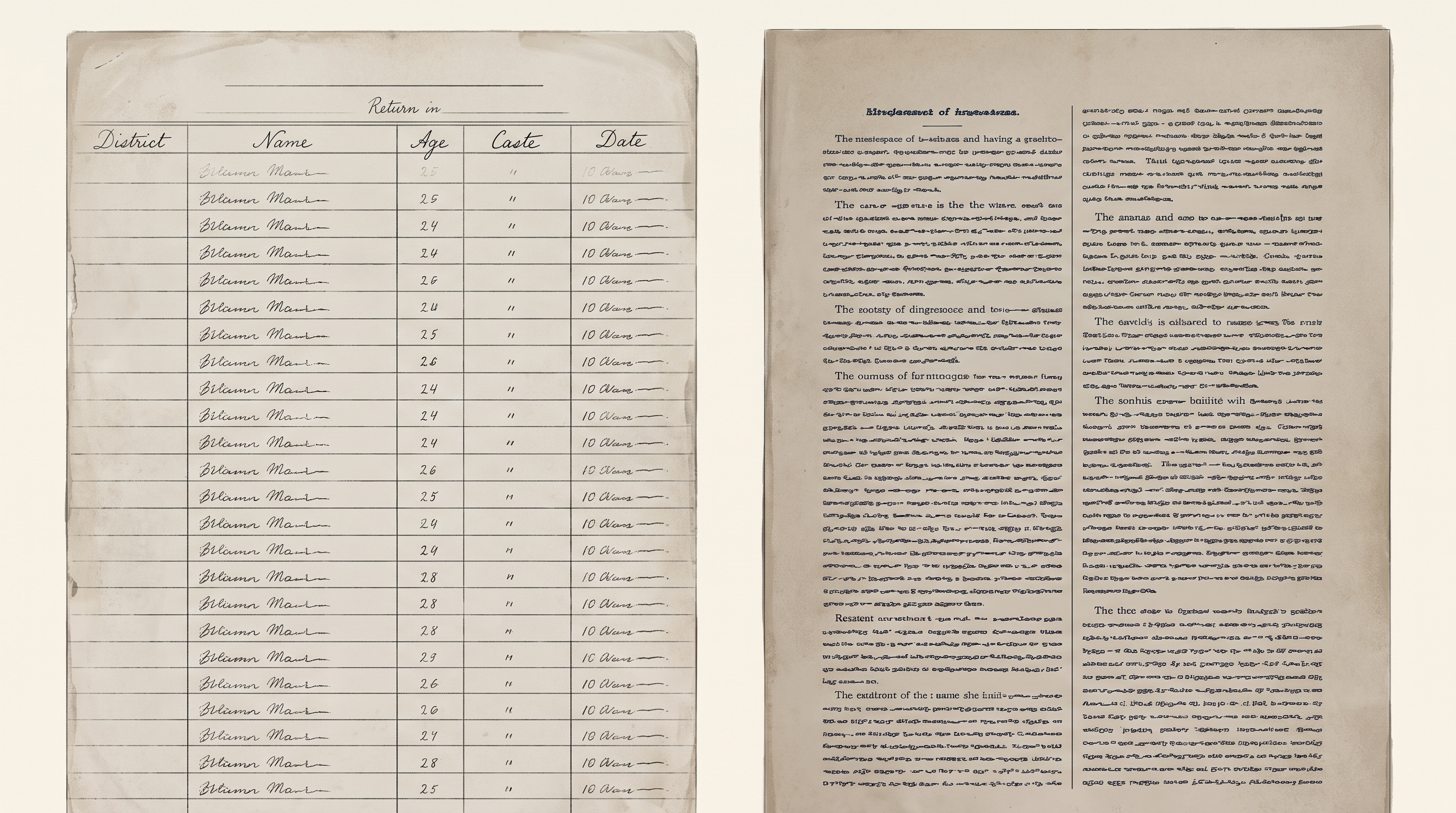
Fig. 2.0 – The two kinds of paper on which the evidence survives.
2.1 Struggle Against Caste
Between the 1840s and the 1920s, in three different corners of India, three men set out to break the same thing. None of them met the other two. They wrote in three different languages — Marathi, Malayalam and Telugu — and they went about the work in three quite different ways.
Jyotirao Phule worked in and around Pune, in western India. Narayan Guru worked in Kerala, along the south-western coast. Veerasalingam worked at Rajahmundry, on the Godavari delta in what is now coastal Andhra Pradesh. Map 2.1 places all three.
Map
Map 2.1 Caption: The regions in which the three reformers of this section worked. Brief: Political map showing the full extent of India as officially defined; mark and label Pune, Thiruvananthapuram with Aruvippuram and Varkala nearby, Aluva, Vaikom and Rajahmundry; lightly shade western Maharashtra, Kerala and the coastal Godavari districts; note in the key that present-day state boundaries are shown for location only and are not the administrative boundaries of the nineteenth century.
Before we can follow what they did, we need to know what they were up against. That is where this section begins.
2.1.1 Caste And The Condition Of The Untouchables
Two different words are needed here, and students mix them up constantly. Varna is the four-fold order set out in ancient Sanskrit texts — brahmana, kshatriya, vaishya and shudra, ranked one above the next. Jati is something else: the birth group a person actually belongs to, of which there are thousands, each with its own rules about whom its members may marry, eat with and work alongside.
The four-fold scheme is a model found in texts. It is not a photograph of how any village worked. Real social life ran on jati, and the jatis of one district often did not fit neatly into the textual ladder at all.
Outside The Order Altogether
Below and outside this order stood communities treated as untouchable. Untouchability is the practice of treating certain groups as ritually polluting, so that ordinary contact with them — touching, eating together, sharing water — is held to defile others.
The restrictions were not the same everywhere, but they had a common shape. Members of these communities were kept out of temples and schools. They were barred from the wells that other castes used, and often from the streets those castes walked on.
The work they were required to do was the work no one else would take: removing dead animals, working with leather, tending cremation grounds, clearing human waste. The occupation was hereditary, and the low status attached to the occupation was hereditary with it.
In parts of Kerala the rule went further still. It was not only touch that polluted but nearness. Certain castes were required to keep a fixed distance from certain others, and to call out as they came, so that no one of higher status was approached unawares.
The Ezhavas of Kerala, the community Narayan Guru was born into, lived under a version of these rules. They could not enter the great temples, could not use public wells, and were not appointed to government service.
2.1.2 Why Attitudes Began To Change
Nothing about caste made it fixed forever, and in the nineteenth century several pressures came together at once.
The first was print. Cheap presses meant that a schoolteacher in Rajahmundry or a gardener’s son in Pune could put an argument into Telugu or Marathi and sell it for a few annas. An argument in print can be answered in print, in public, by people who have never met.
The second was schooling of a new kind. Mission schools and government schools taught by a syllabus, not by birth, and they were the first classrooms many low-caste children could enter. They also carried ideas of equality and of reasoning from evidence, which educated Indians promptly turned on their own society.
The third was movement. Railways, growing towns, new offices, mills and markets threw together people who in a village would never have shared a bench. Contact of that kind did not abolish caste, but it made the old rules harder to enforce, and it made them visible as rules rather than as nature.
Colonial rule cut both ways, and this is worth being careful about. The same government that opened schools also counted, classified and ranked castes in its records, its army recruitment and its courts — and so gave caste identity a new official life.
Many Indians drew a further conclusion. A society divided against itself was easy to rule, and would stay easy to rule until the divisions went. Reform of caste, on this argument, was not a distraction from politics but a condition of it.
2.1.3 Jyotirao Phule
Jyotirao Govindrao Phule was born in 1827 at Pune, into a mali family — gardeners and flower-sellers, a cultivating caste well below the top of the local order and well above the bottom. He was educated at the Scottish Mission school in the city, which mattered later in ways his teachers did not intend.
Phule’s central claim was blunt. The subordination of the shudra and ati-shudra castes was not a religious truth but a human arrangement, made and maintained by those it benefited. The sacred texts that justified it, he argued, were written to keep it in place.
From that claim two things followed. If the arrangement was human, it could be unmade. And if the texts were interested writing rather than revelation, then priests had no automatic authority over anyone’s marriage, funeral or worship.
Education First
Phule began with schooling, and he began at the hardest point. He taught his wife Savitribai to read, and in 1848 the two of them opened a school in Pune for girls, including girls from the lowest castes.
He and Savitribai went on opening schools, and Phule pressed non-brahmin families to educate their children as a matter of self-interest, not charity. Literacy, on his reading, was the thing the old order most depended on withholding.
The Satyashodhak Samaj
In 1873 Phule founded the Satyashodhak Samaj, the Society of Truth Seekers — an organisation whose purpose was to free the non-brahmin castes from dependence on priests and from the belief that their position was ordained.
Its practical programme was small and pointed. Members conducted marriages without a brahmin priest, using simple vows in Marathi that the couple themselves could understand and afford. A wedding is an ordinary thing; that was rather the point.
Phule wrote for the same audience. His Gulamgiri — ‘Slavery’ — appeared in 1873, and Shetkaryacha Asud, ‘The Cultivator’s Whipcord’, set out the condition of the peasant, who was in his view crushed twice over, by the moneylender and by the priest.
He argued that the non-brahmin peasant castes had to act together, since separately each was too weak to matter. And he was sharp about the new nationalist politics of the 1880s, holding that a Congress which ignored the depressed classes could not honestly call itself national.
Phule served as a nominated member of the Poona municipality from 1876. In 1888 a public meeting in Bombay conferred on him the title Mahatma, ‘great soul’. He died in 1890.
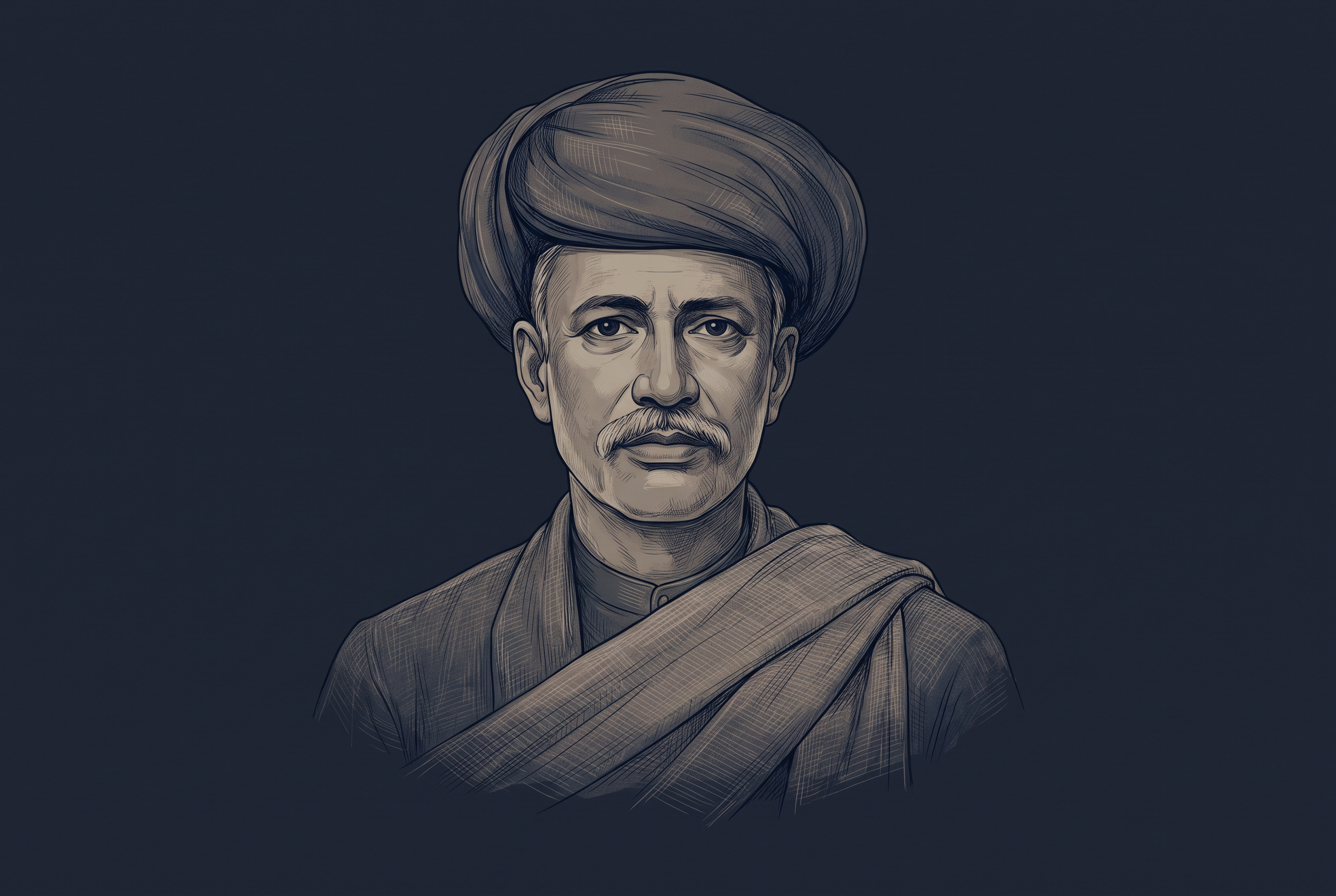
Fig. 2.1 – Jyotirao Phule.
Half a century after Phule’s death, B. R. Ambedkar dedicated a book of his own to him. Ambedkar was by then the best-known leader of India’s untouchable communities, and he chose his words with care.
Read the last clause slowly, because it is a political argument, not a compliment. Ambedkar is saying that Phule put equality inside Indian society ahead of freedom from British rule — and Ambedkar is endorsing that order of priorities in 1946, when independence was months away.
2.1.4 Narayan Guru
Narayan Guru was born in 1856 at Chempazhanthy, near Thiruvananthapuram in southern Kerala, into the Ezhava community. He became a formidable Sanskrit scholar and a writer of philosophy — his Darsanamala was published in 1916 — which is itself part of the story, since the learning he mastered was learning his community was not supposed to have.
Aruvippuram, 1888
In 1888, at Aruvippuram on the Neyyar river, Narayan Guru did something without precedent. He lifted a stone from the riverbed and consecrated it as an image of Shiva — an act reserved by custom for brahmin priests, performed for a community forbidden to enter existing temples.
When brahmins objected that he had no right to consecrate a Shiva, he is said to have replied that the Shiva he had consecrated was an Ezhava Shiva. The plaque set up at the site declared it a place where people lived as one, without division of caste or creed.
More temples followed, and Narayan Guru used them to make arguments. At Kalavankodam he installed a mirror where the image would stand, so that a worshipper looking for God saw himself. At Murikkumpuzha the words fixed in the shrine were truth, duty, kindness and love — and nothing else.
These temples admitted everyone, of any caste and of no caste, and members of untouchable communities worked in their kitchens. He also founded a Sanskrit school at Varkala, teaching a language that had been guarded, to students who had been excluded from it.
Organising A Movement
In 1903 the SNDP Yogam — the Sree Narayana Dharma Paripalana Yogam — was founded under his guidance. Its declared programme was to build temples open to all castes, high or low, and to do away with untouchability towards the lower castes.
The Yogam gave the movement what a single teacher cannot supply: members, funds, meetings, schools and a printed voice. It drew in the depressed Hindus of the Ezhava caste in very large numbers, and turned a religious gesture into an organisation.
He founded the Advaita Ashram at Aluva in 1913, dedicating it to universal brotherhood, and in 1924 an All Religions Conference met there under his guidance. Its purpose, as he framed it, was not to argue and win but to know and to make known — the delegates were to study each other’s religions rather than defeat them.
Vaikom
In 1924 the satyagraha at Vaikom began — satyagraha being a form of open, non-violent defiance in which people deliberately break an unjust rule and accept the punishment. The demand at Vaikom was the right of avarna castes to walk the public roads surrounding the Mahadeva temple, from which they were barred.
Narayan Guru supported the campaign and gave it shelter. Gandhi came to Vaikom in 1925 and met him, and the two discussed caste and untouchability directly.
He was not, however, a comfortable ally. He criticised Gandhi and the Congress openly for saying warm things about the lower castes while neglecting their actual grievances.
The slogan he left is four words in Malayalam — oru jati, oru matam, oru daivam manushyanu: one caste, one religion, one god for man. He died in 1928.
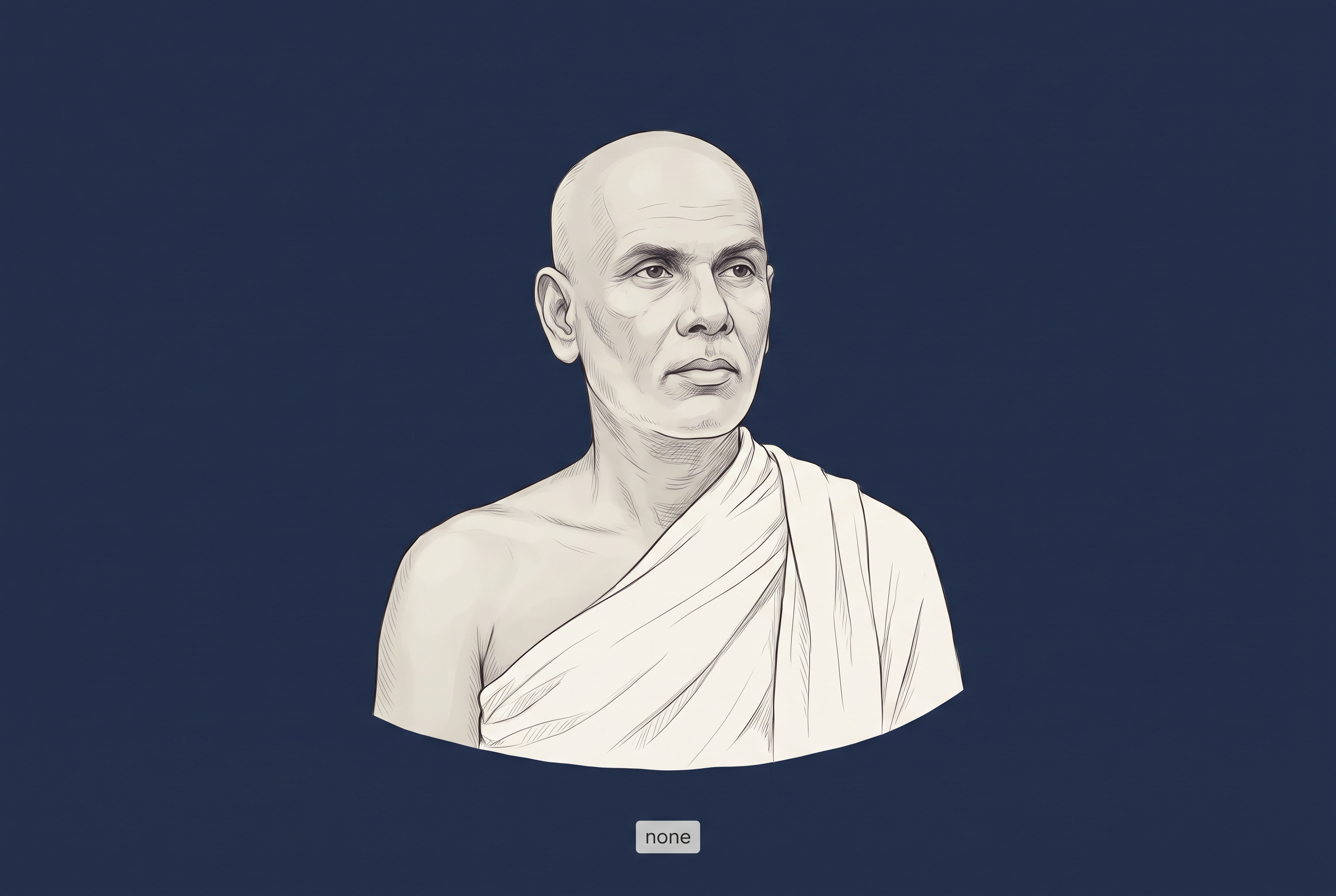
Fig. 2.2 – Narayan Guru.
2.1.5 Veerasalingam
Kandukuri Veerasalingam was born in 1848 at Rajahmundry, in a brahmin family, and worked most of his life as a schoolteacher. He came to the anti-caste cause from inside the group it privileged, which shaped both his methods and the abuse he attracted.
His weapon was Telugu prose. He founded the journal Vivekavardhini in 1874 and used it to expose, month after month, the practices he thought were rotting his society — priestly extortion, superstition, the exclusion of the lower castes from temples and wells, and the treatment of widows.
He wrote satires in which recognisable local hypocrites were held up to ridicule, and he wrote the first Telugu novel, Rajasekhara Charitramu. Because he wrote plain, modern Telugu prose for ordinary readers rather than ornamented verse for scholars, he is remembered as the father of the Telugu literary renaissance.
Schools, Wells And Temples
Veerasalingam was inspired by the Brahmo Samaj, a reforming body that rejected image worship and caste distinction, and he took from it a belief in one God and in a religion stripped of priestly monopoly.
From the 1870s he opened schools, including schools for girls and night schools for working people, and he ran them without caste bars. He had wells dug for the use of children of the depressed castes, and gave free tuition to children whose families could not pay.
He argued publicly for the right of the lower castes to enter temples and to draw water from public wells, and he encouraged marriages across caste lines — which in the Godavari districts of the 1880s was not a gesture but a risk.
His central campaign, and the one that consumed his life, was the remarriage of widows. He arranged the first widow remarriage in the Telugu country at Rajahmundry on 11 December 1881, and went on arranging others through an association he set up for the purpose. We return to that campaign, and to what the law did and did not do for it, in section 2.2.4.
He also spoke against the devadasi system, under which girls were dedicated to temples and expected to perform at the entertainments of wealthy men, with no possibility of an ordinary married life. In his last years he made over his property to the Hitakarini Samaj, so that the schools would outlive him. He died in 1919.
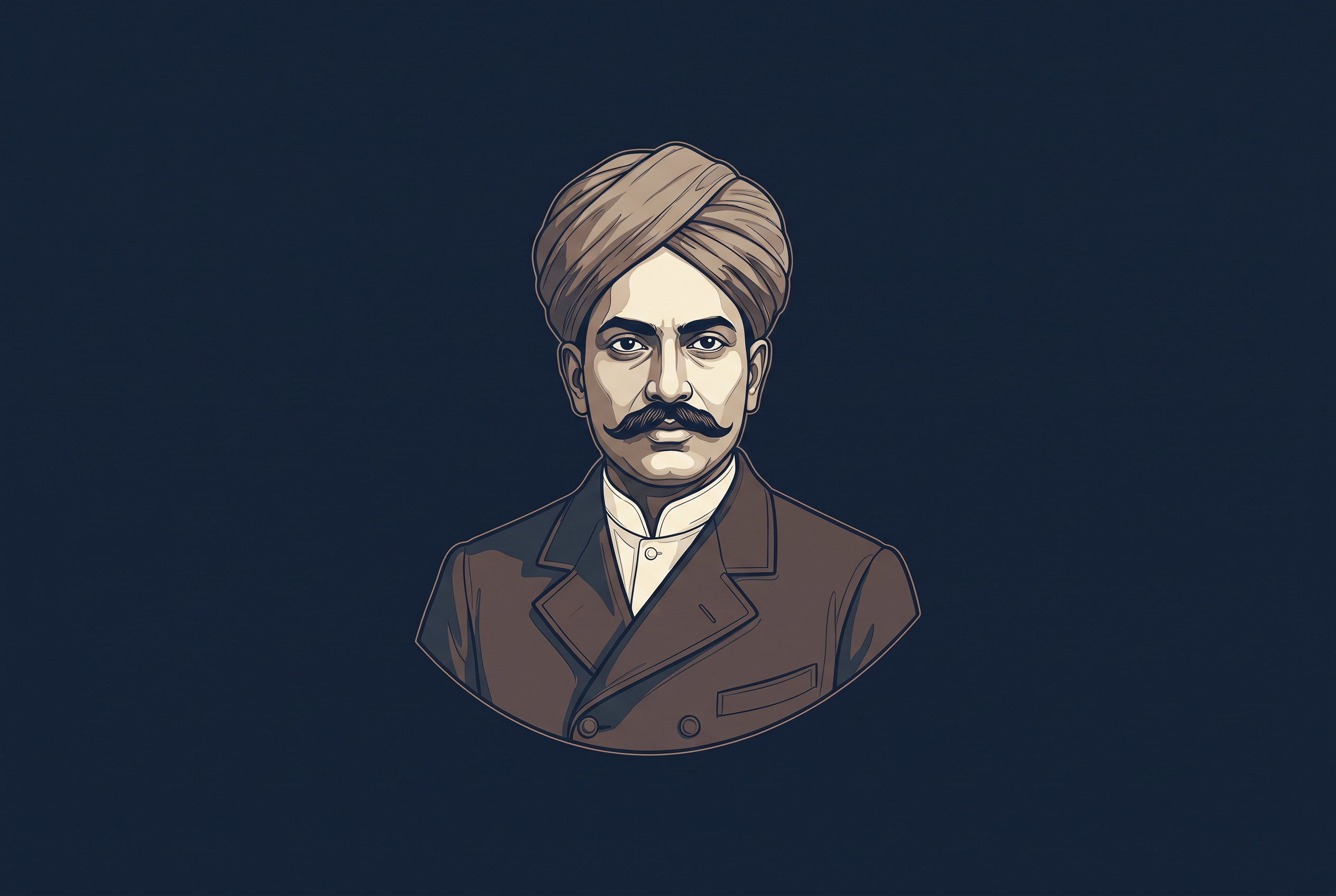
Fig. 2.3 – Kandukuri Veerasalingam.
2.1.6 What The Three Reformers Left Behind
Set the three side by side and the differences are as instructive as the resemblance.
Phule attacked the scriptural claim head-on and built a rival institution — a society whose members married without priests and educated their daughters. His argument was that authority over the low castes rested on a text, and that the text could be refused.
Narayan Guru worked through religion rather than against it. He did not tell Ezhavas that their worship was worthless; he consecrated images for them, built temples that admitted everyone, and thereby demonstrated that the exclusive right of one caste to perform such acts was a claim, not a fact.
Veerasalingam worked through print, schooling and, eventually, the law. He wrote from within the priestly caste, addressed the educated Telugu reader, and tried to change what respectable opinion would tolerate.
What the three shared went beyond that. All of them put education at the centre, because exclusion from learning was what kept the arrangement running. All of them were attacked hardest not by the colonial government but by their own neighbours. And all of them treated caste as a question about how Indians treated each other, not one the state could settle for them.
The reach of the work should not be exaggerated. Each movement was regional, each was strongest among people already in touch with schools and print, and none of them ended untouchability in its own lifetime. Their achievement was to make the arrangement arguable — and once a social order has to defend itself in public, it has already lost its claim to be natural.
The sequence of the whole struggle, as this section has told it, is set out in Fig. 2.4.
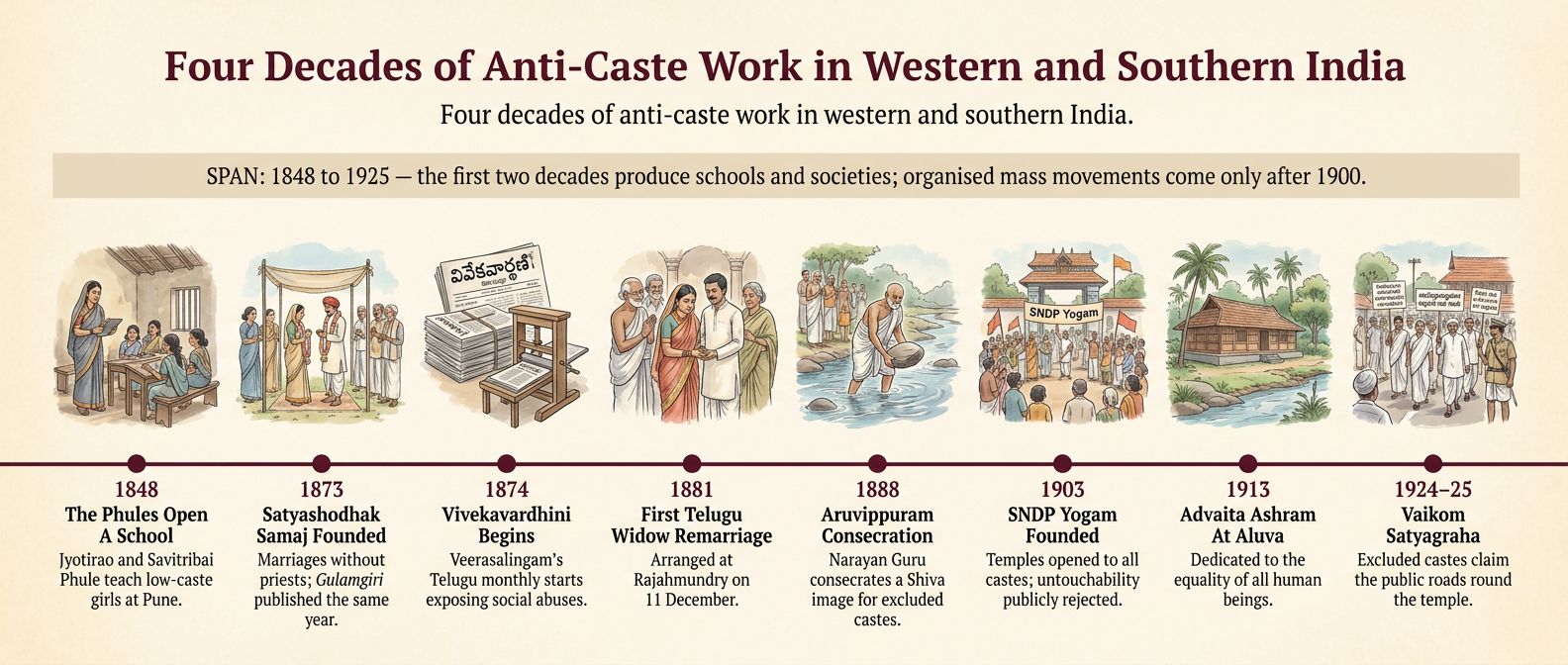
Fig. 2.4 – The Struggle Against Caste.
2.2 The Women’s Question
In nineteenth-century India, a set of arguments about marriage, widowhood, education and the killing of infant girls came to be discussed under a single heading: the women’s question. It ran in newspapers, in petitions, in law courts and finally in legislation.
One feature of it should be noticed at the start. Almost all of it was conducted by men — reformers, pandits, missionaries, officials and judges — arguing with each other about women. Women’s own words enter the record late and in small quantities, and where they do enter, this chapter will say so.
2.2.1 The Condition Of Women In The Nineteenth Century
A woman’s position in nineteenth-century India was defined almost entirely by her relation to a man: first her father, then her husband, then her son. She was rarely treated as a person with claims of her own.
In matters of inheritance and property she stood far behind men, and she generally had no guardianship of her own children. A girl’s own family often described her as belonging elsewhere from birth, since her destination was another household.
The Practices Under Attack
Several specific practices lay at the centre of the argument, and it is worth naming them precisely, because the four Acts in this section each attack one of them.
Sati was the burning of a widow on her dead husband’s funeral pyre. It was held to make her a chaste and devoted wife, and to carry her and her husband to heaven — and it was, in most recorded cases, the alternative to a widowhood that was itself a kind of social death.
Child marriage was the norm rather than the exception in many communities. Girls were married before puberty, sent to their husband’s household young, and given no schooling on the argument that a wife needs housework, not letters.
Polygamy — one man married to several wives at once — was practised in several communities, and was a regular practice among the Kulin brahmins of Bengal, where a man might contract many marriages and maintain none of the households.
The purdah system, the seclusion of women behind a veil or a curtained inner apartment, kept women out of public spaces, and with them out of schools, meetings and courts.
Female infanticide — the deliberate killing of a newborn girl — was practised in particular regions and particular communities, for reasons taken up in section 2.2.5.
And a widow, if she survived her husband, was forbidden to remarry in most caste Hindu communities. Her head might be shaved, her food restricted, her clothing reduced to coarse white cloth, and her presence treated as inauspicious at every celebration.
Two Necessary Qualifications
The first qualification is regional and social. These practices were not uniform across India. They were most rigid among propertied, upper-caste households; among poorer peasant and artisan families, where women’s labour was needed in the field and the workshop, seclusion was simply not affordable, and widow remarriage was often permitted by custom.
The second concerns evidence. Much of what we know comes from reformers who were building a case, and from officials and missionaries who had reasons of their own to describe Indian society as needing rescue. That does not make their accounts false, but it does mean they were selected — and a practice that no reformer wrote about has left almost no trace at all.
2.2.2 Reformers, Organisations And Public Opinion
From the 1820s a body of Indians who had been through the new schools and the new printing presses began to argue in public that these practices were neither sacred nor permanent.
Rammohan Roy is the beginning of the line: a Bengali scholar of Sanskrit, Persian and English who founded the Brahmo Samaj in 1828, campaigned against sati, and pressed for women’s right to property. Derozio’s students in Calcutta, Debendranath Tagore, Keshab Chandra Sen and Ishwar Chandra Vidyasagar carried the argument forward in Bengal.
Beyond Bengal, the Arya Samaj founded by Dayananda Saraswati in 1875, the Ramakrishna Mission and the Theosophical Society all attacked one or another of these customs. Christian missionaries campaigned, collected figures and published pamphlets, with motives that were partly humanitarian and partly evangelical.
The Method Of Argument
Notice how the reformers argued, because it is the most important thing about them. They almost never said that the ancient texts were wrong and should be discarded. They said instead that the practice was a later corruption, and that the oldest and most authoritative texts did not require it at all.
This was a deliberate choice of ground. A reformer who attacked scripture could be dismissed as a westernised apostate; a reformer who out-quoted the pandits had to be answered on their own terms.
It also had a cost. It conceded that ancient texts were the proper court of appeal on how women should live — which meant the argument was always about what the texts said, and almost never about what women wanted.
2.2.3 The Abolition Of Sati, 1829
Attempts to stop sati were not new. The Mughal emperor Akbar tried to restrict it, the Portuguese banned it in their territory at Goa, and the French took steps against it at Chandannagar.
The East India Company’s early policy was different: it tried to regulate rather than prohibit. From 1813, official rules declared sati lawful when it was voluntary and conformed to what the pandits certified as scripture — and unlawful for girls below a stated age, for pregnant women, and for women who had been drugged into it. Police were to attend and record.
The consequence would be comic if it were not so grim. The Company now certified some burnings as legal, and kept annual returns of them, which is why the numbers reached Calcutta and London at all.
Rammohan Roy And The Pandits
From 1818 Rammohan Roy campaigned to end the practice outright. He published tracts in Bengali and English, wrote in the journal Sambad Kaumudi, and organised parties of volunteers who went to the burning ghats of Calcutta to argue with families and dissuade widows.
His argument was scriptural. The highest authorities, he held, prescribed for a widow a life of austerity and brahmacharya — self-denial and study — and nowhere commanded her death. Mrityunjay Vidyalankar, a pandit of great standing, gave a formal opinion to the same effect: religious literature sanctioned no such thing.
The Serampore missionaries added a different kind of ammunition. William Carey and William Ward collected passages from Sanskrit texts to show that sati was encouraged as a virtue rather than commanded as a duty, and they compiled statistics of the women burnt in and around Calcutta.
Their journals — the English monthly The Friend of India and the Bengali Samachar Darpan — kept the subject in front of readers and pressed the Governor-General to act. Sahajanand Swami, founder of the Swaminarayan sect in Gujarat, argued that God alone, who gives life, may take it away.
The Regulation Of 1829
Opinion in England was moving too, and petitions from eminent men reached Lord William Bentinck, the Governor-General, urging prohibition. Orthodox Hindus led by Radhakanta Deb replied through their own press and their own petitions, arguing that a government which had promised not to interfere in religion was breaking its word.
Bentinck was advised that a ban might provoke insurrection, and Rammohan Roy himself warned against banning the practice abruptly, fearing a backlash. Bentinck went ahead. The Bengal Sati Regulation, Regulation XVII of 1829, was passed on 4 December.
The Regulation opened by stating exactly what its authors thought they were doing.
The clauses were short. Sati was declared illegal and punishable in the criminal courts. Zamindars, petty landholders, local agents and revenue officers were made specifically responsible for informing the nearest police station of any intended burning, and were liable to punishment if they wilfully failed to do so.
Anyone who aided or abetted a burning was to be tried for culpable homicide. On receiving information, the police were to go to the spot, declare the gathering illegal, and report the names and addresses of those present; if the burning had already happened, an immediate enquiry was to follow.
Radhakanta Deb’s group appealed to the Privy Council in London. The appeal failed and the Regulation stood. It was extended to the Madras and Bombay Presidencies in 1830.
In a report of 1829 Bentinck set out how the reported cases were distributed.
What The Law Could And Could Not Reach
The Regulation ran only where the Company ruled. In the princely states, which the Company did not administer directly, it had no force, and sati continued there for decades after 1829, particularly in parts of Rajputana.
Even inside Company territory, a law is only as strong as the willingness to report and prosecute. Families, priests and neighbours often had every reason to stay silent, and the officers made responsible by the Regulation were the very landholders most embedded in local society.
Change, when it came, was slower than the statute and larger than it. By the later nineteenth century there were cases of villagers and police intervening to stop a burning in progress — which is a change in what neighbours thought acceptable, not merely in what the law said.
2.2.4 The Widow Remarriage Act, 1856
Once burning was outlawed, the condition of the surviving widow became the obvious next question — and it was a harsh condition. A Hindu widow in the higher castes was held to be paying, through her husband’s death, for the sins of a former life.
Her hair was often shaved. She wore coarse white cloth, ate restricted food, kept fasts, and was excluded from weddings and festivals as an ill omen. Where child marriage was common, this life could begin at eight or nine and last sixty years.
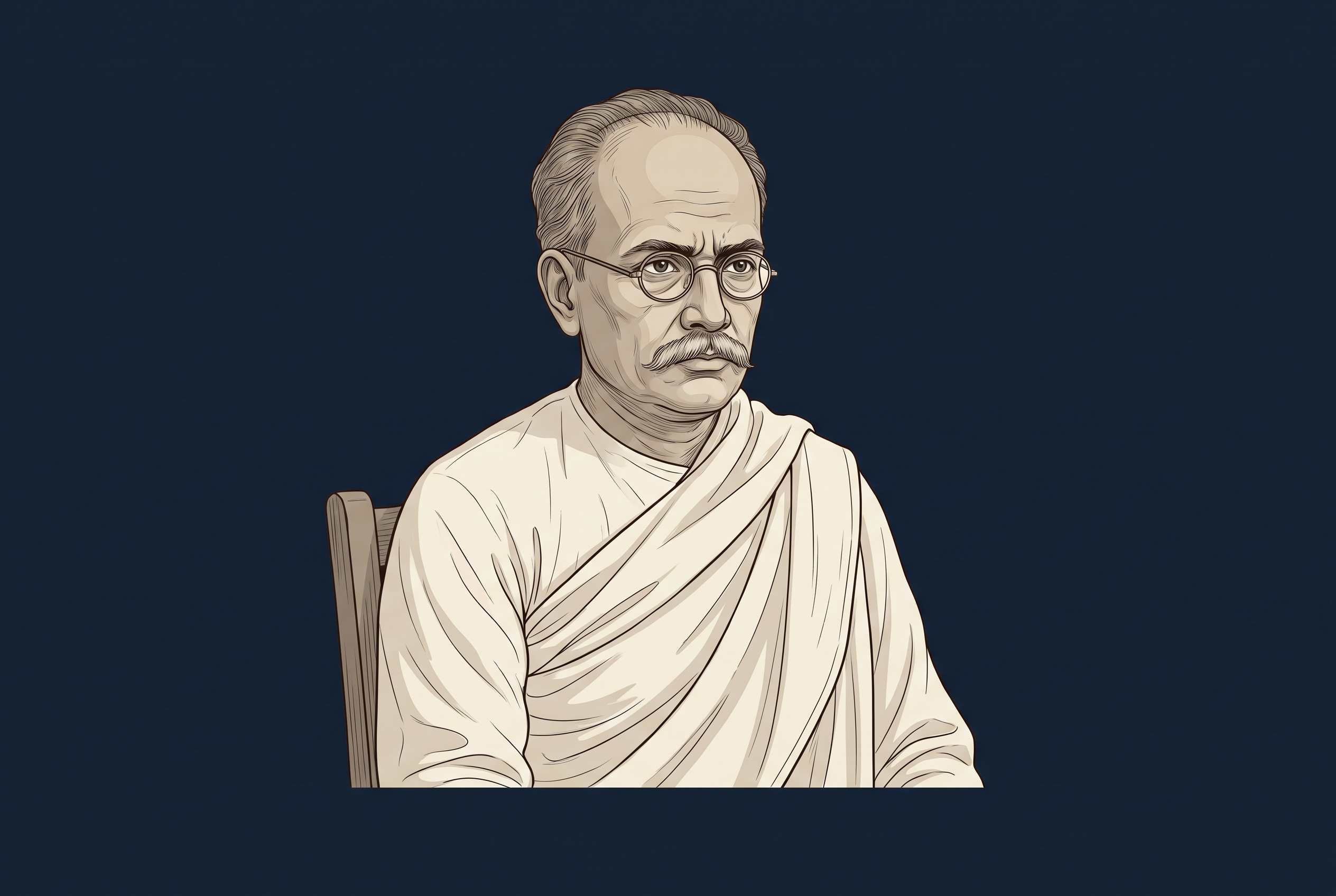
Fig. 2.5 – Ishwar Chandra Vidyasagar.
Vidyasagar’s Campaign
Ishwar Chandra Vidyasagar was the outstanding Sanskrit scholar of his generation, and he fought on scriptural ground. Writing in Tattwabodhini Patrika and in a book on the remarriage of Hindu widows, he cited verses from the Parashara Samhita to argue that remarriage was permitted by the very texts the orthodox accepted.
The campaign had allies. Rammohan Roy had already pressed the cause, Jyotirao Phule supported it in Maharashtra, and Karsandas Mulji and Dhondo Keshav Karve took it up in western India — Karve eventually marrying a widow himself and founding a home where widows could be educated.
On 4 October 1855 Vidyasagar sent a petition to the Government of India praying that widow remarriage be legalised. It carried about a thousand signatures, among them Debendranath Tagore, Akshay Kumar Dutta, Peary Chand Mitra and Prasanna Kumar Tagore, and further petitions came from Madras, Bombay and Nagpur.
The orthodox reply was far larger. Led again by Radhakanta Deb, opponents submitted a counter-petition bearing 36,763 signatures. That ratio is worth pausing on: the reformers were winning the argument in print and losing it decisively by numbers.
The Act And Its Sting
J. P. Grant took the Bill up in the Legislative Council, and the Hindu Widow’s Remarriage Act, Act XV of 1856, was passed on 26 July 1856 under Lord Dalhousie’s government. It made the remarriage of Hindu widows lawful throughout the Company’s territories, and it declared the children of such marriages legitimate.
It also contained a clause that shaped everything afterwards. A widow who remarried forfeited whatever rights she held in her deceased husband’s property — the maintenance, or the life interest, that widowhood itself had given her.
The first marriage under the Act took place at Sukea Street in Calcutta on 7 December 1856, under Vidyasagar’s supervision and amid loud protest; the bridegroom was Srish Chandra Vidyaratna. A second followed two days later, and Vidyasagar later married his own son to a widow to make the point personally.
The results were thin. Over the next twenty years about eighty widows were remarried in Bengal. In western India, where the movement began about a decade later, the first remarriage was celebrated with great difficulty in June 1869, and by the end of the century only thirty-eight widows had been remarried there.
Associations multiplied all the same: Mahadev Govind Ranade helped found a Widow Remarriage Association in 1861, Vishnu Shastri Pandit and his friends formed another in 1866, and the Madras Hindu Widow Remarriage Association was founded in 1874. Veerasalingam’s parallel work in the Telugu districts is described in section 2.1.5.
Why It Failed
Vidyasagar spent his own money on these marriages, buying gifts and jewellery for brides and borrowing when he ran short — and found that some young men married child widows for the gifts and then abandoned them.
Couples who married under the Act were treated as of inferior status, and families that arranged such marriages were sometimes excommunicated by their caste. The Madras association was publicly dismissed as a performance staged to please Europeans.
2.2.5 The Female Infanticide Prevention Act, 1870
The killing of newborn girls was the hardest of these practices to see, because it was meant to leave nothing behind. It was carried out within the household, usually within hours of birth, and it was not spoken of outside it.
British officials reported it most persistently from parts of northern and western India — among some Rajput lineages, and among landholding groups such as the Jats, Ahirs, Gujars and Khatris in the north-west, and the Lewa Patidars and Kanbis of Gujarat. Cases were also reported from parts of the south.
Two cautions are essential here. These were reports about particular lineages in particular districts, not about whole communities, and most families within them did no such thing. And the reports come from an administration with a strong interest in describing Indian society as barbarous — which does not make them untrue, but does mean they were collected selectively.
Why It Happened
The reasons were economic and social, and they were tightly bound to marriage. A daughter had to be married upward, into a family of equal or higher standing, and that marriage had to be paid for — a dowry, and a wedding whose scale was itself a claim to status.
For a family with several daughters and little land, this was ruin in instalments. An unmarried daughter, meanwhile, was treated as a dishonour to the household, so there was no acceptable way of simply not marrying her.
Behind that stood the whole structure this section has described. If the daughter’s husband died, she became a widow who could not remarry, and before 1829 she might be burnt. A girl’s future, seen coldly from the parents’ side, was a chain of costs and risks.
None of this justifies the killing, and the reformers were right to call it murder. But it explains why criminalising it alone did not stop it.
The Law
Infanticide was already a crime. Bengal Regulation XXI of 1795 and Regulation III of 1804 had declared the killing of a child to be murder, and from the 1830s officials pressed particular clans to abandon the practice by agreement. Neither approach worked.
Under pressure from Indian reformers and Christian missionaries, the Viceroy’s Council passed the Female Infanticide Prevention Act, Act VIII of 1870. It was applied first to Oudh, the North Western Provinces and Punjab, with power for the Governor-General to extend it to any other district at his discretion.
Map
Map 2.2 Caption: The territories to which the Female Infanticide Prevention Act of 1870 first applied. Brief: Map showing the full extent of India as officially defined, with Oudh, the North Western Provinces and Punjab shaded and labelled; state in the key that the boundaries shown are those of 1870 and are not present-day boundaries.
Its method was not punishment but counting. Parents in the notified areas had to register every birth. Officials were empowered to verify some years later that the girls on the register were still alive, and to take a census of children in a district at their discretion. Obstructing them carried a fine, imprisonment, or both.
What The Act Achieved
It did not end the practice. What it changed was the method: instead of killing at birth, families let a girl die slowly of neglect and undernourishment in her first year or two, which no register could prove.
A contemporary Urdu newspaper made exactly this point, arguing that the Act had not suppressed infanticide but had made the crime worse in form, since girls who had once been killed at birth were now left to perish of sickness. It is a devastating observation, and the registers themselves could not refute it.
Prosecutions were few, and convictions fewer, set against what the sex ratios implied. Over the longer run, the decline that did occur owed as much to steady official supervision, to a growing body of Indian opinion against the practice, and to the spread of education, as to the criminal law.
2.2.6 The Age Of Consent Act, 1891
The Indian Penal Code of 1860 fixed the age of consent — the age below which a girl cannot in law agree to sexual intercourse, so that intercourse is a crime whatever she says — at ten years. Within marriage, this meant that a husband committed no offence once his wife had passed her tenth birthday.
Two Cases That Changed The Argument
Rukhmabai had been married as a child and had gone on living in her mother’s house, educating herself. In 1884 her husband, Dadaji Bhikaji, went to the Bombay High Court to compel her to join him, and after appeals the court ordered her to do so or face imprisonment; the case was finally settled in 1888.
What made it a national case was that Rukhmabai wrote. She published letters in the Bombay press, under a pen name, on infant marriage and enforced widowhood — one of the first occasions in this whole story when a woman argued her own case in public, in print, and was read.
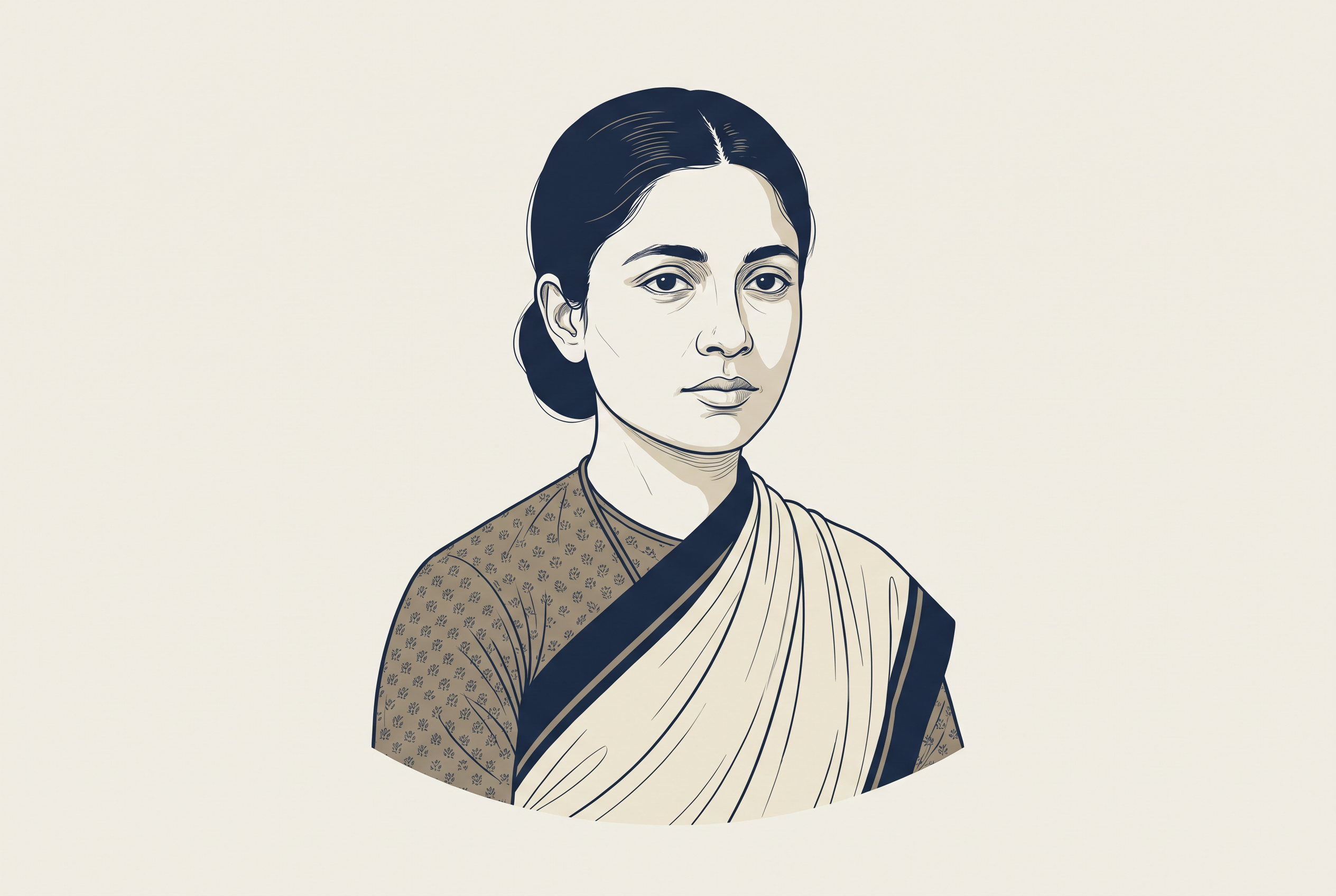
Fig. 2.6 – Rukhmabai.
The second case was worse and briefer. In 1890 a girl named Phulmonee, about ten years old, died of injuries inflicted by her husband, a man of about thirty-five. He was tried — but because his wife was over ten, the law of consent did not touch him, and he could be convicted only of causing death by a rash act.
Phulmonee’s death was reported and discussed across India. It exposed something no argument had managed to make plain: that the law as written protected the husband, and that the reformers’ objection was not sentimental but legal.
The Bill And The Storm
Behramji Malabari, a Parsi journalist of Bombay, had already circulated his ‘Notes on Infant Marriage and Enforced Widowhood’ in 1884, and toured the country speaking for reform. Sir Andrew Scoble introduced a Bill in 1891 to raise the age of consent from ten to twelve years, and it passed as Act X of 1891.
The Act’s clauses were narrow. The age of consent rose from ten to twelve for married and unmarried girls alike, and applied to all religious communities. Offences were triable only by district magistrates, and were declared non-cognisable — so the police could not act on their own.
The opposition was ferocious, and it was not mainly about twelve-year-olds. Bal Gangadhar Tilak argued that the government of a foreign power had no business legislating on Hindu social custom, even where the measure itself might be beneficial, and that such change must come from Hindus themselves.
Revivalist nationalists pointed to Queen Victoria’s Proclamation of 1858, in which the Crown had promised not to interfere with the religion and customs of its Indian subjects, and asked whether that promise now meant anything. Ramesh Chandra Mitter, the member of the Council from Bengal, opposed the Bill on the ground that it cut across the orthodox Hindu code.
Support was equally public. Ranade backed it; the council member Rao Bahadur Krishnaji Lakshman Nulkar spoke for it; the Viceroy, Lord Lansdowne, carried it. The Brahmo journal Indian Mirror rallied educated opinion, and The Hindu and the Madras Times supported the Bill.
Most striking of all, women declared for it in their own name. Kadambini Ganguly, one of the first Indian women to qualify in medicine, joined about a hundred and fifty Hindu, Christian, Brahmo, Buddhist and Muslim women in formally endorsing the measure.
The quarrel of 1891 mattered beyond its subject. It drew large numbers of people into political argument, hardened a nationalist position that social change must not come from the ruler’s hand, and gave Indian women’s organisations their first significant public voice.
2.2.7 The Impact Of The Four Acts On Indian Women
Take the four Acts together — 1829, 1856, 1870, 1891 — and a pattern appears that no single one of them shows.
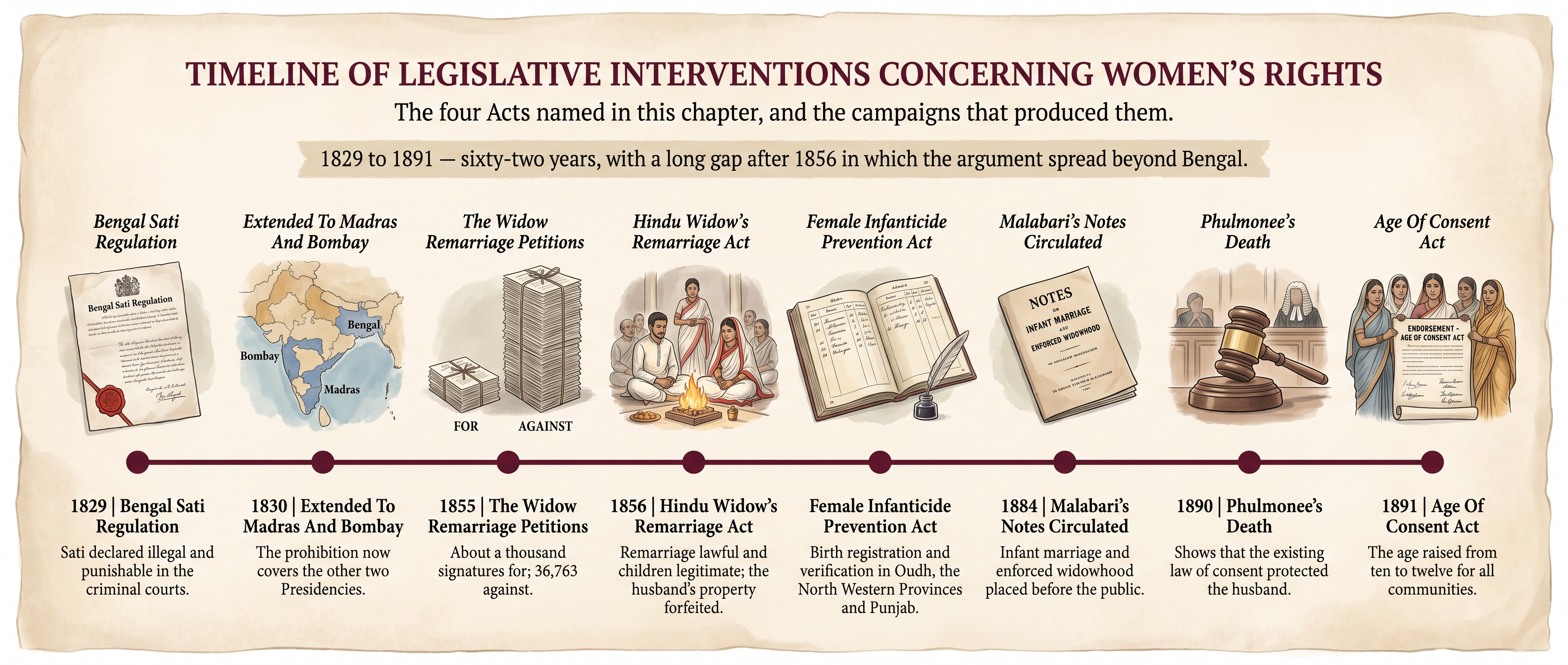
Fig. 2.7 – Legislating The Women’s Question.
What Changed
First, a practice that had been defended as religious duty could now be named as a crime, and defended only as custom. That is a real shift, and every later reform stood on it.
Second, the campaigns created machinery that outlasted them: associations, journals, petitions, schools for girls, and the habit of taking a social grievance to the legislature. By 1891 women themselves were signing endorsements and publishing letters, which would have been unimaginable in 1829.
Third, the Acts of 1870 and 1891 committed the state to counting and inspecting — birth registers, censuses, verification that girls were still alive. Once a state counts something, it can be argued with using its own figures.
What Did Not Change
Against that, the record is sobering. Sati continued in territories the Regulation did not reach. Widows remarried in dozens where there were millions. Infanticide changed its method rather than stopping. The age of consent moved by two years, and the offence was made hard to prosecute.
The reason is consistent across all four. Each Act attacked an act, and none of them touched the arrangements that produced the act — the property rules that made a widow’s remarriage costly, the dowry and status system that made a daughter expensive, and the custom that sent girls to their husbands as children.
The reach was narrow too. These campaigns were strongest among the educated urban middle classes, largely in the Presidency cities, and they touched the villages where most Indian women lived far more slowly and far less.
There is one more thing these laws did, and it is easy to miss. By making women’s condition a matter of public argument and public record, they turned it into a question that could be raised again — and it was raised again, by women, in the movements of the twentieth century.
2.3 Summary
The Order Being Attacked
- Varna is the four-fold ranking set out in ancient Sanskrit texts; jati is the birth group a person actually belongs to. Real social life ran on jati, and the textual ladder never described any village exactly.
- Communities treated as untouchable stood outside this order altogether: barred from temples, schools, wells and often streets, and confined to hereditary work that carried hereditary contempt. In parts of Kerala even nearness, not only touch, was held to pollute.
- Almost everything we know about their condition was written by others — reformers, missionaries, officials. Very little written by these communities themselves survives from before the late nineteenth century.
Why The Argument Became Possible
- Cheap printing let an argument be made in Marathi, Malayalam or Telugu and answered in public by strangers. Schooling by syllabus rather than by birth admitted children the old order had excluded. Towns, railways and offices made the rules harder to enforce.
- Colonial rule cut both ways: the same state that opened schools also counted, ranked and legislated by caste, giving caste a new official life. Historians disagree over how much of the change came from the state and how much from Indian reformers.
The Three Reformers
- Jyotirao Phule argued that low-caste subordination was a human arrangement defended by interested texts, and that what people made they could unmake. He and Savitribai Phule opened a school for low-caste girls at Pune in 1848; his Satyashodhak Samaj of 1873 conducted marriages without priests.
- Narayan Guru worked through religion rather than against it. By consecrating a Shiva image at Aruvippuram in 1888, building temples open to every caste, and organising the SNDP Yogam from 1903, he showed that the exclusive right of one caste to perform sacred acts was a claim, not a fact.
- Veerasalingam worked through print, schooling and law from inside the brahmin caste: the journal Vivekavardhini from 1874, the first Telugu novel, schools without caste bars, wells for depressed-caste children, and the first widow remarriage in the Telugu country in 1881.
- All three put education at the centre, all three were attacked hardest by their own neighbours, and all three were regional in reach. Their achievement was to make caste rank arguable — an order that must defend itself in public has already lost its claim to be natural.
The Women’s Question
- Women’s position was defined by their relation to a man; they stood far behind men in property and had no guardianship of their children. The practices under attack — sati, child marriage, polygamy, purdah, female infanticide, enforced widowhood — were most rigid among propertied upper-caste households, and least so where women’s labour was needed.
- Reformers almost never rejected scripture. They argued that the practice was a later corruption and that the oldest texts did not require it. This won them a hearing, but conceded that ancient texts, rather than women, were the proper authority on how women should live.
- The debate itself was conducted by men. Women enter the record in their own voice only late — Rukhmabai’s published letters, and the women who endorsed the Consent Bill in 1891.
The Four Acts
- Regulation XVII of 1829 made sati illegal and punishable, made landholders and revenue officers responsible for reporting it, and treated abetment as culpable homicide. It ran only in Company territory, so burnings continued in the princely states.
- The Hindu Widow’s Remarriage Act of 1856 made remarriage lawful and its children legitimate — but stripped a remarrying widow of her rights in her late husband’s estate. About eighty widows remarried in Bengal in twenty years, and thirty-eight in western India by the century’s end.
- The Female Infanticide Prevention Act of 1870 attacked an invisible crime by counting: compulsory birth registration, and later verification that the girls were alive. Killing at birth gave way to death by neglect, which no register could prove.
- The Age of Consent Act of 1891 raised the age from ten to twelve for all communities, after Rukhmabai’s case and Phulmonee’s death showed that the existing law protected the husband. Offences were non-cognisable, and opposition turned the measure into a quarrel about who may reform Indian society.
- Each Act criminalised an act without touching what produced it — the property rules, the dowry and status system, the custom of marrying girls as children. What the Acts did leave behind was machinery: associations, journals, petitions, registers, and a question that could be raised again.
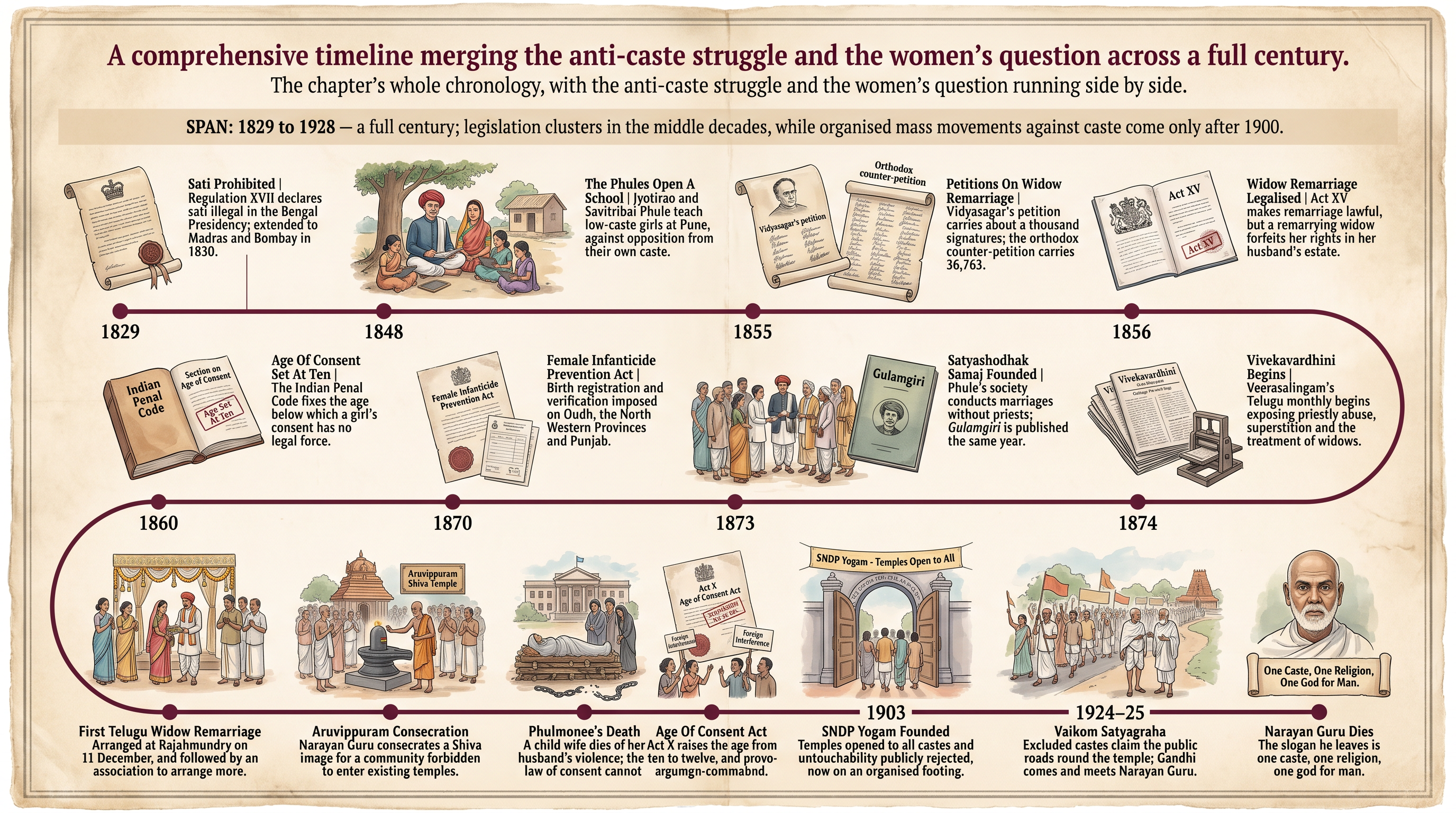
Fig. 2.8 – Social Movements, 1829 To 1928.
What The Evidence Cannot Tell Us
Almost nothing in this chapter was written by the people it is about. The untouchable communities, the widows, the girls married at nine, the women counted in the sati returns — they appear as the subjects of other people’s tracts, petitions and columns, and hardly ever as authors.
The records were built for other purposes too. A return counts what officials could see and were told; a reformer’s pamphlet argues a case; a birth register holds what a family chose to declare. None of them was designed to record what a woman or a low-caste labourer thought was happening to her.
So we can say with confidence what the laws said, who signed which petition, and how many marriages were registered. We cannot say, from these sources, what most Indians actually believed — and that gap is not a failure of research but a property of the evidence itself.
2.4 Check Your Memory
State what Regulation XVII of 1829 required of zamindars, local agents and revenue officers, and say how the Regulation treated a person who helped a burning to take place.
Using Map 2.1, locate the region in which each of the three reformers named in this chapter worked. For each region, describe one thing the reformer did there that struck at caste exclusion.
The reformers of the women’s question rarely told their opponents that the sacred texts were wrong. Explain the ground they chose instead, why it was effective, and what it cost them.
Narayan Guru lifted a stone from a river and consecrated it as an image of Shiva. Explain why an act of worship counted as an attack on caste, using the response it drew at the time.
Look again at Source 2.3. What does Bentinck’s report establish about where reported burnings took place, and what does it fail to tell you about how common the practice actually was?
Read Source 2.1. Set out what Ambedkar claims Phule taught, and explain why the order of priorities in the last clause was a political argument in 1946 rather than a compliment.
Using Fig. 2.7, reconstruct the sequence that led from the two court cases of the 1880s to the Act of 1891. Explain at each step why the case changed what reformers could argue.
Phule and Narayan Guru attacked the same structure by opposite routes — one refusing the authority of the texts, the other performing the acts those texts reserved. Explain the difference, and state what the two men nevertheless had in common.
The Act of 1870 tried to reach a crime that was designed to leave no trace. Explain how birth registers and counts of children could reveal female infanticide, and state what this evidence still could not prove.
‘The Hindu Widow’s Remarriage Act of 1856 was a conservative measure dressed as a reform.’ Argue this case and then argue against it, using the chapter’s account of what the Act granted, what it withdrew, and how many remarriages followed.