Chapter 10: Rise Of Fascism Under Mussolini In Italy (1919-39)
Through the summers of the later 1920s, Italian newspapers printed the same kind of photograph again and again. A bare-chested man stands beside a threshing machine in a wheat field, sheaves at his feet, chaff on his shoulders. He is Benito Mussolini, Prime Minister of Italy, and he has come out to the harvest in order to be seen working at it.
Almost nothing in the picture is accidental. Officials chose the field and the day. Photographers travelled out from Rome. The farm workers who did the threshing for the rest of the season stand at the edge of the frame, or outside it altogether. At the centre is the Duce — ‘the leader’ — in the pose of a labourer.
The photographs belonged to a campaign the government called the ‘Battle of Wheat’, a drive to make Italy grow all its own bread and depend on no foreign supplier. The message was simple enough for a front page: your leader works, your nation is strong, your bread is your own.
Historians studying these years have both the photographs and the harvest records. The two do not say the same thing. That gap — between the image a government projects and the results it actually produces — is one of the things this chapter is about. The other is stranger still: how a man whose party held thirty-five seats in Parliament came to be photographed like this at all.
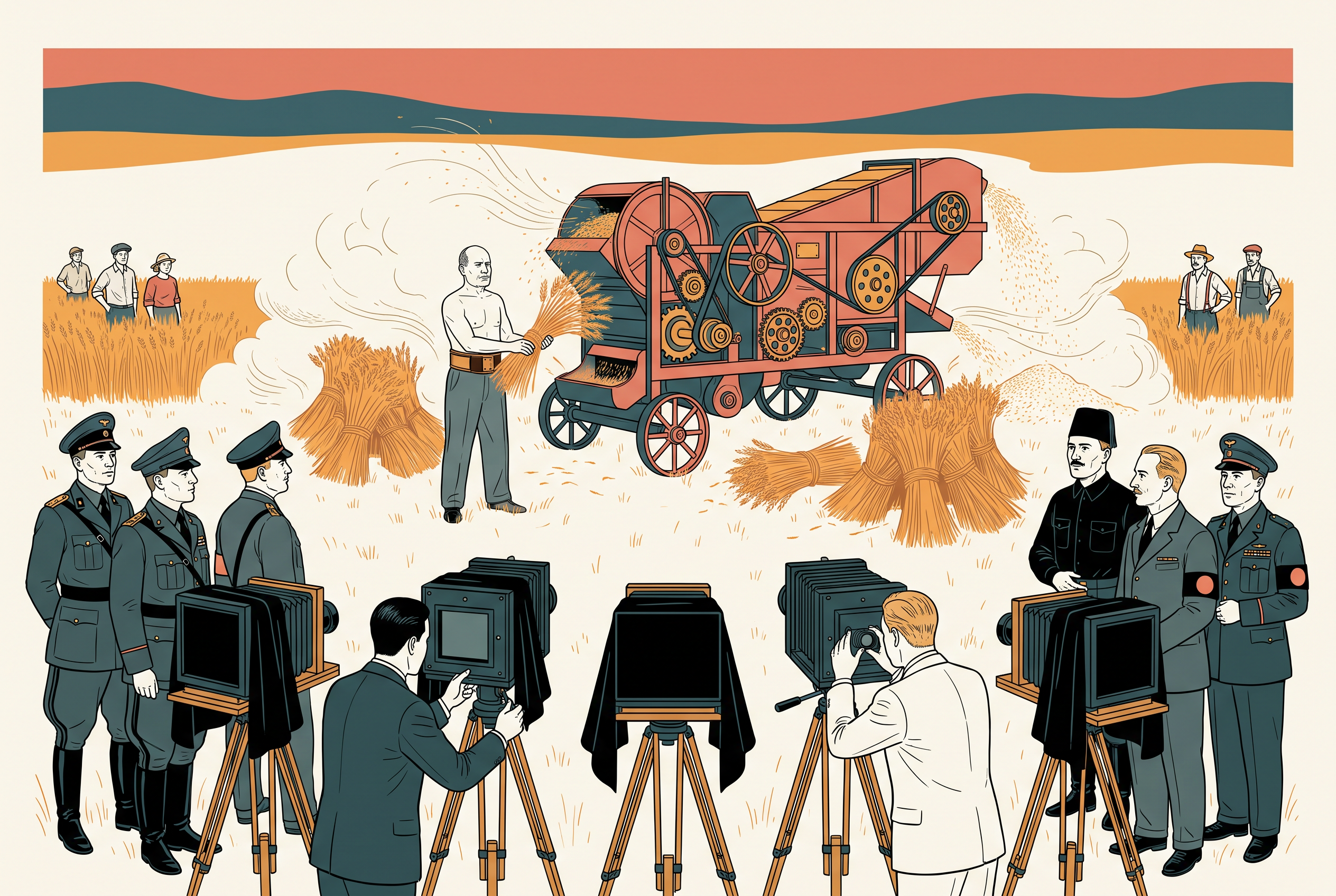
Fig. 10.0 – Staged ‘Battle of Wheat’ photo call.
10.1 Italy After The First World War
Fascism did not arrive in Italy out of nowhere. It grew in a country that had just come through four years of war, and had come through them badly. To understand why Italians turned to a movement that promised order by force, you have to begin with the state Italy was in when the fighting stopped.
Four pressures built up together between 1918 and 1921: anger over the peace settlement, an economy in disorder, a wave of strikes and land seizures that frightened property owners, and a parliament that could not produce a stable government. No single one of these made fascism inevitable. Together they made an extreme solution look reasonable to people who would never have considered it in 1913.
10.1.1 The Mutilated Victory
Italy had not entered the First World War in 1914. It had been tied by treaty to Germany and Austria-Hungary, and it stayed out while its old partners fought. It joined the other side in May 1915, and it did so because it was offered land.
The offer was written down in the Treaty of London, a secret agreement signed in April 1915 between Italy and the Allied Powers. In return for entering the war, Italy was promised Trentino and South Tyrol on its northern border, the port of Trieste, the Istrian peninsula, a stretch of the Dalmatian coast along the eastern Adriatic, and a controlling position in Albania. The treaty was secret because it was a bargain, not a principle.
Italy fought for three and a half years, largely in the mountains along the Austrian front, and more than half a million of its soldiers died. When the peace conference met in Paris in 1919, Italians expected the bargain to be honoured in full. It was not.
What Italy Got, And What It Did Not
Italy did gain a great deal. Under the Treaty of Saint-Germain, signed with Austria in September 1919, it received Trentino, South Tyrol up to the Alpine watershed, Trieste and Istria. Its northern frontier was pushed to the mountains, which is what its generals had wanted for fifty years.
But most of the Dalmatian coast went instead to the new Kingdom of Serbs, Croats and Slovenes — the state later called Yugoslavia. Italy’s claim to a protectorate over Albania was given up in 1920. Above all, Italy did not get Fiume, a mixed Italian and Croat port on the Adriatic that had not even been promised in 1915, but which Italian nationalists had come to demand loudly. Under the Treaty of Rapallo of November 1920, Fiume was made a free state belonging to neither country; Italy annexed it only in 1924.
To many Italians this looked like theft. Their soldiers had died; the great powers had rewritten the bargain at the table. Newspapers gave the feeling a name that stuck: the ‘mutilated victory’. It was nationalism — the belief that a people forms a nation with a right to its own state and its own greatness — turned bitter and looking for someone to blame.
Map
Map 10.1 Caption: What Italy was promised in 1915 and what it actually held by 1920. Brief: Northern Adriatic and northern Italy, 1915–1920. Shade in one tone the areas promised under the Treaty of London (Trentino, South Tyrol, Trieste, Istria, the Dalmatian coastal strip, Albanian coast at Valona); shade in a second tone the areas actually acquired by Italy by 1920; mark Fiume separately as a free state; label the Kingdom of Serbs, Croats and Slovenes. State in a corner note that these are the boundaries of 1920, not present-day boundaries. Do not show later Fascist-era conquests.
Read Map 10.1 alongside the paragraphs above. The gap between the two shaded areas is the whole of the grievance. It is not a large gap in square kilometres, and that is worth noticing: the anger it produced was out of all proportion to the territory involved, because what was felt to be lost was standing rather than land.
10.1.2 An Economy Under Strain
A war of that length has to be paid for, and Italy paid for it by borrowing and by printing money. The result was inflation — a general rise in prices, which means the same coin buys less each year. The lira lost much of its value, and prices in 1920 stood far above what Italians had been used to before 1914. Savings quietly disappeared; wages chased prices and rarely caught them.
Then the war orders stopped. Factories that had been running day and night on shells, steel and uniforms cut back sharply, and threw off workers as they did so. At the same time the army was demobilised, sending millions of men home to look for jobs that no longer existed. Officers who had commanded men in the mountains found themselves unemployed and unthanked.
10.1.3 The Two Red Years
Between 1919 and 1920 Italy went through what was later called the biennio rosso, the ‘Two Red Years’. It was the most intense period of labour conflict in the country’s history to that point, and it is the single condition that did most to make property owners look kindly on fascism.
Strikes ran through the industrial cities of the north. Shops were looted where food prices had risen out of reach. In September 1920, workers occupied the metalworking factories of Turin, Milan and Genoa and kept production going under their own committees for several weeks. In the countryside of the Po valley, labourers’ leagues organised by the Socialists took over land from wealthy owners and worked it as cooperatives.
These movements were led by people who called themselves socialists. Socialism is the belief that the great means of producing wealth — land, factories, mines — should be owned in common rather than privately, and used for the benefit of all who work them. In Italy in 1919 the Socialist Party was the largest party in Parliament, and its language was revolutionary.
Why The Fear Grew
Two things sharpened the alarm. First, the government proved unable, or unwilling, to protect the owners: when estates were occupied, officials negotiated rather than evicted. To a landowner, that looked like a state that had stopped defending property.
Second, in January 1921 a group of revolutionaries broke away from the Socialist Party and founded the Italian Communist Party. Communists argued that the Russian revolution of 1917 should be repeated in Italy. To property owners, its existence confirmed the worst reading of the strikes: that a revolution was not a threat but a timetable.
Whether Italy was actually close to revolution in 1920 is a separate question, and the evidence points the other way — the factory occupations ended in a negotiated settlement, and the strike wave had already peaked before the Fascists became a serious force. But politics runs on what people believe is about to happen. The fear was real even where the danger was not.
10.1.4 A Parliament Without A Majority
Italy’s parliament in these years could not hold a government together. Elections were now held under proportional representation, a system in which seats are shared out in proportion to the votes each party wins, so a party with a fifth of the votes gets roughly a fifth of the seats. It is a fair way to reflect opinion, and in Italy in 1919 opinion was deeply divided.
The Socialists emerged as the largest party, and the newly founded Catholic Popular Party close behind them; the liberals who had governed Italy for decades were reduced to a bloc among many. None of these forces would work with the others. The Socialists would not join a bourgeois government; the liberals would not accept Socialist terms.
What followed was a run of coalition governments — cabinets made up of several parties, none of which commands a majority alone. Ministries formed, quarrelled and fell. No consistent policy on prices, land or public order could survive long enough to work.
This is the point that matters for the rest of the chapter. Ordinary Italians did not lose faith in democracy because someone argued them out of it. They lost faith because for three years it visibly failed to govern — while prices rose, veterans went unemployed and the streets were fought over.
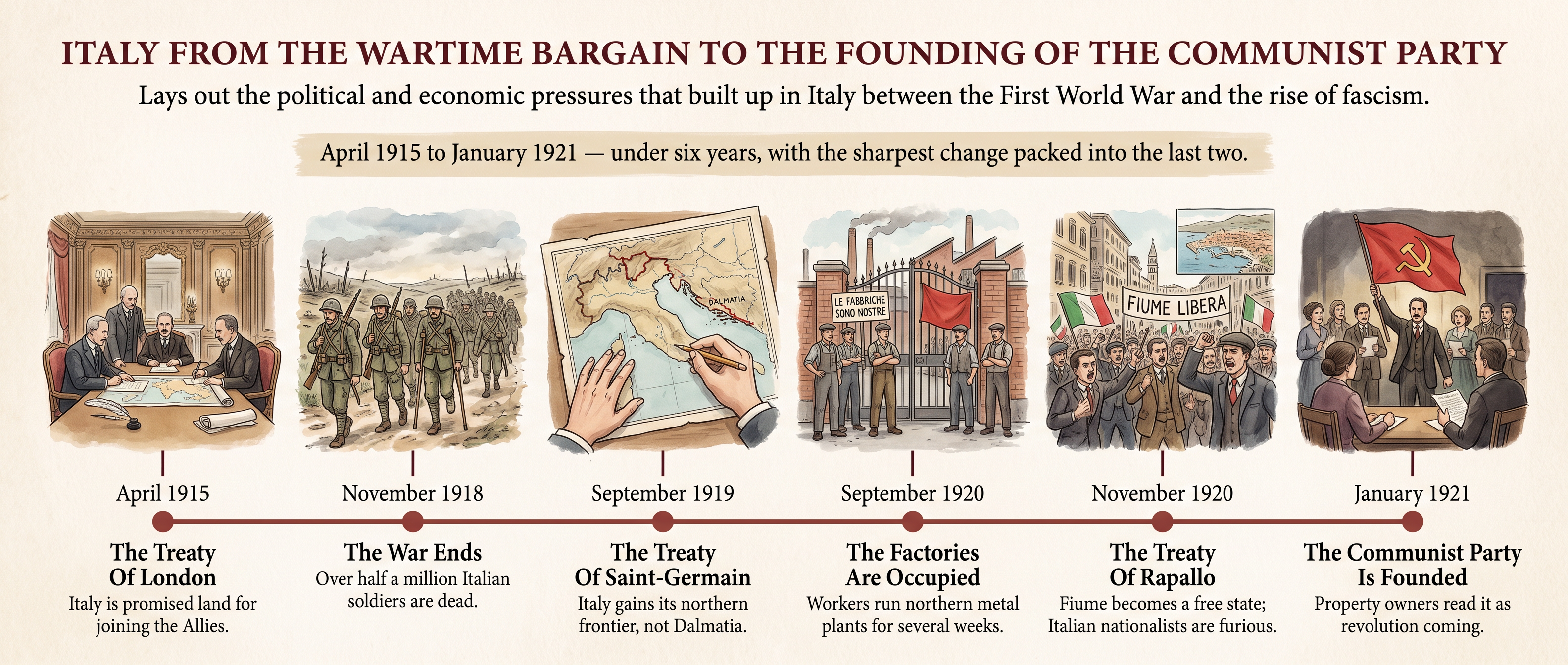
Fig. 10.1 – The Ground Fascism Grew In.
The sequence in Fig. 10.1 sets up everything that follows. By the start of 1921, Italy had a wounded national pride, a damaged economy, a frightened propertied class and a parliament that could not act. What it did not yet have was anyone able to gather all four grievances into a single movement. That is what the next section is about.
10.2 Mussolini And The Fascist Movement
Grievances do not organise themselves. Italy in 1920 had angry veterans, frightened landowners, unemployed workers and a discredited parliament, but these groups wanted different things and disliked each other. What fascism did — and this is the whole of its early success — was to gather them behind one man by giving them a common enemy and a common promise.
Fascism is best defined by what it demanded rather than by a doctrine, because it had little doctrine to begin with. It placed the nation above the individual and above class, insisted on a single leader whose will was not to be questioned, rejected both liberal parliaments and socialism, treated organised violence as a legitimate political method, and glorified discipline, obedience and war.
10.2.1 From Socialist Editor To Fascist Leader
The man who led it had begun on the other side. Benito Mussolini was a schoolteacher’s son from Romagna who became a socialist journalist, and by 1912 he was editing Avanti!, the daily newspaper of the Italian Socialist Party. He was known then as a fierce opponent of war and of the monarchy.
In late 1914 he changed position and argued that Italy should join the war. The Socialist Party expelled him. He founded his own paper, Il Popolo d’Italia, and used it to attack his former comrades. He served at the front and was wounded, and came back to a country full of men like himself: veterans who had risked everything and returned to find themselves nobodies.
The Meeting In Milan, 1919
In March 1919 Mussolini gathered a few hundred people in Milan and founded the Fasci Italiani di Combattimento — the Italian Combat Leagues. A fascio is a bundle or league, and the name reached back to the fasces of ancient Rome, a bundle of rods tied around an axe that had been carried before Roman magistrates as a sign of authority. The message of the name was unity and force together.
The programme of 1919 would surprise anyone who knows what fascism became. It called for a republic, votes for women, an eight-hour working day, a heavy tax on wartime profits and the seizure of church property. It was, in short, a radical programme aimed at the same voters the Socialists were courting.
It failed completely. In the general election of November 1919 the movement won no seats at all. Fascism’s first appearance in Italian politics was as a small, noisy failure.
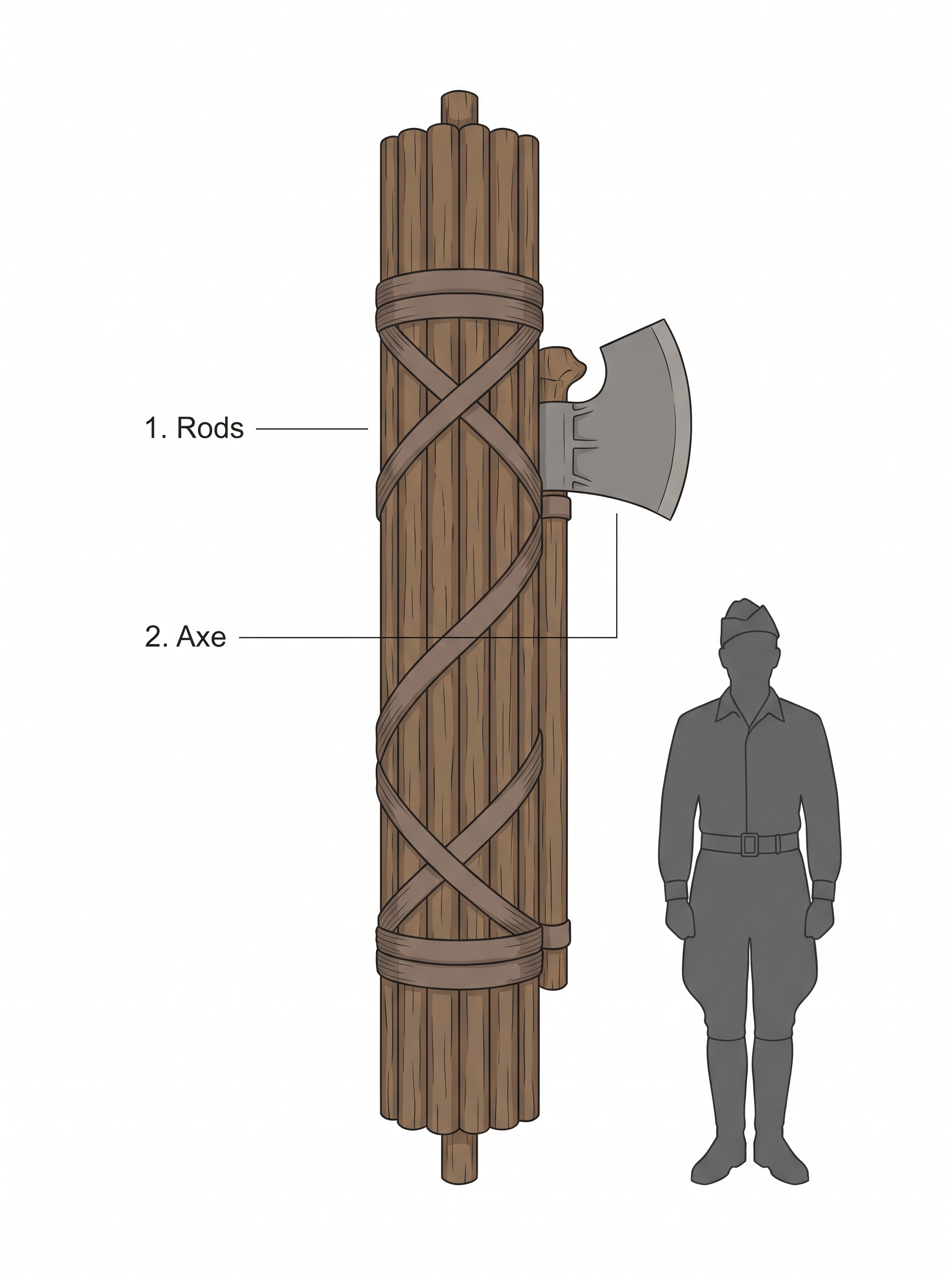
Fig. 10.2 – The Roman fasces and a Blackshirt silhouette.
10.2.2 The Blackshirts And Squad Violence
What changed the movement’s fortunes was not an argument but a tactic. From 1920 the Fascists organised themselves into armed squads — the squadristi, known from their uniform as the Blackshirts — and turned them loose on the socialist movement in the countryside and the small towns of the north.
The pattern was regular enough to be described. A lorry-load of squad members would arrive in a town, break into the offices of the local labour chamber, the socialist party branch or the farm workers’ cooperative, and burn the furniture and the records in the street. Socialist mayors and organisers were beaten, forced to drink castor oil as a humiliation, or driven out of the district. Then the squad drove away.
This was not resisted as it should have been. Landowners in Emilia and Tuscany paid for the lorries and the petrol, because the squads were breaking the very leagues that had occupied their land. Local police often looked the other way, and sympathetic army officers sometimes supplied weapons. Squad leaders in each district — the local bosses known as ras — built up private power bases that even Mussolini could not simply overrule.
10.2.3 Winning Over Property, Church And Crown
The squads made fascism feared. What made it respectable was a series of deliberate changes of position by Mussolini, each of which dropped part of the 1919 programme in exchange for a powerful friend.
The first was property. From 1920 Mussolini stopped speaking as a radical and began presenting himself as the defender of private enterprise against Bolshevism. Industrialists and landowners who had wanted the strikes broken now had a national movement that promised to break them permanently, and they funded it accordingly.
The second was religion. The 1919 programme had demanded the confiscation of church property; that demand quietly disappeared. Mussolini began speaking respectfully of Catholicism as part of Italy’s national tradition. For a Church that regarded socialism as an atheist enemy, an anti-socialist strongman was not an obvious ally, but he was not an obvious opponent either — and that was enough for the Church to stand aside at the decisive moment.
The third was the monarchy. Republicanism had been the loudest demand of 1919. In November 1921 the movement reorganised itself into the National Fascist Party (PNF) — until then it had been a league of squads rather than a party — and the republican plank was abandoned. King Victor Emmanuel III could now be told that the Fascists were no threat to his throne.
The Cost Of Becoming Respectable
Notice what Mussolini surrendered: a republic, church property, and his old claim to speak for workers. Notice what he kept: the squads, the nation, the promise of order.
Within roughly three years he had assembled a coalition that no other Italian politician could match — veterans, frightened property owners, nationalists furious about Fiume, a Church prepared to tolerate him and a king prepared to consider him. He had done it without winning an election.
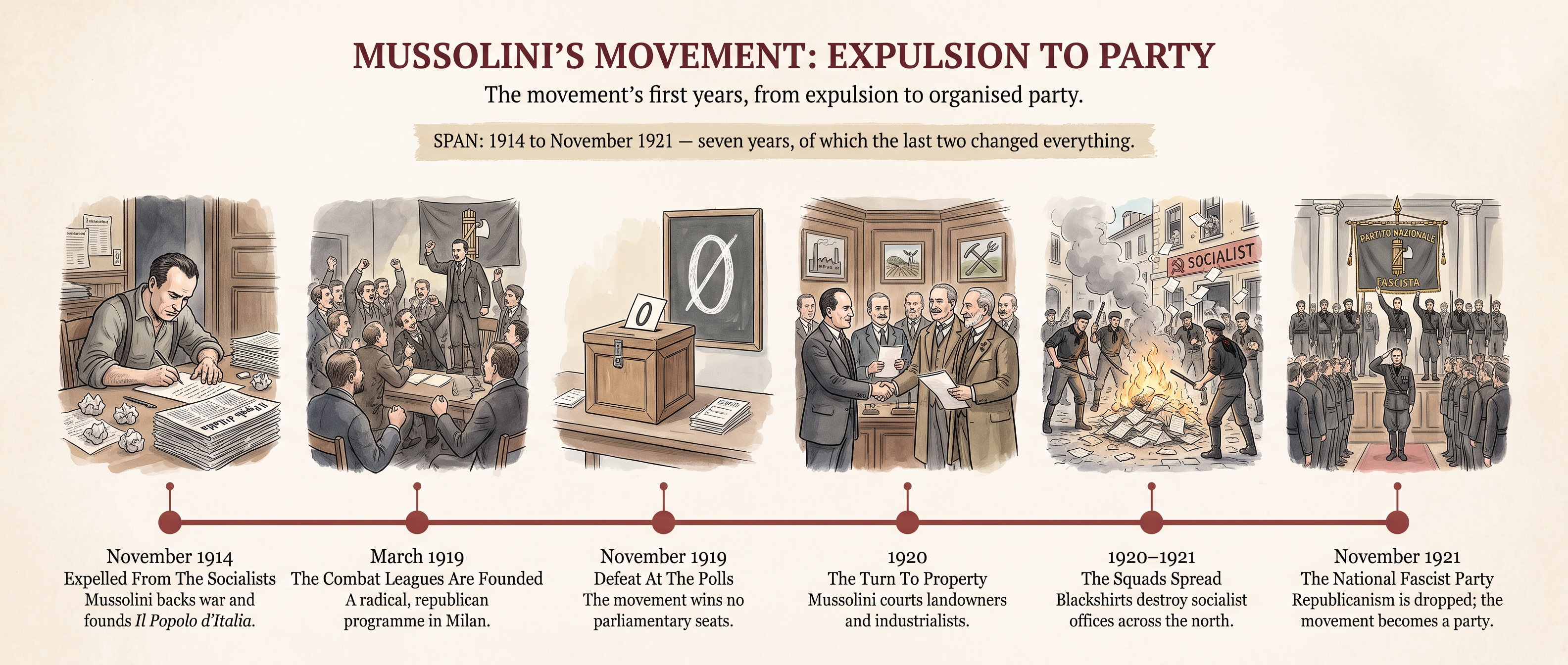
Fig. 10.3 – From One Editor To A National Party.
Fig. 10.3 ends where the decisive year begins. By the close of 1921 Mussolini had a party, a private army and powerful backers. The next section follows, month by month, how that combination was converted into the office of Prime Minister.
10.3 From The Elections Of 1921 To The March On Rome
Eighteen months separate the general election of May 1921 from Mussolini’s appointment as Prime Minister on 30 October 1922. In that time the Fascists won no new election, passed no law and captured no city by force of arms. What they did was to make themselves the only force in Italy that appeared able to act, while everyone else appeared unable to.
This section follows that sequence closely, because the sequence is the argument. Read it as a chain in which each link is the failure of somebody else.
10.3.1 The Elections Of May 1921
Elections were held in May 1921, called early by Giovanni Giolitti, who had been Prime Minister since June 1920 and was the most experienced politician in Italy. His calculation was that the Fascists could be absorbed: he invited them to stand alongside liberals and nationalists in a combined electoral list, expecting that a few dozen inexperienced deputies would be tamed by the routines of Parliament.
The Fascists won thirty-five seats, and Mussolini himself entered the Chamber of Deputies as a member for Milan. The Socialists remained by far the largest party. On paper, nothing much had changed.
Table 10.1 shows what was, and was not, at stake. The Fascists were the smallest of the four forces listed, holding about one seat in fifteen. The remaining seats belonged to liberal, democratic and nationalist groupings that had never formed a single disciplined party, which is why no stable majority could be built out of them.
Two consequences followed immediately. Giolitti’s attempt to use the Fascists had instead given them respectability, a platform in Parliament and legal protection for their leader. And when the arithmetic produced no workable government, Giolitti resigned in July 1921. A short-lived cabinet under Ivanoe Bonomi followed, and then, from February 1922, one under Luigi Facta.
10.3.2 Why The Opposition Failed
Thirty-five deputies could have been contained. They were not, and the reason lies with the parties that opposed them.
The Socialists refused to join any government with liberals or nationalists, on the principle that a workers’ party must not prop up a bourgeois state. The liberals, for their part, wanted Socialist votes without Socialist ministers. Each side preferred to be right rather than to govern, and neither would combine against the squads.
Meanwhile the squads themselves kept growing. Through the spring and summer of 1922 the Blackshirts moved from breaking up meetings to taking over towns: driving out elected councils in Emilia and Romagna, occupying town halls and installing their own men. In several northern cities, Fascist authority was already a fact before it was ever a law.
10.3.3 The General Strike Of 1922
At the end of July 1922 the anti-Fascist trade unions called a general strike — a strike across all industries at once — hoping to force the state to act against Fascist violence. It was intended as a show of strength.
It was a disaster for those who called it. Support was patchy, and the strike collapsed within days. The Fascists announced that if the government could not end it, they would end it themselves, and then did exactly that: squads ran trams and trains, cleared strikers from the streets, and in Milan occupied the city hall.
The strike handed Mussolini the argument he had been making since 1920. Here was a socialist challenge to public order; here was a government unable to meet it; here were the Fascists meeting it. He could now present himself not as a party leader but as the saviour of the nation from disorder — and, crucially, many Italians who disliked fascism found they could not name anyone else doing the job.
10.3.4 The March On Rome, October 1922
By October the Fascists were demanding the government itself. Their leaders gathered at a party congress in Naples on 24 October and then set the plan in motion: squads from across Italy would converge on the capital.
The ‘March on Rome’ began on 27 October. About thirty thousand Blackshirts moved on the city, seizing telephone exchanges, prefectures and railway stations in the towns they passed through. Many were poorly armed; the weather was wet; the columns were disorganised. They were nothing like an army.
Facta, still Prime Minister, understood the danger and asked King Victor Emmanuel III to sign a decree placing the country under a state of siege — a declaration that suspends normal government and puts the army in charge of order. The decree was drawn up. On the morning of 28 October the King refused to sign it.
That refusal, and not the march, decided the matter. Facta resigned. On 29 October the King telegraphed Mussolini in Milan and invited him to form a government. Mussolini travelled down to Rome overnight by train, arriving on 30 October to be appointed Prime Minister. Only after he had been appointed did the Blackshirt columns parade through the capital.
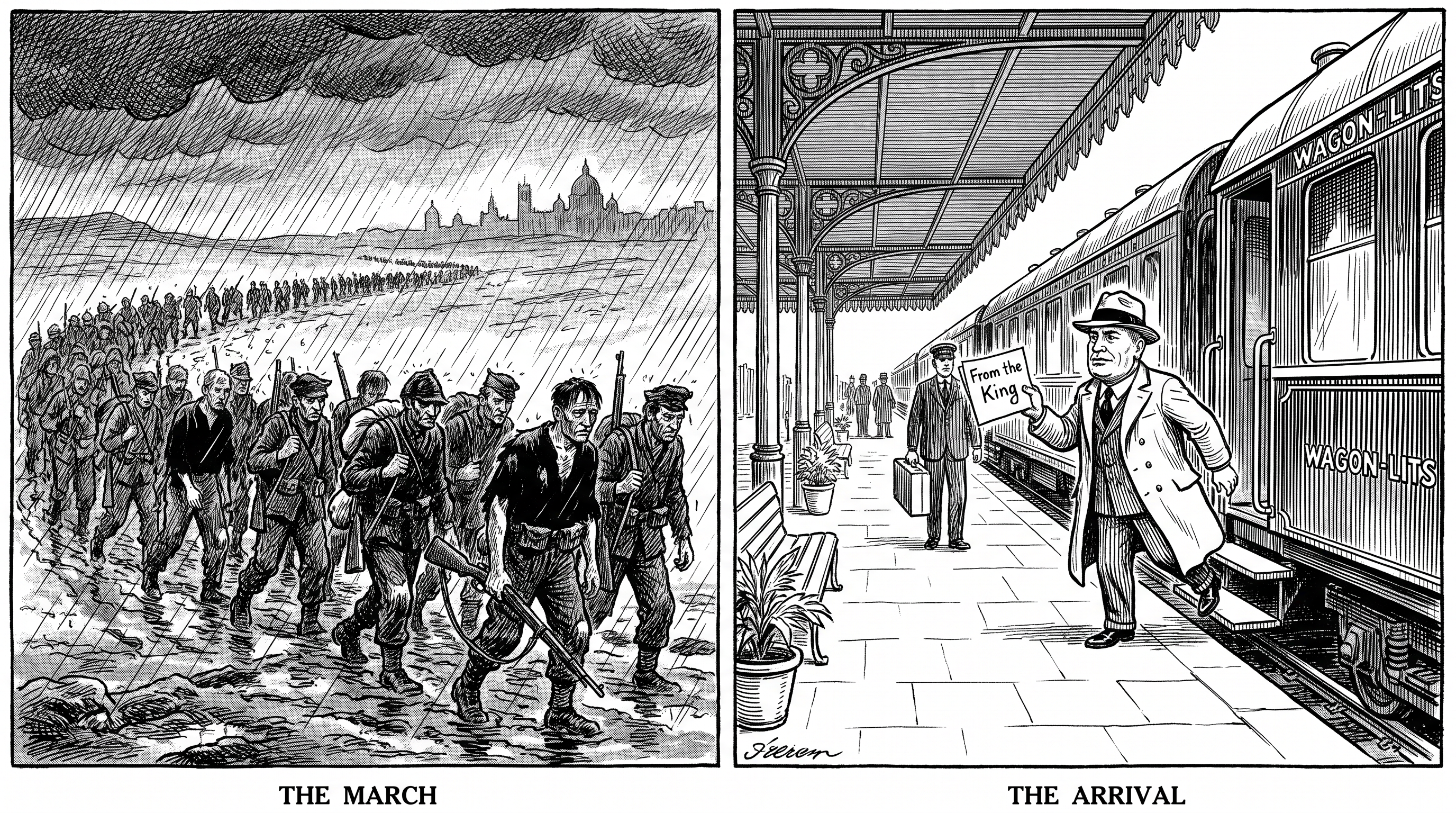
Fig. 10.4 – The march that arrived by rail.
Fig. 10.4 makes a point the word ‘march’ hides. Power was not seized in the streets; it was handed over in a telegram, and the marching was then arranged around the handover. Fascist propaganda spent the next twenty years describing October 1922 as a conquest, and the anniversary was celebrated every year as the birth of the regime.
10.3.5 Why The King Sent For Mussolini
Victor Emmanuel III’s refusal to sign is the most argued-over decision in modern Italian history. Four reasons are usually given, and they overlap.
He had lost confidence in Facta’s government, which had failed to control the violence for months. He doubted the loyalty of the army and police, whose officers were widely sympathetic to the Fascists, and feared giving an order that might not be obeyed. He feared that if the army could not crush the squads quickly, the result would be civil war. And he was aware that a section of the nationalist right favoured his cousin, the Duke of Aosta, and might use a crisis to replace him on the throne.
None of these is a reason of principle. They are calculations about risk, made by a man protecting his crown. He kept it for another twenty-four years, and lost it in the end because of this decision: he abdicated in 1946, and Italy voted to become a republic.
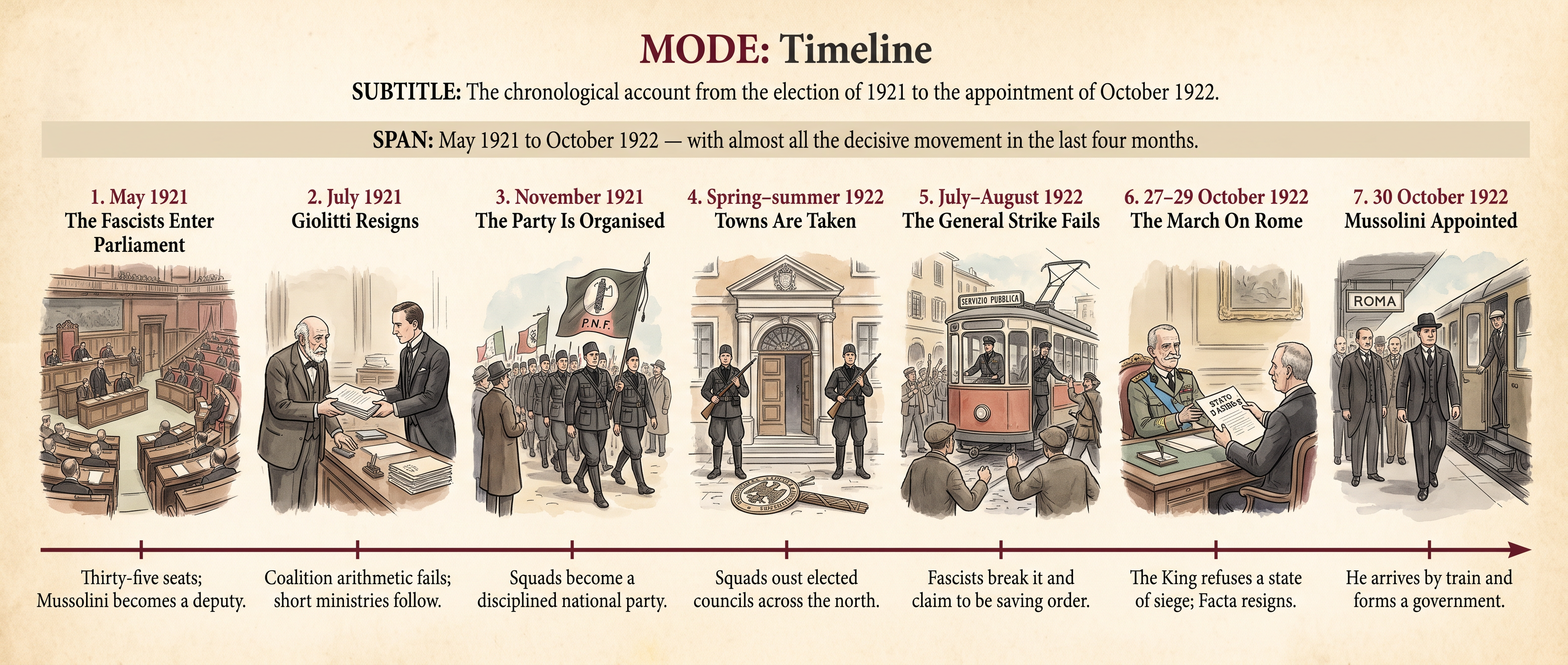
Fig. 10.5 – Eighteen Months To Power.
Fig. 10.5 sets out the account in order, but the order alone can mislead. Mussolini took office legally, appointed by the King and heading a coalition cabinet in which most ministers were not Fascists. Parliament was still sitting, elections were still due, and the constitution had not been altered by a single word. Turning that position into a dictatorship took another four years, and it is the subject of the sections that follow.
10.4 Remaking The Constitution And Local Government
Mussolini took office in October 1922 as the head of a coalition, appointed under the existing constitution and answerable to a parliament in which his party held thirty-five seats. Italy did not become a dictatorship on that day. It became one over the next six years, through a series of ordinary-looking laws.
That is the important thing to grasp about Fascist domestic policy. Very little of it was done in defiance of the law. Most of it was done by changing the law, one instrument at a time, so that at each stage the change appeared legal to the people asked to accept it.
10.4.1 Constitutional Changes
Rewriting The Election Rules
The first move came in November 1923, with the Acerbo Law, which altered how votes became seats. Under it, the list that won the largest share of the vote — provided it won at least a quarter of all votes cast — would automatically receive two-thirds of the seats in the Chamber of Deputies. The remaining third would be shared among everyone else.
Think about what that does. A party with a large minority of votes is converted into an overwhelming majority of seats, without any need for coalition partners. Proportional representation had produced parliaments that could not govern; the Acerbo Law produced a parliament that could not resist.
The law was used at the general election of April 1924, which the Fascist list won comfortably, in a campaign in which opponents were beaten and meetings broken up. From then on Mussolini commanded the Chamber outright.
Concentrating Power In One Office
The changes that followed, made mainly between 1925 and 1928, moved authority steadily away from Parliament.
Mussolini’s office was redefined: as Head of Government he was answerable to the King alone, and no longer to the Chamber that had traditionally been able to bring a ministry down by withdrawing its confidence. A minister who could not be voted out cannot be held to account by debate.
The government then took the power to issue decrees — orders that carry the force of law without being passed as bills. New law no longer required discussion. Opposition parties were dissolved in 1926, along with the associations attached to them, so that the only organised political body left in Italy was the Fascist Party itself.
Finally, the electorate itself was cut. Under the electoral law of 1928 the number of Italians entitled to vote fell from around ten million to roughly three million. The qualification was not simply wealth: it turned mainly on paying dues to the state-recognised syndicates or paying certain taxes, with the clergy and some other categories admitted separately. What it removed was the vote of anyone outside the structures the regime controlled.
Voting itself was changed beyond recognition. Instead of choosing between candidates, electors were handed a single national list of four hundred names, drawn up by the Fascist Grand Council — the party’s supreme body, which was made an organ of the state in 1928 — and asked only to approve or reject the whole list. The Grand Council was also to be consulted on constitutional questions, including the succession to the throne, which placed a party committee inside the machinery of the monarchy.
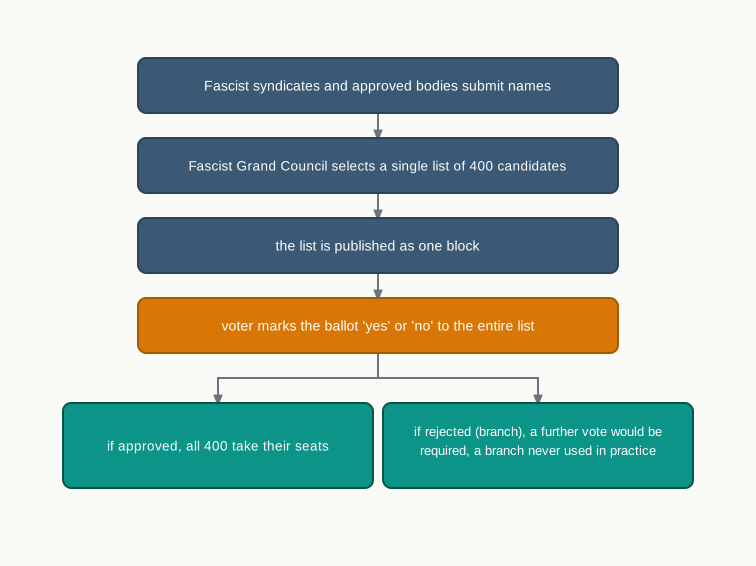
Fig. 10.6 – How the single list was chosen.
Fig. 10.6 shows why this cannot be called an election in the ordinary sense. An election offers a choice between alternatives; this offered a choice between the government’s list and no parliament at all.
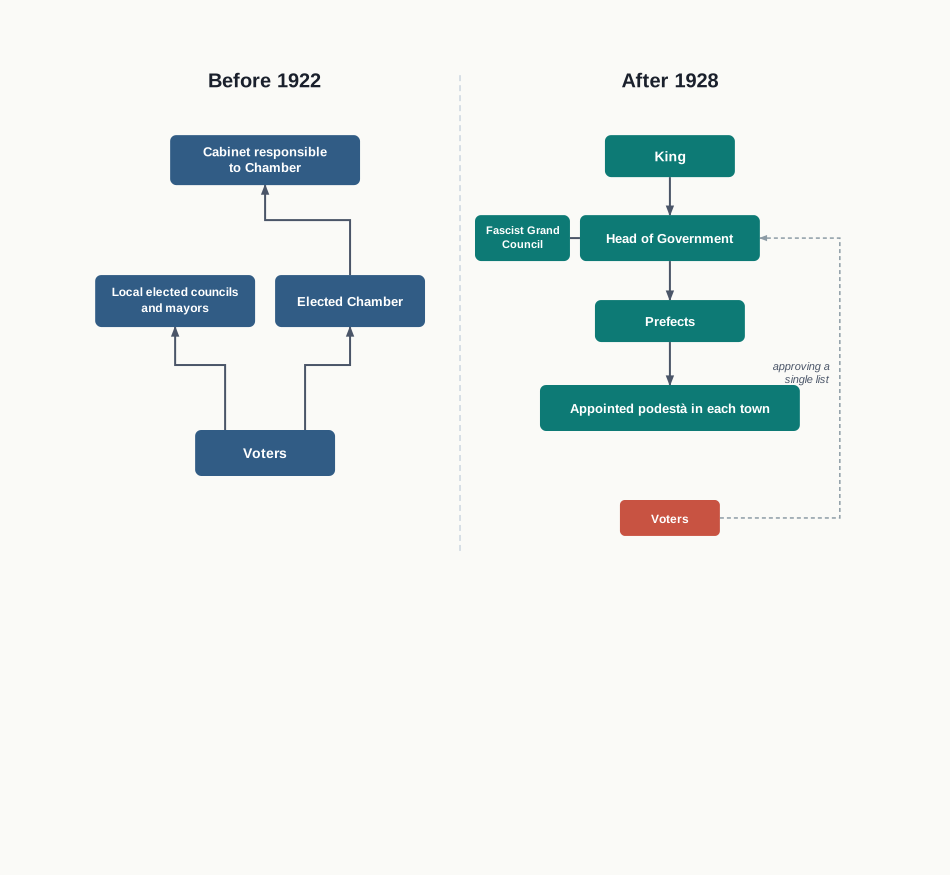
Fig. 10.7 – Authority before 1922 and after 1928.
10.4.2 The End Of Elected Local Government
A dictatorship at the centre is not secure while thousands of towns still elect their own councils, because every mayor with a local mandate is a rival source of authority. The regime therefore dismantled local self-government as thoroughly as it had dismantled Parliament.
Elected town councils and elected mayors were abolished. In their place each commune was administered by a single official, the podestà, appointed from Rome and removable by Rome, working under the prefect of the province. The people of a town no longer chose the person who governed it, and had no way to remove him.
Alongside this went the clearing away of everything that might organise people outside the party. Civic associations, clubs and unions were banned, or merged into Fascist structures that carried the same names and did the same activities under new control. In many districts the real power was neither the podestà nor the prefect but the local Fascist boss, whose squad had taken the town in the first place and who now went unchecked.
The point of all this was uniformity. A single set of instructions could now travel from Rome to every commune in Italy without meeting an elected body anywhere along the way.
By 1928, then, the machinery of Italian government had been rebuilt. Elections offered no choice, Parliament could not remove the head of government, laws needed no debate, and towns had no elected representatives. But machinery alone does not make a population obedient. That required reaching people where they lived, worked, studied and prayed — which is the subject of the next four sections.
10.5 Youth, Education And The Press
A regime that has abolished elections still has a problem: it must be obeyed every day, in millions of homes, by people it cannot individually supervise. Fascism’s answer was to reach Italians early and continuously — in the classroom, in the youth club, in the newspaper, on the radio and in the cinema.
Two words describe what followed, and they are not the same thing. Propaganda is the deliberate spreading of information chosen to produce a particular belief. Indoctrination is the training of people, usually the young, to accept a set of beliefs without questioning them. The regime used the first on adults and attempted the second on children.
10.5.1 Indoctrination Of The Youth
What The Schools Were For
Mussolini’s educational policy had two declared aims. The first was to produce boys who would join the army willingly, so that Italy would have the military strength its rhetoric claimed. The second was broader: to raise a generation that would take Fascist rule for granted, having known nothing else.
School and university teaching was supervised accordingly. Textbooks were rewritten to glorify the regime and its leader, and from the end of the 1920s elementary schools were required to use a single official book. History lessons dwelt on the greatness of ancient Rome and presented fascism as its rightful heir.
Teachers were required to wear uniform and to swear loyalty to the regime, and both teachers and pupils were forbidden to criticise the government. A teacher who could be dismissed for a remark in class is not going to encourage argument in it.
Organising Childhood
Outside school hours, the regime built a structure that took in children from the age of six. The youngest, boys and girls together, were enrolled as Figli della Lupa — ‘children of the she-wolf’, a name pointing back to the wolf that was said to have suckled the founders of Rome. Older boys passed through the national youth organisation founded in 1926, drilling with uniforms, flags and, in the senior ranks, rifles. In 1937 the whole apparatus was reorganised into a single body, the Gioventù Italiana del Littorio, known as the GIL.
Boys were trained for war and girls for motherhood — physical exercise, domestic skills, and the duty of raising many children for the nation. Meetings, camps, parades and sports filled Saturdays and holidays. The slogan taught to them was as plain as slogans get: ‘Believe, obey, fight’.
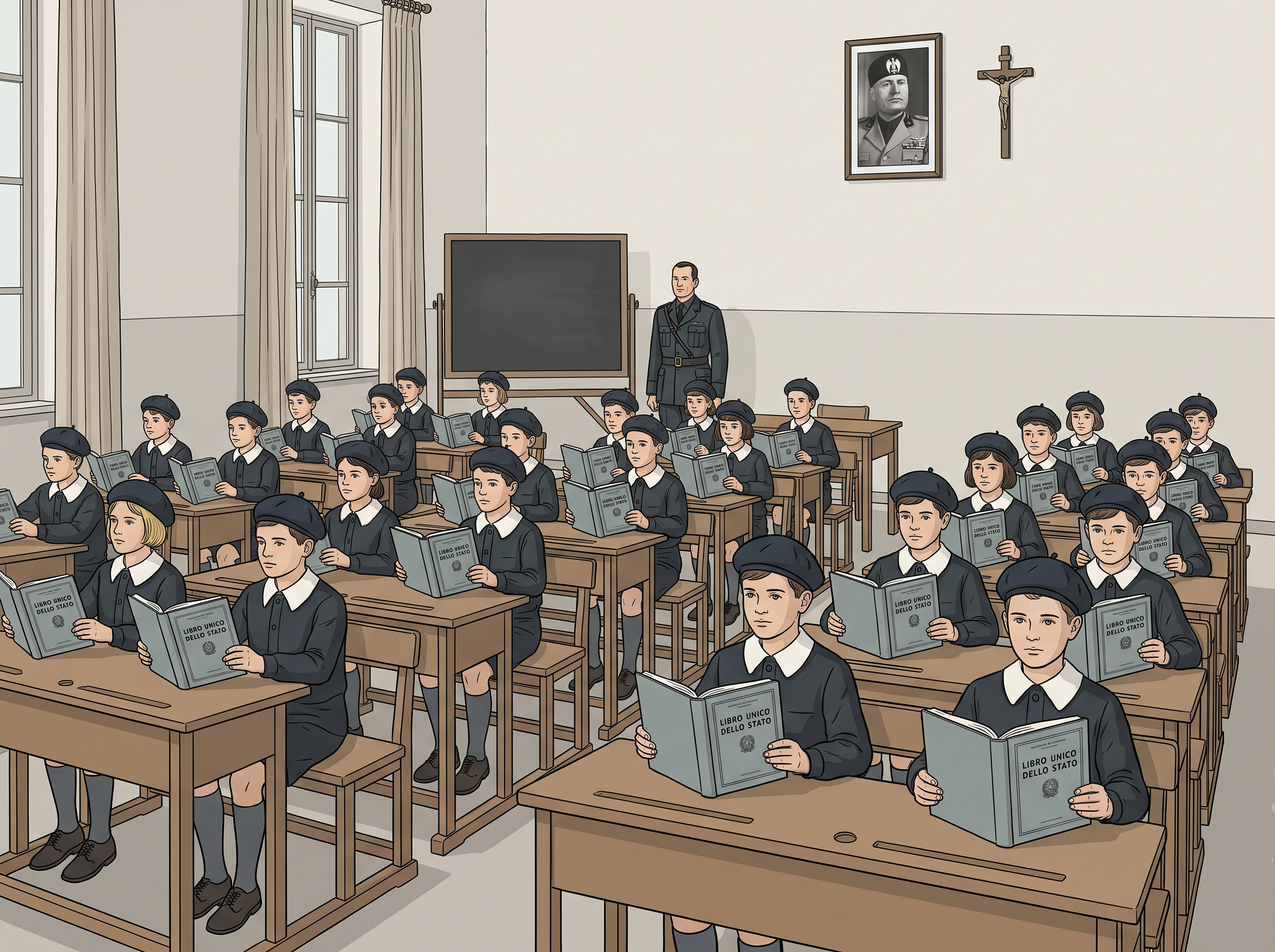
Fig. 10.8 – A classroom under the regime.
10.5.2 Control Over Opinion
Closing Down The Press
The aims here were equally clear: to control what the public knew, and to keep Fascist values in front of them daily.
From 1926 the government took powers over the newspaper trade that made independent journalism impossible. Anti-Fascist papers and magazines were banned outright. Editors had to be acceptable to the authorities, and officials could seize an issue before it reached the streets. Since a seized edition is a financial loss, editors learned to censor themselves, which is cheaper for a government than censoring them.
Control then extended beyond print. Radio broadcasting, still new, was in state hands. Newsreels made by the state film institute were shown in cinemas before the main feature, so that audiences who had come for entertainment watched the government’s version of the week’s events first. Theatre, films and books all came under supervision, coordinated from 1937 by the Ministry of Popular Culture, remembered by its abbreviation MinCulPop, which issued instructions on what could be published or broadcast.
Trace It shows why the absence of criticism in Italian newspapers after 1926 proves nothing about Italian opinion. The papers did not fall silent because readers had stopped complaining. They fell silent because the complaint could not be printed.
The Cult Of The Leader
Two themes ran through everything the machinery produced. One was ancient Rome: the regime presented Roman militarism as a model and itself as the empire’s rightful successor, which is why the fasces, the eagle and the language of legions appear everywhere in its imagery.
The other was Mussolini himself. His portrait hung in classrooms and offices; his speeches were broadcast to crowds assembled to hear them; the phrase ‘Mussolini is always right’ was painted on walls. He was shown as soldier, farmer, pilot, sportsman and statesman by turns — tireless, and never wrong.
This cult was not a personal vanity project alone; it did political work. Where an ordinary politician’s failures can be debated, a leader who is always right cannot be criticised without attacking the nation itself. That is precisely what it was designed to prevent.
Schools, youth organisations and a controlled press between them shaped what Italians heard from childhood onwards. But belief is one thing and bread is another. The regime also had to settle what would happen in the workplaces where the strikes of 1920 had begun, and that is the subject of the next section.
10.6 Labour And The Corporate State
The strikes and factory occupations of 1919 and 1920 had done more than anything else to make fascism attractive to those with property. Once in power, the regime had to settle the question those years had raised: who decides what a worker is paid, and what happens when workers and employers disagree?
Its answer was the corporate state. In theory, workers and employers in each branch of the economy would no longer confront each other as enemies. They would be organised into bodies called corporations, supervised by the state, in which the national interest rather than class interest would decide. Class conflict would not be won by either side; it would be abolished.
Dismantling Independent Unions
The theory required the removal of anything that could bargain on its own. Independent trade unions — those attached to socialist, communist or Catholic movements — were dissolved, and their funds and offices taken over. In their place stood Fascist syndicates, which alone were recognised in law and alone had the right to negotiate on behalf of workers in a trade.
An agreement in 1925 between the Fascist syndicates and the employers’ confederation settled the point at the top: employers would deal with the Fascist syndicates and with nobody else, and elected factory committees inside the workplaces were abolished. A worker with a grievance now had exactly one channel, and it belonged to the government.
The law of 1926 completed the arrangement. Only recognised syndicates could make collective agreements; strikes and lockouts — an employer’s counterpart to a strike, in which workers are shut out of the workplace until they accept terms — were both made illegal. Disputes were to go instead to special labour courts, which would rule on what was fair.
How The System Was Meant To Work
From 1926 a Ministry of Corporations supervised the structure, and by the mid-1930s twenty-two corporations had been set up, one for each broad branch of the economy. Each brought together the syndicate of workers and the association of employers in that branch, with government officials and party representatives alongside them.
The corporations were to lay down wages, hours and conditions for their whole industry, and their decisions had the force of law. A statement of principles issued in 1927 declared that private enterprise was the most effective way of producing wealth, that the state would intervene where private effort fell short, and that work was a social duty owed to the nation.
That last phrase repays attention. If work is a duty owed to the nation rather than a service sold for wages, then withholding it is not bargaining but desertion — and the ban on strikes follows naturally from the definition.
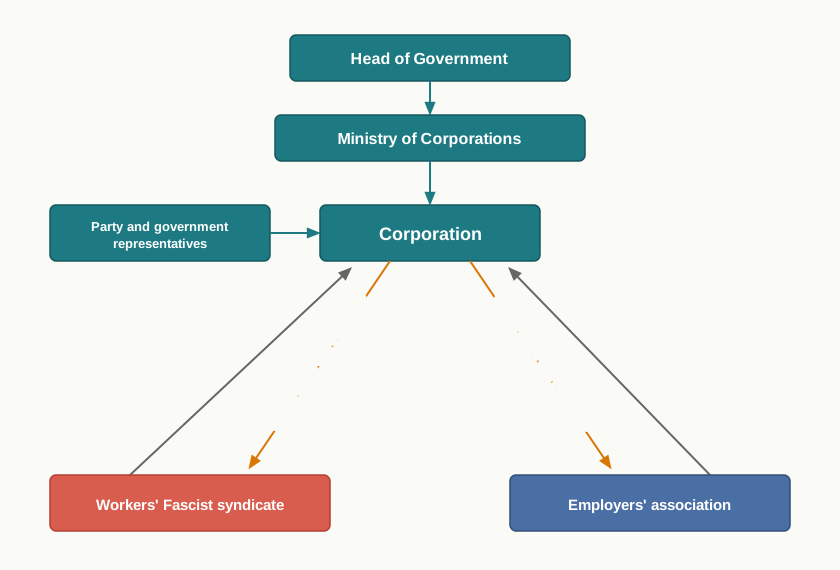
Fig. 10.9 – The corporate state organisation.
What It Meant On The Factory Floor
The two sides did not lose equally. Employers kept their own confederation, their own officials and a great deal of independence in running their firms; corporation decisions were often shaped by what large industrialists were prepared to accept. Workers lost the organisation they had built over decades, and gained officials appointed over their heads.
The measurable results point the same way. Through the later 1920s and the 1930s, hours and conditions in many industries were fixed by agreements that workers had no means of refusing, and real wages — what a wage will actually buy — fell for much of the period.
In return the state offered compensations of a different kind: paid annual holidays, free Sundays, social insurance against accident and old age, and organised leisure, which is discussed in section 10.9. These were real benefits and were felt as such. They were also, precisely, gifts — granted by a government rather than won by negotiation, and revocable by the same government.
Judging The Corporate State
Corporatism was the part of fascism that its supporters abroad admired most, presenting it as a third way between free-market capitalism and communism — neither leaving the economy to private owners nor handing it to the state.
Whether it was anything of the kind is disputed. The corporations employed a great many officials and produced a great deal of paper. Historians have argued for decades over how much they actually decided, and how much they simply registered decisions taken elsewhere.
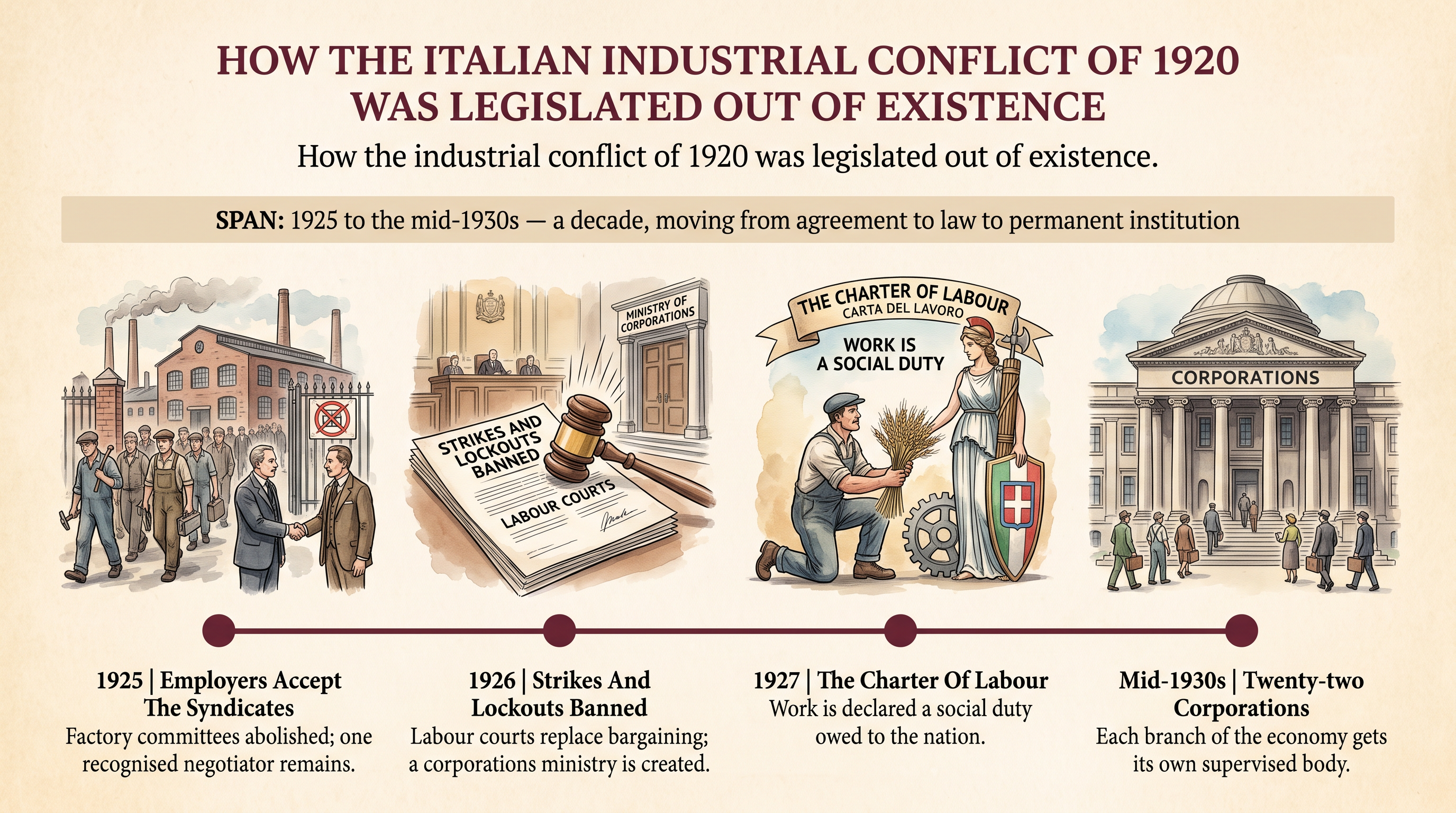
Fig. 10.10 – Settling The Labour Question.
Fig. 10.10 completes the picture of a state that had absorbed politics, local government, schooling, the press and now the workplace. What remained outside it was the Church — an institution older than the Italian state itself, with a hold on Italians that no ministry could legislate away. That is the subject of the next section.
10.7 The Regime And The Catholic Church
Of all the institutions the Fascist state dealt with, the Catholic Church was the one it could not abolish, absorb or outvote. It was older than the Italian kingdom, it was international, and it reached into the life of nearly every Italian family through baptisms, marriages, funerals and the parish priest.
It was also, in 1922, at war with the Italian state — and had been for half a century.
The Roman Question
Until 1870 the Pope had ruled a band of territory across central Italy, including Rome, as a temporal sovereign: not merely as head of a Church but as the government of a state, with taxes, courts and an army. In 1870 the armies of the new Kingdom of Italy took Rome and made it the national capital, and that rule ended.
The Papacy never accepted the loss. Pope Pius IX and his successors refused to recognise Italian authority over Rome, declined to leave the Vatican, and for decades discouraged Catholics from taking a full part in the political life of the kingdom. This long standoff was known as the Roman Question, and it left the Italian state without the blessing of the institution most Italians belonged to.
The Lateran Pacts Of 1929
Mussolini had begun as an anti-clerical who demanded the confiscation of church property. From 1920 onwards he abandoned that position entirely, spoke of Catholicism as inseparable from Italian identity, and made a settlement with the Papacy one of his objectives. In February 1929, after long negotiations, the two sides signed the Lateran Pacts.
The settlement had three parts, and it is worth separating them.
First, a treaty. Italy recognised Vatican City as an independent state under the sovereignty of the Pope — a territory of well under half a square kilometre, the smallest independent state in the world, and the administrative and spiritual centre of the Roman Catholic Church. In return, the Papacy recognised the Kingdom of Italy with Rome as its capital. The Roman Question was over.
Second, a financial agreement. The Italian state paid the Holy See a large sum in cash and government bonds as compensation for the territories lost in 1870.
Third, a concordat — an agreement between a state and the Papacy governing the position of the Church within that state. Catholicism was recognised as the sole religion of the Italian state. Religious instruction, already given in elementary schools, was extended to secondary schools. Marriages celebrated in church were given full effect in civil law. Bishops were to swear loyalty to the state. The Church was left free in its spiritual work, and its lay organisations were permitted to continue on the condition that they stayed out of politics.
Map
Map 10.2 Caption: The Vatican City State created in 1929, an independent territory inside the city of Rome. Brief: Two-level map. Inset: outline of the city of Rome with the Vatican area marked. Main map: the Vatican City boundary, showing St Peter’s Basilica, the square, the palaces and gardens, with a scale bar to make the size clear, and the surrounding Italian streets labelled as Italian territory. Caption the map with the date 1929. Do not show any other Papal territory, which had ceased to exist in 1870.
What Each Side Gained
For Mussolini the settlement was probably his greatest success in the eyes of ordinary Italians, and it was presented as such throughout the controlled press described in section 10.5. A quarrel that had defeated every liberal government since 1870 had been closed by the Fascist regime. Catholics who had held back from the state could now support it without conflict of conscience, and foreign governments took the settlement as evidence that the regime was respectable.
For the Church the gains were substantial and concrete: sovereignty over its own territory, financial compensation, a guaranteed place in the education of Italian children, and the recognition of religious marriage. What it gave in exchange was legitimacy — and legitimacy given to a regime is not easily withdrawn.
The Limits Of The Alliance
It would be wrong to conclude that the Church had become an arm of the regime. The two institutions wanted the same children, and that made a collision certain.
In 1931 the government moved against the Church’s youth organisations, which competed with its own. The Pope protested publicly and in strong terms, objecting to the state’s claim on the whole upbringing of the young. A compromise followed: the Catholic organisations survived, but confined to religious activity.
The episode shows both the strength and the limits of the settlement of 1929. The Church could not be crushed as the socialist unions had been, and it could speak in public when no one else in Italy could. But it spoke about what touched it directly, and it did not withdraw the legitimacy it had granted.
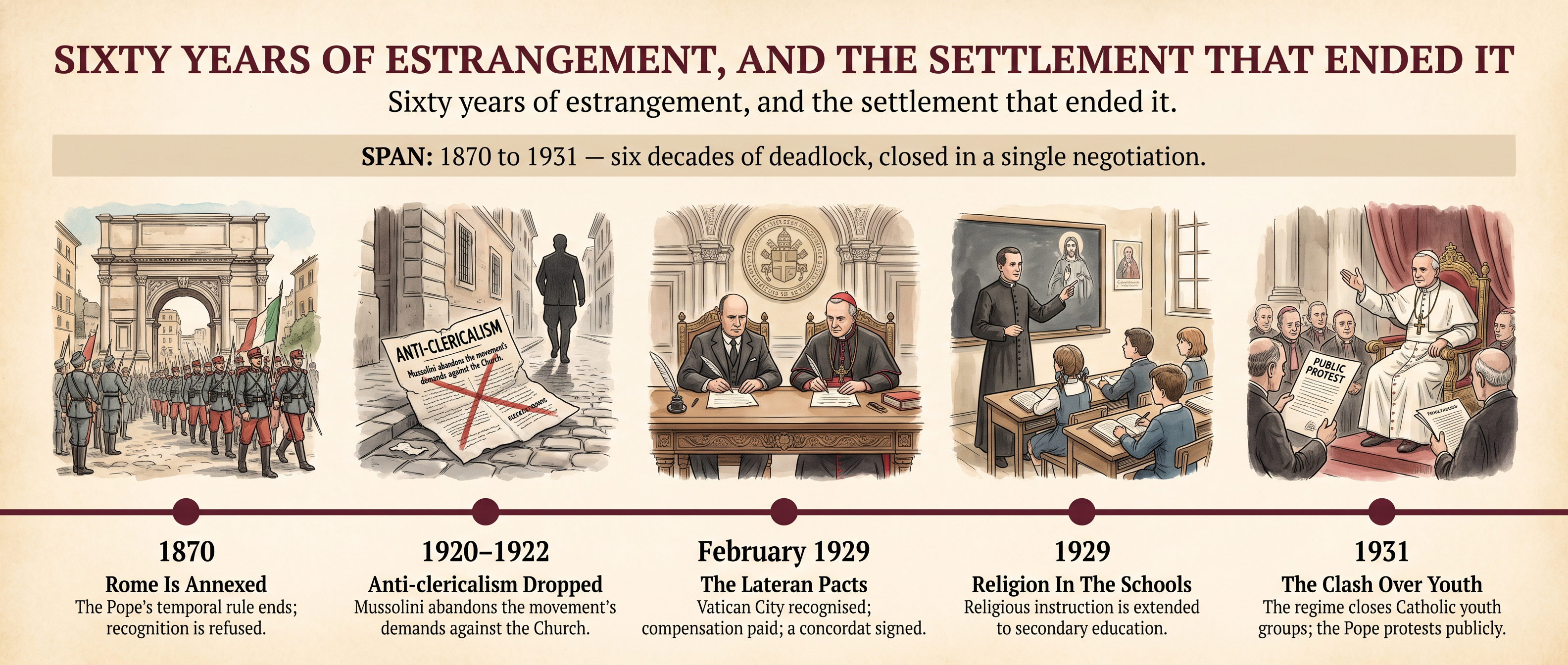
Fig. 10.11 – From The Roman Question To The Concordat.
Fig. 10.11 closes the account of how the regime dealt with the institutions it inherited. The next section concerns something it did not inherit but chose, late and deliberately: a policy of racial discrimination that had no precedent in Italian law.
10.8 The Racial Laws From 1938
For the first sixteen years of the regime, Italian fascism had no racial policy directed against Jews. Italian Jews had held full legal equality since the unification of Italy, and they were a very small community — fewer than fifty thousand people, roughly one Italian in a thousand. Some had fought in the First World War, some held university chairs, and a number had joined the Fascist Party in its early years.
In 1938 that changed, quickly and by law. Antisemitism — hostility and discrimination directed against Jews as a group — became official Italian policy, and within months Italian citizens were stripped of rights their families had held for three generations.
What The Laws Did
In July 1938 the regime published a statement on race, commonly called the Charter of Race, drawn up by academics and officials. It asserted that a distinct Italian race existed, described it as of ‘Aryan’ origin, and declared that Jews did not belong to it. There was no scientific basis for any of these claims; their purpose was to make a legal category out of a prejudice.
The measures followed at once. In September Jewish pupils and teachers were expelled from state schools and universities. Jews who were not Italian citizens were ordered to leave the country. In November came the main body of law: marriage between Jews and other Italians was forbidden, Jews were barred from public employment, from the armed forces and from the party, and limits were placed on the land, property and businesses they could own. Professional work was progressively closed to them.
State the effect plainly. A schoolteacher lost her post, a boy was sent home from his class, a family firm passed out of its owners’ hands, and none of it depended on anything they had done. Several thousand people left Italy; those who remained lived under restrictions that were tightened rather than relaxed.
Why 1938?
The date is the puzzle, and it has produced a long argument among historians.
One explanation is external. By 1938 Mussolini’s government was drawing close to Nazi Germany, whose own racial laws were five years old, and antisemitic legislation was the price or the proof of that friendship. On this reading the policy was imported, and it was not deeply believed in — which would help explain why enforcement in Italy was uneven and why many officials, neighbours and employers quietly failed to apply it.
The other explanation is internal. Fascism had always insisted that the nation was a single organism with a single destiny, and had always treated those outside it as a danger. On this reading 1938 was not a borrowing but a conclusion — the point at which a doctrine of national unity produced the exclusion it had always implied.
The Reaction, And The Silence
The Church objected, though within limits. The ban on marriages between Jews and other Italians cut directly across the concordat of 1929, under which the state had recognised marriages celebrated by the Church, and the Papacy protested on that ground and against the racial doctrine itself. The protest changed nothing in the law.
Elsewhere there was very little public opposition, and section 10.5 explains why there could not be. By 1938 there were no opposition parties, no independent newspapers, no free associations and no elected councils. A country that has dismantled every means of collective objection has also dismantled the record of whether anyone objected.
The racial laws remained in force through the end of the period covered by this chapter. What happened to Italy’s Jews after the German occupation of 1943 belongs to a later story and a later chapter of European history, but it began here, with a register of names compiled in 1938.
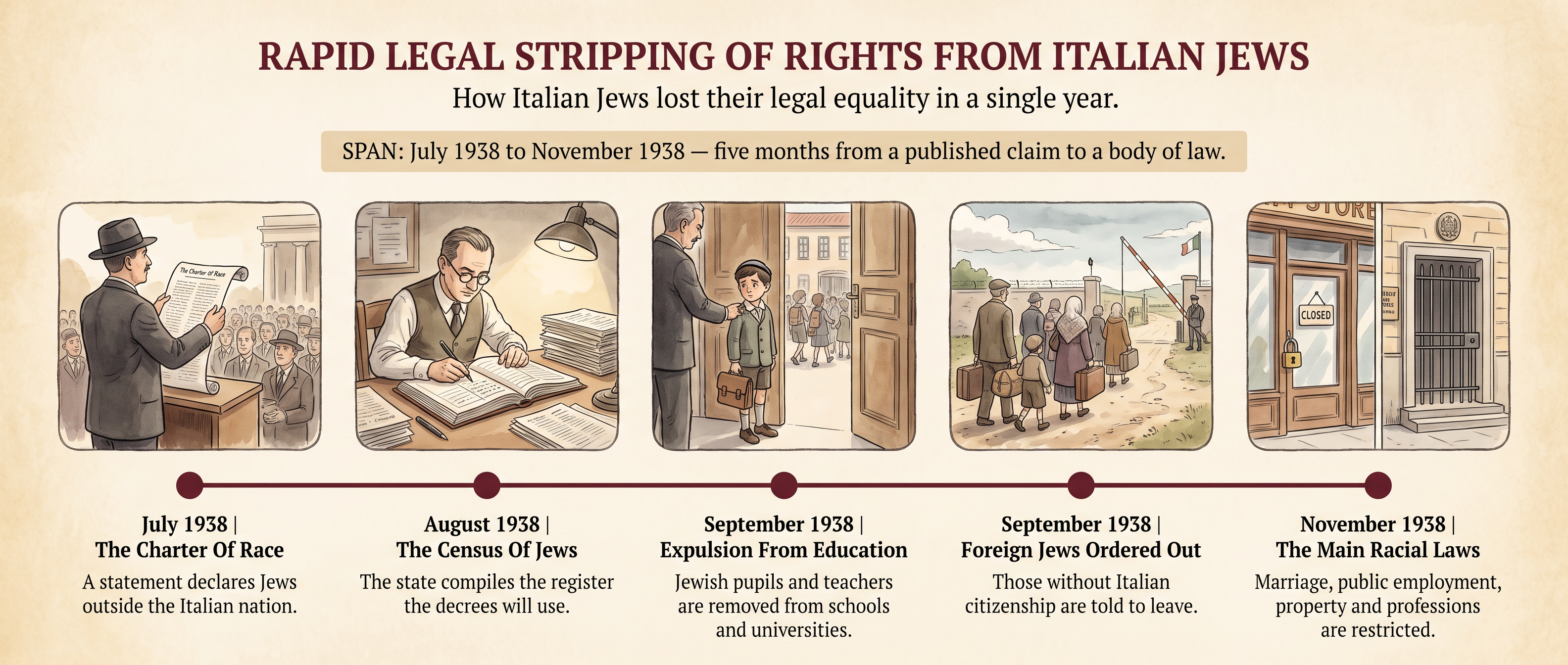
Fig. 10.12 – One Year Of Law.
Fig. 10.12 completes the account of the regime’s domestic policy. The remaining question is the one Mussolini himself claimed to care about most, and on which he asked to be judged: what all this power was used for economically, and whether it left Italy stronger.
10.9 A Critical Appraisal Of Mussolini’s Economic Policy
Mussolini presented his economic programme as a series of battles — the Battle of Wheat, the Battle for the Lira, the Battle for Births — and the language was chosen deliberately. A battle has a commander, an enemy and a victory; it is not a policy to be examined but a campaign to be won.
Behind the campaigns lay one governing idea. Autarky is the condition of a country that supplies its own needs and depends on no foreign source for food, fuel or raw materials. Mussolini believed autarky was necessary if Italy was to be, in his phrase, a warrior nation, since a country that imports its bread and its coal cannot fight a long war without permission from its suppliers.
The question this section asks is the one the regime itself invited: did the campaigns work?
10.9.1 Autarky And The Battle Of Wheat
The Battle of Wheat, launched in 1925, aimed to make Italy self-sufficient in the grain from which its bread was made. The government raised the tariff — the tax charged on goods entering the country — on imported wheat, so that foreign grain became expensive. It paid subsidies to growers, distributed better seed and machinery, and ran prize competitions and publicity of the kind described in the chapter opener.
What It Achieved
The wheat harvest grew substantially, and by the later 1930s Italy was importing far less grain than before. Measured against its own stated target, the campaign could reasonably be called a success, and it was extremely popular with the large cereal growers of the northern plains, who had the flat land, the capital and the machinery to expand production.
What It Cost
The costs fell elsewhere, and they were serious. Land was pushed under wheat that was not suited to it, particularly in the south, where grazing, olives, citrus and vines had been more productive and more profitable. Output of those products fell, and so did the number of livestock, which meant less dairy produce.
Two consequences followed. Italian farming as a whole became less efficient, because land was being used for what it was worst at rather than what it was best at. And the Italian diet narrowed: more bread, less meat, milk, oil and fruit, for a rural population among whom farm labourers were already the poorest people in the country.
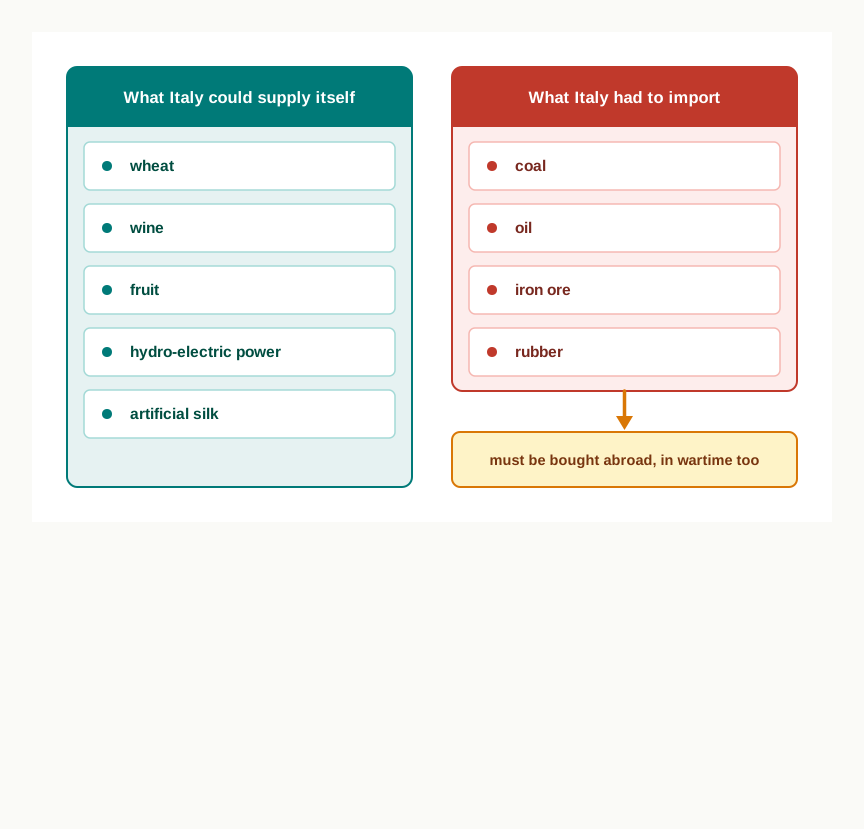
Fig. 10.13 – Goods Italy could supply versus required imports.
10.9.2 The Battle For The Lira
In 1926 Mussolini announced that the lira would be revalued and defended at ninety lire to the pound sterling — a rate soon known simply as ‘quota 90’. The lira had been trading much weaker than that. Raising its value was a matter of national prestige: a strong currency was to be the visible sign of a strong state.
Working Out What A Revaluation Does
Follow the arithmetic slowly, because the whole judgement rests on it. Suppose an Italian manufacturer sells cloth at \(1{,}800\) lire a bale. If the exchange rate is \(150\) lire to the pound, a British buyer pays
\[\frac{1800 \text{ lire}}{150 \text{ lire per pound}} = £12\]
If the lira is revalued to \(90\) lire to the pound, the same bale, at the same Italian price, now costs that buyer
\[\frac{1800 \text{ lire}}{90 \text{ lire per pound}} = £20\]
The Italian producer has not raised his price by a single lira, and his goods have become two-thirds dearer abroad. The same movement works in reverse on imports: coal, iron ore and cotton bought from abroad became cheaper in lire.
Who Gained And Who Lost
Exporting industries were hit hard — textiles above all, which had been among Italy’s most successful trades — and unemployment rose in them. Industries that bought heavily from abroad, chiefly steel and chemicals, gained from cheaper raw materials.
Workers paid a direct price. To keep Italian goods saleable at the new exchange rate, wages were cut by decree, by something in the region of a tenth to a fifth. Prices fell too, but not by as much, so the cost of living rose in real terms for many families. This is where the corporate state described in section 10.6 mattered: a wage cut imposed by decree could not be answered by a strike, because striking was now a crime.
10.9.3 Industry, Land Reclamation And Public Works
Fascist Italy did build. Steel output rose, hydro-electric power expanded considerably in a country with mountains and rivers but no coal, and the artificial silk industry — rayon, made from wood pulp — grew into one of the largest in Europe.
But the fundamental shortages were not addressed, because they could not be: Italy had very little coal and almost no oil, and no policy could put them in the ground. Italian industrial output continued to lag behind that of Britain, Germany and France, and the country entered the 1940s dependent on imported fuel.
The world slump that began in 1929 struck Italy as it struck everyone, and banks that had lent heavily to industry found their borrowers unable to repay. The state stepped in, taking over the industrial shareholdings of the failing banks through a new public institute set up in 1933. The result was unintended and significant: by the late 1930s the Italian state owned a larger share of its own industry than any government in Europe outside the Soviet Union.
Land reclamation was pursued under a law of 1928 that combined the draining of marshes with irrigation, road building and the planting of trees in the mountains. Public works followed the same logic — bridges, stations, schools, blocks of flats, new towns and motorways — with the double purpose of employing men and displaying a modern, energetic Italy.
10.9.4 The Battle For Births
Population was treated as a branch of economic policy, because Mussolini held that a great power needed men — for its army, its factories and its future. The Battle for Births, launched in 1927, aimed to raise the Italian population from roughly forty million to sixty million by 1950.
The measures were financial and legal together. A tax was levied on unmarried men. Family allowances were paid, and men with large families were given preference in employment and promotion. Contraception and abortion were penalised. Propaganda praised prolific mothers and held up twelve children as the ideal family.
It did not work. The birth rate continued to fall through the 1930s, as it was falling across urban Europe, and no combination of taxes and prizes reversed it. The population did grow, but chiefly because people were dying less often rather than because more were being born.
The failure is instructive. This was the regime at the height of its power over schools, press, radio and law, applying every instrument it had to a decision made privately in millions of homes — and losing.
10.9.5 Dopolavoro And Fascist Welfare
The Dopolavoro — literally ‘after work’ — was the regime’s national leisure organisation, founded in 1925 and grown by the 1930s into one of the largest bodies of its kind anywhere. Through local clubs it offered organised sport, cinema shows, concerts, theatre, choirs, libraries, excursions, cheap holidays and railway tickets, insurance benefits and help for low-income families.
It was genuinely popular, and for many working families it provided the first holidays and organised entertainment they had ever had. This is worth stating plainly, because a regime is not explained by pretending that everything it offered was worthless.
But its purpose was not only recreational. It reached workers who had lost the right to strike and their independent unions, and gave them something in return that the state could withdraw. It also brought leisure hours inside an organisation the party supervised, so that the football team, the outing and the film show all came with the regime attached.
The wider welfare schemes worked the same way. They were presented as building a modern state that looked after its people, and they did employ men and put up buildings. But they were directed at securing loyalty and projecting an image of a dynamic Italy rather than at meeting need where it was greatest, and they never amounted to a system a family could rely on as of right.
10.9.6 An Overall Assessment
Set the campaigns side by side and a pattern appears. Each was announced with great publicity, each produced a visible achievement that could be photographed, and each was costly in ways that were not photographed at all.
Wheat output rose, and Italian farming became less productive and less varied. The lira was defended at a proud figure, and exports and wages fell. Marshes were drained at Pontine, and nine-tenths of the reclamation programme was never done. Leisure was organised for millions, and the bargaining power that might have raised their wages was gone.
Two judgements can be made with reasonable confidence. First, the policies favoured those already strong — large landowners, heavy industry, the state’s own institutions — while workers and peasants saw little improvement, and real wages for much of the period fell. Second, autarky was never achieved where it mattered most. Italy could grow its bread but not dig its coal or pump its oil, and in 1940 it entered a great war with an economy that could not supply the war it had spent fifteen years talking about.
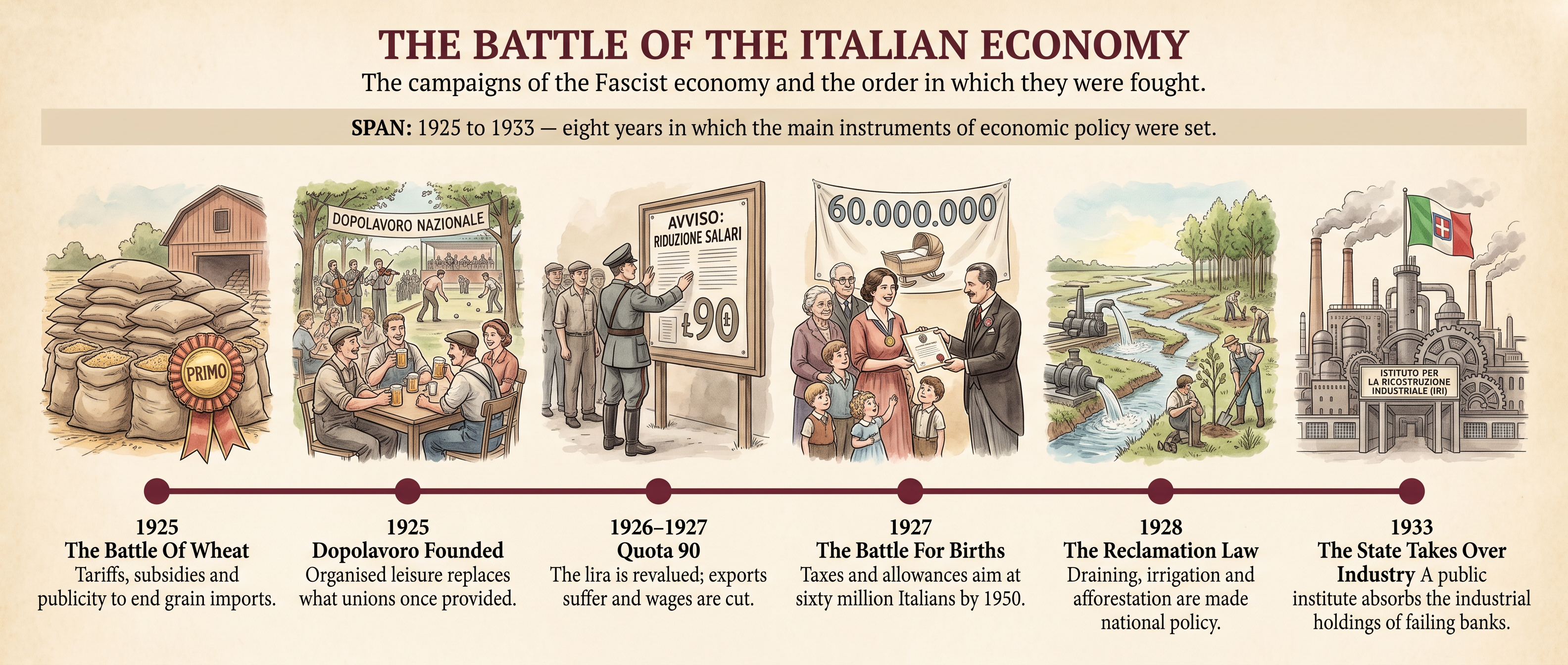
Fig. 10.14 – The Economic Battles.
10.10 Summary
Italy After The War
- Italy joined the First World War in 1915 in exchange for territory promised in the secret Treaty of London, and more than half a million of its soldiers died.
- The peace settlement gave Italy its northern frontier under the Treaty of Saint-Germain, but not Dalmatia, not Albania and not Fiume; nationalists called the result a ‘mutilated victory’.
- Wartime borrowing left inflation, a devalued lira and heavy debt; war contracts ended just as millions of soldiers were demobilised into unemployment.
- The Two Red Years of 1919–20 brought strikes, occupied factories and land seizures by labourers’ leagues, and the state did not defend property owners.
- Whether revolution was actually close matters less than the fact that property owners believed it was, especially after the Communist Party was founded in 1921.
- Proportional representation produced a parliament of blocs that would not combine, so coalition ministries formed and fell while nothing was decided.
The Rise To Power
- Fascism placed the nation above class, insisted on one unquestioned leader, rejected both parliaments and socialism, and treated violence as a legitimate political method.
- Mussolini began as a socialist editor, was expelled in 1914 for backing the war, and founded the combat leagues in Milan in March 1919 on a radical, republican programme that won no seats.
- What changed his position was squad violence: Blackshirts funded by landowners destroyed socialist offices and leagues while police and courts looked away.
- He then traded away the 1919 programme piece by piece — abandoning attacks on property, on the Church and finally on the monarchy — to gain powerful backers.
- In May 1921 the Fascists won thirty-five seats after Giolitti invited them into his electoral bloc, hoping that office would tame them.
- The failed general strike of July 1922 let Mussolini claim to be the only force capable of keeping order, since the Fascists broke a strike the government could not.
- In October 1922 the King refused to sign a decree of a state of siege, Facta resigned, and Mussolini was invited to Rome and appointed Prime Minister; the march followed the appointment.
- The King’s decision rested on distrust of Facta, doubt about the army’s loyalty, fear of civil war and fear for his own throne — calculations of risk, not of principle.
Rebuilding The State
- The dictatorship was built inside the constitution by legislation, not seized in a single act; that is what makes the sequence worth studying.
- The Acerbo Law of 1923 gave two-thirds of the seats to whichever list won a quarter or more of the votes, cutting the link between votes and representation.
- Between 1925 and 1928 the head of government was made answerable to the King alone, given power to rule by decree, and freed from any parliament able to remove him.
- The electorate was cut from about ten million to about three million, and voters were given a single list of four hundred names to approve or reject.
- Elected town councils and mayors were abolished in 1926 and replaced by the appointed podestà, so no elected body stood between an Italian and Rome.
- Clubs, cooperatives and associations were banned or absorbed, removing the places where any future opposition would have had to be built.
Shaping People
- Schools were supervised, textbooks rewritten and a single elementary reader prescribed; teachers swore loyalty and could be dismissed for a remark in class.
- Uniformed organisations took children from the age of six through to adulthood, training boys for war and girls for motherhood.
- Opposition newspapers were banned in 1926, surviving editors received instructions on what to print, and radio and newsreels repeated the same account.
- Independent unions were dissolved; only Fascist syndicates could bargain, and strikes and lockouts were made crimes, with disputes sent to labour courts.
- The corporate state claimed to end class conflict; in practice employers kept their organisation and much of their independence while workers lost theirs.
- The Lateran Pacts of 1929 recognised Vatican City, compensated the Papacy and made Catholicism the state religion, ending the Roman Question and giving the regime enormous prestige.
- The Church retained an independent voice, as its public protest over the youth organisations in 1931 showed, but it did not withdraw the legitimacy it had granted.
- From July 1938 the racial laws stripped Italian Jews of legal equality — barred from schools, public employment, professions and marriage — after sixteen years in which the regime had legislated nothing of the kind.
The Economy
- Every economic campaign served autarky, the aim of depending on no foreign supplier, which Mussolini believed a warrior nation required.
- The Battle of Wheat raised grain output and cut imports, but pushed unsuitable land under wheat, damaged olives, vines and livestock, and narrowed the Italian diet.
- Quota 90 revalued the lira for prestige, making exports dearer, costing jobs in textiles and leading to wage cuts that workers could no longer resist by striking.
- Steel, rayon and hydro-electric power grew, but Italy had no coal or oil and remained behind Britain, Germany and France in industrial output.
- The Battle for Births failed outright: the birth rate kept falling, because the decision it targeted was made privately and turned on wages and housing.
- Reclamation succeeded strikingly at the Pontine Marshes and hardly anywhere else; about a tenth of the programme was completed, with much of the money lost.
- The Dopolavoro gave millions of workers organised leisure and holidays they had never had, and simultaneously replaced the bargaining power they had lost.
- Taken together, the policies favoured large landowners, heavy industry and the state itself; real wages fell, and the autarky that mattered most was never achieved.
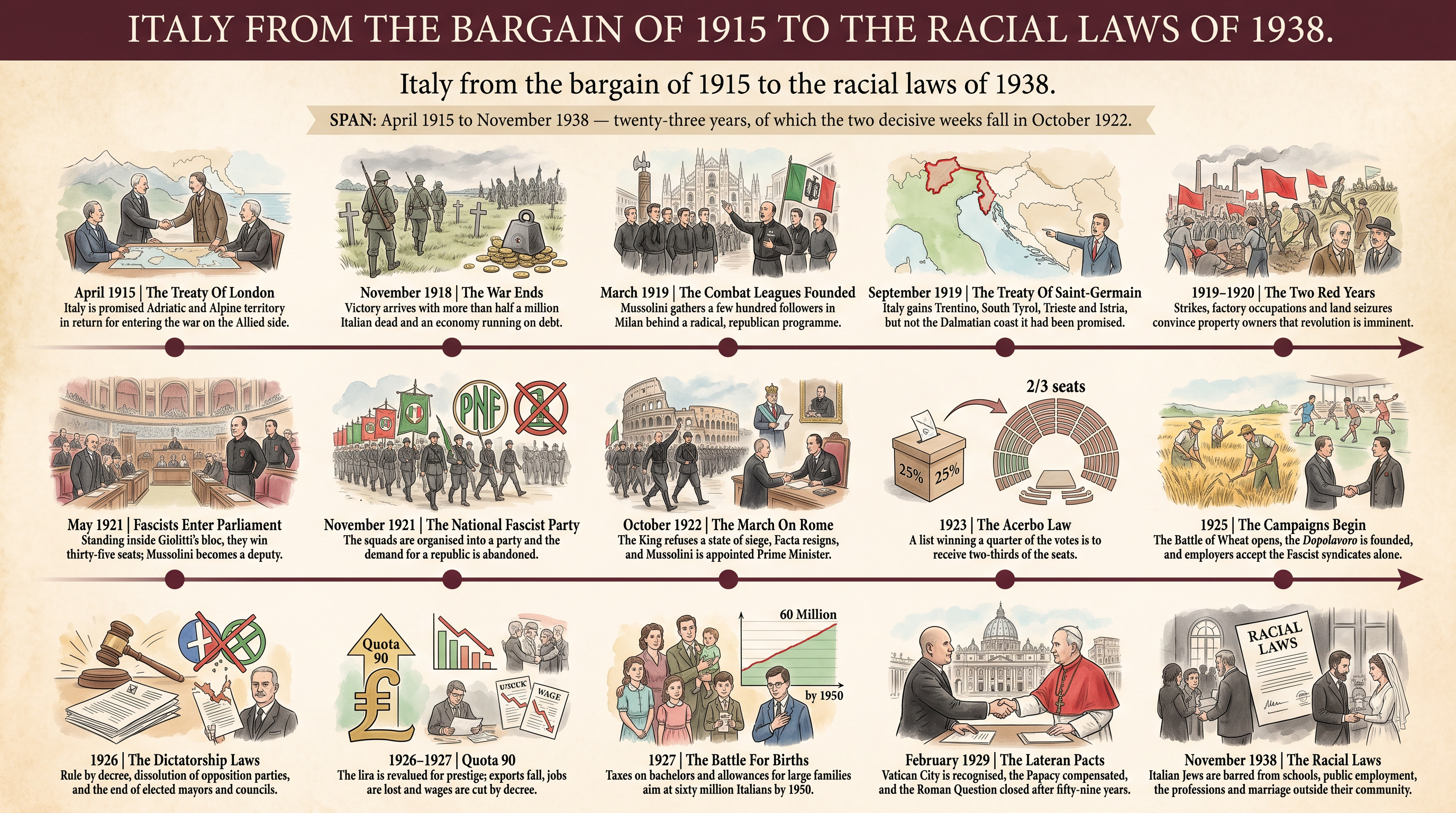
Fig. 10.15 – The Chapter In Order.
What The Evidence Cannot Tell Us
The most serious gap in this chapter is that we cannot measure Italian opinion under the regime. From 1926 there were no free newspapers, no opposition parties, no independent unions and no contested elections, so the ordinary instruments that record what a people thinks had all been dismantled — and a state that suppresses disagreement also destroys the record of how much of it there was.
What survives instead is mostly the regime’s own paper: laws, decrees, statistics compiled by its ministries, photographs it arranged and instructions it sent to editors. These are excellent evidence of intention and very poor evidence of effect. They tell us what the Fascist state wanted Italians to do, read, learn and believe; they cannot tell us what happened in a kitchen after the newspaper was folded away.
10.11 Check Your Memory
Explain what Italians meant by the ‘mutilated victory’, naming the territories Italy was promised in 1915 and what it actually held by 1920.
Set out the terms of the Acerbo Law of 1923, and show with an example how a list winning a quarter of the votes could end up holding two-thirds of the seats.
Look again at Table 10.1. What does the seat count tell you about Fascist strength in Parliament in 1921, and what does it fail to tell you about Fascist strength in the country?
Using Map 10.1, identify the areas promised to Italy under the Treaty of London and those actually acquired by 1920. Explain why so small a difference in territory produced so large a political grievance.
Reconstruct, in order, the chain of events from the calling of the general strike in July 1922 to Mussolini’s appointment as Prime Minister on 30 October. At which point in that chain could the outcome most easily have been different, and why?
Fig. 10.4 contrasts the march with the train. Using the evidence given in this chapter, explain why the ‘March on Rome’ is better described as a handover of power than as a seizure of it.
The Fascist state claimed that corporatism ended class conflict by treating workers and employers alike. Using Fig. 10.9 and the account in section 10.6, hold the two sides side by side: what did each gain, and what did each lose?
The chapter states that after 1926 we cannot measure Italian public opinion. Explain which institutions had been removed by then, and why their removal destroys the evidence as well as the opposition.
Historians disagree about whether the racial laws of 1938 were imported to please Nazi Germany or grew out of fascism’s own ideas. Set out the strongest case for each reading, and state what evidence would help settle the question.
‘Mussolini’s economic policy achieved visible results at hidden costs.’ Assess this statement using any two of the campaigns described in section 10.9, and say whether you think Italy was economically stronger in 1939 than in 1925.