Chapter 7: World War I: Causes, Events And Peace Settlements
In the summer of 1919, the German delegation at Versailles was handed a treaty it had taken no part in writing. One clause, Article 231, required Germany to accept responsibility for the loss and damage the war had caused. Germans called it the war-guilt clause, and they set out to disprove it — not with speeches, but with paper.
The Foreign Ministry in Berlin opened its archives. Clerks copied out despatches, telegrams and the confidential minutes of ambassadors reaching back to 1871. From 1922 these began to appear in print: forty volumes of documents, published so that anyone could read what German diplomats had actually written to one another in the years before 1914. The argument behind the publication was simple. Read the papers, and you will find that every power in Europe had been preparing for a war.
Other governments could not let that stand. Britain answered with an edited series of its own, prepared by the historians G. P. Gooch and Harold Temperley. France, Austria and the Soviet government followed, each with its archives and its case to make.
The result is one of the strangest inheritances in the writing of history. We know more about European diplomacy in the years before 1914 than about almost any earlier period — and we know it because the powers were quarrelling over blame. The evidence was released to win an argument, by governments that were not neutral.
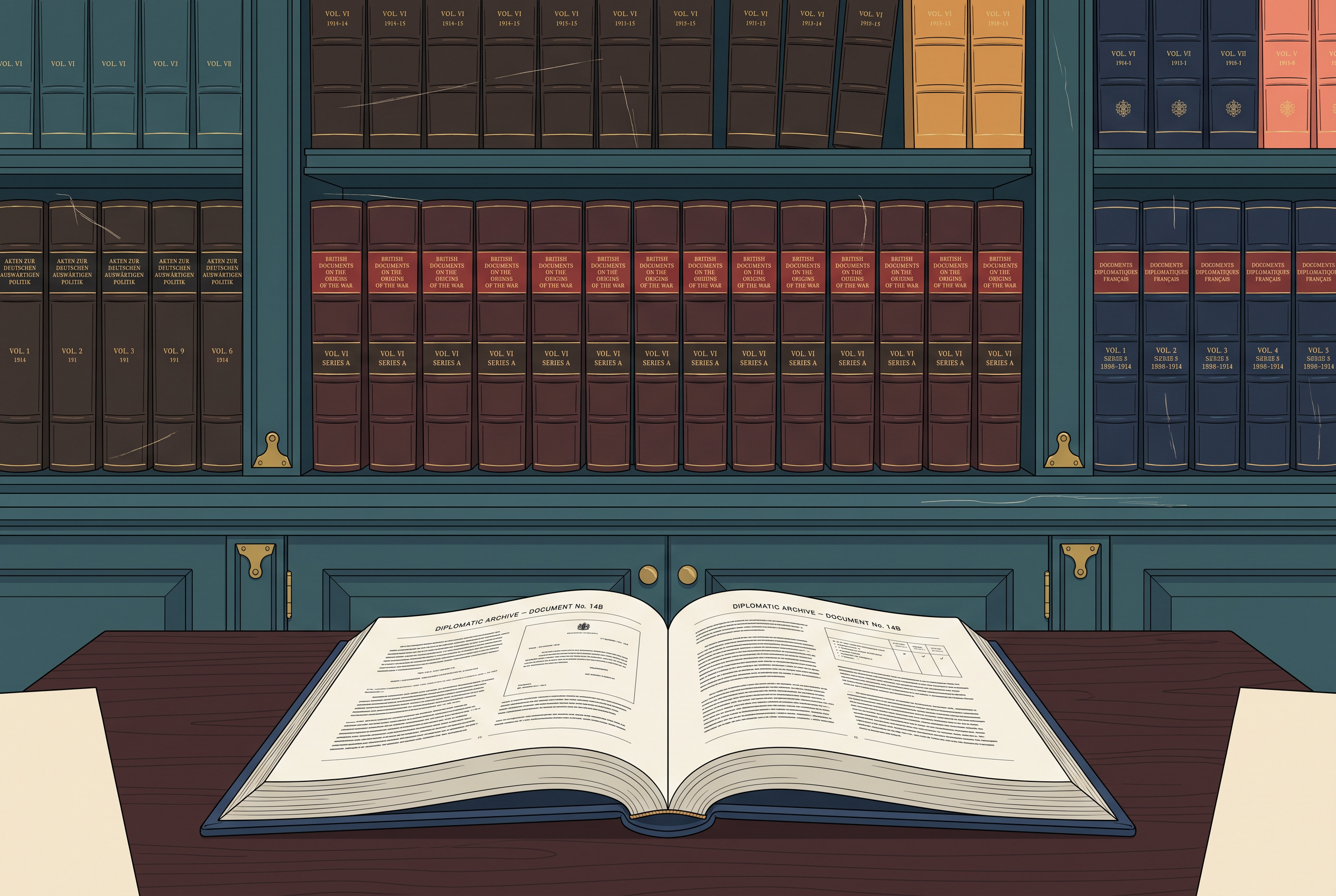
Fig. 7.0 – Published diplomatic archives as state defense.
7.1 Europe In 1900: The Setting
At the beginning of the twentieth century, the affairs of Europe were settled by six states. Britain, France, Germany, Austria-Hungary, Russia and Italy were the great powers — states strong enough in army, navy, industry and money that no important question could be decided against their wishes. A seventh, the Ottoman Empire, had once belonged to that company and was now slipping out of it.
Nothing stood above these states. There was no world organisation, no court that could bind them, no rule that they had to explain themselves to anyone. What kept the peace was the balance of power: the habit of making sure no single state grew strong enough to dominate the rest, and of forming combinations against any state that seemed to be trying.
That was the theory. In practice, the balance was held together by armies, by secret agreements between governments, and by the judgement of a small number of ministers, ambassadors and monarchs. When their judgement failed in the summer of 1914, there was nothing underneath to catch the fall.
The distribution of territory that these governments were working with is shown in Fig. 7.1.
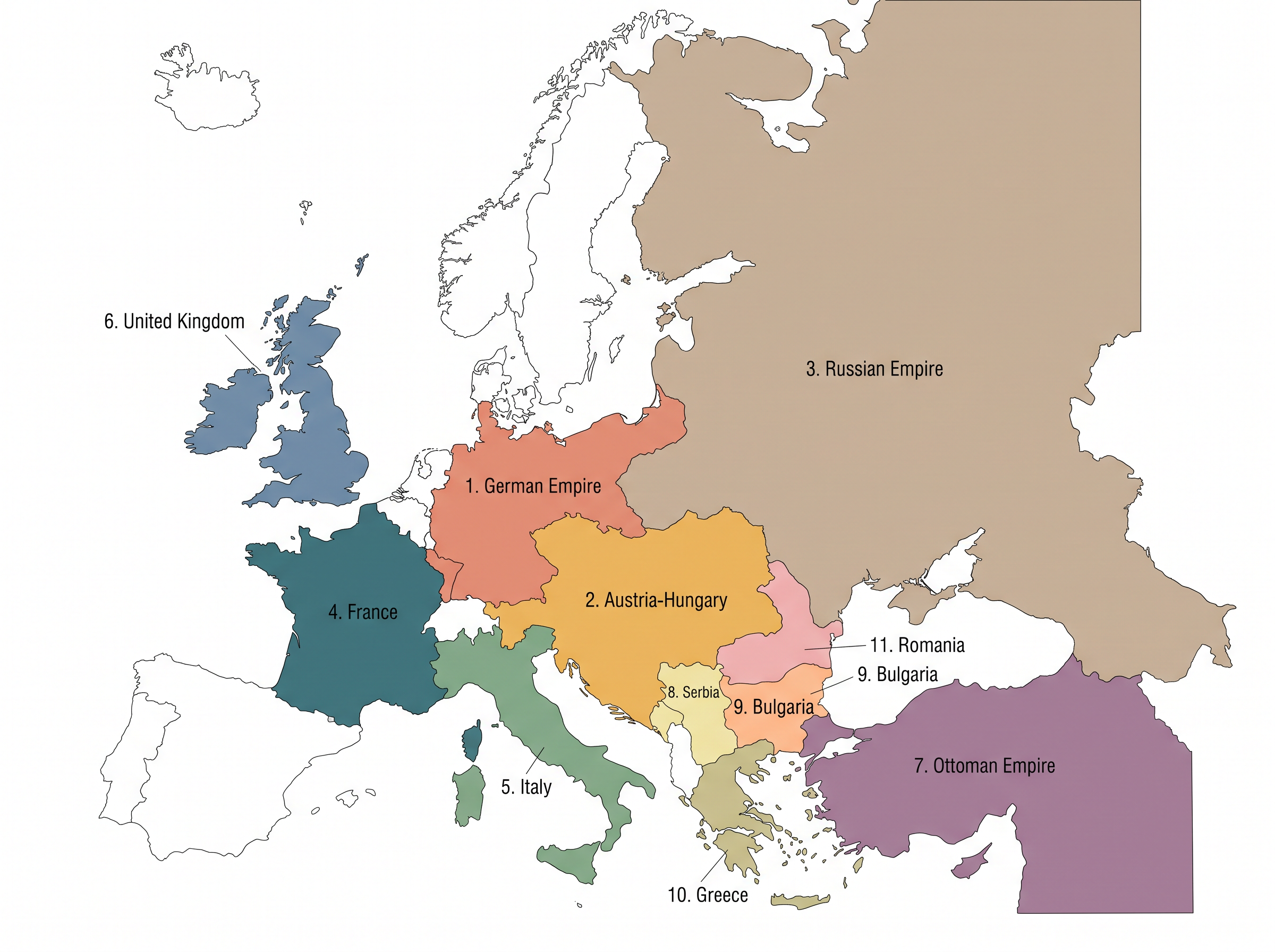
Fig. 7.1 – The great powers of Europe in 1900.
7.1.1 The Great Powers And Their Anxieties
Each of these states had a settled view of what it wanted and, more importantly, of what it feared. Reading those fears is the beginning of understanding the war.
The Newest Power And Its Enemy
Germany was the newest of them. The German Empire had been proclaimed in 1871, at the end of a war in which Prussia and the other German states defeated France. It came into the world with the best army in Europe and grew fast: by the turn of the century Germany was producing more steel than Britain and led the world in chemicals and electrical goods.
Otto von Bismarck, who had built the empire and served as its Chancellor until 1890, understood exactly what that victory had cost him. France would want Alsace-Lorraine back. So his foreign policy had one fixed aim — to keep France without friends, and therefore without the means to fight.
France, for her part, had lost Alsace and most of Lorraine in 1871 and had not accepted the loss. The word used for the mood was revanche, revenge, and it meant more than wounded pride. A France on her own could not challenge Germany, and every French government after 1871 knew it. French policy was therefore a long search for allies.
The Empire Of Many Peoples
Austria-Hungary was ruled by the Habsburg dynasty, and is often called the Habsburg Empire. Since 1867 it had been a Dual Monarchy: Austria and Hungary each had its own parliament and government, joined by one ruler and by common ministries for war, foreign affairs and their financing.
Within its borders lived Germans, Hungarians (also called Magyars), Czechs, Slovaks, Poles, Ruthenes, Romanians, Croats, Serbs, Slovenes and Italians. Not one of these peoples formed a majority of the whole. The distribution is shown in Fig. 7.2.
This mattered because of nationalism — the belief that a people who share a language, a history and a sense of belonging should govern themselves in a state of their own. In an empire of eleven peoples, that belief was not a sentiment. It was a threat to the empire’s existence.
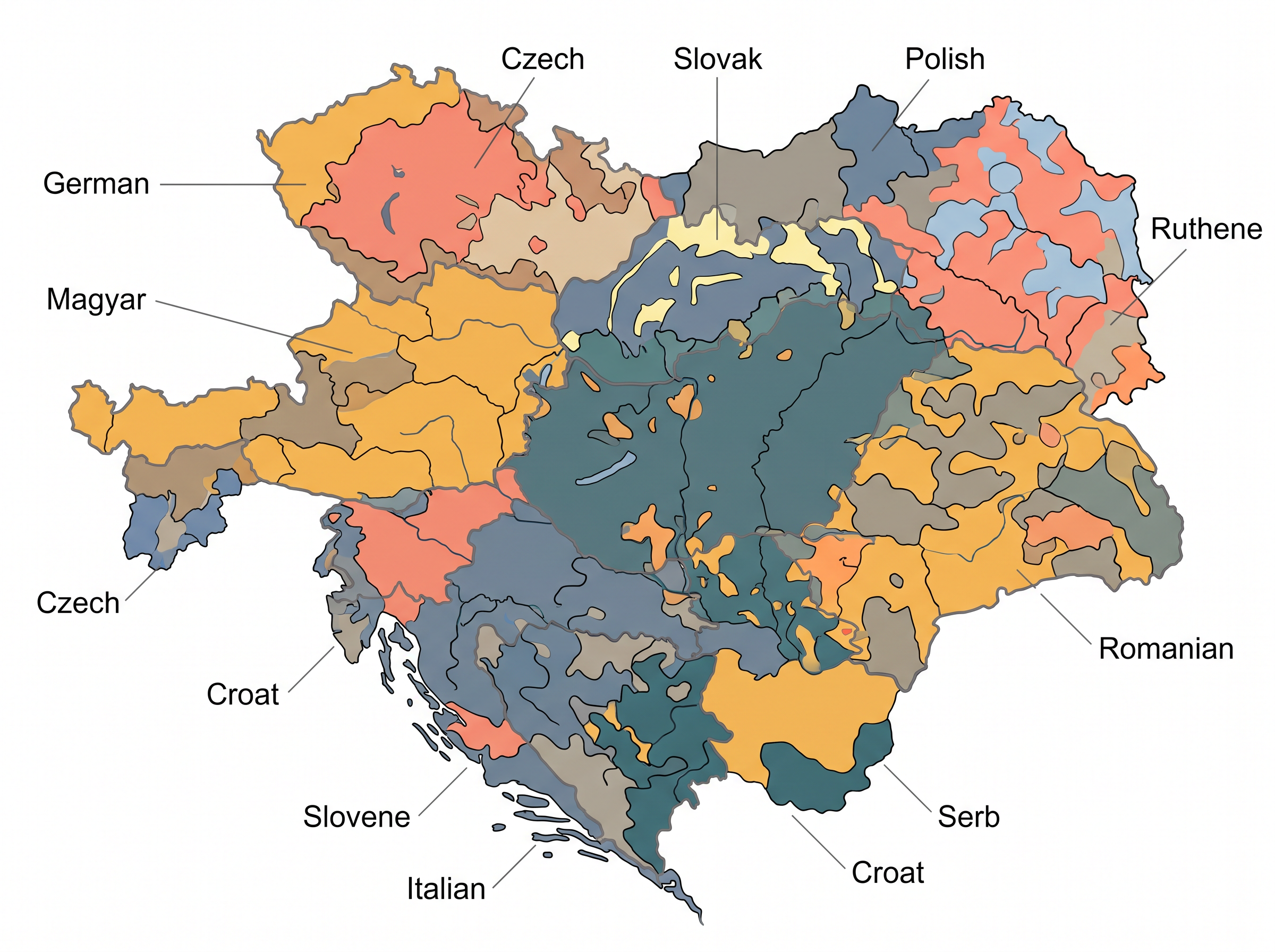
Fig. 7.2 – Language groups of Austria-Hungary before 1914.
The Weaker Members Of The Club
Italy was the other new state. The Kingdom of Italy had been proclaimed in 1861 and completed in 1870, when Rome was taken and made the capital. She was counted a great power, but her industry was small, her army untested and her treasury poor, and she knew it.
Britain had the largest navy in the world and an empire on every continent. Her policy was called ‘splendid isolation’ — she kept out of permanent alliances on the European mainland, intervening when the balance seemed at risk and otherwise attending to her empire and her trade routes.
Russia had the largest population and the largest army in Europe, and the weakest industry of any great power. Her government was an autocracy under the Tsar, and it faced serious unrest at home, which made a foreign success attractive and a foreign humiliation dangerous.
The Ottoman Empire had ruled south-eastern Europe, the Arab lands and Asia Minor for centuries. By 1900 it was losing territory steadily and losing control of what it kept. European diplomats called it ‘the Sick Man of Europe’, and the phrase carried a question with it: who would take the inheritance when the patient died?
7.1.2 The Balkan Question
The Balkans are the mountainous peninsula of south-eastern Europe, lying between the Adriatic and the Black Sea, north of Greece and south of the Danube. Almost all of it had once been Ottoman. Almost all of it, by 1900, was ceasing to be.
How The New States Appeared
The retreat of Ottoman power left new states behind it. Greece had won independence in the 1830s. In 1878, after a war between Russia and the Ottoman Empire, the great powers met at the Congress of Berlin, called by Bismarck, to settle the terms among themselves.
The Congress recognised Serbia, Montenegro and Romania as independent, and made Bulgaria a self-governing principality still formally under the Sultan. It also handed the province of Bosnia-Herzegovina to Austria-Hungary to occupy and administer — while leaving the Sultan its legal owner. That arrangement, half-conquest and half-fiction, would matter enormously thirty years later.
Two Great Powers, One Peninsula
Two great powers had an interest in what replaced the Sultan. Russia wanted influence over the Slav states, a friendly route towards the Mediterranean, and the standing that came with being their protector. Austria-Hungary wanted the opposite: small, weak Balkan neighbours who could not attract her own Slav subjects away from her.
This was the deeper trouble. For Russia, a strong Serbia was an asset. For Austria-Hungary, a strong Serbia was a magnet, drawing the Serbs and Croats inside the empire towards a state outside it. The same event, in the same place, meant success to one great power and danger to the other.
The Balkans were therefore called a tinder-box, and the word was well chosen. A tinder-box is not dangerous because it is large. It is dangerous because it is dry, and because other people keep bringing sparks to it.
7.2 The Alliance System
By 1907 the six great powers had sorted themselves into two groups. On one side stood Germany, Austria-Hungary and Italy. On the other stood France, Russia and Britain. Neither group had been planned as half of a divided Europe. Each was built one agreement at a time, by governments trying to make themselves safer.
An alliance is a formal agreement between states to help one another, usually with a promise of military support in stated circumstances. Most of the agreements described here were secret, or had secret clauses, and none of them was submitted to a parliament for approval. Foreign policy in this period was made by ministers and monarchs, and the public learned of it afterwards, if at all.
The sequence in which the two camps formed is set out in Fig. 7.3.
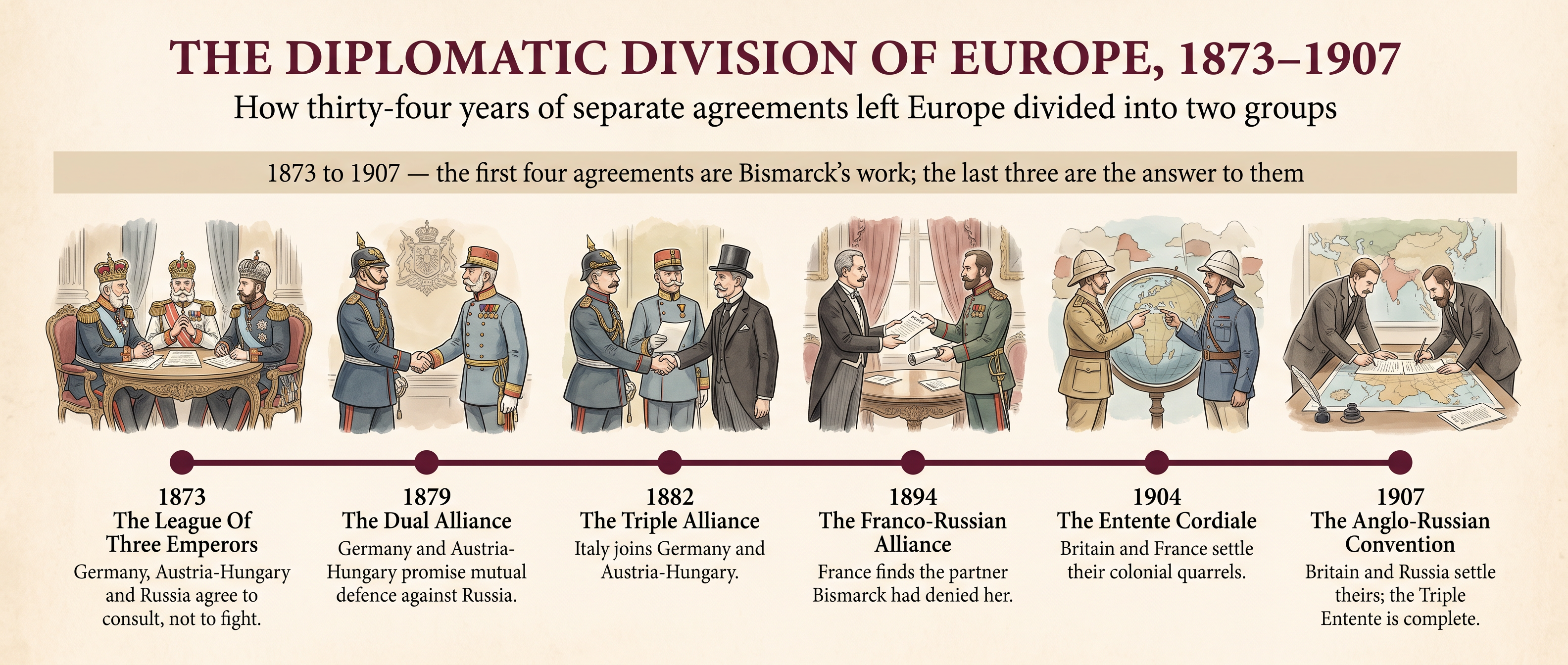
Fig. 7.3 – The Making Of The Two Camps.
7.2.1 Bismarck’s Alliances
Bismarck’s problem after 1871 was simple to state and hard to solve. France would want her lost provinces back, and France alone could not take them. Therefore France must never be allowed a friend among the other great powers.
In 1873 he brought Germany, Austria-Hungary and Russia together in the League of the Three Emperors, the Dreikaiserbund. It was less an alliance than an understanding: the three conservative monarchies would consult one another and would not let France divide them.
The understanding did not survive the Balkans. At the Congress of Berlin in 1878, Russia felt that the settlement had stripped her of gains she had won in war, and blamed Bismarck for presiding over it. The League fell apart.
The Choice Bismarck Made
Bismarck now had to choose between Vienna and St Petersburg, and he chose Vienna. In 1879 Germany and Austria-Hungary signed the Dual Alliance, each promising to come to the other’s aid if attacked by Russia.
This was the single most consequential decision in the whole system. It tied Germany, a state with no territorial interest in south-eastern Europe, to a state whose survival depended on what happened there.
Bismarck himself tried to soften what he had done. He kept a separate secret agreement with Russia — the Reinsurance Treaty of 1887, by which each promised to stay neutral if the other were attacked. He was, in effect, insuring himself against his own alliance.
7.2.2 The Triple Alliance
Italy joined the Dual Alliance in 1882, turning it into the Triple Alliance. Her reason had little to do with Germany or Austria-Hungary and much to do with France, who had taken Tunis in North Africa the year before, in a region Italian governments regarded as their own field of expansion.
The alliance was awkward from the first day. Italy’s partner Austria-Hungary held Trentino, Trieste and other lands where Italians lived, and Italian opinion wanted them. An ally you hope one day to fight is not a reliable ally.
Italy showed this herself. In 1902 she gave France a secret assurance that she would remain neutral if France were attacked — while remaining, in public, a member of the Triple Alliance. When war came in 1914 she did not fight beside her allies.
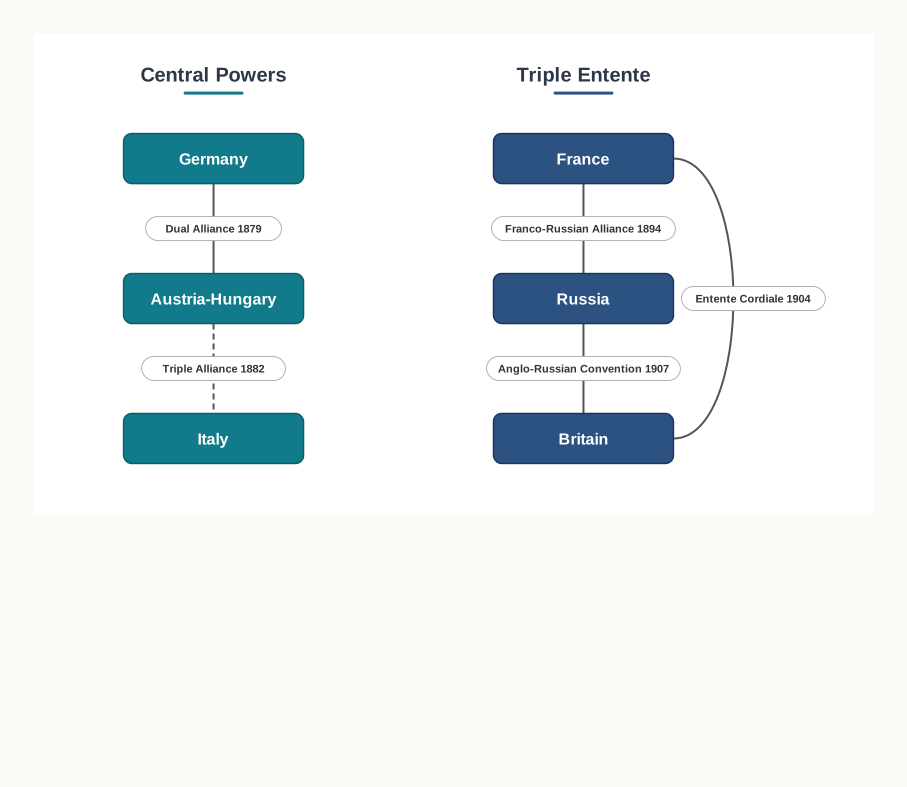
Fig. 7.4 – The rival European alliance blocs by 1907.
7.2.3 The Triple Entente
Bismarck was dismissed in 1890 by the new Kaiser, Wilhelm II. Within months the Reinsurance Treaty was allowed to lapse, and the isolation of France, which Bismarck had guarded for twenty years, began to come apart.
Russia needed money and France had it; both had reason to fear Germany. A military convention drawn up in 1892 came into force in 1894 as a full alliance: if either was attacked by Germany, the other would fight. Germany now faced the possibility of war on two fronts at once.
Britain Comes In From Isolation
Britain was harder to move. She had no wish to be tied to a continental quarrel and had spent the nineteenth century avoiding one. What changed her mind was not affection for France but the growth of German naval power, which touched the one interest Britain would never trade away.
An entente is not an alliance. It is an understanding — an agreement to settle disputes and act as friends, without the binding promise to go to war. The Entente Cordiale of 1904 was exactly that: Britain and France gave up their long colonial quarrels, chiefly by recognising Britain’s position in Egypt and France’s in Morocco.
The Anglo-Russian Convention of 1907 did the same work at the other end. Britain and Russia had spent decades in rivalry across Persia, Afghanistan and the approaches to India; the Convention divided their spheres and closed the argument. With Russia already allied to France, the three now formed what was called the Triple Entente.
Britain’s position remained genuinely ambiguous, and that ambiguity mattered. Her army and navy staffs held talks with the French from 1906, and by 1912 the two fleets were arranged so that the French concentrated in the Mediterranean and the British in the Channel. No treaty obliged Britain to defend the French coast. A decade of quiet arrangement had made it very hard for her not to.
7.2.4 How Alliances Enlarged A Quarrel
Every one of these agreements was defensive in its wording. Each was signed to prevent a war, or to make sure of help if one came. Together they produced something none of the signatories had intended.
The first effect was that a local quarrel could no longer stay local. Austria-Hungary and Serbia could not fall out without Russia’s interest being engaged; Russia could not move without France being engaged; France could not be attacked without the German plan of war involving Belgium, and Belgium could not be invaded without Britain’s oldest commitment being tested.
The second effect was on the freedom of each government. A state that abandoned its ally in a crisis would have no ally in the next one. Germany therefore had to support Austria-Hungary in Balkan disputes she considered unimportant, and France had to support Russian policy in the Balkans for exactly the same reason. Each partner was pushed by the fear of being left alone.
The third effect was on the pace of events. Alliances meant that once one government began to prepare for war, the others could not afford to wait and see. The system that was meant to give statesmen security ended by taking away their time.
7.3 Imperialism
Imperialism is the building of an empire: the extension of one state’s rule or control over territories and peoples beyond its own borders. In the late nineteenth century it became the ordinary business of every European great power, and the measure by which each judged its standing against the others.
The connection to a European war is not obvious at first sight, and it is worth stating carefully. No colony caused the First World War. What imperial competition did was to give the powers thirty years of practice in treating one another as rivals, and to teach their publics to read every foreign dispute as a test of national strength.
7.3.1 The Scramble For Africa
In 1880 most of Africa was ruled by Africans, and European possessions were coastal footholds. By 1900 almost the whole continent had been claimed by European states. Only Ethiopia and Liberia remained outside their control. Historians call this rush the ‘Scramble for Africa’, and it was startlingly quick.
The powers were anxious enough about colliding with one another that they set rules for the process. At a conference in Berlin in 1884–85, called by Bismarck and attended by the European states, they agreed on how claims to African territory were to be recognised — chiefly, that a power announcing a claim had to occupy the territory in fact.
No African ruler took part in these discussions. That absence is not a detail of etiquette; it is the substance of the thing. Boundaries were drawn between European delegations, across societies whose existence the delegates barely knew, and many of those boundaries are still on the map today.
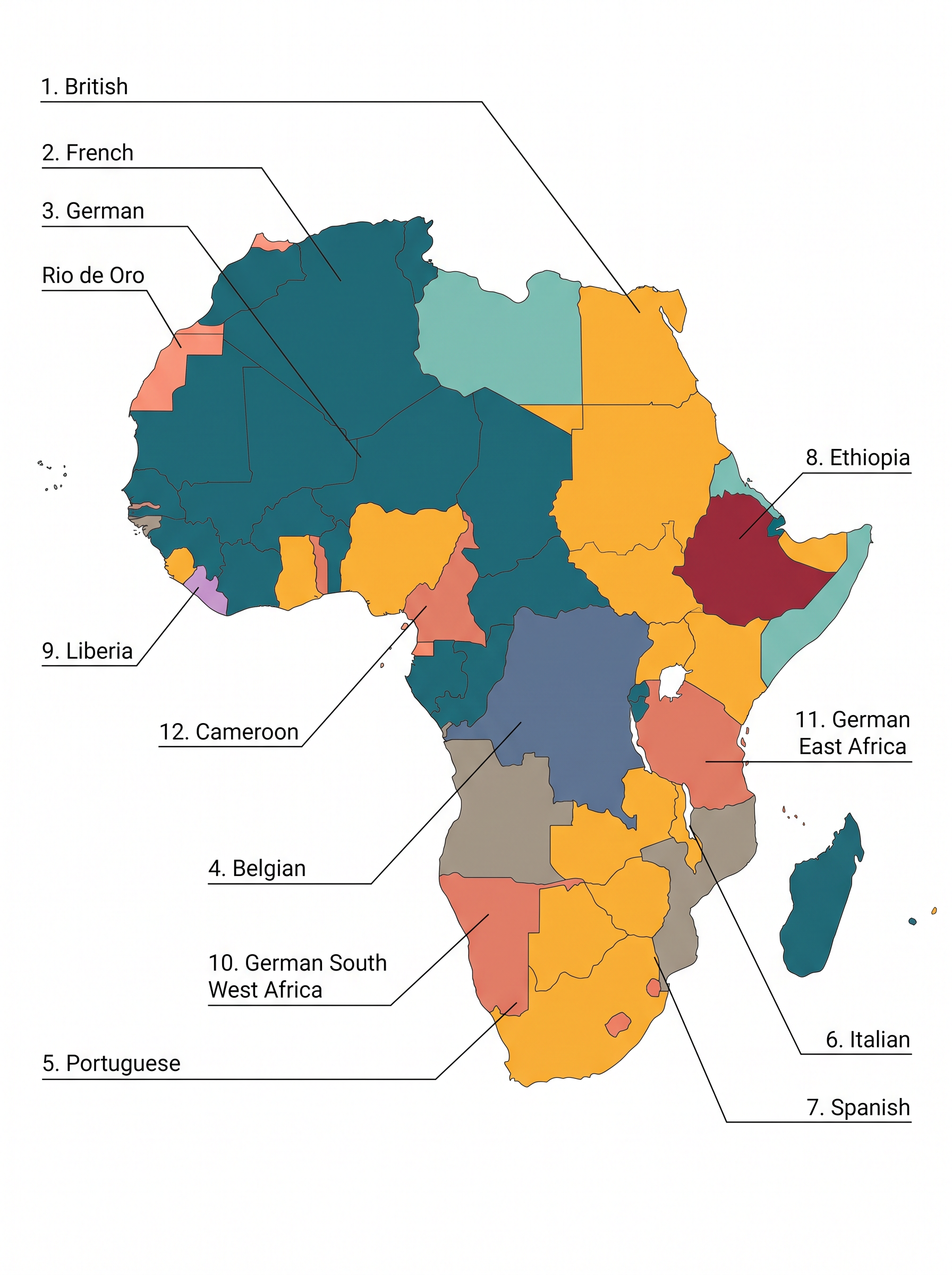
Fig. 7.5 – European colonial possessions in Africa in 1914.
7.3.2 Markets, Raw Materials And Rivalry
Behind the flags lay an economic argument that governments made openly. Industry in Europe was producing more goods than Europeans could buy, and needed raw materials — cotton, rubber, palm oil, minerals — that Europe did not have. Colonies promised both: a protected market at one end and a supply at the other.
Whether colonies actually delivered these benefits is a separate question, and a doubtful one. What matters for our purposes is that governments and businessmen believed they did, and acted on the belief.
Germany’s Grievance
Germany felt the arithmetic most sharply. She had become a state only in 1871, by which time Britain and France had been acquiring overseas territory for two centuries. Her colonies, gathered from 1884, were relatively poor, and she held nothing to compare with British India or French West Africa.
From 1897 the German government adopted what it called Weltpolitik, world policy: the claim that a state of Germany’s industrial strength was entitled to a world role, colonies and a fleet to match. German ministers spoke of their country’s right to a place in the sun.
Friction With Britain
Britain and Germany were each other’s best customers and, increasingly, each other’s sharpest competitors. German manufactures were displacing British goods in markets Britain had long held alone, and German capital was appearing in regions Britain regarded as her own.
Southern Africa was one such region. German interest in the Boer republics irritated London, and in 1896 the Kaiser sent a telegram congratulating President Kruger of the Transvaal on defeating a raid by British irregulars. The telegram changed nothing on the ground and did lasting damage to British opinion of Germany.
Further east, the Ottoman government granted German companies the concession to build a railway from Constantinople towards Baghdad. To Berlin this was commerce. To London it looked like a German road towards the Persian Gulf, and to St Petersburg like a German presence on Russia’s southern flank.
7.3.3 Imperial Rivalry Comes Home To Europe
The Entente Cordiale of 1904 had settled the affairs of two empires: Britain would have her way in Egypt, France in Morocco. Germany had not been consulted, and the German government decided to test whether this new friendship would hold under pressure.
The pattern set at Algeciras is the point of this section. A quarrel over North Africa was fought out by European powers, in a European conference, and its result was measured in European terms: who supported whom.
After 1906, colonial questions were no longer separable from the balance of power at home. A dispute about a Moroccan port had become a test of which camp could hold together — and the powers would run that test again, more dangerously, in 1911.
7.4 Militarism And The Arms Race
Militarism has two meanings, and both were present in Europe before 1914. The first is a policy: keeping large armed forces and being ready to use them. The second is an attitude of mind: the belief that soldierly values are the highest values, that a nation is measured by its army, and that war is a normal and even a healthy instrument of policy.
An arms race follows from the first meaning. When one state increases its forces, its neighbour increases hers in reply, which justifies a further increase by the first, and so on. Each government believes it is only responding. Each is, at the same time, the reason the other is arming.
The consequences of this competition were not only military. It absorbed a large share of national budgets, it filled newspapers with comparisons of fleets and battalions, and it gave every diplomatic quarrel the background noise of counted guns.
7.4.1 Armies, Conscription And Army Reform
Every continental great power raised its army by conscription — compulsory military service, usually of two or three years, followed by years on the reserve. This produced something new in European history: peacetime armies of hundreds of thousands, and trained reserves of millions who could be called back within days.
Britain was the exception. She relied on a volunteer army, small by continental standards, on the grounds that her security rested on the navy and her army’s work lay in the empire.
The Reforms Of The Last Decade
Between 1905 and 1914 every power overhauled its forces. In Britain, Lord Haldane, Secretary of State for War from 1905 to 1912, reorganised the army: he created a general staff, formed a small, well-equipped expeditionary force ready to be sent abroad quickly, and reorganised the part-time forces at home into a Territorial Force.
Germany passed army laws in 1912 and again in 1913 that substantially enlarged her peacetime strength. France answered in 1913 with the Three-Year Law, extending compulsory service from two years to three — a heavy demand on a country with a much smaller population than Germany’s.
Russia mattered most of all to the calculations. With French loans she was rebuilding her railways and enlarging her army on a programme due for completion around 1917. German planners drew a conclusion from this that should be read carefully: if war with Russia was coming, it was better fought soon than later.
7.4.2 The Naval Race And The Dreadnought
The most visible competition was at sea, and it was fought between Britain and Germany.
Britain’s navy was the foundation of everything she had. An island that imported much of its food and governed an empire across every ocean could not survive the loss of control of the sea. British policy had long held that the Royal Navy should be at least equal to the next two navies combined.
From 1898, under Admiral Alfred von Tirpitz, Germany began building a battle fleet by a series of navy laws that fixed the programme years in advance and made it hard for the Reichstag to reverse. Germany’s argument was that a great trading and colonial power needed a fleet. Britain’s reading was different: Germany already had the strongest army in Europe, and the fleet she was building was based in the North Sea, facing Britain and nobody else.
One Ship Changes The Count
In 1906 Britain launched HMS Dreadnought. She carried a uniform main armament of large guns and was driven by steam turbines, making her faster and far more powerful than any battleship afloat.
The consequence was not what the Admiralty had hoped. By making every existing battleship obsolete, Britain had cancelled her own enormous lead and restarted the count from zero. What mattered now was how many dreadnoughts each side had, and on that measure Germany was only a little way behind.
Germany began building her own dreadnoughts at once. Because these ships were wider and deeper than their predecessors, she also widened and deepened the Kiel Canal, which links the Baltic to the North Sea and had been completed in 1895; the enlarged canal was ready in 1914, allowing her heaviest ships to pass between the two seas without sailing around Denmark.
In Britain the response was public and loud. A dispute in 1909 over whether to lay down four dreadnoughts or six produced the popular slogan ‘we want eight and we won’t wait’. The government laid down eight. Negotiations to limit the race, including a mission by Haldane to Berlin in 1912, produced nothing, because Germany would only slow her building in return for a British promise of neutrality in a European war, which Britain would not give.
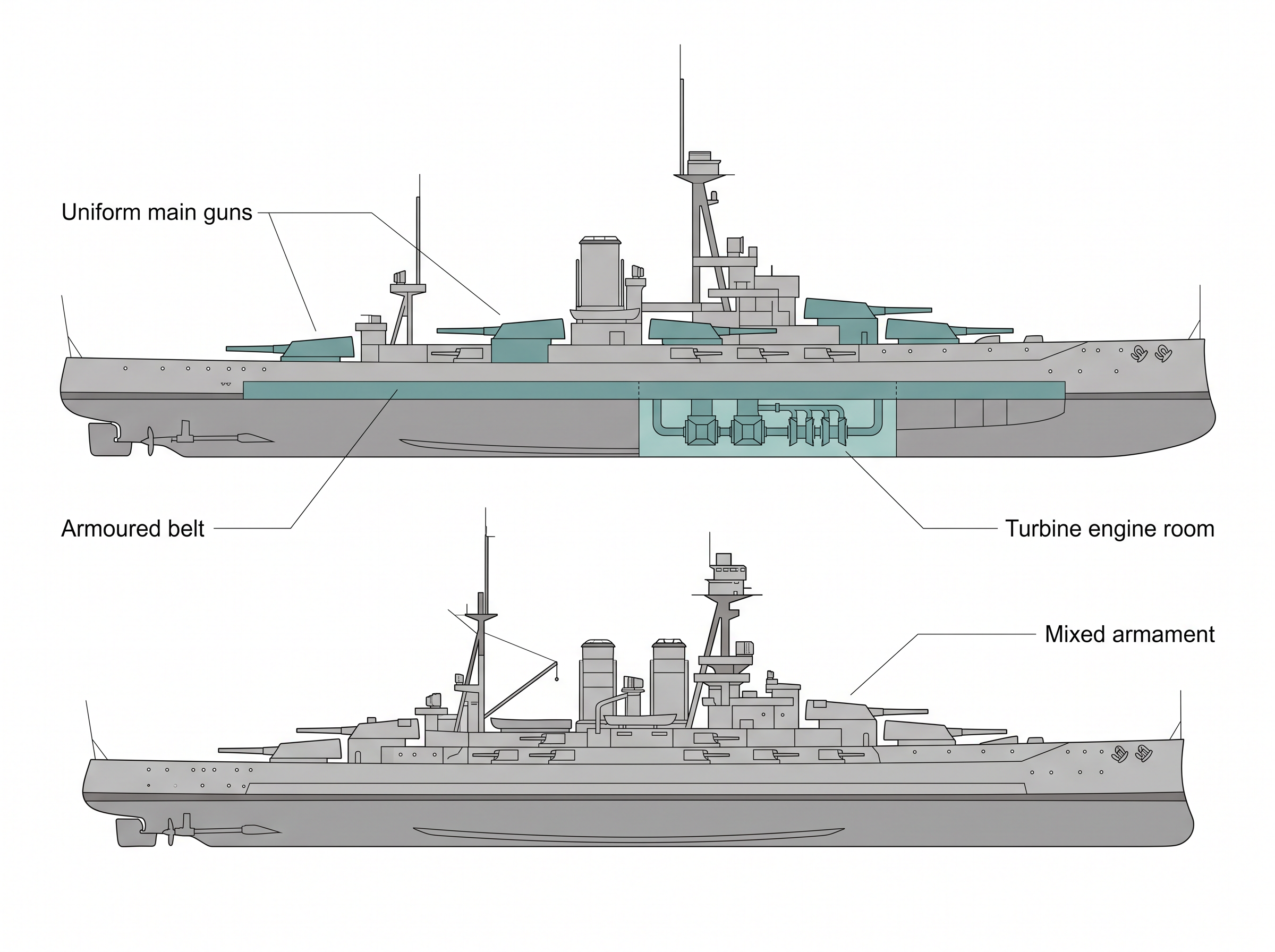
Fig. 7.6 – The dreadnought and the older battleship compared.
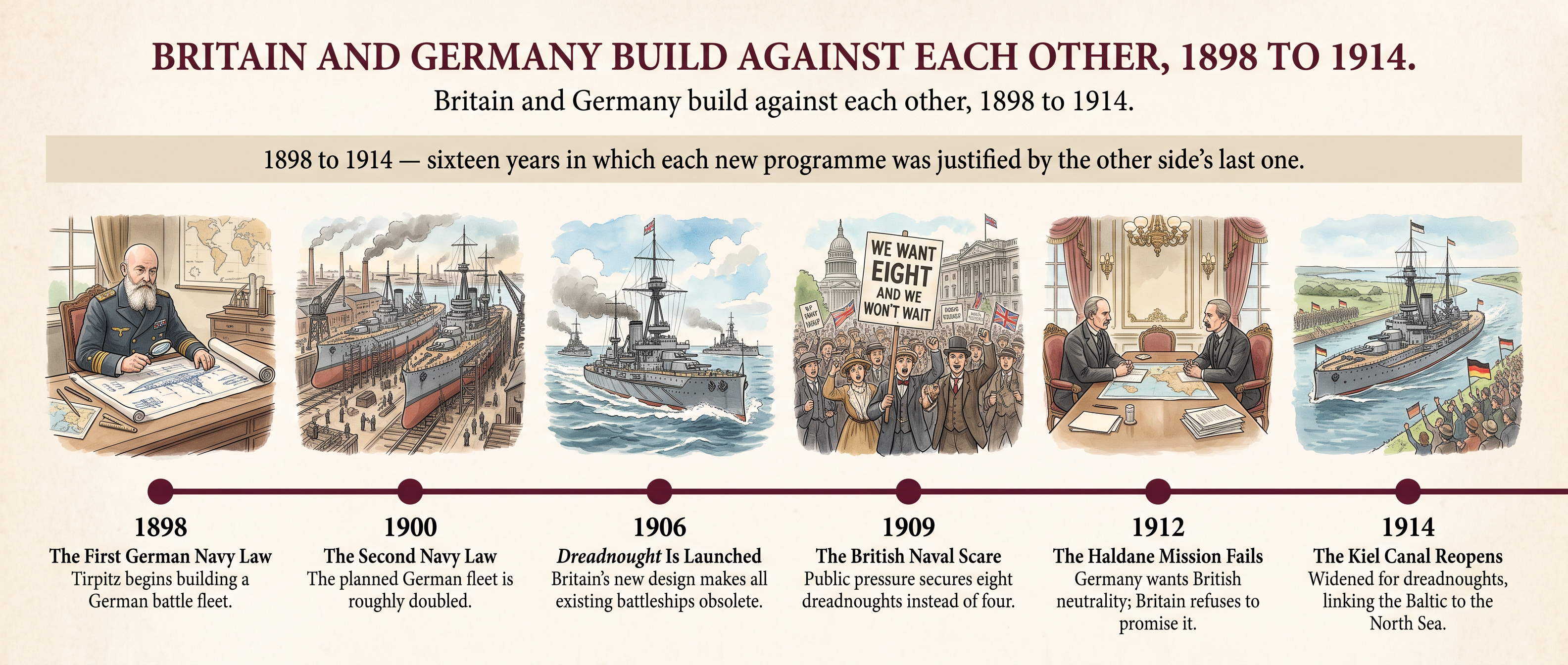
Fig. 7.7 – The British and German naval arms race.
7.4.3 Soldiers In The Councils Of State
The second meaning of militarism — the weight of military opinion inside government — was the more dangerous one, and it worked through planning.
Every general staff had prepared a plan for the war it expected. Germany’s, drawn up in 1905 by Alfred von Schlieffen and altered by his successor, faced the problem of a war on two fronts. Its answer was to defeat France quickly by advancing through Belgium, then turn the whole army east against Russia, whose mobilisation was expected to be slow.
Mobilisation is the process of calling up reserves, arming them and moving them to the frontier. It ran on railway timetables prepared over years, in which trains, units and stations were fixed in advance. A plan of that kind is very difficult to halt once started, and almost impossible to alter halfway.
This produced two political facts. First, a decision to mobilise, taken as a precaution, was read by the other side as a decision for war. Second, in a crisis the soldiers could tell their governments that every day of delay cost them the advantage — and ministers who knew nothing of railway schedules found that hard to argue with.
The Schlieffen Plan carried one further consequence, which nobody in Berlin treated as decisive in advance. Any German war against Russia now meant an attack on France, and an attack on France meant marching through neutral Belgium. The plan had built the widening of the war into its first week.
7.5 Nationalism
Nationalism in the first half of the nineteenth century had generally been a demand for liberty: peoples under foreign rule wanted governments of their own. By the end of the century it had acquired a second and harder character. It became competitive — a matter of proving that one’s own nation was stronger, older and more deserving than the nation next door.
Both kinds were alive in 1900, and they pulled in opposite directions. In Germany, Italy and Britain, nationalism held a state together and pushed it outward. In Austria-Hungary and the Ottoman Empire, the same idea pulled a state apart. Whether nationalism was a force for building or for breaking depended entirely on where you stood.
7.5.1 Nationalism In The Great Powers
What made this nationalism new was that it reached everybody. Compulsory schooling taught a national history; cheap newspapers reported foreign affairs daily and profitably; conscription put men of every class through the same uniform. A quarrel between two ambassadors could now be followed, and felt, by millions of readers.
Governments discovered that this cut both ways. Popular enthusiasm was useful when a minister wanted funds for ships or soldiers. It was much less convenient during a crisis, when the same newspapers denounced any concession as a national humiliation and any compromise as cowardice.
The word for the aggressive form of this feeling is chauvinism — an exaggerated, boastful patriotism that assumes one’s own nation is superior and treats rival nations with contempt. It was a mood the press could raise in a week and a government could not always calm in a month.
Germany’s Weltpolitik, described earlier, drew much of its force from exactly this mood. So did the British insistence on naval supremacy and the French refusal to let Alsace-Lorraine be forgotten.
7.5.2 Italia Irredenta And Pan-Germanism
Italy’s version had a name of its own. Irredentism — from Italia irredenta, ‘unredeemed Italy’ — was the demand that lands inhabited by Italians but ruled by another state should be joined to the Italian kingdom. The lands in question were Trentino, Trieste and the Dalmatian coast, and the state that ruled them was Austria-Hungary.
This is why the Triple Alliance never worked as an alliance should. Italy was formally bound to defend the empire whose provinces her own nationalists intended to take. Italian governments signed the treaty and renewed it, and Italian crowds demonstrated for the recovery of Trieste.
The German Version
Pan-Germanism was the corresponding claim in the German-speaking world: that all Germans, wherever they lived, formed one people, and that Germany was entitled to lead Central Europe. A Pan-German League, founded in 1891, argued this case loudly, pressing for colonies, a fleet and a firmer hand with Slav neighbours.
The League never governed anything. What it did was to set the terms of public argument, so that a government which negotiated with France or Russia could be accused of betraying the nation. Pressure of this kind narrowed the room in which ministers could work.
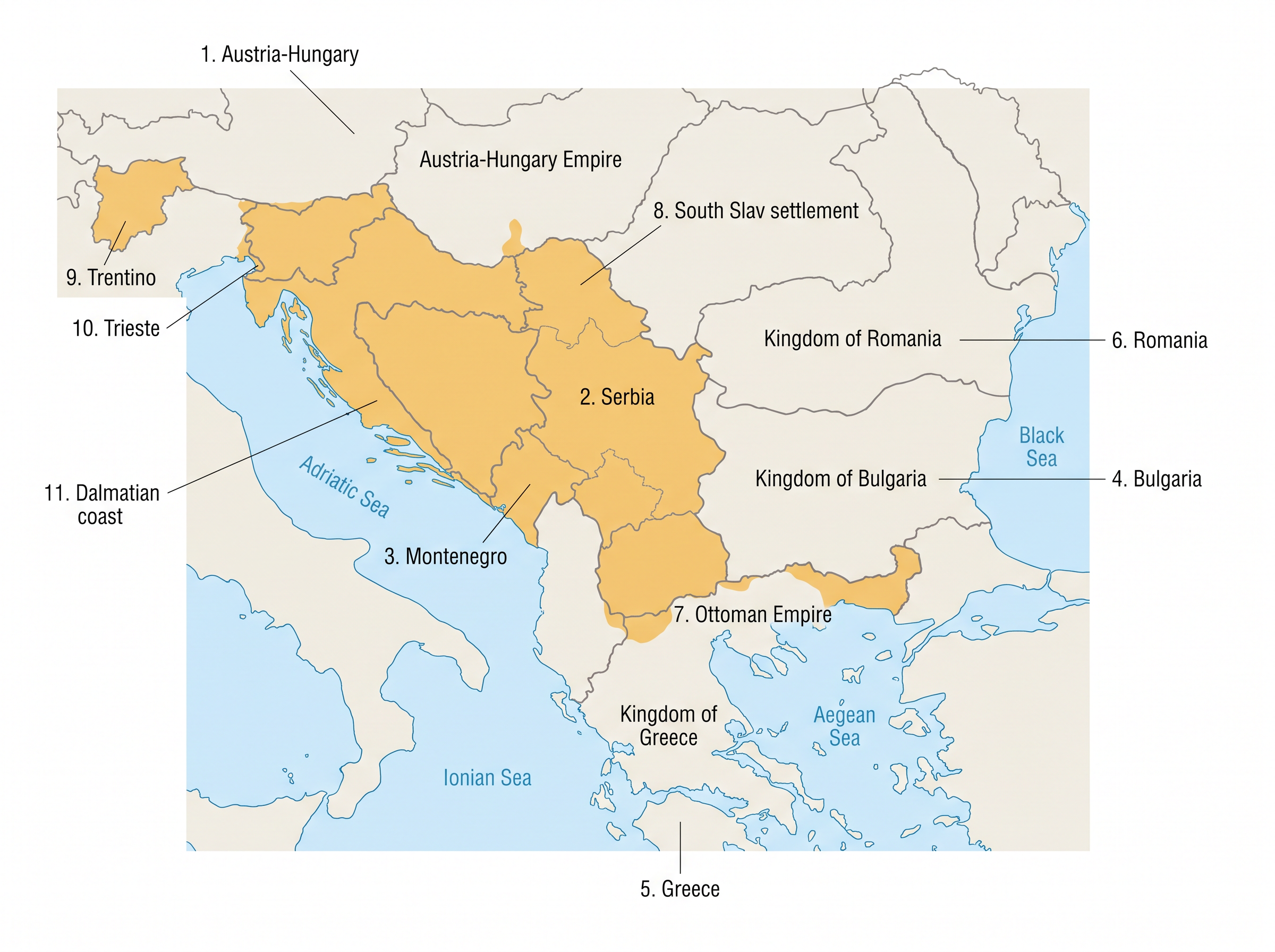
Fig. 7.8 – South Slav populations across state borders before 1912.
7.5.3 Serbian Nationalism And Pan-Slavism
Serbia had been recognised as an independent state in 1878 and became a kingdom soon after. It was small, poor and landlocked, and its ambition was very large: to gather the South Slavs — Serbs, Croats and Slovenes — into a single state. The name given to that state in advance was Yugoslavia, the land of the South Slavs.
The obstacle was Austria-Hungary, and the obstacle was immovable. Millions of Serbs, Croats and Slovenes lived inside the Habsburg lands, and the empire could not surrender them without beginning its own dissolution. Every Serbian success was therefore an Austrian loss.
Two events sharpened the quarrel. The Congress of Berlin in 1878 had placed Bosnia-Herzegovina, with its large Serb population, under Austrian administration. Then, after a violent change of ruling dynasty in 1903, Serbian policy turned away from Vienna and towards St Petersburg.
Russia As Protector
Pan-Slavism was the belief that the Slav peoples of Europe formed one family, and that Russia, the greatest Slav power, was their natural protector. It suited Russian interests neatly, giving a moral dress to influence in the Balkans and to the old ambition of a route to the Mediterranean.
It also imposed a cost. A Russian government that abandoned a Slav state to Austrian pressure would be accused at home of betraying its calling. Russia had made herself Serbia’s patron, and patrons are not free to walk away.
7.5.4 The Habsburg Empire Under Strain
The Habsburg Empire is often described as a museum of nationalities, and the phrase does it an injustice; it was a working state with a real administration, a common army and a long history. But it was built on a principle — loyalty to a dynasty — which the new nationalism directly contradicted.
Each people wanted more. Czechs pressed for the standing that Hungary had won in 1867; Poles and Ruthenes quarrelled in Galicia; and in the Hungarian half the government pressed its non-Magyar subjects to use Hungarian in schools and offices, which deepened the resentment of Croats, Slovaks and Romanians.
Out of this came the argument for a preventive war — a war begun not because an attack has happened but to stop a rival growing stronger. Influential figures in Vienna, including the chief of the general staff, urged repeatedly that Serbia should be crushed while it was still possible.
That is the thought to carry into the next section. The men who acted in July 1914 did not decide, in a moment of shock, that Serbia must be destroyed. They had wanted it for years, and were waiting for an occasion the other powers would accept.
7.6 The Short-Term Causes: Events From 1908 To 1914
The four long-term causes explain why Europe in 1908 was combustible. They do not explain why the fire started in 1914 rather than in 1909 or 1912, and they cannot explain it, because they were present throughout.
For that we need the short-term causes: a series of crises in which the powers confronted one another, backed down, and learned something from the experience. Each crisis was settled. Each also left one side humiliated, the other emboldened, and both more certain that next time they would not give way.
The sequence is set out in Fig. 7.9.
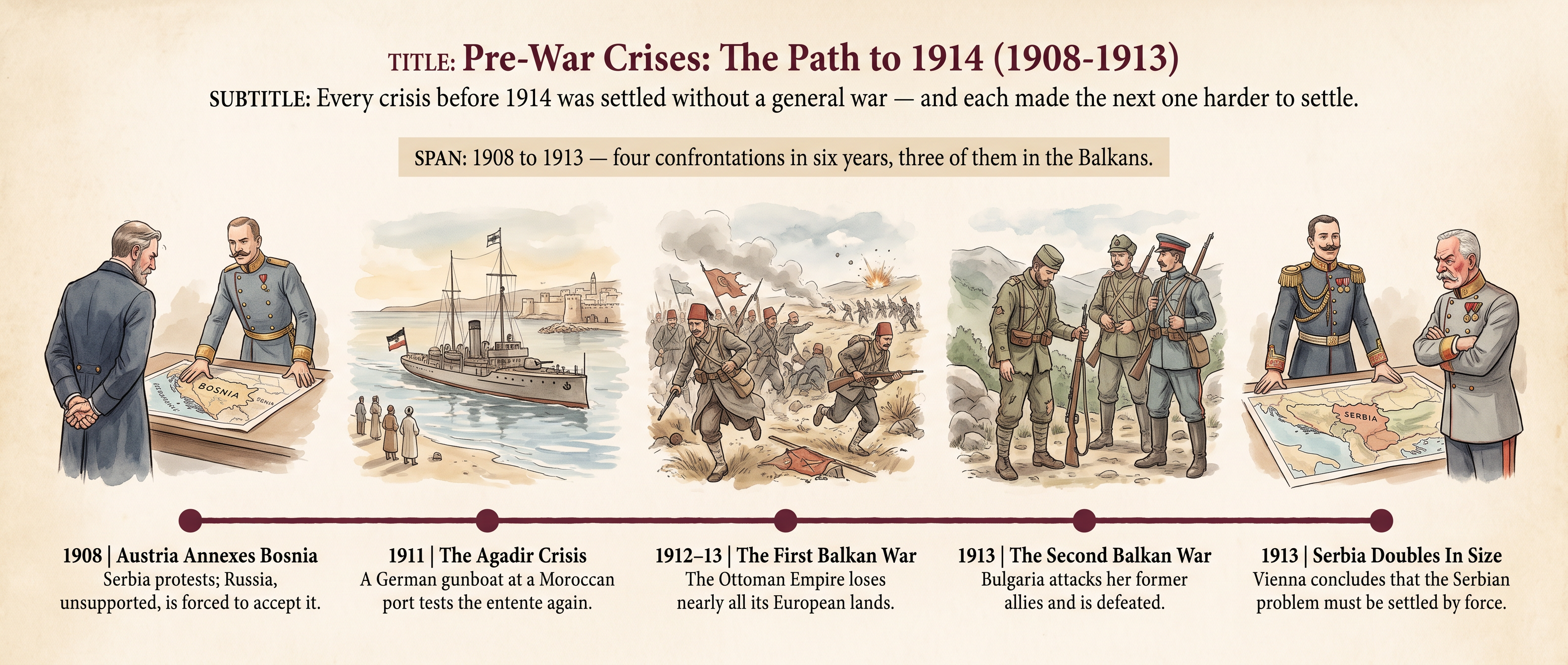
Fig. 7.9 – Six years of diplomatic crises.
7.6.1 The Bosnian Crisis, 1908
Bosnia-Herzegovina had been administered by Austria-Hungary since 1878, while remaining, in law, the Sultan’s territory. In 1908 a revolution in the Ottoman Empire brought a group of reforming officers to power in Constantinople, and Vienna saw both a danger and an opportunity: a revived Ottoman state might one day ask for its province back.
Before acting, the Austrian foreign minister met his Russian counterpart privately at Buchlau in September 1908. The two men reached an understanding of sorts — Russia would not object to the annexation of Bosnia, and Austria would support Russia’s wish to open the Turkish Straits to Russian warships.
In October 1908 Austria-Hungary announced the annexation of Bosnia-Herzegovina, taking full sovereignty over it. Russia’s part of the bargain was never delivered, because the other powers had no intention of reopening the question of the Straits. The Russian foreign minister had been outmanoeuvred, and knew it.
Serbia Alone
For Serbia the annexation was a national injury. Bosnia’s population was under two million, and roughly two-fifths of it was Serb; Serbian nationalists had assumed that the province would one day be theirs. A formal Austrian annexation closed that door.
Serbia appealed to Russia, and Russia to a European conference. Nothing came. Germany announced her firm support for Austria and pressed St Petersburg to accept the annexation and to make Serbia accept it too. Britain and France, unwilling to fight over Bosnia, gave Russia no encouragement.
In March 1909 Russia gave way, and Serbia was obliged to declare that her rights had not been infringed and to promise good neighbourly relations. Austria had won completely.
7.6.2 The Agadir Crisis, 1911
In 1911 a rebellion broke out in Morocco against Sultan Abd al-Hafid, and French troops were sent to Fez to restore order. To Berlin this looked like the last step towards a French protectorate over a country whose independence Germany had publicly defended six years earlier.
Germany’s response was to send the gunboat SMS Panther to the Moroccan port of Agadir in July 1911, ostensibly to protect German interests. The real purpose was to extract compensation, and the compensation asked for was a large part of the French Congo.
Britain now intervened with unexpected sharpness. A German naval station on the Atlantic coast of Morocco would sit across Britain’s trade routes. In a speech at the Mansion House in London in July 1911, David Lloyd George, the Chancellor of the Exchequer, warned that Britain would not accept being treated as of no account where her interests were vitally affected.
The crisis was settled by negotiation in November 1911. Germany accepted a French protectorate over Morocco and received two strips of the French Congo in exchange — a poor return for the alarm she had caused.
What Each Side Took Away
The results were felt in Europe, not Africa. The entente had held under strain for the second time, and Britain and France now went further, arranging their fleets so that France concentrated in the Mediterranean and Britain in the Channel and North Sea.
In Germany, public opinion turned sharply against Britain, and the government answered the diplomatic defeat with a further naval law. In Britain, opinion hardened in the belief that Germany was a state that used warships to open negotiations.
7.6.3 The Balkan Wars, 1912–1913
While the great powers watched Morocco, the small Balkan states organised themselves. In 1912 Serbia, Bulgaria, Greece and Montenegro formed the Balkan League, and in October they attacked the Ottoman Empire together, intending to divide its remaining European provinces.
The League won quickly and completely. Britain and Germany, both anxious to prevent the war spreading, arranged a peace conference in London, and by the Treaty of London in May 1913 the Ottoman Empire surrendered nearly all its territory in Europe.
The victors then quarrelled over the spoils, which is the usual result of dividing land after a victory. Bulgaria, believing she had been cheated of Macedonia, attacked Serbia and Greece in June 1913. Romania and the Ottoman Empire joined against her, and the Second Balkan War ended in a matter of weeks with Bulgaria defeated and stripped of most of her gains.
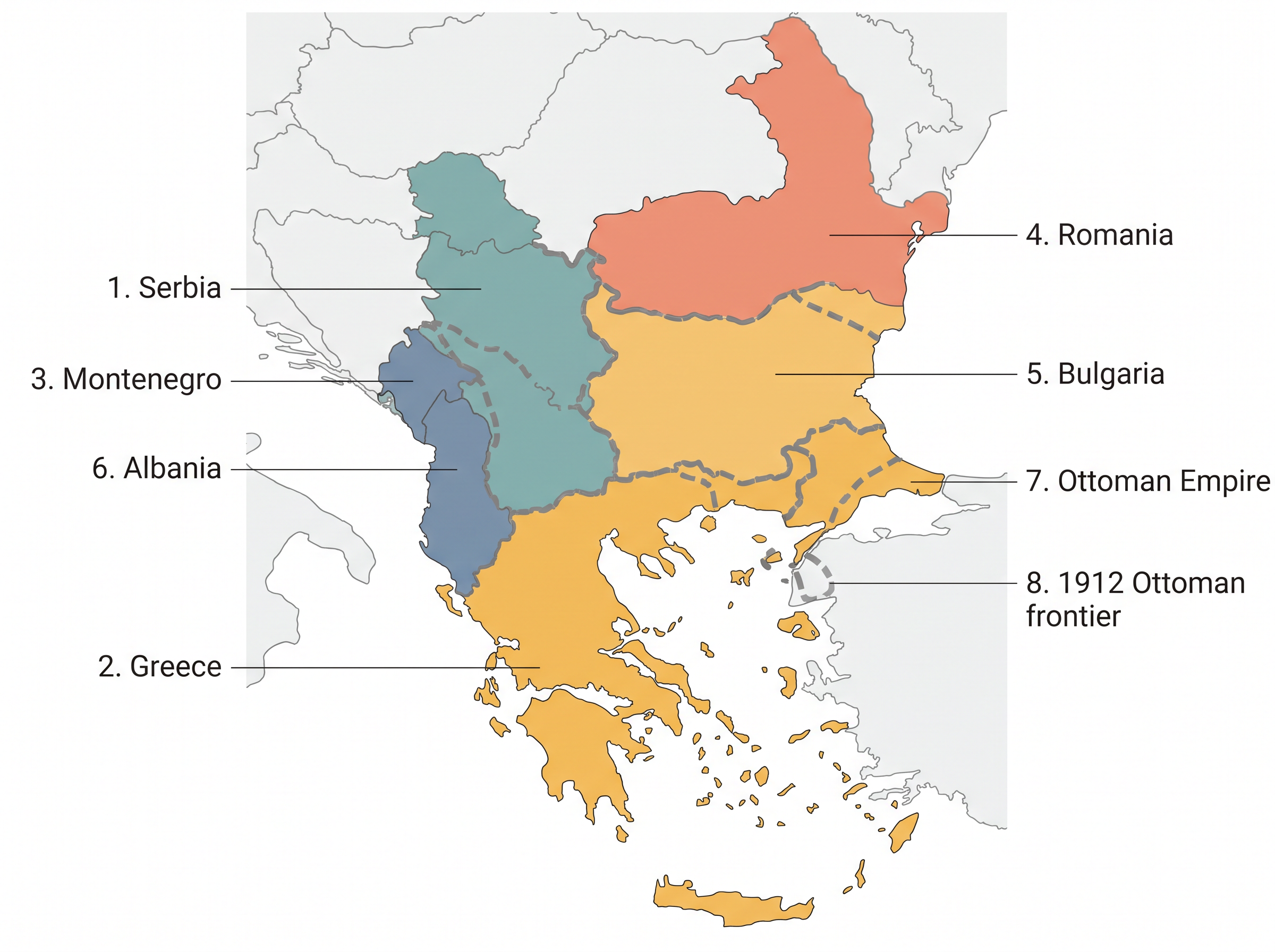
Fig. 7.10 – The Balkans after the Treaty of Bucharest of 1913.
Why Vienna Read This As A Threat
Serbia emerged from the two wars roughly twice her former size and far more confident. That was the outcome Austria-Hungary had feared for a decade.
Vienna did secure one thing. With Italian support, the great powers created an independent Albania, which kept Serbia off the Adriatic coast and denied her a port. But this was a limit on Serbian growth, not an end to it, and the Austrian general staff drew the conclusion it had been drawing since 1908 — that the problem would have to be settled by war, and soon.
7.6.4 The Sarajevo Crisis, June 1914
On 28 June 1914 the Archduke Franz Ferdinand, heir to the Austro-Hungarian throne, visited Sarajevo, the capital of Bosnia, with his wife Sophie. He had come to observe army manoeuvres. The date was St Vitus’s Day, an anniversary of great meaning to Serbs, and the choice of it for an imperial visit to an annexed province was, at the least, careless.
A group of young Bosnian Serbs had planned to kill him. They were subjects of Austria-Hungary, not of Serbia, and their weapons had reached them through a secret society of Serbian army officers known as the Black Hand, which worked for the union of all Serbs and was not under the control of the Serbian government.
A bomb thrown that morning missed. Later in the day, after the royal car took a wrong turning and stopped to reverse, Gavrilo Princip, a nineteen-year-old member of the group, shot the Archduke and his wife at close range. Both died within minutes.
Six Weeks Of Decisions
Nothing about what followed was automatic. The murder of an heir to a throne could have been treated as a crime, and the culprits pursued through the courts. It was treated instead as an opportunity, and the decisions that made it one were taken by identifiable men over the next five weeks.
Vienna’s first step was to make sure of Germany. On 5 July the German government assured Austria-Hungary of its full support whatever action she took against Serbia — an undertaking historians usually call the ‘blank cheque’, because no limit was placed on it. Austria was now free to act, and knew that Germany would face Russia if Russia intervened.
7.6.5 From Ultimatum To World War
Once Austria declared war on Serbia, the alliance system and the mobilisation timetables described earlier did the rest, and they did it in a week. The sequence is set out in Fig. 7.11.
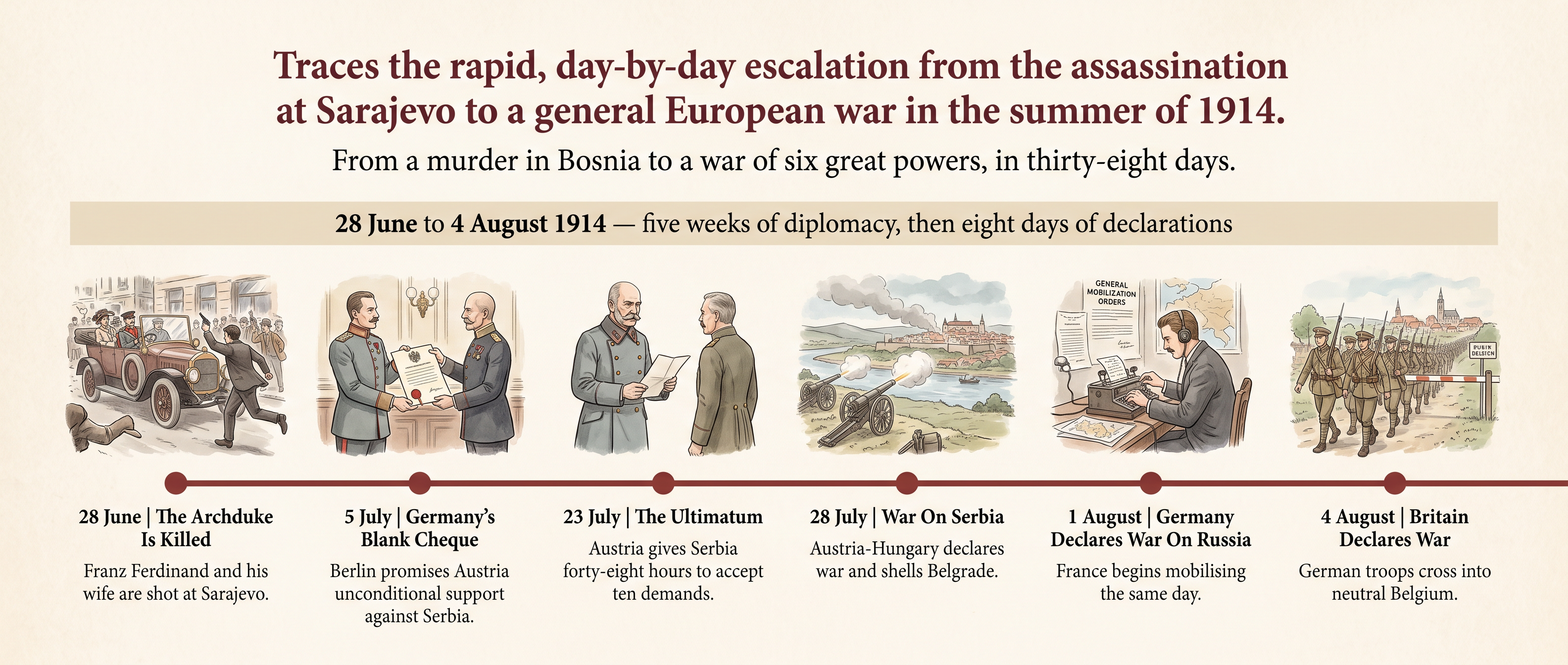
Fig. 7.11 – The July Crisis of 1914.
Why Russia Could Not Wait
Russia’s decision on 30 July was the hinge. Her government had retreated in 1908 and had promised itself it would not retreat again; abandoning Serbia twice would have ended Russian influence in the Balkans altogether.
But Russian mobilisation was slow, and to order it against Austria alone was technically impossible with the plans in existence. A general mobilisation was ordered — and in Berlin, general mobilisation by Russia was the one event the German war plan could not survive. Germany demanded that it stop, and when it did not, declared war.
Why Britain Came In
Germany’s plan required an attack on France through Belgium, whose neutrality Britain, along with the other powers, had guaranteed by treaty in 1839. When German troops crossed the Belgian frontier on 4 August, Britain demanded their withdrawal and, receiving no answer, declared war that night.
The German Chancellor is reported to have asked the British ambassador whether Britain would really go to war for a scrap of paper. The question was not as foolish as it sounds. Belgium was a reason Britain could give her own people; the deeper reason was that Britain could not allow Germany to defeat France and stand on the Channel coast.
7.7 The Paris Peace Settlements
The war that began in August 1914 lasted more than four years and drew in states from every continent. It ended on 11 November 1918, when Germany signed an armistice — an agreement to stop fighting while terms of peace are settled. Her allies had already given up in the preceding weeks.
Four empires had fallen: the German, the Austro-Hungarian, the Russian and the Ottoman. Millions were dead, and the governments that met in Paris in 1919 were dealing not with a defeated enemy but with a continent whose political map had ceased to exist.
7.7.1 The Conference, The Peacemakers And Their Aims
The Paris Peace Conference opened on 18 January 1919. Delegations from more than thirty states attended, but the decisions were taken by a very small group: Woodrow Wilson, President of the United States, David Lloyd George, the British Prime Minister, Georges Clemenceau, the French Premier, and Vittorio Orlando of Italy — ‘the Big Four’.
Two important states were absent. Germany was not invited to negotiate, and was called in only at the end to receive the terms. Soviet Russia, which had left the war in 1918 and whose government the Allies did not recognise, was not invited at all.
Four Aims, Not All Compatible
The conference set itself several tasks at once: to make peace treaties with the defeated states, to redraw frontiers on the principle of self-determination, to build an organisation that would prevent future wars, and to fix responsibility and compensation for the damage done.
Self-determination — the principle that a people should decide the state it lives under — came chiefly from Wilson, who had set out American war aims in January 1918 in his Fourteen Points. Their substance was open diplomacy instead of secret treaties, freedom of the seas, free trade, disarmament, colonial claims settled with regard to the peoples concerned, a list of specific territorial settlements, and, as the last point, a general association of nations to keep the peace.
Germany had asked for an armistice expecting a peace on that basis. What she met in Paris was a negotiation among victors, of whom only one was much interested in the Fourteen Points.
7.7.2 The Treaty Of Versailles With Germany
The treaty with Germany was signed on 28 June 1919 in the Hall of Mirrors at the Palace of Versailles — the room in which the German Empire had been proclaimed in 1871. The choice of room was not an accident, and both sides understood it.
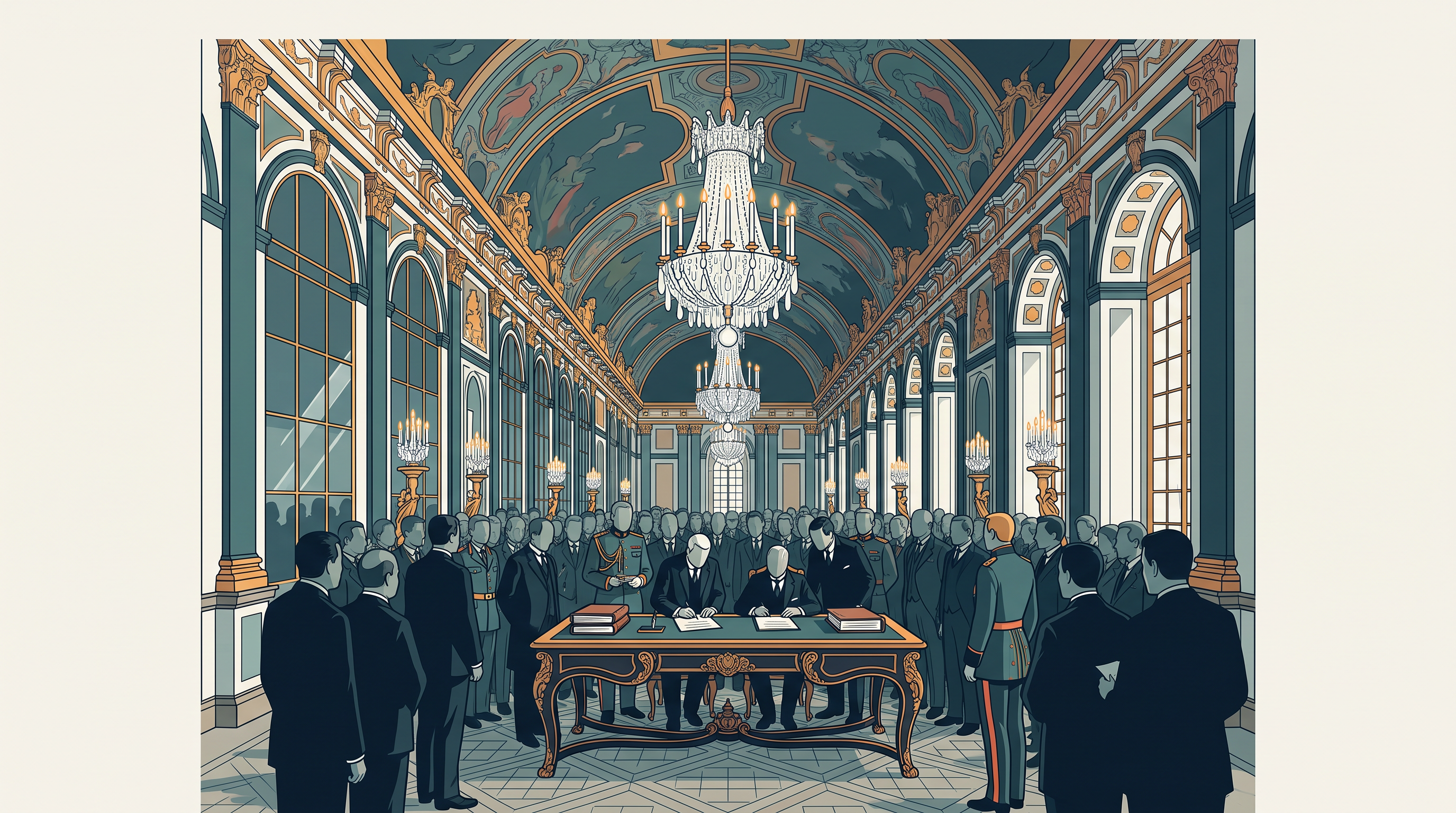
Fig. 7.12 – Signing the Treaty of Versailles in the Hall of Mirrors.
The Territorial Terms
Germany lost territory on every frontier. Alsace-Lorraine returned to France, ending the grievance of 1871. Eupen and Malmedy went to Belgium, and North Schleswig to Denmark after a vote of its inhabitants.
In the east, West Prussia and Posen went to the reconstituted state of Poland, giving Poland access to the sea through a strip of land that separated East Prussia from the rest of Germany — the Polish Corridor. The port of Danzig, at the head of it, became a free city under League of Nations control rather than Polish or German territory.
The Saar coalfield was placed under League administration for fifteen years, with its coal at France’s disposal, after which its people would vote on their future. Memel was taken from Germany and placed under Allied control. Germany also renounced the territories she had taken from Russia during the war, and Estonia, Latvia and Lithuania emerged as independent states.
Two clauses dealt with peoples rather than land. Anschluss, the union of Germany with Austria, was forbidden. And all Germany’s overseas colonies were taken away, to be governed by the victorious powers as mandates — territories held under supervision of the League of Nations, with an obligation to report on their administration.
The Military And Financial Terms
The German army was limited to 100,000 men and conscription was banned. Germany was forbidden tanks, military aircraft and submarines, her navy was reduced to a handful of ships, and the Rhineland — German territory west of the Rhine and a strip to the east of it — was permanently demilitarised.
Then came the clause that would be quoted more than any other.
Read the sentence carefully, because a great deal turns on what it does and does not say. The word ‘guilt’ does not appear in it. Its function was legal: the Allies were establishing a basis in law for a bill, since a state cannot be charged for damage it is not responsible for causing.
That is not how it was read in Germany. The article was called the Kriegsschuldlüge, the war-guilt lie, and it became the foundation of the German case against the whole treaty — the case that sent clerks into the Foreign Ministry archives to publish those forty volumes of documents.
The treaty itself named no total sum for reparations, the payments a defeated state makes for war damage. It established the principle and left a commission to calculate the amount. In 1921 that commission fixed the figure at 132 billion gold marks.
7.7.3 The Treaties With Austria, Bulgaria, Hungary And Turkey
Versailles was one of five treaties. The others dealt with Germany’s allies and, between them, dismantled two empires. Their order is given in Fig. 7.13.
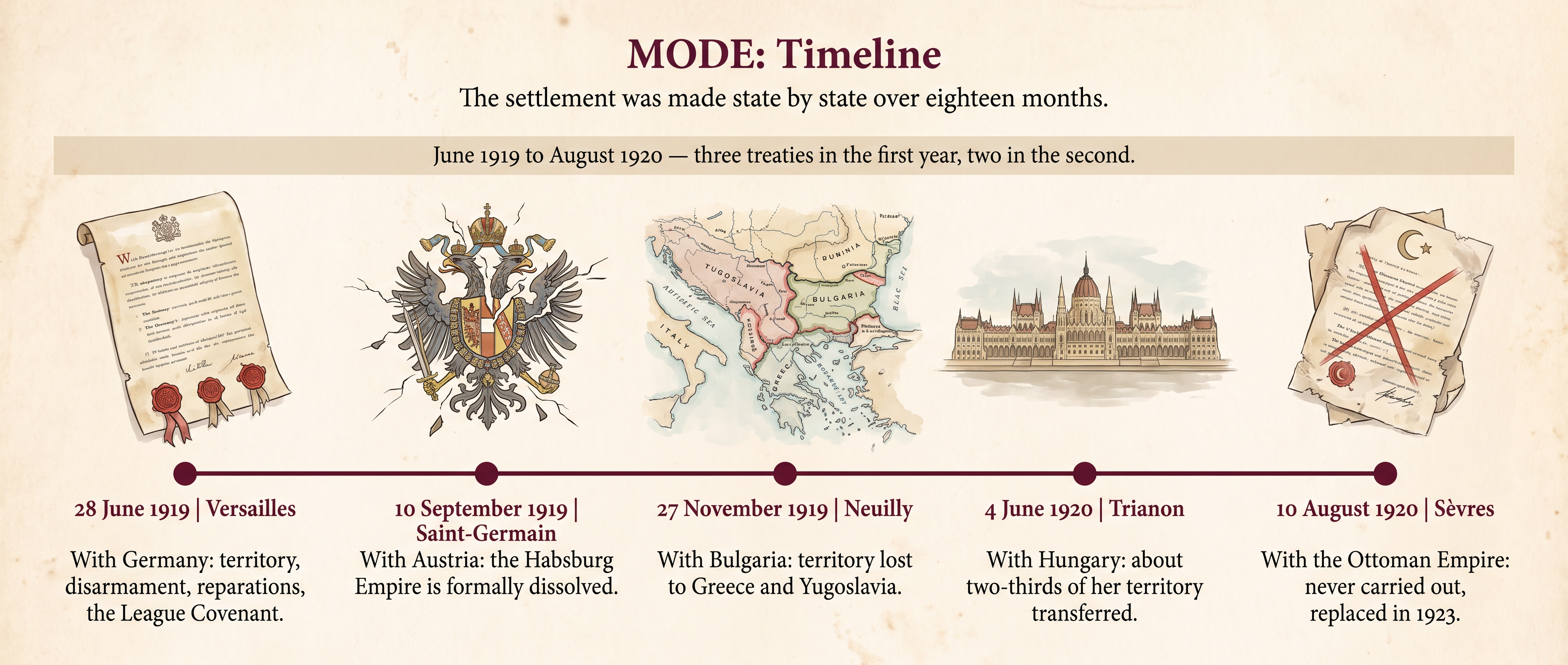
Fig. 7.13 – The five post-war peace treaties.
Saint-Germain And Trianon
The Treaty of Saint-Germain confirmed what the collapse of 1918 had already done: Austria-Hungary ceased to exist. Austria was left a small German-speaking republic. Bohemia and Moravia went to the new state of Czechoslovakia; South Tyrol, Trentino, Istria and Trieste to Italy; Bosnia-Herzegovina and Dalmatia to the new South Slav kingdom that became Yugoslavia; Galicia to Poland.
The Treaty of Trianon dealt with Hungary, and dealt with her severely. Transylvania went to Romania, Slovakia and Ruthenia to Czechoslovakia, Croatia to Yugoslavia. Hungary lost roughly two-thirds of the territory of the old kingdom, and with it about a third of the Hungarian-speaking population, who now lived as minorities in neighbouring states.
Here the principle of self-determination collided with its own consequences. In a region where peoples were mixed village by village, as Fig. 7.2 showed, no frontier could be drawn that left every nation whole. Every line satisfied somebody and stranded somebody else.
Neuilly And Sèvres
The Treaty of Neuilly took western Thrace from Bulgaria and gave it to Greece, costing Bulgaria her outlet to the Aegean, with further districts going to Yugoslavia.
The Treaty of Sèvres would have ended the Ottoman Empire altogether. Iraq, Palestine and Transjordan were to become British mandates, Syria and Lebanon French; eastern Thrace and the district of Smyrna were to go to Greece; and the Straits were to be placed under international control.
It never took effect. A Turkish national movement rejected the treaty, defeated the Greek forces in Anatolia, and obtained a different settlement — the Treaty of Lausanne of 1923. Of the five treaties made in Paris, one was overturned by the state it was imposed upon, within three years.
7.8 Changes In The Map Of Europe
Set Fig. 7.1, drawn for about 1900, beside Fig. 7.14, drawn for 1923. The two show the same continent twenty-three years apart, and they have very little in common. Nothing comparable had happened to the political geography of Europe in a single generation.
Three of the empires that had gone to war in 1914 no longer existed. Austria-Hungary had dissolved in the last weeks of the fighting, before any treaty was written. The Russian Empire had ended in revolution in 1917. The Ottoman Empire lost its Arab provinces and was replaced, after 1923, by the Turkish republic. Germany survived as a state, without her monarchy, her colonies and a seventh of her territory.
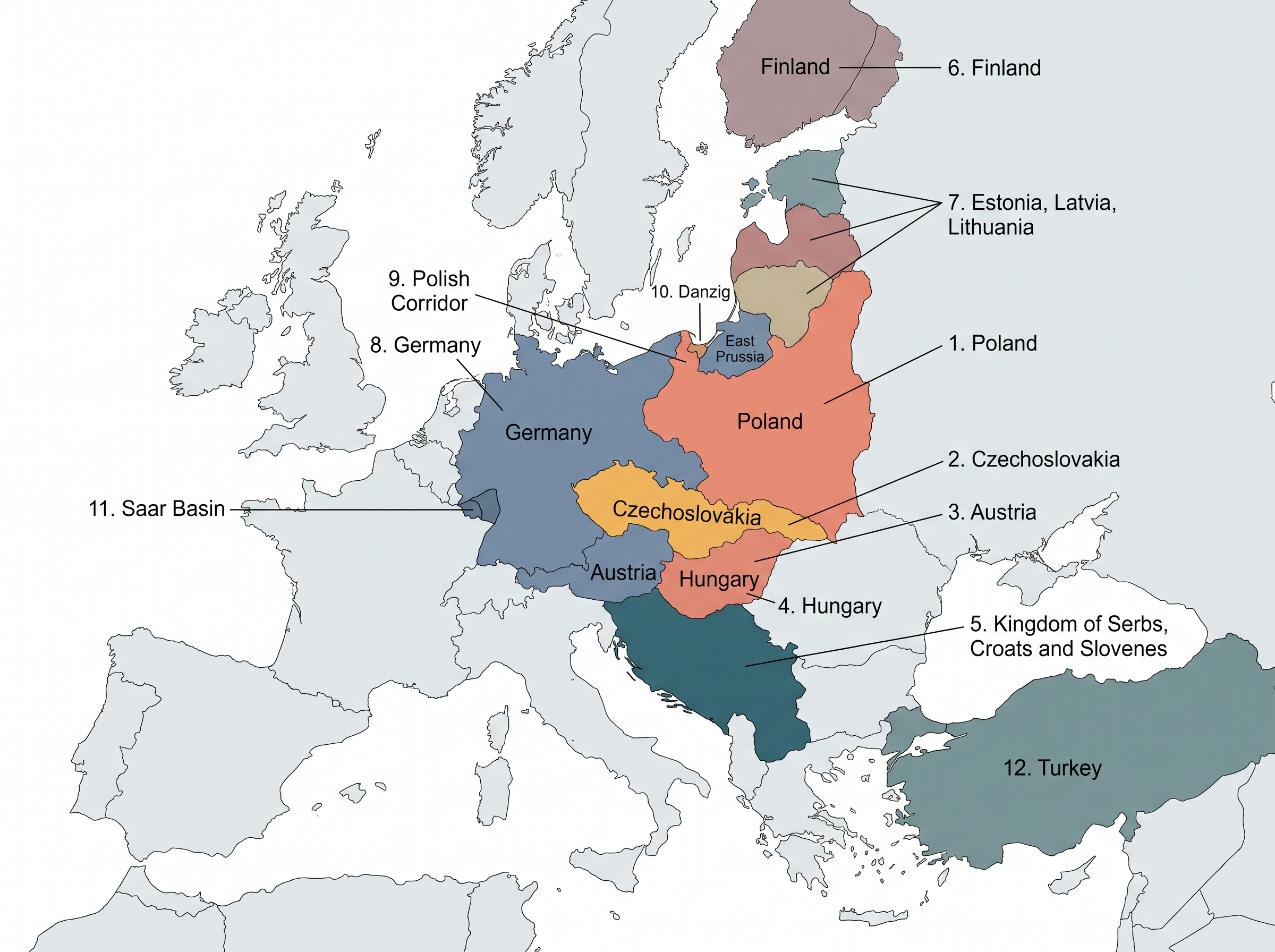
Fig. 7.14 – The political map of Europe in 1923.
The New States
Poland reappeared after more than a century of partition, put together out of German, Austro-Hungarian and Russian territory. Czechoslovakia was created from the Czech and Slovak lands of the Habsburg Empire. The South Slav kingdom joined Serbia and Montenegro with the Croats, Slovenes, Bosnians and others formerly ruled from Vienna and Budapest.
Along the Baltic, Finland, Estonia, Latvia and Lithuania emerged as independent states out of the collapse of the Russian Empire. Austria and Hungary, once two halves of a great power, became small and separate republics with no coastline between them.
Others simply grew. Romania roughly doubled in size, chiefly with Transylvania. Italy took South Tyrol, Trentino, Trieste and Istria. Greece gained western Thrace. France recovered Alsace-Lorraine, and was given the use of the Saar coalfield while the Saar itself was administered by the League of Nations.
The Problem Left Behind
Drawing borders by nationality sounds straightforward until you look at where people actually lived. In central and eastern Europe, villages of different languages stood within a few kilometres of one another, and no line could separate them cleanly.
Every new frontier therefore left minorities on the wrong side of it. About three million German speakers found themselves in Czechoslovakia; roughly a third of all Hungarian speakers lived outside Hungary; Poland contained large German, Ukrainian and Jewish populations. The peacemakers were aware of this and required the new states to sign treaties guaranteeing the rights of their minorities, supervised by the League of Nations.
In some disputed districts the inhabitants were asked directly.
Two Absences
The most consequential feature of the new map is something not marked on it. Between Germany and Russia there now lay a belt of small, new, mutually suspicious states, several of them quarrelling with one another over borders within a few years of their creation.
Germany was defeated but not dismembered: still the largest population in western and central Europe, still the strongest industry, and now surrounded by weaker neighbours than in 1914. Russia was absent from the settlement altogether, excluded by the victors and hostile to it.
Neither was going to remain absent for ever. The peacemakers had redrawn the map of the region between two great powers at the moment when both happened to be prostrate.
7.9 A Critical Evaluation Of The Treaty Of Versailles
No treaty of modern times has been argued over as fiercely as this one, and the argument began before the ink was dry. To evaluate it properly you have to hold two things apart: what the treaty actually contained, and what people believed it contained. Both had consequences, and they were not the same.
It also helps to remember what the peacemakers were working with. They had four months, a continent in ruins, populations demanding that somebody pay, and armies that could not be kept in the field indefinitely while they deliberated.
7.9.1 The Case For The Settlement
The first argument in the treaty’s favour is that it recognised nations that had not been allowed to exist. Poland, Czechoslovakia and the Baltic states owed their independence to the settlement, and for the peoples of the fallen empires, 1919 was not a disaster but the year they acquired states of their own.
The second is the League of Nations, created by a Covenant written into the treaty itself. For the first time, states agreed to submit disputes to a standing international body and to act together against an aggressor — the principle of collective security. The League was weak from the start, and weaker still because the United States Senate refused to ratify the treaty and America never joined. But the idea of a permanent organisation to keep the peace survived its failure, and shaped what came after.
The third is disarmament. Germany’s forced reduction was defended not as punishment but as a first step, with the victors declaring their intention to follow. It was the first time European powers had written arms limits into a peace treaty at all.
The fourth is that the reparations, whatever their effect on Germany, answered a real injury. Northern France and Belgium had been fought over for four years; mines were flooded, towns flattened and farmland made unusable. Somebody had to pay for reconstruction, and the states that had been invaded did not see why it should be themselves.
The mandate system was also presented as a moral advance: the colonies of the defeated powers were not to be annexed, but administered under League supervision with an obligation to report. Whether it worked that way in practice is dealt with below.
7.9.2 The Case Against The Settlement
A Dictated Peace
Germany’s first objection was to the process. She had not been allowed to negotiate; the terms were presented complete, with a deadline and the threat of renewed war. Germans called the result the Diktat — the dictated peace — and drew from it the conclusion that they were bound by force rather than by agreement.
This mattered more than the individual clauses. A government that signs under protest, and whose people believe it was ambushed, has an interest in revision from the first day.
Self-Determination Applied Unevenly
The second objection was that the principle proclaimed by the victors was applied to some peoples and not others. Germans in the Sudetenland became Czechoslovak citizens; Germans in Danzig, in the Polish Corridor and in Upper Silesia were separated from Germany; and Austria, a German-speaking state that wished to join Germany, was forbidden to do so.
The Allies had reasons — security, viable frontiers, economics, the fact that in a mixed region somebody must always be the minority. But the reasons were not the principle they had announced, and the gap between the two supplied every future German government with an argument that sounded like justice.
Reparations
The third objection was financial. John Maynard Keynes, a British Treasury official who resigned from the delegation, published The Economic Consequences of the Peace in 1919, arguing that the demands were beyond Germany’s capacity and would damage the European economy as a whole. The book was enormously influential and shaped opinion in Britain and America against the settlement.
To this the Germans added a charge of unfairness. Article 231 assigned responsibility to Germany and her allies alone, and the sum fixed in 1921 was owed by a state that had also been defeated, blockaded and stripped of its coalfields and colonies.
The Discontented Victors
Not all the anger came from the defeated. Italy had entered the war in 1915 on the promise of territory along the eastern Adriatic, and did not receive all of it. Italian nationalists called the outcome a mutilated victory, and the grievance became a permanent feature of Italian politics.
Two great powers were absent altogether. Germany was excluded as a defeated aggressor, and Soviet Russia because the Allies would not deal with the Bolshevik government. A settlement for Europe had been made without two of the largest states in Europe, and both had every reason to attack it later.
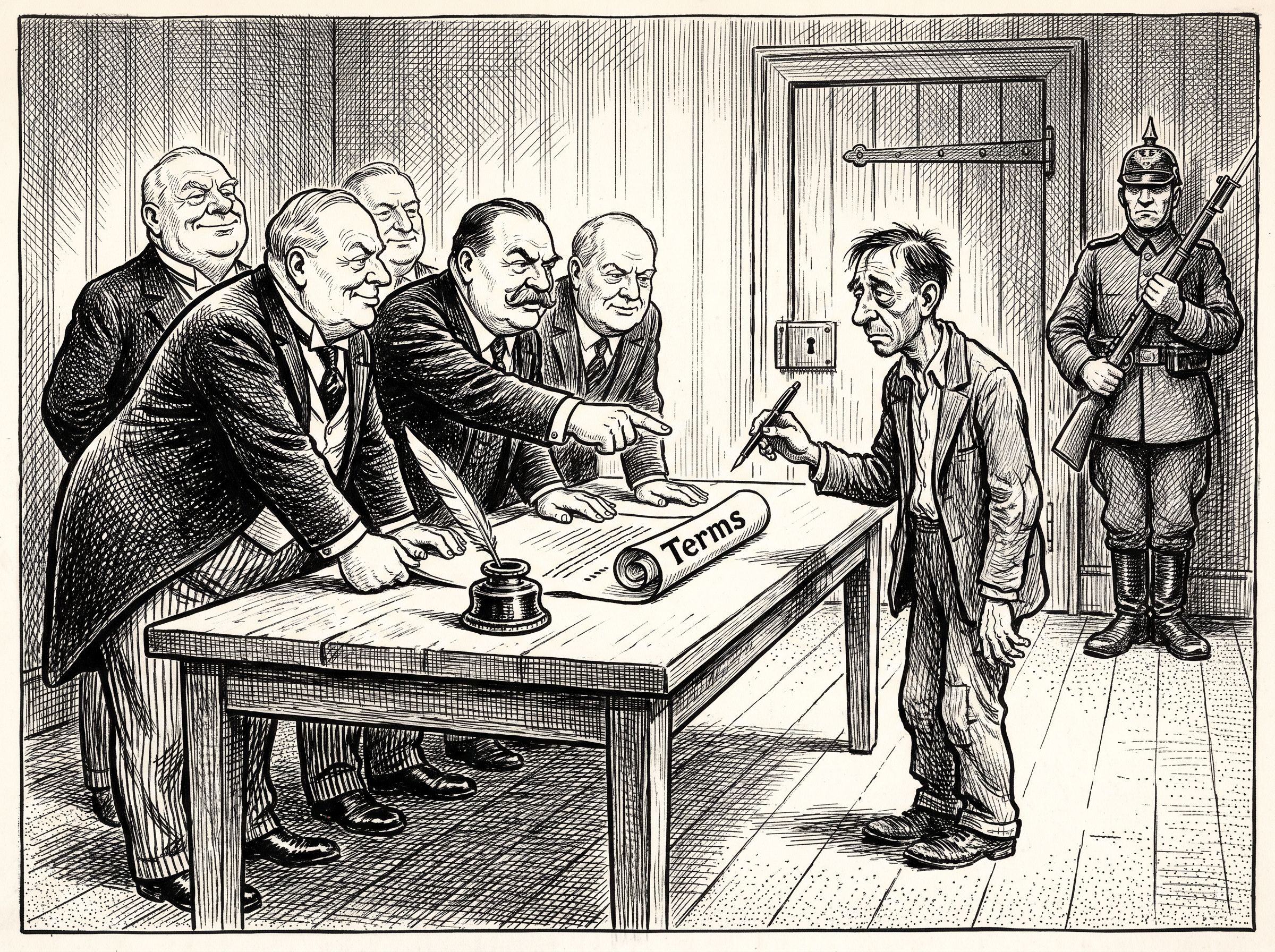
Fig. 7.15 – The dictated peace. Inspiration: Original cartoon for this book.
7.9.3 A Peace To End All Peace?
Was the treaty, then, too harsh? The most useful answer is that it was harsh enough to be resented and not harsh enough to disable. Germany lost territory, arms and money, and remained the strongest single state in central Europe, with her industry and unity intact and her neighbours smaller than before.
A comparison sharpens the point. In March 1918, when Germany had defeated Russia, she imposed a peace at Brest-Litovsk that stripped Russia of a vast territory and a large share of her population and industry. The victors of 1919 were not inventing severity, and Germans who denounced Versailles as unprecedented had a very short memory.
Yet the comparison does not settle the argument, because what mattered was not the objective weight of the terms but the belief that they were an injustice. Article 231 was a lawyer’s clause, and it became a national wound. The League was a genuine innovation, and it lacked the members and the force to act. Self-determination was a genuine principle, and its incomplete application supplied a decade of grievances.
The judgement often quoted is that this was a peace to end all peace. It is a memorable phrase and it should be used with care. Treaties do not cause wars twenty years later by themselves; governments, movements and voters make the choices in between. What a bad settlement does is to leave the arguments lying about, ready for whoever wants to pick them up.
That is the honest verdict a student can defend. The peacemakers of 1919 faced a problem with no clean solution, chose a settlement that satisfied nobody entirely, and left behind a Europe in which the losers, and some of the winners, wanted the map redrawn again.
7.10 Summary
Why Europe Was Combustible
- Europe in 1900 was run by six great powers with nothing above them. Peace rested on the balance of power, which was held together by armies, secret agreements and the judgement of a few ministers and monarchs.
- Each power’s policy grew out of a specific fear: France feared Germany, Germany feared encirclement, Austria-Hungary feared her own nationalities, Russia feared humiliation, Britain feared the loss of naval supremacy.
- The Balkans were dangerous because Ottoman retreat left small states with competing claims, and because Russia and Austria-Hungary wanted opposite outcomes there.
- The alliance system was built one defensive agreement at a time — from Bismarck’s Dreikaiserbund of 1873 to the Triple Entente of 1907 — and each was signed to prevent war.
- Its effect was the opposite of its intention. Alliances meant a local quarrel engaged distant powers, that no partner could safely stand aside, and that events moved faster than negotiation could.
- Imperialism did not cause the war directly. It gave the powers thirty years of practice in treating one another as rivals, and taught their publics to read every foreign dispute as a test of national strength.
- After the Moroccan crisis of 1905–06, colonial disputes became tests of which European camp could hold together. The result was measured in Europe, not Africa.
- Militarism meant more than large forces. Conscript armies with millions of reserves, a naval race in which Britain’s own Dreadnought cancelled her lead, and general staffs whose plans ran on fixed railway timetables.
- Those timetables mattered politically. Mobilisation became a commitment rather than a warning, and Germany’s only war plan turned any eastern crisis into an attack on France through Belgium.
- Nationalism had changed character by 1900: schooling, cheap newspapers and conscription made it popular, competitive and difficult for governments to calm once roused.
- The same idea built states in Germany and Italy and dissolved them in Austria-Hungary. Serbian nationalism sought a South Slav state; the Habsburg Empire could not concede one and survive.
The Crises That Lit It
- Every crisis from 1908 to 1913 was settled without a general war, and every settlement made the next crisis harder. Vienna learned that firmness worked; St Petersburg learned it could not retreat twice.
- The annexation of Bosnia in 1908 humiliated Russia and embittered Serbia. Agadir in 1911 tightened the entente and turned German opinion against Britain.
- The Balkan Wars of 1912–13 left Serbia roughly twice her former size and convinced the Austrian general staff that the Serbian question must be settled by force.
- The murder of Franz Ferdinand on 28 June 1914 supplied an occasion, not a cause. What followed was a series of decisions: Germany’s blank cheque, an ultimatum written to be rejected, Russia’s general mobilisation, and the German march into Belgium that brought Britain in.
The Settlement
- The peacemakers of 1919 faced four fallen empires and four aims that did not fit together: treaties with the defeated, self-determination, a League of Nations, and compensation for the damage done.
- The Treaty of Versailles took German territory on every frontier, removed her colonies as mandates, limited her forces, and established, through Article 231, a legal basis for reparations whose sum was fixed in 1921.
- Article 231 was drafted by lawyers to justify a bill. In Germany it was read as a verdict on the nation’s honour, and it became the foundation of the case against the whole treaty.
- Four further treaties dissolved Austria-Hungary, reduced Bulgaria and Hungary severely, and would have partitioned the Ottoman Empire — until Sèvres was overturned and replaced in 1923.
- The map of Europe was remade: new states from the Baltic to the Adriatic, and millions of people left as minorities because no frontier could separate mixed populations cleanly.
- The settlement was harsh enough to be resented and not harsh enough to disable. Germany remained the strongest single state in central Europe, and Russia was excluded from the arrangement entirely.
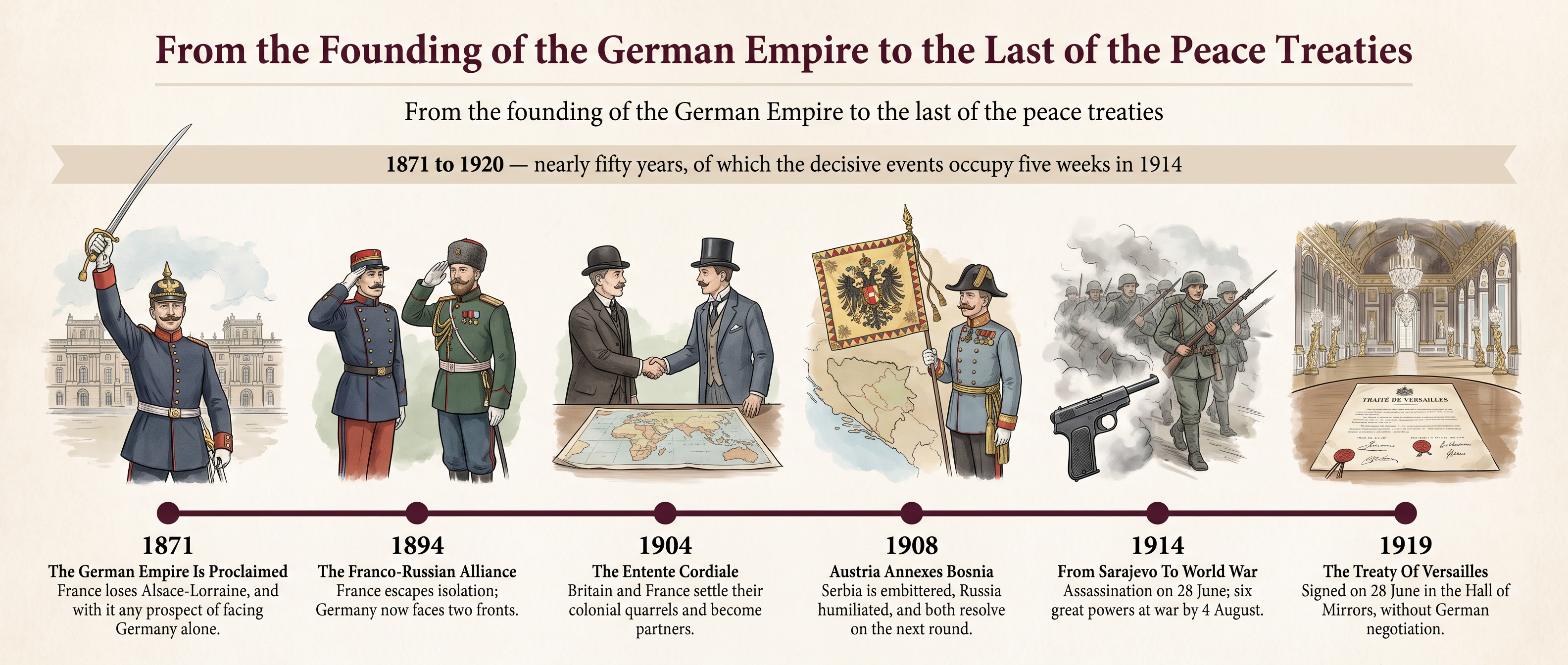
Fig. 7.16 – The whole chapter in dates.
What The Evidence Cannot Tell Us
The documents for these years are unusually rich, and that is precisely the problem. The despatches and minutes were published by governments arguing about blame, and each chose what to print; the decisive conversations of July 1914 happened in rooms, not on paper.
The record is also lopsided in a second way. We can trace what a dozen ministers and generals decided almost hour by hour. We cannot recover, with anything like the same certainty, what the conscripts, the Bosnian villagers or the minorities of the new states thought was being decided about them.
7.11 Check Your Memory
Name the six great powers of Europe in 1900 and explain, in your own words, what was meant by the balance of power.
State what Germany and Austria-Hungary promised each other in the Dual Alliance of 1879, and explain why that promise drew Germany into quarrels in the Balkans in which she had no interest of her own.
Look again at Fig. 7.6. Explain how the design of HMS Dreadnought differed from earlier battleships, and why its launching in 1906 damaged Britain’s own naval position.
An alliance and an entente are not the same thing. Bring out the difference between them, using the Franco-Russian alliance of 1894 and the Entente Cordiale of 1904 as your examples.
Using Fig. 7.10, identify the states that gained territory from the Ottoman Empire in the Balkan Wars. Explain why the creation of an independent Albania mattered so much to Serbia, and why Austria-Hungary supported it.
Reconstruct the sequence of events from Russia’s general mobilisation on 30 July 1914 to Britain’s declaration of war on 4 August, showing at each step why the next one followed.
Read Source 7.1 again. What was Article 231 drafted to achieve, and why was it read in Germany as something quite different from what its drafters intended?
Much of what we know about the origins of the war comes from diplomatic documents published by governments in the 1920s. Explain what this kind of evidence records well, and identify two things it cannot tell us.
Historians disagree about whether the Treaty of Versailles was too harsh on Germany. Set out the strongest case on each side, and then argue for the view you find more convincing, giving your reasons.
‘The assassination at Sarajevo was the occasion of the war, not its cause.’ Using the long-term causes studied in this chapter, explain how far you agree with this statement.