Chapter 5: Gandhian Nationalism (1916–1922)
In November 1919, in a committee room in Lahore, a British officer sat answering questions. Brigadier-General Reginald Dyer had been called before the Disorders Inquiry Committee, appointed by the Government of India and chaired by Lord Hunter, a Scottish judge. Seven months earlier, Dyer had marched troops into a walled enclosure in Amritsar and ordered them to fire on a crowd.
What makes the record remarkable is how little he denied. He agreed that he had given no warning before the firing began. He agreed that the shooting continued until the ammunition was almost gone — some sixteen hundred and fifty rounds. He explained that he had fired not merely to break up that gathering but to produce an effect across the whole of Punjab. Asked whether he would have used the machine guns mounted on his armoured cars, he said he would have, had the lane been wide enough to bring them in.
Historians do not have to reconstruct what happened at Jallianwala Bagh from rumour. Much of the core of it comes from the officer who ordered it, set down in print, under questioning, in the government’s own published volumes of evidence.
That inquiry sat because India had erupted. A law passed that March had turned a lawyer who still believed in British justice into its most determined opponent — and had begun to turn a party of petitions into a mass movement.

Fig. 5.0 – The published report of the Disorders Inquiry Committee.
5.1 The Rowlatt Act
In March 1919 the Government of India placed on the statute book a law that allowed a person to be arrested without a warrant, held without trial and tried without a jury or an appeal. Its formal name was the Anarchical and Revolutionary Crimes Act, 1919. Almost nobody used that name.
Indians called it the Rowlatt Act, after the English judge whose committee had recommended it, and very quickly they called it the Black Act. The law itself was short-lived and, as you will see, was never actually used against anyone. Its consequences were enormous.
To understand why, you have to understand what Indians had been promised, and what they were given instead. The sequence set out in Fig. 5.1 covers less than four years, and every step in it matters.
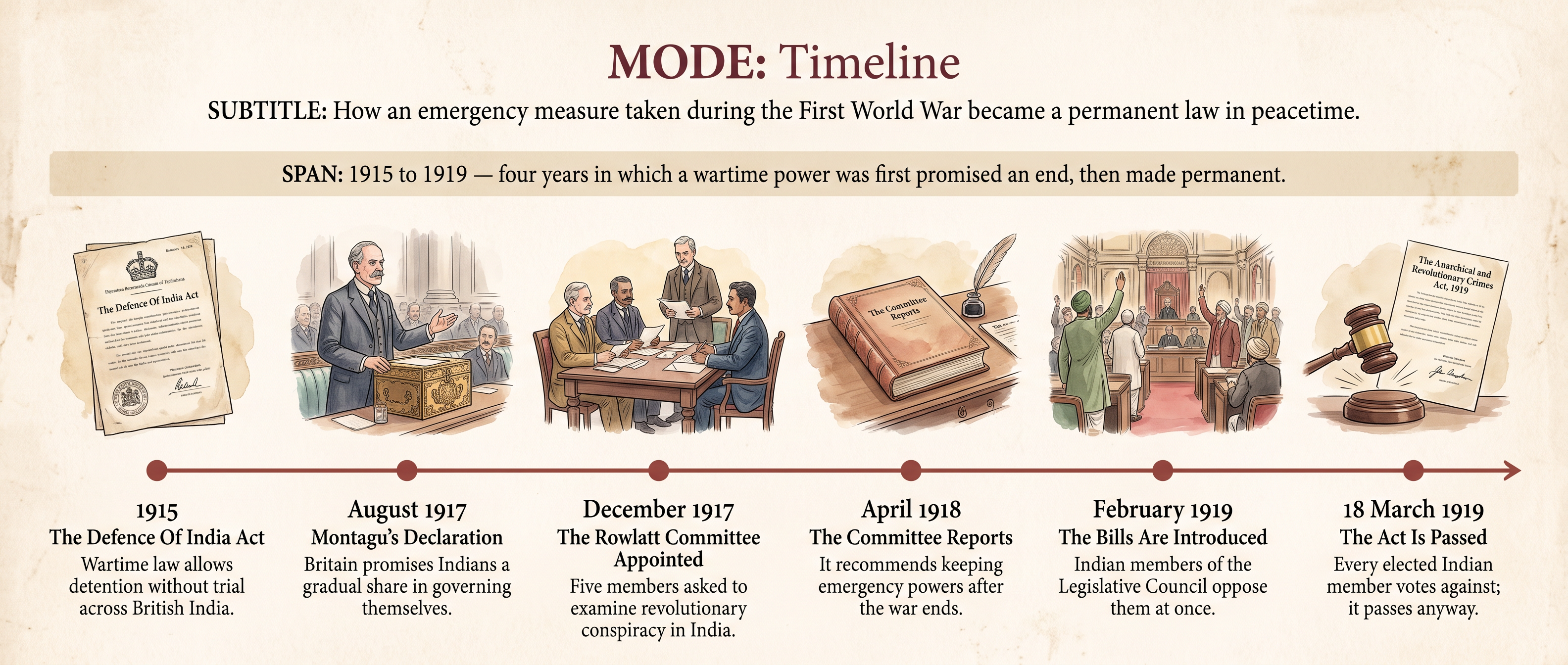
Fig. 5.1 – From Wartime Powers To The Black Act.
5.1.1 Why The Government Wanted The Act
A Law Made For War
When the First World War began in 1914, the Government of India took emergency powers. The Defence of India Act of 1915 let the executive arrest a suspect without a warrant, hold him without trial, and place him before a special tribunal from which there was no appeal.
These powers rested on a simple argument: a state at war cannot afford ordinary legal delay. The Act was therefore temporary. It was due to lapse six months after the war ended.
That expiry date created the problem. The war ended in November 1918, and with it the legal basis for powers the police and the provincial governments had come to rely on.
Officials had used them chiefly against revolutionary groups in Bengal and Punjab — small, armed, secret organisations that had attempted assassinations and robberies, and some of which had sought money and weapons from Germany during the war. Whether that threat still existed in 1919 was exactly the question in dispute.
Reform In One Hand, Repression In The Other
At the same time, Britain was promising something quite different. In August 1917 the Secretary of State for India, Edwin Montagu — the minister in London responsible for Indian affairs — announced a new policy in the House of Commons.
Read what he actually committed Britain to. The wording was picked over in India for years afterwards, because every word in it was doing work.
Montagu came to India himself between November 1917 and March 1918 to work out what the declaration meant in practice. The reforms he and the Viceroy, Lord Chelmsford, proposed became law only in December 1919 — nine months after the Rowlatt Act.
That order matters. Indians met the repression before they met the reform, and it shaped how they judged the reform when it came.
The Committee And Its Report
In December 1917 the government appointed a committee of five, under Sir Sidney Rowlatt, a judge of the King’s Bench in England. Its task was to examine revolutionary conspiracies in India and recommend what legal powers were needed against them. It is often called the Sedition Committee. Sedition means speech or action intended to stir people up against the authority of the government — a charge that in colonial India could cover a newspaper article as easily as a bomb.
The committee reported in April 1918. It concluded that conspiracy in Bengal and Punjab remained dangerous, and that the ordinary criminal law, with its rules of evidence and rights of appeal, could not reach it. Emergency powers, it advised, should continue in peacetime.
There was a further reason the committee did not have to state. India in 1918–19 was tense in a way that had little to do with revolutionaries. Prices had risen sharply during the war, an influenza epidemic had killed millions, and soldiers were coming home to no work and no reward. A government expecting trouble wanted powers ready before the trouble began.
5.1.2 The Main Terms Of The Act
What The Courts Could Do
The Act created a special procedure for certain offences. A case could be sent to a tribunal of three High Court judges instead of an ordinary court.
That tribunal sat without a jury. It could admit evidence that the ordinary law of evidence would have excluded, and it could hear parts of a case in private. Against its verdict there was no appeal.
Each of these was a normal safeguard removed. Together they meant that a person could be convicted on material he was never allowed to test, by a court from which there was nowhere to go.
What The Executive Could Do
The second part of the Act did not involve a court at all. It gave a provincial government power to act on suspicion, before any offence was proved.
A suspect could be arrested without a warrant and confined. He could be ordered to live in a particular place, to report himself, to deposit a security — a sum of money forfeited if he broke the conditions — and to abstain from taking part in political, educational or religious activity. Possession of a seditious document was itself made an offence.
This is what Indians meant when they said the Act made a man guilty before trial. The power that mattered was not the special court. It was preventive detention — holding a person because of what the state believes he might do, rather than convicting him for what he has done.
How It Passed
The Act went through the Imperial Legislative Council, the body in Delhi that made law for British India. Indians sat on it, but only a minority were elected, and officials and nominated members together held a permanent majority.
Every elected Indian member voted against the Bill. It passed on 18 March 1919 regardless, and the vote taught a lesson no speech could have taught: on a question Indians cared about, Indian opinion could be recorded and then ignored.
5.2 The Satyagraha Against The Rowlatt Act
Opposition to the Rowlatt Bills was not new in March 1919. Indian members had argued against them in the Legislative Council, newspapers had attacked them, and moderate leaders such as Surendranath Banerjee had recorded their objections through the usual channels of petition and speech.
All of it had failed. The Act passed anyway, and that failure is the hinge of this chapter. Constitutional protest had been tried against a government that did not have to listen, and something else was needed.
The something else came from a man of forty-nine who had been back in India for four years. Mohandas Karamchand Gandhi had spent two decades in South Africa leading Indians against racial laws there, and had worked out a method of resistance in the process. He called it satyagraha — literally ‘holding firmly to truth’, a way of refusing obedience to an unjust law openly, without concealment and without violence, and accepting the punishment that follows.
5.2.1 Gandhiji’s Call For A Hartal
The Pledge Of February 1919
In February 1919, while the Bills were still before the Council, Gandhiji and a group of associates in Bombay formed a Satyagraha Sabha. Its members signed a pledge that committed them in advance to disobey the law if it was enacted.
The pledge is worth reading closely, because it shows how carefully this kind of resistance was defined. It states an objection, sets a condition, promises disobedience, and then binds the signatory to a limit.
Notice the phrase ‘refuse civilly to obey’. The disobedience was to be announced, not hidden; the signatories expected arrest and did not intend to resist it. Notice also who was bound — the men who signed. That gap between the pledge and the crowd would matter within weeks.
The Day Of Humiliation And Prayer
The Act became law on 18 March. Gandhiji’s first call was not for disobedience of the Act itself but for a hartal — a complete and voluntary suspension of ordinary life, in which shops shut, work stopped and business closed for the day.
He asked Indians to spend that day fasting and in prayer, and described it as a day of humiliation and prayer. This was a deliberate choice of weapon. A hartal required no organisation, no weapons and no leaders on the spot; it needed only that ordinary people agree to do nothing, all on the same day.
The date first fixed was 30 March 1919. It was then changed to 6 April to allow more time for the news to spread — and the change itself caused the first deaths.
5.2.2 Protest, Arrest And Repression
6 April: The Country Responds
On 6 April the hartal was observed across British India — in Bombay, Ahmedabad, Calcutta, Madras, Lahore and Amritsar. Shops closed, mills stood idle, and processions and public meetings were held in cities where the Congress had never brought crowds into the streets before.
In Bombay, Gandhiji marked the day by selling copies of his own writings that the government had banned, a small and deliberate breach of the law designed to invite prosecution. The scale of the response surprised everyone, including him.
Map 5.1 shows the main centres of the April protests. Look at the spread: this was not one province in revolt but a coordinated action across the subcontinent, and that was precisely what alarmed the government.
Map
Map 5.1 Caption: Main centres of the Rowlatt satyagraha and the disturbances that followed, March and April 1919. Brief: Political outline of British India in 1919 within the full extent of India as officially defined today, with the 1919 provincial boundaries shown in a light tone and clearly labelled as historical; mark and label Delhi, Amritsar, Lahore, Bombay, Ahmedabad, Nadiad, Palwal, Calcutta and Madras; do not shade any area to suggest control or territory.
Support came from very different quarters. In the Legislative Council, Madan Mohan Malaviya, Mazhar-ul-Haq and Muhammad Ali Jinnah resigned their seats in protest at the Act. Shankarlal Banker of the Home Rule League and Mukhtar Ahmed Ansari worked in the agitation, and leaders as far apart in politics as Lala Lajpat Rai and Bal Gangadhar Tilak condemned the law. Newspapers such as the Amrita Bazar Patrika attacked it directly.
The Arrest At Palwal
Leaders in Delhi asked Gandhiji to come there, and he set out for Delhi and Punjab. The government had no intention of letting him arrive. He was served with an order forbidding him to enter Delhi or Punjab, and when he continued he was arrested on 9 April at Palwal, a small railway station south of Delhi, escorted back to Bombay and released.
The arrest of an unarmed man for the offence of travelling did more damage to the government than his speeches could have done. News of it spread faster than any explanation of the Rowlatt Act ever had.
The Violence Gandhiji Had Not Wanted
What followed was not what the pledge had promised. In Ahmedabad and Nadiad in Gujarat, crowds hearing of the arrest attacked government property, cut telegraph wires and killed officials; in Bombay too there was rioting and firing.
Gandhiji fasted for three days over it, and later described his own decision to call for mass civil disobedience before people had been trained in non-violence as a ‘Himalayan miscalculation’. The judgement is severe, and it is his own.
In Amritsar, the sequence ran faster and further. On 10 April the authorities arrested and removed from the city two popular local leaders, Dr Saifuddin Kitchlew and Dr Satyapal, on the orders of Sir Michael O’Dwyer, the Lieutenant-Governor of Punjab.
A crowd marching to demand their release was fired on. The city then turned violent: banks were burned, several Europeans were killed, and a British schoolteacher was beaten and left for dead. Civil authority in Amritsar collapsed within a day.
On 11 April, Brigadier-General Reginald Dyer arrived with troops and took charge of the city. The sequence in Fig. 5.2 covers seven weeks, and the last four days of it move faster than the first six weeks together.
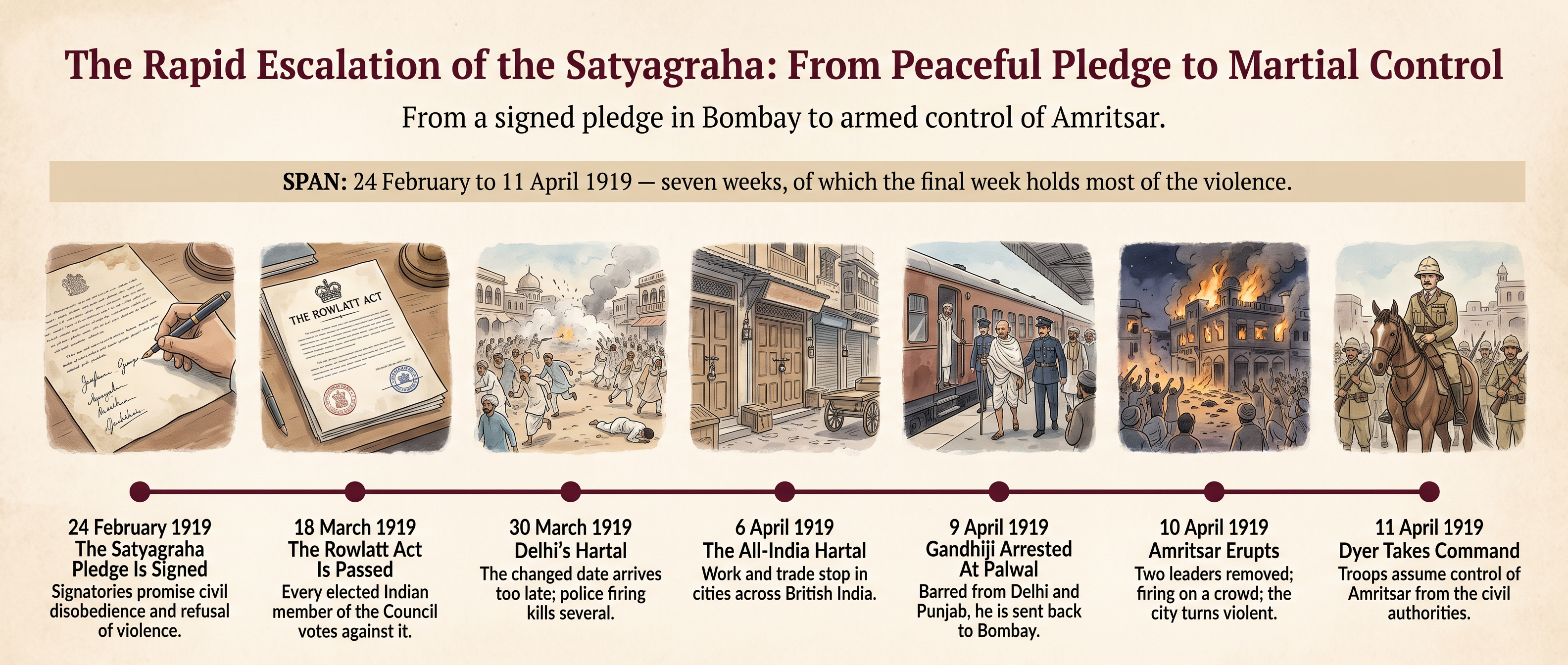
Fig. 5.2 – Six Weeks That Changed The Movement.
5.3 Jallianwala Bagh
What happened in Amritsar on 13 April 1919 took about ten minutes. It is the single event that turned a protest against one law into a national movement against British rule itself.
This section deals with killing, and it will state plainly what was done. That is not the same as dwelling on it. The historian’s questions here are what happened, on whose orders, how we know, and what the evidence still cannot tell us.
5.3.1 The Firing Of 13 April 1919
The Proclamation Nobody Heard
Dyer had taken military control of Amritsar on 11 April. On the morning of 13 April he had a proclamation announced through parts of the city: public gatherings and processions were banned, and anyone on the streets after eight in the evening could be fired on.
The proclamation was read at a limited number of places. Amritsar was a crowded city, and the announcement did not reach everyone in it.
It certainly did not reach the villagers arriving that day from the surrounding countryside. 13 April 1919 was Baisakhi, the spring harvest festival, and thousands had come into the city for the fair and the cattle market. Many of the people who assembled that afternoon had no idea a ban existed.
The Ground Itself
Jallianwala Bagh was not a park in any ordinary sense. It was an open piece of waste ground of a few acres, hemmed in on almost every side by the backs of houses, with a handful of narrow lanes leading in and out and a well in one corner.
That shape decides everything that followed. A crowd in an open field scatters; a crowd in an enclosure with narrow exits cannot. Study Fig. 5.3 before you read further.
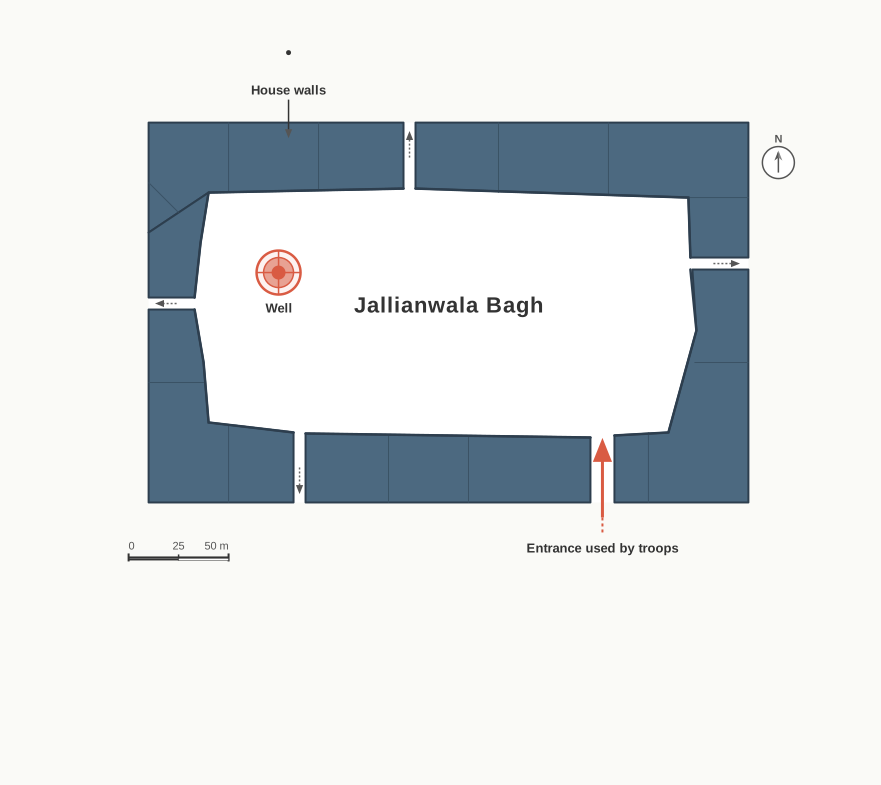
Fig. 5.3 – Plan of the Jallianwala Bagh enclosure, 1919.
Ten Minutes
A meeting was called in the Bagh that afternoon to protest against the Rowlatt Act and the removal of Kitchlew and Satyapal. Estimates of the crowd vary widely; most place it between ten and twenty thousand, seated on the ground and listening to speeches.
Dyer arrived in the early evening with about fifty riflemen. He brought two armoured cars mounted with machine guns, but the entrance passage was too narrow to bring them in.
He gave no warning and no order to disperse. He positioned his troops at the raised entrance and ordered them to fire into the crowd, directing the fire towards the places where people were densest and where they crushed towards the exits.
The firing continued for about ten minutes, until the ammunition was nearly gone — roughly sixteen hundred and fifty rounds. People trying to climb the walls were shot; others jumped into the well. Dyer then marched his men out. He made no arrangement for the wounded, and the curfew that night left them where they lay.
How Many Died
There is no agreed figure, and there never will be. The government’s own inquiry recorded 379 dead and over a thousand wounded. The Indian National Congress conducted its own inquiry and concluded that more than a thousand had been killed.
You should be uneasy about both numbers, and it is worth understanding exactly why.
5.3.2 Aftermath And The Withdrawal Of The Satyagraha
Martial Law In Punjab
Martial law was proclaimed across Punjab, and what followed was punishment aimed at a population rather than at individuals. Public floggings were carried out, aircraft were used against crowds at Gujranwala, and in the lane where a British teacher had been assaulted, Dyer ordered that any Indian passing through must crawl the length of it on hands and knees.
The crawling order was not about security. It was about humiliation, and it was understood as such at the time by Indians and by many British officials.
Censorship went with it. News of what had happened at Amritsar spread slowly and unreliably through the rest of India, and Gandhiji himself was refused permission to enter Punjab until the autumn.
The Inquiries
The government appointed the Disorders Inquiry Committee under Lord Hunter in late 1919. Its majority report criticised Dyer for a mistaken conception of his duty; its Indian members went further in a separate minority report, rejecting the claim that the firing had been necessary at all.
Dyer was relieved of his command. What happened next did more damage than the report. The House of Lords passed a motion sympathetic to him, and a public subscription in Britain raised tens of thousands of pounds for him as a wronged man.
Indians drew the obvious conclusion. The Congress ran its own inquiry, with Gandhiji among its members, and its findings were far harsher than the official ones.
Renouncing The Knighthood
In May 1919, as fragments of the news reached Bengal, Rabindranath Tagore wrote to the Viceroy asking to be relieved of the knighthood the British had given him. He was the most celebrated Indian alive, and he gave up the honour in public.
Tagore’s letter matters for a reason beyond its eloquence. Renouncing a title was a form of protest available to a man who held one, and it pointed towards a method the whole country could use — the surrender of everything the British gave, from titles to schools to courts.
Why Gandhiji Called The Satyagraha Off
Gandhiji suspended the civil disobedience campaign on 18 April 1919. His reason was not Amritsar, of which he still knew little; it was the violence at Ahmedabad, Nadiad and elsewhere, which convinced him that people had not been prepared for the discipline the pledge demanded.
So the first satyagraha on a national issue ended in five weeks, formally in failure. Judged by its stated aim it achieved nothing: the Rowlatt Act stayed on the statute book until 1922.
Judged by anything else, it changed the terms of Indian politics. It had shown that ordinary people would act together on a call from a single leader, and Jallianwala Bagh had shown what the government would do when they did. Within a year Gandhiji would ask India for something far larger than a one-day hartal.
5.4 Passive Resistance As A Method
The Rowlatt satyagraha had been called off, but the method had not been abandoned. Between 1919 and 1920 Gandhiji worked out how the same idea could be applied not to a single law but to the whole apparatus of British rule.
Before you follow that story, you need to be clear about what the method actually claimed. It is easy to reduce non-violence to a slogan, and the slogan hides the argument.
Why The Name Mattered
The English phrase for this kind of protest was ‘passive resistance’ — refusing to comply with a law or an order, without using force. Gandhiji used the phrase, but he was never satisfied with it.
His objection was that ‘passive’ suggested weakness: the tactic of people who had no other option and would use force if they had it. Satyagraha, as he defined it, was the opposite — a positive act chosen by people who accepted suffering rather than inflicting it, and who would go on refusing whether they were strong or weak.
He had set out the argument years earlier, in a pamphlet written in 1909 that the Government of India later banned. It is the same pamphlet he sold in Bombay on the day of the hartal.
The Four Commitments
Gandhiji’s method rested on four things held together, and it fails if any one of them is dropped.
The first is truth. A satyagrahi announces what he intends to do and then does it openly, which is why the pledge of 1919 spoke of refusing ‘civilly’ to obey.
The second is ahimsa — non-violence, understood not merely as refraining from injury but as refusing to wish harm on the opponent. The third is tapasya, self-suffering: the willingness to take the punishment, including imprisonment, rather than pass the cost to anyone else.
The fourth is faith that the opponent has a conscience that can be reached. This is the assumption everything else rests on, and it is the one most often questioned.
The Argument Behind Non-Cooperation
The step from satyagraha to non-cooperation depends on a single observation about how colonial rule actually worked.
A few thousand British officials governed a subcontinent. They could not have done it alone. The revenue was collected through Indian officials, the law was enforced by Indian police, the courts were filled by Indian lawyers and Indian litigants, the army was largely Indian, the schools trained Indian boys for government service, and Indian merchants sold British cloth.
The conclusion follows: British rule in India rested on Indian cooperation. If that cooperation were withdrawn, the government would not have to be defeated. It would simply stop functioning.
What The Method Demanded
Read down that list again and you can see what non-cooperation would cost the people asked to practise it. A lawyer would give up his practice, a student his degree, an official his salary, a soldier his pension.
That is why the method required discipline rather than enthusiasm. Enthusiasm brings a crowd out for one day; discipline keeps a boycott going for a year, and keeps it non-violent when the police charge.
It also created a permanent weakness, and Gandhiji knew it. A movement that stakes everything on non-violence can be discredited by the actions of a few of its own supporters. A government facing a riot is back on ground it understands.
The Method Meets Its Moment
A method needs an occasion, and by the middle of 1920 Gandhiji had two of them running side by side.
One was the unhealed wound of Punjab, kept open by the government’s treatment of Dyer. The other was a grievance he did not share and had not created — the anger of Indian Muslims at what Britain was doing to the defeated Ottoman Sultan.
Joining those two together was the political decision that made the Non-Cooperation Movement possible. The next section explains the second of them.
5.5 The Khilafat Movement
The Khilafat Movement is the point at which a question of international diplomacy became a mass agitation in Indian towns and villages. Understanding it requires holding two things together: a religious loyalty that reached far beyond India, and a broken British promise.
It ran from 1919 to 1922 and, for most of that time, it ran alongside the Non-Cooperation Movement. The two were separate movements with separate committees and separate aims. They were fought by many of the same people, on the same days, in the same streets.
5.5.1 Why Indian Muslims Were Angered
The Sultan And The Caliphate
The Ottoman Empire, ruled from Constantinople, was the last great Muslim power in the world. Its Sultan also claimed the title of Khalifa or Caliph — successor to the Prophet’s authority over the community of Muslims, and guardian of the holy places at Mecca, Medina and Jerusalem.
That claim was not accepted by every Muslim everywhere, and it carried no legal force in India. But for large numbers of Indian Muslims the Ottoman Sultan was the symbolic head of their faith, and the survival of his position mattered.
This is what made the First World War so difficult for them. Turkey entered the war in 1914 on the side of Germany, against Britain — and Indian Muslim soldiers were in the British army, ordered to fight the Caliph’s forces.
The Promise Of 1918
The British government understood the problem exactly, and set out to reassure Indian Muslim opinion while the war was still being fought. In January 1918 the Prime Minister, David Lloyd George, made a public statement of Britain’s war aims.
Indian Muslim leaders took the assurance at face value, and cooperation with the war effort continued through its last year. When the war ended, the assurance was not honoured.
The Peace Terms
Turkey had been defeated, and the victorious Allies proceeded to divide its empire. The terms became public in May 1920 and were embodied in the Treaty of Sèvres, imposed on Turkey in August 1920.
Under it the Arab provinces — including Palestine, Syria, Lebanon and Mesopotamia — were detached and placed under British and French mandates, an arrangement by which a victorious power administered a territory on behalf of the League of Nations while denying that it was a colony. Allied and Greek claims were recognised in Turkish territory, and the capital and the Straits came under Allied control.
The Sultan kept his throne and his title, but very little else. Map 5.2 shows what the treaty took away, and why the Khilafat demand centred on the Arab lands rather than on Turkey alone.
Map
Map 5.2 Caption: The Ottoman Empire before the First World War, and the territories detached from it under the Treaty of Sèvres, 1920. Brief: Two-panel map — the Ottoman Empire in 1914, and the same region under the terms of Sèvres, with mandated territories shaded and labelled; mark Constantinople, Mecca, Medina and Jerusalem; date each panel and state on the map that these are boundaries of the past, not present-day borders.
To Indian Muslims the objection was specific. If the holy places passed under non-Muslim control, and the Caliph was left without the territory or the revenue to defend the faith, the office would survive in name only.
5.5.2 Aims, Leaders And The Khilafat Committee
The Movement Organises
A Khilafat Committee was formed at Bombay early in 1919, and grew quickly into a network across the provinces. Its leadership brought together men who had often been at odds with each other and with the Congress.
The most prominent were the brothers Muhammad Ali and Shaukat Ali, released in December 1919 after four years of wartime internment; with them worked Maulana Abul Kalam Azad, Hakim Ajmal Khan, Maulana Mahmud Hasan and Mukhtar Ahmed Ansari. The movement drew in religious scholars, urban professionals and, in Sindh especially, local religious leaders with deep influence in the countryside.
What The Movement Demanded
The demands were narrower than the anger behind them, and it is worth being precise about them.
First, that the Caliph should retain enough territory and authority to defend the faith. Second, that the holy places of Islam and the Arab lands around them should remain under Muslim control. Third, that Britain should be held to the assurances it had given in 1918.
Notice what is not there. This was not, at the outset, a demand for Indian independence. It was a demand that the British government keep a promise about a country two thousand miles away — which is exactly what made Congress support for it a matter for argument.
The First Actions
The methods used were the methods of Indian agitation rather than of diplomacy. A Khilafat Day was observed on 17 October 1919, with fasting and a hartal, and Hindus were asked to join it.
The All India Khilafat Conference met at Delhi on 23 November 1919 and elected Gandhiji its president. There he pressed the argument that petitions would achieve nothing, and that boycott of British goods and withdrawal of cooperation were the only pressure available.
A delegation went to London and met Lloyd George in March 1920. He conceded nothing, and the delegates returned to India in October empty-handed. That failure destroyed the case for constitutional methods within the Khilafat leadership.
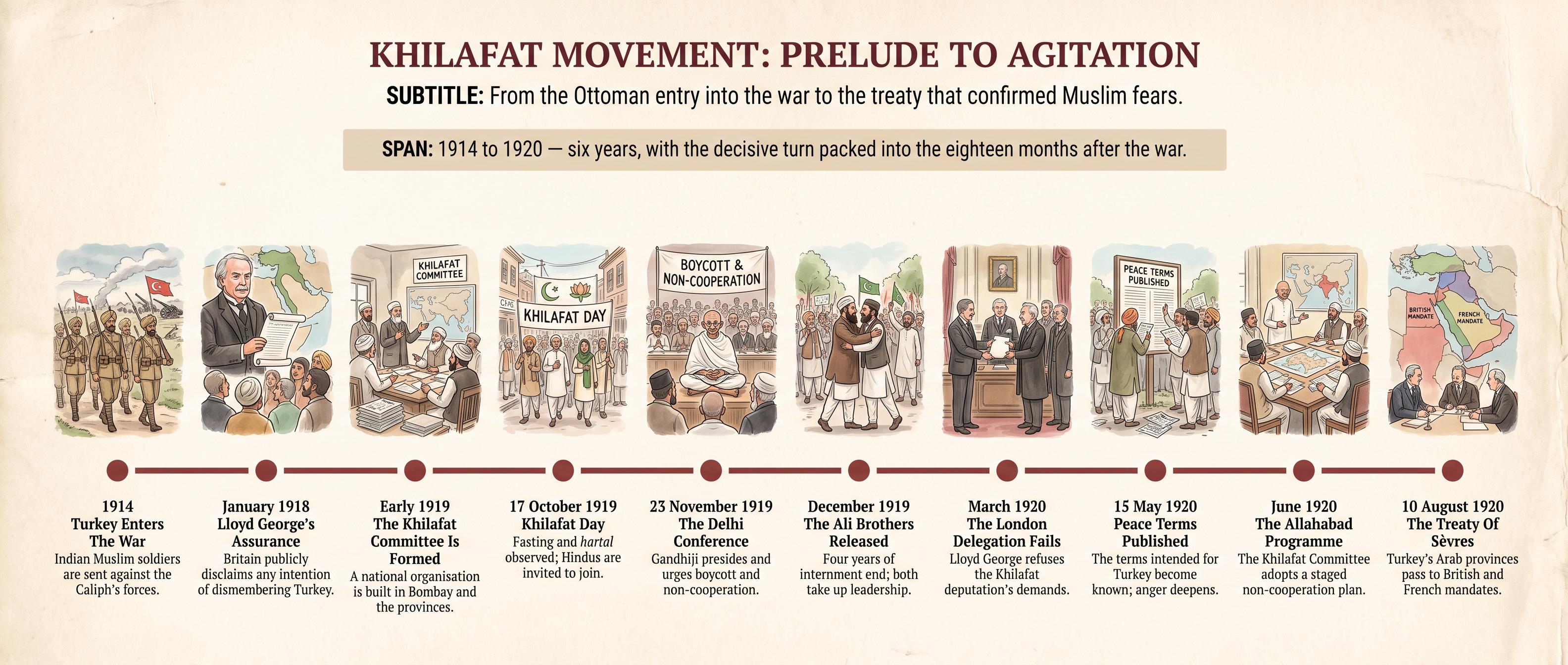
Fig. 5.4 – The Khilafat Movement Takes Shape.
5.5.3 Gandhiji And The Khilafat Cause
Why He Took It Up
Gandhiji was neither a Muslim nor a pan-Islamist, and the future of the Ottoman Sultan was of no personal concern to him. He committed himself to the cause anyway, for three reasons.
The first was that he judged the grievance to be just. A promise had been given publicly and broken, and in his view a wrong done to Indian Muslims was a wrong done to India.
The second was political, and he never disguised it. Hindus and Muslims had cooperated in politics before, but they had not marched together in the streets in large numbers. He believed the Khilafat question offered an opportunity for Hindu-Muslim unity that might not come again in a lifetime.
The third followed from the method described in the previous section. Non-cooperation needed numbers, and the Khilafat organisation could supply what the Congress alone could not — committees, mosques and religious leaders reaching into towns the Congress had never touched.
The Bargain
What was agreed amounted to an exchange. The Khilafat leaders accepted non-violent non-cooperation as their method, and accepted Gandhiji’s leadership of it. In return the Congress took up the Khilafat wrong as one of its own grievances, alongside the wrongs of Punjab.
The Central Khilafat Committee met at Allahabad in June 1920 and adopted a staged programme: surrender of titles and honorary posts, withdrawal from government service, resignation from the police and the army, and refusal to pay taxes, each stage to be reached only when the one before it had been carried through.
The decision was contested at the time, and has been argued over ever since.
5.6 The Launching Of Non-Cooperation
5.6.1 Causes Of The Movement
Three Grievances, One Movement
By the middle of 1920 the Congress had three separate causes of anger, and the decision that made the movement possible was to carry all three at once.
The first was the Rowlatt Act and what had been done in Punjab under martial law, together with the refusal of the British Parliament and public to treat the man responsible as a criminal. The second was the Khilafat question and the peace terms imposed on Turkey. The third was self-government itself — the demand that had been made through petitions for thirty-five years and conceded only in a form Indians found insulting.
The reforms promised in 1917 became law in December 1919. They gave Indian ministers charge of some departments in the provinces while the government kept control of revenue, police and justice, and they left the central government essentially untouched. Measured against ‘responsible government’, which was the phrase Indians had been given, the reforms fell far short.
What The War Had Cost
Behind the political grievances lay a harder material one, and it explains why the movement reached people who cared nothing for constitutional questions.
India had supplied the war effort on a very large scale: roughly 1.3 million Indians served as soldiers and labourers overseas, and tens of thousands did not return. The Government of India also made an outright gift of £100 million to Britain in 1917, and the money came from Indian taxation.
The war years brought sharply higher prices for cloth, salt, kerosene and food, while a country that grew its own grain exported it to feed the armies. When the fighting stopped, prices did not come down, demobilised soldiers came home to no employment, and traders and manufacturers found their wartime profits collapsing.
5.6.2 Calcutta And Nagpur, 1920
1 August 1920
Gandhiji did not wait for the Congress to decide. Non-cooperation was launched on 1 August 1920 by the Khilafat Committee, which had already adopted the programme, with Gandhiji directing it.
On that day he wrote to the Viceroy returning the Kaiser-i-Hind medal that the British had awarded him for his service in South Africa, explaining that he could not retain an honour from a government he could no longer respect. The day was also the day Bal Gangadhar Tilak died in Bombay, and much of the country closed in mourning — so the launch and the funeral of the older nationalist leadership fell together.
The Calcutta Session
A special session of the Congress met at Calcutta in September 1920, presided over by Lala Lajpat Rai, to decide whether the party would adopt this method as its own.
Gandhiji moved the resolution for non-violent non-cooperation until the Punjab and Khilafat wrongs were redressed and swaraj was established. Swaraj means self-rule, and its deliberate imprecision was part of its power: it could mean dominion status to a lawyer in Calcutta and freedom from the landlord and the moneylender to a peasant in Bihar.
The opposition was formidable. Chittaranjan Das, Bipin Chandra Pal, Madan Mohan Malaviya, Annie Besant and Muhammad Ali Jinnah all argued against it, chiefly on the ground that abandoning the councils and the courts surrendered real positions for an untested method. The resolution carried anyway.
The Nagpur Session
The Calcutta decision was provisional. It had to be confirmed at the regular annual session, which met at Nagpur in December 1920 under the presidency of C. Vijayaraghavachariar.
At Nagpur the resolution was moved by Chittaranjan Das — the same man who had opposed it three months earlier. The change of position by a leading opponent settled the matter, and the movement now had the Congress behind it.
Nagpur did something more lasting than pass a resolution. The Congress rewrote its own object.
Rebuilding The Machine
The Congress also remade its organisation, because a movement of this kind needed something an annual debating session could not provide.
Membership was opened to anyone who paid four annas a year — a quarter of a rupee, small enough for a peasant. Provincial committees were reorganised on the basis of language rather than the administrative boundaries the British had drawn. A Working Committee of fifteen was created to take decisions between sessions.
This is how a party of lawyers and editors became a machine capable of moving millions. Jinnah, who could not accept either the method or the direction, left the Congress after Nagpur.
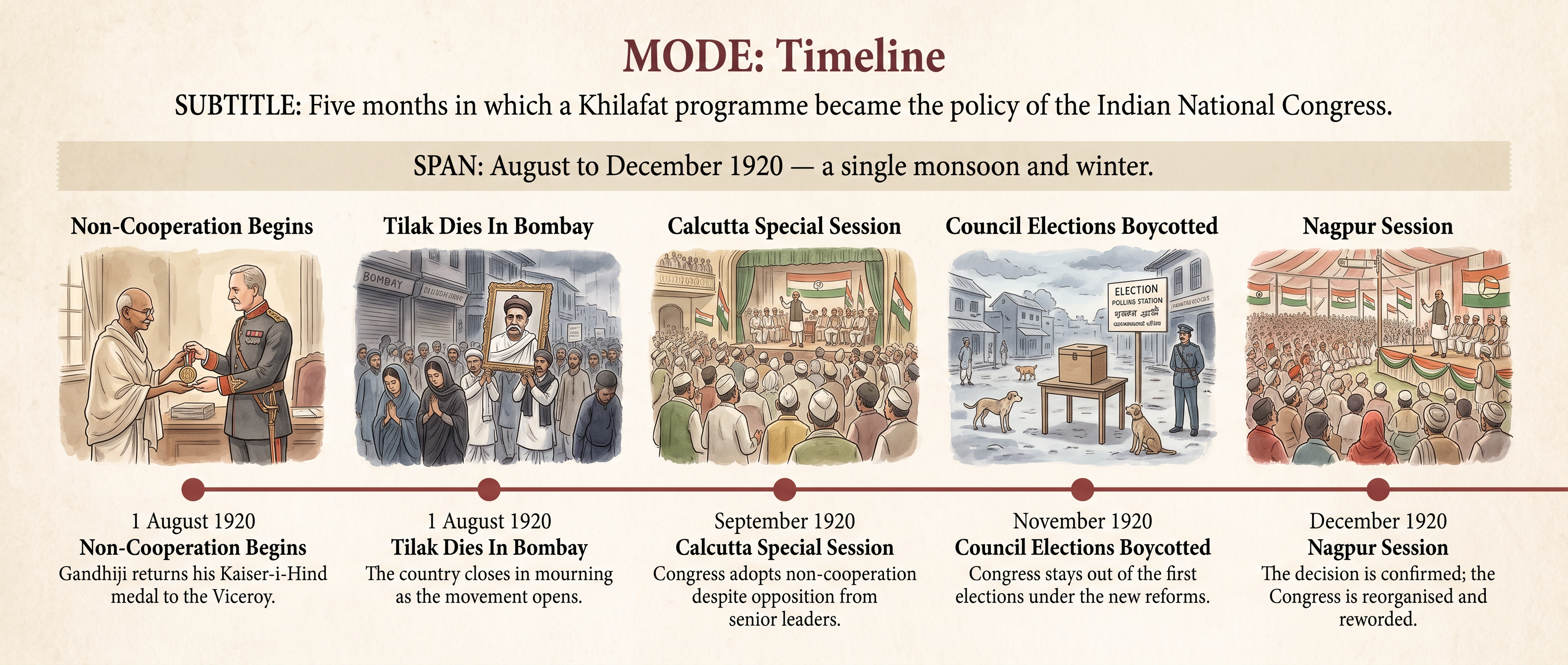
Fig. 5.6 – Non-Cooperation Is Adopted.
5.6.3 The Programme Of Non-Cooperation
What Was To Be Given Up
The programme had two halves, and students who learn only the first half misunderstand the movement completely.
The first half was renunciation. Indians were asked to surrender government titles and honorary offices; to withdraw from government and government-aided schools and colleges; to boycott the law courts, meaning that lawyers would give up practice and litigants would settle disputes outside them; to boycott the elections to the new councils; and to refuse foreign cloth.
Beyond these lay two further stages held in reserve: resignation from government service, including the police and the army, and finally the refusal to pay taxes. These were never made general, and the reason will become clear at the end of this chapter.
The programme also included picketing — standing peacefully outside shops selling foreign cloth or liquor to persuade customers not to enter. It was non-violent by definition, and it was the point at which the movement most often came close to force.
What Was To Be Built
The second half was construction, and Gandhiji regarded it as the more important of the two. Withdrawal alone would leave a student with no school and a litigant with no court; something had to take their place.
National schools and colleges were founded, among them Jamia Millia Islamia, the Kashi Vidyapith, the Gujarat Vidyapith and the Bihar Vidyapith. Panchayats — village councils of arbitration — were set up to settle disputes that would have gone to the courts. The Tilak Swaraj Fund was opened with a target of one crore rupees, and the target was met.
At the centre of the constructive programme stood cloth. The charkha, or spinning wheel, and khadi, hand-spun and hand-woven cloth, were to replace imported mill-made textiles.
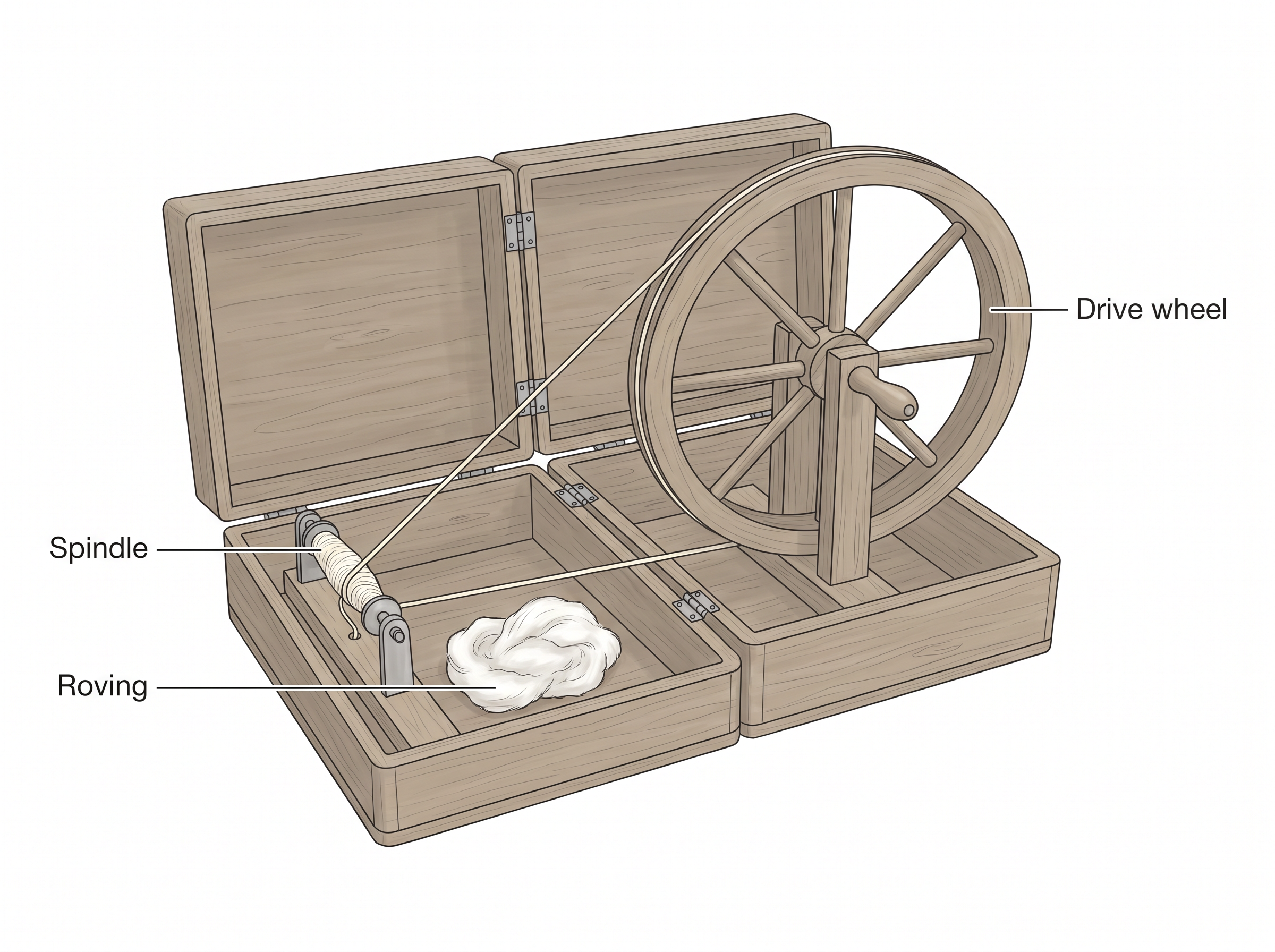
Fig. 5.5 – The box charkha.
The choice was not sentimental. Imported cloth was Britain’s largest export to India, so refusing it hit a real economic interest. Spinning could be done by anyone, anywhere, including women in households where public protest was impossible, and it gave a person in a village something to do for the movement every single day.
Two further items completed the programme and were, in their way, the most demanding: the maintenance of Hindu-Muslim unity, and the removal of untouchability. Gandhiji insisted that a movement asking Britain to stop treating Indians as inferior could not simultaneously treat a section of Indians as inferior itself.
The Aims
The movement’s aims were stated plainly and repeatedly: redress of the Punjab wrongs, a satisfactory settlement of the Khilafat question, and swaraj.
To these Gandhiji added a promise that would later be used against him. If the programme were carried out fully, he said, swaraj could be won within one year.
5.7 The Movement In The Country
In 1921 the movement did what no Indian political campaign had done before: it reached the villages. Millions of people who had never seen a Congress leader took some part in it.
That reach is the movement’s achievement, and it is also the source of its central problem. A call travelling that far cannot travel unchanged. What swaraj meant in the Working Committee’s resolutions and what it meant in a Bihar village were not the same thing, and nobody in Delhi could control the difference.
5.7.1 The Spread Across The Regions
Map 5.3 marks the main centres. Notice that the strongest areas were not simply the big cities: some of the fiercest activity was in districts with a local grievance the movement gave people a language for.
Map
Map 5.3 Caption: Main centres of the Non-Cooperation Movement, 1921–22. Brief: Outline of British India within the full extent of India as officially defined today, provincial boundaries of 1921 shown in a light tone and labelled as historical; mark Midnapore, Chandpur, Chittagong, Rae Bareli, Faizabad, Pratapgarh, Champaran, Chotanagpur, Bombay, Bardoli, Guntur, Malabar and Amritsar; do not shade regions by intensity of activity.
Bengal And Assam
Bengal was among the storm centres. In Midnapore a no-tax campaign under Birendranath Sasmal gave the district a reputation for discipline, and in parts of east Bengal government land settlement work was blocked by simple refusal to cooperate with it.
The movement also ran into industrial labour. Strikes broke out among coal miners in the Raniganj and Jharia fields, in the jute mills around Calcutta, and on the Assam-Bengal Railway and the river steamers, where Jatindra Mohan Sengupta took a leading part.
Students left classrooms in Calcutta, Dacca, Chittagong and Mymensingh to picket shops selling foreign cloth. When the Prince of Wales toured India at the end of 1921, Calcutta shut completely, and thousands were arrested there.
The sharpest episode was in the Assam tea gardens.
Bihar And The United Provinces
In Bihar the movement took hold in Champaran, Saran, Muzaffarpur and Purnea. In the Chotanagpur region the Tana Bhagat movement, a reform movement among Oraon cultivators, aligned itself with non-cooperation and added to it a refusal to pay dues to landlords.
In the United Provinces the peasant movement was older than non-cooperation and larger than it. Kisan agitation in Rae Bareli, Faizabad, Pratapgarh, Sultanpur and Awadh was directed against rent increases and evictions by zamindars — landholders whose right to collect rent from cultivators the colonial state recognised and enforced.
When the Congress arrived with a call to withdraw cooperation, tenants heard permission to withhold rent. This produced a no-rent movement the Congress had not called for and could not disown, and it alarmed the zamindars, many of whom were Indians.
The West And The South
In Gujarat the movement followed Gandhiji’s own pattern closely, and it was in Bardoli taluka that peasants stopped paying land revenue and preparations were made for the next stage of the struggle.
Bombay city produced the most violent single episode of 1921. When the Prince of Wales landed on 17 November, the city observed a complete hartal, crowds attacked those who had gone to greet him, and in the rioting that followed about fifty-three people were killed.
Maharashtra as a whole responded weakly. Followers of Tilak there had never been convinced by non-violence, and their reserve held the province back.
In the Andhra districts of Madras Presidency the movement was strong, led by Konda Venkatappayya, Pattabhi Sitaramayya and T. Prakasam. In Guntur a no-tax campaign became one of the most effective in the country.
Punjab
In Punjab the response ran along an existing channel. The Akali movement to free Sikh gurdwaras — Sikh places of worship — from hereditary managers backed by the government became closely identified with non-cooperation, and the Akalis’ own discipline of non-violent occupation matched Gandhiji’s method.
Where The Discipline Broke
In August 1921 the movement in Malabar, on the south-western coast, escaped every restraint that had been placed on it.
The Mappila (Moplah) tenants of Malabar had grievances of long standing against landlords and against the tenancy law that protected them, and Khilafat organisation had spread through the district. When police action was taken against Khilafat leaders, the district rose in armed rebellion.
What followed was terrible. Government offices were seized, landlords were killed, and Hindu families were attacked and in places forcibly converted. The rebellion was crushed by the army over months, and thousands died in the fighting and in captivity.
Malabar carried a warning that was read at the time and is read now. A movement that recruits by giving people a language for their own grievances cannot always determine which grievance they will act on, or how.
5.7.2 Who Joined, And Who Held Back
The Professions
The boycott of institutions was carried by the educated classes, and the cost to individuals was real. Lawyers with large practices — among them Motilal Nehru, Chittaranjan Das, Rajendra Prasad and Vallabhbhai Patel — gave them up.
Students left government schools and colleges in large numbers and went to the new national institutions. But the surrender of government titles, which had been the first item of the programme, was numerically small: the men who held titles had the most to lose and gave up the least.
Women
Women entered public political action on a scale never seen before in India. They marched in processions, picketed shops selling foreign cloth and liquor, attended meetings, and courted arrest — in Calcutta, Basanti Devi and Urmila Devi were among those who did.
Spinning made this possible in households where a woman could not go into the street. It gave her a way of taking part without leaving the courtyard, and it counted.
Peasants And Workers
The largest numbers came from the countryside, and they came with their own reading of what the movement was for.
Industrial workers struck in mills, mines and workshops, and their participation marked the entry of organised labour into nationalist politics. Gandhiji, however, did not encourage strikes against Indian mill owners, whose support the Congress needed, and the movement’s labour wing was never given the place its numbers might have earned.
Merchants And Those Who Stayed Away
Traders and industrialists gave money generously, and the boycott of imported cloth served their interests as well as the movement’s. Merchants who dealt in foreign goods, however, stood aside, as did shopkeepers ruined by picketing.
The zamindars mostly stayed loyal to the government, and the no-rent movement is the reason. Many upper-middle-class politicians also declined the boycott of the councils and contested the elections of November 1920, taking the seats the Congress had left empty.
The Government Answers
Through 1921 the government moved from watching to repression. Volunteer organisations were declared unlawful, public meetings were banned and the press was restricted.
Muhammad Ali and Shaukat Ali were arrested in September 1921. By December the government was arresting Congress and Khilafat workers in tens of thousands, and Chittaranjan Das, Motilal Nehru and Lala Lajpat Rai were all in jail. Gandhiji remained at liberty, which was itself a calculation: the government judged that arresting him would cost more than leaving him free.
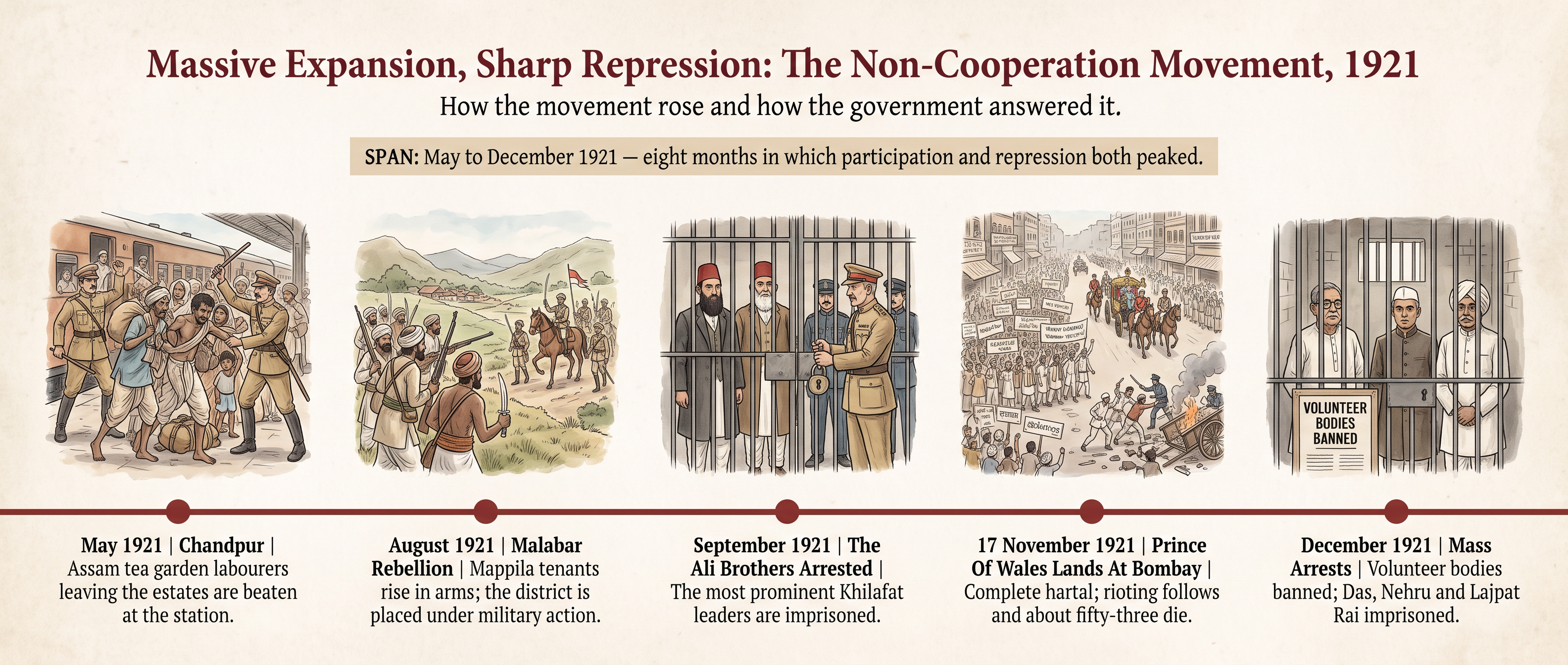
Fig. 5.7 – The Year Of The Movement, 1921.
By the end of 1921 the movement had jails full of volunteers, a boycott that was hurting British trade, and a promise of swaraj within the year that had less than a month left to run.
5.8 Chauri Chaura And The Suspension
The year in which swaraj was to be won ended without it. Gandhiji’s answer was to raise the stakes rather than lower them.
In February 1922 he wrote to the Viceroy, Lord Reading, giving notice that unless political prisoners were released and controls on the press lifted, mass civil disobedience would begin in Bardoli — the refusal of land revenue by an entire taluka, which was the final stage the programme had held in reserve.
Bardoli never happened. The reason lay four hundred miles away, in a place almost nobody in the Congress leadership had heard of.
The Fourth Of February
Chauri Chaura is a small town in Gorakhpur district in the eastern United Provinces. On 4 February 1922 a procession of local volunteers, angry about high food prices and the sale of liquor, passed the police station and was taunted and then fired on.
When the police exhausted their ammunition they retreated into the thana, the police station. The crowd set it alight. About twenty-two policemen died in the fire or were killed as they tried to escape.
The men who did this were not enemies of the movement. They were its supporters, and they had done exactly what the pledge of non-violence forbade.
The Bardoli Resolution
Gandhiji fasted for five days. The Congress Working Committee met at Bardoli on 12 February 1922 and passed a resolution suspending mass civil disobedience altogether, and turning the movement back to constructive work — spinning, national schools, temperance and the removal of untouchability.
The decision was taken while the movement was at its height, with jails full, imports falling and volunteers still enrolling. That is what made it so difficult to accept.
Leaders sitting in prison were dismayed. Motilal Nehru, Chittaranjan Das and Lala Lajpat Rai all regarded the suspension as a mistake, and the younger men in jail found it hard to understand a movement being stopped by the act of a crowd it did not control.
What The State Did Next
The government did not treat Chauri Chaura as the movement’s leaders did. Mass trials followed, and the sessions court sentenced 172 men to death; on appeal, the High Court confirmed the executions of nineteen of them and sent most of the rest to long terms of imprisonment.
Gandhiji himself was arrested on 10 March 1922 and tried at Ahmedabad for sedition, on the basis of articles he had written. He pleaded guilty and asked for the heaviest sentence the law allowed.
He was sentenced to six years and released in 1924 after an operation. The judge, in passing sentence, said openly that no sentence he could pass would please anybody, which tells you something about the position the government now found itself in.
5.8.1 The End Of The Khilafat Cause
The Khilafat movement did not end because it was defeated in India. It ended because the object it had campaigned for was abolished by the Turks themselves.
Mustafa Kemal, later called Ataturk, led a national movement in Turkey that rejected the peace terms, drove out the occupying forces and rebuilt the Turkish state as a republic. In November 1922 the Grand National Assembly abolished the Sultanate. In March 1924 it abolished the Caliphate itself and sent the last Caliph into exile.
Indian Muslims had spent five years demanding the restoration of an office that the Caliph’s own countrymen now considered finished. There was nothing left to campaign for, and the Khilafat organisation dissolved.
The alliance did not survive the movement. The unity of 1920 and 1921 had been built on two grievances held simultaneously; when both were gone, so was the reason for the two organisations to work together, and the later 1920s brought serious communal violence in several cities. Whether that unity had ever been more than an alliance of convenience is the question set out earlier in this chapter, and it is not settled.
5.8.2 Results And Significance
What Failed
Measured against its stated aims, the movement failed on every count. Swaraj was not attained in a year or in ten. The Punjab wrongs were never redressed. The Khilafat question was settled by Turkey, not by Britain.
The reasons for failure are not mysterious. The movement had recruited faster than it could train, so non-violence held in some districts and broke in others. It had also been built on a coalition with limits: it would not attack the zamindars, because it needed them not to oppose it, and it would not back strikes against Indian mill owners, because it needed their money. Peasants and workers who had joined for their own reasons found the movement would go only so far with them.
There were practical failures too. Khadi was often more expensive than mill cloth, so the poor could not always afford the cloth of freedom. Students who had left government schools found the national institutions too few to take them all, and many went back. Repression removed almost the entire leadership by the end of 1921.
What Changed
And yet the four years covered by this chapter changed Indian politics permanently, in ways that no resolution announced.
The Congress became a mass organisation. In 1919 it was a body of professional men that met once a year; by 1922 it had committees in villages, members who paid four annas, an executive that could issue instructions, and a following among peasants, workers, students and women.
Fear went. Tens of thousands had gone to prison voluntarily and come out again, and a government that rules by prestige had watched its punishments lose their terror. Boycott had also proved it could bite: imports of British cloth fell sharply while the movement lasted, and Indian mills and handlooms gained.
Gandhiji emerged as the leader of the national movement, and his method emerged as its normal method. Every major campaign for the next twenty-five years would be built on the pattern set between 1920 and 1922.
The Split
The suspension had one immediate political consequence. The Congress divided between those who accepted Gandhiji’s programme of constructive work and boycott of the councils, known as the no-changers, and those who argued that the councils should be entered and obstructed from within, known as the pro-changers.
The second group, led by Chittaranjan Das and Motilal Nehru, formed the Swaraj Party at the beginning of 1923 and contested elections to the legislatures. The disagreement was real, and it was about the same question the movement had never resolved: whether to work the institutions of colonial rule or refuse them.
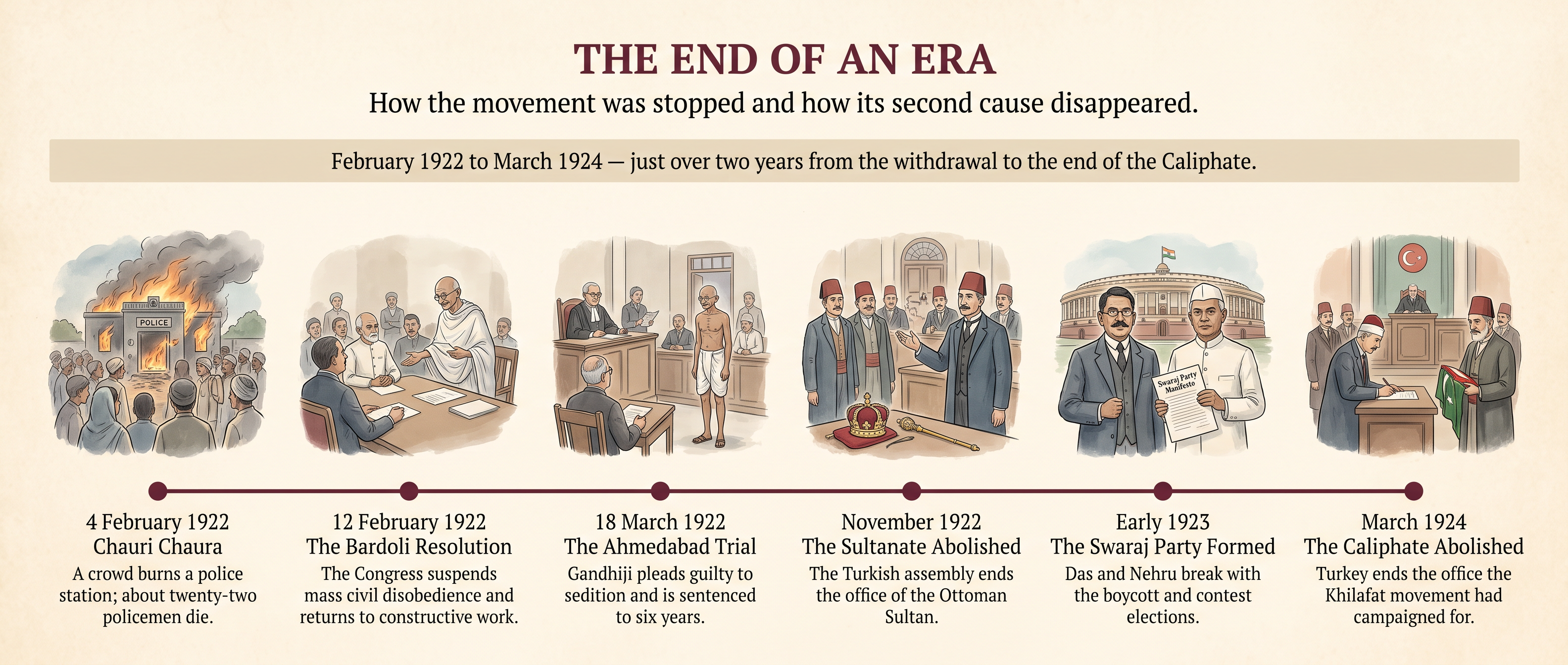
Fig. 5.8 – Suspension And Aftermath.
5.9 Summary
The Rowlatt Act And The Satyagraha
- The Defence of India Act of 1915 gave the government wartime powers of detention without trial. Those powers were due to lapse after the war, and the Rowlatt Committee, appointed in 1917, recommended keeping them.
- The Anarchical and Revolutionary Crimes Act of March 1919 allowed trial by a tribunal of three judges without jury or appeal, and allowed a provincial government to detain, restrict and bind over a suspect before any offence was proved.
- Britain had promised, in Montagu’s declaration of 1917, the gradual development of self-governing institutions. Indians met the repression nine months before they met the reform, and judged the reform accordingly.
- Every elected Indian member of the Legislative Council voted against the Act and it passed regardless. That vote, more than the Act’s terms, showed that Indian opinion could be recorded and ignored.
- Gandhiji’s answer was satyagraha — open refusal to obey an unjust law, without violence, accepting the punishment. The Satyagraha Sabha’s pledge of February 1919 bound its signatories both to disobey and to refrain from violence.
- The first weapon was a hartal, chosen because it needed no organisation and no weapons. It was observed across India on 6 April 1919, after the changed date reached Delhi too late and cost lives there on 30 March.
Jallianwala Bagh
- Gandhiji was arrested at Palwal on 9 April, and news of it produced violence in Ahmedabad and Bombay that the pledge had never sanctioned. In Amritsar, the removal of two local leaders was followed by firing, riot and the collapse of civil authority.
- On 13 April 1919 Dyer’s troops fired without warning on a meeting in an enclosure with few exits, continuing until the ammunition was nearly gone. The official count was 379 dead; the Congress enquiry put it above a thousand.
- Martial law in Punjab brought public floggings, aerial firing and the crawling order — punishment aimed at a population rather than at individuals, and understood at the time as humiliation.
- The British reaction did as much damage as the massacre. Dyer lost his command, but the House of Lords and a public subscription treated him as a wronged man, and Indians drew the obvious conclusion.
- Gandhiji suspended the campaign on 18 April 1919 because of the violence in Gujarat, not because of Amritsar, of which censorship still kept him ignorant.
The Method And The Two Movements
- Passive resistance rests on a claim about power: a few thousand officials ruled because Indians staffed, served, argued in and bought from the system. Withdrawing that cooperation was therefore an act available to everyone.
- Non-cooperation means giving up what the government offers and breaks no law. Civil disobedience means breaking a specific law openly and accepting the penalty. The first was the instrument of 1920–21; the second was held in reserve.
- Indian Muslims were angered by the dismemberment of the Ottoman Empire and the reduction of the Sultan, who was recognised as Khalifa, guardian of the holy places. Lloyd George’s assurance of 1918 was read as a promise and the peace terms as a betrayal.
- The Khilafat Committee adopted non-cooperation in June 1920, before the Congress did. Gandhiji supported the cause both because he judged the grievance genuine and because it offered a chance of joint Hindu-Muslim action unlikely to come again.
- The alliance was criticised at the time for making a religious demand the basis of national politics. Jinnah objected and left the Congress; the argument about whether the alliance built the nation or its fault line remains open.
Non-Cooperation, 1920–22
- The Congress adopted non-cooperation at Calcutta in September 1920 and confirmed it at Nagpur in December, redefining its object as the attainment of swarajya by all legitimate and peaceful means.
- Nagpur also rebuilt the organisation: four-anna membership, committees from village to province organised by language, and a Working Committee of fifteen. This is what turned a party of professional men into a machine.
- The programme had two halves. Renunciation covered titles, schools, courts, councils and foreign cloth; construction covered national schools, panchayats, the Tilak Swaraj Fund, khadi and the charkha, Hindu-Muslim unity and the removal of untouchability.
- The movement reached the villages, and the message changed as it travelled. Tea garden labourers in Assam walked off the estates, tenants in Awadh withheld rent, and in Malabar the Mappila rebellion escaped every restraint and ended in killing and military suppression.
- Its coalition had limits. It would not attack the zamindars or back strikes against Indian mill owners, so the peasants and workers who joined for their own reasons found the movement would go only so far with them.
- On 4 February 1922 a crowd at Chauri Chaura burnt a police station and about twenty-two policemen died. The Bardoli Resolution suspended mass civil disobedience twelve days later, with the movement still at its height.
- Gandhiji was tried for sedition in March 1922 and asked for the heaviest penalty the law allowed. The Khilafat cause ended when Turkey abolished the Sultanate in 1922 and the Caliphate in 1924.
- The movement failed in every stated aim and changed Indian politics permanently: the Congress became a mass organisation, imprisonment lost its terror, boycott proved it could bite, and Gandhiji’s method became the normal method of Indian nationalism.
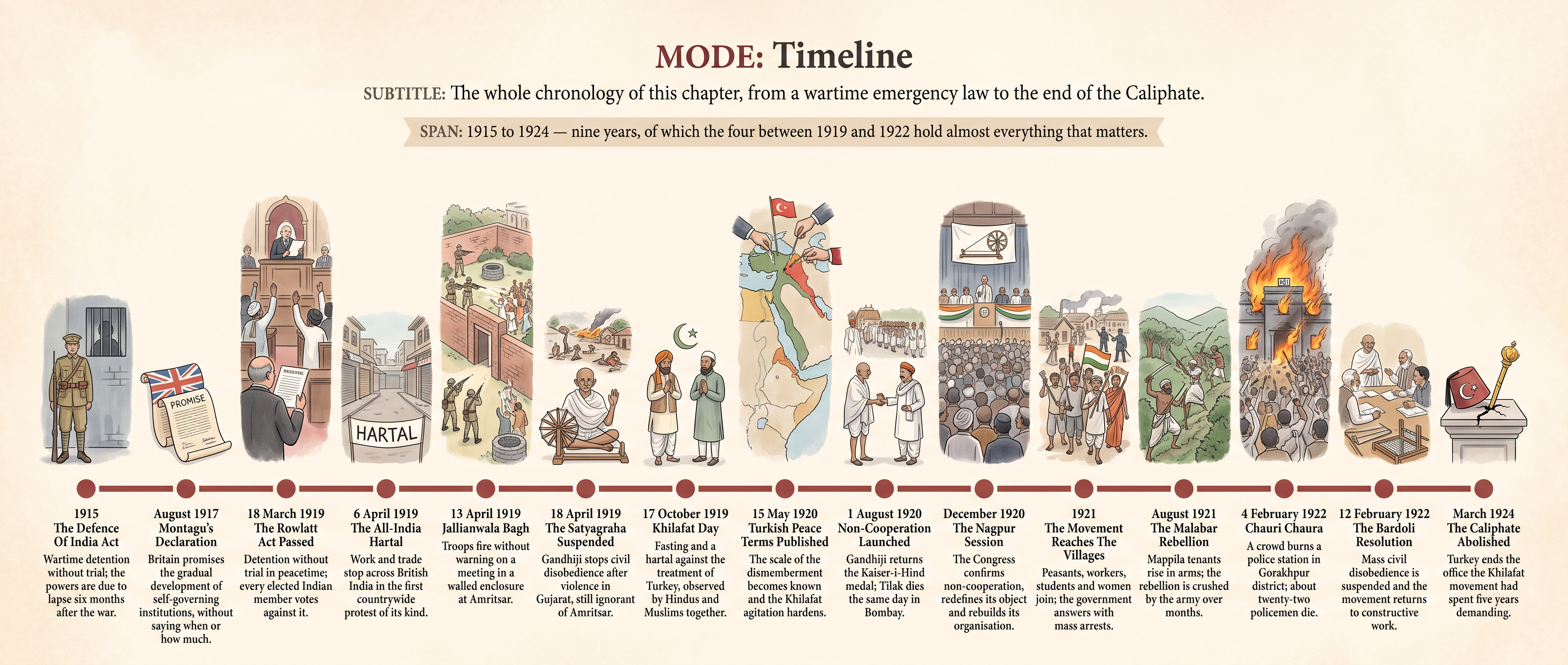
Fig. 5.9 – Gandhian Nationalism, 1915–1924.
What The Evidence Cannot Tell Us
- We do not know how many died at Jallianwala Bagh, and we never will. A curfew, martial law and censorship kept relatives away and villagers from outside Amritsar off every register that was kept.
- We know what satyagraha meant to Gandhiji because he explained it endlessly in print. We know far less about what it meant to the peasant in Awadh or the labourer at Chandpur, because almost nobody wrote their understanding down.
- The fullest records of Chauri Chaura are trial records, gathered to convict. They establish who struck a blow and are silent on the question a historian most wants answered: why a crowd of neighbours believed, that morning, that the police could be defied.
5.10 Check Your Memory
Set out the main terms of the Rowlatt Act, keeping separate what the special tribunals were allowed to do and what a provincial government could do without going to a court at all. Which of the two did Indians object to most strongly, and why?
The programme of non-cooperation had a renunciative half and a constructive half. Name the main items in each, and explain why Gandhiji regarded the constructive half as the more important of the two.
Trace the chain of events and grievances that carried the Congress from constitutional protest in March 1919 to the adoption of non-cooperation in September 1920. Your answer should show how three separate grievances came to be carried by one movement.
Distinguish non-cooperation from civil disobedience, giving an example of each from this chapter. Explain why Gandhiji began with the first and held the second in reserve until February 1922.
Read Source 5.5 again. State precisely what Lloyd George promised and what his wording left out. Then explain how Britain could claim to have kept this promise while Indian Muslims regarded the peace terms as a betrayal of it.
Study Fig. 5.3. Explain how the shape of the enclosure at Jallianwala Bagh shaped what happened there on 13 April 1919, and why the same firing in an open field would have produced a different result.
This chapter states that the number of people killed at Jallianwala Bagh cannot be established. Give the reasons the evidence cannot settle it, and explain what this case shows about the limits of official records in general.
Using Map 5.3, locate Chandpur, Rae Bareli, Malabar and Bardoli. For any three of them, explain what form the movement took in that place and what local grievance shaped it.
The chapter sets out two readings of the Congress decision to support the Khilafat cause. State each reading with the evidence it rests on, and say what a historian would need to establish in order to prefer one of them.
‘A movement built on non-violence had no choice but to stop after Chauri Chaura.’ Assess this view, using the arguments made at the time by those who agreed with Gandhiji and by those who did not.