Chapter 8: The Great Depression
On Thursday, 24 October 1929, the floor of the New York Stock Exchange stopped making sense. Sell orders arrived faster than the clerks could write them down. The ticker — the telegraph machine that printed each completed sale on a narrow paper tape and carried the price to brokers across the country — fell behind, and stayed behind for hours. Investors in Chicago and Boston spent the morning watching prices that had already ceased to exist. A crowd gathered in the street outside, listening to rumour, because rumour was travelling faster than the tape.
Around midday, a group of the most powerful bankers in the United States met a few doors away at the offices of J. P. Morgan and Company. They agreed to put their own institutions’ money into the market to steady it. Shortly afterwards Richard Whitney, the vice-president of the Exchange, walked across the floor to the post where the shares of United States Steel were traded and bid a price well above the last sale. He moved on and did the same for other leading stocks.
It worked, for a few days. Prices recovered that afternoon and the newspapers wrote that confidence had been restored. Five days later, on Tuesday, 29 October, the market collapsed outright.
We can follow those hours closely because the tape survived, along with brokers’ ledgers and the Exchange’s own records. The evidence of the crash was printed as it happened — several hours late.
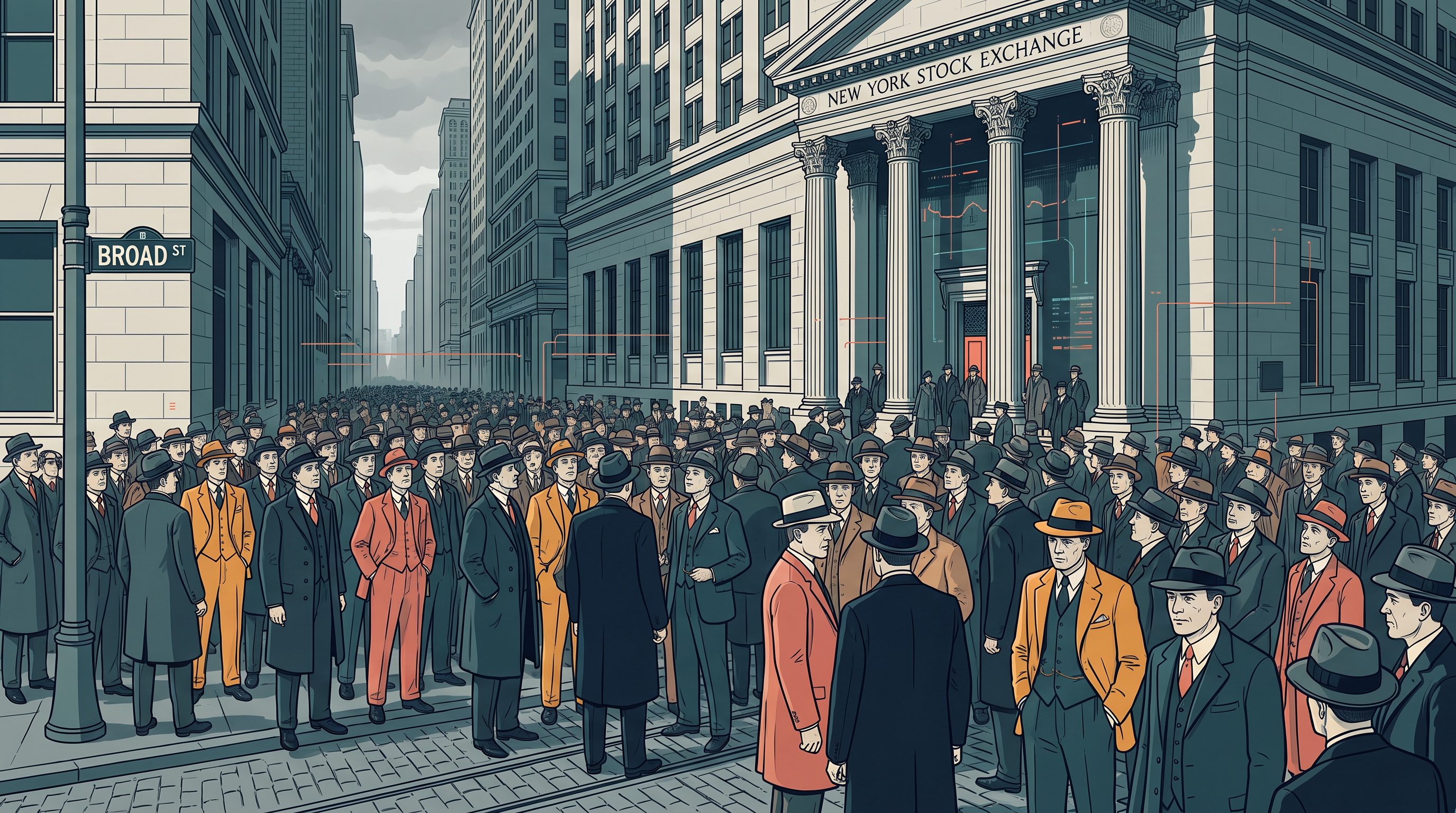
Fig. 8.0 – Crowds outside the New York Stock Exchange, 24 October 1929.
8.1 The Boom Before The Crash
Every account of the Great Depression has to begin with prosperity. The crisis that struck the United States in 1929 did not follow years of hardship. It followed the most confident decade the country had ever known, and much of what went wrong in 1929 was built during the good years.
This section sets out that decade: what the boom of the 1920s actually consisted of, who governed during it, and how ordinary Americans came to own shares in companies for the first time. The causes of the Crash are examined in 8.2. Here we are looking at the ground on which those causes grew.
8.1.1 The Roaring Twenties
The First World War ended in November 1918. It left Europe exhausted, indebted and short of goods, and it left the United States in an unusually strong position. American factories and farms had supplied the Allied war effort. American banks had lent to Allied governments. By 1919 the United States was the world’s leading industrial producer and its leading creditor — a country owed money by others, rather than one that owes.
The decade that followed became known as the Roaring Twenties. The phrase describes a real change in how many Americans lived. Motor cars, electric lighting, refrigerators, telephones, radio sets and cinema tickets moved within reach of a large section of the population. Factory output rose steeply, helped by assembly-line production, in which a product moves past workers who each repeat one small task.
The Politics Of The Boom
Three Republican Presidents held office through these years: Warren G. Harding from 1921 until his death in 1923, Calvin Coolidge from 1923 to 1929, and Herbert Hoover from March 1929 to March 1933. Hoover had won the election of November 1928, but under the American system a President elected in November did not take office until the following March.
All three governed on broadly laissez-faire lines. Laissez-faire is the principle that government should leave the economy largely alone — keeping taxes low, regulating business lightly, and trusting private enterprise to produce prosperity. Taxes on high incomes were cut, business regulation stayed thin, and federal spending was kept small.
A Republican campaign advertisement of 1928 promised American voters ‘a chicken in every pot and a car in every garage’. The line is often quoted as though Hoover said it himself; he did not. It was party publicity, and it captures what the boom felt like from inside — a widening prosperity that seemed to have no natural stopping point.
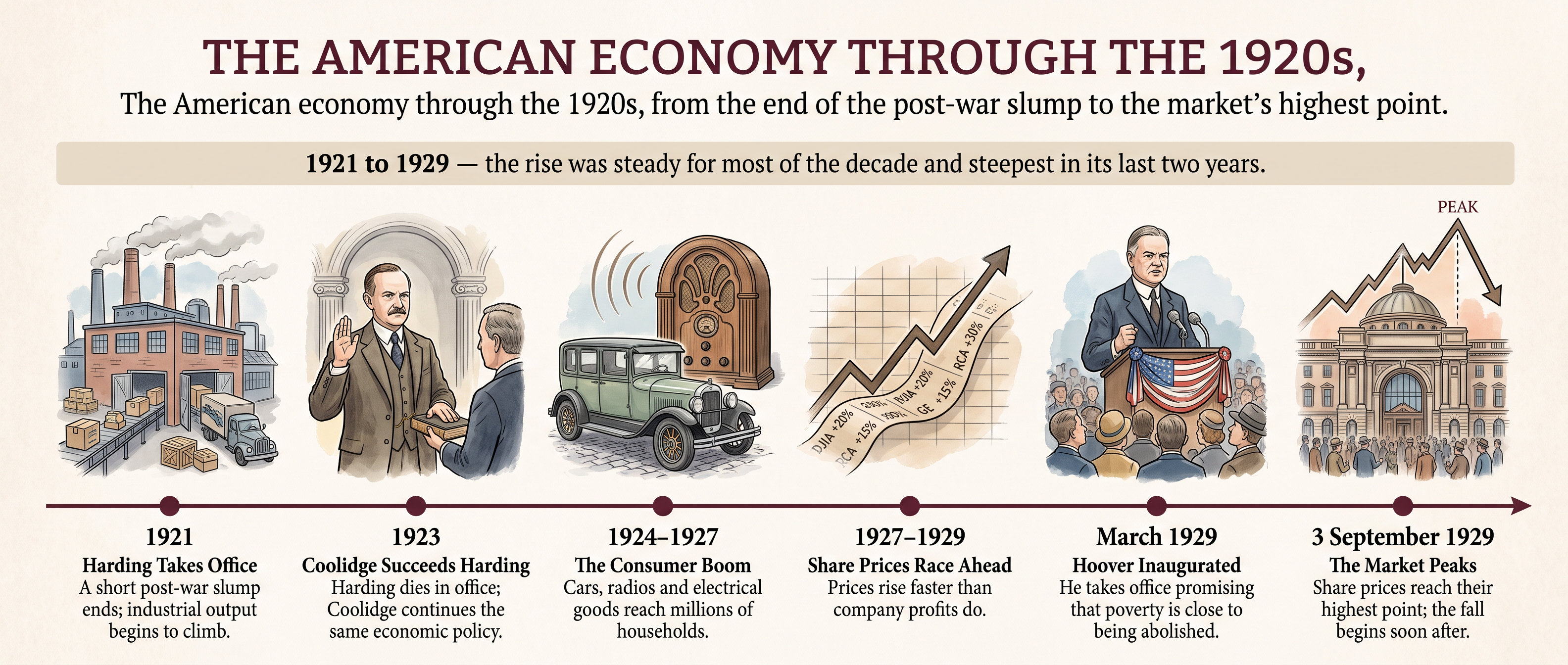
Fig. 8.1 – The Boom Years.
The prosperity was real. It was also narrower than it looked from a city street, and that narrowness is one of the causes examined in the next section.
8.1.2 The Stock Market And The Small Investor
To follow what happened in October 1929, a student needs to be clear about what was being bought and sold. A share is a unit of ownership in a company. Whoever holds it owns a fraction of that company and has a claim on a fraction of its profits.
A stock exchange is an organised marketplace where shares are bought and sold. The largest in the United States stood, and still stands, on Wall Street — a short street at the southern tip of Manhattan island in New York City. The name of the street became shorthand for American finance as a whole, which is why the events of October 1929 are called the Wall Street Crash.
What Moves A Share Price
A share has no fixed value. Its price is whatever a buyer will pay today, and buyers pay according to what they expect the company to earn tomorrow. If many people expect profits to rise, prices rise. If enough of them change their minds at once, prices fall, and nothing in the company itself need have changed.
Through the 1920s expectations pointed steadily upward. To follow the market as a whole rather than one company at a time, newspapers reported an index — a single figure calculated from the prices of a fixed group of large companies, so that its movement stands for the movement of the market. The best known was the Dow Jones Industrial Average. It climbed through the decade and reached its highest point on 3 September 1929, at a little over 381.
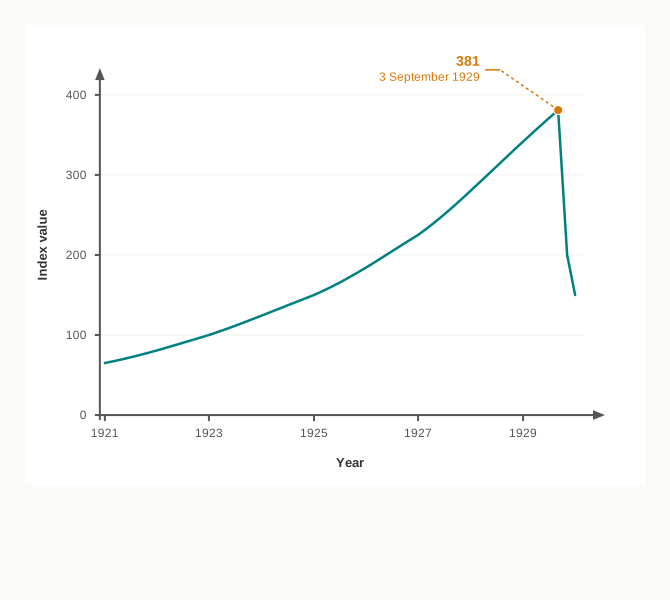
Fig. 8.2 – The Dow Jones Industrial Average, 1921–1929.
A Market For Everybody
Before the war, buying shares had been largely the business of the wealthy and of professional firms. During the 1920s that changed. Clerks, schoolteachers, shopkeepers and skilled workers began to open accounts with a broker, the agent who buys and sells shares on a client’s behalf for a fee.
They were encouraged by a simple observation that had held true for years: prices went up. A share bought in one year could be sold at a profit in the next. Newspapers carried market pages for readers who had never owned a share before, and brokers opened branch offices in ordinary neighbourhoods.
The habit of expecting a rising market is the last piece of the background. It meant that a fall in prices would not be read as a normal correction, but as the failure of something people had come to treat as a certainty.
8.2 Causes Leading To The Wall Street Crash
No single cause brought down the American share market in October 1929. Four pressures had been building through the decade described in 8.1, and each of them weakened a different part of the structure.
The first three were faults in the real economy — in what farms and factories produced, in who could afford to buy it, and in who abroad was still buying. The fourth was in the market itself: the way shares were bought with borrowed money. The Crash came when the fourth ran into the first three.
Keep the order in mind as you read, because the four are connected. Overproduction and unequal incomes are two sides of one problem, and falling exports removed the escape route that both of them needed.
8.2.1 Overproduction In Farm And Factory
Overproduction means producing more goods than can be sold at a price that covers their cost. The word can mislead, because the problem is rarely that too much exists. It is that too few buyers have money enough to take it.
American farming had this problem from the early 1920s onward. During the First World War, farmers had ploughed up new land and borrowed to buy machinery, because Europe could not feed itself and prices were high. When European farming recovered after 1918, that demand fell away.
Output did not fall with it. A farmer facing a lower price for wheat often plants more wheat, not less, hoping that a bigger harvest will make up the loss. Across a whole country, every farmer doing this drives the price down further. Farm prices stayed low through the decade while mortgage payments stayed exactly where they were.
The Same Problem In Industry
Factories reached the same point later, and by a different route. Assembly-line methods and electric power raised output per worker sharply during the 1920s, but wages rose far more slowly. Goods therefore came off the line faster than the people who made them could buy them.
Unsold stock piled up in warehouses. Firms responded in the only way open to a single company: they cut prices, then cut production, then dismissed workers. Each of those decisions was sensible for one firm and damaging for all of them together, because a dismissed worker is also a customer who stops spending.
By the middle of 1929 this was visible in the figures that mattered most to investors. House-building had been falling since the middle of the decade, motor-car sales slowed, and American industrial production turned downward in the summer of 1929 — weeks before the Crash. Company profits, on which share prices ultimately rest, were no longer growing as the market assumed they would.
8.2.3 The Decline In Export Demand
An economy producing more than its own people can buy has one obvious remedy: sell the surplus abroad. Through the 1920s that door was closing, for reasons partly outside American control and partly of American making.
After the First World War the United States was the world’s leading exporter as well as its leading creditor. European countries bought American wheat, cotton, machinery and manufactured goods, and European governments owed American banks and the American government large war debts.
But Europe was in no condition to keep buying. Governments were struggling with war debts, damaged industry and, in Germany’s case, the aftermath of severe currency collapse. A country short of foreign currency cannot import freely, and European purchases of American goods grew slowly at best.
Tariff Walls
A tariff is a tax charged on goods entering a country, which makes imported goods dearer and protects producers at home. The United States raised its tariffs sharply in 1922, under the Fordney–McCumber Act, to shield American farmers and manufacturers from foreign competition.
The difficulty is that a tariff wall works in both directions. Countries that could not sell to the United States earned fewer dollars, and with fewer dollars they bought less from the United States. Several of them raised tariffs of their own in reply.
Map
Map 8.1 Caption: American goods, loans and war-debt repayments across the North Atlantic in the 1920s. Brief: Political map of North America and Europe with 1920s boundaries; arrows westward to eastward for American exports and American loans, arrows eastward to westward for war-debt and reparation repayments; mark the United States tariff barrier of 1922 at the American border; label the United States, Britain, France and Germany only; do not show later boundaries and do not extend the map to Asia.
The effect fell hardest on export industries and on the ports that handled them. Job losses in those industries fed back into the same weakening demand at home that 8.2.1 and 8.2.2 described.
8.2.4 Speculation And Buying On Margin
The three causes so far describe a real economy losing momentum. Share prices, meanwhile, were rising faster than ever. That gap between the market and the economy underneath it is the fourth cause, and the one that made the fall so violent.
Speculation is buying an asset not for the income it yields but in order to resell it quickly at a higher price. A speculator does not particularly care what the company makes. He cares only that someone will pay more for the share next month than he paid this month.
Speculation is not in itself unusual or illegal. It becomes dangerous when it is done on a large scale with borrowed money, and that is what happened in the late 1920s.
Buying On Margin
Buying on margin meant paying only a fraction of a share’s price in cash and borrowing the rest from the broker, who held the shares themselves as security for the loan. In the boom years that fraction fell very low — in some cases as little as a tenth of the price.
Consider a purchase of shares worth one thousand dollars, made with one hundred dollars of the buyer’s own money and nine hundred borrowed. If the price rises by a tenth, the holding is worth 1100 dollars; selling it and repaying the loan leaves
\[(1100 - 900) - 100 = 100\]
dollars of profit, in dollars, on an outlay of one hundred dollars. The buyer has doubled his own money on a rise of ten per cent.
Now run it the other way. If the price falls by a tenth, the holding is worth nine hundred dollars, the loan swallows all of it, and the buyer’s own hundred dollars is gone. The same borrowing that multiplies a gain multiplies a loss, and it does so faster.
The Margin Call
There was a further trap in the arrangement. If the value of the shares fell close to the size of the loan, the broker could demand more cash at once to cover it. This demand was called a margin call.
A buyer who could not pay had his shares sold immediately by the broker to recover the loan. In a falling market, thousands of such forced sales arrive together — sales made not because anyone judged the price too high, but because the borrowers had run out of cash.
Banks were drawn in from two directions. Many lent heavily to brokers, who lent onward to buyers like the clerk above. Some banks also bought shares on their own account, with money that depositors had placed with them for safekeeping.
Four Causes, One Structure
It is worth stating plainly why these four are told together. Overproduction created goods that could not be sold at home; unequal incomes explained why they could not be sold at home; falling exports closed the market abroad; and margin buying meant that when share prices finally reflected any of this, the fall could not stop where it started.
A student who names only one of the four has not explained 1929. The Crash was not caused by greedy speculators alone, nor by poor farmers alone. It happened where a fragile market sat on top of a slowing economy.
8.3 The Crash Of October 1929
The market did not fall in a single afternoon, and it did not stop falling when the newspapers stopped printing headlines. October 1929 was the beginning of a decline that ran for nearly three years.
This section does two things. It sets out what happened on the exchange floor in those weeks, and then it asks the harder question: why a fall in share prices turned into the deepest economic collapse the industrial world had seen.
8.3.1 Black Thursday And Black Tuesday
Prices reached their highest point on 3 September 1929 and then began to drift downward. Through late September and early October the fall was uneven — some days down, some days recovering — and most commentators treated it as an ordinary correction after a long rise.
Thursday, 24 October, ended that reading. Selling began at the opening and did not slow. Nearly 12.9 million shares changed hands, several times the volume of an ordinary day, and prices fell far enough during the morning to frighten every holder who had borrowed to buy. The afternoon brought a partial recovery, and the day closed with much of the loss regained.
That recovery lasted the weekend. On Monday, 28 October, prices fell again, and this time nothing held them.
Tuesday, 29 October
Tuesday, 29 October 1929, was the worst single day the New York Stock Exchange had known. More than sixteen million shares were traded — a volume that would not be matched for nearly forty years — and there were stretches of the day when sellers could find no buyer at any price.
Much of that selling was not chosen. As 8.2.4 explained, brokers were entitled to sell out a client whose shares no longer covered his loan, and by Tuesday they were doing so in bulk. Every forced sale pushed prices lower, which produced the next margin call, which produced the next forced sale.
The day is remembered as Black Tuesday. Together with 24 October it gives the whole episode its name — the Wall Street Crash.
The table below gives the closing values of the index introduced in 8.1.2 on the days the timeline names.
Read the last two lines against the first. By mid-November 1929 the index had lost roughly half its September value — and that was not the bottom. The market went on falling for another two and a half years, until in July 1932 it stood at about a ninth of its peak.
This is the point at which the base of the crisis is usually misread. The dramatic week was October 1929; the destruction was the long slide that followed it.
8.3.2 From A Crash To A Depression
Share markets had crashed before, in America and elsewhere, without ruining the economy around them. Something else was needed to turn the events of October 1929 into the Great Depression — a severe fall in output, trade and employment, far deeper and far longer than the ordinary downturns that follow a boom.
Four connections did that work, and they ran in sequence.
Confidence And Spending
The first was the simplest. Millions of people had believed that share prices could only rise, and had arranged their spending around that belief. When the belief broke, households that still had money stopped spending it, especially on the expensive goods that the boom had been built on.
Orders for cars, radios and building materials fell away. The slowdown already visible in the summer of 1929 became a collapse.
Debt And The Banks
The second connection carried the losses from the market to the banking system. Buyers who had borrowed to speculate could not repay, so the losses landed on brokers, and through them on the banks that had lent to brokers or bought shares themselves.
A weakened bank calls in the loans it has made and stops making new ones. Businesses that had borrowed to expand now had to repay in the middle of a slump, and firms that needed credit to survive could not get it.
Bank Failures
The third connection was the most damaging, and it is examined more closely in 8.4.1. When depositors doubted a bank, they queued to withdraw their savings, and no bank keeps enough cash to repay every depositor at once.
Banks closed by the thousand in the years after 1929. Each closure destroyed the savings of people who had never bought a share in their lives, and frightened the depositors of the next bank down the street.
Falling Prices
The fourth connection is the least obvious and matters greatly. As demand collapsed, prices fell across the economy — this is deflation, a general fall in the level of prices, the opposite of inflation.
Falling prices sound like relief to a buyer, and they are ruin to a debtor. A farmer who borrowed when wheat was dear had to repay the same fixed sum out of wheat that was now cheap. The real weight of every existing debt grew heavier each year, which forced more sales, more failures and lower prices still.
Nothing To Break The Fall
One more feature of the United States in 1929 shaped everything that followed. There was no national unemployment insurance, no old-age pension system, and no guarantee protecting a depositor’s savings if a bank failed.
A worker who lost a job lost his whole income. A family whose bank closed lost its savings outright. Relief was left to local authorities and private charities, and both were overwhelmed within months. The country had, in effect, no floor beneath a falling economy — which is why the New Deal, when it came, spent so much of its effort building one.
8.4 The Impact On The Economy Of The United States
The United States was the first economy struck and the worst struck among the great industrial powers. Between 1929 and 1932 its industrial production fell by roughly half, and national income fell with it.
Those are the aggregate figures, and they are worth remembering. But an aggregate hides the mechanism, and this section follows the mechanism instead: how the collapse moved from the banks to the farms to the streets, and finally to the ballot box in November 1932.
8.4.1 Bank Failures And The Loss Of Savings
A bank does not keep its depositors’ money in a vault. It lends most of it out, keeping only a fraction in cash, on the reasonable assumption that depositors will not all want their money on the same morning.
That assumption held for a century and broke after 1929. Loans made to brokers, to businesses and to farmers went unpaid. As word spread that a bank was in difficulty, its depositors queued to withdraw everything, and the queue itself finished the bank off — because no bank can produce cash it has already lent.
Roughly nine thousand American banks failed between 1930 and 1933, in several waves of panic. When a bank closed, the savings held in it simply ceased to exist. There was no federal guarantee of deposits in these years, so a clerk, a widow or a shopkeeper who had never touched the share market could lose everything a bank’s failure took with it.
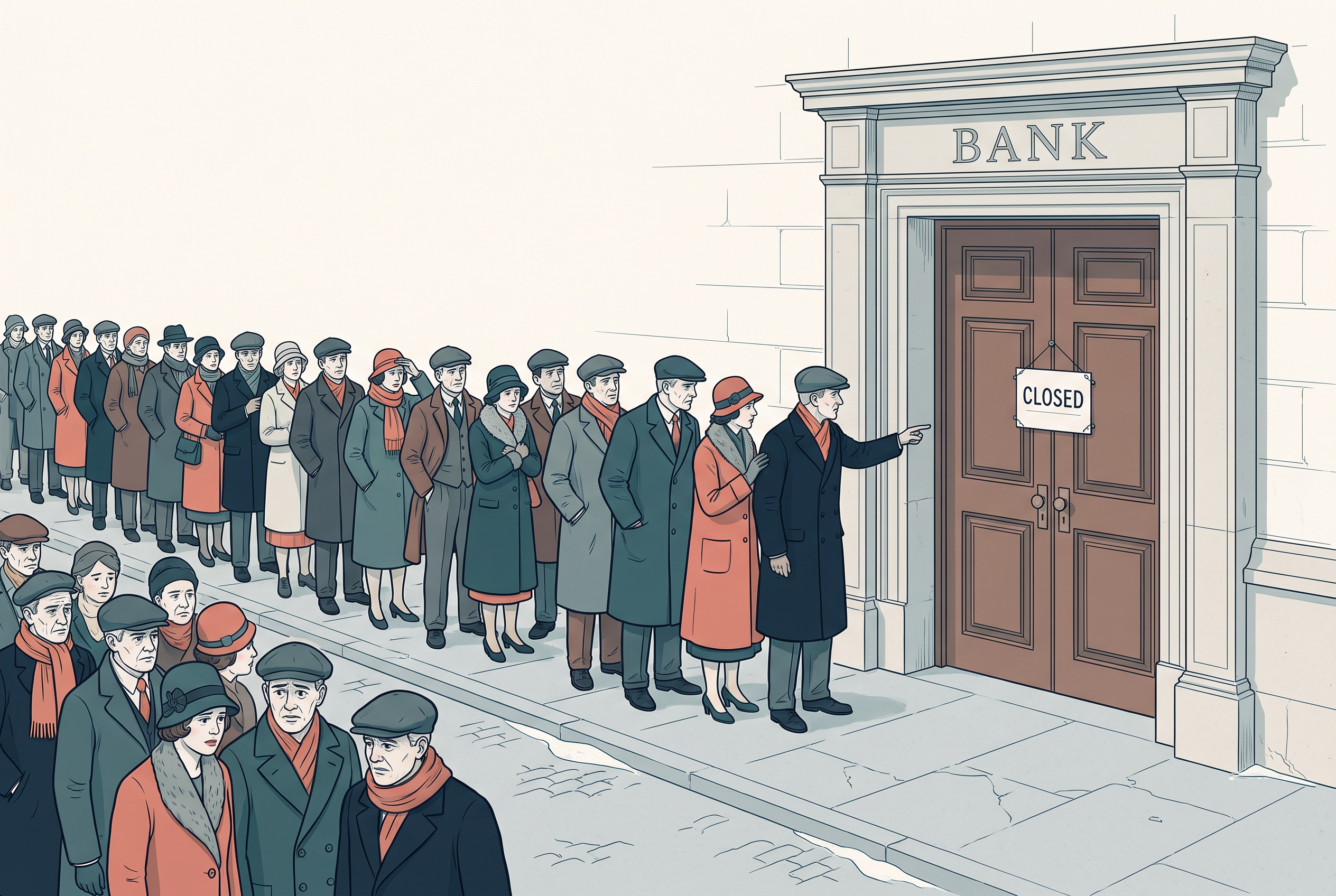
Fig. 8.3 – Depositors queuing outside a closed bank in the early 1930s.
The wider effect ran beyond the depositors. Every failure made the surviving banks more cautious, so they called in loans and lent nothing new. Credit dried up for firms that were perfectly sound, and the shortage of credit closed businesses that the Crash alone would never have touched.
8.4.2 Falling Farm Prices And The Dust Bowl
American farmers had been in difficulty since the early 1920s, as 8.2.1 explained. After 1929 their position became impossible. Demand fell at home and abroad at once, and crop prices dropped to a fraction of what they had been.
The trap lay in the difference between prices and debts. The price of wheat or cotton fell; the mortgage on the land did not. A farmer who had borrowed against his land now had to find the same repayment out of a crop worth far less, and when he could not, the bank took the farm.
Foreclosure — the seizure and sale of mortgaged property by the lender when repayments stop — swept the farming states in these years. Families who had worked the same land for two generations became tenants on it, or left it altogether.
The Dust Bowl
On the southern Great Plains a second disaster arrived on top of the first. From about 1931 the region suffered years of severe drought, and the dry soil began to blow away in storms that darkened the sky at midday and buried fences, machinery and roads.
The drought was natural. The scale of the damage was not. For decades the deep-rooted native grasses that held the soil together had been ploughed up to plant wheat, leaving loose earth exposed the moment the rains failed. This is why historians describe the Dust Bowl as a disaster made by farming methods and weather together, rather than by weather alone.
Thousands of families abandoned ruined land in Oklahoma, Texas, Kansas, Colorado and New Mexico and moved west, chiefly to California, looking for agricultural work that was already oversupplied with hands.
Map
Map 8.2 Caption: The Dust Bowl region of the southern Great Plains during the drought years of the 1930s. Brief: Map of the central United States with 1930s state boundaries; shade the worst-affected area across the panhandles of Oklahoma and Texas and adjoining parts of Kansas, Colorado and New Mexico; label those five states and mark the main direction of migration westward towards California; do not shade areas outside the drought region and do not show present-day boundaries.
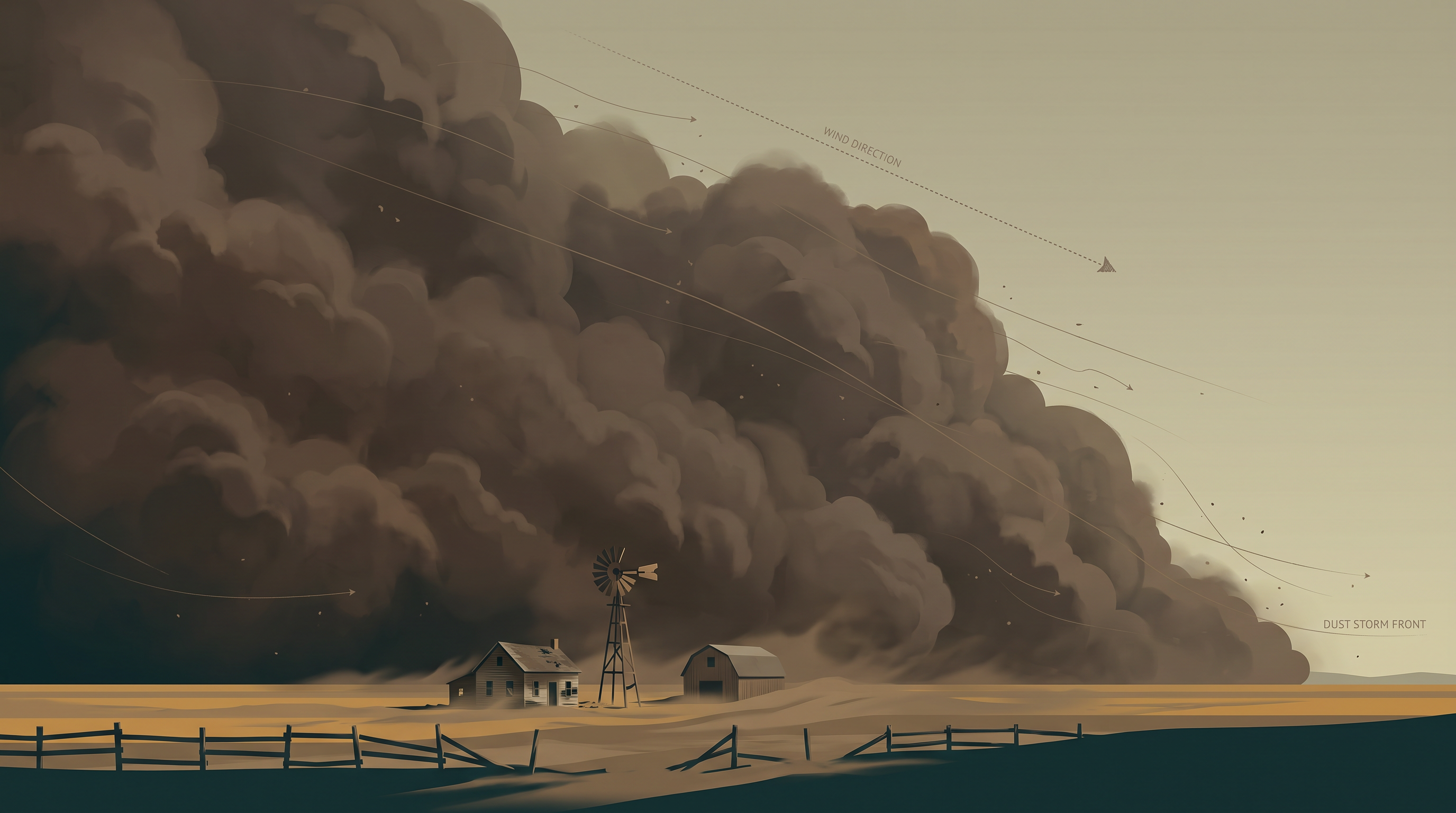
Fig. 8.4 – A dust storm advancing over a Great Plains farmstead.
8.4.3 Unemployment And The Hoovervilles
Unemployment is the figure by which the Depression is usually measured, and in the United States it reached a level without precedent. By 1933 roughly one worker in four had no job at all — some twelve to thirteen million people — and many of those still employed were on short hours or reduced wages.
There was no unemployment insurance to draw on. A family’s income could fall to nothing in a fortnight, and what stood between it and destitution was savings, relatives, or the local soup kitchen and bread line run by charities and city authorities.
Those queues became the visible face of the crisis in every American city. So did the settlements of scrap-built shelters that grew on waste ground at the edges of towns, made of packing cases, flattened tin and tar paper. They were called Hoovervilles — named for the President, in bitter mockery, by people who held his government responsible for leaving them there.
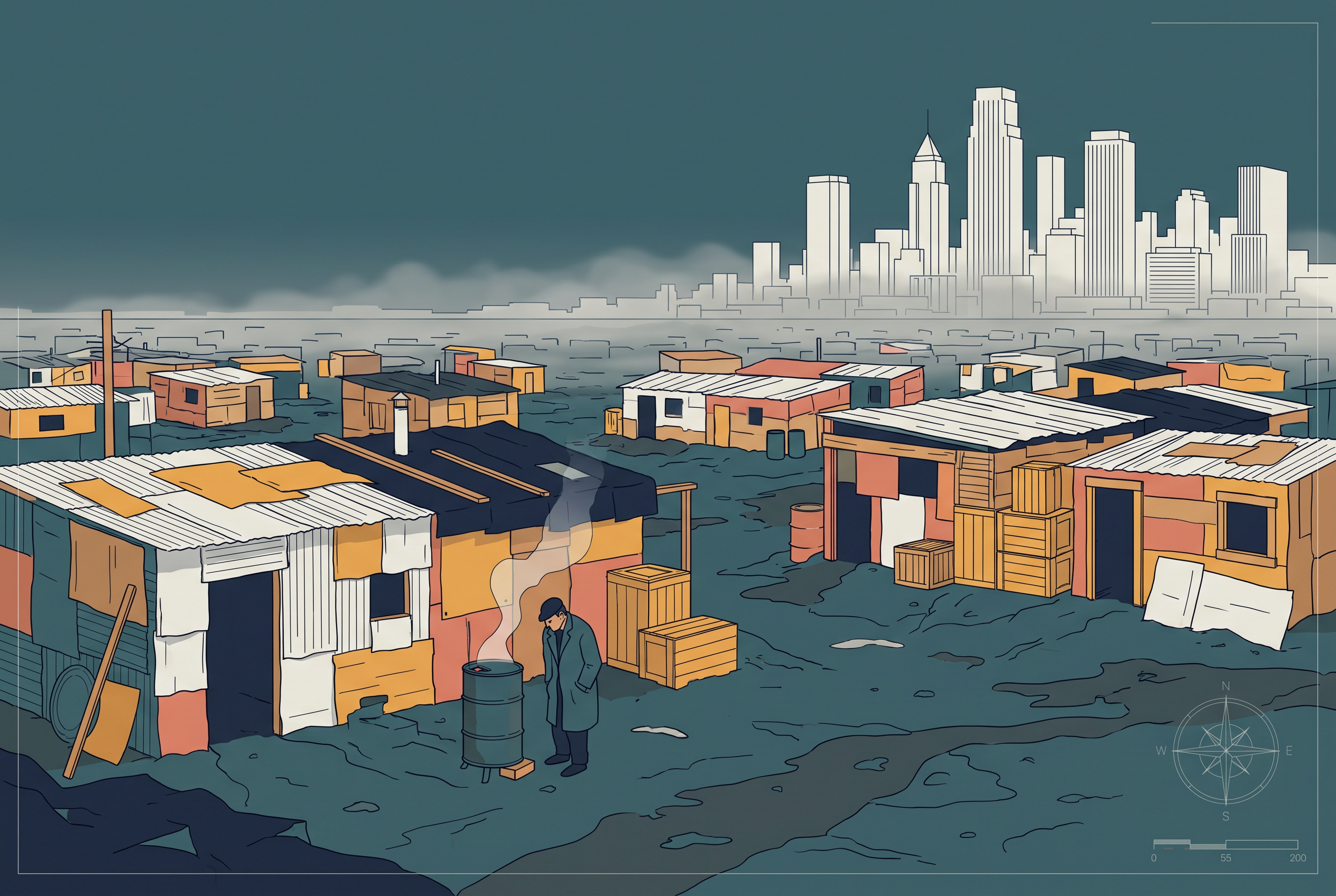
Fig. 8.5 – A Hooverville shanty settlement outside an American city.
8.4.4 Hoover Discredited: The Election Of 1932
Herbert Hoover was not an idle President, and it is a caricature to say he did nothing. He was, however, committed to the laissez-faire principle described in 8.1.1, and he held to two positions that the crisis made politically fatal.
The first was that relief of the poor was the business of state governments, local authorities and private charity, not of the federal government in Washington. As the numbers grew, those bodies ran out of money, and the federal government did not step in with direct payments to the unemployed.
The Tariff Of 1930
The second was protection. In June 1930 Hoover signed the Smoot–Hawley Tariff Act, which raised American import duties to among the highest levels in the country’s history, in the hope of shielding American farmers and manufacturers.
Other governments retaliated with tariffs of their own. World trade, already shrinking, fell by roughly two-thirds in value between 1929 and 1933. For an economy whose export industries were already in difficulty, the remedy deepened the disease — and it exported American distress to every country that depended on selling to the United States, as 8.5 and 8.6 will show.
The Verdict Of November 1932
By 1932 Hoover’s name was attached to the shanty towns, and his administration had come to stand for a government that watched. In the presidential election of November 1932 the Democratic candidate, Franklin D. Roosevelt, defeated him overwhelmingly, carrying forty-two of the forty-eight states.
Roosevelt had campaigned on a promise of federal action without specifying much of what it would be. What mattered to voters was the principle behind it: that the government in Washington would take responsibility for the crisis. The programme built on that promise is the subject of 8.7 to 8.9.
8.5 The Impact On The Economy Of Germany
Of all the economies outside the United States, Germany’s was hit hardest and fastest. That seems strange at first sight. Germany had no share boom to burst and no Wall Street of its own.
The explanation is that the German recovery of the 1920s had been built with American money, borrowed on terms that could be withdrawn at short notice. When American lenders needed their money back, the structure came down.
Germany at this time was governed as a republic. The Weimar Republic was the parliamentary state set up in 1919 after Germany’s defeat in the First World War and the abdication of its emperor, and it took its name from the town where its constitution was drafted. Its economic collapse after 1929 is inseparable from its political collapse, and this section follows both.
8.5.1 A Recovery Built On American Loans
The Treaty of Versailles of 1919 required Germany to pay reparations — compensation to the victorious powers for the damage of the war — and in 1921 the sum was fixed at 132 billion gold marks. Payments on that scale were beyond an economy that had already lost territory, resources and a generation of workers.
The strain broke the German currency in 1923, when money lost its value so completely that savings became worthless within months. By the following year all sides had reason to look for a workable arrangement.
The Dawes Plan And The Young Plan
The Dawes Plan of 1924 provided one. It rescheduled Germany’s reparation payments to amounts the economy could actually bear in the near term, reorganised the German central bank, and — the crucial part — opened the way for large American loans to Germany.
Those loans transformed the situation. Between 1924 and 1929 German industry re-equipped itself, municipalities built power stations, housing and transport, and unemployment fell. These are often called the golden years of the Weimar Republic, and American credit paid for a great deal of the gold.
The Young Plan of 1929 went further, reducing the total reparations bill and stretching the payments over a longer period. It was agreed in the same year that the American market peaked, and it assumed that American lending would continue.
The Weakness Inside The Arrangement
Here lay the fault that mattered. A large share of the foreign money entering Germany came as short-term loans — credit lent for months, renewable at the lender’s choice — while the things it paid for were long-term: factories, plant, public works.
Long-term assets cannot be turned back into cash quickly. A country that funds them with short-term borrowing is solvent only for as long as the lenders keep renewing. German banks, firms and city governments were all in this position by 1929.
8.5.2 The Loans Recalled: Banks, Factories, Jobs
The Wall Street Crash reversed the flow within months. American banks facing losses at home stopped making new loans abroad and refused to renew the short-term credits already lent to Germany, calling instead for repayment.
Germany had to find cash it did not have. German banks, deprived of the foreign credit on which they had been running, called in their own loans from German businesses, which in turn could not pay.
The Banking Crisis Of 1931
The strain broke into open crisis in the summer of 1931. The collapse of a major Austrian bank in May sent alarm across central Europe, and in July one of Germany’s largest banks failed. The German government ordered the banks closed for a period to stop withdrawals, and the Reichsbank, the central bank, could not steady the system.
Reparation payments were suspended that year, but by then the damage was done. Credit had vanished from an economy that ran on it.
Exports And Unemployment
The second blow came through trade. Every industrial country was cutting purchases and raising tariffs at the same moment, and German exports — the earnings on which reparations and imports both depended — fell steeply.
Factories closed or went on short time. Registered unemployment in Germany rose past six million by the winter of 1932–33, in a country far smaller than the United States. Whole industrial districts had no work at all, and unemployment among young men entering the labour market was worse still.
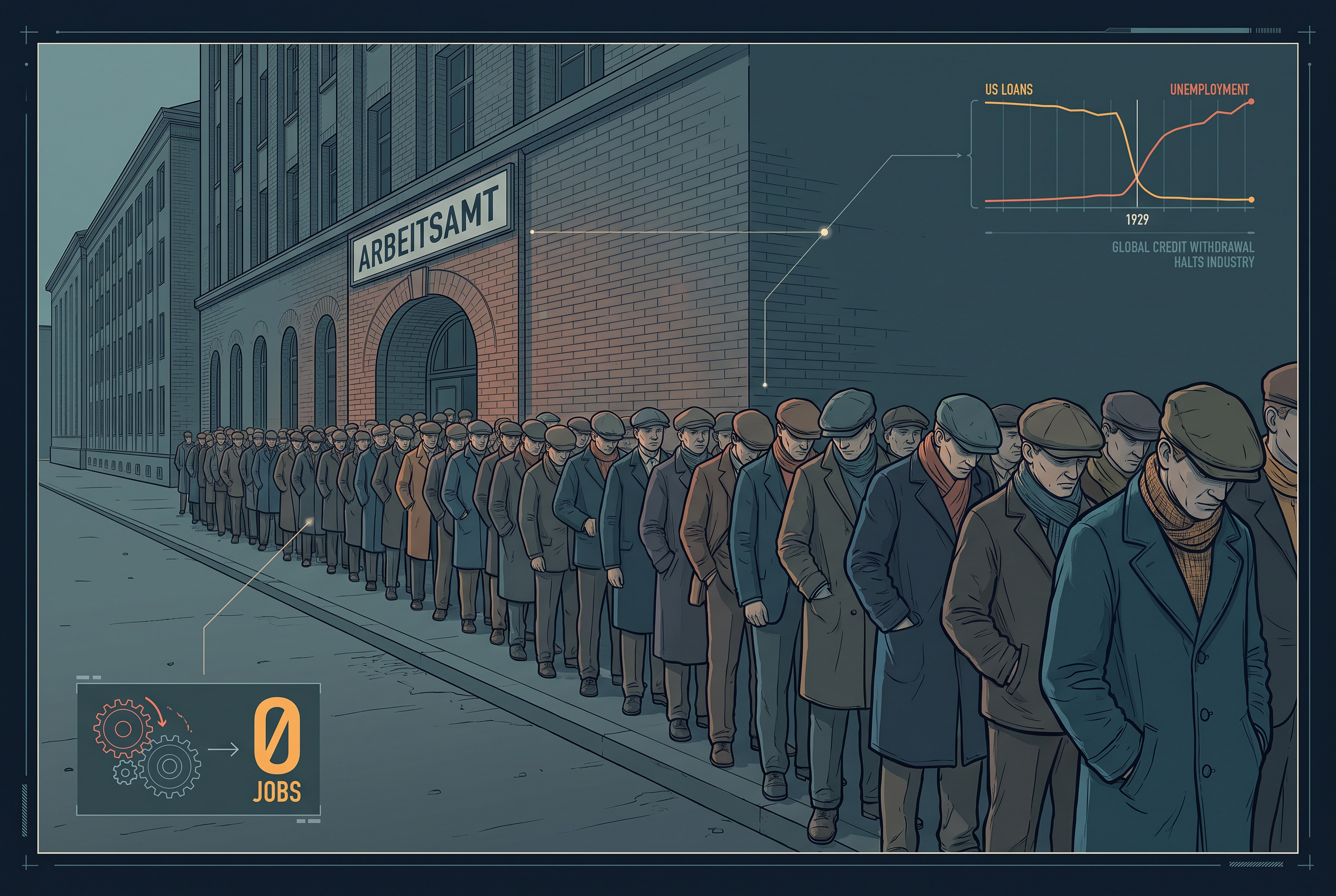
Fig. 8.6 – Men queue outside a German labour exchange.
8.5.3 The Weimar Republic Under Strain
The economic collapse arrived in a state whose political foundations were already narrow. Many Germans had never accepted the republic, blaming it for the defeat of 1918 and the terms of Versailles, and the crisis handed those arguments an audience.
The government’s response deepened the resentment. Chancellor Heinrich Brüning met the slump by cutting government spending, reducing wages and salaries, raising taxes and — most damaging of all for the unemployed — cutting the level and duration of unemployment benefit.
The reasoning was that a balanced budget would restore confidence and demonstrate that reparations were unpayable. The effect on an economy already short of demand was to remove more of it, and to take support away from precisely the people with nothing else.
The Loss Of Consent
Industrialists complained that the republic could not protect business. Working-class voters, watching benefits cut while unemployment rose, lost their reason to defend it. A government that could no longer command a majority in the Reichstag, the German parliament, increasingly governed through emergency decrees signed by the President.
By the end of 1932 the republic was governing without consent, without a working majority and without an economic policy that anyone believed in. That vacuum, and what filled it, belongs to the study of Germany after 1933. What concerns us here is how completely an economic collapse that began on a New York exchange had hollowed out a European democracy in three years.
8.6 The Impact On The Economy Of Japan
Japan’s experience of the Depression was different from the American and the German, and the difference is instructive. Japan was an industrialising country whose foreign earnings rested on a narrow range of exports, and one export above all.
That made it unusually exposed. A fall in demand in the United States did not reach Japan through banks, as it reached Germany. It reached Japan through the price of raw silk, and from there it went straight into the farmhouse.
8.6.1 The Collapse Of The Silk Trade
Japan in the 1920s paid for its imports of oil, iron ore, machinery and raw cotton by selling cotton cloth, tea and, above all, raw silk. The largest customer for that silk was the United States, where it was woven into stockings and dress fabrics for exactly the consumers whose spending collapsed after 1929.
Silk was not produced on plantations. It came from sericulture — the rearing of silkworms on mulberry leaves and the reeling of thread from their cocoons — carried on in ordinary farm households as a cash income alongside rice. A very large share of Japanese farming families had some part of their earnings in silk.
The price of raw silk fell by more than half within two years of the Crash. American demand shrank, and artificial fibres took a further share of what remained of the market. For millions of households the cash half of the family income effectively disappeared.
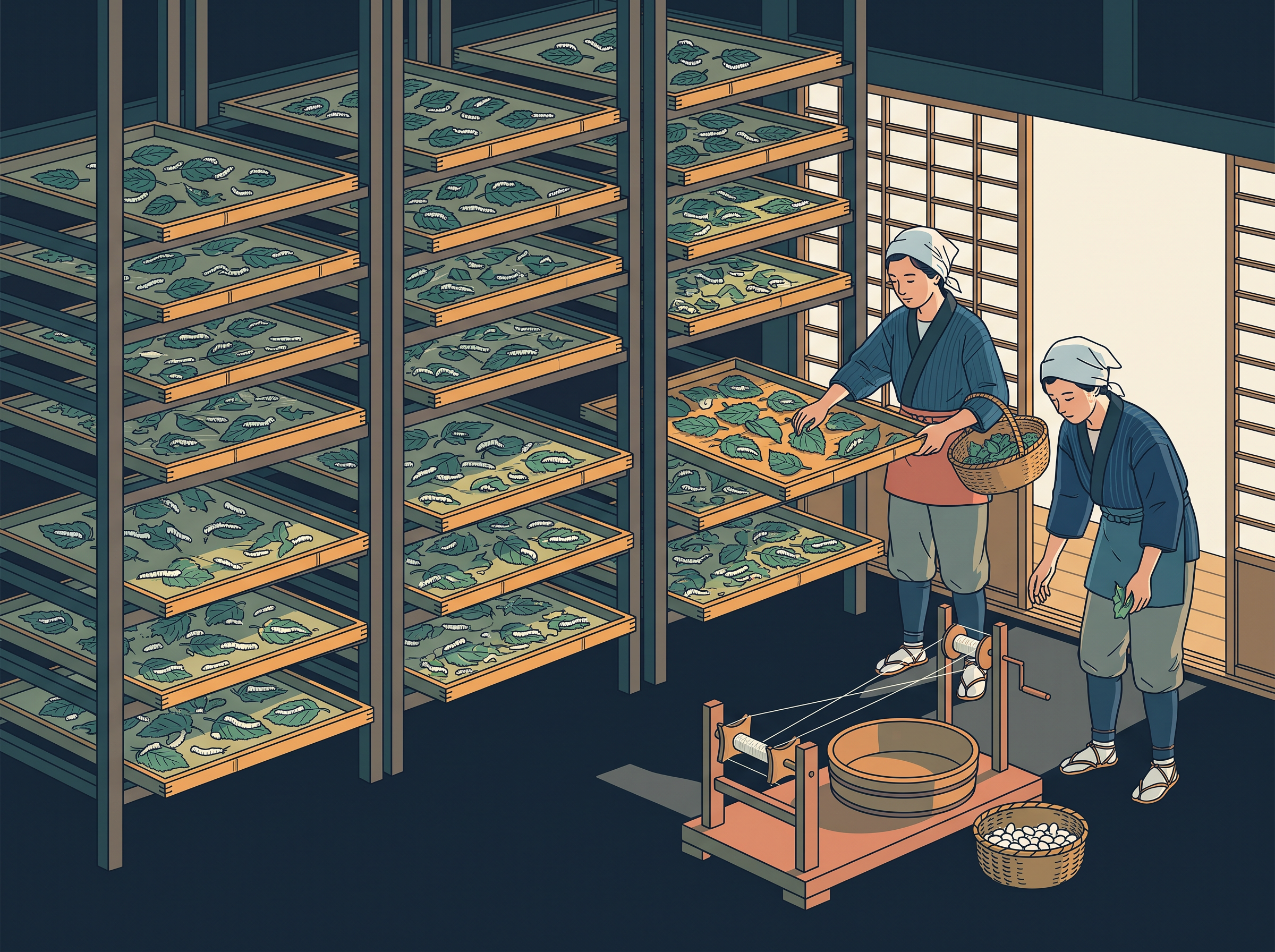
Fig. 8.7 – Silkworm rearing in a Japanese farm household.
Map
Map 8.3 Caption: Japan’s silk-rearing districts and the export route to the United States, about 1929. Brief: Map of the Japanese islands with 1920s boundaries, plus an inset of the North Pacific; shade the main silk-rearing districts of central Honshu; mark the north-eastern prefectures affected by crop failure in 1931 in a second shade; draw one arrow across the Pacific from Yokohama to the west coast of the United States labelled ‘raw silk’; do not show trade with any other country.
The Gold Standard Decision
Japan’s government worsened the timing by its own choice. In January 1930 it returned the yen to the gold standard — a system in which a currency is fixed to a set quantity of gold — at the pre-war rate, in the belief that a strong, stable yen would discipline the economy and win foreign confidence.
Fixing a high value for the currency makes a country’s exports dearer abroad at the very moment its customers are cutting back. Prices inside Japan fell sharply, debts grew heavier in real terms, and the export collapse deepened. The decision was reversed in December 1931, when Japan left the gold standard again and the yen fell in value.
8.6.2 Distress In The Villages And The Cities
Because silk income belonged to farm households, the crisis struck the countryside first and hardest. The blow was doubled when rice prices also collapsed, so that the two sources of a farming family’s money failed together.
Many of these families were tenant farmers, who did not own the land they worked and paid a large share of the harvest as rent. A tenant with no cash income cannot pay rent, taxes or the interest on borrowed money, and by 1931 rural indebtedness had reached levels that no harvest could clear.
Famine In The North-East
Distress became disaster in the north-east. The summer of 1931 brought cold weather and crop failure to the northern prefectures of Honshu, and the region — already stripped of its silk earnings — faced outright hunger.
Village schools reported children coming to class without food. Families deep in debt sent daughters away into factory work or domestic service, and cases of daughters being sold were reported in the national press. These reports shaped opinion far beyond the districts concerned, because many of the men serving in the Japanese army had come from exactly such villages.
The Cities
Urban Japan suffered in the ordinary way of a slump. Textile mills and export industries cut hours, reduced wages or closed; unemployment rose; labour disputes multiplied. Workers dismissed from city factories often returned to home villages that had nothing to feed them.
8.6.3 The Retreat From Taisho Democracy
Japan entered the Depression with a parliamentary system that was young and not deeply rooted. Governments were formed by political parties, elections were contested, and the vote had been extended to all adult men in 1925.
That system was judged by results, and after 1929 the results were catastrophic. Party governments had presided over the return to gold, the collapse of silk, the ruin of the villages and the famine in the north-east. Politicians were widely seen as close to the great business houses and remote from rural distress.
Confidence drained accordingly. Public opinion turned towards nationalist and military figures who spoke of decisive action, of the corruption of party politicians, and of securing by force the raw materials and markets that trade had failed to supply.
What Japan then did with that conviction, from 1931 onwards, belongs to the separate study of the rise of militarism. What belongs here is the economic root: an export collapse that discredited a parliamentary government within three years, and made an argument for empire sound to many Japanese like an argument for survival.
8.7 Roosevelt And The Aims Of The New Deal
The three preceding sections described a collapse. This one and the two that follow describe a response — the most important attempt made anywhere in the 1930s to pull a capitalist economy out of a depression by government action.
The response is known as the New Deal. It was not a single plan drawn up in advance and then executed. It was a series of programmes, laws and agencies introduced between 1933 and 1938, some of which worked, some of which were struck down by the courts, and some of which pulled against each other.
This section deals with its aims: where the phrase came from, what Roosevelt said he intended, and how that intention differed from what had gone before. The measures themselves follow in 8.8 and 8.9.
8.7.1 A New Deal For The American People
Franklin D. Roosevelt was Governor of New York when the Democratic Party chose him as its candidate in the summer of 1932. He had already used the powers of a state government against unemployment, and he arrived at the convention arguing that the crisis required action rather than patience.
The phrase that named his whole presidency appeared in the speech accepting that nomination, delivered in Chicago on 2 July 1932.
Notice how little the sentence actually commits him to. It names no policy, no law and no sum of money. It promises a change in the relationship between the government and the governed, and leaves the content to be settled later — which is roughly what happened.
That vagueness was politically shrewd, and it also reflected something true about Roosevelt’s approach. He was willing to try a measure, abandon it if it failed, and try another, and he said so openly during the campaign.
The Winter Of 1932–33
Roosevelt won in November 1932, but under the arrangements then in force a President elected in November did not take office until the following March. Those four months were the worst of the whole Depression.
Bank failures reached their peak in the winter, and by the beginning of March 1933 governors in many states had ordered the banks in their states to close altogether to stop the withdrawals. Roosevelt was inaugurated on 4 March 1933 with much of the American banking system shut.
His inaugural address is remembered for one clause, and the clause was aimed at exactly that situation.
The line is often quoted as encouragement, and it was more than that. Roosevelt was making an economic argument in a single sentence: that panic itself — depositors withdrawing, employers postponing, buyers waiting — was now doing damage independently of the original causes.
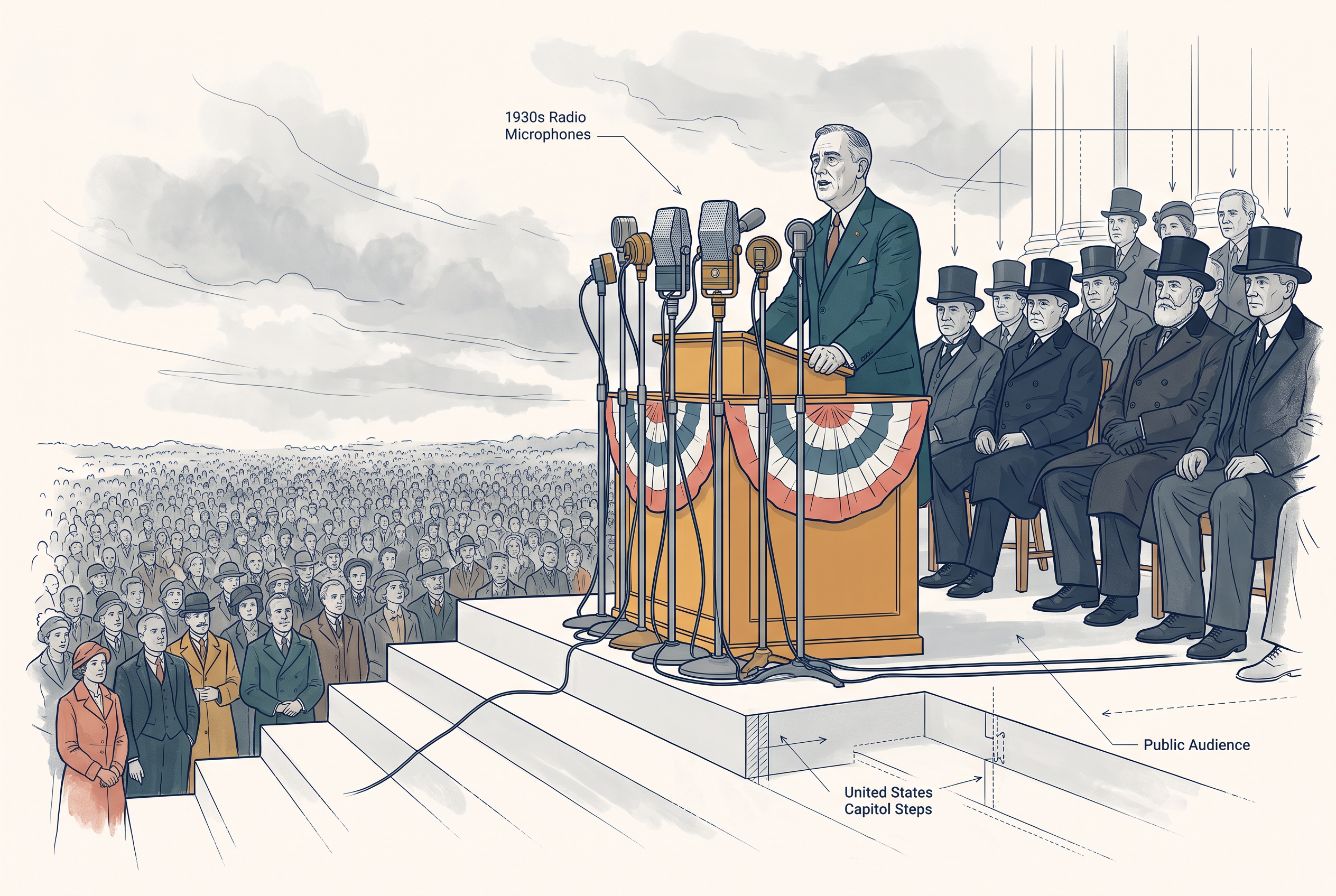
Fig. 8.8 – Roosevelt delivering his first inaugural address, 4 March 1933.
8.7.2 The Three Rs: Relief, Recovery, Reform
The New Deal’s aims are usually summarised under three words, and the summary is a useful one provided it is not mistaken for a plan that existed on paper in March 1933.
Relief meant immediate help to people already destitute: food, cash payments, shelter and, above all, paid work for the unemployed. This was the most urgent aim, because millions of families had exhausted their savings and their local charities years earlier.
Recovery meant restoring the economy itself — raising farm and factory prices from their collapsed levels, restarting production, and bringing employment back towards its former level. Relief kept people alive; recovery was meant to make relief unnecessary.
Reform meant changing the rules so that a collapse of this kind could happen again in the same way: regulating banks and the share market, guaranteeing savings, and building the permanent protections whose absence 8.3.2 described.
What Was New About It
Two things distinguished this from what Hoover had done. The first was the willingness to spend federal money directly on relief and employment, rather than leaving destitution to states and charities.
The second was the scale of federal authority claimed over the economy. Under the New Deal the government in Washington set out to regulate wages and hours, restrict what farmers grew, supervise banks, and employ millions of people itself. The laissez-faire principle described in 8.1.1 was set aside, deliberately and openly.
What was not intended is equally worth stating. Roosevelt did not propose to abolish private ownership or replace the market. He was, on his own account, trying to preserve American capitalism and American democracy at a moment when both were failing — and when governments elsewhere were being replaced altogether.
8.8 Measures Taken: The Hundred Days And The Laws
Roosevelt took office on a Saturday and called Congress into special session the following week. The session that followed ran from 9 March to 16 June 1933 and is known as the Hundred Days. In just over three months it passed fifteen major laws, a rate of law-making without parallel in American peacetime history.
This section deals with the laws themselves — what each was meant to do and what became of it. The agencies and work schemes created alongside them are taken up in 8.9.
One feature of the American system shapes the whole story and needs stating first. A law passed by Congress and signed by the President can still be struck down by the Supreme Court if the Court finds that it exceeds the powers the Constitution grants. Two of the central New Deal laws met exactly that fate.
8.8.1 Rescuing The Banks
Nothing else could begin until the banks reopened. As 8.7.1 noted, much of the American banking system was shut by the first week of March 1933, and money had almost stopped circulating in some states.
Roosevelt’s first act was to close the rest. On 6 March he declared a national bank holiday, shutting every bank in the country, which stopped the withdrawals and bought the government a few days.
The Emergency Banking Act was then drafted, introduced and passed by Congress on 9 March — in a single day. It allowed the Treasury to examine every bank and to license for reopening only those found sound, with federal support behind them.
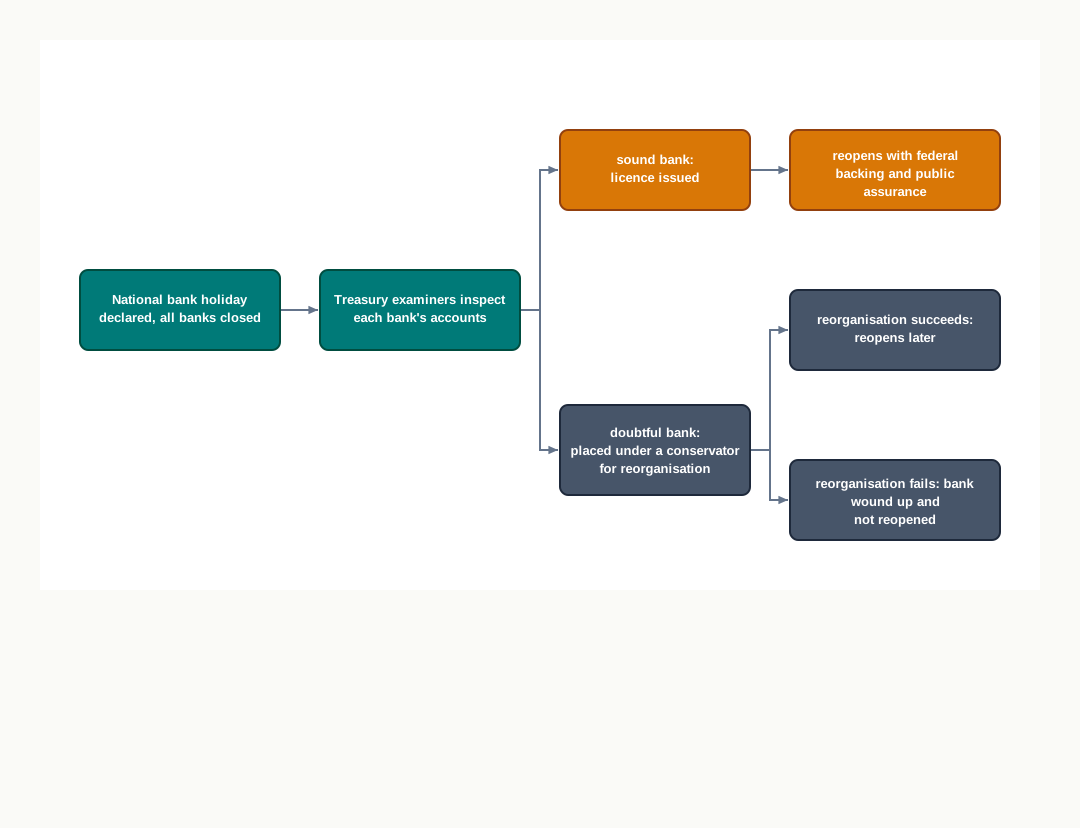
Fig. 8.9 – How a closed bank reopened, March 1933.
Talking To The Country
The procedure was only half the remedy. Depositors had to be willing to put their money back, and no examiner’s licence could make them. On the evening of Sunday 12 March, the day before the first banks reopened, Roosevelt broadcast to the nation by radio and explained in plain language what had been done and why a licensed bank was now safe.
The sentence is worth pausing over because of what it does not do. It does not address citizens, voters or the American people in the language of a proclamation. A President is proposing a conversation, in a medium that reached families in their own homes, at a moment when official statements had lost their power to reassure.
These broadcasts, which continued through his presidency, became known as fireside chats. When the licensed banks opened on 13 March, deposits flowed back in rather than out — the first clear evidence that confidence could be restored by an action of government.
Reform followed the rescue. The Banking Act of June 1933 separated ordinary deposit banking from the business of dealing in shares, so that a bank could no longer gamble its depositors’ savings as some had done in the 1920s. It also created a federal corporation to insure deposits, so that a saver whose bank failed would no longer lose everything — the guarantee whose absence had made the failures of 1930 to 1933 so devastating.
8.8.2 Industry And Agriculture, 1933
The banking measures stopped the bleeding. Recovery required something to be done about the two collapsed halves of the real economy, and two laws of 1933 attempted it.
The National Industrial Recovery Act
The National Industrial Recovery Act, passed in June 1933, worked through two very different instruments. One section set up the National Recovery Administration, which drew up codes of fair competition for each industry — agreements on minimum wages, maximum hours and prices, intended to stop firms from competing by cutting wages and undercutting each other into ruin.
The codes also abolished child labour in the industries covered and recognised the right of workers to organise and bargain through unions of their own choosing. Participation was voluntary in law, and firms that signed displayed a blue eagle emblem which customers were urged to look for.
The Act’s other section created the Public Works Administration, which was given a large budget to fund the building of dams, bridges, roads, schools, hospitals and airports — putting people to work and leaving useful assets behind.
The industrial codes did not last. In May 1935 the Supreme Court ruled unanimously that the National Recovery Administration’s code-making went beyond the powers the Constitution gave the federal government, and the whole scheme fell.
The Agricultural Adjustment Act
The companion measure for farming was the Agricultural Adjustment Act of May 1933. Its logic was the mirror image of the industrial codes: since farm prices had collapsed because output exceeded what buyers could pay for, the government would pay farmers to produce less.
Farmers who agreed to reduce the area they sowed, or the number of animals they raised, received compensation from the government, financed by a tax on the firms that processed farm produce. Farm prices did rise, and farm incomes with them.
The method caused lasting unease. In its first year the programme involved ploughing growing cotton back into the ground and slaughtering millions of piglets, in a country where families were queuing for bread. The Supreme Court struck this Act down too, in 1936, on the ground that the processing tax was unconstitutional; a revised Agricultural Adjustment Act followed in 1938.
There is a further limit to record. Payments went to landowners, and landowners who took land out of cultivation had less need of the tenants and sharecroppers who worked it. Many of the poorest cultivators in the southern states, a large proportion of them African American, were pushed off the land by a law meant to relieve agricultural distress.
8.8.3 Labour And Social Security, 1935–1938
By 1935 two things had changed. The Supreme Court had destroyed the industrial code system, and the political pressure for permanent protection rather than temporary relief had grown. The laws of 1935 to 1938 are more durable than those of 1933, and they are the part of the New Deal that survives today.
The Wagner Act, 1935
The National Labor Relations Act of 1935, usually called the Wagner Act after the senator who framed it, restored and strengthened the union rights that had gone down with the industrial codes.
It gave workers a legal right to form unions and to collective bargaining — negotiating wages and conditions as an organised body rather than as individuals — and set up a federal board to conduct workplace elections and stop employers from obstructing them. Trade union membership in the United States grew rapidly in the years that followed.
The Fair Labor Standards Act, 1938
The last major New Deal law returned to the ground the courts had taken away in 1935. The Fair Labor Standards Act of 1938 fixed a national minimum wage and a maximum working week — set at forty-four hours to begin with and reduced by stages to forty — and prohibited the employment of children under sixteen in most work covered by the Act.
Where the industrial codes had rested on voluntary agreement between firms, this was law, enforceable in the courts, and it survived.
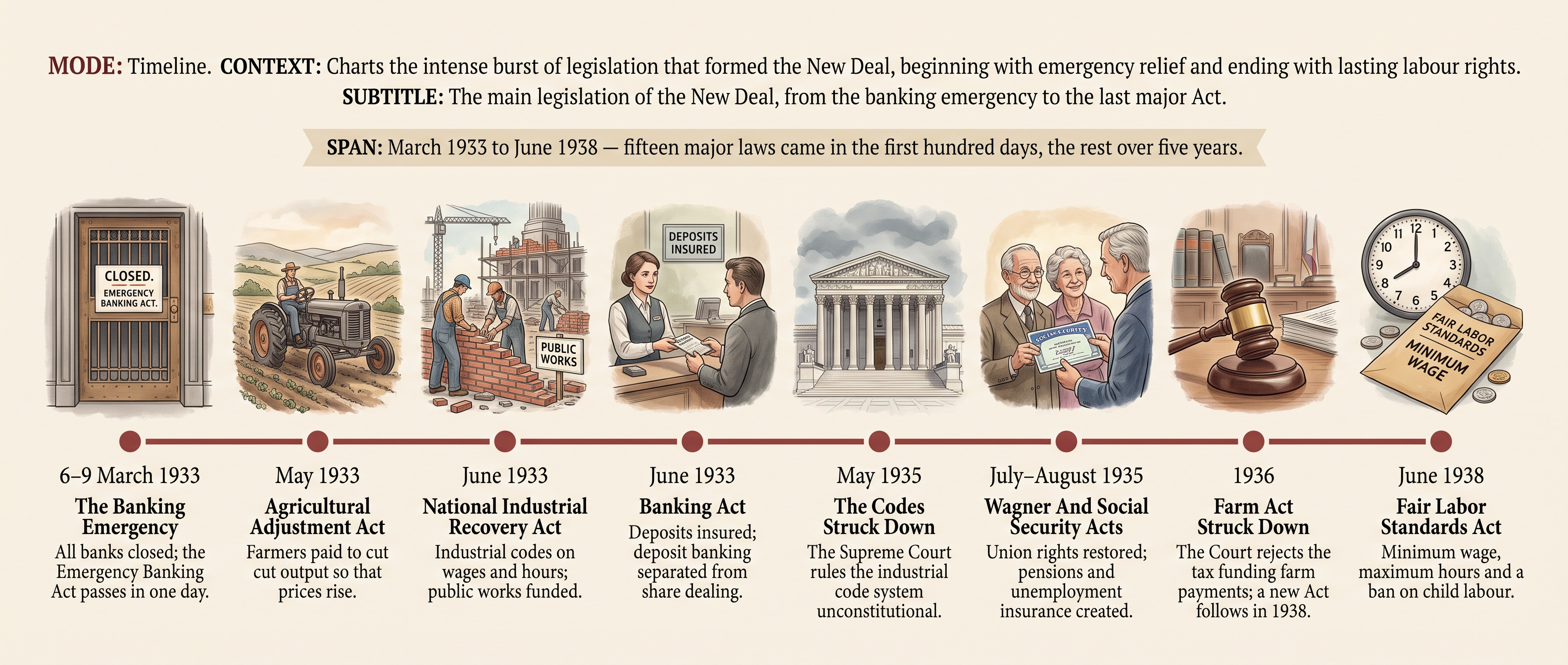
Fig. 8.10 – The Laws Of The New Deal.
8.9 Measures Taken: The Agencies And Schemes
Laws set out what a government intends. Somebody then has to hire the men, buy the cement, sign the cheques and inspect the accounts, and in 1933 the American federal government had no machinery for doing any of it on the scale required.
So it built the machinery. Dozens of new bodies were created between 1933 and 1935, each with a task and a set of initials, and Americans took to calling them the alphabet agencies. This section takes the most important of them in three groups: those that provided work and relief, those that rebuilt land and regions, and the one that policed the share market where the whole disaster had begun.
8.9.1 Work And Relief Programmes
The first task was the most urgent. Millions of families needed money and food immediately, and Roosevelt’s government took the view — against everything Hoover had argued — that this was a federal responsibility.
The Federal Emergency Relief Administration, set up in May 1933, sent federal money to the state governments so that they could pay direct relief and provide shelter to the destitute. It was a stopgap, and it was understood as one. Roosevelt disliked cash handouts and preferred to pay people for work.
The Civilian Conservation Corps
The Civilian Conservation Corps, also created in 1933, was the clearest expression of that preference. It enrolled young unmarried men who had no work, housed them in camps, and set them to plant trees, fight forest fires, check soil erosion, build trails and lay out state parks.
Enrollees received food, clothing, shelter and a small monthly wage, most of which was sent directly home to their families. Some three million young men passed through the Corps during its existence, at an age when unemployment would otherwise have left them with nothing to do for years.
The Works Progress Administration
The largest of the work schemes came in 1935. The Works Progress Administration employed people directly on projects that a locality wanted but could not fund: roads, schools, hospitals, drains, bridges, playgrounds and airfields.
Several million Americans worked for it over the following years. Its principle was simple and deliberate — the money was spent on wages for useful work rather than on relief payments, so that a family kept its income and the country kept the road.
The Works Progress Administration also did something no government had done before. It paid unemployed actors, writers, musicians and painters to practise their own trades, on the argument that a skilled worker’s skill is worth preserving whatever the trade. The Federal Theatre Project of 1935 staged plays across the country, often at very low prices, in towns that had never seen a professional company.
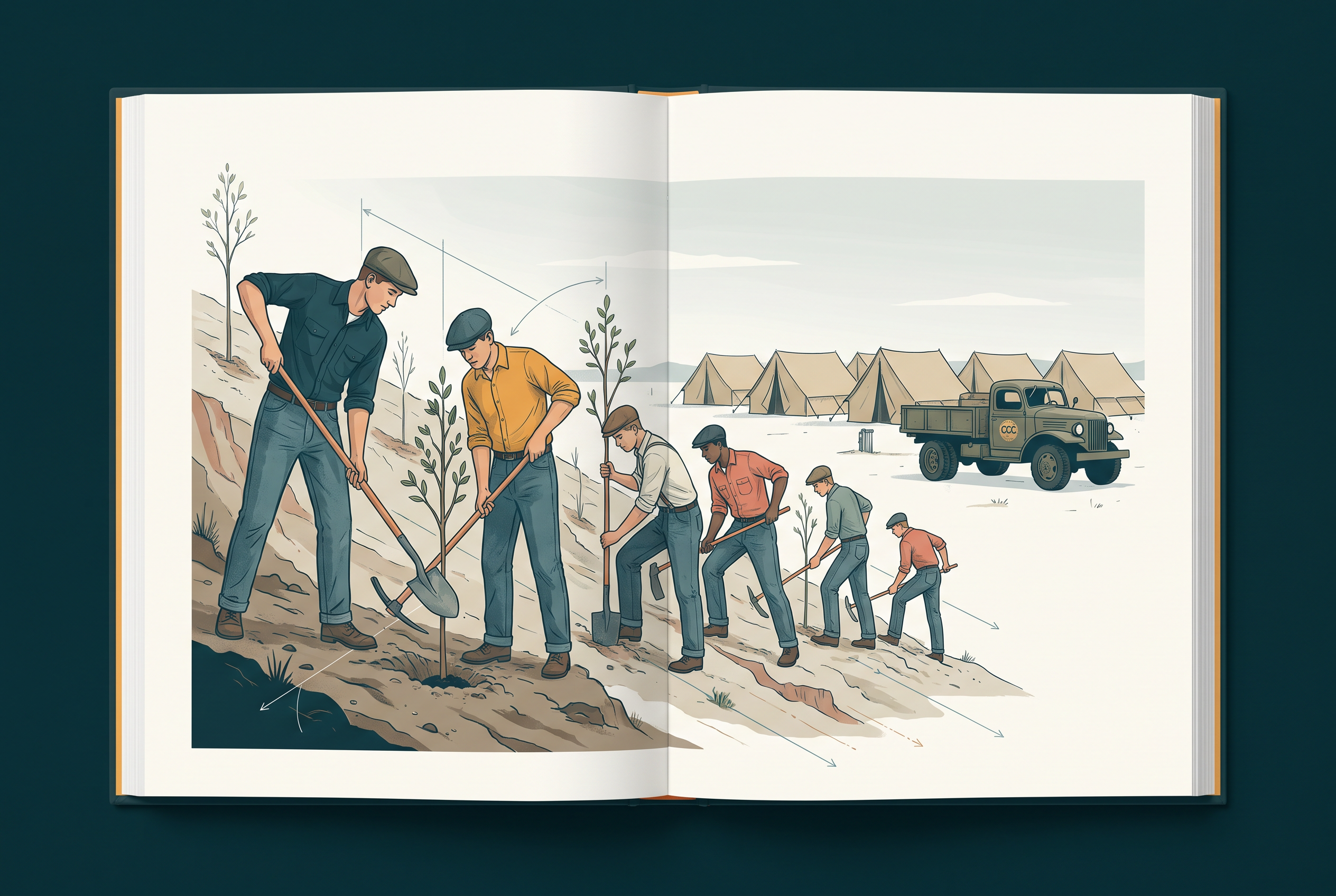
Fig. 8.11 – Civilian Conservation Corps workers planting trees.
8.9.2 Conservation And Regional Development
The New Deal’s second group of agencies attacked a problem that neither relief nor recovery addressed: whole regions that had been poor before the Depression and would still be poor after it.
The most ambitious of them was the Tennessee Valley Authority, created in May 1933. It was a public corporation — a body owned by the government but run like a business, with its own staff, budget and powers — and it was given responsibility for an entire river basin spread across parts of seven states.
Map
Map 8.4 Caption: The Tennessee River basin and the seven states in which the Tennessee Valley Authority operated after 1933. Brief: Map of the south-eastern United States with 1930s state boundaries; trace the Tennessee River and shade its drainage basin; label Tennessee, Kentucky, Virginia, North Carolina, Georgia, Alabama and Mississippi; mark the sites of major dams built under the Authority; do not shade areas outside the basin.
The dams did not come free of cost to everyone. Reservoirs flood land, and thousands of families in the valley were required to leave farms and villages that disappeared under the new lakes, receiving compensation that many judged inadequate for a home their families had held for generations.
8.9.3 Regulating The Stock Market
The last group of measures returned to the origin of the crisis. If shares could again be bought with a tenth of their price in borrowed money, and if companies could again tell investors whatever they pleased, another 1929 was possible.
Two laws dealt with this. The first, in 1933, required companies offering shares to the public to disclose accurate information about their finances, and made those who signed a false statement liable for it.
The second, in 1934, created the Securities and Exchange Commission — a permanent federal body with power to license the exchanges, enforce disclosure, investigate fraud and make rules for how shares are traded. The same Act gave the Federal Reserve authority to set minimum margin requirements, and the level was fixed far above the tenth of the price that had been common in 1929.
The reform did not abolish speculation, and it was not meant to. It was meant to ensure that an investor could find out what he was buying, and that he could not buy it almost entirely with someone else’s money.
What The Measures Achieved, And Did Not
The record of these years can be stated plainly. Unemployment fell from roughly a quarter of the workforce in 1933 to about one worker in seven by 1937, and banking panics ended. Then, in 1937–38, output fell and unemployment rose again in a sharp recession, and the level of 1929 was not regained until the demands of the Second World War transformed American industry.
The New Deal therefore did not end the Depression, and no serious account claims that it did. What it did was keep millions of people alive, restore a working banking system, build a permanent floor of social protection where there had been none, and preserve a democratic government at a time when several European states were losing theirs.
8.10 Summary
The Boom And Its Faults
- The United States came out of the First World War as the world’s leading industrial producer and its leading creditor, and the 1920s brought a real rise in living standards built on mass production and consumer goods.
- Three Republican Presidents governed on laissez-faire lines: Harding, Coolidge and Hoover, who took office in March 1929 after winning the election of November 1928.
- Shares are units of ownership in a company, priced by what buyers expect future profits to be. Through the 1920s ordinary Americans began buying them, encouraged by prices that had risen every year.
- Overproduction was the first fault: farms and factories were producing more than buyers could afford, and American industrial output had already turned downward in the summer of 1929.
- Unequal incomes were the second, and they are the same fault seen from the demand side. Mass production needs mass purchasing power, and instalment buying supplied it only by borrowing against future wages.
- Falling exports were the third. Europe could not afford American goods, and the tariff of 1922 made it harder still for other countries to earn the dollars with which to buy them.
- Speculation on borrowed money was the fourth. Buying on margin multiplied gains and losses alike, and a fall in prices triggered margin calls that forced holders to sell whether they wished to or not.
The Crash And The Depression
- Share prices peaked on 3 September 1929. Heavy selling on Black Thursday, 24 October, was steadied by an afternoon recovery; Black Tuesday, 29 October, brought outright collapse.
- The famous week was not the whole fall. Prices went on declining until July 1932, when the index stood at about a ninth of its 1929 peak.
- A crash became a depression through four connections: confidence and spending collapsed, unpaid debts wrecked the banks, bank failures destroyed savings and credit, and falling prices made every existing debt heavier.
- The United States had no deposit guarantee, no unemployment insurance and no federal relief in 1929, so there was nothing to break the fall.
The Impact On Three Economies
- In the United States, some nine thousand banks failed between 1930 and 1933, industrial production fell by roughly half, and about one worker in four was unemployed by 1933.
- Farm prices fell while mortgage payments did not, so farms were foreclosed; on the southern Great Plains, drought acting on soil loosened by deep ploughing produced the Dust Bowl and drove families west.
- Hoover held that relief belonged to states and charities, and signed the Smoot–Hawley tariff in June 1930, which helped cut world trade by roughly two-thirds by 1933. He lost the election of November 1932 to Roosevelt in forty-two of forty-eight states.
- Germany’s recovery after 1924 had been financed by short-term American loans under the Dawes Plan, used to pay for long-term assets. When the loans were recalled, banks failed, exports collapsed and unemployment passed six million.
- The German government met the slump by cutting spending, wages and unemployment benefit, which removed demand and support together, and by the end of 1932 the Weimar Republic was governing without consent.
- Japan was exposed through a single export. Raw silk earned much of its foreign currency and was reared in farm households, so when American demand vanished the loss went straight into the village.
- Rice prices collapsed as well, the northern prefectures suffered crop failure and famine from 1931, and party government — the achievement of the Taisho years — lost the confidence of a rural population and of the army recruited from it.
Roosevelt And The New Deal
- Roosevelt promised ‘a new deal for the American people’ in July 1932 without specifying its content, and took office on 4 March 1933 with much of the banking system closed.
- Its aims are summarised as relief for the destitute, recovery of output and employment, and reform of the rules. What was new was federal money spent directly on relief and federal authority claimed over banks, wages and farming.
- The Hundred Days closed the banks, examined them and reopened the sound ones with federal backing; the Banking Act of June 1933 insured deposits and separated deposit banking from share dealing.
- The National Industrial Recovery Act set industrial codes on wages and hours and funded public works; the Agricultural Adjustment Act paid farmers to produce less. The Supreme Court struck down the first in 1935 and the second in 1936.
- The laws of 1935 to 1938 proved durable: union rights under the Wagner Act, pensions and unemployment insurance under the Social Security Act, and a minimum wage and ban on child labour in 1938.
- The alphabet agencies did the work: federal grants for relief, the Civilian Conservation Corps, the Works Progress Administration, and the Tennessee Valley Authority, which rebuilt an entire river basin.
- The Securities and Exchange Commission, created in 1934, licensed the exchanges and enforced disclosure, and margin requirements were fixed far above the levels of 1929.
- Unemployment fell from about a quarter of the workforce in 1933 to about one in seven by 1937, then rose again in the recession of 1937–38. The New Deal did not end the Depression; it kept people alive, rebuilt the banking system and preserved a democracy.
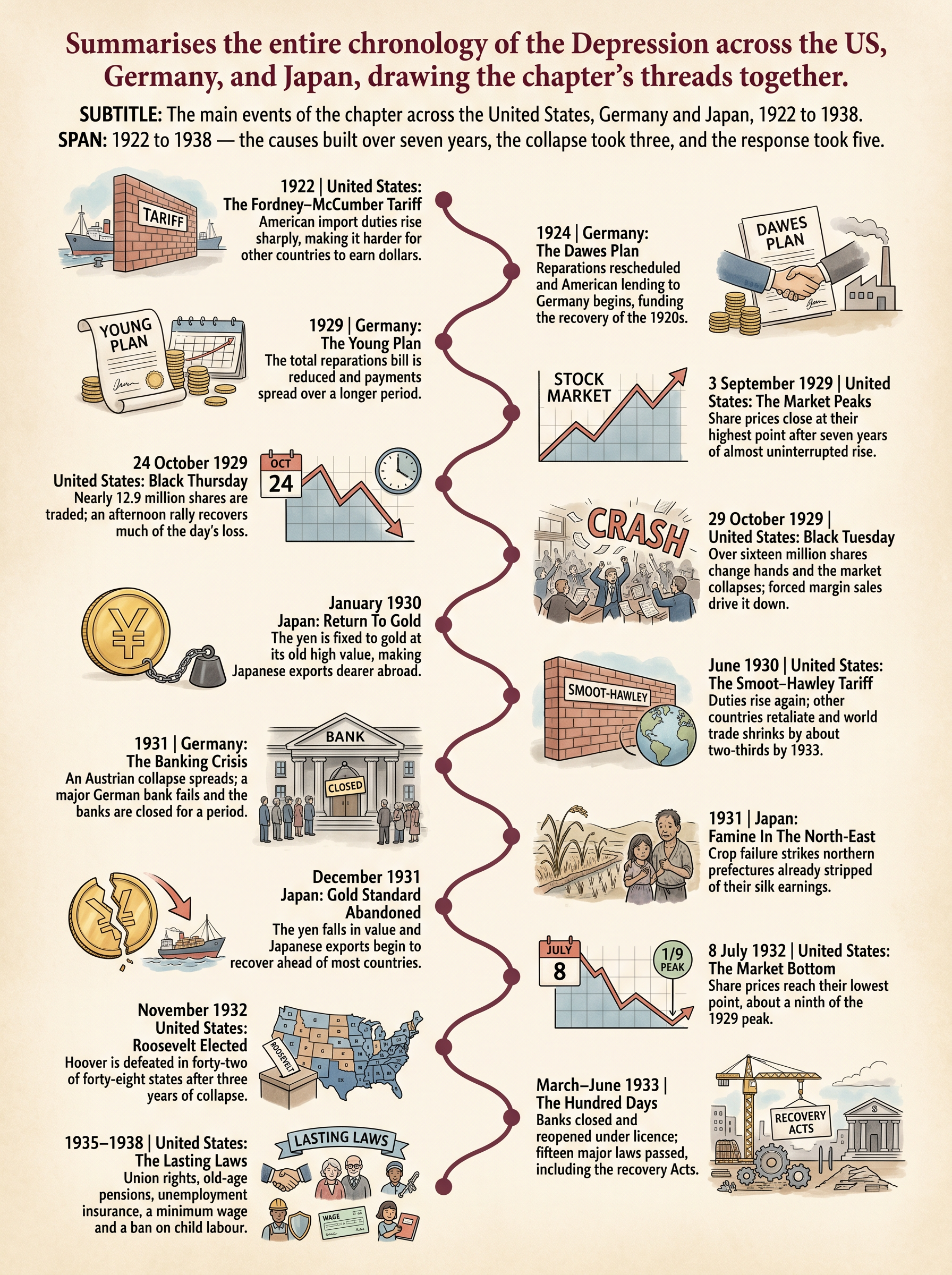
Fig. 8.12 – The Great Depression: The Whole Chronology.
What The Evidence Cannot Tell Us
The Depression is unusually well documented in numbers — index values, output figures, bank returns, unemployment counts — and every one of those numbers records what an institution could see. Unemployment figures counted registered workers, so they missed women’s unpaid work, tenants pushed quietly off the land, and those who had stopped looking altogether.
The photographs that shape our picture of these years were largely commissioned to build support for relief, which makes them true and unrepresentative at the same time. Nobody was paid to photograph the families who were managing.
The voices we have least of are those of the people worst hit: the sharecroppers displaced by a farm subsidy, the depositors of a failed bank, the daughters sent away from a famine district in northern Japan. Their experience survives mostly in somebody else’s record of it.
8.11 Check Your Memory
Explain what overproduction meant in the American economy of the 1920s, and say why the chapter warns that the word can mislead.
Roosevelt’s aims are usually summarised as relief, recovery and reform. Choose one measure described in this chapter for each of the three, and explain how it was meant to serve that particular aim.
Read Source 8.1 again. It promises no law, no policy and no sum of money. Suggest why a pledge of this kind could still be effective with American voters in 1932.
Instalment buying and buying on margin were both ways of purchasing with borrowed money. Explain each, and set out clearly what they had in common and how they differed in their consequences.
Trace the sequence by which the fall in share prices in New York led to farming families in the American Midwest losing land they had worked for two generations. Show each step in the chain.
Germany had no share boom of its own to burst. Explain, step by step, how the Wall Street Crash nevertheless produced mass unemployment in Germany within three years.
Look again at Table 8.1. What does it show about the pace of the fall, and why would it be wrong to say that the American market collapsed in a single week of October 1929?
Study Fig. 8.5 together with the guidance on reading it. What can a photograph of this kind establish for a historian, and what can it not? Refer to how such photographs came to be taken.
Using Map 8.3, identify the silk-rearing districts of Japan and the market to which the silk was sold. Explain why the loss of this one trade reached so far into Japanese village life.
The chapter sets out two explanations for why the fall after 1929 went so deep — one blaming the failure to protect money and the banks, the other blaming the collapse of spending itself. State both, then argue for whichever you find stronger, using evidence from this chapter.