Chapter 9: Rise Of Communism Under Stalin In Russia (1917–1939)
In May 1920 a photographer set up his camera in Sverdlov Square in Moscow. Lenin stood on a wooden platform, coat open, speaking to soldiers about to leave for the front. At the right-hand edge of the frame, on the steps of the platform, two men waited their turn to speak. One was Leon Trotsky, who had built the Red Army out of nothing. The other was Lev Kamenev, among the most senior men in the party. The picture was printed, sold and hung on walls.
By the later 1930s the same photograph was appearing in Soviet books with the steps empty. Not shadowed, not cropped — retouched. The grain of the wood ran on smoothly where the two men had stood, and no caption mentioned them. By then Trotsky had been expelled from the party and driven out of the country, and Kamenev had been tried in public, made to confess to crimes he had not committed, and shot.
We know what was done because both versions survive: early prints that left the country, later ones issued inside it. Set them side by side and the alteration is plain.
That is where this chapter begins its work. Between 1917 and 1939 Russia was remade twice over, at enormous human cost — and the people who remade it also edited the record of what they had done.
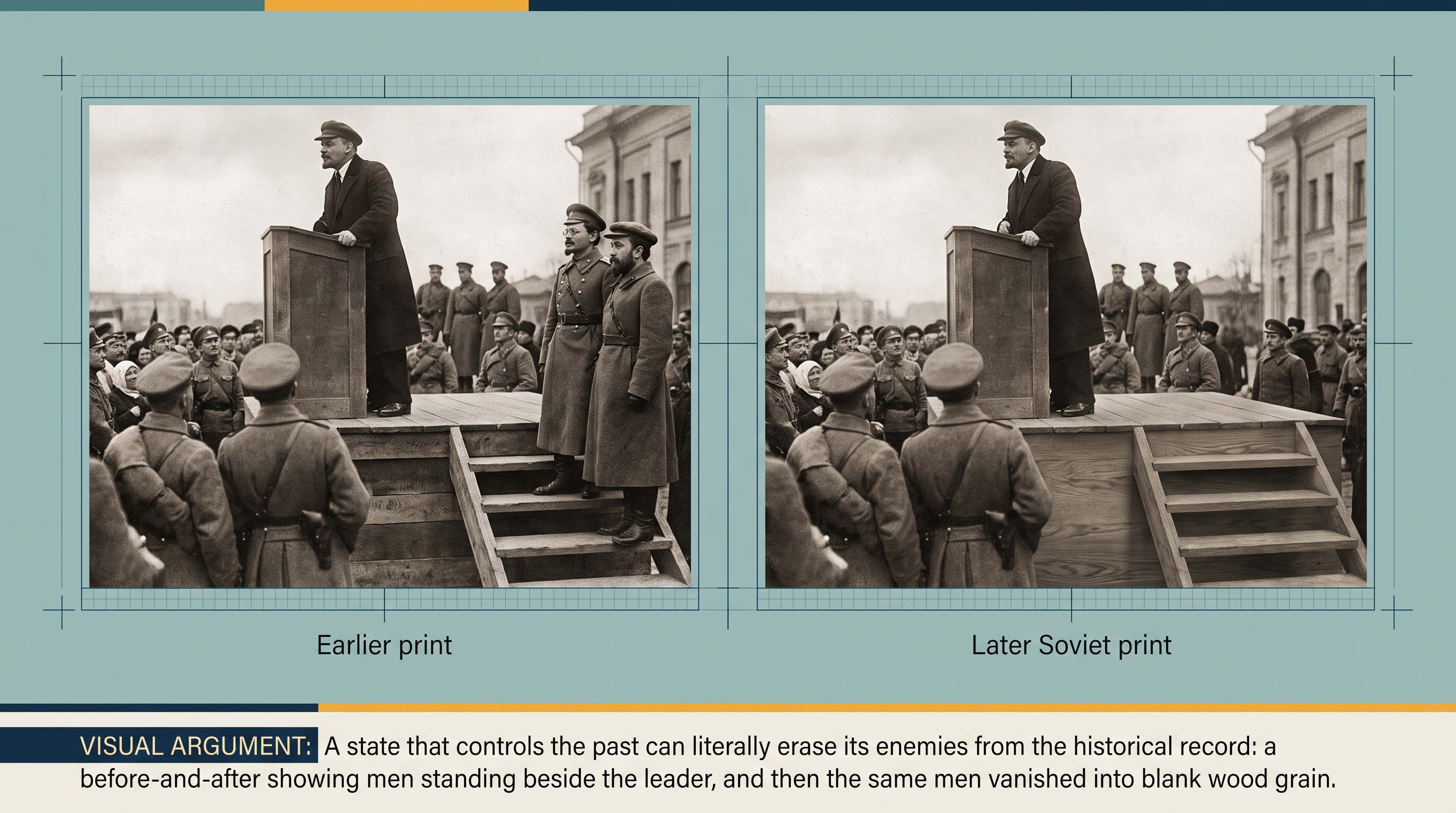
Fig. 9.0 – The retouched 1920 photograph of Lenin.
9.1 The Causes Of The March Revolution
The revolution that ended Tsarist rule in Russia happened in March 1917. It is also, confusingly, called the February Revolution. Both names are correct, and the reason lies in a calendar.
Until 1918 Russia used the Julian calendar, which by the twentieth century ran thirteen days behind the Gregorian calendar used in Western Europe. A day that was 23 February in Petrograd was 8 March in London. This book follows the syllabus and uses the Gregorian dates — March and November — but you will meet the Julian dates constantly in the sources, and you should be able to convert between them.
The country in which all this happened was enormous. The Russian Empire stretched from the borders of Germany to the Pacific, and its rulers governed peoples of many languages and religions from a single capital in the far west of it. Map 9.1 sets out the places this chapter will keep returning to.
Map
Map 9.1 Caption: The Russian Empire in 1914, showing the places named in this chapter. Brief: Political map of the Russian Empire at its 1914 extent; label Petrograd, Moscow, the Volga region, the Ural mountains, Siberia with the Lena goldfields, and the Kronstadt naval base near Petrograd; mark the western war frontier of 1915 with a dashed line; a note must state that these are the boundaries of 1914 and not present-day boundaries; do not mark any post-1917 republic or border.
9.1.1 Autocracy And The Failure Of Reform
Russia in 1914 was an autocracy — a state in which one ruler holds power that no parliament, court or constitution can override. The ruler was the Tsar, the title of the Russian emperor, and in 1917 he was Nicholas II of the Romanov family, whose dynasty had held the throne for three hundred years.
That power had already been shaken once. Defeat in war with Japan and a year of strikes and mutinies in 1905 forced Nicholas to concede an elected assembly, the Duma. It was the first parliament Russia had ever had.
The concession turned out to be small. The Tsar kept the right to dissolve the Duma and to rule by decree when it was not sitting, and in 1907 the voting rules were changed to favour landowners. Two Dumas were dismissed within months. A body that had been promised as a share in power became a body that could be ignored.
Repression continued alongside it. The Okhrana, the political police, ran informers in factories and universities. Teachers and students who argued for change were watched, expelled or exiled. The result was that the intelligentsia — the educated professional class of writers, teachers, doctors and lawyers — was pushed into opposition rather than won over.
9.1.2 Industrial Discontent And The Land Question
Russia industrialised late and fast. From the 1890s foreign capital built railways, coal mines, steelworks and textile mills, and peasants moved into the cities to work in them. By 1914 Petrograd held some of the largest factories in Europe.
Conditions inside them were harsh: long shifts, low wages, dangerous machinery and overcrowded barracks. Trade unions were barely tolerated and strikes were often broken by troops. In April 1912, soldiers fired on striking miners in the Lena goldfields in Siberia, killing around 270 of them. The shootings set off a wave of strikes that ran on until the war began.
What the strikers wanted changed as the strikes went on. Wage demands turned into political ones, and among the most organised workers the demand became the rule of the proletariat — the industrial working class, in the language of socialist politics.
The Peasants And The Land
Most Russians were not factory workers but peasants. Serfdom had been abolished in 1861, but the freed peasants had been made to pay for their land over decades, and much of the best land stayed with the nobility. Villages were crowded and holdings were small.
Pyotr Stolypin, Prime Minister from 1906 to 1911, tried to fix this. His reforms let peasants leave the mir, the village commune, and farm consolidated holdings of their own, in the hope of creating a class of prosperous farmers with something to lose. Some peasants did well out of it. But the reforms moved slowly, the rural population kept growing, and ploughs and tools remained old-fashioned.
Stolypin was shot at the Kiev opera house in September 1911 and died days later. His assassin had been an informer for the police, which fed lasting suspicion that parts of the state had wanted him gone. Whatever the truth of that, the monarchy lost the one minister with a serious plan for the countryside, and no comparable plan replaced it.
9.1.4 A Monarchy That Lost Its Standing
A ruler with unlimited power is judged personally for everything that goes wrong. By 1917 the judgement on Nicholas II was severe, and it came from the court and the army as much as from the streets.
Much of it fastened on Grigori Rasputin, a Siberian peasant and self-proclaimed holy man who had gained influence over the Tsarina Alexandra. The heir to the throne, Alexei, suffered from haemophilia, an inherited condition in which the blood does not clot properly, and Rasputin appeared able to ease his suffering when doctors could not. That gave him the ear of the imperial family.
From 1915, with the Tsar away at military headquarters, Alexandra took a large hand in appointing ministers, and Rasputin’s opinion counted in those appointments. Capable officials were replaced by unsuitable ones at speed. Stories about his private conduct spread through the capital, and censorship could not stop them.
In December 1916 a group of nobles murdered Rasputin. It changed nothing. The point was not the man but what his career had shown: that the government of a great empire at war could be swayed by a court favourite. Monarchists themselves began to say the Tsar should go.
9.1.5 The Impact Of The First World War
Russia entered the First World War in 1914 as part of the Triple Entente, and at first the war was popular. That did not last. Russian armies suffered heavy defeats in 1914 and 1915, and casualties ran into millions. Soldiers were sent forward short of rifles, boots and shells.
In 1915 Nicholas took personal command of the army and left for headquarters. It was the single worst decision of his reign. Every subsequent defeat now belonged to him by name, and the government in the capital was left to Alexandra and her ministers.
The war also broke the economy. Millions of men and horses were taken from the fields. The railways carried soldiers and munitions, so grain that had been harvested could not be moved to the cities. Prices rose faster than wages, fuel ran short in a Russian winter, and factories could not get raw materials. The chain that ended in the bread queues of Petrograd is set out beside this paragraph.
By the winter of 1916–17 the Tsar had lost the confidence of almost everyone who might have defended him: the Duma politicians, the industrialists, the senior generals, much of the aristocracy, and the soldiers of the garrison. The sequence that brought him to that point is set out in Fig. 9.1.
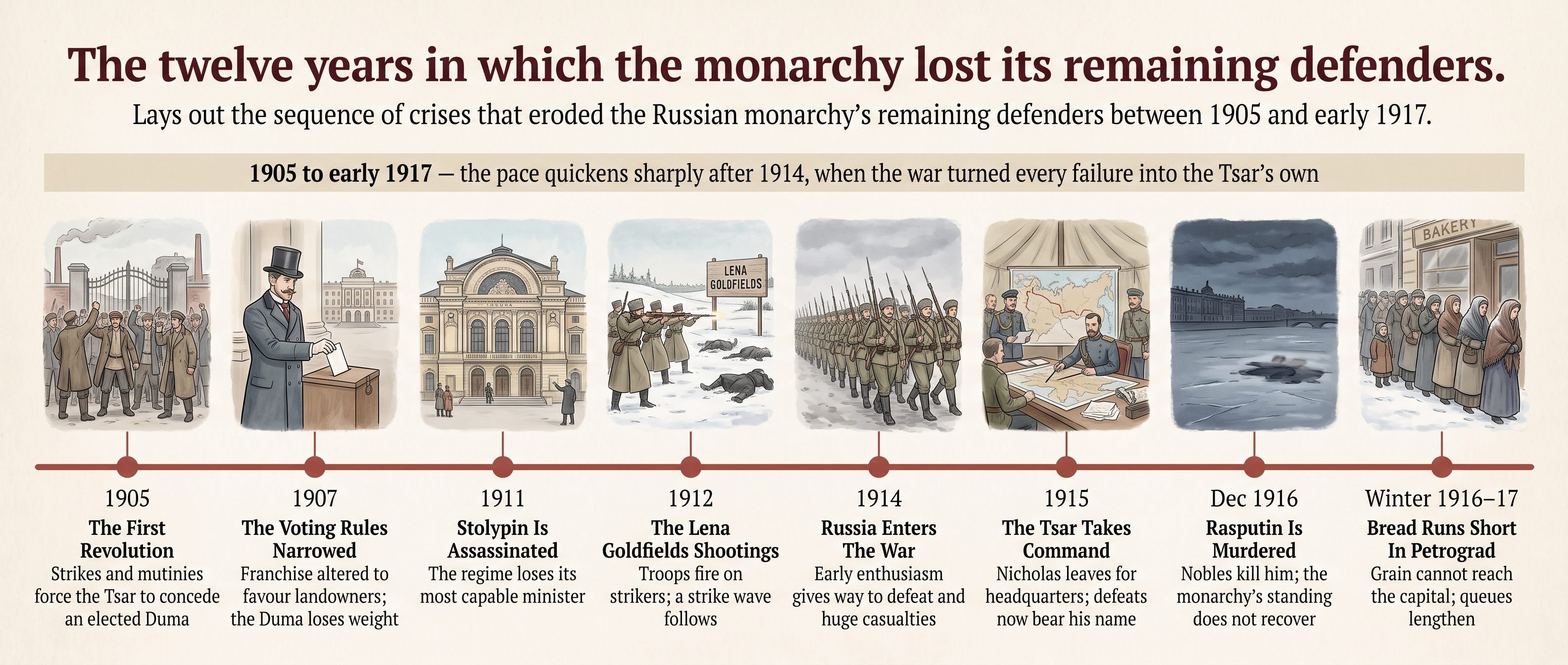
Fig. 9.1 – Pressure builds on the Tsarist regime.
No single one of these causes brought the monarchy down. The land question was decades old, the strike wave predated the war, and the court scandals would have embarrassed a stronger government without destroying it. What the war did was bring them together, remove the regime’s defenders, and put hungry people and armed soldiers in the same freezing streets.
9.2 The March Revolution And Its Results
Nobody planned the March Revolution. The revolutionary parties had been arguing for years about how the Tsar would fall, and when he fell most of their leaders were in exile, in prison or abroad. What brought the regime down in nine days was a bread queue that turned into a strike, and a garrison that would not shoot.
9.2.1 The Days In Petrograd
On 8 March 1917 — International Women’s Day, and 23 February by the Russian calendar — women textile workers in the Vyborg district of Petrograd walked out of their mills and into the streets. They were demanding bread. Vyborg was a working-class quarter across the river from the centre, crowded with factories and with a long record of strikes.
The march grew because it was joined. Workers from the huge Putilov engineering works, shut out by their employers days earlier, came in behind the women. Over the next two days one factory after another stopped, until by 10 March the capital was under a general strike and crowds were crossing the frozen Neva into the centre of the city.
The government’s answer was force. On 11 March troops fired on demonstrators and around forty people were killed. In most earlier confrontations that had been enough to clear the streets. This time the crowds came back the next morning.
The Garrison Changes Sides
On 12 March the decisive thing happened. Soldiers of the Petrograd garrison refused to fire on the crowds, and then began to join them. These were not the trained regiments of 1905 but wartime conscripts, many of them recently drafted and none of them keen to be sent to the front.
Mutinous soldiers and workers broke open the arsenals, freed prisoners, burned police stations and took over the railway stations and telegraph offices. Within a day the government had no armed force in its own capital that it could rely on.
Two rival bodies took shape in the same building on the same day. In one wing of the Tauride Palace, members of the Duma — which the Tsar had just ordered to dissolve, and which refused — formed a committee to restore order. In another wing, workers and soldiers elected delegates to a soviet, a council of workers’, soldiers’ and peasants’ representatives. This one called itself the Petrograd Soviet of Workers’ and Soldiers’ Deputies.
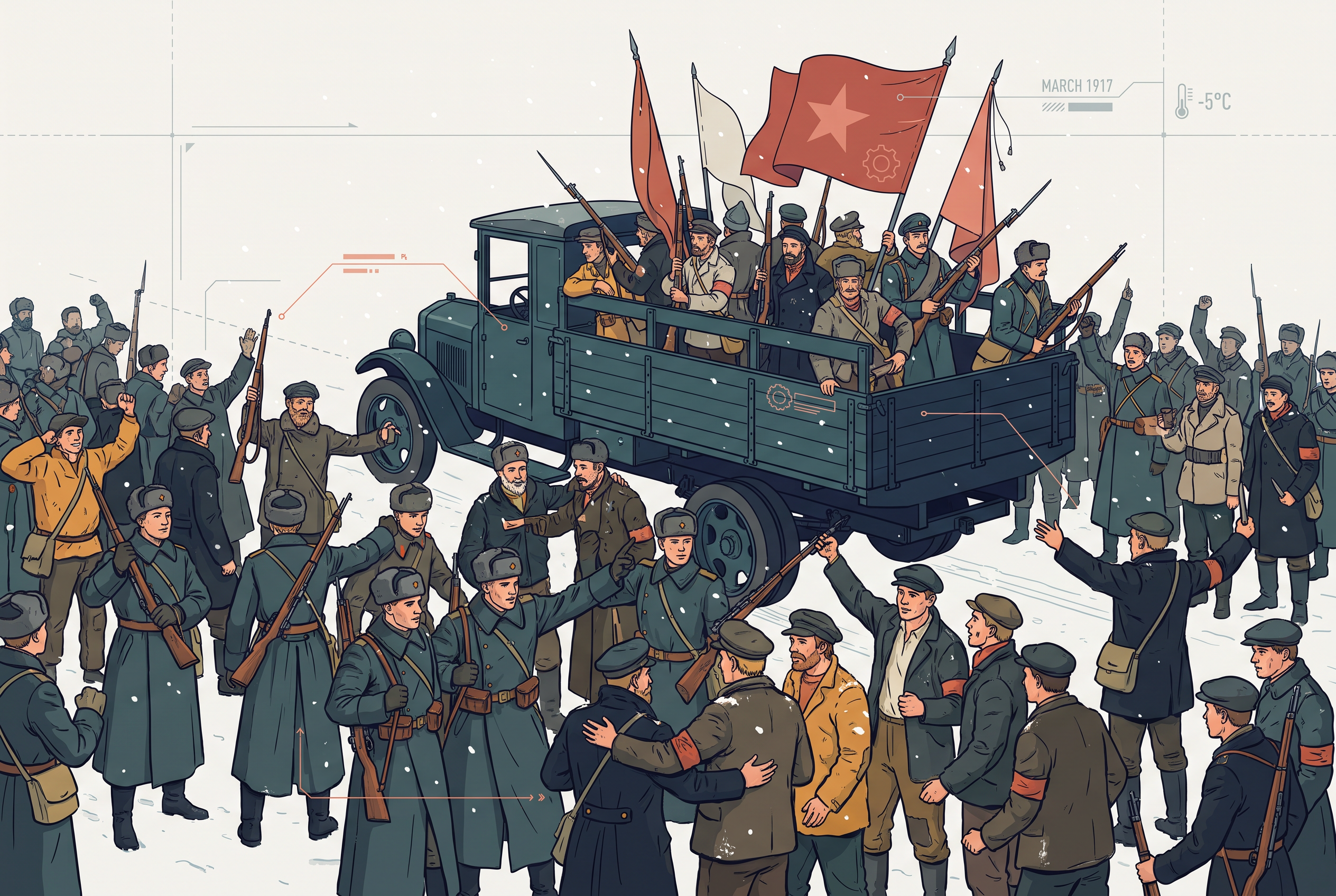
Fig. 9.2 – Armed soldiers and civilians in Petrograd, March 1917.
9.2.2 The Abdication And The End Of Tsarist Rule
Nicholas II was at military headquarters when the capital was lost. He ordered troops sent to Petrograd to restore order, and set off by train to return to the city. His train was diverted to Pskov, where the commander of the northern front met him with bad news.
The Chief of Staff had asked the front commanders a single question: should the Tsar go? They answered, almost unanimously, that he should. The Duma leaders said the same. An autocrat who has lost his generals has lost everything, because there is no constitution behind him to appeal to.
On 15 March Nicholas abdicated. He gave up the throne not only for himself but also for his son Alexei, whose illness made a long reign unlikely, and passed the crown instead to his brother, Grand Duke Michael. On 16 March Michael declined it unless an elected assembly should offer it to him. No such offer was ever made. Three centuries of Romanov rule, and centuries of autocracy before that, ended in two days of telegrams.
The sequence of those nine days is set out in Fig. 9.3.
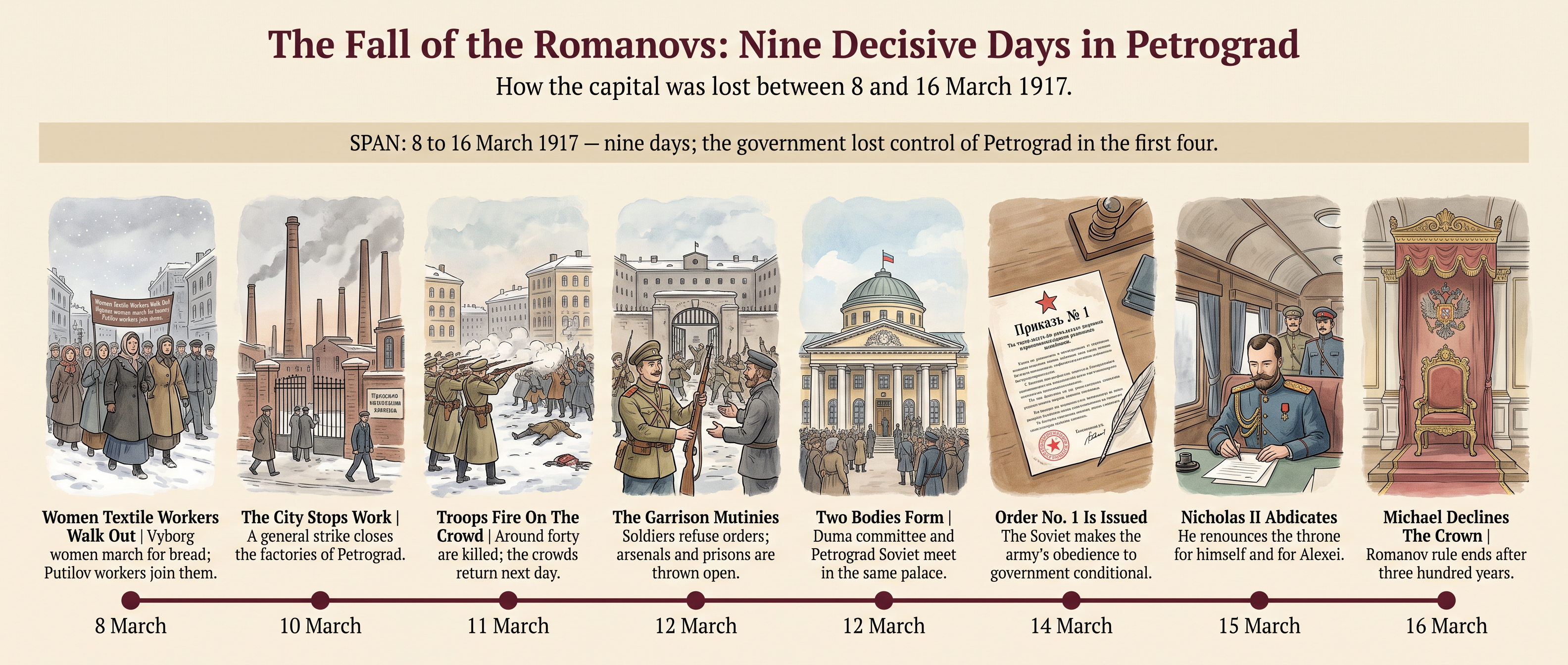
Fig. 9.3 – The March days in Petrograd.
9.2.3 The Provisional Government Takes Charge
The Duma committee now formed a cabinet and called itself the Provisional Government. The word mattered: it claimed to govern only until a Constituent Assembly, elected by the whole population, could be chosen to write a constitution and decide what Russia was to become.
Its head was Prince George Lvov, and most of its members were liberals and moderates from the propertied classes. One man stood out from them — Alexander Kerensky, a lawyer and Socialist Revolutionary who was Minister of Justice, and the only person who sat in both the Provisional Government and the Petrograd Soviet.
What the new government did first was undo the police state. It declared a political amnesty and threw open the prisons and the Siberian exile settlements. It abolished the death penalty, ended censorship, allowed strikes and unions, and promised full civil equality regardless of religion or nationality. For a few months Russia had freedoms that few countries in Europe could match.
Exiles came home to use them. Revolutionaries who had spent years in Switzerland, Siberia and London arrived in Petrograd through the spring of 1917, and among them, in April, was Lenin.
9.2.4 Dual Power And Political Amnesty
The Provisional Government had authority on paper. The Petrograd Soviet had the loyalty of the workers who ran the factories and the soldiers who held the guns. Contemporaries called this arrangement dual power, and it was built into the revolution from its first week.
The clearest statement of it was Order No. 1, issued by the Soviet to the garrison on 14 March. It told soldiers to elect committees, to keep their unit’s weapons under those committees’ control, and — most important — it set a condition on whom they were to obey.
Read the clause slowly and its force becomes clear. The government’s military orders were valid only when the Soviet did not object. A cabinet that cannot command its own soldiers is not really a government, and every crisis of the next eight months would run into this wall.
So the March Revolution produced three results at once. It ended Tsarist rule and the Romanov dynasty. It replaced autocracy with the freest government Russia had ever had. And it left that government sharing power with a body it could not command, over a country still at war.
9.3 The Weaknesses Of The Provisional Government
The Provisional Government lasted eight months. It fell not because it was more brutal than the regime it replaced — it was far less so — but because it could not deliver the three things the country wanted: peace, land and bread. Every one of its weaknesses came back, in the end, to a decision it made in its first weeks, which was to stay in the war.
9.3.2 The Land Question Left Unanswered
For most Russians, revolution meant one thing: the land of the nobles, the church and the crown would be divided among those who farmed it. Peasants had waited for that since 1861 and expected it within weeks.
The Provisional Government agreed in principle and refused to act. Land, it said, was too great a question for a temporary cabinet; only the Constituent Assembly could settle who owned Russia. There was a respectable argument behind this. There was also an interest, since many ministers and their supporters were themselves landowners.
Peasants stopped waiting. Through the summer of 1917 villages began seizing estates, dividing fields, cutting timber and burning manor houses, ignoring the government’s instructions to keep order. The army felt this immediately, because the army was made up of peasants in uniform. Soldiers deserted in growing numbers, walking home so as not to miss the division of the land in their own village.
9.3.3 Economic Distress And The Delay In Elections
Meanwhile the shortages that had brought the crowds out in March grew worse. Prices rose far faster than wages, factories closed for want of fuel and raw materials, and bread was rationed more tightly in the autumn than it had been under the Tsar. The government did little about prices, distribution or supply, partly because it disliked interfering with private trade.
The elections to the Constituent Assembly, on which every hard question had been postponed, were themselves postponed. Preparing an election with universal suffrage in a country at war was genuinely difficult — the first such election in Russian history, in an empire of many languages, with millions of men at the front. But each delay looked worse than the last.
The Bolsheviks made the point relentlessly: a government that will not hold the election it promised, and will not settle the land question until that election, is simply refusing to decide. Voting was eventually fixed for November, by which time the Provisional Government no longer existed to hold it.
9.3.4 Lenin’s Return And The April Theses
Lenin had spent the war in Switzerland. In April 1917 the German government, which had every interest in Russian disorder, allowed him to travel home across Germany in a sealed railway carriage. He reached the Finland Station in Petrograd on 16 April.
His own party expected him to support the new order cautiously. Instead he published, in the Bolshevik newspaper Pravda, the ten short statements known as the April Theses. They rejected the Provisional Government outright, demanded an immediate end to the war, called for the land to be handed to the peasants and for the banks and industry to come under state control, and insisted that power belonged not to a parliament but to the soviets.
That single line explains why the Bolsheviks could not be brought into a coalition, as the Mensheviks and Socialist Revolutionaries had been. Lenin was not asking for a larger share of the Provisional Government. He was saying the whole structure should be replaced by the soviets, and the slogans that carried this to the streets — ‘Peace, Land and Bread’, ‘All Power to the Soviets’ — named exactly what the government had failed to provide.
9.3.5 The June-July Offensive And The July Days
Russia’s allies wanted an attack. Kerensky, now War Minister, ordered a major offensive on the eastern front that opened on 1 July 1917. Russia was bound to its allies by the Triple Entente, and the government believed a victory would restore its own standing and the army’s discipline.
The offensive advanced briefly and then collapsed, with heavy casualties and mass desertion. Army morale, already low after three years of war, gave way. The government had spent its remaining credit on a gamble and lost.
Within days the capital erupted. Between 16 and 20 July armed workers, soldiers and sailors from the Kronstadt naval base outside Petrograd poured into the streets and marched on the Tauride Palace, demanding that the Soviet take power. The Soviet’s leaders refused, loyal troops were brought in, and the demonstrations were broken up.
The July Days badly damaged the Bolsheviks. The government published documents alleging that Lenin was in German pay, arrested Bolshevik leaders including Trotsky, and drove Lenin into hiding in Finland. Prince Lvov resigned and Kerensky became Prime Minister. For a few weeks the government looked stronger than it had all summer.
9.3.6 The Kornilov Affair
The recovery lasted six weeks. In early September General Lavr Kornilov, whom Kerensky had appointed Commander-in-Chief, moved troops towards Petrograd. His purpose is still argued over: he intended at the least to crush the Soviet and impose military discipline, and he regarded the Bolsheviks as traitors who would be the ruin of Russia.
Kerensky concluded that a coup was being launched against him, dismissed Kornilov and had him arrested. But he had no reliable troops of his own to stop the advance, so he turned to the very people Kornilov was coming to destroy. Arms were handed to the Red Guards, the armed workers’ militia organised in the factories, and imprisoned Bolsheviks were released to help defend the capital.
Kornilov’s soldiers never arrived. Railway workers stopped and misdirected their trains, and agitators sent out from the Soviet persuaded the troops not to fight. The affair ended without a battle, and it destroyed what was left of the Provisional Government.
By late September the Bolsheviks held majorities in the Petrograd and Moscow soviets, and Trotsky — released from prison weeks earlier — was elected chairman of the Petrograd Soviet. The slogan ‘All Power to the Soviets’ now meant something quite different from what it had meant in April, because the soviets were becoming Bolshevik.
9.4 The November Revolution
The March Revolution had taken the government by surprise. The November Revolution did not surprise anybody. It was argued about in the newspapers for a fortnight beforehand, and the Provisional Government knew it was coming and could not stop it.
9.4.1 The Bolsheviks Take Petrograd
Lenin, still in hiding in Finland, spent October bombarding his own Central Committee with letters insisting that the party must seize power at once. Waiting, he argued, would only allow the government to gather troops and to hold the Constituent Assembly elections on its own terms.
The committee agreed in late October, though not unanimously. Kamenev and Zinoviev, two of the party’s senior figures, thought an armed rising premature and said so publicly in a newspaper — which meant the plan was in print before it happened.
The instrument was ready to hand. The Petrograd Soviet had set up a Military Revolutionary Committee, chaired in practice by Trotsky, ostensibly to defend the capital against another Kornilov. Through October it quietly established which regiments would obey it rather than the government. That mattered for how the rising could be presented: not as one party’s coup, but as the Soviet defending the revolution.
The Nights Of 6 And 7 November
The seizure itself was undramatic. On the nights of 6 and 7 November, Red Guards, soldiers and sailors occupied the bridges, railway stations, telegraph offices, power stations and the state bank. There was almost no fighting because there was almost nobody willing to fight: the garrison had already declared for the Soviet. Map 9.2 shows how small an area the whole operation covered.
Map
Map 9.2 Caption: The points occupied in central Petrograd on the nights of 6 and 7 November 1917. Brief: Street map of central Petrograd in 1917 showing the Neva and its bridges; mark and label the Winter Palace, the Smolny Institute as Bolshevik headquarters, the main railway stations, the central telegraph office, the state bank and the mooring of the cruiser Aurora; include a scale bar showing the whole operation covered only a few kilometres; do not shade any area as ‘controlled’.
The ministers of the Provisional Government sat through the day in the Winter Palace, guarded by a few military cadets and a women’s battalion, waiting for troops who never came. Kerensky had already left the city by car to look for loyal soldiers at the front. In the early hours of 8 November the palace was entered and the ministers were arrested. The cruiser Aurora, anchored in the Neva, had fired a blank round as a signal.
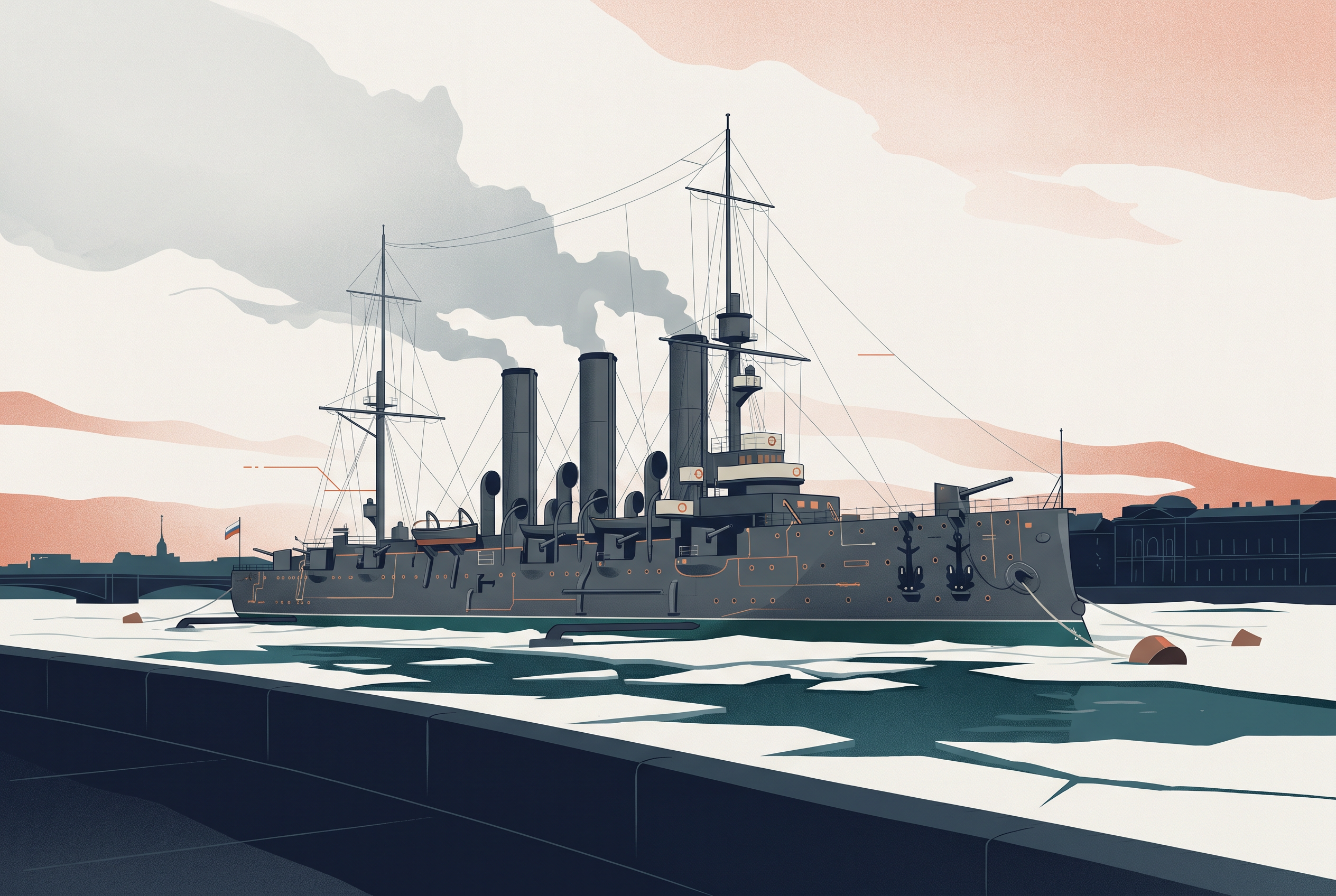
Fig. 9.4 – The cruiser Aurora.
While the palace was being taken, the Second All-Russian Congress of Soviets was meeting across the city. The Mensheviks and the right wing of the Socialist Revolutionaries walked out in protest at what they called a conspiracy, which left the Bolsheviks and their allies in comfortable control of the hall. The Congress declared that power had passed to the soviets and appointed a new government, the Council of People’s Commissars, with Lenin as its chairman, Trotsky in charge of foreign affairs and Stalin responsible for the empire’s many nationalities.
9.4.2 The First Decrees Of The New Government
The new government’s first acts were designed to make the revolution irreversible within days, and each of them addressed a promise the Provisional Government had broken.
The Decree on Peace called for an immediate armistice and a peace without annexations or payments exacted from the defeated. It was addressed as much to the soldiers of every army as to their governments.
The Decree on Land abolished the landlords’ property in land without compensation and handed it to peasant committees to divide. In substance this was the Socialist Revolutionaries’ programme rather than the Bolsheviks’ own, and it did not so much create a settlement as make lawful the seizures peasants had been carrying out all summer. That was precisely its value: millions of villagers now had a reason to prefer this government to whatever might replace it.
Other measures followed quickly — workers’ control in the factories, the nationalisation of the banks, and in December a political police force, the Cheka, to deal with opponents.
The Constituent Assembly
The election the Provisional Government had never managed to hold took place at the end of November 1917, under the new government. The Bolsheviks lost it. The Socialist Revolutionaries took the largest share of the vote, drawn from the peasant majority, while the Bolsheviks won roughly a quarter, concentrated in the cities and the army.
The Constituent Assembly met in January 1918, sat for a single day, and was closed by armed guards. Lenin’s justification was that the soviets were a higher form of democracy than any parliament, and that the election lists had been drawn up before the Socialist Revolutionaries split. Whatever weight one gives that argument, the practical result was plain. Russia’s first freely elected national assembly lasted one day, and no rival party would be allowed to govern again.
In 1918 the Bolshevik Party took the name Communist Party, and the capital was moved from Petrograd to Moscow. The steps from seizure to single-party rule are set out in Fig. 9.5.
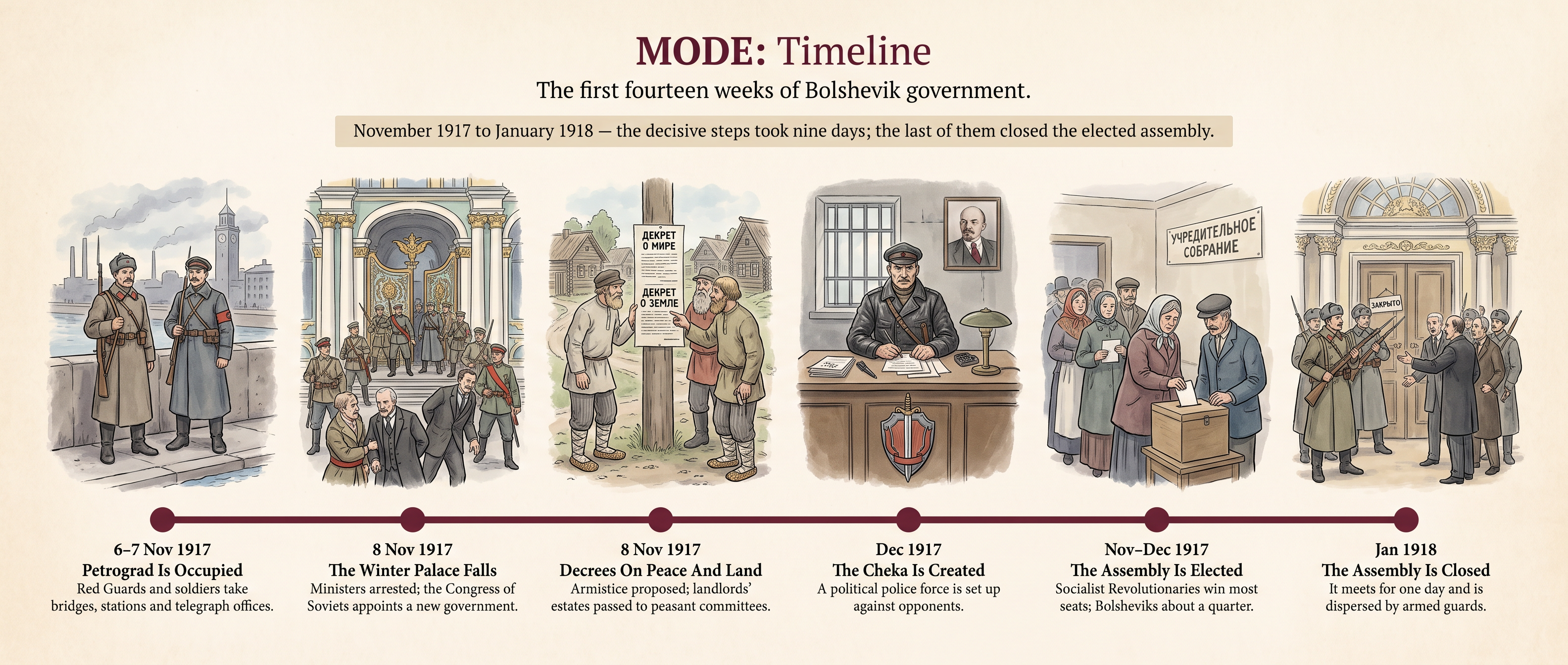
Fig. 9.5 – From seizure to single-party rule.
9.5 Lenin And The New Economic Policy
The Bolsheviks took power in a fortnight and then spent four years fighting to keep it. Understanding why Lenin introduced the New Economic Policy in 1921 means understanding what those four years did to the country, because the NEP was a response to a state of emergency that had very nearly destroyed the government that declared it.
9.5.1 War Communism And The Civil War
The first step was to leave the war. In March 1918 the new government signed the Treaty of Brest-Litovsk with Germany, and the terms were severe: Russia gave up Poland, the Baltic provinces, Finland and Ukraine, and with them about a third of its population, a great part of its best farmland and most of its coal and iron.
Lenin’s opponents inside and outside the party called it a betrayal. His answer was that the government would not survive a war it could not fight, and that territory could be recovered later while power could not.
Peace abroad brought war at home. From 1918 the Bolsheviks — the ‘Reds’ — faced the ‘Whites’, a loose alliance of ex-Tsarist officers, Mensheviks, Socialist Revolutionaries and nationalist movements, who agreed on little except that the Bolsheviks must go. Britain, France, the United States and Japan sent troops and supplies to the Whites. The fighting ran on until 1921 and cost several million lives, most of them to hunger and disease rather than battle.
Governing By Requisition
To feed the Red Army and the cities, the government adopted the emergency system known as War Communism. Industry was nationalised, private trade was banned, labour was directed, and armed detachments were sent into the villages to take grain from the peasants at fixed prices or at no price at all.
Alongside it came the Red Terror. The Cheka arrested and shot people by category as much as by evidence — landowners, priests, employers, officers, anyone classed as ‘bourgeois’. The former Tsar and his family, held in the Urals, were shot in July 1918.
War Communism kept the army fed and it destroyed the economy. Peasants who could not sell their surplus simply stopped growing one, and sowed only what their own families needed. Factories closed for want of fuel and workers drifted back to the villages to look for food; Petrograd lost a large share of its population. By 1921 industrial output had collapsed to a fraction of its pre-war level, the currency was worthless, and drought on top of requisitioning produced a famine in the Volga region in which several million people died.
9.5.2 Reasons For The New Economic Policy
By the winter of 1920–21 the Bolsheviks had won the civil war and were losing the country. Peasant risings spread across the Volga, Siberia and Tambov province, tying down more troops than the Whites ever had. Strikes broke out in Petrograd. Then came Kronstadt.
The reasons for the NEP therefore stack up in a clear order. The economy had collapsed and the cities could not be fed. The countryside was in open revolt and would not produce grain under requisition. The famine of 1921 showed that the emergency system was killing the population it was supposed to feed. And Kronstadt proved that discontent had reached the regime’s own supporters, which made the question one of survival rather than of policy.
9.5.3 The Main Features Of The NEP
The New Economic Policy was introduced in March 1921. Its central move was to stop taking grain and start taxing it.
Requisitioning was replaced by a tax in kind: a peasant household handed over a fixed proportion of its produce and kept the rest. What it kept, it could sell. Later the tax was collected in money rather than in grain, which meant peasants had to trade in order to pay it.
Private trade was legal again. Small workshops and businesses employing only a few people were returned to private owners, and traders — soon nicknamed NEPmen — reopened markets and shops in towns that had been running on ration cards and barter.
The state did not let go of everything. Lenin kept what he called the commanding heights of the economy: heavy industry, the banks, the railways, and foreign trade all stayed in government hands. Foreign firms were invited to operate concessions, and the currency was stabilised with a new rouble backed by gold.
Two things did not change at all. Land remained legally the property of the state, and no political concession accompanied the economic one. The single-party monopoly stayed exactly as it was, and in 1922 the same congress that confirmed the retreat also banned organised factions inside the party itself.
Farming under the NEP was done by households, on their own holdings, as it always had been. This is worth stating plainly, because the collective farm belongs to a later policy and a different leader, and confusing the two makes the 1930s impossible to understand.
9.5.4 The Impact Of The NEP
The recovery was rapid where it depended on peasants. With something to gain from a good harvest, they grew one; grain production climbed back towards pre-war levels within about five years, and food reappeared in the towns. Markets, shops and small workshops revived, cities filled up again, and industrial output rose steadily, though more slowly than agriculture. Electrification advanced, and industrial workers gained an eight-hour day and paid holidays.
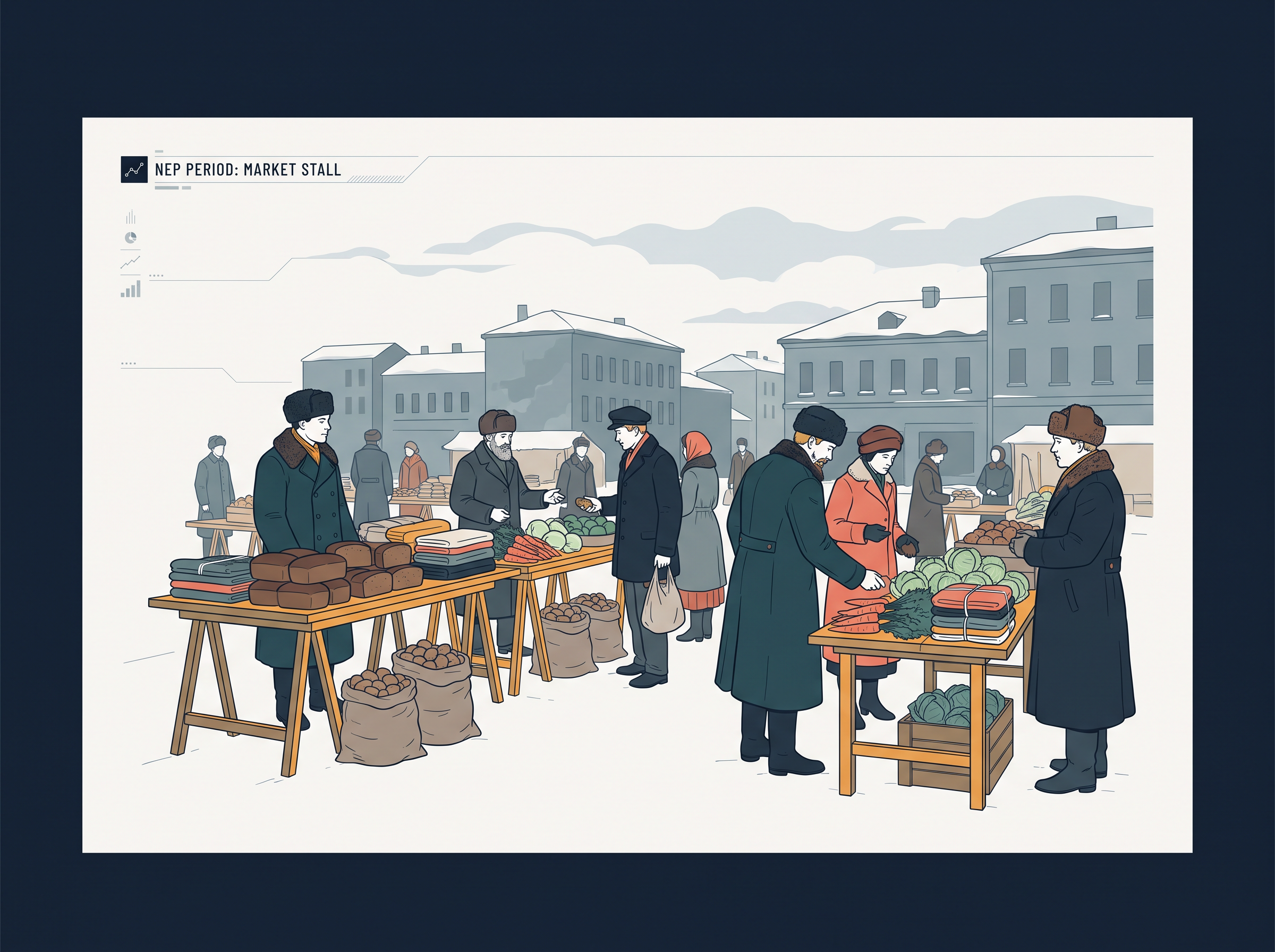
Fig. 9.6 – A street market under the New Economic Policy.
The costs were real too. Industry recovered more slowly than agriculture, and unemployment in the towns stayed high. In 1923 the gap between the two — high prices for manufactured goods, low prices for farm produce — grew so wide that peasants stopped buying, and the crisis had to be brought under control by the state.
The NEP also produced a class the party disliked. Traders grew rich in the towns, and in the villages the kulaks — better-off peasants who owned more land or livestock than their neighbours and sometimes hired labour — did well out of a market in grain. To many communists this looked like capitalism growing back inside a workers’ state, and the question of what to do about it became the central quarrel of the party after Lenin.
In December 1922 the state itself was formally reorganised as the Union of Soviet Socialist Republics, joining Russia with Ukraine, Belorussia and the Transcaucasian republics under a single government in Moscow. The sequence from the treaty to the union is set out in Fig. 9.7.
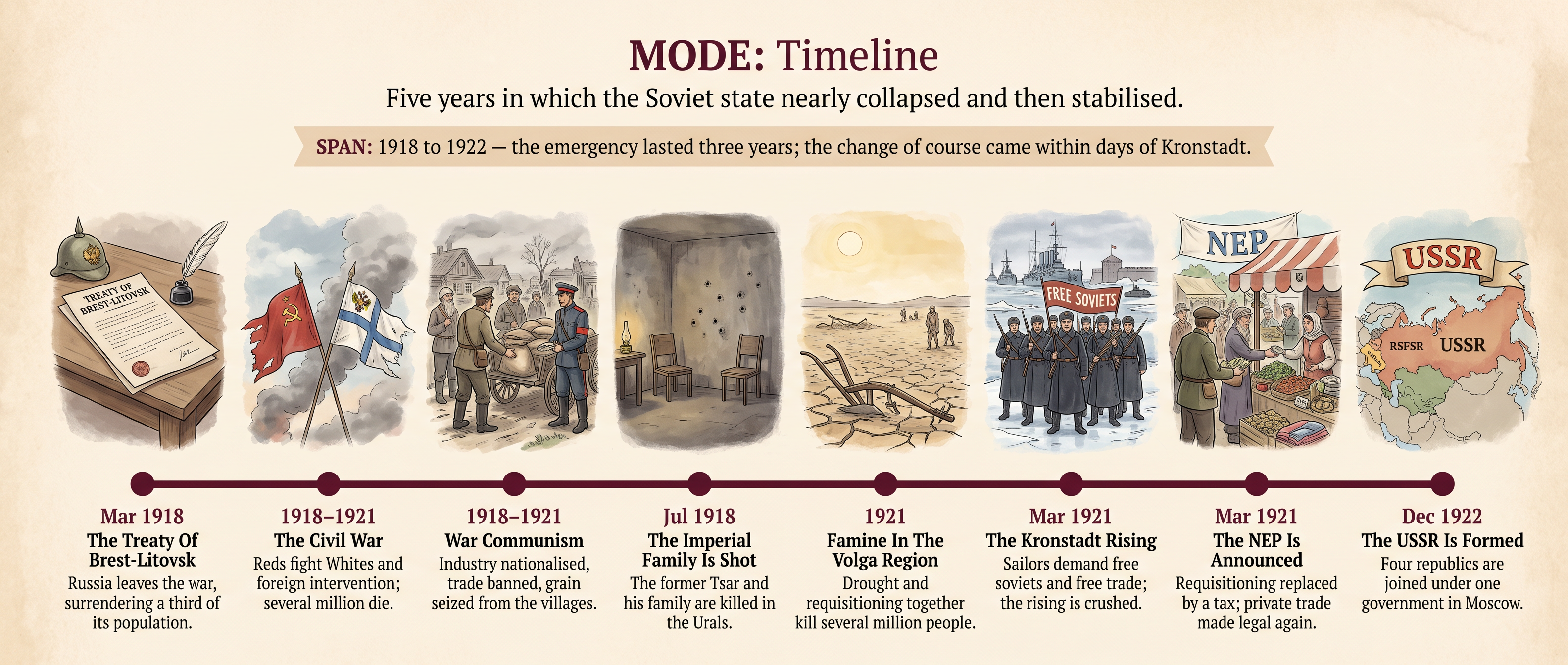
Fig. 9.7 – From War Communism to the NEP.
9.6 The Rise Of Stalin To Power
Nobody in 1922 expected Stalin to rule the Soviet Union. He was not the party’s finest speaker, its leading theorist or its most famous name. Trotsky had built the Red Army; Zinoviev and Kamenev were Lenin’s old companions; Bukharin was the party’s ablest writer on economics. Stalin held an administrative post that the others considered dull.
That post was the reason he won.
9.6.1 The Contest After Lenin’s Death
Lenin suffered a series of strokes from 1922 and died in January 1924, aged fifty-three. He left no arrangement for a successor, and the party had no procedure for choosing one — a single-party state that had abolished elections for everyone else had also abolished them for itself.
What he did leave was a set of notes dictated in his last months, known as Lenin’s Testament, assessing each of the leading Bolsheviks in turn. None came off well. In a postscript added in January 1923 he turned specifically to the General Secretary.
The Testament was read privately to delegates in 1924 and then set aside; the leaders who heard it had their own reasons for not wanting a fight, and Stalin’s rivals believed they could manage him. It was not published inside the Soviet Union until the 1950s.
Stalin’s answer to the Testament was to make himself Lenin’s chief mourner. He took a leading part in the funeral, spoke of the party as the guardian of Lenin’s legacy, and supported the embalming of the body and its display in a mausoleum in Moscow, which Lenin’s own family opposed. Trotsky, who was away and ill, did not attend the funeral at all — a small thing that was remembered.
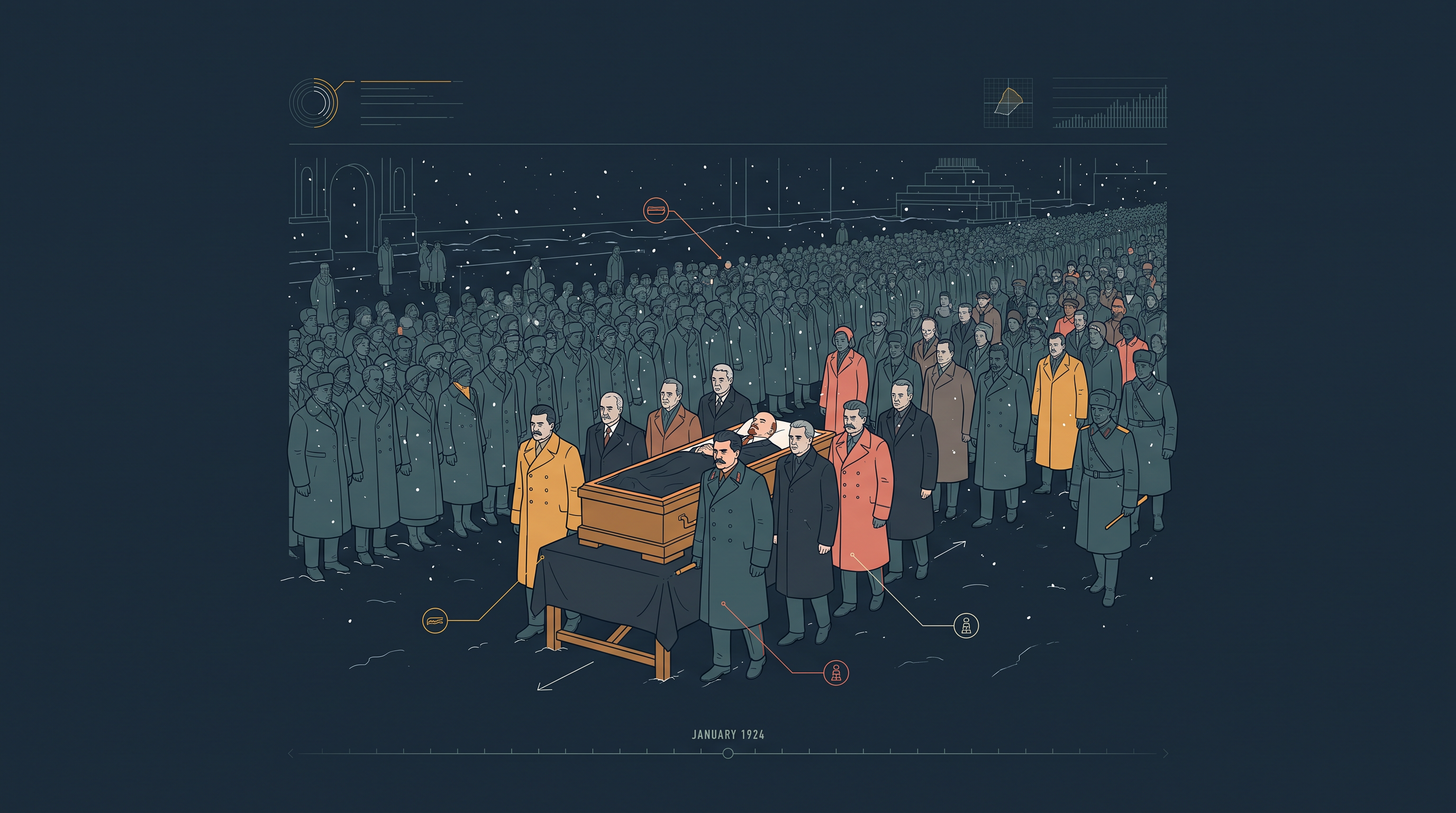
Fig. 9.8 – Lenin’s funeral in Moscow, January 1924.
The Rivals Removed In Turn
Stalin did not defeat his opponents together. He defeated them in sequence, and each time he took the side that isolated the strongest man left standing.
From 1923 he worked with Zinoviev and Kamenev against Trotsky, who was pushed out of his post at the head of the armed forces in 1925. He then joined Bukharin and those who wanted the NEP continued, against Zinoviev and Kamenev, who by 1926 had formed a joint opposition with the man they had spent three years attacking. That opposition was defeated and expelled from the party in 1927; Trotsky was exiled within the country and deported from the Soviet Union in 1929.
Only then did Stalin turn on Bukharin and the supporters of the NEP, on the ground that their policy was too soft on the peasants. By 1929 Bukharin had lost his place in the Politburo, and Stalin faced no organised opposition anywhere in the party.
9.6.2 Factors Assisting Stalin’s Rise
The Party Machine
The single greatest factor was the office his rivals had thought beneath them.
Stalin used it exactly as its powers allowed. He filled provincial secretaryships with men who owed him their positions and moved opponents’ supporters far from Moscow. In 1924 the party admitted a large intake of new working-class members, most of them with no experience of the old factional arguments and every reason to be loyal to the apparatus that had recruited them. By the later 1920s the delegates who filled party congresses were, in large part, his appointees.
Underestimation And The Weakness Of The Opposition
His rivals helped him. They saw a competent administrator with a heavy Georgian accent and no great record as a thinker, and they treated the contest as an argument about doctrine, which they expected to win by argument.
Trotsky in particular was politically vulnerable. He had spent years attacking the Bolsheviks before joining them in 1917, which was thrown at him constantly by men who had been in the party for two decades. His brilliance and his manner had made him disliked in the Politburo, and as the founder of the Red Army he could always be accused of aiming at military dictatorship — an accusation that frightened a party well read in the French Revolution. He also declined to organise a faction against Stalin, partly because the 1921 ban on factions inside the party made any such move an offence, and partly out of a reluctance to be seen splitting the party.
That ban was the rule Stalin used again and again. To disagree in an organised way was now a disciplinary matter rather than a political one, and expulsion followed.
9.6.3 Socialism In One Country
The succession struggle was fought partly over a real question: could a socialist state survive alone in a hostile capitalist world?
Trotsky’s answer was permanent revolution. Backward, peasant Russia could not build socialism by itself; it had to survive until revolutions in the industrial countries of Europe came to its aid. Stalin, from 1924, argued the opposite, in the doctrine known as socialism in one country. The Soviet Union could build socialism with its own resources, and its first duty was to make itself strong.
The two positions were serious, and each could be defended from Lenin’s writings. But it is not hard to see why Stalin’s was the more popular in the party. Revolutions abroad had failed. The country was exhausted by seven years of war, civil war and famine. Telling party members that their own work was building socialism, rather than that everything depended on workers in Berlin, was both more encouraging and more flattering.
Socialism in one country also carried a practical demand. If the USSR had to survive alone, it had to industrialise fast, and it had to be able to feed its cities and pay for machinery without waiting on the goodwill of peasants selling grain at market prices.
That is where the NEP came under attack. In 1927 and 1928 peasants sold less grain to the state, because the prices offered were low and there was little worth buying with the money. Stalin’s response was to send officials into the countryside to seize grain again, as in the civil war. Bukharin objected that this would wreck the recovery and turn the peasantry against the state; he was defeated and removed.
The NEP was over. What replaced it is the subject of the rest of this chapter.
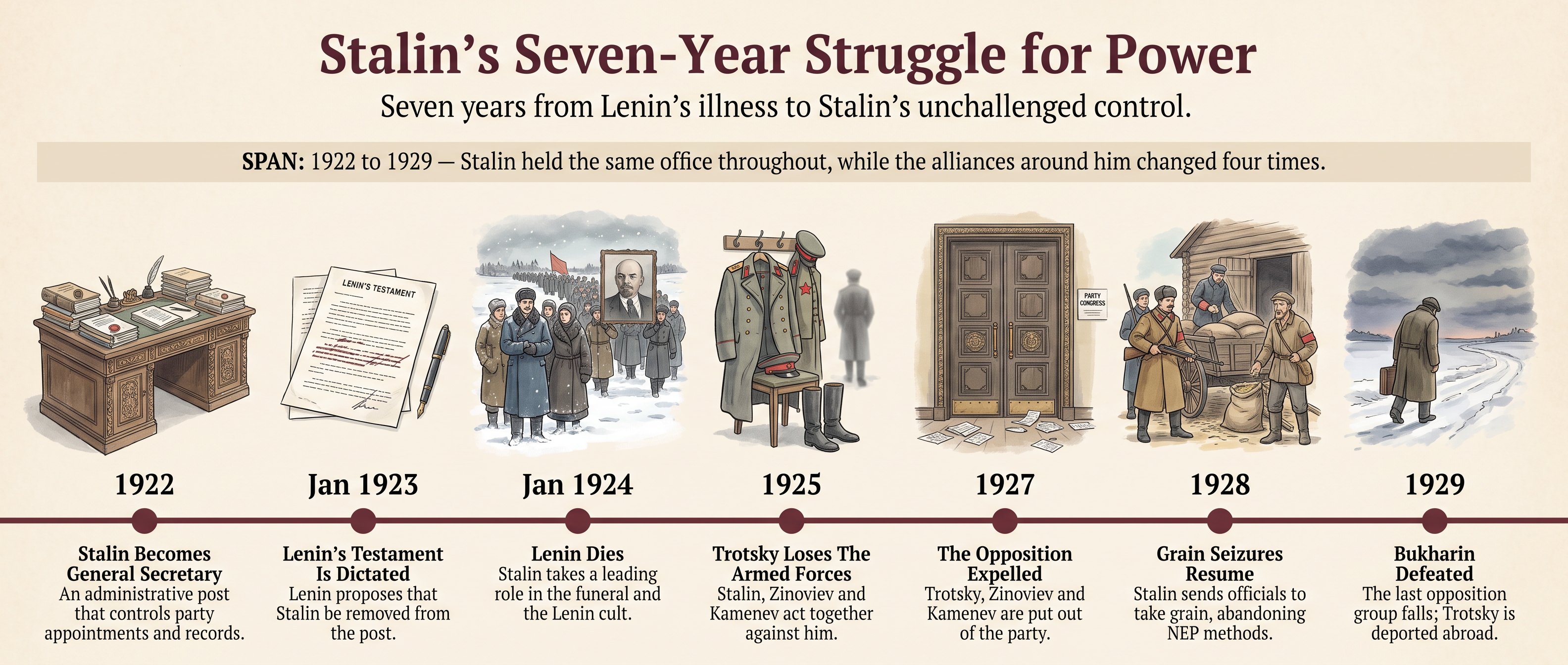
Fig. 9.9 – The succession struggle.
9.7 Collectivisation Of Agriculture
In 1928 the Soviet Union was a country of some twenty-five million peasant households farming their own strips of land. Ten years later it was a country of collective farms. The change was carried through in about four years, against the wishes of most of the people it was done to, and it cost millions of lives.
9.7.1 What Collectivisation Meant
Collectivisation meant merging small individual holdings into large farms worked in common. Two forms existed. The kolkhoz was a collective farm in which peasants pooled their land, tools and animals and worked them together; the sovkhoz was a state farm, owned outright by the government, on which peasants worked for wages like factory hands.
The collective farm was not a co-operative in any ordinary sense. Its first obligation was to deliver a fixed quota of grain to the state at prices the state set, which were far below what grain fetched on the open market. Only what remained after the quota was shared among the members. Households were later allowed to keep a small private plot and a few animals.
Machinery came from Machine Tractor Stations, government depots that hired out tractors and combines to the collectives. These stations were also political centres, with party officials attached to them, and they gave the state a lever over every farm in the district.
9.7.2 Why Stalin Turned On The Peasantry
Four reasons came together, and it is worth separating them.
The first was food for the cities. Industrialisation would draw millions of workers into the towns, and those workers had to be fed by a countryside that was itself losing labour.
The second was money for machinery. The Soviet Union had to buy foreign machines and hire foreign engineers, and it had little to sell abroad except grain and timber. Grain bought at low state prices and sold abroad at world prices was the way industrialisation would be paid for.
The third was control. Under the NEP the state had to bargain with millions of independent producers, and when they judged the terms poor — as in 1927 and 1928 — they sold less and the cities went short. A collective farm could be given a quota and made to meet it.
The fourth was ideology. To many communists the private farm was capitalism surviving inside a socialist state, and the kulak was a class enemy growing rich inside the revolution. Eliminating that class was presented as completing the work of 1917.
9.7.3 Resistance, Famine And Human Cost
The drive began in earnest in 1929. Party activists were sent out from the towns — many of them factory workers who had never farmed — to organise collectives and to break resistance.
Attached to it was a campaign called dekulakisation. Kulaks were barred from joining the collectives and treated as enemies to be removed: their land, tools and animals were confiscated, and well over a million people were deported to Siberia, the far north and Kazakhstan, where large numbers died of cold, hunger and disease. In practice the label was applied loosely. Any peasant who resisted, or who had a better roof than his neighbours, could be denounced as a kulak.
Peasants resisted in the ways available to them. They hid grain, refused to work, attacked officials — and, most damaging of all, slaughtered and ate their own livestock rather than surrender it to the collective. Horse and cattle numbers fell by roughly half, and the loss took a generation to make good.
By March 1930 the countryside was in such disorder that Stalin published an article, ‘Dizzy with Success’, blaming over-enthusiastic local officials for the coercion. Millions of households promptly left the collectives. Within months the pressure resumed, and by 1937 over ninety per cent of Soviet farmland was collectivised.
The Famine Of 1932-33
The worst consequence came in 1932 and 1933. Harvests fell, but procurement quotas did not; grain was taken from villages that had nothing left, and export continued. Famine followed across Ukraine, the North Caucasus, the Volga and Kazakhstan, where nomadic herders had also been forced to settle and had lost their herds. Several million people died. Peasants were forbidden to leave the famine districts to look for food. In Ukraine these events are remembered as the Holodomor.
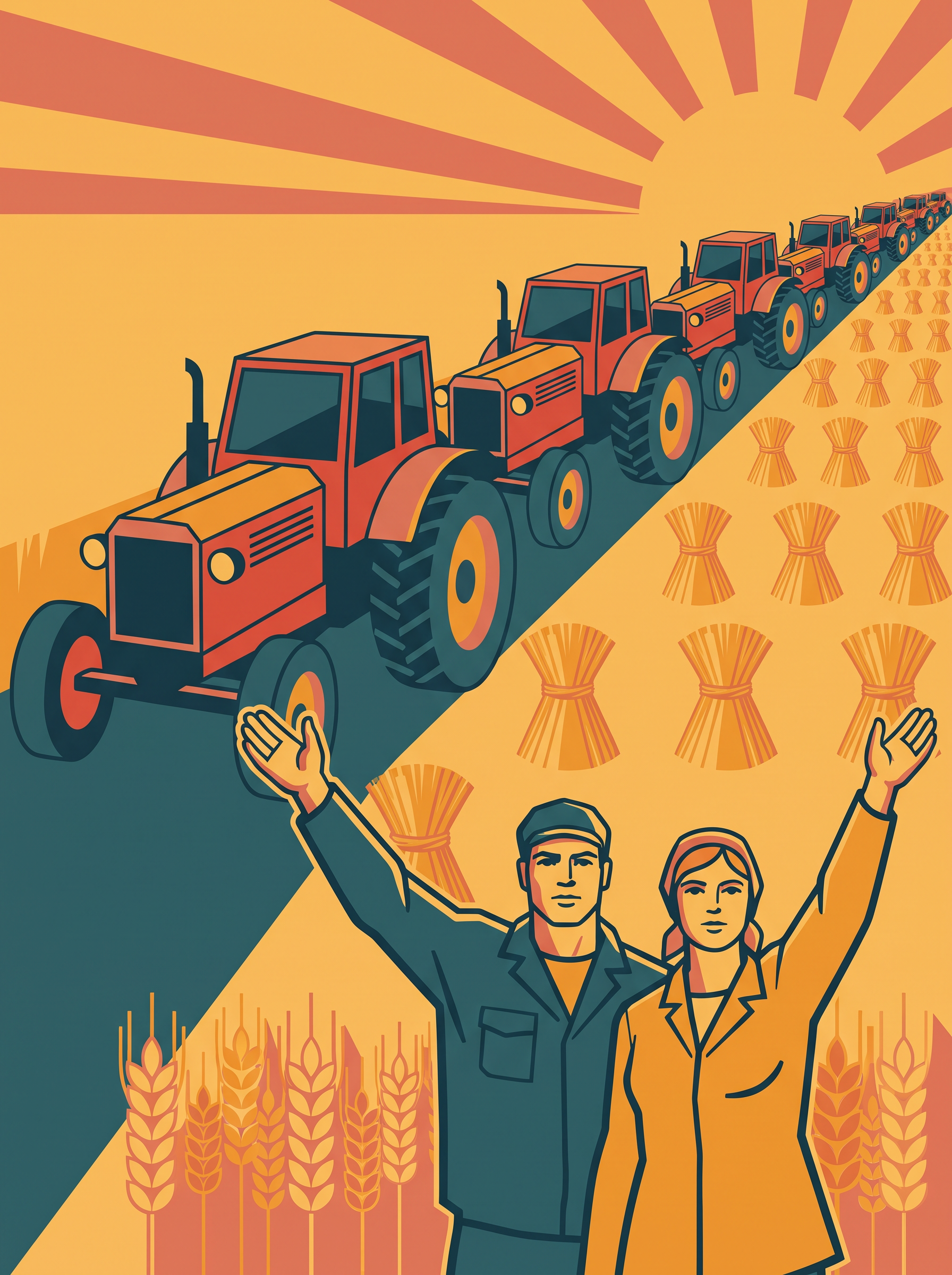
Fig. 9.10 – Soviet poster promoting the collective farm.
9.7.4 How Far Was Collectivisation A Success?
The answer depends entirely on whose purposes are being measured, which is why this question is worth asking carefully.
Judged by the state’s own aims, it worked. Procurement rose even in years when the harvest fell, so the government got the grain it wanted whatever the weather. Exports earned the foreign currency that paid for imported machinery. Tractors and combines were introduced on a scale impossible on scattered strips. The peasantry, independent for a decade under the NEP, was brought under direct state control, and the kulaks disappeared as a class.
Judged as agriculture, it failed. Grain output per person did not rise above the level of the 1920s for years. Livestock had been destroyed by the peasants themselves. The best farmers, labelled kulaks, had been removed from the land altogether, and the activists sent to run the farms often knew nothing about farming. Tractors arrived late and in insufficient numbers, so ploughing was frequently delayed. And peasants who were allowed a private plot worked it far harder than the collective fields, because on the plot the effort was their own.
Judged by its human cost, it was a catastrophe. Millions died in the famine, over a million were deported, and rural life was broken up by force. Yet it is precisely this violent transfer of grain and labour from countryside to town that made the industrial expansion of the next section possible, which is why the two policies must be understood together and not separately.
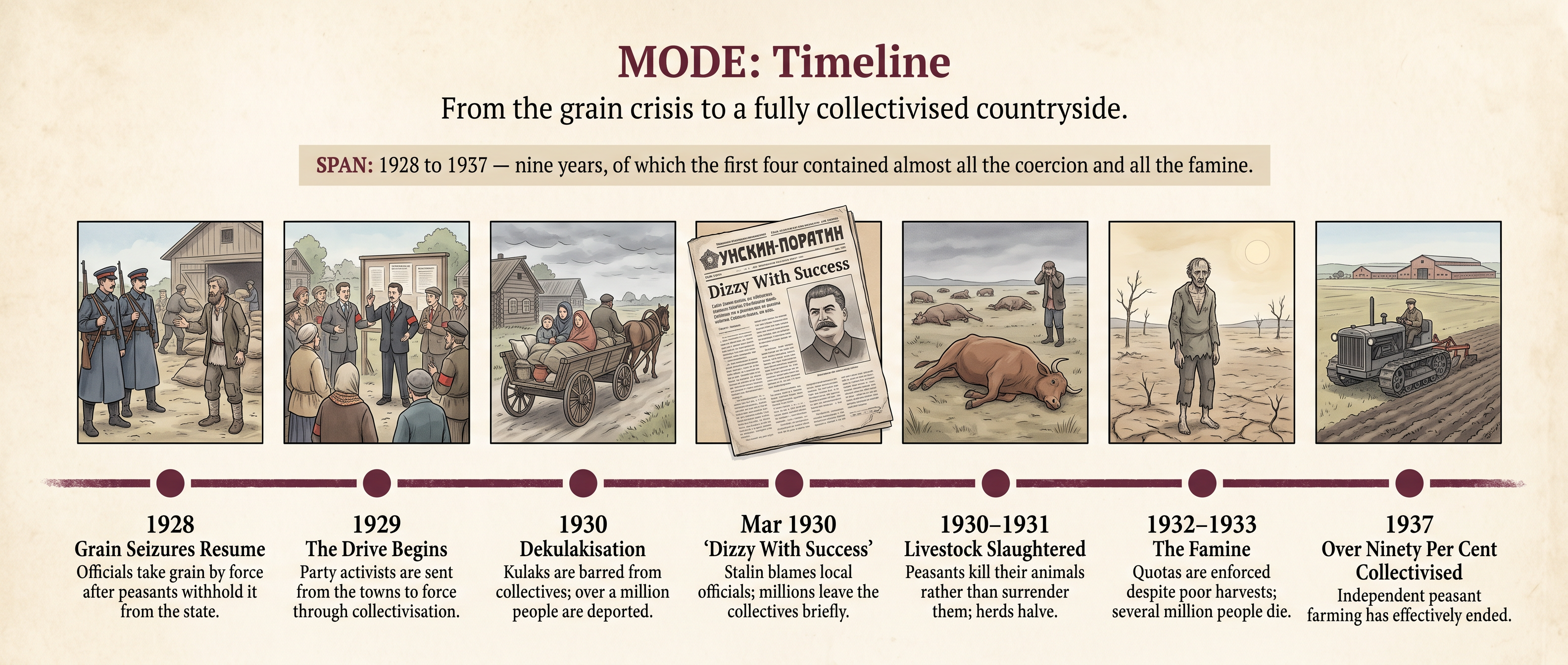
Fig. 9.11 – Collectivisation.
9.8 Industrialisation: The First And Second Five Year Plans
In 1931 Stalin told a conference of industrial managers that the Soviet Union was fifty or a hundred years behind the advanced countries, and that it had ten years to close the gap or be crushed. The Five Year Plans were the attempt to do it. Judged by tonnes of steel they succeeded; judged by almost anything else the account is far more troubling.
9.8.1 Planning The Soviet Economy
Planning meant that the state, not the market, decided what would be produced. The state planning commission, Gosplan, drew up targets for every industry, region and factory: so many tonnes of coal from this pit, so many tractors from that works, by a fixed date.
The First Five Year Plan ran from 1928 and was declared fulfilled at the end of 1932, a year early. The Second ran from 1933 to 1937. Both concentrated overwhelmingly on heavy industry — coal, iron and steel, oil, electricity, cement and machinery — and on the transport needed to move them.
Consumer goods came a distant second. Shoes, cloth, pots and housing were produced in quantities far below what a growing urban population needed, and rationing operated in the towns for much of the first plan.
9.8.2 How Industrialisation Was Paid For
A country that industrialises has to find the money for machinery, and the usual ways were closed. The Soviet Union could not borrow abroad on any scale, and it had no colonies to draw on. So it paid for the plans out of its own population.
Grain, timber, oil and gold were exported, and the foreign currency bought imported machines and hired foreign engineers, many of them American and German, to install them and train Soviet workers. Peasants paid for the use of state machinery and delivered grain at prices the state fixed. Wages were held down and profits taken by the state rather than distributed. Consumption was squeezed so that investment could rise.
Education was expanded to supply the skills. Literacy campaigns, technical schools and universities produced engineers and foremen in large numbers, and a generation of workers moved into technical jobs their parents could not have entered.
Labour also came from the camps. Prisoners of the gulag were put to work on canals, railways, mines and timber in the far north and Siberia, in conditions that killed many of them.
9.8.3 What The Plans Achieved
The physical achievements were real and they were large. Entire industrial towns were built in the Urals and beyond, deliberately placed far from the western frontier. An enormous iron and steel complex rose at Magnitogorsk. A hydroelectric dam was built on the Dnieper. Tractor works, oil refineries and machine plants were constructed at Kharkov, Stalingrad, Chelyabinsk and in the Caucasus, and in 1935 the Moscow underground railway opened.
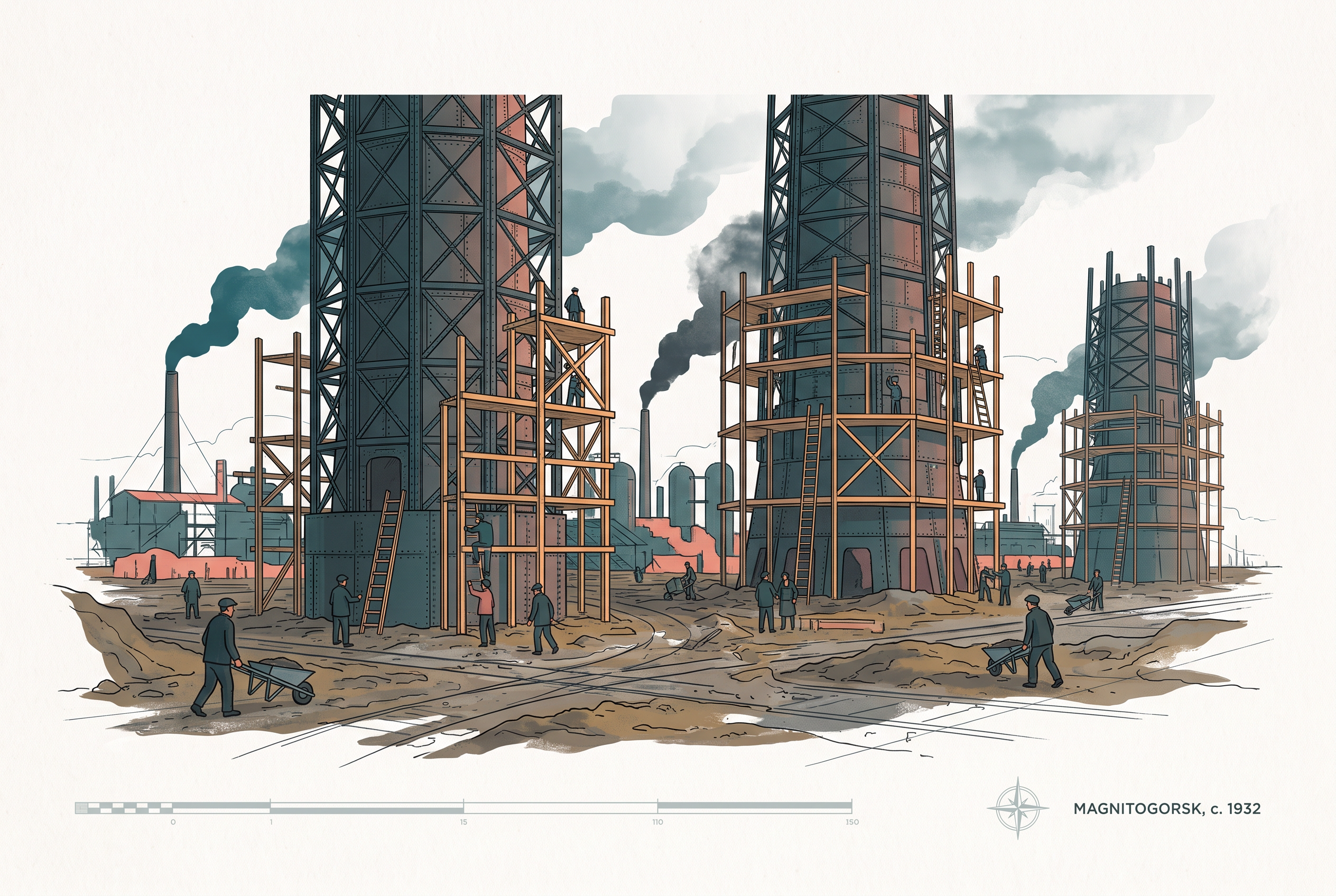
Fig. 9.12 – Construction work at Magnitogorsk.
The output figures behind these projects are set out in Table 9.1. Read them as the state’s own record of what it produced, and notice which line rises fastest.
Coal roughly doubled in the first plan and doubled again in the second. Electricity rose more than sevenfold across the decade. Steel barely moved in the first plan — the target was wildly missed — and then grew threefold in the second, once the plants built during the first were actually working. That pattern matters: the first plan built the capacity, the second used it.
By 1937 the Soviet Union was among the world’s major industrial producers, unemployment had disappeared, and millions of women had entered industrial work. The country that had been beaten in 1915 for want of shells now had an industrial base behind it.
9.8.4 The Cost To The Workers
The plans were driven by pressure, not by wages, and the pressure fell on the workforce.
Targets were set beyond what was possible and then raised. Managers and workers who failed to meet them were not simply criticised; failure was treated as deliberate, and those responsible could be denounced as ‘wreckers’ or ‘saboteurs’ and prosecuted. This is worth holding on to, because it explains something about the next section: an economy in which shortfalls must have culprits generates culprits.
Discipline was tightened by law. Absenteeism and leaving a job without permission became criminal offences, and from 1932 internal passports restricted where a worker could live and move.
Rewards existed alongside the punishments. Pay differentials and piece rates were widened so that skilled and productive workers earned considerably more, which was a deliberate break with the levelling of the early revolution. From 1935 the Stakhanovite movement, named after a coal miner credited with an enormous single shift’s output, honoured record-breakers with medals, bonuses and better housing — though such records were usually achieved with a team of helpers clearing the way, and other workers resented the raised norms that followed.
Living conditions in the new industrial towns were severe: overcrowded barracks, poor food, few consumer goods, and dangerous machinery run at speed by inexperienced hands. Quantity was rewarded over quality, so a good deal of what was produced was badly made or broke down.
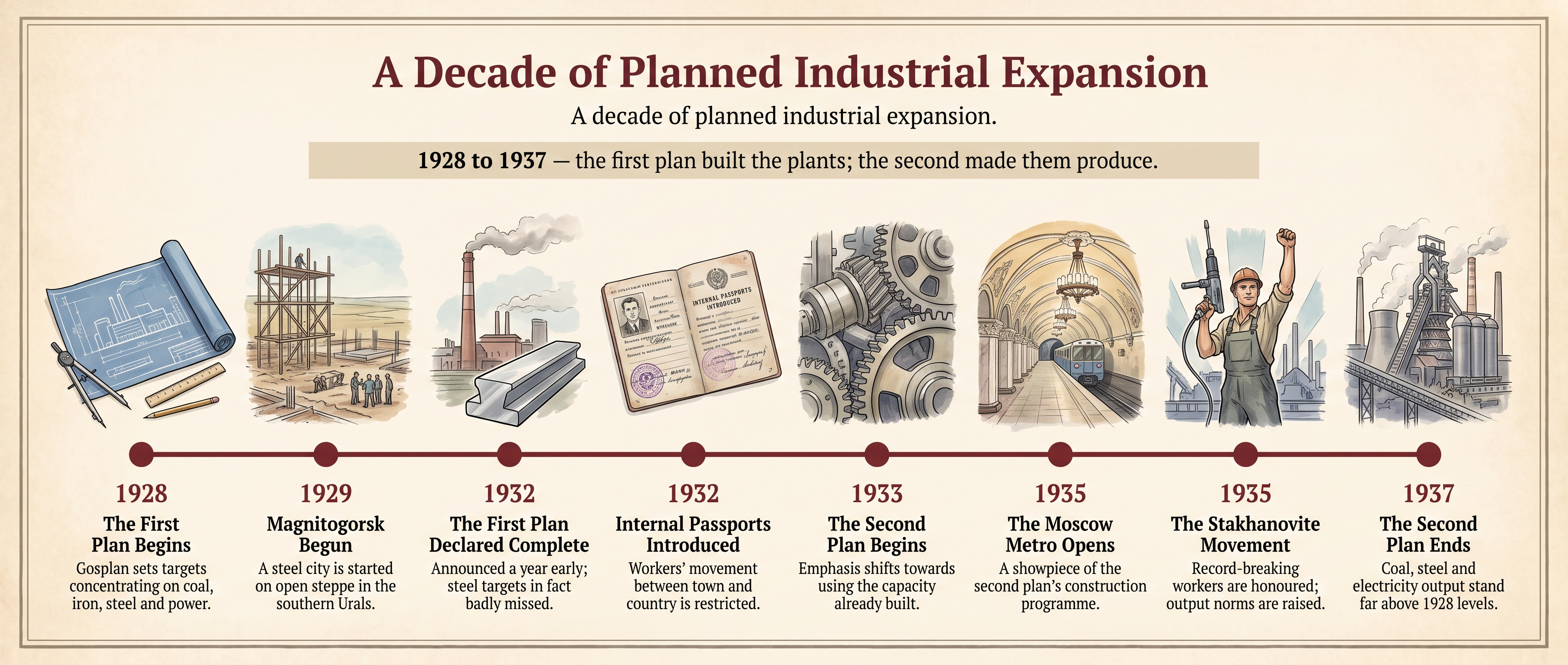
Fig. 9.13 – The First and Second Five Year Plans.
9.9 The Purges Of 1937-1938
By 1934 Stalin had no organised opposition. There was no faction to defeat, no rival with a following, no policy under public challenge. What followed was therefore not a struggle for power but something stranger: a state destroying its own officials, officers and citizens on an enormous scale, at the moment when it was least threatened.
The peak years were 1937 and 1938. The machinery, however, was assembled earlier, and it is easier to follow if we begin in December 1934.
9.9.1 Reasons For The Purges
The Murder Of Kirov
Sergei Kirov, the party leader in Leningrad and a popular figure in the leadership, was shot dead in his offices in December 1934. Who arranged the killing has never been established, and historians still disagree about whether Stalin had a hand in it.
What is certain is the use made of it. Within days, emergency procedures were introduced for cases of terrorism: swift trials, no defence counsel, no appeal, immediate execution. The murder became the pretext for arresting former oppositionists as members of an imagined conspiracy, and the conspiracy grew with every confession extracted.
The Reasons Behind The Machinery
Several pressures came together, and no single one explains what happened.
Collectivisation and the first plan had caused famine, deportation and hardship on a scale that could not be admitted. If the policies were correct and the leader infallible, then failures had to be the work of enemies. The purges supplied the enemies.
Opposition had also existed recently enough to be remembered. In 1932 a party official named Ryutin had circulated a document criticising Stalin’s policies and calling for his removal from the leadership. It was suppressed, but it showed that such thoughts were possible inside the party.
The Old Bolsheviks were a standing problem of a different kind. They had known Lenin, had argued with Stalin as an equal, and remembered the party’s history as it had actually happened — including the Testament. A leader building a cult of his own infallibility had reason to want the witnesses gone.
Finally, terror worked as a method of rule. Arrests that struck without pattern, and could reach anyone, produced obedience more reliably than any inspectorate. Stalin’s aim, as his own instructions to the police make clear, was compliance across the whole society and not merely the removal of named rivals.
9.9.2 How The Purges Were Carried Out
The Show Trials
The public face of the terror was a series of trials in Moscow between 1936 and 1938. Zinoviev and Kamenev were tried in 1936; Bukharin, among others, in 1938. The defendants were Lenin’s closest colleagues, and each stood in open court and confessed to plotting with foreign powers to wreck Soviet industry and murder Soviet leaders.
The confessions were false and were obtained by prolonged interrogation, threats to families and torture. Almost all the accused were shot. Foreign journalists were admitted to the courtroom, and the trials were reported around the world; a good many observers abroad believed them.
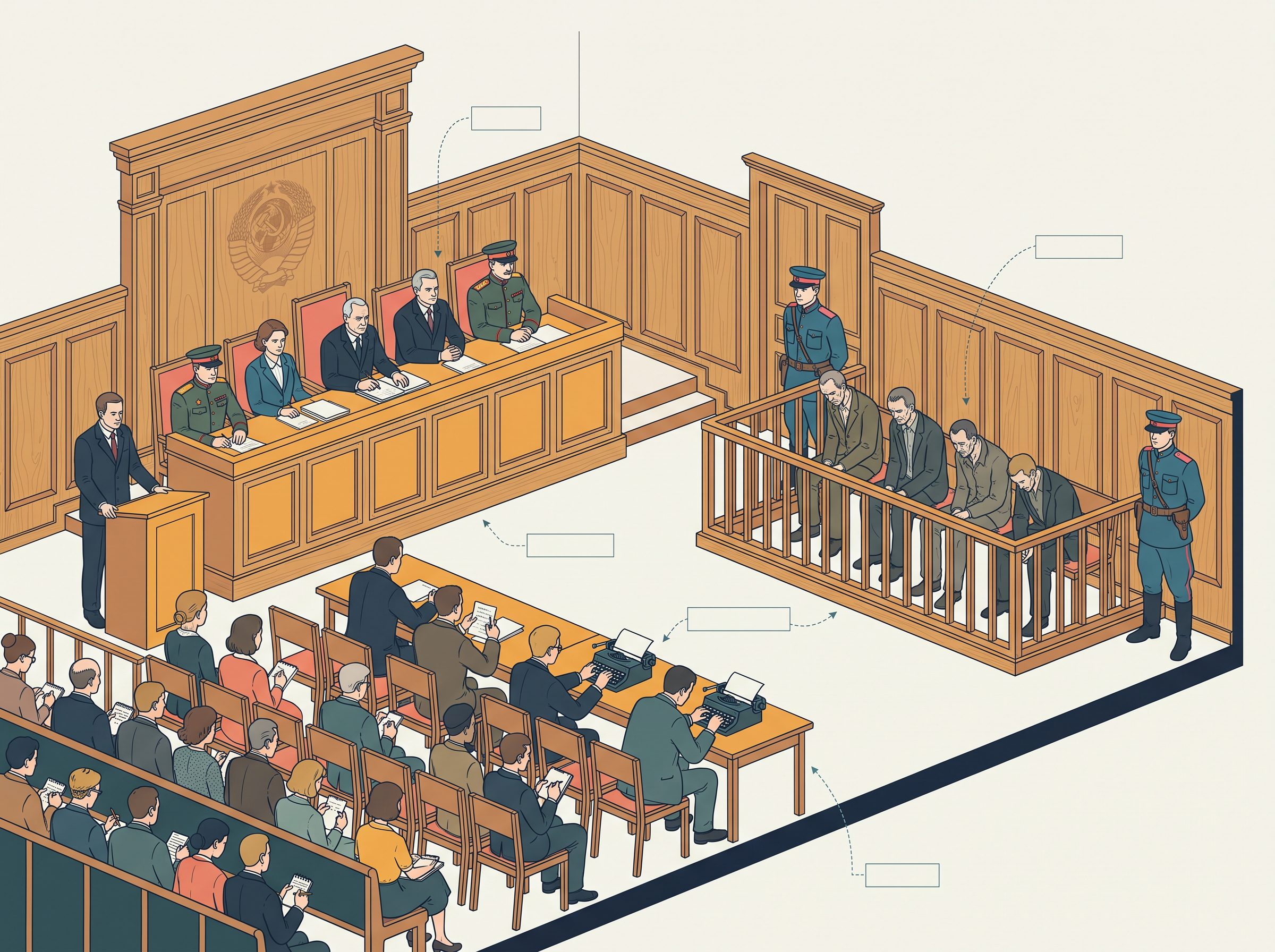
Fig. 9.14 – A Moscow show trial courtroom.
The Army And The Quotas
In June 1937 Marshal Tukhachevsky and a group of the Red Army’s most senior commanders were tried in secret and shot. The purge then ran down through the officer corps, removing a very large proportion of its experienced commanders in the two years before Germany invaded.
Away from the courtrooms, the terror was administrative. In 1937 the political police, now called the NKVD, sent out an operational order setting each region a target number of people to be arrested, with a fixed share to be shot and the rest sent to camps. Local officials, afraid of appearing slack, asked for their quotas to be raised.
Arrests were made at night. Denunciation by neighbours or colleagues was encouraged, and confession under interrogation was the standard evidence. Families were punished with the accused: wives were sent to camps and children to state orphanages. Across 1937 and 1938 roughly 700,000 people were shot and far larger numbers were sent to the gulag.
Rewriting The Record
Alongside the arrests went a systematic revision of the past. People removed from public life were removed from the record of it: photographs were retouched, encyclopaedia pages were reissued for subscribers to paste over the old ones, textbooks were rewritten, and the histories of the revolution and the civil war were recast to enlarge Stalin’s part in them and to erase his opponents’.
9.9.3 Consequences Of The Purges
The first consequence was the one intended. Stalin’s authority became unchallengeable, the Old Bolsheviks were destroyed as a political generation, and the party and government were filled with younger men who owed their promotion entirely to the vacancies terror had created.
The second was a loss of competence. Engineers, managers, planners, scientists and administrators were arrested in large numbers, and industrial planning suffered accordingly. In the armed forces the damage was graver still: the Red Army entered the Second World War with much of its experienced leadership gone.
The third was fear as the ordinary condition of life. Denunciation was a survival strategy, silence a habit, and trust between colleagues, neighbours and even relatives became dangerous. Millions of ordinary citizens with no political history at all were among the arrested.
The fourth was the narrowing of thought. Criticism of Stalin was impossible, censorship was total, and in the arts the doctrine of socialist realism — optimistic, accessible work showing Soviet life as it ought to be — became the only permitted form. Writers, artists and scientists who fell outside it lost their work, their liberty or their lives.
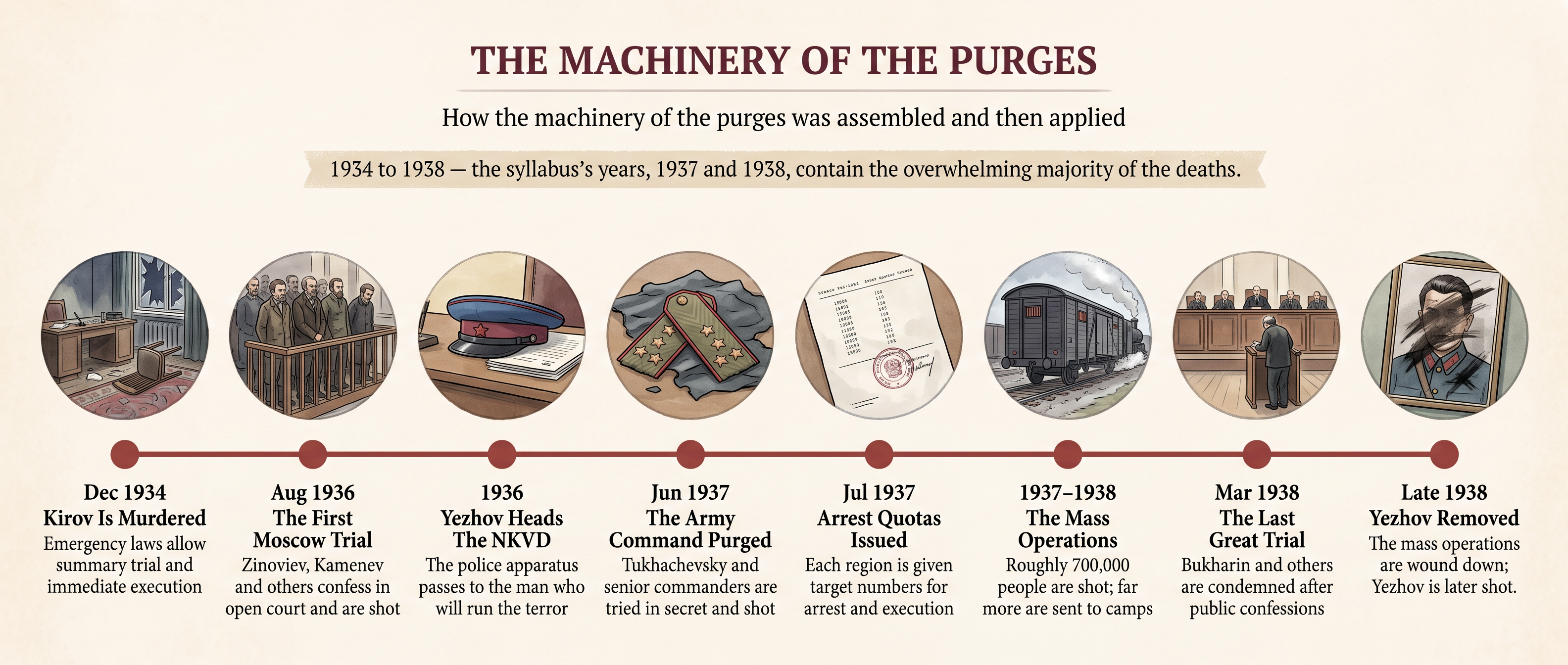
Fig. 9.15 – From Kirov’s murder to the end of the terror.
9.10 Summary
The Fall Of Tsarism
- Russia in 1914 was an autocracy: the Tsar’s power was limited by no constitution, and the Duma conceded in 1905 had been reduced to a body that could be ignored.
- The causes of the March Revolution had been building for years — factory conditions and strikes, peasant land hunger that Stolypin’s reforms had not satisfied, repression that pushed the educated classes into opposition, and socialist parties ready with an alternative.
- The monarchy also lost its standing at court and in the army, where Rasputin’s influence over ministerial appointments became a public scandal.
- The First World War did not create these problems; it brought them together, took the Tsar’s remaining defenders away from him, and put hungry crowds and unwilling soldiers in the same streets.
- The revolution of March 1917 began as a bread protest by women textile workers and became irreversible when the Petrograd garrison refused to fire and then joined the crowds.
- Nicholas II abdicated for himself and for his son; his brother declined the throne; three centuries of Romanov rule ended in two days of telegrams.
The Eight Months Of The Provisional Government
- Power was immediately divided. The Provisional Government held office; the Petrograd Soviet held the loyalty of the workers and soldiers, and under Order No. 1 the army’s obedience to the government was conditional.
- The Soviet’s Menshevik and Socialist Revolutionary leaders declined to take power themselves, believing Russia had first to pass through a parliamentary, capitalist stage.
- The government postponed the three things the country wanted. Land waited for a Constituent Assembly whose election was itself postponed; food supply worsened; and it stayed in the war.
- Lenin’s April Theses rejected the whole arrangement and demanded that power pass to the soviets, which is why the Bolsheviks could not be absorbed into coalition as the other socialist parties were.
- The failed summer offensive, the July Days and finally the Kornilov affair destroyed the government’s authority. Arming the Red Guards against Kornilov made the Bolsheviks the defenders of the revolution, and by late September they held majorities in the Petrograd and Moscow soviets.
The Bolsheviks In Power
- The November Revolution was a planned operation rather than a mass rising: the key points of Petrograd were occupied with almost no fighting, and the Winter Palace was entered in the early hours of 8 November 1917.
- The first decrees addressed the broken promises directly — an immediate armistice, and the landlords’ estates handed to peasant committees — which made millions of villagers stakeholders in the new government.
- The Bolsheviks lost the Constituent Assembly election and closed the Assembly after a single day. From that point no rival party would be permitted to govern.
- Brest-Litovsk took Russia out of the war at the price of a third of its population and much of its industry and best land.
- War Communism fed the Red Army through the civil war and wrecked the economy: requisitioning gave peasants no reason to grow a surplus, and famine and revolt followed.
- The NEP of 1921 was a retreat in economics and not in politics. Requisitioning became a tax, private trade and small business returned, but the state kept the commanding heights and the single-party monopoly was untouched.
- The NEP restored the food supply and revived the towns, and it also produced traders and kulaks whose prosperity many communists regarded as capitalism growing back inside a workers’ state.
Stalin’s Revolution From Above
- Lenin died in 1924 leaving no successor and a Testament proposing Stalin’s removal, which the leadership set aside.
- Stalin’s rise rested above all on the office his rivals thought dull: as General Secretary he controlled appointments, and therefore the delegates who voted at party congresses.
- He defeated his opponents in sequence rather than together, and used the 1921 ban on factions to turn disagreement into a disciplinary offence.
- Socialism in one country was both a doctrine and a programme: if the USSR had to survive alone, it had to industrialise fast and could not wait on peasants selling grain at market prices.
- Collectivisation merged peasant holdings into collective and state farms whose first duty was a compulsory grain quota. Dekulakisation removed the most productive farmers; peasants slaughtered their livestock; famine in 1932–33 killed several million people.
- Judged by the state’s aims collectivisation worked, because procurement rose even when harvests fell. Judged as agriculture it failed, and its human cost was catastrophic.
- The Five Year Plans concentrated on heavy industry and were paid for out of the population — exported grain, suppressed consumption, forced labour and held-down wages.
- Output of coal, steel, oil and electricity rose steeply between 1928 and 1937, but so did coercion: criminal penalties for absenteeism, internal passports, and failure treated as sabotage.
- The purges of 1937–1938 came when Stalin had no organised opposition left. Show trials destroyed the Old Bolsheviks, the army lost much of its command, and arrest quotas were sent to every region.
- Roughly 700,000 people were shot in those two years and far more were sent to the camps; the state then rewrote textbooks, encyclopaedias and photographs so that the record would match the story it was telling.
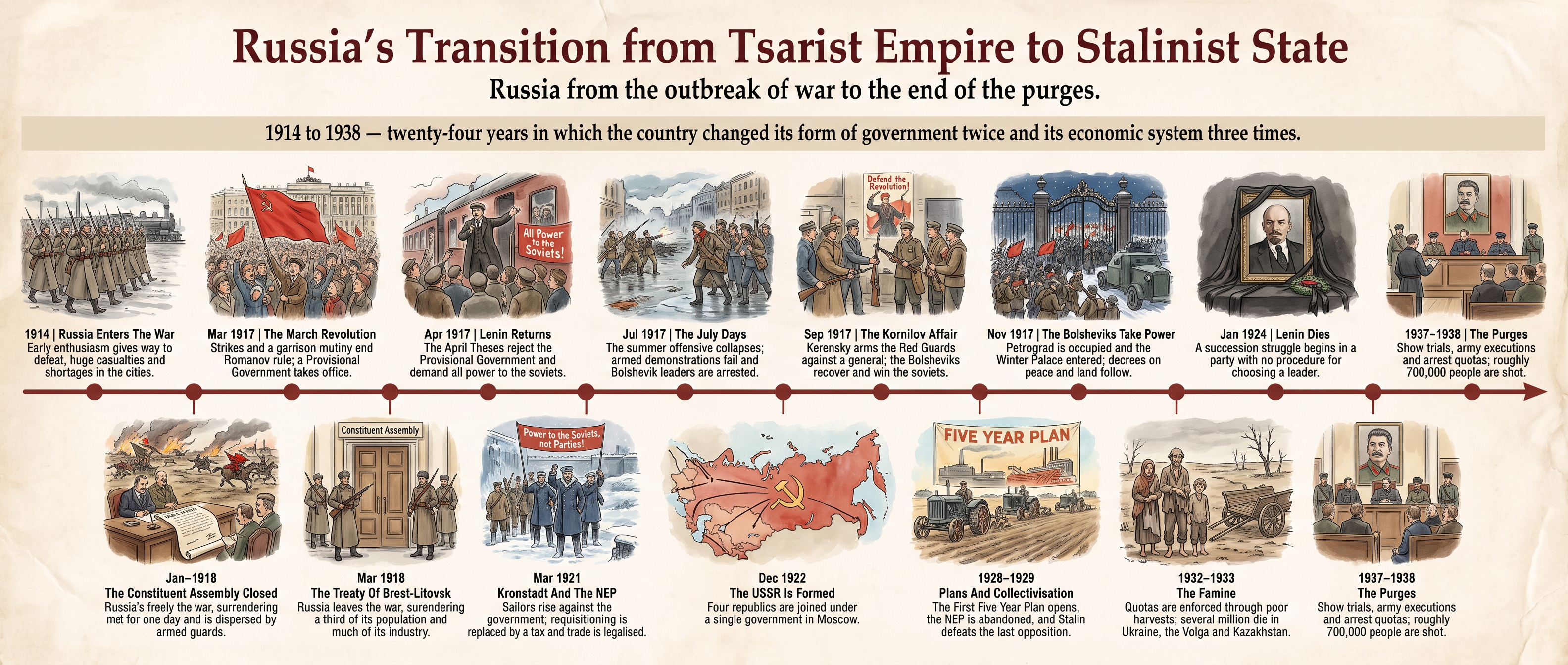
Fig. 9.16 – The whole chapter.
What The Evidence Cannot Tell Us
Almost everything we have from these years was produced by the state, and the state was a participant. The output figures were compiled by the people who set the targets, the arrest records by the police making the arrests, and the grain returns by the officials taking the grain.
The peasants who lost their land and their animals left almost nothing in writing, so their side of collectivisation reaches us mostly through the reports of those sent to break their resistance. What ordinary Soviet citizens actually believed, as opposed to what they said at meetings, is largely beyond recovery.
And in this chapter, uniquely, the record was altered on purpose — names removed from books, faces removed from photographs. That is why a historian’s first question about any Soviet source of the 1930s is not what it says, but who made it and what they needed it to say.
9.11 Check Your Memory
Why is the same revolution called both the February Revolution and the March Revolution? Explain the reason in your own words.
What was meant by dual power in Russia in 1917? Name the two bodies involved and state what each of them actually controlled.
Explain how the Provisional Government’s decision to stay in the war made its other difficulties worse. Refer to the land question and to the food supply of the cities in your answer.
Reconstruct the chain of events that led Lenin to announce the New Economic Policy in March 1921. Begin with grain requisitioning under War Communism and set out each step in order.
Farming under the New Economic Policy and farming under collectivisation were organised in opposite ways. Explain how each worked, and what the state gained from each.
Read Source 9.1 again. What condition does it place on the army’s obedience, and why did that condition matter so much to a government that had only just taken office?
Look again at Table 9.1. Describe how the steel figures behave across the two Five Year Plans, and explain what the chapter suggests is the reason for the difference between the two periods.
Using Map 9.2, explain how a few thousand people were able to take control of Petrograd on the nights of 6 and 7 November 1917. Locate three of the points they seized and say why each mattered.
The chapter states that in these years the record of the past was altered on purpose. Using Fig. 9.0 and what you have read about the purges, explain how historians can still work out what happened, and state one thing such evidence cannot tell them.
Historians disagree about why Stalin, rather than any of his better-known rivals, ended up ruling alone. Set out the argument that this was the achievement of one skilful politician, and the argument that any single-party state without elections was likely to be captured by whoever ran its machinery. Say which you find the stronger, and why.
9.1.3 Socialist Ideas And The Revolutionary Parties
Into this discontent came a body of ideas. Marxism, the theory developed by Karl Marx, argued that history moves through struggle between classes, that capitalism concentrates wealth in the hands of a few, and that the working class would eventually overthrow it. Marx’s writings were translated and argued over in Russia from the 1880s, mostly by exiles and students.
Two parties grew out of this argument. The Social Revolutionaries, formed at the turn of the century, looked to the peasants rather than the workers and wanted the land handed to those who farmed it. The Social Democratic Party was Marxist and looked to the industrial workers.
In 1903 the Social Democrats split over a question that sounds narrow and was not: who could be a member. Vladimir Lenin wanted a small, disciplined party of full-time revolutionaries who would lead the working class; his group took the name Bolsheviks, from the Russian for majority. Julius Martov wanted an open party that anyone who accepted its programme could join, and whose task was to build up the workers’ own movement until it was ready; his group became the Mensheviks, from the word for minority. Both were Marxist, both wanted the Tsar gone, and both drew their support from the cities. What divided them was discipline, timing and who was to lead whom — and by 1917 that difference decided everything.
Q. Were the Bolsheviks the larger party in 1903?
A. No. The name came from winning one vote at one congress, and it stuck.