Chapter 2: The Origin And Evolution Of The Earth
The night sky looks still. It is not. In 1920 Edwin Hubble, studying faint smudges of light through a telescope, found that the galaxies are not sitting quietly in place — they are rushing apart. The further away a galaxy lies, the faster it flees. Wherever an astronomer looks, everything is moving away from everything else.
Run that motion backwards, like a film played in reverse, and the galaxies rush together instead of apart. Keep rewinding, and all the matter of the universe crowds into a single point — a tiny ball of unimaginable heat and density. About 13.7 billion years ago, that ball exploded. Space itself began to swell, and it has been swelling ever since. This is the Big Bang, and the sky above you tonight is its slow aftermath.
There is a stranger truth folded into that starlight. Light travels fast but not instantly — about 300,000 kilometres every second. Even so, the light now entering your eye from a distant galaxy left it thousands of years ago. You are not seeing the galaxy as it is. You are seeing it as it was. To look up at night is to look back in time.
Out of that expanding, cooling universe came clouds of gas, then stars, then planets — and one small rocky ball that would slowly gather an interior, an atmosphere, oceans and, at last, life. This chapter follows that story, from the first flash to the first fossil.
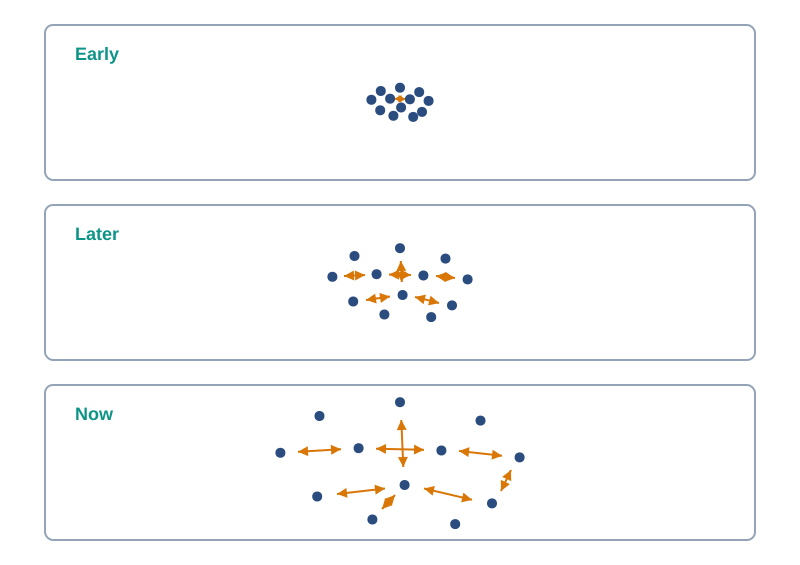
Fig. 2.0 – The expansion of space.
This chapter will let you answer each of these by the time you reach its final page.
2.1 Early Theories
Before scientists asked how the whole universe began, they asked a smaller and closer question: how did the earth and its neighbouring planets come to exist? The earliest answers all belong here, and they were answers about planets, not about everything.
2.1.1 Origin Of The Earth
Over the years a large number of hypotheses — proposed explanations still awaiting proof — were put forward by philosophers and scientists about how the earth formed. No single one won everyone over, but a few shaped the thinking that followed.
One of the earliest and most influential came from the German philosopher Immanuel Kant. The mathematician Laplace revised it in 1796, and in this form it became known as the Nebular Hypothesis — the idea that the planets were born from a cloud of gas and dust surrounding a young sun. That cloud, the hypothesis held, was slowly rotating, and the planets condensed out of the material associated with it.
The idea did not stay fixed. In 1950 Otto Schmidt in Russia and Carl Weizsäcker in Germany reworked the nebular hypothesis, agreeing on its broad shape while differing over the finer details. In their version the sun was surrounded by a solar nebula — a spread of gas made mostly of hydrogen and helium, together with fine solid particles that may be termed dust.
From Cloud To Planets
The mechanism they proposed was patient and physical. Within the nebula, particles were constantly rubbing against and colliding with one another. This friction and collision gradually worked the material into a flat, disk-shaped cloud. Out of that disc the planets slowly took shape through accretion — the process by which small particles stick and clump together, building up into larger and larger bodies.
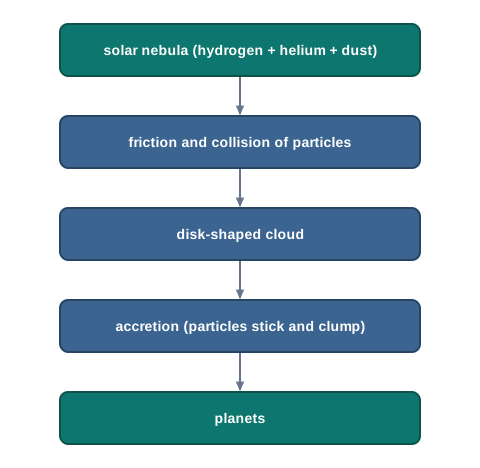
Fig. 2.1 – The revised nebular hypothesis.
Notice how the question itself shifted over time. Having proposed how the planets might have formed, scientists in the later period turned to a deeper puzzle — the origin of the whole universe, rather than of the earth or the planets alone. That larger question is where the next section begins.
2.2 Modern Theories
By the middle of the last century the question had grown larger. Instead of asking only how the earth and the planets formed, scientists began to ask how the entire universe came to be, and then how stars and planets emerged within it.
2.2.1 Origin Of The Universe
The most widely accepted answer to the origin of the universe is the Big Bang Theory, also called the expanding universe hypothesis — the idea that the universe began from a single point and has been growing outward ever since.
The first strong evidence came from the astronomer Edwin Hubble. In 1920 he showed that the universe is expanding: as time passes, galaxies — vast systems, each holding a great many stars — move further and further apart. Wherever one looks, the galaxies are separating from one another.
Reading The Balloon Experiment
NCERT suggests a simple experiment to picture this. Mark some dots on a balloon to stand for galaxies, then start inflating it. As the balloon swells, every dot appears to move away from every dot — just as the real galaxies do, and just as the distance between them keeps increasing. The comparison is only partly right, though. On the balloon the dots themselves also grow larger, but real galaxies are not expanding; only the space between them is. So the balloon captures the spreading apart, but not the whole truth.
The Big Bang In Stages
The Big Bang Theory sets out the story in stages. In the beginning, all the matter of the universe was gathered in one place as a ‘tiny ball’, or singular atom — a point of unimaginably small volume, infinite temperature and infinite density.
Then came the bang itself. The tiny ball exploded violently, driving a huge expansion. This event is now generally dated to 13.7 billion years before the present, and the expansion it began still continues today. As the young universe grew, some of its energy turned into matter. The expansion was especially rapid in the first fractions of a second and then slowed down; within the first three minutes, the first atom began to form.
The universe went on cooling. Within 300,000 years of the Big Bang, the temperature had fallen to 4,500 K — the Kelvin scale, used in science, begins at absolute zero, the lowest temperature possible. At this point atomic matter took shape, and the universe, opaque until then, became transparent.
The figure below shows this outward growth from the starting point.
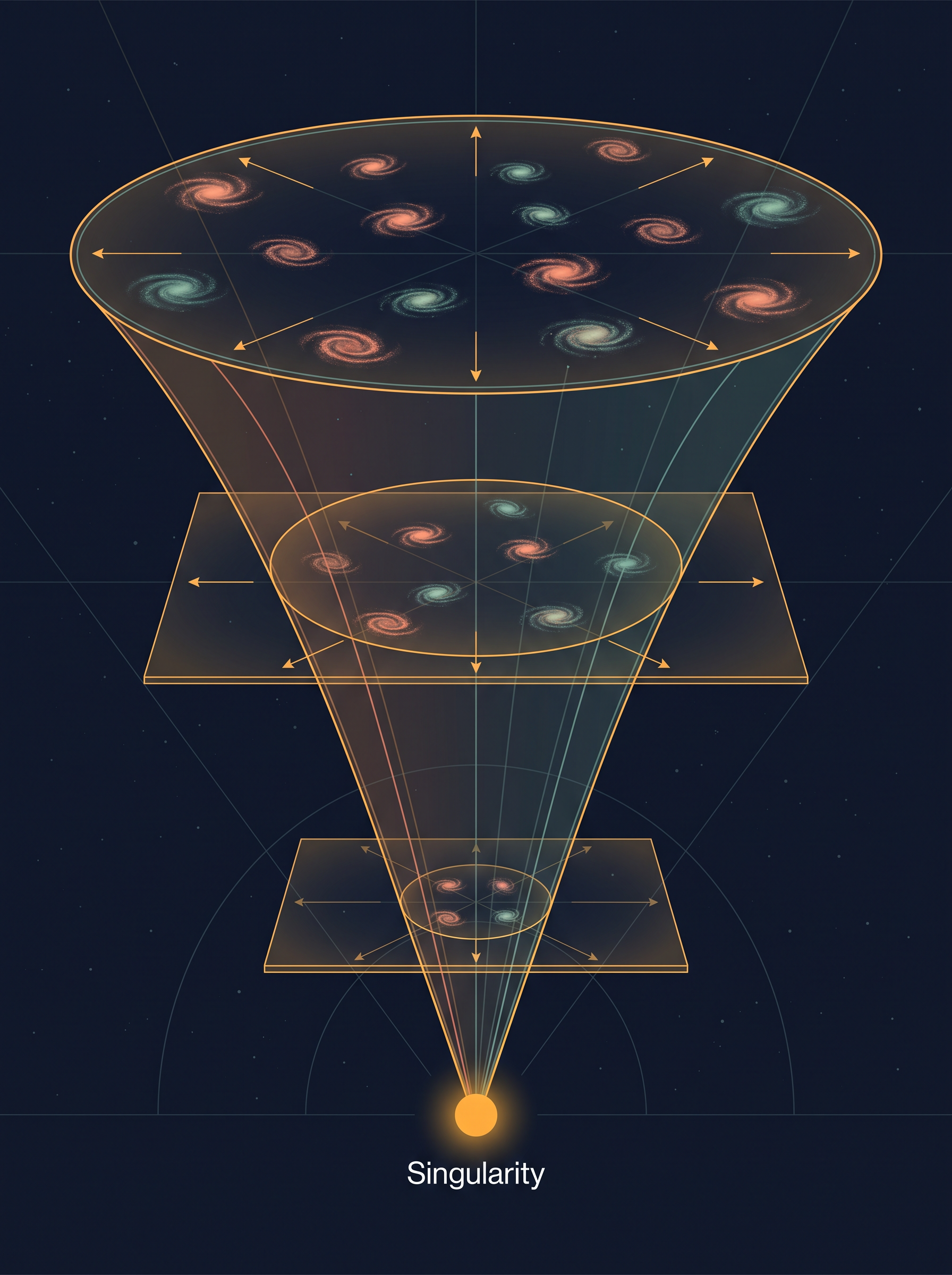
Fig. 2.2 – Outward expansion of the universe from the Big Bang.
Not every scientist accepted that the universe had a beginning. The astronomer Fred Hoyle offered a rival, the steady state concept, which held that the universe looks roughly the same at every point in time, with no single moment of creation. But as more and more evidence for expansion accumulated, the scientific community came to favour the expanding universe, and the Big Bang remains the leading account today.
2.2.2 The Star Formation
Why did the smooth early universe break up into separate galaxies and stars at all? The answer lies in a small unevenness. The distribution of matter and energy in the early universe was not even. These initial density differences produced differences in gravitational force, and gravity drew the matter together into clumps. Those gatherings became the bases from which galaxies developed.
Galaxies are enormous. They spread over distances measured in thousands of light-years — a light-year being the distance light travels in a single year, not a measure of time. The diameters of individual galaxies range from 80,000 to 150,000 light years.
How Stars Are Born
Within a galaxy, star-making follows its own sequence. A galaxy begins to form as hydrogen gas accumulates into a very large cloud called a nebula. As the nebula grows, it develops localised clumps of gas. Each clump keeps drawing in more material and grows into an even denser gaseous body — and it is these dense bodies that become stars. The formation of stars is believed to have taken place some 5 to 6 billion years ago.
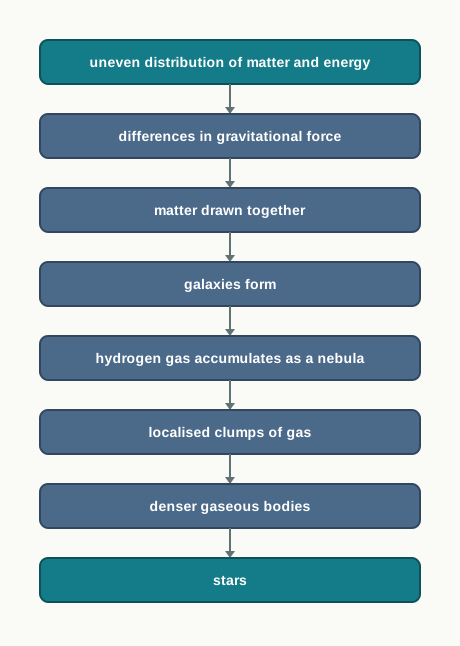
Fig. 2.3 – Stages of star formation.
There is a striking consequence of light’s fixed speed. Because light takes time to cross space, the light reaching us from a distant galaxy left it long ago. We therefore always see distant objects as they were in the past, never as they are at this moment.
2.2.3 Formation Of Planets
Once stars had formed, the same kind of nebula around a young star became the birthplace of planets. NCERT sets out the process in three stages.
First, a star is a localised lump of gas within a nebula. The gravitational force inside this lump pulls material toward the middle, forming a core, and around that core a huge rotating disc of gas and dust develops.
Second, the gas cloud begins to condense. The matter around the core gathers into small rounded objects, and by cohesion — the tendency of particles to hold together on contact — these grow into bodies called planetesimals, which are a large number of smaller bodies. Larger bodies then start forming by collision, with gravitational attraction pulling the pieces together and making the material stick.
Third and finally, this large number of small planetesimals accrete — the same gathering-together of particles met in the earlier hypothesis — to form a much smaller number of large bodies, which are the planets.
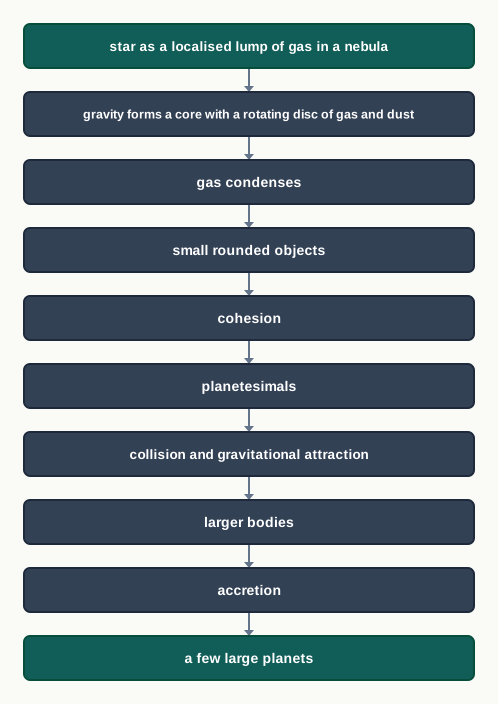
Fig. 2.4 – The stages of planet formation.
2.3 Evolution Of The Earth
The earth did not begin as the world we know. At first it was a barren, rocky and hot object wrapped in a thin atmosphere of hydrogen and helium — nothing like today’s planet with its oceans and its life-supporting air. Some sequence of events and processes must have carried it from that raw beginning to the present.
This section follows the long stretch between 4,600 million years ago and now, and the changes that slowly made the earth fit for life.
One of the deepest of those changes is that the earth is not the same all the way through. It has a layered structure: from the outer edge of the atmosphere down to the very centre, the material is not uniform. The atmosphere holds the least dense material of all; going deeper, the interior is divided into different zones, each made of material with its own characteristics.
2.3.1 Evolution Of Lithosphere
The lithosphere is the earth’s solid, rocky outer shell — the crust and the rigid rock just beneath it. How this solid, layered earth came to be is a story of cooling and sorting.
In its earliest stage the earth was mostly in a volatile, near-molten state. As its density gradually increased, the temperature inside rose, and the material began to separate according to how heavy it was. This allowed the heavier materials, such as iron, to sink towards the centre, while the lighter ones moved up towards the surface.
With the passage of time the earth cooled further, solidified, and condensed into a smaller size. This cooling built the outer surface into a crust. Then, during the formation of the moon, a giant impact heated the earth up once again, keeping its interior mobile while the sorting finished.
The name for this whole sorting is differentiation — the process by which the earth-forming material got separated into distinct layers according to density. Working from the surface inward, these layers are the crust, the mantle, the outer core and the inner core, and the density of the material increases steadily from the crust down to the core. The detailed properties of each layer belong to the next chapter.
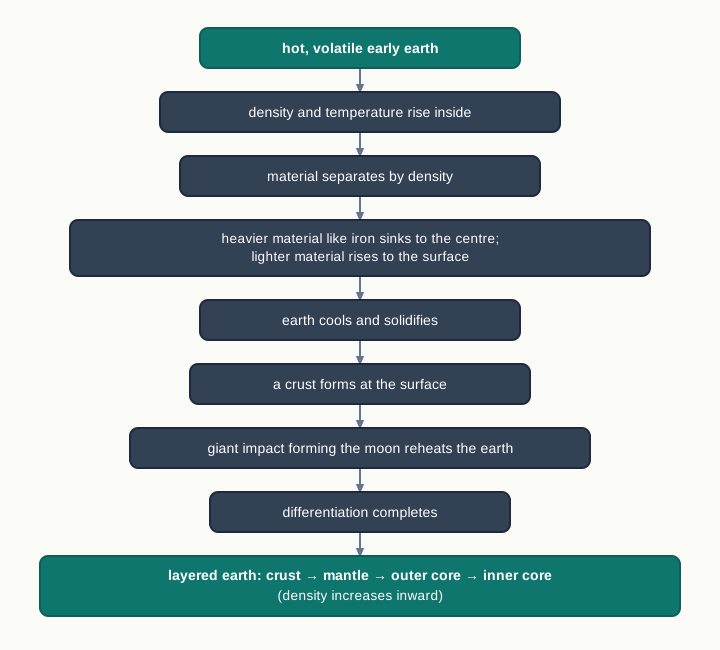
Fig. 2.5 – Differentiation and the layering of the earth.
2.3.2 Evolution Of Atmosphere And Hydrosphere
The hydrosphere is all the water of the earth — its oceans, and the water on and near the surface. The air and the water we now depend on were not present at the start; both had to evolve, and they evolved together.
Today the earth’s atmosphere is chiefly nitrogen and oxygen. It reached that state through three stages: first the loss of the earliest atmosphere, then a new atmosphere breathed out by the hot interior of the earth, and finally a reshaping of that atmosphere by living things through photosynthesis — the process by which living organisms make food and, in doing so, release oxygen. The full composition and structure of today’s atmosphere is taken up in a later chapter.
The First Air, Blown Away
The early atmosphere of hydrogen and helium is supposed to have been stripped away by the solar winds — a stream of particles flowing outward from the sun. This did not happen to the earth alone; all the terrestrial, that is earth-like rocky, planets are supposed to have lost their earliest atmosphere the same way.
A Second Air, From Within
As the earth cooled, gases and water vapour were released from its solid interior, and this began the evolution of the present atmosphere. The process by which these gases were poured out from inside is called degassing, and continuous volcanic eruptions added still more water vapour and gases. This early atmosphere held water vapour, nitrogen, carbon dioxide, methane, ammonia and very little free oxygen.
From Rain To Oceans
As cooling continued, the released water vapour began to condense. Carbon dioxide dissolved into the rainwater, which lowered the temperature further and brought on still more condensation and rain. The rain collected in the surface depressions and gave rise to the oceans. These oceans formed within 500 million years of the earth’s own formation, which makes them about 4,000 million years old.
Life followed the water. Around 3,800 million years ago life began to evolve, and by about 2,500 to 3,000 million years before the present, photosynthesis had appeared. At first the oxygen it produced went into the oceans; only once the oceans were saturated did oxygen, from about 2,000 million years ago, begin to flood the atmosphere.
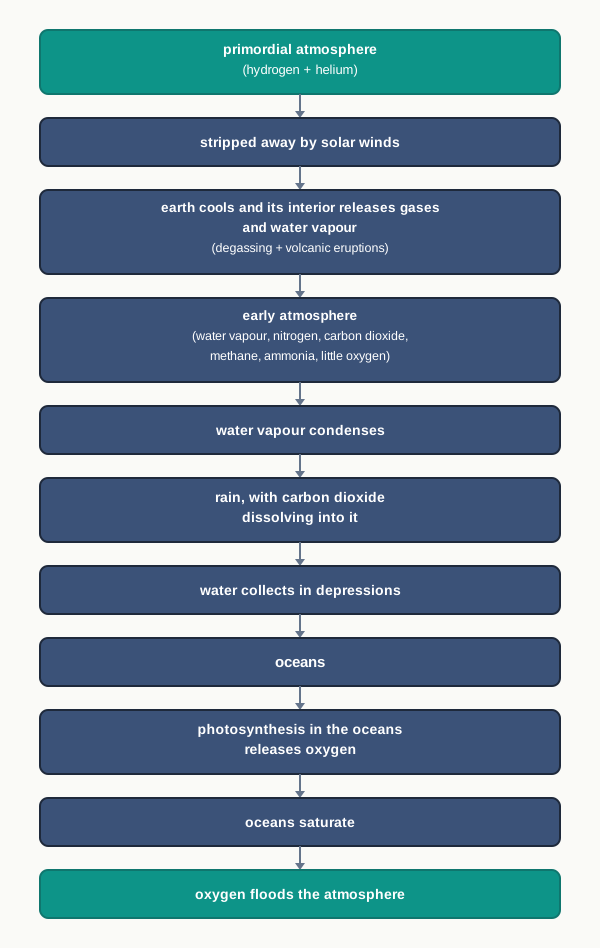
Fig. 2.6 – Evolution of the atmosphere and oceans.
2.3.3 Origin Of Life
The final phase in the earth’s evolution is the origin of life itself. Early on, neither the earth nor its atmosphere was conducive to life; conditions had to change first, as the earlier stages describe.
Modern scientists picture the origin of life as a kind of chemical reaction — one that first built complex organic molecules and then assembled them into arrangements that could copy themselves, turning inanimate matter into living substance. That capacity to self-duplicate is the threshold between mere chemistry and life.
How do we know life is so old? The record is kept in the rocks. Fossils are the preserved traces of past life, and microscopic structures closely resembling present-day blue algae have been found in geological formations older than some 3,000 million years. From evidence like this, it is taken that life began to evolve about 3,800 million years ago.
2.4 Summary
- Early thinkers asked how the earth and planets formed. The Nebular Hypothesis of Kant, revised by Laplace in 1796, held that planets grew from a rotating cloud of gas and dust around a young sun.
- Schmidt and Weizsäcker reworked this idea in 1950: a solar nebula of hydrogen, helium and dust was worked by friction and collision into a disc, and planets formed by accretion.
- The leading account of the universe’s origin is the Big Bang Theory, the expanding universe hypothesis. Hubble’s evidence in 1920 showed galaxies moving apart.
- In the Big Bang, all matter began as a tiny ball of infinite temperature and density, exploded about 13.7 billion years ago, and has been expanding ever since; the rejected alternative was Hoyle’s steady state.
- Galaxies grew where the early universe was slightly uneven and gravity drew matter together. Within them, hydrogen gathered into a nebula, clumped, and thickened into stars about 5 to 6 billion years ago.
- A light-year measures distance, not time — the distance light travels in one year.
- Planets formed around stars in stages: a core and rotating disc, then small rounded objects, then planetesimals joined by cohesion, and finally accretion into a few large planets.
- The earth became layered through differentiation: while it was hot and molten, heavy iron sank to the centre and lighter material rose, sorting it into crust, mantle, outer core and inner core, with density rising inward.
- The earliest atmosphere of hydrogen and helium was stripped away by solar winds. A second atmosphere came from degassing and volcanic eruptions, holding water vapour, nitrogen, carbon dioxide, methane, ammonia and little oxygen.
- As the earth cooled, water vapour condensed into rain that filled depressions to form the oceans about 4,000 million years ago. Photosynthesis later released oxygen, which flooded the atmosphere from about 2,000 million years ago.
- Life is pictured as a chemical reaction that built self-copying organic molecules. Fossils resembling blue algae, older than 3,000 million years, show that life began evolving about 3,800 million years ago.
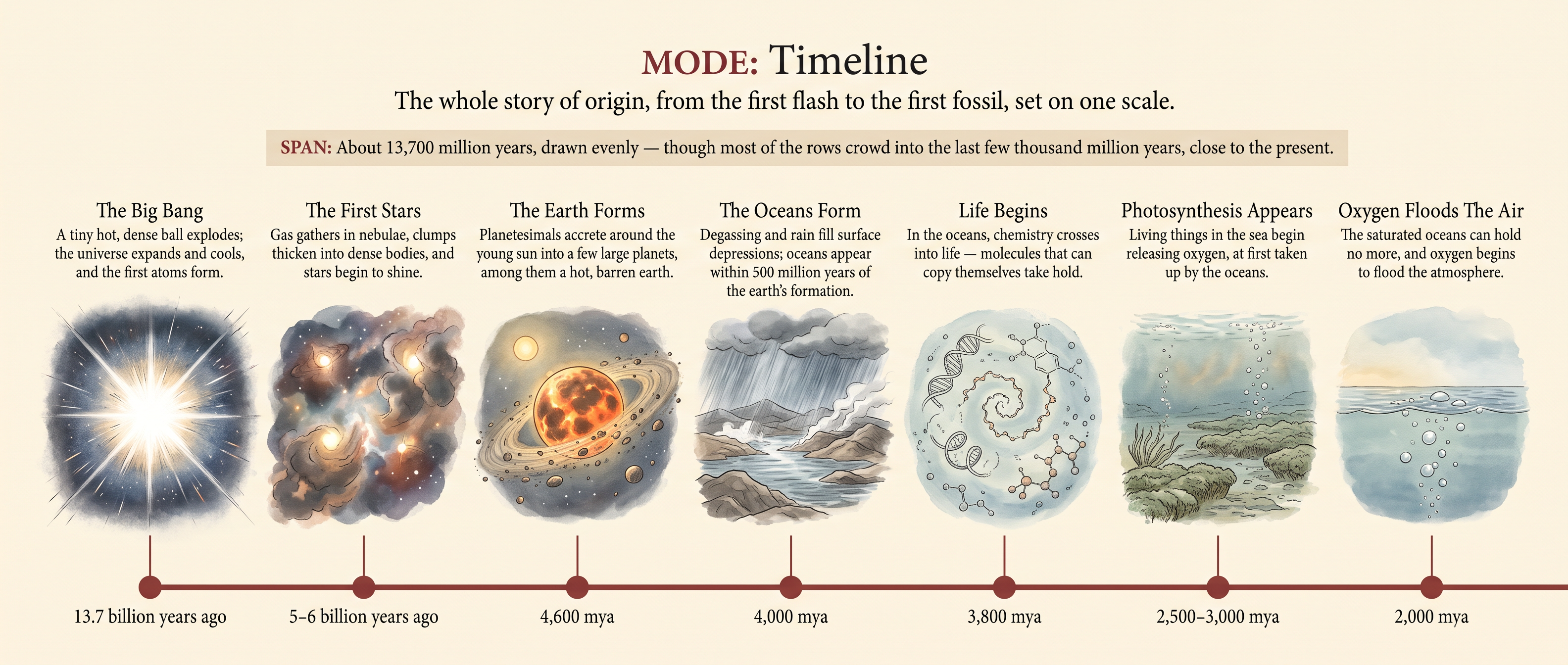
Fig. 2.7 – From The Big Bang To The First Life.
What This Chapter Cannot Tell You
The ages here are estimates on an enormous scale. Figures like 13.7 billion and 4,600 million years are rounded pictures, not exact dates, and fresh evidence can still shift them.
None of the earliest events was ever witnessed. The Big Bang, differentiation and the first oceans are inferred backwards from what can still be measured today, not seen directly.
The chapter names the earth’s inner layers — crust, mantle, outer core, inner core — but not what they are actually like. Their properties are left for the next chapter.
2.5 NCERT Questions
Which one of the following figures represents the age of the earth?
- 4.6 million years
- 13.7 billion years
- 4.6 billion years
- 13.7 trillion years
Which one of the following is not related to the formation or modification of the present atmosphere?
- Solar winds
- Differentiation
- Degassing
- Photosynthesis
Life on the earth appeared around how many years before the present?
- 13.7 billion
- 3.8 million
- 4.6 billion
- 3.8 billion
What is meant by the process of differentiation? (30 words)
What was the nature of the earth surface initially? (30 words)
What were the gases which initially formed the earth’s atmosphere? (30 words)
Write an explanatory note on the ‘Big Bang Theory’. (150 words)
List the stages in the evolution of the earth and explain each stage in brief. (150 words)
2.6 Check Your Concepts
Look again at Fig. 2.2. What does the point marked ‘Singularity’ at its base stand for, and what does the widening of the figure as it rises tell you about the universe over time?
Put the three stages of planet formation in their correct order, from a localised lump of gas within a nebula to a finished planet, naming what happens at each stage.
Trace the chain of events, in order, that leads from the cooling of the early earth to the formation of the oceans. Name each step.
The chapter describes two rival views of the universe — the expanding universe and Hoyle’s steady state. State what each one claims, and explain why scientists at present favour one over the other.
The earth’s oceans filled with oxygen before its atmosphere did. Using what the chapter says about photosynthesis, explain why the oxygen went into the oceans first.
The chapter states that light travels at 300,000 km per second and that the mean distance between the sun and the earth is 149,598,000 km. Using only these figures, work out roughly how long sunlight takes to reach the earth, and check your answer against the 8.311 minutes given in the chapter.
The chapter dates the Big Bang to about 13.7 billion years ago and the earth to about 4,600 million years ago. Why are figures like these best described as estimates rather than exact dates?