Chapter 7: Composition And Structure Of Atmosphere
Late at night, a shortwave radio can pull in a voice from the other side of the world — a station thousands of kilometres away, far beyond the curve of the horizon. Light from that same distance never reaches you. Light travels in straight lines, and the round Earth blocks it long before it arrives. Yet the radio signal comes through. How?
The answer lies not on the ground but high above it. When a transmitter sends radio waves upward, most of the sky simply lets them pass. But between about 80 and 400 kilometres up sits a layer of air so thin, and so full of electrically charged particles, that it behaves like a mirror. The waves climb, strike this layer, and bounce back down to the surface — landing far past the point where a straight line would have hit the ground. Bounce by bounce, a single signal can cross an ocean.
None of this is visible. The air is colourless and odourless, and we feel it only when it blows as wind. Yet above our heads the atmosphere is built in floors, each with its own temperature, its own thinning density and its own job. One floor shields us from the Sun’s harmful rays. One holds all our weather. One turns radio signals back toward the ground. To study climate, we first have to understand the invisible building that climate happens inside.
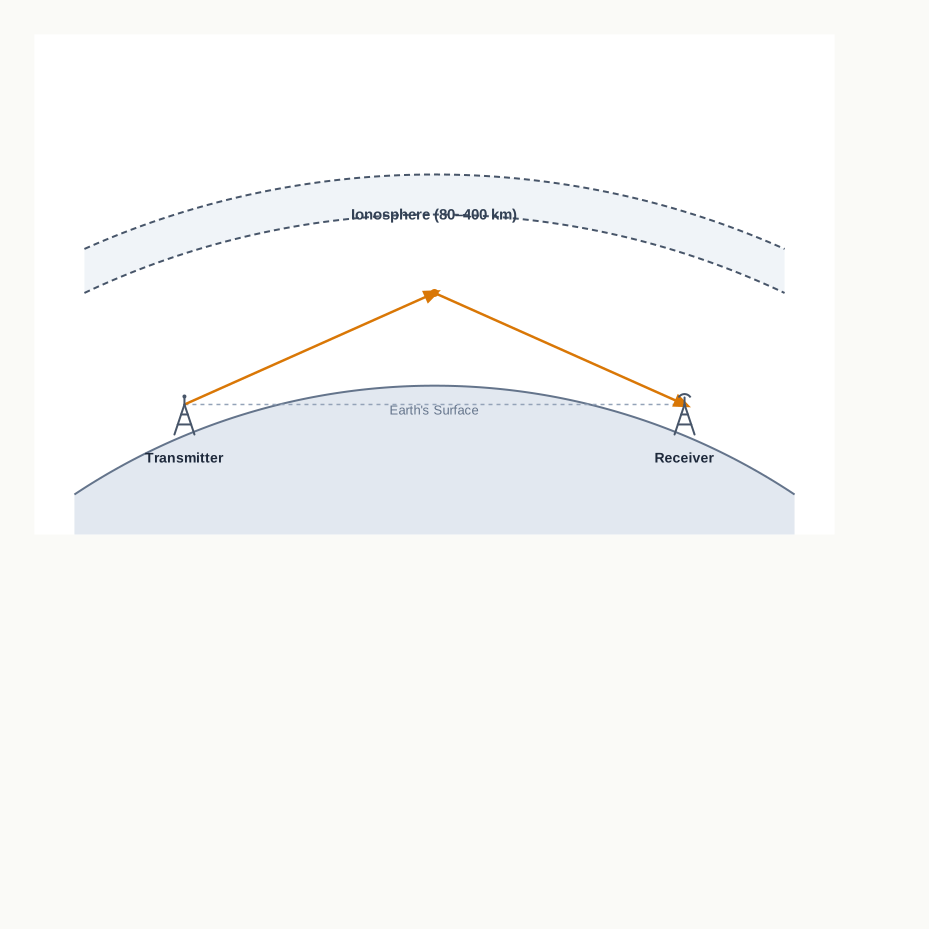
Fig. 7.0 – Radio wave reflection by the ionosphere.
By the end of this chapter you will be able to answer each of these from what the atmosphere is made of and how it is built.
7.1 Composition Of The Atmosphere
Air is so ordinary that it is easy to forget how completely we depend on it. We eat a few times a day and drink water now and then, but we breathe every few seconds, and a few minutes without air would end most life. That dependence is reason enough to look closely at the atmosphere — the envelope of gases that wraps the whole Earth.
The atmosphere carries the gases that living things need: oxygen for humans and animals, carbon dioxide for plants. It is part of the Earth’s own mass, and it is packed tightly against the ground. In fact, 99 per cent of the atmosphere’s mass lies within just 32 km of the surface — a thin skin compared with the size of the planet. The air itself is colourless and odourless, and we notice it only when it moves as wind.
The atmosphere is not one substance but a mixture of three things: gases, water vapour and dust particles. Each of the three does a different job, and the sections below take them in turn.
Thinning With Height
The mixture does not stay the same all the way up. The proportion of gases shifts in the higher layers, so that oxygen becomes almost negligible by a height of about 120 km. Carbon dioxide and water vapour do not reach even that far — they are found only up to about 90 km above the surface. So the air is not merely thinner at height; its very make-up changes as you rise.
7.1.1 Gases
Some gases matter to weather and climate far more than their small share of the air would suggest. Two of them earn a closer look.
The Greenhouse Role Of Carbon Dioxide
Carbon dioxide is meteorologically very important, and the reason lies in how it treats radiation. It is transparent to incoming solar radiation, letting the Sun’s energy pass straight through it to reach the ground. But it is opaque to the outgoing terrestrial radiation — the heat that the warmed Earth sends back out. Carbon dioxide absorbs part of this outgoing heat and reflects part of it back toward the surface.
This one-way trapping of the Earth’s escaping heat is the greenhouse effect: the warming that results when a gas lets sunlight in but holds the Earth’s outgoing heat back. It is a natural process, and without it the surface would be far colder.
The amount of most gases in the air stays steady over time. Carbon dioxide is the exception. Its volume has been rising over the past few decades, mainly because of the burning of fossil fuels, and as its share of the air has grown, the temperature of the air has risen with it.
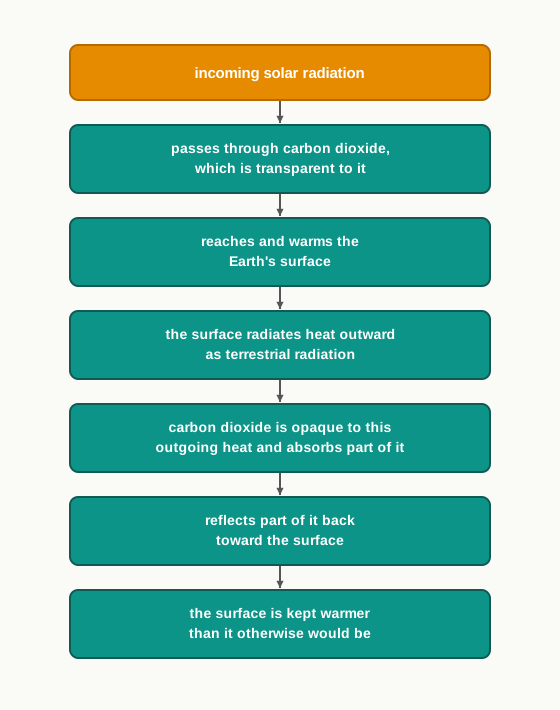
Fig. 7.1 – The greenhouse effect of carbon dioxide.
Ozone, The Ultraviolet Filter
Ozone is another gas that does a job out of all proportion to its quantity. It is found between about 10 and 50 km above the surface, and it works as a filter. It absorbs the ultra-violet rays streaming from the Sun and stops them from reaching the ground. Ultra-violet radiation at full strength is harmful to living things, so this thin band of ozone shields the life below it.
7.1.2 Water Vapour
Water vapour is the atmosphere’s variable gas. Its amount changes sharply from place to place, and it thins out with altitude. In the warm, wet tropics it can make up as much as four per cent of the air by volume. In the dry, cold deserts and the polar regions it may be less than one per cent. It also decreases steadily from the equator toward the poles, following the warmth.
Water vapour does more than simply sit in the air. It absorbs part of the insolation — the incoming solar radiation the Earth receives from the Sun — softening how much of that heat reaches the surface. It also holds on to the heat the Earth radiates back out, preserving it rather than letting it escape. Working at both ends in this way, it acts like a blanket, keeping the Earth neither too hot by day nor too cold at night. Water vapour also feeds the stability and instability of the air — the tendency of air either to stay put or to rise.
7.1.3 Dust Particles
The third ingredient of the atmosphere is solid, not gaseous. The air is able to hold vast numbers of tiny particles, drawn from many sources: sea salts, fine soil, smoke and soot, ash, pollen, ordinary dust and even the disintegrated remains of meteors.
These particles gather mostly in the lower air. But rising convectional currents — columns of warm air moving upward — can carry them to great heights. They are most concentrated over the subtropical and temperate regions, where dry winds keep the air loaded with them, and least concentrated over the more humid equatorial belt and the polar regions.
Small as they are, these particles do essential work. Dust and salt grains act as hygroscopic nuclei — tiny surfaces that attract water. Water vapour condenses onto them, and the droplets that form around them are the first stage of a cloud.
7.2 Structure Of The Atmosphere
The atmosphere is not the same all the way up. It is built of layers, and two things change as you climb through them: density and temperature. Density is the amount of air packed into a given volume, and it is highest right at the surface, where the whole weight of the air above presses the molecules together. As you rise, there is less air above, the packing eases, and density falls away steadily with altitude.
Temperature is the other changing quantity, and it is temperature that geographers use to divide the atmosphere into five layers. From the ground upward these are the troposphere, the stratosphere, the mesosphere, the thermosphere and the exosphere. Fig. 7.2 plots how temperature behaves across all of them, and it is worth reading before taking the layers one by one.
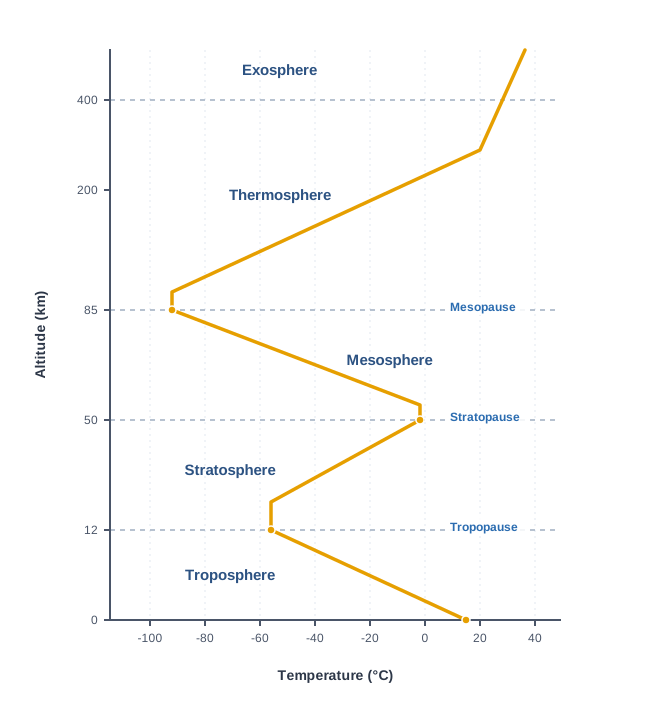
Fig. 7.2 – Structure of the atmosphere: temperature and altitude.
The Layer That Holds Our Weather
The troposphere is the lowermost layer, the one we live in. Its average height is about 13 km, but that average hides a real difference: it reaches only about 8 km near the poles and about 18 km at the equator. The reason is heat. At the equator, strong convectional currents carry warmth to great heights, pushing the layer’s ceiling higher, so the troposphere is thickest where the Earth is warmest.
This layer holds the dust particles and water vapour, and every change of weather and climate happens inside it. It is also where temperature falls most reliably with height: the air cools by 1°C for every 165 m you climb. That works out to roughly 6°C for every kilometre, since 1000 m divided by 165 m gives about six steps of one degree. It is why a hill station is cooler than the plain below it, and it makes the troposphere the single most important layer for all biological activity.
At the top of the troposphere lies the tropopause, the zone that separates it from the stratosphere. Here the temperature stops falling and holds nearly steady — about minus 80°C over the equator and about minus 45°C over the poles. Because the temperature stays constant across it, the boundary takes its name from that pause.
Above The Weather
Above the tropopause sits the stratosphere, reaching up to about 50 km. Its most important feature is the ozone layer described earlier. Ozone here absorbs the Sun’s ultra-violet radiation and shields the life below from an intense and harmful form of energy. As Fig. 7.2 shows, temperature in this layer climbs with height rather than falling — the opposite of the troposphere.
The mesosphere lies above the stratosphere and extends up to about 80 km. In it, temperature starts falling with height once again, reaching about minus 100°C at 80 km — the coldest air in the whole atmosphere. Its upper limit is the mesopause.
The Electric Layer And The Edge Of Space
Above the mesopause, between about 80 and 400 km, lies the ionosphere. It takes its name from the electrically charged particles, called ions, that fill it. These charged particles are what turn radio signals back toward the ground: radio waves sent up from the Earth are reflected by this layer and returned to the surface. Temperature here begins to rise again with height.
The exosphere is the highest layer of all, lying above the thermosphere. Very little is known about it. Whatever it contains is extremely rarefied — spread so thinly that it barely counts as air — and it gradually merges into outer space. The layers can be pictured as a stack, each giving way to the next at a named boundary.
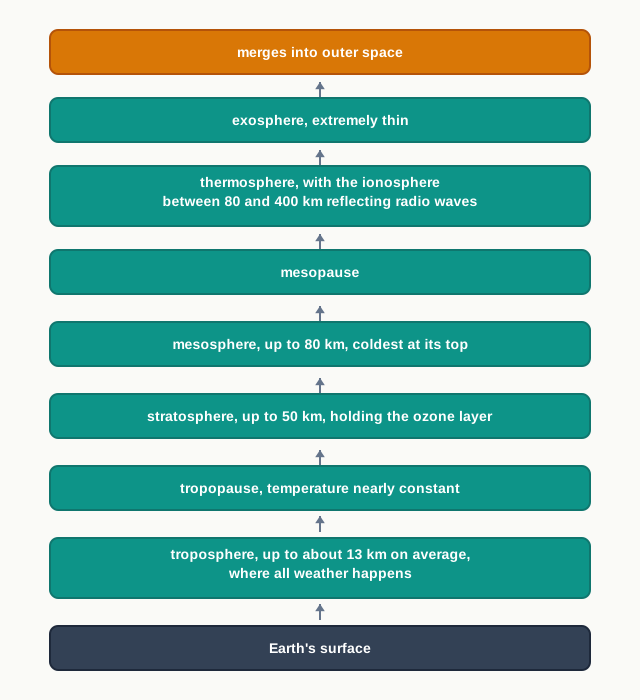
Fig. 7.3 – The layers of the atmosphere.
Every layer must exert some influence on us, but for the purposes of weather and climate, geographers are concerned mainly with the first two — the troposphere, where weather is made, and the stratosphere, which guards the life beneath it.
7.3 Elements Of Weather And Climate
Not everything about the atmosphere changes. Its layered structure and its broad make-up stay much the same from one day to the next. But a handful of its qualities are always shifting, and it is these changeable qualities that we actually feel as weather. The chapter names six of them: temperature, pressure, winds, humidity, clouds and precipitation. Because they are subject to change, they are the elements that shape weather and climate, and through them the atmosphere reaches into human life on Earth.
Two of the six have already appeared in this chapter. Humidity is simply the amount of water vapour in the air — the variable gas discussed earlier. Clouds are what form when that vapour condenses onto the dust and salt particles the air carries. The other four — temperature, pressure, winds and precipitation — are the readings a weather forecast puts in front of you every day: how warm it will be, whether pressure is high or low, which way and how hard the wind will blow, and whether rain is on the way.
It is worth keeping the two words in the section’s title apart. Weather is the state of these elements at a place at a single moment; climate is their average behaviour over many years. Each element is taken up in full in the chapters that follow, where the processes behind it are worked out one at a time. This section only names them, so that the doorway into the rest of the unit is clear.
7.4 Summary
- Air is essential to all life. Ninety-nine per cent of the atmosphere’s mass lies within 32 km of the surface, and the air is colourless and odourless, felt only when it moves as wind.
- The atmosphere is a mixture of gases, water vapour and dust particles. Its make-up changes with height: oxygen is almost negligible by about 120 km, and carbon dioxide and water vapour reach only to about 90 km.
- Carbon dioxide is transparent to incoming solar radiation but opaque to outgoing terrestrial radiation. By absorbing part of that outgoing heat and returning part to the surface, it drives the greenhouse effect. Its volume has been rising with the burning of fossil fuels, warming the air.
- Ozone, found between 10 and 50 km, filters the Sun’s ultra-violet rays and shields the life below from them.
- Water vapour is a variable gas — up to four per cent of the air in the warm, wet tropics but under one per cent in deserts and polar regions. It thins with altitude and from the equator poleward, and it acts as a blanket, keeping the Earth neither too hot nor too cold.
- Dust and salt particles act as hygroscopic nuclei on which water vapour condenses to build clouds. They are most concentrated over the subtropical and temperate regions.
- Density is highest at the surface and falls with altitude. By temperature, the atmosphere is divided into five layers: troposphere, stratosphere, mesosphere, thermosphere and exosphere.
- The troposphere holds all weather, averages 13 km in height (about 8 km at the poles and 18 km at the equator), and cools by 1°C for every 165 m. The tropopause above it holds a nearly constant temperature.
- The stratosphere, up to 50 km, holds the ozone layer. The mesosphere, up to 80 km, is coldest at its top, near minus 100°C. The ionosphere, between 80 and 400 km, carries charged ions that reflect radio waves back to Earth. The exosphere merges into outer space.
- The changeable elements of the atmosphere — temperature, pressure, winds, humidity, clouds and precipitation — are what shape weather and climate and, through them, human life.
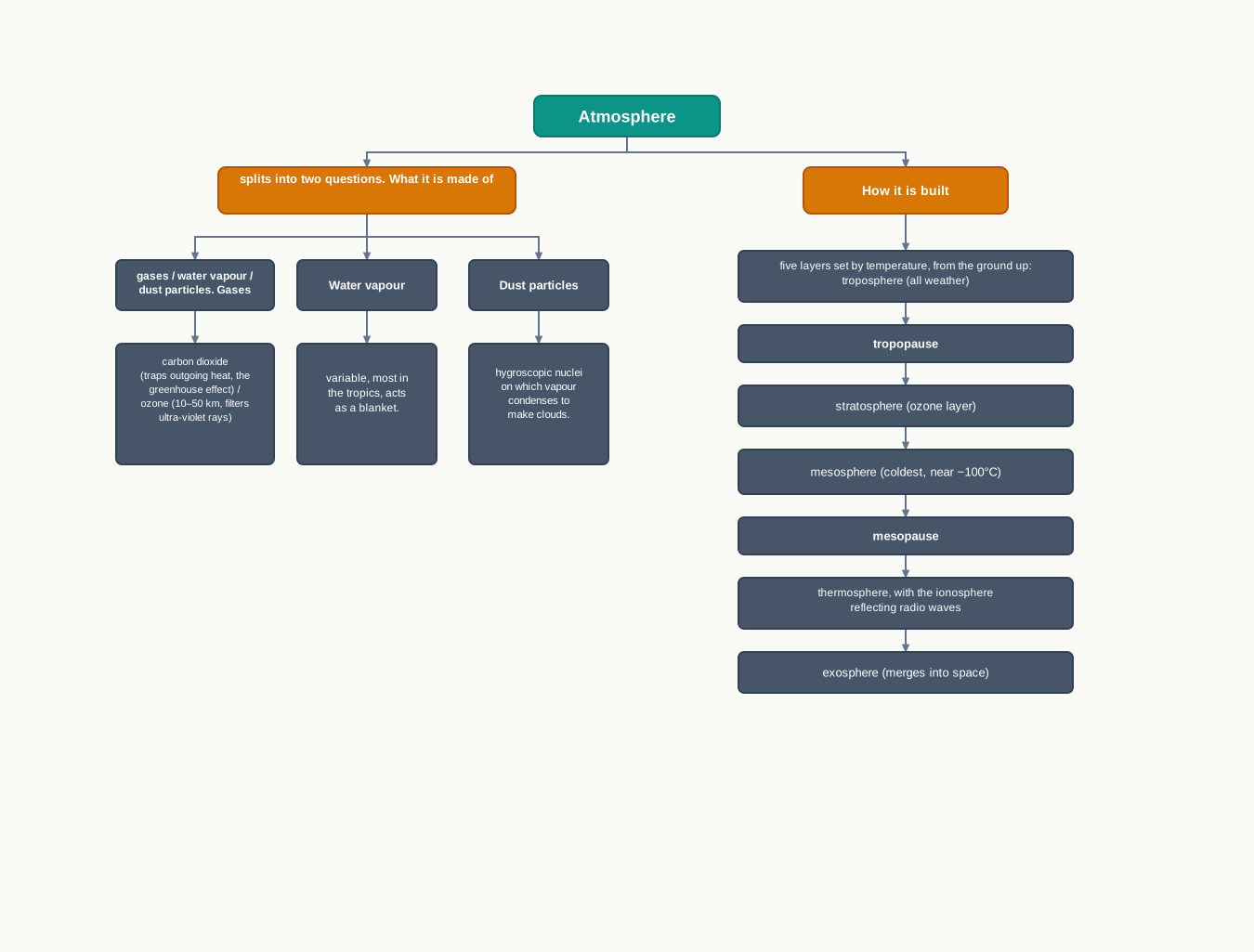
Fig. 7.4 – Chapter summary: composition and structure of the atmosphere.
What This Chapter Cannot Tell You
The layer heights and temperatures are round averages, not fixed walls. The real boundaries are broad zones of transition, and figures like 13 km or minus 80°C stand for typical conditions, not exact lines drawn in the sky.
The chapter says carbon dioxide is rising and warming the air, but it gives no measured rate — only the direction of the change, not how much, how fast, or over what period.
It names the six elements of weather and climate without explaining how any of them works. On its own, this chapter cannot tell you why pressure varies or how winds form; that reasoning belongs to the chapters that follow.
7.5 NCERT Questions
Which one of the following gases constitutes the major portion of the atmosphere?
- Oxygen
- Nitrogen
- Argon
- Carbon dioxide
Atmospheric layer important for human beings is:
- Stratosphere
- Mesosphere
- Troposphere
- Ionosphere
Sea salt, pollen, ash, smoke soot, fine soil — these are associated with:
- Gases
- Dust particles
- Water vapour
- Meteors
Oxygen gas is in negligible quantity at the height of atmosphere:
- 90 km
- 120 km
- 100 km
- 150 km
Which one of the following gases is transparent to incoming solar radiation and opaque to outgoing terrestrial radiation?
- Oxygen
- Nitrogen
- Helium
- Carbon dioxide
What do you understand by atmosphere? (30 words)
What are the elements of weather and climate? (30 words)
Describe the composition of atmosphere. (30 words)
Why is troposphere the most important of all the layers of the atmosphere? (30 words)
Describe the composition of the atmosphere. (150 words)
Draw a suitable diagram for the structure of the atmosphere and label it and describe it. (150 words)
7.6 Check Your Concepts
Using Fig. 7.2, describe how the air temperature changes as you climb from the surface up to about 80 km. Say clearly where it falls and where it rises.
Explain, step by step, how dust and salt particles help clouds to form.
Radio waves sent from the Earth can reach places far beyond the horizon, where straight-line light cannot. Which layer of the atmosphere makes this possible, and what feature of that layer causes it?
The troposphere is about 18 km thick at the equator but only about 8 km at the poles. Explain why, using what the chapter says about convectional currents.
Water vapour may make up as much as four per cent of the air in the warm, wet tropics but less than one per cent in deserts and polar regions. Account for this difference.
The temperature in the troposphere falls by 1°C for every 165 m of height. Express this as an approximate fall in temperature for each kilometre of climb, showing your working.
The average height of the troposphere is given as 13 km, yet it ranges from about 8 km at the poles to about 18 km at the equator. What does the single figure of 13 km hide, and why can such an average mislead?