Chapter 1: An Overview of Recombinant DNA Technology
For most of the twentieth century, a child with diabetes depended on animals. Insulin was extracted from the pancreatic glands of cattle and pigs collected from slaughterhouses, and it took an enormous quantity of glandular tissue to yield a small amount of the hormone. The supply was limited, the price was high, and the animal hormone was not exactly the same molecule as human insulin. In some patients the body recognised it as foreign and reacted against it.
Then something remarkable happened. Scientists learned to take the human instruction for making insulin — the gene itself — and place it inside a bacterium. The bacterium read the instruction as if it were its own and began manufacturing human insulin. A living cell too small to see had been turned into a factory. In 1982, the first recombinant DNA therapeutic product, Humulin, developed by Eli Lilly and Genentech, was approved for human use. For the first time, patients received insulin that was chemically identical to the hormone their own bodies should have made.
That single shift — from harvesting a molecule to instructing a cell to build it — is the heart of recombinant DNA technology. This chapter traces how it became possible.
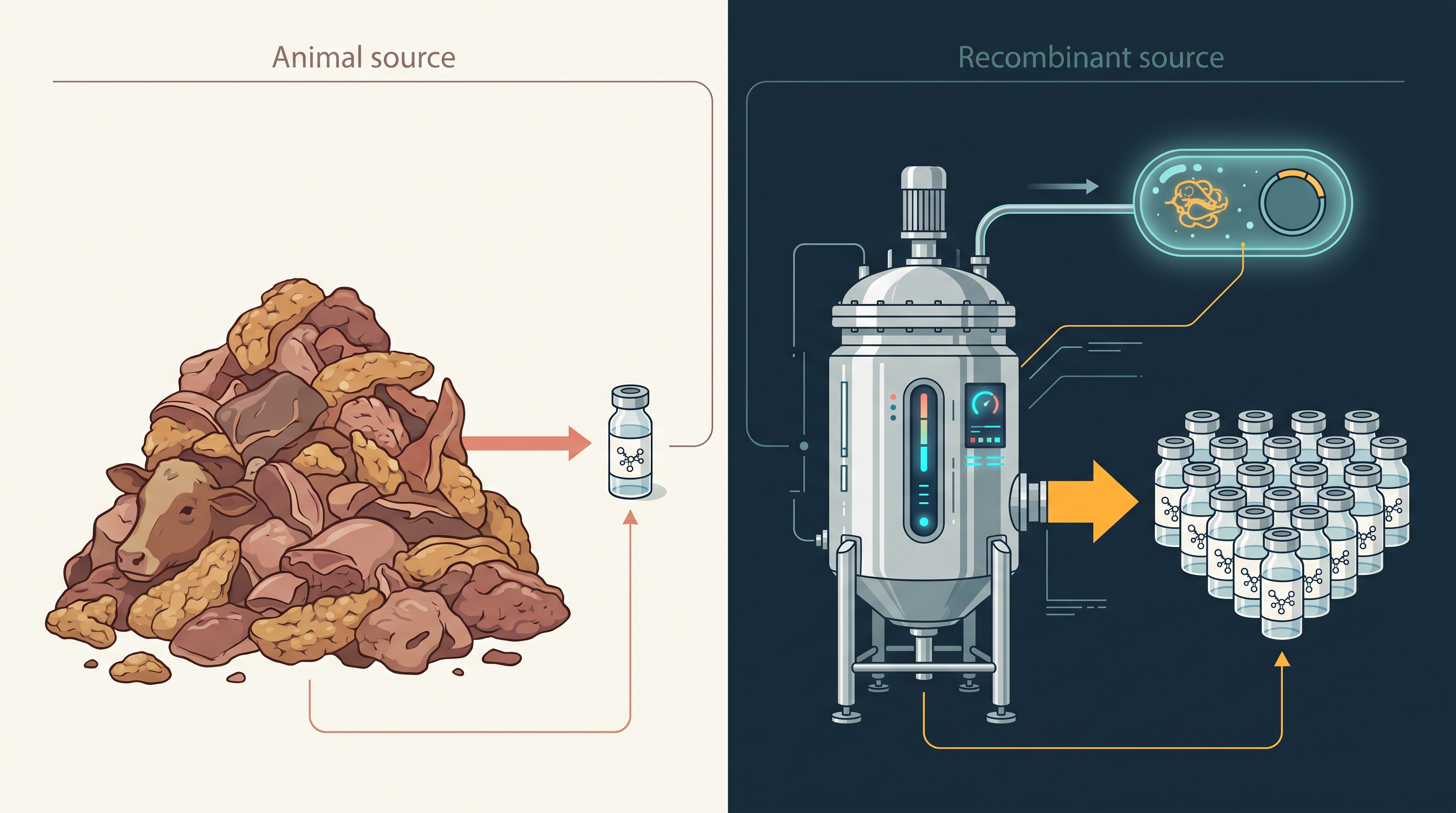
Fig. 1.0 – Animal versus recombinant sources of insulin.
Read on — each of these questions is answered inside this chapter, and you will find the answers marked out for you as you go.
1.1 An Overview of Recombinant DNA Technology
This chapter gives an overview of recombinant DNA (rDNA) technology — how the basic ideas of molecular biology, microbiology, genetics and biochemistry came together to make it possible. It also looks, in a conceptual way, at what rDNA technology has done for medicine and agriculture, along with some well-known products that have come out of it.
What Genetic Engineering Means
In the last century, scientists established that nucleic acid — specifically DNA — is the principal molecule responsible for the expression of characters. Once that was clear, a new possibility opened up. If DNA decides the characters an organism shows, then changing the DNA should change the characters.
This is a very different way of thinking from traditional breeding. A plant breeder crosses two plants and waits to see which combination of thousands of genes appears in the offspring. Here, instead, scientists set out to alter the genetic makeup of an organism by manipulating nucleic acid directly — working on the molecule itself rather than on the whole organism.
The various methods used for directly manipulating the nucleic acid or genome of an organism are collectively referred to as recombinant DNA (rDNA) technology, or genetic engineering. The word recombinant is the key: pieces of DNA that were never together in nature are deliberately combined into one molecule.
The Sciences That Made It Possible
rDNA technology did not appear from a single experiment. It became possible because of rapid progress in several fields of biology at once — biochemistry, genetics, cytology, microbiology, molecular biology and others. Each field supplied one piece of the puzzle.
The most important contributions of the last century were the isolation and purification of nucleic acids, followed by an understanding of their structures, properties and functions, and finally their sequencing. These laid the foundation on which rDNA technology was built. Notice the order — you cannot study a molecule until you can obtain it in pure form, and you cannot engineer it until you know how it is built and how it works.
The first breakthrough in this journey was to establish that the DNA of an organism not only carries its genetic information but also propagates that information from one generation to another. This settled the question of what the hereditary material actually is.
The next hallmark was the determination of the chemical and physical structure of the DNA molecule, and of its double helical structure. Structure mattered enormously here, because the two complementary strands explain how DNA can be copied faithfully — and complementarity is later exactly what allows a scientist to design a matching piece of DNA at will.
Beyond structure, scientists worked out replication, transcription and translation in detail — how DNA is copied, how it is read into RNA, and how that message is translated into protein. This is what makes the whole enterprise useful: if you place a gene inside a cell, the cell’s own transcription and translation machinery will read it and make the protein.
Alongside this, scientists developed various methods and techniques to isolate and purify DNA from a wide range of organisms. Without a reliable way to get clean DNA out of a cell, nothing further would be possible.
Enzymes: The Molecular Tools
Knowing about DNA is not the same as being able to handle it. To work on a molecule you can neither see nor hold, you need tools that act at the molecular scale. Several enzymes were discovered at around the same time, using which one can precisely manipulate a DNA molecule.
Restriction enzymes were one such discovery. They act as molecular scissors that cut the molecules of DNA, and they were discovered by Werner Arber, Hamilton Smith and Daniel Nathan during the late 1960s and early 1970s. What makes them so valuable is that they do not cut at random — each one recognises a particular short sequence and cuts there, so the same enzyme cuts the same DNA into the same fragments every time.
The complementary tool is ligase, the enzyme that joins two DNA fragments, discovered by Gellert, Lehman, Richardson and Hurwitz in the year 1967. Together, these two kinds of enzyme give a scientist the two operations any craftsman needs — cutting to size, and joining. The cutting and joining action is shown in Fig. 1.1.
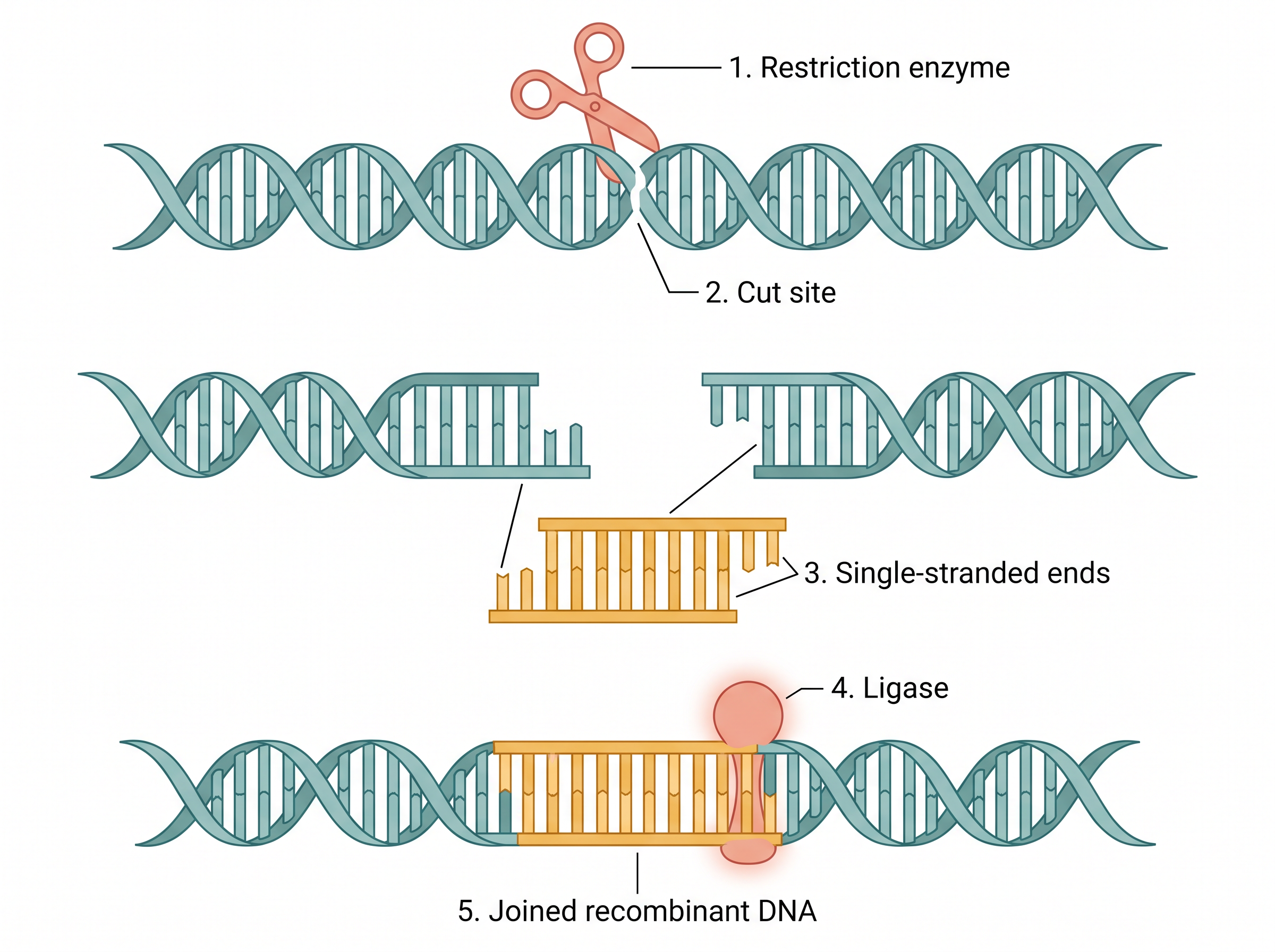
Fig. 1.1 – Cutting and joining of DNA.
Bacteria That Pick Up DNA
During this same period, scientists also noticed something about bacteria that turned out to be extremely useful. Bacteria can take up foreign DNA fragments from their surrounding environment, and that DNA can then be integrated into the bacterial genome. In other words, a bacterial cell is not sealed off from outside DNA — it can accept it and treat it as its own. The uptake of foreign DNA by a cell in this way is called transformation, and it is the doorway through which an engineered DNA molecule is later delivered into a living cell.
This mattered because a piece of DNA sitting in a test tube does nothing. It has to be inside a living cell before it can be copied and read.
With all this knowledge in hand, scientists asked a natural question: is it possible to transfer the gene of interest from one organism to another organism, and so obtain its product? Every element of an answer now existed separately. What was missing was someone who could put them together.
Two Experts, One Idea
Stanley Cohen had the expertise in introducing plasmid DNA into Escherichia coli (E. coli), and in the subsequent propagation and cloning of plasmids in the bacteria. A plasmid is a small circular DNA molecule that exists in a bacterial cell separately from the main chromosome and can multiply on its own; because it multiplies, anything carried inside it multiplies too. To clone here means to make many identical copies.
Herbert Boyer, on the contrary, had the expertise to cleave double stranded DNA using restriction enzymes, so as to produce single stranded ends with identical termini. This detail is worth pausing on. If two different DNA molecules are cut with the same restriction enzyme, both are left with the same kind of single-stranded ends — and identical ends will pair with each other. That is precisely what allows a foreign gene to slot into a plasmid.
Both scientists visualised the potential of combining the two discoveries into what would later become rDNA technology, or genetic engineering. One knew how to open and rejoin DNA; the other knew how to get a plasmid into a bacterium and multiply it. Neither skill alone was enough.
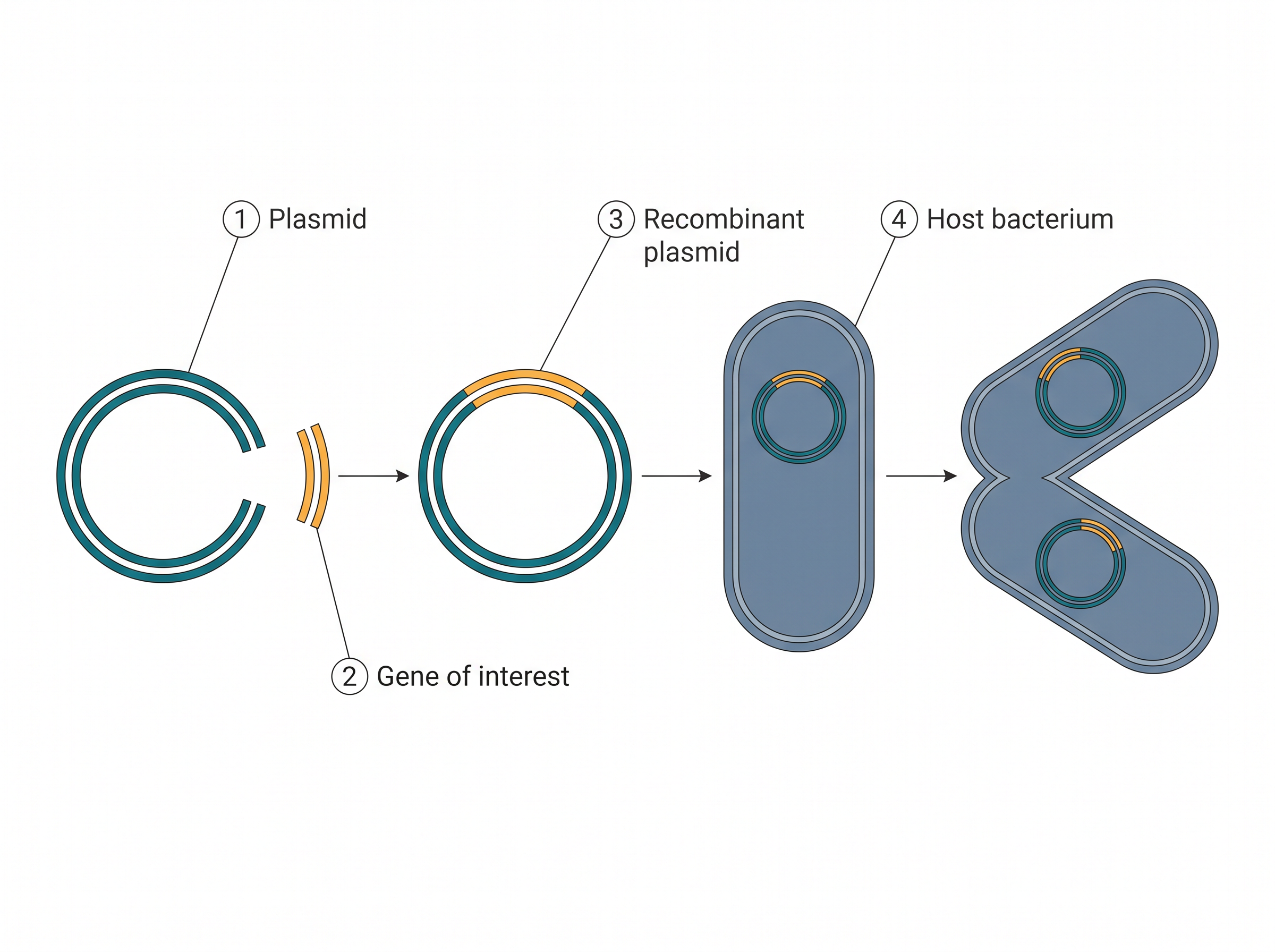
Fig. 1.2 – The Cohen–Boyer experiment.
The general sequence that emerged from this work is the backbone of the whole subject, and is summarised in Fig. 1.3. Every later chapter of this unit expands one of its steps.
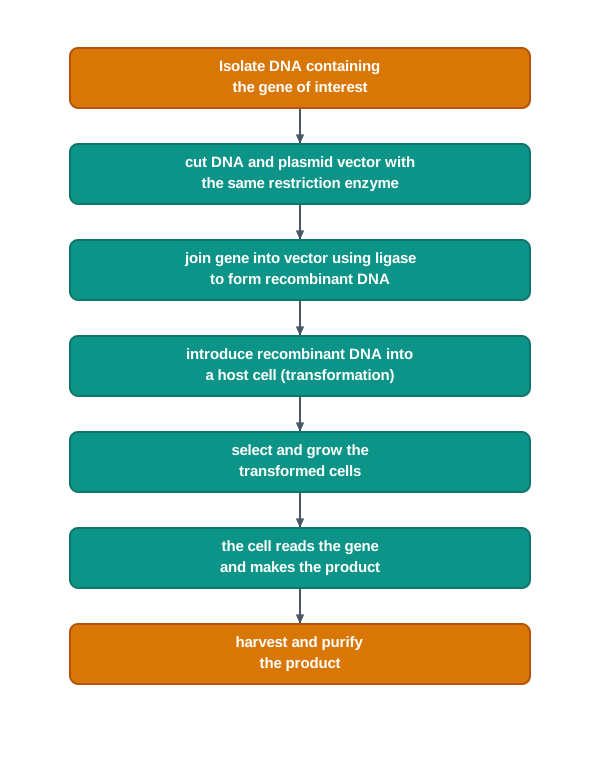
Fig. 1.3 – The basic rDNA workflow.
rDNA Technology in Medicine
rDNA technology has contributed immensely to the diagnosis and treatment of various diseases, including genetic disorders, and to the development of disease-free, high-yielding crops. Its contribution in shaping our lives can be judged from a few examples.
Earlier, several tons of animal pancreatic glands were needed to obtain a few milligrams of insulin to treat diabetes. Similarly, thousands of animal pituitary glands were required to isolate growth hormone to treat dwarfism. Because the raw material was so scarce, these products were available only in limited quantity and at a high cost.
There was a second, subtler problem. Even after purification, therapeutic proteins from an animal source exhibited immunogenic reactions in humans. The animal protein is not identical to the human one, so the patient’s immune system can recognise it as foreign and react against it — a serious matter for someone who must take the medicine every day for life.
Scientists circumvented both obstacles by producing human insulin and human growth hormone in a bacterial system using rDNA technology. The human gene is placed in bacteria, the bacteria are grown in large cultures, and the protein they make is the human protein — so the quantity problem and the immunogenicity problem are solved together.
Other products followed the same logic. Interferon is produced to treat cancer, while plasminogen activator and urokinase are produced to dissolve blood clots. Each of these is a human protein that would otherwise be almost impossible to obtain in useful amounts.
rDNA Technology in Agriculture
In the last few decades, by employing rDNA technology, scientists have been able to introduce specific targeted modifications into the plant genome to obtain genetically modified crops. The word targeted is important — a chosen character is altered, rather than a whole set of unknown characters being shuffled as in conventional crossing.
In this way, crops have been developed that offer resistance to diseases, freeing farmers from constant worry about damage to their standing crop. Drought-resistant and salinity-tolerant crops have also been developed, so that farmers can grow them in adverse environments — on land that is dry, or where the soil carries too much salt.
Such modifications in the genetic system of plants or crops by rDNA technology not only improve the quality of production but also enhance the value of the products.
Looking Ahead: Plants as Factories
The days are not far off when a variety of important therapeutic proteins, peptides and hormones will be produced from plants by employing rDNA technology. The idea is the same as with bacteria: place the human gene in the plant and let the plant make the protein.
Such products will have many advantages over animal-based products, in terms of both cost and contamination. Animal-based products are generally costlier and require extra care to ensure that they are free of viruses and other animal protein contaminants — a plant does not carry the viruses that infect human beings, so one whole class of risk is removed at the source.
Landmarks in the Growth of Biotechnology
The following table lists selected developments in the history of biotechnology. Read it as a story rather than a list to be memorised: notice how the early entries are about understanding DNA, the middle entries are about acquiring tools, and the later entries are about products reaching patients and farmers.
Selected developments in the history of biotechnology
| Year | Development |
|---|---|
| 1917 | Karl Ereky coined the term ‘Biotechnology’ |
| 1944 | Avery, MacLeod and McCarty demonstrated that ‘DNA is the genetic material’ |
| 1952 | Joshua Lederberg discovered ‘Plasmids’ |
| 1953 | Watson and Crick proposed ‘Double Helical structure of DNA’ |
| 1960s | Werner Arber, Matthew Meselson discovered ‘Type I restriction enzymes’ |
| 1967 | Gellert, Lehman, Richardson and Hurwitz discovered ‘ligase enzymes’ |
| 1970 | Hamilton O. Smith and Thomas J. Kelly discovered ‘Type II restriction enzymes’ |
| 1972 | Paul Berg assembled the first ‘Recombinant DNA’ from a bacterium into the virus |
| 1973 | Stanley N. Cohen and Herbert Boyer developed ‘DNA cloning and rDNA technology’ |
| 1975 | Georges J.F. Köhler and César Milstein described the ‘Hybridoma Technology’ for production of monoclonal antibodies |
| 1982 | FDA approved world’s first recombinant DNA Therapeutic Product ‘Humulin’ developed by Eli Lilly and Genentech |
| 1983 | Kary Mullis developed ‘Polymerase Chain Reaction’ |
| 1984 | Sir Alec Jeffreys invented ‘DNA Fingerprinting’ |
| 1986 | The first recombinant vaccine ‘Recombivax HB’ for Hepatitis B was approved for human use |
| 1990 | ‘Human Genome Project’ officially initiated which was coordinated by the U.S. Department of Energy (DOE) and the National Institutes of Health (NIH) |
| 1994 | The first genetically engineered crop ‘Flavr Savr’ tomato was introduced that was produced by Calgene in 1992 |
| 1996 | Keith Campbell and Ian Wilmut cloned the first mammal ‘Dolly’ the sheep from somatic cell using nuclear transfer technique |
| 1996 | Researchers at Monsanto developed ‘Bt cotton’ and first commercially released it in China and the United States in 1996, followed by its introduction in India in 2003 |
| 2000 | Ingo Potrykus and Peter Beyer developed ‘Golden Rice’ |
| 2003 | The Human Genome Project (HGP) was completed |
| 2004 | ‘Avastin’, an anti-VEGF monoclonal antibody for cancer treatment was developed |
| 2006 | A recombinant vaccine ‘Gardasil’ against human papillomavirus (HPV) received FDA approval |
| 2006 | Nobel prize awarded for discovery of RNA interference ‘Gene Silencing’ by double stranded RNA |
| 2010 | Robert Edwards awarded Nobel Prize for the development of human ‘in vitro fertilization’ (IVF) therapy |
| 2012 | Shinya Yamanaka and John B. Gurdon discovered that mature differentiated cells can be reprogrammed into ‘Induced Pluripotent Stem Cells’ |
| 2019 | Nobel prize awarded for discovery of ‘CRISPR-Cas9’ genome editing tool |
| 2020 | Recombinant vaccines against COVID-19 was developed |
| 2023 | Nobel prize awarded for the mRNA vaccine against covid–19 |
Board and competitive papers use a timeline like this in a particular way. You are rarely asked to reproduce it; you are asked who discovered what, or to place two events in the correct order, or given an assertion–reason item pairing a scientist with a discovery. Learning the table as a sequence of enabling steps, rather than as isolated year–name pairs, is what makes those questions easy.
In the next chapters of this unit, the various components and applications of rDNA technology are discussed in detail — the host and vector systems that carry the gene, the process of gene cloning itself, and the applications that grow out of it.
1.2 Summary
The methods used for directly manipulating the nucleic acid or genome of an organism are collectively referred to as recombinant DNA (rDNA) technology, or genetic engineering.
The fundamental theme of rDNA technology is the isolation and propagation of a desired DNA molecule (gene) from a source, with the aim of obtaining its product in ample quantity. This technique is called gene cloning.
rDNA technology became possible because of progress in several fields at once — biochemistry, genetics, cytology, microbiology and molecular biology. The isolation and purification of nucleic acids, and the understanding of their structure, properties, functions and sequence, laid its foundation.
The first breakthrough was establishing that DNA carries an organism’s genetic information and passes it from one generation to the next. The determination of the chemical and physical structure of DNA, and of its double helical structure, followed. Replication, transcription and translation were then understood in detail.
Two groups of enzymes supplied the working tools. Restriction enzymes cut DNA and were discovered by Werner Arber, Hamilton Smith and Daniel Nathan during the late 1960s and early 1970s. Ligase joins two DNA fragments and was discovered by Gellert, Lehman, Richardson and Hurwitz in 1967.
Bacteria can take up foreign DNA fragments from their surroundings and integrate them into their genome. This natural ability is what allows an engineered DNA molecule to be delivered into a living cell.
Stanley Cohen’s expertise lay in introducing plasmid DNA into Escherichia coli and propagating and cloning plasmids in the bacteria; Herbert Boyer’s lay in cleaving double stranded DNA with restriction enzymes to give single stranded ends with identical termini. Combining the two led to rDNA technology.
In medicine, rDNA technology solved both the scarcity and the immunogenicity of animal-derived therapeutic proteins. Human insulin and human growth hormone are now produced in bacterial systems; interferon is used against cancer, and plasminogen activator and urokinase dissolve blood clots.
In agriculture, specific targeted modifications in the plant genome have produced crops resistant to disease and tolerant of drought or salinity, improving both the quality of production and the value of the products.
In future, therapeutic proteins, peptides and hormones are expected to be produced from plants, which would be cheaper and free of the virus and animal protein contamination risks that come with animal-based products.
The overall sequence of the technology is summarised in Fig. 1.4.
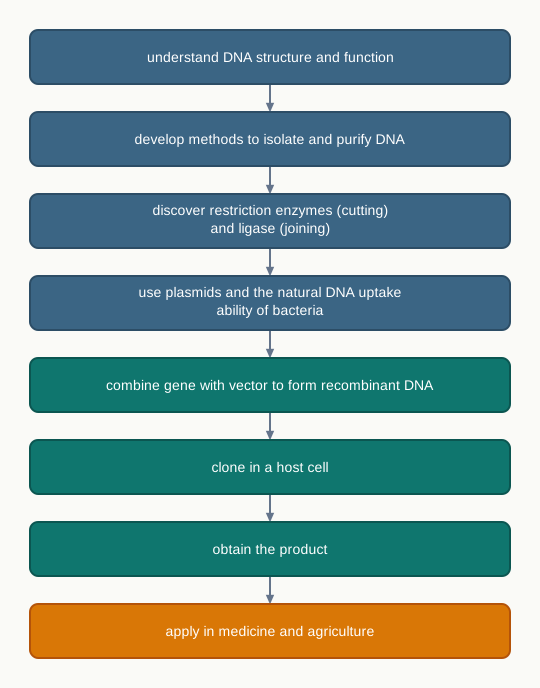
Fig. 1.4 – Chapter overview.
1.3 Key Terms
Nucleic acid (DNA) — The principal molecule responsible for the expression of characters, which carries an organism’s genetic information and passes it from one generation to the next.
Genome — The complete genetic material of an organism, which rDNA technology sets out to manipulate directly.
Recombinant DNA (rDNA) technology — The collective set of methods used for directly manipulating the nucleic acid or genome of an organism.
Genetic engineering — Another name for rDNA technology, used for the same set of direct DNA-manipulation methods.
Sequencing — Determining the order of bases in a nucleic acid, one of the foundational advances on which rDNA technology was built.
Replication — The copying of DNA, so that genetic information can be passed on to daughter cells.
Transcription — The reading of a DNA sequence into RNA.
Translation — The conversion of the RNA message into a protein, which is why a gene placed inside a cell can yield its product there.
Restriction enzyme — An enzyme that acts as molecular scissors, cutting DNA molecules at a specific recognised sequence.
Ligase — An enzyme that joins two DNA fragments together, sealing a gene into a vector.
Transformation — The uptake of foreign DNA fragments by a bacterium from its surroundings, after which the DNA can be integrated into its genome.
Plasmid — A small circular DNA molecule present in bacteria apart from the main chromosome, able to multiply on its own and therefore able to carry and multiply an inserted gene.
Vector — The self-replicating DNA molecule, such as a plasmid, used to carry a gene of interest into a host cell.
Recombinant plasmid — A plasmid that has been cut open, given a gene from a different source and closed again, so that it contains recombined DNA from two different sources.
Host cell — The living cell, such as Escherichia coli, into which recombinant DNA is introduced so that it can be copied and read.
Clone — An identical copy; cloning is the production of many identical copies of a DNA molecule or cell.
Gene cloning — The isolation and propagation of a desired DNA molecule from a source, so that its product is obtained in ample quantity.
Genetically modified organism — An organism whose genetic material has been deliberately altered by rDNA technology, the first of which came from the Cohen–Boyer experiment.
Immunogenic reaction — The reaction of a patient’s immune system against a therapeutic protein it recognises as foreign, a problem with animal-derived hormones.
Interferon — A therapeutic protein produced by rDNA technology and used in the treatment of cancer.
Plasminogen activator — A recombinant therapeutic protein used to dissolve blood clots.
Urokinase — A recombinant therapeutic protein, also used to dissolve blood clots.
Genetically modified crop — A crop carrying a specific targeted modification in its genome, giving it a chosen character such as disease resistance, drought resistance or salinity tolerance.
1.4 Points to Ponder
Traditional breeding also changes the genetic makeup of an organism, but it does so indirectly. What exactly makes rDNA technology different in kind, and not merely faster?
The chapter says that understanding the structure of DNA came before the ability to engineer it. Think about why structural knowledge had to come first — what would a scientist be unable to do without knowing that the two strands are complementary?
Restriction enzymes cut DNA only at particular sequences rather than at random. Consider what genetic engineering would look like if an enzyme cut DNA wherever it happened to land.
Ligase was discovered in 1967 and restriction enzymes around the same period, yet the first recombinant plasmid was made only in 1973. Reflect on what else had to be in place before cutting and joining could actually produce a genetically modified organism.
Cohen and Boyer each held only half of what was needed. Think about how often a scientific advance comes from combining two existing skills rather than from a single new discovery, and what that suggests about how research is best organised.
Bacteria naturally take up DNA from their environment. Reflect on the fact that a major technology was built on an ordinary ability that bacteria already possessed, and consider what other natural abilities of organisms might be turned into tools.
Human insulin made in bacteria is chemically the same molecule as human insulin made in the pancreas. Should the source of a medicine matter to a patient if the molecule is identical? Consider both the scientific and the personal side of this question.
Drought-tolerant and salinity-tolerant crops allow farming on land that was previously unusable. Think about the benefits this brings and the questions it raises about land use, biodiversity and the farmer’s dependence on seed suppliers.
The chapter suggests that plants may one day produce therapeutic proteins more safely than animals. What practical difficulties would have to be solved before a medicine grown in a field could reach a patient?
Look again at the timeline of developments in biotechnology. Which single entry, in your view, made the largest number of later entries possible, and why?
1.5 NCERT Questions
Discuss in brief how recombinant DNA technology was initially developed.
Briefly discuss the application of rDNA technology in crop improvement and therapeutics.
Who discovered the Plasmid?
- Paul Berg
- Sir Alec Jeffreys
- Joshua Lederberg
- Kary Mullis
Plasminogen activator and Urokinase are used as:
- Antiviral agent
- Blood clot dissolving drug
- Sugar lowering agent
- Cholesterol lowering agent
Assertion: Restriction endonuclease cuts DNA and isolated mostly from bacteria. Reason: Restriction endonuclease is a type of nuclease.
- Both assertion and reason are true and the reason is the correct explanation of the assertion.
- Both assertion and reason are true but the reason is not the correct explanation of the assertion.
- Assertion is true but reason is false.
- Both assertion and reason are false.
Assertion: E. coli divides in 20 minutes while replicates its DNA in about 60 minutes. Reason: E. coli follows multifork replication mechanism.
- Both assertion and reason are true and the reason is the correct explanation of the assertion.
- Both assertion and reason are true but the reason is not the correct explanation of the assertion.
- Assertion is true but reason is false.
- Both assertion and reason are false.
1.6 Objective Questions
- The collective set of methods used for directly manipulating the nucleic acid or genome of an organism is known as:
- Selective breeding
- Recombinant DNA technology
- Tissue culture
- Hybridisation
- The enzyme that acts as molecular scissors in genetic engineering is:
- DNA ligase
- DNA polymerase
- Restriction enzyme
- Reverse transcriptase
- Ligase enzymes were discovered in the year:
- 1953
- 1967
- 1972
- 1982
- Restriction enzymes were discovered by:
- Watson and Crick
- Avery, MacLeod and McCarty
- Werner Arber, Hamilton Smith and Daniel Nathan
- Gellert, Lehman, Richardson and Hurwitz
- Stanley Cohen’s particular expertise, before his collaboration with Herbert Boyer, was in:
- Cleaving double stranded DNA with restriction enzymes
- Determining the double helical structure of DNA
- Introducing plasmid DNA into E. coli and cloning plasmids in bacteria
- Sequencing nucleic acids
- The first genetically modified organisms were created by the Cohen–Boyer team after preliminary experiments in:
- 1967
- 1970
- 1973
- 1982
- The term ‘Biotechnology’ was coined by:
- Karl Ereky
- Joshua Lederberg
- Paul Berg
- Kary Mullis
- Earlier, growth hormone for the treatment of dwarfism had to be isolated from:
- Several tons of animal pancreatic glands
- Thousands of animal pituitary glands
- Human blood plasma
- Cultured plant cells
- Interferon produced by rDNA technology is used in the treatment of:
- Diabetes
- Dwarfism
- Cancer
- Blood clots
- Which of the following is not a reason why therapeutic proteins from animal sources were unsatisfactory?
- They were available only in limited quantity
- They were costly
- They could cause immunogenic reactions in humans
- They were chemically unstable at room temperature
- The world’s first recombinant DNA therapeutic product approved by the FDA was:
- Gardasil
- Recombivax HB
- Humulin
- Avastin
- The property of bacteria that allows engineered DNA to be delivered into them is that they can:
- Take up foreign DNA fragments from their surroundings and integrate them into their genome
- Synthesise DNA without a template
- Reproduce sexually
- Cut their own chromosome with ligase
- The first genetically engineered crop, the ‘Flavr Savr’ tomato, was introduced in:
- 1986
- 1990
- 1994
- 2000
Assertion: A gene of interest is inserted into a plasmid before being introduced into a bacterial cell. Reason: A plasmid is a small circular DNA molecule that can multiply on its own inside a bacterium, so whatever it carries is multiplied along with it.
Assertion: Two different DNA molecules cut with the same restriction enzyme can be joined together easily. Reason: Cutting with the same restriction enzyme leaves single stranded ends with identical termini on both molecules.
Assertion: Human insulin produced in bacteria does not cause the immunogenic reactions that animal-derived insulin could cause. Reason: The bacterium carries the human gene and therefore makes the human protein itself.
Assertion: Restriction enzymes alone were not sufficient to create recombinant DNA. Reason: A cut DNA molecule must also be sealed to another fragment, which requires ligase.
Assertion: Therapeutic proteins produced in plants are expected to be safer than those obtained from animal sources. Reason: Animal-based products are costlier and require extra care to be kept free of virus and other animal protein contaminants.
Assertion: Understanding transcription and translation was essential before genes could be transferred usefully between organisms. Reason: A transferred gene yields a product only if the host cell can read it and build the corresponding protein.
1.7 Check Your Concepts
Why is the technology called recombinant DNA technology? Explain what is actually being recombined, and how this differs from the recombination that occurs naturally during breeding.
The chapter states that the isolation and purification of nucleic acids had to come before rDNA technology could develop. Explain why this order was unavoidable.
What would go wrong if a scientist had access to restriction enzymes but no ligase? Describe the stage at which the work would stop.
Suppose a restriction enzyme cut DNA at random positions instead of at a specific recognised sequence. Explain, with reasoning, why gene cloning would become impractical.
Compare and contrast restriction enzymes and ligase under the headings: action on DNA, site of action, and role in making recombinant DNA.
Herbert Boyer’s technique produced single stranded ends with identical termini on the cut DNA molecules. Explain why the word “identical” is the crucial part of that sentence.
Arrange the following in the correct historical sequence and state briefly what each one made possible: demonstration that DNA is the genetic material; discovery of plasmids; proposal of the double helical structure; discovery of ligase; development of DNA cloning by Cohen and Boyer.
Arrange the following steps of the basic rDNA workflow in the correct order: transformation of the host cell; cutting the vector and the gene of interest with a restriction enzyme; harvesting the product; isolating the DNA containing the gene of interest; joining the gene into the vector with ligase; growing the transformed cells.
Match the following:
| Column A | Column B |
|---|---|
| a. Joshua Lederberg | i. Polymerase Chain Reaction |
| b. Kary Mullis | ii. DNA Fingerprinting |
| c. Sir Alec Jeffreys | iii. Plasmids |
| d. Karl Ereky | iv. Hybridoma technology |
| e. Köhler and Milstein | v. Coined the term ‘Biotechnology’ |
Draw a labelled diagram of the Cohen–Boyer experiment. Label the plasmid, the site of cutting, the gene from the second bacterial species, the recombinant plasmid, and the host bacterium.
Why were animal-derived insulin and growth hormone both scarce and potentially harmful? Give the separate reason behind each of these two problems.
A student writes: “rDNA technology solved the insulin problem because bacteria can produce large amounts of protein.” Explain what important part of the answer the student has left out.
A student describes a cloning procedure as follows: isolate the gene of interest → introduce it directly into the host bacterium → grow the bacterium → harvest the protein. Identify the step that has been wrongly omitted, and explain what would happen to the gene inside the cell without it.
Why is the ability of bacteria to take up foreign DNA from their surroundings described in this chapter as a turning point, even though it is a perfectly natural ability that bacteria always had?
Explain the difference between a genetically modified crop and a crop improved by conventional cross-breeding, using the word “targeted” in your answer.
Drought-tolerant and salinity-tolerant crops are described as allowing farming in adverse environments. Explain how a change at the level of the genome can produce a change in the field, and mention one scientific and one social question that such crops raise.
The chapter suggests that plants may in future replace animals as the source of therapeutic proteins. Give two advantages of plant-based production, and explain why the protein produced would still be identical to the human protein.
Interferon, plasminogen activator and urokinase are all produced by rDNA technology. State the therapeutic use of each, and explain what these three products have in common that made rDNA technology necessary for their manufacture.
“Neither Cohen’s skill nor Boyer’s skill alone would have produced a genetically modified organism.” Justify this statement by explaining what each scientist contributed and why both were required.
1.8 Case-Based Questions
A hospital pharmacist is going through old purchase records. In one register from several decades ago, insulin is listed as being supplied in very small vials, at a high price, with a note that supply depends on the availability of animal glands. A few pages later, a note records that some patients on this insulin developed reactions and had to be monitored. In a much more recent register, insulin is listed as being available in steady supply at a far lower price, with no such note about reactions.
- Explain why the earlier supply of insulin was both scarce and expensive.
- What was the biological reason behind the reactions recorded in some patients?
- Describe how rDNA technology removed both of these problems at once.
- State one other human hormone that faced exactly the same difficulty before rDNA technology, and the condition it is used to treat.
A student is attempting a simple cloning exercise in a school laboratory simulation. She isolates a gene of interest and cuts it out using one restriction enzyme. She then takes a plasmid and cuts it open using a completely different restriction enzyme. She mixes the two, adds ligase, and finds that almost no recombinant plasmid is formed. She then repeats the exercise, this time cutting both the gene and the plasmid with the same restriction enzyme, and this time the joining works.
- Explain, in terms of the ends produced by a restriction enzyme, why the first attempt failed.
- Why did using the same enzyme on both molecules solve the problem?
- What is the specific role of ligase in this exercise, and why is it needed even after the ends have paired?
- Name the scientist whose expertise lay exactly in this cutting step, and the scientist whose expertise lay in the step that follows it.
A farmer in a coastal district finds that a strip of his land has become too salty to grow his usual variety of crop. An agricultural officer tells him about a variety developed using rDNA technology, in which a specific targeted modification has been introduced into the plant genome so that the plant can tolerate high salt levels. The farmer is interested but asks whether this is “the same as the new varieties my father used to get from the seed shop.”
- Explain to the farmer how this variety differs from one produced by conventional cross-breeding.
- What does the word “targeted” mean in this context, and why is it an advantage?
- Apart from salinity tolerance, name two other characters that rDNA technology has been used to introduce into crops.
- State one benefit and one concern that such crops raise, and mention why regulatory approval is required before release.
A biotechnology company announces that it has grown a batch of plants carrying a human gene, and that these plants are producing a therapeutic protein in their tissues. The company claims that this route will eventually be cheaper and safer than producing the same protein in animal systems. A newspaper reader is doubtful, and asks whether a protein made in a plant can really be the same as one made in the human body.
- Explain why the protein made by the plant is the same human protein, referring to the role of the gene.
- Give two reasons why the company expects this route to be safer and cheaper than an animal-based route.
- Explain what is meant by “animal protein contaminants” and why they are a concern.
- Which two cell types has rDNA technology already used successfully as protein factories, as described in this chapter?
A school is preparing a timeline display for a science exhibition titled “How Biotechnology Became Possible”. The students have written the following entries on separate cards, but have shuffled them: Watson and Crick propose the double helical structure of DNA; Cohen and Boyer develop DNA cloning and rDNA technology; Avery, MacLeod and McCarty demonstrate that DNA is the genetic material; FDA approves the first recombinant DNA therapeutic product; Gellert, Lehman, Richardson and Hurwitz discover ligase enzymes; Lederberg discovers plasmids.
- Arrange the cards in the correct chronological order.
- Group the entries into three phases — understanding DNA, acquiring tools, and delivering products — and justify your grouping.
- Choose any one entry and explain what became possible immediately after it that was not possible before it.
- The display ends in the 1980s. Name any two later developments from the chapter’s timeline that the students could add, with their years.