Chapter 8: Peasants, Zamindars And The State
It is a morning in the 1660s, somewhere in the plains of northern India. A cultivator is out before the light is full, walking the edge of a field he has marked off with a low border of earth and thorn. He owns a pair of bullocks, which makes him better off than many of his neighbours. His wife is already at work sifting grain. By the afternoon the village headman will sit with the accountant, checking what has been sown, and in a few weeks an official of the emperor will ride in to ask what the fields have produced.
Now think about what that man left behind. Not a letter. Not a diary. Not a single line in his own hand. He could not write, and nobody thought his opinion worth recording. He is one of roughly eighty-five people out of every hundred then living in India — and he is silent.
So how can a historian say anything at all about him? Everything we know about this village comes from people who were not the cultivator: a court historian writing to please an emperor, a revenue clerk counting what the state could tax, a European traveller startled by what he saw. The past of the Indian countryside has to be reconstructed from documents written by outsiders looking in — and often from above.
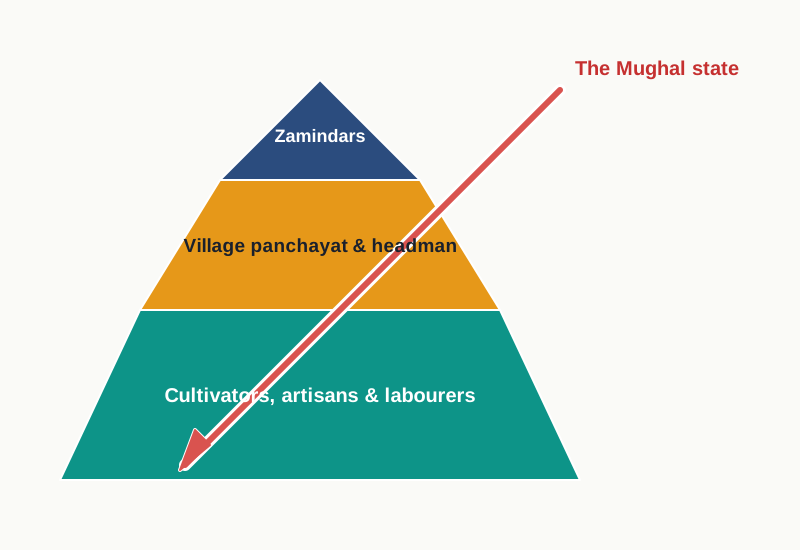
Fig. 8.0 – Rural society in Mughal India.
8.1 Peasants And Agricultural Production
During the sixteenth and seventeenth centuries, about 85 per cent of the population of India lived in its villages. Both peasants and landed elites were involved in agricultural production, and both claimed rights to a share of the produce.
That double claim on a single harvest created relationships of cooperation, competition and conflict. The sum of these agrarian relationships — the word simply means everything to do with land, its cultivation and the people who live off it — made up rural society.
At the same time, agencies from outside also entered the rural world. The most important of these was the Mughal state, which derived the bulk of its income from agricultural production.
Agents of the state — revenue assessors, collectors, record keepers — sought to control rural society. Their aim was to ensure that cultivation took place and that the state got its regular share of taxes from the produce. Since many crops were grown for sale, trade, money and markets entered the villages and linked agricultural areas with the towns.
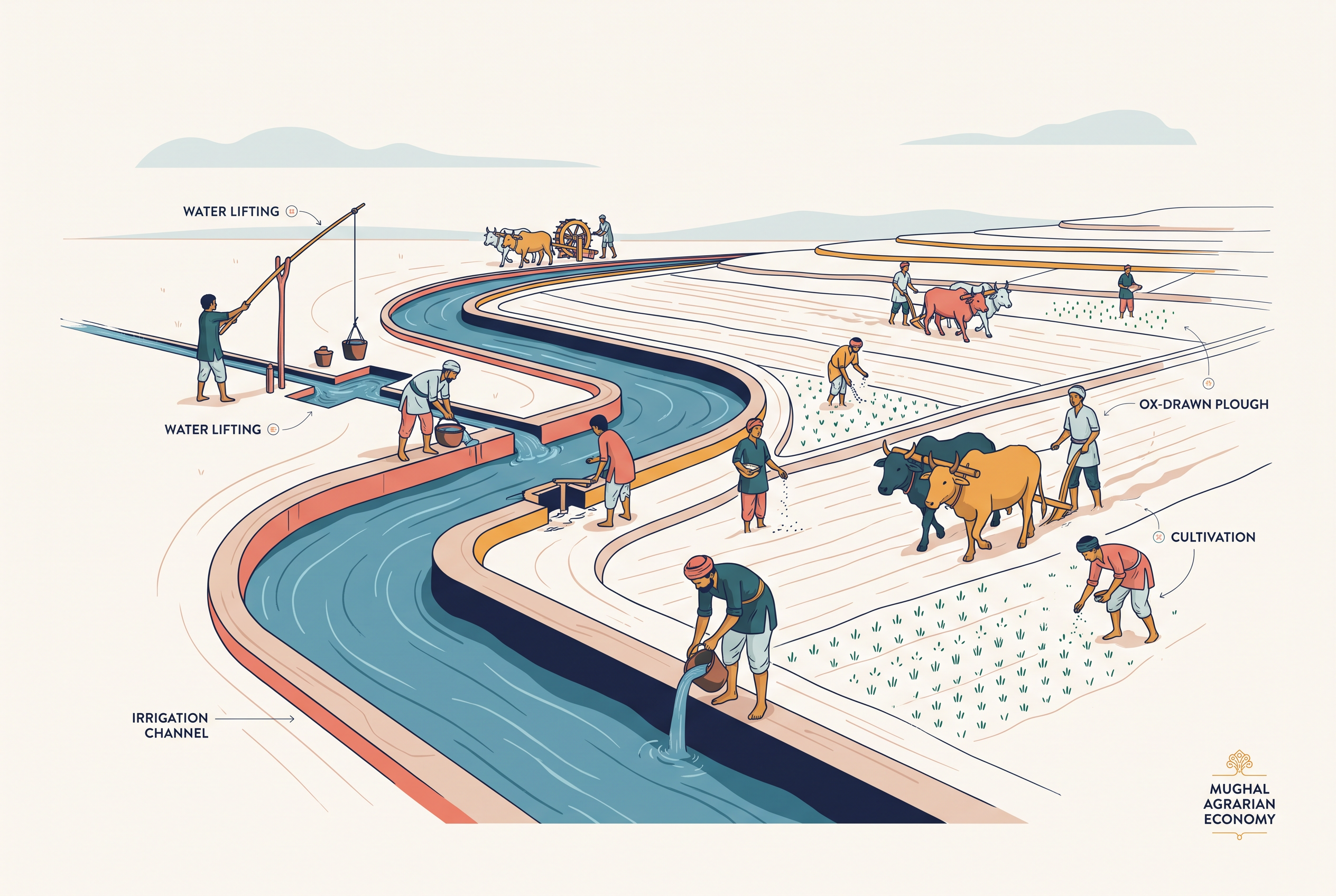
Fig. 8.1 – Rural scene from a Mughal painting.
The Varied Face Of The Countryside
The basic unit of agricultural society was the village. It was inhabited by peasants who performed the many seasonal tasks that made up agricultural production through the year — tilling the soil, sowing seeds, harvesting the crop when it was ripe. They also gave their labour to the making of agro-based goods such as sugar and oil.
But rural India was not made up of settled peasant production alone. Several kinds of areas — large tracts of dry land, or hilly regions — could not be cultivated in the same way as the more fertile expanses of land.
In addition, forest areas made up a substantial proportion of territory. We need to keep this varied topography in mind when we discuss agrarian society: a peasant with a plough, a herder on dry scrub and a forest dweller gathering honey were all part of the same countryside.
8.1.1 Looking For Sources
Our understanding of how rural society worked does not come from those who worked the land. Peasants did not write about themselves. They left no memoirs, no letters, no accounts of their own days.
Our major sources for the agrarian history of the sixteenth and early seventeenth centuries are chronicles — long narratives of a reign, written at court, usually to record and praise a ruler — and documents from the Mughal court (see also Chapter 9).
The Ain And Its Purpose
One of the most important chronicles was the Ain-i Akbari (in short, the Ain, see also Section 8.8). It was written by Abu’l Fazl, Akbar’s court historian. The text meticulously recorded the arrangements the state made to ensure cultivation, to enable the collection of revenue by the agencies of the state, and to regulate the relationship between the state and rural magnates, the zamindars.
Notice what that list has in common. Every one of those arrangements is a state arrangement, described from the state’s side.
The central purpose of the Ain was to present a vision of Akbar’s empire in which social harmony was provided by a strong ruling class. Any revolt, or any assertion of autonomous power against the Mughal state, was — in the eyes of the author of the Ain — predestined to fail.
In other words, whatever we learn from the Ain about peasants remains a view from the top. It is not a lie; it is a particular angle of sight, and the historian has to allow for it.
Reading Against The Grain
Fortunately, the account of the Ain can be supplemented by descriptions in sources that came from regions away from the Mughal capital.
These include detailed revenue records from Gujarat, Maharashtra and Rajasthan, dating from the seventeenth and eighteenth centuries. Further, the extensive records of the East India Company — the English trading company that later became a ruling power in India (see also Chapter 10) — give us useful descriptions of agrarian relations in eastern India.
All these sources record instances of conflict between peasants, zamindars and the state. That is what makes them so valuable. In recording a quarrel, they let slip what the quarrel was about, and so they give us an insight into how peasants saw the state and what they expected of it in the way of fairness.
8.1.2 Peasants And Their Lands
The term that Indo-Persian sources of the Mughal period most frequently used for a peasant was raiyat (plural, riaya) or muzarian. We also come across the terms kisan and asami.
Sources of the seventeenth century refer to two kinds of peasants — khud-kashta and pahi-kashta. The former were residents of the village in which they held their lands. The latter were non-resident cultivators, who belonged to some other village but cultivated land elsewhere on a contractual basis.
People became pahi-kashta either out of choice or out of compulsion. Out of choice, for example, when the terms of revenue in a distant village were more favourable. Out of compulsion, for example, when they were driven out by economic distress after a famine.
Babur, the first Mughal emperor, was struck by exactly this mobility. He came to India from Central Asia, and the ease with which people here abandoned a place and rebuilt elsewhere seemed to him remarkable enough to write down in his memoirs.
Babur is telling us something real: that in much of northern India, crops depended on rain rather than on dug channels, and that building materials were easy to come by. A village could therefore be raised, and abandoned, at speed.
But look at what he does not say. He never tells us why people fled — famine, war, an unbearable revenue demand. He is a newcomer noticing a difference, not an investigator explaining a cause.
How Much Land Did A Peasant Hold?
Seldom did the average peasant of north India possess more than a pair of bullocks and two ploughs. Most possessed even less. That single sentence tells you how thin the margin was between managing and not managing.
Holdings were small, and what counted as a good holding varied by region. In Gujarat, peasants possessing about six acres of land were considered affluent. In Bengal, five acres was the upper limit of an average peasant farm, and 10 acres would make one a rich asami.
Cultivation was based on the principle of individual ownership. Peasant lands were bought and sold in the same way as the lands of other property owners. The village, in other words, was not a collective farm.
A description written in the nineteenth century about peasant holdings in the Delhi-Agra region would apply equally to the seventeenth century:
The cultivating peasants (asamis), who plough up the fields, mark the limits of each field, for identification and demarcation, with borders of (raised) earth, brick and thorn so that thousands of such fields may be counted in a village.
Those little ridges of earth and thorn are the point. They are boundaries — evidence, on the ground, that each field belonged to somebody in particular.
8.1.3 Irrigation And Technology
The abundance of land, available labour and the mobility of peasants were three factors that accounted for the constant expansion of agriculture. Land could be brought under the plough because there was land to spare, hands to work it, and people willing to move to it.
Since the primary purpose of agriculture is to feed people, basic staples such as rice, wheat or millets were the most frequently cultivated crops. Areas which received 40 inches or more of rainfall a year were generally rice-producing zones, followed by wheat and millets, corresponding to a descending scale of precipitation.
Read that as a rule of thumb: the wetter the ground, the more likely it grew rice; drier country grew wheat, and the driest grew millets.
Monsoons remained the backbone of Indian agriculture, as they are even today. But there were crops which required additional water. Artificial systems of irrigation had to be devised for this.
Babur again proves a useful witness. In his memoirs he described, in careful detail, the devices he saw people using to lift water in northern India.
The device Babur describes in the first passage is the Persian wheel: a chain of pitchers carried round on a rope loop, turned by a bullock through a set of toothed wheels, emptying into a trough. The second device is far simpler — a bucket, a rope over a roller, and a bullock walking away from the well to haul it up.
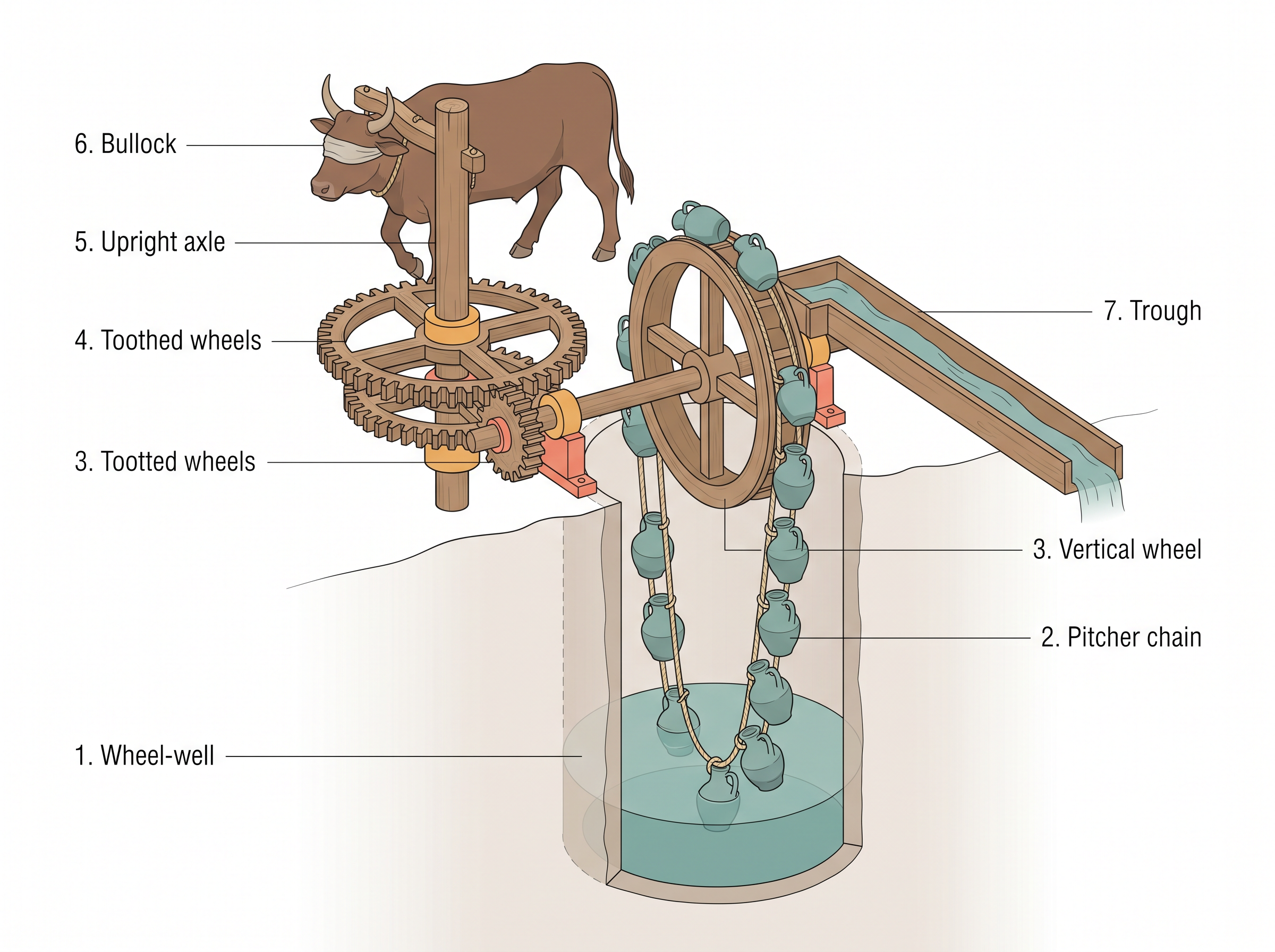
Fig. 8.2 – Reconstructed Persian wheel.
Irrigation projects received state support as well. In northern India, for example, the state undertook the digging of new canals (nahr, nala), and also repaired old ones — like the shahnahr in the Punjab during Shah Jahan’s reign.
Tools In The Field
Though agriculture was labour intensive, peasants did use technologies that often harnessed cattle energy. One example was the wooden plough, which was light and easily assembled with an iron tip or coulter.
Because it was light, it did not make deep furrows. That was an advantage, not a defect: shallow furrows preserved the moisture better during the intensely hot months, when a deeply turned field would have dried out.
A drill, pulled by a pair of giant oxen, was used to plant seeds. But broadcasting of seed — scattering it by hand across the field — was the most prevalent method. Hoeing and weeding were done simultaneously, using a narrow iron blade with a small wooden handle.
8.1.4 An Abundance Of Crops
Agriculture was organised around two major seasonal cycles, the kharif (autumn) and the rabi (spring). This meant that most regions, except those terrains that were the most arid or inhospitable, produced a minimum of two crops a year (do-fasla).
Some regions did better still. Where rainfall or irrigation assured a continuous supply of water, the land even gave three crops.
The result was an enormous variety of produce. The *Ain tells us that the Mughal provinces of Agra produced 39 varieties of crops and Delhi produced 43 over the two seasons. Bengal produced 50 varieties of rice alone.
Not Only For The Stomach
The focus on the cultivation of basic staples did not mean that agriculture in medieval India was only for subsistence — that is, growing only what the household itself needs to eat.
We often come across the term jins-i kamil (literally, perfect crops) in our sources. The Mughal state encouraged peasants to cultivate such crops, because they brought in more revenue.
Cotton and sugarcane were jins-i kamil par excellence. Cotton was grown over a great swathe of territory spread over central India and the Deccan plateau, whereas Bengal was famous for its sugar. Such cash crops would also include various sorts of oilseeds (for example, mustard) and lentils.
This shows how subsistence and commercial production were closely intertwined in an average peasant’s holding. The same peasant grew grain to eat and cotton to sell — and the state had a direct interest in the second.
Crops From Across The World
During the seventeenth century, several new crops from different parts of the world reached the Indian subcontinent. Maize (makka), for example, was introduced into India via Africa and Spain, and by the seventeenth century it was being listed as one of the major crops of western India.
Vegetables like tomatoes, potatoes and chillies were introduced from the New World at this time, as were fruits like the pineapple and the papaya. It is worth pausing on that list: several of the things we now think of as most ordinary in an Indian kitchen were, in the sixteenth century, unknown here.
Tobacco followed a similar path, and its spread can be dated closely. The plant arrived first in the Deccan, and spread to northern India in the early years of the seventeenth century. The Ain does not mention tobacco in its lists of crops in northern India.
Akbar and his nobles came across tobacco for the first time in 1604. At this time, smoking tobacco — in hookahs or chillums — seems to have caught on in a big way. Jahangir was so concerned about its addiction that he banned it.
The ban was totally ineffective. By the end of the seventeenth century, tobacco had become a major article of consumption, cultivation and trade all over India. An imperial order, it turns out, could not stop a crop that people wanted to grow, sell and smoke.
A Slowly Growing Population
One important outcome of such varied and flexible forms of agricultural production was a slow demographic growth — that is, a slow increase in the number of people.
Despite periodic disruptions caused by famines and epidemics, India’s population increased, according to calculations by economic historians, by about 50 million people between 1600 and 1800. That is an increase of about 33 per cent over 200 years.
Set beside the growth rates of our own time, this is slow. But it is steady, and it rests on the same fact this whole section has been describing: a countryside able to produce two crops a year, on varied soils, with a mix of food and cash crops.
8.2 The Village Community
The account in the last section makes one thing clear: agricultural production involved the intensive participation and initiative of the peasantry. Peasants did not merely obey; they chose crops, moved villages, cleared land and bargained over terms.
How did this affect the structure of agrarian relations in Mughal society? To find out, let us look at the social groups involved in agricultural expansion, and at their relationships and conflicts.
We have seen that peasants held their lands in individual ownership. At the same time, they belonged to a collective village community as far as many aspects of their social existence were concerned.
There were three constituents of this community — the cultivators, the panchayat, and the village headman (muqaddam or mandal). Keep the three apart in your mind: the people who worked the land, the assembly that governed them, and the man who headed that assembly and kept its accounts.
8.2.1 Caste And The Rural Milieu
It is tempting to imagine ‘the peasants’ as one mass of similar people. They were not. Deep inequities on the basis of caste and other caste-like distinctions meant that the cultivators were a highly heterogeneous group.
Among those who tilled the land, there was a sizeable number who worked as menials or agricultural labourers (majur) — people who worked on someone else’s field for a wage or a share, and held little or no land of their own.
Despite the abundance of cultivable land, certain caste groups were assigned menial tasks and thus relegated to poverty. Land existed; the right to work it on one’s own account did not follow.
Though there was no census at that time, the little data that we have suggest that such groups comprised a large section of the village population, had the least resources, and were constrained by their position in the caste hierarchy — much like the Dalits of modern India.
The Same Pattern In Other Communities
Such distinctions had begun permeating into other communities too. In Muslim communities, menials like the halalkhoran (scavengers) were housed outside the boundaries of the village.
Similarly, the mallahzadas (literally, sons of boatmen) in Bihar were comparable to slaves. Exclusion from the village, and bondage within it, were not confined to any one religious community. They were features of rural society as a whole.
Movement In The Middle Ranks
There was a direct correlation between caste, poverty and social status at the lower strata of society. The lower a group stood, the poorer it was likely to be, and the fewer its ways out.
Such correlations were not so marked at intermediate levels. Here, status could shift — and the evidence shows it shifting. In a manual from seventeenth-century Marwar, in western Rajasthan, Rajputs are mentioned as peasants, sharing the same space with Jats, who were accorded a lower status in the caste hierarchy.
The Gauravas, who cultivated land around Vrindavan (Uttar Pradesh), sought Rajput status in the seventeenth century. Castes such as the Ahirs, Gujars and Malis rose in the hierarchy because of the profitability of cattle rearing and horticulture.
In the eastern regions, intermediate pastoral and fishing castes like the Sadgops and Kaivartas acquired the status of peasants. Notice the mechanism in each case: prosperity in a line of work came first, and a claim to higher status followed it.
Look closely at Fig. 8.3, a painting of a village in the Punjab made in the early nineteenth century. Describe what the women and the men in it are shown doing, and describe the architecture of the village as the artist has drawn it.
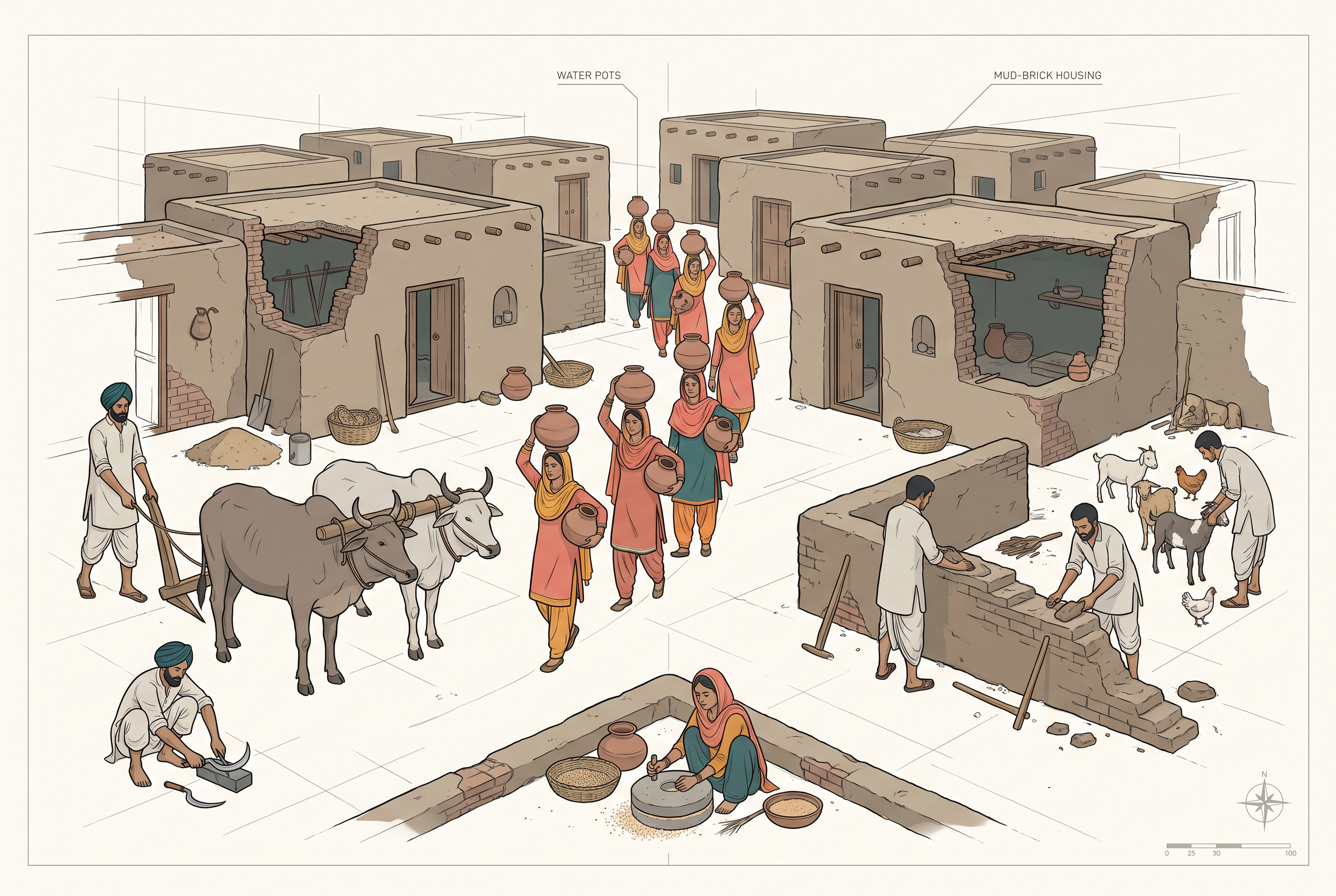
Fig. 8.3 – Village in the Punjab.
8.2.2 Panchayats And Headmen
The village panchayat was an assembly of elders, usually important people of the village with hereditary rights over their property. Do not read ‘elders’ as ‘the old’. It means the established, propertied men of the place.
In mixed-caste villages, the panchayat was usually a heterogeneous body. It represented various castes and communities in the village — though the village menial-cum-agricultural worker was unlikely to be represented there.
That combination made it an oligarchy: government by a small group of the powerful. Its decisions were binding on the members. A body can be mixed in composition and still be closed to the people at the bottom.
The Headman And The Accountant
The panchayat was headed by a headman known as muqaddam or mandal. Some sources suggest that the headman was chosen through the consensus of the village elders, and that this choice had to be ratified by the zamindar.
Two authorities therefore stood behind him — the elders below and the zamindar above. Headmen held office as long as they enjoyed the confidence of the village elders, failing which they could be dismissed by them.
The chief function of the headman was to supervise the preparation of village accounts, assisted by the accountant, or patwari, of the panchayat. Between them, these two men decided what the written record of the village would say.
That power was open to abuse, and it was abused. The mandals often misused their positions. They were principally accused of defrauding village accounts in connivance with the patwari, and of underassessing the revenue they owed from their own lands, in order to pass the additional burden on to the smaller cultivator.
The Common Purse
The panchayat derived its funds from contributions made by individuals to a common financial pool. Households put something in; the assembly decided how it was spent.
These funds were used for defraying the costs of entertaining revenue officials who visited the village from time to time — an expense which tells us something in itself about how a village handled the state’s men.
Expenses for community welfare activities, such as tiding over natural calamities like floods, were also met from these funds. Often these funds were deployed in the construction of a bund, an embankment to hold back water, or in digging a canal, which peasants usually could not afford to do on their own.
Guarding The Caste Order
One important function of the panchayat was to ensure that caste boundaries among the various communities inhabiting the village were upheld. In eastern India, all marriages were held in the presence of the mandal.
In other words, one of the duties of the village headman was to oversee the conduct of the members of the village community ‘chiefly to prevent any offence against their caste’. The same assembly that dug a canal also policed whom a person could marry.
Panchayats also had the authority to levy fines and to inflict more serious forms of punishment, like expulsion from the community. The latter was a drastic step, and was in most cases meted out for a limited period.
Understand what expulsion actually meant. A person forced to leave the village became an outcaste and lost his right to practise his profession — his living and his standing went together. Such a measure was intended as a deterrent to violation of caste norms.
The Jati Panchayat
In addition to the village panchayat, each caste or jati in the village had its own jati panchayat — the assembly of that caste group alone. These panchayats wielded considerable power in rural society.
In Rajasthan, jati panchayats arbitrated civil disputes between members of different castes. They mediated in contested claims on land, decided whether marriages were performed according to the norms laid down by a particular caste group, determined who had ritual precedence in village functions, and so on.
Their authority was recognised from above. In most cases, except in matters of criminal justice, the state respected the decisions of jati panchayats. The Mughal state, in other words, left a great deal of everyday justice to bodies it did not run.
Petitions From Below
Archival records from western India — notably Rajasthan and Maharashtra — contain petitions presented to the panchayat. They complain about extortionate taxation, or about the demand for unpaid labour (begar) imposed by the ‘superior’ castes or by officials of the state.
These petitions were usually made by villagers from the lowest rungs of rural society. The people with least power in the village turn out to be the people most willing to put a grievance on record.
Often petitions were made collectively as well, by a caste group or a community protesting against what they considered morally illegitimate demands on the part of elite groups. These included excessive tax demands which, especially in times of drought or other disasters, endangered the peasants’ subsistence.
In the eyes of the petitioners, the right to the basic minimum for survival was sanctioned by custom. They regarded the village panchayat as the court of appeal that would ensure that the state carried out its moral obligations and guaranteed justice.
When The Panchayat Could Not Settle It
The decision of the panchayat in conflicts between ‘lower-caste’ peasants and state officials, or the local zamindar, could vary from case to case. In cases of excessive revenue demands, the panchayat often suggested compromise.
In cases where reconciliation failed, peasants took recourse to more drastic forms of resistance, such as deserting the village. This looks like flight. It was, in fact, a weapon.
The relatively easy availability of uncultivated land, and the competition over labour resources, made desertion an effective weapon in the hands of cultivators. Land without cultivators yielded nothing — so a village that walked away took the state’s income with it.
Look now at Fig. 8.4, a painting of a meeting between village elders and tax collectors. Ask yourself how the artist has differentiated between the two groups.
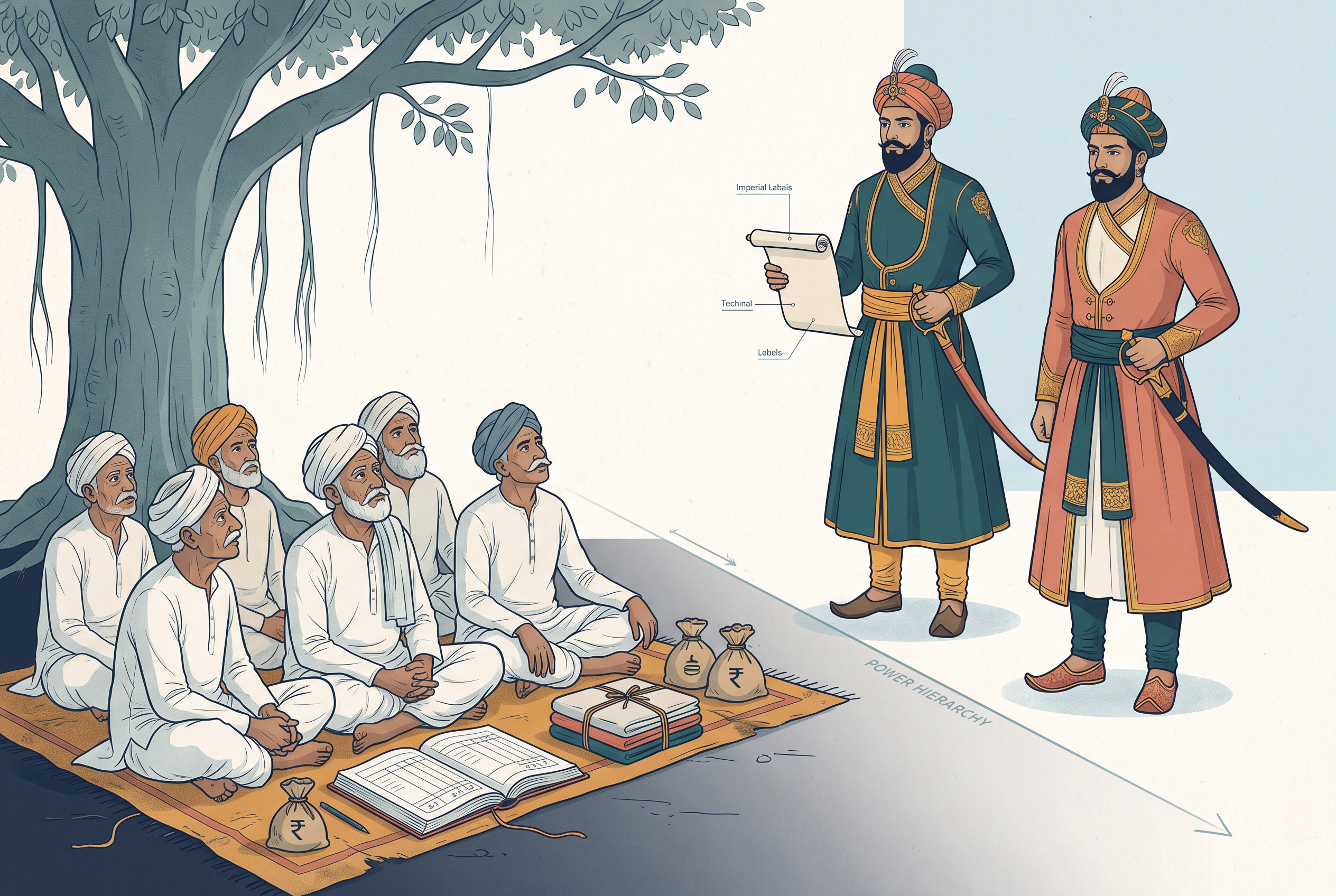
Fig. 8.4 – Meeting of village elders and tax collectors.
8.2.3 Village Artisans
Another interesting aspect of the village was the elaborate relationship of exchange between different producers. A village did not only grow food. It also made things.
Marathi documents and village surveys made in the early years of British rule have revealed the existence of substantial numbers of artisans, sometimes as high as 25 per cent of the total households in the villages. In some places, then, one household in four was an artisan household.
At times, however, the distinction between artisans and peasants in village society was a fluid one, as many groups performed the tasks of both. Cultivators and their families would also participate in craft production — such as dyeing, textile printing, baking and firing of pottery, and making and repairing agricultural implements.
Why a peasant had time for this becomes clear once you look at the farming year. Phases in the agricultural calendar when there was a relative lull in activity — as between sowing and weeding, or between weeding and harvesting — were a time when cultivators could engage in artisanal production.
Fig. 8.5 shows textile production in a seventeenth-century painting. Describe the activities that are shown in the illustration, following the cloth from one pair of hands to the next.
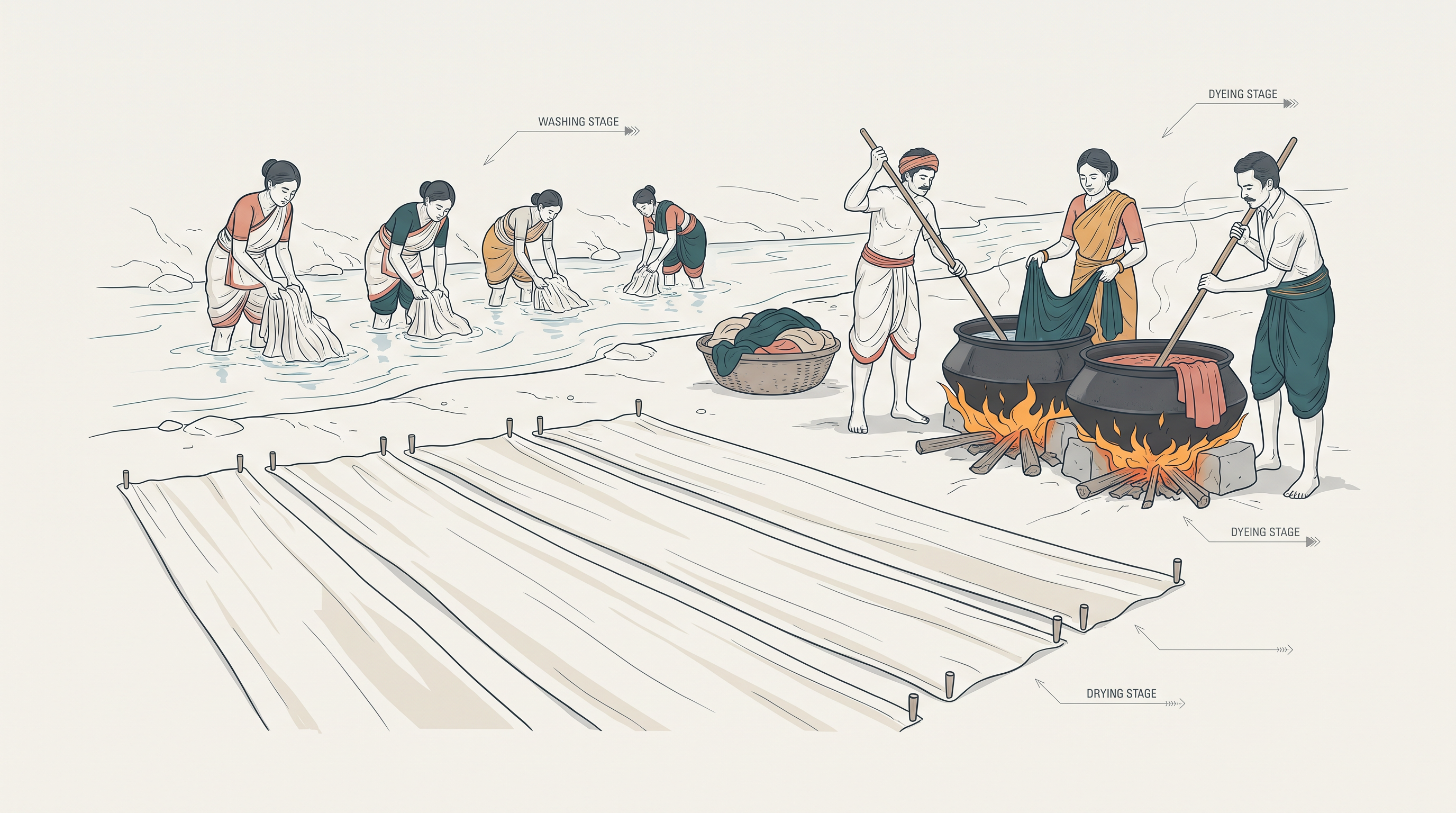
Fig. 8.5 – Textile production.
How An Artisan Was Paid
Village artisans — potters, blacksmiths, carpenters, barbers, even goldsmiths — provided specialised services, in return for which they were compensated by villagers by a variety of means.
The most common way of doing so was by giving them a share of the harvest, or an allotment of land, perhaps cultivable wastes, which was likely to be decided by the panchayat. In Maharashtra, such lands became the artisans’ miras or watan — their hereditary holding.
Another variant of this was a system where artisans and individual peasant households entered into a mutually negotiated system of remuneration, most of the time goods for services. The blacksmith mended the plough; the peasant handed over grain.
For example, eighteenth-century records tell us of zamindars in Bengal who remunerated blacksmiths, carpenters, even goldsmiths for their work by paying them a small daily allowance and diet money — a payment for the day, and food to eat while the work was done.
This later came to be described as the jajmani system, though the term was not in vogue in the sixteenth and seventeenth centuries. Be careful with such words. The name is later than the practice, and using it can make a set of negotiated arrangements sound like a fixed system.
Such evidence is interesting because it indicates the intricate ways in which exchange networks operated at the micro-level of the village. Cash remuneration was not entirely unknown either — a point that leads straight into the next question.
8.2.4 A ‘Little Republic’?
How does one understand the significance of the village community? Some British officials in the nineteenth century saw the village as a ‘little republic’, made up of fraternal partners sharing resources and labour in a collective — a small, self-contained world of equals, governing itself.
It is a flattering picture, and it is wrong. This was not a sign of rural egalitarianism. There was individual ownership of assets, and there were deep inequities based on caste and gender distinctions.
A group of powerful individuals decided the affairs of the village, exploited the weaker sections, and had the authority to dispense justice. Everything in this section points the same way — the panchayat of propertied elders, the excluded majur, the mandal shifting his own burden on to the small cultivator.
Money Was Already In The Village
More importantly, a cash nexus had already developed through trade between villages and towns. Money moved in and out of the village long before any British official arrived to call it a republic.
In the Mughal heartland too, revenue was assessed and collected in cash. Artisans producing for the export market — for example, weavers — received advances or wages in cash, as did producers of commercial products like cotton, silk or indigo.
The seventeenth-century French traveller Jean-Baptiste Tavernier found it remarkable that in India a village must be very small indeed if it has not a money-changer called a shroff. Such men, he wrote, acted as bankers to make remittances of money, and they enhanced the rupee as they pleased for paisa, and the paisa for cowrie shells.
Read that and the ‘little republic’ collapses. A village with a money-changer in it is a village tied to a wider market, handling more than one kind of currency, and dealing with someone who profits from the rate between them.
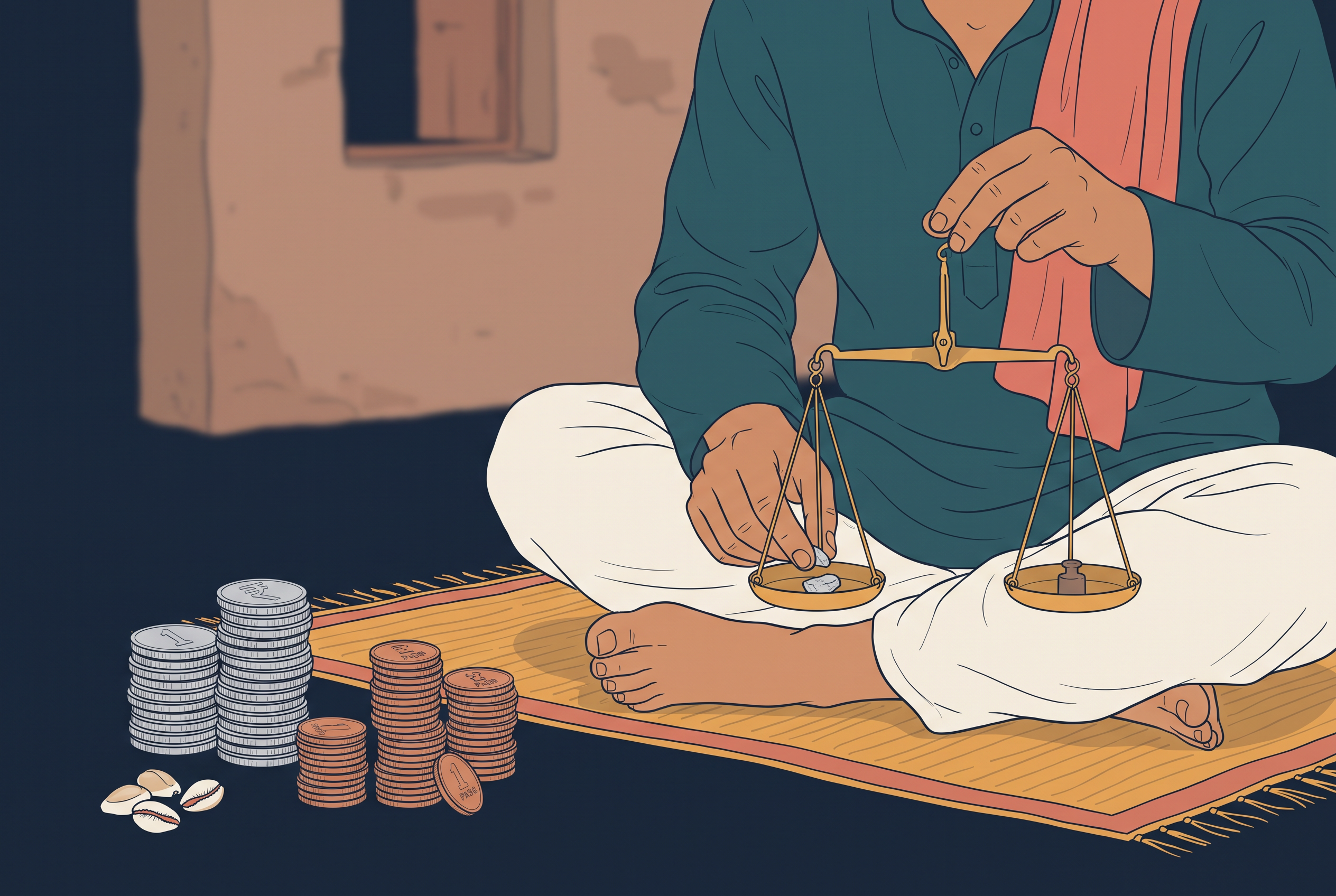
Fig. 8.6 – A money-changer or shroff.
8.3 Women In Agrarian Society
As you may have observed in many different societies, the production process often involves men and women performing certain specified roles. Work is divided — and the division is rarely accidental.
In the contexts that we are exploring, women and men had to work shoulder to shoulder in the fields. Men tilled and ploughed, while women sowed, weeded, threshed and winnowed the harvest. Winnowing is the separating of grain from husk by tossing it in the wind, and it was work without which nothing came to the table.
With the growth of nucleated villages — villages clustered around a settled core — and with the expansion in individuated peasant farming, which characterised medieval Indian agriculture, the basis of production was the labour and resources of the entire household.
That fact had a consequence worth stating plainly. Naturally, a gendered segregation between the home (for women) and the world (for men) was not possible in this context. A household that had to feed itself could not afford to keep half its workers indoors.
The Biases That Remained
Nonetheless, biases related to women’s biological functions did continue. Menstruating women, for instance, were not allowed to touch the plough or the potter’s wheel in western India, or to enter the groves where betel-leaves (paan) were grown in Bengal.
Notice what those prohibitions have in common. Each one bars a woman from a tool or a crop at the heart of production. The rule did not remove women from work; it marked certain work, at certain times, as closed to them.
Hands The Market Depended On
Artisanal tasks such as spinning yarn, sifting and kneading clay for pottery, and embroidery were among the many aspects of production dependent on female labour. Behind every pot and every length of cloth stood women’s hands at an earlier stage of the work.
Here is the sentence to underline: the more commercialised the product, the greater the demand on women’s labour to produce it. Cloth for the export market did not reduce the burden on women; it increased it.
In fact, peasant and artisan women worked not only in the fields, but even went to the houses of their employers or to the markets if necessary. The idea that women of the countryside stayed within a courtyard does not survive contact with the evidence.
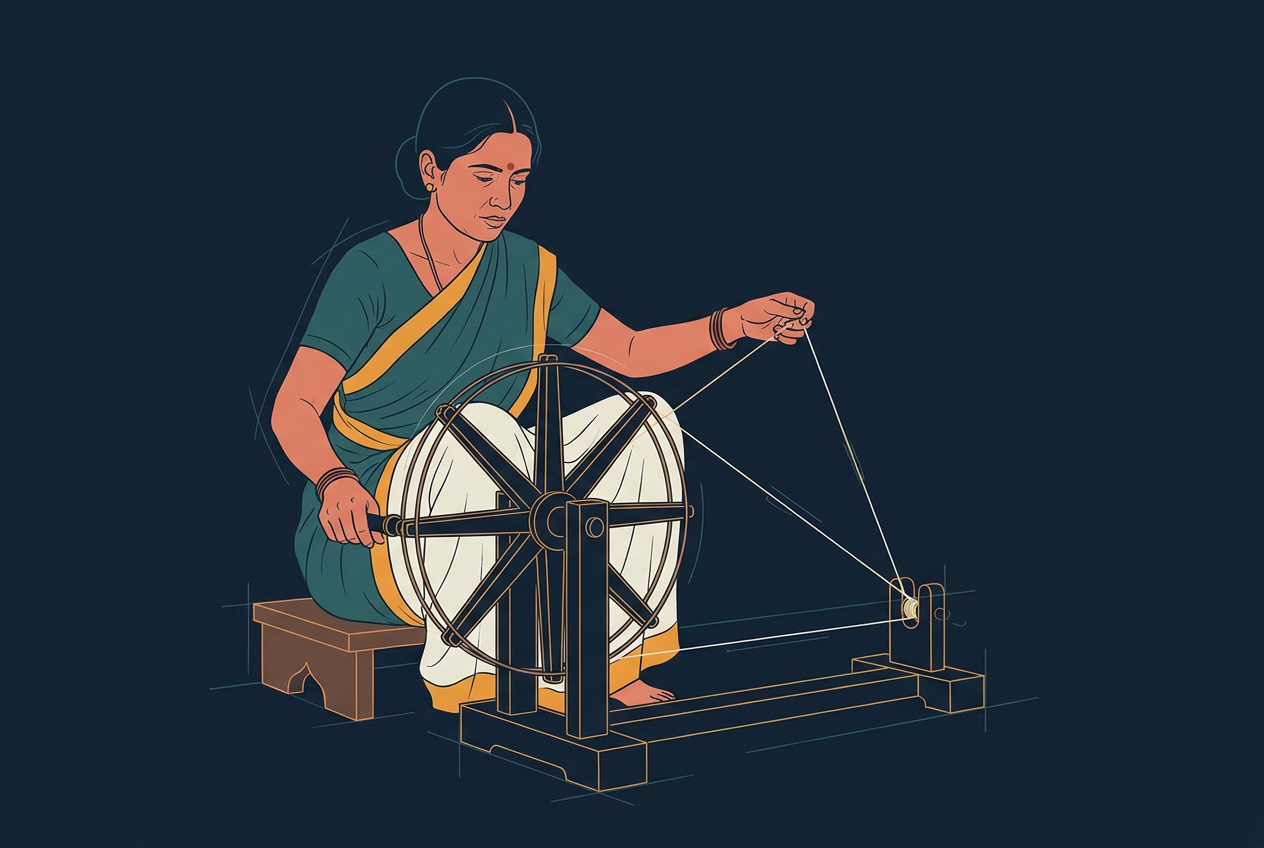
Fig. 8.7 – Woman spinning thread.
Women also worked far from their own fields. The construction sites of the empire drew them in: Fig. 8.8a shows women crushing stones during the construction of Fatehpur Sikri, and Fig. 8.8b shows women carrying loads at such a site.
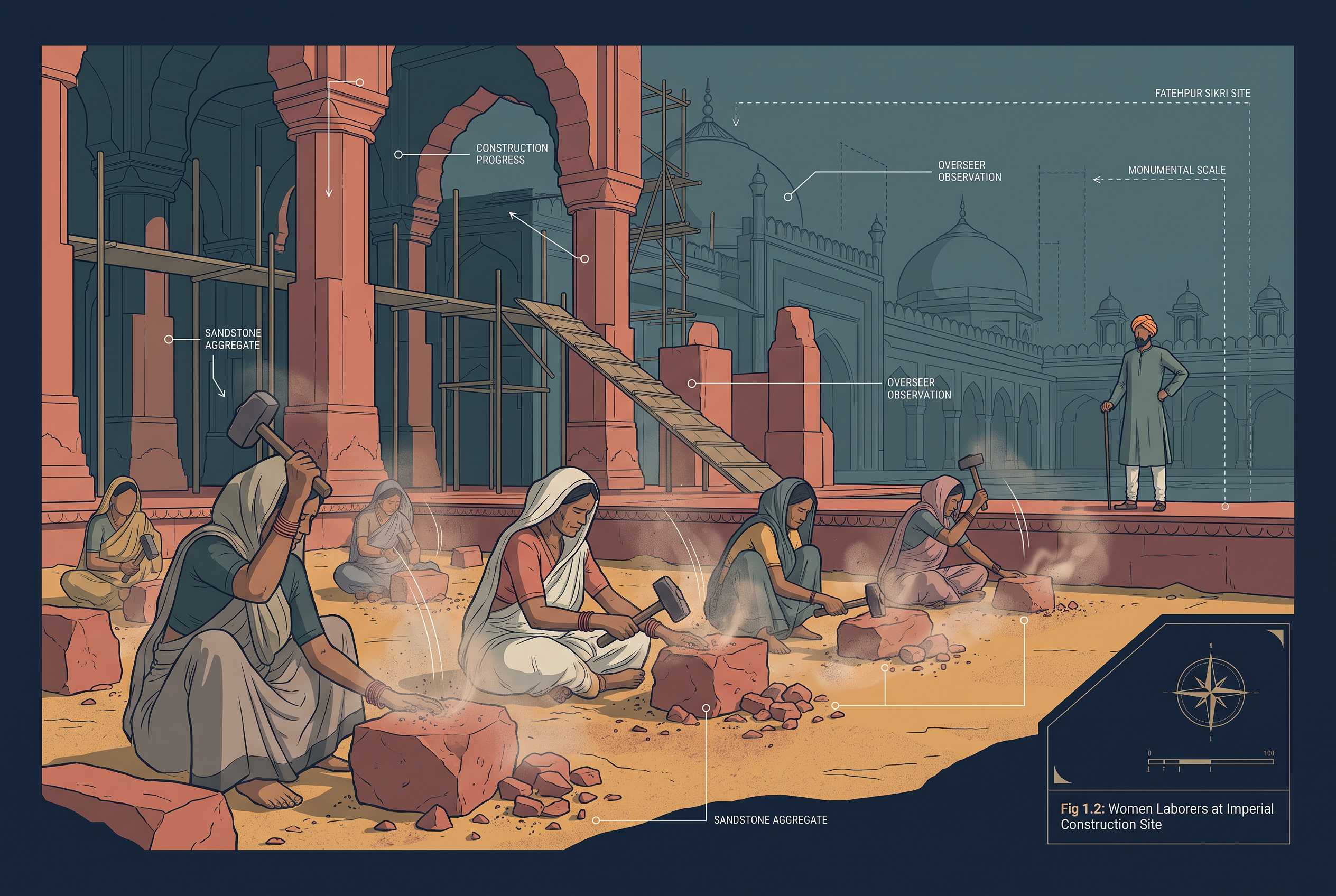
Fig. 8.8a – Women crushing stones at Fatehpur Sikri.
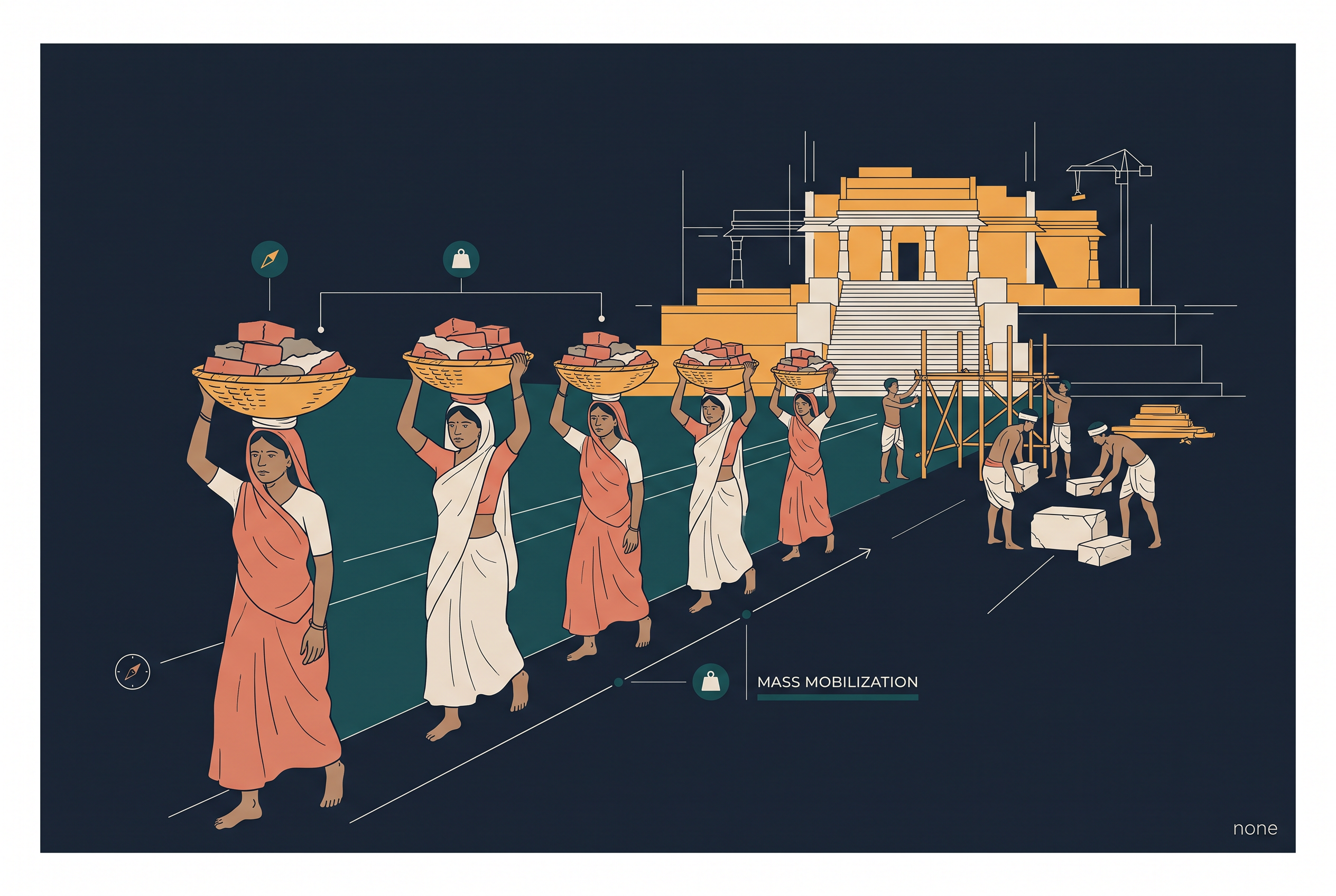
Fig. 8.8b – Women carrying loads at a construction site.
Childbearers, And What Followed
Women were considered an important resource in agrarian society also because they were child bearers in a society dependent on labour. More hands meant more production; children were the future hands.
At the same time, high mortality rates among women — owing to malnutrition, frequent pregnancies, and death during childbirth — often meant a shortage of wives. Women died young, and in numbers, of causes that were preventable in principle and not prevented in practice.
This led to the emergence of social customs in peasant and artisan communities that were distinct from those prevalent among elite groups. Marriages in many rural communities required the payment of bride-price — money or goods paid by the groom’s side to the bride’s family — rather than dowry, which moves the other way.
Remarriage was considered legitimate both among divorced and widowed women. In communities where wives were scarce and every pair of hands was needed, custom permitted what elite society did not.
Control, And Its Cruelty
The importance attached to women as a reproductive force also meant that the fear of losing control over them was great. Scarcity did not translate into freedom. It translated into surveillance.
According to established social norms, the household was headed by a male. Thus women were kept under strict control by the male members of the family and the community. They could inflict draconian punishments if they suspected infidelity on the part of women — punishments that were severe, and that fell on the woman rather than on the man.
That last asymmetry is not a detail. It is the shape of the whole arrangement, and the next paragraphs show women contesting it.
Women Petition The Panchayat
Documents from Western India — Rajasthan, Gujarat and Maharashtra — record petitions sent by women to the village panchayat, seeking redress and justice. Women, in other words, used the same court of appeal that the village’s poorest men used.
Wives protested against the infidelity of their husbands, or against the neglect of the wife and children by the male head of the household, the grihasthi. These are complaints about a man failing in his duties, brought by the person he had failed.
The response was uneven. While male infidelity was not always punished, the state and ‘superior’ caste groups did intervene when it came to ensuring that the family was adequately provided for. Maintenance was enforceable; fidelity, when it was a man’s, often was not.
And the record itself carries a further silence. In most cases when women petitioned to the panchayat, their names were excluded from the record: the petitioner was referred to as the mother, sister or wife of the male head of the household.
Women Who Owned Land
Amongst the landed gentry, women had the right to inherit property. This was not a small right in a society whose wealth was land.
Instances from the Punjab show that women, including widows, actively participated in the rural land market as sellers of property inherited by them. They were not passive holders; they bought and sold in a market of buyers and sellers.
Hindu and Muslim women inherited zamindaris, which they were free to sell or mortgage. Women zamindars were known in eighteenth-century Bengal.
In fact, one of the biggest and most famous of the eighteenth-century zamindaris, that of Rajshahi, had a woman at the helm. Hold this beside the unnamed petitioner of the previous page. Both are women of the same countryside, and the distance between them is the distance made by property.
8.4 Forests And Tribes
8.4.1 Beyond Settled Villages
There was more to rural India than sedentary agriculture. If you picture the countryside only as ploughed fields, you have left out a great part of it.
Apart from the intensively cultivated provinces in northern and north-western India, huge swathes of forests existed across the subcontinent. Contemporary texts distinguish dense forest (jangal) from scrubland (kharbandi).
These forests lay all over eastern India, central India and northern India — including the Terai, the marshy forest belt on the Indo-Nepal border — as well as in Jharkhand, and in peninsular India down the Western Ghats and the Deccan plateau. That list covers a very large part of the map.
How much of the land was forest? It is nearly impossible to set an all-India average of the forest cover for this period. Informed conjectures based on contemporary sources suggest an average of 40 per cent.
What Jangli Actually Meant
Forest dwellers were termed jangli in contemporary texts. The word has since been abused, so it needs care.
Being jangli, however, did not mean an absence of ‘civilisation’, as popular usage of the term today seems to connote. Rather, the term described those whose livelihood came from the gathering of forest produce, hunting and shifting agriculture. It named a way of making a living, not a want of one.
These activities were largely season specific — the forest yielded different things at different times of year. Among the Bhils, for example, spring was reserved for collecting forest produce, summer for fishing, the monsoon months for cultivation, and autumn and winter for hunting.
Such a sequence presumed and perpetuated mobility, which was a distinctive feature of tribes inhabiting these forests. A people who must be in four places across four seasons cannot be a settled people, and were not meant to be.
The Forest As A Threat
For the state, the forest was a subversive place — a place of refuge (mawas) for troublemakers. Trees hid people, and people who could hide could refuse.
Once again, we turn to Babur, who says that jungles provided a good defence, behind which the people of the pargana become stubbornly rebellious and pay no taxes. A forest, in the emperor’s eyes, was not scenery. It was cover.
8.4.2 Inroads Into Forests
External forces entered the forest in different ways. The forest was not left alone, and this sub-section sets out the several routes by which the outside world came in.
For instance, the state required elephants for the army. So the peshkash levied from forest people often included a supply of elephants. The tribute a forest chief paid was not always in coin; sometimes it walked.
The Hunt And Its Message
In the Mughal political ideology, the hunt symbolised the overwhelming concern of the state to relate to all its subjects, rich and poor. It was an image of kingship as much as a sport.
Regular hunting expeditions, so court historians tell us, enabled the emperor to travel across the extensive territories of his empire and personally attend to the grievances of its inhabitants. The emperor rode out; the empire, in theory, came within his hearing.
The hunt was a subject frequently painted by court artists. The painter resorted to the device of inserting a small scene somewhere in the picture that functioned as a symbol of a harmonious reign. Look for that small scene: it is the painting’s argument.
Study Fig. 8.9, in which Shah Jahan hunts nilgais. Describe what you see. Then find the symbolic element that helps establish the connection between the hunt and ideal justice.
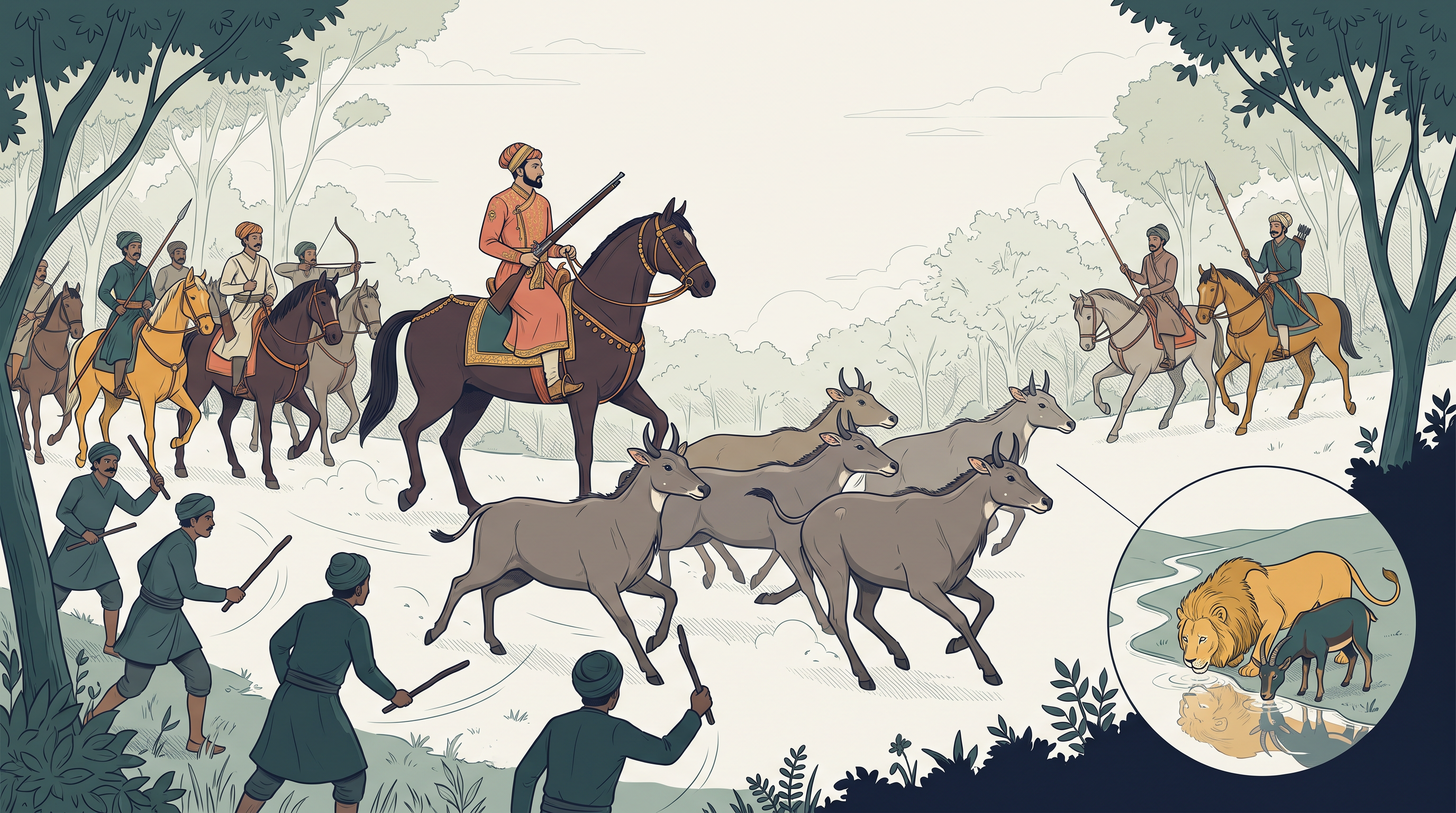
Fig. 8.9 – Shah Jahan hunting nilgais.
Clearing The Forest
The forest was not only entered. It was cut down, and the land beneath it turned into fields. A sixteenth-century Bengali poem describes exactly that, and celebrates it.
Read the poem as a record of a process, and it tells you a great deal. Settlement needed tools, and the tools were bought and handed out. It needed labour, and the labour came in organised groups from several directions. Once the trees were down, markets followed — and the tigers, which is to say the forest itself, went.
Read it as a record of feeling, however, and it tells you only one side’s. This is a poem in praise of a hero who founded a kingdom. The people already living in that forest are not its subject.
Trade Across The Hills
Forest and hill peoples were also drawn in by exchange. Abu’l Fazl, writing around 1595, recorded what the hill tribes brought down to the plains of Awadh, and what they carried back.
Notice how the goods travel. Nothing is carted; everything is carried — on men’s backs, on stout ponies, on goats. Mountain paths decide the technology, and the technology limits how much can move at a time.
Commerce Reaches The Forest
The spread of commercial agriculture was an important external factor that impinged on the lives of those who lived in the forests. Once produce could be sold, the forest became a place worth extracting from.
Forest products — like honey, beeswax and gum lac — were in great demand. Some, such as gum lac, a resin used to make lacquer and dye, became major items of overseas export from India in the seventeenth century. A resin scraped from a forest branch could end up on a ship.
Elephants were also captured and sold. Trade involved an exchange of commodities through barter as well, so not all of this movement of goods left a trail of coin behind it.
Some tribes, like the Lohanis in the Punjab, were engaged in overland trade between India and Afghanistan, and in the town-country trade in the Punjab itself. Forest and hill peoples, then, were not outside the market. Some of them were carrying it.
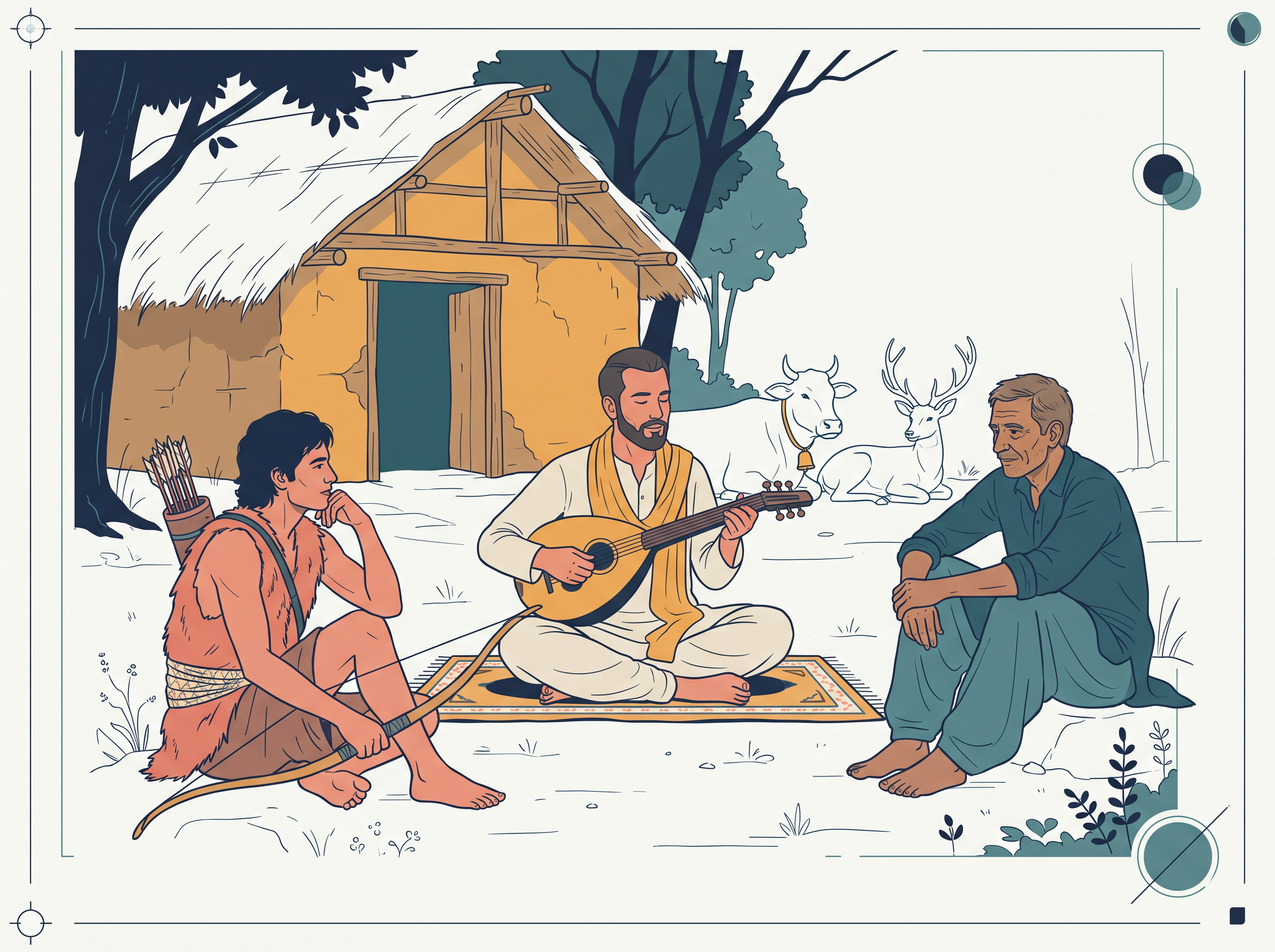
Fig. 8.10 – Peasant and hunter listening to a sufi singer.
Chiefs, Armies And Kingdoms
Social factors too wrought changes in the lives of forest dwellers. Like the ‘big men’ of the village community, tribes also had their chieftains.
Many tribal chiefs had become zamindars; some even became kings. For this they required to build up an army. They recruited people from their lineage groups, or demanded that their fraternity provide military service — kinship itself became a way of raising troops.
The numbers are not small. Tribes in the Sind region had armies comprising 6,000 cavalry and 7,000 infantry. In Assam, the Ahom kings had their paiks, people who were obliged to render military service in exchange for land. The capture of wild elephants was declared a royal monopoly by the Ahom kings.
Though the transition from a tribal to a monarchical system had started much earlier, the process seems to have become fully developed only by the sixteenth century. This can be seen from the Ain’s observations on the existence of tribal kingdoms in the north-east.
War was a common occurrence. For instance, the Koch kings fought and subjugated a number of neighbouring tribes in a long sequence of wars through the sixteenth and seventeenth centuries. Kingdoms in the forest zone were built, as kingdoms usually are, by force.
New cultural influences also began to penetrate into forested zones. Some historians have indeed suggested that sufi saints (pirs) played a major role in the slow acceptance of Islam among agricultural communities emerging in newly colonised places.
Read that sentence for its caution. It says ‘some historians have suggested’, and it says ‘slow’. Where the evidence is thin and the change is gradual, a careful historian offers a suggestion, not a conclusion — and the textbook keeps the hedge rather than removing it.
8.5 The Zamindars
Our story of agrarian relations in Mughal India will not be complete without referring to a class of people in the countryside that lived off agriculture but did not participate directly in the processes of agricultural production.
These were the zamindars: landed proprietors who also enjoyed certain social and economic privileges by virtue of their superior status in rural society. They took from the harvest without holding the plough.
Where did that superior status come from? Caste was one factor that accounted for the elevated status of zamindars. Another factor was that they performed certain services (khidmat) for the state — they were useful to the empire, and were rewarded for it.
Three Sources Of Power
The first was land of their own. The zamindars held extensive personal lands termed milkiyat, meaning property. Milkiyat lands were cultivated for the private use of zamindars, often with the help of hired or servile labour, and they could sell, bequeath or mortgage these lands at will.
The second was revenue. Zamindars also derived their power from the fact that they could often collect revenue on behalf of the state, a service for which they were compensated financially. A man who collects the state’s money in a village is a man that village cannot ignore.
The third was force. Control over military resources was another source of power. Most zamindars had fortresses (qilachas), as well as an armed contingent comprising units of cavalry, artillery and infantry.
Add those contingents together across the empire and the scale becomes startling. According to the Ain, the combined military strength of the zamindars in Mughal India was 384,558 cavalry, 4,277,057 infantry, 1,863 elephants, 4,260 cannons, and 4,500 boats.
Thus, if we visualise social relations in the Mughal countryside as a pyramid, zamindars clearly constituted its very narrow apex. Very few people; very much power.
Who The Zamindars Were
Abu’l Fazl’s account indicates that an ‘upper-caste’, Brahmana-Rajput combine had already established firm control over rural society. Caste, as so often in this chapter, is doing work at the top as well as at the bottom.
But the picture is not one of a closed elite. The same account also reflects a fairly large representation from the so-called intermediate castes, as we saw earlier, as well as a liberal sprinkling of Muslim zamindaris.
How A Zamindari Was Made
Contemporary documents give an impression that conquest may have been the source of the origin of some zamindaris. The dispossession of weaker people by a powerful military chieftain was quite often a way of expanding a zamindari.
Even so, force alone was not enough. It is unlikely that the state would have allowed such a show of aggression by a zamindar unless he had been confirmed by an imperial order (sanad). The sword needed a piece of paper behind it.
The Slow Way, Which Was The Commoner Way
More important were the slow processes of zamindari consolidation, which are also documented in sources. These were undramatic and they were effective.
They involved colonisation of new lands, transfer of rights, order of the state, and purchase. A zamindari could be built, in other words, by settling waste land, by acquiring somebody’s rights, by an official grant, or simply by buying.
That last route mattered socially. These were the processes which perhaps permitted people belonging to the relatively ‘lower’ castes to enter the rank of zamindars, as zamindaris were bought and sold quite briskly in this period. Money could buy a rank that birth withheld.
A combination of factors also allowed the consolidation of clan- or lineage-based zamindaris. For example, the Rajputs and Jats adopted these strategies to consolidate their control over vast swathes of territory in northern India. Likewise, peasant-pastoralists — like the Sadgops — carved out powerful zamindaris in areas of central and south-western Bengal.
What Zamindars Did For The Countryside
Zamindars spearheaded the colonisation of agricultural land, and helped in settling cultivators by providing them with the means of cultivation, including cash loans. A peasant who wanted to break new ground needed seed, cattle and credit, and the zamindar could supply all three.
The buying and selling of zamindaris accelerated the process of monetisation in the countryside. In addition, zamindars sold the produce from their milkiyat lands — they were sellers in the market, not only takers of rent.
There is evidence to show that zamindars often established markets (haats) to which peasants also came to sell their produce. The same man who took a share of your harvest also built the place where you sold the rest of it.
An Exploitative Class — And Yet
Although there can be little doubt that zamindars were an exploitative class, their relationship with the peasantry had an element of reciprocity, paternalism — the protective, superior care a patron claims to give a dependant — and patronage.
Two aspects reinforce this view. Both come from the evidence, and both are surprising.
First, the bhakti saints, who eloquently condemned caste-based and other forms of oppression, did not portray the zamindars — or, interestingly, the moneylender — as exploiters or oppressors of the peasantry. Usually it was the revenue official of the state who was the object of their ire.
Second, in a large number of agrarian uprisings which erupted in north India in the seventeenth century, zamindars often received the support of the peasantry in their struggle against the state. When the countryside rose, it frequently rose behind its zamindar, not against him.
8.6 Land Revenue System
Revenue from the land was the economic mainstay of the Mughal Empire. Armies, buildings, salaries, the court itself — all of it rested, in the end, on grain grown by peasants.
It was therefore vital for the state to create an administrative apparatus to ensure control over agricultural production, and to fix and collect revenue from across the length and breadth of the rapidly expanding empire.
This apparatus included the office (daftar) of the diwan, who was responsible for supervising the fiscal system of the empire. Fiscal simply means ‘to do with public revenue and spending’ — so the diwan was the empire’s chief officer of money.
Thus revenue officials and record keepers penetrated the agricultural domain and became a decisive agent in shaping agrarian relations. Recall Section 8.5: it was this official, not the zamindar, whom the bhakti saints attacked. He was the face the state showed the village.
Assessment, Then Collection
The Mughal state tried first to acquire specific information about the extent of the agricultural lands in the empire, and about what these lands produced, before fixing the burden of taxes on people. Measure first, demand afterwards.
The land revenue arrangements consisted of two stages — first, assessment, and then actual collection. The jama was the amount assessed, as opposed to hasil, the amount collected.
Keep those two words apart, because the gap between them is the history. Jama is what the state claimed on paper; hasil is what it actually got. The two were not the same, and a historian who reads only the jama is reading the state’s hopes.
In his list of duties of the amil-guzar, or revenue collector, Akbar decreed that while he should strive to make cultivators pay in cash, the option of payment in kind was also to be kept open. The preference was money; the possibility of grain remained.
While fixing revenue, the attempt of the state was to maximise its claims. The scope of actually realising these claims was, however, sometimes thwarted by local conditions — a failed rain, a deserted village, an unmeasured forest.
Measuring The Land
Both cultivated and cultivable lands were measured in each province. Note the second word: not only land under the plough, but land that could be ploughed, was measured — the state was counting its future revenue as well as its present.
The Ain compiled the aggregates of such lands during Akbar’s rule. Efforts to measure lands continued under subsequent emperors.
For instance, in 1665, Aurangzeb expressly instructed his revenue officials to prepare annual records of the number of cultivators in each village. You will read that order below, as Source 7.
Yet not all areas were measured successfully. As we have seen, forests covered huge areas of the subcontinent, and thus remained unmeasured. The empire’s map of itself had large blank spaces in it.
Sorting Land By What It Yields
Before a demand could be fixed, land had to be sorted. The Ain sets out the criteria used under Akbar, and the passage rewards slow reading, because it is really a set of definitions followed by a formula.
The four names are a ladder of rest. Polaj never rests; parauti rests for a while; chachar has rested three or four years; banjar has rested five years and more. Land was taxed according to how hard it was actually working.
Now the arithmetic. For polaj and parauti, each is graded good, middling and bad. The three yields are added, and the average — ‘the third of this’ — is taken as the medium produce:
\[\text{medium produce} = \frac{\text{good} + \text{middling} + \text{bad}}{3}\]
The state then took one-third of that figure:
\[\text{Royal dues} = \frac{1}{3} \times \text{medium produce}\]
Every term here is a quantity of produce from one kind of land. Notice what the method does: it never asks what this peasant’s field yielded this year. It works from a graded average, so a man on bad land in a bad year could owe on a yield he never saw.
Cash Or Kind
Assessment settled how much. Collection settled how. The Ain describes several methods, and they are not variations on one idea — they differ in who bears the risk.
Follow the four methods carefully. Kankut is an estimate of the standing crop, so the peasant is taxed on a guess. Batai, or bhaoli, divides the actual harvest after reaping, in the presence of both parties — which is fairer, but needs honest inspectors, as the Ain itself admits. Khet-batai divides the fields themselves after sowing. Lang batai divides the cut grain once it has been heaped.
The difference matters to the man in the field. Under an estimate, a bad harvest still owes what the estimate said. Under a division of the actual heap, a bad harvest means a smaller share for the state as well — the risk is shared.
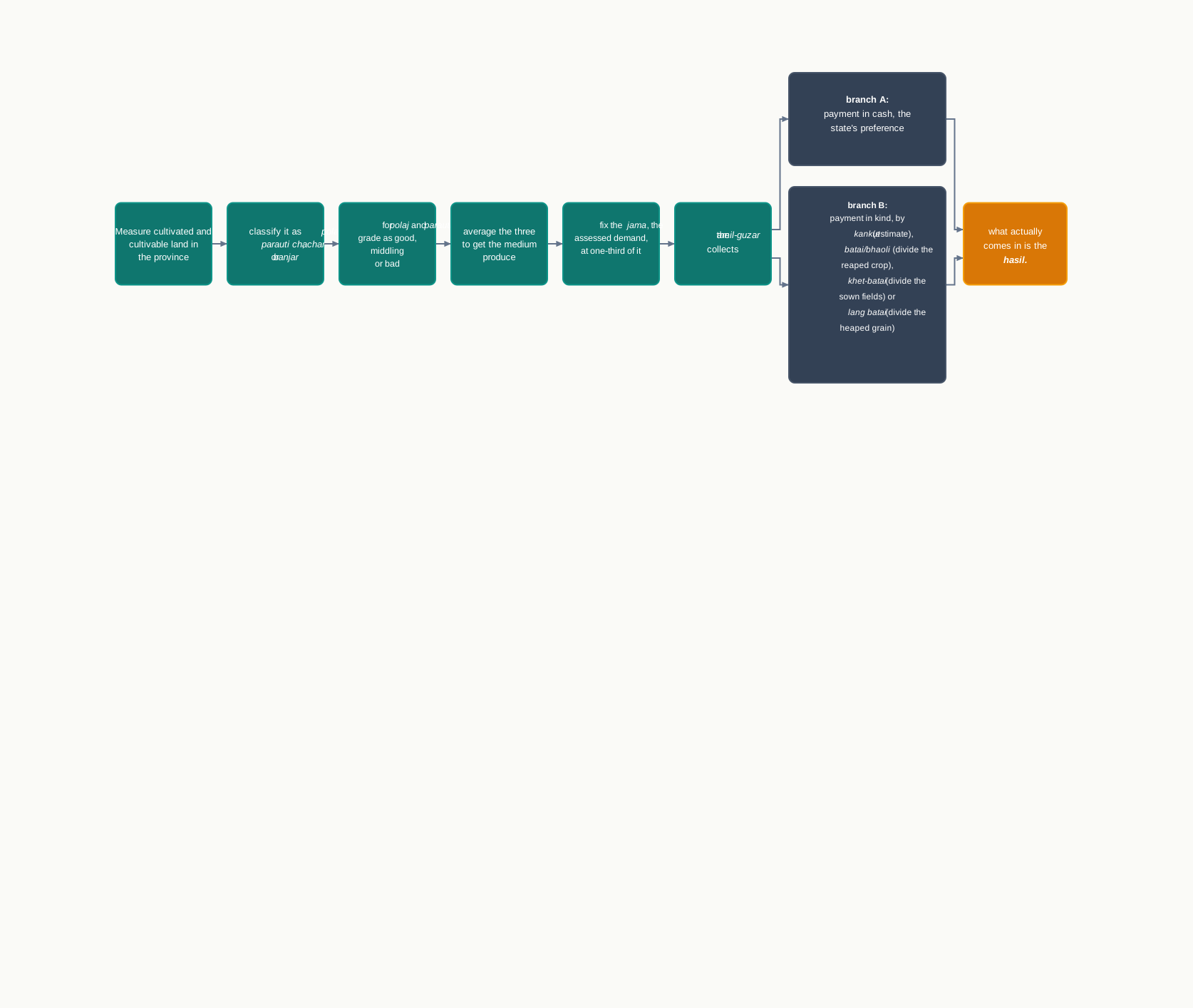
Fig. 8.11 – How revenue was assessed and collected.
The Emperor Insists On A Survey
The order below is Aurangzeb’s, issued in 1665. Read it as an instruction from the centre to men in the districts — and notice that it names both the government’s interests and the peasantry’s.
‘Village by village, peasant-wise’ is the heart of it. The emperor is not asking for a total; he is asking for a demand built up from individual cultivators, because a total can hide a village that has been over-assessed into ruin.
But an order is not an outcome. This is a command issued at court; it does not tell us whether the amins actually walked those villages, or what they wrote down when they did.
The Men Who Lived Off The Revenue
The Mughal administrative system had at its apex a military-cum-bureaucratic apparatus, the mansabdari, which was responsible for looking after the civil and military affairs of the state.
How were these officers paid? Some mansabdars were paid in cash (naqdi), while the majority of them were paid through assignments of revenue (jagirs) in different regions of the empire — that is, they were given the right to collect the revenue of an area instead of a salary.
They were transferred periodically. That single practice is worth pausing on: an officer who knew he would be moved on had little reason to nurse the long-term prosperity of the land he was drawing from.
The Empire Grows, And The Demand With It
The empire whose fields were being measured was not standing still. Map 1 shows its expansion — the territory held in Babur’s reign in 1530, in Akbar’s in 1605, and in Aurangzeb’s in 1707. Study it, and ask yourself what impact the expansion of the empire would have had on land revenue collection.
Map
Map 1 Caption: The expansion of the Mughal Empire, showing the territory held in 1530, in 1605 and in 1707. Brief: Redraw the sketch map with three shaded extents — Babur’s reign 1530, Akbar’s reign 1605, Aurangzeb’s reign 1707 — and the keyed places: Samarqand, Balkh, Kabul, Qandahar, Lahore, Panipat, Delhi, Agra, Amber, Ajmer, Patna, Rohtas, Goa; label the Arabian Sea and the Bay of Bengal. Mark it ‘sketch map not to scale’. These are seventeenth-century political extents, not modern boundaries: state this on the map. The full extent of India as officially defined must be shown.
8.7 The Flow Of Silver
The Mughal Empire was among the large territorial empires in Asia that had managed to consolidate power and resources during the sixteenth and seventeenth centuries. It was not alone. The other such empires were the Ming (China), the Safavid (Iran) and the Ottoman (Turkey).
Place them on a map and a line appears. The political stability achieved by all these empires helped create vibrant networks of overland trade from China to the Mediterranean Sea. Goods could cross Asia because, for a long stretch, they crossed only a few strong states.
Then the sea route changed everything. Voyages of discovery and the opening up of the New World resulted in a massive expansion of Asia’s — and particularly India’s — trade with Europe.
This resulted in a greater geographical diversity of India’s overseas trade, as well as an expansion in the commodity composition of that trade. India was now selling more kinds of things, to more parts of the world, than before.
What Europe Paid With
Europe wanted Indian goods. The question is what it had to give in return, and the answer is the theme of this section: silver.
An expanding trade brought in huge amounts of bullion — uncoined precious metal, valued by weight — into Asia to pay for goods procured from India, and a large part of that bullion gravitated towards India.
This was good for India, as it did not have natural resources of silver. The metal that would become the country’s ordinary coin was not dug out of Indian ground; it was earned by selling cloth, and it arrived by ship.
As a result, the period between the sixteenth and eighteenth centuries was also marked by a remarkable stability in the availability of metal currency, particularly the silver rupya in India.
Why That Mattered To A Peasant
Stable, plentiful silver facilitated an unprecedented expansion of the minting of coins and the circulation of money in the economy. It also strengthened the ability of the Mughal state to extract taxes and revenue in cash.
Now put this beside Section 8.6. Akbar had instructed the amil-guzar to strive to make cultivators pay in cash. That instruction was only workable because coin was reaching the countryside in the first place.
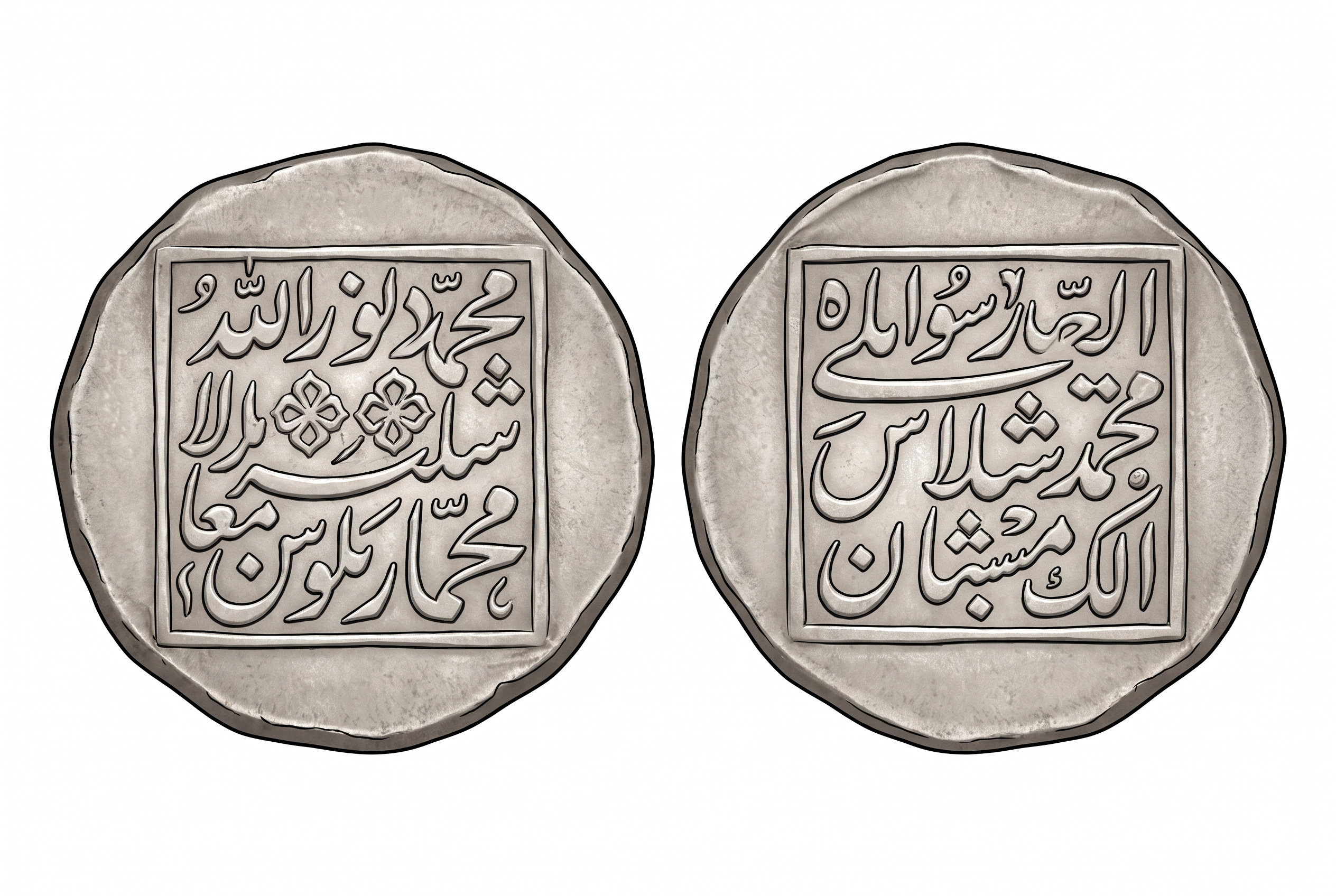
Fig. 8.12 – Silver rupya issued by Akbar.
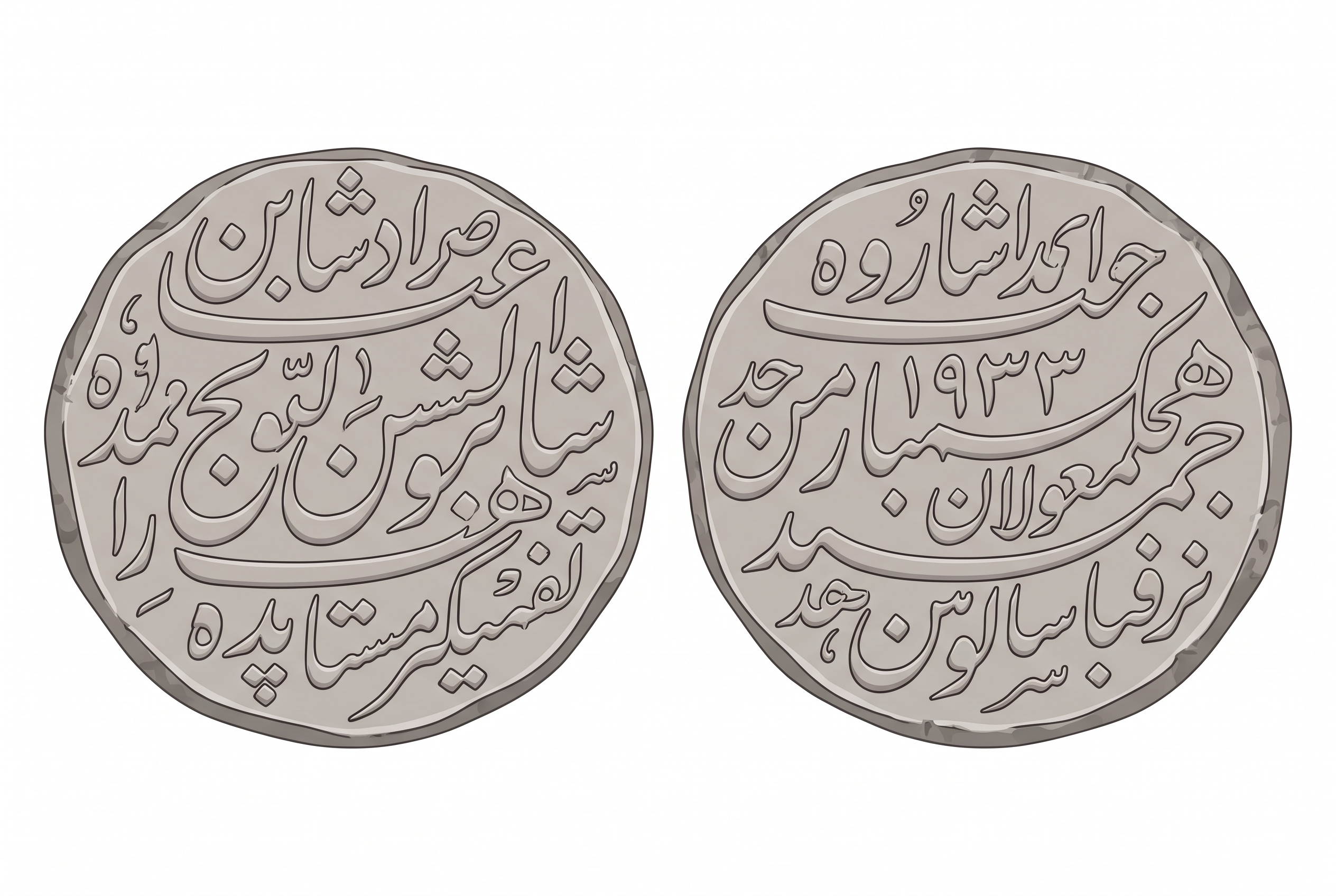
Fig. 8.13 – Silver rupya issued by Aurangzeb.
The Cloth That Bought The Silver
Silver did not arrive as a gift. It arrived in exchange for goods, and above all for cloth. Fig. 8.14 shows a textile made in the subcontinent for European buyers — an object designed with a distant market in mind.

Fig. 8.14 – Textile produced for European markets.
A Traveller Follows The Money
The testimony of an Italian traveller, Giovanni Careri, who passed through India c. 1690, provides a graphic account about the way silver travelled across the globe to reach India. It also gives us an idea of the phenomenal amounts of cash and commodity transactions in seventeenth-century India.
Careri is describing a chain, not a single route. Silver leaves America, passes through Europe, and is spent in Turkey and Persia. Those countries, unable to do without Indian commodities, then send money on to Mocha and Basra, from where ships carry it to India. Silver from Japanese mines, fetched by the Dutch, ends up in the same place.
His last clause is the one to remember: goods carried from India to France, England or Portugal are all bought for ready money, which remains there — that is, in India. Every purchase left its silver behind.
Map
Map 8.A1 Caption: The routes by which silver reached India, as described in Source 8. Brief: World outline map, seventeenth century. Show arrows for silver only: America → Europe → Turkey and Persia (mark Smirna); Turkey, Persia and Arabia → Mocha on the Red Sea and Basra on the Persian Gulf → by sea to India; Japan → (Dutch shipping) → India. Label the Red Sea, the Persian Gulf, the Arabian Sea and the Bay of Bengal. Show no other trade goods and no political boundaries beyond the coastlines; this map illustrates Source 8 and adds nothing to it. The full extent of India as officially defined must be shown.
8.8 The Ain-i Akbari Of Abu’l Fazl Allami
We have leaned on the Ain through this whole chapter — for crop varieties, for the strength of zamindar armies, for the classification of land. It is time to turn the text itself into the object of study, and ask what kind of document it is.
The Ain-i Akbari was the culmination of a large historical, administrative project of classification undertaken by Abu’l Fazl at the order of Emperor Akbar. It was written to command, and that is the first fact about it.
It was completed in 1598, the forty-second regnal year of the emperor, after having gone through five revisions. A regnal year is a year counted from a ruler’s accession, so the empire dated the book by its own reign rather than by any other calendar.
The Ain was part of a larger project of history writing commissioned by Akbar. This history, known as the Akbar Nama, comprised three books. The first two provided a historical narrative; these are examined more closely in Chapter 9. The Ain-i Akbari, the third book, was organised as a compendium of imperial regulations and a gazetteer of the empire — a systematic geographical description, region by region.
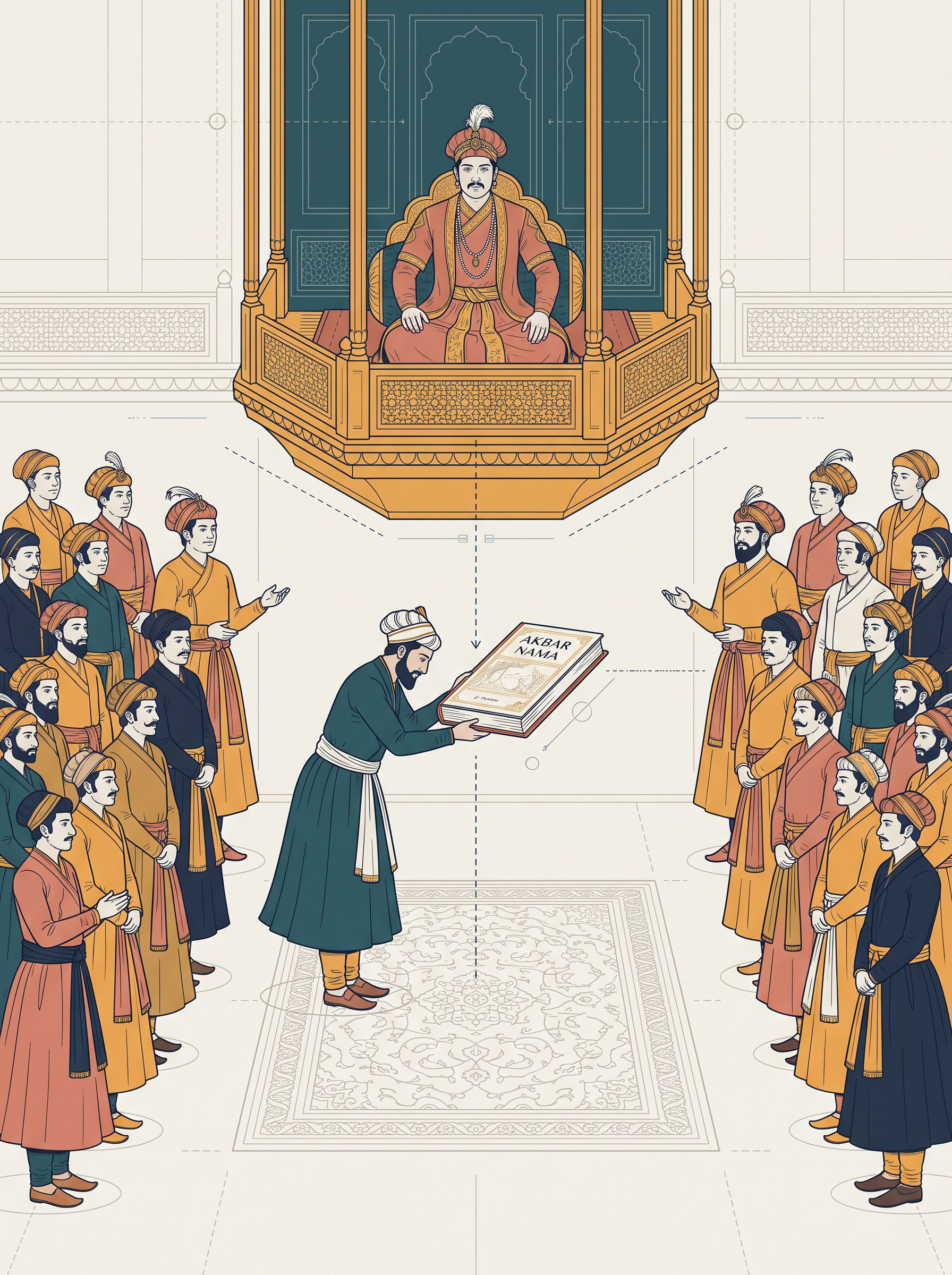
Fig. 8.15 – Abu’l Fazl presenting the Akbar Nama.
What Is Inside It
The Ain gives detailed accounts of the organisation of the court, the administration and the army; of the sources of revenue and the physical layout of the provinces of Akbar’s empire; and of the literary, cultural and religious traditions of the people.
Along with a description of the various departments of Akbar’s government, and elaborate descriptions of the various provinces (subas) of the empire, the Ain gives us intricate quantitative information about those provinces. Numbers, not just narrative — this is what makes it unlike most chronicles.
Collecting and compiling this information systematically was an important imperial exercise. It informed the emperor about the varied and diverse customs and practices prevailing across his extensive territories. To govern people, the state first had to know them.
The Ain is therefore a mine of information for us about the Mughal Empire during Akbar’s reign. It is important, however, to keep in mind — as we noted at the very start of this chapter — that this is a view of the regions from the centre, a view of society from its apex.
The Five Books
The Ain is made up of five books (daftars), of which the first three describe the administration.
The first book, called manzil-abadi, concerns the imperial household and its maintenance. The second book, sipah-abadi, covers the military and civil administration and the establishment of servants. It includes notices and short biographical sketches of imperial officials (mansabdars), learned men, poets and artists.
The third book, mulk-abadi, is the one which deals with the fiscal side of the empire, and provides rich quantitative information on revenue rates, followed by the ‘Account of the Twelve Provinces’. This is the book an agrarian historian lives in.
This section has detailed statistical information, which includes the geographic, topographic and economic profile of all subas and their administrative and fiscal divisions (sarkars, parganas and mahals), the total measured area, and the assessed revenue (jama).
Down To The Sarkar
After setting out details at the suba level, the Ain goes on to give a detailed picture of the sarkars below the suba. This it does in the form of tables, which have eight columns.
The columns give the following information: (1) parganat/mahal; (2) qila (forts); (3) arazi and zamin-i paimuda (measured area); (4) naqdi, revenue assessed in cash; (5) suyurghal, grants of revenue in charity; (6) zamindars. Columns 7 and 8 contain details of the castes of these zamindars, and their troops, including their horsemen (sawar), foot-soldiers (piyada) and elephants (fil).
Read that list of columns again and you can see the state’s mind at work. It wants to know what the land measures, what it pays, who holds it, what caste he is, and how many armed men he can raise. The mulk-abadi gives a fascinating, detailed and highly complex view of agrarian society in northern India.
The fourth and fifth books (daftars) deal with the religious, literary and cultural traditions of the people of India, and also contain a collection of Akbar’s ‘auspicious sayings’.
Where The Information Came From
Abu’l Fazl himself tells us how he gathered his material. The passage below is his own account of the method — and it is one of the most valuable things in the whole chapter, because a historian rarely gets to watch another historian work.
Strip away the ornament and a method appears. He interrogated servants of the state and old members of the family; he took down oral statements in writing; he had provincial officials send in their notes and memoranda; he used the Record Office chronicle; he procured the originals or copies of imperial orders; he incorporated reports submitted by ministers and high officials.
But look at the first line as well. The mandate came from the emperor, and the instruction was to write of ‘glorious events’ and ‘dominion-conquering victories’. The researcher and his patron are the same relationship, and it runs through every page.
How Careful Was He?
Although the Ain was officially sponsored to record detailed information to facilitate Emperor Akbar in governing his empire, it was much more than a reproduction of official papers.
That the manuscript was revised five times by the author would suggest a high degree of caution on the part of Abu’l Fazl, and a search for authenticity. For instance, oral testimonies were cross-checked and verified before being incorporated as ‘facts’ in the chronicle.
There is a further precaution worth admiring. In the quantitative sections, all numeric data were reproduced in words, so as to minimise the chances of subsequent transcriptional errors. A copyist can slip a digit; he is less likely to mangle a word.
The Problems Historians Have Found
Historians who have carefully studied the Ain point out that it is not without its problems. Care is not the same as accuracy.
Numerous errors in totalling have been detected. These are ascribed to simple slips of arithmetic, or of transcription, by Abu’l Fazl’s assistants. They are generally minor and do not detract from the overall quantitative veracity of the manuals — that is, the figures, taken as a whole, still hold.
Another limitation of the Ain is the somewhat skewed nature of the quantitative data. Data were not collected uniformly from all provinces.
For instance, while for many subas detailed information was compiled about the caste composition of the zamindars, such information is not available for Bengal and Orissa. A historian working on eastern India therefore simply cannot ask a question that a historian working on the north-west can ask.
Further, while the fiscal data from the subas is remarkable for its richness, some equally vital parameters, such as prices and wages from these same areas, are not as well documented.
The detailed list of prices and wages that the Ain does provide is mainly derived from data pertaining to areas in or around the imperial capital of Agra, and is therefore of limited relevance for the rest of the country. A price recorded near Agra is not a price in a Bengal village.
Why The Ain Still Matters
These limitations notwithstanding, the Ain remains an extraordinary document of its times.
By providing fascinating glimpses into the structure and organisation of the Mughal Empire, and by giving us quantitative information about its products and people, Abu’l Fazl achieved a major breakthrough in the tradition of medieval chroniclers.
Consider what that tradition had been. Chroniclers wrote mostly about remarkable political events — wars, conquests, political machinations, and dynastic turmoil. Information about the country, its people and its products was mentioned only incidentally, and as embellishment to the essentially political thrust of the narrative.
The Ain completely departed from this tradition, as it recorded information about the empire and the people of India. It thus constitutes a benchmark for studying India at the turn of the seventeenth century.
The value of the Ain’s quantitative evidence is uncontested where the study of agrarian relations is concerned. But it is the information it contains on people, their professions and trades, and on the imperial establishment and the grandees of the empire, which enables historians to reconstruct the social fabric of India at that time.
8.9 Summary
What This Chapter Taught
- About 85 per cent of India’s population lived in villages in the sixteenth and seventeenth centuries. Peasants and landed elites both claimed a share of the produce, and their cooperation, competition and conflict made up rural society.
- The Mughal state drew the bulk of its income from agriculture, and pushed its revenue assessors, collectors and record keepers into the village. Because many crops were grown for sale, money and markets came in with them.
- Peasants left no writings of their own. We know them through the Ain-i Akbari, through regional revenue records from Gujarat, Maharashtra and Rajasthan, and through East India Company records — all written from outside, and mostly from above.
- Sources of the period name two kinds of peasant: khud-kashta, who farmed in the village where they lived, and pahi-kashta, who came in from elsewhere on contract, by choice or after distress. Holdings were small, and cultivation rested on individual ownership.
- Land, labour and peasant mobility together allowed agriculture to keep expanding. Rainfall decided the staple — rice in the wettest zones, then wheat, then millets — while wells, wheels, canals and the light wooden plough extended what the rain could not reach.
- Two seasons, kharif and rabi, gave most regions two crops a year and some three. Alongside food staples, peasants grew jins-i kamil — cotton, sugarcane, oilseeds — for the market, and new crops such as maize, tomatoes, potatoes, chillies and tobacco arrived from other parts of the world.
- The village community had three constituents: the cultivators, the panchayat, and the headman (muqaddam or mandal). The panchayat was an oligarchy of propertied elders that kept accounts, spent a common fund, levied fines, and upheld caste boundaries. Each jati also had its own panchayat.
- Caste ran through everything. Menial and labouring groups (majur) were held in poverty, while some intermediate castes rose as their work grew profitable. Villagers from the lowest rungs petitioned the panchayat against extortionate taxation and begar, arguing that a demand which threatened survival broke custom.
- Artisans could be a quarter of village households. They were paid with a share of the harvest, with land, or by negotiated goods-for-services arrangements later called the jajmani system — and sometimes in cash. The village was never the ‘little republic’ that British officials imagined.
- Women worked in the fields, in artisanal production and at construction sites, and their labour was needed most where production was most commercialised. High mortality made wives scarce, so bride-price and remarriage were accepted. Women petitioned panchayats, though their names were left out of the record; among the gentry, women inherited, sold and even held zamindaris.
- Forests may have covered around 40 per cent of the land. Forest dwellers, called jangli, lived by gathering, hunting and shifting cultivation on a seasonal round. The state took peshkash, wanted elephants, feared the forest as mawas, and watched commerce, clearance and chieftaincy transform forest life.
- Zamindars lived off agriculture without cultivating. They held milkiyat lands, collected revenue for the state, and kept forts and troops. They were an exploitative class, yet they settled cultivators, built haats, and often had peasant support in revolts against the state.
- Land revenue was the empire’s economic mainstay. Land was measured and classified — polaj, parauti, chachar, banjar — and the assessed jama was fixed at one-third of the medium produce. What was actually collected, the hasil, routinely fell short.
- Silver flowed into India from the Americas and Japan through Europe and West Asia, because Europe had to pay for Indian goods. India mined almost no silver of its own, yet minted the rupya in unprecedented numbers — which is what made a cash revenue system possible.
- The Ain-i Akbari, completed in 1598 after five revisions, was a compendium of imperial regulations and a gazetteer of the empire. Its mulk-abadi book gives an unmatched quantitative picture of agrarian society — and remains, throughout, a view of the regions from the centre.
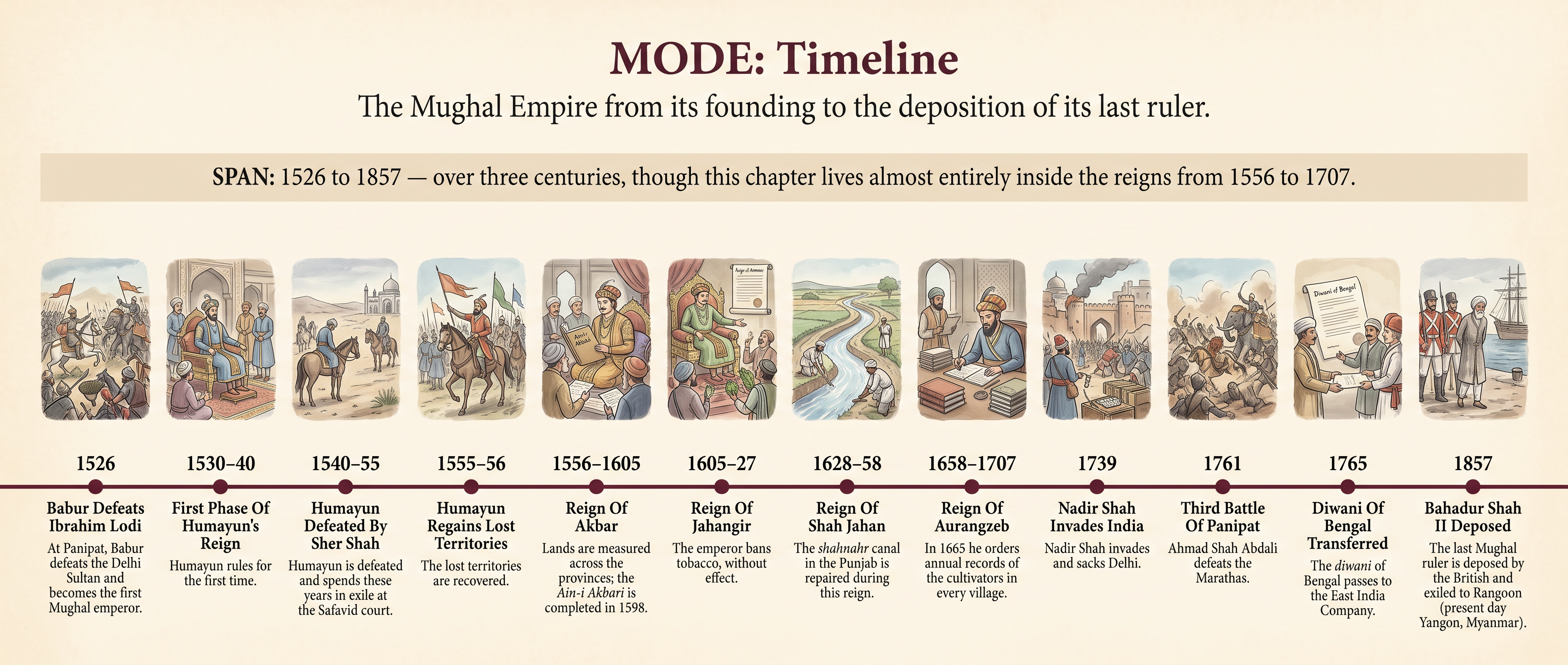
Fig. 8.16 – Landmarks in the history of the Mughal Empire.
What The Evidence Cannot Tell Us
The peasant is the subject of this chapter and the author of none of it. Everything we know about him was written by a court historian, a revenue official, a zamindar’s clerk or a foreign traveller — people who came to the village to count, to tax, to celebrate a patron, or to be surprised.
So the silences are shaped like the sources. We know what the state could measure, and almost nothing about the forests it could not. We know what women demanded of a panchayat, but not their names. We know the jama the empire claimed, and only imperfectly the hasil it took.
A record of a quarrel remains our best window, because people arguing let slip what they believed they were owed. But it is a window opened by conflict alone — and the ordinary, uneventful day of a raiyat in his field has left no trace at all.
8.10 NCERT Questions
What are the problems in using the Ain as a source for reconstructing agrarian history? How do historians deal with this situation? (in about 100-150 words)
To what extent is it possible to characterise agricultural production in the sixteenth-seventeenth centuries as subsistence agriculture? Give reasons for your answer. (in about 100-150 words)
Describe the role played by women in agricultural production. (in about 100-150 words)
Discuss, with examples, the significance of monetary transactions during the period under consideration. (in about 100-150 words)
Examine the evidence that suggests that land revenue was important for the Mughal fiscal system. (in about 100-150 words)
To what extent do you think caste was a factor in influencing social and economic relations in agrarian society? (in about 250-300 words)
How were the lives of forest dwellers transformed in the sixteenth and seventeenth centuries? (in about 250-300 words)
Examine the role played by zamindars in Mughal India. (in about 250-300 words)
Discuss the ways in which panchayats and village headmen regulated rural society. (in about 250-300 words)
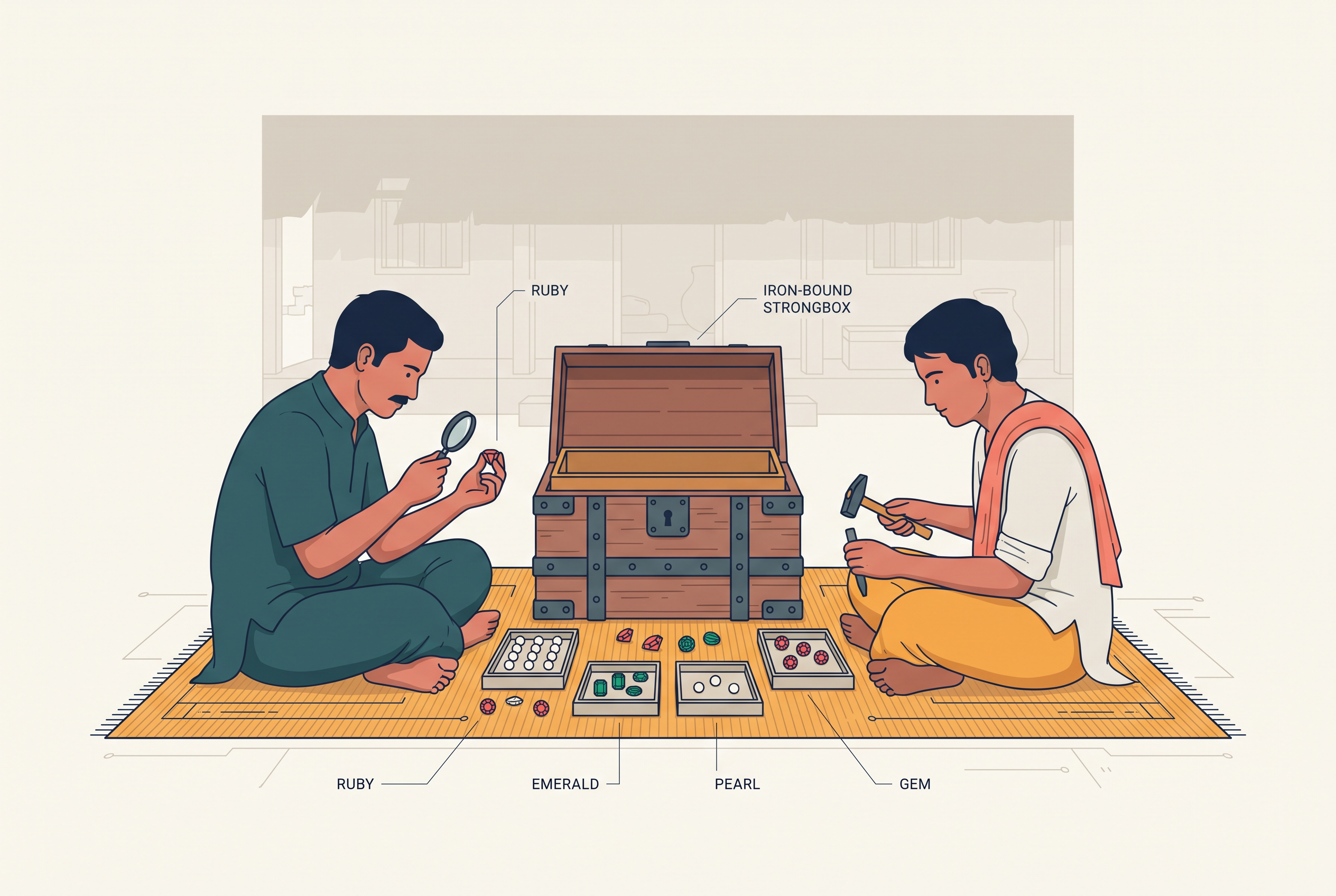
Fig. 8.17 – Jewellers at work.
- On an outline map of the world, mark the areas which had economic links with the Mughal Empire, and trace out possible routes of communication.
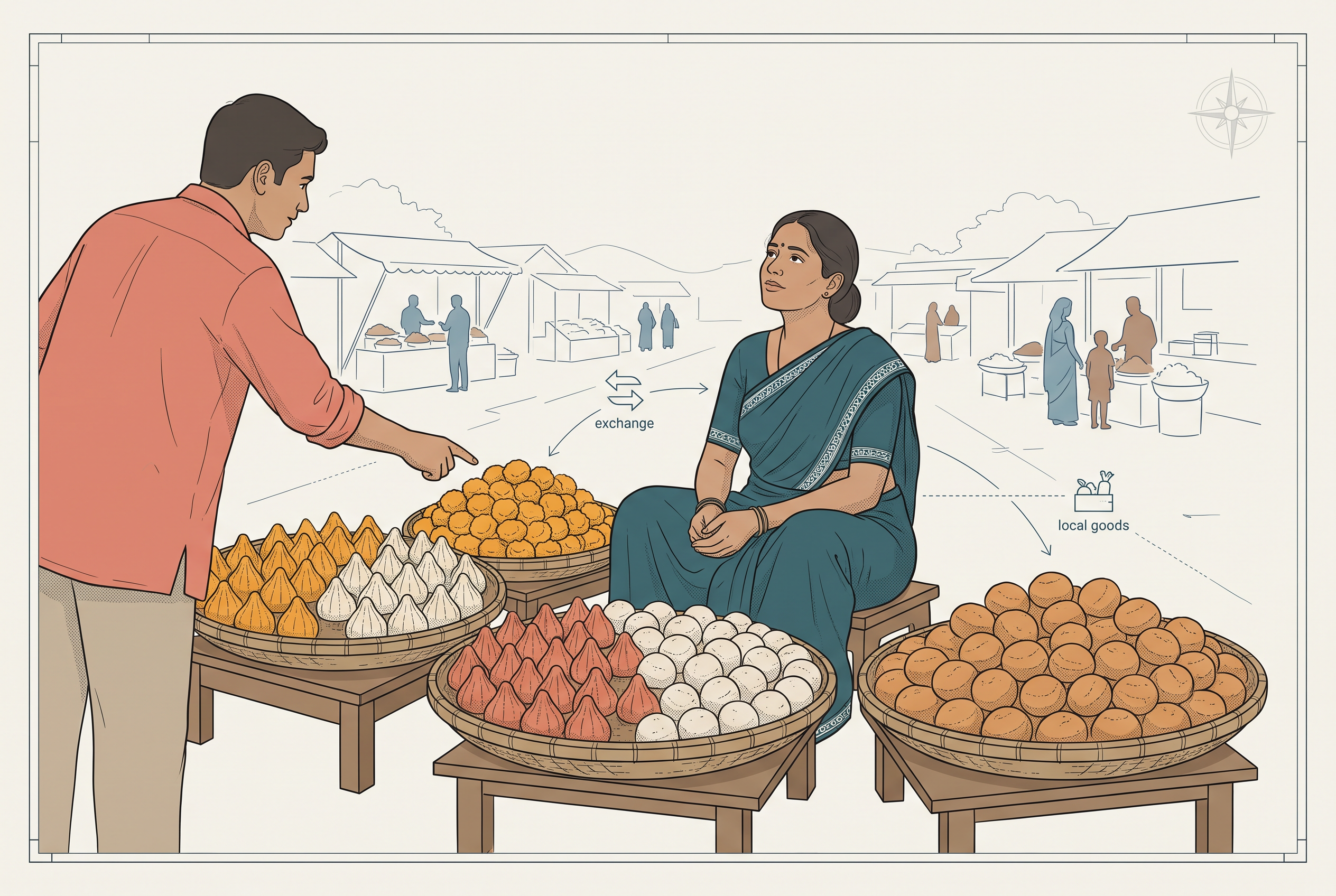
Fig. 8.18 – Woman selling sweets.
8.11 Check Your Concepts
Explain the difference between a khud-kashta and a pahi-kashta peasant. Give one reason a peasant might become pahi-kashta by choice, and one reason he might become pahi-kashta by compulsion.
Read Source 1 again. State two things Babur’s account shows us about village settlement in northern India, and one important thing it cannot tell us about the villages he describes.
Using Source 5, set out the four categories into which land was classified, and show step by step how the royal dues were arrived at for polaj and parauti land. Whose risk does an assessment based on an average carry — the state’s or the cultivator’s? Explain your answer.
Distinguish between jama and hasil. Why did the empire keep two separate figures, and what does the gap between them tell a historian about the reach of the Mughal state?
Reconstruct, in order, the steps a village might take when it was faced with a revenue demand it thought excessive — from the first appeal to the last resort. Explain why the final step was an effective weapon in the hands of cultivators.
The chapter calls the zamindars an exploitative class, and also tells us that peasants often supported them in the agrarian uprisings of seventeenth-century north India. How can both statements be true? Use the evidence of the bhakti saints in your answer.
Women in western India petitioned the village panchayat, but their names were left out of the record and they were entered as the mother, sister or wife of the male head of the household. What can a historian still learn from such a petition, and what is now permanently lost? What does this tell you about the silences in the sources for this chapter?