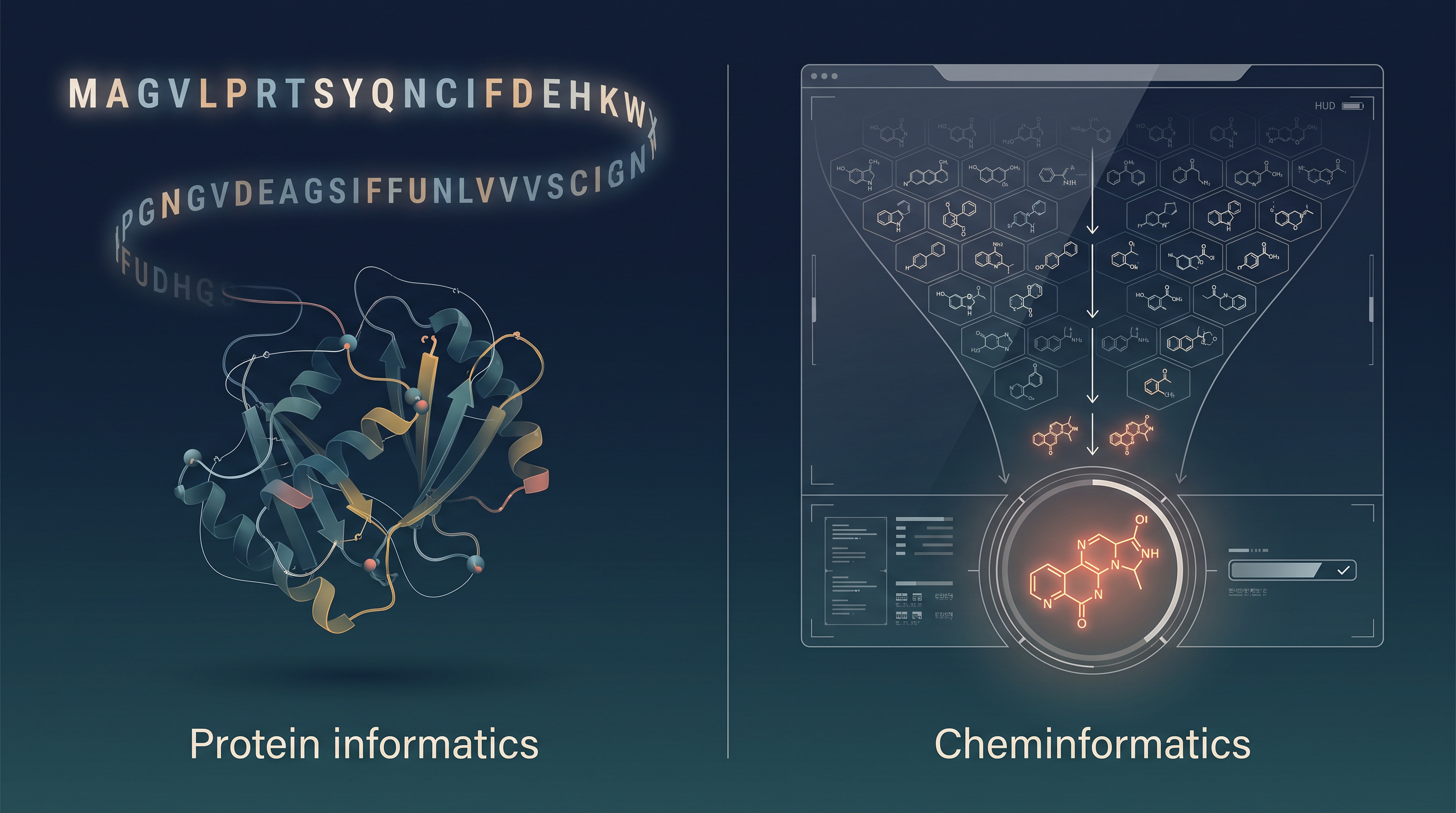
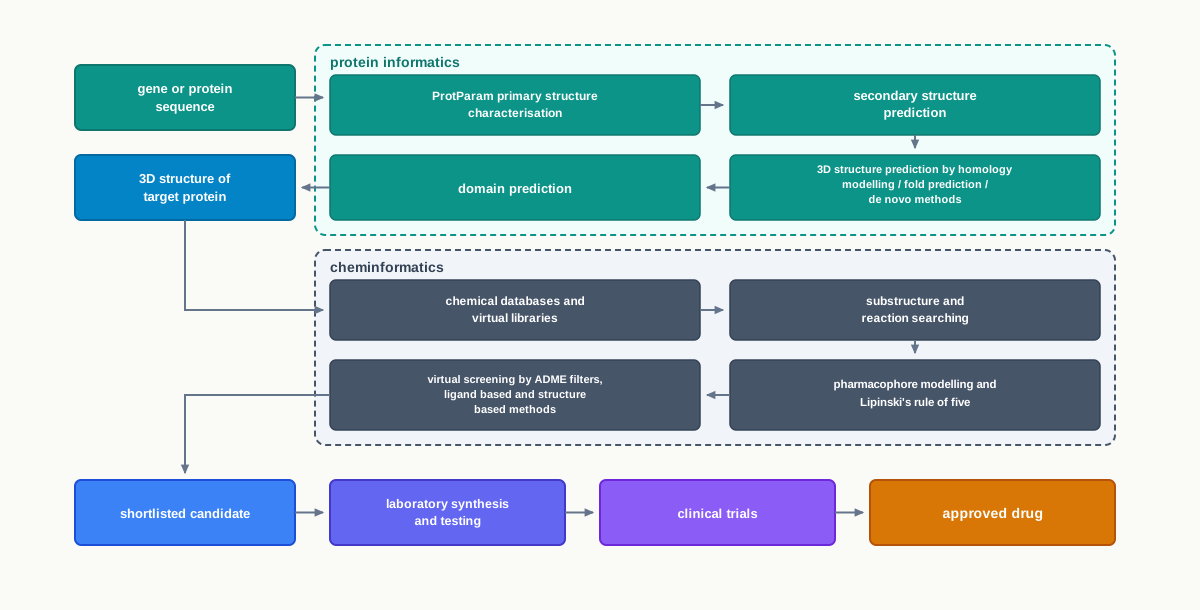
Protein informatics — The collection, storage and analysis of information about any protein using the techniques of information technology.
Hypothetical protein — A protein whose sequence has been derived directly from a genomic sequence but for which there is no known evidence of existence.
Functional site — The specific region on a folded protein, such as a pocket or groove, where a substrate or partner molecule binds.
Biochemical function — The chemical reaction or activity that a protein carries out.
Biological function — The role that a protein’s activity plays in the life of the organism.
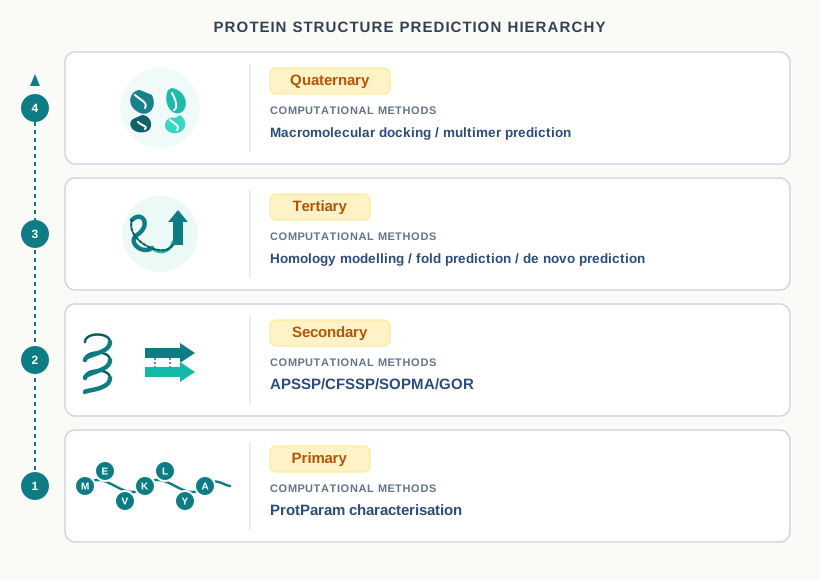
Tertiary structure — The complete three-dimensional folded shape of a single polypeptide chain.
Heterogeneous databases — Collections of different kinds of biological information, held in different formats and at different centres, that can nevertheless be searched together.
Descriptor — A measurable number or code standing for a property of a molecule, allowing molecules to be compared mathematically.
Proteome — The complete set of proteins expressed by an organism.
MALDI (Matrix Assisted Laser Desorption Ionisation) — A mass-spectrometry technique in which a laser is used on a matrix-embedded sample to produce short protein sequence reads.
NMR (Nuclear Magnetic Resonance) — A technique that reports on the environment of atomic nuclei in a magnetic field and yields structural information about proteins in solution.
MS (Mass Spectrometry) — A technique that measures very accurate molecular masses of proteins and their fragments.
Multi-fractal property — A texture that repeats at different magnifications and needs several numbers to describe it, used to design protein-markers from images of heat-denatured aggregates.
Network mapping — The construction of maps showing which protein influences which, used to identify possible targets for treatment of diseases.
Wavelet techniques — Image-analysis methods that break an image into patterns at several scales.
Homology — The degree of similarity between the sequences of two proteins.
Structure optimisation — Adjustment of a rough structural model until its atoms occupy energetically sensible positions.
ANN, SVM and HMM — Artificial Neural Network, Support Vector Machine and Hidden Markov Model; statistical and machine learning techniques that learn rules from known examples and apply them to unknown proteins.
SBML (Systems Biology Mark-up Language) — A standard computer language for writing biological models so that they can be exchanged between laboratories.
High throughput screening — The ability to run the same analysis on very large numbers of samples or compounds one after another without extra manual work.
ProtParam — The tool of the ExPASy Proteomics Server that computes the physico-chemical properties of a protein from its sequence.
ExPASy Proteomics Server — The proteomics resource that hosts ProtParam and related analysis tools.
Isoelectric point (pI) — The pH at which the surface of a protein is covered with charge but its net charge is zero, at which the protein is stable and compact.
Isoelectric focusing — A purification method in which proteins migrate through a pH gradient and each stops at the pH equal to its own pI.
Aliphatic index (AI) — The relative volume of a protein occupied by aliphatic side chains (A, V, I and L), a positive factor for thermal stability of globular proteins.
Instability index — An index computed from destabilising dipeptides that estimates the stability of a protein in a test tube; below 40 predicts stability, above 40 instability.
Grand Average Hydropathy (GRAVY) value — The sum of the hydropathy values of all the amino acids divided by the number of residues, a low value indicating better interaction with water.
Secondary structure — The local, regularly repeating folds of the protein backbone, chiefly α-helices and β-pleated sheets.
APSSP, CFSSP, SOPMA and GOR — Common computational tools for protein secondary structure prediction.
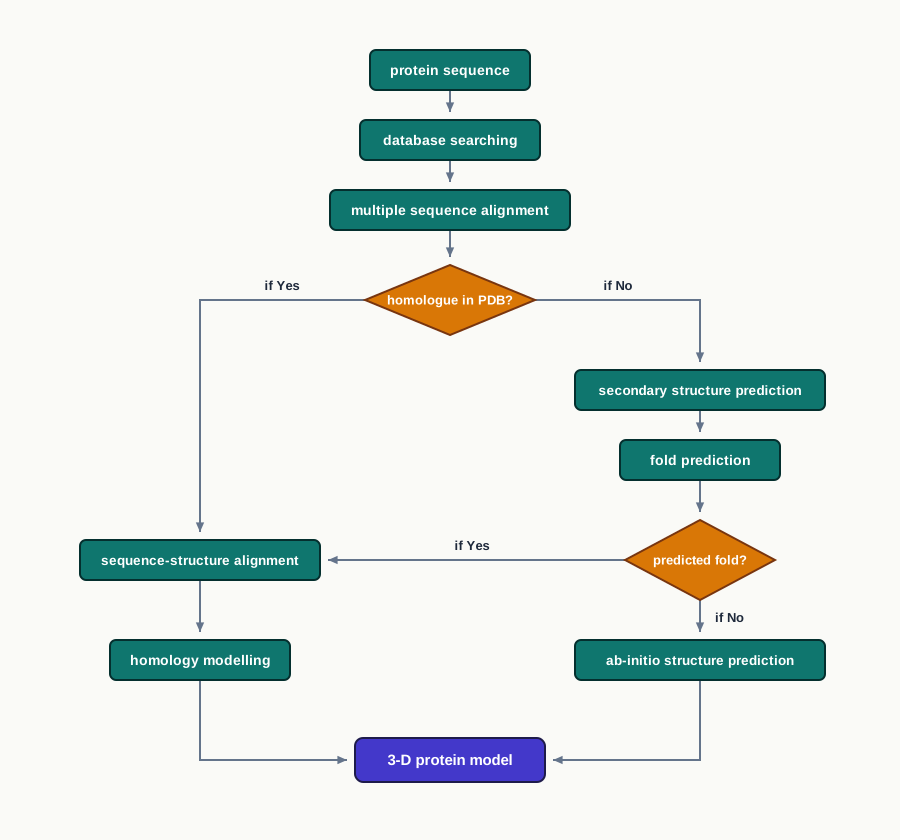
Homology modelling — Prediction of the structure of an unknown protein by aligning its sequence against proteins of known structure and borrowing their fold.
Chou-Fasman method — A method that uses lower degrees of homology to determine local structures, used for predicting secondary structure.
MODELLER and SWISS-MODEL — Commonly used tools for homology modelling.
Fold prediction (threading) — A method in which the sequence of an unknown protein is forced to take the backbone conformation of a protein of known structure.
LIBELLULA and Threader — Commonly used tools for fold prediction by threading.
De novo protein structure prediction — An algorithmic process in which the tertiary structure is predicted from the amino acid primary sequence alone, without a template.
Ab initio — Meaning “from the beginning”; describing structure prediction built from first principles, as implemented in the QUARK algorithm.
PDB file — A text file with the extension .pdb that stores the three-dimensional atomic coordinates of a structure.
Protein Data Bank (PDB) — The database of biomolecular structures containing data from X-ray crystallography, NMR and a few theoretical structure models.
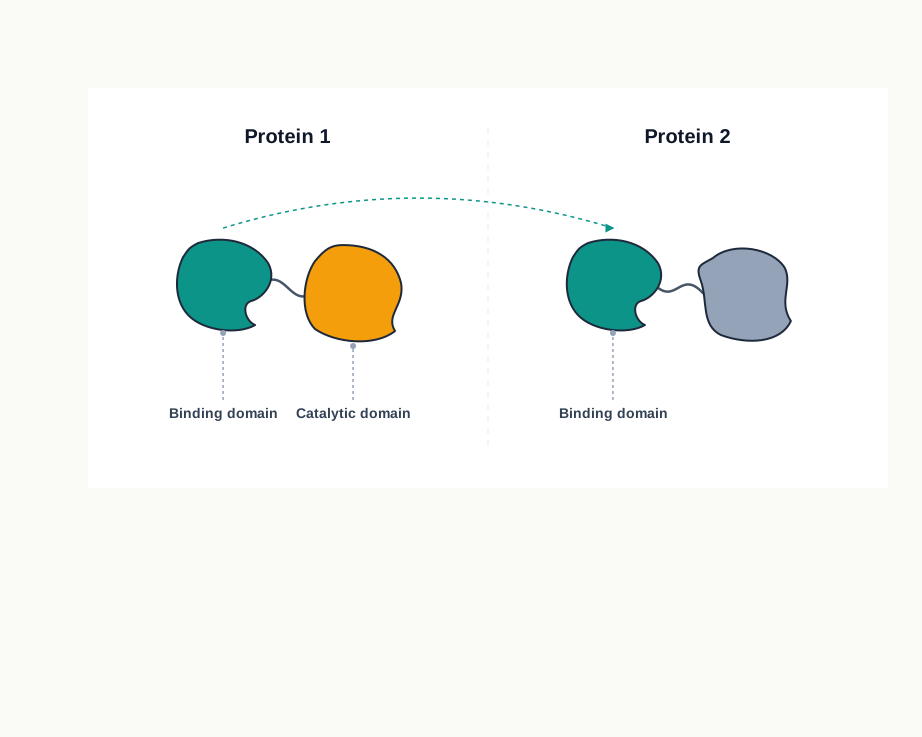
Domain — A distinct structural and/or functional unit of a protein that folds independently and carries a specific function.
InterPRO and CDD — The most common tools for domain prediction, InterPRO scan of EMBL and CDD search of NCBI.
Cheminformatics — The use of computational and informational techniques to understand problems of chemistry, also called chemoinformatics or chemical informatics.
Computer-aided drug design (CADD) — The use of cheminformatics to look for molecules with specific biological and therapeutic properties.
Virtual library — A collection of chemical compounds that exist as data rather than as substances, including hypothetical compounds along with their likely synthesis methods and predicted stability.
Combinatorial techniques — Synthetic methods in which chemical building blocks are combined in every possible arrangement to generate a very large family of related molecules.
CAS (Chemical Abstracts Service) — A division of the American Chemical Society that maintains the world’s largest collection of chemistry insights and serves as a universal standard for chemical names and structures.
In silico — Meaning “inside a computer”; used for work done computationally, alongside in vivo and in vitro.
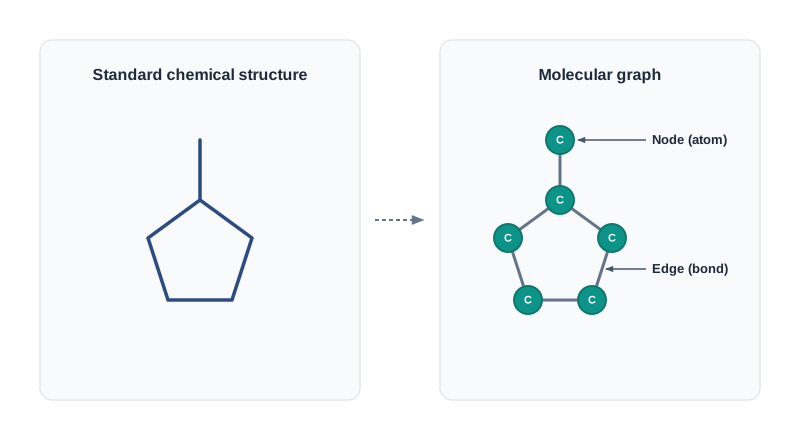
Molecular graph — A computer representation of a chemical structure in which nodes stand for atoms and edges stand for bonds.
Node and edge — In a graph, a node is a unit of chemical substance and an edge is the movement of information between nodes.
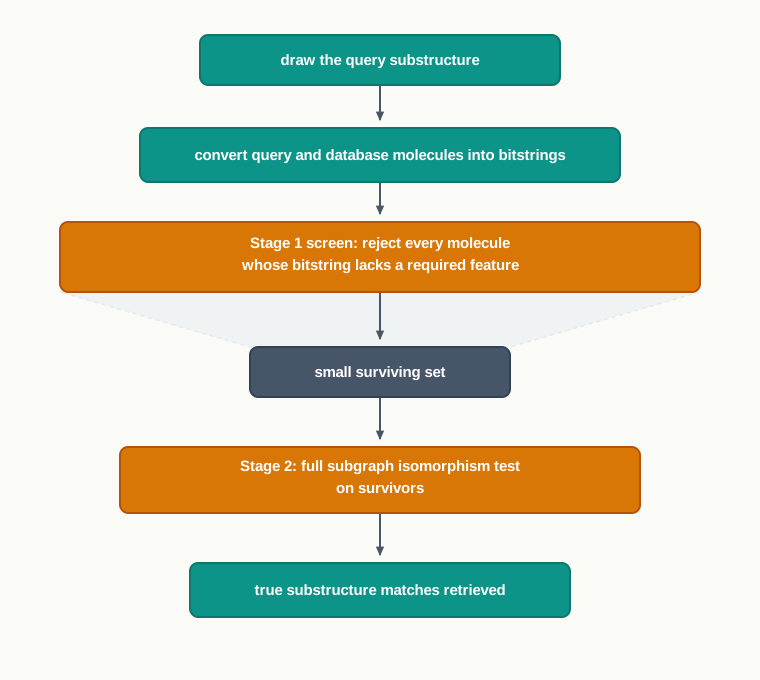
Substructure retrieval — A search that returns all compounds containing a specified structural feature, such as a methyl group or benzene ring.
Subgraph isomorphism — The complete embedding of a small graph into a larger one, the computational basis of substructure searching.
Two-stage search — A search strategy in which most molecules are first filtered out cheaply, and the elaborate subgraph test is applied only to the small surviving set.
Bitstrings — Binary strings of 0s and 1s used to implement molecule screens by recording the presence or absence of structural features.
Atom mapping — Finding an exact correspondence between the atoms of the reactants and the atoms of the resulting products in a reaction search.
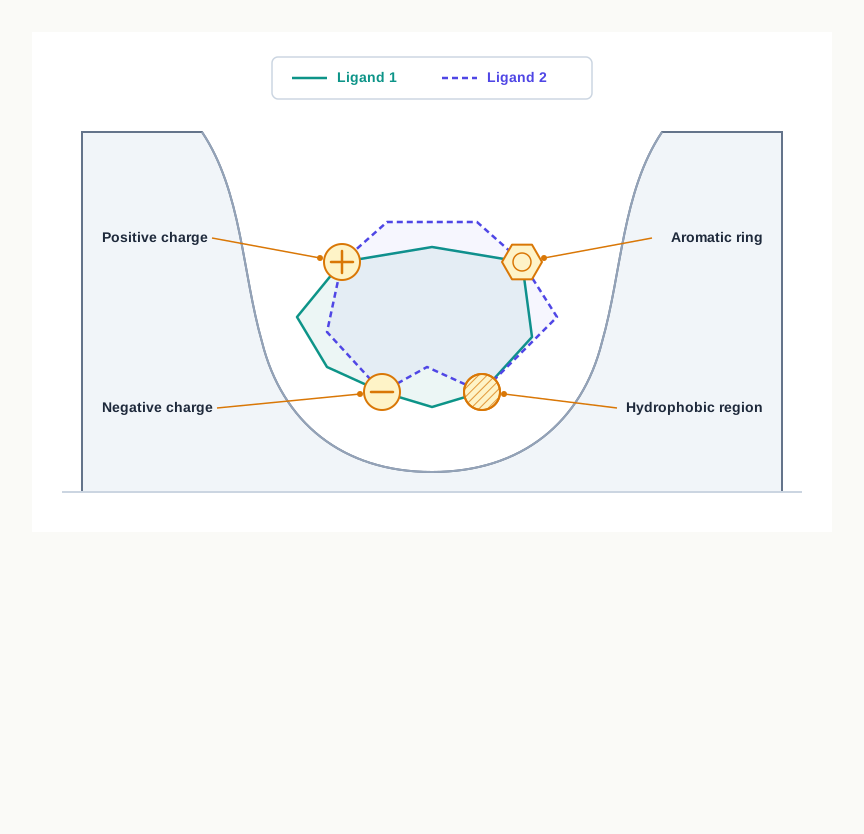
Pharmacophore — An ensemble of the steric and electronic features necessary to ensure optimal interaction with a specific biological target and to trigger a biological response.
3D pharmacophore — A set of pharmacophore features described in terms of their spatial orientation, such as charged groups, rings and hydrophobic regions.
Lipinski’s rule of five (RO5) — A set of four criteria, proposed in 1997, describing the molecular properties expected of an orally active drug, with not more than one violation permitted.
log P — The octanol–water partition coefficient, a dimensionless measure of how strongly a compound prefers a lipid environment over water.
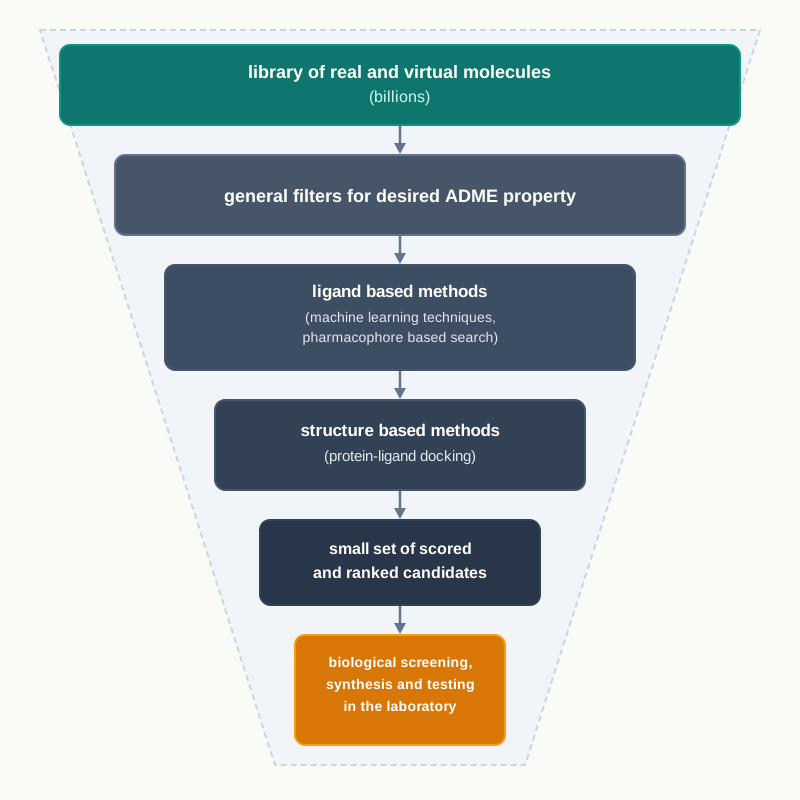
ADME — Absorption, Distribution, Metabolism and Excretion; the properties describing what the body does to a drug.
Ligand based methods — Virtual screening methods, including machine learning techniques and pharmacophore based search, that rely on molecules already known to be active.
Structure based methods — Virtual screening methods, including protein-ligand docking, that rely on the three-dimensional structure of the target.
Protein-ligand docking — Computational placement of a candidate molecule into the binding site of a target protein to score how well it fits.
Virtual screening — The in silico scoring, ranking and extraction of promising structures from large libraries of real and virtual molecules using increasingly stringent filters.
High Throughput Screening (HTS) — A large scale automated process in which millions of compounds are tested for a desired property.
Hits — Activity observed during high-throughput screening, defined by the percent activity of new compounds compared with well defined known compounds.
False positive — A compound found active in an assay that turns out to be inactive towards a certain biological target.
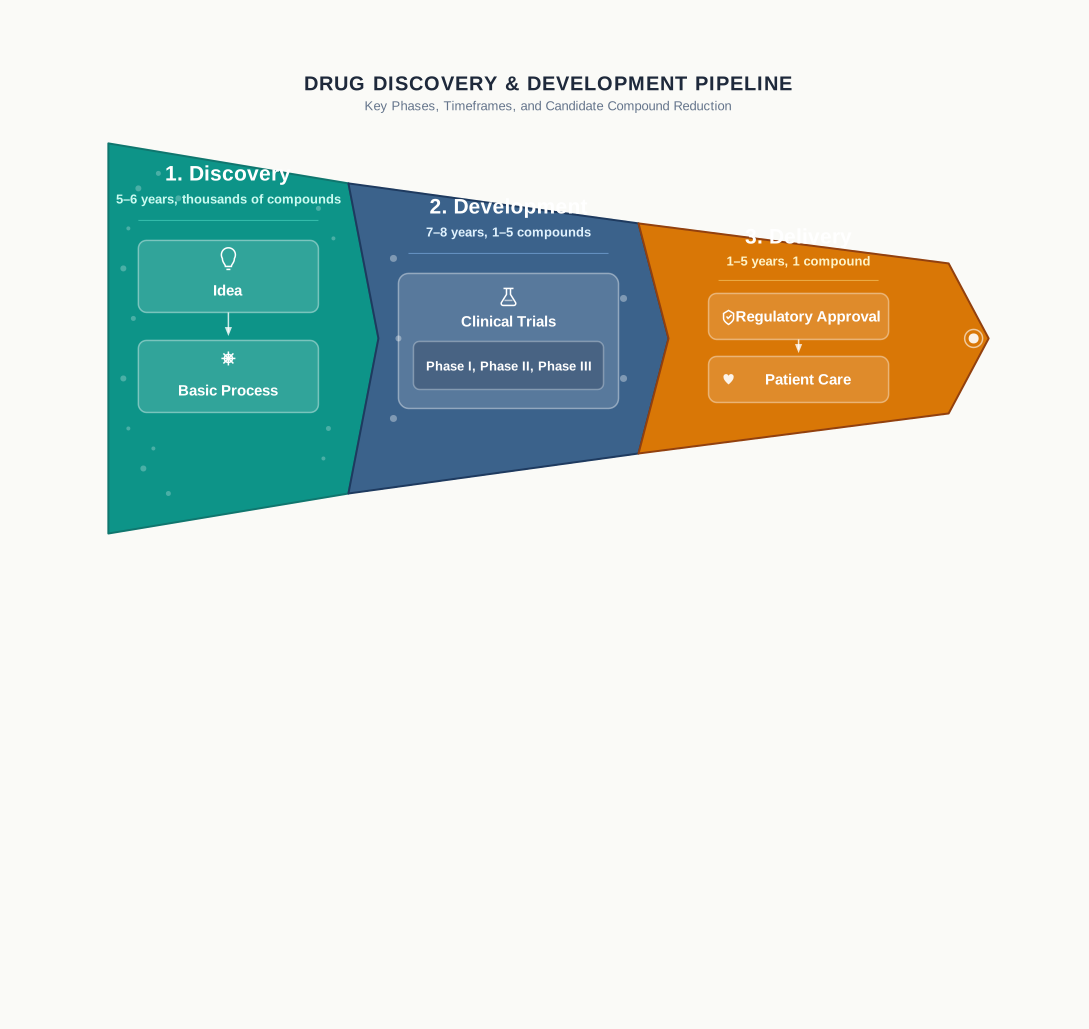
Lead compound — A compound that is biologically and pharmacologically active with desired properties and can be processed further.
Library — An inventory of compounds that fulfil the criteria for screening against specific cellular targets.
New Chemical Entity — A novel molecule discovered in the laboratory that has not yet entered clinical trials.
Off target activity — Molecular interactions between chemical compounds and cellular molecules that do not bind the intended target.