Chapter 11: Dual Nature of Radiation and Matter
In the year 1887, the German physicist Heinrich Hertz was busy proving that light is a wave. He was generating and detecting electromagnetic waves using two metal spheres separated by a small air gap. When a high voltage was applied, a spark would leap across the gap — and this spark told him that invisible electromagnetic waves were travelling through the air, exactly as Maxwell’s theory had predicted.
While watching these sparks closely, Hertz noticed something he had not expected. When ultraviolet light from a nearby source fell on the metal, the sparks jumped across the gap more easily. Shine ultraviolet light on the metal, and sparking became stronger; block that light, and the effect faded.
Hertz recorded the observation carefully but did not chase its meaning. It seemed like a small side-detail in an experiment about waves. Yet hidden inside that little spark was a puzzle so deep that solving it would shake the very idea of what light is — and would earn a young clerk named Albert Einstein a Nobel Prize almost two decades later.
That tiny spark is where this chapter begins. It leads us to a strange conclusion: light, which behaves as a wave, can also behave as if it were a stream of tiny energy packets — and, even stranger, so can matter.
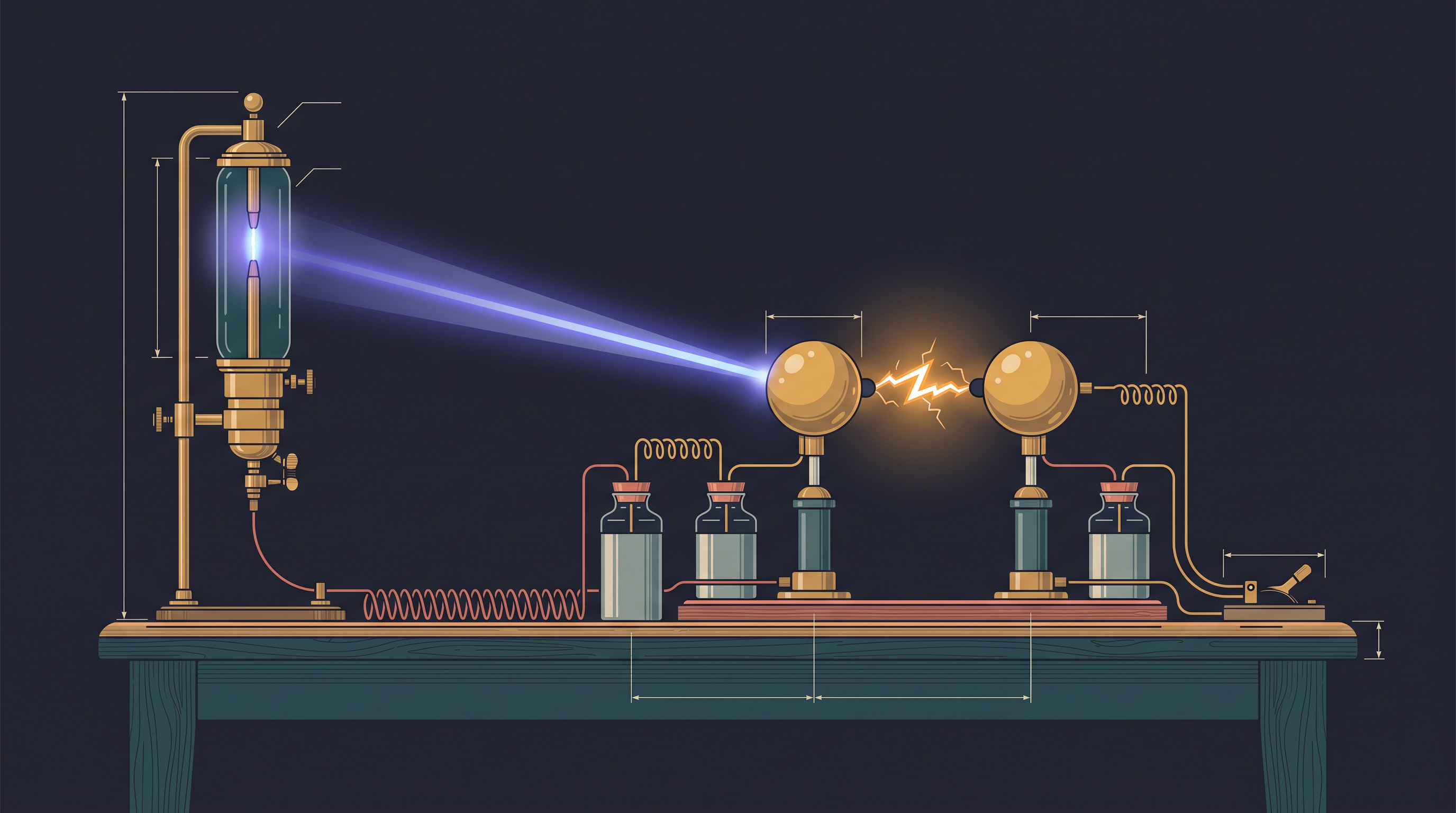
Fig. 11.0 – Hertz’s spark-gap apparatus and the photoelectric effect.
This chapter will answer each of these questions as it unfolds. Keep them in mind — by the end, the spark that puzzled Hertz will make complete sense.
11.1 Introduction
By the end of the nineteenth century, physicists were confident about one thing: light is a wave. Maxwell’s equations had shown that electric and magnetic fields can travel together through space as an electromagnetic wave, and in 1887 Heinrich Hertz succeeded in producing and detecting such waves in his laboratory. Together, these results firmly established the wave nature of light.
Around the same period, scientists were also studying a very different phenomenon — how electricity passes through gases. Normally a gas does not conduct electricity. But if the gas is sealed inside a glass tube and its pressure is lowered greatly, it begins to conduct when a high voltage is applied across two metal plates fixed inside. This setup is called a discharge tube, and the passing of current through the low-pressure gas is called electric discharge.
The two metal plates through which the current enters and leaves are called electrodes. The electrode connected to the negative terminal is the cathode, and the one connected to the positive terminal is the anode. Studying discharge tubes led to some of the most important discoveries in physics, including the discovery of X-rays by Roentgen in 1895 and the discovery of the electron by J. J. Thomson in 1897.
It was found that at a very low pressure — about \(0.001\) mm of mercury column — a discharge takes place between the two electrodes when an electric field is applied to the gas. (Pressure here is measured by the height of a mercury column it can support, so \(0.001\) mm of mercury is an extremely low pressure, close to a vacuum.)
At this stage, a glowing patch appears on the glass wall of the tube, on the side directly opposite the cathode. This glow is called fluorescence — the giving out of visible light by a material when it is struck by invisible radiation.
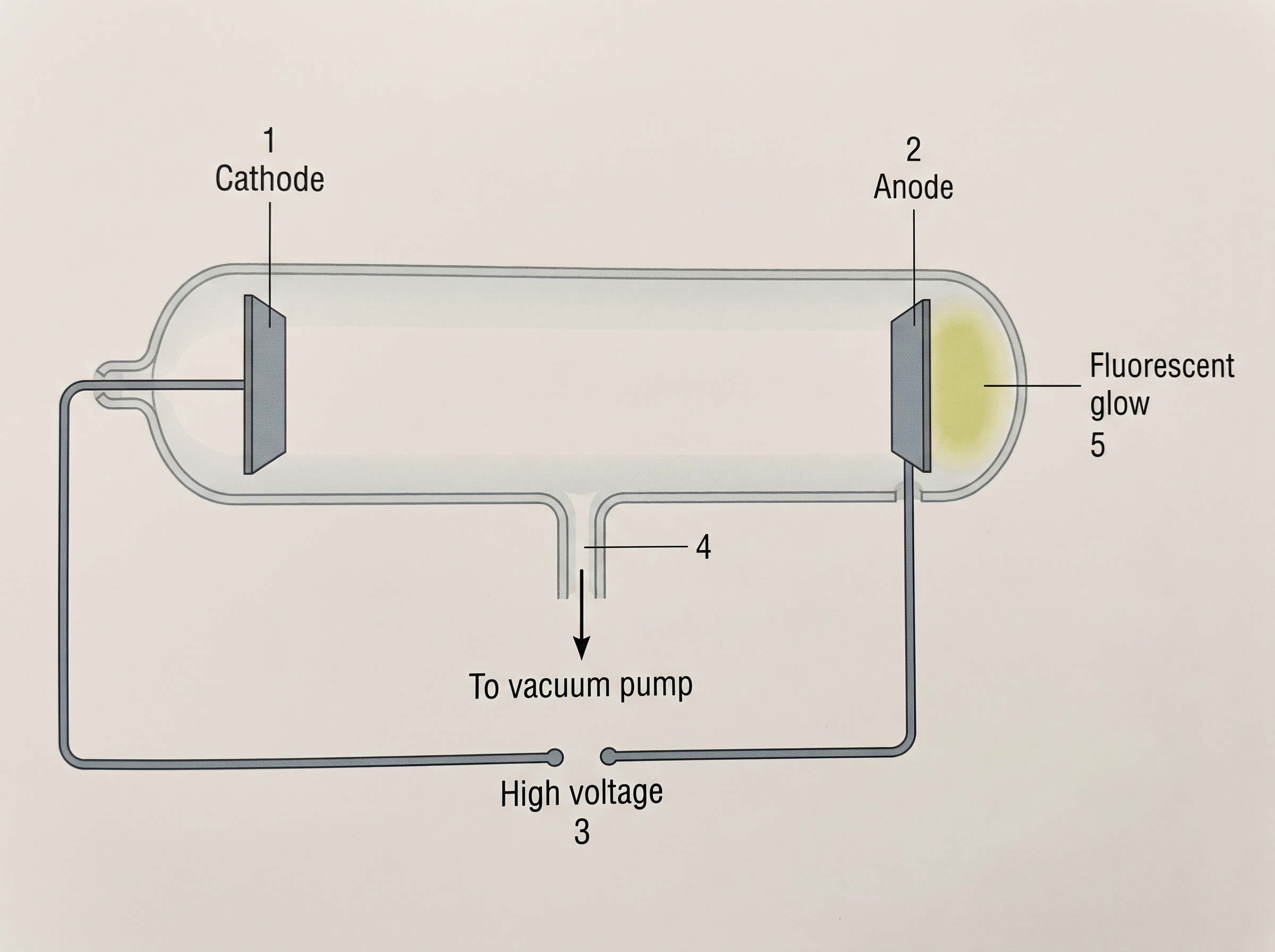
Fig. 11.1 – Electric discharge through a low-pressure gas.
The colour of this glow depends on the type of glass used; for soda glass it is yellowish-green. Scientists reasoned that the fluorescence was caused by some radiation coming from the cathode and striking the glass. Because this radiation seemed to originate at the cathode, it was named cathode rays.
According to the textbook account, these cathode rays were discovered in 1870 by William Crookes, who later, in 1879, suggested that they were made up of streams of fast-moving, negatively charged particles.
The British physicist J. J. Thomson (1856–1940) confirmed this idea experimentally. To do so, he applied an electric field and a magnetic field across the discharge tube in directions perpendicular to each other and to the beam. By balancing the deflection caused by one field against the other, he could work out both the speed of the cathode-ray particles and their specific charge.
The specific charge of a particle is simply its charge divided by its mass. It is a useful quantity because it can be measured directly from how much a beam bends in electric and magnetic fields, even before the individual charge or mass is known.
A striking result was that this value of \(e/m\) did not change at all — it stayed the same no matter which metal was used for the cathode, or which gas was placed in the tube. This pointed to something deep: the same kind of particle was present in every material.
Around the same time, in 1887, another observation was made. Certain metals, when exposed to ultraviolet light, gave out negatively charged particles that moved with small speeds. Also, some metals emitted negatively charged particles when they were heated to a high temperature.
When the specific charge of all these particles was measured, it came out to be the same as that of the cathode-ray particles. So even though these particles were produced under completely different conditions — a discharge tube, ultraviolet light, or strong heating — they were identical in nature.
In 1897, J. J. Thomson named these particles electrons and proposed that they are fundamental, universal constituents of all matter — that is, tiny building blocks present inside every substance. For this landmark discovery, made through his experimental and theoretical study of the conduction of electricity through gases, he was awarded the Nobel Prize in Physics in 1906.
The next big step was to measure the actual charge on a single electron. In 1913, the American physicist R. A. Millikan (1868–1953) achieved this through his famous oil-drop experiment.
This result showed that electric charge does not come in just any value; it always appears in exact multiples of a smallest unit. This property is called the quantisation of charge.
Once the elementary charge \(e\) was known from Millikan’s work, and the specific charge \(e/m\) was known from Thomson’s work, the mass \(m\) of the electron could be found simply by dividing one by the other:
\[m = \\frac{e}{(e/m)}\]
This gives an extremely small mass, about \(9.11 \\times 10^{-31}\) kg, showing just how light the electron is.
Together, these discoveries built a clear picture of the electron: a universal, negatively charged particle with a fixed charge and a fixed, tiny mass. This picture is the starting point for everything that follows in this chapter — because the story of the electron leaving a metal surface, and of light behaving as particles, begins right here.
11.2 Electron Emission
We already know that metals are good conductors of electricity. The reason is that a metal contains free electrons — some of the outermost electrons of the metal atoms are not bound to any one atom but are free to wander throughout the metal. When a voltage is applied, these free electrons drift and carry the electric current.
However, “free” here only means free inside the metal. These electrons cannot normally jump out of the metal surface on their own. Something holds them back.
To see why, imagine one electron trying to escape from the surface. The moment it moves out, the metal it left behind becomes slightly positive (it has lost a negative charge). This leftover positive charge immediately pulls the electron back. In this way, the free electron is held inside the metal by the attractive pull of the positively charged ions.
Because of this pull, an electron can leave the metal surface only if it is given enough energy to overcome the attraction. A certain minimum amount of energy must be supplied to pull an electron out from the surface. This minimum energy has a special name — the work function of the metal.
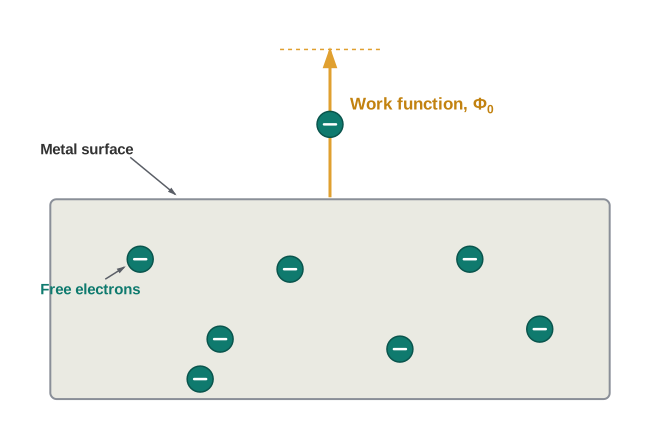
Fig. 11.2 – The work function and electron escape.
The work function is usually measured in a small unit of energy called the electron volt (eV), which is very convenient for the tiny energies involved at the atomic scale.
One electron volt is defined as the energy gained by an electron when it is accelerated through a potential difference of exactly \(1\) volt. This follows from a basic idea you have met earlier: when a charge \(q\) moves through a potential difference \(V\), the energy it gains is \(W = qV\). Putting \(q = e = 1.602 \\times 10^{-19}\) C and \(V = 1\) volt gives the value of one electron volt.
This unit is used very commonly in atomic and nuclear physics, where energies are far too small to be written comfortably in joule.
The size of the work function is not the same for every metal. It depends on the properties of the metal and also on the nature and cleanliness of its surface. A metal with a smaller work function releases electrons more easily than one with a larger work function. This point becomes important in exam problems, where you compare metals or check whether a given metal will emit electrons under given conditions.
Now, where can an electron get this extra energy to escape? The minimum energy needed for electron emission can be supplied to the free electrons by any one of the following three physical processes.
(i) Thermionic emission. By heating the metal suitably, enough thermal energy is given to the free electrons to enable them to come out of the metal surface. The hotter the metal, the more electrons can escape.
(ii) Field emission. By applying a very strong electric field to a metal — of the order of \(10^{8}\) V m\(^{-1}\) — electrons can be pulled straight out of the metal surface. The intense field literally tears electrons off the metal. This is what happens across the tiny gap of a spark plug.
(iii) Photoelectric emission. When light of suitable frequency shines on a metal surface, electrons are emitted from that surface. The energy needed for the electrons to escape is supplied by the light itself. The electrons produced in this way are given a special name because light generated them.
Of these three processes, it is photoelectric emission that leads us into the heart of this chapter. Studying it carefully will slowly reveal that light behaves in a way the wave picture alone cannot explain — and that is exactly the puzzle we set out to solve.
11.3 Photoelectric Effect
11.3.1 Hertz’s Observations
The story of the photoelectric effect begins with the very experiment you met in the chapter opener. In 1887, while Heinrich Hertz (1857–1894) was producing and detecting electromagnetic waves using a spark discharge, he noticed something unexpected. The high-voltage sparks across his detector jumped across the gap more easily when the metal was illuminated by ultraviolet light from an arc lamp.
In other words, shining ultraviolet light on the metal surface somehow helped charged particles escape from it. Today we know these charged particles are electrons — the same universal particles introduced in Section 11.1.
Let us understand what is physically happening. Recall from Section 11.2 that free electrons inside a metal are held back by the attraction of the positive ions at the surface, and that a minimum energy (the work function) is needed for an electron to escape.
When light falls on the metal, some electrons near the surface absorb energy from the incident radiation. If an electron gains enough energy, it can overcome the attractive pull of the positive ions holding it in.
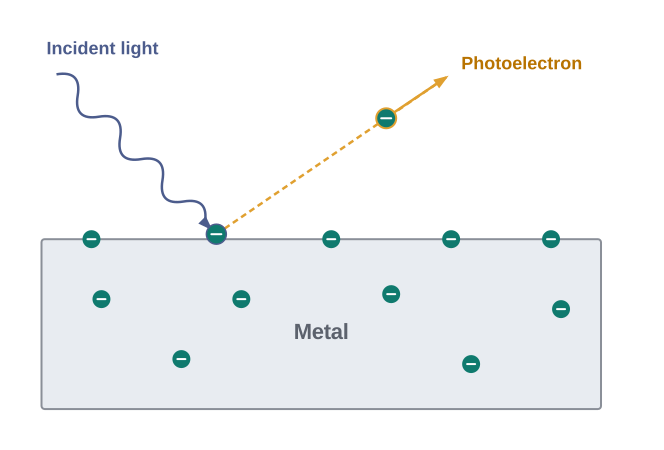
Fig. 11.3 – Photoelectric emission from a metal surface.
Having gained sufficient energy from the incident light, the electron then escapes from the surface of the metal into the surrounding space. This simple idea — that light can supply electrons the energy they need to break free — is the seed from which the entire chapter grows.
11.3.2 Hallwachs’ and Lenard’s Observations
After Hertz’s first clue, two scientists — Wilhelm Hallwachs and Philipp Lenard — studied the phenomenon of photoelectric emission in detail during the years 1886–1902. Their careful experiments turned a chance observation into a well-defined effect with clear rules.
Lenard’s observation. Lenard (1862–1947) took an evacuated glass tube (a tube from which the air has been pumped out) containing two metal plates, or electrodes. When he allowed ultraviolet radiation to fall on one plate — the emitter plate C — a current began to flow in the circuit, as in the arrangement of Fig. 11.4 (the full apparatus is described in Section 11.4). The moment the ultraviolet light was switched off, the current stopped as well.
This behaviour told Lenard exactly what was happening. When ultraviolet light strikes the emitter plate C, electrons are ejected from it. These electrons are then attracted across the tube to the positively charged collector plate A by the electric field between the plates. Their flow through the evacuated tube is what shows up as a current in the circuit.
So the key conclusion is: light falling on the surface of the emitter causes a current to flow in the external circuit. Hallwachs and Lenard then studied how this photocurrent changes with the collector plate potential, and with the frequency and intensity of the incident light — the very experiments we take up in Section 11.4.
Hallwachs’ observation. In 1888, Hallwachs took the study further using an electroscope — a simple instrument that shows whether an object carries charge and roughly how much. He connected a negatively charged zinc plate to the electroscope and shone ultraviolet light on it.
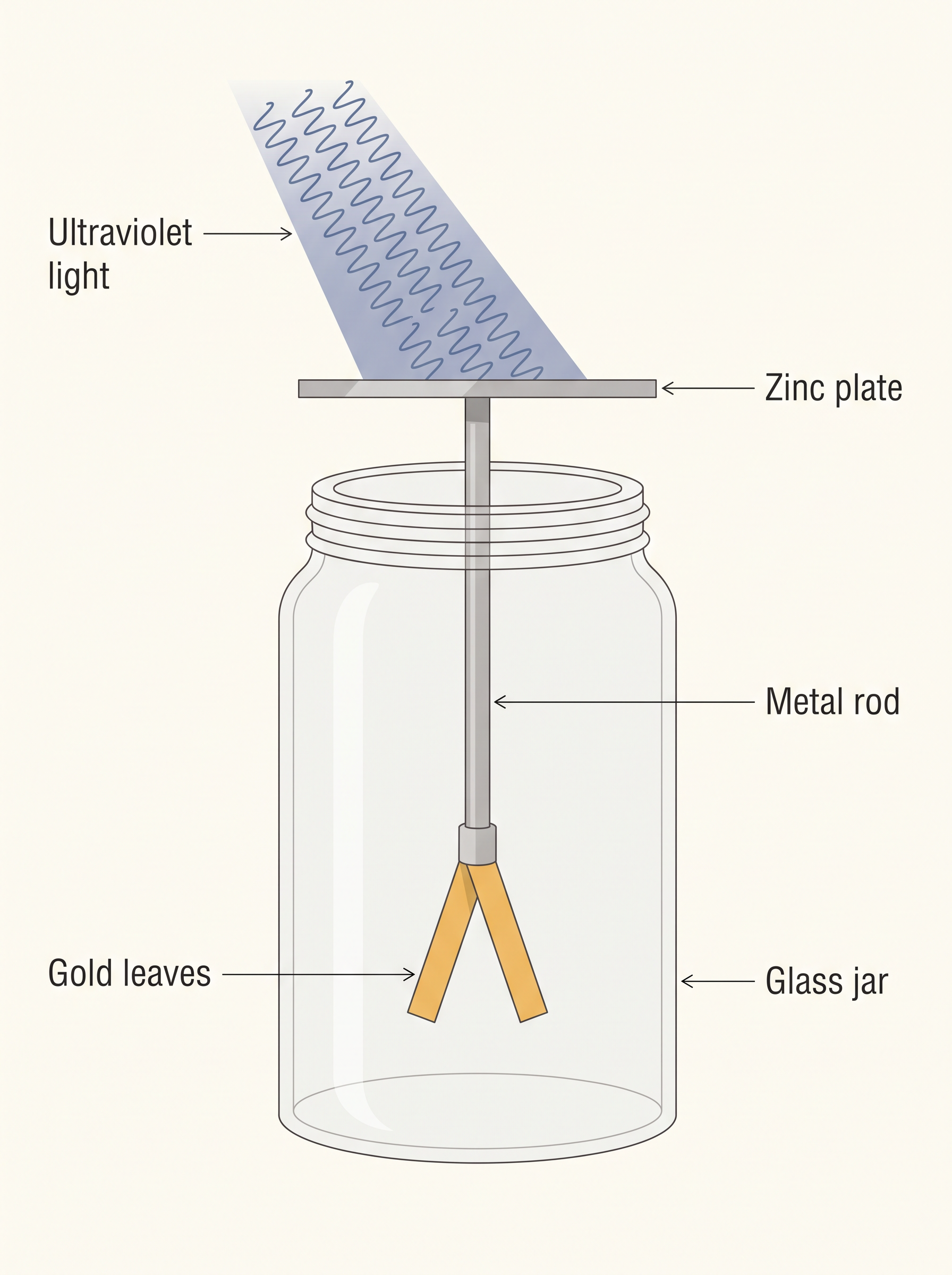
Fig. 11.5 – Hallwachs’ electroscope experiment with ultraviolet light.
He noticed three things. A negatively charged zinc plate lost its charge when illuminated by ultraviolet light. An uncharged zinc plate became positively charged when irradiated by ultraviolet light. And a plate that was already positively charged became even more positive under ultraviolet light.
All three results point to the same cause: ultraviolet light was knocking negatively charged particles out of the zinc plate. Losing negative charge leaves a plate more positive, which explains every case. Hallwachs therefore concluded that negatively charged particles are emitted from the zinc under the action of ultraviolet light.
After the discovery of the electron in 1897, it became clear that these ejected negative particles were electrons, and that the incident light causes electrons to be emitted from the emitter plate. Because they are negative, the emitted electrons are pushed towards the positive collector plate by the electric field, completing the circuit.
The threshold frequency. Hallwachs and Lenard also noticed something surprising. When ultraviolet light fell on the emitter plate, no electrons were emitted at all if the frequency of the incident light was below a certain minimum value. This minimum frequency is called the threshold frequency, and its value depends on the nature of the material of the emitter plate.
This was a genuine puzzle. Even a very bright light of low frequency produced nothing, while a dim light of high enough frequency worked. The wave picture of light could not explain this, and the full explanation had to wait for Einstein — we return to it in Section 11.6.
Different materials behaved differently. Certain metals such as zinc, cadmium and magnesium responded only to ultraviolet light, which has a short wavelength. However, some alkali metals — lithium, sodium, potassium, caesium and rubidium — were sensitive even to visible light. Materials that emit electrons when light falls on them are called photosensitive substances.
All these photosensitive substances emit electrons when illuminated by light. As introduced in Section 11.2, the emitted electrons are called photoelectrons, and the whole phenomenon is called the photoelectric effect.
11.4 Experimental Study of Photoelectric Effect
To turn these observations into precise laws, we need an apparatus in which we can control the light and measure the resulting current. Figure 11.4 shows a schematic view of the arrangement used to study the photoelectric effect experimentally.
The heart of the apparatus is an evacuated glass or quartz tube containing two plates: a thin photosensitive plate C and another metal plate A. Monochromatic light — that is, light of a single frequency (a single colour) — from a source S of sufficiently short wavelength passes through a window W and falls on the photosensitive plate C, which acts as the emitter.
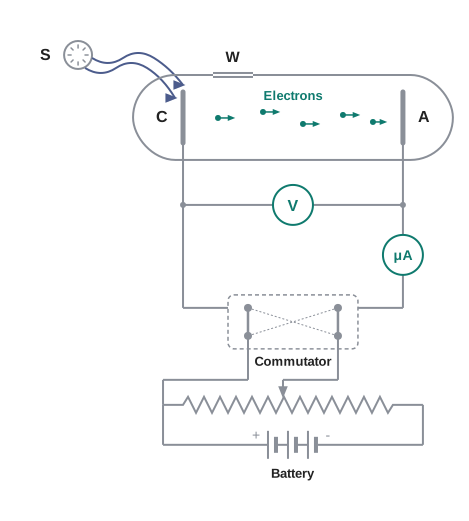
Fig. 11.4 – Experimental arrangement for studying the photoelectric effect.
A transparent quartz window is sealed onto the glass tube. Ordinary glass blocks ultraviolet light, but quartz lets it pass, so the quartz window allows ultraviolet radiation through to irradiate the plate C.
The electrons emitted by plate C are collected by plate A, the collector. They are pulled across by the electric field set up by a battery connected between the plates. This battery maintains a potential difference between C and A, and this potential difference can be varied at will.
The polarity of the two plates can be reversed using a commutator — a switching device that swaps the connections to the battery. Because of the commutator, plate A can be kept at any desired potential, positive or negative, with respect to the emitter C.
When the collector plate A is made positive with respect to the emitter plate C, the emitted electrons are attracted towards it. Their emission and flow constitute an electric current in the circuit — this is called the photoelectric current or photocurrent.
Two meters read off the important quantities. A voltmeter (V) measures the potential difference between the emitter and collector plates, while a microammeter (μA) measures the small photocurrent flowing in the circuit. The photocurrent can be increased or decreased by changing the potential of collector plate A relative to emitter C.
The apparatus is deliberately flexible: the intensity and the frequency of the incident light can both be varied, and so can the potential difference \(V\) between the emitter C and the collector A. This lets us study the photocurrent under many different conditions.
In particular, we can use the arrangement of Fig. 11.4 to study how the photocurrent varies with: a. the intensity of the radiation, b. the frequency of the incident radiation, c. the potential difference between the plates A and C, and d. the nature of the material of plate C.
To change the frequency of the light, a suitable coloured filter or coloured glass is placed in the path of the light falling on the emitter C, so that only light of the chosen frequency reaches the plate. To change the intensity, we simply move the light source nearer to or farther from the emitter — closer means brighter (more intense) light.
With this single, adjustable apparatus, we can now examine each factor one at a time. The next three subsections do exactly that.
11.4.1 Effect of Intensity of Light on Photocurrent
In the first experiment, we hold the collector plate A at a positive potential with respect to the emitter C, so that every electron ejected from C is attracted towards A and none is lost. We also keep the frequency of the incident light and the potential difference fixed.
Now we vary only the intensity of the light — that is, how bright it is — and measure the resulting photoelectric current each time. To make the light more or less intense, we move the source closer or farther, as described in Section 11.4.
The result is clear and simple: the photocurrent increases in a straight line as the intensity increases, as shown graphically in Fig. 11.6.
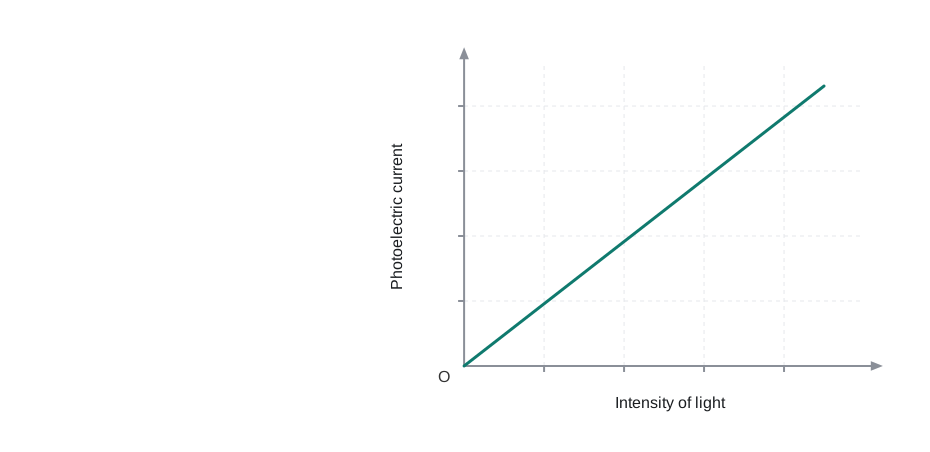
Fig. 11.6 – Variation of photoelectric current with incident light intensity.
Why does this happen? The photocurrent depends on how many electrons reach the collector per second — the more electrons emitted each second, the larger the current. So the graph is really telling us that brighter light frees more electrons every second.
We can now state the result of this experiment.
11.4.2 Effect of Potential on Photoelectric Current
In the previous experiment we changed the brightness of the light. Now we keep the light fixed and change the potential of the plates instead. We illuminate plate C with light of a fixed frequency \(\\nu\) and a fixed intensity \(I\_1\), and study what happens as we vary the potential of plate A.
Accelerating (positive) potential. We first keep plate A at a positive potential with respect to plate C, and gradually increase this positive potential, measuring the photocurrent each time. We find that the photocurrent increases as the positive (accelerating) potential is raised.
This makes sense: a more positive collector pulls the emitted electrons across more effectively, so more of them reach plate A each second.
At some stage, for a certain positive potential, all the electrons emitted by C are collected by A. Now the photocurrent reaches its maximum value and levels off — it saturates. Increasing the accelerating potential further does not increase the current, because there are no more electrons left to collect. This maximum value is called the saturation current.
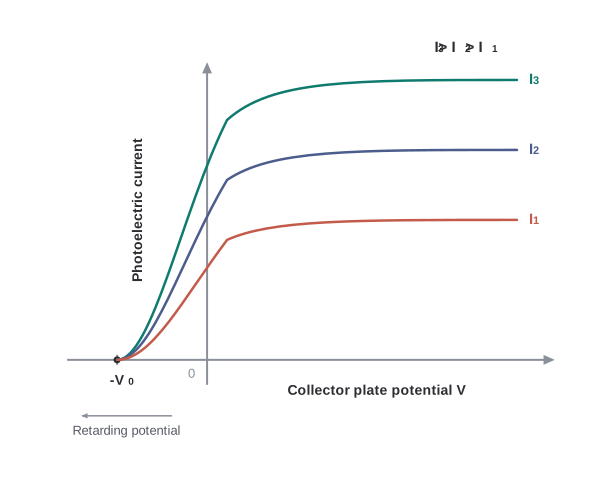
Fig. 11.7 – Photocurrent versus collector plate potential at different intensities.
Retarding (negative) potential. Next we reverse the situation. We make plate A negative with respect to plate C, and gradually more negative. Now plate A repels the electrons instead of attracting them, because like charges repel. Only those electrons that are energetic enough to fight against this repulsion manage to reach plate A.
As the negative potential is increased, the photocurrent falls rapidly. Finally, at a certain sharply defined critical value of the negative potential, written \(V\_0\), the current drops all the way to zero. At this point, not even the most energetic electron can reach the collector.
For a given frequency of incident light, this minimum negative (retarding) potential \(V\_0\) at which the photocurrent just becomes zero is called the cut-off or stopping potential.
Interpreting the stopping potential. The stopping potential gives us a direct handle on the energy of the fastest photoelectrons. To just stop an electron of charge \(e\), the retarding potential must do work equal to the electron’s kinetic energy. The work done against a potential difference \(V\_0\) in moving a charge \(e\) is \(eV\_0\).
The current becomes zero only when the retarding potential is large enough to turn back even the most energetic electron — the one carrying the maximum kinetic energy \(K\_{\\text{max}}\). Therefore
\[K\_{\\text{max}} = e,V\_0 \\tag{11.1}\]
Here \(K\_{\\text{max}}\) is the maximum kinetic energy of the emitted photoelectrons (in joule, J), \(e\) is the magnitude of the electron’s charge (\(1.602 \\times 10^{-19}\) C), and \(V\_0\) is the stopping potential (in volt, V). This neat relation lets us measure the maximum kinetic energy of the photoelectrons just by reading off the stopping potential.
Changing the intensity. Finally, we repeat the whole experiment at the same frequency but with brighter light — intensities \(I\_2\) and \(I\_3\), where \(I\_3 > I\_2 > I\_1\). Looking at Fig. 11.7, we notice two things.
First, the saturation currents are now higher. This simply confirms the result of Section 11.4.1: brighter light frees more electrons per second, so more electrons are collected and the saturation current is larger, in proportion to the intensity.
Second, and more strikingly, the stopping potential stays exactly the same for all three intensities. The three curves meet the axis at the very same point \(-V\_0\).
Since \(K\_{\\text{max}} = eV\_0\), an unchanged stopping potential means an unchanged maximum kinetic energy. So making the light brighter releases more electrons, but it does not make the fastest electrons any faster.
This is a surprising result. Common sense might suggest that a stronger, brighter beam should hit the electrons harder and throw them out faster. The experiment says otherwise. Holding this puzzle in mind, we turn next to the effect of frequency.
11.4.3 Effect of Frequency of Incident Radiation on Stopping Potential
We now change the one factor we have kept fixed so far — the frequency of the light. We shine light of various frequencies on the emitter, keeping the intensity the same for each, and study how the photocurrent varies with the collector plate potential. The resulting curves are shown in Fig. 11.8.
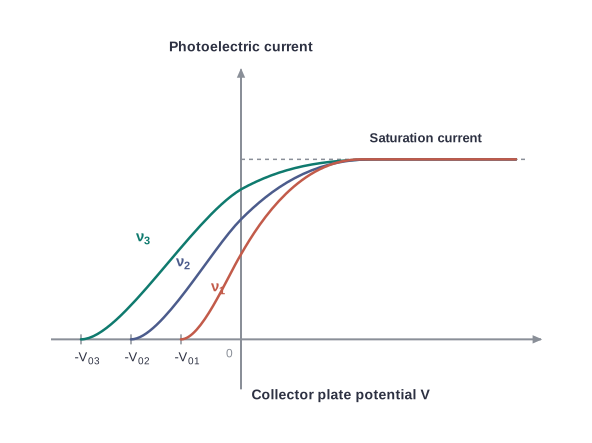
Fig. 11.8 – Photocurrent versus collector plate potential at different frequencies.
Two features stand out. All three curves rise to the same saturation current, because the intensity is the same in each case. But they cut off at different stopping potentials.
This tells us that the energy of the emitted electrons depends on the frequency of the incident light. The stopping potential is more negative for higher frequencies. From Fig. 11.8, the stopping potentials are in the order \(V\_{03} > V\_{02} > V\_{01}\) when the frequencies are in the order \(\\nu\_3 > \\nu\_2 > \\nu\_1\).
In plain terms: the greater the frequency of the incident light, the greater the maximum kinetic energy of the photoelectrons. And since faster electrons are harder to stop, a greater retarding potential is needed to bring the current to zero.
The stopping-potential versus frequency graph. If we now plot the stopping potential \(V\_0\) against the frequency \(\\nu\) of the incident radiation, for a given photosensitive material, we get a straight line, as shown in Fig. 11.9. Repeating this for different metals gives a set of parallel straight lines, each shifted along the frequency axis.
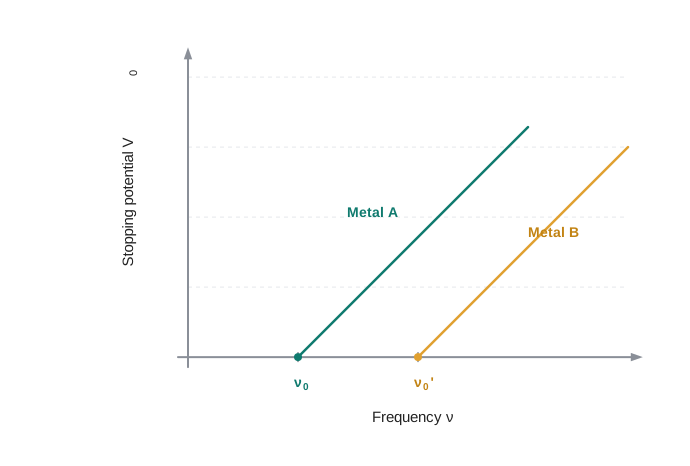
Fig. 11.9 – Variation of stopping potential with frequency for two metals.
The graph reveals two clear facts. First, the stopping potential \(V\_0\) varies linearly with the frequency of the incident radiation for a given photosensitive material. Second, there is a certain minimum cut-off frequency \(\\nu\_0\) at which the stopping potential is zero — below this frequency the line does not exist at all.
These two facts carry two important implications, which we state carefully.
This minimum cut-off frequency \(\\nu\_0\) is exactly the threshold frequency we met in Section 11.3.2. As noted there, it is different for different metals.
Different photosensitive materials respond differently to light. Selenium, for instance, is more sensitive than zinc or copper. Even the same material responds differently to different wavelengths (colours) of light. For example, ultraviolet light produces the photoelectric effect in copper, while green or red light does not — no matter how bright the green or red light is made.
Instantaneous emission. There is one more remarkable feature. In all these experiments, whenever the frequency of the incident light is above the threshold frequency, the photoelectric emission begins the instant the light strikes — with no apparent time lag — even if the light is very dim. It is now known that the emission starts within about \(10^{-9}\) s or less.
Summary of the experimental observations. We can now gather together everything this section has shown about the photoelectric effect.
- For a given material and a given frequency (above the threshold), the photoelectric current is directly proportional to the intensity of the incident light (Fig. 11.6).
- For a given material and frequency, the saturation current is proportional to the intensity, whereas the stopping potential is independent of the intensity (Fig. 11.7).
- For a given material, there is a minimum cut-off (threshold) frequency below which no photoelectrons are emitted, however intense the light. Above the threshold, the stopping potential — and equivalently the maximum kinetic energy of the photoelectrons — increases linearly with frequency, but stays independent of intensity (Fig. 11.9).
- The photoelectric emission is an instantaneous process, with no apparent time lag (\(\\sim 10^{-9}\) s or less), even when the incident light is made exceedingly dim.
These four results are simple to state, yet the wave theory of light — so successful everywhere else — cannot explain them. That failure is the subject of the next section.
11.5 Photoelectric Effect and Wave Theory of Light
By the end of the nineteenth century, the wave nature of light was firmly established. Three phenomena in particular were explained naturally and beautifully by the wave picture: interference (the bright and dark bands formed when two light waves overlap), diffraction (the bending of light around edges and through narrow gaps), and polarisation (the restriction of the wave’s vibrations to a single plane). You have studied these in earlier chapters, and in each case the wave model works perfectly.
According to this picture, light is an electromagnetic wave — a combination of electric and magnetic fields travelling together — and its energy is spread continuously over the whole region of space through which the wave extends. The energy is not concentrated in tiny lumps; it flows smoothly, like the energy carried by ripples on a pond.
The natural question is whether this same wave picture can also explain the observations on photoelectric emission listed at the end of Section 11.4.3. Let us test it against those observations, one prediction at a time.
Prediction about intensity. In the wave picture, the free electrons at the metal surface absorb the light’s energy continuously. Now, the intensity of a wave is proportional to the square of its amplitude, so a brighter beam means larger electric and magnetic field amplitudes. Larger fields should push harder on the electrons and hand each electron more energy.
So the wave theory clearly predicts that the maximum kinetic energy of the photoelectrons should increase as the intensity increases. But the experiments in Section 11.4.2 showed the opposite: the maximum kinetic energy does not depend on intensity at all. This directly contradicts what we observed.
Prediction about threshold frequency. The wave picture also says that frequency should not matter for whether emission occurs. Whatever the frequency, a beam that is intense enough — or that shines for long enough — should eventually pour enough energy into an electron to let it escape the metal. In this view, a threshold frequency should simply not exist.
Yet the experiments showed a sharp threshold frequency \(\\nu\_0\): below it, no electrons come out, however intense the light. Again the wave theory’s prediction fails. Together, these first two failures clash with observations (i), (ii) and (iii) of Section 11.4.3.
Prediction about time lag. There is a third, even more serious problem. In the wave picture, an electron absorbs energy continuously from the entire spread-out wavefront that reaches it. But that arriving energy has to be shared among the huge number of electrons on the surface, so the energy collected by any one electron per second turns out to be extremely small.
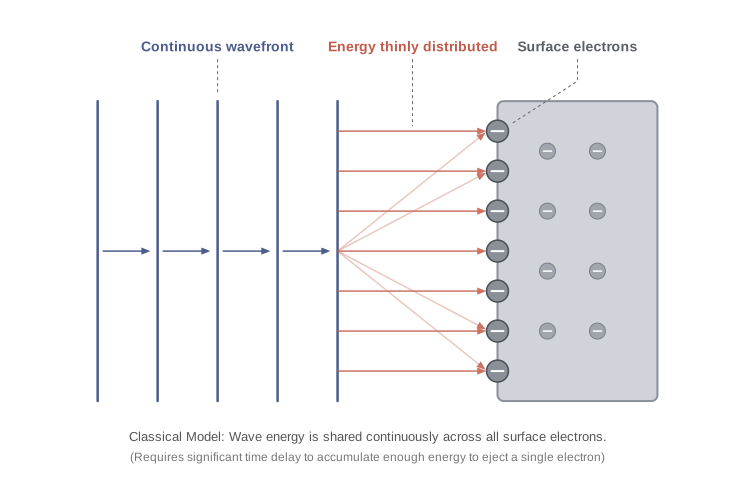
Fig. 11.10 – Incident continuous wavefront and energy distribution across surface electrons.
Explicit calculations based on this idea estimate that it should take hours or more for a single electron to slowly accumulate enough energy to overcome the work function and leave the metal. This is in striking contrast to what is actually seen — observation (iv), that photoelectric emission is instantaneous, beginning within about \(10^{-9}\) s even for very dim light.
Verdict. On every count — the role of intensity, the existence of a threshold frequency, and the instant start of emission — the predictions of the wave theory disagree with experiment. In short, the wave picture of light, for all its earlier triumphs, is simply unable to explain the most basic features of photoelectric emission.
Something new was needed. That new idea came from Albert Einstein, and it forms the subject of the next section.
11.6 Einstein’s Photoelectric Equation: Energy Quantum of Radiation
In 1905, Albert Einstein (1879–1955) proposed a radically new picture of electromagnetic radiation to explain the photoelectric effect — a picture that broke sharply with the smooth wave model of the previous section.
Einstein’s key idea was this: photoelectric emission does not happen by the continuous absorption of energy from a spread-out wave. Instead, the energy of radiation is built up of tiny, separate packets — discrete units called quanta of radiation. Each quantum of radiant energy carries a fixed amount of energy
\[E = h\\nu\]
where \(h\) is Planck’s constant and \(\\nu\) is the frequency of the light. Here \(E\) is the energy of one quantum (in joule, J), \(\\nu\) is the frequency (in hertz, Hz), and \(h = 6.626 \\times 10^{-34}\) J s is a fundamental constant of nature.
Now consider what happens in the photoelectric effect. An electron in the metal absorbs one whole quantum of energy \(h\\nu\) — all of it at once, not a little at a time. Part of this energy is used up in freeing the electron from the surface (the work function \(\\phi\_0\) from Section 11.2). Whatever is left over becomes the electron’s kinetic energy.
The electrons that are least tightly held keep the most leftover energy, so they emerge with the maximum kinetic energy:
\[K\_{\\text{max}} = h\\nu - \\phi\_0 \\tag{11.2}\]
Here \(K\_{\\text{max}}\) is the maximum kinetic energy of the photoelectrons (J), \(h\\nu\) is the energy supplied by one quantum (J), and \(\\phi\_0\) is the work function of the metal (J).
Electrons that are more tightly bound need more energy to escape, so they come out with kinetic energies less than this maximum value. This is exactly why the emitted electrons show a spread of speeds, as we noted in Section 11.4.2.
An important consequence follows for intensity. The intensity of light of a given frequency is simply the number of quanta (photons) arriving per second. Making the light more intense means sending more quanta per second, which frees more electrons per second — but each electron still absorbs just one quantum of energy \(h\\nu\). So the maximum kinetic energy of the emitted electrons is fixed by the energy of each photon (the frequency), not by how many photons arrive.
Equation (11.2) is known as Einstein’s photoelectric equation. Its real power is that a single, simple idea now explains every one of the puzzling observations from Section 11.4.3. Let us go through them.
How the equation explains everything.
First, the equation says \(K\_{\\text{max}}\) depends linearly on the frequency \(\\nu\), and does not depend on intensity at all — exactly matching experiment. This is natural in Einstein’s picture, because the photoelectric effect comes from a single electron absorbing a single quantum. The intensity, which is just the number of quanta per unit area per unit time, plays no part in this basic one-to-one process.
Second, the threshold frequency now appears automatically. Since kinetic energy can never be negative, \(K\_{\\text{max}} \\geq 0\) in Equation (11.2) requires that
\[h\\nu > \\phi\_0 \\qquad \\text{or} \\qquad \\nu > \\nu\_0, \\quad \\text{where} \\quad \\nu\_0 = \\frac{\\phi\_0}{h} \\tag{11.3}\]
Equation (11.3) says that a larger work function \(\\phi\_0\) means a higher threshold frequency \(\\nu\_0\). Below this frequency, a single photon simply does not carry enough energy (\(h\\nu < \\phi\_0\)) to free even one electron.
And here is the crucial point: piling on more photons does not help, because the electron can only absorb one at a time, and one low-frequency photon is too weak. So no matter how intense the light, or how long it shines, there is no emission below \(\\nu\_0\). This is precisely why light of the right frequency ejects electrons while light of too low a frequency never does, however bright.
Third, the dependence of current on intensity also falls into place. Intensity is proportional to the number of quanta arriving per unit area per unit time. The more quanta available, the more electrons absorb them and escape (for \(\\nu > \\nu\_0\)). This is why, above the threshold, the photoelectric current is proportional to the intensity.
Fourth, the instant start of emission is explained. The basic process — one electron absorbing one light quantum — is itself instantaneous. So emission begins the moment suitable light arrives, whatever the intensity. Low intensity does not cause a delay; it only means fewer electrons take part in this same instantaneous process, giving a smaller current.
A testable prediction. We can combine Einstein’s equation with the relation \(K\_{\\text{max}} = eV\_0\) from Equation (11.1). Substituting gives
\[eV\_0 = h\\nu - \\phi\_0 \\quad ; \\quad \\text{for } \\nu \\geq \\nu\_0\]
\[\\text{or} \\qquad V\_0 = \\left(\\frac{h}{e}\\right)\\nu - \\frac{\\phi\_0}{e} \\tag{11.4}\]
This is an important result. It predicts that a graph of stopping potential \(V\_0\) against frequency \(\\nu\) is a straight line whose slope equals \(h/e\) — and remarkably, this slope is the same for every metal, since it contains only the universal constants \(h\) and \(e\). This is exactly the straight-line behaviour seen in Fig. 11.9.
Millikan’s test. The equation was checked with great care by R. A. Millikan. During 1906–1916, Millikan carried out a long series of photoelectric experiments — with the declared aim of disproving Einstein’s equation, which he distrusted.
The successful explanation of the photoelectric effect using light quanta, together with Millikan’s precise measurement of \(h\) and \(\\phi\_0\) in agreement with other experiments, led physicists to accept Einstein’s picture. Millikan went on to verify the photoelectric equation with great precision for several alkali metals across a wide range of frequencies.
With this, the puzzle that began with a spark in Hertz’s laboratory is solved — but it has opened an even deeper question, which we take up next: if light delivers its energy like a particle, is light itself a particle?
11.7 Particle Nature of Light: The Photon
The photoelectric effect gave clear evidence for a strange fact: when light interacts with matter, it behaves as if it is made of separate packets, or quanta, each carrying energy \(h\\nu\). Light does not deliver its energy smoothly and continuously, as a wave would — it delivers it in whole lumps.
This raises a natural question. If a light quantum carries a definite energy like a particle, does it also carry momentum like a particle? Momentum is the quantity we usually associate with moving matter; for an ordinary object it is \(p = mv\).
Einstein showed that the answer is yes. A light quantum can be associated with a momentum
\[p = \\frac{h\\nu}{c}\]
where \(p\) is the momentum of the quantum (in kg m s\(^{-1}\)), \(h\\nu\) is its energy (J), and \(c\) is the speed of light (m s\(^{-1}\)). Having both a definite energy and a definite momentum is a strong sign that the light quantum can be treated as a genuine particle. This particle was later given the name photon.
So light shows two faces. It spreads out and bends as a wave in interference and diffraction, yet in its interaction with matter — as in the photoelectric effect — it acts as a stream of particles, each a photon with definite energy and momentum. Both descriptions are needed; which one shows up depends on the experiment.
Confirmation by Compton. The particle-like behaviour of light was confirmed still more directly a few years later.
In recognition of this line of work, Einstein was awarded the Nobel Prize in Physics in 1921 for his contribution to theoretical physics and the photoelectric effect, and Millikan received the Nobel Prize in Physics in 1923 for his work on the elementary charge of electricity and on the photoelectric effect.
The photon picture, summarised. We can now gather the main features of the photon description of electromagnetic radiation.
- In the interaction of radiation with matter, radiation behaves as if it is made up of particles called photons.
- Each photon has energy \(E = h\\nu\) and momentum \(p = h\\nu/c\), and moves at speed \(c\), the speed of light.
- All photons of light of a particular frequency \(\\nu\) (or wavelength \(\\lambda\)) carry the same energy and the same momentum, whatever the intensity of the radiation. Since the speed of light gives \(c = \\nu\\lambda\), we can rewrite these as
\[E = h\\nu = \\frac{hc}{\\lambda}, \\qquad p = \\frac{h\\nu}{c} = \\frac{h}{\\lambda}\]
Increasing the intensity of light of a given wavelength only increases the number of photons crossing a given area per second — each photon still carries the same energy. So the energy of a photon is independent of the intensity of the radiation.
- Photons are electrically neutral, and so they are not deflected by electric or magnetic fields.
- In a photon–particle collision (such as a photon–electron collision), the total energy and total momentum are conserved. However, the number of photons need not be conserved: a photon may be absorbed, or a new photon may be created.
The two worked examples below consolidate the photon-energy and threshold-frequency ideas of Sections 11.6 and 11.7.
Light, then, is both wave and particle. Once physicists accepted this dual nature for light, a bold new question could not be avoided: if waves can behave like particles, can particles behave like waves? That question drives the final section of this chapter.
11.8 Wave Nature of Matter
By now, the dual (wave–particle) nature of light stands out clearly from what we have learnt in this chapter and the preceding ones. The wave nature of light shows up in interference, diffraction and polarisation. On the other hand, in the photoelectric effect and the Compton effect — processes that involve the transfer of energy and momentum — light behaves as if it is made up of a bunch of particles, the photons.
Which description is better — wave or particle — depends entirely on the experiment we are doing. Both are needed to describe nature fully.
A bold question. If radiation has a dual wave–particle nature, a natural question arises: might the particles of matter — electrons, protons, and so on — also show a wave-like character? In 1924, the French physicist Louis Victor de Broglie (pronounced “de Broy”) put forward exactly this bold hypothesis: moving particles of matter should display wave-like properties under suitable conditions.
His reasoning rested on the symmetry of nature. Matter and energy are the two basic physical entities, and de Broglie argued they should have a symmetrical character. If radiation (energy) can show both wave and particle aspects, then matter should too.
De Broglie proposed that a particle of momentum \(p\) has associated with it a wavelength \(\\lambda\) given by
\[\\lambda = \\frac{h}{p} = \\frac{h}{mv} \\tag{11.5}\]
where \(h\) is Planck’s constant (J s), \(p\) is the particle’s momentum (kg m s\(^{-1}\)), \(m\) is its mass (kg), and \(v\) is its speed (m s\(^{-1}\)). This is the de Broglie relation, and the wavelength \(\\lambda\) is called the de Broglie wavelength of the matter wave.
The dual aspect of matter is written right into Equation (11.5). On the left side, \(\\lambda\) is the attribute of a wave; on the right side, the momentum \(p\) is a typical attribute of a particle. Planck’s constant \(h\) is the bridge that ties the two together.
A consistency check with the photon. Equation (11.5) is, for a material particle, a hypothesis that only experiment can confirm. But it is reassuring to see that the same relation is already obeyed by a photon. For a photon we found in Section 11.7 that
\[p = \\frac{h\\nu}{c} \\tag{11.6}\]
Therefore
\[\\frac{h}{p} = \\frac{c}{\\nu} = \\lambda \\tag{11.7}\]
using \(c = \\nu\\lambda\). So the de Broglie wavelength of a photon, worked out from Equation (11.5), comes out equal to the ordinary wavelength of the electromagnetic radiation of which the photon is a quantum. Matter and light fit the same formula.
Why everyday objects show no waviness. Look again at Equation (11.5): \(\\lambda = h/mv\). The wavelength is smaller for a heavier particle (large \(m\)) or a faster particle (large \(v\)). Since \(h\) itself is extraordinarily tiny (\(\\approx 10^{-34}\) J s), any ordinary object gives an unimaginably small \(\\lambda\).
Take, for example, a ball of mass \(0.12\) kg moving at \(20\) m s\(^{-1}\). Its momentum is
\[p = mv = 0.12 \\text{ kg} \\times 20 \\text{ m s}^{-1} = 2.40 \\text{ kg m s}^{-1}\]
and its de Broglie wavelength is
\[\\lambda = \\frac{h}{p} = \\frac{6.63 \\times 10^{-34} \\text{ J s}}{2.40 \\text{ kg m s}^{-1}} = 2.76 \\times 10^{-34} \\text{ m}\]
This wavelength is so small that it is beyond any possible measurement. That is exactly why macroscopic objects in daily life never show wave-like properties. In the sub-atomic domain, however — where masses are minute — the wave character of particles becomes significant and measurable.
11.9 Summary
- The minimum energy an electron needs in order to escape from a metal surface is called the work function of the metal, denoted \(\\phi\_0\). Any energy greater than \(\\phi\_0\) can be supplied to the electron in three ways: by heating the metal (thermionic emission), by applying a strong electric field (field emission), or by shining light of suitable frequency on it (photoelectric emission).
- The photoelectric effect is the emission of electrons by a metal when light of suitable frequency falls on it. Some metals respond only to ultraviolet light, while others are sensitive even to visible light. The effect converts light energy into electrical energy and obeys the law of conservation of energy. Photoelectric emission is an instantaneous process and shows several special features.
- The photoelectric current depends on (i) the intensity of the incident light, (ii) the potential difference applied between the two electrodes, and (iii) the nature of the emitter material.
- The stopping potential \(V\_0\) depends on (i) the frequency of the incident light, and (ii) the nature of the emitter material. For a given frequency, it is independent of the intensity. The stopping potential is directly related to the maximum kinetic energy of the emitted electrons: \[eV\_0 = \\tfrac{1}{2}m v\_{\\text{max}}^{2} = K\_{\\text{max}}\]
- Below a certain frequency — the threshold frequency \(\\nu\_0\), which is characteristic of the metal — no photoelectric emission takes place, no matter how intense the light.
- The classical wave theory could not explain the main features of the photoelectric effect. Its idea of continuous absorption of energy failed to explain why \(K\_{\\text{max}}\) is independent of intensity, why a threshold frequency \(\\nu\_0\) exists, and why emission is instantaneous. Einstein explained all this using the photon picture of light: light is composed of discrete packets of energy called quanta or photons. Each photon carries energy \(E = h\\nu\) and momentum \(p = h/\\lambda\), both of which depend on the frequency \(\\nu\) of the light and not on its intensity. Photoelectric emission occurs when a single photon is absorbed by a single electron.
- Einstein’s photoelectric equation follows from applying the law of conservation of energy to the absorption of a photon by an electron in the metal. The maximum kinetic energy of the emitted electron equals the photon energy \(h\\nu\) minus the work function \(\\phi\_0\) (where \(\\phi\_0 = h\\nu\_0\)): \[\\tfrac{1}{2}m v\_{\\text{max}}^{2} = V\_0 e = h\\nu - \\phi\_0 = h(\\nu - \\nu\_0)\] This equation explains every feature of the photoelectric effect. Millikan’s first precise measurements confirmed it and gave an accurate value of Planck’s constant \(h\). This led to the acceptance of the particle (photon) description of electromagnetic radiation introduced by Einstein.
- Radiation has a dual nature — both wave and particle. The nature of the experiment decides which description is best suited. Reasoning that radiation and matter should behave symmetrically, Louis Victor de Broglie attributed a wave-like character to material particles. The waves associated with moving material particles are called matter waves or de Broglie waves.
- The de Broglie wavelength \(\\lambda\) associated with a moving particle is related to its momentum \(p\) by \[\\lambda = \\frac{h}{p}\] The dual nature of matter is built into this relation, which combines a wave concept (\(\\lambda\)) with a particle concept (\(p\)). The de Broglie wavelength is independent of the charge and nature of the material particle. It is significantly large — of the order of the spacing between atomic planes in crystals — only for sub-atomic particles such as electrons and protons, because of their very small masses and hence small momenta. For macroscopic objects in everyday life, it is exceedingly small and quite beyond measurement.
11.10 Points to Ponder
- Free electrons in a metal are “free” only in a limited sense: they move about inside the metal as though the potential there were constant (this is only an approximation). They are not free to leave the metal. To get out, they must be given extra energy.
- The free electrons in a metal do not all carry the same energy. Much like the molecules in a jar of gas, they have a spread of energies — an energy distribution — at any given temperature. However, this distribution is not the familiar Maxwell distribution you met in the kinetic theory of gases. The difference arises because electrons obey Pauli’s exclusion principle (which forbids two electrons from occupying the same quantum state); you will study this distribution in later courses.
- Because of this spread of energies, the amount of extra energy an electron needs to escape is different for different electrons. An electron that already has more energy needs less additional energy to get out than one with less. The work function is therefore the least energy that any electron needs to come out of the metal — it corresponds to the most energetic electrons.
- The observations on the photoelectric effect tell us that, when light and matter interact, energy is absorbed in discrete units of \(h\\nu\). Notice the careful wording: this is not quite the same as saying that light itself consists of particles, each of energy \(h\\nu\). The photoelectric effect establishes the lumpiness of the energy exchange; the fuller claim that light behaves as particles (photons) rests on further evidence, such as the Compton effect.
- Of all the photoelectric observations, those on the stopping potential — that it is independent of intensity but depends on frequency — are the crucial test that separates the wave picture from the photon picture. It is here that the two pictures make clearly different predictions, and experiment sides with the photon picture.
- For a matter wave, the wavelength given by \(\\lambda = h/p\) has real physical meaning. Its phase velocity \(v\_p\) (the speed of a single wave crest) does not have physical significance. However, the group velocity of the matter wave — the speed at which the overall wave packet travels — is physically meaningful, and it turns out to equal the velocity of the particle itself.
11.11 NCERT Questions
- Find the
- maximum frequency, and
- minimum wavelength of X-rays produced by 30 kV electrons.
- The work function of caesium metal is 2.14 eV. When light of frequency \(6 \\times 10^{14}\) Hz is incident on the metal surface, photoemission of electrons occurs. What is the
- maximum kinetic energy of the emitted electrons,
- stopping potential, and
- maximum speed of the emitted photoelectrons?
- The photoelectric cut-off voltage in a certain experiment is 1.5 V. What is the maximum kinetic energy of photoelectrons emitted?
- Monochromatic light of wavelength 632.8 nm is produced by a helium-neon laser. The power emitted is 9.42 mW.
- Find the energy and momentum of each photon in the light beam,
- How many photons per second, on the average, arrive at a target irradiated by this beam? (Assume the beam to have uniform cross-section which is less than the target area), and
- How fast does a hydrogen atom have to travel in order to have the same momentum as that of the photon?
- In an experiment on photoelectric effect, the slope of the cut-off voltage versus frequency of incident light is found to be \(4.12 \\times 10^{-15}\) V s. Calculate the value of Planck’s constant.
- The threshold frequency for a certain metal is \(3.3 \\times 10^{14}\) Hz. If light of frequency \(8.2 \\times 10^{14}\) Hz is incident on the metal, predict the cut-off voltage for the photoelectric emission.
- The work function for a certain metal is 4.2 eV. Will this metal give photoelectric emission for incident radiation of wavelength 330 nm?
- Light of frequency \(7.21 \\times 10^{14}\) Hz is incident on a metal surface. Electrons with a maximum speed of \(6.0 \\times 10^{5}\) m/s are ejected from the surface. What is the threshold frequency for photoemission of electrons?
- Light of wavelength 488 nm is produced by an argon laser which is used in the photoelectric effect. When light from this spectral line is incident on the emitter, the stopping (cut-off) potential of photoelectrons is 0.38 V. Find the work function of the material from which the emitter is made.
- What is the de Broglie wavelength of
- a bullet of mass 0.040 kg travelling at the speed of 1.0 km/s,
- a ball of mass 0.060 kg moving at a speed of 1.0 m/s, and
- a dust particle of mass \(1.0 \\times 10^{-9}\) kg drifting with a speed of 2.2 m/s?
- Show that the wavelength of electromagnetic radiation is equal to the de Broglie wavelength of its quantum (photon).
11.12 Check Your Concepts
- Explain why increasing the intensity of the incident light increases the photoelectric current, but does not change the maximum kinetic energy of the emitted photoelectrons. Use the photon picture of light in your answer.
- A bright red light shining on a metal fails to eject any electrons, while a faint violet light ejects them at once. Explain this observation in terms of the threshold frequency and the energy of a photon.
- State any two features of the photoelectric effect that the classical wave theory of light could not explain, and briefly explain why the wave theory failed in each case.
- Keeping the frequency of the incident light fixed, its intensity is doubled. State what happens to (i) the saturation current and (ii) the stopping potential, and justify each answer.
- Two metals A and B have work functions such that \(\\phi\_A > \\phi\_B\). Light of the same frequency (above the threshold for both) is incident on each. Which metal emits photoelectrons with the greater maximum kinetic energy? Give a reason.
- Photoelectric emission begins almost instantaneously (within about \(10^{-9}\) s) even when the incident light is very dim. Explain how Einstein’s photon picture accounts for this, whereas the wave theory predicts a long time delay.
- A moving electron shows measurable wave-like behaviour, but a moving cricket ball does not. Explain this difference using the de Broglie relation.
- A photon has no rest mass, yet it carries momentum. Explain how this is possible, and write the expression for the momentum of a photon of wavelength \(\\lambda\).
11.13 Practice with Numericals
- The work function of a metal is 1.9 eV. Calculate its threshold wavelength.
- Light of wavelength 400 nm falls on a metal of work function 2.0 eV. Find (a) the maximum kinetic energy of the emitted photoelectrons in electron volt, and (b) the stopping potential.
- A photon has energy 2.8 eV. Find (a) its frequency and (b) its wavelength.
- An electron is accelerated from rest through a potential difference of 100 V. Find the de Broglie wavelength associated with it. (Take mass of electron \(= 9.11 \\times 10^{-31}\) kg.)
- A source emits monochromatic light of wavelength 600 nm at a power of 3.3 mW. Calculate the number of photons emitted per second.
- An electron and a proton have the same de Broglie wavelength. Find the ratio of their speeds, \(v\_{\\text{electron}} : v\_{\\text{proton}}\). (Take mass of proton \(= 1.67 \\times 10^{-27}\) kg and mass of electron \(= 9.11 \\times 10^{-31}\) kg.)
- In a photoelectric experiment, the stopping potential is 2.0 V when light of wavelength 300 nm is incident on the emitter. Find the work function of the metal in electron volt.
- A proton and an alpha particle are accelerated from rest through the same potential difference. Find the ratio of their de Broglie wavelengths. (Take the mass of the alpha particle as 4 times that of the proton, and its charge as 2 times that of the proton.)