Chapter 13: Nuclei
For most of human history, no one could explain why the Sun keeps shining. It pours out heat and light every second, and it has been doing so for billions of years — yet what fuels it?
In the nineteenth century, the physicist Lord Kelvin tried to answer this using the best physics of his time. He assumed the Sun shone because it was slowly shrinking under its own gravity, releasing heat as it contracted. His calculation gave an alarming result: the Sun could only have burned for a few tens of millions of years.
But this created a deep conflict. Geologists studying rock layers, and biologists studying the slow pace of evolution, were sure the Earth — and therefore the Sun — had to be far older, hundreds of millions of years at least. Ordinary burning, like coal or wood, was hopeless: a Sun made of coal would burn out in a few thousand years.
The puzzle stood unsolved for decades. The answer, when it finally came in the early twentieth century, lay not in chemistry or gravity but in the tiny, dense core of the atom — the nucleus. A source of energy millions of times more powerful than any chemical fire was hiding inside every atom. This chapter is about that hidden world.
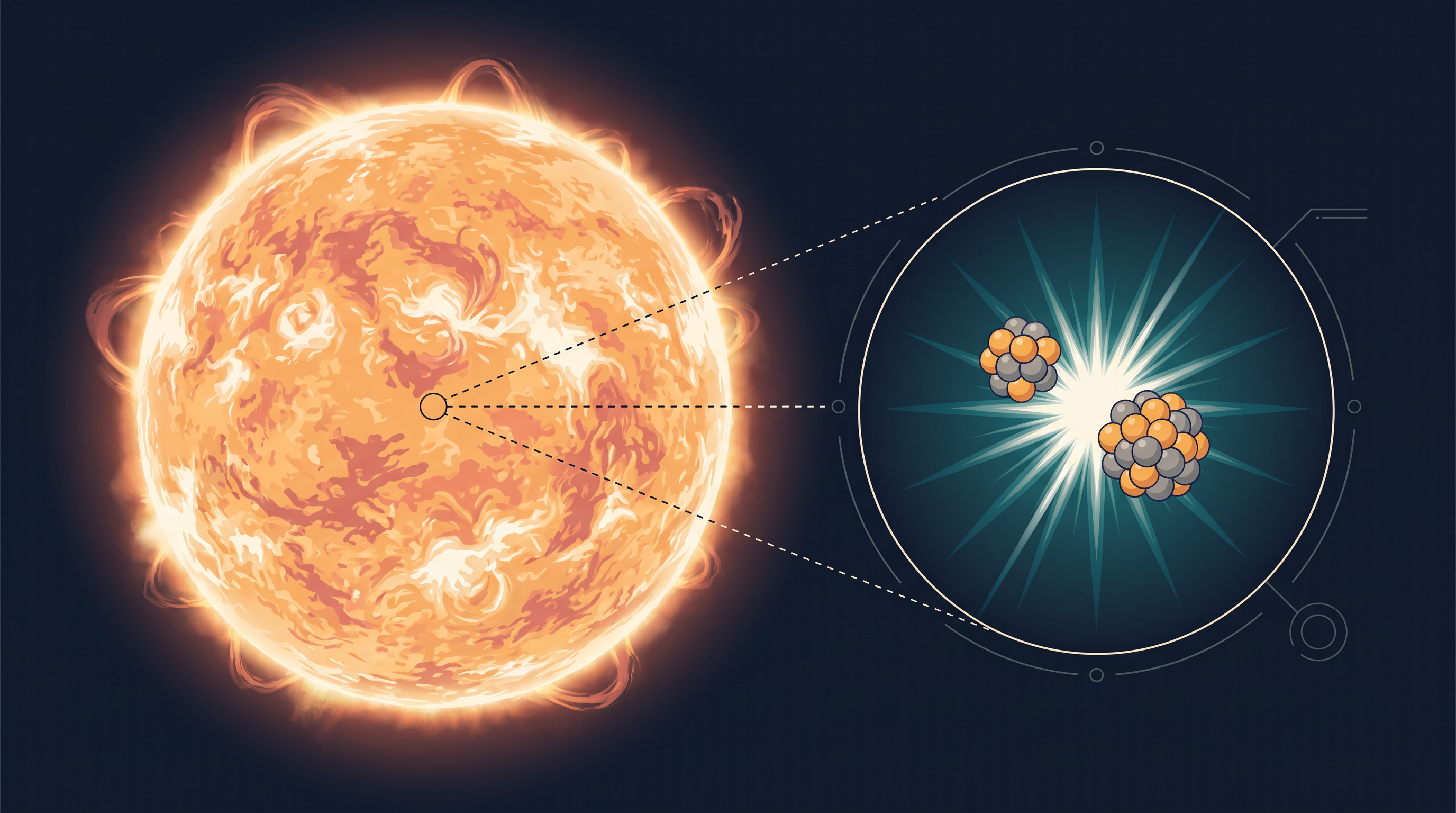
Fig. 13.0 – The Sun and nuclear fusion at its core.
By the end of this chapter, you will be able to answer each of these questions.
13.1 Introduction
In the previous chapter on atoms, we learnt an important fact: in every atom, almost all the positive charge and almost all the mass are crowded into an extremely tiny region right at the centre. This dense central core is called the nucleus.
Just how small is the nucleus? Experiments on the scattering of \(\alpha\)-particles (helium nuclei) showed that the radius of a nucleus is smaller than the radius of the whole atom by a factor of about \(10^{4}\). In other words, if you lined up ten thousand nuclei side by side, their combined width would only just span one atom.
Because the radius is smaller by a factor of \(10^{4}\), the volume — which depends on the cube of the radius — is smaller by a factor of about \((10^{4})^{3} = 10^{12}\). So the nucleus occupies only about \(10^{-12}\) times the volume of the atom.
This leads to a striking conclusion: an atom is almost entirely empty space. To picture the scale, imagine enlarging a single atom until it fills an entire classroom. On that scale, the nucleus at the centre would be no bigger than the head of a pin, as suggested in Fig. 13.1.

Fig. 13.1 – The scale of the nucleus compared with the atom.
Yet that pinhead is astonishingly important. Even though the nucleus takes up almost none of the atom’s space, it carries more than 99.9% of the atom’s entire mass. Nearly everything heavy about an atom is locked inside this minute core.
Naturally, this raises deeper questions. Does the nucleus itself have a structure, just as the atom does? If so, what are its constituents — the particles that make it up? And once we know what is inside, how are those particles held together so tightly?
In this chapter we shall search for answers to exactly these questions. We shall study the key properties of nuclei — their size, mass, and stability — and then explore the powerful nuclear phenomena that arise from them: radioactivity, fission, and fusion.
13.2 Atomic Masses and Composition of Nucleus
The mass of a single atom is extraordinarily small compared with everyday units. For example, the mass of a carbon atom, \(^{12}\text{C}\), is only \(1.992647 \times 10^{-26}\) kg. Writing such tiny numbers in kilograms every time is clumsy and inconvenient. So, for atomic and nuclear masses, physicists use a special unit called the atomic mass unit, written u.
The atomic mass unit is defined by comparing every mass to one particular atom — carbon-12. One atomic mass unit is defined as exactly \(\dfrac{1}{12}\) of the mass of a single carbon (\(^{12}\text{C}\)) atom. Using this definition:
\[1\,\text{u} = \frac{\text{mass of one } ^{12}\text{C atom}}{12} = \frac{1.992647 \times 10^{-26}\ \text{kg}}{12} = 1.660539 \times 10^{-27}\ \text{kg} \tag{13.1}\]
When the masses of different elements are expressed in this unit, an interesting pattern appears: the atomic masses come out close to whole-number (integral) multiples of the mass of a hydrogen atom. This is only a rough rule, however, and there are striking exceptions. Chlorine, for instance, has an atomic mass of \(35.46\) u — clearly not a whole number.
Isotopes
Accurate atomic masses are measured using an instrument called a mass spectrometer. When scientists measured masses carefully with such instruments, they made a key discovery: the same element can exist as atoms of different masses.
These atoms behave identically in chemical reactions, yet they weigh differently. Atomic species of the same element that share the same chemistry but differ in mass are called isotopes. (The word comes from Greek, meaning “same place,” because these atoms all sit in the same box of the periodic table.)
It turns out that almost every element in nature is really a mixture of several isotopes. How much of each isotope is present is called its relative abundance, and this differs from one element to another.
This mixing explains the non-whole-number atomic mass of chlorine. Chlorine has two isotopes of masses \(34.98\) u and \(36.98\) u — both close to whole-number multiples of the hydrogen mass. Their relative abundances are \(75.4\%\) and \(24.6\%\). The measured atomic mass of chlorine is simply the weighted average of the two isotope masses:
\[\text{Average mass} = \frac{75.4 \times 34.98 + 24.6 \times 36.98}{100} = 35.47\ \text{u}\]
This weighted average agrees beautifully with the observed atomic mass of chlorine, confirming that the “odd” value is just the effect of averaging over a mixture of isotopes.
The Proton
Even hydrogen, the lightest element, is not a single kind of atom. It has three isotopes, with masses \(1.0078\) u, \(2.0141\) u, and \(3.0160\) u.
The nucleus of the lightest and by far the most common hydrogen atom (its relative abundance is \(99.985\%\)) is given a special name: the proton. Its mass is
\[m_p = 1.00727\ \text{u} = 1.67262 \times 10^{-27}\ \text{kg} \tag{13.2}\]
Notice that this proton mass equals the mass of the whole hydrogen atom (\(1.00783\) u) minus the mass of one electron (\(m_e = 0.00055\) u). This makes sense: a hydrogen atom is just a proton with one electron around it, so removing the electron’s mass leaves the bare proton.
The other two isotopes of hydrogen have their own names: deuterium and tritium. Tritium nuclei are unstable, so they do not occur naturally on Earth and have to be produced artificially in laboratories.
The positive charge of a nucleus comes entirely from its protons. Each proton carries exactly one unit of fundamental (positive) charge and is itself stable. In the early days it was thought that the nucleus might also contain electrons, but this idea was later ruled out using arguments based on quantum theory. All the electrons of an atom lie outside the nucleus.
We already know that the number of these outer electrons is \(Z\), the atomic number. So the total charge of all the atomic electrons is \(-Ze\). Since a complete atom is electrically neutral, the nucleus must carry an equal and opposite charge, \(+Ze\). This tells us at once that the number of protons in the nucleus is exactly \(Z\) — the atomic number.
Discovery of the Neutron
If the nucleus contains only protons, a puzzle appears. Deuterium and tritium are isotopes of hydrogen, so each must contain just one proton. Yet the masses of the hydrogen, deuterium and tritium nuclei stand in the ratio \(1 : 2 : 3\).
So deuterium and tritium must contain, besides their single proton, some extra neutral matter. Measured in units of the proton’s mass, the amount of extra neutral matter is roughly one proton-mass in deuterium and two proton-masses in tritium. This strongly suggested that nuclei contain, alongside protons, some neutral particles that come in whole-number multiples of a basic unit.
The mass of the neutron is now known very accurately:
\[m_n = 1.00866\ \text{u} = 1.6749 \times 10^{-27}\ \text{kg} \tag{13.3}\]
There is one more surprising fact. A free neutron — one outside any nucleus — is unstable. It decays into a proton, an electron, and an antineutrino (another elementary particle), with a mean life of about \(1000\) s. Yet the very same neutron becomes perfectly stable once it is bound inside a nucleus.
Describing the Composition of a Nucleus
We can now describe any nucleus using three whole numbers:
\[Z - \text{atomic number} = \text{number of protons} \tag{13.4(a)}\] \[N - \text{neutron number} = \text{number of neutrons} \tag{13.4(b)}\] \[A - \text{mass number} = Z + N = \text{total number of protons and neutrons} \tag{13.4(c)}\]
A single word covers both protons and neutrons: a nucleon. So the total number of nucleons in a nucleus is just its mass number \(A\).
A particular nuclear species — called a nuclide — is written with the notation \(^{A}_{Z}X\), where \(X\) is the chemical symbol, the lower-left number \(Z\) is the atomic number, and the upper-left number \(A\) is the mass number, as shown in Fig. 13.2.
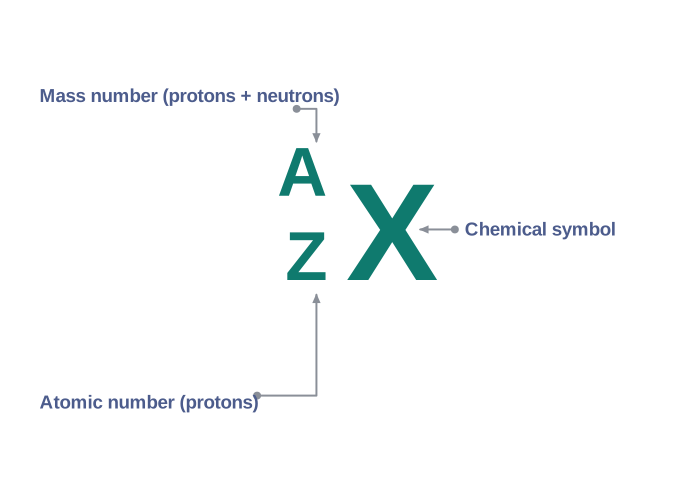
Fig. 13.2 – Notation for a nuclear species (nuclide).
For example, the nucleus of gold is written \(^{197}_{79}\text{Au}\). It contains \(197\) nucleons in total, of which \(79\) are protons; the remaining \(197 - 79 = 118\) are neutrons.
Isotopes, Isobars and Isotones
We can now explain isotopes clearly in terms of \(Z\) and \(N\). The nuclei of isotopes of a given element contain the same number of protons (\(Z\)) but different numbers of neutrons (\(N\)).
For example, deuterium, \(^{2}_{1}\text{H}\), has one proton and one neutron; its heavier cousin tritium, \(^{3}_{1}\text{H}\), has one proton and two neutrons. Some elements have many isotopes — gold, for instance, has \(32\) isotopes ranging from \(A = 173\) to \(A = 204\).
Because chemical behaviour depends on the electronic structure of an atom, and isotopes have identical electron arrangements, all isotopes of an element are chemically identical and sit in the same place in the periodic table.
Two other families of nuclides are also worth naming, as illustrated in Fig. 13.3. Nuclides with the same mass number \(A\) (but different \(Z\)) are called isobars — for example, \(^{3}_{1}\text{H}\) and \(^{3}_{2}\text{He}\). Nuclides with the same neutron number \(N\) (but different atomic number \(Z\)) are called isotones — for example, \(^{198}_{80}\text{Hg}\) and \(^{197}_{79}\text{Au}\).
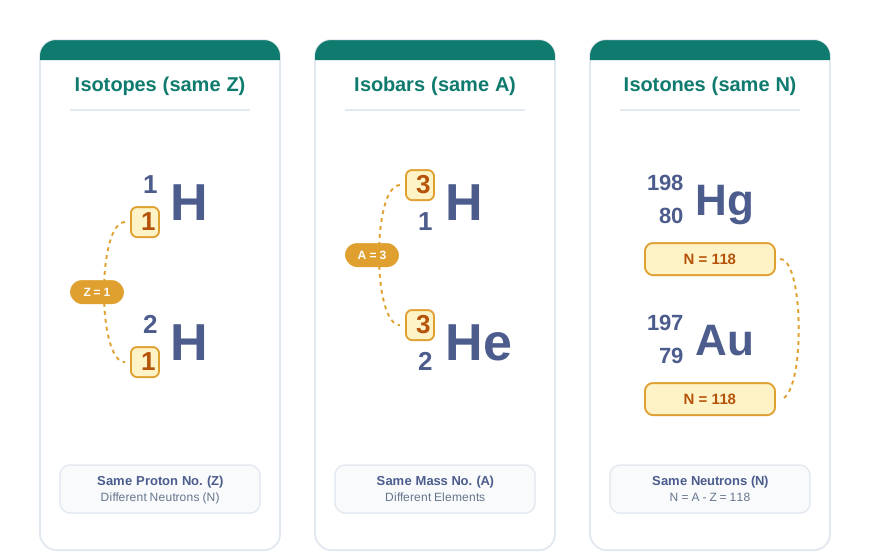
Fig. 13.3 – Examples of isotopes, isobars, and isotones.
13.3 Size of the Nucleus
We saw in Chapter 12 that Rutherford was the scientist who first proposed and established the existence of the atomic nucleus. But how do we actually measure something as small as a nucleus? We cannot look at it under any ordinary microscope. Instead, physicists probe the nucleus by firing fast particles at it and studying how they bounce off.
To understand this distance, picture the incoming \(\alpha\)-particle heading straight at a gold nucleus. Both carry positive charge, so the Coulomb force pushes them apart. As the \(\alpha\)-particle drives in, this repulsion steadily slows it down — its kinetic energy is converted into electrical potential energy — until, at the closest point, it momentarily stops and is then pushed back out, as shown in Fig. 13.4.
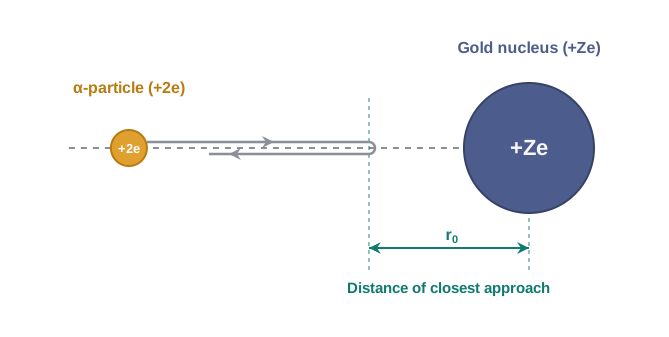
Fig. 13.4 – Distance of closest approach in head-on alpha scattering.
Rutherford could explain the whole scattering pattern by assuming that the Coulomb repulsive force alone was responsible. Since the positive charge is packed entirely inside the nucleus, and the \(\alpha\)-particle never actually touched the nucleus (it turned back at \(4.0 \times 10^{-14}\) m), the true size of the nucleus must be less than \(4.0 \times 10^{-14}\) m.
We can push this probe further. If we use \(\alpha\)-particles of energy higher than \(5.5\) MeV, they approach the gold nucleus even more closely. At some point they come near enough to feel the short-range nuclear force, and the scattering starts to disagree with Rutherford’s predictions — because his calculation assumed pure Coulomb repulsion between the \(\alpha\)-particle and the gold nucleus. The distance at which these deviations begin gives a direct clue to the nuclear size.
Using even finer probes — scattering fast electrons instead of \(\alpha\)-particles off targets made of many different elements — physicists have measured the sizes of nuclei accurately. The result is a simple and elegant relation. A nucleus of mass number \(A\) has a radius
\[R = R_0\, A^{1/3} \tag{13.5}\]
where \(R_0 = 1.2 \times 10^{-15}\ \text{m}\) (that is, \(1.2\) fm; here \(1\) femtometre, \(1\ \text{fm} = 10^{-15}\) m). In this formula \(R\) is the nuclear radius (in metres), \(A\) is the mass number (a pure number), and \(R_0\) is a constant.
This little formula hides a remarkable fact. Since the radius grows as \(A^{1/3}\), the volume of the nucleus — which is proportional to \(R^{3}\) — is proportional to \((A^{1/3})^{3} = A\). So the nuclear volume is directly proportional to the number of nucleons it contains.
Now think about density. Each nucleon adds roughly the same mass, so the total mass of a nucleus is proportional to \(A\) as well. Density is mass divided by volume, and both are proportional to \(A\):
\[\text{density} = \frac{\text{mass}}{\text{volume}} \propto \frac{A}{A} = \text{constant}\]
So the density of nuclear matter is a constant, the same for every nucleus regardless of \(A\). In this respect different nuclei behave like small drops of the same liquid — a liquid of fixed density, no matter the size of the drop.
Working out the value, the density of nuclear matter comes to about \(2.3 \times 10^{17}\ \text{kg m}^{-3}\). Compare this with the density of ordinary matter such as water, which is only \(10^{3}\ \text{kg m}^{-3}\) — the nucleus is denser by a factor of about \(10^{14}\). This enormous density is exactly what we should expect: we already saw that the atom is almost entirely empty, with all its mass crammed into a minute core.
13.4 Mass-Energy and Nuclear Binding Energy
13.4.1 Mass – Energy
Until the early twentieth century, physicists believed that mass and energy were two completely separate things, each conserved on its own. In any process, the total mass stayed fixed and the total energy stayed fixed, independently.
Einstein captured this idea in his famous mass-energy equivalence relation:
\[E = mc^2 \tag{13.6}\]
Here \(E\) is the energy (in joules) equivalent to a mass \(m\) (in kilograms), and \(c\) is the speed of light in vacuum, approximately \(3 \times 10^{8}\ \text{m s}^{-1}\).
The key to appreciating this equation is the factor \(c^2\). Because the speed of light is so large, \(c^2 \approx 9 \times 10^{16}\ \text{m}^2\text{s}^{-2}\) is an enormous number. This means that even a tiny amount of mass is equivalent to a huge amount of energy. Converting a small mass into energy can release a staggering quantity of it — a fact that lies at the heart of all nuclear energy.
Is Einstein’s relation just theory? No — it has been tested and confirmed experimentally, above all in the study of nuclear reactions among nucleons, nuclei, electrons and other particles. In such reactions, the ordinary law of conservation of energy still holds — but only if we count the energy associated with mass as part of the total. In other words, the initial and final energies balance provided the mass-energy \(mc^2\) is included in the bookkeeping.
This single idea — that mass counts as energy — is essential for understanding nuclear masses and the way nuclei interact with one another. It forms the foundation of the sections that follow.
13.4.2 Nuclear Binding Energy
We saw in Section 13.2 that a nucleus is built out of neutrons and protons. It seems natural to expect that the mass of a nucleus should simply equal the total mass of all its individual protons and neutrons added together. Remarkably, this is not what nature does. The actual mass of a nucleus, \(M\), is always found to be less than the sum of the masses of its separate parts.
Let us see this with a concrete example: the oxygen nucleus \(^{16}_{8}\text{O}\), which has \(8\) neutrons and \(8\) protons.
\[\text{Mass of } 8 \text{ neutrons} = 8 \times 1.00866\ \text{u}\] \[\text{Mass of } 8 \text{ protons} = 8 \times 1.00727\ \text{u}\] \[\text{Mass of } 8 \text{ electrons} = 8 \times 0.00055\ \text{u}\]
Adding a proton and a neutron gives \(1.00727 + 1.00866 = 2.01593\) u. So the expected mass of the \(^{16}_{8}\text{O}\) nucleus (protons plus neutrons only) is
\[= 8 \times 2.01593\ \text{u} = 16.12744\ \text{u}\]
Now for the measured value. Mass spectroscopy gives the atomic mass of \(^{16}_{8}\text{O}\) as \(15.99493\) u. But an atom includes its electrons, so to get the mass of the nucleus alone we subtract the mass of the \(8\) electrons (\(8 \times 0.00055\) u). This gives the experimental mass of the \(^{16}_{8}\text{O}\) nucleus as \(15.99053\) u.
Comparing the two numbers, the real nucleus (\(15.99053\) u) is lighter than the sum of its parts (\(16.12744\) u) by \(0.13691\) u. This missing mass is called the mass defect, written \(\Delta M\):
\[\Delta M = [Z m_p + (A - Z) m_n] - M \tag{13.7}\]
Here \(Z m_p\) is the mass of all the protons, \((A - Z) m_n\) is the mass of all the neutrons, and \(M\) is the actual measured mass of the nucleus. All masses are in u.
What does this missing mass mean? This is exactly where Einstein’s equivalence of mass and energy comes into play. Because the oxygen nucleus is lighter than its separated constituents (8 protons and 8 neutrons in the free, unbound state), the equivalent energy of the nucleus is less than the total equivalent energy of those separated particles.
So the bound nucleus sits at a lower energy than its scattered parts. To pull the oxygen nucleus apart again into \(8\) free protons and \(8\) free neutrons, we would have to supply this missing energy, \(\Delta M c^2\), from outside. This required energy, called \(E_b\), is related to the mass defect by
\[E_b = \Delta M\, c^2 \tag{13.8}\]
Although we cannot literally tear a nucleus apart in this way, the binding energy is still a very useful measure of how strongly a nucleus is held together.
An even more revealing quantity is the binding energy per nucleon, \(E_{bn}\), defined as the binding energy \(E_b\) divided by the number of nucleons \(A\):
\[E_{bn} = E_b / A \tag{13.9}\]
We can picture the binding energy per nucleon as the average energy needed to knock out one nucleon — that is, the average energy per nucleon required to break the nucleus into its individual parts.
Figure 13.5 shows how \(E_{bn}\) varies with mass number \(A\) for a large number of nuclei. Studying this curve reveals the following main features.
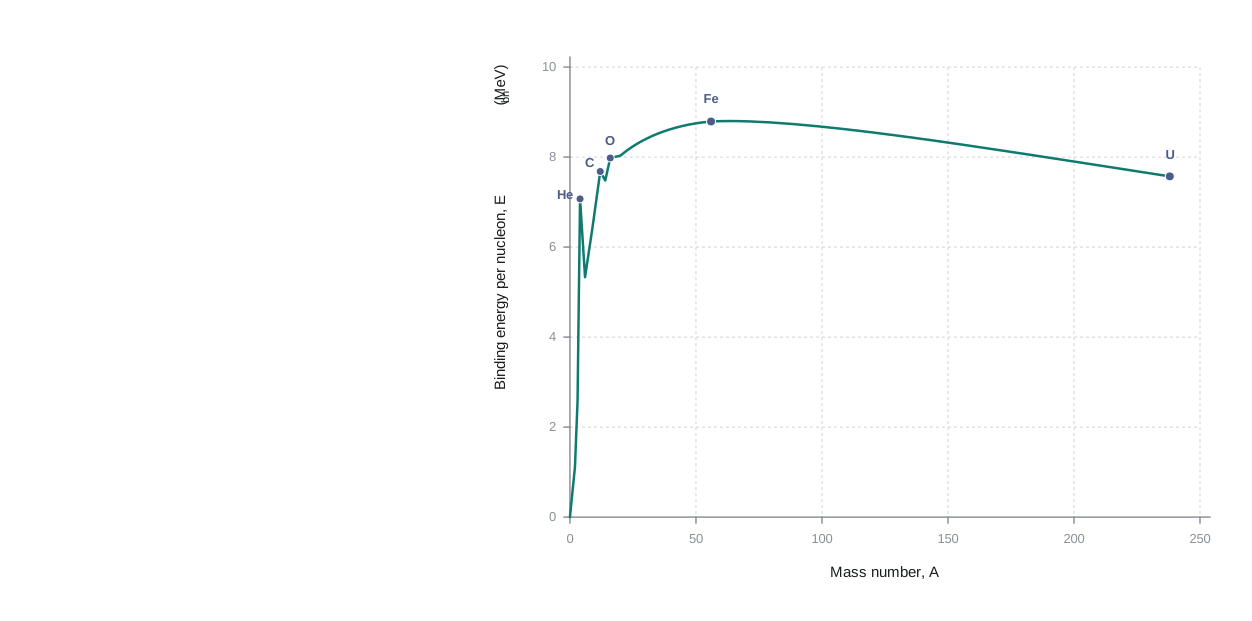
Fig. 13.5 – Binding energy per nucleon as a function of mass number.
For nuclei of middle mass number (\(30 < A < 170\)), the binding energy per nucleon \(E_{bn}\) is practically constant — essentially independent of the atomic number. The curve reaches a maximum of about \(8.75\) MeV at \(A = 56\), and has fallen only to about \(7.6\) MeV by \(A = 238\).
The binding energy per nucleon is lower for both very light nuclei (\(A < 30\)) and very heavy nuclei (\(A > 170\)).
From these two observations we can draw several important conclusions.
(i) The force binding the nucleons must be attractive and strong enough to produce a binding energy of a few MeV per nucleon.
(ii) The near-constancy of \(E_{bn}\) in the range \(30 < A < 170\) is a direct consequence of the nuclear force being short-ranged. Consider one particular nucleon deep inside a large nucleus. It feels the attraction of only those few neighbours that lie within the short range of the nuclear force; any nucleon farther away than this range has no influence on its binding. Suppose a nucleon can have at most \(p\) neighbours within range; then its binding energy is proportional to \(p\). Let the binding energy of such a nucleus be \(pk\), where \(k\) is a constant with the dimensions of energy. Now if we increase \(A\) by adding more nucleons, the number of close neighbours of an interior nucleon does not change — so its binding energy stays the same. Since in a large nucleus most nucleons lie deep inside (not on the surface), the change in binding energy per nucleon is small, and \(E_{bn}\) stays roughly constant at about \(pk\). This property — that a given nucleon interacts only with the nucleons closest to it — is called the saturation property of the nuclear force.
(iii) A very heavy nucleus, say \(A = 240\), has a lower binding energy per nucleon than a nucleus of \(A = 120\). So if an \(A = 240\) nucleus splits into two \(A = 120\) nuclei, the nucleons end up more tightly bound than before. This means energy would be released in the process. This has crucial implications for energy production through fission, discussed later in Section 13.7.1.
(iv) Consider instead two very light nuclei (\(A \leq 10\)) joining to form a heavier one. The binding energy per nucleon of the fused, heavier nucleus is greater than that of the light nuclei. So the final system is more tightly bound than the starting system, and again energy would be released — this time in the process of fusion. This is the energy source of the Sun, discussed later in Section 13.7.2.
13.5 Nuclear Force
What kind of force actually holds a nucleus together? The force that governs the motion of the atomic electrons is the familiar Coulomb force — the electric attraction between the positive nucleus and the negative electrons. But the Coulomb force cannot be the glue of the nucleus itself. In fact, it works against it.
Recall from Section 13.4 that for average-mass nuclei the binding energy per nucleon is about \(8\) MeV. This is enormously larger than the binding energies found in atoms, which are only a few electron-volts. Such strong binding cannot come from the Coulomb force. So, to hold a nucleus together, there must exist a strong attractive force of a completely different kind — the nuclear force.
This nuclear force faces a serious challenge. Inside the tiny nuclear volume, the protons are all positively charged and packed extremely close together, so they repel one another fiercely through the Coulomb force. To keep the nucleus intact, the nuclear force must be strong enough to overcome this proton–proton repulsion and bind both the protons and the neutrons into that minute volume.
Many features of the nuclear binding force are known from a wide variety of experiments carried out roughly between \(1930\) and \(1950\). They are summarised below.
(i) The nuclear force is far stronger than the Coulomb or gravitational forces. The nuclear binding force has to win against the Coulomb repulsion between protons inside the nucleus, and it does so only because it is much stronger than the Coulomb force. (The gravitational force between the nucleons is weaker still — far weaker than even the Coulomb force — so gravity plays no role in holding the nucleus together.)
This is what answers our earlier puzzle about the stability of the nucleus: the protons do repel one another electrically, but the far stronger, attractive nuclear force overwhelms that repulsion and keeps the nucleons bound.
(ii) The nuclear force has a very short range. The force between two nucleons falls rapidly to zero once their separation exceeds a few femtometres (\(1\ \text{fm} = 10^{-15}\) m). Because each nucleon can only “feel” its immediate neighbours, the force saturates in a medium-sized or large nucleus — the very reason (seen in Section 13.4.2) that the binding energy per nucleon stays nearly constant.
A rough plot of the potential energy between two nucleons as a function of their separation \(r\) is shown in Fig. 13.6. The potential energy dips to a minimum at a separation \(r_0\) of about \(0.8\) fm.
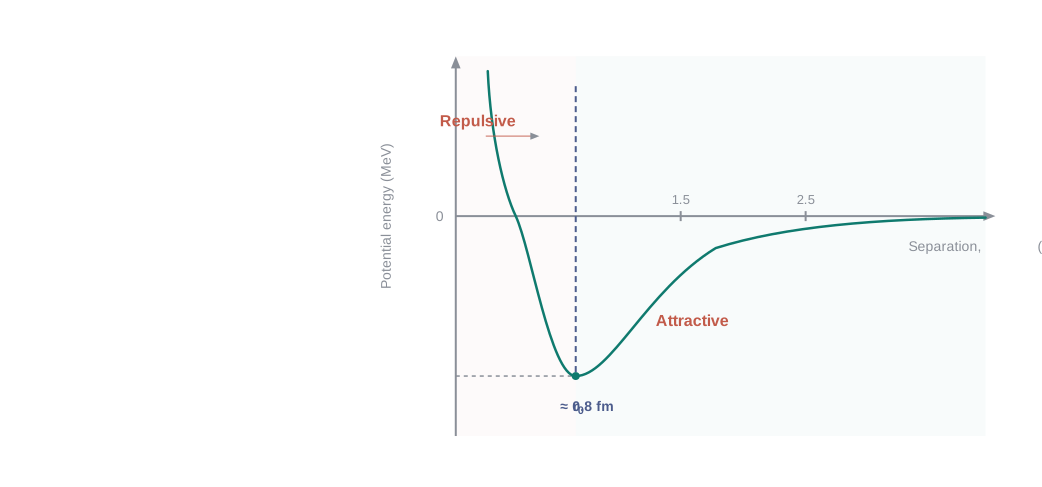
Fig. 13.6 – Potential energy of a pair of nucleons.
The shape of this curve tells us how the force behaves. For separations larger than \(0.8\) fm the force is attractive (pulling the nucleons together), while for separations smaller than \(0.8\) fm the force becomes strongly repulsive (pushing them apart).
(iii) The nuclear force is charge-independent. The force between a neutron and a neutron, between a proton and a neutron, and between a proton and a proton is approximately the same. In other words, the nuclear force does not depend on the electric charge of the nucleons.
Finally, unlike Coulomb’s law for charges or Newton’s law of gravitation, the nuclear force has no simple mathematical formula. It cannot be written as a neat inverse-square law; its behaviour is far more complex.
13.6 Radioactivity
Some of the most important discoveries in science have been made by accident — and radioactivity is a classic example.
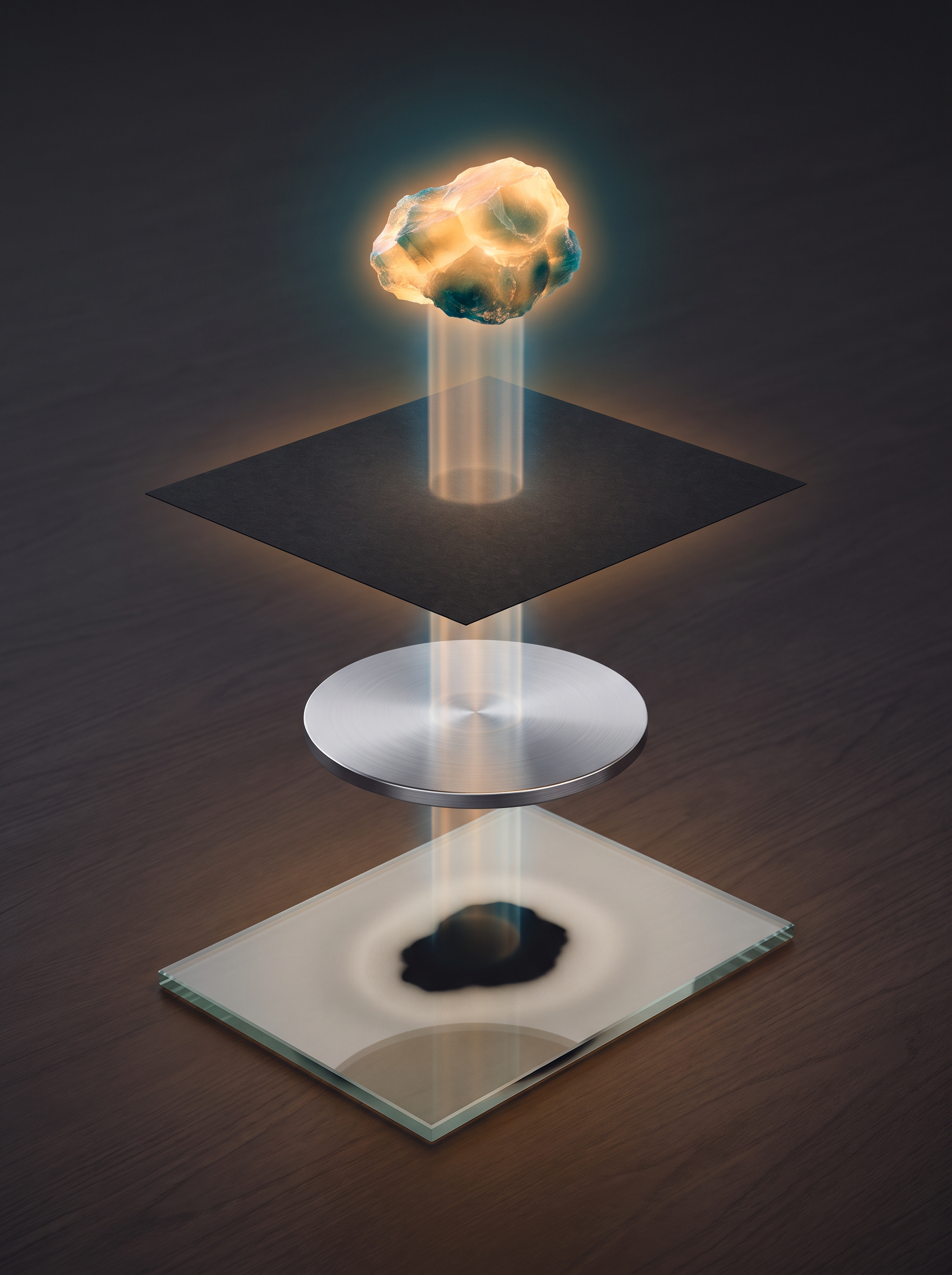
Fig. 13.7 – Becquerel’s arrangement discovering radioactivity.
Later experiments revealed what was really happening. Radioactivity is a nuclear phenomenon: it arises when an unstable nucleus undergoes a spontaneous change, or decay. This process is called radioactive decay. Importantly, it is a property of the nucleus, not of the atom’s chemistry — no heating, lighting, or chemical treatment is needed to trigger it; the unstable nucleus simply transforms on its own.
Three types of radioactive decay occur in nature:
(i) \(\alpha\)-decay, in which a helium nucleus \(^{4}_{2}\text{He}\) (called an \(\alpha\)-particle) is emitted;
(ii) \(\beta\)-decay, in which electrons or positrons are emitted. A positron is a particle with the same mass as an electron but a charge exactly opposite to that of the electron;
(iii) \(\gamma\)-decay, in which high-energy photons — hundreds of keV or more — are emitted.
13.7 Nuclear Energy
The whole idea of drawing useful energy from the nucleus rests on the shape of one graph: the binding-energy-per-nucleon curve, \(E_{bn}\) versus \(A\), that we met in Fig. 13.5.
That curve has a long, flat middle region between \(A = 30\) and \(A = 170\), where the binding energy per nucleon is nearly constant at about \(8.0\) MeV. On either side of this plateau — for the lighter nuclei (\(A < 30\)) and the heavier nuclei (\(A > 170\)) — the binding energy per nucleon is less than \(8.0\) MeV, as we noted earlier.
Now recall a key link from Section 13.4: the greater the binding energy of a bound system such as a nucleus, the less its total mass. A more tightly bound nucleus is a lighter, lower-energy nucleus.
Putting these ideas together gives the central principle of nuclear energy. If nuclei with less total binding energy transform into nuclei with greater total binding energy, the system moves to a lower-mass, lower-energy state, and the difference is released as usable energy.
There are two ways to climb toward the tightly bound peak of the curve. A heavy nucleus can split into two or more intermediate-mass fragments — this is fission. Or two light nuclei can join together into a heavier nucleus — this is fusion. Both processes move nucleons toward the peak of the binding-energy curve, so both release energy.
How much energy? Here nuclear reactions are in a league of their own. Ordinary energy sources such as coal and petroleum rely on exothermic chemical reactions, where the energies involved are only of the order of a few electron-volts (eV). In a nuclear reaction, by contrast, the energy released is of the order of MeV — a million electron-volts. So, for the same amount of matter, a nuclear source produces roughly a million times more energy than a chemical one.
13.7.1 Fission
So far we have looked at natural radioactive decay, where a nucleus transforms on its own. New possibilities open up when we go a step further and deliberately bombard nuclei with other nuclear particles — protons, neutrons, \(\alpha\)-particles, and so on — to make them react.
The neutron turns out to be an ideal projectile for this. Because it carries no charge, it feels no Coulomb repulsion from the positively charged nucleus, so even a slow neutron can walk right up to a nucleus and be absorbed. The most important neutron-induced reaction of all is fission.
A classic example is the uranium isotope \(^{235}_{92}\text{U}\). When it absorbs a neutron, it first forms the unstable nucleus \(^{236}_{92}\text{U}\), which then splits into two intermediate-mass fragments:
\[^{1}_{0}\text{n} + \, ^{235}_{92}\text{U} \rightarrow \, ^{236}_{92}\text{U} \rightarrow \, ^{144}_{56}\text{Ba} + \, ^{89}_{36}\text{Kr} + 3\,^{1}_{0}\text{n} \tag{13.10}\]
The very same reaction can split the uranium into different pairs of fragments on different occasions. For instance:
\[^{1}_{0}\text{n} + \, ^{235}_{92}\text{U} \rightarrow \, ^{236}_{92}\text{U} \rightarrow \, ^{133}_{51}\text{Sb} + \, ^{99}_{41}\text{Nb} + 4\,^{1}_{0}\text{n} \tag{13.11}\]
or, as another example,
\[^{1}_{0}\text{n} + \, ^{235}_{92}\text{U} \rightarrow \, ^{140}_{54}\text{Xe} + \, ^{94}_{38}\text{Sr} + 2\,^{1}_{0}\text{n} \tag{13.12}\]
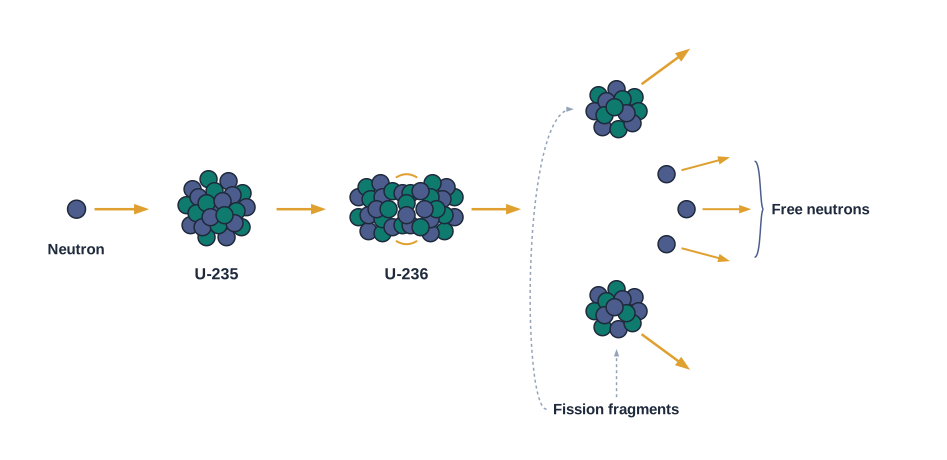
Fig. 13.8 – Neutron-induced fission of a uranium-235 nucleus.
The fragment nuclei produced in fission are themselves radioactive; they emit \(\beta\) particles one after another until they finally reach stable end products.
Notice that each fission releases two, three, or more fresh neutrons. Each of these can, in turn, strike another \(^{235}_{92}\text{U}\) nucleus and cause it to fission, releasing still more neutrons. This self-sustaining sequence is called a chain reaction, and it is what makes large-scale nuclear energy possible.
How much energy does fission release? The energy liberated per fission — called the \(Q\) value — for a uranium-like nucleus is about \(200\) MeV. We can estimate this directly from the binding-energy curve. Imagine a nucleus of \(A = 240\) breaking into two fragments, each with \(A = 120\):
- \(E_{bn}\) for the \(A = 240\) nucleus is about \(7.6\) MeV,
- \(E_{bn}\) for each of the \(A = 120\) fragment nuclei is about \(8.5\) MeV.
So the gain in binding energy per nucleon is about \(8.5 - 7.6 = 0.9\) MeV. Since there are \(240\) nucleons in total, the total gain in binding energy is
\[240 \times 0.9 = 216\ \text{MeV}\]
This is close to the observed value of about \(200\) MeV per fission, confirming our estimate.
Where does this released energy first appear? It shows up as the kinetic energy of the flying fragments and neutrons. As these fast-moving particles collide with the surrounding material, their kinetic energy is transferred to it and appears as heat.
13.7.2 Nuclear Fusion – Energy Generation in Stars
Fission takes energy out of heavy nuclei by splitting them. Fusion does the opposite for light nuclei: it joins them. When two light nuclei fuse into a single larger nucleus, energy is released, because the larger nucleus is more tightly bound than the two small ones — exactly as the binding-energy curve of Fig. 13.5 predicts.
Some examples of energy-liberating fusion reactions are:
\[^{1}_{1}\text{H} + \, ^{1}_{1}\text{H} \rightarrow \, ^{2}_{1}\text{H} + e^{+} + \nu + 0.42\ \text{MeV} \tag{13.13(a)}\] \[^{2}_{1}\text{H} + \, ^{2}_{1}\text{H} \rightarrow \, ^{3}_{2}\text{He} + n + 3.27\ \text{MeV} \tag{13.13(b)}\] \[^{2}_{1}\text{H} + \, ^{2}_{1}\text{H} \rightarrow \, ^{3}_{1}\text{H} + \, ^{1}_{1}\text{H} + 4.03\ \text{MeV} \tag{13.13(c)}\]
Let us read these. In the first reaction, two protons (\(^{1}_{1}\text{H}\)) combine to form a deuteron (\(^{2}_{1}\text{H}\), the deuterium nucleus) together with a positron (\(e^{+}\)) and a neutrino (\(\nu\)), releasing \(0.42\) MeV. In reaction 13.13(b), two deuterons combine to form the light isotope of helium, \(^{3}_{2}\text{He}\). In reaction 13.13(c), two deuterons combine to form a triton (\(^{3}_{1}\text{H}\), the tritium nucleus) and a proton.
The obstacle: the Coulomb barrier. For fusion to happen, the two nuclei must come close enough for the short-range attractive nuclear force to take hold. But both nuclei are positively charged, so as they approach they experience Coulomb repulsion, which tries to push them back apart. To fuse, they must arrive with enough energy to overcome this Coulomb barrier, as shown in Fig. 13.9.
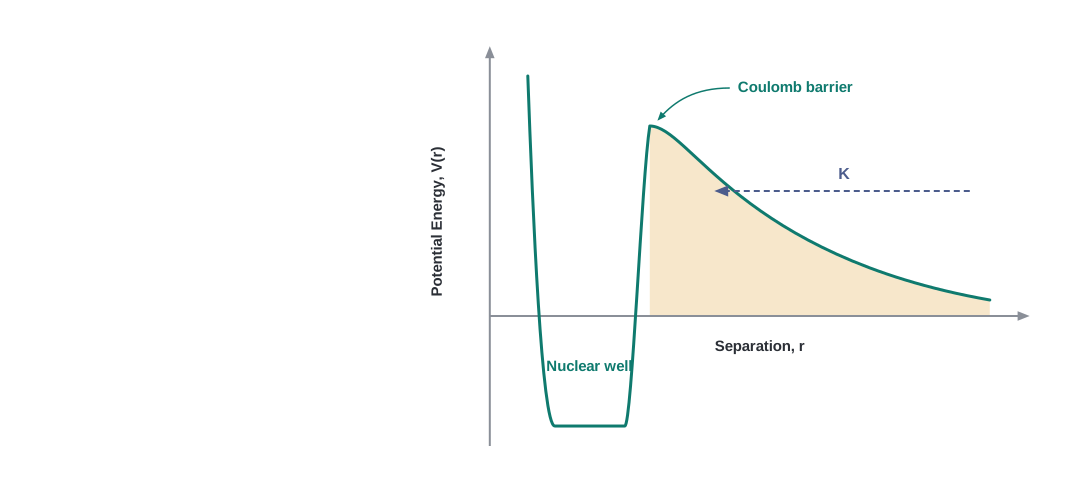
Fig. 13.9 – The Coulomb potential barrier for nuclear fusion.
The height of this barrier depends on the charges and radii of the two interacting nuclei. For two protons, it can be shown that the barrier height is about \(400\) keV, and it is higher for nuclei carrying larger charges.
We can estimate the temperature at which the protons in a hot proton gas would, on average, have enough kinetic energy to clear this barrier. The average kinetic energy of a gas particle is \(\tfrac{3}{2}kT\), so setting this equal to the barrier energy \(K \simeq 400\) keV:
\[\frac{3}{2}kT = K \simeq 400\ \text{keV}, \quad \text{which gives} \quad T \sim 3 \times 10^{9}\ \text{K}\]
When fusion is achieved by heating the material to such high temperatures — so that the particles have enough thermal kinetic energy to overcome the Coulomb repulsion — the process is called thermonuclear fusion.
Fusion in the Sun. Thermonuclear fusion is the source of the energy pouring out of the interiors of stars. Curiously, the interior of the Sun sits at a temperature of about \(1.5 \times 10^{7}\) K — much lower than the \(\sim 3 \times 10^{9}\) K our estimate suggested is needed for average-energy particles. So fusion in the Sun must be driven by the small fraction of protons whose energies are far above the average.
The Sun’s fusion is not a single step but a multi-step chain in which hydrogen is gradually “burned” into helium. The fuel is the hydrogen in the Sun’s core. The sequence, known as the proton–proton (p, p) cycle, is:
\[^{1}_{1}\text{H} + \, ^{1}_{1}\text{H} \rightarrow \, ^{2}_{1}\text{H} + e^{+} + \nu + 0.42\ \text{MeV} \quad \text{(i)}\] \[e^{+} + e^{-} \rightarrow \gamma + \gamma + 1.02\ \text{MeV} \quad \text{(ii)}\] \[^{2}_{1}\text{H} + \, ^{1}_{1}\text{H} \rightarrow \, ^{3}_{2}\text{He} + \gamma + 5.49\ \text{MeV} \quad \text{(iii)}\] \[^{3}_{2}\text{He} + \, ^{3}_{2}\text{He} \rightarrow \, ^{4}_{2}\text{He} + \, ^{1}_{1}\text{H} + \, ^{1}_{1}\text{H} + 12.86\ \text{MeV} \quad \text{(iv)} \tag{13.14}\]
In step (ii), the positron produced in step (i) meets an electron and the two annihilate, converting their mass into two \(\gamma\)-ray photons. For the fourth reaction to occur, the first three must each happen twice, so that two \(^{3}_{2}\text{He}\) nuclei are available to unite into ordinary helium, \(^{4}_{2}\text{He}\).
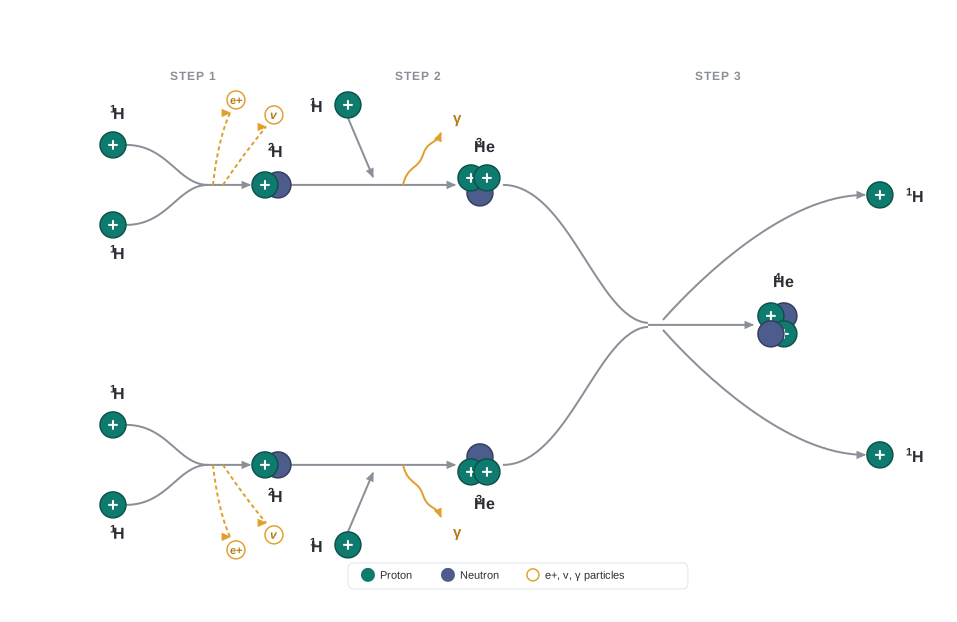
Fig. 13.10 – The proton–proton cycle.
Adding up the whole cycle — the combination \(2\text{(i)} + 2\text{(ii)} + 2\text{(iii)} + \text{(iv)}\) — the net effect is
\[4\,^{1}_{1}\text{H} + 2e^{-} \rightarrow \, ^{4}_{2}\text{He} + 2\nu + 6\gamma + 26.7\ \text{MeV}\]
or, writing it in terms of neutral atoms,
\[(4\,^{1}_{1}\text{H} + 4e^{-}) \rightarrow (^{4}_{2}\text{He} + 2e^{-}) + 2\nu + 6\gamma + 26.7\ \text{MeV} \tag{13.15}\]
So the overall result is that four hydrogen atoms combine to form one \(^{4}_{2}\text{He}\) atom, releasing \(26.7\) MeV of energy. This is the furnace that keeps the Sun and other stars shining.
Building heavier elements. Helium is not the only element made inside stars. As the hydrogen in the core runs out and turns to helium, the core cools and the star starts to collapse under its own gravity. This collapse raises the core temperature. If it reaches about \(10^{8}\) K, a new round of fusion begins — this time helium nuclei fusing into carbon. Step by step, such processes can build up higher and higher mass-number elements. However, elements more massive than those near the peak of the binding-energy curve (Fig. 13.5) cannot be produced this way, because fusing beyond the peak would no longer release energy.
The future of the Sun. The Sun is about \(5 \times 10^{9}\) years old, and it is estimated to have enough hydrogen to keep shining for another \(5\) billion years. After that, hydrogen burning will stop, the Sun will cool and begin to collapse under gravity, which will again raise the core temperature. Its outer envelope will then swell enormously, turning it into what astronomers call a red giant.
13.7.3 Controlled Thermonuclear Fusion
If fusion powers the stars, can we harness it here on Earth? That is the goal of a thermonuclear fusion device — a machine that tries to reproduce, in a controlled way, the natural fusion process of a star.
In a controlled fusion reactor, the aim is to generate steady power by heating the nuclear fuel to a temperature in the range of about \(10^{8}\) K. At such temperatures the fuel is no longer an ordinary gas: the atoms are stripped of their electrons, leaving a hot mixture of positive ions and free electrons. This ionised state of matter is called a plasma.
Herein lies the central difficulty. The plasma is so hot that no material container can hold it — any ordinary wall would simply vaporise on contact. The great challenge, then, is to confine the plasma without touching it. Because a plasma is made of charged particles, one clever approach is to trap it using strong magnetic fields, which steer the charged particles and keep them away from the walls, as suggested in Fig. 13.11.
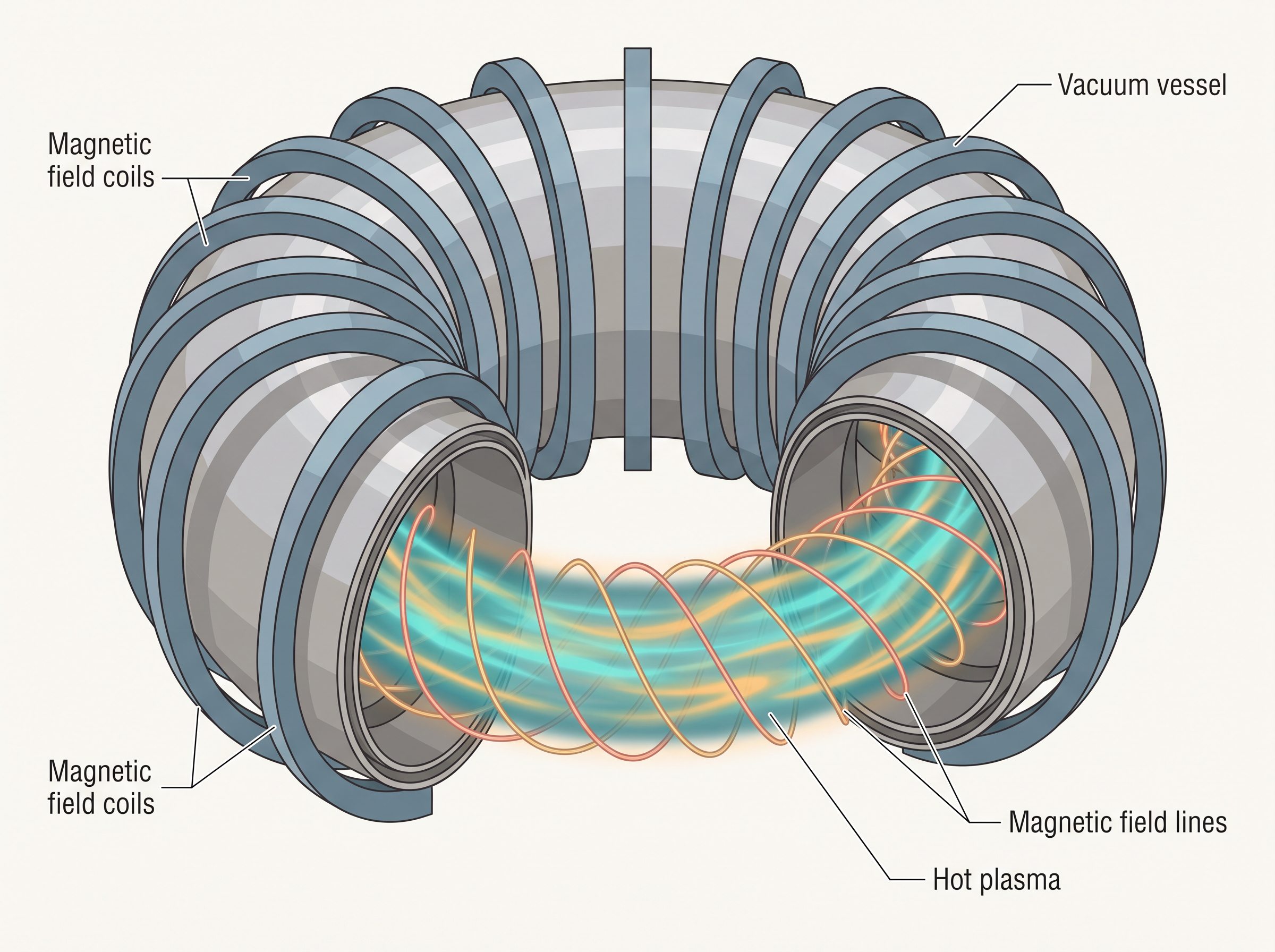
Fig. 13.11 – Magnetic confinement of plasma in a toroidal reactor.
Several countries around the world, including India, are actively developing techniques to meet this challenge. If they succeed, fusion reactors could one day supply almost unlimited, clean power to humanity — fuelled largely by hydrogen, using far cleaner reactions than fission.
13.8 Summary
Every atom has a nucleus. The nucleus is positively charged, and its radius is smaller than the radius of the atom by a factor of about \(10^{4}\). More than \(99.9\%\) of the mass of an atom is concentrated in its nucleus.
On the atomic scale, mass is measured in atomic mass units (u). By definition, one atomic mass unit is \(\dfrac{1}{12}\) of the mass of one \(^{12}\text{C}\) atom: \[1\,\text{u} = 1.660563 \times 10^{-27}\ \text{kg}\]
A nucleus also contains a neutral particle called the neutron. Its mass is almost the same as that of the proton.
The atomic number \(Z\) is the number of protons in the nucleus. The mass number \(A\) is the total number of protons and neutrons, so that \(A = Z + N\), where \(N\) is the number of neutrons. A nuclear species (a nuclide) is written as \(^{A}_{Z}X\), where \(X\) is the chemical symbol. Nuclides with the same \(Z\) but different \(N\) are isotopes; nuclides with the same \(A\) are isobars; and nuclides with the same \(N\) are isotones. Most elements are mixtures of two or more isotopes, and the atomic mass of an element is the weighted average of the masses of its isotopes, calculated using their relative abundances.
A nucleus can be treated as spherical, with a radius given by electron-scattering experiments as \[R = R_0\, A^{1/3}\] where \(R_0 = 1.2\) fm is a constant. This implies that the nuclear density is independent of \(A\), with a value of the order of \(10^{17}\ \text{kg/m}^3\).
Neutrons and protons are bound together in the nucleus by the short-range strong nuclear force. This force does not distinguish between a neutron and a proton.
The nuclear mass \(M\) is always less than the total mass \(\Sigma m\) of its constituents. This difference is the mass defect: \[\Delta M = \big(Z m_p + (A - Z) m_n\big) - M\] Using Einstein’s mass-energy relation, this mass difference is expressed as energy — the binding energy: \[\Delta E_b = \Delta M\, c^2\] In the mass-number range \(A = 30\) to \(170\), the binding energy per nucleon is nearly constant, about \(8\) MeV/nucleon.
The energies associated with nuclear processes are about a million times larger than those of chemical processes.
The \(Q\)-value of a nuclear process is \[Q = \text{(final kinetic energy)} - \text{(initial kinetic energy)}\] Because of conservation of mass-energy, this is also \[Q = \big(\text{sum of initial masses} - \text{sum of final masses}\big)c^2\]
Radioactivity is the phenomenon in which nuclei of a given species transform by emitting \(\alpha\), \(\beta\), or \(\gamma\) rays. \(\alpha\)-rays are helium nuclei; \(\beta\)-rays are electrons; and \(\gamma\)-rays are electromagnetic radiation of wavelengths shorter than X-rays.
Energy is released when less tightly bound nuclei are transformed into more tightly bound nuclei. In fission, a heavy nucleus such as \(^{235}_{92}\text{U}\) splits into two smaller fragments, for example: \[^{235}_{92}\text{U} + \, ^{1}_{0}\text{n} \rightarrow \, ^{133}_{51}\text{Sb} + \, ^{99}_{41}\text{Nb} + 4\,^{1}_{0}\text{n}\]
In fusion, lighter nuclei combine to form a larger nucleus. The fusion of hydrogen nuclei into helium nuclei is the source of energy of all stars, including our Sun.
Table of Physical Quantities
| Physical Quantity | Symbol | Dimensions | Units | Remarks |
|---|---|---|---|---|
| Atomic mass unit | — | \([\text{M}]\) | u | Unit of mass for expressing atomic or nuclear masses. One atomic mass unit equals \(1/12\) of the mass of a \(^{12}\text{C}\) atom. |
| Disintegration or decay constant | \(\lambda\) | \([\text{T}^{-1}]\) | s\(^{-1}\) | — |
| Half-life | \(T_{1/2}\) | \([\text{T}]\) | s | Time taken for the decay of one-half of the initial number of nuclei present in a radioactive sample. |
| Mean life | \(\tau\) | \([\text{T}]\) | s | Time at which the number of nuclei has been reduced to \(e^{-1}\) of its initial value. |
| Activity of a radioactive sample | \(R\) | \([\text{T}^{-1}]\) | Bq | Measure of the activity of a radioactive source. |
13.9 Points to Ponder
The density of nuclear matter is independent of the size of the nucleus — every nucleus, large or small, has essentially the same density. The mass density of the atom, however, does not follow this rule (because the atom is mostly empty space, its density depends strongly on the atom).
The radius of a nucleus measured by electron scattering comes out slightly different from the radius measured by alpha-particle scattering. This is because the two probes “see” different things: electron scattering senses the charge distribution of the nucleus, whereas alpha and similar particles sense the nuclear matter itself.
Once Einstein established the equivalence of mass and energy, \(E = mc^2\), we can no longer speak of separate laws for the conservation of mass and the conservation of energy. Instead there is a single, unified law of conservation of mass and energy. The most convincing evidence that this principle operates in nature comes from nuclear physics, and it is central to understanding nuclear energy and harnessing it as a source of power. Using this principle, the \(Q\)-value of a nuclear process (a decay or a reaction) can be expressed in terms of the initial and final masses.
The shape of the binding-energy-per-nucleon curve tells us that exothermic (energy-releasing) nuclear reactions are possible in two ways: when two light nuclei fuse, or when a heavy nucleus fissions into nuclei of intermediate mass.
For fusion, the light nuclei must arrive with enough initial energy to overcome the Coulomb potential barrier between them. This is precisely why fusion requires very high temperatures.
Although the binding-energy-per-nucleon curve is smooth and slowly varying overall, it shows small peaks at certain nuclides such as \(^{4}\text{He}\) and \(^{16}\text{O}\). These peaks are taken as evidence of an atom-like shell structure inside nuclei — just as electrons fill shells in an atom, nucleons appear to fill shells in a nucleus.
The electron and the positron form a particle–antiparticle pair. They have identical mass, and charges that are equal in magnitude but opposite in sign. When an electron and a positron meet, they annihilate each other, releasing their combined energy in the form of gamma-ray photons.
Radioactivity is a sign of the instability of a nucleus. Stability requires the ratio of neutrons to protons to be around \(1:1\) for light nuclei; this ratio rises to about \(3:2\) for heavy nuclei, since more neutrons are needed to counter the growing Coulomb repulsion among the protons. Nuclei that stray from this stability ratio — having an excess of either neutrons or protons — are unstable. In fact, only about \(10\%\) of all known isotopes are stable. The rest have either been produced artificially in the laboratory (by bombarding stable targets with \(\alpha\)-particles, protons, deuterons, neutrons or other particles) or identified in astronomical observations of matter in the universe.
13.10 NCERT Questions
You may find the following data useful in solving the exercises:
\[e = 1.6 \times 10^{-19}\ \text{C} \qquad N = 6.023 \times 10^{23}\ \text{per mole}\] \[\frac{1}{4\pi\varepsilon_0} = 9 \times 10^{9}\ \text{N m}^2/\text{C}^2 \qquad k = 1.381 \times 10^{-23}\ \text{J K}^{-1}\] \[1\ \text{MeV} = 1.6 \times 10^{-13}\ \text{J} \qquad 1\ \text{u} = 931.5\ \text{MeV}/c^2\] \[1\ \text{year} = 3.154 \times 10^{7}\ \text{s}\] \[m_{\text{H}} = 1.007825\ \text{u} \qquad m_{\text{n}} = 1.008665\ \text{u}\] \[m(^{4}_{2}\text{He}) = 4.002603\ \text{u} \qquad m_{e} = 0.000548\ \text{u}\]
Obtain the binding energy (in MeV) of a nitrogen nucleus \((^{14}_{7}\text{N})\), given \(m(^{14}_{7}\text{N}) = 14.00307\) u.
Obtain the binding energy of the nuclei \(^{56}_{26}\text{Fe}\) and \(^{209}_{83}\text{Bi}\) in units of MeV from the following data: \[m(^{56}_{26}\text{Fe}) = 55.934939\ \text{u} \qquad m(^{209}_{83}\text{Bi}) = 208.980388\ \text{u}\]
A given coin has a mass of \(3.0\) g. Calculate the nuclear energy that would be required to separate all the neutrons and protons from each other. For simplicity, assume that the coin is entirely made of \(^{63}_{29}\text{Cu}\) atoms (of mass \(62.92960\) u).
Obtain approximately the ratio of the nuclear radii of the gold isotope \(^{197}_{79}\text{Au}\) and the silver isotope \(^{107}_{47}\text{Ag}\).
The \(Q\) value of a nuclear reaction \(A + b \rightarrow C + d\) is defined by \[Q = [m_A + m_b - m_C - m_d]c^2\] where the masses refer to the respective nuclei. Determine from the given data the \(Q\)-value of the following reactions and state whether the reactions are exothermic or endothermic.
\(\ ^{1}_{1}\text{H} + \, ^{3}_{1}\text{H} \rightarrow \, ^{2}_{1}\text{H} + \, ^{2}_{1}\text{H}\)
\(\ ^{12}_{6}\text{C} + \, ^{12}_{6}\text{C} \rightarrow \, ^{20}_{10}\text{Ne} + \, ^{4}_{2}\text{He}\)
Atomic masses are given to be: \[m(^{2}_{1}\text{H}) = 2.014102\ \text{u} \qquad m(^{3}_{1}\text{H}) = 3.016049\ \text{u}\] \[m(^{12}_{6}\text{C}) = 12.000000\ \text{u} \qquad m(^{20}_{10}\text{Ne}) = 19.992439\ \text{u}\]
Suppose we think of the fission of a \(^{56}_{26}\text{Fe}\) nucleus into two equal fragments, \(^{28}_{13}\text{Al}\). Is the fission energetically possible? Argue by working out \(Q\) of the process. Given \(m(^{56}_{26}\text{Fe}) = 55.93494\) u and \(m(^{28}_{13}\text{Al}) = 27.98191\) u.
The fission properties of \(^{239}_{94}\text{Pu}\) are very similar to those of \(^{235}_{92}\text{U}\). The average energy released per fission is \(180\) MeV. How much energy, in MeV, is released if all the atoms in \(1\) kg of pure \(^{239}_{94}\text{Pu}\) undergo fission?
How long can an electric lamp of \(100\) W be kept glowing by the fusion of \(2.0\) kg of deuterium? Take the fusion reaction as \[^{2}_{1}\text{H} + \, ^{2}_{1}\text{H} \rightarrow \, ^{3}_{2}\text{He} + n + 3.27\ \text{MeV}\]
Calculate the height of the potential barrier for a head-on collision of two deuterons. (Hint: The height of the potential barrier is given by the Coulomb repulsion between the two deuterons when they just touch each other. Assume that they can be taken as hard spheres of radius \(2.0\) fm.)
From the relation \(R = R_0 A^{1/3}\), where \(R_0\) is a constant and \(A\) is the mass number of a nucleus, show that the nuclear matter density is nearly constant (i.e. independent of \(A\)).
13.11 Check Your Concepts
Different nuclei have widely different masses, yet the density of nuclear matter is nearly the same for all of them. Using the relation \(R = R_0 A^{1/3}\), explain why this is so.
A free neutron is unstable and decays with a mean life of about \(1000\) s, yet neutrons bound inside a stable nucleus do not decay at all. Explain how this is possible.
Explain why a slow neutron can enter a nucleus and trigger a nuclear reaction far more easily than a proton of the same kinetic energy.
The measured mass of any nucleus is always less than the total mass of its separate protons and neutrons. What is this missing mass called, and what has become of it?
The fusion of light nuclei requires extremely high temperatures, but the neutron-induced fission of a heavy nucleus does not require high temperatures at all. Give the physical reason for this difference.
The binding-energy-per-nucleon curve rises to a peak near \(A = 56\) and falls off on both sides of it. Using this fact, explain why both the fission of very heavy nuclei and the fusion of very light nuclei release energy.
Classify each of the following pairs as isotopes, isobars, or isotones, giving a brief reason in each case:
- \(^{3}_{1}\text{H}\) and \(^{3}_{2}\text{He}\);
- \(^{198}_{80}\text{Hg}\) and \(^{197}_{79}\text{Au}\);
- \(^{12}_{6}\text{C}\) and \(^{14}_{6}\text{C}\).
Consider the following statements. Assertion: The nuclear force between two nucleons does not distinguish between a proton and a neutron. Reason: The nuclear force is much stronger than the gravitational force between the nucleons. State whether the assertion and the reason are each correct, and whether the reason correctly explains the assertion.
13.12 Practice with Numericals
Using \(R = R_0 A^{1/3}\) with \(R_0 = 1.2\) fm, calculate the radius of a \(^{56}_{26}\text{Fe}\) nucleus.
Calculate the binding energy per nucleon of the helium nucleus \(^{4}_{2}\text{He}\), using the atomic-mass data given at the top of this exercise (\(m_{\text{H}} = 1.007825\) u, \(m_{\text{n}} = 1.008665\) u, \(m(^{4}_{2}\text{He}) = 4.002603\) u, and \(1\ \text{u} = 931.5\ \text{MeV}/c^2\)).
The mass defect of a certain nucleus is found to be \(0.0303\) u. Calculate its binding energy in MeV.
Calculate the energy equivalent (in MeV) of the rest mass of an electron, \(m_e = 0.000548\) u.
In the proton–proton cycle, four hydrogen nuclei fuse to form one helium-4 nucleus, releasing \(26.7\) MeV. Estimate the total energy (in joules) released when \(1.0\) kg of hydrogen is completely converted to helium in this way. (Take the molar mass of hydrogen as \(1\) g, Avogadro’s number \(N = 6.023 \times 10^{23}\) per mole, and \(1\ \text{MeV} = 1.6 \times 10^{-13}\) J.)
For the nucleus \(^{238}_{92}\text{U}\), find the number of neutrons it contains, and calculate its nuclear radius using \(R = R_0 A^{1/3}\) with \(R_0 = 1.2\) fm.