Chapter 1: Definition of Economics
Every economy begins with the same awkward fact: people want more than there is. A farmer holding one hectare of irrigated land must decide whether to sow wheat on it or mustard, because the land cannot carry both. Choosing wheat means giving up the mustard crop. The choice is forced not by poor planning but by the limits of the land itself. Economics is the study of choices of this kind — how individuals, firms, governments and whole economies decide what to do with means that fall short of their wants. Yet economists have not always described the subject in this way. Over more than two centuries the definition of economics has shifted: from a science of wealth, to a study of human welfare, to the logic of scarcity and choice, and finally to a subject that asks how an economy grows over time. Each shift widened what economists believed they were studying. This chapter examines those four definitions, sets out the features and weaknesses of each, and then divides the subject into its two branches, microeconomics and macroeconomics.
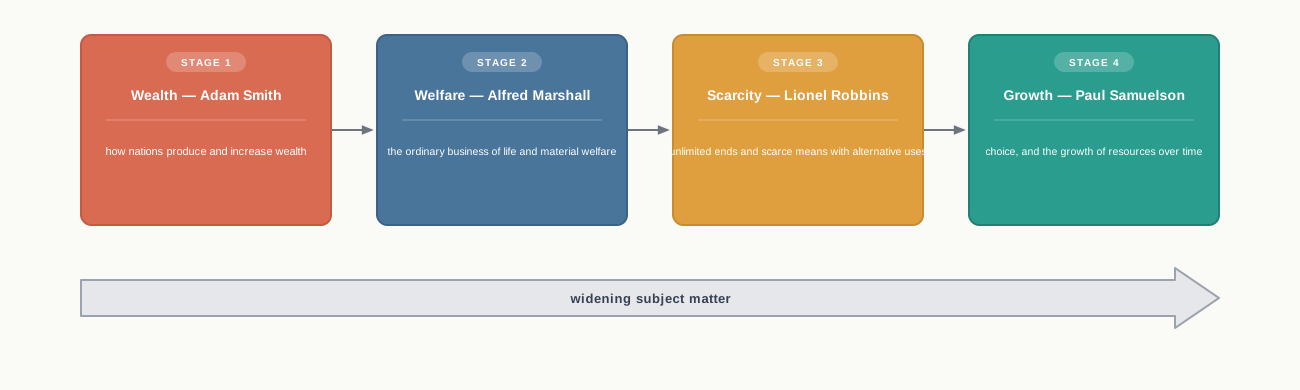
Fig. 1.0 – How the definition of economics widened over time.
1.1 Introduction
Every science is marked out by the questions it asks. Biology asks how living organisms are built and how they change over time; physics asks how matter and energy behave; political science asks how states and governments are organised. A student beginning economics is entitled to put the same question to this subject: what is it that economics studies?
The answer begins with a difficulty rather than with a list of topics. Human wants are many and the means of satisfying them are limited. Land, labour, machinery, fuel, foreign exchange and the hours in a working day all exist in fixed quantity at any given moment, while the uses to which they could be put are endless. Every household, every firm and every government must therefore decide what to do with what it has, and every such decision leaves something else undone.
Economics is the systematic study of those decisions. It asks how they are taken, what determines their outcome, and whether the outcome could be bettered.
1.1.1 The Questions Economics Asks
The simplest way to see the subject matter of economics is to look at the questions economists actually discuss. Some of them arise in ordinary daily life:
- How does a consumer divide a limited income among food, clothing, travel, education and saving?
- How does a producer decide which commodities to make, by what method to make them, and at what price to sell them?
- What determines the wage a worker is paid, and why do government employees ask for a higher dearness allowance when prices rise?
Other questions are far larger and are faced by the economy as a whole. What determines the level of national income? Why does unemployment persist in India? How is the continuing poverty of a large section of the population to be explained? Why do prices rise sharply in some years, and what policy will curb them? What are the effects of the government’s taxation and expenditure decisions? Why does one country grow faster than another?
The two sets of questions differ in the unit they examine. The first set looks at a single consumer, a single producer or a single market; the second looks at the economy taken as a whole. This difference is important enough to have divided economics into two branches, and Section 1.4 takes it up in detail.
1.2 Evolution Of Economic Thought
Economic questions are as old as human society. Long before anyone thought of economics as a subject, households had to divide a harvest between eating and sowing, and rulers had to decide how much of the produce to take as revenue and what to spend it on. What changed over the centuries was not the questions but the discipline that claimed them.
1.2.1 From Statecraft To A Separate Discipline
In the ancient world these questions were treated as a part of philosophy and of the art of governing. Aristotle (384–322 BCE), whom some writers regard as the first economist, was chiefly occupied with the philosophy of state and society, but in the course of it he described the subject as the science of the management of the family and the state. Through the ancient and medieval periods economics developed in much the same way, as a branch of statecraft rather than as a study in its own right.
A sharper turn came with the mercantilists, whose thinking prevailed in Europe from the sixteenth to the middle of the eighteenth century. They held that wealth, and particularly the stock of precious metals a country held, was of paramount importance as the means of making the state powerful. Economic thought of this kind treated the subject as an account of the wealth-earning activities of individuals and of the state.
It was in the hands of the classical economists — Adam Smith and those who followed him — that economics became a science of wealth clearly and deliberately, and it was in their writings that it emerged for the first time as a separate discipline. Ever since, economists have defined the subject matter of their subject explicitly, though, as the next section shows, not in the same way.
Until close to the end of the nineteenth century the subject was in fact called political economy, the name under which it had grown up alongside logic, ethics and politics. The title of Alfred Marshall’s Principles of Economics (1890) marks the point at which the shorter name became the settled one.
1.2.2 Why Economists Define Economics Differently
Since economics emerged as a separate discipline more than two centuries ago, it has been defined differently by different economists. This is less surprising than it first appears. Economics covers a very wide range of human activity, and each generation of economists has defined the subject around the problem that seemed most pressing in its own time — the wealth of nations in the eighteenth century, human welfare in the nineteenth, the allocation of scarce resources between the wars, and economic growth thereafter.
A definition is therefore not a mere form of words. It fixes what counts as an economic question, and so decides what the economist is entitled to study and what is left to other subjects. Each of the definitions that follow widened the subject in some direction and was found wanting in another.
For clarity these definitions may be grouped under four heads, and the next section takes them in the order in which they appeared:
- Wealth definition — associated with Adam Smith and the classical economists.
- Welfare definition — associated with Alfred Marshall.
- Scarcity definition — associated with Lionel Robbins.
- Growth-oriented definition — associated with Paul Samuelson.
1.3 Major Definitions Of Economics
Each of the four definitions that follow was written by an economist trying to say what the central economic fact is. Smith took it to be wealth, Marshall the welfare of ordinary people, Robbins the scarcity of means, and Samuelson the growth of resources over time. Read in that order, the four show the subject slowly finding its own boundaries.
For each definition, take three things in turn: what it says, the features that follow from it, and the grounds on which later economists found it inadequate.
1.3.1 The Wealth Definition Of Adam Smith
The classical economists — Adam Smith, J.B. Say, Nassau William Senior, David Ricardo and J.S. Mill among them — treated economics as a science of wealth. Smith, generally regarded as the father of economics, set out this view in An Enquiry into the Nature and Causes of the Wealth of Nations (1776), where the production, growth and distribution of wealth are taken to be the whole subject matter of the discipline.
Say described economics simply as the science which treats of wealth, and Senior wrote that the subject treated by political economy is not happiness but wealth. The main features of the wealth definition are these.
- Study of wealth — economics is the study of wealth alone, and its main object is to examine how people earn wealth and how they spend it. Wealth is the focal point of the enquiry.
- Causes of wealth — the subject seeks the causes that lead to an increase in wealth, since wealth can be increased both by production and by accumulation.
- Economic man — the definition assumes an economic man who is aware of his own self-interest and pursues it by increasing his material gains.
Criticisms Of The Wealth Definition
- Too much emphasis on materialism — thinkers of the time, notably Thomas Carlyle and John Ruskin, attacked a subject so defined as a ‘dismal science’ and a study of getting rich. Their charge was that by making wealth the end, economics ignored happiness, affection and the other things for which people actually live. The classical economists were not in fact worshippers of wealth; they emphasised it because it is the basis of physical existence and the means of raising the standard of living. But the definition invited the charge by putting wealth first.
- Narrow view of wealth — the classical economists took wealth to mean material or tangible goods, and so left out the services of doctors, teachers and lawyers, which satisfy wants quite as urgently as goods do. The subject matter of economics was thereby narrowed to material goods only.
- Secondary place to man — with wealth as the end of the enquiry, man was reduced to a secondary place in it. Yet wealth is only a means; the ultimate object of economic activity is human welfare. It was this objection that Alfred Marshall set out to answer.
1.3.2 The Welfare Definition Of Alfred Marshall
By the close of the nineteenth century the subject had fallen into disrepute for exactly the reasons just given. Marshall was the first economist to try to raise its standing in the public mind, and he did so by making a fundamental change in the definition: he put man at the centre and made wealth the means.
The definition has two sides, and Marshall was explicit that of the two the study of man is the more important. Its main features are these.
- Study of mankind — primary emphasis falls on man. Wealth is not an end in itself but only a means to human welfare, so it is the study of man that occupies the central place in economics.
- Study of the ordinary business of life — an individual has economic, social, religious and political aspects to his life, and economics is concerned only with the first: the income-earning and income-spending activities by which people obtain their livelihood.
- Study of material welfare — economics is not concerned with total human welfare but only with material welfare, that is, with the part of welfare that is related to wealth.
- Exclusion of non-economic activities — the scope of the subject is limited to those forces and activities that can be measured in terms of money, which is why political, social and religious activity falls outside it.
A.C. Pigou carried the same approach further, defining economics as the study of economic welfare — the part of social welfare that can be brought directly or indirectly into relation with the measuring rod of money.
Criticisms Of The Welfare Definition
- Economics treated as a social science only — a social science studies people as members of an organised community, whereas a human science studies human beings whether they live in a community or in isolation. On Marshall’s definition the activities of an isolated individual, cut off from society, would lie outside economics. This is unacceptable, because the problem of choice is faced by such a person quite as much as by anyone else.
- Impractical classification of activities — the line between economic and non-economic activity, or between material and non-material welfare, cannot be drawn cleanly. Almost every human activity has an economic aspect, and welfare is composite, so separating its material part from the whole is not workable in practice.
- Welfare cannot be measured — welfare is subjective and psychic, and differs with time, place and person, so it cannot be quantified in objective terms. Worse, economics plainly studies the production of liquor, cigarettes and armaments, which add nothing to welfare and may reduce it. Welfare therefore cannot be the test of what belongs to the subject.
1.3.3 The Scarcity Definition Of Lionel Robbins
Robbins was both the sharpest critic of the welfare definition and the author of the definition that replaced it. His method was to ask what all economic problems have in common, whoever faces them, and to build the definition on that.
The definition rests on four facts of economic life, and the way they lock together is shown in Fig. 1.1.
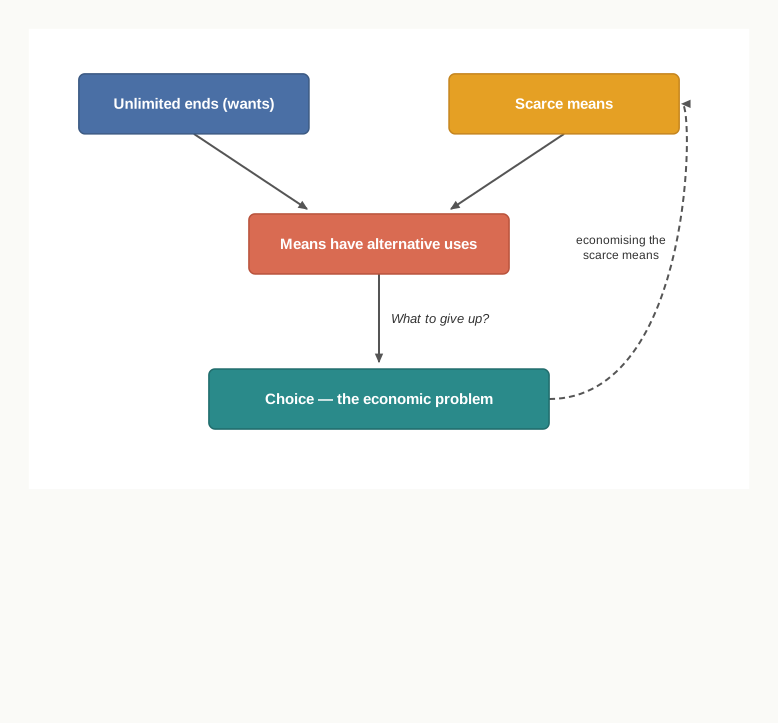
Fig. 1.1 – The four facts behind the scarcity definition.
- Unlimited ends — ends here mean human wants. Wants are not merely large in number; they multiply over time, since one want satisfied gives rise to another. Not all of them are equally intense, and it is precisely this difference in intensity that makes ranking them possible.
- Scarce means — the means of satisfying wants, that is, productive resources such as land, labour and capital, are limited. Labour is limited by the size of the population, land by the area of the country. Scarcity here is relative, not absolute: it means that the supply of a resource falls short of the demand for it.
- Alternative uses of means — a resource can be put to more than one use. A piece of land can grow wheat or vegetables; a worker can be employed in a field or a factory. Using a resource for one commodity therefore prevents its use for another, and the society must decide which use it will have.
- Choice — because ends are unlimited, means are scarce and those means have alternative uses, people must choose which wants to satisfy first. Robbins called this the problem of economising scarce resources: getting the greatest gain from the means available.
Merits Of The Scarcity Definition
- It locates the root of the economic problem — the definition states plainly why economic problems arise at all, namely the scarcity of means in relation to the wants for them, and so gives the subject a single foundation.
- It is universal — scarcity in relation to ends is faced everywhere and at all times. Rich and poor countries, traditional and modern economies, capitalist, socialist and mixed systems all face the problem of choice, so the definition applies to every one of them.
- It widens the range of economic activity — any activity involving scarce means and competing wants is economic, whether it produces tangible goods or services, and whether or not it promotes welfare. The awkward material–non-material line disappears.
Criticisms Of The Scarcity Definition
- It makes economics neutral between ends — Robbins treated economics as a positive science, telling us what is rather than what ought to be. But economists are asked to advise on policy, and advice requires a judgement about which ends are worth pursuing. Economics today is taken to be both a positive and a normative science.
- It restricts the subject matter — by reducing economics to the theory of resource allocation, that is, to product and factor pricing, the definition leaves out economic instability, unemployment, the determination of national income and the problems of growth and development.
- It is static — the definition takes the available means as given. It does not allow for the fact that resources grow over time and are used more efficiently as an economy develops, so it speaks only to present problems and not to future ones.
1.3.4 The Growth-Oriented Definition Of Paul Samuelson
The last of the criticisms above is the one that matters most, and it is the one Samuelson answered. If resources themselves grow, then how they grow is an economic question, and a definition that fixes the means at their present level cannot contain it.
The features of the definition follow directly from the phrase ‘over time’.
- Emphasis on the problem of choice — like Robbins, Samuelson builds the subject on choice arising out of scarce resources and unlimited wants, so nothing of the scarcity definition is given up.
- A long-term perspective — wants are not static but grow, and so do resources. Economics is therefore concerned not only with allocating the means now available but with how the growth of those means can be used to meet rising wants.
- A universal problem — the definition covers economies with and without money, and applies equally to capitalist, socialist and mixed systems, since all of them must allocate resources and distribute output.
- A comprehensive scope — consumption, production, exchange, distribution and economic growth all fall inside it, and Marshall’s concern with welfare survives in the question of how output is distributed among people and groups.
Of the four definitions, Samuelson’s is the one most widely accepted today, because it treats choice in a dynamic setting and covers the growth and distribution questions that dominate modern economics. Its breadth is also its weakness as a definition: a statement that admits so much marks the boundaries of the subject less sharply than Robbins’s does.
1.3.5 Comparing The Four Definitions
The four definitions may now be set beside one another on the points where they part company.
Two conclusions follow. The first is that the definition of economics has changed as the subject has grown, and there is no definition universally accepted for all times; the boundaries have kept moving outward. The second is that the disagreement is a disagreement about emphasis rather than about content, since each definition retained what its predecessor had established. Jacob Viner’s remark that economics is what economists do is a way of saying that the surest guide to the subject matter is the range of questions economists in fact discuss.
1.4 Subject Matter Of Economics
Whichever definition is adopted, the questions that come out of it are of two kinds, as Section 1.1 showed. Some concern a single consumer, a single firm or a single market; others concern the economy taken as a whole. Modern economics accordingly divides its subject matter into two branches, microeconomics and macroeconomics, and the division is by the unit of study. Fig. 1.2 sets out what falls under each.
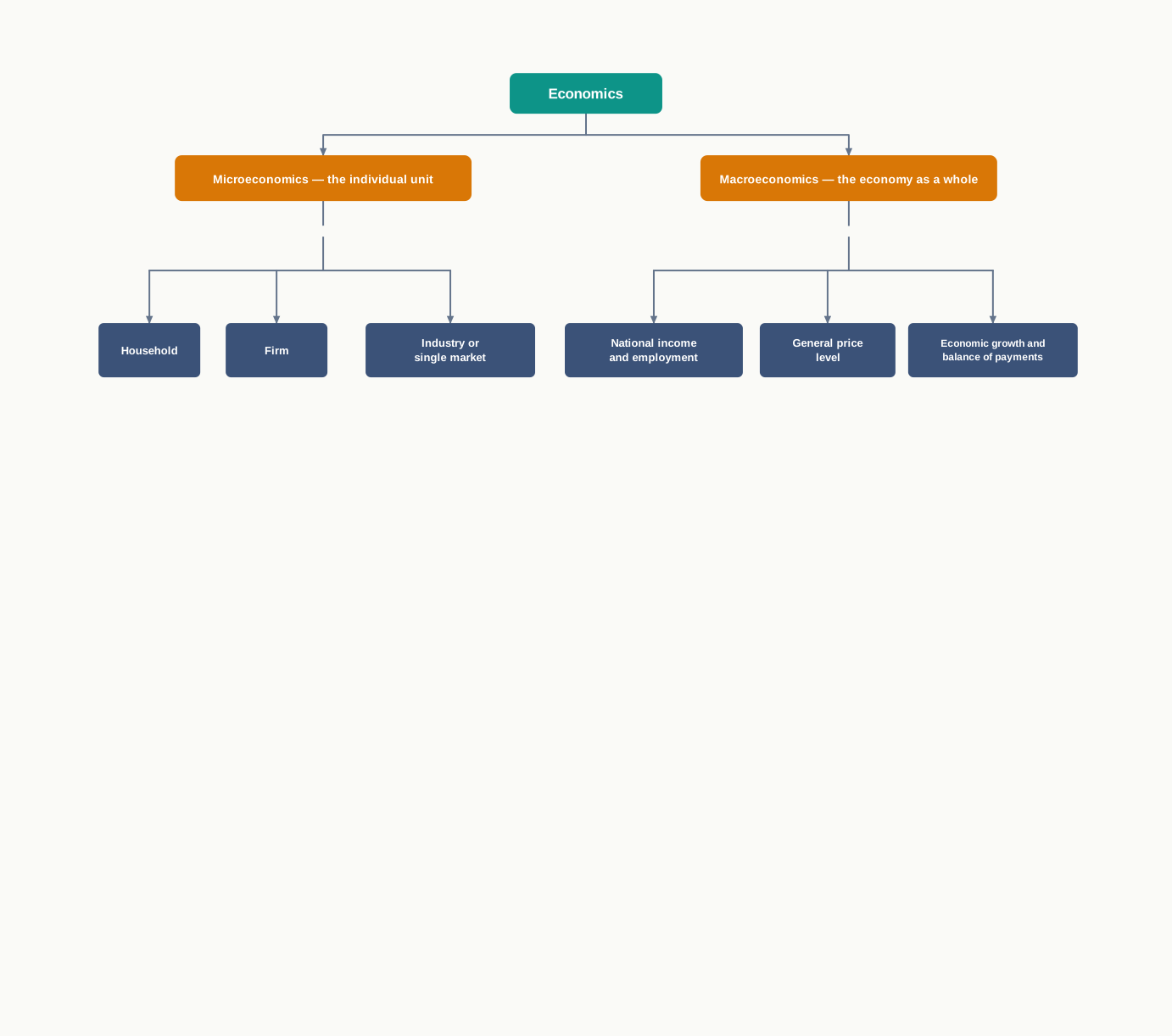
Fig. 1.2 – The two branches of economics.
1.4.1 Microeconomics
The prefix ‘micro’ comes from the Greek mikros, meaning small. Microeconomics studies the economic behaviour of individual economic units and individual economic variables. Its unit of study is a part of the economy rather than the whole of it: a household, a firm, an industry or a single market.
The questions it takes up follow from that unit. How does a consumer distribute a limited income among goods and services so as to obtain the greatest satisfaction? At what price should a firm sell, how much should it produce, and how is its cost of production to be kept down? How is the price of a particular commodity determined in its market, and how is the output produced shared among the workers, landowners and capital-owners who cooperated in producing it?
Microeconomics also asks whether resources have been allocated as well as they could be, and sets out the conditions under which output and welfare would be at their greatest. Its subject matter is therefore usually described as the theory of product pricing, the theory of factor pricing and economic welfare — a microscopic view of the economy, in which the individual parts are examined closely.
1.4.2 Macroeconomics
The prefix ‘macro’ comes from the Greek makros, meaning large. Macroeconomics deals with the functioning of the economy as a whole. Its unit of study is the entire economy, and the problems it takes up are those faced by the economy rather than by any one of its parts.
It asks how the total output of goods and services and the total employment of resources are determined, and what explains the fluctuations in them. Why is the economy sometimes working near full employment and at other times burdened with widespread unemployment? Why is productive capacity fully used in some years and left idle in others? Why does growth run fast in one decade and slow in the next, and why do prices rise sharply at some times and hold steady at others?
The concerns of macroeconomics are therefore the broad aggregates: national income and employment, aggregate consumption, aggregate saving and investment, the general price level, economic growth and the balance of payments.
1.4.3 Differences Between Microeconomics And Macroeconomics
The two branches differ on several counts, which are set out below.
The last two rows repay attention, because they explain the first. Microeconomics can hold the aggregates constant only because it is examining one small part of the economy, where the assumption does little harm. Macroeconomics can hold relative prices and allocation constant for the same reason in reverse: what it wants to explain is the movement of the totals. Each branch treats as fixed what the other sets out to explain.
Boulding put the distinction in terms of the quantities studied: macroeconomics deals not with individual quantities but with aggregates of them — not with individual incomes but with national income, not with individual prices but with the price level.
1.4.4 Interdependence Of Microeconomics And Macroeconomics
Drawing the distinction sharply should not suggest that the two are independent ways of studying the economy. They are complementary: microeconomic and macroeconomic analysis supplement each other rather than supplant each other, which is why Shapiro observed that strictly speaking there is only one economics.
The reason is that the variables are interdependent. An economy is made up of its parts, so aggregate consumption is the sum of what households spend, and aggregate investment the sum of what firms invest. Equally, no household decides what to spend without regard to the level of employment and prices in the economy at large. Analysis cannot therefore be conducted in two watertight compartments, and a student who takes account of one set of variables must keep an eye on the other.
Nor is either branch the more important. The goal of both is the same — the greatest material welfare of the people. From the macro point of view that welfare is maximised by the fullest use of the economy’s productive resources; from the micro point of view it is maximised by the best allocation of those resources among competing uses. A student who understood only one of them would be in the position of the blind men in the fable, each describing an elephant from the one part he had touched. Samuelson’s judgement was that there is no real opposition between the two branches and that both are vital.
How Macroeconomics Came To Prominence
Until about 1930 economists concentrated almost entirely on microeconomics, and macroeconomics was given passing reference. The classical economists believed that an economy normally operates at full employment, so that output was simply whatever full employment of resources would produce, and any departure from it would be temporary and corrected by competition. That belief was tenable while prolonged unemployment was rare.
The Great Depression of the 1930s ended it. Widespread and lasting unemployment in the advanced capitalist countries left a large part of productive capacity standing idle, which the classical account could not explain. The explanation came from J.M. Keynes, whose The General Theory of Employment, Interest and Money (1936) argued that an economy can settle at any level of employment, full employment being only one possibility among many, and normally settles below it. Macroeconomics has been central to the subject ever since, and contemporary economists work in both branches.
1.5 Summary
- Economics begins from a single fact: human wants exceed the means available to satisfy them, so every household, firm and government must choose what to do with what it has, leaving something else undone.
- The subject matter of economics is the set of economic questions concerning the individual, the society and the economy — how a consumer spends, how a producer decides what and how to produce, and what determines national income, employment, prices and growth.
- Economics is a social science. It does not merely record economic facts but builds principles, theories and models that identify the causes of economic events, so that policy can act on those causes.
- Economic questions are as old as society, but the discipline is not. Economics was treated as part of statecraft in ancient and medieval times, was taken up by the mercantilists as the study of the wealth that made a state powerful, and emerged as a separate discipline in the writings of the classical economists. It was called political economy until the closing years of the nineteenth century.
- Definitions of economics have differed because each generation defined the subject around the problem most pressing in its own time. They fall under four heads: wealth, welfare, scarcity and growth-oriented.
- Wealth definition — Adam Smith defined economics as a science which enquires into the nature and causes of the wealth of nations.
- Features: study of wealth; the causes of wealth; the assumption of an economic man pursuing his self-interest.
- Criticisms: too much emphasis on materialism; a narrow view of wealth confined to material goods; man reduced to a secondary place.
- Welfare definition — Alfred Marshall defined economics as a study of mankind in the ordinary business of life, examining that part of individual and social action most closely connected with the attainment and use of the material requisites of well-being.
- Features: study of mankind; study of the ordinary business of life; study of material welfare; emphasis on the material requisites of well-being; exclusion of activities not measurable in money.
- Criticisms: it treats economics as a social science only; the line between economic and non-economic activity cannot be drawn; welfare is subjective and cannot be measured, and goods that reduce welfare are still studied.
- Scarcity definition — Lionel Robbins defined economics as the science which studies human behaviour as a relationship between ends and scarce means which have alternative uses.
- It rests on four facts: unlimited ends; scarce means; means capable of alternative uses; and the consequent necessity of choice, which Robbins called the problem of economising scarce resources.
- Merits: it locates the root of the economic problem; it is universal, applying to every economy at every time; it widens the range of activity counted as economic.
- Criticisms: it makes economics neutral between ends and so purely positive; it restricts the subject to resource allocation, leaving out unemployment, income determination and growth; it is static, taking the stock of means as given.
- Growth-oriented definition — Paul Samuelson defined economics as the study of how people and society choose, with or without the use of money, to employ scarce productive resources with alternative uses to produce commodities over time and distribute them for consumption now and in the future.
- Features: it retains choice under scarcity; it takes a long-term view in which both wants and resources grow; it is universal across economic systems; it is comprehensive, covering consumption, production, exchange, distribution and growth.
- It is the most widely accepted definition today, because it treats choice in a dynamic setting; its breadth, however, makes it a less sharply bounded definition than Robbins’s.
- There is no universally accepted definition of economics, because the subject has kept growing. The disagreement between the four is one of emphasis rather than of content, each having retained what its predecessor established.
- The subject matter of economics is divided into two branches by the unit of study.
- Microeconomics studies the economic behaviour of individual economic units — a household, a firm, an industry or a single market — and is concerned with product pricing, factor pricing and economic welfare.
- Macroeconomics studies the functioning of the economy as a whole and is concerned with national income, total employment, aggregate consumption, saving and investment, the general price level, growth and the balance of payments.
- The two branches differ in their unit of study, the problems they take up, their basic parameter — price for microeconomics and national income for macroeconomics — their bottom-up and top-down perspectives, and their methods, partial equilibrium analysis against general equilibrium analysis. Each takes as given what the other sets out to explain.
- The two are nevertheless interdependent and complementary, since aggregates are built from individual decisions and individual decisions are taken against the state of the aggregates. Both aim at the same end, the greatest material welfare of the people.
- Economists concentrated on microeconomics until about 1930, believing that an economy normally works at full employment. The Great Depression disproved this, and Keynes’s The General Theory of Employment, Interest and Money (1936) established macroeconomics by showing that an economy can settle at any level of employment.
1.6 Points To Ponder
- Robbins held that economics should be neutral between ends — it can tell a government what a policy will cost, but not whether the policy is worth its cost. If economists refuse to say which ends are worth pursuing, who is left to say it? And if they do say it, are they still speaking as economists?
- Marshall’s definition excludes activities that cannot be measured in money. A parent caring for a child at home and a paid crèche worker doing the same work are then treated differently, one inside economics and one outside it. Is that a defensible boundary, or one drawn for the convenience of measurement?
- Scarcity is said to be universal — faced by rich and poor economies alike. Yet the choice between two crops on one hectare and the choice between two luxury cars are both choices under scarcity. Does calling them by the same name illuminate the economic problem, or conceal something that matters about it?
- Some critics point out that during the Great Depression the problem was not too few goods but too many, with unsold output and idle factories side by side with unmet wants. Can a definition built on scarcity explain a crisis of abundance, or does it need supplementing?
- Samuelson’s definition is called the most satisfactory because it is the most comprehensive. But a definition that admits almost every human decision draws no boundary at all. Is comprehensiveness a virtue in a definition, or is Robbins’s narrower statement the more useful working tool?
- Macroeconomics assumes the allocation of resources as given; microeconomics assumes national income and the price level as given. Each therefore rests on something the other explains. Is this a sound division of labour, or a circularity that a single unified economics would avoid?
1.7 Objective Questions
- Which one of the following is studied in macroeconomics? [1]
- The price at which a firm sells its output
- The general price level in the country
- The wage paid by a single factory
- The demand for cement in one town
- The definition of economics that treats the growth of resources over time as part of the subject matter is the ______ definition. [1]
- State whether the following statement is true or false: The scarcity definition of economics applies only to poor countries, since rich countries do not face a shortage of resources. [1]
- Match the description in Column A with the economist in Column B. [1]
| Column A | Column B |
|---|---|
| a. Human behaviour as a relationship between ends and scarce means | i. Adam Smith |
| b. A study of mankind in the ordinary business of life | ii. Lionel Robbins |
| c. An enquiry into the nature and causes of the wealth of nations | iii. Alfred Marshall |
- Assertion (A): Microeconomics assumes the level of national income and employment to be given. Reason (R): Microeconomics studies the behaviour of an individual economic unit rather than of the economy as a whole. Choose the correct option. [1]
- Both (A) and (R) are true, and (R) is the correct explanation of (A)
- Both (A) and (R) are true, but (R) is not the correct explanation of (A)
- is true and (R) is false
- is false and (R) is true
1.8 Check Your Concepts
- Define microeconomics and give one example of a question it studies. [2]
- State any three features of Marshall’s welfare definition of economics. [3]
- Explain, with an example of each, what Robbins meant by ‘scarce means’ and by ‘means which have alternative uses’. [4]
- ‘Samuelson’s definition is an improvement on Robbins’s definition.’ Examine this claim, stating the features of the growth-oriented definition and the criticisms of the scarcity definition it answers. [6]
1.9 Case-Based Question
- Meenakshi runs a tailoring unit in a small town. This month she must decide whether to use her limited stock of cloth for school uniforms or for festival wear, since the same cloth cannot be used for both, and she must also fix the price at which she will sell. Reading the newspaper the same evening, she finds that unemployment in the country has risen and that the general price level has climbed for the third quarter running.
- Identify which of the decisions and events in the passage belong to microeconomics and which to macroeconomics, giving a reason for your classification. [2]
- Meenakshi’s difficulty over the cloth illustrates two of the four facts on which Robbins built his definition of economics. Name them and explain how the situation illustrates each. [2]