Chapter 4: Types of Economies
In India, the railways are owned and run by the government, while the cars that travel on the roads beside them are made in factories owned by private firms. The two arrangements sit side by side, and that is not an accident. It is the result of a choice the country has made about who should own productive resources and who should decide what is produced with them. Every economy faces the same problem of scarcity, and every economy must therefore answer the same three questions: what to produce, how to produce and for whom to produce. What separates one economy from another is the machinery it uses to answer them. Some leave the answers to the price mechanism, some to a central planning authority, and some to a deliberate combination of the two. Economies also differ in how far they have travelled — in per capita income, in the quality of life their people enjoy, and in the structure of their production. This chapter examines both kinds of difference: developed and developing economies, the three economic systems, other common classifications, and the major regional and global economic groupings.
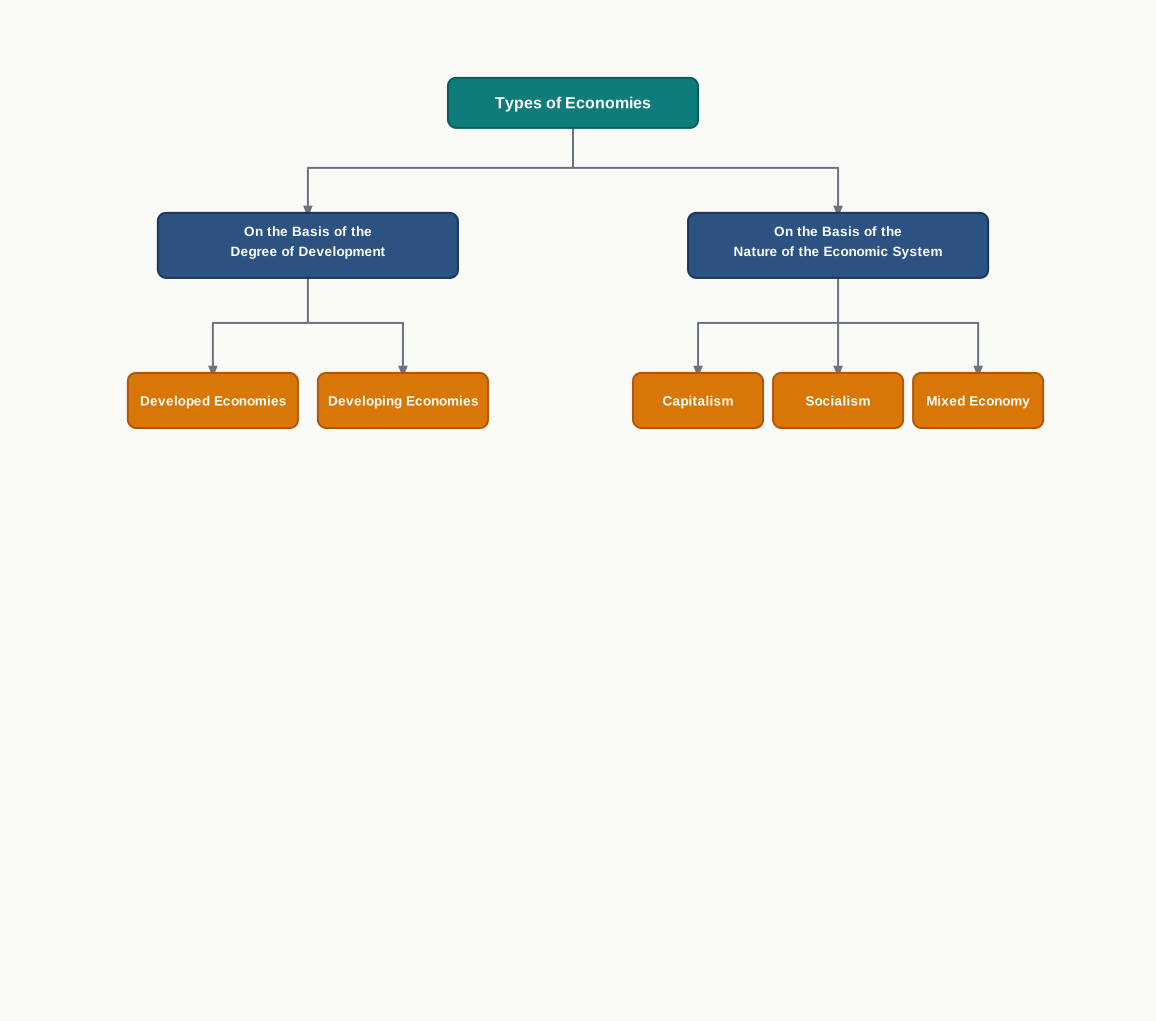
Fig. 4.0 – Bases of classifying economies.
4.1 The Economy and Its Classification
Economics begins with scarcity. Wants are unlimited, the means of satisfying them are limited, and every want satisfied is another want left unmet. A person therefore has to choose, and so does a firm, and so does a government.
These choices are never made in isolation. A farmer grows wheat only because someone else will buy it; a worker takes a job only because a firm is willing to pay wages. Whenever people exchange goods or services with one another, an economic interaction takes place, and such interactions occur within organisations — a household, a firm, a bank, a government department.
The whole arrangement of these organisations, and of the rules and customs that govern how they deal with one another, is what we call an economy. Before comparing economies, it is worth being clear about what the word means.
4.1.1 What an Economy Is
An economy is the broad institutional framework within which economic interaction takes place in a country. It is not a place and not a group of people, but a structure of arrangements: who owns land and machinery, who decides what is produced, how goods reach the people who want them, and what happens to those who are left out.
An economy can be viewed in two ways. Seen from one side, it is a cooperation of producers who between them satisfy the wants of consumers. Seen from the other, it is a system of mutual exchange in which each participant gives up something in order to obtain something else. Both descriptions fit the same reality, and both remind us that no household in a modern economy is self-sufficient.
4.1.2 Bases of Classification
No two economies are alike, so any comparison must begin by stating the basis on which economies are being separated. Change the basis and the same country falls into a different category. The classifications commonly used are set out below, and the first two are the ones this chapter treats in detail.
- Degree of development — economies are divided into developed and developing (underdeveloped) economies according to real per capita income and the standard of living it supports.
- Nature of the economic system — economies are divided into capitalism, socialism and mixed economy according to who owns productive resources and who decides what is produced.
- Degree of specialisation — economies are divided into simple and complex economies according to how far the division of labour has been carried.
- Economic transactions with the rest of the world — economies are divided into closed and open economies according to whether they trade with other countries.
- Mainstay of economic activity — economies are divided into agricultural and industrial economies according to the sector that provides most income and employment.
The first two bases are shown together in Fig. 4.0 at the opening of this chapter. They are independent of each other, which is why a single country can be described in more than one way at the same time: India is a developing economy on the first basis and a mixed economy on the second, and there is no contradiction between the two statements.
4.2 Developed and Developing Economies
The world we live in is marked by a sharp contrast in ways of living. An average family in North America or Western Europe lives in a large and comfortable house, is well fed, well clothed and educated, uses a range of household appliances and travels by car. In much of Asia, Africa and Latin America, life is very different. Housing is small and simple, diets are inadequate, sanitation and safe drinking water are often missing, health is poor and literacy is low. Affluence and acute poverty coexist in the same world.
That contrast is what the division into developed and developing economies tries to capture. The problem is one of measurement: living standards cannot be observed directly for a whole country, so economics needs an indicator that can be compared across countries and over time. The indicator ordinarily used is real per capita income — the real national income of a country divided by its population.
4.2.1 Income Classification of Countries
The World Bank classifies countries by Gross National Income (GNI) per capita, converted into US dollars. The bands in use for the classification based on GNI per capita for 2022 are given in Table 4.1. The threshold figures are revised every year, so they should always be quoted with the year to which they belong.
Low-income and middle-income countries taken together are what we ordinarily call developing or underdeveloped economies. High-income countries are what we call developed countries. The broad pattern behind these bands matters more than the exact figures: a small share of the world’s population lives in the high-income countries but receives a very large share of world income, while the great majority of the world’s people live in developing countries and receive a much smaller share of it. Over the past three decades the number of low-income countries has fallen and the number of middle- and high-income countries has risen, so the distribution, though still very unequal, has been shifting.
4.2.2 Meaning of a Developed Economy
Economists have traditionally used real per capita income as the cut-off for separating the two groups. A country with a high real per capita income has, on average, more goods and services available to each of its citizens, and its people are therefore able to enjoy a higher standard of living.
The United States of America, Canada, Australia, New Zealand, Japan, the countries of Western Europe and several countries of Eastern Europe are the developed countries of the world today.
4.2.3 Meaning of a Developing Economy
This definition rests on two elements, and both must be stated in an answer.
- Low per capita income — the income is low in a relative sense, that is, lower than that of the developed countries. There is no absolute figure below which a country becomes underdeveloped; the comparison is always with the richer economies of the world.
- Potentiality of development — the country possesses unused or under-used resources, so that its real per capita income can be raised. A country with low income and no such potential would be poor but not developing.
The terms ‘developing’, ‘underdeveloped’ and ‘poor’ are used interchangeably. The word developing is preferred because it signifies that although the country is still underdeveloped, the process of development has already been set in motion. Most countries of Asia, Africa and Latin America fall into this group.
Limitations Of Per Capita Income
Real per capita income is a rough and ready index of development rather than a satisfactory one, because it is an average and an average conceals as much as it reveals.
- It says nothing about distribution — a rise in average income is consistent with the gains going largely to a few.
- It ignores the extent of poverty — two countries with the same average income may have very different proportions of people below the poverty line.
- It ignores unemployment — output per head can rise while a large part of the labour force remains without work.
- It leaves out the non-income aspects of well-being such as health, education, sanitation and life expectancy.
This is why development is now judged by composite measures alongside income, a point taken up when the Human Development Index is discussed later in the book.
4.2.4 Characteristics of a Developing Economy
Developing economies differ a great deal from one another, but a set of features recurs in almost all of them. Each of these features is both a symptom of low income and a reason why income stays low.
- Low per capita income — income per head is much lower than in the developed countries, which limits both consumption and the ability to save.
- Widespread poverty — a large section of the population is unable to meet even its basic needs of food, clothing, shelter, sanitation and safe drinking water.
- Large income inequalities — the gap between the richest and the poorest sections is wide, so national averages overstate what most people actually receive.
- Predominance of agriculture — a large share of the labour force depends on agriculture for income and employment, while agriculture contributes a much smaller share of national income than of employment.
- High growth rate of population — a rapidly rising population means that a part of the increase in output is absorbed simply in maintaining existing living standards.
- Deficiency of capital — the stock of capital is small and the rate of capital formation is low, because low incomes leave little margin for saving.
- Poor quality of human capital — low literacy, low levels of education and inadequate health facilities reduce the productive capacity of the workforce.
- Use of traditional techniques of production — outdated methods and equipment keep the level of productivity low in both agriculture and industry.
- High unemployment and underemployment — jobs grow more slowly than the labour force, and much of the employment that exists is of low productivity.
- Underdeveloped infrastructure — shortages of transport, communication, power supply and financial institutions raise costs and hold back production.
- Low quality of life — life expectancy is lower and infant mortality higher than in developed countries, reflecting weaknesses in nutrition, sanitation and health care.
These features form a chain rather than a list. Low income permits little saving, little saving means low capital formation, low capital formation keeps productivity down, and low productivity keeps income low. Breaking that chain is what development policy sets out to do, and most underdeveloped economies have made a start: savings and investment are rising, occupational structure is shifting gradually from agriculture towards industry and services, and infrastructure is being expanded.
4.2.5 Differences Between Developed and Developing Economies
The two groups of economies can now be separated feature by feature. The main points of difference are set out below.
4.3 Economic Systems and the Basic Problems
Classifying economies by their level of development tells us how much they have achieved. It says nothing about how they are organised. Two countries with similar incomes may run their economic affairs on entirely different lines — one leaving production to private firms competing for profit, the other placing it in the hands of the state. That difference of organisation is the second basis of classification, and it is the more important of the two for understanding how an economy actually works.
4.3.1 Meaning of an Economic System
Every country has some arrangement through which resources are allocated among competing uses. Land can be used for wheat or for housing; a trained engineer can work in a power plant or in a software firm. Something has to decide which. The set of arrangements that makes such decisions is the economic system.
Economic systems are not permanent. Slavery and feudalism were economic systems of the past, and they gave way as technology, ownership and political power changed. The systems relevant today are capitalism, socialism and the mixed economic system.
4.3.2 The Questions Every Economic System Must Answer
Scarcity is universal. It is faced by rich countries and poor ones, and by capitalist, socialist and mixed economies alike. Because resources are scarce and have alternative uses, every economy, whatever its system, must answer the same central questions. These are the basic problems of an economy, studied earlier with the help of the production possibility curve.
- What to produce, and in what quantities — since resources used for one good are no longer available for another, the economy must choose the combination of goods it will produce and thereby accept the opportunity cost of what it gives up.
- How to produce — the same good can usually be produced by labour-intensive or capital-intensive techniques, and the economy must choose the combination of factors that will be used.
- For whom to produce — output has to be distributed among the members of society, so the economy must settle how the national product is shared.
- How to use resources efficiently — the economy must see that no resource lies idle and that no output is being wasted, so that it operates on its production possibility curve rather than inside it.
The problems are the same everywhere; the machinery that answers them is not. In one system the answers emerge from the prices thrown up by market forces; in another they are laid down by a central planning authority; in a third the two work side by side. This is set out in Fig. 4.1.
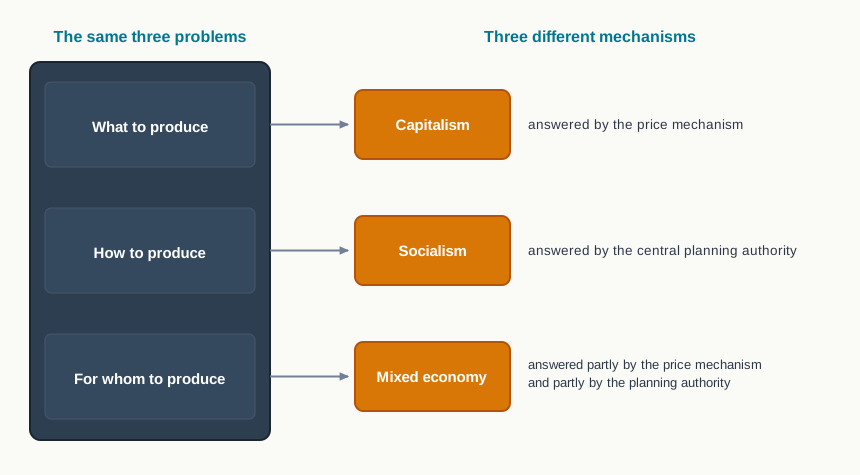
Fig. 4.1 – How economic systems solve the basic problems.
4.3.3 Types of Economic Systems
On the basis of who owns the means of production and who takes economic decisions, the economic systems relevant today fall into three types.
- Capitalism, or the capitalistic economy — productive resources are owned by private individuals, who use them to earn profits, and state intervention is kept to a minimum.
- Socialism, or the socialistic economy — the means of production are owned by society as a whole and operated by the public authority according to a general economic plan.
- Mixed economy, or the mixed economic system — the private sector and the public sector exist side by side, the first guided by the price mechanism and the second by the state.
The three sections that follow take each system in turn, and in each case ask the same set of questions: what its main features are, how it answers the basic problems, and what can be said for and against it.
4.4 Capitalism
Capitalism is the oldest of the three economic systems still in use. Its central idea is simple: leave the ownership of productive resources in private hands, allow their owners to use them as they think best, and let the resulting prices coordinate the whole. Nobody is placed in charge of the economy, and yet the economy is organised.
4.4.1 Meaning of a Capitalist Economy
Because the system rests on free enterprise with the least possible interference by the government, it is also known as a free enterprise economy, a market economy or a laissez-faire economy. It is in practice today, in one form or another, in the United States of America, most of Western Europe, Japan and Australia.
4.4.2 Features of Capitalism
The following are the main features of a capitalist economy. Each of them follows from private ownership, and together they explain how the system holds together without a directing authority.
- Private property — productive resources such as land, factories, mines and machinery are owned by private individuals, who have the right to acquire, possess, use and sell them. It is these owners who decide what to produce, how to produce and how much to save and invest. The right is not absolute, since governments impose restrictions on it and themselves own roads, railways and other infrastructure.
- Right of inheritance — property owned by an individual can be legally passed on to his heirs. This is the natural corollary of private ownership and provides a powerful incentive to save and accumulate wealth.
- Freedom of enterprise and occupation — private enterprises are free to use resources to produce any product of their choice, and individuals are free to choose an occupation in keeping with their education, talent and ability, and to move between jobs and places in search of better opportunities.
- Freedom of choice for consumers — consumers are free to spend their income on whatever goods and services they prefer. Since it is their choices that determine what is produced, the consumer is described as sovereign in a capitalist economy.
- Price mechanism — the prices of goods, services and factors are determined by the market forces of demand and supply. Every commodity carries a price tag, and it is prices that signal what consumers want and direct resources accordingly.
- Competition — there is rivalry among the participants in the market. In the product market producers compete to sell goods, and in the factor market resource owners compete to sell their services. Competition forces costs down and drives inefficient firms out.
- Profit motive — maximisation of profit is the sole motive of producers and the motivation for carrying out economic activity. Producers make more of those goods that yield larger profits, so the allocation of resources is determined by the profit motive.
- Self-interest — each individual is guided by self-interest in his economic pursuits: the producer aims at maximum profit, the worker at the highest wage he can obtain. Self-interest is the motivating force that gives order to the actions of millions of separate individuals.
- Minimum government interference — the government interferes least in economic activity and in the working of market forces, so consumers and producers are by and large free to take their own decisions.
4.4.3 How the Price Mechanism Solves the Basic Problems
The distinctive claim of capitalism is that the three basic problems are solved without anyone solving them. The price mechanism does the work.
The sequence is shown in Fig. 4.2 and works as follows.
- What to produce is settled by consumer demand. A rise in demand for a good raises its price and therefore its profitability, so producers move resources into it; a fall in demand lowers the price and resources move out.
- How to produce is settled by factor prices. A producer seeking maximum profit adopts the technique that costs least, so where labour is cheap relative to machinery he uses more labour, and where labour is dear he uses more machines.
- For whom to produce is settled by the distribution of income. Each factor earns a price for its services, and goods go to those who are willing and able to pay. Purchasing power, not need, decides the share.
- Efficient use of resources is enforced by competition and the profit motive, since a firm that wastes resources has higher costs than its rivals and cannot survive.
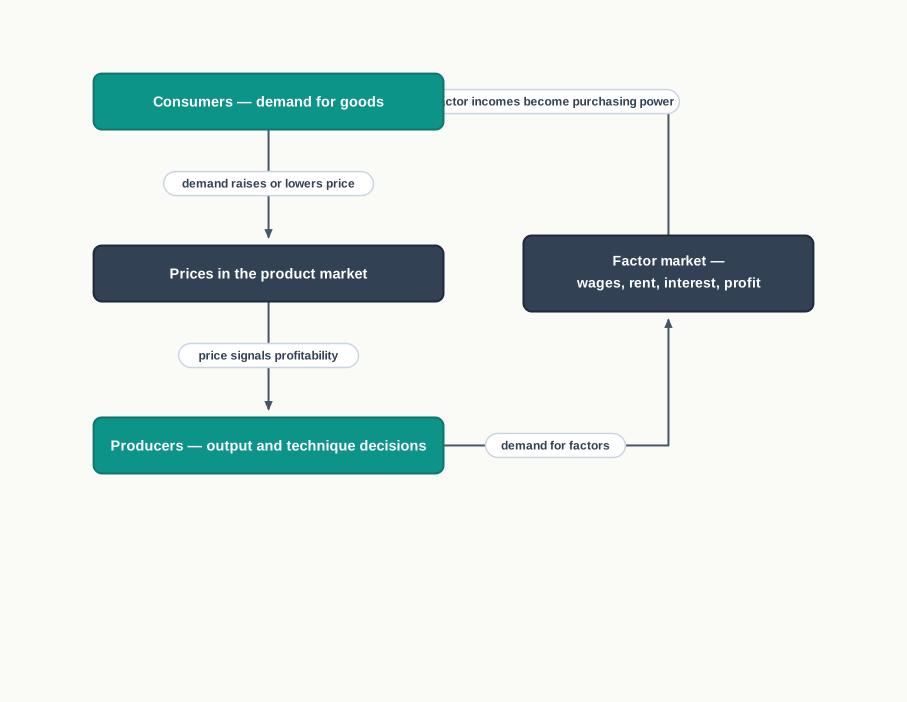
Fig. 4.2 – The price mechanism in a capitalist economy.
4.4.4 Merits of Capitalism
The capitalist system has enjoyed wide popularity, and the following are the arguments in its favour.
- Spirit of enterprise — the prospect of profit encourages individuals to take risks and to set up new ventures, which develops entrepreneurial ability in the economy.
- Incentive for technological progress — to survive competition and earn profits, producers are driven to invent and adopt improved techniques and to develop new products.
- Efficient use of resources — efficient firms are rewarded with profits and inefficient ones are penalised with losses, so producers are under constant pressure to keep costs to a minimum.
- Incentive for capital formation — private property and the right of inheritance encourage saving and investment, and higher investment raises income and the rate of economic growth.
- New consumer goods — the desire to earn profit has brought a flood of new products and, through competition, improvements in the quality of existing ones.
- Flexibility and adaptability — the system has adapted itself to changed conditions, withstanding political crises, business cycles and technological change without central direction.
- Automatic working — there is no planning body and no central agency, yet the impersonal forces of the price mechanism keep the economy working in an orderly way and answer the basic problems on their own.
- Economic freedom — consumers are free to buy, producers are free to produce, and individuals are free to save, invest and choose their occupation.
- Higher production and standard of living — the capitalist countries have achieved large increases in production and national income and, with them, high standards of living.
- Expansion of international trade — the system favours free trade between countries, and international trade and global economic interaction have expanded under it.
4.4.5 Demerits of Capitalism
The system is not free from serious defects, and the case against it is as follows.
- Inequalities of income and wealth — private property, the right of inheritance and the concentration of productive resources in a few hands produce affluence alongside acute poverty, and tend to make the rich richer and the poor poorer.
- Class struggle — society divides into the owners of property and those who own only their labour, and the conflict between the two groups takes the form of strikes and lockouts that disturb the working of the economy.
- Economic instability — with no coordinating agency, there is always the possibility of overproduction or underproduction, booms and depressions, inflation and unemployment, each causing considerable hardship.
- Misallocation of resources — since goods go to those with purchasing power, resources are drawn towards luxuries bought by the rich while the production of necessities for the poor is neglected.
- Wastes of capitalist production — competition itself causes waste: techniques are discarded before they are worn out, heavy expenditure goes on advertisement in order to push up sales, and plant capacity remains underutilised.
- Emergence of monopoly power — competition tends to destroy itself as large firms grow, and monopolies then exploit consumers by charging higher prices and restricting output.
- Neglect of social welfare — production is undertaken to maximise private profit, so goods that yield no profit but add to social welfare tend not to be produced.
- Domination of economic values — the system promotes materialism, judging a person’s worth by economic success and giving pecuniary values precedence over social and cultural ones.
To sum up, capitalism delivers enterprise, efficiency and growth, but it does so at the cost of inequality, instability and the neglect of those who cannot pay. It is this second list that gave rise to the demand for an entirely different way of organising economic life.
4.6 Mixed Economy
Capitalism is efficient but unequal; socialism is equitable but inefficient. The mixed economy is the attempt to take what is best in each and leave out the rest — to keep private enterprise and the price mechanism, and to place beside them a public sector and a measure of planning that can correct what the market gets wrong.
4.6.1 Meaning of a Mixed Economy
In a mixed economy the private sector operates through the market or price mechanism, while the government controls and regulates the working of the private sector and, in many cases, itself participates in production. This gives two broad models, and the difference between them lies in how far the state goes.
- Regulation without participation — the government controls and regulates the private sector through taxation, public expenditure, monetary policy and laws on wages and working conditions, but does not itself undertake production. This form is found in most developed countries, such as the United States of America and the United Kingdom.
- Regulation with participation — the government not only regulates the private sector but also produces goods and services itself through public enterprises. This form prevails in most developing countries, including India.
4.6.2 Features of a Mixed Economic System
- Coexistence of the public and private sectors — the public sector is that part of the economy owned and managed by the state, and it takes up fields requiring very large investment, offering low profitability or having a long gestation period, such as railways, power projects, heavy industry and defence production. The private sector covers the part owned and operated by private individuals for profit, and dominates agriculture, consumer goods industries and retail trade.
- Coexistence of capitalist and socialist features — private property, the profit motive, competition and the price mechanism are all present, and so are economic planning, government regulation and the emphasis on economic equality.
- Economic planning — the economy is guided by plans framed to promote development and to coordinate the working of the two sectors. Planning is an important part of the system, but it is neither as dominant nor as comprehensive as under socialism.
- Regulation and control of the private sector — there is no room for an unregulated private sector. The government regulates it through taxation, subsidies, monetary policy, licensing and controls on monopoly, so that private activity serves the wider interest of the economy.
- Promotion of social welfare — the state runs social security schemes for the poor and the backward classes, provides education and health services, protects labour through legislation and enacts laws to protect consumers, and works to reduce economic and regional inequalities.
- Role of the price mechanism — prices continue to be determined largely by demand and supply, but subject to regulation. The government may fix minimum wages, control the prices of essential commodities and administer charges such as electricity tariffs and fares.
- Profit motive — the private sector is guided by profit and the public sector largely by social welfare, but the private sector is not permitted to maximise profit at the cost of social interest.
- Preservation of freedom — there is freedom of enterprise, of occupation and of consumption, and political freedom as well, though all of these are subject to restrictions imposed in the interest of society.
4.6.3 How a Mixed Economy Solves the Basic Problems
Here the basic problems are answered twice over — once by the market in the private sector, and once by the state in the public sector. Fig. 4.4 sets out the division.
- What to produce is decided in the private sector by consumer demand and profitability, and in the public sector by plan priorities, with the government also influencing private output through taxes, subsidies and licensing.
- How to produce is decided by producers on the basis of cost, subject to government policy on the use of labour, on the location of industry and on the protection of small producers.
- For whom to produce is decided partly by purchasing power in the market and partly by the state, which redistributes income through progressive taxation and supplies goods and services free or at subsidised prices to those who need them.
- Efficient use of resources is pursued by competition in the private sector and by planning in the public sector.
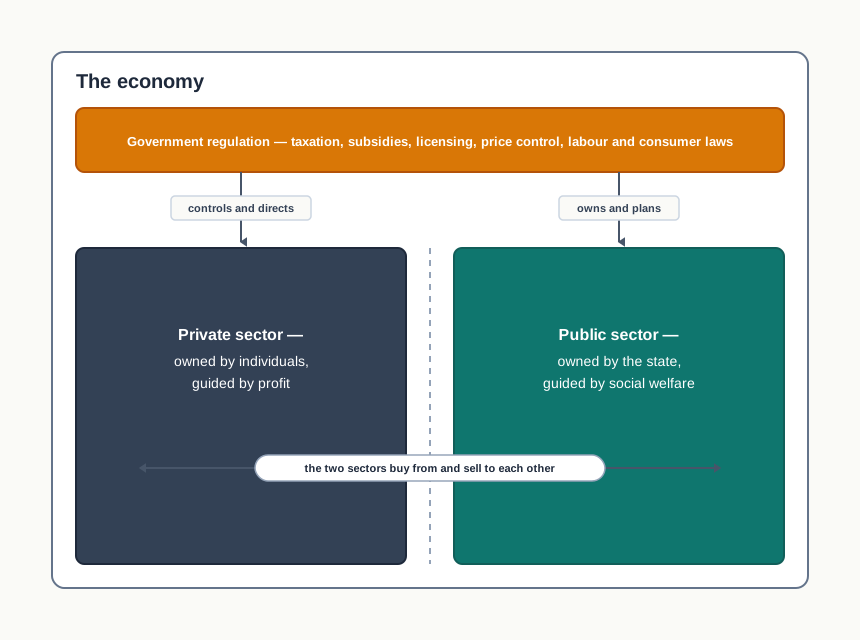
Fig. 4.4 – Coexistence of sectors in a mixed economy.
4.6.4 Merits of a Mixed Economic System
- Proper allocation of resources — planning ensures that resources are divided between the two sectors with the overall interest of the economy in view, instead of being drawn entirely towards whatever is most profitable.
- Economic stability — planning and state regulation smooth the ups and downs of economic activity and reduce the danger of overproduction and underproduction.
- Advantages of the market system — private property, inheritance, competition, the profit motive and freedom of enterprise are all retained, so the drive and efficiency of the market are not lost, while government presence keeps their adverse effects in check.
- Rapid economic development — the combined resources and energies of the two sectors are available for development, and public ownership of key resources allows that development to be pursued with social justice.
- Check on the concentration of economic power — monopolistic control of industry and its exploitative tendencies are curbed, and progressive taxation keeps inequality of income within limits.
- Economic and political freedom — consumers may choose the goods they buy and individuals the occupations they follow, while civil and political freedom is preserved.
4.6.5 Demerits of a Mixed Economic System
- Conflict between the two sectors — mistrust and non-cooperation may arise between the public and private sectors, and the economy then works badly at the point where the two must work together.
- Short-lived nature — over time each sector may try to expand at the cost of the other, so that the system slides towards socialism if the public sector dominates, or towards capitalism if the private sector does.
- Inefficient operation — the private sector may be unable to function effectively under excessive control, while the public sector may operate slackly for want of initiative and responsibility on the part of officials.
- Poor performance of the public sector — public enterprises in mixed economies have often suffered from inertia, inefficiency and red tape, and have earned low returns on the capital invested in them.
- Excessive regulations — the system tends to generate a large apparatus of licensing and control which is inconvenient, adds to the cost of doing business and may itself promote inefficiency.
Most of these shortcomings arise from how the system is administered rather than from the idea behind it, and they can be reduced where the government is efficient and has the political will to act. It is for this reason that the mixed economic system, in one proportion or another, is the form most countries follow today.
4.7 Comparing the Three Economic Systems
The three systems have now been examined one at a time. Setting them against each other brings out what really separates them, which is not the goods they produce but the answers they give to two questions: who owns the means of production, and who decides how they are used.
4.7.2 Where the Mixed Economy Stands
The mixed economy does not sit outside this comparison. It sits between the two, and on each basis of comparison it takes an intermediate position, as Fig. 4.5 shows.
- Ownership — resources are owned partly by private individuals and partly by the state, and the right to own private property exists.
- Freedom — producers and consumers are free to take their own decisions, but that freedom is not absolute and is subject to restrictions imposed by the government in the interest of society.
- Mechanism — the price mechanism plays an important role but is not as dominant as under capitalism, since it operates subject to price control, minimum wages and similar measures; planning is an important aspect of the system but is not as comprehensive as under socialism.
- Motive — the public sector is guided largely by the motive of social welfare, while profit remains the guiding motive of the private sector.
- Competition — competition prevails to some extent, but subject to government control.
- Distribution — some degree of inequality of income persists, and a limited degree of class difference exists, but progressive taxation and social spending keep both within bounds.
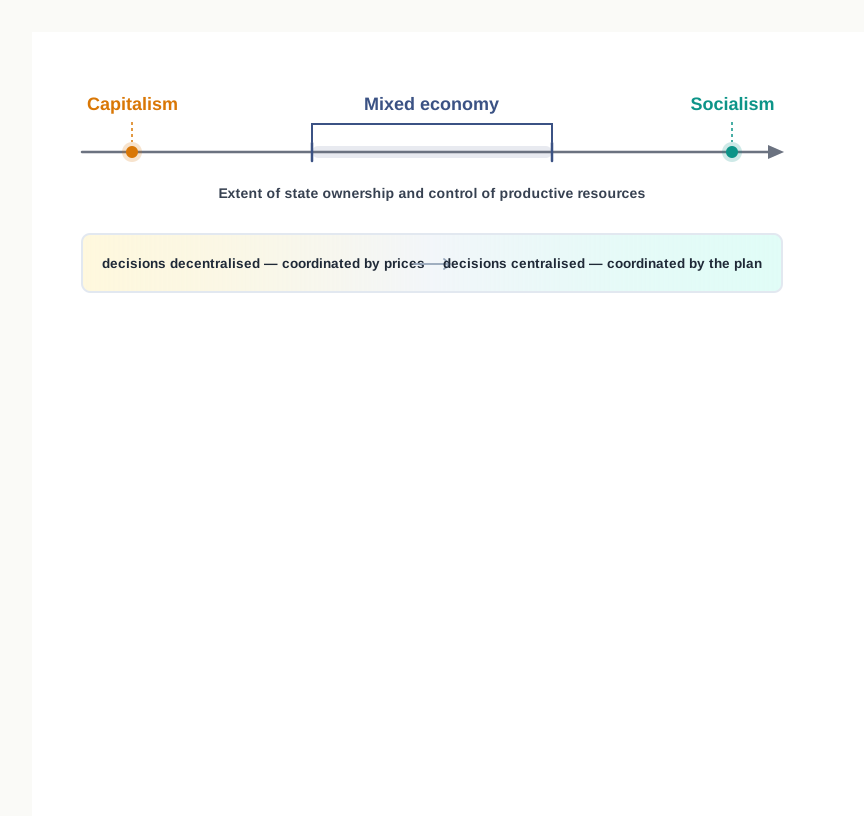
Fig. 4.5 – The three economic systems on a single scale.
The practical importance of this scale is that a country’s place on it is a matter of policy, and policy changes. Very few economies today are pure examples of either extreme. What we observe is a range of mixtures, each country settling the boundary between its two sectors according to its own history, resources and political choices.
4.8 Other Ways of Classifying Economies
Development and the economic system are the two classifications that matter most, but they are not the only ones. Three further pairs are in common use, each resting on a different basis: how far specialisation has been carried, whether the economy trades with the rest of the world, and which sector provides its livelihood.
4.8.1 Simple and Complex Economies
Economies can be classified as simple or complex on the basis of the degree of specialisation and division of labour.
A simple economy is an economy in which each individual specialises in the production of one commodity only. One person weaves cloth, another grows grain, a third makes tools; each produces more than he needs and trades the surplus for the goods he lacks. Exchange is largely by barter, production is by family labour using simple techniques, the scale of production is small and productivity is low. Traditional and early economies were of this kind.
A complex economy is an economy in which there is a high degree of specialisation, complex division of labour and mutual dependence. Here a worker does not produce a complete good at all. The making of a single product is divided into many tasks, and one worker performs one of them — in a textile mill a labourer spins, or weaves, or dyes. Workers therefore do not earn by selling what they have made; they sell their labour services to firms for money wages. Production is on a large scale with advanced techniques, and exchange is carried on through money.
All modern economies are complex economies.
4.8.2 Closed and Open Economies
Economies are classified as closed or open on the basis of whether they have economic transactions with the rest of the world.
A closed economy is an economy which does not have any economic transaction with other countries of the world. It neither exports nor imports goods and services, and it neither receives nor pays factor incomes across its borders. Two consequences follow. Since no factor income is earned from abroad, domestic product equals national product; and since the economy is self-contained, its level of activity is not affected by fluctuations elsewhere in the world. In the modern world a genuinely closed economy is very rare.
An open economy is an economy which has economic transactions with other countries of the world. It exports and imports goods and services, and capital and labour move to and from other economies. Domestic product and national product therefore need not be equal, and the level of activity in the country is affected by conditions abroad.
All modern economies, including India, are open economies.
4.8.3 Agricultural and Industrial Economies
Economies are classified as agricultural or industrial on the basis of the mainstay of economic activity.
An agricultural economy is an economy which is primarily engaged in agricultural activities. The majority of the labour force works in agriculture, the sector’s contribution to national income is high, operations are carried on largely by family members and most of the population lives in rural areas. Most underdeveloped economies are agricultural economies.
An industrial economy is an economy which is primarily engaged in industrial activities. The industrial sector is the major source of employment and contributes a high share of national income, productive activities are mostly performed by hired workers, and population is concentrated in urban areas. Developed countries are mostly industrial economies.
4.9 Regional and Global Economic Groupings
Economies are not sealed off from one another. Since the middle of the twentieth century, countries have increasingly joined together in groupings intended to advance their common economic interests, and the working of any one economy today is partly shaped by the groupings it belongs to.
4.9.1 Why Countries Form Economic Groupings
A regional or global economic grouping is an association of countries formed to consolidate their economic, and often political and social, relations with one another. The reasons are straightforward.
- Common problems — neighbouring countries usually face similar difficulties, from trade barriers to shared rivers and shared borders, and can settle them better together than separately.
- Larger markets — removing barriers between members gives each producer access to a market much larger than the home market alone.
- Bargaining strength — a group of countries negotiating as one carries far more weight in world trade and finance than any of its members would carry alone.
- Geographical contiguity — the members of most regional groupings are neighbours, since proximity makes trade cheaper and cooperation easier to organise.
The groupings named in the syllabus are of two kinds. SAARC, ASEAN and the European Union are regional, formed by countries of one region. The G-8 and the G-20 are global forums, whose members are drawn from across the world.
4.9.2 SAARC and ASEAN
South Asian Association For Regional Cooperation
SAARC is the inter-governmental organisation of the South Asian nations. It was founded on 8 December 1985 with seven member countries — India, Pakistan, Bangladesh, Sri Lanka, Nepal, Bhutan and the Maldives. Membership rose to eight when Afghanistan joined in 2007. Its secretariat is at Kathmandu in Nepal. Its economic objectives are to promote the welfare of the people of South Asia and improve their quality of life, to accelerate economic growth, social progress and cultural development in the region, and to promote and strengthen self-reliance among the countries of South Asia. It rests on respect for sovereignty, territorial integrity and non-interference in the internal affairs of member states.
Association Of South-East Asian Nations
ASEAN is a regional inter-governmental organisation established in 1967 by five founding members — Indonesia, Malaysia, the Philippines, Thailand and Singapore. Its membership grew to ten with the joining of Brunei, Vietnam, Laos, Myanmar and Cambodia, and Timor-Leste was admitted as the eleventh member in October 2025. ASEAN was set up to promote regional economic, political, social and cultural cooperation among its members. It created a free trade area among its members in the 1990s so that they could compete as a bloc in international trade, and it has since become one of the most successful regional organisations in Asia. India signed a free trade agreement in goods with ASEAN in 2009, and the two have become important markets for each other.
4.9.3 The European Union
The European Union is a political and economic union of 27 European countries. It began in 1957, when six countries — France, West Germany, Italy, the Netherlands, Belgium and Luxembourg — signed the Treaty of Rome and created the European Economic Community, which later became the European Community and, in 1993, the European Union. Membership widened over the following decades to include the countries of Northern, Southern and, after 2004, Eastern Europe. The United Kingdom left the Union in January 2020, leaving the present membership of 27.
The EU is the most advanced example of economic integration in the world today. It has removed internal tariff barriers and created a single market in which people, goods, services and capital move freely among member countries, and it frames common policies on trade, agriculture and regional development. It has also created a common currency, the euro, which is used by 21 of the 27 members as of 2026; the remaining members retain their national currencies.
4.9.4 G-8 and G-20
The Group Of Seven And The Group Of Eight
The G-7 is a group of leading advanced industrialised countries — the United States of America, the United Kingdom, France, Germany, Italy, Canada and Japan — whose heads of government have met at annual summit conferences since 1975 to set economic, political and, later, environmental and security goals for the global future. Russia joined the group in 1998, and it was then known as the Group of Eight or G-8. Russia’s participation was suspended in 2014, after which the group reverted to being the G-7. Its members coordinate their economic policies, particularly on exchange rates, interest rates, employment and trade.
The Group Of Twenty
The G-20 is an international forum that brings together the world’s major industrialised and emerging economies. It was created in 1999 as a meeting of finance ministers and central bank governors, and has met at the level of heads of state and government since 2008. Its membership consists of 19 individual countries — Argentina, Australia, Brazil, Canada, China, France, Germany, India, Indonesia, Italy, Japan, Mexico, Russia, Saudi Arabia, South Africa, South Korea, Turkey, the United Kingdom and the United States of America — together with the European Union, and the African Union, which was admitted as a permanent member in 2023. Its members account for a large majority of world output and a substantial share of world population.
The G-20 exists to discuss key economic and financial issues relating to the global economy: promoting international financial stability, global economic growth, international trade and the working of financial markets. The heads of state and government meet annually, and the finance ministers and central bank governors meet separately to prepare the leaders’ summit and to implement its decisions.
The difference between the two forums is one of coverage. The G-7 seeks cooperation on the problems of the major industrial economies; the G-20 reflects the interests of both developed and emerging economies, and India, as a large emerging economy, is a member of the second but not the first.
4.10 Summary
- An economy is the broad institutional framework within which economic interaction takes place in a country. Economics is the subject that studies the choices made within that framework.
- Economies are classified on several different bases, and a country carries one label from each. The main bases are:
- the degree of development — developed and developing economies;
- the nature of the economic system — capitalism, socialism and mixed economy;
- the degree of specialisation — simple and complex economies;
- transactions with the rest of the world — closed and open economies;
- the mainstay of economic activity — agricultural and industrial economies.
- A developed economy is a country which has a high real per capita income and consequently a high standard of living. A developing or underdeveloped economy is a country in which real per capita income is low but which possesses the potentiality of development.
- Real per capita income is only a rough index of development, because it is an average that says nothing about the distribution of income, the extent of poverty, the level of unemployment or the non-income aspects of well-being.
- The characteristic features of a developing economy are low per capita income, widespread poverty, large income inequalities, predominance of agriculture, high population growth, deficiency of capital, poor human capital, traditional techniques, high unemployment, inadequate infrastructure and a low quality of life. These features form a chain in which low income, low saving and low productivity reinforce one another.
- An economic system is the sum total of the devices and institutions through which economic choices are made and scarce resources are used to satisfy human wants. Every system, whatever its form, must answer the same basic problems — what to produce, how to produce, for whom to produce, and how to use resources efficiently.
- A capitalist economy is one in which productive resources are owned by private individuals who use them to earn profits, and in which state intervention is minimum. Its features are private property, the right of inheritance, freedom of enterprise and occupation, freedom of choice for consumers, the price mechanism, competition, the profit motive, self-interest and minimum government interference.
- In a capitalist economy the basic problems are solved by the price mechanism: consumer demand and profitability decide what is produced, relative factor prices decide the technique used, and purchasing power decides who receives the output.
- The merits of capitalism are the spirit of enterprise, technological progress, efficient use of resources, capital formation, new consumer goods, flexibility, automatic working, economic freedom, higher production and the expansion of international trade. Its demerits are inequalities of income and wealth, class struggle, economic instability, misallocation of resources, the wastes of competition, monopoly power, neglect of social welfare and the domination of economic values.
- A socialist economy is one in which the means of production are owned by the entire society and operated by the public authority according to a general economic plan for the benefit of the entire community. Its features are social ownership, economic planning, social welfare as the motivating force, economic equality, a classless society and the elimination of competition.
- In a socialist economy the basic problems are solved by the central planning authority, which surveys resources and needs and then fixes output targets, techniques and the terms of distribution.
- The merits of socialism are better allocation and fuller utilisation of resources, the elimination of instability and of class struggle, equitable distribution, social security, rapid growth and the production of more useful goods. Its demerits are the difficulty of rational allocation without factor prices, loss of efficiency, loss of incentives, loss of consumers’ sovereignty, loss of freedom, concentration of economic and political power, and loopholes in the planning process.
- A mixed economy combines the elements of the capitalist and the socialist economies, and is characterised by the coexistence of the private and public sectors. It takes two forms — one in which the government only regulates the private sector, and one in which it also participates in production, as in India.
- The features of a mixed economy are the coexistence of the two sectors, the presence of both capitalist and socialist features, economic planning, regulation of the private sector, promotion of social welfare, a regulated price mechanism, the profit motive in the private sector and the preservation of freedom.
- The merits of a mixed economic system are proper allocation of resources, economic stability, the advantages of the market system, rapid development, a check on the concentration of economic power, and economic and political freedom. Its demerits are conflict between the two sectors, a short-lived nature, inefficient operation, poor performance of the public sector and excessive regulation.
- The three systems differ in ownership, in the mechanism through which decisions are coordinated, in the motive that drives production and in the distribution of income. The essential contrast is between decentralised decisions coordinated by prices and centralised decisions coordinated by a plan, with the mixed economy occupying the ground between them. The three are compared below.
- A simple economy is one in which each individual specialises in producing one commodity only; a complex economy is one with a high degree of specialisation, complex division of labour and mutual dependence. All modern economies are complex economies.
- A closed economy is one that has no economic transaction with other countries, so that domestic product equals national product. An open economy has such transactions, and its level of activity is affected by conditions abroad. All modern economies, including India, are open economies.
- An agricultural economy is one primarily engaged in agricultural activities; an industrial economy is one primarily engaged in industrial activities. Most underdeveloped economies are agricultural and most developed economies are industrial.
- Countries form regional and global economic groupings to solve common problems, widen their markets and strengthen their bargaining power. The groupings prescribed for study are:
- SAARC — founded in 1985, eight South Asian countries, working for welfare, growth and self-reliance in the region;
- ASEAN — founded in 1967, eleven South-East Asian countries, working for regional cooperation and free trade among members;
- the European Union — 27 European countries with a single market and a common currency, the euro;
- the G-7, earlier the G-8 — seven leading industrialised countries meeting in annual summits to coordinate economic policy;
- the G-20 — 19 countries with the European Union and the African Union, meeting to discuss global financial stability, growth and trade.
4.11 Points to Ponder
- A capitalist economy is said to answer the question ‘for whom to produce’ through purchasing power. If a country produces enough food for everyone and yet some go hungry, has the price mechanism failed, or has it done exactly what it was designed to do?
- Real per capita income is used to separate developed economies from developing ones because it can be measured and compared. What is worth having that this measure leaves out, and would you be willing to accept a slower rise in per capita income in exchange for it?
- Socialism removed private property in order to remove inequality, and in doing so removed much of the incentive to work hard and to innovate. Is there any way to keep the first result without producing the second?
- Every mixed economy has to decide where the boundary between the public and the private sector should lie. What test would you apply to decide whether a particular activity — running a railway, a hospital, a bank, an airline — belongs on one side of that line or the other?
- Developing economies are described as being in transition, with income, savings and productivity all rising gradually. If the developed countries are also growing at the same time, is the gap between the two groups closing, and does it matter whether it is?
- Regional groupings widen the market for their members by removing barriers among themselves, while keeping barriers against outsiders. Do such groupings move the world towards freer trade or away from it?
4.12 Objective Questions
- In a capitalist economy, the question of what to produce is settled by [1]
- the central planning authority
- consumer demand working through prices
- the government’s annual budget
- an agreement among producers
- Choose the incorrect statement about a socialist economy. [1]
- The means of production are owned by the entire society.
- Production is guided by the motive of social welfare.
- Socialism aims at absolute equality of income among all citizens.
- Competition between production units is eliminated.
- Assertion (A): A country may have a very large national income and still be classified as a developing economy. [1] Reason (R): The classification is based on real per capita income, which depends on population as well as on total income.
- Both A and R are true, and R is the correct explanation of A.
- Both A and R are true, but R is not the correct explanation of A.
- A is true but R is false.
- A is false but R is true.
- Fill in the blank: In a closed economy, domestic product is equal to __________ product, because no factor income is earned from abroad. [1]
- Match the grouping in Column A with the description in Column B. [1]
| Column A | Column B |
|---|---|
| a. SAARC | i. A forum of nineteen countries together with the European Union and the African Union |
| b. European Union | ii. An association of eight South Asian countries founded in 1985 |
| c. G-20 | iii. A union of twenty-seven countries with a single market and a common currency |
4.13 Check Your Concepts
- Define an economic system, and name the three types of economic system relevant today. [2]
- State any three characteristics of a developing economy, giving one line of explanation for each. [3]
- Explain how the price mechanism solves the problems of what to produce, how to produce and for whom to produce in a capitalist economy. [4]
- ‘A mixed economy takes the best of capitalism and socialism and leaves out the worst.’ Evaluate this claim, giving three merits and three demerits of the mixed economic system. [6]
4.14 Case-Based Question
- The country of Meridia has for many years left its factories, farms and shops in private hands, with prices settled in the market. Its output per head is among the highest in the world, but a recent survey finds that a large share of its national income goes to a small group of families, that its cities have expensive apartment blocks standing next to slums, and that private firms have shown no interest in supplying electricity to remote villages, where the returns would be low and slow. The government is now debating whether to set up a state-owned power utility and to raise taxes on the highest incomes.
- Identify the economic system Meridia has been following, and name two demerits of that system that appear in the passage. [2]
- If Meridia carries out the two measures being debated, what type of economy would it be moving towards? Give one reason why private firms avoid the activity described. [2]
4.5 Socialism
Socialism grew out of the objections to capitalism set out at the end of the last section. If private ownership produces inequality, and if production for profit neglects the needs of those who cannot pay, then the remedy proposed by socialism is to remove private ownership of the means of production altogether and to produce for social welfare instead.
The word itself is used loosely, and one commentator remarked that socialism is like a hat that has lost shape because too many people have worn it. There is no single model of a socialist economy, and the writings of Karl Marx, from which the modern socialist movement drew its ideas, describe a direction rather than a blueprint. What follows is the set of features common to socialist economies as they have actually been organised.
4.5.1 Meaning of a Socialist Economy
Socialist Economy A socialist economy is an economic system in which the means of production are owned by the entire society and operated by the public authority according to a general economic plan for the benefit of the entire community.
Soviet Russia was the first country to establish a socialist economy, and most of the countries of Eastern Europe adopted the system after the Second World War. At its widest extent, socialist systems of one variety or another covered a large part of the world’s population. Most of those regimes have since collapsed, and the system survives today, in modified forms, in countries such as China, Cuba and Vietnam.
4.5.2 Features of Socialism
Socialism aims at equity, not at absolute equality. Some differences of income are retained deliberately, because rewards must still reflect differences in skill and effort.
4.5.3 How Central Planning Solves the Basic Problems
In a socialist economy the basic problems are not left to prices. They are decided, deliberately and in advance, by the central planning authority, which first surveys the resources available and the needs of the community and then issues targets. The process is shown in Fig. 4.3.
Fig. 4.3 – Central planning in a socialist economy.
Q. With no prices set by demand and supply, how does the planning authority know how much steel the country needs?
A. It works backwards from the plan’s targets — so many houses, so many railway wagons — and calculates the steel each requires. The estimate is only as good as the information and statistics behind it, which is one of the system’s known weaknesses.
Allocation Without Prices Foodgrain sold through ration shops is not allocated by price. Entitlements per household, the issue price and the quantity moved to each state are fixed administratively, and a family cannot obtain more simply by offering more money. It is a small illustration of how allocation works when an authority, rather than the market, decides.
4.5.4 Merits of Socialism
4.5.5 Demerits of Socialism
It was these shortcomings, and above all the loss of efficiency and freedom, that led to the fall of the socialist regimes in Soviet Russia and most of Eastern Europe. Yet the objectives socialism set out to serve — equity, security and welfare — did not disappear with them, and it is the attempt to serve those objectives without giving up the market that produced the third system.
The definition of socialism carries three parts — ownership by the entire society, operation by the public authority, and a general economic plan for the benefit of the entire community. Answers that mention only state ownership are incomplete.