Chapter 11: Structural Changes in the Indian Economy After Liberalisation
In the middle of 1991 India came close to being unable to pay for what it bought from abroad. The foreign exchange left with the Reserve Bank was enough to cover only a few weeks of imports, fresh loans from abroad had dried up, and the government pledged part of the country’s gold reserve overseas to raise the currency it needed to meet its obligations.
An economy in that position has to do more than borrow its way past the crisis. The government chose to change the rules under which the economy had worked since Independence. The New Economic Policy of 1991 loosened the licensing controls on industry, cut back the reach of the public sector and opened the country to foreign goods, capital and technology — the three strands of liberalisation, privatisation and globalisation.
Three decades on, the economy that emerged is differently built. Services carry a larger share of the national income than they once did, the private sector does most of the investing, and foreign trade counts for far more relative to output. This chapter takes up why the reforms became necessary, what each of the three policies contained, and how the structure of the Indian economy changed after them.
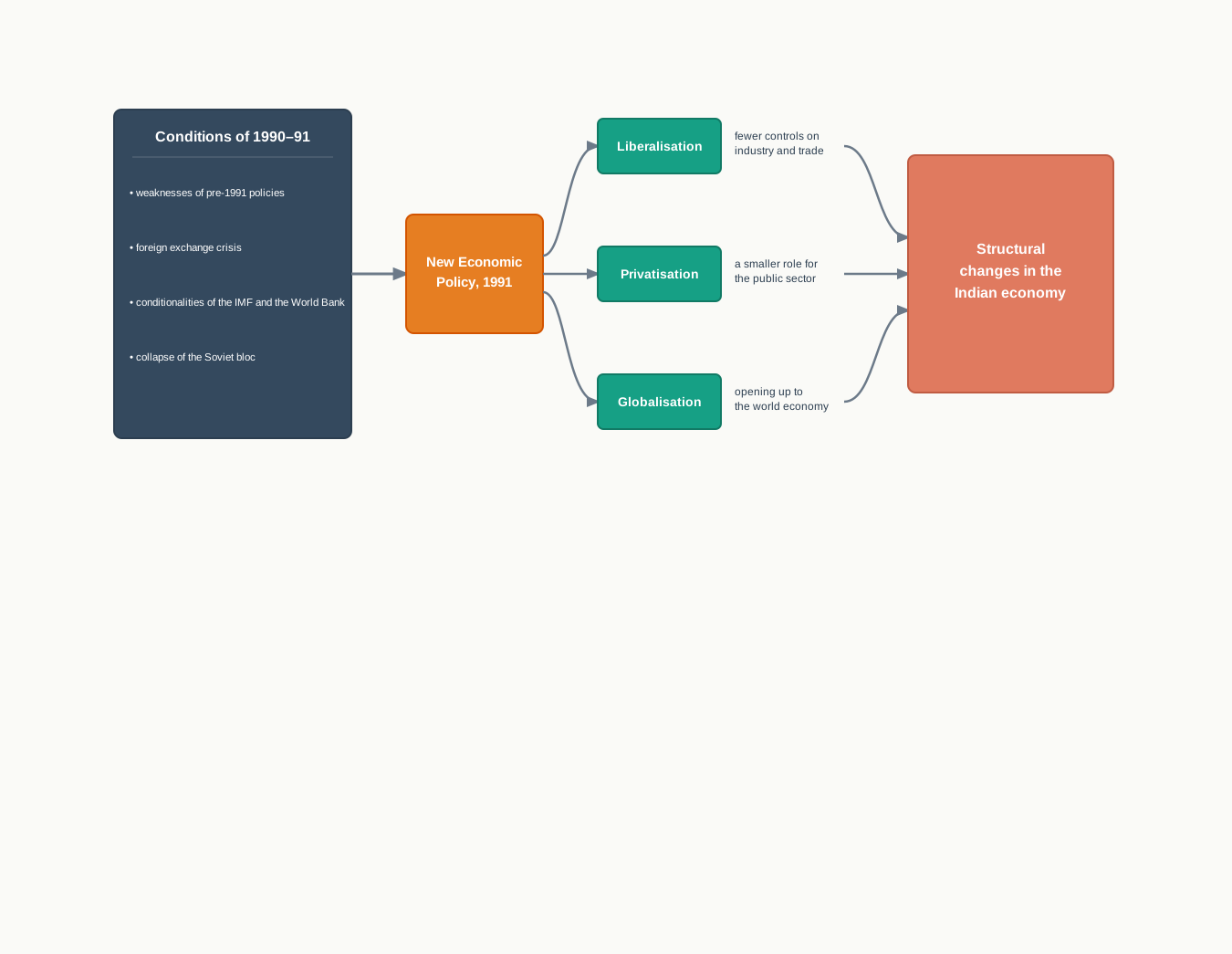
Fig. 11.0 — The New Economic Policy of 1991 and its components.
11.1 The Need for Economic Reforms
No government abandons a settled strategy of development in a single year unless it is forced to. The reforms announced in India in 1991 were the work of a few weeks, but the conditions that made them unavoidable had been building for a decade and more. Part of the pressure came from inside the economy, in the slow returns being earned on the way resources were being used. Part came from outside, in an external account that finally ran out of the means to pay its bills.
This section takes those pressures in turn: the state of the economy on the eve of the reforms, the weaknesses of the policies followed until then, the foreign exchange crisis that brought matters to a head, the conditions attached to assistance India sought, and the changes in the world outside that closed off the older way of trading.
11.1.1 The Indian Economy on the Eve of the Reforms
From the beginning of planning in 1951, India followed a strategy in which the state occupied the leading position in the economy. The public sector was given the heavy and basic industries, the private sector was allowed to grow only under a system of industrial licences, imports were restricted so that domestic industry could be built up behind that protection, and foreign capital was admitted sparingly and on tight terms.
That strategy had real achievements to its name. An industrial base was created where almost none had existed, food production rose enough to end the dependence on imported grain, and a network of roads, power stations, railways and technical institutions was put in place. None of what followed in 1991 denies any of this.
By the late 1980s, however, the same arrangements were yielding less and less for what they cost. Output per worker in much of industry was low, the public sector was earning a poor return on the enormous investment sunk into it, and the government was spending far more than it collected. An economy in that position can carry on for some years by borrowing. It cannot carry on indefinitely, because every year of borrowing raises the claim that future output has to meet.
11.1.2 Weaknesses of the Pre-1991 Policies
The case for reform rested first on the record of the policies then in force. Six weaknesses stood out.
- Slow growth of output — for the three decades to 1980 the economy grew at around three and a half per cent a year, which after allowing for the growth of population left per capita income rising very slowly. Growth improved in the 1980s, but it was financed increasingly by government borrowing rather than by higher productivity.
- Poor performance of the public sector — many public sector enterprises earned low profits or made losses year after year, and had to be kept going by budgetary support. Resources that could have been invested elsewhere were locked into units that returned very little.
- The system of industrial licensing — a firm needed government permission to start production, to expand capacity, to change its product and often to import its equipment. The system was meant to direct investment towards national priorities. In practice it delayed decisions, discouraged new entrants, protected existing producers from competition and created wide scope for corruption.
- An inward-looking trade policy — high tariffs, import licensing and quantitative restrictions kept foreign goods out. Domestic producers were sheltered from competition for so long that they had little reason to reduce costs or improve quality, and Indian exports lost ground in world markets.
- Persistent fiscal deficit — government expenditure ran well ahead of revenue through the 1980s. The gap was met by borrowing at home and abroad and by creating money, which added to the public debt and to the pressure on prices.
- Rising prices of essential goods — inflation was in double digits by 1991. Rising prices fall hardest on households with fixed money incomes, and they also make a country’s exports dearer relative to those of its competitors.
11.1.3 The Foreign Exchange Crisis of 1991
A country pays for its imports with the foreign currency it earns from its exports, from remittances and from borrowing abroad. Through the 1980s India’s imports grew faster than its exports, so the shortfall had to be met year after year by borrowing. External debt rose accordingly, and with it the annual burden of repaying old loans and paying interest on them. By 1990–91 debt servicing was absorbing close to a third of India’s export earnings, which meant that a third of everything the country earned abroad was committed before a single import could be paid for.
Four developments then turned a difficult position into a crisis.
- The Gulf war of 1990–91 — the conflict between Iraq and Kuwait pushed up crude oil prices sharply. India imported most of its oil, so the import bill rose suddenly. At the same time remittances from Indian workers in the Gulf fell, because many of them had to return home.
- The drying up of fresh credit — as the debt position worsened, India’s credit rating was downgraded and international lenders became unwilling to extend new loans. The usual means of covering the gap was no longer available.
- Withdrawal of non-resident deposits — deposits held in India by non-resident Indians could be withdrawn in foreign currency. Political uncertainty at home prompted large withdrawals, draining reserves at exactly the moment they were most needed.
- Political instability — three governments held office between late 1989 and mid-1991. A country facing a payments crisis needs to take unpopular decisions quickly, and no government in that period was in a position to do so.
By June 1991 the foreign exchange reserves held with the Reserve Bank were sufficient to pay for roughly a fortnight’s imports. India was within days of defaulting on its external obligations, and default would have shut the country out of world credit markets for years. To avoid it, the government pledged part of the country’s gold reserve abroad and approached the International Monetary Fund for emergency assistance.
11.1.4 Conditionalities Imposed by the IMF and the World Bank
The International Monetary Fund lends to countries that cannot meet their external payments, and the World Bank lends for longer-term development. Neither lends unconditionally. Assistance came with a set of undertakings about the way the Indian economy would be run, usually described as conditionalities.
- Reducing the fiscal deficit — government borrowing had to be brought down, since a large deficit was seen as the source of both the inflation and the excess demand for imports.
- Controlling the growth of money supply — to bring inflation down and hold it down.
- Correcting the exchange rate — the rupee was to be allowed to find a more realistic value rather than being held at an official rate that made exports uncompetitive.
- Opening the economy — restrictions on the movement of goods, services, capital and technology across India’s borders were to be relaxed in a phased manner.
- Deregulating domestic industry — licensing and other controls on investment and production were to be dismantled.
It would be a mistake, though, to read the reforms as a programme written abroad and accepted under duress. The measures announced in 1991 and afterwards went well beyond anything the two institutions were pressing for, and they continued long after the payments crisis had passed in 1993 and successive governments of different political complexions had taken office. The crisis supplied the occasion; the conviction that the older strategy had exhausted itself supplied the direction.
11.1.5 Collapse of the Soviet Bloc and the Loss of Export Markets
A further reason for change lay outside India altogether. The Soviet Union and the countries of Eastern Europe had for years been major buyers of Indian manufactures, and much of that trade was conducted under rupee payment arrangements rather than in convertible currency. It was, in effect, a sheltered market in which Indian goods did not have to meet international competition on price or quality.
When the political systems of those countries collapsed at the end of 1990 and they moved towards market economies, the arrangement ended. India’s exporters had to find new buyers in markets where they would be competing directly with producers from every other country. Retaining a share of world exports now depended on being able to compete, and that in turn depended on reforming an industrial structure built for a protected home market.
Taken together, these five pressures — a slowing domestic economy, weak policies, an external account that had run dry, the conditions attached to rescue and a changed world outside — made a fundamental change of strategy unavoidable. That change came in the form of the New Economic Policy of 1991, which the next section sets out.
11.2 The New Economic Policy of 1991
The measures announced from July 1991 onwards were not a single decision but a change of approach, and they are known together as the New Economic Policy. Understanding what the policy set out to do, and how its immediate measures differed from its long-term ones, makes the three components that follow much easier to place.
11.2.1 Meaning and Objectives of the New Economic Policy
The New Economic Policy is the set of measures introduced by the Government of India from 1991 to reduce controls over economic activity, enlarge the role of the private sector and open the economy to the rest of the world. It is also referred to as the policy of economic reforms.
The policy rested on a diagnosis. The older strategy had assumed that a developing economy would allocate its resources better through the decisions of a planning authority than through the decisions of buyers and sellers in a market. Four decades of experience had shown that where the state directed everything, decisions were slow, costs were not controlled and there was little pressure on any producer to do better. The New Economic Policy did not abandon planning or the public sector; it changed their place. Government would set the framework and intervene where markets failed, while the day-to-day questions of what to produce, how much and by what method would be settled increasingly by market forces.
The objectives can be stated as follows.
- Restoring external stability — to overcome the balance of payments crisis, rebuild foreign exchange reserves and bring the growth of imports and exports into a sustainable relationship.
- Controlling inflation — to bring the rate of increase in prices down to a level the economy could live with, chiefly by reducing the government’s borrowing.
- Raising efficiency and productivity — to expose producers to competition, at home and from abroad, so that costs fell and quality improved.
- Accelerating growth — to lift the rate of growth of national income above the level of the earlier decades.
- Integrating India with the world economy — to allow goods, capital and technology to move across India’s borders far more freely than before.
- Attracting foreign investment — to supplement domestic savings and bring in technology and management practice from abroad.
11.2.2 Stabilisation Measures and Structural Reform Measures
The measures taken from 1991 fall into two groups that are easy to confuse because they were announced together.
Stabilisation measures were short-term. Their purpose was to put out the fire — to correct the weakness in the balance of payments and to bring inflation under control. Adjusting the exchange rate, obtaining emergency assistance, restricting non-essential imports for a period and cutting government expenditure all belong to this group. Measures of this kind treat the symptoms of a crisis and are meant to work within months.
Structural reform measures were long-term. Their purpose was to change the way the economy was organised, so that the same crisis would not recur and so that output would grow faster. Removing industrial licensing, reducing tariffs, opening sectors to private and foreign investment and reforming the public sector belong to this group. Measures of this kind change the rules under which producers operate and take years to work through.
The main points of difference are set out below.
11.2.3 The Three Components: Liberalisation, Privatisation and Globalisation
The structural reform measures are grouped under three heads, known together from their initials as LPG.
- Liberalisation — the removal or relaxation of government controls over industry, trade, investment and finance, so that producers can decide for themselves what to make, how much to make and where to sell it.
- Privatisation — the transfer of ownership or management of public sector enterprises to the private sector, together with the granting of greater autonomy to those enterprises that remain in public hands.
- Globalisation — the integration of the Indian economy with the economies of the rest of the world, through the freer movement of goods, services, capital, technology and people across national boundaries.
The three are distinct policies but they work on the same principle: that competition disciplines producers in a way that regulation cannot. Liberalisation removes the barriers that keep new domestic firms out of an industry. Privatisation removes the shelter of guaranteed budgetary support from firms already in it. Globalisation removes the barrier that keeps foreign producers out of the market altogether. Each of the three is taken up in turn in the sections that follow.
11.3 Liberalisation
Of the three components of the New Economic Policy, liberalisation was the one that touched the largest number of producers immediately, because it changed the conditions under which every industrial firm in the country had been operating since the 1950s.
11.3.1 Meaning of Liberalisation
Liberalisation means freeing the different segments of the economy from the controls, licences and permits that the government had imposed on them. Under the older arrangement a producer needed official permission at almost every step — to set up a unit, to raise its capacity, to change its product, to import a machine, to obtain foreign exchange. Liberalisation removed a large part of that permission-seeking and left the decisions to the producer.
Two points about the scope of the policy are worth stating at the outset. First, liberalisation applied chiefly to industry, trade, investment and finance; agriculture was never subject to licensing in the same way. Second, liberalisation is not the same as a policy of laissez-faire, under which the government withdraws from the economy altogether. Indian policy-makers were reducing regulation, not abolishing it. Where a market cannot be relied on to produce a good outcome — in public health, in environmental protection, in the safety of banks and of investors — regulation was retained and in some fields it was strengthened. The belief was that market forces, once freed of the restrictions that had held them back, would push the economy along a faster path of growth.
11.3.2 Features of the Liberalisation Policy
The policy took effect through a series of measures, of which the following are the main ones.
- Delicensing — the requirement of an industrial licence was withdrawn for the great majority of industries. The Industrial Policy of 1991 retained compulsory licensing for a limited list, and later announcements shortened that list further, so that today it covers only a few industries such as alcoholic drinks, tobacco products, defence equipment, industrial explosives and hazardous chemicals. Approval for a new venture or for the expansion of an existing one is now largely automatic.
- Relaxation of the controls on large firms — under the Monopolies and Restrictive Trade Practices Act, 1969, firms with assets above a stated limit needed government approval before they could expand or invest. That requirement was removed, and the emphasis shifted from restricting the size of a firm to acting against restrictive and unfair trade practices that harm consumers.
- Liberalisation of industrial location policy — firms became free to set up their operations anywhere except in cities above a stated population, and even that restriction does not apply to industries outside the compulsory licensing list.
- Removal of restrictions on mergers and takeovers — the earlier limits on mergers, takeovers and the reorganisation of industrial units were withdrawn, allowing firms to restructure themselves in response to market conditions.
- Liberalisation of the capital market — a company may now raise money by issuing shares and debentures without prior government permission on the pricing of the issue. In place of that control, the Securities and Exchange Board of India was given statutory powers to regulate the capital market and protect investors.
- Foreign exchange market reforms — the exchange rate of the rupee, previously fixed by the authorities, was allowed to be determined by demand and supply in the market, with the Reserve Bank intervening only to prevent extreme fluctuations. Exporters and importers may buy and sell foreign currency at the market rate.
- Foreign trade reforms — import licensing was dismantled, quantitative restrictions on imports were removed, and tariff rates were cut steeply from the very high levels of the 1980s, so that imports came to be allocated by price rather than by permit.
- Opening of infrastructure to private investment — power, roads, ports, telecommunications, civil aviation and banking, which had been the preserve of the state, were opened to private companies.
- Measures to ease the doing of business — the rules governing licences, registrations, clearances and permissions have been simplified and moved online in recent years, with the aim of reducing the time and cost of starting and running a business.
- Banking reforms — private banks, Indian and foreign, were allowed to enter, interest rates were freed from administrative control, and the role of the Reserve Bank shifted from directing the operations of banks towards regulating and supervising a competitive banking system.
- Tax reforms — the rates of income tax and corporation tax were reduced, the structure of indirect taxes was simplified and, with the introduction of the goods and services tax, the many separate levies of the states and the centre were brought into a single system.
11.3.3 Significance of the Liberalisation Policy
Three things follow from the measures listed above.
- The end of the control raj — the delays, the queues for permits and the corruption that grew around the licensing system largely disappeared for the industries taken off the list. Investment decisions that once waited on a file in Delhi could be taken in the boardroom.
- Freedom of entry for entrepreneurs — a person with an idea and the capital to pursue it no longer had to prove to a government department that the country needed the product. Entry into most industries became a commercial decision rather than an administrative one.
- A spirit of competition — with entry open, no producer could rely on being the only one in the field. Competition rewards the firm that produces at lower cost or better quality, and it is through that pressure that liberalisation is expected to raise efficiency in the economy as a whole.
Whether these gains have been evenly shared, and what they have cost, are questions taken up in the closing section of this chapter. What can be said here is that the framework within which Indian industry operates was changed fundamentally, and that the change has not been reversed by any government since.
11.4 Privatisation
Liberalisation changed the rules under which firms operate. Privatisation changed the answer to a prior question: who should own the firm in the first place. For four decades after Independence the Indian answer, for a large part of industry, was the state. The New Economic Policy reopened that question.
11.4.1 Meaning of Privatisation
Privatisation is the transfer of ownership of a public sector enterprise from the government to the private sector. Taken in a wider sense, it also covers the granting of autonomy to enterprises that remain in public hands, so that they are run on commercial lines rather than on administrative ones.
The idea did not originate in India. It was carried furthest first in the United Kingdom in the 1980s, where a long list of state-run undertakings in transport, energy, telecommunications and other fields was sold to private owners, and at about the same time in the United States. From there it spread to Western Europe, to Japan, to the former communist countries of Eastern Europe as their systems changed, and to developing countries.
The reason for the change of view was practical rather than doctrinal. In India the Industrial Policy Resolution of 1956 had given the public sector the leading role in industrialisation, and there is no denying what it achieved: an industrial base in heavy and basic industries that the private sector of the 1950s would not have built, and the infrastructure on which later growth depended. But by the late 1980s a large number of these enterprises were earning very little on the capital sunk into them, and some were being kept alive by budgetary support alone. When a government must find money every year to cover the losses of firms it owns, that money is not available for schools, hospitals or roads. It was this reappraisal, and not a sudden loss of faith in public ownership as such, that put privatisation on the agenda.
11.4.2 Arguments in Support of Privatisation
Those who support privatisation advance the following arguments.
- Ideological grounds — the public sector should confine itself to activities the private sector cannot or will not undertake. Everything else, on this view, is better done by private enterprise, which is under constant pressure to perform.
- Improvement in managerial efficiency — when shares are held by private investors, the shareholders have a direct financial interest in how well the enterprise is run. Management is answerable to them rather than to a ministry, and is guided by commercial rather than political considerations.
- Creation of a competitive environment — transferring an enterprise to private hands ends its protected position. It must then compete with other firms, and competition forces it to control costs and improve what it offers.
- Profit-oriented decision-making — a private owner judges every decision by whether it adds to profit. That single test brings a discipline to the working of the enterprise that a public undertaking with multiple objectives rarely has.
- Greater flexibility in decision-making — public sector managers must consult, seek approvals and observe procedures, and delay in a commercial decision is often as damaging as a wrong decision. Private ownership allows decisions to be taken quickly.
- Reduction of the burden on the public exchequer — losses of public enterprises and the subsidies paid to them fall on the budget. Once the enterprise is privately owned, the government is no longer obliged to make good its losses.
- Greater attention to consumers — a private firm survives only if consumers keep buying from it, so it has a direct reason to attend to price, quality and service in a way a protected public monopoly need not.
- Greater investment and employment — opening to private enterprise the fields once reserved for the public sector brings in investment that would not otherwise have been made, and with it employment and incomes.
- Revival of sick units — enterprises that have made losses for years may be turned round by an owner willing to put in fresh capital and change the way they are run.
- Increase in accountability — responsibility in a private enterprise is defined and traceable, whereas in a public undertaking it can be shifted from one office to another.
- Financial discipline — a private firm can raise money in the capital market only if investors judge it worth backing. A public enterprise can fall back on the budget whatever its performance. The need to satisfy the market imposes a discipline that budgetary support removes.
11.4.3 Arguments Against Privatisation
The case on the other side is equally worth setting out.
- Privatisation is not always possible — many public enterprises were established precisely because the private sector would not enter, whether because the capital required was too large, the gestation period too long or the return too low. There may be no buyer for such a unit at any acceptable price.
- Neglect of social welfare — a private owner maximises profit. Supplying a good below cost to poor consumers, or serving a remote area that will never pay, is not a commercial proposition, and objectives of social justice may be dropped once the enterprise changes hands.
- Possibility of unemployment — a new owner taking over an overstaffed enterprise will usually reduce the workforce. The gain in efficiency is real, but it is paid for by the workers who lose their jobs.
- Growth of private monopoly — where an enterprise has no competitors, selling it converts a public monopoly into a private one. The inefficiency may go; the power to charge what the market will bear remains, and is now exercised in the interest of shareholders rather than of the public.
- Possibility of corrupt practices — a public asset has no market price until it is sold, and valuing it is a matter of judgement. That leaves room for assets to be undervalued in favour of a particular buyer, which is why transparency in the process matters as much as the decision to sell.
- Lopsided industrial development — private investors avoid projects that are risky, slow to yield returns or low in profitability. Basic and heavy industry and infrastructure, which a developing economy needs, may therefore be starved of investment while consumer industries flourish.
11.4.4 Features of the Privatisation Policy in India
Privatisation in India has been pursued through five main measures, together with the disinvestment policy taken up separately below.
- Dereservation — the Industrial Policy Resolution of 1956 had reserved a long list of industries exclusively for the public sector. The Industrial Policy of 1991 cut that list to eight, and later announcements reduced it to a very small number of strategic activities. The public sector remains free to enter any field, but no longer holds it alone.
- Policy towards sick public sector undertakings — a sick enterprise is one that has been making heavy losses year after year. Public enterprises were brought within the machinery for revival and rehabilitation from 1992; that machinery has since been replaced by the framework of the Insolvency and Bankruptcy Code, 2016, and the administrative ministries are now responsible for monitoring sickness in the enterprises under them. Chronically loss-making units have increasingly been closed rather than revived.
- Autonomy for profit-making enterprises — the better performing central public sector enterprises are graded as Maharatna, Navratna and Miniratna companies according to their financial performance, and their boards are given enhanced powers to invest, borrow, enter joint ventures and decide their own manpower policies without prior approval. The Navratna and Miniratna categories date from 1997 and the Maharatna category from 2010. The list of companies in each category is revised from time to time.
- Memorandum of Understanding — each participating enterprise signs an annual agreement with the government setting out measurable targets, financial and non-financial. Performance is then rated against those targets. The purpose is to strike a balance between autonomy and accountability: the enterprise is left free to decide how to reach the target, and is judged on whether it reached it.
- Voluntary Retirement Scheme — many public enterprises carried far more employees than their operations required. Under the scheme, workers choosing to retire early are paid compensation. It has reduced overstaffing without resorting to retrenchment.
11.4.5 Disinvestment
The chief instrument of privatisation in India has been disinvestment.
Disinvestment can take two forms. In a minority sale the government offers a part of its shareholding while retaining control of the enterprise; the aim is to raise resources and to widen ownership. In a strategic sale the government sells a substantial block of shares to a chosen buyer along with the management of the enterprise; here ownership and control both pass, and the sale amounts to privatisation in the full sense.
The stated purposes of disinvestment have been to raise resources for the budget, to reduce the burden of public debt, to provide funds for modernising the enterprises that remain in public hands, and to bring the general public and the employees into the ownership of these enterprises. In practice the first of these has dominated, with the proceeds used mainly to meet the government’s deficit.
The programme has drawn four persistent criticisms.
- Realisations have fallen short of targets — the amounts actually raised have in most years been well below the amounts budgeted, so the revenue counted on has not materialised.
- Shares have been sold cheap — where an enterprise has been valued on the basis of its accounts rather than its assets, the equity has been sold for less than it could have fetched, and the public has lost the difference.
- The proceeds have been used to meet current expenditure — funds raised by selling a capital asset have gone into financing the year’s deficit rather than into reducing debt or restructuring the remaining enterprises. It is the equivalent of selling the family gold to meet the household’s monthly bills.
- The process has lacked transparency — where valuation and the choice of buyer are not open to scrutiny, every sale invites the suspicion that the asset went cheap to a favoured purchaser, whether or not it did.
Privatisation, then, is not by itself a cure for the shortcomings of the public sector. Where a competitive environment does not exist, transferring ownership achieves little, and it may create in private hands the very monopoly it was meant to end. The policy delivers what is claimed for it only where the sale is transparent, where the buyer faces competition, and where the proceeds are put to a use that adds to the productive capacity of the economy.
11.5 Globalisation
Liberalisation freed producers from controls within the country and privatisation changed who owned them. The third component of the New Economic Policy concerned the boundary of the economy itself — how far goods, money, technology and people should be allowed to move across it.
11.5.1 Meaning of Globalisation
Globalisation means integrating the economy of a country with the economies of the rest of the world. An economy that is fully integrated in this sense treats the world rather than the nation as the field within which it buys, sells, invests and borrows.
Two things follow from the definition. The first is that globalisation is a two-way process. It is not only a matter of foreign goods and foreign firms entering India; it is equally a matter of Indian goods, Indian firms and Indian capital going out. The second is that globalisation is wider than trade. A country can trade heavily and still restrict the movement of capital and technology, as India did for many years. Full integration involves all four flows.
11.5.2 Channels Through Which Globalisation Takes Place
Integration proceeds through three channels.
- Opening up of trade — barriers to the movement of goods and services are removed so that they can flow freely between countries. This means dismantling import licensing, abolishing quantitative restrictions such as import quotas and reducing import duties, so that what a country imports is decided by relative prices rather than by permit.
- Opening up to foreign investment — restrictions on the entry of foreign capital are relaxed so that foreign companies, including multinational corporations, are willing to invest. Direct investment is particularly sought after, because it brings not only money but also technology, management practice and access to markets abroad.
- Free flow of technology — technology developed in the advanced countries is allowed to move to the developing ones, through foreign investment and through agreements between firms. For a developing economy this is often the most valuable of the three flows, since it raises productivity without waiting for domestic research to catch up.
11.5.3 Features of the Globalisation Policy in India
India began opening its economy in a limited way in the 1980s, but the process began in earnest in 1991. The following measures give it effect.
- Exchange rate reforms — the fixed exchange rate was replaced by a market-determined rate. A dual rate was introduced in 1992 and unified in 1993, and in August 1994 the rupee became convertible on the current account, meaning that foreign exchange for trade, travel, education and remittances can be obtained freely at the market rate. The capital account remains only partly convertible.
- Import liberalisation — as a member of the World Trade Organisation from 1995, India dismantled the system of import licensing, removed quantitative restrictions on imports by 2001, and cut tariff rates steeply from the very high levels of the 1980s. Trade between India and the rest of the world became freer than at any time since Independence.
- Liberalisation of foreign direct investment — in 1991 foreign investors were permitted to hold up to 51 per cent of the equity in a list of high-priority industries. That limit has since been raised repeatedly, and today foreign direct investment up to 100 per cent is permitted in most manufacturing and in a large number of service sectors, much of it through the automatic route, which requires no prior government approval. Sectors once closed altogether — insurance, defence, civil aviation, telecommunications, retail — have been opened in stages.
- Free flow of foreign technology — technology agreements between Indian and foreign firms, which formerly needed clearance, are now approved automatically in most cases, and technology comes in both through such agreements and through foreign investment.
- Institutional measures to attract investment — special economic zones were created as enclaves with world-class infrastructure and simplified rules for exporting units, and the Make in India programme launched in 2014 sought to establish the country as a manufacturing base for the world market.
11.5.4 Favourable Effects of Globalisation
The gains claimed for globalisation, in India and elsewhere, are the following.
- Expansion of world trade — with barriers lowered, the volume of goods and services crossing borders has risen greatly, and countries can concentrate on producing what they produce best.
- Larger flows of international capital — savings can move from countries where they are abundant to countries where the return on investment is higher. A developing economy short of capital can invest more than it saves.
- Greater interdependence between countries — the economies of the world are now linked through trade, investment and finance to a degree that has no precedent.
- Transfer of technology — advanced technology reaches developing countries far more quickly than it once did, raising productivity and, with it, living standards.
- Emergence of a world market — producers sell into a market of global size and consumers choose from a range of goods that no single national market could supply.
- Increased flow of information — the revolution in communication has made information move almost instantly between countries, which is itself a condition for the other flows.
- Growth of employment in new activities — where a developing country has a cost or skill advantage, work moves to it, creating occupations that did not exist there before.
- Increase in cross-cultural contact — the movement of people, goods and ideas has reduced the distance between societies.
11.5.5 Adverse Effects of Globalisation
Globalisation is not an unmixed blessing, and four costs are commonly identified.
- Vulnerability to events abroad — an integrated economy is exposed to what happens elsewhere. A financial crisis or a recession in one part of the world is transmitted through trade and capital flows to countries that had no part in causing it. The currency crises of the 1990s and the global financial crisis of 2008 both spread in this way.
- Volatility of financial markets — capital that can enter a country quickly can leave it quickly. Large and sudden movements of short-term capital can move exchange rates and asset prices sharply, with consequences for producers who had nothing to do with the financial market.
- Widening inequality — the gains from globalisation accrue to those who can take part in it, which means the skilled, the mobile and the owners of capital more than the unskilled worker in a sheltered occupation. Inequality has widened both between countries and within them.
- Environmental degradation — a larger volume of production and of transport places a heavier burden on natural resources and on the environment, and countries competing for investment may be tempted to relax the standards that protect them.
Globalisation therefore requires management rather than acceptance or rejection. The task for policy is to secure the gains — the wider market, the capital, the technology — while limiting the exposure to shocks from abroad and ensuring that those who lose from the process are not left to bear the whole cost of it.
11.6 Structural Changes in the Indian Economy After 1991
Three decades is long enough to judge a change of strategy by more than its intentions. This section asks what actually happened to the Indian economy after 1991 — where it grew, how its shape altered, and what the reforms have not achieved.
11.6.1 Meaning of a Structural Change
Economies change in two ways. An aggregate change is a change in the size of a quantity: national income rises, exports rise, the price level rises. A structural change is a change in the composition of the economy — in the relative weight of its parts.
The distinction matters because the two can move independently. An economy can grow rapidly while remaining agricultural in structure, and it can change its structure without growing very fast. What happened in India after 1991 was both at once: the economy grew faster than before, and it grew in a different pattern.
11.6.2 Acceleration in the Growth of Income
For the three decades to 1980 the Indian economy grew at around three and a half per cent a year. Growth improved in the 1980s and improved further after the reforms, averaging close to seven per cent a year over the two decades from the early 2000s, with some years higher and the years of the global financial crisis and of the pandemic much lower. India moved from being a slow-growing economy to one of the fastest-growing among the major economies of the world.
Because the rate of growth of population fell over the same period, the effect on income per head was larger still. Per capita income, which had crept up for four decades, rose several times over in real terms between 1991 and the 2020s. A great many households moved from having barely enough to having something to spare, and it is this that lies behind the growth of a domestic market for consumer goods, housing and services on a scale India had not seen before.
11.6.3 Change in the Composition of National Income
The most visible structural change is the change in what the economy produces, set out in Table 11.1.
The share of agriculture in national income has fallen by close to half, the share of industry has risen moderately, and the share of services has risen to well over half of national income. A shift of this kind, from agriculture towards industry and services, is the normal accompaniment of development everywhere, and in that sense the direction is unsurprising.
What is unusual about the Indian case is the route taken. In most countries that have developed, agriculture gave way first to industry, which absorbed the workers leaving the land, and only later to services. India moved from agriculture to services while its industrial sector remained comparatively small. Services, however, do not employ workers in the same proportion as they contribute to output, and much of the sector’s growth has been in activities requiring education and skill. The result is that agriculture still supports a far larger share of the workforce than its share in output would suggest, and the transfer of workers out of it has been much slower than the transfer of output.
11.6.4 Saving, Investment and the Role of the Private Sector
Growth requires investment, and investment requires saving. Both rose after the reforms. Gross domestic saving, which was under a quarter of national income in 1990–91, rose to around three-tenths in the 2020s, and the rate of investment rose correspondingly. Most of the saving is done by households and by private companies; the government’s own contribution to national saving is small and in some years negative.
The composition of investment changed as much as its level. In 1990–91 the public sector accounted for a large part of capital formation in the country; by the 2020s roughly three-quarters of it was being undertaken by the private sector. The share of the public sector in national income and in employment fell over the same period. This is the structural counterpart of the privatisation and liberalisation policies: the state stopped being the principal investor in the economy and became the setter of its rules.
11.6.5 Changes in Industry and Infrastructure
Industrial growth after the reforms has been uneven. The years immediately after 1991 were slow, as firms accustomed to a protected market adjusted to competition; the middle years of the 2000s and the years to 2018–19 were much faster; the years of the global financial crisis and of the pandemic were poor. Over the whole period the industrial sector has grown, diversified and become far more competitive in quality and cost than it was, but it has not become the principal employer of the country’s workforce, and manufacturing’s share in national income has risen only modestly.
Infrastructure has changed beyond recognition, chiefly because it was opened to private investment. Electricity generating capacity has multiplied several times over. The road network has expanded and improved, and the ports and airports built since the reforms are of international standard. The railways have electrified most of their route length. Banking has spread far more widely, helped by the entry of private banks and by the extension of accounts to households that had never had one.
11.6.6 Changes in the External Sector
The clearest evidence of globalisation is in the external account.
- Foreign trade — the value of exports and of imports has grown many times over, and the two together, expressed as a share of national income, have risen from under a fifth in 1990–91 to around two-fifths in recent years. By this measure the Indian economy is far more open than it was.
- Foreign exchange reserves — reserves that in 1991 could pay for barely a fortnight of imports now run to several hundred billion dollars and cover many months of imports. The crisis that began the reforms could not recur in the form it took in 1991.
- Foreign direct investment — inflows that were negligible before the reforms now run to tens of billions of dollars a year, and India has become one of the larger destinations for such investment among the developing countries.
- Investment abroad by Indian companies — the flow runs both ways. Indian firms in petroleum, steel, pharmaceuticals, telecommunications and information technology have bought companies abroad and set up operations there.
Two qualifications belong with this record. India’s share of world exports remains small — a very small percentage of the world total, well below that of China — so the country is more open than it was without being a major trading power. And the openness itself carries the exposure discussed in the previous section: a downturn in the buying countries now shows up quickly in Indian output and employment.
11.6.7 Improvement in Education and Health Indicators
Development is not only a matter of income, and the indicators of health and education have improved alongside it. The literacy rate, which was a little over half the population at the census of 1991, was close to three-quarters by the census of 2011 and has risen further since. The number of schools, colleges and universities has multiplied, and enrolment at every stage has widened, particularly for girls. Life expectancy at birth, which was around 59 years at the beginning of the 1990s, is now around 70 years, and infant mortality has fallen sharply over the same period.
These gains, however, owe as much to public programmes in health, nutrition and schooling as to the reforms, and the levels reached still fall short of those in countries at a comparable stage of development. Quality remains the weaker half of the record: enrolment in school is close to universal, but the learning achieved in those years is not.
11.6.8 Uneven Spread of the Gains
The benefits of the reforms have not been evenly distributed, and this is the most serious charge against them.
- Between individuals — the share of national income going to the top of the distribution has risen and that going to the bottom has fallen. Growth has lifted a very large number of people above the poverty line, but it has widened the distance between the top and the bottom while doing so.
- Between states — the industrialised states of the west and south have grown faster than the poorer states of the north and east, so the gap between rich and poor states has widened rather than closed.
- Between sectors — the gains have been concentrated in communication, information technology, finance, trade and hospitality. Agriculture and small-scale industry, which together support most of the workforce, have benefited far less.
- Between output and employment — the growth of output has not been matched by a corresponding growth of employment. An economy can raise its output substantially by using capital and technology more intensively without creating jobs in proportion, and this is broadly what has happened.
11.6.9 The Unfinished Agenda of Reform
The reforms of 1991 succeeded in what they were most immediately intended to do. The external crisis was overcome, growth accelerated, industry became competitive, and the economy is no longer at the mercy of a few weeks’ import cover. Judged against the wider objectives of development, the record is incomplete.
Poverty has fallen but has not been removed. Unemployment and underemployment remain, particularly among the educated young. Inequality of income and of region has widened. Health and education have lagged behind the growth of income and are now the sectors most in need of attention, since a workforce that is not healthy and not well taught cannot sustain a fast-growing economy. Reform of the markets for land and labour, and of the banking system, remains largely to be done.
The lesson of the three decades is therefore not that reform succeeded or failed, but that changing the rules under which producers operate is one part of development and not the whole of it. Markets allocate resources efficiently; they do not by themselves distribute the results fairly or supply the education, health and infrastructure on which future growth depends. That remains the work of public policy.
11.7 Summary
- The reforms of 1991 were made necessary by pressures of two kinds — the weaknesses that had built up inside the economy over the preceding decades, and an external account that had run out of the means to pay for imports.
- The internal weaknesses were slow growth of output, poor performance of the public sector, the delays and corruption of industrial licensing, an inward-looking trade policy, a persistent fiscal deficit and rising prices of essential goods.
- The foreign exchange crisis of 1991 arose from imports growing faster than exports over many years, a heavy burden of external debt servicing, the rise in oil prices during the Gulf war, the drying up of fresh credit, withdrawals of non-resident deposits and political instability. By June 1991 reserves could pay for roughly a fortnight of imports.
- Assistance from the International Monetary Fund and the World Bank carried conditionalities — reducing the fiscal deficit, controlling the money supply, correcting the exchange rate, opening the economy and deregulating industry. The reforms nevertheless went beyond what those institutions were pressing for and continued long after the crisis had passed.
- The collapse of the Soviet bloc at the end of 1990 ended a sheltered export market and forced Indian producers to compete in world markets on price and quality.
- The New Economic Policy of 1991 is the programme of reforms under which controls over economic activity were reduced, the role of the private sector was enlarged and the economy was opened to the rest of the world.
- Its measures fall into two groups. Stabilisation measures were short-run and corrective, aimed at the balance of payments and at inflation. Structural reform measures were long-run, aimed at the way the economy is organised.
- The structural reform measures are grouped under three heads — liberalisation, privatisation and globalisation, known together as LPG.
- Liberalisation is the deregulation of the different segments of the economy. Its main features are delicensing, relaxation of the controls on large firms, liberalisation of industrial location, removal of restrictions on mergers, liberalisation of the capital market, foreign exchange and foreign trade reforms, the opening of infrastructure to private investment, banking reforms and tax reforms.
- Liberalisation ended the control raj, gave entrepreneurs freedom of entry and injected a spirit of competition into the economic system. It is not a policy of laissez-faire, since regulation was retained wherever markets cannot be relied on.
- Privatisation is the transfer of ownership of a public sector enterprise from the government to the private sector, and in its wider sense the granting of autonomy to enterprises that remain publicly owned.
- The case for privatisation rests on managerial efficiency, competition, profit-oriented and flexible decision-making, relief to the public exchequer, attention to consumers, investment and employment, the revival of sick units, accountability and financial discipline.
- The case against rests on the impossibility of selling unattractive units, the neglect of social welfare, unemployment through retrenchment, the substitution of a private monopoly for a public one, the scope for corrupt undervaluation and lopsided industrial development.
- Privatisation in India has proceeded through dereservation, a policy towards sick undertakings, autonomy for profit-making enterprises under the Maharatna, Navratna and Miniratna categories, memoranda of understanding, voluntary retirement schemes and, above all, disinvestment.
- Disinvestment is the sale of a part of the government’s equity in public sector enterprises. A minority sale raises resources while control is retained; a strategic sale transfers control and amounts to privatisation. The programme has been criticised for falling short of targets, for underpricing, for using the proceeds to meet current expenditure and for lack of transparency.
- Globalisation is the integration of a country’s economy with the economies of the world through the free movement of goods and services, capital, technology and labour. It proceeds through the opening of trade, the opening to foreign investment and the free flow of technology.
- India gave effect to it through exchange rate reforms leading to current account convertibility in August 1994, import liberalisation as a member of the World Trade Organisation, a steady raising of the limits on foreign direct investment, automatic approval of technology agreements, and institutional measures such as special economic zones.
- Globalisation has expanded world trade, increased the flow of capital and technology, created a world market and widened information and cultural contact. Against this it has made economies vulnerable to events abroad, made financial markets volatile, widened inequality and added to environmental pressure.
- A structural change is a change in the composition of an economy rather than in its size. After 1991 the Indian economy both grew faster and changed its shape.
- The principal structural changes are the acceleration of growth of income and of income per head; the fall in agriculture’s share of national income and the rise of services; higher rates of saving and investment with the private sector doing most of the investing; the expansion of infrastructure; a far larger external sector with comfortable reserves; and improvement in the indicators of education and health.
- The gains have been unevenly spread — between individuals, between states, between sectors, and between output and employment. Poverty, unemployment, inequality and the state of health and education remain the unfinished agenda of reform.
The three components of the New Economic Policy may be set side by side as follows.
11.8 Points to Ponder
- The reforms of 1991 were carried out under the pressure of a crisis, and it is often said that no government would have attempted them otherwise. Is a crisis the only condition under which a country can change a settled economic strategy, or does that view simply excuse the delay?
- Protection was given to Indian industry in the 1950s so that it could grow strong enough to face competition. Four decades later it was withdrawn on the ground that the protection itself had removed the incentive to become strong. How would you decide, for an industry being protected today, when the protection should end?
- Privatisation is defended on the ground that a private owner is under constant pressure to perform. But a private monopoly faces no such pressure either. Does the case for privatisation therefore depend entirely on competition existing in the industry, and what follows for industries where it cannot?
- The proceeds of disinvestment have gone largely into meeting the year’s deficit rather than into reducing debt or rebuilding the remaining enterprises. Does it matter what a government spends such proceeds on, given that the money is spent either way?
- Since 1991 the share of services in India’s national income has risen far faster than the share of the workforce employed in them. What does an economy do with the workers that its fastest-growing sector does not need?
- Openness brought India capital, technology and markets, and with them exposure to downturns that begin elsewhere. If the two cannot be separated, how much of the gain would you be prepared to give up to reduce the exposure?
11.9 Objective Questions
- The three components of the New Economic Policy of 1991 are: [1]
- planning, licensing and protection
- liberalisation, privatisation and globalisation
- stabilisation, dereservation and devaluation
- nationalisation, industrialisation and modernisation
- Which one of the following is a stabilisation measure rather than a structural reform measure? [1]
- Abolition of industrial licensing
- Reduction in the fiscal deficit to correct the balance of payments
- Opening of infrastructure to private investment
- Raising the limit on foreign direct investment
- Assertion (A): Disinvestment does not always amount to privatisation. Reason (R): In a minority sale the government offers only a part of its shareholding and retains control of the enterprise. [1]
- Both A and R are true and R is the correct explanation of A.
- Both A and R are true but R is not the correct explanation of A.
- A is true but R is false.
- A is false but R is true.
- State whether the following statement is true or false, with a reason: ‘Liberalisation means that the government withdraws from the economy altogether.’ [1]
- Match the policy in Column I with its measure in Column II. [1]
| Column I | Column II |
|---|---|
| a. Liberalisation | i. Current account convertibility of the rupee |
| b. Privatisation | ii. Abolition of industrial licensing |
| c. Globalisation | iii. Sale of the government’s equity in a public sector enterprise |
11.10 Check Your Concepts
- Define globalisation and name any two channels through which it takes place. [2]
- Distinguish between stabilisation measures and structural reform measures, giving one example of each. [3]
- ‘Transferring a public monopoly to private hands may achieve very little.’ Evaluate this claim with reference to the arguments for and against privatisation. [4]
- Explain the circumstances that made economic reforms necessary in India in 1991, distinguishing the weaknesses of the pre-reform policies from the immediate external crisis. [6]
11.11 Case-Based Question
- Meghna Tools is a small firm in Ludhiana that made hand tools for the domestic market for thirty years behind high import duties, and had to obtain a licence before it could expand its capacity. After the reforms the licence requirement went, import duties on competing tools were cut sharply, and a foreign manufacturer began selling in the same market at a lower price. Meghna Tools lost a quarter of its domestic sales in three years. It then borrowed to modernise its machinery, and now exports two-fifths of its output to buyers in West Asia.
- Identify the measures of liberalisation and of globalisation that affected Meghna Tools, and state how each one changed the conditions the firm faced. [2]
- Using this case, explain why the effects of the reforms on a single producer may differ from their effects on the economy as a whole. [2]