Chapter 5: Solutions to the Basic Economic Problems Under Different Economic Systems
Every economy, however rich or poor, has to answer the same three questions: what to produce, how to produce and for whom to produce. An earlier chapter showed why these questions arise at all — resources are scarce while wants are unlimited, so every choice made has a cost in terms of the choice given up. This chapter asks something different. Not what the questions are, but who answers them.
The answer depends on the economic system. In a capitalist economy no single authority decides. Millions of buyers and sellers act on prices, and prices settle the matter between them; this arrangement is called the price mechanism. In a socialist economy the answers are decided deliberately, by a central planning authority that owns the productive resources and directs them to chosen uses. In a mixed economy the two work side by side, and India has followed this third route since Independence.
The chapter explains how the price mechanism works, what it achieves and where it fails, and how planning and regulation answer the same three questions under socialism and in a mixed economy.
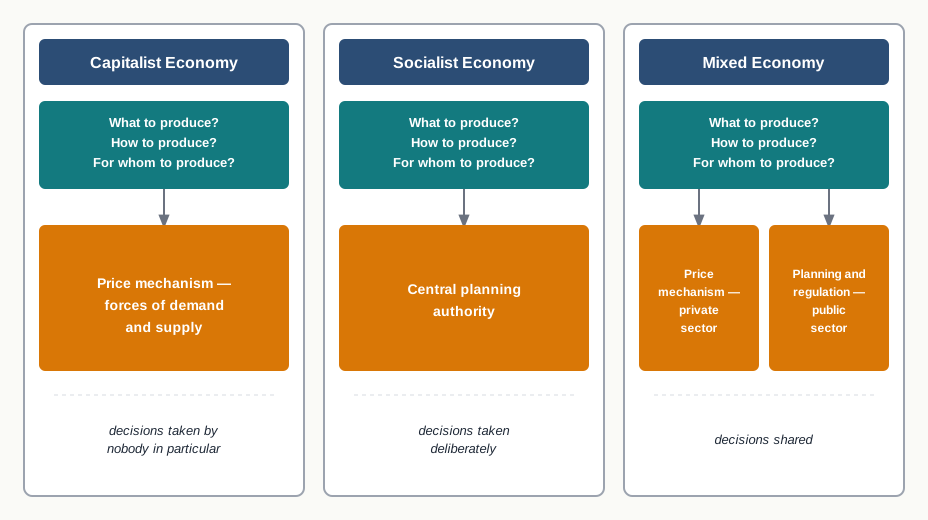
Fig. 5.0 – Who answers the three basic questions.
5.1 The Need for an Allocating Mechanism
Economics begins from a single stubborn fact. The resources available to any society — land, labour, capital and enterprise — are limited, while the wants those resources could satisfy are not. Every use to which a resource is put is therefore a use denied to something else, and that denied alternative is the real cost of the decision.
In a small household this choosing can be done in one head. An economy is not a household. Millions of farmers decide what to sow, thousands of firms decide what to manufacture and with what technique, and crores of consumers decide how to spend their incomes. These decisions are taken separately, by people who have never met and who know almost nothing about one another’s plans.
Yet the decisions have to fit together. The cotton a farmer grows must roughly match the cotton mills need; the skills young people acquire must roughly match the jobs that will exist. Something must coordinate the separate choices of millions of people so that the economy’s scarce resources end up where they are wanted. That something is what this chapter studies.
5.1.1 The Basic Problems Restated
The coordination an economy needs can be set out as a short list of questions. Every economy — capitalist, socialist or mixed, rich or poor — must answer all of them, and must answer them continuously.
- What to produce and in what quantities — should the economy’s resources go into foodgrains or cash crops, houses or highways, consumer goods or machines? Since resources are scarce, more of one means less of another.
- How to produce — should a given output be produced by a labour-intensive technique that uses many workers and little machinery, or by a capital-intensive technique that does the reverse? The choice fixes how much of each scarce factor is used up.
- For whom to produce — once goods exist, who gets them? This is the problem of distribution, and it is settled by how the economy’s income is shared among the people who helped produce the output.
- Whether resources are being used fully and efficiently — an economy that leaves workers unemployed or capacity idle is not producing as much as its resources allow, and one that uses a costlier technique than necessary wastes what it does use.
5.1.2 Three Systems, Three Mechanisms
An economic system is the arrangement through which a country organises production, exchange and distribution. Types of economic systems were taken up in the previous chapter; what concerns us now is the machinery each of them uses to answer the four questions above.
Three answering mechanisms are found in practice.
- Capitalism — the questions are answered by the price mechanism. Nobody decides in particular. Buyers and sellers acting on prices, in pursuit of their own gain, between them determine what is produced, by what technique and for whom.
- Socialism — the questions are answered by economic planning. A central planning authority owns the productive resources, estimates what the country needs and directs resources into those uses by deliberate decision.
- Mixed economy — the two run together. The price mechanism operates in the private sector, but under the control and regulation of the government, while the public sector and the plan carry the decisions the market is trusted with least.
The remaining sections take these three mechanisms in turn: the price mechanism and the capitalist solution first, since the other two are best understood against it.
5.2 The Price Mechanism and Its Elements
A capitalist economy has no coordinating office. Resources are privately owned, firms are free to produce what they like and consumers are free to buy what they like. The question the last section left open is how such an economy avoids chaos, and the answer is that it is held together by prices.
The arrangement is called the price mechanism, and it is worth being precise about what it is before asking what it does. It has two working parts — the prices themselves, and the markets in which those prices are formed. This section takes the meaning first and then the two parts in turn.
5.2.1 Meaning of the Price Mechanism
Prices do more than tell a buyer what a good costs. A high price for a commodity tells producers that it is wanted and that resources moved into producing it will earn well; a low price tells them the opposite. A high wage tells a worker where labour is scarce. Each price is a signal, and each signal is also an incentive, because acting on it is profitable.
The price mechanism is the whole of this arrangement — every price in the economy, working at once, guiding the decisions of producers, consumers and the owners of resources.
Two features of the definition deserve notice. First, the mechanism is impersonal — it guides millions of decisions without any of those millions intending to be guided. Second, it is automatic, in the sense that no authority has to set it in motion; it works as long as people pursue their own advantage and are free to buy and sell.
5.2.2 Prices
In a free-enterprise economy every good and every service carries a price tag, so that a whole set of prices prevails at any moment. Goods have prices because producing them uses up scarce resources, and consumers must pay if they want them. Producers, for their part, will part with goods only at prices that cover their costs and leave a profit.
The same is true of the factors of production. Their services are bought and sold, and they too have prices — wages for labour, rent for land, interest for capital and profit for enterprise. These are called factor prices, and they are simply the prices of the services of factors.
No individual fixes any of these prices. Each is settled by the impersonal forces of demand and supply. Buyers, competing among themselves, create demand; sellers, competing among themselves, offer supply; and price moves until the two are reconciled. The price at which they are reconciled is the equilibrium price, shown in Fig. 5.1.
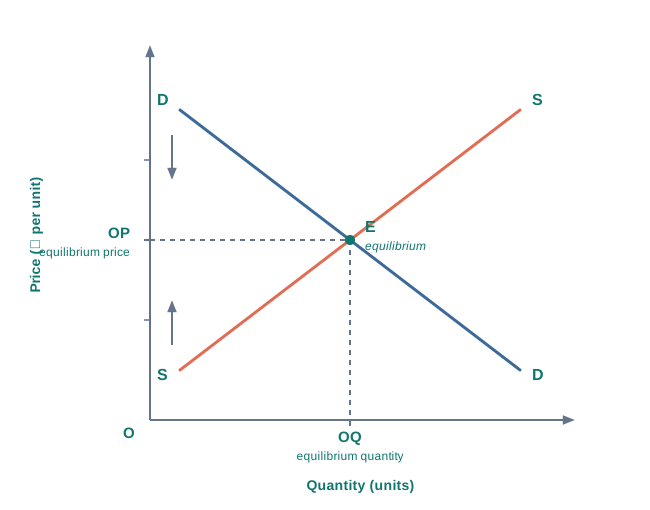
Fig. 5.1 – Determination of equilibrium price in a market.
Competition between buyers and sellers ensures that price ultimately settles at this level. Above OP more is offered than is wanted and the surplus drags price down; below OP more is wanted than is offered and the shortage pushes price up.
Because price is settled this way, it is a very sensitive index of conditions in the economy. Any change in demand or in supply — a failed monsoon, a new technique, a shift in tastes — changes the equilibrium price, and the changed price at once tells every producer and every consumer that something has altered, without their needing to know what.
5.2.3 Markets
Prices are not formed in the air. Demand and supply meet within a market, so markets are an integral part of the price mechanism and its second element.
In economics a market does not mean a place. Buyers and sellers dealing over the telephone or through an online platform are as much in a market as those standing in a bazaar; what makes a market is the contact between them, not the ground they stand on.
Two kinds of market must be distinguished, because the price mechanism works through both and they settle different things. In the goods market, goods and services are bought and sold, and the prices settled there are the prices of commodities. In the factor market, factor services are bought and sold — the labour market, the capital market and so on — and the prices settled there are wages, rent, interest and profit. The main points of difference are set out below.
The two markets are linked, and the link is what makes the mechanism complete. Households earn incomes in the factor market and spend them in the goods market; firms earn revenue in the goods market and pay it out in the factor market. Fig. 5.2 sets out the connection.
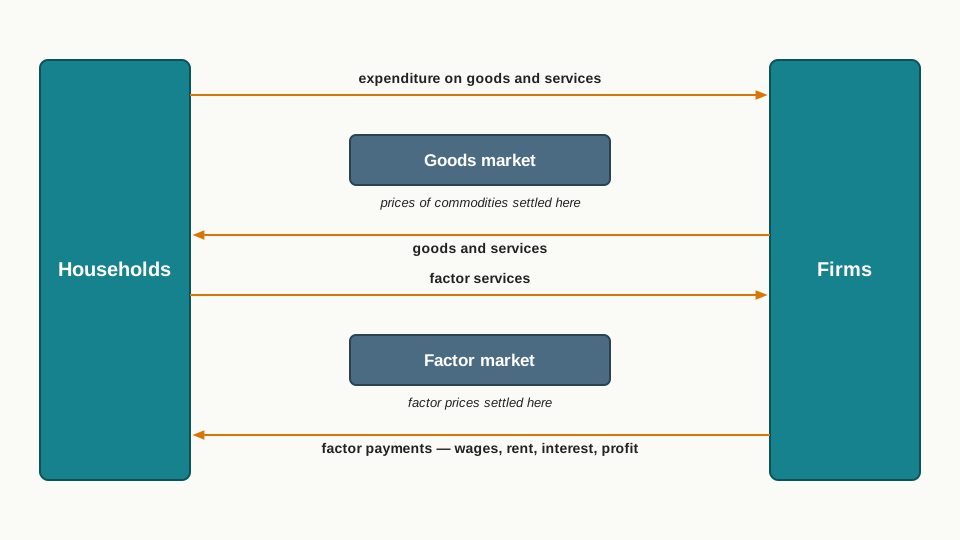
Fig. 5.2 – Goods market and factor market.
To sum up, the price mechanism coordinates decisions in a free-enterprise economy through a system of prices and markets. A capitalist economy possesses no central agency, and yet it does not fall into disorder, because the coordinating work that a planning authority would otherwise do is done automatically and without conscious control by prices.
5.3 Functions of the Price Mechanism
Once it is accepted that prices coordinate a free-enterprise economy, the next question is what exactly they coordinate. It is easy to say that prices ‘guide’ the economy and hard to say precisely what work they do, so the functions are best set out one at a time.
Every one of them rests on a single idea. A price is at once information and inducement — it tells someone what a thing is worth to others, and it rewards them for acting on what it tells them. Fig. 5.3 shows this common structure before the separate functions are listed.

Fig. 5.3 – The price signal and its effects.
The Eight Functions
- Instrument for determining the level of economic activity — prices decide how much production, consumption, saving, investment and technological development the economy undertakes. The general level at which an economy operates is the sum of decisions taken on the basis of prices.
- Coordination of economic decisions — decisions taken separately by a very large number of individuals are brought into agreement through the system of prices and markets. The plans of consumers and of producers, made independently of each other, are reconciled by the prices at which they meet.
- Guiding force for consumers — the prices of goods and services, settled in the goods market, determine how a household spreads its expenditure across commodities. Given the relative prices of different goods, a consumer decides what quantity of each to buy, so the composition of consumption is decided by prices.
- Determination of factor incomes — wages, rent, interest and profit are prices of factor services, settled in the factor market by demand and supply. Since these factor incomes are what households have to spend, the price mechanism also determines the size of the incomes on which consumption depends.
- Guide to producers — a producer aiming at maximum profit is guided by product prices on one side and factor prices on the other. Product prices show what is worth producing; factor prices fix the cost of producing it; the gap between them is the profit that decides the answer.
- Allocation of resources — because resources move towards the uses in which they earn most, prices determine how the economy’s scarce resources are distributed among the production of different goods and services. This is the function on which all the others rest.
- Determination of saving — a household in a free-enterprise economy is free to choose between spending and saving, and the rate of interest settled in the capital market rewards the second. Given the income, the rate of interest therefore influences how much of it is saved.
- Bringing flexibility in the economy — changes in tastes, in supply conditions or in techniques of production alter product and factor prices, and altered prices at once alter what is produced and how. The economy adjusts itself to new circumstances instead of having to be adjusted.
Taken together, the eight functions explain why the price mechanism is described as fundamental to the operation of a capitalist economy. Deciding the level of activity, allocating resources among uses, guiding both consumers and producers, distributing incomes and adjusting to change are exactly the tasks a planning authority is set up to perform in a socialist economy.
5.4 Solutions to the Basic Problems Under Capitalism
The functions listed in the last section can now be put to work. A capitalist economy faces the same questions as any other — what to produce, how to produce and for whom to produce — and it answers all three through the price mechanism alone, without a plan and without an authority.
The thread running through the three answers is profit. A producer in a free-enterprise economy is guided by the difference between the price a good fetches and the cost of the factors used to make it. Both are prices, so both are settled by demand and supply, and the producer’s pursuit of the widest gap between them settles all three questions at once.
5.4.1 What and How Much to Produce
In a capitalist economy a large number of producers compete to supply goods and services, and each will produce whatever yields the highest profit. What yields the highest profit is decided by what consumers are prepared to pay for, so it is consumer spending that ultimately decides what gets produced.
Because of this, the consumer is described as the sovereign, or king, of a capitalist economy. The description is about the direction of influence: consumers do not issue instructions, they merely spend, and their spending draws resources towards the goods on which it falls.
The working of this is best seen through a change in demand. Suppose consumers begin to want more of a commodity. Demand rises, and with supply unchanged the price of the commodity rises with it. At the higher price, and with the cost of production for the moment unaltered, profit per unit is larger, and larger profits induce existing firms to produce more and new firms to enter. Output expands. Fig. 5.4 shows the sequence.
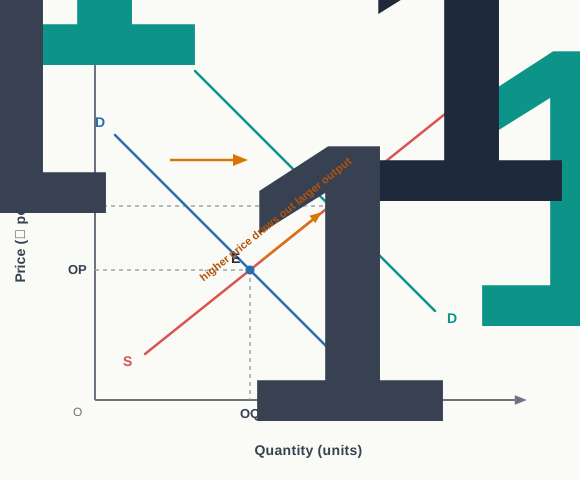
Fig. 5.4 – How a rise in demand expands output.
The same argument runs the other way. If consumers turn away from a commodity, its demand falls, its price falls with it, profits shrink, and producers cut back production and shift resources elsewhere. Resources are thus allocated and reallocated continuously, and the signal in every case is the price.
5.4.2 How to Produce
A given output can usually be produced in more than one way. The problem of how to produce is the problem of choosing between these ways, and the profit motive settles it: since every producer wants maximum profit, every producer will use the least costly technique that will do the job.
Which technique is least costly depends on factor prices, and factor prices are themselves determined by the price mechanism operating in the factor market. Techniques are usually classified by which factor they lean on.
- Labour-intensive technique — a technique that uses more labour and less capital to produce a given output. It is chosen where labour is relatively cheap compared with capital.
- Capital-intensive technique — a technique that uses more capital and less labour to produce the same output. It is chosen where capital is relatively cheap compared with labour.
The word that matters in both is ‘relatively’. What decides the choice is not the wage by itself or the cost of a machine by itself, but the two compared with each other and with the output each yields. The main points of difference are set out below.
Competition enforces the choice. A firm that combines resources wastefully has higher costs than its rivals, and at the common market price its profits are smaller or it makes losses. Firms that combine resources in the most efficient manner earn more and survive. Producing efficiently is therefore not a matter of goodwill in a capitalist economy but a condition of staying in business.
5.4.3 For Whom to Produce
The first two questions concern production. The third concerns distribution — who among the people of the economy actually gets the goods that have been produced.
In a capitalist economy production and distribution are closely linked, because the very act of producing generates incomes. Every factor employed is paid for its services, and those payments — wages, rent, interest and profit — are the incomes out of which goods are bought. Who gets the goods therefore depends on how much income people have, and how much income people have depends on the factor prices settled in the factor market.
Wages illustrate the whole mechanism. The demand for a kind of labour comes from firms, the supply from workers possessing that skill, and the wage settles where the two meet, as in Fig. 5.5. A worker whose skill is scarce relative to the demand for it commands a high wage and can buy a large share of the output; a worker whose skill is abundant commands a low wage and can buy little.
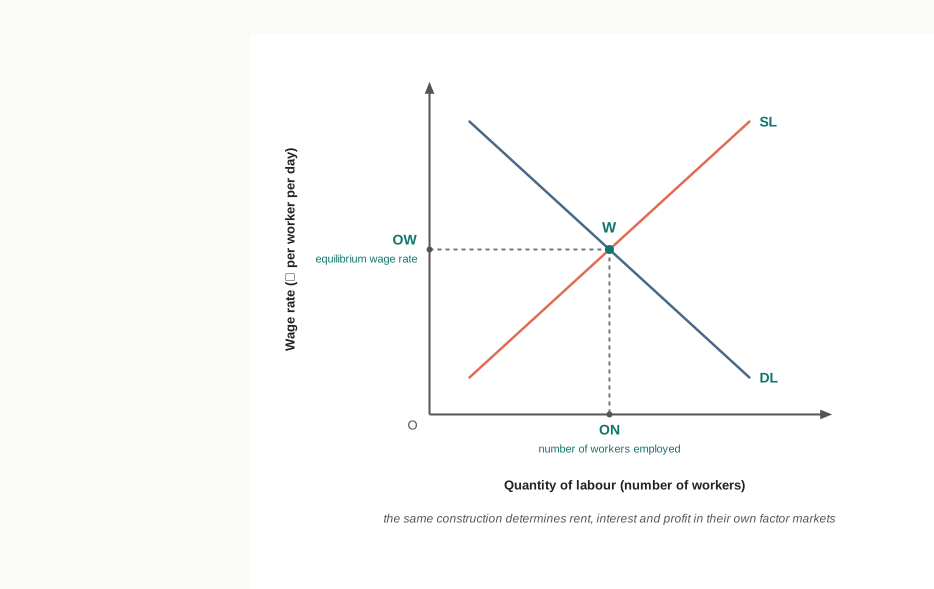
Fig. 5.5 – Determination of wage in the labour market.
Distribution under capitalism is thus settled by the market, and it is settled unequally. Incomes differ widely because the ownership of factors and the scarcity of skills differ widely, and since goods go to those with the purchasing power to buy them, the rich obtain a larger share of the national product and the poor a smaller one. Whether this is acceptable is a separate question, taken up in Section 5.5.3; here it is enough to note that the mechanism produces the outcome automatically.
5.5 The Price Mechanism Assessed
Sections 5.3 and 5.4 described the price mechanism working as it is supposed to work. Whether it works that way in practice is a different matter, and the answer decides how much room is left for the government in a modern economy.
The assessment falls into three parts. The mechanism needs certain conditions before it can function properly; where those conditions hold, it has real merits; and where they fail, so does it.
5.5.1 Conditions Required for the Price Mechanism to Work
The price mechanism functions smoothly and efficiently only if the following conditions are present.
- Existence of competition — the most important condition of all. Competition must be such that no single producer can control or influence the price by his own actions, so that each has to adapt himself to prices rather than set them.
- Costs reflecting the sacrifice — the cost of producing a commodity must be a true reflection of the resources the society gives up in producing it. If a producer does not bear the full cost of what he uses, prices understate the sacrifice and resources are misallocated.
- Demand reflecting needs — demand must reflect what people actually need. Where it does not, production is guided towards the wrong goods, because production follows demand and nothing else.
- Mobility of resources — resources must be able to move quickly from one use to another, otherwise production cannot change in response to changes in demand and the flexibility claimed for the mechanism disappears.
- Correct anticipation of demand — production takes time, so producers must judge demand in advance. If they misjudge it, the result is overproduction of some commodities and underproduction of others.
- Non-economic conditions — the mechanism rests on arrangements that are not themselves economic. A developed legal system protecting property rights, and law and order in the country, are necessary before contracts can be made and honoured at all.
- Absence of government interference — the mechanism can allocate freely only if it is allowed to operate freely. Rationing, licensing and the fixing of quotas replace the price signal with an administrative order and obstruct its working.
5.5.2 Merits of the Price Mechanism
Economists have long defended the price mechanism, and the case for it rests on four claims.
- It solves the economic problems — allocation of resources, choice of technique, distribution of income and the growth of output are all settled by the mechanism, and settled without the enormous information a planning authority would need to settle them deliberately.
- It is a coordinating and organising force — a capitalist economy is unplanned and decentralised, yet it is not chaotic. Millions of people with different and often opposed interests take decisions that fit together well enough for the economy to work in an orderly manner, and no one manages them.
- It promotes social welfare — supporters argue that individuals pursuing their own interest are led, by the invisible hand of the price mechanism, to serve the interest of society as well. A producer who wants profit can obtain it only by supplying what others want, at a price they will pay.
- It preserves individual freedom — consumers choose what to buy and producers choose what to make and how. Economic decisions rest with the people who bear their consequences, which is a claim about liberty rather than about efficiency.
5.5.3 Limitations of the Price Mechanism
In theory the mechanism functions smoothly and perfectly. In practice the conditions of Section 5.5.1 are rarely all satisfied, and the following weaknesses appear.
- Decline of competition — perfect competition, on which the whole case rests, seldom exists. Mass production, larger markets and new techniques have encouraged monopolistic and oligopolistic tendencies, and firms with such power charge higher prices, produce less and misallocate resources.
- Consumer sovereignty becomes a myth — consumers are said to be sovereign, but large firms shape the wants they then satisfy, through advertisement, propaganda and salesmanship. Goods are produced to meet wants, and the wants themselves are influenced by the producers.
- The individual may not be the best judge — the mechanism assumes each person judges his own interest best. Choices are in fact affected by impulse, prejudice, ignorance and sales pressure, and people do not always find the work for which they are most suited.
- Social welfare may not be maximised — production follows ability to pay, not need. Where incomes are very unequal, resources are drawn into luxuries bought by the rich while necessities consumed by the masses are produced in inadequate quantity.
- Inequalities in the distribution of income and wealth — the free operation of the mechanism widens the gap between rich and poor. Those with talent, opportunity, monopoly power or inherited property accumulate more, inheritance carries the advantage forward, and the concentration of wealth distorts the allocation of resources in the next round.
- Economic instability — the mechanism tends to generate booms and depressions. A boom brings inflation, which hits those on fixed incomes hardest; a depression brings unemployment and hardship. The mechanism has no inherent way of preventing either.
- Low-profit areas are neglected — private investment follows profit, so activities and regions that promise low returns are avoided even when they matter greatly to the economy. Backward regions with poor facilities attract little investment, and development becomes lop-sided.
- Public utilities are neglected — services such as medical care, education, water, electricity, sanitation, defence, transport and communication satisfy collective wants. Private producers avoid them because they need heavy investment, yield low returns, and are consumed collectively so that no market price can easily be charged.
To sum up, the free and unrestricted working of the price mechanism has not achieved the optimum allocation of resources or the maximum efficiency and welfare claimed for it. It has instead permitted monopoly, widened inequality and left the level of economic activity unstable.
Governments have therefore been drawn into the working of the mechanism, and no capitalist country today allows it to operate freely. Intervention takes the form of physical controls, monetary measures acting on money supply and the rate of interest, and fiscal measures acting through taxes, public expenditure and subsidies. An economy in which such intervention becomes systematic is on its way to being a mixed economy, which is the subject of Section 5.7.
5.6 Solutions to the Basic Problems Under Socialism
A socialist economy answers the three questions in the opposite way from a capitalist one. Productive resources are owned by the state, all economic activity is centrally planned, controlled and regulated, and the responsibility for solving the basic problems rests squarely with the government.
To discharge that responsibility the government sets up a central planning authority — a planning commission or a planning ministry — with the power to decide what shall be produced, by what methods and how the output shall be shared. Planning plays in a socialist economy exactly the role that the price mechanism plays in a capitalist one.
The difference from capitalism is not that decisions are taken but that they are taken deliberately and in one place. Fig. 5.6 sets out the route a decision travels.
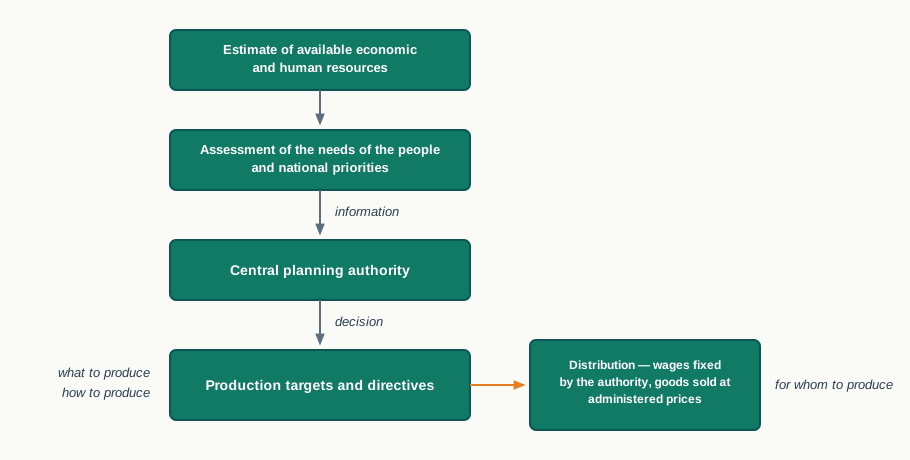
Fig. 5.6 – How a planning authority answers the three questions.
5.6.1 What and How Much to Produce
The planning authority takes this decision itself, and it takes it in two steps. First it estimates the economic and human resources the country has available, since nothing can be planned beyond what the resources allow. Then it assesses what the economy requires — the needs of the people on one side and the national priorities on the other.
Out of these two estimates comes a decision on the size and the assortment of goods to be produced. The authority works out the quantities of the various commodities that people want, directs resources into producing them, and must ensure that adequate amounts are actually made available.
The contrast with capitalism is exact. There, consumer spending draws resources towards a commodity; here, an assessment of need directs them, and where the assessment is faulty the goods are simply not there, since no price rises to signal the shortfall.
5.6.2 How to Produce
The authority decides not only how much is to be produced but by what method. In choosing the technique it weighs several considerations rather than cost alone.
- Economic efficiency of the technique — how much output the technique yields from a given quantity of resources.
- Full utilisation of the country’s resources — the technique should be one that keeps the economy’s resources, and particularly its labour, in use rather than idle.
- Social objectives and development goals — the technique must also serve the wider aims the plan has set, such as raising employment or building up basic industries.
A capitalist producer weighs only the first of these, and only in the form of cost. The planning authority weighs all three, which is why a socialist economy may deliberately choose a technique that a private firm would reject as too expensive.
5.6.3 For Whom to Produce
Distribution too is decided by the planning authority. Since all productive resources belong to the state, people work as employees and earn income in the form of wages alone. There is no rent, interest or profit accruing to private individuals, because there are no privately owned factors to earn them.
How much each category of worker is paid is fixed by the government, taking into account the quantity and the quality of the work done. A skilled worker is paid more than an unskilled one, and those who earn more can obtain more goods and services. The guiding principle is stated as ‘from each according to his capacity and to each according to his work’.
The result is not equality but a much narrower spread. A socialist economy aims at an equitable distribution of income while fixing wages, and inequalities are drastically reduced so that everyone is able to obtain an adequate income.
5.6.4 Administered Prices and the Rationing System
Planning does not abolish prices, and this is a point students often get wrong. Consumer goods and services are still sold, so a goods market exists in a socialist economy and market prices are still formed by demand and supply.
What is missing is the freedom of those forces. Demand and supply do not operate freely, because prices are administered — set by the government rather than settled between buyers and sellers.
Alongside administered prices, the government distributes goods directly. Essential commodities in particular are supplied at fixed or controlled prices through ration shops and fair-price shops, which the government owns and controls. Distribution then depends on entitlement rather than on the ability to pay.
5.7 Solutions to the Basic Problems Under a Mixed Economy
A mixed economy is one in which the private and the public sectors coexist, so that features of both capitalism and socialism are present together. It follows that its basic problems are solved by both methods at once — by a price mechanism that is allowed to work but not allowed to work freely, and by economic planning.
In the private sector the mechanism operates much as it does in a capitalist economy. Firms produce for profit, respond to prices and choose their own techniques. What differs is that the government seeks to control the mechanism through industrial policy, fiscal policy and monetary policy, and these instruments alter the allocation of resources, the distribution of income and the amount of investment so as to serve national priorities.
Fig. 5.7 shows how the three questions are divided between the two sectors.
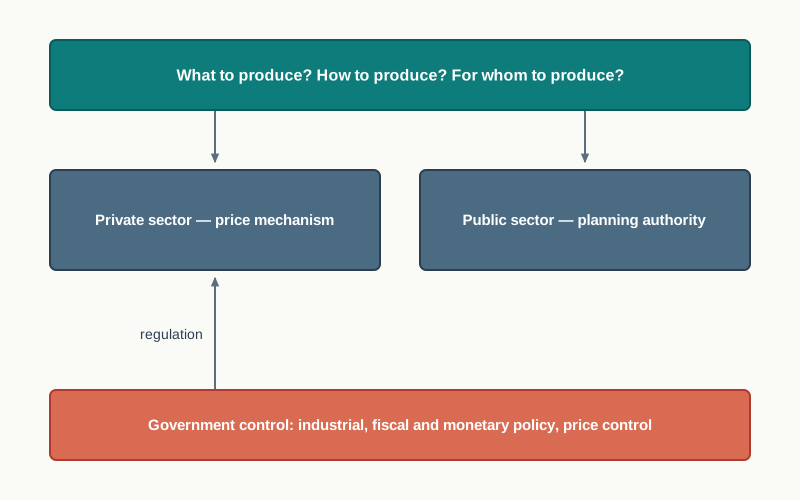
Fig. 5.7 – The two sectors of a mixed economy.
5.7.1 What to Produce
In the private sector the answer comes from consumers. Firms produce the goods that are demanded, because those are the goods on which large profits can be earned, and consumers’ preferences therefore influence what private firms decide to make.
That influence is not left unchecked. Private production is itself controlled and regulated by the government through monetary, fiscal and price control policies, which can encourage the output of some goods and discourage that of others.
In the public sector the question is settled differently. There it is the planning authority that decides what to produce and how much to produce, and it decides with the overall national objectives in mind rather than with an eye to profit.
5.7.2 How to Produce
In the private sector the choice of technique is made by the firm on the basis of factor prices, exactly as under capitalism. The profit motive pushes the firm towards the least costly, most efficient method available to it.
In the public sector the planning authority makes the choice, and it is influenced not only by input prices but by wider objectives — generating more employment opportunities and promoting economic growth among them. A public undertaking may therefore adopt a technique that a private firm in the same industry would not.
5.7.3 For Whom to Produce
In the private sector distribution follows purchasing power, as it does under capitalism. People with higher incomes obtain a larger share of the national product, because more of the goods they demand are produced.
In the public sector the decision is taken by the government, and its main object is to ensure that adequate quantities of necessities are produced. Nor is this confined to what the government itself produces: it also controls production in the private sector to secure the same end, so that essential goods remain available.
5.7.4 The Regulating Role of the Government
The government in a mixed economy does more than restrain the private sector; it acts in its own right, and its role can be set out under four heads.
- Building economic infrastructure — the public sector develops facilities such as power and transportation, on which the whole economy depends and which private investment tends to neglect.
- Investing in capital goods and basic industries — the state undertakes investment in industries that require heavy capital and yield returns only over a long period, so as to promote economic development.
- Adopting economic planning — the state plans to promote development, to raise the level of employment and to influence the distribution of income, aims the market by itself does not pursue.
- Regulating the private sector — free markets and the price mechanism are preserved, but under the control and regulation of the government, so that private activity is consistent with national priorities.
Firms in both sectors are then left free to adjust their activities to market forces, but to market forces that the government has already shaped. This is what is meant by saying that in a mixed economy the basic problems are solved largely through a controlled or regulated price mechanism.
5.8 Summary
- Scarcity forces every economy to answer the same questions — what to produce and in what quantities, how to produce, for whom to produce, and whether resources are being used fully and efficiently. The questions are universal; only the mechanism that answers them differs.
- An economic system is the arrangement through which a country organises ownership, production and distribution. Three answering mechanisms are found in practice:
- capitalism, which answers through the price mechanism;
- socialism, which answers through central economic planning;
- the mixed economy, which answers through a regulated price mechanism working alongside planning.
- The price mechanism is the mechanism in which prices play a key role in directing the activities of producers, consumers and resource suppliers. It is impersonal, since it guides millions of decisions that nobody intends to be guided, and automatic, since no authority has to set it working.
- Its two elements are prices and markets. Every good and every factor service carries a price, settled by demand and supply; equilibrium price is the price at which quantity demanded equals quantity supplied.
- Markets are of two kinds. Commodity prices are settled in the goods market and factor prices — wages, rent, interest and profit — in the factor market. Households earn in the second and spend in the first, which links the two.
- The price mechanism performs eight functions: determining the level of economic activity, coordinating economic decisions, guiding consumers, determining factor incomes, guiding producers, allocating resources, determining saving, and bringing flexibility to the economy.
- Under capitalism the three problems are solved as follows:
- what to produce is settled by consumer spending, which raises the price and the profitability of the goods wanted, so that output expands where demand has risen;
- how to produce is settled by factor prices, since the profit motive makes every producer choose the least costly technique — labour-intensive where labour is relatively cheap, capital-intensive where capital is;
- for whom to produce is settled by the distribution of income, since factor incomes determine purchasing power and goods go to those who can pay.
- The mechanism works well only if certain conditions hold: competition, costs reflecting the sacrifice made by society, demand reflecting needs, mobility of resources, correct anticipation of demand, supporting non-economic conditions such as property rights and law and order, and the absence of government interference.
- Its merits are that it solves the economic problems without any central agency, coordinates a decentralised economy without disorder, is claimed to promote social welfare through Adam Smith’s invisible hand, and preserves individual freedom of choice.
- Its limitations are the decline of competition, consumer sovereignty turning into a myth, the individual not always being the best judge of his own interest, welfare not being maximised because production follows ability to pay, growing inequalities of income and wealth, economic instability, the neglect of low-profit areas, and the neglect of public utilities.
- Because of these failures, governments intervene through physical controls, monetary measures and fiscal measures, and no capitalist economy today allows the price mechanism to operate freely.
- Under socialism the central planning authority answers all three questions — estimating resources and needs before fixing what and how much to produce, choosing techniques with efficiency, full utilisation and social objectives in view, and fixing wages by the quantity and quality of work done, on the principle ‘from each according to his capacity and to each according to his work’.
- A socialist economy still has a goods market, but its prices are administered rather than freely settled, and essential goods are distributed at controlled prices through ration shops and fair-price shops.
- Under a mixed economy the private sector answers the three questions through the price mechanism while the public sector answers them through the planning authority. The government regulates the private sector through industrial, fiscal and monetary policy and price controls, builds infrastructure, invests in basic industries and works to keep necessities available.
- The chapter’s spine is therefore a single contrast, set out below.
5.9 Points to Ponder
- The price mechanism sends resources towards the goods people are willing and able to pay for. A famine can therefore occur in a region where food is still being sold at a price, because those who need it most register no demand. Does this show that the mechanism has failed, or that it was never designed to answer that question in the first place?
- Consumers are called sovereign because their spending decides what is produced, yet firms spend heavily on advertising to shape what consumers want. If wants can be manufactured along with the goods that satisfy them, in what sense is the consumer still king?
- A capitalist producer chooses the technique that costs least at existing factor prices. In an economy with abundant labour, that will often be the technique that employs more people — but not always. Should an economy ever prefer a technique it knows to be costlier because it employs more workers, and who should bear the extra cost?
- A planning authority must estimate what the people need before it can direct resources towards producing it. A market discovers the same thing after the event, through what sells and what does not. Which kind of mistake is easier for an economy to correct — a plan that misjudged demand, or a market that discovered it too late?
- The conditions for the price mechanism to work include the absence of government interference, and its limitations are the reason governments interfere. Is intervention therefore an admission that the mechanism has failed, or a way of supplying the conditions it needs and cannot create for itself?
- Every mixed economy has to decide where the line between the two sectors falls, and the line has moved in India more than once since 1991. What kind of evidence should a country look at when deciding whether to move it further in either direction?
5.10 Objective Questions
- Which of the following is determined in the factor market? [1]
- The price of a shirt
- The wage rate of a carpenter
- The price of a bus ticket
- The price of a kilogram of onions
- Assertion (A): In a capitalist economy the consumer is described as sovereign. Reason (R): Consumers in a capitalist economy fix the prices at which goods are sold. Choose the correct option. [1]
- Both A and R are true and R is the correct explanation of A
- Both A and R are true but R is not the correct explanation of A
- A is true but R is false
- A is false but R is true
- Fill in the blank: The price at which the quantity demanded of a commodity equals the quantity supplied is called its ________ price. [1]
- State whether the following statement is true or false: A socialist economy has no goods market, because all goods are distributed by the planning authority. [1]
- Match the economy in Column I with the mechanism that solves its basic problems in Column II. [1]
| Column I | Column II |
|---|---|
| a. Capitalist economy | i. Central planning authority |
| b. Socialist economy | ii. Regulated price mechanism together with planning |
| c. Mixed economy | iii. Free price mechanism |
5.11 Check Your Concepts
- Define the price mechanism and name its two elements. [2]
- Distinguish between the goods market and the factor market on any three bases. [3]
- Draw a demand and supply diagram and use it to explain how a rise in consumer demand for a commodity leads to an expansion of its output in a capitalist economy. [4]
- ‘The free working of the price mechanism ensures the maximum welfare of society.’ Evaluate this claim, stating any two arguments in its favour and any four limitations that tell against it. [6]
5.12 Case-Based Question
- A poor crop reduced arrivals of green chillies in the Barwara mandi and their price rose sharply within a fortnight. Growers in the surrounding blocks noticed the rise and began preparing to plant chillies on land they had earlier kept for other crops. In the same town, Suneja Chemists sells a life-saving medicine whose maximum price is fixed by the government and printed on the pack; that price did not change during the fortnight.
- Which of the basic economic problems is being solved by the rise in the mandi price of chillies? Explain how the price does this work. [2]
- Name the kind of price at which the medicine is sold, and explain how the way it is arrived at differs from the way the mandi price of chillies is arrived at. [2]