Chapter 15: Unemployment in India
Every year a large number of young Indians reach working age and begin looking for work. Since 1991 production has risen in every sector of the economy, and the number of people at work has risen with it. Yet the number of people without work has risen as well, because the labour force has been growing faster than the jobs being created. That is the problem this chapter deals with. Unemployment is a waste of the one resource a poor country holds in abundance. When a person who is able and willing to work at the going wage rate cannot find work, the output that person could have produced is lost to the economy for good, and the income that work would have earned is lost to the household. Reducing unemployment has therefore been an objective of Indian planning since 1951, and it remains one of the hardest objectives to meet. The chapter explains what unemployment means and how it is measured, distinguishes the types of unemployment found in developed and in underdeveloped economies, examines its extent, consequences and causes in India, and reviews the policy measures taken to remove it.
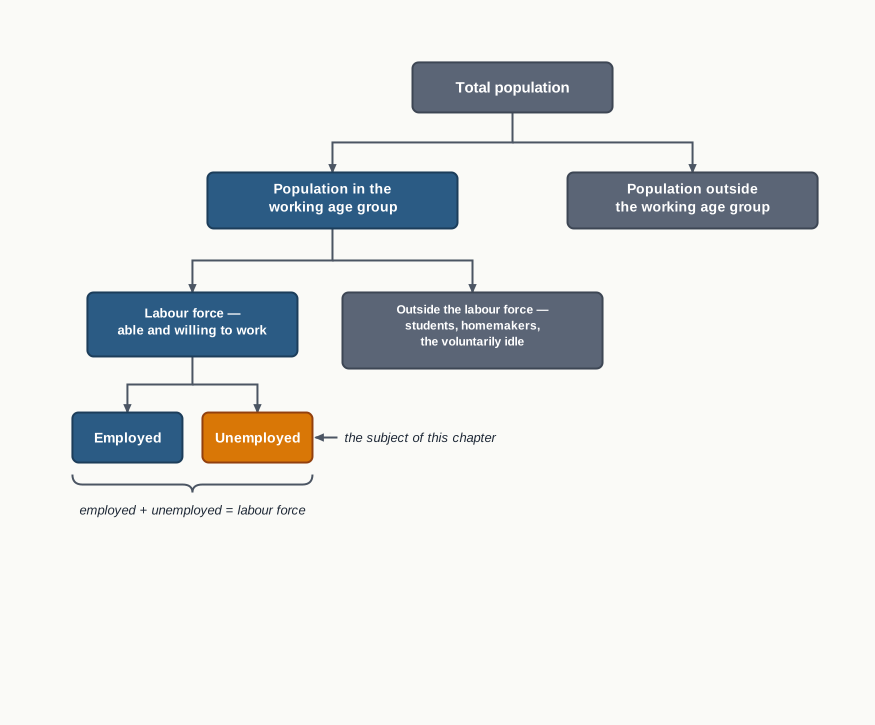
Fig. 15.0 – From the population to the unemployed.
15.1 Employment and Unemployment
Labour is the one productive resource that almost every economy possesses in quantity, and the one resource that cannot be stored. An hour of work not done today cannot be saved and used tomorrow; it is simply lost. The economic problem of unemployment is therefore a problem of waste — a scarce resource lying idle while wants remain unsatisfied.
Before that waste can be measured or remedied, it has to be defined with some care. Ordinary speech calls anyone without a job unemployed, but economics counts only those who want work at the going rate and cannot get it. This section builds that definition step by step and then converts it into a rate.
15.1.1 Meaning of Employment
Employment refers to a situation in which a person is able to earn his livelihood through work. That work may take either of two forms. A person may be in wage-employment, working for an employer in return for a wage or salary. Or he may be in self-employment, working on his own account — cultivating his own land, running a shop, driving a hired vehicle or practising a trade.
The distinction matters in a country like India, where self-employment on small farms and in tiny enterprises accounts for a very large share of all work done. A person who works on the family holding is employed in the economic sense even though no one pays him a wage, because the work yields him a livelihood.
15.1.2 Meaning of Unemployment
Unemployment is easy to notice and difficult to define. In common usage it describes anyone not engaged in productive work and therefore earning nothing. The economic sense of the term is narrower: it requires not only that the person be without work, but that he want work and be capable of doing it, and that work at the prevailing wage rate be unavailable to him.
Each of the three conditions carries weight. A person must be able to work, which excludes the very young, the very old and the permanently infirm. He must be willing to work at the wage the market is offering, which excludes those who could work but choose not to. And he must be unable to find such work despite wanting it, which is the element that makes unemployment an economic problem rather than a personal choice.
15.1.3 Voluntary and Involuntary Unemployment
Voluntary unemployment refers to a situation in which a person is without work by his own choice. He is able to work and work is available to him at the going wage, but he does not take it — whether from idleness, from unwillingness to do that particular kind of work, or because he has other means of living. The idle rich and the idle poor both fall in this category, as do those who live by anti-social means.
Involuntary unemployment refers to a situation in which a person is willing to work at the prevailing wage rate but is unable to find work. Here the shortage lies in the economy, not in the person’s willingness.
Only involuntary unemployment is counted as unemployment. The voluntarily unemployed are left out because no policy of the government can supply work to someone who does not want it, and including them would overstate the waste the economy is actually suffering.
15.1.4 The Labour Force and the Working Age Group
Not everybody in a country is expected to work. Children are at school, the elderly have retired, and some adults keep house or study full time. Measurement therefore begins by marking off the working age group — in Indian labour force surveys, persons aged 15 to 59 years. Those below and above that band are treated as outside the workforce, however useful the work they may do.
Within the working age group, a further division is made. Those who are either working or seeking and available for work make up the labour force. Those who are neither working nor seeking work — full-time students, homemakers, the voluntarily idle — stand outside it. The labour force is thus the sum of the employed and the unemployed, and it is the base against which unemployment is measured.
15.1.5 The Unemployment Rate
The absolute number of unemployed persons tells us little by itself, since a large country will have a larger number than a small one for the same degree of distress. What is needed is a proportion — the share of those who want work who cannot get it. This is what the unemployment rate measures.
\[UR = \dfrac{U}{LF} \times 100\]
Here \(U\) is the number of persons unemployed and \(LF\) is the total labour force, both counted over the same reference period. The result is a percentage. A rate of 4 per cent means that four out of every hundred persons in the labour force are without work though seeking it; the higher the rate, the greater the share of willing hands lying idle.
Because the labour force is the denominator, the rate responds to changes in either part of the fraction. It rises when jobs disappear, but it also falls when people stop searching and leave the labour force altogether — a fall that reflects discouragement rather than improvement.
15.2 Types of Unemployment in Developed Economies
Unemployment is not one condition but several, and each arises from a different failure in the economy. A worker idle because factories have cut back on output is in a different position from one idle only because he has not yet found the next job, and the remedy for the first will do nothing for the second. Any programme of action must therefore begin by recognising which type it is dealing with.
The types found in the advanced industrial economies differ from those found in poor countries. In a developed economy, productive capacity is large and the difficulty lies in keeping demand high enough to use it, or in matching workers quickly to the vacancies that exist. The two main types found there are cyclical unemployment and frictional unemployment.
15.2.1 Cyclical Unemployment
A market economy does not grow at a steady pace. It moves through alternating phases of prosperity and depression, and this movement is called the business cycle. During prosperity the level of economic activity rises, and income, output and employment rise with it. During depression activity is low, and income, output and employment all fall together. The path is set out in Fig. 15.1.
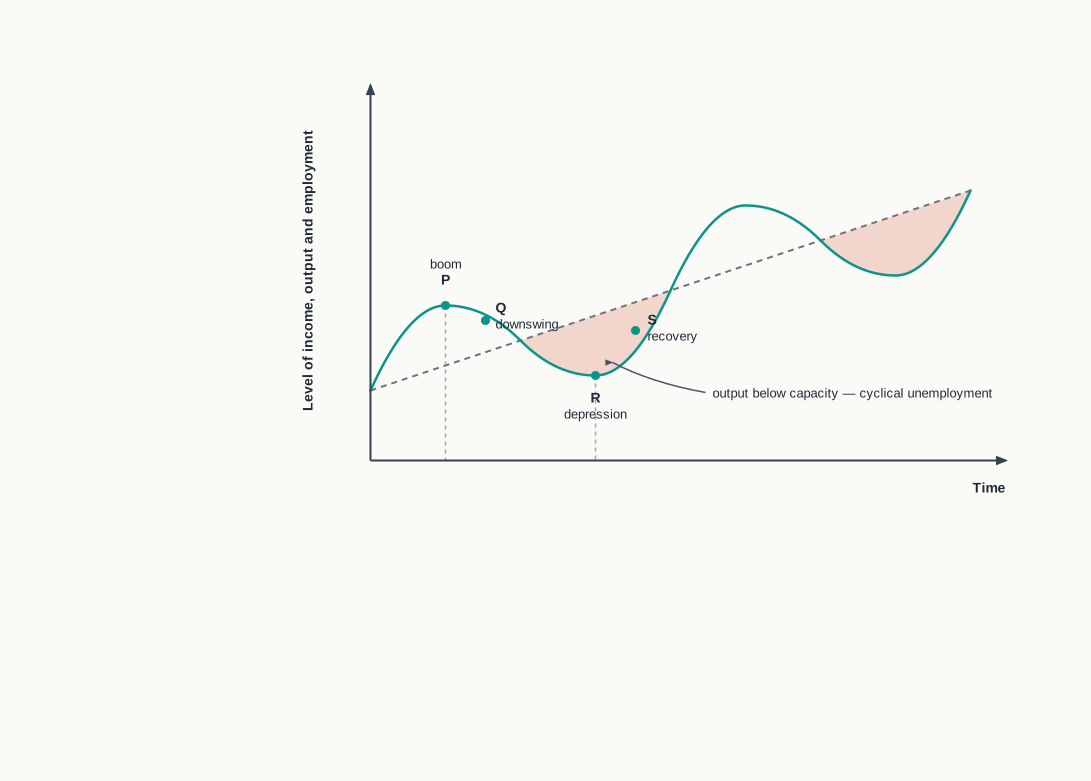
Fig. 15.1 – Employment over the phases of the business cycle.
Cyclical unemployment is the unemployment associated with the downswing and depression phases of the business cycle. Its cause is a deficiency in aggregate demand. As income falls during a depression, households and firms spend less, so the demand for goods and services is no longer enough to buy the whole output that could be produced if the labour force were fully employed. Firms therefore produce less than full employment output, and a large part of the labour force is laid off.
Two features follow from this. First, cyclical unemployment strikes labour and capital together — machines stand idle alongside workers, since it is demand for the product, not any shortage of equipment, that is missing. Secondly, it can be removed by raising aggregate demand far enough to lift output back to the level the labour force is capable of producing.
Cyclical unemployment is an inherent feature of a developed capitalist economy. In a less developed country such as India it appears only when the economy is actually in recession, and it is not the form that accounts for most of the unemployment observed.
15.2.2 Frictional Unemployment
Not all unemployment in a developed country can be traced to a shortage of demand. Even when aggregate demand is high and vacancies exist, some workers will be found without work, because the labour market takes time to bring a particular worker and a particular job together.
Frictional unemployment exists when there is a lack of adjustment between the demand for and the supply of labour. In a modern economy change is constant. People leave jobs for many reasons, and finding the next one takes time, since neither the worker nor the employer has complete knowledge of the other and workers cannot move instantly from one place or occupation to another. The result is a temporary spell of unemployment among workers who are between jobs.
Such frictions arise in several ways. A change in the pattern of demand shifts work from one product to another. Economic progress causes old industries to contract while new ones come up, and labour cannot be transferred at once from the declining industry to the expanding one. In each case the jobs exist, but the matching is imperfect.
Because it is temporary, frictional unemployment is not treated as a weakness of the economy; a growing economy will always show some of it. It is reduced by improving the working of the employment market — better information about vacancies, and greater occupational and geographical mobility of labour. Frictional unemployment occurs in India as well, since ours is a growing economy, but its extent here is small.
The main points of difference between the two types are set out below.
15.3 Types of Unemployment in Underdeveloped Economies
In an underdeveloped country the difficulty is not that demand has fallen short of a large productive capacity. It is that the productive capacity itself is too small to employ the labour force that exists. Unemployment here is a consequence of the underdeveloped nature of the economy, and it persists in good years as well as bad.
The forms it takes are correspondingly different. The main types found in an underdeveloped economy are structural unemployment, open unemployment, disguised unemployment, underemployment and seasonal unemployment. Unemployment in India is basically structural in nature, and the other forms are the shapes that structural shortage takes on the ground.
15.3.1 Structural Unemployment
Structural unemployment refers to a situation in which a large number of people do not get work because the job opportunities available are limited. It arises from a shortage of capital equipment and of the other resources that must be combined with labour before labour can be put to work.
The mechanism is a race between two rates of growth. Productive capacity in India is not only small but grows slowly, because the rate of capital formation is low. The labour force, meanwhile, grows fast, because population has been growing fast. When the labour force increases faster than the new jobs created, the number of persons left without work rises every year even though total employment is also rising.
Structural unemployment is not a temporary phenomenon. It is deep-rooted and chronic, because it is bound up with the structure of the economy itself. It cannot be cured by raising demand, since the equipment to meet that demand does not exist. It yields only to economic development — a sustained increase in productive capacity large enough to absorb both the existing unemployed and the additions to the labour force. Because it can be removed only by structural transformation, it is called structural unemployment.
15.3.2 Open Unemployment
Open unemployment refers to a situation in which there are some workers who have absolutely no work to do. They are willing to work at the prevailing wage rate but are forced to remain idle in the absence of work. Such workers are unemployed for the whole of their time, not for part of it.
This form is called open because it can be seen and counted. The persons concerned are visibly without work, and they can be enumerated in a survey or registered at an employment exchange. Open unemployment is found largely in the urban areas and, to a limited extent, in the villages.
Open unemployment is not a separate cause of idleness so much as a visible condition that several causes can produce. Frictional, structural and cyclical unemployment are all different types of open unemployment, since in each of them the worker is wholly without work rather than partly occupied.
15.3.3 Disguised Unemployment
Disguised unemployment refers to a situation in which the number of workers engaged in a job is much more than the number actually required to do that work. Nobody appears to be idle, so the unemployment is not open to view; it is concealed or hidden within apparent employment. It prevails mostly in the rural areas, where employment in agriculture takes the form of work-sharing — a given quantity of work divided among more people than it needs.
Consider a family farm on which forty hours of work have to be done every day, the normal working day being ten hours. Table 15.1 sets out what happens as the number of persons depending on that farm rises from four to five.
With four workers the farm is exactly manned: each works a full ten-hour day. When a fifth member of the family joins, with no work available outside, the same forty hours are shared among five, and each now works only eight hours. Every one of them appears to be employed, yet each is idle for two hours of every day.
The test is what happens if one of them is withdrawn. If the fifth worker leaves, the remaining four return to a full ten-hour day, complete the same forty hours and produce exactly the same output. His contribution to output was nil — his marginal productivity was zero — and he was therefore unemployed in a disguised way even while working. Ragnar Nurkse made this the defining feature of agriculture in poor countries: a large part of the farm population could be removed without any fall in farm output, even with techniques unchanged.
Disguised unemployment occurs for four interrelated reasons: the availability of a large labour force in the countryside, the absence of alternative employment in the urban sector, agriculture being a family occupation that no member is turned away from, and the small size of holdings, which limits the work to be done. It is the predominant form of unemployment in the agricultural sector of developing countries like India, and it is chronic. It can be removed only by economic development that creates employment outside agriculture.
15.3.4 Underemployment
Underemployment refers to a situation in which employed persons are contributing to production and income less than what they are really capable of. The person has work, and that work is productive, but it does not draw on his abilities or his training.
This happens when work suited to a person’s qualifications is not available and he takes an inferior occupation instead. A trained automobile engineer who cannot find an engineer’s post and takes up work as an ordinary motor mechanic is underemployed. He is genuinely employed and does add to output and income; he is simply not employed to the full extent of his capacity, so a part of the human capital invested in him is going to waste.
15.3.5 Seasonal Unemployment
Seasonal unemployment refers to a situation in which people get work during some days or months of the year but not regularly throughout it, and are therefore unemployed during some part of the year. It arises in occupations whose activity varies with the season, whether because of the climate or because demand for the product is itself seasonal.
Agriculture is the clearest case. There is such a demand for hands at sowing and harvesting that labour becomes scarce in the villages, while in the lean period between the harvest and the next sowing a large number of people are left without work. Since agriculture in India is predominantly seasonal and uses labour-intensive methods, the swing in the demand for agricultural labour across the year is large, and seasonal unemployment is particularly important here.
Certain industries face the same problem. Agro-based units can work only while their raw material is available, and industries whose product is wanted in one season alone must cut back in the others.
Seasonal unemployment arises mainly because suitable alternative work is not available in the slack season. It is independent of the wishes of the workers, being forced on them by the fall in demand during the off season.
The distinction that gives most trouble is between the two rural forms, and it is set out below.
15.4 Special Types of Unemployment
Two further terms are in common use — educated unemployment and technological unemployment. Neither names a fresh category alongside the ones already described. Each picks out a group of the unemployed, or a particular cause of displacement, that raises problems of its own and calls for a policy of its own. They are therefore treated as special types.
15.4.1 Educated Unemployment
Educated unemployment refers to unemployment among educated persons — those who have passed the matriculation stage and above. The educated unemployed are not a type apart in the way that disguised unemployment is; they appear within the forms already described. Some are openly unemployed, doing no work whatsoever. Others are underemployed, holding inferior jobs because work suited to their qualifications is not to be had.
The problem is basically an urban one, since schools and colleges have long been concentrated in the towns. In recent years it has emerged in the rural areas as well, as education has spread among the villagers.
Educated unemployment constitutes a special problem for two reasons.
- Waste of human capital — a large amount of scarce resources goes into the education and training of these people, and the whole of it is wasted when the economy cannot make use of the skills so created. The loss is heavier than the loss of unskilled labour time.
- Greater consciousness — the educated unemployed are more aware of their position and of the reasons for it, so discontent among them can turn into open agitation.
Two reasons are usually given for its growth.
- Rapid expansion of educational facilities — the number of persons completing school and college has risen far faster than the number of posts suited to them, so the output of the education system outruns the demand for it.
- A defective education system — the system lays its emphasis on general education rather than on vocational and technical education, and turns out generalists in numbers the offices of the country cannot absorb, while the skills the economy is short of go untaught.
15.4.2 Technological Unemployment
Technological unemployment refers to unemployment that arises because of the use of labour-saving techniques of production. Labour-saving, or capital-using, techniques are those that employ more capital and less labour to produce a given quantity of output. They are adopted because they are more efficient, but the labour they save is labour displaced.
Modern industrial production is characterised by such techniques, and their spread leaves a trail of unemployment behind it. The effect has been sharp in India because of the place handicrafts occupy in the existing industrial structure. Industrialisation has brought up a great variety of modern industries, and many of them have grown by displacing the small-scale handicraft industries that made the same goods by hand. Displacement of handicraft workers on that scale is technological unemployment in its largest form. The mechanisation of routine clerical work has had the same effect in services.
Whether such unemployment is permanent is a separate question. New techniques create work of their own — in making, installing and maintaining the equipment — and a growing economy may in time absorb those displaced. But the displacement is immediate and falls on particular workers in particular trades, while the absorption is slow and demands skills those workers may not have.
The types of unemployment described in this section and the two preceding ones are brought together in Fig. 15.2.
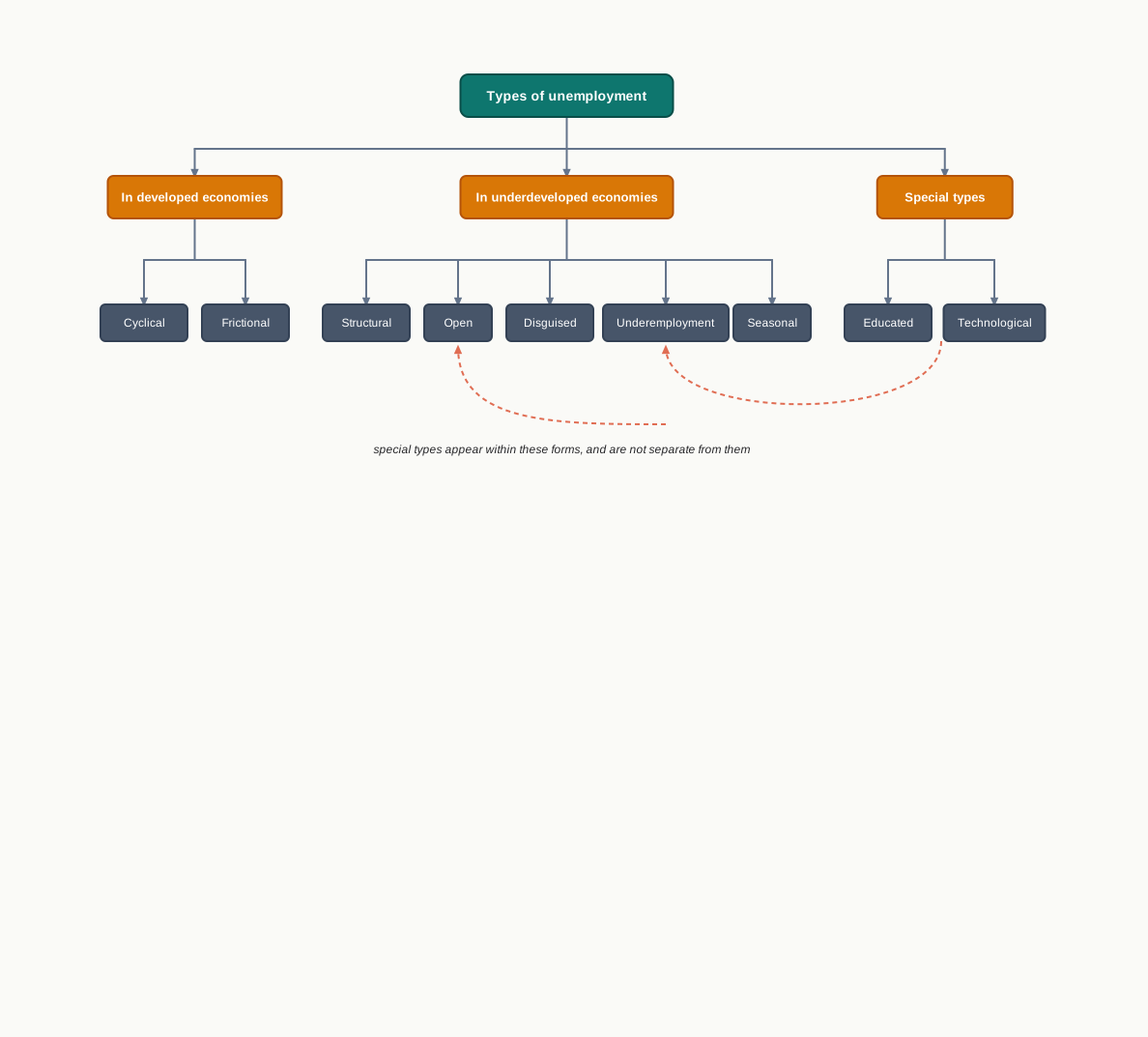
Fig. 15.2 – Types of unemployment.
15.5 Extent and Magnitude of Unemployment in India
Knowing what unemployment is does not tell us how much of it there is. Measuring it in a country like India is unusually difficult, because so much of the work done is casual, seasonal or self-employed, and the line between working and not working is blurred rather than sharp. A precise figure is therefore not to be had; what the surveys give is a reasonable estimate of the magnitude and direction of change.
15.5.1 Sources of Data on Unemployment
Data on employment and unemployment in India come from several agencies. The Census provides figures on workers and non-workers once in ten years. Sample surveys of households have been conducted since the 1950s by the National Sample Survey Organisation, now part of the National Statistical Office, and since 2017–18 these have taken the form of the Periodic Labour Force Survey, conducted every year. Employment exchanges maintain registers of those seeking work through them, and the Planning Commission prepared estimates until it was replaced by NITI Aayog in 2015.
These sources do not agree with one another, because they do not measure the same thing. Estimates made by different agencies are not strictly comparable, and figures from any one of them are best used to judge the trend rather than to fix an exact number.
Registers of employment exchanges deserve particular care. Not every unemployed person registers with an exchange, and not everyone on the register is unemployed, since those already in work register in the hope of a better post. The registers therefore serve as an administrative record rather than as a measure of unemployment.
15.5.2 Usual Principal Status and Current Weekly Status
Because a person may work in some weeks and not in others, a survey must fix the period over which it asks the question. The household survey uses two such reference periods, and they yield two standardised measures.
Under the usual principal status, a person is counted as unemployed if he has been without work for most part of the year preceding the survey date. The reference period is long, so the measure picks up those out of work for a considerable stretch of time. It gives an idea of long-term or chronic open unemployment, and it does not reflect the underemployed at all.
Under the current weekly status, a person is counted as unemployed if he did not get work even for one hour on any day during the week preceding the survey, though he was available for work. The reference period is a single week, so the measure catches spells of joblessness that a year-long question would miss. It serves as a proxy for seasonal unemployment and underemployment.
15.5.3 Trends in the Unemployment Rate
Table 15.2 sets out the unemployment rate on both measures for a series of survey years.
Three things stand out. First, the usual status rate hovered around 2 per cent from 1999–2000 to 2011–12, then rose to 6.1 per cent in 2017–18, the highest reading in four decades. Slower economic growth in the years around 2017 and 2019 accounts for part of the rise; a change in the survey design also makes the later years an imperfect match for the earlier ones.
Secondly, the rate stayed above 4 per cent through the covid years. The nationwide lockdown of 2020 halted activity across most sectors, demand fell, and plants, transport and trade were disrupted, throwing large numbers out of work. From 2021–22 the rate declined, reaching about 3 per cent by 2023–24, and the decline was recorded across rural and urban areas and among men and women alike.
Thirdly, on the current weekly status the rate has been consistently higher than on the usual status — nearly 9 per cent in 2017–18 against 6.1 per cent. This is not a contradiction between two sources but the effect of the shorter reference period, which counts as unemployed people who worked in some part of the year and are therefore employed on the annual measure.
The employment picture has not improved as fast as the growth of output. Where national income rises without a matching rise in employment, the economy is said to be experiencing jobless growth, and this is what many observers judge India’s recent record to show. The government’s employment-generating programmes are examined in §15.9, and how far they have altered this record is a matter on which informed opinion differs.
15.5.4 Pattern of Unemployment Across Regions and Groups
The aggregate rate conceals wide differences between regions and between groups of workers.
- Urban and rural — the unemployment rate is higher in the urban areas than in the rural areas in most states, because the rural worker who cannot find wage work falls back on the family holding and is absorbed there in a disguised form.
- Men and women — in the rural areas the rate is higher for males than for females, while in the urban areas it is higher for females than for males.
- Open unemployment and underemployment — there is evidence of a shift from widespread underemployment towards greater open unemployment, and the shift is particularly marked in rural areas, though underemployment and disguised unemployment there remain high.
- Between states — the rate is higher in states such as Kerala, Tamil Nadu, Haryana, Punjab and Odisha, and lower in poorer states such as Madhya Pradesh, Chhattisgarh, Bihar and Jharkhand. The pattern is not a paradox. Open unemployment requires the means to remain unemployed while searching; where no such means exist, people take whatever work they can get, and their idleness is disguised rather than open.
- Among the educated — the rate of unemployment among those educated to the secondary level and above is well above the national average, which is the measured form of the educated unemployment described in §15.4.1.
- Among the young — unemployment is far higher among those aged 15 to 29 years than in the labour force as a whole, higher in urban areas than in rural areas, and higher among young women than among young men. Youth rates also vary widely across states, being highest in Kerala.
The last two points are the most telling. They say that unemployment in India today falls hardest on those who have just finished their education and are entering the labour force for the first time.
15.6 Consequences of Unemployment
The cost of unemployment does not fall on the unemployed alone. Output that is never produced is lost to the whole economy, and the effects of prolonged idleness reach beyond production into the efficiency of the labour force, the distribution of income, the finances of the government and the temper of society itself. It is because the consequences run so wide that unemployment is treated as one of the most serious problems an economy can face.
15.6.1 Economic Consequences
- Wastage of productive resources — idle manpower means that production and income are lower than they would be if the whole labour force were used. The loss is permanent, because labour time cannot be stored: the goods and services that the unemployed could have produced are not available later, they are simply never produced. Fewer goods for the same population means lower welfare, for the individual and for the nation.
- Loss of labour efficiency — skill survives only so long as it is used. A worker out of work for a long period loses both his skill and his habits of work, may grow lethargic and may lose interest in working at all. Lack of income affects his health and his capacity for sustained hard work as well. When he is finally re-employed he is a less efficient worker than when he left, so the loss outlasts the spell of unemployment.
- Adverse effect on savings — saving falls for two reasons. Households that must support unemployed members out of a single income have less left over to save, and the unemployed themselves eat into the savings they had built up earlier. Lower saving means less finance for investment, which slows the capital formation on which future employment depends.
- Source of exploitation — where many workers compete for few jobs, wages are pushed down and the terms of work worsen. Employers are able to obtain labour at low wages and for long hours, and workers under the constant threat of losing their place are in no position to resist. Economic insecurity, not the law, is what leaves them exposed.
- Inequality of income — the unemployed have little or no income and are generally poor, so unemployment adds to the number of persons at the bottom of the income scale and to the number below the poverty line. During a spell of mass unemployment both poverty and the inequality of income increase.
- Burden on the government — the government must undertake programmes to generate employment in rural and urban areas, and must support those out of work, while the tax revenue collected from a smaller working population is itself reduced. Unemployment therefore strains public finances from both sides at once.
15.7 Causes of Unemployment in India
Unemployment in India has grown even in years when output was rising. The explanation lies in a single arithmetic relation: employment increases only as fast as the economy creates jobs, and unemployment increases whenever the labour force grows faster than that. The causes are therefore of two kinds — those that hold back the creation of jobs, and those that swell the number of people seeking them.
15.7.1 Slow Growth of Output and Employment
- Low rate of economic growth — the rate of growth of the economy determines the rate at which new jobs are created. Growth through the planning period and after has generally fallen short of the job requirements of a labour force growing every year. The non-agricultural sector, and the modern industrial sector in particular, has expanded slowly, which has produced open unemployment in the towns and pushed the surplus back on to the land as disguised unemployment.
- Low growth rate of agriculture — agriculture employs the largest number of people, so employment in it grows only as fast as the sector itself. Growth has been slow, and productivity remains low because of small and scattered holdings, inadequate capital and outmoded technology. Agriculture has therefore been able to offer only low-productivity work, and the absence of multiple cropping leaves the land idle for part of the year, adding to seasonal and disguised unemployment.
- Low rate of capital formation — labour cannot be employed without equipment to work with, and equipment comes from saving invested. A low rate of capital formation has held back the growth of both agriculture and industry, and the shortage of machinery, power, transport and essential raw materials has limited how many workers either sector can absorb. This is the shortage that makes Indian unemployment structural.
15.7.2 Pressure of Population on the Labour Force
- Rapid population growth — a fast-growing population adds directly to the supply of labour, since the children of one generation are the jobseekers of the next. It also works indirectly. More people means more spending on current consumption and on providing water, electricity, medical care and education, which leaves less to be saved and invested, and so slows the very capital formation that would have created jobs.
- Migration from the villages — people move from the rural areas to the towns because employment opportunities at home are inadequate and wages in the towns are higher. But the towns do not have work for all of them. Migration therefore transfers unemployment rather than removing it, converting disguised rural unemployment into open urban unemployment.
15.7.3 Choice of Technique and Pattern of Investment
- Use of capital-intensive techniques — a country with surplus labour and scarce capital would be expected to choose techniques that use much labour and little capital. Indian policy has often encouraged the opposite. Low interest rates, low tariff duties on imported capital goods, concessions given for investment and dependence on imported technology have all made capital-intensive methods relatively more attractive. Such techniques generate less employment for the same investment, so labour remains unused.
- Decline of cottage and small-scale industries — a number of traditional village and cottage industries have declined over the years, partly because demand shifted away from their products and partly because more efficient modern industries displaced them. Large numbers of people have left these traditional occupations, and this has been an important source of rural unemployment.
15.7.4 Educational and Institutional Causes
- Defective education system — the system is still built on traditional liberal lines and is not related to the developmental needs of the country. It emphasises general education rather than vocational and technical education, and produces generalists — clerks, junior executives and government servants — rather than the technically trained people the economy is short of. This mismatch is the direct cause of growing educated unemployment.
- Labour legislation — some economists argue that protective legislation such as the Minimum Wages Act and the Workmen’s Compensation Act, by raising the cost of employing a worker in the organised sector, has held the demand for labour below what it would otherwise have been, and has encouraged employers to substitute machines for men. Others reply that such legislation covers only the small organised sector, that the great majority of Indian workers are outside its protection altogether, and that the causes of unemployment must therefore be looked for elsewhere. The dispute is about how much weight to give the factor, not about whether the other causes exist.
15.7.5 Weaknesses in Planning for Employment
- Inadequate employment planning — employment was given low priority in the Plans, and for a long time the employment objective was not quantified as a time-bound programme. Planning in India was not employment-oriented; the wage-rate policy and the policy on the choice of techniques were not used seriously as instruments for solving unemployment.
- Weak manpower planning — manpower planning means balancing the manpower a country needs against the manpower it produces, field by field — doctors, engineers, administrators, business executives and the rest. Significant imbalances have persisted in different spheres of educated and trained personnel, with shortages in some and surpluses in others, and little has been done to remove them.
- Failure to develop projects providing large employment — the Plans have not been particularly successful in developing works with high employment potential, such as flood control, drainage, anti-waterlogging measures and rural electrification, nor have they placed due emphasis on irrigation, soil conservation, dairying and fisheries. These are precisely the activities that would have absorbed unskilled rural labour in large numbers.
15.8 Long-Run Measures to Remove Unemployment
Since Indian unemployment is structural, its removal requires that the productive capacity of the economy be enlarged until it can absorb the labour force. That is the work of years, not of a single budget, and the measures examined in this section are accordingly long-run measures — measures that raise the economy’s capacity to employ rather than provide work to a particular person this season.
15.8.1 Why a Single Policy Will Not Do
The types of unemployment India faces are several, and each calls for a different remedy. Cyclical unemployment yields to a revival of demand; frictional unemployment to better information and greater mobility; disguised unemployment only to the creation of work outside agriculture. No single instrument reaches all of them, so a set of policies is needed rather than one policy.
The measures must also reach both the countryside and the towns, and must combine the long view with the short. Removing unemployment has been an objective of Indian planning from the beginning, yet no specific long-run employment policy was formulated until the Fifth Five-Year Plan. Until then it was assumed that economic growth would generate employment of its own accord and that unemployment would fall as a by-product.
Experience did not bear this out. The structure of employment changed very slowly, industry and services did not generate work enough to absorb the growing labour force, and the number of unemployed rose over the years. The government therefore came to accept that growth alone would not create the employment required, and began, over and above its growth policy, to frame specific employment programmes. These are taken up in §15.9. The long-run measures below are what those programmes supplement, not what they replace.
15.8.2 Raising the Rate of Economic Growth
A high rate of economic growth will generally lead to a high level of employment, since a larger output requires more hands to produce it. A faster growth of national income has therefore been regarded as the basic strategy for reducing unemployment.
The relation is not automatic, however. How much employment a given rate of growth creates depends on the structure of that growth and on the pattern of investment behind it, which is why growth has sometimes been rapid while employment has lagged. Four requirements follow.
- Growth should place greater emphasis on those sectors that have high employment potential.
- Within each sector, more of those commodities should be produced whose manufacture is employment-intensive.
- Wherever possible, techniques of production with high employment potential should be encouraged.
- Fiscal and monetary policies should be used to encourage the sectors and technologies that employ most labour.
15.8.3 Increasing Investment
There is considerable scope in India for raising investment in industry, in infrastructure and in allied activities, and massive investment of this kind creates work opportunities on a large scale. Road-building and bridge-building, the construction of houses and schools, flood control, irrigation projects and transport activities all generate employment directly while they are being carried out, and add to productive capacity once complete.
Such investment has a double merit. The construction stage employs unskilled labour in large numbers, which is exactly the labour in surplus, and the assets created — roads, canals, schools — raise the productivity of the economy afterwards.
15.8.4 Development of the Agricultural Sector
Since disguised unemployment and underemployment are concentrated in the villages, a comprehensive programme for agriculture and allied activities is needed to reach them. The main measures are these.
- Raising output where growth has lagged — there is considerable scope for raising employment in those regions where agricultural output has grown slowly. Faster growth in these regions would reduce unemployment, poverty and regional inequality together.
- Encouraging high-value labour-intensive crops — vegetables, fruits and similar crops require more labour per hectare than foodgrains and fetch a higher return, so a shift towards them raises both employment and income.
- Developing allied activities — animal husbandry and fishery are highly labour-intensive, and their development results in a large addition to rural employment.
- Rural development projects — small and medium irrigation projects, drainage works and the construction of rural roads absorb labour while they are built and improve agricultural productivity thereafter.
- Use of labour-intensive techniques — wherever they are practicable in agriculture, techniques that use more labour should be encouraged.
- Extension of social services — education, housing and health services in the villages employ people directly and improve the quality of the rural labour force, so their extension serves the wider development of the rural masses as well.
15.8.5 Rural Industrialisation
Unemployment and underemployment in the villages cannot be removed by agriculture alone, since the land available is limited. A programme of rural industrialisation is therefore required, and four lines of development are important.
- Processing industries — industries that process agricultural produce, such as rice milling, cotton ginning, milk products and jute manufactures, should be developed. They employ rural labour where it lives and reduce open, disguised and seasonal unemployment together.
- Small-scale industries — for an employment-oriented strategy it is desirable to encourage small-scale industries, particularly those with high employment potential, through liberal loans, availability of raw materials, provision of infrastructure and marketing facilities.
- Decentralisation — steps should be taken to disperse industry around small towns. This provides jobs to people near their native places, and at the same time reduces the concentration of population and the overcrowding of the metropolitan cities.
- Encouraging low capital-intensity techniques — techniques of production that use less capital per worker should be identified and developed, and fiscal and other incentives should be provided to encourage their use.
15.8.6 Creation of Self-Employment Opportunities
A great part of the work done in India is done on people’s own account, so employment policy provides for the creation of self-employment opportunities, particularly in village and small-scale industries and in the various types of services.
What the self-employed lack is rarely willingness. It is credit to start with, the skills to work with, inputs to work on and a market to sell in. The government therefore provides facilities of exactly these four kinds — credit, training in skills, supply of inputs and assistance in marketing the product.
15.8.7 Educational Reform and Skill Formation
The educational system needs to be reformed if it is to stop producing unemployable graduates. It should be made more vocational at both the school and the college levels, so that a young person leaves it equipped to start an activity of his own or to enter a trade, in the towns and in the villages alike.
Creating the right kind of employment opportunity is not by itself enough. People must also possess the human capital by which they can take advantage of those opportunities, and education and skill development are what supply it. Specific steps are needed for the educated unemployed in particular — appropriate openings in the industrial and service sectors, and, since educated unemployment has spread to the countryside in recent years, opportunities for educated persons in the rural sector as well.
15.8.8 Manpower Planning and Control of Population Growth
The unemployment problem is marked by a lack of balance between the manpower the country develops and the openings available for it. Some sort of balancing between the demand for and the supply of skilled manpower is therefore necessary, and the government uses district-level agencies and employment exchanges to plan for skilled manpower, particularly in fields such as medicine and engineering where training takes many years and a mistake cannot be corrected quickly.
Every effort to create employment will be wasted, however, unless the growth of the labour force itself is checked. Slowing the rate of growth of population is what keeps the additional jobs created from being swallowed by the additional entrants to the labour market, which is why an effective population policy is treated as part of employment policy rather than as separate from it.
15.9 Employment Generation Programmes After 2000
The measures of §15.8 work on the capacity of the economy, and capacity is built slowly. A landless labourer with no work in the lean season cannot wait for the rate of capital formation to rise. Over and above the long-run measures, therefore, the government undertakes special employment generation programmes — public programmes that put work in people’s hands in the short run.
15.9.1 Purpose of Special Employment Programmes
These programmes exist because the people worst affected by unemployment are those least able to survive it. They are needed mainly for the poor residing in the rural areas and small towns — landless agricultural labourers, marginal farmers, village artisans, tribal people and those living in the hill areas — for whom a spell without work means a spell without food.
The programmes serve three purposes at once. They provide work where the market provides none. They raise the earning capacity of the persons employed, and so reduce poverty as well as unemployment. And because they must build something while employing people, they leave behind durable assets — roads, ponds, canals, embankments — that add to the productive capacity of the village.
The programmes described below fall into three groups: those that provide wage employment, those that help people set up on their own account, and those that build the skills with which employment is obtained.
15.9.2 Wage Employment Programmes
- Sampoorna Grameen Rozgar Yojana — launched in 2001, this scheme provided wage employment in the rural areas along with food security, wages being paid partly in foodgrains. It was later subsumed in the national employment guarantee framework that followed it.
- The National Rural Employment Guarantee Act — until 2005 the government undertook employment programmes as a matter of policy, but no one had a legal claim to work under them. Parliament enacted a law in 2005 making it mandatory for the government to provide at least 100 days of guaranteed wage employment in a year to every rural household whose adult members were willing to do unskilled manual work at the notified wage rate for agricultural labour. The Act was renamed the Mahatma Gandhi National Rural Employment Guarantee Act in October 2009. It was implemented from February 2006 in 200 of the most backward districts and extended to all rural districts of the country by 2008–09, subsuming the earlier wage employment programmes. The central government provided the funds and the state governments carried out the works.
- The Viksit Bharat – Guarantee for Rozgar and Ajeevika Mission (Gramin) Act — passed in December 2025, this Act replaced the Mahatma Gandhi National Rural Employment Guarantee Act, which stood repealed when the new law came into force on 1 July 2026. The statutory guarantee has been raised from 100 days to 125 days of wage employment for every eligible rural household in a financial year. Wages are to be paid weekly, or within fifteen days of the closure of the muster roll, and a national floor of ₹300 a day has been notified for 2026–27. The cost is shared between the centre and the states in the ratio 60:40, and 90:10 for the North-eastern and Himalayan states. Works are directed towards water security, rural infrastructure, livelihood assets and protection against extreme weather.
- Aatmanirbhar Bharat Rozgar Yojana — introduced in 2020, this programme met a part of the provident fund contribution for workers newly taken on by establishments, so as to restore formal employment and its social security cover for those who had lost work during the covid pandemic.
The change made in 2025 was substantial enough to be worth setting out point by point.
15.9.3 Self-Employment and Enterprise Programmes
- Prime Minister’s Employment Generation Programme — begun in 2008, this credit-linked programme assists entrepreneurs in setting up new units in the non-farm sector, a subsidy on the project cost being routed through banks that lend to them.
- Make in India — launched in 2014, this campaign encourages companies to manufacture their products in India rather than import them, on the reasoning that a factory established here employs skilled and unskilled workers here. Sectors such as textiles, electronics and automobiles were identified as those where the employment gain would be largest.
- Startup India — launched in 2016, this scheme assists young people and new establishments building businesses around technology and innovation, through easier loans, tax benefits and support in meeting regulatory requirements.
- PM Vishwakarma Yojana — announced in 2023, this scheme supports traditional artisans and craftspeople such as weavers, blacksmiths and potters with skill training, a toolkit, credit on easy terms and help in selling what they make, so that a traditional occupation can yield a living rather than being abandoned.
15.9.4 Skill Development Programmes
Imparting vocational education and training is an effective way of raising the employability of the population, and the skill gap within the vocational training sector is wide. Three schemes address it.
- Deen Dayal Upadhyaya Grameen Kaushalya Yojana — launched in 2014, this is a placement-linked skill development scheme for poor rural youth. Training is tied to an undertaking to place the trainee in wage employment, so that the certificate leads somewhere.
- Pradhan Mantri Kaushal Vikas Yojana — launched in 2015, this scheme provides short-term, industry-relevant skill training to Indian youth and helps them secure a job, with certification of the skill acquired. It is open to the unemployed and to the self-employed seeking to improve what they already do.
- Skill India Mission — launched in 2015, this is a multi-skill programme covering traditional occupations such as carpentry and weaving as well as newer ones such as real estate, textiles and gem and jewellery work, and it aims at improving entrepreneurship alongside employability.
15.9.5 An Assessment of the Programmes
The flagship employment programmes have done what they were designed to do. They generate income and employment for the poor at a relatively low cost per person employed, they reach households that no other policy reaches, and by offering an alternative to working for whatever wage is offered, public employment programmes have exerted upward pressure on rural wages generally.
Their limitations are equally clear. Wage payments have often been delayed, the assets created have been of uneven quality, and administrative capacity at the village level has not always been equal to the planning the works require. The guarantee has also been used well short of its limit: in 2023–24, the average rural household that worked under the employment guarantee did so for about half the hundred days available to it, which suggests that work was not always provided when demanded, or not always demanded when needed.
The change of 2025 has itself been debated. The government holds that a larger guarantee, weekly wages and works planned around water security and durable infrastructure will serve rural households better than the arrangement it replaced. Critics have argued that fixing allocations in advance and sharing the cost with the states shifts the scheme away from responding to whatever work is demanded, and that this weakens the legal character of the right. Which view is borne out will be settled by how the Act works in practice over the coming years.
What is not in dispute is the place of such programmes in employment policy. They relieve distress and they do it quickly, but they do not create the productive capacity that would employ the labour force permanently. That remains the work of the long-run measures.
15.10 The Concept of Full Employment
If unemployment is the condition an economy wants to escape, full employment is the condition it is aiming at. The term is easily misread, however, because ordinary language suggests that under full employment nobody at all would be without work. That is not what the expression means, and a great deal turns on the difference.
15.10.1 Meaning of Full Employment
Full employment is the situation in which all those who are able and willing to work at the prevailing wage rate are getting work and are in fact employed. The test is not whether every person has a job, but whether every person who wants one at the going wage has one.
Two things follow from this. First, full employment does not mean that everyone is employed. Those who are voluntarily unemployed are not employed under full employment either, because they are not willing to work; the idle rich are the standard illustration. Since they were never counted among the unemployed, their continued idleness does not disturb the definition.
Secondly, at any given time some persons will be between jobs. Technological improvement, a fall in demand for the product of some industry, or a structural change in the economy will always be moving workers from one occupation to another, and finding the next job takes time. These persons are temporarily unemployed even in an economy working at capacity.
15.10.2 Full Employment and Frictional Unemployment
Full employment is therefore consistent with a certain amount of frictional unemployment. The experience of the developed countries indicates that about 3 to 4 per cent of the labour force is frictionally unemployed at any time, and an economy in which unemployment is of that order is said to be operating at full employment. Only when unemployment exceeds that range does the economy fall short of full employment.
The distinction is worth holding on to when reading the Indian figures. A measured unemployment rate close to 3 per cent would look like full employment on this reckoning, and yet the unemployment that matters most in India — disguised unemployment on the family holding, underemployment among the educated, and idleness through the lean season — is precisely the kind that the usual status rate does not record. Full employment in the sense defined here is a standard for judging a developed economy in which the unemployed are openly unemployed. Judging India by that standard alone would mistake a measurement problem for an achievement.
15.11 Summary
- Employment refers to a situation in which a person is able to earn his livelihood through work, whether as wage-employment or as self-employment. Unemployment refers to a situation in which a person who is able and willing to work at the prevailing wage rate does not get work.
- Unemployment may be voluntary or involuntary.
- Voluntary unemployment is idleness by the person’s own choice, work being available to him at the going wage.
- Involuntary unemployment is idleness despite willingness to work at the prevailing wage rate. Only involuntary unemployment is counted as unemployment.
- The labour force is the number of persons in the working age group who are either employed or unemployed but seeking and available for work. Those neither working nor seeking work stand outside it, so a person can be without work and yet not be unemployed.
- The unemployment rate is the percentage of unemployed persons in the total labour force in a given period. \[UR = \dfrac{U}{LF} \times 100\] Here \(U\) is the number of persons unemployed and \(LF\) is the total labour force, both over the same reference period. The result is a percentage, and it can fall either because people found work or because they stopped searching and left the labour force.
- The main types of unemployment in developed economies are two.
- Cyclical unemployment is associated with the downswing and depression phases of the business cycle and is caused by a deficiency of aggregate demand. It is removed by raising demand.
- Frictional unemployment exists when there is a lack of adjustment between the demand for and the supply of labour. Jobs exist but the worker has not yet been matched to one, so it is temporary.
- The main types in underdeveloped economies are five, and unemployment in India is basically structural in nature.
- Structural unemployment — a large number of people do not get work because job opportunities are limited, capital being scarce while the labour force grows fast. It is chronic and yields only to economic development.
- Open unemployment — workers have absolutely no work to do; it is visible and can be counted, and is found mainly in the urban areas.
- Disguised unemployment — more workers are engaged in a job than the work requires, so the surplus worker’s marginal productivity is zero and his withdrawal does not reduce output. It prevails in rural agriculture.
- Underemployment — employed persons contribute less to production and income than they are capable of, having taken work below their abilities and training.
- Seasonal unemployment — people get work only during certain seasons and are idle in the rest of the year, as in agriculture and agro-based industries.
- Educated unemployment and technological unemployment are special types. Educated unemployment is unemployment among the matriculate and above, appearing both as open unemployment and as underemployment; technological unemployment arises from the use of labour-saving techniques that use more capital and less labour.
- Data on unemployment come from the Census, household sample surveys, and employment exchanges, and estimates made by different agencies are not strictly comparable. Two standardised concepts are used.
- Usual principal status — unemployed if without work for most part of the year preceding the survey; a measure of chronic open unemployment that does not reflect the underemployed.
- Current weekly status — unemployed if without work even for one hour on any day of the preceding week; a proxy for seasonal unemployment and underemployment. This rate is always the higher of the two.
- The usual status rate stayed near 2 per cent till 2011–12, rose to 6.1 per cent in 2017–18, remained above 4 per cent through the covid years and fell to about 3 per cent by 2023–24. The rate is higher in urban than in rural areas, higher among the educated than the national average, and highest among those aged 15 to 29 years.
- The consequences of unemployment are economic, social, moral and political — wastage of productive resources, loss of labour efficiency, an adverse effect on savings, exploitation of workers, inequality of income, a burden on the government, a changed attitude to work, damage to the individual’s personality, moral degeneration, and discontent with the existing economic order.
- The causes of unemployment in India are the low rate of economic growth, the low growth rate of agriculture, the low rate of capital formation, rapid population growth, migration from the villages, the use of capital-intensive techniques, the decline of cottage and small-scale industries, a defective education system, and weak employment and manpower planning.
- Long-run measures raise the economy’s capacity to employ — a higher rate of economic growth, increased investment, development of agriculture and allied activities, rural industrialisation, creation of self-employment opportunities, educational reform and skill formation, manpower planning, and control of population growth.
- Special employment generation programmes provide work in the short run to the rural poor. The 2005 employment guarantee, renamed the Mahatma Gandhi National Rural Employment Guarantee Act in 2009, guaranteed 100 days of wage employment a year to a rural household; it stood repealed on 1 July 2026, when the Viksit Bharat – Guarantee for Rozgar and Ajeevika Mission (Gramin) Act, 2025 came into force with a guarantee of 125 days. Other programmes support self-employment and enterprise and build skills.
- Full employment is the situation in which all those able and willing to work at the prevailing wage rate are in fact employed. It does not mean that everyone is employed, and it is consistent with about 3 to 4 per cent frictional unemployment.
The distinction that runs through the chapter is the one between the two kinds of economy and the unemployment each produces.
15.12 Points to Ponder
- A machine that does the work of twenty people raises output and displaces labour at the same time. If a country has scarce capital and surplus labour, on what basis should it decide which technique to adopt — and who should decide, the firm that bears the cost or the government that bears the unemployment?
- The withdrawal test says that a disguisedly unemployed worker can leave the family farm without output falling. Yet very few leave. What must exist elsewhere in the economy before he can, and does calling him unemployed help us understand his position or obscure it?
- States with higher incomes tend to record higher unemployment rates, and poorer states lower ones. If unemployment can be a luxury that only the better-off can afford, how useful is the unemployment rate as a measure of economic distress, and what would you want to measure alongside it?
- Educated unemployment is often blamed on an education system that teaches the wrong things. Should the content of school and college education be settled by what employers currently want? Consider what a country gains and what it gives up under each answer.
- Employment programmes give work quickly but do not create lasting productive capacity, while long-run measures build capacity but do nothing for the person idle this month. If the budget available could be spent on only one of the two, which claim is stronger, and does the answer change with how poor the country is?
- A guarantee of work that must be provided whenever it is demanded costs whatever the demand turns out to be, while a fixed annual allocation keeps the cost predictable. What does each arrangement protect, and what does each put at risk?
15.13 Objective Questions
- A worker is said to be disguisedly unemployed when [1]
- he is willing to work but has absolutely no work to do
- his withdrawal from the work would leave total output unchanged
- he refuses to work at the prevailing wage rate
- he works only during certain seasons of the year
- Assertion (A): The current weekly status unemployment rate is higher than the usual principal status rate. Reason (R): The current weekly status uses a reference period of one week, so it counts as unemployed people who worked during other parts of the year. Choose the correct option. [1]
- Both A and R are true and R is the correct explanation of A
- Both A and R are true but R is not the correct explanation of A
- A is true but R is false
- A is false but R is true
- Unemployment that arises from the use of labour-saving techniques of production is called ____________ unemployment. [1]
- State whether the following statement is true or false: An economy is at full employment only when the unemployment rate is zero. [1]
- Match the type of unemployment in Column A with the situation in Column B. [1]
| Column A | Column B |
|---|---|
| a. Seasonal unemployment | i. A postgraduate in commerce works as a shop assistant for want of a suitable post |
| b. Technological unemployment | ii. Workers at an ice cream unit are laid off once the summer demand falls away |
| c. Underemployment | iii. Clerks are no longer required after the office installs an automated billing system |
15.14 Check Your Concepts
- Define the labour force, and state why a full-time student who does no work is not counted among the unemployed. [2]
- Distinguish between open unemployment and disguised unemployment on the basis of visibility, contribution to output, and the areas in which each prevails. [3]
- Explain any four causes of unemployment in India. [4]
- ‘Raising the rate of economic growth is by itself enough to remove unemployment in India.’ Evaluate this claim, and explain any four long-run measures other than growth that the government may adopt. [6]
15.15 Case-Based Question
- Meera Devi’s family owns two acres of land in a village. The work on the holding takes about thirty hours a week, and until last year the four adults in the household shared it, each working a full week. Her nephew Ramesh has now returned to live with them after his training as a motor mechanic, and there is no work for him in the village. The five of them now share the same thirty hours, and the harvest is exactly what it was before. Ramesh’s brother Sunil left for a nearby city two years ago, where he has found no regular work but continues to look for it.
- Identify the type of unemployment that Ramesh represents, and justify your answer using the effect of his arrival on the household’s output. [2]
- Sunil’s position is different from Ramesh’s. Name the type of unemployment he represents, and state one measure the government might take to help persons in his position. [2]
15.6.2 Social, Moral and Political Consequences
Unemployment, in short, is a problem of production, of distribution and of social order together, which is why no economy can treat it as a matter to be left to time.
Questions on consequences carry marks for the number of distinct points, not for length. State the consequence in a phrase and explain it in one line, and begin with the economic consequences before the social and moral ones.