Chapter 10: Indian Economy Post Liberalisation
By the middle of 1991 India’s foreign exchange reserves had fallen so low that they could pay for only a few weeks of imports. An economy of that size cannot simply stop buying oil, fertiliser and machinery from abroad, so the shortage was not a matter of accounting. It forced a decision about how the country would be run. For four decades after Independence the government had answered the basic questions of what to produce, how to produce and for whom to produce largely by direction. Licences decided which firm could make what, the public sector held the commanding heights of the economy, and heavy import duties kept foreign goods out. That strategy built a diversified industrial base and raised the rate of saving, but it also bred delay, shortage and inefficiency. The crisis of 1991 led the government to change course, and the new economic policy of liberalisation, privatisation and globalisation reshaped agriculture, industry and foreign trade alike. This chapter examines the strategy of planning followed before 1991, the reforms introduced after it, and what those reforms have achieved and left unfinished in each of the three sectors.
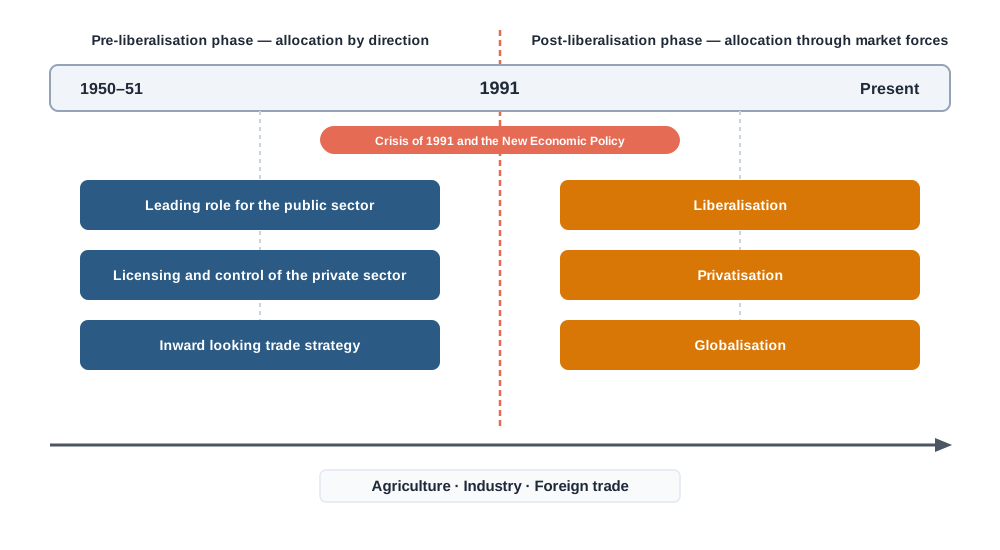
Fig. 10.0 – Two phases of India’s development strategy.
10.1 Strategy of Planning and Its Two Phases
Every economy has to decide not only what it wants to achieve but also how it proposes to get there. India, after Independence, set itself the objectives of accelerating economic development, removing poverty, raising the standard of living, achieving balanced regional development and reducing economic inequality. Those objectives have stayed broadly the same across the whole period of planning.
What has changed, and changed sharply, is the route chosen to reach them. The government’s view of who should own industry, how much freedom the private producer should have, and how open the country should be to foreign goods and foreign capital has altered a great deal since 1950–51. That set of choices is what economists call the strategy of planning.
10.1.1 Meaning of the Strategy of Planning
The strategy of planning is the basic long-term policy adopted to achieve the specific objectives of economic planning. Objectives state the destination; the strategy states the road. It covers the broad actions and policies through which the government intends to reach the targets laid down in successive plans.
A strategy of planning has to settle a small number of large questions.
- The relative role of the public and private sectors — how much of production the state itself will undertake, and how much it will leave to private enterprise.
- The relative priority of agriculture and industry — which sector is to receive the bulk of investment, and which kind of industry is to be built first.
- The degree of regulation of private activity — whether private producers are to be directed through licences, controls and price fixation, or guided mainly by market prices.
- The attitude to the rest of the world — whether the economy is to be protected from foreign goods and foreign capital, or opened to them.
The answers a country gives to these four questions determine the character of its economy far more than the growth targets written into any one plan. A change of strategy therefore marks a genuine turning point, while a change of target does not.
10.1.2 The Pre-1991 and Post-1991 Phases
The strategy of Indian planning has passed through two broad phases, divided by the economic crisis of 1990–91 and the reforms that followed it.
- Pre-1991 phase — during the pre-liberalisation phase the state took the leading part in production and investment. The public sector was assigned the commanding heights of the economy, private industry worked under a system of licences and controls, and the economy was largely closed to imports and to foreign investment. Resources were allocated substantially by administrative decision rather than by price.
- Post-1991 phase — during the post-liberalisation phase the state withdrew from a large part of direct production and turned to regulating an economy in which private enterprise and market prices carry the main burden of allocation. Controls on domestic industry were dismantled, public undertakings were partly sold off, and the economy was opened to foreign trade and foreign capital.
The dividing line is not arbitrary. The balance of payments crisis of 1990–91 exhausted the country’s foreign exchange reserves and made the old strategy impossible to continue, so 1991 marks the point at which the means of planning were recast even though its declared ends were not.
10.2 Features of the Pre-Liberalisation Phase
The strategy followed between 1950–51 and 1990–91 rested on a single judgement: that a poor country with little private capital and a very small industrial base could not be developed quickly by market forces alone. Private investors would go where profit was highest and quickest, not where the economy most needed capital, and heavy industry needed sums that no Indian firm of the time could raise.
The state therefore took the leading part in production and confined private enterprise within limits it laid down. Six features of this phase follow from that decision.
10.2.1 The Mixed Economy Framework
Indian planning adopted the framework of a mixed economy, in which the public and private sectors exist side by side. The declared social objective was economic growth with equitable distribution within a democratic political framework, and neither pure capitalism nor pure socialism was thought capable of delivering both halves of that objective at once.
A mixed economy allowed the state to direct investment towards purposes the market would neglect, while leaving private initiative in place where it worked well. The framework itself has never been abandoned. What changed after 1991 was the proportion between the two sectors and the way each was regulated.
10.2.2 Heavy Reliance on the Public Sector
The public sector was assigned a greater role than the private sector and was expected not merely to begin the process of development but to shape its whole pattern. It was to invest on a massive scale in order to promote industrialisation, to build transport, power and other infrastructure, and to develop basic and heavy industries.
Behind this lay the idea of the commanding heights of the economy — those industries and services of such importance that control over them amounts to control over the direction of the economy as a whole. The Industrial Policy Resolution, 1956 placed seventeen industries, among them arms, atomic energy, iron and steel, heavy machinery, air transport and railways, exclusively in state hands.
Private entrepreneurs at that time had neither the resources nor the willingness to invest on such a scale, particularly in projects that took many years to yield a return. Through the public sector, the government played both a promotional and an entrepreneurial role in economic affairs.
10.2.3 Regulated Growth of the Private Sector
The private sector was assigned a subordinate role. It had a part to play in development, but subject to restrictions designed to keep it in step with the plan and to prevent the concentration of economic power in a few hands.
The main instruments of regulation were the following.
- Industrial licensing — under the Industries (Development and Regulation) Act, 1951, a new industrial unit could not be established, nor an existing one substantially expanded, without government permission. Industrial licensing allowed the state to decide who would produce what, in what quantity and where.
- Price and investment controls — the prices of several important commodities were fixed or regulated, and the investment decisions of large industrial houses required approval.
- Control of foreign exchange — the use of scarce foreign exchange was rationed through exchange regulations, so that a firm could not freely import what it wished.
- Restrictions on large firms — the Monopolies and Restrictive Trade Practices Act, 1969 required large industrial houses to obtain clearance before expanding capacity or setting up new undertakings.
Together these controls came to govern nearly every important decision an industrial firm could take.
10.2.4 Development of Heavy and Strategic Industries
High priority was given to heavy industries such as iron and steel, chemicals and machine-building, and to industries of strategic importance such as electric power generation and engineering goods. The reasoning was that a country able to make its own machines can go on to make everything else, whereas one that imports its machines remains dependent on others for the pace of its own growth.
This choice explains the large public investments of the Second and Third Plan periods and the character of the industrial structure India possessed by 1990.
10.2.5 Development of Small-Scale Industries
Alongside heavy industry, the strategy encouraged small-scale industry for the opposite set of reasons: it generates a great deal of employment for a given amount of capital, it spreads industry across regions rather than concentrating it, and it widens the ownership of productive assets.
Two methods were used. Certain lines of production were reserved for exclusive manufacture by small units, so that large firms could not enter them, and separate financial institutions were set up to meet the credit needs of small producers, along with support for technical training and marketing.
10.2.6 Inward Looking Trade Strategy
Trade policy before 1991 was inward looking. Technically it is described as a strategy of import substitution: goods previously bought from abroad were to be produced at home instead, behind a wall of heavy import duties and quantitative restrictions on imports.
The purpose was twofold. Scarce foreign exchange was to be saved for imports the country could not do without, such as machinery, crude oil and industrial raw material, and domestic industry was to be sheltered from foreign competition until it grew strong enough to face it.
The shelter, however, was never withdrawn. Producers protected from competition for decades had little reason to reduce costs or improve quality, and Indian goods remained expensive by world standards.
10.2.7 Restrictions on Foreign Capital
Foreign investment was tightly restricted. The Foreign Exchange Regulation Act, 1973 limited both the areas in which foreign direct investment was permitted and the share of equity a foreign company could hold in an Indian enterprise. Foreign technology agreements likewise required approval.
The intention was to prevent foreign control over Indian industry and to conserve foreign exchange. The cost was that the country received little of the capital, technology and management practice that foreign investment brings with it.
10.3 The Crisis of 1991 and the New Economic Policy
A strategy is judged by what it produces. The forty years of planning before 1991 left India with a far larger and more varied economy than it had inherited, and at the same time with a set of weaknesses that finally brought the strategy itself to a halt. This section looks at both, and at the new economic policy that replaced the old approach.
10.3.1 Achievements of the Pre-Liberalisation Phase
Judged against the position in 1950–51, the achievements of the planning era were substantial. India moved a considerable distance from underdevelopment towards development, and the different sectors of the economy recorded moderate to good performance.
- Growth of output — gross domestic product grew at about 5.5 per cent a year during the 1980s, well above the rate of the first three decades of planning.
- Industrial growth — industry grew at about 8.5 per cent a year between 1985 and 1990, and by 1990 India possessed a well-diversified industrial sector capable of producing a wide range of capital and consumer goods.
- Structural change — the share of industry and services in gross domestic product rose significantly between 1950–51 and 1990–91, while that of agriculture fell, which is the normal course of economic development.
- Saving and investment — the rates of saving and investment both rose over the period, so that a larger part of the country’s output was being set aside to add to its productive capacity.
10.3.2 Causes of the Crisis of 1991
The same planning strategy that produced high growth in the 1980s pushed the economy towards crisis at the end of that decade, because much of the growth had been financed by borrowing rather than earned. The crisis began in 1990–91 and deepened in 1991–92.
- Weakness of the pre-1991 policies — controls had bred delay, corruption and inefficiency, and protected industry had little incentive to reduce costs, so exports grew slowly while the demand for imports did not.
- Foreign exchange crisis — persistently large trade deficits and heavy external borrowing exhausted the country’s reserves. By June 1991 reserves had fallen to about one billion dollars, enough to pay for roughly two weeks of imports.
- Mounting fiscal deficit — government expenditure ran well ahead of revenue through the 1980s, and the borrowing that filled the gap raised both the interest burden and the pressure on prices.
- The Gulf crisis — the conflict of 1990–91 raised the price of crude oil sharply, increasing the import bill, while remittances from Indians working in the Gulf fell as workers returned home.
- Rising prices — inflation reached double digits by 1991, eroding real incomes and further weakening the competitiveness of Indian goods abroad.
- Poor performance of public undertakings — many public sector enterprises were making losses, so that instead of financing development they drew on the budget to stay in operation.
10.3.3 Liberalisation
The response to the crisis was a new set of policy measures adopted in 1991, known as the new economic policy or, more commonly, the economic reforms. It rests on three elements — liberalisation, privatisation and globalisation.
Liberalisation means freeing the economy from the controls and restrictions imposed on it before 1991. Industrial licensing was abolished for all but a few industries, price controls were withdrawn from most commodities, restrictions on the expansion of large firms were relaxed, and controls on the use of foreign exchange were eased.
The object was not to withdraw the government from the economy but to change what it does. Instead of deciding who may produce and how much, the state was to secure competition, regulate where markets fail and provide for those the market leaves out.
10.3.4 Privatisation
Privatisation means expanding the role of the private sector and correspondingly reducing that of the public sector. Public undertakings had grown into a large part of the economy by 1991, and while many of them had built strategic industries, a great number performed poorly — running losses, using capacity below its potential and carrying more employees than the work required.
The government therefore reduced the number of industries reserved for the public sector and began selling part of the equity of public enterprises to private buyers, a process known as disinvestment. Loss-making and non-performing undertakings were the first to be sold, and those retained were given greater managerial and financial autonomy.
10.3.5 Globalisation
Globalisation means integrating the domestic economy with the economies of the rest of the world through the free movement of goods, services, capital and technology across national boundaries. An economy that trades and invests across borders can obtain what it produces expensively at home from wherever it is made cheaply, and can specialise in what it does well.
Accordingly, import duties were reduced, quantitative restrictions on imports were removed, and the rules governing foreign direct investment were relaxed so as to draw in foreign capital and technology.
The three elements are not separate policies but three sides of one change of strategy: allocation by administrative decision gave way to allocation by market forces, at home and in dealings with the rest of the world. The main points of contrast between the two strategies are set out below.
10.4 Agricultural Policy in the Post-Liberalisation Period
10.4.1 Place of Agriculture in the Indian Economy
Economic development after 1991 has been driven mainly by industry and, still more, by services. Agriculture nevertheless remains the sector on which the largest number of Indians depend for a living, and any policy that neglects it neglects most of the country’s workforce.
Two facts fix its place. Agriculture and allied activities support a little over two-fifths of the working population, and they contribute a much smaller share of national income than that — around one-sixth in recent years. The gap between the two proportions is itself the central fact about Indian agriculture: far more people are employed there than the sector’s output can comfortably support, which is why output per worker, and therefore income per worker, remains low.
The share of agriculture in national income has fallen steadily through the period of planning. This is expected in the course of development, since incomes spent on food rise more slowly than incomes as a whole. What matters for policy is whether the share of the workforce falls with it.
10.4.2 Objectives of Agricultural Policy
At Independence, Indian agriculture was backward and traditional. Productivity was very low, old techniques were in use, water, improved seed and fertiliser were scarce, credit and marketing arrangements were inadequate, and the agrarian structure itself — a system of intermediaries between the state and the tiller — discouraged investment in the land.
Private effort alone could not repair this. Only the government could raise resources on the scale required for irrigation, research and rural infrastructure, and only the state could alter the agrarian structure. From the First Five-Year Plan onwards, therefore, agricultural policy has aimed at raising production and productivity, protecting small and marginal farmers, modernising cultivation, ensuring food security for consumers, strengthening rural infrastructure and making agriculture market-oriented.
The measures adopted fall into three groups — technological, infrastructural and institutional — to which price policy, subsidy, food security and employment programmes have been added over time.
10.4.3 Technological and Infrastructural Measures
Technological measures were designed to raise the yield obtained from a given area of land. They consist of the extension of irrigation, the supply of high-yielding varieties of seed, chemical fertiliser and pesticide, and the spread of improved implements. Introduced from the middle of the 1960s, this combination — commonly called the green revolution — transformed wheat and later rice production in the better-watered parts of the country.
Infrastructural measures provide the facilities without which the new technology cannot be used or its produce sold.
- Credit — institutional credit was expanded through cooperative societies, commercial banks and regional rural banks, with the National Bank for Agriculture and Rural Development, set up in 1982, as the apex institution in the field of rural credit.
- Marketing — regulated markets were established to give the cultivator a fair and open sale, and cooperative marketing was encouraged.
- Storage and warehousing — capacity was built up to hold buffer stocks of foodgrains and to allow the farmer to store rather than sell at the moment of harvest.
- Research and extension — agricultural universities and research institutes were set up to develop new varieties and techniques and to carry them to the cultivator.
10.4.4 Institutional Measures and Land Reforms
Institutional measures change the terms on which land is held and cultivated. The agrarian structure inherited in 1947 gave the person who worked the land neither ownership nor security, so improvements to the land benefited someone else. Such a structure destroys the incentive to invest.
The land reforms undertaken had four parts.
- Abolition of intermediaries — the zamindari and similar systems were abolished, bringing the cultivator into direct relation with the state.
- Tenancy reform — rents payable by tenants were regulated, security of tenure was provided, and ownership rights were conferred on tenants in certain cases.
- Ceilings on landholding — an upper limit was placed on the area one household might hold, the surplus being available for redistribution.
- Consolidation of holdings — scattered plots belonging to one cultivator were exchanged and combined into a single compact holding.
Abolition of intermediaries was carried through with reasonable success. Tenancy reform and ceiling legislation were much less effective, since land was transferred within families and tenancy went unrecorded, and their limited results are among the reasons agriculture still carries the problems examined later in this chapter.
10.4.5 Minimum Support Prices and Procurement Prices
A farmer decides what to sow months before he knows what the crop will fetch. If a good harvest drives prices down, the reward for producing more is a smaller income, and the farmer who has borrowed to buy inputs may not recover his costs. Price policy exists to remove this risk from the decision to produce.
The government therefore announces a minimum support price before the sowing season for a number of agricultural commodities, wheat and paddy among them, on the recommendation of the Commission for Agricultural Costs and Prices. It undertakes to buy at that price whatever quantity is offered to it, so the market price cannot fall below the declared floor.
Distinct from this in principle is the procurement price, the price at which the government buys the quantity of foodgrains it needs for the public distribution system and for building up buffer stocks. Being intended to draw grain in rather than merely to set a floor, it was fixed at a level higher than the support price.
10.4.6 Input Subsidies and the Food Security System
Under the policy of input subsidies, irrigation, fertiliser and power are supplied to farmers below their market price. The purpose is to persuade cultivators to move from traditional inputs to modern ones, whose cost would otherwise deter a farmer with little cash and no certainty of a good season. Because they are meant to raise production rather than merely to relieve distress, these are described as development subsidies.
The food security system works at the other end of the same market. The government maintains a public distribution system through which foodgrains are supplied at subsidised rates to households holding ration cards, particularly poor households, through fair price shops. The Central Government is responsible for procurement and allocation of grain; the state governments distribute it to eligible beneficiaries. Buffer stocks built up in good years supply the system in years when production falls.
10.4.7 Rural Employment, Crop Insurance and People’s Participation
Three further strands complete the policy.
- Rural employment programmes — cultivation gives work for only part of the year, so specially designed programmes provide wage employment and encourage self-employment in the slack season. The Mahatma Gandhi National Rural Employment Guarantee Act, 2005 is the principal measure of this kind, guaranteeing a hundred days of wage employment in a financial year to every rural household whose adult members volunteer to do unskilled manual work.
- Crop insurance — a harvest can be destroyed by drought, flood or pest through no fault of the cultivator. The Pradhan Mantri Fasal Bima Yojana, launched in 2016, insures notified crops against such losses; the farmer pays a low share of the premium and governments at the Centre and in the states pay the rest, and the claim is credited directly to the farmer’s account.
- People’s participation — no plan for rural areas succeeds unless those who live there take part in making it. The Community Development Programme, begun in 1952, treated the village rather than the farm as the unit of development, and the Panchayati Raj system carries decision-making down to the village, the block and the district.
Taken together these measures amount to a comprehensive policy covering almost every facet of rural development. Their success, judged by results, has been fair to moderate — considerable in raising output, much smaller in changing the structure of landholding or the income of the average cultivator.
10.5 Agriculture: Achievements and Problems
Policy is one thing and result is another. Agriculture in India has been transformed since 1950–51 in the quantity it produces, and has changed remarkably little in the conditions under which most cultivators work. Both halves of that statement need to be set out.
10.5.1 Features of Agricultural Development
The policy measures and agrarian reforms of the planning period led to a substantial improvement in Indian agriculture, which has emerged as a vibrant and developing sector of the economy. Its main achievements are the following.
- Increase in production — output of foodgrains and of non-food crops such as sugarcane, cotton and oilseeds has risen greatly over time. The scale of the increase is set out in Table 10.1. The most important consequence is that India, which once imported wheat to feed itself, now meets its foodgrain requirement from its own production.
- Increase in productivity — yield per hectare has risen along with output, so the larger harvest comes chiefly from more produce per unit of land rather than from more land.
- Increase in area under cultivation — gross cropped area has expanded, partly because net sown area increased and partly because double cropping allows the same field to bear two crops in a year. Area under non-food crops has grown faster than area under food crops since 1991, though foodgrains still occupy the greater part of the cultivated area.
- Commercialisation of agriculture — non-food crops are grown for sale rather than for the grower’s own use, so a larger output of them means that farming increasingly earns a money income.
- Change in the farmer’s outlook — farming is no longer regarded merely as a means of subsistence. It is treated as a commercial activity undertaken with the object of earning a profit, which alters the way the cultivator judges what to sow and what to spend.
- Use of high-yielding varieties and chemical fertiliser — high-yielding seed and fertiliser are now used over a large part of the cropped area, wheat being the crop where their adoption is most complete. Fertiliser consumption has multiplied several times over since 1990–91.
- Mechanised agriculture — tractors, harvesters and threshers have come into wide use, raising output per worker. Mechanisation remains confined largely to areas that already have assured irrigation and improved inputs.
10.5.2 Problems of Indian Agriculture
Notwithstanding these achievements, Indian agriculture still faces a number of serious problems.
- Low growth rate — agricultural output has generally grown more slowly than the economy as a whole throughout the period of planning, and the rate fluctuates from year to year with the monsoon. A sector supporting so large a part of the population cannot raise its incomes at that pace.
- Low level of productivity — yield per hectare in India remains well below that of the leading producing countries; the yield of rice, for instance, was about three-fifths of China’s in 2020. Output per worker is lower still and has stayed nearly stagnant, because the number of people the sector supports has not fallen.
- Pressure of population on land — cultivable land per person is very low and has fallen further as population has grown, since the area under cultivation cannot increase in proportion. This pressure is itself the main cause of the subdivision and fragmentation of holdings.
- Land tenure system — although zamindari has been abolished, tenancy persists, much of it unrecorded. A tenant without security of tenure, paying a high rent, has little reason to invest in land he may lose, and large landowners are better placed to obtain subsidised inputs and institutional credit.
- Uneconomic holdings — the average operational holding is only a little over one hectare, and about 86 per cent of holdings are small or marginal, that is below two hectares (Agriculture Census, 2015–16). Modern techniques and machinery cannot be applied economically on holdings of this size.
- Traditional outmoded techniques — a large number of cultivators still work with wooden ploughs, animal power and farm-saved seed. Improved seed, fertiliser and machinery are used intensively in some regions and hardly at all in others.
- Inadequate irrigation facilities — a little over half the gross cropped area is irrigated, which leaves nearly half of it dependent on the monsoon. Rainfall is uncertain in amount and timing, and it is this dependence that gave Indian agriculture its description as a gamble in the rains.
- Inadequate marketing facilities — the cultivator faces a chain of intermediaries, a multiplicity of market charges, absent grading and standardisation, poor storage and transport, and little information about prices elsewhere. His bargaining power against the trader is correspondingly weak.
- Inadequate credit facilities — institutional credit from cooperatives, commercial banks and regional rural banks now meets the bulk of the demand, but a large share of it is taken by larger cultivators. Small farmers, tenants and labourers, who cannot offer security, still borrow from moneylenders and traders at very high rates of interest.
- Large numbers of agricultural labourers — the landless labourer, who owns nothing and works for a wage, is the most exploited class in the rural economy. Such work is casual and seasonal, wages are low, and unemployment during the slack season is normal.
- Low income and indebtedness — the average income of an agricultural household is very low, and roughly half of all such households were in debt, with an average outstanding loan of about ₹74,000 (National Sample Survey, Situation Assessment Survey, 2019). Low and fluctuating income is both the cause of the borrowing and the reason it is hard to repay.
Read together, these problems have a common root. Too many people depend on too little land, and until non-agricultural employment absorbs a part of that workforce, higher output alone raised the income of the average cultivator.
10.6 Industry in the Post-Liberalisation Period
10.6.1 Place of Industry in the Indian Economy
Industry occupies a place in economic development out of proportion to its share in output. Manufacturing contributes roughly a seventh of India’s gross value added and employs a little over a tenth of the workforce, yet no country has moved from poverty to prosperity without building it.
The reason lies in what industry does that agriculture cannot. Land is fixed in quantity and yields less at the margin as more labour is applied to it, whereas a factory can be built beside another factory. Industry also makes the machines, fertilisers and implements on which agricultural productivity itself depends, and it absorbs the workers whom a modernising agriculture no longer needs.
Industrialisation is therefore the process by which the share of industry in national income and in the workforce rises. Planners in India have recognised its importance since the launching of the Five-Year Plans, and the pattern of industry the country possesses today is largely the result of the policy choices described below.
10.6.2 Meaning and Purpose of Industrial Policy
Industrial policy is the roadmap a government lays down for the industrial development of the country. It states the measures through which the government proposes to facilitate and promote industry — what the state will produce itself, what it will allow others to produce, and on what terms.
India’s industrial policy has been revised as needs and circumstances changed, notably in 1948, 1956, 1977, 1980 and 1991. The resolutions of 1948 and 1956 built the framework of state-led industrialisation described earlier in this chapter. The statement of 1991 dismantled a large part of it.
10.6.3 Features of the Industrial Policy of 1991
The Industrial Policy of 1991 was an element of the new economic policy and shares its logic: to remove the controls of the previous era and let competition determine what is produced and by whom. Its main features are the following.
- Abolition of industrial licensing — the requirement that an entrepreneur obtain government permission to start a firm, to close it or to decide its capacity was withdrawn for almost all industries. Compulsory licensing was retained only for a small number, chiefly those involving defence equipment, industrial explosives, hazardous chemicals and tobacco products.
- Policy of dereservation — the number of industries reserved exclusively for the public sector was cut from seventeen to eight in 1991, and reduced further afterwards. Production areas that had been reserved for small-scale units were also progressively dereserved, opening them to firms of any size.
- Relaxation of controls on monopolies — large firms no longer needed prior government approval to expand capacity or to establish new undertakings. The concern shifted from the size of a firm to its conduct, and the Monopolies and Restrictive Trade Practices Act, 1969 was in due course replaced by the Competition Act, 2002.
- Continued importance of small-scale industries — small units retained a high priority for their contribution to employment, to the diversification of industry and to balanced regional growth. Support shifted from protection by reservation to assistance with finance, raw material, technical expertise and infrastructure.
- Reducing the role of public sector enterprises — the number of industries reserved for the public sector was reduced, part of the equity of government-owned undertakings was sold to private buyers, and loss-making units were sold off. Enterprises retained in state hands were given greater managerial autonomy and enhanced financial powers.
10.6.4 Recent Industrial Reforms
Policy since has continued along the same line, working on the conditions in which firms operate rather than on permissions.
- Make in India — launched in 2014, the programme aims at making India a global hub for manufacturing, research and innovation, and at raising the share of manufacturing in output and employment.
- Startup India — launched in 2016 to build an ecosystem for new enterprises, offering simplified compliance, tax concessions and funding support so that small innovative firms can grow.
- Ease of doing business — rules and procedures have been simplified and rationalised to make it quicker and cheaper to start and run a business. India’s position in the World Bank’s ranking improved from 142 in the report for 2015 to 63 in the report for 2020, after which the Bank discontinued the exercise.
- Goods and Services Tax — introduced on 1 July 2017, the tax replaced a large number of central and state indirect taxes with a single levy, so that goods move across state boundaries without a fresh tax at each crossing.
- Atmanirbhar Bharat Abhiyan — announced in May 2020, the campaign for a self-reliant India seeks to make domestic manufacturing competitive enough to serve world markets, moving from reliance to self-reliance and towards manufacturing-led, export-driven growth.
Self-reliance in this sense differs from the import substitution of the pre-1991 era. The earlier policy shut out foreign goods to protect producers who could not match them; the present one aims at producers able to sell in world markets, and relies on reforms in taxation, corporate tax rates, business regulation and foreign investment rules to get them there.
10.6.5 Problems of Industrial Development in India
Industrial development in India remains beset with difficulties, some inherited from the earlier strategy and some created by the pattern of growth itself.
- Gaps between targets and achievements — actual industrial performance has mostly fallen short of the targets fixed in successive plans.
- Unutilised production capacity — a considerable part of installed capacity lies idle, the main causes being shortage of raw materials, interruptions in power supply, labour disputes and insufficient demand for the product.
- High-cost structure of industries — costs and prices of Indian goods are often higher than international levels, owing to low labour productivity, units of uneconomic size, underutilised plant and costly credit and power.
- Inadequate generation of employment — industry has not absorbed labour on the scale expected, largely because capital-intensive methods have been adopted in a country where labour is abundant and capital scarce.
- Poor performance of public sector enterprises — many public undertakings have earned little or no profit and some have accumulated heavy losses, placing a burden on the exchequer that could have financed development instead.
- Regional imbalances — industry has concentrated in a few states, among them Gujarat, Maharashtra, Tamil Nadu and Karnataka, while states such as Bihar and parts of central and eastern India have remained largely non-industrialised.
- Production for elite groups — industries serving high-income demand, such as cars and consumer durables, have expanded faster than those producing goods of mass consumption, so the pattern of output reflects the distribution of purchasing power rather than the distribution of need.
- Concentration of economic power — industrial growth has been accompanied by the concentration of ownership and wealth in relatively few hands, which is what the controls of the earlier era had been designed, unsuccessfully, to prevent.
- Industrial sickness — a significant number of units, particularly small ones, become sick and cease to operate viably, through financial mismanagement, obsolete technology, uneconomic size, high costs or shortage of raw material and power.
10.7 Foreign Trade in the Post-Liberalisation Period
10.7.1 Importance of Foreign Trade
No country possesses everything it needs, and none is equally good at producing everything it can. Foreign trade allows a country to sell abroad what it produces well and to buy what it produces expensively or not at all.
For a developing economy the gains are of three kinds. Exports provide an outlet for output that the home market cannot absorb, so that domestic resources are used more fully. Imports bring in machinery, raw material, crude oil and technology that development requires and the country cannot supply itself. And foreign capital entering along with trade adds plant, equipment and management practice to the resources available for development.
That is why planners in India have always accorded foreign trade a high priority, even in the decades when policy was directed at reducing dependence on it.
10.7.2 Features of India’s Foreign Trade Since 1991
Five changes stand out in the period since 1990–91.
- Large increase in the volume of trade — India’s foreign trade has grown many times over in dollar terms since 1991–92, exports and imports both rising far faster than in the preceding decades.
- Rise in the trade-GDP ratio — exports and imports taken together, expressed as a percentage of gross domestic product, rose from about 17 per cent in 1990 to roughly 46 per cent in 2022–23. Both the export-GDP ratio and the import-GDP ratio increased, which is the clearest single measure of how far the economy has opened since 1991.
- A persistent deficit in the balance of trade — imports have grown consistently faster than exports, so the value of goods bought from abroad has exceeded the value of goods sold. This excess of imports over exports is the deficit in the balance of trade, and it has widened considerably in recent years.
- Low share in world trade — India’s share in world exports was about 1.8 per cent in 2022–23, against roughly 13 per cent for China. Measured by its weight in world markets, India remains among the less globalised of the major economies.
- Change in the composition of exports and imports — what India sells and buys has altered as much as how much it trades. This is examined in the two paragraphs that follow.
The composition of exports has moved away from primary products. Exports of agricultural goods and of industrial raw materials such as jute and cotton have declined in relative importance, while manufactured goods — engineering goods, readymade garments, gems and jewellery, chemicals and pharmaceuticals, petroleum products and electronic goods — now account for about three-quarters of merchandise export earnings. A country that once exported raw material and imported manufactures now largely does the reverse.
The composition of imports has changed correspondingly. India once imported finished goods such as medicines, cloth, automobiles, iron and steel. It now imports mainly crude oil and petroleum products, chemicals, fertilisers, capital goods, electronic components and precious stones — that is, inputs used to produce something else rather than articles for final consumption.
10.7.3 Trade Policy Before and After 1991
Before 1991 India followed an inward looking trade strategy resting on two ideas: import substitution and import restriction. Goods bought abroad were to be produced at home instead, and the home producer was to be shielded from foreign competition by heavy import duties and by quotas limiting the quantity that could be brought in. Scarce foreign exchange was thereby saved for essential imports, and self-reliance was pursued across as wide a range of goods as possible.
After 1991 trade policy underwent a complete change of direction. It is now described as a policy of opening up the economy to free trade and to the world market. Four reforms carried this through.
- Import licensing was abolished, so that a firm no longer needed permission to buy what it required from abroad.
- Quantitative restrictions on imports — that is, import quotas — were withdrawn.
- Import duties were reduced substantially from the very high levels prevailing in 1991, exposing domestic producers to competition and lowering the cost of imported inputs.
- Export duties were removed, so that Indian goods might compete on price in international markets.
The reasoning behind each strategy is best seen side by side.
The result has been the integration of Indian markets with those of the rest of the world, increasing trade and, through competition, pressing domestic producers towards lower costs and better quality.
10.7.4 Problems of India’s Foreign Trade
Opening the economy has brought its own difficulties.
- Imports rising faster than exports — the rate of increase of imports has stayed consistently above that of exports since 1991–92, so the trade deficit has widened rather than closed.
- Slower growth of trade in recent years — after the rapid expansion of the 2000s, the growth of both exports and imports has slowed, and in some years, such as 2015–16 and 2020–21, both actually contracted.
- Meagre share in world trade — India’s share of world exports remains small compared with that of other major economies, so its exports are vulnerable to conditions abroad while its influence on world markets is slight.
- Dependence on imported crude oil — a large part of the import bill consists of petroleum, whose price is set in world markets and cannot be controlled from India. A rise in the price of crude widens the deficit regardless of anything domestic producers do.
- A narrow export base — a few commodity groups and a few destination markets account for a large share of export earnings, so a downturn in one product or one region affects the whole.
10.8 Summary
- The strategy of planning is the basic long-term policy adopted to achieve the objectives of economic planning. India’s objectives have stayed broadly constant since 1951; the strategy chosen to reach them changed sharply in 1991.
- A strategy of planning settles four large questions:
- the relative role of the public and private sectors;
- the relative priority of agriculture and industry;
- the degree of regulation of private activity;
- the attitude to foreign trade and foreign capital.
- The pre-liberalisation phase relied on allocation by administrative decision; the post-liberalisation phase relies on allocation by market forces, with the state acting as regulator.
- The features of the pre-liberalisation phase were: heavy reliance on the public sector, regulated growth of the private sector, development of heavy and strategic industries, development of small-scale industries, an inward looking trade strategy and restrictions on foreign capital, all within a mixed economy framework.
- Private enterprise before 1991 was regulated through industrial licensing, price and investment controls, foreign exchange rationing and restrictions on the expansion of large industrial houses.
- Import substitution is a trade strategy under which goods formerly imported are produced at home instead, the domestic producer being protected by heavy import duties and import quotas.
- The planning era raised growth, built a diversified industrial base and increased the rates of saving and investment, but by 1990–91 it had also produced a foreign exchange crisis, a mounting fiscal deficit, rising prices and loss-making public undertakings.
- The new economic policy of 1991 rests on three elements:
- liberalisation — freeing the economy from licensing, price control and investment restrictions;
- privatisation — enlarging the role of the private sector and reducing that of the public sector, disinvestment being the sale of part of the government’s shareholding;
- globalisation — integrating the domestic economy with the world economy through the free flow of goods, capital and technology.
- Agriculture supports a little over two-fifths of the workforce but contributes around a sixth of national income. That gap is the central fact about the sector and the reason incomes in it are low.
- Agricultural policy has worked through technological measures, infrastructural measures, institutional measures and land reforms, price policy, input subsidies, the food security system, rural employment programmes, crop insurance and programmes of people’s participation.
- The minimum support price is announced before sowing and sets a floor below which the market price cannot fall; the procurement price is the price at which the government buys the grain it needs for the public distribution system and for buffer stocks.
- Land reforms comprised abolition of intermediaries, tenancy reform, ceilings on landholding and consolidation of holdings. Abolition of intermediaries largely succeeded; tenancy reform and ceilings did not.
- Agricultural development has brought higher production and productivity, a larger cropped area, commercialisation, a changed outlook among farmers, wide use of high-yielding varieties and fertiliser, and mechanisation in the better-endowed regions.
- Indian agriculture still faces low growth, low productivity, population pressure on land, an unfavourable tenure system, uneconomic holdings, outmoded techniques, inadequate irrigation, marketing and credit, a large landless labour force and low household incomes with heavy indebtedness.
- Industrial policy is the government’s roadmap for industrial development. The Industrial Policy of 1991 abolished licensing for almost all industries, dereserved industries held for the public sector and items reserved for small-scale units, relaxed controls on large firms, retained support for small industry and reduced the role of public sector enterprises.
- Recent industrial reforms — Make in India, Startup India, measures for ease of doing business, the Goods and Services Tax and Atmanirbhar Bharat Abhiyan — work on the conditions in which firms operate rather than on permissions to operate.
- Industrial development is held back by gaps between targets and achievements, unutilised capacity, a high-cost structure, inadequate employment generation, poor performance of public undertakings, regional imbalance, production for elite groups, concentration of economic power and industrial sickness.
- India’s foreign trade since 1991 shows a large increase in volume, a rise in the trade-GDP ratio from about 17 per cent in 1990 to roughly 46 per cent in 2022–23, a persistent deficit in the balance of trade, a small share in world exports of about 1.8 per cent in 2022–23, and a shift in composition towards manufactured exports and imports of inputs.
- Trade policy reforms after 1991 abolished import licensing, removed quantitative restrictions on imports, reduced import duties and withdrew export duties, replacing an inward looking strategy with an outward looking one.
- The problems of India’s foreign trade are imports rising faster than exports, slower growth of trade in recent years, a meagre share in world trade, dependence on imported crude oil and a narrow export base.
10.9 Points to Ponder
- The controls of the pre-1991 era were designed to prevent the concentration of economic power in a few hands, and yet concentration is listed among the problems of industry today. Did the controls fail at what they set out to do, or did they succeed while something else produced the concentration?
- Protection was intended to shelter Indian industry until it grew strong enough to face foreign competition. If the shelter is never withdrawn, does the industry ever become strong? How would you decide when protection has served its purpose?
- A minimum support price removes the risk of a price collapse from the farmer’s decision to produce. It also tells the farmer which crops are worth sowing. What happens to the pattern of cultivation — and to soil and water — when a floor price is offered for some crops and not for others?
- Agriculture supports a far larger share of the workforce than of national income. Two remedies are possible: raise output per worker in agriculture, or move workers out of it. Which of the two is the more difficult, and does either work without the other?
- India’s share in world exports remains under two per cent, and this is presented in the chapter as a weakness. Would an economy of India’s size necessarily be better off with a much larger share of world trade, or does a large home market change the answer?
- Liberalisation shifted the state from deciding what should be produced to ensuring that competition is fair. Is the second task easier than the first, or merely different? Consider what a regulator needs to know in each case.
10.10 Objective Questions
- Which of the following was not a feature of the pre-liberalisation phase of Indian planning? [1]
- Industrial licensing of the private sector
- Reservation of industries for the public sector
- Removal of quantitative restrictions on imports
- Protection of domestic industry through heavy import duties
- The price announced by the government before the sowing season, below which the market price of a commodity is not allowed to fall, is called the ______________________. [1]
- State whether the following statement is true or false, and give a reason: Liberalisation means that the government has withdrawn completely from the Indian economy. [1]
- Assertion (A): Import substitution was adopted as the trade strategy of the pre-1991 period. Reason (R): India’s foreign exchange reserves were scarce and were to be conserved for essential imports. Choose the correct option: [1]
- Both A and R are true and R is the correct explanation of A.
- Both A and R are true but R is not the correct explanation of A.
- A is true but R is false.
- A is false but R is true.
- Match the measure in Column I with the purpose it serves in Column II: [1]
| Column I | Column II |
|---|---|
| a. Consolidation of holdings | i. To encourage the use of modern inputs by lowering their cost to the farmer |
| b. Buffer stock of foodgrains | ii. To combine a cultivator’s scattered plots into a single compact holding |
| c. Input subsidy | iii. To supply the public distribution system in a year of poor production |
10.11 Check Your Concepts
- Define the strategy of planning. [2]
- Distinguish between the minimum support price and the procurement price. [3]
- Explain any four features of the pre-liberalisation phase of Indian planning. [4]
- ‘Indian agriculture has raised its production greatly and its incomes very little.’ Explain this statement with reference to the achievements and the problems of Indian agriculture since 1991. [6]
10.12 Case-Based Question
- Harnam Singh cultivates three hectares of irrigated land in a canal-fed district and sows wheat every rabi season, selling his crop to a government procurement centre at the announced support price. Vasudha Rao farms one and a half hectares of unirrigated land in a neighbouring state, divided into four scattered plots. She grows coarse cereals and pulses for which no purchase centre operates nearby, and sells to a village trader who fixes the price and deducts a commission. In a year of deficient rain her output falls sharply, while Harnam Singh’s harvest is barely affected.
- Identify two problems of Indian agriculture illustrated by Vasudha Rao’s position, and explain how each reduces her income. [2]
- Explain how the pattern of agricultural policy described in the chapter has benefited cultivators such as Harnam Singh more than cultivators such as Vasudha Rao. [2]