Chapter 2: Basic Concepts of Economics
A household sits down at the start of the month with a fixed income in front of it. Some of it must go on food, some on the children’s school fees, some on repairing a leaking roof, and something should be kept aside for an illness that may never come. Every rupee placed against one of these ends is a rupee taken away from the others. That single act contains almost the whole of economics — wants that outrun the means available, goods that satisfy those wants, prices that must be paid, an income earned by working, and a part of it saved rather than spent. Economics describes such acts in a language of its own. Words like want, utility, value, wealth and welfare are used loosely in everyday speech, but in economics each carries a fixed and narrow meaning, and reasoning built on a loose meaning goes wrong quickly. This chapter sets out the elementary concepts on which the rest of the book rests, and shows how they connect to one another.
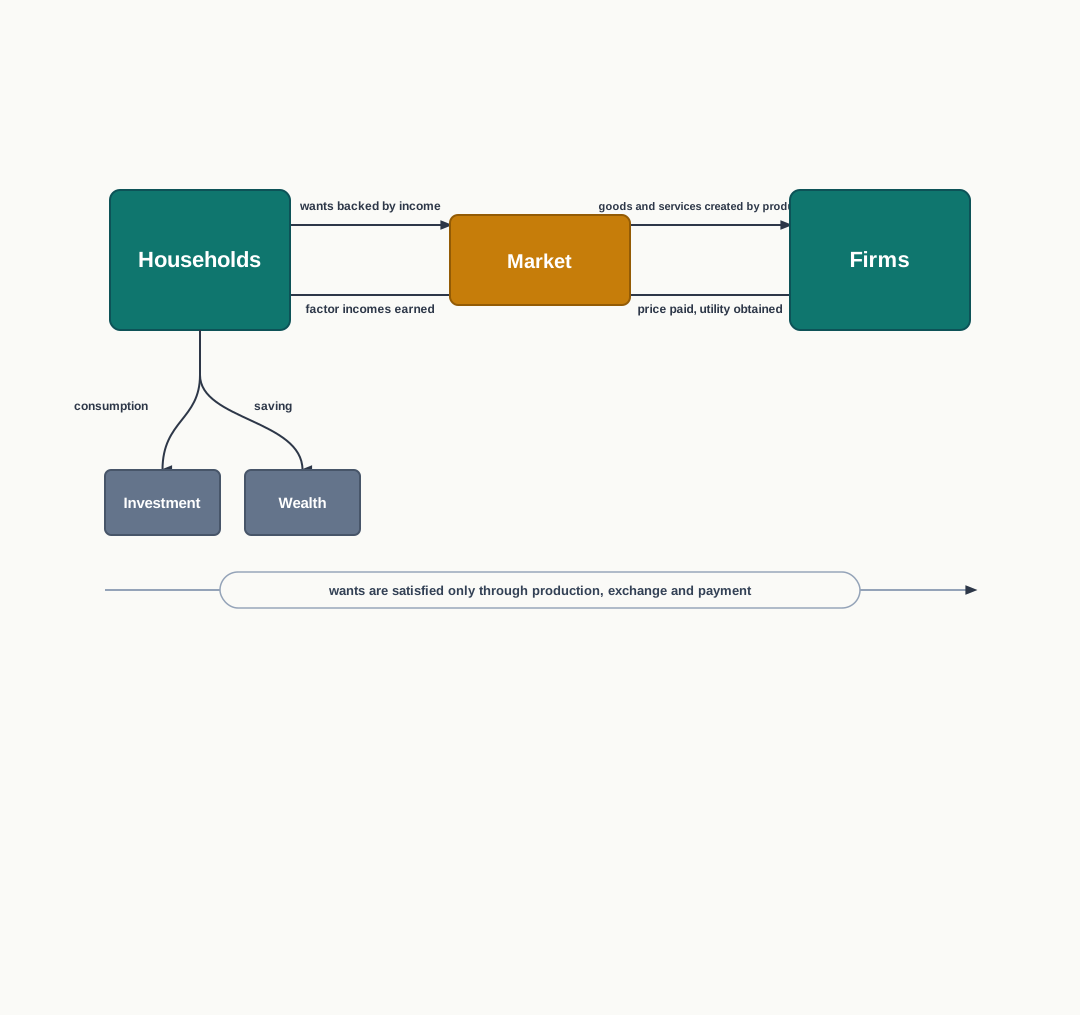
Fig. 2.0 – Connection between basic economic concepts.
2.1 Human Wants
Every economic activity begins with a want. People work, produce, buy and sell because there is something they wish to have and do not yet possess. If wants were few and the means of satisfying them plentiful, there would be no need to choose, and no need for economics. Wants are the starting point of the subject because they are endless, while the means of satisfying them are limited.
The study of wants therefore does two things. It tells us what economic activity is for, and it shows why choice is unavoidable. A student of economics must first be clear about what a want is, how wants are classified, and what characteristics they possess.
2.1.1 Meaning of a Want
In everyday speech the words ‘want’ and ‘desire’ are used to mean the same thing. Economics keeps them apart. A desire is simply a wish to have something. It costs nothing to entertain and carries no consequence for the economy.
A want is a desire that a person is able and willing to act upon. Three conditions must be met together. There must be a desire for the thing, the means to acquire it, and a readiness to part with those means. A person may desire a car and yet have no want for it in the economic sense, because he is neither earning enough to buy one nor prepared to give up other things to get one. The moment he begins to earn and to save for it, the desire becomes an effective want.
This distinction matters because economics deals only with wants that press upon resources. A desire that is never backed by effort makes no claim on the economy’s scarce means and leaves prices, production and income untouched.
2.1.2 Classification of Human Wants
Wants differ in how urgently they press. Some must be met if life is to continue at all; others can wait, and some are pursued only after the rest have been met. On this basis wants are divided into two broad categories, primary and secondary, as set out in Fig. 2.1.
Primary wants are wants for those goods which are necessary for the very existence of human life and for the maintenance of normal efficiency. They fall into two groups. The first covers goods without which life itself cannot be sustained — food, clothing and shelter, commonly called necessities. The second covers goods that keep a person working at normal efficiency: sufficient food for a factory worker doing heavy physical labour, or a table and chair for a student who must study.
Secondary wants are wants that arise only after primary wants have been satisfied. They relate to goods which cater to the comforts and luxuries of life, and they too fall into two groups.
- Wants for comforts — wants for those goods which are a source of comfort and happiness for people. A ceiling fan in a room, a cooking gas connection in the kitchen or a bicycle for the journey to work add ease to daily life without being necessary to it.
- Wants for luxuries — wants for those goods which are very expensive and which are meant to show the wealth and power of a person. Costly houses, expensive jewellery and imported cars are examples. Luxuries need not give benefit in proportion to their price; much of what they yield is prestige.
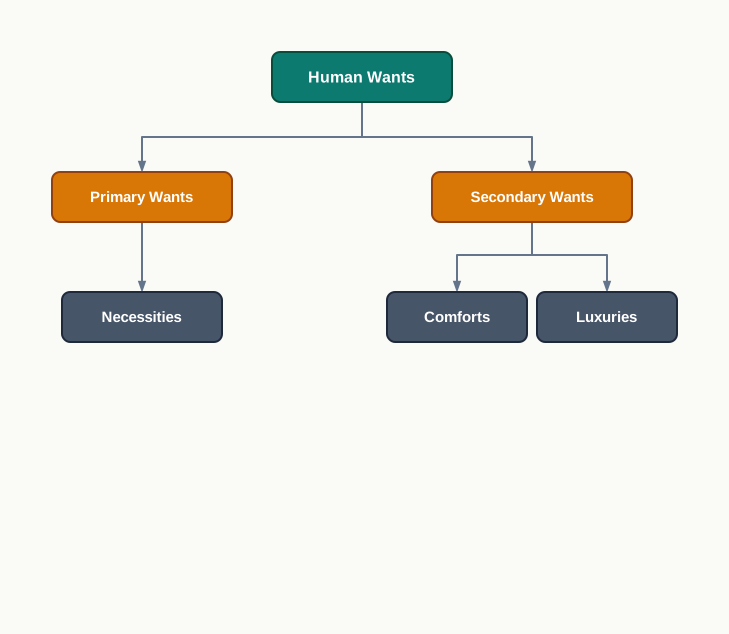
Fig. 2.1 – Classification of human wants.
The line between the two categories is not fixed for all time. A good that is a luxury in one period may become a comfort and later a necessity as incomes rise and the good becomes cheaper to produce. The main points of difference between the two categories are set out below.
2.1.3 Features of Human Wants
Human wants share certain characteristics, and several important economic principles rest on them. The main features are given below.
- Wants are unlimited — wants begin in childhood and continue through life, and satisfying one does not bring the list to an end. As soon as a person’s present wants are met, fresh ones take their place. It is this endlessness, set against limited means, that creates the economic problem.
- Wants are complementary — some wants exist only in company with others. A car creates a want for petrol, a pen a want for ink, a stove a want for fuel. The two goods are wanted together, and demand for one carries demand for the other with it.
- Wants can be substituted — a single want can often be met in more than one way. Thirst may be satisfied by tea, by a cold drink or by a glass of juice. Because substitutes exist, a rise in the price of one good pushes buyers towards another.
- Wants are competitive — a person’s income is limited, so the goods that could be bought with it compete against one another. A student with a fixed sum for the weekend can spend it on a meal outside, on a film, or on a match ticket, but not on all three. Every want satisfied is another want denied.
- Wants multiply — the number of wants grows over time. As knowledge and technology advance, new goods appear, and each new good creates a want that did not previously exist. Nobody wanted a microwave oven before ovens were invented.
- Wants recur — most wants are satisfied only for a while and then return. A meal in the morning does not remove hunger for the day; it returns by evening and must be satisfied again.
- A single want can be satisfied — although all wants together can never be met, any one want can be fully satisfied at a given time, provided enough of the good is consumed. This feature is the foundation of the law of diminishing marginal utility, studied later in this book.
- Some wants can be postponed — wants differ in how long they can be deferred. The purchase of a television or a two-wheeler can wait until income allows; the want for food cannot.
- Wants differ in urgency — wants are not felt with equal intensity. Each person arranges them mentally in order of importance, forming a scale of preference, and satisfies the more pressing ones first. The order is personal and it changes over time.
- Wants remain ahead of the availability of goods and services — however much an economy produces, the wants of its people run ahead of what is available. This gap is permanent, and it is the reason scarcity is the central fact of economics.
Taken together, these features explain why scarcity is universal. Wants are endless, recurring and constantly multiplying, while at any moment the goods available to satisfy them are limited. Every economy, whatever its system, must therefore decide which wants to meet and which to leave unmet.
2.2 Consumption
Wants by themselves change nothing. A want is satisfied only when a good or a service is actually used, and that act of use is what economics calls consumption. It is the point at which the whole chain of economic activity — producing, transporting, buying and selling — finally delivers something to a person.
Consumption is also the reason the rest of the chain exists. Nothing would be produced if there were no one to use it, so the study of consumption tells us what economic activity is ultimately for.
2.2.1 Goods, Services and the Meaning of Consumption
Wants are satisfied by commodities, and commodities fall into two classes. Goods are tangible things that can be seen and handled — rice, shirts, cycles, machines. Services are intangible; they cannot be stored or touched, and they are used at the moment they are provided. Teaching, medical treatment, a haircut and a train journey are services. Both satisfy wants, and economics treats both as part of the same activity.
The main points of difference between the two are set out below.
The act of using goods and services to satisfy human wants is called consumption, and the person who uses them is a consumer. Buying a good is not the same thing as consuming it; the purchase merely places the good in the buyer’s hands, while consumption is the use to which it is then put.
Consumption takes two forms, depending on the nature of the good. Some goods are used up in a single act — an apple satisfies hunger once and is gone, and the same unit cannot be used again. Others yield satisfaction gradually over a long period. A shirt, a television or a scooter is a durable good: it is consumed slowly, over months or years, until it is worn out. In both cases the good is being used to meet a want; only the speed of use differs.
2.2.2 Significance of Consumption
Consumption occupies a central place in economic analysis for the following reasons.
- It is the motive for all economic activity — production, exchange and distribution are undertaken only because goods and services are wanted for use. Remove the expectation of consumption and there is no reason to produce.
- It is the end of the economic process — economic activity begins with production and closes with the use of what has been produced. Until the good reaches a user, the process is incomplete.
- It indicates the standard of living — how much a household consumes, and what kinds of goods it consumes, is the readiest measure of how well it lives. A rise in the share of comforts in a household’s spending signals a rise in its standard of living.
- It is the basis of economic welfare — satisfaction is obtained from the use of goods, not from their mere existence. Broadly, the greater the consumption of goods and services, the greater the economic welfare of the people.
- It is a major determinant of employment — spending by households forms the largest part of the total demand in an economy, and the level of output and employment depends on that demand. When consumption spending falls, firms cut production, and employment falls with it.
2.2.3 Sustainable Consumption
Consumption uses up resources, and the resources of an economy are finite. Present patterns of consumption in many countries draw heavily on natural resources, add to pollution and waste, and leave less behind for those who come later. The question this raises is whether a pattern of consumption can be sustained.
Sustainable consumption does not mean consuming less for its own sake. It means choosing goods that use resources efficiently, that pollute less, and that last longer, so that the same want is satisfied at a smaller cost to the environment. A household that replaces old bulbs with efficient ones gets the same light for less electricity; a city that shifts commuters to public transport moves the same number of people using less fuel.
The idea of sustainable consumption belongs to the wider discussion of sustainable development, which is taken up later in this book. What matters here is the link back to scarcity: consuming a resource today removes it from the choices available tomorrow.
2.3 Utility
A good is bought because it is expected to satisfy a want. That expected want-satisfying power is what economics calls utility, and it is the reason a commodity is demanded at all. Nobody pays for a thing that can do nothing for him.
Utility is therefore the bridge between wants and goods. Wants explain why people act; utility explains why they act on one good rather than another, and why they stop buying more of a good after a point. This section builds the concept, sets out its features, and separates the total satisfaction a good yields from the satisfaction added by one more unit of it.
2.3.1 Meaning of Utility
Utility is the power of a commodity to satisfy a human want. Bread has the power to satisfy hunger, a book the desire for knowledge, a fan the wish to be cool. Any good that people wish to acquire possesses utility for them, and a good with no utility for anyone would not be produced.
Utility can also be looked at from the consumer’s side rather than the good’s. In that sense it is the amount of satisfaction a person derives from a good or service at a particular point of time. The two views agree: the good has the power, and the consumer experiences the satisfaction.
Satisfaction cannot be weighed or counted, so for teaching purposes economists imagine an arbitrary unit of satisfaction called a util. The unit is a device of exposition, nothing more, and no such unit is ever actually measured.
2.3.2 Features of Utility
Utility behaves quite differently from the physical properties of a good, and six features are worth holding in mind.
- Utility is subjective — it exists in the mind of the consumer and cannot be observed from outside. The same cup of tea gives different satisfaction to different people, and only the consumer himself knows how much.
- Utility is not measurable — because it is subjective, it cannot be quantified by any instrument or expressed in any real unit. The util is an assumed measure used to explain the idea, not a real one.
- Utility is relative — it is not fixed but varies with the person, the place, the time and the circumstance. A meal gives high utility to a hungry person and very little to one who has just eaten; woollen clothing gives more utility in a cold place than in a hot one.
- Utility is different from usefulness — a good has utility so long as it satisfies someone’s want, whether or not it does that person any good. A cigarette is harmful, yet it has utility for a smoker because it satisfies his want. Usefulness is a judgement about consequences; utility is only about want-satisfaction.
- Utility has no moral or legal connotation — it is neutral between good and bad, lawful and unlawful. A commodity forbidden by custom or law may still possess utility for the person who wants it. Economics records the want; it does not approve of it.
- Utility is abstract — it cannot be seen, touched or handled. Only its effect, the willingness of a consumer to pay for a good, is visible.
2.3.3 Total Utility and Marginal Utility
A consumer rarely takes just one unit of a good. He may eat several mangoes in an evening or drink several cups of tea in a day, and the satisfaction he gets can be looked at in two ways — as the whole satisfaction from all the units together, or as the addition made by the last unit alone.
Total utility is the entire amount of satisfaction obtained from consuming a given quantity of a commodity. If three mangoes are eaten, total utility is the satisfaction yielded by all three taken together.
Marginal utility is the addition made to total utility when one more unit of the commodity is consumed. It looks not at the whole stock but at the increment — what the next unit is worth to the consumer. This is the concept a buyer actually uses when deciding whether to purchase one more unit.
Marginal utility is found by taking the total utility after the extra unit has been consumed and subtracting the total utility before it.
\[MU_n = TU_n - TU_{n-1}\]
Here \(MU_n\) is the marginal utility of the \(n\)th unit, \(TU_n\) the total utility from \(n\) units and \(TU_{n-1}\) the total utility from one unit less. Both are measured in utils. The result tells us what the \(n\)th unit by itself added to the consumer’s satisfaction.
The relationship between the two is set out in Table 2.1, which records a person’s total and marginal utility from mangoes eaten in an evening.
Read the table one row at a time. Two mangoes yield 17 utils in all; a third raises the total to 21, so the third mango by itself is worth 4 utils. The fourth adds only 1. The fifth adds nothing at all — total utility stands at 22 whether four or five mangoes are eaten — and at that point the consumer’s want for mangoes is fully satisfied. The sixth mango actually reduces total utility from 22 utils to 19, so its marginal utility is –3. When marginal utility turns negative the good is said to yield disutility: the extra unit is now a burden rather than a benefit.
2.3.4 Diminishing Marginal Utility
The last column of Table 2.1 falls steadily: 10, 7, 4, 1, 0, –3. This is not an accident of the figures chosen. It reflects a general tendency observed in consumption, that as more and more units of a commodity are consumed in a given period, the satisfaction added by each successive unit becomes smaller. This tendency is known as diminishing marginal utility.
The reason lies in the seventh feature of wants studied earlier: any single want can be satisfied. The first mango meets the sharpest edge of the want and is therefore worth most. Each later mango meets a want that has already been partly met, and is worth correspondingly less. Once the want is fully met, a further unit adds nothing, and beyond that it becomes a nuisance.
The movement of the two magnitudes together is shown in Fig. 2.2.
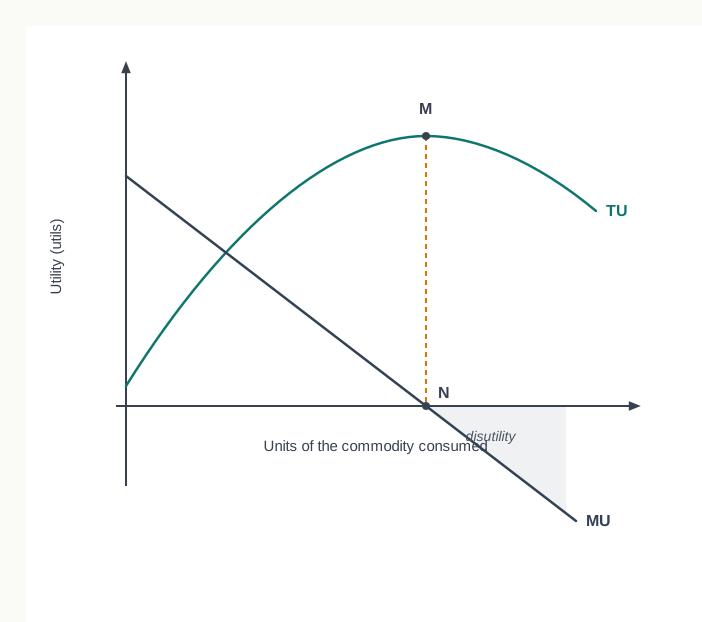
Fig. 2.2 – Total utility and marginal utility.
Three readings follow from the figure. So long as marginal utility is positive, total utility is rising. Where marginal utility is zero, total utility is at its maximum. Where marginal utility is negative, total utility is falling. The consumer stops at the quantity where marginal utility reaches zero, since taking more would reduce his satisfaction.
Marginal utility is worked out from a total utility schedule as shown below.
Diminishing marginal utility is one of the most widely used ideas in economics. It explains why a consumer spreads his spending across many goods instead of buying a great deal of one, and why the quantity a buyer is willing to take rises only when the price falls. Those consequences are taken up in the chapters on consumer behaviour and demand.
2.4 Production
Goods do not appear of their own accord. Before anything can be consumed it must be made available in the form, at the place and at the time at which it is wanted, and the activity that does this is production. If consumption is the end of the economic process, production is its beginning.
Production is also where scarcity bites. Making anything uses up resources that could have been used to make something else, so the question of what to produce is settled only by giving up an alternative. This section establishes what economics counts as production and what it does not.
2.4.1 Meaning of Production
In ordinary speech production means manufacturing — turning raw materials into physical goods. A cotton textile mill takes yarn, chemicals and dyes and turns out cloth, and this is what most people picture when they hear the word.
Early economists worked with just such a narrow idea. Production was taken to mean the creation of material or tangible goods, and services were left out of it altogether. On that view a doctor, a teacher or a musician produced nothing, because nothing solid emerged from their work.
The narrow view has been abandoned for a simple reason. A person who wants a haircut, a train journey or a lesson in mathematics has a genuine want, and the barber, the railway and the teacher satisfy it. If production is the activity that makes want-satisfaction possible, there is no ground for admitting the tailor and excluding the teacher.
Economics therefore uses production in a wider sense: any activity that creates utility, whether in a good or through a service, is production. Manufacturing, farming, mining, transport, trade, banking, teaching and medical care are all productive, because each adds to the power of something to satisfy a want.
One qualification must be attached to this. Production does not mean the creation of matter, since matter can be neither created nor destroyed. A carpenter does not bring wood into existence; he changes its shape so that it can serve as a table. What is created is not the material but the utility.
Anyone who helps to make goods or services available is a producer. Producers are those who transform resources into products that consumers want.
2.4.2 Production as the Creation of Utility
If production is the creation of utility, it is worth asking in what ways utility can be added to a thing. There are four, and they are shown together in Fig. 2.3.
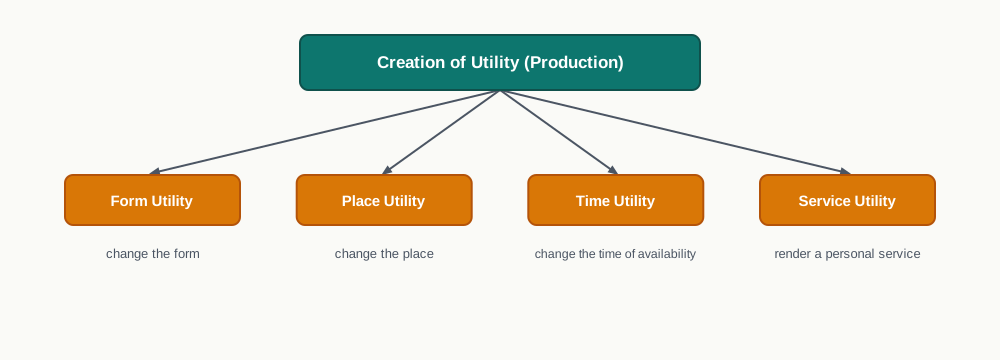
Fig. 2.3 – The four ways utility is created.
- Form utility — utility is added by changing the physical form of a thing. A carpenter converts a plank into a table, a mill converts raw cotton into cloth, a foundry converts iron ore into machinery. In each case the material is the same; its usefulness to a buyer is not.
- Place utility — utility is added by moving a thing from where it is of little use to where it is wanted. Wheat lying in a village has less value to a city household than the same wheat on a shop shelf nearby. Transport and trade create place utility.
- Time utility — utility is added by holding a thing until the moment at which it is needed. A crop is harvested in a few weeks but eaten through the year, and storing it makes it available when the want arises. Warehousing and cold storage create time utility.
- Service utility — utility is created directly through personal services, without any good changing hands at all. Doctors, teachers, engineers, bankers and lawyers add to want-satisfaction by what they do rather than by what they make.
Two consequences follow. First, trading and transport activities are as much a part of production as manufacturing, because production is not complete until the goods that have been made have actually reached the people who want them. A good sitting in a factory yard satisfies no want. Second, the four kinds of utility are frequently created one after another on the same commodity: cotton is spun and woven, the cloth is carried to a town, it is held in a shop until a buyer comes, and a tailor then stitches it to measure.
Production, then, is the whole activity by which scarce resources are turned into want-satisfying goods and services. The resources it uses are themselves limited, and how they are classified is the subject of the next section.
2.5 Factors of Production
Nothing can be produced without resources, and the resources an economy has are limited. Land is fixed in extent, workers are limited in number, machines have to be built before they can be used, and the ability to organise a business is scarcer still. Because these resources are scarce, using them for one purpose means not using them for another.
Economics groups all productive resources into four classes, called factors of production. The classification matters for two reasons: it tells us what an economy has to work with, and it tells us where the income of the economy comes from, since every factor is paid for the service it renders.
2.5.1 Land and Labour
Land in economics does not mean soil alone. It is used in a far wider sense to cover every free gift of nature that can be put to productive use — the surface of the earth, forests, rivers, minerals below the ground, rainfall and sunlight. These are commonly called natural resources.
Two things follow from this definition. Land is not produced by human effort, so no cost of production lies behind it, and its total supply is fixed by nature however much its price may rise. The reward paid for the use of land is rent.
Labour is human effort applied to production, whether that effort is physical or mental. In common speech labour suggests manual work — the agricultural labourer or the factory worker. Economics uses it more broadly, so that the work of an office clerk, a teacher, a doctor or a dancer is labour just as much as the work of a mason.
Labour cannot be separated from the labourer. A worker’s skill goes wherever the worker goes, and the service cannot be stored: an hour of work not done today is lost and cannot be supplied tomorrow. The reward paid for labour is wages.
2.5.2 Capital and Entrepreneurship
Capital is that part of a nation’s produced wealth which is used to produce further goods and services — machinery, tools, equipment, factory buildings and stocks of raw material. It differs from land in one decisive respect: capital is itself the result of past production.
Two points about capital are worth holding on to. First, capital is produced by human beings and is not a gift of nature; a plough exists only because someone made it instead of making something for immediate use. Second, capital is not wanted for its own sake but as a means of producing other things. The reward paid for capital is interest.
The fourth factor is of a different kind. Land, labour and capital do not combine themselves; someone must decide what to produce, arrange the finance, hire the workers, buy the machines and accept the loss if the venture fails. That person is the entrepreneur, and the special ability involved is called entrepreneurship.
The entrepreneur’s position is unlike that of the other three factors. Rent, wages and interest are agreed in advance and must be paid whether the business succeeds or not. What remains after they have been paid belongs to the entrepreneur, and it may be large, small or negative. This residue is profit, and it is the reward for bearing risk rather than for supplying a measurable quantity of a service. Table 2.3 sets out the four factors and their rewards together.
2.5.3 Characteristics of Factors of Production
Whatever the good being produced, the four factors behave in certain common ways. Six characteristics are important.
- Production is the outcome of cooperation — no single factor can produce anything by itself. Land without labour lies idle, labour without tools achieves little, and machines without someone to organise them stand still. Every act of production requires all four to be brought together.
- Factors can be combined in different proportions — cooperation does not mean a fixed recipe. Handloom cloth is produced with a large amount of labour and simple equipment, while a modern textile mill produces the same cloth with a great deal of machinery and only a few workers. The proportion chosen depends on what each factor costs and on the technique available.
- It is the services of a factor that contribute to production — the factor itself is not used up in the way a raw material is. A firm hires the working hours of a labourer and the use of a machine, not the labourer or the machine as such. Production draws on the flow of services that the factors provide.
- Factors are embodied in resources that can be identified — land, buildings and machinery are physical assets, and labour and enterprise are supplied by particular men and women. This makes it possible to say who owns each factor and therefore to whom its reward is due.
- The demand for factors is a derived demand — a firm does not want a factor for the satisfaction it gives, but for the goods it helps to produce. The demand for a factor is therefore derived from consumers’ demand for the final product. If people stop buying pens, the demand for the labour that makes pens falls with it.
- Factors differ in mobility — mobility refers to the ease with which a factor can move from one employment or one place to another. Labour and enterprise are comparatively mobile: a worker can retrain, or migrate to another city. Land cannot be moved at all, and heavy capital such as a blast furnace can be moved only at great cost.
These four factors, combined in some proportion, produce the goods and services an economy has to offer. What each unit of that output exchanges for is settled by its price, which is taken up next.
2.6 Price
Goods are scarce, and scarce things have to be rationed among the people who want them. In a free-enterprise economy this rationing is done by price. Whoever is willing to give up the required sum of money gets the good; whoever is not, goes without it.
Price therefore does more than label a commodity. It is the device by which an economy decides who gets what, and it is the signal that tells producers what is worth producing. This section sets out what a price is, how it comes to be what it is, and what is meant by a rise or fall in prices generally.
2.6.1 Meaning of Price
The price of a commodity is the amount of money that has to be given in order to obtain one unit of it. If a shirt sells for ₹800, the buyer must part with ₹800 to acquire it, and the seller will hand it over for nothing less.
A price expressed in money in this way is also called the money price or absolute price of the good. It states the sacrifice a buyer must make in rupees, and it is the form in which prices are quoted in every modern economy.
Not everything carries a price. Goods command a price only when they are useful and, at the same time, scarce in relation to the amount people would like to have. Both conditions must hold together. Nobody will pay for something that satisfies no want, however scarce it may be; and nobody needs to pay for something available in unlimited amount, however useful it may be. Air is essential to life, but because it is available freely to all it commands no price. Goods of this kind are free goods. Goods that are scarce and must be produced by using resources are economic goods, and these are the goods economics is concerned with.
Factor services carry prices for the same reason and in the same way. A producer who wants labour must pay wages, and one who wants the use of land must pay rent. An economy is thus a vast set of prices — for the millions of goods and services sold, and for the factor services used to produce them.
2.6.2 How the Price of a Commodity is Determined
Prices are not fixed by any single person. They emerge from the interaction of the two sides of a market. Buyers create the demand for a commodity, and are willing to take more of it when it is cheap than when it is dear. Sellers create its supply, and are willing to offer more of it when the price is high than when it is low.
Competition operates on both sides. Buyers compete against one another for the limited quantity available, which pushes the price up. Sellers compete against one another for the limited number of buyers, which pulls the price down. Where the two pressures balance — where the quantity buyers wish to purchase is exactly the quantity sellers wish to sell — the price settles.
At any other price the market cannot rest. If the price is above the equilibrium, sellers find stocks unsold and cut the price to clear them. If it is below the equilibrium, buyers compete for a quantity that is too small and bid the price up. Only at the equilibrium does neither side have reason to change.
Price is a highly sensitive index. Any change in the conditions of demand or of supply alters the point at which the two balance, and so alters the price. A failed harvest reduces supply and raises the price; a fall in the incomes of buyers reduces demand and lowers it. The detailed working of demand, supply and market equilibrium is taken up in Class XII.
2.6.3 The General Price Level
The price of one commodity tells us about that commodity alone. For the economy as a whole economists use a broader measure, the general price level, which refers to the average level of the prices of all goods and services produced in the economy. It is usually shortened to ‘the price level’.
The general price level is an average, and averages conceal movement within them. At any time some prices are rising while others are falling. What the price level records is the net effect of all these movements taken together, and it is measured by index numbers such as the Wholesale Price Index and the Consumer Price Index, which are studied in the chapter on index numbers.
2.6.4 General Rise and Fall in Price
The general price level does not stay put. Over a period it may drift upward or downward, and the two movements have names of their own.
A sustained and appreciable rise in the general price level is called inflation. When inflation occurs, the same sum of money buys a smaller quantity of goods than before, so the purchasing power of money falls. A household whose income is fixed finds that it can afford less than it could a year earlier.
A sustained and appreciable fall in the general price level is called deflation. Here the same sum of money buys more than before, so the purchasing power of money rises. Producers, however, find that the goods they sell fetch less, and may cut back output and employment in response.
Two qualifications belong to both terms. The movement must be persistent, so a single jump in prices followed by a return is not inflation. And it must be appreciable, so a very small drift in the price level is not treated as inflationary. The causes of inflation and the measures used against it are taken up in Class XII.
2.7 Value
A price tells us what a commodity costs in money. But money itself is only a convenience, and behind every money price lies a more basic question: what must be given up, in real terms, to obtain the good? That question is the subject of value.
Value matters because money prices can mislead. A wage that has doubled in rupees while prices have trebled has fallen, not risen, and only by looking through the money figure to what it commands can such a change be read correctly. This section separates the two senses in which the word ‘value’ is used, and then distinguishes value expressed in money from value measured in goods.
2.7.1 Value-in-Use and Value-in-Exchange
Value is the worth that a household places on a commodity. The word carries two quite different meanings, and confusing them has caused a good deal of trouble in the history of the subject.
Value-in-use is the satisfaction a commodity yields when it is consumed. It is a measure of usefulness to the person using the good, and it is close to the idea of utility studied earlier. Water has an enormous value-in-use, since life itself depends on it.
Value-in-exchange is the rate at which a commodity can be exchanged for other commodities. Under a barter system, if a weaver is willing to give 1 metre of cloth for 5 kg of rice, then the value-in-exchange of 1 metre of cloth is 5 kg of rice. Value in this sense is a power of purchase — what the good commands when offered in exchange.
The two need bear no relation to each other, and this produced a puzzle that troubled early economists. Commodities such as water, which cater to basic necessities, have a very high value-in-use but a low value-in-exchange. Diamonds, which no one needs in order to live, have a very low value-in-use but an extremely high value-in-exchange. If usefulness governs worth, why does the useless thing fetch the higher price? Early writers, unable to answer, called this the paradox of value.
Modern economics resolves the puzzle by pointing to scarcity. Exchange value is settled not by how useful a commodity is in general, but by demand set against the supply available. Water is abundant relative to the demand for it, so a further litre adds little and commands almost nothing. Diamonds are extremely scarce relative to the demand for them, so a further stone is worth a great deal. The paradox dissolves once it is seen that price attaches to the last unit available, not to the whole class of goods.
2.7.2 Real Value and Nominal Value
Value-in-exchange can be expressed in two ways: in money, or in goods. This gives the distinction between nominal and real value, which the syllabus treats as the central pair in this topic.
Nominal value is the value of a commodity measured in monetary units such as the rupee. It is simply the money price of the good. If 1 metre of cloth sells for ₹200, the nominal value of that metre of cloth is ₹200.
Real value is the purchasing power of a commodity in terms of other commodities — what quantity of other goods a unit of it will command. In the example above, if 5 kg of rice also sells for ₹200, then the real value of 1 metre of cloth is 5 kg of rice.
The distinction becomes important the moment the general price level moves. A nominal figure can rise while the real figure behind it falls, because the money in which the nominal figure is stated has itself lost purchasing power. Suppose the price of cloth rises from ₹200 to ₹300 a metre while the price of rice rises from ₹40 to ₹75 a kilogram. In nominal terms cloth has become dearer. In real terms it has become cheaper: a metre of cloth commanded 5 kg of rice before and commands only 4 kg now.
This distinction runs through the whole of economics. National income, wages, interest rates and the value of exports are all reported both in nominal terms and in real terms, and the two can move in opposite directions.
2.8 Market
Prices are settled by the meeting of demand and supply, but that meeting has to take place somewhere. The arrangement within which buyers and sellers come into contact is what economics calls a market, and every price quoted in an economy is the outcome of what happens in one.
The word carries a much wider meaning in economics than in ordinary speech, and the difference is worth getting straight at the outset, because a good many propositions in the subject turn on it.
2.8.1 Meaning of a Market
In ordinary usage a market means a physical place where commodities are bought and sold — a vegetable market, a cloth market, a shopping street. The word calls up a picture of a place people go to in order to buy something.
Economics does not use the word in this sense. What matters is not the place but the contact. Buyers and sellers of a commodity must be able to reach one another, learn what the commodity is being offered at, and strike a bargain. Wherever that is possible, a market exists, whether or not anyone travels anywhere.
Two consequences follow from defining a market in this way.
- A market need not be located in a particular place — its geographical extent depends on how widely the buyers and sellers of the commodity are scattered. Fresh vegetables are traded in local markets because they cannot travel far. Wheat, cars, aircraft and gold are traded in world markets, because buyers and sellers anywhere can deal with one another, and the price of such a commodity tends towards uniformity across the world.
- Buyers and sellers need not meet in person — all that is required is a means of communication between them. Deals struck by telephone, by correspondence and over the internet are as much market transactions as a purchase made across a counter.
2.8.2 Size of a Market
Markets differ in how large they are, and the size of a market refers to the amount of goods and services demanded in it. The greater the quantity that buyers in a market are willing to purchase, the larger the market is said to be.
Size in this sense is not the same as geographical extent, though the two are usually related. A market may cover a wide area and yet be small, if only a few buyers within it want the commodity; and a market confined to one city may be very large, if demand there is heavy. What is being measured is the volume of demand, not the distance across which it is spread.
Two things chiefly govern the size of a market. One is the number of buyers who want the commodity and are able to pay for it, which depends on population and on income. The other is the ease with which the commodity can be carried and communicated about, since a good that cannot travel cannot be sold far from where it is produced.
2.8.3 Types of Markets
Two broad types of market must be distinguished, according to what is bought and sold in them.
Goods markets are markets in which goods and services are bought and sold. The sellers are usually firms, and the buyers may be households, other firms or the government. A cloth market and a market for cars are goods markets.
Factor markets are markets in which factor services are bought and sold — the labour market, the market for the use of land, the market for capital. Here the roles are reversed: the buyers are the firms that need factor services in order to produce, and the sellers are the households that own the factors. In the labour market, a firm is the buyer and a worker is the seller.
The relation between the two is shown in Fig. 2.4.
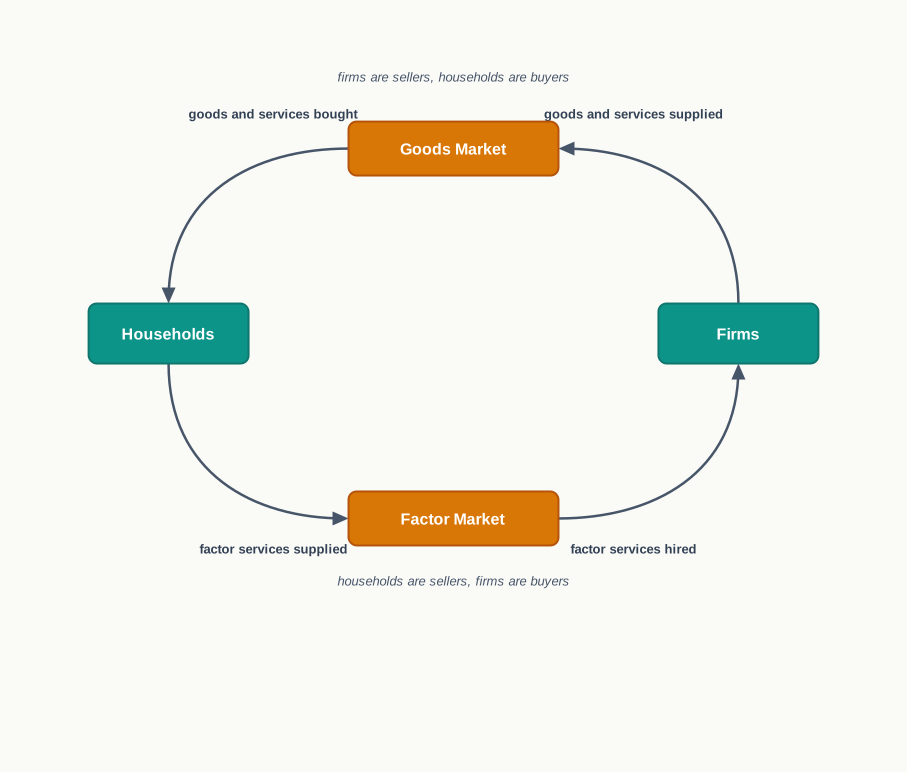
Fig. 2.4 – Goods markets and factor markets.
The main points of difference between the two are set out below.
Households and firms therefore meet twice, once on each side of the counter. What passes between them in both markets is settled in money, and the nature of money is the subject of the next section.
2.9 Money
An economy in which people specialise must also be an economy in which people exchange. A farmer who grows only rice cannot eat cloth, and a weaver who makes only cloth cannot wear rice; each produces far more of one thing than he can use and none at all of the rest. Exchange is what turns that surplus into the variety a household actually wants.
Exchange, however, is easy only if there is something everyone is willing to accept. Where there is no such thing, trade becomes clumsy and specialisation itself is held back. This section compares the two arrangements: exchange conducted goods for goods, and exchange conducted through money.
2.9.1 The Barter Economy and Its Difficulties
Before money existed, goods were exchanged directly for other goods. This is the barter system, and an economy resting on it is a barter economy. The system is not extinct; small direct exchanges still occur in some traditional and tribal communities, and between neighbours everywhere.
Barter works tolerably in a small community where people produce few goods and know one another. As the range of goods widens it runs into serious difficulties.
- Lack of a double coincidence of wants — a barter exchange requires each party to want precisely what the other is offering. A weaver with cloth who wants rice must find a rice-grower who happens to want cloth. This matching of wants on both sides at once is the double coincidence of wants, and the larger the number of goods, the rarer it becomes.
- Absence of a common measure of value — with no single unit in which worth can be stated, every pair of goods needs its own exchange ratio. Cloth must be priced in rice, in wheat, in oil and in labour separately, and the number of ratios to be remembered grows unmanageable as goods multiply.
- Indivisibility of certain goods — many goods cannot be split without destroying their value. A man who owns a cow and wants a few kilograms of rice cannot hand over one leg of the cow in payment.
- Difficulty of storing value — a person who wishes to save must store his wealth in the form of goods, and most goods deteriorate, need space, and cost something to keep. Grain rots and cattle die.
- Difficulty of making deferred payments — a loan or a payment promised for a later date must be stated in some good, and both parties then face the risk that the good’s worth will have changed by the time the debt falls due.
Taken together these difficulties waste effort, restrict the scope of specialisation and division of labour, and hold back the growth of the economy. Every society has therefore sooner or later invented some form of money to escape them.
2.9.2 The Money Economy
An economy that carries out its transactions through money is a money economy. Money is not a particular commodity but anything that is generally accepted in payment, and it is this general acceptability, rather than any quality of the material itself, that makes money work.
The definition contains the escape from each difficulty of barter. Because money is accepted by everyone, the weaver need no longer find a rice-grower who wants cloth; he sells cloth for money and buys rice with it, and the double coincidence of wants disappears. Because the worth of every good is stated in one unit, a single set of prices replaces the tangle of exchange ratios. Because money can be held without deteriorating, saving becomes simple, and because a debt can be stated in money, payment can be deferred to a future date.
The main points of difference between the two arrangements are set out below.
2.9.3 Forms of Money in Use Today
Money in a modern economy takes two main forms.
Currency consists of notes and coins. Currency notes are paper money, and in India they are issued by the Reserve Bank of India; coins are metallic money, minted under the authority of the Government of India. Currency passes from hand to hand and is legal tender, so it must be accepted in settlement of a debt.
Deposit money, also called bank money, consists of the deposits held with banks against which the depositor can issue instructions to pay. A cheque drawn on such a deposit, or an electronic transfer made from it, settles a payment without any note or coin changing hands. Deposit money is not legal tender — a seller is free to refuse a cheque — yet in value terms the greater part of the payments made in a modern economy is settled in this form.
The kinds of money, the measures of money supply and the working of the banking system are studied in detail in Class XII. What matters here is the contrast established above: money is the device that frees exchange from the requirement that each party want what the other has.
2.10 Income
Wants can be acted upon only to the extent that means are available, and for most people the means come from what they earn. Income is what sets the limit within which a household’s choices are made: it fixes how much can be spent, how much can be saved, and therefore how many wants can be satisfied at all.
Income also has a second aspect. What one household receives, some firm has paid out, and it has paid it out for the use of a factor of production. Income is thus the other side of production, and looking at it in that way shows how the value of what an economy produces comes back to the people who produced it.
2.10.1 Meaning of Income
Income is the flow of goods and services, or of money, accruing to a person or to all the people in an economy over a specified period of time. A clerk earning ₹40,000 a month, a shopkeeper earning a certain sum in a year, a farmer receiving the proceeds of a harvest — each is receiving income.
Two elements of the definition need care. The first is the word ‘flow’. Income is not a quantity held at a moment but a stream received across a stretch of time, and a figure for income means nothing until the period is attached to it. To say that a person’s income is ₹40,000 is incomplete; ₹40,000 a month and ₹40,000 a year describe very different situations.
The second is that income need not take the form of money. A farmer who keeps part of his harvest for his family’s consumption has received real income in the form of goods, even though no money changed hands. Where income is measured in a monetary unit such as the rupee, it is called money income, and this is the form in which income is normally expressed in a modern economy.
Money income has to be read with the same caution as any other money figure. What a household can actually obtain with its earnings depends on prices as well as on the number of rupees received, so a rise in money income is a real gain only if it outruns the rise in the price level.
2.10.2 Factor Incomes
In a modern economy people rarely consume what they themselves produce. They sell the services of the factors they own to firms, and receive money in return. Income earned in this way, by supplying a factor service, is called factor income.
Since there are four factors, there are four kinds of factor income.
- Rent — the income received by the owner of land for allowing its use in production. A person who lets out a shop or a plot of land receives rent.
- Wages — the income received by a worker for the physical or mental effort supplied. Salaries paid monthly and wages paid daily are alike wage income.
- Interest — the income received by the owner of capital for its use in production, such as the interest a bank pays on a deposit or a lender receives on a loan.
- Profit — the income received by the entrepreneur for organising production and bearing its risk. Unlike the other three it is not agreed in advance, and it may turn out to be negative.
A single household commonly receives more than one of these. It may earn wages from employment, rent from a room let out, and interest from a deposit, and its total income is the sum of them.
Not every sum a person receives is factor income. A scholarship, a gift or a pension paid out of public funds is a receipt without any factor service having been rendered in exchange for it, and economics keeps such receipts separate from earnings.
The distinction becomes important when the income of a whole economy is added up, since counting receipts of both kinds would count the same money twice. That exercise, national income accounting, belongs to Class XII. What matters here is the connection established above: every factor income is a payment made for a service used in production.
2.11 Saving
Income arrives as a stream, but it need not be spent as fast as it arrives. A household that receives its earnings and buys goods with only a part of them has kept the rest aside, and that unspent part is saving.
The decision is again one of choice under scarcity, but the choice is spread across time. Every rupee saved is a rupee of present consumption given up in order to make future consumption possible — the school fee that must be paid three years from now, the house that must be repaired, the years after work ends. Saving also matters to the economy as a whole, because it is out of saving that the funds for producing capital goods come.
2.11.1 Meaning of Saving
Saving is that part of income which is not spent on consumption. It is not a separate kind of receipt but a residue: what remains of income once consumption has been provided for.
Since income in any period is either consumed or saved, the relation between the three can be stated directly. Saving is measured by taking the income of the period and deducting from it the amount spent on consumption.
\[S = Y - C\]
Here \(S\) is saving, \(Y\) is income and \(C\) is consumption expenditure, all three measured in money over the same period of time — a month or a year. The result shows how much of the period’s income has been held back from present use.
Saving, like income, is a flow: it is an amount set aside during a period, not a sum held at a moment. The stock built up by saving over many years is a different thing, and it is called savings. A household that saves ₹5,000 a month is describing a flow; the ₹3,00,000 standing in its account is the accumulated value of past saving.
Households save for reasons that are easy to recognise: the education of children, the building or repair of a house, marriage, illness, and provision for old age when earning stops. Behind all of them lies the same motive — the wish to move purchasing power from the present, when it is available, to a future date when it will be needed.
2.11.2 Individual Saving and Aggregate Saving
Saving is not done by households alone. Firms and the government save as well, and it is useful to keep the categories apart.
- Individual saving — the saving done by a single income earner out of his own income. It is the smallest unit of the idea, and it is what a person means when he says he has saved something this month.
- Personal or household saving — the saving done by households, taken as the units in which income is received and spending decisions are made.
- Business saving — the saving done by firms. A company that does not distribute the whole of its profit to shareholders, but retains a part of it to expand the business or to hold as a reserve, has saved that part.
- Government saving — the saving done by the central government, state governments, local authorities and public corporations. It arises chiefly when government revenue exceeds government expenditure, leaving a surplus.
Saving by everyone other than the government — that is, by individuals, households and business firms together — is called private saving. Adding government saving to it gives the saving of the economy as a whole, which is called aggregate saving.
The distinction drawn in that last exchange is the link to the next section. Saving by itself adds nothing to an economy’s productive capacity; it becomes useful only when the resources released by it are put to work producing capital goods.
2.12 Investment
An economy that used all its resources to make goods for immediate consumption would produce nothing with which to produce in future. Its machines would wear out, its buildings would decay, and its capacity to produce would shrink year by year.
Investment is the decision to avoid that outcome. It means turning a part of the economy’s currently available resources away from making things to be consumed now, and towards making things that will help produce later. The sacrifice is present consumption; the return is a larger capacity to produce in the years ahead.
2.12.1 Meaning of Investment
Investment is the act of using productive resources to produce capital goods — goods that are used not for their own sake but to produce other goods and services in future. Building a factory, installing machinery, laying a road and adding to a stock of raw material are all acts of investment.
Investment takes three main forms.
- Producers’ fixed investment — expenditure on new capital goods such as plant, machinery, tools and equipment. These are the goods with which firms produce, and they are often called producers’ fixed capital.
- Investment in residential and non-residential construction — expenditure on the building of houses, office buildings, factories, power plants, bridges and roads. A house is treated as investment rather than as consumption because it yields its services gradually over a very long period, in the same way a machine does.
- Investment in stocks — the addition made during the period to the stocks of raw material, semi-finished goods and finished goods held by firms. Such goods have been produced but not used up in the period, so the addition to them is counted as investment.
The point behind that warning deserves a paragraph of its own, because ordinary usage runs the other way. When a person buys shares in a company, he is said in everyday speech to have made an investment. In economics this is merely financial investment: the shares change hands, the money moves from buyer to seller, and not one additional machine comes into existence. Real investment is the production of a capital good, and it is real investment that economics means by the word.
2.12.2 Investment as a Process of Capital Formation
Another name for investment is capital formation, and the two terms are used interchangeably. The reason is plain from the definition: every act of investment adds something to the economy’s stock of capital, and the stock of capital grows only through investment.
The relation must be stated carefully, because capital goods do not last for ever. Machines wear out with use, buildings decay, and equipment becomes unusable in time. This physical wear and tear of capital goods in the process of production is called depreciation. The investment needed merely to make good what has worn out, so that the existing stock of capital is kept intact, is called replacement investment, and it is equal in amount to depreciation.
The total expenditure on all investment goods during a period — fixed investment, construction and addition to stocks together — is called gross investment. Part of this only replaces what has worn out. What remains after depreciation has been provided for is net investment, and it alone adds to the total stock of capital in the economy.
\[\text{Net investment} = \text{Gross investment} - \text{Depreciation}\]
Here gross investment is the whole of the period’s expenditure on capital goods, depreciation is the value of the capital used up during the same period, and net investment is what is left. All three are measured in money over the same period. A positive figure means the stock of capital has grown; a figure of zero means it has merely been maintained; and a negative figure means the economy has failed even to replace what it has used up, so its capacity to produce has fallen.
Capital formation is one of the central concerns of a developing economy. A country whose net investment is small adds little to its productive capacity each year, and its output can grow only slowly. Since the resources for investment come out of what has not been consumed, saving and investment are two halves of the same act — the first releases the resources, the second puts them to work.
2.13 Wealth
Income and saving are streams; they are received and set aside over a period. What accumulates from them, and what an economy has inherited from its own past and from nature, is a quantity of a different kind. It exists at a moment, and it can be counted at that moment. That quantity is wealth.
Wealth matters because it is the base from which further production is carried on. A country with more land under cultivation, more machinery installed and more people trained to use it can produce more than one without them, whatever its current income happens to be.
2.13.1 Meaning and Characteristics of Wealth
Wealth refers to the stock of all those assets which are a source of income or which have a value in exchange. A house, a shop, a machine, a bank deposit and a piece of jewellery are all items of wealth.
The last words of that definition carry the important idea. Wealth is a stock: a quantity existing at a point of time, with no time period attached to it. Income and saving are flow quantities, measured over a period. The distinction runs through the whole of economics, and confusing the two produces statements that cannot be interpreted.
Not everything a person possesses counts as wealth in economics. Four characteristics must be present together.
- Utility — the thing must have the power to satisfy a want. Something that satisfies nobody’s want is not wealth, however much of it exists.
- Scarcity — the thing must be limited in supply relative to the demand for it. Air is useful but not scarce, so it is not wealth in the economic sense.
- Transferability — ownership of the thing must be capable of being passed from one person to another. A person’s good health satisfies wants and is scarce, but it cannot be handed over to anyone else.
- Exchange value — the thing must command something in exchange. Anything possessing utility, scarcity and transferability will have exchange value, so this characteristic follows from the other three rather than standing apart from them.
2.14 Welfare
Everything studied so far — production, income, saving, wealth — is a means. None of it is wanted for itself. What people ultimately seek is to live well, and the term economics uses for that condition is welfare.
The difficulty is that welfare cannot be counted the way output and income can. Some of what makes life go well passes through the market and can be priced; a great deal of it does not. This section separates the part that can be measured from the part that cannot, and then asks the question that the whole chapter has been building towards: does more wealth mean more welfare?
2.14.1 Economic Welfare and Non-Economic Welfare
Welfare means a sense of satisfaction, happiness and well-being among the people. Many things influence it — the goods and services consumed, the state of the environment, relations within the family, the degree of freedom people enjoy, and the condition of law and order.
Some of these influences raise welfare: greater consumption, more leisure, greater freedom, greater security. Others lower it: heavier work, natural disasters such as an earthquake, political instability and insecurity.
The influences differ in one respect that matters for economics. Some can be brought into relation with the measuring rod of money, and some cannot. Pigou drew the line here, defining economic welfare as that part of social welfare which can be brought directly or indirectly into relation with money.
Welfare influenced by national income, per capita income, the composition of output and the level of consumption is therefore economic welfare. Everything else is non-economic welfare — the welfare affected by factors that cannot be expressed in money, such as the environment, family relations, the security of life and property, and the degree of freedom a person enjoys. Political welfare and moral welfare are examples.
2.14.3 Relation between Wealth and Welfare
Wealth and welfare are generally related in a direct way. Wealth is a command over goods and services; goods and services satisfy wants; and want-satisfaction is welfare. As a rule, therefore, the greater the wealth of a community, the greater its economic welfare, and the poorer a country is, the less its people are able to obtain.
The relation, however, is a tendency and not a rule that holds in every case. Four qualifications are important.
- The distribution of wealth matters as much as its amount — an additional rupee is worth far more to a poor household, which will spend it on necessities, than to a rich one, which will spend it on something it can readily do without. A given amount of wealth therefore yields greater welfare when it is spread evenly than when it is concentrated in a few hands.
- The way wealth is acquired matters — wealth produced by long hours in unsafe conditions, or by exhausting a forest or polluting a river, is bought at a cost in welfare that the wealth figure does not record. What has been added on one side has been subtracted on the other.
- The kind of goods matters — goods that damage health add to the wealth and income of a country while reducing the well-being of those who consume them. Their production is counted; their effect is not.
- Non-economic factors are untouched by wealth — a rise in wealth does nothing in itself for the security, freedom or social relations that form the other half of welfare, and may in some circumstances work against them.
The upshot is that wealth is a means and welfare an end, and the two must not be treated as the same thing. This is why national income by itself is an imperfect indicator of how well a country’s people live, a point taken up again when growth and development are compared later in this book.
2.15 Business Cycle
An economy does not grow at a steady pace year after year. There are stretches when factories run at full capacity, jobs are easy to find and incomes rise, and stretches when orders dry up, workers are laid off and incomes fall. These swings recur, and they affect the whole economy at once rather than one industry at a time.
The swings matter because the resources idled in a downturn are simply wasted. Machines that stand still and workers who cannot find employment produce nothing, and the goods they might have produced are lost for good. Understanding the pattern is the first step towards moderating it.
2.15.1 Meaning of a Business Cycle
A business cycle is the recurrent fluctuation in the aggregate economic activity of an economy — that is, in its total output, income and employment taken together.
Three features of the definition deserve attention.
- The fluctuations are general — a business cycle is not a fall in one industry while others prosper. Expansion occurs at much the same time across many activities, and contraction likewise, so output, income and employment move together.
- The fluctuations are recurrent — periods of expansion and contraction alternate, one following the other, which is why the movement is described as wave-like rather than as a single episode.
- The fluctuations are short-run — a business cycle is a movement about the trend of an economy, not the trend itself. An economy may be growing over the long run and still pass through cycles along the way.
2.15.2 Phases of a Business Cycle
A typical business cycle passes through four phases, which follow one another in a fixed order.
- Expansion, also called prosperity — output, employment and income rise. Firms are producing more, hiring more workers and investing in new capacity, and the demand for goods is strong. The phase closes at the peak, the highest point the level of activity reaches in that cycle.
- Recession — the direction turns. Demand slackens, firms cut production, orders fall and workers are laid off, and income and employment decline. A recession is a sustained downward movement, not a single bad month.
- Depression — the phase of a severe and prolonged recession. Economic activity declines severely and generally, with a large reduction in output, employment and income, and prices fall as well. The lowest point reached is called the trough.
- Recovery, also called revival — activity begins to turn upward again from the trough. Firms that had cut back start producing again, employment picks up, incomes rise, and the economy moves once more towards expansion, so that the sequence begins afresh.
The four phases and their relation to one another are shown in Fig. 2.5.
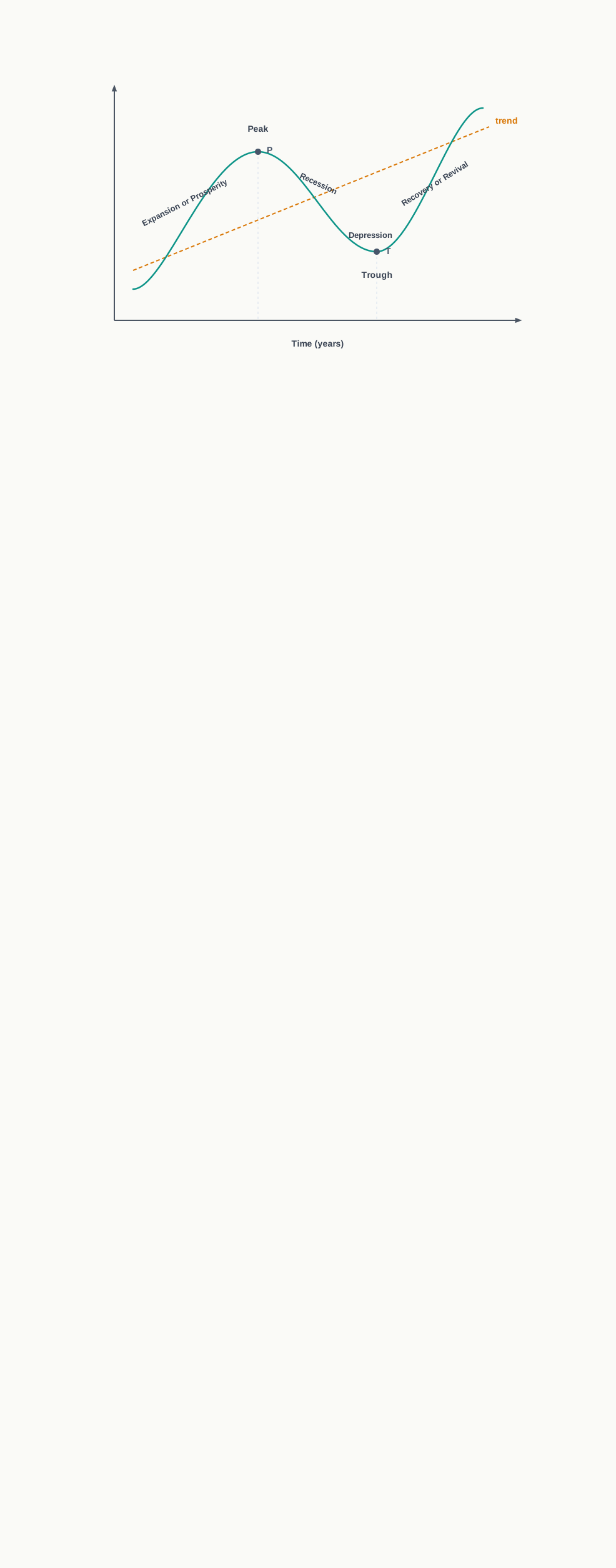
Fig. 2.5 – Phases of a business cycle.
The length of a cycle and the depth of its downturns vary, and no two cycles are alike. What recurs is the sequence: expansion cannot continue indefinitely, and a depression does not last for ever either. How governments act to check excess and deficiency in demand belongs to Class XII.
2.16 Aggregate Demand and Aggregate Supply
Most of this chapter has looked at single commodities — the price of a shirt, the utility of a mango, the market for cloth. Macroeconomics asks the same questions about the economy taken as a whole. Instead of the demand for one good it considers the demand for all goods together, and instead of the output of one firm it considers the output of all firms together.
The two magnitudes that result, aggregate demand and aggregate supply, are the tools with which the level of output, income and employment in an economy is explained — including the fluctuations described in the previous section. The concepts are introduced here in outline; the analysis built on them belongs to Class XII.
2.16.1 Aggregate Demand
Aggregate demand is the total amount of final goods and services that all the buyers in an economy desire to purchase during a given period. It is the sum of the intended purchases of every buyer, not of any one of them.
The buyers fall into three groups in a closed economy, and each contributes a component to the total.
- Consumption expenditure — the spending of households on consumer goods and services. It is much the largest of the three in most economies.
- Investment expenditure — the spending of firms on capital goods, that is, on the plant, machinery, construction and stocks described earlier as investment.
- Government expenditure — the spending of the government on goods and services in discharging its responsibilities, such as running schools, hospitals, the police and the administration.
Adding the three gives the aggregate demand of a closed economy.
\[AD = C + I + G\]
Here \(AD\) is aggregate demand, \(C\) is consumption expenditure by households, \(I\) is investment expenditure by firms and \(G\) is government expenditure on goods and services, all measured in money over the same period. In an open economy, which trades with the rest of the world, the demand of foreign buyers for the country’s exports is added and the part of domestic spending that goes on imports is deducted.
How much a country’s buyers desire to purchase depends chiefly on the level of income in the economy. When incomes are high, households spend more and firms invest more, so aggregate demand is high; when incomes fall, it falls with them.
2.16.2 Aggregate Supply
Aggregate supply is the total amount of output that all the firms or producers in an economy are willing to produce during a given period. Where aggregate demand records what buyers intend to buy, aggregate supply records what producers intend to make available.
Aggregate supply is limited by what the economy is capable of producing — by the factors of production available to it and by the state of technology. An economy cannot supply more than its land, labour, capital and enterprise permit, however strong the demand for goods may be.
Both magnitudes may also be expressed in relation to the price level rather than to income. In that form, aggregate demand is the total quantity of goods and services that all buyers wish to buy at different price levels, and aggregate supply is the total quantity that all firms are willing to supply at different price levels.
This pair of concepts closes the chapter. Together with the terms established in the sections before it — want, utility, production, factor, price, value, market, money, income, saving, investment, wealth and welfare — they form the vocabulary in which the rest of the subject is written.
2.17 Summary
- A desire is a wish to have something; a want is an effective desire, that is, a desire backed by the means to acquire the thing and the readiness to make the effort. Economics deals only with wants, because only wants press upon scarce resources.
- Wants are classified into two broad categories.
- Primary wants — wants for goods necessary for the very existence of human life and for the maintenance of normal efficiency, covering necessities.
- Secondary wants — wants arising after primary wants are met, covering comforts and luxuries.
- Human wants have ten features: they are unlimited, complementary, substitutable, competitive; they multiply and recur; a single want can be satisfied; some wants can be postponed; wants differ in urgency; and wants remain ahead of the availability of goods and services. Together these features make scarcity universal.
- Commodities are of two kinds — goods, which are tangible, and services, which are intangible and are used as they are provided. Consumption is the act of using goods and services to satisfy human wants, and the person who uses them is a consumer. Purchase is not consumption.
- Consumption is significant because it is the motive for all economic activity, the end of the economic process, an index of the standard of living, the basis of economic welfare, and a major determinant of employment.
- Sustainable consumption is consumption that meets people’s needs and improves their quality of life without harming the environment or the needs of future generations.
- Utility is the want-satisfying power of a commodity, or the satisfaction derived from a good at a particular point of time. Its six features are that it is subjective, not measurable, relative, different from usefulness, free of moral or legal connotation, and abstract.
- Total utility is the entire satisfaction obtained from a given quantity of a commodity; marginal utility is the addition made to total utility by one more unit.
\[MU_n = TU_n - TU_{n-1}\]
Here \(MU_n\) is the marginal utility of the \(n\)th unit, \(TU_n\) the total utility from \(n\) units and \(TU_{n-1}\) the total utility from one unit less, all in utils.
- As successive units of a commodity are consumed in a given period, marginal utility falls. Total utility rises while marginal utility is positive, is at its maximum where marginal utility is zero, and falls where marginal utility is negative; a negative marginal utility means the unit yields disutility.
- Production in the wider sense is the creation of utility, not of matter, and covers services as much as goods. Utility is created in four ways — form utility, place utility, time utility and service utility. Anyone who helps to make goods or services is a producer.
- The four factors of production and their rewards are land and rent, labour and wages, capital and interest, and entrepreneurship and profit. Land is the free gift of nature, capital is the produced means of production, and profit is a residue because the entrepreneur bears the risk.
- Factors of production cooperate in production, can be combined in different proportions, contribute through their services, are owned by identifiable owners, are demanded as a derived demand from the demand for the final product, and differ in mobility.
- Price is the amount of money that has to be given to get a commodity. Goods command a price only when they are both useful and scarce; free goods are unlimited in supply and command none. Equilibrium price is the price at which quantity demanded equals quantity supplied.
- The general price level is the average level of the prices of all goods and services produced in an economy. A persistent and appreciable rise in it is inflation, which lowers the purchasing power of money; a persistent and appreciable fall is deflation.
- Value has two senses — value-in-use, the satisfaction a commodity yields in consumption, and value-in-exchange, the rate at which it exchanges for other commodities. The paradox of value, that water is cheap and diamonds dear, is explained by scarcity relative to demand rather than by usefulness.
- Nominal value is the value of a commodity in money; real value is its purchasing power in terms of other commodities. A nominal figure can rise while the real figure behind it falls, because money itself loses purchasing power when prices rise.
- A market is a system or set-up in which buyers and sellers can communicate and strike a deal about price and quantity; it need not be a place, and the parties need not meet. The size of a market is the amount of goods and services demanded in it.
- Goods markets are those in which goods and services are bought and sold, with firms as sellers; factor markets are those in which factor services are bought and sold, with households as sellers and firms as buyers.
- Under barter, goods are exchanged directly for goods. The system fails as goods multiply, because of the need for a double coincidence of wants, the absence of a common measure of value, the indivisibility of some goods, and the difficulty of storing value and of making deferred payments.
- Money is anything generally accepted as a means of exchange which also acts as a measure and a store of value. A money economy escapes every difficulty of barter and so widens specialisation. Money today takes the form of currency and of deposit money held with banks.
- Income is the flow of goods and services, or of money, accruing to a person or to an economy over a specified period. Factor income is income earned by supplying a factor service, and takes the form of rent, wages, interest or profit; a receipt made without any factor service is not factor income.
- Saving is the part of income not spent on consumption during a period.
\[S = Y - C\]
Here \(S\) is saving, \(Y\) income and \(C\) consumption expenditure, all measured in money over the same period. Saving is a flow; savings is the stock accumulated by past saving.
- Saving is done by individuals and households, by firms in the form of retained profits, and by the government through a budget surplus. Private saving covers everyone but the government; aggregate saving is private saving plus government saving.
- Investment is the use of productive resources to produce capital goods, and is another name for capital formation. Its forms are producers’ fixed investment, construction, and addition to stocks. Buying shares or bonds is financial investment, not real investment.
\[\text{Net investment} = \text{Gross investment} - \text{Depreciation}\]
Gross investment is the whole of the period’s expenditure on capital goods, depreciation is the value of capital used up in wear and tear, and net investment alone adds to the stock of capital.
- Wealth is the stock of assets that are a source of income or possess exchange value, measured at a point of time. To be wealth a thing must have utility, be scarce and be transferable, from which exchange value follows.
- Personal wealth is the stock of assets owned by an individual, held as money, financial assets and real assets. Social or national wealth is the stock of tangible wealth of a country’s residents, comprising reproducible and non-reproducible assets; domestic financial assets are excluded, being offset by domestic liabilities.
- Welfare is a sense of satisfaction and well-being. Economic welfare is the part that can be measured in money terms; non-economic welfare is the part that cannot. Social welfare is the sum of the two, and is the total happiness of all individuals in a society.
- Wealth and welfare are generally related in a direct way, but not proportionately. The relation is qualified by how the wealth is distributed, how it was acquired, what kinds of goods it consists of, and the fact that non-economic welfare is untouched by wealth.
- A business cycle is the recurrent fluctuation in aggregate economic activity. Its four phases follow in order — expansion or prosperity, ending at the peak; recession; depression, at its lowest at the trough; and recovery or revival. A depression is a severe and prolonged recession, not a separate kind of event.
- Aggregate demand is the total amount of final goods and services all buyers desire to purchase in a period; aggregate supply is the total output all producers are willing to produce.
\[AD = C + I + G\]
Here \(AD\) is aggregate demand in a closed economy, \(C\) consumption expenditure by households, \(I\) investment expenditure by firms and \(G\) government expenditure on goods and services. In an open economy, exports are added and imports deducted.
- Running through the chapter is one distinction that governs how every magnitude in economics must be read.
2.18 Points to Ponder
- Wants multiply as an economy grows richer, since every new good creates a want that did not exist before. If the gap between what people want and what they have never closes, can a society ever be said to have solved its economic problem — or does growth simply move the problem to a higher level?
- Air is treated in this chapter as a free good because it is unlimited relative to the want for it. In cities where the air is badly polluted, clean air has begun to be bought and sold in the form of filters and purifiers. What does it tell us about an economy when something that was a free gift of nature starts to command a price?
- Economics counts a good as productive if it satisfies someone’s want, whatever its effects. A commodity that damages the health of those who use it therefore adds to a country’s output while reducing the well-being of its people. Should the measurement of production take account of what a good does to the person who consumes it, or would that make economics a judge of tastes rather than a science of choice?
- A rupee given to a poor household is spent on necessities, while the same rupee given to a rich one is spent on something easily done without. If this is accepted, does it follow that a country raises its welfare more by distributing its existing wealth differently than by producing more of it? What would be lost by choosing the first course?
- Saving releases resources for investment, and investment builds the capacity to produce in future. But saving also means that goods produced today go unsold. When should an economy be encouraged to save more, and when should it be encouraged to spend?
- Every act of investment is a decision to give up something now for a larger output later, and the people who make the sacrifice are not always the people who receive the benefit. On what grounds can one generation be asked to consume less so that the next may consume more?
2.19 Objective Questions
- Which one of the following is not a factor of production? [1]
- Land
- Money
- Labour
- Entrepreneurship
- Assertion (A): Air commands no price even though it is essential to human life. Reason (R): A commodity commands a price only when it is both useful and scarce in relation to the want for it. Choose the correct option. [1]
- Both A and R are true, and R is the correct explanation of A
- Both A and R are true, but R is not the correct explanation of A
- A is true but R is false
- A is false but R is true
- Total utility is at its maximum at the level of consumption at which marginal utility is __________. [1]
- State whether the following statement is true or false: The purchase of shares of a company by an individual is a part of real investment in an economy. [1]
- Match the items in Column A with those in Column B. [1]
| Column A | Column B |
|---|---|
| a. Reward of capital | i. Rent |
| b. Reward of enterprise | ii. Interest |
| c. Reward of land | iii. Profit |
2.20 Check Your Concepts
- Define a want and state how it differs from a desire. [2]
- Distinguish between value-in-use and value-in-exchange, using one example of each. [3]
- A consumer’s total utility from successive glasses of juice is 14, 25, 33, 38, 38 and 35 utils. Calculate the marginal utility of each glass, state the number of glasses at which total utility is highest, and explain what the marginal utility of the sixth glass indicates. [4]
- ‘A country that becomes wealthier necessarily makes its people better off.’ Examine this claim, stating the general relation between wealth and welfare and the qualifications to which it is subject. [6]
2.21 Case-Based Question
- Ratanpur is a small town whose households have long saved a part of their monthly earnings and kept it in bank deposits. Meera runs a garment workshop in the town. Last year she withdrew a part of her accumulated savings and used it to buy two new stitching machines and to enlarge her workshop building. In the same year she also bought shares in a large textile company, and her neighbour Farooq, who owns a shop on the main road, let out its upper floor and began to receive a monthly rent for it.
- Identify which of Meera’s two purchases counts as investment in the economic sense, and give the reason. [2]
- State whether the rent received by Farooq is factor income, and explain why. [2]
2.14.2 Social Welfare
The two parts taken together give the welfare of the society as a whole, which is called social welfare.
Social Welfare Social welfare is the sum total of the happiness of all the individuals in a society. It is the total of economic and non-economic welfare.
Economics concerns itself directly with the economic part, because that is part its tools can measure. It does not follow that the rest is unimportant. A policy that raises output while damaging the environment or the security of the people may raise economic welfare and lower social welfare, and an economist who reports only the first has reported only half the result.
Output Up, Air Worse When industrial activity and vehicle use in a city grow, incomes and output rise and the goods available to households increase. If the air over the same city becomes harder to breathe, part of what the higher incomes bought has been taken back in a form no income figure records. Economic welfare has risen; whether social welfare has risen depends on how the two changes weigh against each other.