Chapter 6: Economic Growth and Development
India began planned development in 1951. Since then real national output has grown many times over, and average income per head has risen with it. Yet rising income by itself does not tell us whether ordinary people live better — whether children stay in school, whether the sick are treated, whether work is available to those who want it. An economy can produce more and still leave large numbers of its people poor. That gap is what this chapter is built on. Economic growth asks a narrow and measurable question: is real per capita income rising, and rising over a long period rather than in a single good year? Economic development asks a wider one: does that rise come with a fall in poverty, inequality and unemployment, and with changes in the structure of the economy itself? The chapter defines both terms, explains why per capita income is preferred to total national income as the indicator of growth, sets the traditional view of development against the new view, and takes up quality of life as the ultimate test of development.
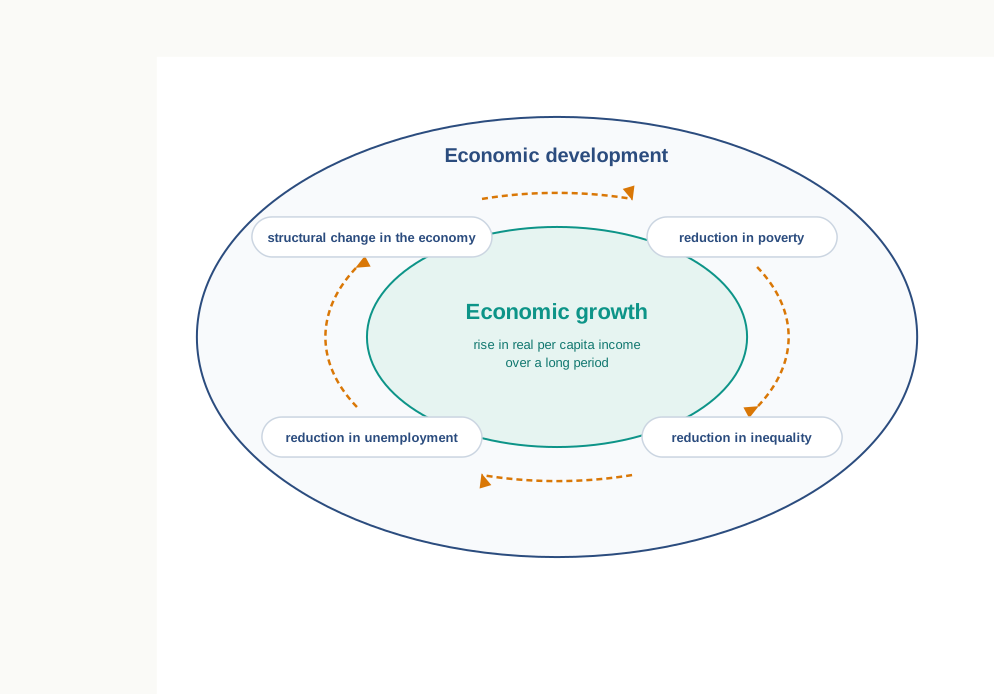
Fig. 6.0 – Economic development as growth plus structural change.
6.1 Why Economic Development Became A Central Question
Economics begins from scarcity: means are limited, wants are not, and every economy must choose. For most of the subject’s history that choice was studied as a problem of allocation — how a given stock of land, labour and capital should be divided among competing uses. For a poor country, however, the more pressing question is a different one. It is not only how to use the means it has, but how to enlarge them, so that fewer of its people go without food, schooling, treatment and work.
That second question is the subject matter of development economics. It became a central concern of the discipline only in the middle of the twentieth century, when a large number of countries in Asia, Africa and Latin America emerged from colonial rule and found themselves poor, largely agricultural and short of industry, capital and skills. India was one of them. Its economy had stagnated over the closing decades of colonial rule, and the governments that took charge after 1947 treated the raising of national output and living standards as their first duty.
Since then the study of economic development has grown into one of the most active branches of economics. Economists in rich and poor countries alike now concern themselves with why some economies advance and others do not, and with what a government can do about it.
6.1.1 Reasons For The Growing Interest In Development
The interest in development is not the work of economists alone. It grew out of changes in the world itself, and six of these are usually singled out.
- Awareness of poverty — people in the poor countries of Asia, Africa and Latin America came to know how the rest of the world lived, and no longer accepted poverty as a settled condition. The demand for a rising standard of living became a political demand as much as an economic one.
- Desire for economic power and recognition — poor countries found that their weak economic position carried with it a weak position in world affairs. Only by developing their economies could they gain the strength, and with it the standing, that they were denied.
- Emulation of advanced living standards — the goods, services and amenities enjoyed in the advanced countries became widely known through trade, travel and communication. Once the possibility is visible, it becomes an objective, and it can be reached only through development.
- Development as the leading policy objective — the nationalist governments established after the Second World War inherited economies shaped to serve colonial trade rather than domestic needs. Raising output, employment and living standards became the declared purpose of economic policy in these countries.
- Avoiding cyclical fluctuations — the rich countries had their own reason for interest. A steady expansion of output and demand protects an economy against the alternation of boom and slump, so growth is pursued not merely for its own sake but for the stability it brings.
- Self-interest of the developed countries — poor countries that grow richer buy more from abroad. The development of the poorer half of the world therefore widens the market for goods and services produced in the advanced countries, and generates output and employment there.
6.1.2 Development As A Concern Of Rich And Poor Countries Alike
The last two reasons deserve to be taken together, because they explain something that at first seems odd. Development is usually discussed as a problem of the poor countries, yet the rich countries have taken an active interest in it. Part of that interest is commercial. A poor country is a poor customer; as incomes rise there, its imports rise with them, and the factories and firms of the advanced countries gain the demand that keeps their own output and employment high.
The rest of the interest is a matter of security and stability. Wide differences in living standards between countries produce migration, conflict and instability that no border shuts out. It has come to be accepted that poverty anywhere is a threat to prosperity everywhere, and that the survival of the advanced economies is not separable from the progress of the rest.
For all this interest, the terms in which the discussion is conducted have often been used loosely. ‘Growth’ and ‘development’ are frequently treated as though they meant the same thing, and a country is called developed or underdeveloped without any stated test. Progress cannot be measured against a standard that has not been fixed. The chapter therefore turns next to the precise meaning of economic growth, and then to the meaning of economic development.
6.2 Economic Growth
If the progress of an economy is to be judged, it must first be measured, and measurement requires a definition that everybody uses in the same sense. Loose usage is not a small fault here. A government that claims its economy is growing, and a critic who denies it, may both be right if they are counting different things. Economists therefore define economic growth in terms of a stated, measurable quantity.
Three elements of this definition carry the whole of its meaning — that the measure is per capita income and not total income, that the increase is in real terms and not in money terms, and that it must last over a long period. Each is taken up in turn.
6.2.1 National Income As A Measure Of Output
Everybody agrees that an economy has grown only if it is producing more goods and services than before. The difficulty is that an economy produces thousands of unlike things — wheat, cloth, cement, haircuts, bus journeys — which cannot be added up in their own units. They can be added only in terms of money value, and the total so obtained is national income.
The word ‘final’ matters. Only goods that reach their last user are counted, so that the wheat sold to a flour mill is not counted separately from the bread that is finally bought. National income is expressed through two aggregates that differ in what they treat as the boundary of the economy.
Gross domestic product is the value of all final goods and services produced within the domestic territory of a country in a year. It counts output by the place where it is produced. The output of a foreign bank operating in Mumbai is part of India’s gross domestic product, because it is produced inside India.
Gross national product is the value of final goods and services produced by the normal residents of a country during a year. It counts output by who produces it rather than where. It differs from gross domestic product by the net factor income from abroad — the income earned abroad by a country’s own residents, less the income earned within the country by residents of other countries.
The one aggregate is thus fixed by territory and the other by residence, and the gap between them is the net factor income from abroad, which may be positive or negative. Both aggregates measure the size of the economy, and either may be used as the starting point. Neither, however, can serve as the indicator of growth by itself.
6.2.2 Per Capita Income As The Indicator Of Growth
An economy exists to support the people living in it, so what matters to them is not the size of the national cake but the size of the slice that reaches each of them on an average. That is what per capita income measures.
Per capita income converts a total into an average, so that economies of very different sizes, and the same economy at two different dates, can be compared on equal terms.
\[\text{Per capita income} = \dfrac{\text{National income}}{\text{Population}}\]
Here national income is the value of final goods and services produced in the year, measured either as gross domestic product or as gross national product, and population is the number of people in the country in that year. The result is a sum of money per person per year, so it is read as the goods and services available on an average to one person over the year.
Since national income may be taken in either form, the same relation is often written as follows.
\[\text{Per capita income} = \dfrac{\text{GNP (or GDP) of a country}}{\text{Population of a country}}\]
Why The Average And Not The Total
Suppose an economy’s national income rises by two per cent in a year while its population rises by three per cent. The total output available is larger than before, and yet there is less of it for each person than there was. Income per head has fallen. Nothing in that year has improved the position of the average citizen, and it would be misleading to call it growth.
Growth therefore requires that national income grow faster than population. This is the reason economists take the rise in per capita income, rather than the rise in national income, as the test. It is a rise that has been corrected for the number of people among whom the output must be shared.
6.2.3 Real Income And The Long Period
Two further conditions are built into the definition, and a rise that fails either of them is not economic growth.
The Increase Must Be In Real Terms
Money income measures income at the prices ruling in the year concerned. Real income measures it at the prices of a fixed base year, so that changes in the price level are removed and only changes in the quantity of goods and services remain.
The distinction decides the answer in a common case. If per capita income in money terms rises by ten per cent in a year and the general price level also rises by ten per cent, the citizen can buy no more at the end of the year than at the beginning. Money income has risen; real income has not. Growth requires that money income rise faster than the price level, for only then does a larger quantity of goods and services actually become available.
The Increase Must Last A Long Period
A rise in per capita income confined to one or two good years is not growth. Output may rise because of a favourable monsoon, or during the upswing of a trade cycle, and fall back when conditions turn. Growth means a rise that is sustained and prolonged — spread over several decades rather than a few seasons.
Such a rise can be sustained only if it rests on a permanent enlargement of the economy’s productive capacity, through investment in factories, machinery, roads, power and skills, and through technological progress. A boom raises output using capacity that already exists; growth adds to the capacity itself.
The distinction between a short-period rise and a long-period one is set out in Fig. 6.1.
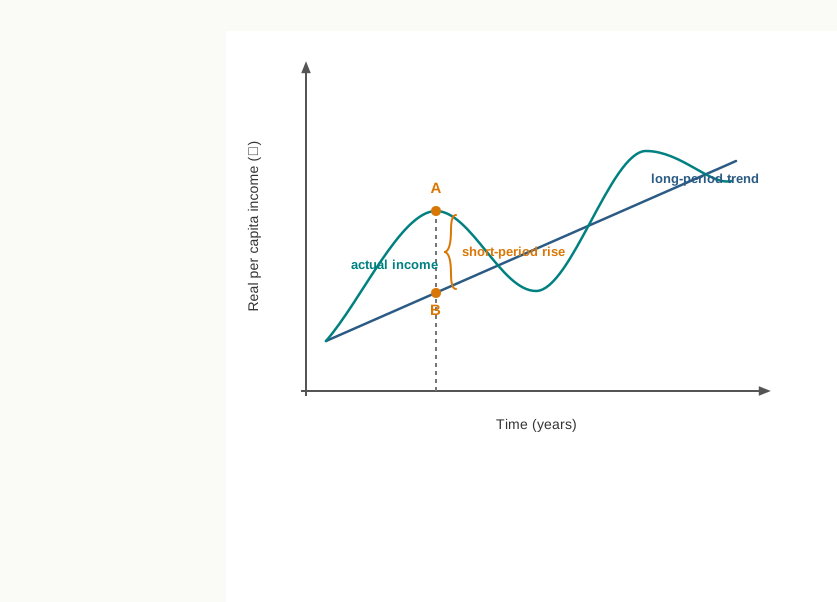
Fig. 6.1 – Short-period rise distinguished from long-period growth.
Growth Is A Process
Finally, growth is described as a process rather than an event. Calling it a process means that it is brought about by forces that operate continuously and depend on one another — saving and investment, the supply of skills, the state of technology, the size of the market. Identifying those forces is what makes growth something a country can plan for rather than merely hope for.
It also means that growth is not purely a matter of using more inputs. Output rises partly because more land, labour and capital are employed, and partly because each unit of input yields more than before, as better techniques come into use. Advanced technology, by raising efficiency, provides the basis on which a rise in per capita income can be kept up over decades.
6.3 Economic Development
Economic growth could be defined in a single sentence because it rests on one measurable quantity. Economic development cannot, and there is no definition of it that every economist accepts. The reason is not carelessness but the nature of the thing being defined. Development is multidimensional: it concerns output, but also the distribution of that output, the work people do, the health and literacy they enjoy and the institutions they live under. Economists have accordingly defined it differently, each emphasising the dimension that concerned him most.
Two broad positions can be distinguished, and the movement from one to the other is itself part of the subject’s history. The older position identified development with a rise in income. The later one held that a rise in income which leaves poverty, inequality and unemployment untouched is not development at all.
6.3.1 The Traditional View Of Economic Development
The traditional approach defined economic development strictly in economic terms, and in effect in one term — real per capita income.
On this view, development and growth mean the same thing, and the words were used interchangeably. The reasoning behind it was not unreasonable. A rise in real per capita income means a larger quantity of goods and services available to the average citizen for consumption and investment, and that was taken as the measure of improvement in overall economic well-being.
Behind the identification lay a further assumption. It was presumed that the gains from rising income would trickle down to the mass of the people, in the form of more jobs, higher wages and a consequent fall in poverty and inequality. If that were so, a government would need to concern itself only with raising output; the rest would follow. Poverty, unemployment and the distribution of income were therefore treated as secondary problems, and an increase in real income per head as the problem of primary importance.
6.3.2 The New View Of Economic Development
The traditional view was tested by events and did not survive them. During the 1960s and 1970s a number of developing countries recorded high rates of growth of per capita income, and showed little or no improvement in employment, in the equality of incomes or in the extent of poverty. Growth had occurred; the poor had gained little from it. The trickle-down strategy had not worked in the way it was expected to.
During the 1970s, therefore, a number of economists called for the rejection of the traditional definition as too narrow. They and the policy-makers who followed them began to define development in terms of the reduction or elimination of poverty, inequality and unemployment within a growing economy, and ‘redistribution with growth’ became a common slogan of the period. Development came to be interpreted not only as a rise in real per capita income but as a rise accompanied by these reductions.
The two views are set against each other below.
What The New View Includes
Because it is comprehensive, the new view brings a wide range of changes within the meaning of development. These are usually grouped as follows.
- Improvement in incomes and material welfare — a rise in real per capita income and in the goods and services actually available to ordinary households.
- Eradication of poverty and reduction of inequality — a fall in the number of people unable to meet basic needs, and a narrowing of the gap between the richest and the poorest.
- Reduction in unemployment — the creation of work for those willing to work, so that rising output is matched by rising employment.
- Social advance — the elimination of illiteracy and disease, and a fall in the death rate, so that people live longer and are better able to use their capacities.
- Structural change in output — a shift in the composition of output away from agriculture towards industry and services, which is the usual course of an economy as it develops.
- Structural change in employment — a corresponding shift in the occupational structure of the labour force, as workers move out of agriculture into other occupations.
- Institutional and social change — changes in the value system, in social structure and in the institutions through which economic activity is organised, which either assist development or hold it back.
The last three items give the phrase structural change its content. They explain why development is described as growth plus change: the economy that develops does not merely produce a larger quantity of what it produced before, but becomes a different kind of economy.
6.4 Difference Between Economic Growth And Economic Development
The two terms are now defined, and the difference between them can be stated exactly. Economic growth refers to an increase in real per capita income over a long period. Economic development means that increase together with a reduction in poverty, inequality and unemployment and a change in the structure of the economy. Development is often summed up as growth plus change, and the differences that follow are all consequences of what that ‘plus’ contains.
Difference In Scope
Economic growth is a narrow concept and economic development a comprehensive one. Growth is concerned with a single question — is real income per head rising? Development asks that question and several others besides: who is receiving the additional income, whether the number of the poor is falling, whether work is being created, and whether the economy is coming to be organised differently. Development therefore contains growth within it, while growth does not contain development.
The difference in scope shows itself in the indicators each uses. Growth is defined strictly in terms of economic indicators, and in practice in terms of income. Development uses economic indicators along with non-economic ones — literacy, the provision of housing, the availability of health services, life expectancy. A country may stand well on the first set and poorly on the second.
Difference In Nature And Measurability
Growth is entirely a quantitative concept. It is a rise in a magnitude, and a magnitude can be computed, compared across countries and traced across years. Development has qualitative dimensions as well — the change in attitudes and institutions, the improvement in the conditions under which people live and work — and these are not fully reducible to number.
This has a practical consequence. Growth is fully measurable, whereas development is not fully measurable. It does not follow that development cannot be assessed at all: composite indicators have been constructed for the purpose, and the ordinary evidence of literacy rates, death rates and the incidence of poverty is available. It does follow that any single figure claiming to capture development leaves something out.
Difference In The Role Of Government
Growth can occur without much intervention by the government. If saving, investment and technology are advancing, output per head will rise whether or not the state takes a hand in it. Development places a larger burden on the government, because the reductions it requires — in poverty, in inequality, in unemployment — do not follow automatically from a rising national income, as the experience of the trickle-down decades showed. Someone must direct resources towards schools, health services, employment programmes and the poorer regions, and in a developing economy that is chiefly the state.
Development is also the harder achievement for a further reason. Output and income can be raised by employing more inputs and using them more efficiently. Development involves the whole range of changes in a society — in its social structure, its attitudes and its institutions — alongside the eradication of poverty and the reduction of inequality. It asks a much more intensive effort of an underdeveloped country than growth asks of an advanced one.
Difference In The Countries Concerned
Growth is the ordinary concern of the advanced countries, which have already made the structural changes that development involves and are chiefly occupied with keeping output rising steadily. Development is the concern of the developing countries, where those changes are still to be made. The distinction is one of emphasis rather than an absolute division, since a developing country needs growth and an advanced country is not free of poverty or inequality.
The differences are collected below.
6.5 Quality Of Life As The Goal Of Development
The widening of the idea of development did not stop at poverty, inequality and unemployment. In recent decades development economists have stopped concentrating on national income altogether as the test of progress, and have turned to the quality of the development itself — not how much an economy produces, but what its production does for the people who live in it. Direct attention, they argue, should be given to the quality of life.
6.5.1 Meaning Of Quality Of Life
The argument behind the term is a simple one about ends and means. Economic development is not an end in itself; it is a means to something further. Human beings should be the end of development rather than mere instruments of it, and if that is so, then the ultimate objective of development must be the well-being of people. Development is accordingly to be judged by how far it enriches human life.
The Human Development Report of 1996 put the point in much this form, arguing that growth should be judged not by the abundance of commodities it makes available but by how much it enriches the lives of people. The distinction is between counting what an economy has produced and asking what difference the production has made.
That the two can come apart is not a theoretical possibility only. The experience of developing countries has shown that there is no automatic link between economic development and quality of life. In a number of countries the conditions of life of very large numbers of people deteriorated in the course of their development, as production expanded while housing, water, air and working conditions worsened. Growth, on this evidence, is not the answer to everything.
Quality of life is determined by many factors — income, consumption, health, education and the environment among them. National income is only one of these determinants, and one that is subject to the limitations already discussed. Development economists therefore go beyond the basic means of well-being and ask directly about the conditions in which people live.
6.5.2 Components Of A Better Quality Of Life
If quality of life is to serve as the objective of development, it must be given some definite content. Development economists set out its important components as follows.
- Better nourishment — providing people with more food and better food, so that undernutrition ceases to limit health and capacity for work.
- Adequate clothing and housing — shelter of a decent standard, which affects health, safety and the ability to hold regular work.
- Essential public services — pure drinking water, sanitation, health services and medical care made available to all the people, not to those who can pay for them alone.
- Better education — schooling of a quality that equips people to take up productive work and to take part in the life of the community.
- Better living conditions — the surroundings in which people live, including the state of the air, water and neighbourhood.
- More and better employment — the creation of work, particularly for the low-end poverty groups whose only asset is their labour.
- Overcoming poverty — a fall in the number of people unable to meet their basic needs.
- Reduction of inequality — distributing the benefits of economic development equitably, so that its gains are not confined to a section of the population.
Using The Components As Yardsticks
No country succeeds in all eight at once, and a country may do well on some and poorly on others. Their value is as yardsticks against which the progress of an economy can be judged. A successful country is one that converts the increase in income that development brings into progress along these dimensions.
At every stage, therefore, policy-makers are to ask a set of direct questions. Is the country able to meet the life-sustaining needs of its people? What has happened to educational and medical facilities? Are the living conditions of the masses improving? What has been happening to poverty? Has growth created employment, and who has benefited from it? Have inequalities narrowed as development has proceeded?
Where the answers to these questions are affirmative, quality of life has improved in the course of development, and only then can an economy be said to have achieved the development it desired. Where they are not, output has risen and little else has.
6.6 Summary
- Development became a central concern of economics in the middle of the twentieth century, when a large number of countries emerged from colonial rule and set out to raise their output and living standards. Six reasons are usually given for the interest that followed.
- Awareness of poverty among the people of the poor countries.
- The desire for economic power and recognition in world affairs.
- Emulation of the living standards of the advanced countries.
- Development adopted as the leading objective of policy by nationalist governments.
- The need of the rich countries for steady growth to avoid cyclical fluctuations.
- The self-interest of the developed countries, whose markets widen as poor countries grow richer.
- Economic growth is the process whereby the real per capita income of a country increases over a long period of time. All three elements — real, per capita and long period — are part of the definition.
- National income is the value of all final goods and services produced in a country in a year. It is expressed as gross domestic product, which counts output by the territory in which it is produced, or as gross national product, which counts output by the residents who produce it; the two differ by the net factor income from abroad.
- Per capita income is the average income of the people of a country in a particular year, obtained by dividing national income by population.
\[\text{Per capita income} = \dfrac{\text{National income}}{\text{Population}}\]
Here national income is the value of final goods and services produced in the year, taken as gross domestic product or gross national product, and population is the number of people in the country in that year. The result is a sum of money per person per year.
- Per capita income, and not total national income, is the indicator of growth, because it corrects for changes in population. If population grows faster than output, income per head falls even though the national total has risen.
- The increase must be in real terms. If money income and the price level both rise by the same proportion, no additional goods and services become available, and there has been no growth.
- The increase must be sustained over a long period. A rise confined to a boom or a good season is not growth; a lasting rise requires a permanent enlargement of productive capacity through investment and technological progress, which is why growth is described as a process.
- Economic development has no single accepted definition, because it is multidimensional in nature. Economists have defined it differently according to the dimension they emphasise.
- The traditional view treated economic development as a sustained increase in real per capita income, and therefore as a synonym for economic growth. It presumed that the gains would trickle down to the poor in the form of jobs and higher incomes.
- Experience during the 1960s and 1970s showed that trickle down did not work: per capita income rose in several developing countries while poverty, unemployment and inequality remained largely unchanged.
- The new view defines economic development as the process whereby the real per capita income of a country increases over a long period of time, along with a reduction in poverty, inequality and unemployment, and various structural changes. Those structural changes include a shift of output and of the workforce away from agriculture towards industry and services, and changes in values, social structure and institutions.
- Economic growth and economic development differ on several bases, the chief of which are condensed below.
- The relation between the two is not symmetrical. Growth does not necessarily imply development, but development almost invariably implies growth, since the resources development calls for come out of the economy’s own output.
- Quality of life refers to the degree of economic well-being enjoyed by the people of a country. It rests on the argument that human beings are the end of development rather than its instrument, so development is to be judged by how far it enriches human life.
- There is no automatic link between development and quality of life, and in a number of countries the conditions of life of large numbers of people deteriorated in the course of development. Income is only one of the determinants of well-being, alongside consumption, health, education and the environment.
- The important components of a better quality of life are better nourishment, adequate clothing and housing, essential public services such as pure drinking water, sanitation and medical care, better education, better living conditions, more and better employment, the overcoming of poverty, and the equitable distribution of the benefits of development. They serve as the yardsticks against which the progress of an economy is judged.
6.7 Points to Ponder
- Per capita income is an average, and an average can rise while most people are no better off. If that is so, why has economics not replaced it with some measure of the income of the typical household, and what would be lost if it did?
- Development requires the government to direct resources towards schools, hospitals and employment programmes, and those resources have to be taken out of the economy’s output before they can be spent. Can a very poor country afford to pursue development and growth at the same time, or must one wait upon the other?
- Kerala improved literacy and life expectancy without leading the states in income per head, while other states have raised incomes faster with less to show on social indicators. Which of the two records would you call the greater development, and what does your answer reveal about the standard you are using?
- The structural change that accompanies development moves people out of agriculture into industry and services. For the family that makes that move, the change may mean leaving land, village and a settled way of living. Should such costs be counted against development, and if so, how?
- Development economists argue that human beings are the end of development and not its means. Yet the policies that raise output — building factories, opening mines, laying roads — often ask particular groups of people to bear a cost so that the rest may gain. How should an economy decide when that trade is worth making?
- If quality of life cannot be fully measured, a government can always claim it is improving and a critic can always deny it. Does that make quality of life too vague to serve as the objective of policy, or is a rough measure of the right thing better than an exact measure of the wrong one?
6.8 Objective Questions
- Economic growth is best indicated by a rise in: [1]
- money national income
- real per capita income over a long period
- gross domestic product in a single year
- the size of the population
- Assertion (A): A rise in a country’s national income is not by itself proof of economic growth. Reason (R): National income may rise while population rises faster, so that income per head falls. Choose the correct option. [1]
- Both A and R are true and R is the correct explanation of A.
- Both A and R are true but R is not the correct explanation of A.
- A is true but R is false.
- A is false but R is true.
- Fill in the blank: The presumption that the gains of rising per capita income would reach the poor in the form of jobs and higher incomes is known as the ______ strategy. [1]
- Match the items in Column A with those in Column B. [1]
| Column A | Column B |
|---|---|
| a. Gross national product | i. Shift of the workforce out of agriculture |
| b. Quality of life | ii. Output of the normal residents of a country |
| c. Structural change | iii. Degree of economic well-being of the people |
- State whether the following statement is true or false, and give a reason: Economic development is fully measurable, while economic growth is not. [1]
6.9 Check Your Concepts
- Define economic development as it is understood in the new view. [2]
- State three components of a better quality of life, explaining each in one sentence. [3]
- Explain why economists regard per capita income, rather than total national income, as the appropriate indicator of economic growth. Use an example in which the two point in opposite directions. [4]
- Distinguish between economic growth and economic development on any six bases, and explain why growth does not necessarily imply development while development almost invariably implies growth. [6]
6.10 Case-Based Question
- Meera Raghavan is asked to report on the economy of a district where a large cement plant, Suryagiri Cement, was set up eight years ago. She finds that the district’s output has more than doubled since then and that average income per head has risen every year. She also finds that the number of households below the poverty line is very nearly what it was, that most of the plant’s skilled posts are held by people who moved in from outside the district, and that the district’s schools and health centre are as they were eight years ago. [4]
- State, with reasons, whether the district has experienced economic growth, economic development, or both. [2]
- Identify two components of quality of life on which the district appears to have made no progress, and explain in each case why a rise in average income has not produced an improvement. [2]