Chapter 8: Sustainable Development
Every generation inherits a stock of resources — land, water, forests, minerals, factories, roads and the skills of its people — and uses that stock to produce the goods it needs. What it leaves behind decides how much the generation after it will be able to produce. For most of the last century, development was measured only by how fast income grew, and the cost of that growth was rarely counted: forests cleared, rivers fouled, groundwater drawn down and the air of the industrial cities made unfit to breathe. A country can raise its output for a few decades in this way and still leave its children poorer, because the means of producing have themselves been used up.
Sustainable development is the answer economics offers to that problem. It asks that the present generation meet its needs without reducing the ability of future generations to meet theirs — that the stock of capital handed on stays constant or rises rather than shrinking.
This chapter explains what sustainable development means, why the concern for it has grown, how economic development damages resources and the environment, what global warming is and what it does, and what strategies are being followed to meet the challenge.
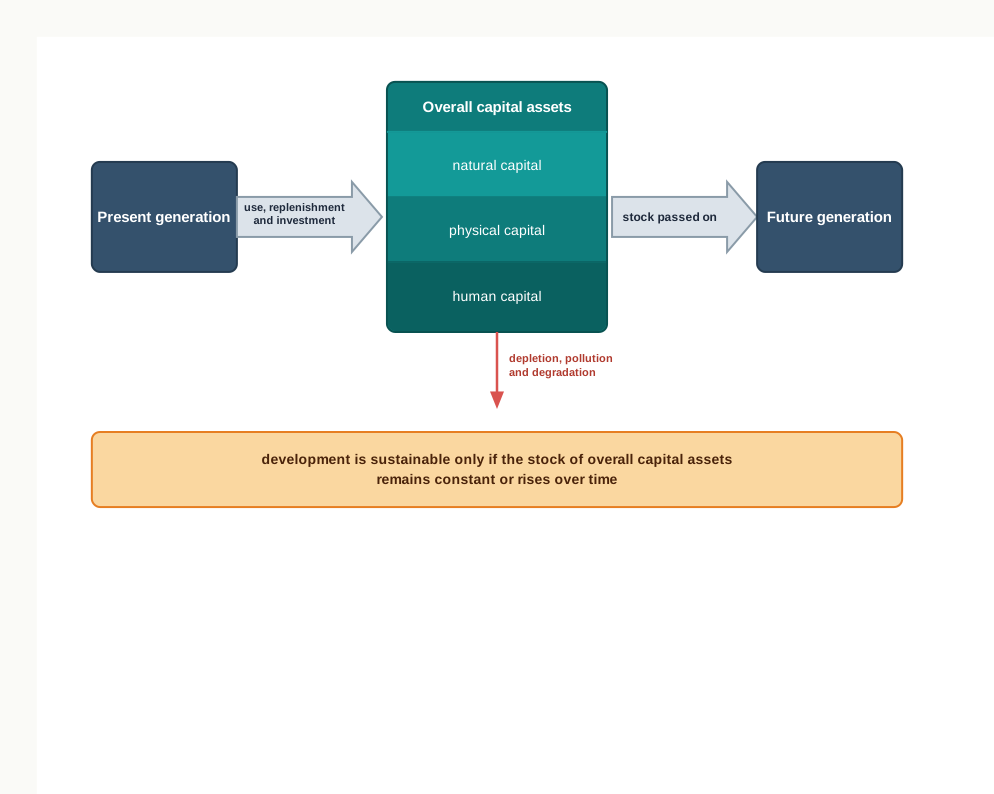
Fig. 8.0 – Passing on the stock of capital assets.
8.1 Meaning Of Sustainable Development
Every economy has to decide how much of its resources to use up today and how much to leave standing for tomorrow. This is a problem of choice like any other in economics, except that the two claimants are not two buyers in a market but two generations, one of which cannot bid for what it needs. The generation that is alive makes the decision; the generation that follows lives with it.
For a long time economics had little to say about this choice, because development was judged only by how much output rose. It is only over the last few decades that the question of what development costs, and who pays that cost, has been brought into the definition of development itself.
8.1.1 The Changing Idea Of Economic Development
Economic development is an evolving idea rather than a fixed one. As the world changed and new problems appeared, what economists counted as development changed with it.
Until the 1960s, economic development was treated as a rise in income, measured by the rise in real per capita income. An economy that produced more per head each year was held to be developing, and nothing further was asked about how that output was distributed or how it had been obtained.
During the 1970s the idea was widened. Alongside per capita income, development was taken to require the eradication of poverty, a fall in income inequality and a reduction in unemployment. Growth that left the poor where they were was no longer accepted as development.
In 1990 the United Nations Development Programme published its first Human Development Report, which argued that development should not be measured by the national income indicator alone. In place of income by itself, it measured development in terms of the quality of life, taking three dimensions — health, education and income.
More recently, development economists and policy-makers have gone one step further and begun to speak of sustainable economic development rather than economic development alone. The reason is that development in the past depleted natural resources and polluted the environment, reducing the resources available to present and future generations and damaging their capacity to grow. The idea of development has therefore had to take account of the long-term use of natural resources and the interest of the generations still to come.
8.1.2 Meaning And Features Of Sustainable Development
The concept of sustainable development came into prominence with the report of the World Commission on Environment and Development in 1987. Sustainability, in general, refers to meeting the needs of the present generation without compromising the needs of future generations.
Put differently, sustainable development is the pattern of development that permits future generations to live at least as well as the current generation. It is development that can be sustained over a long period of time, allowing those who come later the same quality of life as is being enjoyed now.
Three features follow from this meaning.
- Equality of potentiality — sustainable development requires that the potential for development be shared equally between the present and the future generations, so that the opportunities open to one are open to the other.
- Inter-generational and intra-generational equity — sustainable human development addresses fairness both between generations and within a generation, enabling all people, present and future, to make the best use of their capabilities.
- A sustained rise in well-being — the goal is a sustainable increase in per capita income and a reasonable and equitably distributed level of economic well-being that can be maintained continuously for many generations.
What is passed on, it should be noted, is not a fixed bundle of goods but the potentiality of a particular level of development — the opportunities that future generations can freely exercise for their own well-being.
8.1.3 Overall Capital Assets As The Necessary Condition
What, then, is the key condition for achieving sustainable development? Economic development is sustainable if, and only if, the stock of overall capital assets remains constant or rises over time.
The reason lies in what determines development opportunity in the long run. Three kinds of asset do so.
- Natural capital — the stock of natural resources and the environment, such as mineral reserves, oil stocks, fisheries in the oceans, forest reserves and the quality of air, water and soil.
- Physical capital — plant, machine tools, equipment and factories, together with infrastructure such as power and transport.
- Human capital — education, skills, knowledge and technical advancement.
Overall capital assets are the sum of these three. If the sum is falling, the economy is consuming its own means of production and the next generation will inherit less capacity to produce than the present one had. Sustainable development therefore requires that this total stock remains constant or rises over time.
Read in this way, sustainable development is a wider issue than the environment alone, since physical and human capital enter the total as well. In the strict sense, however, a constant stock of natural resources and environmental quality is taken as the necessary condition, and this yields four requirements.
- Renewable resources must be used without degrading them — sustainable development does not mean that natural resources should not be used at all, but that renewable resources are used in a manner which does not reduce or diminish their usefulness for future generations.
- Renewable resources must not be extracted faster than they regenerate — the rate of extraction should not exceed the rate at which the resource renews itself.
- Non-renewable resources must be used carefully — exhaustible resources such as minerals should be used in a manner that does not needlessly reduce their availability and accessibility for the future. Wasteful and ruthless exploitation has to be avoided.
- Polluting activities must be discarded — activities that damage the environment work against sustainability even where no resource is being exhausted.
8.2 Need For Sustainable Development
Why has sustainable development become a concern only in recent decades, and why should a generation take trouble over the well-being of people not yet born? The question is worth putting plainly, because the cost of caring about the future is borne now while the benefit accrues later.
The case rests on four arguments. The first is about who owns the environment, the second about how it has actually been used, the third about how development has been measured, and the fourth about the quality of life of the present generation itself.
8.2.1 Natural Resources And Environment As Common Heritage
Economic development and the overall quality of life both depend on the stock of natural resources and the quality of the environment. That stock, however, belongs to no single generation. The quality of air, water and land is the common heritage of all generations, so every generation has an equal claim to use it.
It follows that using these resources indiscriminately to achieve short-term economic goals penalises the generations to come. Where a rise in income today is obtained by depleting natural resources and degrading the environment, the next generation is left to produce its output from a smaller resource base and under polluted conditions. Its production capacity is reduced, and with it the rate of growth and the quality of life it can expect.
This is why the argument is often put in ethical rather than technical terms. If the present generation has enjoyed a certain range of opportunities from a shared inheritance, it is under an obligation to guarantee similar opportunities to those who follow.
8.2.2 Indiscriminate Use Of Natural Resources
The second argument rests on the record. Many of the industrialised countries of the world have a history of rapid depletion of their stock of natural resources, and growth in such cases may be consuming its own foundations — visible in exhausted resources and in polluted air and water.
What this shows is that the present generation has pursued economic growth without due regard to its long-term consequences. Resources that took geological time to form have been drawn down within a few generations, and the environment has been treated as a free dumping ground because no one is charged for using it. Both are of great concern for the future.
8.2.3 Resource Depletion As A Cost Of Development
It is now widely accepted that the depletion of the stock of natural resources and the degradation of the environment should be treated as costs of development. If they are costs, they must be deducted from national income before the growth rate is read, in the same way that the wearing out of machinery is deducted.
In the past these costs were not taken into account at all. National income counted the timber sold but not the forest lost, the crop harvested but not the soil eroded in raising it. Because the debit side was left blank, the benefits of past development have been exaggerated. A growth rate calculated in this way overstates how much better off the economy has actually become.
8.2.4 Quality Of Life And Quality Of Environment
The fourth argument concerns the present generation rather than the future one. Sustainable development matters for improving the quality of life now, because quality of life depends on a healthy and long life, a balanced diet, safe drinking water, clean air, better sanitation and a hygienic environment. Each of these requires both sufficient resources and a clean environment.
Quality of life is therefore dependent on the access of citizens to a healthy environment. Safe and plentiful water and clean, unpolluted air are not merely conditions for development; they are themselves part of the improvement in economic welfare that development is supposed to bring.
This gives the sharpest form of the argument. If the benefits of rising incomes are offset by the costs imposed on health and quality of life by pollution, the rise in income cannot be called real development at all. A household that earns more and spends the addition on medicines for an illness caused by the air it breathes has gained nothing.
8.3 Effect Of Economic Development On Resources And Environment
Economic development has had remarkable positive effects on human life. Incomes have risen greatly, modern techniques of production have raised productivity, and industrialisation has brought a flood of new products that have made life more comfortable. Mass production, the easy availability and discovery of new goods, and higher incomes have changed the way people live altogether.
At the same time, growth has drawn heavily on the country’s natural resources and environment. The process of economic growth has been invariably accompanied by a depletion in the stock of natural resources and by rising pollution and environmental degradation. This section sets out first the damage that has been done, and then the forces that have caused it.
8.3.1 Damage To Natural Resources And The Environment
Economic development has inflicted various damages on natural resources and the environment. The main ones are the following.
- Depletion of natural resources — industrial development created a large demand for raw materials for mass production, and this has drawn down the stock of natural resources, particularly where the resource is limited, as with minerals. At the same time the demand for agricultural land has risen with population and with the need for more food, extending the area under cultivation and converting forest land into farmland.
- Water pollution — industrialisation and urbanisation have led to substances being mixed with natural water so as to deteriorate its quality. Polluted water is unpleasant to smell and unfit for drinking, bathing and washing, and it carries waterborne diseases such as diarrhoea, which mainly affect children and the poor. Rivers are contaminated by heavy metals, toxic chemicals and other hazardous wastes discharged into them, and groundwater has been contaminated through seepage.
- Air pollution — in the course of growth, air pollution has increased mostly in the urban areas, largely because of gaseous emissions from industry, thermal power plants, automobiles and domestic combustion. Air pollutants include carbon monoxide, oxides of nitrogen and sulphur, hydrocarbons and suspended particulate matter. Polluted air has disturbed the natural balance, brought about climatic changes, and caused asthma, other respiratory diseases and cancer. In Indian cities the transport system is among the largest single sources.
- Solid and hazardous wastes — a growing population and increasing urbanisation have produced a tremendous increase in solid waste: organic waste from human beings and animals, domestic waste, industrial waste such as metals and oil spills, commercial waste such as plastics and packing material, and agricultural waste. Thousands of tonnes are produced daily in urban areas, and inadequate collection and the absence of an effective disposal system have spread disease and polluted groundwater.
- Soil erosion — heavy rain and land erosion strip the topsoil, and where the loss is large the land may become unfit for supporting vegetation. Productivity falls as soil quality deteriorates, and the eroded material silts up dams and tanks, reducing their irrigation potential. In India the extent of soil erosion has increased over the years for want of proper land management.
- Deforestation — forests protect the environment and are often called the lungs of the earth, since trees absorb carbon dioxide and give out oxygen through photosynthesis. In the course of development, large areas of virgin forest have been cleared for agricultural, mining and industrial use. Deforestation causes soil erosion and with it floods and loss of crops; it changes the hydrological cycle, altering the water held in the soil and the moisture in the air and reducing rainfall; and it raises the concentration of greenhouse gases in the atmosphere.
- Use of chemical fertilisers and pesticides — in the course of agricultural development, these have been used ever more heavily to raise yields. They contain toxic chemicals that creep into the food chain through the foods and vegetables people eat, and their indiscriminate use has caused ecological damage through toxic effects on fish stocks, birds and wildlife.
- Loss of biodiversity — biological diversity refers to the range of species and ecosystems, whose members collectively maintain the ecological balance and supply food, fibre, medicine and raw material. Human activity has eroded this diversity: species-rich forests have been cleared, overfishing and river pollution have reduced freshwater and marine stocks, and coastal mangroves in India have been cleared for aquatic sports and for the construction of luxury resorts, threatening the habitats they shelter.
A ninth damage, global warming, arises out of several of the eight above and is serious enough to be taken separately. It is dealt with in section 8.4.
8.3.2 Causes Of Depletion Of Resources And Environmental Degradation
A number of factors are responsible for the depletion of resources and the degradation of the environment in the course of economic growth.
- Industrialisation — industry is an essential part of any programme of economic growth, but it has created a large demand for raw materials, putting pressure on agricultural and mineral resources. It pollutes in several ways at once: greenhouse gases into the atmosphere, chemicals and effluents into rivers and other waterbodies. Its large demand for energy, met by thermal and hydro power, has depleted coal reserves and submerged land and rivers behind large dams.
- Urbanisation — industrialisation and urbanisation go hand in hand. As cities grow and spread, the demand for housing rises, and agricultural land and forest land at the edges are encroached upon. More vehicles mean more emissions, and a growing urban population discharges more waste into rivers and waterbodies. Sewage and solid and hazardous wastes add to both air and water pollution.
- Population growth — world population has been rising fast since the eighteenth century, and India’s population grew from about 361 million at the Census of 1951 to more than 1.4 billion by the early 2020s. Large tracts of forest and grassland have been converted to cropland to feed the growing numbers, and the demand for energy has risen with them — fossil fuels meeting the bulk of urban demand and fuelwood much of the rural.
- Technological progress — modern technology has created a large demand for resources so as to raise production. Easier and cheaper output has raised consumer demand in turn, goods have been produced in great surplus, and mass-scale production together with excess output has led to large-scale wastage of resources.
- Agricultural development — the area under cultivation has been extended to raise farm output, causing deforestation. High-yielding varieties, introduced to raise productivity, require heavy inputs of irrigation water, chemical fertilisers and chemical pesticides. Yields have certainly risen, but at the cost of severe environmental hazards and of chemical residues in foodgrains and vegetables.
8.4 Global Warming
Of all the damages traced in the previous section, one is different in kind. Polluted river water harms the people who live along that river; a felled forest is lost to the district that held it. Global warming is not confined in this way. Gases emitted anywhere mix through the whole atmosphere, and the warming that follows is shared by every country, including those that emitted almost nothing.
This makes it the hardest environmental problem for economics to handle, because no single country can solve it by acting alone and each has an incentive to wait for the others.
8.4.1 Meaning Of Global Warming
Indiscriminate industrialisation, urbanisation and environmental pollution are bringing about certain changes in the atmosphere on a global scale. The major hazard to have emerged from them is the greenhouse effect and the global warming arising from it.
Industrialisation, urbanisation, deforestation, rapidly expanding agriculture, change of land use and the burning of fossil fuels have all raised the emission of greenhouse gases such as carbon dioxide, methane and nitrous oxide. Greenhouse gases are those gases that retain heat within the atmosphere. The retention of heat causes the greenhouse effect, which raises the average atmospheric temperature and results in global warming.
The chain from economic activity to a warmer atmosphere is set out in Fig. 8.1.
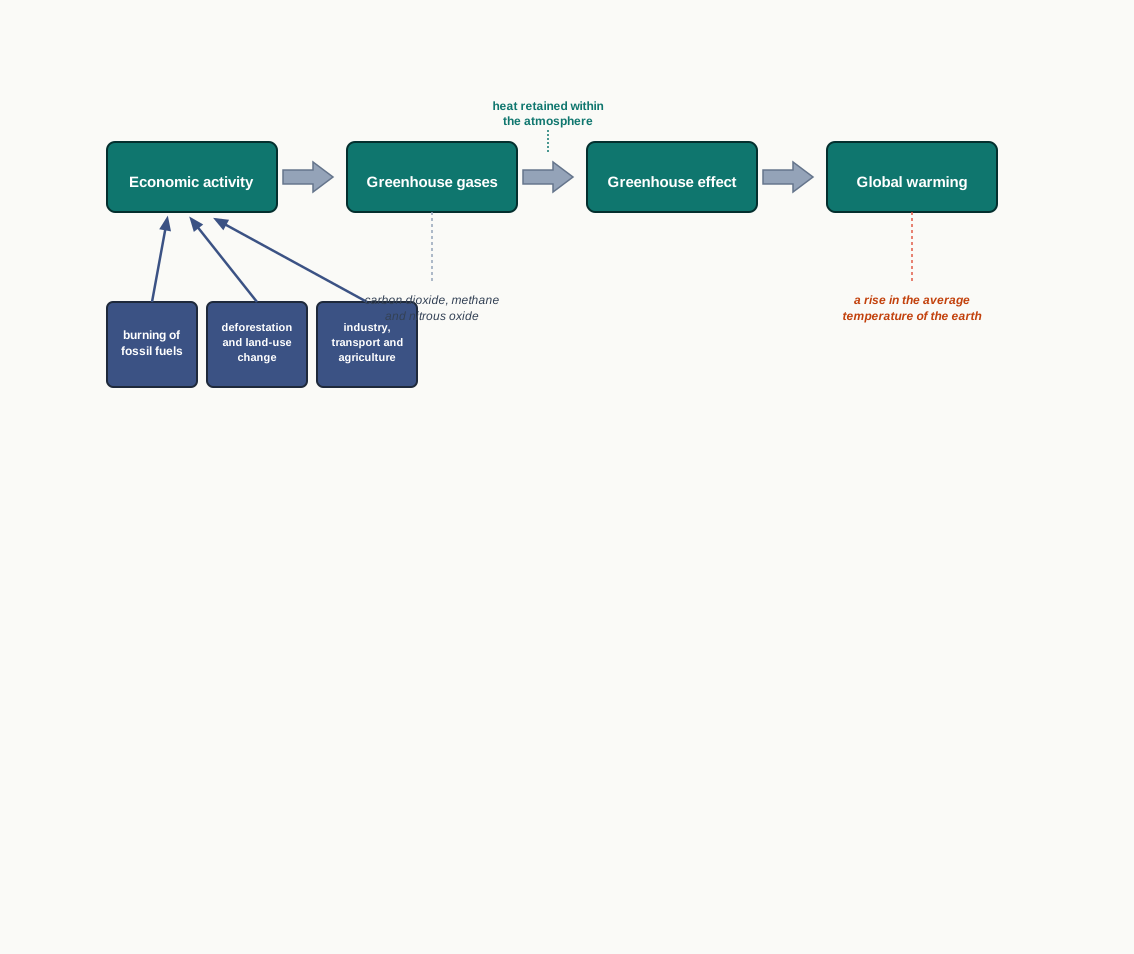
Fig. 8.1 – How economic activity leads to global warming.
8.4.2 Effects Of Global Warming
Global warming is likely to have serious effects on the environment and on the economy.
- Melting of glaciers — glaciers across the Himalayan and Alpine ranges are retreating and shrinking each year. Since these glaciers feed the rivers on which dry regions depend, their loss threatens water supplies and has a heavy impact on the ecosystems that draw on them.
- Rise in sea level — melting ice and warming water raise the level of the sea, which permanently floods wetlands and low-lying land and causes loss of land through coastal erosion and flooding.
- Loss of coastal land and displacement — the loss of coastal land bears directly on the economic life of the people who live there. A large population faces displacement through permanent flooding, and the result is a large migration out of the coastal areas.
- Widespread change in temperature and rainfall — warming does not raise temperature evenly. Some regions would see a dramatic increase in rainfall while others face drought with meagre rainfall, and both affect agriculture and natural vegetation.
- Redistribution of plants and animals — species are adapted to particular climatic and geographical conditions, so changing temperature patterns push their ranges to shift.
- Extinction of species — shifting climate zones, changing vegetation zones, rising sea level and the flooding of coastal areas together may result in major species extinction, since not every species can move or adapt fast enough.
- Threat to food security — global climatic change affects food security in many places through greater soil erosion and reduced rainfall, both of which cut agricultural production.
8.5 Sustainable Development As A Challenge
As the world grows and develops economically, it faces a difficult question: how are rivers, freshwater lakes, grasslands, woodlands and the rest of the natural base to be preserved while output goes on rising? The loss of these resources and the degradation of the environment lead in the end to a deterioration in the quality of life, so the question cannot be postponed indefinitely.
The challenge is a particularly sharp one for India. Since the early 1990s India has been among the fastest-growing large economies in the world, and rapid growth on this scale presses hard on the country’s environment and natural resources. Given the size of the country, its high population density, its vulnerable ecology and extreme climate, and the large share of the economy that depends directly on the natural base, the environmental risks are wide-ranging. The share of growth-related damage — degradation of the urban environment, industrial waste and pollution — has been increasing.
Environmental management has therefore emerged as an important issue, and environmental sustainability has become one of the significant challenges faced by India in the course of its economic growth. In recent years attempts are being made all over the world to adopt sustainable ways of using resources, and the conservation of natural resources and the environment is now a major focus of policy in most countries.
8.5.1 Strategies For Sustainable Development
Sustainable development requires the optimum use of resources and their effective management. For resource and environment management to be effective, development plans have to pursue the following strategies.
- Replenishment of resources — resources should not only be exploited but replenished as well. The extraction of renewable resources should not exceed the rate at which they renew themselves, and the extraction of non-renewable sources should be minimised.
- Equitable use of resources across generations — resources should be used in a way that meets the needs of the present generation and the future generations alike, without causing damage to the environment.
- Environment protection — further damage to the environment and to other life-support systems should be prevented; instead of polluting the environment, we should conserve it.
- Conservation of biological diversity — the range of species and ecosystems should be conserved and nurtured rather than allowed to erode.
- Use of efficient techniques — efficient techniques make the best use of a given quantity of resources. Efficiency in resource use moderates the stress on the resource endowment and is therefore itself a form of conservation.
- Use of eco-friendly technologies — existing techniques need to be modified towards technologies geared to conserving the environment. Energy-saving technologies and those using renewable resources should be promoted: gobar gas plants as a source of domestic fuel and organic fertiliser, solar energy as a clean and non-exhaustible source, and wind power where wind speeds are high, since windmills generate electricity without adverse impact on the environment.
- Use of environment-friendly sources of energy — LPG and CNG are cleaner fuels than petrol and diesel and their use should be encouraged in their place.
- Development of organic farming — excessive use of fertilisers, insecticides and pesticides has caused loss of soil fertility, soil erosion, salination and contamination. Organic farming, which uses biocompost made from organic wastes and biological pest control based on plant products, supports sustainable agricultural development.
- Setting air-quality and emission standards — the government must set air-quality standards and emission standards for vehicles, with fines imposed where emissions exceed the permitted level.
- Technical devices to reduce air pollution — the government may encourage better technologies to control air pollution, such as low-pollutant fuels, compressed natural gas in place of petrol, and catalytic converters fitted to vehicles.
- Public means of transport — public transport, including the Metro, should be developed. This cuts the use of private vehicles and reduces pollution in the cities.
- Increasing public awareness — people need to be made aware of the desirability of conserving natural assets for future generations, since policy works only where the public supports it.
8.5.2 Efforts Made In India
India has been making serious efforts towards sustainable development and has built up a body of environmental law and institutions to deal with them.
Laws And Institutions
The need for environmental protection was written into the Constitution by the 42nd Amendment in 1976, which added Article 48A to the Directive Principles of State Policy, placing on the State the responsibility to protect and improve the environment. The first serious legislative attempt to curb water pollution came with the Water (Prevention and Control of Pollution) Act, 1974, under which pollution control boards were set up at the centre and in the states. The Air (Prevention and Control of Pollution) Act, 1981 followed to control air pollution. In the wake of the Bhopal gas tragedy of December 1984, the Environment (Protection) Act, 1986 was enacted, empowering the government to take all possible steps to prevent and control pollution of water, air and land.
In more recent years, sustainable development has become an important part of the policy of the Government of India. The National Environment Policy, 2006 attempted to bring environmental concerns into all developmental activities. Forest and tree cover has recorded modest increases across successive assessments, which places India among the few developing countries where forest cover has not shrunk. Programmes to spread LED lighting have reduced the electricity used for lighting and with it the carbon dioxide emitted in generating it, and electric passenger vehicles are being developed to run on cleaner energy. In the field of climate finance, a Green Climate Fund has been established. Voluntary agencies, the corporate sector and an active judiciary have all played a part in improving environmental quality.
Despite all this, environmental degradation has not been arrested effectively, and there remains a dire need for much more active involvement of the government, voluntary organisations and other stakeholders.
Participation In World Conventions
India has also been an active participant in world conventions on climate change since 1992. The first Earth Summit was held at Rio de Janeiro in Brazil in June 1992, where more than 160 countries signed the Rio convention. For nearly three decades since, the United Nations has brought countries together at the climate summit known as the Conference of the Parties. The Climate Change Conference at Cancun in Mexico in 2010 adopted a resolution to set governments more firmly on a path towards low emissions and enhanced action in the developing world, and the Durban meeting of December 2011 took steps to reduce greenhouse gas emissions and to establish a global climate fund for the purpose.
The United Nations climate change conference held at Paris in France from 30 November to 12 December 2015 produced the Paris Agreement, a global agreement on climate change adopted by 196 parties. It was the first universal climatic agreement, and its key element was the goal of limiting global warming to well below 2°C above the pre-industrial level, with efforts pursued towards 1.5°C. All nations were required to play their part in cutting greenhouse gas emissions, and developed countries were to assist poorer countries with climate finance. India has set itself an ambitious target of 500 gigawatts of non-fossil-fuel electricity generation capacity by 2030, announced at the Glasgow conference in 2021, along with net zero emissions by 2070.
The conferences that followed — Katowice in Poland in 2018, Glasgow in 2021 and Sharm el-Sheikh in Egypt in 2022 — reiterated the objective of holding warming within 1.5°C above the pre-industrial level. They called for rapid and sustained reductions in greenhouse gas emissions, a phased reduction in the use of fossil fuels and a shift to clean fuels such as electricity. These conferences have also pressed the financial responsibility of the developed countries, which contributed the bulk of past emissions, to compensate developing countries for the losses caused by climate disasters.
8.6 Summary
- Economic development is an evolving idea. Until the 1960s it meant a rise in real per capita income; in the 1970s it was widened to include the eradication of poverty and reductions in inequality and unemployment; and in 1990 the first Human Development Report measured it by the quality of life across three dimensions — health, education and income.
- Sustainable development came into prominence with the report of the World Commission on Environment and Development in 1987. It is development that meets the needs of the present generation without compromising the ability of future generations to meet their own needs.
- Sustainable development requires equality of potentiality between generations, addresses both inter-generational and intra-generational equity, and aims at a sustainable and equitably distributed rise in per capita income. What is passed on is development opportunity, not a fixed bundle of goods, and sustainability does not mean sustaining the present level of poverty.
- The necessary condition for sustainable development is that the stock of overall capital assets remains constant or rises over time. Overall capital assets are the sum of three:
- natural capital — minerals, oil, fisheries, forests and the quality of air, water and soil;
- physical capital — plant, machinery, factories and infrastructure;
- human capital — education, skills, knowledge and technical advancement.
- In the strict sense, sustainability requires that renewable resources be used without degrading their usefulness and extracted no faster than they regenerate, that non-renewable resources not be exploited wastefully, and that polluting activities be discarded.
- The need for sustainable development rests on four arguments: natural resources and the environment are the common heritage of all generations; resources have been used indiscriminately by the industrialised countries; resource depletion and environmental degradation are costs of development that were never deducted from national income, so past gains were exaggerated; and the quality of life of the present generation itself depends on the quality of the environment.
- Economic development has damaged resources and the environment in eight main ways: depletion of natural resources, water pollution, air pollution, solid and hazardous wastes, soil erosion, deforestation, the use of chemical fertilisers and pesticides, and loss of biodiversity.
- Five forces have caused this depletion and degradation: industrialisation, urbanisation, population growth, technological progress and agricultural development.
- Global warming is the increase in the average temperature of the earth resulting from the emission of greenhouse gases, especially carbon dioxide, which trap the heat of the sun. Its effects include the melting of glaciers, a rise in sea level, loss of coastal land and displacement of population, changed rainfall patterns, redistribution of species, extinction of species and a threat to food security.
- Sustainable development requires the optimum use of resources and their effective management. The strategies include replenishing resources, equitable use across generations, protection of the environment and of biological diversity, efficient and eco-friendly techniques, cleaner fuels, organic farming, air-quality and emission standards, technical devices to cut vehicular pollution, public transport and public awareness.
- India has built a framework of environmental law — Article 48A inserted by the 42nd Amendment in 1976, the Water (Prevention and Control of Pollution) Act, 1974, the Air (Prevention and Control of Pollution) Act, 1981, the Environment (Protection) Act, 1986 and the National Environment Policy, 2006 — and has taken part in world conventions on climate change since the Earth Summit at Rio in 1992, including the Paris Agreement of 2015.
- The distinction that runs through the chapter is set out below.
8.7 Points to Ponder
- A generation cannot ask the next one what it would like to inherit, and the next one cannot bid for what it needs. If neither bargaining nor voting can settle the claim of people not yet born, on what basis should the present generation decide how much to leave behind?
- Sustainability is defined as keeping the stock of overall capital assets constant or rising. That allows a country to run down forests and minerals so long as it builds enough factories, roads and schools with the proceeds. Are the three kinds of capital really substitutes for one another, or are some parts of natural capital irreplaceable whatever else is built in their place?
- If depletion and pollution were deducted from national income as costs, the growth rates of the past several decades would fall. Would a country that measured its growth in this way be better governed, or would it simply appear poorer than its neighbours while living exactly as before?
- The industrialised countries reached their present incomes by using resources and emitting freely for two centuries. Developing countries are now asked to grow along a cleaner and costlier path. How should the burden of cutting emissions be divided between those who caused the problem and those who are still poor?
- A household that cooks on firewood pays nothing for fuel; one that cooks on gas pays every month. If the environmental gain from the switch is shared by everyone but the bill falls on a single poor household, what does that tell you about why clean choices often need policy behind them?
- Every strategy in this chapter has a cost that falls now and a benefit that arrives later, often after the present government has left office. Does that make sustainable development mainly an economic problem, or mainly a political one?
8.8 Objective Questions
- Which one of the following statements about sustainable development is incorrect? [1]
- It requires that renewable resources be extracted no faster than they regenerate.
- It requires that natural resources should not be used at all.
- It treats the environment as the common heritage of all generations.
- It takes the welfare of future generations into account.
- The necessary condition for development to be sustainable is that the stock of ______ remains constant or rises over time. [1]
- Assertion (A): A rise in national income obtained by felling forests overstates how much better off an economy has become. [1] Reason (R): The depletion of natural resources is not deducted from national income as a cost of development.
- Both A and R are true and R is the correct explanation of A.
- Both A and R are true but R is not the correct explanation of A.
- A is true but R is false.
- A is false but R is true.
- State whether the following statement is true or false: Global warming and the greenhouse effect mean exactly the same thing. [1]
- Match the items in Column A with those in Column B. [1]
| Column A | Column B |
|---|---|
| a. Forest reserves and quality of air and water | i. Physical capital |
| b. Roads, power lines and factories | ii. Human capital |
| c. Education, skills and technical advancement | iii. Natural capital |
8.9 Check Your Concepts
- Define sustainable development and state the necessary condition for achieving it. [2]
- Explain, with an example, why the depletion of natural resources should be treated as a cost of development. [3]
- ‘Sustainable development does not mean that natural resources should not be used at all.’ Evaluate this claim, stating the conditions under which the use of renewable and non-renewable resources remains consistent with sustainability. [4]
- Explain the meaning of global warming and describe any four of its effects on the environment and the economy. [6]
8.10 Case-Based Question
- The town of Ratanpur grew rapidly after a cluster of dyeing units was set up on the bank of the river that runs past it. Wages in the town doubled within a decade, and the district’s income figures showed one of the fastest growth rates in the state. In the same period, effluent discharged into the river made its water unfit for drinking and washing, wells near the bank turned brackish, and households that had drawn water free now buy it from tankers. The municipal council is considering whether to require the units to treat their effluent before discharge, and the owners argue that the cost would drive some of them out of business.
- Explain why the district’s recorded growth rate overstates the improvement in the well-being of Ratanpur’s residents. [2]
- Suggest, with reasons, two strategies from the chapter that the council could adopt to make growth in Ratanpur more sustainable. [2]