Chapter 9: Planning and Economic Development in India
In 1947 India was among the poorest countries in the world. Per capita income was low, agriculture depended on the monsoon, industry was small, and the economy had barely grown for half a century. The resources available — land, savings, skilled workers, foreign exchange — were tiny compared with everything the country needed to do at once. Every rupee spent on a steel plant was a rupee not spent on a school. That is the problem of scarcity and choice, faced now by a whole nation rather than a single consumer. India’s answer was economic planning: a central authority would decide, for a fixed period, how the country’s productive resources should be used and which goals came first. The Planning Commission was set up in March 1950 and the First Five-Year Plan began on 1 April 1951. Twelve Plans followed over the next sixty-six years, and in 2015 NITI Aayog took the Commission’s place. This chapter explains what economic planning means, what India’s Plans set out to achieve, what they achieved and failed to achieve, and how NITI Aayog works today.
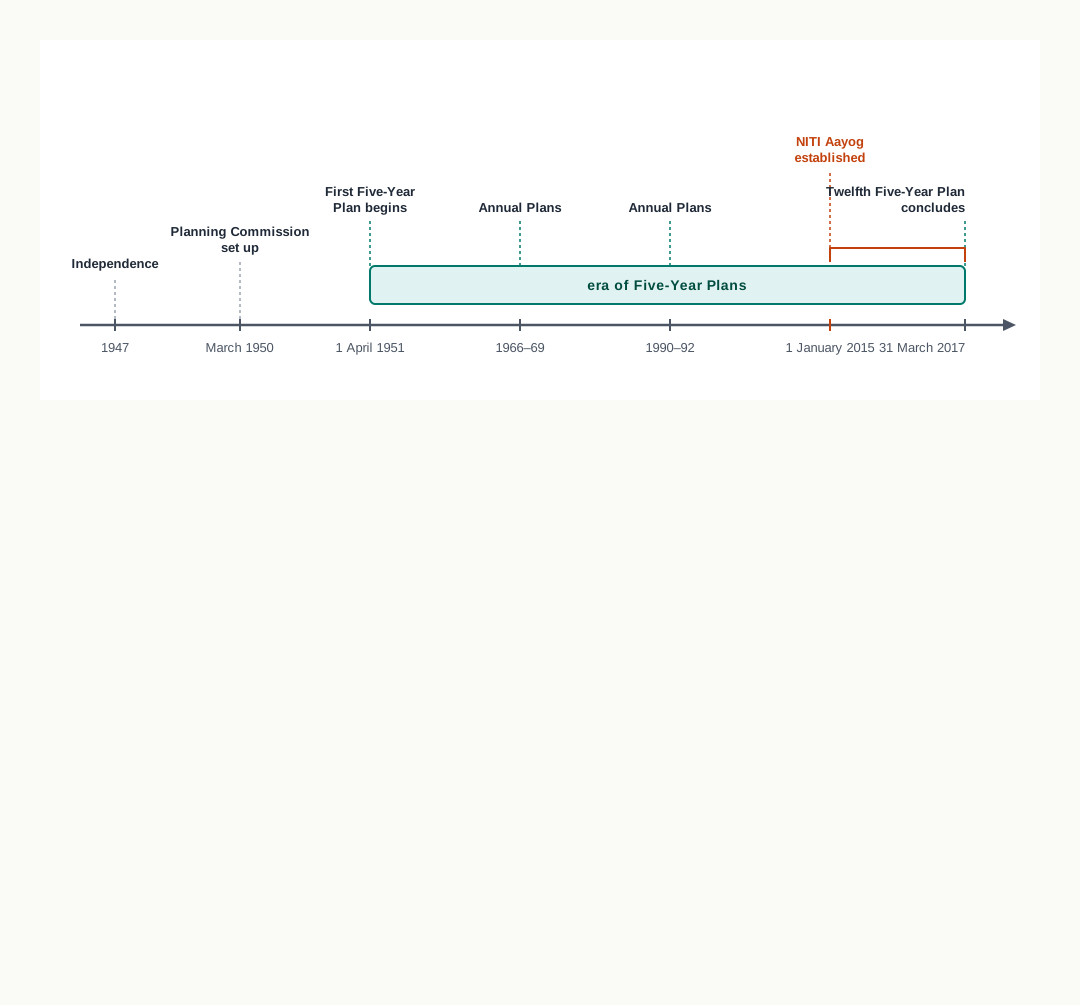
Fig. 9.0 – The planning era in India.
9.1 Economic Planning and Why India Adopted It
Every economy has to decide what to produce, how to produce it and for whom. A market economy leaves those decisions to prices: whatever buyers are willing to pay for gets made. A country that is very poor, however, may not be satisfied with the answers the market gives. Steel plants, power stations, dams and schools take years to build and pay back nothing for a long time, so private firms with small savings behind them will rarely undertake them on the scale required.
India faced exactly this difficulty in 1947. The choices before the new government were not marginal adjustments but decisions about the shape of the whole economy over decades. The instrument it chose for making those decisions was economic planning.
9.1.1 Meaning of Economic Planning
To plan is to think ahead. In economics the word carries a stricter sense. Economic planning means that a central authority — usually the government — takes a deliberate view of the productive resources a country has, decides which uses of those resources matter most, and directs them accordingly over a stated period of years, instead of leaving the outcome to the separate decisions of millions of buyers and sellers.
Three things distinguish planning from ordinary government activity. There must be an authority with the power to take a view of the economy as a whole. There must be objectives stated clearly enough to be worked towards and later checked. And there must be a fixed period within which those objectives are to be reached.
Planning of this kind is macroeconomic in character. It is concerned with the economy as a whole — with total output, total savings, the balance between agriculture and industry — and not with the affairs of any single household or firm.
9.1.2 Features of Economic Planning
The main features of economic planning follow from its definition.
- A central planning authority — planning requires a body placed above individual industries and states, able to survey the economy as a whole and to set priorities between competing uses of the same resources.
- Predetermined objectives — a plan must state what it is trying to achieve, such as a target rate of growth or a reduction in poverty, since resources cannot be directed towards goals that have not been named.
- A fixed plan period — objectives are set for a definite span of years, most commonly five, which is long enough for projects to be completed and short enough for progress to be reviewed.
- A survey and mobilisation of resources — the authority must first estimate the resources available in the form of savings, foreign exchange, skilled labour and administrative capacity, and then arrange to raise what the plan needs.
- An order of priorities — since resources are scarce, the plan has to decide which sectors receive them first, and this ranking is the heart of the exercise.
- Machinery for implementation and review — targets are of little use unless projects are executed and performance measured against what was promised.
9.1.3 The Condition of the Indian Economy in 1947
The case for planning rested on the state of the economy the country inherited. The first half of the twentieth century was a period of near-stagnation. National income grew at roughly one per cent a year, and since population grew at almost the same rate, average income per head at the end of the period was little higher than at the beginning.
The structure of the economy was that of a poor agrarian country. More than half of national output came from agriculture and allied activities, which employed the great bulk of the working population. Yields were low, holdings were small, and output swung with the monsoon, so that a failed rain meant not merely lower incomes but hunger. Industry was confined largely to cotton textiles, jute and a little iron and steel; machinery, fertiliser and most capital goods had to be imported.
Behind these features lay a deeper problem. Incomes were so low that very little could be saved, and with little saving there was little investment, so incomes stayed low. Poor health and education kept productivity down and reinforced the same circle. Roads, power and irrigation were thin, and Partition had disrupted supplies of food and raw materials in the very year of Independence.
9.1.4 Planning as the Chosen Instrument of Development
An economy in this condition could not be expected to transform itself quickly through the price mechanism alone. Private savings were small and went mainly into land, gold and trade rather than into industry. The projects the country most needed were precisely those that were large, slow to yield returns and unattractive to private investors. Left to itself, the market would have produced growth of a sort, but not at the pace or in the direction the government judged necessary.
Planning was chosen because it allowed the state to do three things the market would not do on its own. It could raise the rate of saving and investment above what individuals would have chosen. It could direct investment into heavy industry, power and irrigation, whose benefits spread across the whole economy. And it could pursue objectives such as the removal of poverty and the reduction of inequality, which the market takes no account of at all.
This choice was not India’s alone. After the Second World War most newly independent countries adopted planning as the technique by which a poor economy might accelerate its rate of growth. What distinguished India was that it attempted to do so while remaining a democracy and leaving the greater part of production in private hands — a combination that shaped both the achievements and the failures examined later in this chapter.
9.2 The Era of Five-Year Plans in India
Once the decision to plan had been taken, the country needed machinery to do the planning, a way of carrying the states along with it, and a rhythm in which plans would succeed one another. All three were in place within a few years of Independence, and together they gave India a planning era that lasted more than six decades.
9.2.1 Setting Up of the Planning Commission
The Planning Commission was constituted by a resolution of the Union Cabinet in March 1950. It was not created by the Constitution and was not a ministry; it was an advisory body attached to the government, deriving its influence from the fact that the Prime Minister chaired it.
Its composition reflected that position. The Prime Minister was Chairman by virtue of office, a full-time Deputy Chairman was appointed by him, and a small number of full-time members were appointed by the Central Government. The Deputy Chairman, in practice, ran the Commission.
Two tasks defined its work. It prepared the Five-Year Plans, working out targets for output, investment and employment sector by sector. And it recommended how central financial assistance should be distributed among the states, which is what gave an advisory body real authority over state governments.
9.2.2 The National Development Council
A plan drawn up at the centre cannot be implemented at the centre. Agriculture, irrigation, health and education are largely state subjects, so the states had to accept the Plan as their own. The National Development Council, set up in August 1952, existed for that purpose.
The Prime Minister was its Chairman by virtue of office, and its members included Union Cabinet Ministers and the Chief Ministers of all the states. Every Plan prepared by the Planning Commission was placed before the Council and took effect only after the Council approved it. The Council also reviewed the working of a Plan while it was running and could suggest changes in the light of experience.
The arrangement was an attempt to reconcile central planning with a federal Constitution. Resources were allocated centrally, but the body that gave the Plan its final blessing was one in which every state had a voice.
9.2.3 Course of the Five-Year Plans
India entered the planning era with the launching of the First Five-Year Plan on 1 April 1951. Twelve Five-Year Plans followed one another over the next sixty-six years, the Twelfth Plan concluding on 31 March 2017. The plan periods are set out in Table 9.1.
Two gaps in the sequence deserve notice. Between 1966 and 1969, and again between 1990 and 1992, the country was governed by Annual Plans rather than a Five-Year Plan. A break of this kind is called a plan holiday: planning did not stop, but the horizon was shortened to a single year at a time because conditions were too unsettled for a five-year commitment to mean anything. A shorter interruption followed the Fifth Plan, which was terminated a year ahead of schedule in 1978, so that the Sixth Plan began only in 1980.
The pattern of the plan holidays is instructive. Both occurred when the economy was under acute strain — war and drought in the first case, a balance of payments crisis and political instability in the second — which is a reminder that planning depends on being able to forecast the resources that will be available.
9.2.4 Long-Term and Immediate Objectives of a Plan
Every Plan from the First onwards listed the objectives it was meant to fulfil. These fell into two levels.
The basic objectives were the long-term goals of Indian planning as a whole — growth, employment, equity, the removal of poverty, modernisation and self-reliance. They did not change from Plan to Plan, because they described what the planners hoped the economy would look like after several decades rather than after five years.
The immediate objectives were the particular emphases of each individual Plan, fixed in the light of the problems of the moment. A Plan drawn up after a food crisis gave first place to agriculture; one drawn up after a period of jobless growth gave it to employment. These immediate objectives were always subordinate to the basic ones: they settled what to attend to first, not what the whole exercise was for.
The distinction matters when the Plans are appraised. A Plan may achieve its immediate objective and still leave the long-term objective unmet, which, as the next sections show, describes much of the Indian experience.
9.3 Objectives of Economic Planning in India
A plan is a statement of priorities, and priorities can only be judged against goals. Seven objectives run through India’s Five-Year Plans. No single Plan pursued all of them with equal force, but every Plan drew its targets from this list, and the appraisal of planning in the sections that follow is an appraisal against these seven.
9.3.1 Economic Growth
Growth was the first and, for most of the planning era, the foremost objective. A poor country cannot raise living standards, fund schools and hospitals or provide work for a growing population unless total output rises. The Plans therefore set targets for the annual growth of national income, and each Plan’s investment programme was designed to reach that target.
The targets were modest at first and rose over time. The First Plan aimed at growth of national income of about 2.1 per cent a year; the Eleventh Plan set a target of about 9 per cent. Across the planning era the target has generally been in the region of 5 per cent a year.
Two things explain why the target was always set well above the growth rate of population. Population grew at roughly 2 per cent a year through much of the planning period, so any target below that would have meant a fall in income per head. And per capita income, not total income, is what measures the standard of living. Growth of total output was never the goal in itself; it was the means by which average income could be made to rise.
9.3.2 Reducing Unemployment
Chronic unemployment and underemployment have long afflicted the Indian economy. Unemployment is both a cause and a consequence of poverty: those without work have no income, and an economy with idle labour is producing less than it could. Creating employment and reducing underemployment were therefore stated objectives of every Plan.
In practice the objective was rarely given high priority. The prevailing view among the planners was that employment would look after itself — that rising investment would raise output and that rising output would automatically absorb labour. No separate employment plan was drawn up, and no strategy for employment generation was worked out in detail.
The approach changed later. Specific programmes were introduced to create work directly, among them the Integrated Rural Development Programme, the Scheme of Training Rural Youth for Self Employment, the Jawahar Rozgar Yojana and, much later, the employment guarantee established by the Mahatma Gandhi National Rural Employment Guarantee Act, 2005. Direct job creation had become an instrument of policy in its own right rather than a by-product of growth.
9.3.3 Reducing Inequalities of Income and Wealth
Growth tells us how large the national cake is, not how it is divided. Indian planning accepted from the outset that development should not widen the gap between rich and poor, and reduction of inequality in the distribution of income and wealth was written into the Plans.
The process was understood to work in two directions at once. Incomes at the bottom had to be raised, through employment, land reform and support to small producers. And the concentration of income and wealth at the top had to be checked, through taxation and the regulation of large industry. Of the two, raising incomes at the lower end was the more important thrust of the Plans.
Inequality between regions was treated as part of the same objective. Some states and districts had been left far behind, and successive Plans spoke of balanced regional development, with special attention to backward states and hilly areas.
The objective was nevertheless accorded a low priority in practice. The belief that growth would by itself reduce inequality persisted for a long time, and while national income and income per head both rose, the pattern of distribution changed very little.
9.3.4 Removal of Poverty
The removal of poverty was among the most fundamental objectives of Indian planning, though it became a specific and separately stated objective only from the Fifth Plan onwards.
Until the Fourth Plan the planners’ thinking was that poverty would be dealt with indirectly. Higher national and per capita income would, it was assumed, reach the poor of its own accord. That expectation was not fulfilled. National income rose without the incidence of poverty falling correspondingly, and the number of people below the poverty line remained very large.
Against this background the approach shifted. The Fifth Plan adopted the Minimum Needs Programme, directing expenditure towards elementary education, health, drinking water and rural roads for the poorest. A reduction in the magnitude of poverty became the primary objective of the Sixth Plan; the Seventh Plan concentrated anti-poverty effort in rural areas; the Eighth Plan treated employment generation as the principal means of poverty removal; and the Ninth Plan adopted the goal of growth with equity.
The individual poverty alleviation programmes, and how far they have worked, are examined in a later chapter. What matters here is the change of principle: poverty came to be treated as a problem requiring direct attack rather than as something growth would dissolve.
9.3.6 Modernisation of the Economy
Modernisation was a newer objective, mentioned explicitly for the first time in the Sixth Plan, where it was defined broadly. It involved four kinds of change.
- A change in the composition of output — raising the share of the industrial and service sectors in national product and reducing the dependence of the economy on agriculture alone.
- Diversification of production — building industries producing engineering goods, chemicals, petroleum products and similar items, so that the economy makes a wide variety of goods rather than a narrow range.
- Adoption of advanced techniques — replacing outdated methods with more efficient technology in both agriculture and industry, since the same resources then yield more output.
- Development of institutions and infrastructure — banks and financial institutions, educational institutions, railways, roads, power and irrigation, without which modern production cannot be organised.
Modernisation was not sought for its own sake. Efficiency and productivity rise when techniques and institutions improve, and rising productivity is what allows growth to be sustained rather than merely achieved for a few years.
9.3.7 Self-Reliance
Self-reliance means that a country is able to meet its essential needs from its own resources and is not vulnerable to pressure from abroad. The objective was first stated in the Third Plan, developed in clear terms in the Fourth Plan and made one of the two basic objectives of the Fifth Plan.
It carried three dimensions. First, an end to dependence on foreign loans and grants to finance development. Second, a reduction in dependence on imports of essential commodities such as foodgrains, fertiliser, machinery and raw materials, by producing more of them at home. Third, the attainment of self-sustaining growth — an economy generating enough savings of its own to finance the investment it needs.
Self-reliance in this sense is not the same as cutting the country off from world trade. A self-reliant economy trades, and may trade a great deal; what it avoids is dependence of a kind that leaves it unable to withstand a poor harvest, a rise in import prices or the withdrawal of foreign aid.
9.3.8 How the Objectives Relate to One Another
Three features of the list as a whole should be kept in mind.
The objectives are interrelated. Higher national income makes more employment possible; more employment raises the incomes of the poor; a modern and diversified economy is better placed to be self-reliant. Progress on one front assists progress on others.
They have to be pursued in balance. Excessive emphasis on any one objective can damage the economy and make the rest harder to achieve, so a Plan that pushed growth alone at the cost of everything else would in the end weaken growth itself.
And they can conflict. Resources devoted to consumption today are not available for investment; investment concentrated where returns are highest may widen regional disparity; a rapid drive for self-reliance may mean producing at home what could be imported more cheaply. Choosing between the objectives when they pull against one another was the essential task of the Planning Commission — and it is against this list, objective by objective, that the record of planning is assessed in the sections that follow.
9.4 Achievements of Planning in India
Six and a half decades of planning have left an economy very different from the one that existed in 1950. Output is many times larger, its composition has altered, and the country feeds itself. The achievements set out below are the ones by which the Plans are usually judged; the figures are given with the years to which they belong, because the point in every case is the comparison between the beginning of the planning era and its close.
9.4.1 Increase in National and Per Capita Income
The most direct measure of what planning accomplished is the growth of real national income — that is, income measured at constant prices, so that a rise in prices is not mistaken for a rise in output. Growth was continuous through the planning era, and it accelerated. Plan by plan, the record is set out in Table 9.2.
Three patterns stand out. Growth was slow through the first two and a half decades, falling to 3 per cent a year in the Third and Fourth Plans. It improved from the Fifth Plan onwards, and it rose sharply from the Tenth Plan, when national income grew at over 7 per cent a year and India was among the fastest growing economies in the world. Against the near-stagnation of the first half of the twentieth century, described in 9.1.3, even the slower plan periods represent a decisive break.
Per capita income tells the same story one step further on. In every plan period it grew more slowly than national income, because a part of the additional output was absorbed by additional population. In the Third and Fourth Plans, when population was growing at over 2 per cent a year, growth of income per head almost disappeared. As population growth slowed, the gap between the two columns narrowed, and by the Eleventh Plan income per head was growing at about 6 per cent a year.
9.4.2 Change in the Composition of National Income
Development changes not only how much an economy produces but what it produces. As a country develops, the share of the primary sector in national output declines while the shares of the secondary and tertiary sectors rise, because incomes spent on food grow more slowly than incomes spent on manufactures and services. India has followed this path, as Table 9.3 shows.
Agriculture, which contributed more than half of national output in 1950–51, contributed about 15 per cent by 2017–18. The industrial sector — manufacturing, mining, electricity, gas, water supply and construction — rose from under a fifth to nearly a third. The service sector rose furthest, from under 30 per cent to over half of output.
One qualification must be attached to these figures. The falling share of agriculture in output has not been matched by an equally sharp fall in its share of employment, so a large part of the workforce continues to depend on a shrinking share of national income. The structural change is real, but it is incomplete.
9.4.3 Growth of Agricultural Production
Agricultural output grew at between 2.5 and 3.7 per cent a year over the planning period, against roughly 0.3 per cent a year before Independence. The gain came from irrigation, high-yielding variety seeds, fertiliser, pesticides and farm machinery, and from a shift away from subsistence cultivation towards production for the market.
The clearest measure is foodgrains. Output rose from about 51 million tonnes in 1950–51 to a record of about 285 million tonnes in 2017–18. Per capita availability of foodgrains and pulses rose over the same period, from 395 grams a day in 1951 to 494 grams a day in 2018, which means that output grew faster than population. A country that imported wheat to avert famine in the 1960s had become self-sufficient in foodgrains.
Growth in agriculture has nevertheless remained unsteady, because a large part of the cropped area is still unirrigated and output therefore continues to follow the monsoon.
9.4.4 Growth and Diversification of Industry
Industrial output grew at over 6 per cent a year between 1950–51 and 2000–01, against about 2 per cent a year before Independence, and at over 8 per cent a year during much of the period from 2004–05 to 2016–17.
More striking than the rate is the change in what industry makes. In 1950 India produced consumer goods and little else, importing machinery, metals and equipment. The Plans built a base of heavy and capital goods industries — iron and steel, aluminium, machine tools, engineering goods, chemicals, petroleum products — so that goods once imported are now made at home. Output of finished steel and of aluminium rose many times over between 1950–51 and 2011–12. Later, industries producing durable consumer goods such as televisions, refrigerators, scooters and cars expanded rapidly, particularly from the 1980s.
Two consequences followed. The industrial structure became highly diversified, covering consumer goods, intermediate goods and capital goods together. And the composition of exports changed with it: engineering goods, chemicals, gems and jewellery, leather goods and readymade garments displaced agricultural products as the country’s main export earners.
9.4.5 Increase in Savings and Capital Formation
Investment cannot exceed what an economy saves, borrows or receives from abroad, so the rate of saving sets the limit to the rate of capital formation, and capital formation sets the limit to growth. Raising both was central to the whole planning effort.
Gross domestic saving rose from about 9.5 per cent of gross domestic product in 1950–51 to about 30.5 per cent in 2017–18, and gross capital formation from about 10.1 per cent to about 32.3 per cent over the same period. Both had been higher still around the end of the Eleventh Plan and fell back thereafter.
The significant point is where the additional investment came from. Almost all of it was financed by domestic saving; foreign capital contributed only a small fraction of the total. An economy that could barely save a tenth of its output in 1950 was, by the close of the planning era, financing investment at close to a third of output out of its own resources.
9.4.6 Expansion of Infrastructure
Power, irrigation, transport, communications and banking are the conditions under which agriculture and industry can grow at all, and expanding them was among the largest items of plan expenditure. Table 9.4 gives the record for a few of them.
Electricity generation rose about 255 times. Gross irrigated area rose more than four and a half times, though even at the end of the period only about half the gross cropped area was irrigated. The road network grew about fifteen times, making India’s the second largest in the world, while railway route length grew only modestly — the railway achievement lay in electrification, which reached about 43 per cent of the network by March 2018, and in traffic carried, freight rising about twelve and a half times and passenger traffic about six times.
Banking expanded after the nationalisation of major banks in 1969, the number of branches rising from 8,260 in June 1969 to about 1.42 lakh in June 2018. Communications advanced furthest of all: by the end of 2021 India had the second largest telecom network in the world after China, with over 1,100 million cellular subscribers and over 800 million internet subscribers.
9.4.7 Progress in Education, Health, Science and Technology
Human capital was the other condition of development, and the social indicators moved as decisively as the economic ones. A selection is given in Table 9.5.
Schools multiplied several times over and enrolment much faster still, so that the gross enrolment ratio at the elementary level rose from about 32 per cent in 1950–51 to near universal enrolment by 2018–19. Colleges rose from 695 in 1950–51 to over 39,000 by 2016–17 and universities from 27 to over 900, with enrolment in higher education rising even more sharply.
Science and technology received deliberate support as part of the objective of modernisation. National laboratories and research organisations were established during the plan period, among them the Council of Scientific and Industrial Research, the Indian Council of Agricultural Research and the Indian Space Research Organisation, and public and private industry built research and development laboratories of their own. The stock of technical manpower — scientists, engineers and technicians — grew rapidly as a result.
9.4.8 Progress Towards Self-Reliance
Measured against the three dimensions set out in 9.3.7, the record is substantial. The country is no longer dependent on imports of foodgrains. It produces a wide range of consumer goods and capital goods that were once bought abroad, a direct result of industrialisation and of the policy of import substitution. Foodgrain stocks, foreign exchange reserves and domestic capacity in capital goods have together allowed the economy to withstand droughts, oil price shocks and financial crises without the disruption such events once caused.
Dependence on foreign capital has fallen, though it has not disappeared, and a wholly self-financing economy was never in fact reached.
Taken together, these achievements show an economy that has moved out of stagnation. Whether it moved far enough, and whether the gains reached the people the Plans were meant to help, is the question taken up next.
9.5 Failures of Planning in India
The objectives listed in 9.3 are also the standard against which the Plans must be found wanting. Judged by output, infrastructure and self-sufficiency in food, planning succeeded. Judged by what it promised the poor, it did not. The failures below are not a separate account from the achievements; they are the same record read against the goals the planners themselves set.
9.5.1 Inadequate Growth Rate
Growth was continuous but, for a long time, too slow to matter. Through the first four Plans the rate of growth of national income stayed at or below 5 per cent a year, and in the Third and Fourth Plans it fell to about 3 per cent, which was barely ahead of population growth.
Two comparisons make the point. Measured against the targets the Plans themselves set, achievement fell short in most plan periods. Measured against other developing economies — China, South Korea, Singapore — which began at comparable levels of income and grew far faster over the same decades, India’s performance was modest. Growth only reached a rate that could transform living standards quickly from the Tenth Plan onwards, by which time five decades of planning had passed.
9.5.2 Failure to Eradicate Poverty
Removing poverty was among the fundamental objectives of Indian planning from the Fifth Plan onwards, and it was not achieved. On the official estimates for 2011–12, about 269 million people in India — roughly 22 per cent of the population — were below the poverty line, living without a minimum acceptable standard of food, health and shelter.
That a fifth of the population remained poor after six decades of planning is the sharpest single criticism that can be made of the exercise. The failure has two aspects. Growth did not translate into poverty reduction as automatically as the early planners assumed, so for a long period incomes rose without the incidence of poverty falling correspondingly. And the programmes designed to attack poverty directly reached only a part of those they were meant for.
9.5.3 Failure to Remove Unemployment
Employment generation was an objective of every Plan and the priority of none. The consequence was that the labour force grew faster than the jobs available for it, so the absolute number of the unemployed rose from one Plan to the next even while output was rising.
The pattern that emerged is often described as jobless growth. Output grew rapidly in sectors that use relatively little labour, while the sectors employing the bulk of the workforce grew slowly. Underemployment compounded the problem: large numbers were nominally at work in agriculture and petty trade while contributing very little to output.
9.5.4 Large Inequalities of Income, Wealth and Region
The distributional record is the weakest part of the appraisal. The gains of development were not equitably distributed: much of the increase in income was taken by those already better off, while the share going to those at the bottom changed little.
Concentration of wealth increased rather than diminished. Survey estimates for 2018–19 indicate that the richest tenth of the population owned more than half the country’s physical and financial assets taken together, while the bottom half owned only about a tenth. Programmes of land redistribution did not greatly alter the ownership of agricultural land either.
Regional inequality persisted alongside personal inequality. Some states advanced far faster than others, so that income per head in the poorer states remains a fraction of that in the richer ones, and a disproportionate share of the country’s poor lives in a small number of states. The gap between rural and urban incomes widened over the same period.
9.5.5 Inefficient Use of Resources
Planning is meant to secure the efficient use of scarce resources, and here too the record disappoints.
A large number of production units, particularly in the public sector, became commercially unviable. Rather than being closed, many were kept running on government subsidies, so that resources continued to be absorbed by units producing less than the value of the inputs they used. The resources locked into them were resources denied to more productive uses.
Capacity was also left idle. In several industries, particularly those producing durable consumer goods, plants built under licence operated well below their rated capacity, and the unutilised capacity represented capital that had been created but was not working.
9.5.6 Slow Growth of Infrastructure
Infrastructure expanded greatly in absolute terms, as 9.4.6 showed, but not fast enough to keep pace with the demands of a growing economy. Power, transport, communications, healthcare, educational facilities and drinking water supply all fell short of requirements.
The economic cost of the shortfall was that infrastructure became a bottleneck. A shortage of power or of transport capacity holds back agriculture and industry however well those sectors are otherwise placed, because output that cannot be produced for want of electricity, or cannot be moved for want of wagons and roads, is output lost.
9.5.7 Inflationary Pressure and Deficit Financing
The two failures under this head are connected.
Prices rose repeatedly through the planning era — in the mid-1960s, the early and late 1970s and again in the first decade of the present century. Slow growth of agricultural output, and of foodgrain output in particular, was a recurring cause: when supply of food falls short of demand its price rises sharply, and food inflation bears hardest on the poor, whose budgets are dominated by food. Inflation also eroded the purchasing power of salaried and wage-earning households, whose incomes adjust slowly.
One of the causes lay in how the Plans were financed. Plan outlays regularly exceeded what could be raised through taxation and borrowing, and the gap was met by deficit financing — in effect, by creating money. Money created in this way adds to demand without adding to output, and heavy recourse to it fed directly into the rise in prices.
Planning in India thus succeeded in building an economy and failed in distributing what it built. Why the Plans fell short even where the objectives were clearly stated is the question the next section takes up.
9.6 Factors That Inhibited Successful Implementation of the Plans
A plan can fail in three ways. It may be badly drawn up, so that the targets were never attainable. It may be well drawn up and badly executed. Or it may be defeated by conditions that no planner could control. The nine factors usually held responsible for the limited success of Indian planning fall under these three heads.
9.6.1 Weaknesses in the Formulation of Plans
- Unrealistic plans — targets were often set without regard to what the economy could actually deliver, and the assumptions made about resources to be raised through taxation and public borrowing frequently proved optimistic. A target based on revenue that never materialises cannot be met however well the projects are run.
- Failure to rank the objectives — the planners set out several objectives at once without deciding which was to yield when two of them conflicted. The result was that contradictory policies were sometimes adopted in pursuit of different objectives, and the effect of one measure cancelled the effect of another.
- Overambitious plans — very large Plans were drawn up without settling whether the finance and the logistics existed to carry them through. Plans were also shaped at times by political commitment and by populist considerations rather than by a pragmatic view of what was feasible, and a Plan of this kind is defeated before implementation begins.
9.6.2 Weaknesses in the Implementation of Plans
- Faulty implementation — projects were frequently taken up without being worked out in detail beforehand, and the administrative machinery available to execute them was neither adequate nor efficient. A target stated in a Plan document is not a project ready to be built.
- Lack of coordination — planning requires the parts of the economy to move together, and often they did not. Coordination was weak between the central and state governments, whose responsibilities in agriculture, irrigation and education overlap, and weaker still between the public and the private sector, since no effective mechanism existed to align private production and investment decisions with plan priorities.
- Bureaucratic approach — procedural and bureaucratic bottlenecks made decision-making slow. Delay in clearing a proposal delays the start of a project, and delay in starting it delays completion, so that costs run above the estimates on which the Plan was built.
9.6.3 Constraints Beyond the Control of the Planners
- Inadequate infrastructure — the economy repeatedly ran into shortages of power, coal and transport. These shortages sometimes reached serious proportions and held back the working of sectors that were otherwise ready to expand.
- Financial constraints — resource mobilisation, internal and external, fell short of what the Plans required, so projects had to be dropped or deferred for want of funds. Shortage of foreign exchange was a recurring difficulty, since machinery, fertiliser and petroleum had to be imported and paid for in currencies the country did not earn enough of.
- Natural constraints — agriculture remained dependent on the monsoon throughout the planning era. Drought and excessive rainfall affected output directly, and because agriculture is linked to industry through raw materials and through rural demand, a poor harvest pulled down the growth rate of the whole economy.
- Rapid growth of population — a high rate of population growth worked against the Plans in two ways. Resources that might have gone into investment had to be diverted to meeting the basic needs of a larger population, which held down savings. And the additional schools, hospitals and houses created under the Plans had to be shared among more people, so that availability per head improved only slowly.
Two conclusions follow. The first is that most of these factors are administrative and political rather than economic: the technique of planning was not at fault so much as the capacity to formulate realistic targets and execute them. The second is that planning within a mixed economy carries a difficulty of its own — the Planning Commission could direct the public sector, but the private sector, which accounted for the greater part of production, could only be influenced. It is partly against this experience that the change described in the next section was made.
9.7 NITI Aayog
The era of five-year planning closed while the Twelfth Plan was still running. On 1 January 2015 the Planning Commission was replaced by a new body, NITI Aayog — the National Institution for Transforming India — set up, like its predecessor, by a resolution of the Union Cabinet.
9.7.1 From the Planning Commission to NITI Aayog
The change reflected an economy that no longer resembled the one the Commission had been designed for. In 1950 the state owned or controlled most large-scale production and could direct it. After the reforms of 1991 the private sector accounted for the greater part of investment and output, and an authority that fixed physical targets sector by sector had little means of enforcing them.
The financial function had also lapsed. The Planning Commission’s influence over the states rested largely on its role in recommending central assistance; once a larger share of central taxes began to be transferred to the states as untied funds, that lever disappeared.
What remained was the need for long-term thinking about the direction of the economy, and for a forum in which the centre and the states could agree on it. NITI Aayog was created for those purposes rather than to prepare Plans.
9.7.2 Composition of NITI Aayog
The structure keeps the Prime Minister at the head, as under the earlier arrangement, but widens participation by the states.
- Chairperson — the Prime Minister of India, by virtue of office.
- Vice-Chairperson — appointed by the Prime Minister, and in practice the officer who directs the work of the body.
- Chief Executive Officer — a senior civil servant appointed by the Prime Minister, responsible for its administration.
- Full-time members, together with ex-officio members drawn from the Union Council of Ministers and special invitees nominated by the Prime Minister.
- Governing Council — comprising the Chief Ministers of all the states and the Lieutenant Governors of the Union Territories, the forum in which national priorities are discussed with the states.
The Governing Council is the feature that most clearly distinguishes the new body. Under the Planning Commission, states received a Plan prepared at the centre and approved it through the National Development Council; under NITI Aayog, the states are intended to take part in shaping priorities from the outset.
9.7.3 Objectives of NITI Aayog
The objectives set out for NITI Aayog are the following.
- To evolve a shared vision of national development, with the active involvement of the states, in the light of national objectives.
- To design strategic long-term policies and programmes for the economy.
- To provide technical advice to the central and state governments on development priorities.
- To monitor and evaluate the implementation of development programmes.
- To foster cooperative federalism by involving the states in policy formulation.
- To advise the government on matters specifically referred to it.
- To provide a platform for resolving inter-sectoral and inter-departmental issues that hold up the development agenda.
- To promote the upgradation of technology in the implementation of programmes.
9.7.4 Role and Functions of NITI Aayog
Three functions summarise what the body actually does.
- It acts as the policy think tank of the Government of India, assisting the central government in policy formulation by supplying strategic and technical advice.
- It monitors and evaluates the implementation of the government’s development programmes, reporting on how far they are achieving what they were designed to achieve.
- It promotes cooperative federalism, by drawing state governments into policy making rather than transmitting decisions to them.
The approach is described as bottom-up rather than top-down: priorities are meant to be built from the states upward instead of being prescribed from the centre downward.
9.7.5 How NITI Aayog Differs from the Planning Commission
The two key activities of the Planning Commission were preparing and implementing the Five-Year Plans and recommending the allocation of financial resources to the states. NITI Aayog performs neither. The era of five-year planning is over, and the annual exercise of allocating plan resources to states is no longer conducted. The principal points of difference are set out below.
Whether the change will prove an improvement is not yet settled. What can be said is that the instrument has been matched to the economy: a body that advises and evaluates suits an economy in which most investment decisions are taken privately, as a body that fixed targets suited an economy in which the state took most of them itself.
9.8 Summary
- Economic planning is the consciously directed effort of a central authority to organise and use a country’s productive resources so as to achieve predetermined and well-defined objectives within a specified period of time. It is macroeconomic in character, being concerned with the economy as a whole.
- The main features of planning are a central planning authority, predetermined objectives, a fixed plan period, a survey and mobilisation of resources, an order of priorities among competing uses, and machinery for implementation and review.
- India adopted planning because the economy inherited in 1947 was stagnant, agrarian and monsoon-dependent, with saving too low for the market alone to finance the heavy industry, power and irrigation the country needed.
- The Planning Commission was set up in March 1950 by a Cabinet resolution, with the Prime Minister as Chairman. The National Development Council, on which the Chief Ministers of all the states sat, approved every Plan.
- The First Five-Year Plan was launched on 1 April 1951. Twelve Five-Year Plans followed, the Twelfth concluding on 31 March 2017. Annual Plans replaced Five-Year Plans in 1966–69 and 1990–92, a break known as a plan holiday.
- Each Plan carried basic long-term objectives, common to all Plans, and immediate objectives fixed in the light of the problems of the moment. The immediate objectives were subordinate to the basic ones.
- The seven objectives of Indian planning were:
- Economic growth — raising national income and, through it, income per head faster than population.
- Reducing unemployment — creating employment and reducing underemployment.
- Reducing inequalities of income and wealth — raising incomes at the bottom, checking concentration at the top, and securing balanced regional development.
- Removal of poverty — a specific objective from the Fifth Plan onwards.
- Establishment of a socialist society — equality of opportunity, equitable distribution and absence of exploitation.
- Modernisation of the economy — change in the composition of output, diversification, advanced techniques, and development of institutions and infrastructure.
- Self-reliance — ending dependence on foreign loans and on imports of essential commodities, and attaining self-sustaining growth.
- The objectives are interrelated, must be pursued in balance, and can conflict with one another. Resolving those conflicts was the essential task of the Planning Commission.
- The main achievements of planning were:
- A continuous and accelerating rise in national and per capita income, growth exceeding 7 per cent a year from the Tenth Plan.
- A change in the composition of national income, the share of agriculture falling from 51.9 per cent in 1950–51 to 14.9 per cent in 2017–18 while industry and services rose.
- Growth of agricultural output and self-sufficiency in foodgrains, output rising from about 51 million tonnes in 1950–51 to about 285 million tonnes in 2017–18.
- Growth and diversification of industry, with a base of heavy and capital goods industries built up.
- A rise in gross domestic saving from about 9.5 per cent of GDP in 1950–51 to about 30.5 per cent in 2017–18, financing investment almost entirely from domestic resources.
- Large expansion of infrastructure — electricity, irrigation, roads, railway electrification and banking.
- Substantial progress in education, health, science and technology.
- Considerable progress towards self-reliance.
- The main failures of planning were an inadequate growth rate until the Tenth Plan, failure to eradicate poverty, failure to remove unemployment, large inequalities of income, wealth and region, inefficient use of resources, slow growth of infrastructure relative to need, and inflationary pressure aggravated by heavy deficit financing.
- The factors that inhibited successful implementation were unrealistic plans, overambitious plans, faulty implementation, lack of coordination, inadequate infrastructure, a bureaucratic approach, financial constraints, natural constraints and rapid population growth.
- The record of planning in India is therefore a mixed one. It moved the economy out of stagnation and built its productive base, but did not deliver on poverty, employment and equality, which the Plans had themselves named as objectives.
- NITI Aayog — the National Institution for Transforming India — replaced the Planning Commission on 1 January 2015. It is a policy think tank that advises the central and state governments, monitors and evaluates development programmes, and fosters cooperative federalism.
- NITI Aayog differs from the Planning Commission in that it neither prepares Five-Year Plans nor allocates financial resources to the states, and it works through a bottom-up approach in which the states take part in framing priorities through its Governing Council.
9.9 Points to Ponder
- The Plans assumed for two decades that faster growth would by itself reduce poverty. India’s experience suggests otherwise. Is growth then of little use to the poor, or does it matter what kind of growth an economy has — in which sectors, using how much labour, in which regions?
- Planning was defended on the ground that a poor country cannot afford to let the market decide. But the same poverty means that a mistaken plan wastes resources the country can least spare. Which risk is the greater one for an economy with very little to invest?
- Every Plan named seven objectives and ranked none of them. Would Indian planning have achieved more if each Plan had been required to state which objective was to yield when two of them conflicted — or would that simply have made the conflicts harder to conceal and the Plans politically impossible to adopt?
- India planned within a mixed economy and a democracy, while the countries that grew fastest over the same decades generally did neither. Was the slower growth of the planning era a price paid for those choices, or were the reasons for it unconnected with them?
- NITI Aayog advises but does not allocate. A body with no control over money must persuade rather than direct. Does that make it weaker than the Planning Commission, or better suited to an economy in which most investment decisions are taken privately?
- The Twelfth Plan was the last of its kind, yet governments still announce targets for output, employment and emission for years ahead. If setting long-term national goals continues, what exactly ended in 2017 — planning itself, or only one form of it?
9.10 Objective Questions
- The Planning Commission of India was set up in: [1]
- March 1950
- April 1951
- August 1952
- January 2015
- From the given statements Assertion (A) and Reason (R), choose the correct option. [1] Assertion (A): During most plan periods, per capita income in India grew more slowly than national income. Reason (R): A part of the increase in national income is absorbed by the growth of population.
- Both (A) and (R) are true and (R) is the correct explanation of (A).
- Both (A) and (R) are true but (R) is not the correct explanation of (A).
- is true and (R) is false.
- is true and (A) is false.
- Fill in the blank: A break in which Annual Plans are drawn up in place of a Five-Year Plan is called a ______. [1]
- State whether the following statement is true or false: NITI Aayog recommends the allocation of central financial resources to the states. [1]
- Match the items in Column A with those in Column B. [1]
| Column A | Column B |
|---|---|
| a. Minimum Needs Programme | i. Plan holiday |
| b. Governing Council | ii. NITI Aayog |
| c. Annual Plans of 1966–69 | iii. Fifth Five-Year Plan |
9.11 Check Your Concepts
- Define economic planning and state any one feature that distinguishes it from ordinary government expenditure. [2]
- Distinguish between the basic objectives and the immediate objectives of a Five-Year Plan, using one example of each. [3]
- The share of agriculture and allied sectors in India’s gross domestic product fell from 51.9 per cent in 1950–51 to 14.9 per cent in 2017–18. Explain what this change indicates about the Indian economy, and state one reason why it should not be read as evidence of complete structural transformation. [4]
- ‘Economic planning in India has been a mixed bag of successes and failures.’ Evaluate this claim with reference to any three achievements and any three failures of the Five-Year Plans. [6]
9.12 Case-Based Question
- The state of Nandanpur has recorded growth of state income of about 8 per cent a year over the last decade, led by software services and construction. Over the same period the number of people seeking work has risen steadily, and two-thirds of the workforce is still employed in agriculture. The state government has now asked its planning department to prepare a ten-year vision document, to be drawn up in consultation with district administrations rather than handed down to them.
- Identify the objective of planning that Nandanpur is failing to achieve, and explain why rapid growth of state income has not achieved it. [2]
- Name the approach to planning that the method of preparing the vision document reflects, and state one advantage of following it. [2]