Chapter 13: Rural Development
A farmer harvests his crop and must sell it within days. He has a loan to repay, no godown to store the crop in, no cart of his own to reach a distant market, and no way of knowing what the crop is fetching elsewhere. He accepts whatever the nearest trader offers. Weeks later the same crop reaches a city consumer at several times that price. Almost every question of rural development sits inside that gap. Can the cultivator borrow at a fair rate, and from whom? Can he store, grade and carry his produce, and sell it where the price is best? And if one crop leaves him this exposed, can he spread the risk by producing something else as well? These are questions about how a poor and scattered producer is connected to the rest of the economy, and they decide the income of nearly half the country’s workforce. This chapter examines agricultural marketing and its defects, the sources of rural credit, agricultural diversification, and organic farming as an alternative system of cultivation.
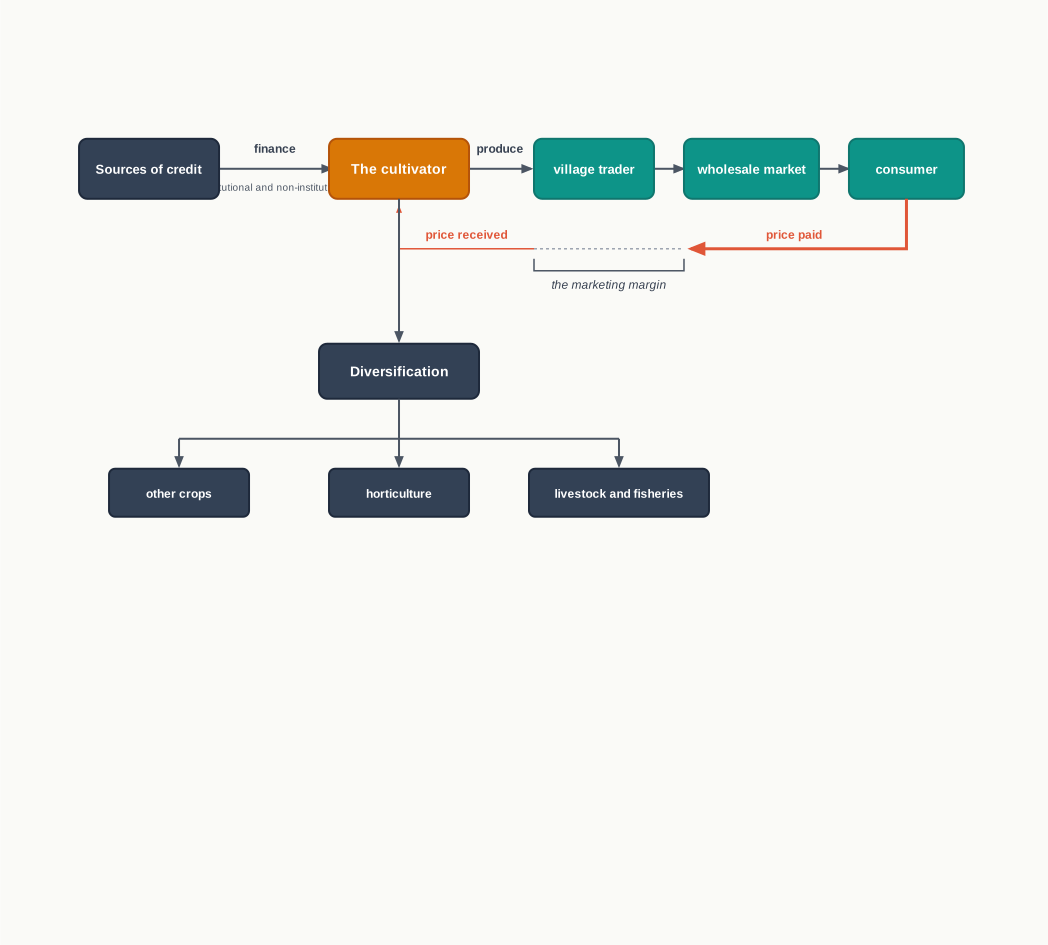
Fig. 13.0 — The farmer’s position in the rural economy.
13.1 The Problem of Rural Development
13.1.1 Meaning of Rural Development
More than half of India’s people live in villages, and the greater part of them depend on land for a living. Their incomes are low, their holdings are small, and the institutions that a producer in a city takes for granted — a bank, a regulated market, a warehouse, a metalled road — are often thin or missing. The economic problem in rural India is therefore not only that resources are scarce, but that the arrangements through which a small producer uses those resources work badly.
Rural development is the action taken to improve the economic and social conditions of the rural population. It is wider than agricultural development, because it takes in the whole life of the village — the credit the cultivator can obtain, the market he can reach, the schooling and health care his family receives, and the work available to those who own no land at all.
The rural economy is not the agricultural economy alone. A village artisan, a shopkeeper, a labourer working on a road and a woman running a dairy unit are all part of it. But because agriculture remains the occupation of the largest number, the development of agriculture is the centre around which the rest of rural development is built.
13.1.2 Key Areas of Rural Development
Rural development is not a single measure but a set of connected ones, each removing a different obstacle in the cultivator’s path.
- Development of human resources — literacy, vocational training, and health and sanitation facilities, so that rural workers can use better methods and take up work outside farming.
- Land reforms — measures affecting the ownership and tenancy of land, so that the person who tills the land has a secure interest in improving it.
- Development of infrastructure — irrigation, electricity, rural roads, banking, storage and market yards, without which no improvement in farming can be carried very far.
- Provision of adequate credit — a supply of finance at reasonable cost and at the time it is needed, in place of the moneylender’s terms.
- Improvement of agricultural marketing — arrangements through which the cultivator can grade, store, transport and sell his produce at a fair and remunerative price.
- Agricultural diversification — a shift towards other crops and towards allied activities such as horticulture, dairying, poultry and fisheries, which spreads risk and adds employment.
- Alleviation of poverty — special programmes directed at those in rural areas whose incomes remain below what is needed for a minimum standard of living.
- Sustainable practices in farming — methods of cultivation that keep the soil and water fit for use by those who come after.
Of these, the ISC syllabus takes up rural credit, agricultural marketing, the role of cooperatives, diversification and organic farming, and this chapter is confined to them.
13.1.3 Why Rural Development Must Be Accorded Priority
Economic development is usually associated with industrialisation, and India’s Five-Year Plans made a determined effort in that direction. Yet agricultural progress is normally treated as a condition for the growth of an economy rather than as something that follows it. The reasons lie in the size of the sector and in the number of other sectors that depend on it.
Place Of Agriculture In The Economy
- Share in national income — agriculture and allied activities contributed about 15 per cent of gross value added at constant prices in 2024–25. The share has fallen steadily as industry and services have grown, which is what economic development normally brings about; but a sector of this size still carries a large part of national output.
- Source of employment — about 46 per cent of the workforce depended on agriculture and allied activities in 2024–25. The share of the sector in employment is far above its share in output, which means output per worker in agriculture is low. This gap is the central fact about the Indian rural economy.
- Provision of foodgrains — foodgrains production rose from about 51 million tonnes in 1950–51 to about 353.9 million tonnes in 2024–25. The country is now broadly self-sufficient in foodgrains and no longer depends on imports to feed its population, and it is among the world’s largest producers of both rice and wheat.
- Supply of raw materials to industry — cotton textiles, jute, sugar, vanaspati and food processing all draw their raw material from the farm. Unless agriculture grows, these industries cannot grow, so the rate of agricultural growth sets a limit on the rate of industrial growth.
- Market for industrial products — a large rural population is a large body of buyers. Rising farm incomes raise the demand for soap, cloth, cycles, two-wheelers and televisions, and also for the inputs agriculture itself uses — fertilisers, tractors, pump sets and pesticides.
- Earner of foreign exchange — tea, coffee, spices, cotton, sugar, cashew and marine products are exported. The share of agricultural products in total exports has fallen as manufactured exports have grown, standing at about 12 per cent in 2023–24, but the sector remains a net earner.
- Support to trade and transport — railways and roadways secure a large part of their business from the movement of foodgrains and raw materials, and a substantial part of the country’s internal trade is in agricultural products.
- Source of government revenue — the direct contribution of agricultural taxes is small, but through its effect on the prosperity of the whole economy, agriculture influences the revenue of the central and state governments considerably.
Taken together, these facts explain the priority. A sector that employs nearly half the workforce while producing about a seventh of the output is where the largest gains from improvement lie. If it prospers, it gives an impetus to the growth of other sectors; if it fails, the failure spreads. Development of agriculture is in this sense a pre-condition for the overall development of the economy, and the arrangements examined in the rest of this chapter — marketing, credit and diversification — are the arrangements through which that development is either helped or hindered.
13.2 Agricultural Marketing
13.2.1 Meaning and Scope of Agricultural Marketing
Growing a crop is only half of the cultivator’s task. The crop has still to be gathered, kept safe, carried to a place where buyers are, sorted by quality and sold. Everything that happens to farm produce between the field and the final buyer is the business of agricultural marketing.
Agricultural marketing therefore covers a chain of activities rather than a single act of sale. The main ones are the collection of the produce, its storage until it is sold, its transport to the market, its grading and standardisation by quality, and the sale itself.
India has a very large number of places where this trade is done. Counting wholesale markets together with the rural primary markets and periodic village markets at which small quantities change hands, there are of the order of 29,000 agricultural markets in the country. Their number is not the difficulty; the way they work is.
13.2.2 Why an Efficient Marketing System Matters
An efficient marketing system is a prerequisite for agricultural development, for three reasons that follow one from the other.
- It gives the cultivator a fair and remunerative price — the price he receives is what tells him whether the crop was worth growing, so a system that lets a large part of the consumer’s rupee stay with intermediaries weakens the signal that guides production.
- It creates the incentive to raise output — a farmer who can be reasonably certain of selling at a fair price will invest in better seed, fertiliser and irrigation. One who expects to be squeezed at the point of sale will not.
- It mobilises the marketed surplus — foodgrains and raw materials have to be moved out of the villages to feed the urban population and supply industry. The marketing system is the machinery that does this, and a defective system leaves surplus stranded in one region while another goes short.
An efficient system, in short, does not merely divide the proceeds of a crop. It decides how much crop there will be.
13.2.3 Defects of Agricultural Marketing in India
Agricultural marketing in India suffers from a number of deficiencies, as a result of which farmers are often unable to get a fair price for their produce. The main defects are these.
- Lack of collective bargaining — millions of small farmers sell separately and face a small number of organised traders. The bargaining power of the cultivator against the trader is weak, and the price he obtains reflects that weakness rather than the value of the crop.
- Multiplicity of intermediaries — a long chain of village traders, commission agents, wholesalers and retailers stands between the farmer and the consumer. Each takes a margin, so the difference between the price realised by the farmer and the price paid by the consumer is large.
- Distress sale — the average cultivator is poor, has a loan to repay and little holding capacity, and so must sell immediately after the harvest. That is precisely the season when supplies are heaviest and prices are at their lowest.
- Lack of grading — produce is often sold as a single undifferentiated lot instead of being classified by quality. The good is then paid for at the price of the poor, and the scope for the buyer to undervalue the lot is wide.
- Malpractices in unorganised markets — underweighing, fixing of prices among traders and the levy of a number of unspecified market charges and fees are common where the market is not regulated.
- Lack of storage facilities — without a godown, the farmer cannot hold his crop back until the market recovers, and a part of what he does hold is lost to damp, rodents and pests.
- Lack of transport facilities — small farmers, particularly, cannot reach a distant market where the price is better. Produce carried on slow vehicles over poor roads goes to the nearest buyer instead.
- Lack of market knowledge — the cultivator frequently does not know the prices ruling in other markets on the day he sells. Traders and commission agents, who do know, are able to buy at prices that would not survive an informed seller.
These defects are connected. Poor storage forces distress sale; distress sale weakens bargaining power; weak bargaining power leaves the farmer with too little to invest in the storage he lacks. This is why measures to improve marketing have to be taken together rather than one at a time.
13.2.4 Measures Taken by the Government to Improve Agricultural Marketing
Both the central and the state governments have taken a number of steps to improve agricultural marketing. The main measures follow.
Regulated Markets And Physical Facilities
- Establishment of regulated markets — organised marketing is promoted through a network of regulated markets set up under the Agricultural Produce Marketing Committee Acts of the state governments. In these markets, sale and purchase are supervised by a marketing committee on which farmers, traders and the government are represented. The object is to make the transaction transparent, to eliminate unfair practices, to reduce market charges, to enforce standardised weights and to secure a reasonable price for both sides. The number of regulated wholesale markets rose from 286 in 1951 to over 7,200 as on 31 March 2024, and about 40 per cent of agricultural produce is now sold through them.
- Storage and warehousing facilities — to prevent distress sale, public sector warehouses have been built through the Central and State Warehousing Corporations and the Food Corporation of India, and cooperatives have constructed warehouses in rural areas. Under the rural godown scheme, implemented through NABARD, a subsidy is given on the capital cost of construction. Total storage capacity with these agencies was about 80 million metric tonnes as on 1 March 2024, of which cold storage accounted for about 39.7 million metric tonnes.
- Uniform standard weights — the Standard Weights and Measures Act of 1958 made the use of government-approved weights compulsory, and the metric system was introduced in 1963. Standard weights remove one of the simplest ways in which an unlettered seller could be cheated.
Information, Grading And Price Support
- Grading and standardisation — a large number of agricultural and allied commodities, including rice, wheat, pulses, coffee, tobacco, oilseeds and cotton, are graded under the Agricultural Produce (Grading and Marking) Act. Graded goods carry the AGMARK seal, which certifies that the lot conforms to a stated quality.
- Marketing information — the government collects data on market arrivals, sales and prices and passes them to farmers through radio, television, newspapers and, increasingly, internet connectivity provided to important agricultural markets. A farmer who knows the price ruling in the next district is a different seller from one who does not.
- National Agriculture Market — the e-NAM scheme, launched in 2016, links regulated wholesale markets across states to a common electronic platform, so that a lot offered in one mandi can be bid for by buyers elsewhere. By October 2024 about 1,390 wholesale markets had been integrated with the platform. Widening the circle of bidders is a direct attack on the defect of weak bargaining power.
- State trading in foodgrains — the food departments of the central and state governments and the Food Corporation of India undertake the purchase, storage, distribution and sale of foodgrains, which centralises their movement and assists farmers in securing reasonable prices.
- Minimum support prices — for a number of crops the government announces a minimum support price before the sowing season and stands ready to buy at that price. It sets a floor below which the market price is not expected to fall, and so removes a part of the risk the cultivator carries when he decides what to sow.
Despite these measures, private traders still dominate agricultural markets in much of the country, and the need remains for more regulated markets and for more physical infrastructure — roads, warehouses and cold storage — to support them.
13.3 The Role of Cooperatives in Agricultural Marketing
13.3.1 Meaning of Cooperative Marketing
The defects examined in the last section have one root in common. The cultivator is small and alone, and the trader he faces is not. A single farmer with four quintals of produce has no bargaining power, no reason to be offered a grading facility and no means of holding stock back. A hundred such farmers acting together have all three.
That is the idea behind cooperative marketing. Farmers form a society, hand their produce to it, and the society does for them jointly what none of them could do singly — collect, grade, store, transport and sell, and return the proceeds to the members after meeting its costs.
The society is not a buyer standing opposite the farmer. Its members are the farmers, so the margin that a private trader would keep as profit returns to them. This is the essential difference between the two channels.
13.3.2 Structure of Cooperative Marketing in India
Cooperative marketing in India is organised in three tiers, each dealing with the tier below it.
- Primary marketing societies — at the village level. These are the cooperatives of the farmers themselves. They collect the produce of members and of non-member cultivators willing to sell through them, grade and store it, and sell it as and when it is advantageous to do so.
- Central marketing societies — at the district level. They deal with the primary societies, purchasing and selling agricultural produce and supplying agricultural inputs to farmers through them.
- State marketing federations — at the apex within a state. They buy and sell the produce of the district societies, supply them with inputs such as chemical fertilisers, and provide them with credit.
Above the state federations stands the National Agricultural Cooperative Marketing Federation, NAFED, the apex organisation for the marketing of agricultural produce in the country. It coordinates and promotes the marketing and trading activity of the cooperative institutions and is entrusted with the procurement, storage, distribution, export and import of selected agricultural commodities.
Some of these societies have specialised in particular commodities — sugarcane, tobacco, fruits and vegetables among them — and the total value of produce handled by marketing cooperatives has risen considerably over the years.
13.3.3 Advantages of Cooperative Marketing
The advantages of the cooperative channel follow from what pooling makes possible.
- Greater bargaining power — the society bargains collectively on behalf of many farmers and can deal directly with the final buyer, so the price obtained reflects the strength of the group rather than the weakness of the individual.
- Protection against distress sale — the societies advance loans to members against the produce deposited with them, so a farmer who needs money immediately after the harvest need not sell at the harvest price to get it.
- Storage and warehousing — societies generally maintain their own storage, which prevents damage to produce from damp, rodents and pests and allows the sale to be postponed until the market improves.
- Cheaper transport — arrangements made for many members at once, and in some cases transport owned by the society itself, reduce the cost of carrying produce to market.
- Grading and standardisation — the society can grade the produce of its members and sell it by quality, which a single small farmer has neither the equipment nor the quantity to do.
- Elimination of intermediaries — by dealing directly with the final buyer, the society removes several links from the chain and with them the margins those links took.
- Cheaper inputs — societies buy seeds, fertilisers and pesticides in bulk, and sometimes consumer goods as well, and supply them to members at relatively lower prices.
- Market information — the society collects information on prices, demand and supply on a regular basis and can plan the timing of sales accordingly.
13.3.4 Limitations of Cooperative Marketing
Cooperative marketing has made progress, but it has not displaced the private trader, and its weaknesses are well recognised.
- Limited coverage — both in membership and in the share of total marketed produce handled, the reach of the societies remains small. Most produce in the country is still sold outside the cooperative channel.
- Uneven development among states — the growth of cooperative marketing has been very uneven across the country, strong in a few states and weak in most others, so the benefit is regionally concentrated.
- Unsatisfactory financial performance — many societies are financially weak, depending heavily on outside funds and unable to build reserves of their own.
- Managerial weaknesses — inadequate professional management and, in some societies, control by the larger farmers among the membership have limited the benefit reaching the small cultivator.
Cooperative marketing is therefore best described as the most promising reform of agricultural marketing rather than an accomplished one. Where the societies work well, they demonstrate exactly what the defects of the ordinary market cost the farmer; where they do not, the farmer is back with the trader.
13.4 Need and Purpose of Rural Credit
13.4.1 Why the Cultivator Needs Finance
Finance is a requirement of every productive activity, and agriculture is no exception. But farming needs it in a particular pattern. Money must be spent at sowing — on seed, fertiliser, pesticide, hired labour and the hire of implements — and nothing comes back until the crop is harvested and sold, several months later. Between the outlay and the return there is a gap, and the gap has to be bridged by borrowing.
For the Indian cultivator the gap is wide, because savings are small. Holdings are tiny, incomes are low and uncertain, and a bad season leaves nothing to carry forward. So the farmer turns to outside agencies not once but as a matter of routine, and a large proportion of agricultural households in India carry debt at any given time.
Farm finance matters, then, not because farmers are improvident but because the crop cycle makes borrowing unavoidable. The real questions are on what terms the credit comes, from whom, and whether it arrives when it is needed.
The requirements of the cultivator are classified in two ways: by the purpose for which the finance is required, and by the period for which it is needed.
13.4.2 Productive and Unproductive Credit
Classified by purpose, agricultural credit takes two forms.
Productive credit is finance taken to carry on productive activity. It covers the purchase of seeds, fertilisers, pesticides and equipment, the payment of wages and rent, and expenditure on permanent improvements to land such as digging wells and fencing. Such borrowing helps to carry out production and to raise productivity, so the loan can be repaid out of the additional income it generates. It is, in that exact sense, economically justified.
Unproductive credit is finance taken for purposes not connected with production — expenditure on marriages, funerals and litigation, consumption during a year when the crop has failed, medical treatment, the education of children, and the purchase of a house. Such loans do not add to production and cannot easily be repaid out of income. They cannot be economically justified, though they may be important to the household for other reasons.
The main points of difference between the two are set out below.
The distinction matters for policy. Institutional lenders were built mainly to supply productive credit, while consumption needs went on being met by the moneylender. That is one reason the moneylender survived long after institutional credit had grown large.
13.4.3 Short-Term, Medium-Term and Long-Term Credit
Classified by the period for which the finance is required, agricultural credit falls into three types. The three are set out in Table 13.1.
- Short-term credit — needed for the routine operations of a single crop season, that is, for the outlay on inputs and wages that the current activity of production requires. Farmers also borrow short for consumption in a year of bad crops. Because the purpose is current, the loan can be repaid out of the current income of the farmer once the crop is sold.
- Medium-term credit — needed to acquire assets that last several seasons rather than one: draught and milch animals, improvements to land, and the repair of wells and implements. Such borrowing is also used, in practice, for expenditure on marriages and social functions.
- Long-term credit — needed for investment that yields returns for many years: the purchase of additional land, reclamation, the construction of wells and tube wells, and costly machinery. Because the return comes in slowly and over a long period, the loan is repaid over a long period too.
The three types answer to three different lengths of investment, and an efficient credit system has to supply all three. A lender that offers only short-term loans leaves the cultivator unable to improve his land; one that offers only long-term loans leaves him unable to buy seed. Much of the discussion in the sections that follow turns on how far the various agencies of rural credit have managed to provide the right kind of credit for the right period.
13.5 Non-Institutional Sources of Rural Credit
13.5.1 The Two Broad Sources of Rural Credit
The credit requirements of farmers are met from two broad kinds of source.
- Non-institutional sources, also called informal or private sources — moneylenders, landlords, traders, commission agents, relatives and friends. These are the traditional sources of agricultural credit in India.
- Institutional sources — cooperative credit societies, land development banks, commercial banks, regional rural banks and the agencies that refinance them. These are the organised agencies, developed largely through deliberate policy since Independence.
The balance between the two has changed completely over seventy years. At the beginning of the planning period the informal lender was the rural credit system; today he is a minority in it. The change is set out in Table 13.2.
The direction of the change is unmistakable, and it is the result of policy rather than accident. What has not changed is the reason a farmer goes to an informal lender in the first place, and that is why the informal lender has not disappeared.
13.5.2 Moneylenders
The moneylender is the most important of the non-institutional sources. He may be a professional moneylender whose whole business is lending, or a landowning agriculturist who lends on the side, or a trader who lends to the farmers from whom he also buys.
In 1950–51 moneylenders alone accounted for nearly 70 per cent of agricultural credit. Their relative share fell sharply after the expansion of institutional credit and now stands at about a sixth of the total, though in absolute terms the amount they lend has not vanished.
The moneylender’s advantage was never the rate he charged. It was that he was there, and would lend, and would not ask questions.
13.5.3 Landlords, Traders and Relatives
Landlords, traders and commission agents also advance loans, generally for productive purposes and generally against the standing crop. The loan is often tied to a condition: the borrower must sell his produce to the lender, and at a rate the lender fixes. This kind of lending is particularly common in cash crops such as cotton, groundnut, sugarcane and tobacco, where the trader has a direct interest in the harvest.
Relatives and friends lend too, usually for short periods and to tide the household over a temporary difficulty. These loans generally carry no interest, but they are small and cannot be relied upon.
Landlords, traders, commission agents and relatives together provided about 20 per cent of total agricultural credit in 1950–51; their combined share is now around 5 per cent.
13.5.4 Why Non-Institutional Sources Continue to Matter
Non-institutional sources have been losing ground for decades, yet they continue to play a part in the agrarian economy, particularly for unproductive loans. Their persistence is not a puzzle; it follows from four advantages the formal lender does not offer.
- Loans for any purpose — the moneylender and the landlord will lend for productive and unproductive purposes alike, for a short period or a long one. The institutional lender is far more restrictive about purpose.
- Easy accessibility — they live in the village and keep no fixed hours. A household that needs money at night, or on a day the bank is closed, has one place to go.
- Simple and flexible method of business — they insist on no procedural formality, no application and no paperwork, and they adjust the terms to suit the needs of the borrower.
- No insistence on security — they are prepared to lend against personal security, because they have an intimate knowledge of the character and circumstances of the borrower that no visiting bank official can have.
13.5.5 Shortcomings of Non-Institutional Sources
Against these advantages stand the reasons the whole thrust of policy has been to replace them.
- Exorbitant rates of interest — rates ranging from about 24 to 50 per cent a year are common, and far higher rates are not unknown. At such rates a loan taken in a bad season is very difficult to clear out of the income of a good one.
- Malpractices in accounts — taking advantage of the illiteracy of the borrower, lenders manipulate accounts, give no receipt for repayments made, and let a debt run on long after it should have been discharged.
- Forced sale of produce — borrowers are compelled to sell their produce to the lender at rates below the market, which is a second charge on the loan over and above the interest.
- Perpetuation of indebtedness — because much of the borrowing is unproductive and the rates are high, debt passes from one generation to the next. In the past a great many small farmers lost their land to their creditors in this way.
Realising this, the government has taken steps to regularise the activities of moneylenders and to protect borrowers — making registration of moneylenders compulsory, fixing maximum rates of interest, and requiring proper accounts to be maintained. But regulation of this kind is difficult to enforce in a scattered rural economy, and the more effective response has been the one taken up in the next section: to build institutional agencies capable of supplying the credit the moneylender was supplying.
13.6 Institutional Sources of Rural Credit
13.6.1 The Multi-Agency Approach
The basic need of rural credit is cheap credit, in adequate quantity, at the right time. The moneylender failed the first test and the fourth, and policy since 1951 has therefore aimed at the progressive institutionalisation of rural credit — building organised agencies able to lend to the cultivator at reasonable cost, with particular attention to small and marginal farmers and other weaker sections.
Up to 1970 the policy relied almost entirely on the cooperatives. It became clear that cooperatives alone could not meet the growing requirement, and since 1971 the government has followed what is known as the multi-agency approach: several different kinds of institution lending to the same rural sector, each suited to a different need.
The agencies and the division of work between them are as follows. Primary agricultural credit societies provide largely short-term and medium-term credit; land development banks provide long-term credit; commercial banks and regional rural banks provide largely short-term credit for agriculture; and NABARD stands above all of them as the apex institution, refinancing and coordinating.
How the burden has been shared among the three main groups, and how sharply that sharing has changed, is shown in Table 13.3.
Two movements stand out. The cooperatives, which supplied nearly half of institutional credit in 1990–91, now supply under a tenth. The commercial banks, which supplied about half, now supply four-fifths. The regional rural banks have grown from a small presence to about a ninth of the total.
13.6.2 Cooperative Credit Societies
Cooperative credit societies were started to provide credit for agricultural operations at a low rate of interest, to make funds available in time and at cheaper rates, and to release the farmer from the clutches of the moneylender.
The short-term and medium-term structure is organised in three tiers.
- Primary Agricultural Credit Societies, at the village level. These are the societies of the cultivators themselves. They deal directly with the rural borrower, give the loans and collect the repayments, and so form the final link between the ultimate borrower and the funding agencies above.
- District Central Cooperative Banks, at the district level. They lend to the primary societies, receiving their funds largely from NABARD and partly from deposits taken from the public.
- State Cooperative Banks, at the apex within each state. They lend to the central cooperative banks, and in some cases directly to the primary societies.
Primary Agricultural Credit Societies constitute the backbone of this structure. Loans are given mainly for short periods, normally for one year, for carrying out agricultural operations, and for medium periods for machinery and cattle. The major objective is to assist the weaker sections, including the scheduled castes and scheduled tribes. There were about 1.05 lakh such societies as on 31 March 2023, covering the great majority of villages in the country. A programme of computerising them across the country was launched in June 2022, with the object of improving transparency and reliability and of turning the society into a point at which other government services can also be delivered.
13.6.3 Land Development Banks
Land Development Banks are the specialised institutions providing long-term credit to agriculturists. They are known in some states as land mortgage banks or as agriculture and rural development banks, and they have been organised in the country effectively since 1929. They are registered as cooperative societies, and their structure is two-tier — State Cooperative Agriculture and Rural Development Banks at the state level and Primary Cooperative Agriculture and Rural Development Banks at the district level.
These banks obtain the bulk of their funds by issuing debentures, which are subscribed mainly by NABARD, insurance companies, commercial banks and the central and state governments. NABARD also provides them with substantial refinance.
Their main business is long-term lending for the redemption of old debts, the improvement of land, the purchase of costly equipment such as tractors, and the construction of wells. Loans are given against the security of land, at moderate rates of interest, and are repayable over a long period, commonly twenty to thirty years. In recent decades they have also begun lending for activities subsidiary to agriculture, such as dairy farming, fisheries, sericulture and sheep raising.
The weakness of this arm is its size. The share of the long-term credit cooperatives in meeting agricultural finance is very low, and the cooperative sector as a whole is dominated by its short-term structure.
13.6.4 Commercial Banks
Commercial banks entered the field of rural credit late. Until 1969 they confined their operations mainly to urban areas and played an insignificant part in financing agriculture, contributing less than 1 per cent of agricultural finance in 1951–52 and a little more than 2 per cent as late as 1968–69. The reasons they gave were the uncertain character of agriculture, the absence of proper accounts, the small size of individual loans and the difficulty of obtaining satisfactory security.
The nationalisation of the leading banks in 1969 changed this. Lending policy was reoriented in favour of agriculture, branches were opened rapidly in rural and unbanked areas, and the Lead Bank Scheme, introduced in the same year, made banks responsible for preparing a development programme for the districts assigned to them.
Commercial banks now assist agriculture in two ways.
- Directly — short-term and medium-term loans to cultivators for seeds, fertilisers, machinery, tractors, ploughs and the construction of wells and tube wells, and loans for allied activities such as dairy and poultry farming, bee-keeping and fisheries.
- Indirectly — loans to primary credit societies, to agencies distributing seeds and fertilisers, to the Food Corporation of India and to regional rural banks.
The result has been an outstanding expansion. The share of commercial banks in institutional credit to agriculture rose from about 52 per cent in 1990–91 to about 79 per cent in 2023–24. They still face difficulties in this business — the high cost of servicing small agricultural loans, large overdues, and reluctance among staff to work in rural areas.
13.6.5 Regional Rural Banks
Regional Rural Banks were established on 2 October 1975 to bring more credit to the rural sector, and specifically to the weaker sections — small and marginal farmers, agricultural labourers, artisans and small entrepreneurs. They provide credit at lower cost than any other agency in the rural areas, which is why they are described as ‘small man’s banks’.
They are scheduled commercial banks in law, but they differ from ordinary commercial banks in granting direct loans to the weaker sections of rural areas at concessional lending rates. They are sponsored by public sector banks and the government, which participate in their capital, and they are regulated by NABARD.
Five such banks were set up in 1975. Their number rose to 196 by June 2005, after which a process of amalgamation was begun to consolidate and strengthen them; by 31 March 2024 the number had come down to 43, with around 22,000 branches, and a further round of consolidation has reduced it again since.
Their main achievements are three.
- Growth in lending — the share of regional rural banks in institutional credit to agriculture and allied activities rose from about 4 per cent in 1990–91 to about 11 per cent in 2023–24.
- Reach among the weaker sections — a very large majority of their loans has gone to small and marginal farmers and agricultural labourers, which is the object for which they were created.
- Concessional terms — they lend at rates lower than comparable institutions and, as a matter of government policy, do not lay heavy emphasis on guarantee or security.
Their functioning has also been criticised, on four grounds: low earning capacity, arising from the low-cost lending that is their purpose; an unsatisfactory recovery position, with a large number of defaulters; high operating costs, since their salary structure follows that of commercial banks; and procedures copied from commercial banks that have not found favour with rural borrowers.
13.6.6 NABARD
The National Bank for Agriculture and Rural Development is the apex institution at the national level for agricultural and rural credit. It does not, in the main, lend to cultivators itself. Its functions are of three kinds.
- Refinance — it provides refinance assistance to cooperative societies, land development banks and regional rural banks, so that the agencies that do lend to the farmer have funds to lend.
- Coordination — it coordinates the agricultural financing activities of all the institutions in the field and is entrusted with improving the agricultural credit system as a whole.
- Promotion and supervision — it regulates regional rural banks and cooperative banks, implements development schemes such as the rural godown scheme, and promotes the linking of self-help groups with the banking system.
13.6.7 Self-Help Groups as a New Source of Rural Credit
A newer source of finance for the rural poor is the self-help group, which sits between the moneylender and the bank and borrows something from the method of each.
Members can take small loans at modest rates from the funds they have themselves pooled, for releasing mortgaged land, buying tools, seeds, fertilisers and raw materials, or acquiring assets such as a sewing machine, a handloom or a milch animal. No collateral is required and repayment is in small instalments. Many groups also borrow from banks to supplement their own pooled savings, which is how a group that began with a few hundred rupees a month becomes a channel for institutional credit.
The self-help group answers the two things the formal system did least well. It lends without security, because the group knows its members; and it lends in amounts small enough to be worth taking. It has become an important route through which women in particular have obtained credit in rural India.
13.7 Rural Credit Assessed
13.7.1 Advantages of Institutional Credit
The shift from the moneylender to the organised agencies is the largest single change in rural India since 1951. Its value lies in four things institutional credit does that private credit did not.
- It is not exploitative — the motive of the institutional lender is to help the cultivator raise his productivity and so his income, not to profit from his weakness. It assists the farmer rather than exploiting him, and it has no interest in keeping him in debt.
- The rate of interest is low — and it is differentiated, with different rates for different types of loan and different categories of borrower, so that the small farmer is not charged what the large one is charged.
- It distinguishes between short-term and long-term needs — institutional agencies draw a clear line between working requirements and investment requirements and lend accordingly, with a repayment period matched to the purpose. The moneylender made no such distinction.
- It is integrated with other agricultural operations — institutional credit comes alongside the supply of seeds and fertilisers, extension advice, insurance and marketing arrangements, so that the loan and the use of the loan are connected.
Set against the informal lender, the contrast is complete on some points and less so on others.
13.7.2 Shortcomings of the Cooperative Credit System
Cooperative credit institutions have made rapid progress since 1951–52, but their share in institutional credit has fallen steadily, and the primary agricultural credit societies are widely regarded as the weakest link in the structure. The main shortcomings are these.
- Inadequate coverage — the societies reach only a part of the rural population and meet only a small proportion of the total borrowing of the farmers who are members. Their progress has not been adequate to the scale of demand.
- Regional imbalances — growth has been very uneven across the country. A small number of states account for the great bulk of the loans advanced by these societies, and the cooperatives have made little progress in the tribal and hilly regions where the need is greatest.
- Inadequate resources — their own funds are small in relation to the credit requirement of the rural sector. The bulk of what they lend comes from NABARD and the government rather than from deposits and reserves of their own.
- Overdues — recovery of loans has been a persistent problem, and overdues have at times reached alarming levels. Unsound lending, indifferent management, weak supervision and the absence of effective measures for recovery are the usual causes, and large overdues in turn choke off fresh lending.
- Inadequate credit — societies provide credit to only a fraction of the rural population, and even for productive purposes they do not fully meet the requirement. Most of them are financially weak.
- Cornering by large farmers — a large part of the funds is taken by the bigger and richer cultivators, while small and medium farmers, tenants, landless labourers and rural artisans, who are the poorest, find it hardest to obtain what they need.
- Lack of timely credit — undue delay in sanctioning and disbursing loans is common, and in farming a loan that arrives after the sowing season has passed is of little use.
13.7.3 Problems That Remain in Rural Credit
Taking rural credit as a whole, the near monopoly of the moneylender is a thing of the past, and the period of the Five-Year Plans has been marked by continuous institutionalisation. Institutional agencies now provide the greater part of productive credit in rural India, and agricultural financing is far better organised than it was. Four problems, however, remain.
- The poorest are still not adequately served — despite the growth in total lending, it has not been possible to provide adequate credit to the bottom half of the rural population. Those with the least security are the least likely to obtain a formal loan.
- Delay and paperwork drive borrowers back to high-cost credit — enormous delays in obtaining credit from banks and cumbersome procedures compel farmers, particularly small and marginal farmers, to fall back on the informal lender for anything urgent.
- Regional disparity in distribution — institutional credit is concentrated in the better-developed agricultural regions, and the regions that most need it receive proportionately least.
- Weakness of the long-term structure — lending is dominated by short-term credit, while the long-term cooperative agencies that finance land improvement and heavy investment remain small.
Steps have been taken in the right direction, but a good deal remains to be done. The measure of success in rural credit is not the total amount lent; it is whether the small cultivator gets the right amount, at the right time, at a rate he can repay.
13.8 Agricultural Diversification
13.8.1 Meaning of Agricultural Diversification
A cultivator who grows one crop on all his land has staked everything on one outcome. If the rain fails, or the pest arrives, or the price of that crop collapses in the year he happens to harvest it, he has nothing else to fall back on. The economic answer to a risk of that kind is not to work harder at the single crop but to spread the resources across several uses.
Agricultural diversification is that spreading. It means reallocating productive resources — land, labour, capital and farm equipment — within the agricultural sector towards new activities, whether those are new crops or activities other than crop cultivation altogether.
Diversification applies both to an individual farmer and to a region. A farmer may switch from wheat or rice to cotton or oilseeds, or may add a few milch animals to what he already does. A region may move out of less remunerative crops into more remunerative ones. The unit changes; the logic does not.
13.8.2 The Two Aspects of Diversification
Agricultural diversification has two aspects, and they are easily confused.
- Diversification of crop production — a change in the cropping pattern, that is, in what is grown on the land. A shift from coarse cereals to oilseeds or sugarcane is diversification of this kind.
- Diversification of productive activity — a shift of agricultural labour and other resources from crop cultivation to allied activities such as livestock, poultry, fisheries and horticulture, and beyond agriculture to non-farm work in the rural areas.
The first changes what the field produces. The second changes what the household does.
13.8.3 Reasons for Diversification
Diversification may arise from any of several causes, and in India most of them have operated at once.
- The need to reduce risk — this is the central reason. A farmer who switches part of his land to a drought-resistant crop, or who adds livestock to cultivation, has made his income less dependent on a single harvest.
- Change in demand — as incomes rise and towns grow, consumers spend proportionately more on fruits, vegetables, milk, eggs, meat and fish and proportionately less on cereals. Production follows that demand.
- Change in relative prices — when the price of one product rises against another, resources move towards it.
- Availability of new techniques — a new seed, a new breed or a new method makes an activity worth taking up that was not worth taking up before.
- Change in government policy — support prices, procurement, credit and extension all direct resources towards some activities and away from others.
- Export demand — farmers sometimes diversify into crops that can be sold abroad.
The clearest Indian instance of technique-induced diversification is the Green Revolution of the mid-1960s. High-yielding varieties of wheat and rice, developed in Mexico and adopted in India as part of a package with assured irrigation, fertilisers and pesticides, made those two crops far more remunerative than what they replaced. Punjab, Haryana and Western Uttar Pradesh moved decisively towards wheat and rice, and foodgrains output rose from about 82 million tonnes in 1960–61 to over 136 million tonnes in 1990–91. It was diversification through regional specialisation: those states became more concentrated in two crops while the country as a whole became self-sufficient in food.
13.8.4 Diversification of the Cropping Pattern
Since the 1990s the movement has gone the other way — away from concentration and towards variety. Diversification within the crop sector has been largely in favour of non-foodgrain or commercial crops such as oilseeds, spices, sugarcane and cotton. The share of cereals and pulses in agricultural output has fallen while the share of these commercial crops has risen.
The shift shows up even inside the foodgrain group. Area has moved away from the coarse cereals, jowar and bajra, towards the superior cereals and towards cash crops. What the land grows today reflects what the market now pays for, in a way it did not when the first concern was simply to produce enough food.
13.8.5 Diversification Towards Horticulture
Horticulture — fruits, vegetables, flowers, spices and plantation crops — is the largest single area of diversification of production activity in rural India.
The expansion has been substantial. The area under horticulture rose from about 12.8 million hectares in 1991–92 to about 29 million hectares in 2024–25, and horticultural output contributed roughly 30 per cent of total agricultural output in 2023–24. Fruits and vegetables account for the great bulk of horticultural production, and India is the second largest producer of fruits and vegetables in the world after China. The pattern is regionally distinct: Maharashtra leads in fruit production, West Bengal in vegetables, Tamil Nadu in flowers and Gujarat in spices.
The attraction of horticulture is that it is labour-intensive and high-value at once. It generates employment through the year rather than at two peaks, gives small landholders a quick and repeated return, and has provided remunerative work for women in rural areas. It has also become a growing source of export earnings, in mangoes, grapes, bananas and other produce.
The sector’s problems are those of a perishable product. Crop productivity on small farms is low, post-harvest losses and damage in transport are heavy, food processing units and cold storage are inadequate, and the link between rural producers and urban markets is weak. Lack of storage is what compels growers of onion, potato and tomato to sell at throwaway prices in a season of glut — the same defect of marketing examined earlier in this chapter, felt at its sharpest where the crop cannot wait.
13.8.6 Diversification Towards Animal Husbandry and Fisheries
The other major movement has been out of crop production altogether, into livestock and fisheries. Within agriculture, the share of output and employment in these non-crop activities has risen steadily; dairying and animal husbandry together contributed over 30 per cent of agricultural gross domestic product and about 4.7 per cent of total gross domestic product in 2022–23.
Livestock farming has become an important secondary source of income for millions of rural families, and is usually combined with crop farming rather than replacing it. Its great advantage is that it yields income daily rather than twice a year, which is exactly what a household with no savings needs. Milk production in India rose from about 17 million tonnes in 1950–51 to about 239 million tonnes in 2023–24, and India is the world’s largest producer of milk. The White Revolution that brought this about also strengthened village institutions, since the dairy cooperative became a channel for health care, education and the participation of women. The sector’s weaknesses are the poor quality of much of the livestock and its low productivity, which government breeding and dairy development programmes address.
Fisheries have followed a similar path. Fish production rose from about 5.6 million tonnes in 2000–01 to about 18.4 million tonnes in 2023–24, and the sector has grown at an average of about 9 per cent a year over the decade to 2023–24. It contributed around 1.3 per cent of total gross domestic product in 2022–23 and provides a livelihood to a very large number of people, particularly in Kerala, Andhra Pradesh, Maharashtra, Gujarat, West Bengal and Tamil Nadu. A separate Department of Fisheries was created in 2019 in recognition of the sector’s potential. Its problems are low productivity, low per capita income among fishers, underemployment, slow upgradation of technology and widespread indebtedness.
13.8.7 Importance of Agricultural Diversification
Diversification has contributed to agricultural growth in three ways.
- It has raised output and incomes, particularly in the rain-fed regions of the south and west, where the shift to non-cereal crops suited land with less irrigation and gave those regions higher agricultural growth from the 1990s onwards.
- It has generated employment, because fruits, vegetables, dairy, poultry and fisheries all use labour-intensive techniques and spread work more evenly through the year, reducing seasonal unemployment.
- It has benefited small landholders in particular, since high-value products give a regular, quick and high return on a very small holding — which is precisely what a cereal crop on two acres cannot do.
Diversification is therefore an instrument of agricultural development and not merely a change in the composition of output. It raises income, adds employment, spreads risk away from a single harvest, and by moving resources towards what consumers now want, it makes the rural economy less exposed to the failure of any one crop.
13.9 Alternate Farming and Organic Farming
13.9.1 Meaning of Alternate Farming
The modern system of cultivation raised output enormously, but it did so by drawing heavily on chemical fertilisers, pesticides, irrigation water and high-yielding seed. Over time the cost of that dependence became visible — falling soil fertility, soil salinity, chemical residues in food and water, and the erosion of local varieties. Alternate farming is the general name for methods of cultivation that seek to avoid these costs.
Organic farming is the most important and the most widely practised of these systems, and it is the one the syllabus takes up.
13.9.2 Meaning of Organic Farming
Organic farming replaces manufactured inputs with natural processes. In place of chemical fertiliser it uses animal manure, compost and green manure; in place of chemical pesticide it uses biological pest control; and in place of continuous cultivation of one crop it uses crop rotation and multi-cropping to keep the soil in condition.
It is best understood as a whole production management system rather than a list of prohibited inputs. It works by promoting the health of the agro-ecosystem — biodiversity, biological cycles and the biological activity of the soil — and it prefers management practices to bought-in materials wherever a choice exists.
13.9.3 Organic Farming and Conventional Farming
Organic agriculture is distinguished from what is generally called conventional agriculture — the modern system practised by most farmers and promoted by governments across the world, based on high-yielding varieties of seed, chemical fertilisers, irrigation water, pesticides and multiple cropping. The differences between the two systems are set out below.
13.9.4 Need for Organic Farming in India
The need for organic farming in India arises from three connected considerations.
- To overcome the ill effects of modern agricultural practices — the chemical-intensive system has led to ecological and environmental damage, including soil erosion, genetic erosion, salinity and contamination, and organic methods are a way of arresting it.
- To achieve sustainable agricultural development — sustainable agriculture requires that the quality of the environment be maintained and natural resources conserved, so that the land is left fit for those who come after. Organic farming is one of the means of meeting that objective.
- To promote consumer welfare — awareness of the harmful effects of chemical residues has raised the demand for organically grown food, and organic farming supplies produce meeting safety, quality and hygiene standards.
There is also a reason specific to the Indian farmer. Organic cultivation uses locally produced inputs that cost far less than high-yielding seed, chemical fertiliser and pesticide, and so lies within the reach of the small and marginal cultivator in a way that the conventional package does not.
13.9.5 Importance of Organic Farming
The advantages of organic farming over the conventional system are these.
- Protection of the environment — it avoids chemical contamination of soil and water, improves soil fertility and helps prevent soil erosion.
- Healthy and nutritious food — produce free of pesticide residue, with the contamination of food, fodder and fibre by poisonous chemicals substantially reduced.
- Improvement in soil quality — multi-cropping, crop rotation and organic manuring maintain the fertility of the soil instead of drawing it down.
- More employment — organic methods require more labour than conventional farming, so they create employment; and because the crops have different planting and harvesting schedules, seasonal unemployment is reduced.
- Inexpensive inputs — locally produced organic inputs cost less than purchased chemicals, which makes the system particularly suitable for small and marginal farmers.
- Sustainable development — taken together, these make organic farming a way of raising agricultural production that can be continued indefinitely without exhausting the resources it depends on.
Organic farming in India remains small in relation to total cultivation, and its spread is slow, held back by lower yields in the early years, the cost and difficulty of certification, and the limited size of the market willing to pay a premium. But it has established itself as a genuine alternative system rather than a curiosity, and its importance lies less in the area it covers today than in the direction it points for a country whose soil has already paid a good deal for its output.
13.10 Summary
- Rural development means a sustained improvement in the economic and social conditions of people living in rural areas. It is wider than agricultural development, taking in credit, marketing, infrastructure, education, health and non-farm work as well as farming itself.
- Agriculture must be accorded priority because of its place in the economy — its share in national income and, far larger, its share in employment; its supply of foodgrains and of raw materials to industry; its market for industrial products; its earnings of foreign exchange; and its support to trade, transport and government revenue. The gap between its share in employment and its share in output is the central fact about the Indian rural economy.
- Agricultural marketing covers everything that happens to produce between the field and the final buyer — collection, storage, transport, grading and standardisation, and sale. An efficient system gives the cultivator a fair price, creates the incentive to raise output, and mobilises the marketed surplus.
- The main defects of agricultural marketing in India are lack of collective bargaining, multiplicity of intermediaries, distress sale, lack of grading, malpractices in unorganised markets, and lack of storage, transport and market knowledge. These defects reinforce one another.
- Government measures to improve agricultural marketing are of two kinds.
- Physical and regulatory — regulated markets under the state Agricultural Produce Marketing Committee Acts, storage and warehousing including the rural godown scheme, and uniform standard weights.
- Informational and price-related — grading under AGMARK, market information services, the e-NAM electronic platform, state trading in foodgrains, and minimum support prices.
- Cooperative marketing is the sale of produce through societies owned by the farmers themselves, organised in three tiers — primary societies at village level, central societies at district level and state federations at the apex — with NAFED as the national apex body. Its advantages follow from pooling: greater bargaining power, protection against distress sale, storage, cheaper transport, grading, elimination of intermediaries, cheaper inputs and market information. Its limitations are limited coverage, uneven growth among states, weak finances and managerial shortcomings.
- Rural credit is needed because farming requires outlay at sowing and yields a return only at harvest, and the Indian cultivator’s savings are too small to bridge the gap.
- Agricultural credit is classified in two ways.
- By purpose — productive credit, taken for inputs, wages and improvement of land, which can be repaid out of the income it helps to create; and unproductive credit, taken for consumption, marriages, litigation or medical treatment, which cannot.
- By period — short-term, up to 15 months; medium-term, 15 months to 5 years; and long-term, over 5 years and extending to 15 or 20 years.
- Non-institutional sources are moneylenders, landlords, traders, commission agents and relatives. They survive because they lend for any purpose, are always accessible, insist on no formality and require no security. Their shortcomings are exorbitant interest, manipulated accounts, forced sale of produce at below-market rates, and the perpetuation of indebtedness.
- Institutional sources are cooperative credit societies, land development banks, commercial banks and regional rural banks, refinanced and coordinated by NABARD. Their share of agricultural credit has risen from about a tenth in 1950–51 to about three-quarters today.
- Cooperative credit is organised in three tiers — Primary Agricultural Credit Societies, District Central Cooperative Banks and State Cooperative Banks — and supplies short-term and medium-term credit.
- Land Development Banks, organised in two tiers, supply long-term credit against the security of land.
- Commercial banks entered rural lending after the nationalisation of 1969 and now supply the largest share of institutional credit to agriculture.
- Regional Rural Banks, established on 2 October 1975, lend to the weaker sections at concessional rates and are known as small man’s banks.
- Self-help groups, village-based savings groups of about ten to twenty-five members, lend from pooled savings without collateral and are linked to banks for further funds.
- Institutional credit is not exploitative, carries a low and differentiated rate of interest, distinguishes short-term from long-term requirements, and is integrated with the supply of inputs and other agricultural operations.
- The cooperative credit system suffers from inadequate coverage, regional imbalances, inadequate resources, overdues, inadequate credit, cornering of funds by large farmers and lack of timely credit. Rural credit as a whole still fails to reach the poorest, is slowed by delay and paperwork, is unevenly distributed across regions, and is dominated by short-term lending.
- Agricultural diversification is the re-allocation of land, labour, capital and equipment within agriculture into new activities. It has two aspects — diversification of the cropping pattern, which changes what the field produces, and diversification of productive activity, which changes what the household does.
- Diversification arises from the need to reduce risk, changes in demand and relative prices, new techniques, government policy and export demand. The Green Revolution of the mid-1960s was technique-induced diversification through regional specialisation; since the 1990s the movement has been towards commercial crops, horticulture, livestock and fisheries.
- Diversification matters because it raises output and income, generates employment through the year rather than at two peaks, spreads risk away from a single harvest, and benefits small landholders most, since high-value products give a regular return on a very small holding.
- Alternate farming is any system of cultivation that departs from the chemical-intensive modern method. Organic farming, the principal such system, relies on crop rotation, green manure, compost and biological pest control, without manufactured fertilisers, pesticides, growth regulators or genetically modified organisms.
- Organic farming is needed to overcome the ill effects of chemical-intensive farming, to achieve sustainable agricultural development and to promote consumer welfare. Its importance lies in protection of the environment, healthier food, improvement in soil quality, greater employment and inexpensive locally produced inputs, which make it particularly suited to small and marginal farmers.
13.11 Points to Ponder
- If a farmer’s produce is worth far more to the consumer than the farmer receives for it, the difference pays for storage, transport, grading and the risk the trader carries. At what point does a margin stop being payment for a service and become the price of the farmer’s weakness — and how would you tell the two apart?
- Regulated markets, warehouses, market information and an electronic trading platform have all been provided, and private traders still dominate agricultural marketing in much of the country. What does that suggest about the difference between creating an institution and making farmers able to use it?
- Cooperative marketing works by pooling. Yet the same cooperatives are criticised for being cornered by their larger members. Is that a failure of the cooperative idea, or the predictable result of unequal landholding inside a village? What would have to change for the answer to be the first rather than the second?
- Institutional credit is cheaper than the moneylender’s, and the moneylender has not disappeared. Suppose a bank could lend as quickly, as flexibly and with as little paperwork as he does. Would it still be able to lend as cheaply? What does your answer say about the real cost of formality?
- A loan for a daughter’s wedding or a parent’s operation is called unproductive because no output comes from it. Is ‘unproductive’ the right word for borrowing that keeps a household intact? Consider whether the term describes the loan or only the lender’s view of it.
- Diversification reduces a farmer’s risk by spreading his resources across several activities. But specialisation is what raised yields during the Green Revolution and what makes a region efficient at what it does best. Where should a small cultivator with two acres draw the line between the two — and should policy push him in either direction?
- Organic farming yields less per hectare than conventional farming, at least in the early years. In a country that took decades to become self-sufficient in foodgrains, how much output is it reasonable to trade for soil that stays fertile for the next generation? Who should make that trade — the farmer, the consumer who pays the premium, or the government?
13.12 Objective Questions
- Which of the following is an institutional source of rural credit? [1]
- Commission agents
- Regional rural banks
- Traders
- Landlords
- A cultivator borrows to buy a tractor and repays the loan over seven years. This is an example of _______ credit. [1]
- State whether the following statement is true or false: a distress sale takes place because the market price is favourable to the seller. [1]
- Assertion (A): Cooperative marketing societies are able to secure a better price for the produce of their members than an individual farmer can obtain. [1] Reason (R): The society pools the produce of many farmers and bargains collectively with the buyer.
- Both A and R are true, and R is the correct explanation of A.
- Both A and R are true, but R is not the correct explanation of A.
- A is true but R is false.
- A is false but R is true.
- Match the institution in Column I with the kind of credit it mainly supplies in Column II. [1]
| Column I | Column II |
|---|---|
| a. Land Development Banks | i. Refinance to other lending agencies |
| b. Primary Agricultural Credit Societies | ii. Long-term credit against the security of land |
| c. NABARD | iii. Short-term and medium-term credit to cultivators |
13.13 Check Your Concepts
- Define agricultural diversification and name its two aspects. [2]
- Distinguish between productive credit and unproductive credit on any three bases. [3]
- ‘Non-institutional sources of rural credit have been losing ground for decades, yet they have not disappeared.’ Explain any four reasons why farmers continue to borrow from them. [4]
- Explain any four defects of agricultural marketing in India, and for each one state the measure the government has taken to remedy it. [6]
13.14 Case-Based Question
- Ramanna cultivates three acres of paddy in a village with no godown and no all-weather road. Every year he borrows from Devraj, a trader in the nearest town, on the condition that the harvest is sold to Devraj at a rate fixed at the time of the loan. Last season a neighbouring district recorded a paddy price a fifth higher than the rate Ramanna received, but he learnt of it only after the sale. This year a self-help group in his village has begun lending to its members from pooled savings, and a cooperative marketing society has opened a collection centre in the block. [2 + 2]
- Identify two defects of agricultural marketing from which Ramanna suffers, quoting the evidence for each from the passage. [2]
- Explain how the arrival of the cooperative marketing society could change the price Ramanna receives, and state one reason it might not. [2]