Chapter 14: Human Capital Formation in India
The output an economy can produce depends not only on the machines, factories and roads it owns, but on the people who work with them. Two economies given the same equipment will not produce the same output if the workers of one are better educated, better trained and healthier than the workers of the other. Economics calls this second stock human capital, and the process of adding to it human capital formation.
For a developing economy the question is a practical one. Resources are limited, and every rupee spent on a school, a health centre or a training institute is a rupee not spent on a road or a power plant. Yet spending on people raises what all the other resources are able to produce, and improves the lives of those people directly. Deciding how much to spend, and on what, is a choice forced by scarcity like any other.
This chapter explains what human capital is, how it is formed, the part it plays in economic development, and how far India’s education sector has grown and where it still falls short.
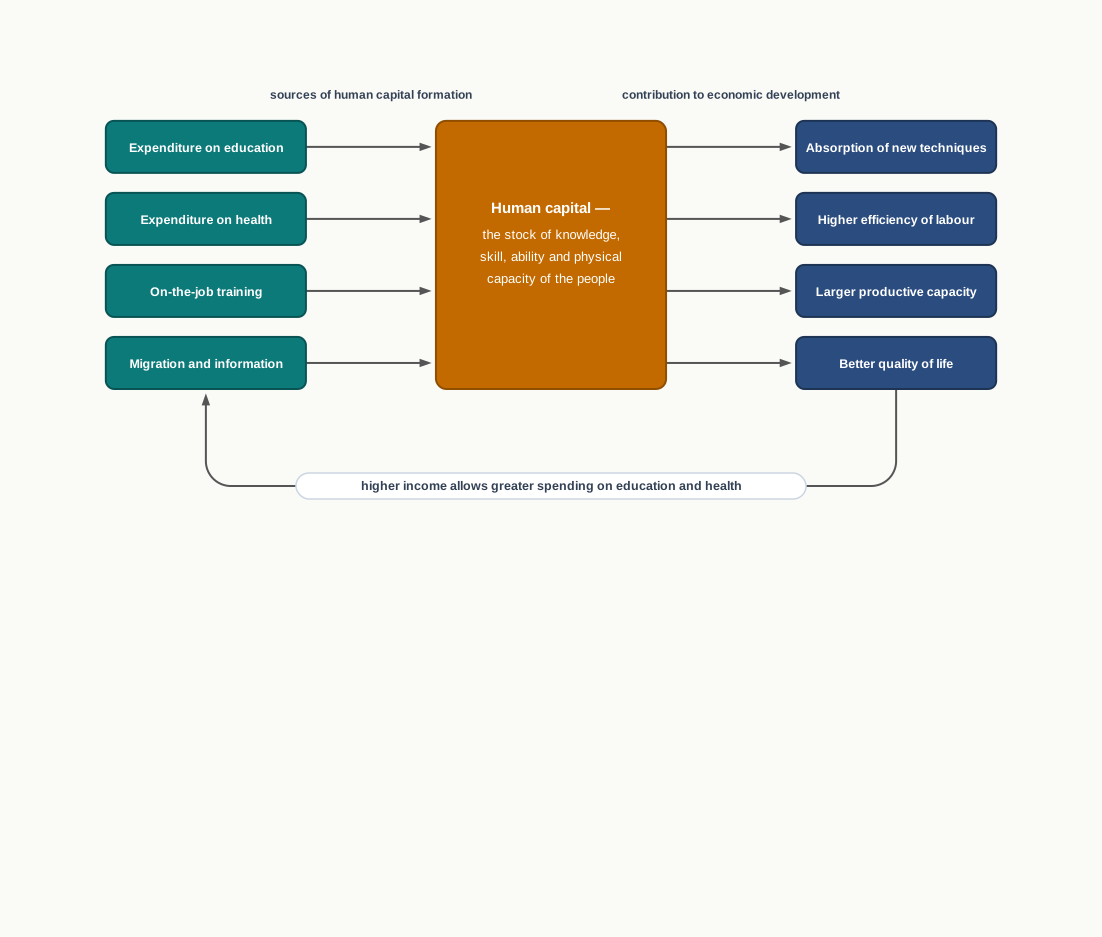
Fig. 14.0 – How human capital is formed and what it yields.
14.1 Human Capital and Human Capital Formation
14.1.1 Physical Capital and Human Capital
Every economy produces with the resources it has accumulated. A shortage of capital is one of the defining characteristics of an underdeveloped economy: the existing stock of capital is small in relation to what production requires, and the rate at which fresh capital is being added is also low. Much of the explanation of poverty in such countries rests on this shortage.
Capital was traditionally understood in a narrow sense. Physical capital means the stock of reproducible or man-made means of production which help in the production of other goods in future — tools and instruments, machinery, plant and equipment, factories, roads and buildings. Capital formation in this sense refers to the process of adding to the stock of physical capital.
Development economists now define capital in a wider sense, so as to cover people as well as things. A trained doctor, a skilled fitter and an experienced teacher each carry a productive capacity that no machine supplies, and that capacity has been built up over years at a cost. Economics treats this accumulated capacity as capital in its own right.
Human capital raises the capacity of an economy to produce in the same way that physical capital does. The two differ, however, in what they consist of, in how they are built up and in who reaps the benefit. The main points of difference are set out below.
14.1.2 Meaning of Human Capital Formation
Just as physical capital has to be built up by investment, the stock of human capital has to be built up by spending on people. That spending is not a single act but a continuing process, running from a child’s first years at school to the training a worker receives after two decades in a trade.
The expression human capital formation therefore describes a process, while human capital describes the stock that the process adds to. The distinction matters because policy acts on the process — a new medical college, a mid-day meal, a skill training programme — while the effect on output comes from the stock that slowly accumulates.
14.1.3 How People Become a Resource
A large population is not by itself a productive resource. People become a resource when they are equipped to work — when they can read a manual, operate a machine, keep accounts, treat a patient or teach a class, and when they are healthy enough to do so regularly and for a full working life. The same numbers that constitute a burden on an economy where they are untrained and unwell become its greatest asset where they are not.
Human capital can be increased in a number of ways. The development of human resources requires the provision of education, health services, water supply, housing, nutrition and family welfare facilities. In practice, human capital formation is generally confined to expenditure on education and on health, and it is these two that this chapter follows.
Education and health occupy a special position because they do two things at once. They generate productive human resources, and they contribute directly to the well-being of the people who receive them. For this reason they are known together as social infrastructure, alongside the physical infrastructure of roads, power and communications.
14.2 Sources of Human Capital Formation
The stock of human capital grows only where resources are put into people. Each of the sources described below is a use of scarce resources that could have gone elsewhere, and each is undertaken because the return — in higher output, higher earnings and better living — is expected to exceed that cost.
14.2.1 Expenditure on Education
Education is the largest single source of human capital formation. Spending on schools, colleges, teachers, books and equipment raises the knowledge and skill of the people, and a worker who has been educated can be trained more quickly, adapts more readily to a new technique and moves more easily from one occupation to another.
The spending comes from two sides. Governments meet the cost of running the public education system, and households meet the cost of fees, books, uniforms, transport and coaching. To this must be added the earnings a student gives up while studying, which is the opportunity cost of remaining in education rather than entering work.
Education is treated as investment because its return is spread over the whole of a working life. A rupee spent on a machine yields output for as long as the machine lasts; a rupee spent on schooling a child yields a higher earning capacity for forty years or more, and yields it to the economy as well as to the person.
14.2.2 Expenditure on Health
Health is the second component of human resource development. Knowledge and skill are of little use to an economy if the person carrying them is too ill to work, and expenditure on health directly increases the supply of a healthy labour force and thereby raises labour productivity.
Health expenditure covers preventive medicine such as vaccination, curative medicine such as treatment in hospitals, social medicine including the spread of health literacy, and the provision of clean drinking water and sanitation. It also covers the training of the medical personnel — doctors, nurses, dentists and technicians — without whom the facilities cannot function.
Public health care in India is organised on a three-tier pattern in the rural areas, and the private sector operates alongside it, particularly in the towns and cities. Where the public system is thin, families meet the cost of treatment themselves, and this out-of-pocket expenditure falls hardest on poor households, which may have to sell assets or borrow to meet a single illness.
The gains from health expenditure show themselves in the health indicators of a population. Life expectancy at birth in India was about 32 years in 1950–51 and had risen to about 70 years by the early 2020s, while the infant mortality rate fell sharply over the same period. A longer and healthier working life is itself an addition to the stock of human capital.
14.2.3 On-the-Job Training, Migration and Information
Formal schooling is not the only way in which productive capacity is built. Three further sources complete the account.
- On-the-job training — a firm trains its workers either at the workplace under an experienced supervisor or by sending them to an institute at its own expense. The firm bears the cost because a trained worker produces more, and it usually expects the worker to stay with it for a period afterwards. The skill acquired this way is often specific to the trade and cannot easily be obtained in a classroom.
- Migration — people move from villages to towns, and from one country to another, in search of work that pays better than what is available where they are. Migration involves the cost of travel, the cost of living in an unfamiliar and often dearer place, and the psychic cost of leaving home behind. It is undertaken because the additional earnings are expected to more than cover those costs, so the migrant is in effect investing in the return on his own skill.
- Information — a worker who does not know where the jobs are, what they pay or what qualification they require cannot put his skill to best use. Expenditure on gathering information about the labour market and about education itself is therefore a source of human capital formation, since it allows both education and skill to be directed where the return is highest.
14.3 Role of Human Capital in Economic Development
Human capital formation is of immense importance in promoting the growth of an economy. Its contribution runs through five channels, which are taken in turn below.
14.3.1 Absorbing New Techniques of Production
Modern techniques of production have become complex and sophisticated. A country may import the most advanced machinery available, but the machinery will not raise output unless there are workers able to install it, run it and repair it when it fails.
Knowledgeable and skilled workers make better use of these techniques. They understand the problems involved in operating them, work them more efficiently and lose less time and material in doing so. The capacity of an economy to absorb technology is therefore set by the quality of its people rather than by the technology available to it.
14.3.2 Increase in the Efficiency of Labour
Human capital formation raises the efficiency of labour directly. A skilled and technically knowledgeable worker completes more work in an hour, spoils less of what he handles and needs less supervision than an unskilled worker doing the same job.
Health works alongside skill. Adequate health facilities and nutrition increase the physical capacity and stamina of workers, so that they can work longer and harder and lose fewer days to illness. Because skilled and healthy workers produce more, they are also able to earn more than unskilled and unhealthy workers, and their contribution to national output is correspondingly larger.
14.3.3 Addition to Productive Capacity
Beyond working the existing techniques better, human capital adds to what an economy is able to produce at all. It does so in three ways.
- Improving indigenous techniques — skilled workers update and modernise the methods already in use in the country, drawing on their own experience of local conditions.
- Adapting imported techniques — knowledgeable workers modify machinery and processes brought in from abroad to suit local raw materials, climate and scale of operation, which is rarely possible without technical understanding.
- Developing new techniques — trained scientists, engineers and technicians create methods of production that did not exist before, which is the source of long-run growth.
14.3.5 Improvement in the Quality of Life
The last contribution is the most direct. Human capital formation improves the quality of life by raising per capita income, lengthening life expectancy, raising the literacy ratio and providing better health care, safe water and housing.
Education changes the standing of a person within society as well as his income. It gives access to information, to public services and to legal rights that an illiterate person cannot easily claim, and it supplies the knowledge needed to understand why change in society is necessary and how it may be brought about.
In short, human capital formation raises productivity, raises the level of production and improves the quality of life of the people. It is for this reason that human resource development has been assigned a key role in every development strategy adopted in India.
14.4 Education as a Source of Human Resource Development
14.4.1 Meaning and Importance of Education
The most important component of human capital formation is education. Education is the process of teaching, training and learning, carried on especially in schools and colleges, by which knowledge is passed on and skills are developed.
Education is the crucial investment in human beings. It is valued for its own sake, since an educated life is a fuller one, but it is also an important factor in economic development, because the knowledge and skill it creates are what allow every other resource in the economy to be used well.
Learning is acquired in more than one way. The ISC syllabus treats two of these — formal education and informal education — and it is with their meaning that this section is concerned.
14.4.2 Formal Education
Formal education is the education received from recognised institutions. It follows a fixed curriculum, is governed by a given set of rules and norms, and is imparted through the interaction of students with teachers in schools, colleges and universities.
Its distinguishing features are that it is deliberate, graded from one stage to the next, and certified at the end. A school-leaving certificate, a degree or a diploma is the evidence of formal education, and it is on this evidence that employers and institutions of higher learning normally rely.
14.4.3 Informal Education
Informal education is the learning that takes place outside any institutional setting. It is not planned, has no curriculum and no examination, and leads to no certificate, yet it accounts for a large part of what a person actually knows and can do.
It occurs in a variety of places — the home, the field, the workshop, the marketplace — and through activities such as listening to the radio, watching television and talking with those who already know a trade. A child who learns to keep accounts by helping at the family shop has been educated informally.
The two kinds of education are distinguished below.
14.4.4 How Education Contributes to Economic Development
The contribution education makes to development can be set out under six heads.
- Developing a scientific outlook — education widens the mental horizon of the people, raises their level of understanding and promotes a rational and scientific way of approaching problems.
- Raising efficiency — an educated worker learns a task faster, performs it more accurately and adapts more readily to a change in method, which raises efficiency and productivity.
- Acquiring skill — education provides the basic literacy and numeracy on which every further skill and talent is built, and without which technical training cannot be given at all.
- Increasing participation in development — educated people are more conscious of their responsibility towards society and take a larger part in developmental activities, and wider participation itself promotes development.
- Ensuring equity and social justice — better education facilities for the common people enable them to earn higher incomes, and thereby reduce the incidence of poverty and inequality.
- Improving the quality of life — education is a necessary input for better living, and brings about improvement in health, hygiene and the other components of the quality of life.
14.5 Growth of the Education Sector in India
14.5.1 Education in the Constitutional and Policy Framework
Education in India is placed in the Concurrent List of the Constitution, which makes it the responsibility of the Central government and the State governments together. The Central government frames the broad education policies and funds centrally sponsored schemes; the State governments are primarily responsible for expanding education within their own territory and provide most of the funding for the school system.
Policy is formed on the recommendations of education commissions and committees appointed from time to time, and after wide consultation. Successive policies have set targets of two kinds. Quantitative achievements are measured by the number of institutions, the enrolment and the number of teachers; qualitative achievements are measured by the gross enrolment ratio, the dropout rate, the intake capacity of institutions and the expenditure incurred on education.
One measure recurs throughout this section and should be understood before the figures are read.
14.5.2 Elementary Education
Elementary education covers children from the pre-school stage to Class VIII, that is, the age group of 6 to 14 years. It has been given the highest priority of any level, because a person who does not complete it can neither be trained further nor exercise the ordinary rights of a citizen with confidence.
Two measures gave the goal legal force. The Constitution was amended in 2002 to make free and compulsory education for children of the age group 6 to 14 years a fundamental right, and the Right of Children to Free and Compulsory Education Act, 2009 gave effect to that right from 2010. Under the Act it is the duty of the government and the local authorities to establish neighbourhood schools providing free elementary education, and the duty of parents and guardians to admit their children to them.
The expansion since Independence has been very large, as Table 14.1 shows.
Four things stand out from the table. The number of schools has risen more than five times and enrolment more than eight times; the gross enrolment ratio at the primary level, which was under a third in 1950–51, is now close to universal; the share of girls in total enrolment has risen from a little over a quarter to nearly half; and the number of teachers has risen faster than the number of schools, which has brought the pupil–teacher ratio down. India’s elementary education system is today among the largest in the world, and Kerala was the first State to achieve full primary education.
A number of programmes carried this expansion. Sarva Shiksha Abhiyan, launched in 2001 and subsumed in 2018 within Samagra Shiksha Abhiyan, is the flagship programme for universal elementary education, and works by opening schools, building classrooms and toilets, supplying drinking water, appointing teachers and providing free textbooks and uniforms. The Kasturba Gandhi Balika Vidyalaya scheme, launched in 2004 and merged with Sarva Shiksha Abhiyan in 2007, runs residential upper primary schools for girls of the scheduled castes, the scheduled tribes, the other backward classes, minority communities and families below the poverty line in educationally backward blocks. Beti Bachao, Beti Padhao, launched in 2015, works on the attitudes that keep girls out of school rather than on buildings.
14.5.3 Secondary Education
Secondary education serves the 14 to 18 age group and prepares students either for higher education or for the labour market. It comprises the secondary stage, Classes IX and X, and the senior secondary stage, Classes XI and XII. Secondary education is free in a large number of States, and children belonging to the scheduled castes and scheduled tribes receive free education in all States.
Table 14.2 shows growth on a scale even larger than at the elementary level, since the base in 1950–51 was so small. The gross enrolment ratio at the secondary level has risen from about 19 in 1990–91 to about 66 in recent years, which is a considerable advance and still well below the ratios of Japan, China and Sri Lanka.
Three developments complete the picture at this level. Vocational courses have been introduced at the higher secondary stage under a centrally sponsored scheme, in agriculture, trade and commerce, engineering and health, to make secondary education more directly employable. Open schooling, through the National Institute of Open Schooling set up in 1989, provides a route to the secondary and senior secondary certificate for school dropouts, working adults and others outside the regular system, and is the largest open schooling system in the world. And two networks of central schools — the Kendriya Vidyalayas, begun in 1963 for the children of transferable central government employees and defence personnel, and the Jawahar Navodaya Vidyalayas, begun after the 1986 policy to give talented rural children a residential education of good quality — have been extended across the country.
14.5.4 Higher Education
Higher education comprises general and technical education above the senior secondary stage, and the Indian system is among the largest in the world. Its growth since 1950–51 is set out in Table 14.3.
Alongside the general universities, the government has built institutions of national importance — the Indian Institutes of Technology, the National Institutes of Technology and the Indian Institutes of Management — and has expanded technical and professional education in engineering, medicine, dentistry, agriculture, architecture and teacher training. Distance education carries a small but significant share of enrolment, and women now account for close to half of all students enrolled.
The main policy initiatives at this level have been curriculum reform, vocationalisation, the spread of distance education, the setting up of model colleges, special grants for women’s hostels, scholarships and subsidised educational loans, and measures to attract teaching talent.
14.5.5 Public Expenditure on Education
Expenditure on education in India is met by the Central government, the State governments and the parents. The part met by the government is public expenditure, and it has grown steadily in absolute terms: State governments spend between 10 and 15 per cent of their budgets on education, and the Union government about 4 per cent of its own.
As a proportion of the economy, however, the position has changed very little. Public expenditure on education, Centre and States combined, has stayed at roughly 3 per cent of gross domestic product for several decades. The target of 6 per cent of gross domestic product was first recommended by the Education Commission of 1964–66, was accepted by the National Policy on Education, 1986 and has been reaffirmed by the National Education Policy, 2020; it has not been reached. Measured against the requirements of a young and growing population, public expenditure on education remains inadequate.
14.5.6 National Education Policy 2020
India has had three national education policies before the present one — those of 1968, 1986 and 1992. Their common objective was that education should promote economic development, eradicate illiteracy, correct social and regional imbalances, empower women and secure a place for disadvantaged groups and minorities. Much has changed since 1992: the economy has opened up, technology has advanced rapidly, and participation in economic and social life has widened. The National Education Policy, 2020, approved in July 2020 and being implemented in phases, is the response to that change and to the unfinished agenda of the earlier policies.
Its main features at the school level are the following.
- Universalisation of school education — the policy aims at a gross enrolment ratio of 100 per cent from the pre-school stage to the secondary stage by 2030.
- A modified curricular structure — the 10 + 2 pattern is replaced by a 5 + 3 + 3 + 4 pattern corresponding to the age groups shown in Table 14.4.
- Foundational literacy and numeracy — every child is to be able to read, write and do simple arithmetic by the time he reaches Class 3.
- Multiple streams — the hard separation between arts, commerce and science and between vocational and academic study is removed, and vocational education is to begin from Class 6.
- Multilingualism — three languages are to be taught, with the choice left to the States, and the local language is preferred as the medium of instruction up to Class 8.
- Reform of board examinations — Class 10 and Class 12 examinations are to test understanding rather than memorisation, students may retake them once, and the papers are to combine objective and descriptive questions.
- Use of technology — low-cost digital technology is to be developed so that teaching can reach children irrespective of their location or background.
At the level of higher education the policy provides for undergraduate courses of three or four years with multiple exit options, so that a student may leave with a certificate, a diploma or a degree and return later; for multidisciplinary study across faculties; for a common entrance examination; for colleges to become autonomous degree-granting institutions instead of remaining affiliated to universities; for one-year and two-year master’s programmes; and for foreign universities to set up campuses in India.
14.6 Shortcomings of the Education Sector in India
The expansion described in the previous section is real, and it is large. It has not, however, produced an education system adequate to the needs of the country, and the shortcomings that remain fall under three heads.
14.6.1 Inadequate and Unequal Access
Despite the growth in the number of institutions, education facilities are still short of what the population requires, and education still reaches a limited part of it. Literacy has risen from about 18 per cent in 1951 to a little over three-quarters of the population by the early 2020s, which means that a substantial minority of adults still cannot read and write, and illiteracy is markedly higher among women than among men.
Access is also unequal between groups. Opportunities are not the same for boys and for girls, for urban and for rural children, or for children of the scheduled castes and scheduled tribes and the rest. Women belonging to the scheduled castes and scheduled tribes are the most disadvantaged of all, and the system as a whole remains biased in favour of the towns.
The second failure of access is that many who enter do not stay.
Dropout is heaviest at the points of transition, particularly between Class X and Class XI, and it is higher among boys than among girls. Dropout rates at all levels of school education have fallen in recent years, but every child who leaves early represents human capital formation begun and abandoned, with the cost incurred and the return never earned.
14.6.2 Poor Quality and Imbalances in Provision
The quality of education determines the quality of the human capital it creates, and on this test the Indian system does less well than the enrolment figures suggest. The content of what is taught is often weak, and it is frequently less relevant to the needs of the country than it should be — there is too much emphasis on general education as against technical and vocational education, and vocationalisation remains a distant goal.
Higher education suffers from weaknesses of its own: substandard institutions have multiplied, academic standards have deteriorated in many of them, and curricula have not kept pace with what employers and the professions now require. The result is visible in the labour market, where there is large unemployment among those holding general degrees while people with relevant technical training remain in short supply.
A third weakness is the ratio of teachers to pupils.
The pupil–teacher ratio has improved at every level in recent years, but it remains high, and a teacher responsible for a large class cannot give individual attention however well qualified he may be. Alongside this sits an imbalance in the way funds are divided: a greater proportion of resources goes to elementary and higher secondary education, while universities and other higher education receive low priority, which is itself a matter of concern.
14.6.3 Insufficient Resources
Underlying all the shortcomings above is the level of resources devoted to education. Public expenditure on education has remained at roughly 3 per cent of gross domestic product, against the 6 per cent recommended by the Education Commission of 1964–66 and reaffirmed in every policy since.
The consequence is a system stretched thin at every point: too few teachers for the enrolment, too little for laboratories, libraries and equipment, and too little for the training that would keep teachers current. Expanding access and raising quality both require money, and where the money is short, expansion has generally been chosen and quality has been allowed to suffer.
14.7 Summary
- Physical capital is the stock of man-made means of production which help in the production of other goods in future. A shortage of it, and a low rate of addition to it, is a defining feature of an underdeveloped economy.
- Human capital is the stock of knowledge, skill, ability and physical capacity of the people at a point of time, which helps the human factor to produce more goods. It raises productive capacity in the same way physical capital does, but it cannot be separated from the person in whom it is embodied.
- Human capital formation, or human resource development, is the process of improvement in the knowledge, skill, ability and physical capacity of the people. Human capital is the stock; human capital formation is the process of adding to it.
- People become a resource when they are equipped to work. This requires education, health services, water supply, housing, nutrition and family welfare facilities, of which education and health are the two on which human capital formation chiefly rests. Together they are called social infrastructure, because they create productive capacity and add to well-being at the same time.
- The sources of human capital formation are:
- expenditure on education, met by the government and by households, and including the earnings a student forgoes while studying;
- expenditure on health, covering preventive, curative and social medicine, safe water and sanitation, and the training of medical personnel;
- on-the-job training, which builds skill specific to a trade;
- migration, which moves skill to where it is more productive and better paid;
- expenditure on information about the labour market and about education itself.
- Human capital contributes to economic development in five ways: it allows new techniques to be absorbed, raises the efficiency of labour, adds to productive capacity by improving indigenous techniques and adapting imported ones, acts as an instrument of economic and social change, and improves the quality of life.
- Education is the most important component of human capital formation. Formal education is systematic and organised education imparted in recognised institutions according to a given curriculum, leading to a certificate, diploma or degree. Informal education is learning gained through experience in one’s surroundings, at home, at work and through the media, and leads to no certificate.
- Education contributes to development by developing a scientific outlook, raising efficiency, imparting skill, increasing participation in the process of development, ensuring equity and social justice, and improving the quality of life.
- Education is a Concurrent subject. The Central government frames policy and funds centrally sponsored schemes; the State governments are responsible for expansion and provide most of the funding.
- The gross enrolment ratio is the ratio of children enrolled at a level of education to the children in the corresponding age group.
\[\text{GER} = \dfrac{\text{Number of children enrolled at a level}}{\text{Number of children in the corresponding age group}} \times 100\]
Because it counts every enrolled child whatever the age, it can exceed 100 per cent. 11. Elementary education covers the age group 6 to 14 years. Free and compulsory education for this group was made a fundamental right by the constitutional amendment of 2002 and given effect by the Right of Children to Free and Compulsory Education Act, 2009. Schools have risen from 2.23 lakh in 1950–51 to about 11.6 lakh, enrolment from 22.3 million to about 182 million, and the primary gross enrolment ratio from 32.1 per cent to about 95 per cent. 12. Secondary education serves the age group 14 to 18 years. Schools have risen from 7,400 in 1950–51 to about 3.07 lakh and enrolment from 1.5 million to about 65 million, while the gross enrolment ratio has risen from about 19 in 1990–91 to about 66, still below that of several comparable countries. 13. Higher education has grown from 27 universities and 695 colleges in 1950–51 to 1,168 universities and 45,473 colleges in 2021–22, with the gross enrolment ratio rising from 5.8 per cent in 2001–02 to 28.4 per cent. 14. Public expenditure on education, Centre and States combined, has stayed at roughly 3 per cent of gross domestic product, against the 6 per cent of gross domestic product recommended by the Education Commission of 1964–66 and reaffirmed by every education policy since. 15. The National Education Policy, 2020 replaces the 10 + 2 pattern with a 5 + 3 + 3 + 4 structure covering ages 3–8, 8–11, 11–14 and 14–18; aims at a gross enrolment ratio of 100 per cent up to the secondary stage by 2030; sets targets for foundational literacy and numeracy; removes the hard separation between streams; and reforms board examinations. In higher education it provides for undergraduate courses of three or four years with multiple exit options, multidisciplinary study, autonomous degree-granting colleges and the entry of foreign universities. 16. The shortcomings of the education sector are: a. inadequate facilities and a literacy ratio still short of universal; b. unequal access between men and women, town and country, and social groups; c. high dropout, especially at the transition from Class X to Class XI; d. poor quality and content insufficiently related to the needs of the economy; e. a high pupil–teacher ratio, though it has fallen at every level; f. imbalance in the allocation of funds between levels of education; g. insufficient resources, with public expenditure at about half the recommended share of gross domestic product.
14.8 Points to Ponder
- A government with a fixed budget must choose between building a road and building a school. The road raises output within a year or two; the school raises it only after fifteen. How should a poor country, whose people are poor now, weigh a return that arrives so late?
- Human capital cannot be separated from the person who carries it. Does this mean that a country which educates its people at public expense has any claim on them if they emigrate, and if so, what kind of claim?
- Enrolment at the elementary level in India is close to universal, yet the quality of what is learnt is widely held to be poor. If access and quality compete for the same limited funds, which should a State government prioritise, and what is lost by the choice?
- Education is described in this chapter both as a means to higher output and as an end in itself. Would a country that valued it only as a means teach a different syllabus from one that valued it as an end?
- The 6 per cent of gross domestic product target has been recommended since the 1960s and never met, by governments of every description. Does that suggest the target was wrong, or that something in the way budgets are decided works against it?
- Much of the skill used in Indian agriculture, crafts and small enterprise is acquired informally and recorded nowhere. If this human capital does not appear in any statistic, is it likely to be neglected by policy, and how might that be remedied?
14.9 Objective Questions
- Which of the following is not a source of human capital formation? [1]
- Expenditure on health
- On-the-job training
- Purchase of machinery by a firm
- Migration in search of better paid work
- Assertion (A): The gross enrolment ratio at a level of education can exceed 100 per cent. Reason (R): The gross enrolment ratio counts every child enrolled at that level, whatever his age. Choose the correct option. [1]
- Both A and R are true and R is the correct explanation of A
- Both A and R are true but R is not the correct explanation of A
- A is true but R is false
- A is false but R is true
- Education and health are together known as ____________ infrastructure, because they create productive capacity and add directly to well-being. [1]
- State whether the following statement is true or false: a fall in the pupil–teacher ratio indicates a deterioration in the quality of school education. [1]
- Match the items in Column A with those in Column B. [1]
| Column A | Column B |
|---|---|
| a. Right of Children to Free and Compulsory Education Act | i. Replaces the 10 + 2 pattern with a 5 + 3 + 3 + 4 structure |
| b. National Education Policy | ii. Programme for universal elementary education, within which Sarva Shiksha Abhiyan was subsumed |
| c. Samagra Shiksha Abhiyan | iii. Places the duty of providing free elementary education on the government and the local authorities |
14.10 Check Your Concepts
- Define human capital formation, and state how it differs from human capital. [2]
- Distinguish between formal education and informal education, giving one example of each. [3]
- Why is expenditure on education treated as investment rather than as consumption? Explain with reference to the return it yields and the period over which that return is earned. [4]
- ‘India’s education sector has expanded greatly since 1950–51, but the expansion has not made it adequate.’ Evaluate this claim, using evidence from both the growth of the sector and its shortcomings. [6]
14.11 Case-Based Question
- Devbhoomi Tools employs 40 workers at its plant in Sonipat. The firm imports a computer-controlled lathe, but output falls in the first three months because no worker can set it up correctly and the machine stands idle for days at a time. The management then sends eight workers for a six-week course at a technical institute at the firm’s expense, and pays each of them a higher wage on their return, on the understanding that they will remain with the firm for at least two years. Within a year output per worker at the plant is well above what it had been before the lathe arrived.
- Identify the source of human capital formation illustrated here, and explain why the firm was willing to bear its cost. [2]
- The lathe alone reduced output while the lathe and the training together raised it. What does this tell you about the relationship between physical capital and human capital? [2]