Chapter 1: Microeconomics and Macroeconomics: Introduction
When a household decides how much of its monthly income to spend on wheat and how much to set aside as savings, it is answering a small question, but a real one. When the same household finds that prices in general are climbing year after year, or that work is harder to come by than it was, it is facing a question of a very different size. Economics studies both, and it needs two different sets of tools to do so. Scarcity forces a choice at every level. A consumer must choose between one good and another; a firm must choose how much to produce and at what price to sell; and an entire economy must choose how much of its resources to put to work and how fast to grow. The first two questions belong to microeconomics, the study of individual units. The third belongs to macroeconomics, the study of the economy as a whole. This chapter explains what each branch studies, sets out the subject matter, importance and limitations of both, distinguishes them point by point, and shows why neither can be understood without the other.
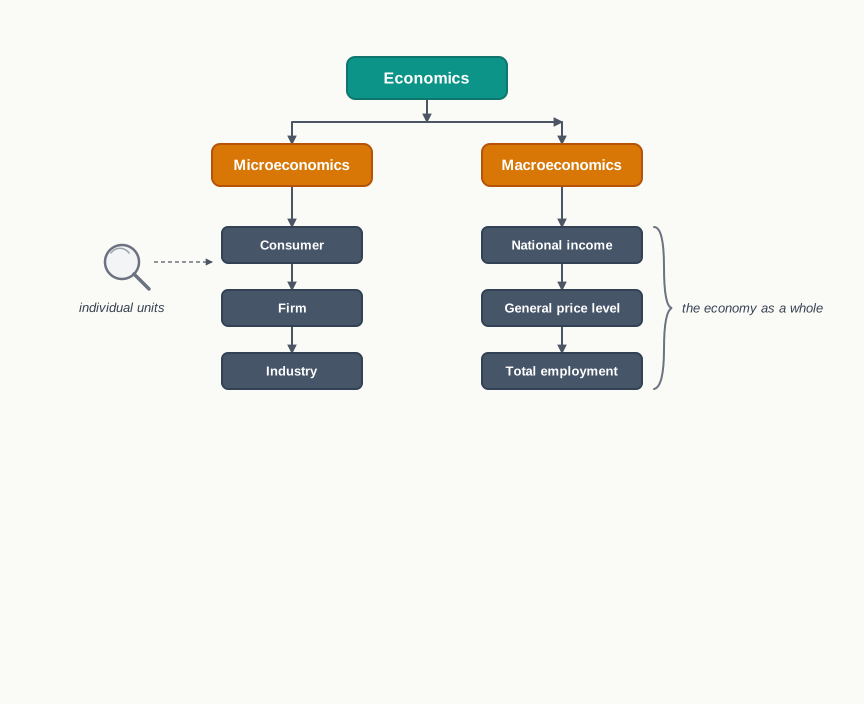
Fig. 1.0 – The two branches of economic study.
1.1 Microeconomics
Every economy is made up of parts. Households earn incomes and spend them, firms buy resources and produce goods, and industries group together firms making similar products. Each of these parts faces the central difficulty of economics in miniature: its means are limited, and it must decide what to do with them.
Economics therefore needs a way of studying that decision at the level of the single unit — what the consumer chooses to buy, what the firm chooses to produce, and what price emerges when the two meet in a market. Microeconomics is that way of studying the economy.
1.1.1 Meaning of Microeconomics
The prefix ‘micro’ is derived from the Greek word ‘mikros’, meaning small. Microeconomics studies the economic behaviour of individual economic units and of individual economic variables. The unit of study is a part of the economy — a single consumer, a single firm, a single industry — and not the economy taken as a whole.
An individual economic variable is a variable that belongs to one such unit: the price of one commodity, the output of one firm, the wage paid to one kind of labour, the demand of one household. Because the determination of price lies at the centre of all these questions, microeconomics is also called price theory.
The terms microeconomics and macroeconomics were coined by the Norwegian economist Ragnar Frisch, who founded the discipline of econometrics and was awarded the first Nobel Prize in Economics, jointly with Jan Tinbergen, in 1969.
Microeconomics may be described as the microscopic study of the economy. Instead of looking at the economy as a single object, it picks up one small part of it and examines the economic behaviour of that part in detail. It then studies how these parts act on one another, chiefly through the interaction of buyers and sellers in a market.
1.1.2 Subject Matter of Microeconomics
The questions microeconomics asks all follow from scarcity at the level of the unit. A consumer with a limited income must decide what to buy; a firm with limited resources must decide what and how much to produce, and at what cost; and the output produced must somehow be shared among those who helped produce it. The subject matter falls under the following heads.
- Theory of demand — how an individual consumer distributes a limited income among various goods and services so as to obtain the greatest possible utility from it.
- Theory of production — what quantity of each factor of production a firm should employ in producing a commodity, and how output responds when the quantity of a factor is changed.
- Theory of cost — how the cost of producing a given output is built up, and how a firm can produce that output at the least cost.
- Theory of product pricing — how the price of a single commodity is determined in a market, and how an individual firm decides the price to charge and the output that will maximise its profit.
- Theory of distribution — how the output produced is shared among those who cooperate in producing it, that is, how wages, interest, rent and profit are determined. This is also called factor pricing.
- Welfare economics — whether the resources of the economy are being allocated efficiently, and what conditions must be satisfied if output and social welfare are to be maximised.
These heads can be grouped under three broad divisions — the product market and product pricing, the factor market and factor pricing, and welfare economics. The whole subject matter, with its divisions, is set out in Fig. 1.1.
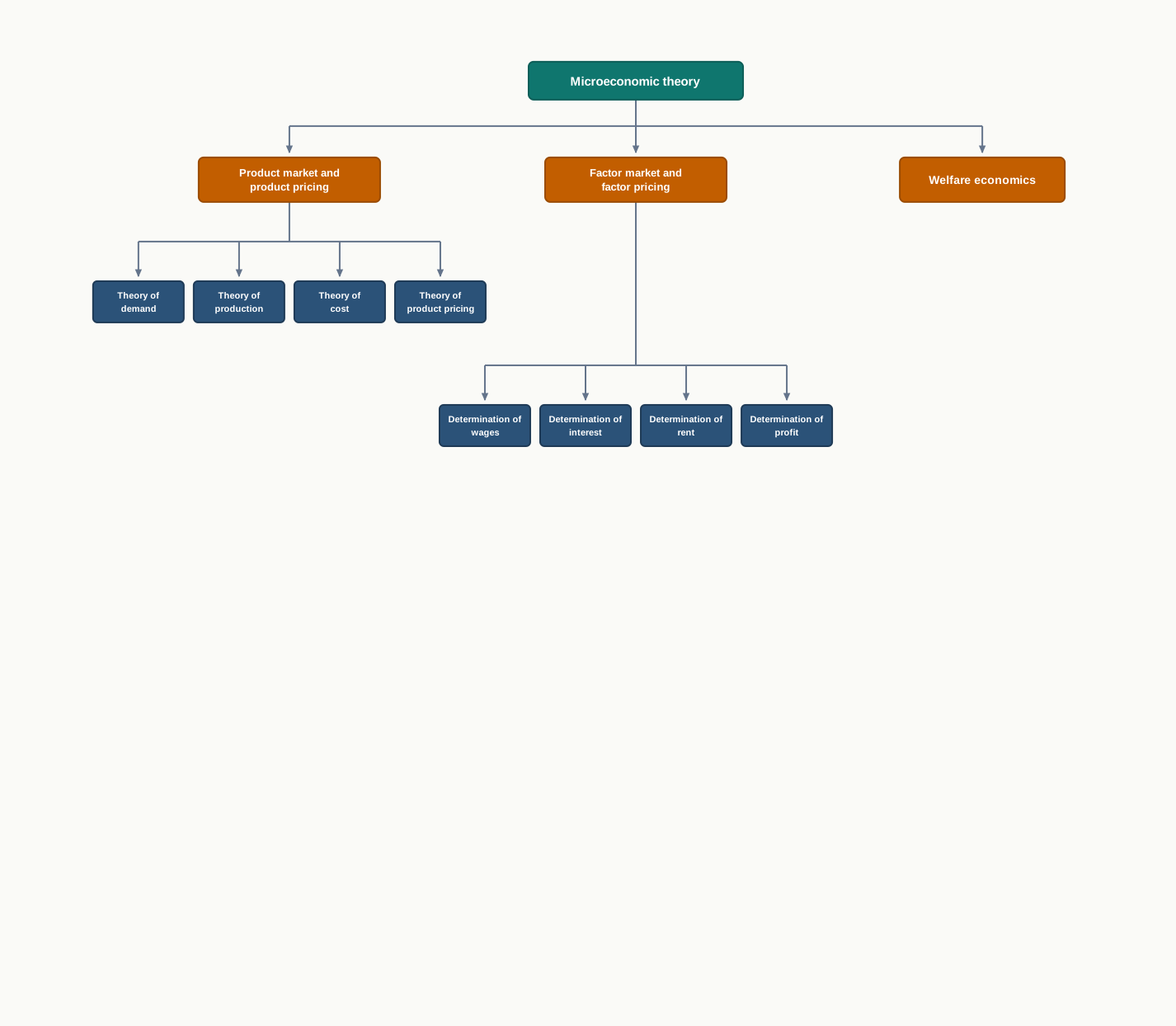
Fig. 1.1 – Subject matter of microeconomics.
1.1.3 Importance of Microeconomics
Microeconomics is not merely a description of small units. It is the working apparatus of the subject, and much of what economics is able to say about resources rests on it.
- It explains the working of a market economy — in an economy where decisions are decentralised, it is prices that tell producers what to make and consumers what to buy. Microeconomics shows how those prices come to be what they are.
- It examines the allocation of resources — since resources are scarce, the question of whether they are being put to their most valuable use is a real one, and microeconomics supplies the conditions under which the allocation is efficient.
- It guides business decisions — a firm deciding its output, its price, its scale of plant or its input mix is using demand analysis, cost analysis and the theory of market forms.
- It assists the framing of policy — the effect of a tax, a subsidy, a price ceiling or a support price on a particular market is a microeconomic question before it is anything else.
- It provides the foundation of other branches — the theory of international trade, public finance and much of welfare analysis are built on microeconomic tools.
1.1.4 Limitations of Microeconomics
Useful as it is, microeconomic analysis cannot be asked to do everything, and its limits explain why a second branch of the subject was needed at all.
- It cannot explain economy-wide problems — the general price level, the total level of employment, the rate of growth of national income and the balance of payments lie outside its unit of study.
- It rests on restrictive assumptions — much of the analysis assumes full employment of resources, other things remaining equal, and a market left largely to itself. None of these holds exactly in a real economy.
- Its conclusions cannot simply be extended to the whole — what is true of one household or one firm need not be true of all of them together, a difficulty examined in Section 1.3.
- It gives an incomplete picture — studying the parts one at a time tells us a great deal about each tree and very little about the forest.
1.2 Macroeconomics
Some of the questions an economy faces cannot be asked of any single unit within it. Whether output as a whole is rising, whether people who want work are able to find it, whether prices in general are stable, and how fast the country is growing are questions about the economy itself, not about one household, one firm or one market.
These are also questions forced by scarcity, but scarcity seen from the other end. A country has a given stock of labour, capital and natural resources, and what matters is how much of that stock is actually being used, how much output it yields and how the fruits of that output are being spread. Macroeconomics is the branch that studies the economy at this level.
1.2.1 Meaning of Macroeconomics
The prefix ‘macro’ is derived from the Greek word ‘makros’, meaning large. Macroeconomics deals with the functioning of the economy as a whole. Its unit of study is the entire economy rather than a part of it, and the variables it works with are aggregates — totals and averages that describe the economy taken together.
National income, total output, total employment, aggregate consumption, aggregate saving and investment, the general price level and the rate of economic growth are all such aggregates. Because the determination of national income lies at the centre of the analysis, macroeconomics is also called income theory.
Macroeconomics asks why an economy sometimes works at near full employment and at other times leaves a large part of its labour force idle, why growth is rapid in some periods and slow in others, and why the price level rises sharply at some times and remains steady at others. These are the ‘big issues’, and no amount of study of a single market will settle them.
1.2.2 Subject Matter of Macroeconomics
The subject matter of macroeconomics is best identified by the broad areas its theories cover. Each area takes one aggregate and asks what determines it.
- Theory of national income — what national income means, how it is measured by the product, income and expenditure methods, and what the aggregates derived from it show about the economy.
- Theory of output and employment — what determines the total output produced and the total employment of resources, and why the level of activity fluctuates from one period to another.
- Theory of the general price level — why prices in general rise or fall, and what causes inflation and deflation.
- Theory of money — what money is, how the supply of money is determined, how banks create credit and how the central bank regulates the flow of credit in the economy.
- Theory of economic growth — what makes the productive capacity of an economy expand over time, and what raises per capita income in the long run.
- Theory of international trade — how a country’s transactions with the rest of the world are recorded in the balance of payments, and how the exchange rate between currencies is determined.
The main areas and their common source are shown in Fig. 1.2.
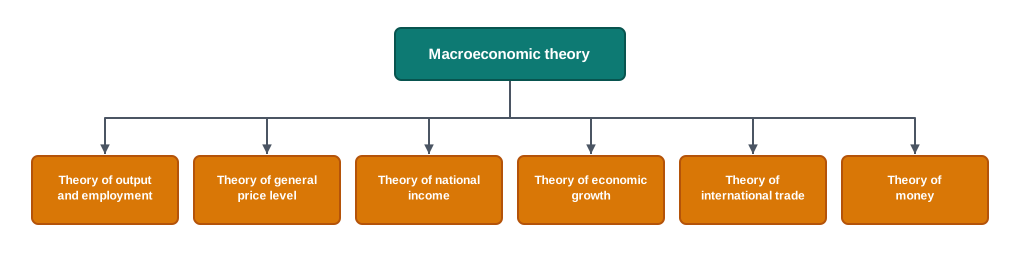
Fig. 1.2 – Subject matter of macroeconomics.
The chapters that follow take up these areas in turn — the theory of income and employment, money and banking, the balance of payments and the exchange rate, public finance, and national income.
1.2.3 Importance of Macroeconomics
The value of macroeconomics lies in the fact that the problems it studies are the ones an economy is judged by, and the ones government policy is expected to act on.
- It explains the working of the economy as a whole — the relations between total output, total income and total expenditure can only be set out at the level of the economy, and it is these relations that a macroeconomic model describes.
- It explains fluctuations in activity — periods of expansion and contraction in output and employment are a recurring feature of economies, and macroeconomics examines their causes and the measures that can moderate them.
- It is the basis of economic policy — a decision on the tax rates and expenditure in the government budget, or on the repo rate and the cash reserve ratio, is taken with the whole economy in view.
- It underlies the study of growth and development — questions about the rate of growth of national income, the level of per capita income and the standard of living are macroeconomic questions.
- It makes measurement and comparison possible — the estimation of national income gives a country a record of its own performance over time and a basis on which to compare itself with others.
1.2.4 Limitations of Macroeconomics
Working with aggregates buys breadth at a price, and the price is detail.
- Aggregates conceal differences within them — a rise in national income says nothing about who received the additional income, and an average can improve while a large section of the population is no better off.
- Unlike things are added together — the general price level is compiled from commodities as different as cereals, fuel and rent, so a single index number can never describe every household’s experience of rising prices.
- What is true of the whole need not be true of every part — an economy may be growing while a particular industry or region is contracting, a difficulty examined in Section 1.3.
- The aggregates are difficult to measure accurately — national income, employment and the price level are all estimates, and in an economy with a large unorganised sector the estimates carry a wide margin of error.
1.3 Difference Between Microeconomics and Macroeconomics
The two branches are not two subjects. They are two ways of looking at the same economy, and every difference between them follows from one decision — the size of the unit chosen for study.
Once that unit is fixed, the rest is settled. A branch that studies a single consumer must work with the price of a single commodity; a branch that studies the whole economy must work with totals and averages. The questions asked, the tools used and even the names by which the two branches are known all follow from the choice of unit.
1.3.1 Bases of Difference
The first and governing difference is the unit of study. Microeconomics takes a part of the economy — a household, a firm, an industry, a single market. Macroeconomics takes the economy itself.
From this follows the difference in variables. Microeconomics works with individual variables: the demand of one household, the output of one firm, the wage paid for one kind of work, the price of one commodity. Macroeconomics works with aggregates: national income, total output, total employment and the general price level.
The two also differ in method. Microeconomics uses what is called the slicing method — the economy is cut into parts and one part is examined closely, while the totals for the rest of the economy are taken as given. Macroeconomics uses the lumping method — the parts are added together and the behaviour of the total is studied directly, while the way that total is divided among individual units is left aside. The contrast is shown in Fig. 1.3.
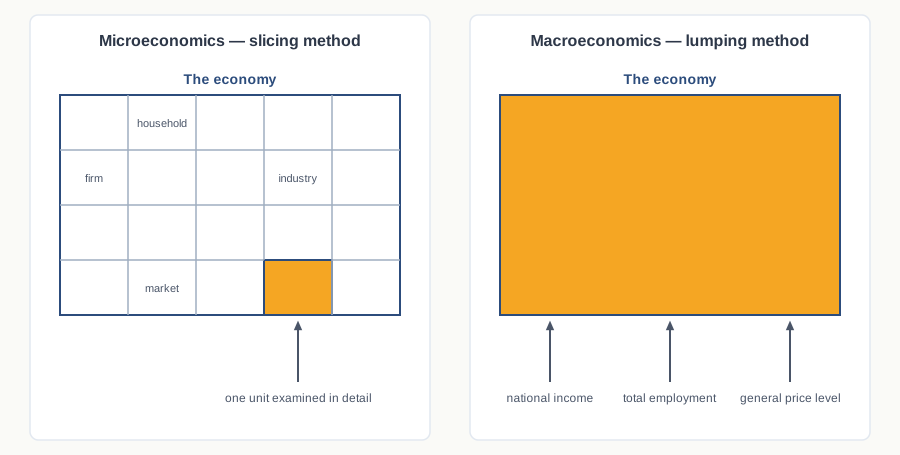
Fig. 1.3 – The slicing method and the lumping method.
The central problem each branch sets itself differs in the same way. Microeconomics asks how prices are determined and how scarce resources are allocated among competing uses, which is why it is known as price theory. Macroeconomics asks how the level of income and employment is determined and how the economy grows over time, which is why it is known as income theory. The main points of difference are set out below.
1.3.2 Why the Whole Is Not the Sum of Its Parts
If the economy were only the sum of its units, one branch of economics would be enough. Study every household and every firm, add the results, and the behaviour of the whole should follow. It does not, and the reason is worth understanding.
What is true of one unit acting alone need not be true when all units act in the same way at the same time. This error of reasoning is called the fallacy of composition. A single unit can treat the rest of the economy as fixed, because its own decision is far too small to disturb it. All units acting together cannot, because their combined action changes the very conditions each of them faced.
Saving is the standard illustration. A household that decides to save a larger share of its income ends the year with more wealth, and that is a sound microeconomic conclusion. But one household’s spending is another household’s income. If every household saves more at once, total spending falls, firms sell less, output and incomes are cut back, and the economy may end the year with no more saving than it began with.
The error runs in the other direction too. What is true of the whole need not be true of every part. National income may be rising steadily while a particular industry is closing units and shedding workers, and the general price level may be stable while the price of a single commodity doubles. An aggregate describes the total and hides everything that has happened inside it.
Because the whole behaves in ways its parts do not, the economy as a whole needs its own variables and its own body of theory. That is the case for macroeconomics, and it is why neither branch can be collapsed into the other.
1.4 Interdependence of Microeconomics and Macroeconomics
Having separated the two branches, it would be easy to leave them separated. That would be a mistake. Neither branch is self-contained, and an economist who works in one is constantly relying on results borrowed from the other.
The dependence runs both ways, and the two directions are worth stating separately.
Aggregates Are Built From Units
Every macroeconomic total is assembled, in the end, out of the behaviour of individual units. It cannot be otherwise, because there is nothing else in an economy for the total to be made of.
- National income is obtained by adding the value added by every firm, or the incomes earned by every factor owner, so its measurement rests directly on the accounts of individual units.
- Aggregate demand is built up from the demand of individual households for consumption goods and of individual firms for capital goods, each of which is settled by microeconomic reasoning.
- The general price level is an index number compiled from the prices of individual commodities, which are themselves determined in individual markets.
- Total employment is the sum of the hiring decisions of individual employers, and each such decision is taken by comparing the cost of a worker with the revenue that worker’s output will earn.
Units Live Inside An Economy
The influence runs in the other direction just as strongly. No household or firm makes its decisions in a vacuum; each of them acts inside an economy whose condition is given to it by macroeconomic forces.
- The demand facing a single firm depends on the level of national income, since consumers buy more of most goods when incomes in general are rising.
- The wage a worker can bargain for depends on the general price level, because what matters to the worker is what the wage will buy.
- A firm’s decision to invest depends on the rate of interest and on the availability of credit, both of which are settled at the level of the economy by the banking system and the central bank.
- A firm’s costs and its market are altered by the taxes, subsidies and public expenditure decided in the government budget.
The relationship is set out in Fig. 1.4.
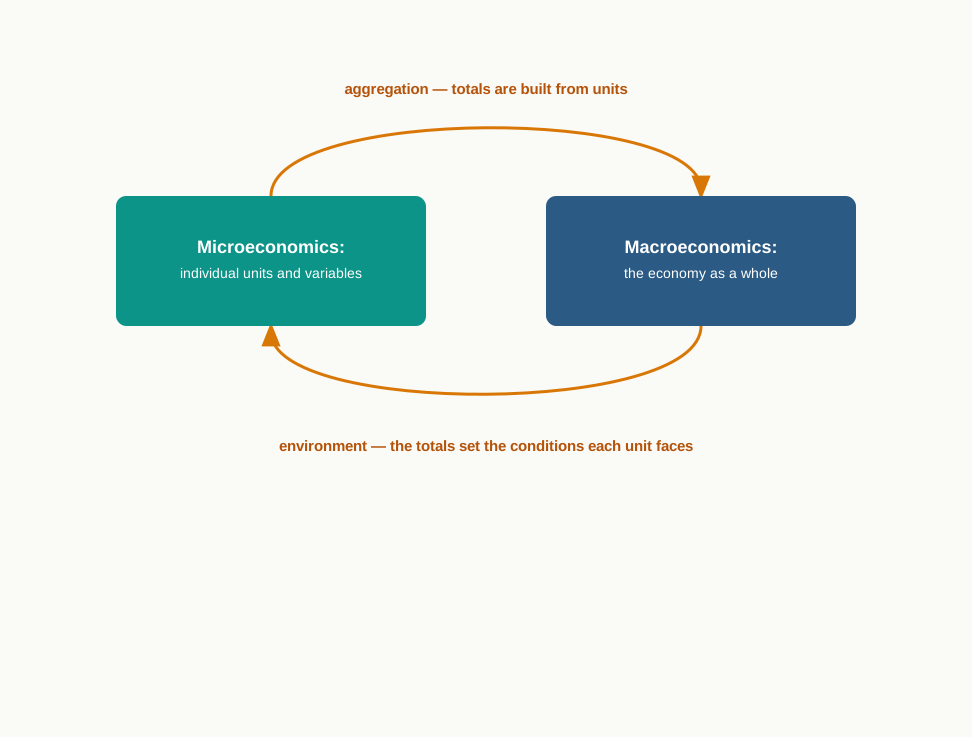
Fig. 1.4 – Interdependence of microeconomics and macroeconomics.
The sensible conclusion is that the division of economics into two branches is a division of labour, not a division of the subject. Each branch studies what the other is obliged to assume, and a complete account of an economy needs both.
1.5 Summary
- The subject matter of economics is broadly divided into two branches, microeconomics and macroeconomics. The two terms were coined by the Norwegian economist Ragnar Frisch.
- Microeconomics studies the economic behaviour of individual economic units, such as a consumer, a firm or an industry, and of individual economic variables, such as the price or output of a single commodity. Because price determination lies at its centre, it is also called price theory.
- The subject matter of microeconomics covers:
- theory of demand;
- theory of production and theory of cost;
- theory of product pricing;
- theory of distribution, or factor pricing;
- welfare economics.
- Microeconomics explains how a market economy works, examines whether scarce resources are efficiently allocated, guides the decisions of firms, assists the framing of policy for particular markets and provides the foundation of several other branches of the subject.
- Its limitations are that it cannot explain economy-wide problems, rests on restrictive assumptions such as full employment, cannot be extended from the part to the whole, and gives an incomplete picture of the economy.
- Macroeconomics studies the functioning of the economy as a whole. It works with aggregates such as national income, total output, total employment, aggregate consumption and saving, and the general price level, and is also called income theory.
- The subject matter of macroeconomics covers:
- theory of national income;
- theory of output and employment;
- theory of the general price level;
- theory of money;
- theory of economic growth;
- theory of international trade.
- Macroeconomics explains the working of the economy as a whole and the fluctuations in its activity, supplies the basis for fiscal and monetary policy, underlies the study of growth, and makes the measurement and comparison of national performance possible.
- Its limitations are that aggregates conceal the differences within them, that unlike things are added together, that what is true of the whole need not hold for every part, and that the aggregates themselves are difficult to measure accurately.
- The two branches differ first in the unit of study — a part of the economy against the whole of it — and their differences in variables, in central problem and in the assumptions each makes all follow from that choice.
- What is true of one unit acting alone need not be true when all units act together. This error is called the fallacy of composition, and it is the reason the economy as a whole needs its own concepts and its own theory.
- The two branches are interdependent. Every aggregate is built up from the behaviour of individual units, and every unit acts within conditions — income, prices, interest rates, taxes — that are set for the economy as a whole.
The distinction on which the chapter turns may be recalled in brief from the table below.
1.6 Points to Ponder
- Microeconomics takes the economy’s totals as given, and macroeconomics takes the division of those totals among individual units as given. Each branch therefore assumes away exactly what the other sets out to explain. Is either branch complete on its own, and what would a single theory covering both have to be able to do?
- A country’s national income may rise in a year in which the incomes of its poorest households do not rise at all. Has that economy improved? What else would you need to know before you were willing to answer?
- In a difficult year, a household is usually advised to cut its spending and save more. If every household followed that advice at the same time, incomes would fall and saving might not rise at all. Should economic advice be tested on the single household or on the economy as a whole?
- Much of microeconomic analysis assumes full employment of resources and other things remaining equal, conditions that rarely hold exactly in a real economy. Is a theory built on unrealistic assumptions still worth having, and what would have to go wrong before you gave it up?
- Suppose a government wants to raise employment. It could act on a particular industry — through a subsidy, a tariff or a public order — or it could act on the aggregate demand of the whole economy through its budget and through monetary policy. On what should the choice between the two approaches depend?
- Economists studied the prices of individual goods and the wealth of nations for a century and a half before the words ‘microeconomics’ and ‘macroeconomics’ were coined. Does dividing a subject into branches deepen understanding, or does it make certain questions harder to ask?
1.7 Objective Questions
- Which of the following is an individual economic variable? [1]
- The general price level
- The price of a kilogram of tea
- Total employment in the economy
- National income
- Assertion (A): Microeconomics is described as price theory. Reason (R): Microeconomics studies how the general price level of an economy is determined. Choose the correct option. [1]
- Both (A) and (R) are true and (R) is the correct explanation of (A).
- Both (A) and (R) are true but (R) is not the correct explanation of (A).
- is true but (R) is false.
- is false but (R) is true.
- Fill in the blank: The branch of economics that studies the functioning of the economy as a whole is called ______. [1]
- State whether the following statement is true or false: A firm that employs ten thousand workers is studied under macroeconomics because of its size. [1]
- Match the items in Column I with those in Column II. [1]
| Column I | Column II |
|---|---|
| a. An aggregate variable | i. The wage paid for one kind of labour |
| b. An individual variable | ii. Macroeconomics |
| c. Also known as income theory | iii. The general price level |
1.8 Check Your Concepts
- Define microeconomics and give one example of a variable it studies. [2]
- Explain, with an example, why the size of a firm does not decide whether it is studied under microeconomics or under macroeconomics. [3]
- Distinguish between microeconomics and macroeconomics on any four bases. [4]
- ‘Microeconomics and macroeconomics are interdependent branches of the same subject.’ Evaluate this claim, giving two examples of an aggregate that is built up from individual units and two examples of an individual unit whose decisions are governed by economy-wide conditions. [6]
1.9 Case-Based Question
- Arundhati Sen owns a small furniture workshop in Bhopal. Last year she raised the price of her dining tables by five per cent and found that her sales fell only slightly, so her total revenue rose. During the same year prices in the country were rising in general, and banks raised their lending rates; the loan Arundhati had planned to take for a new cutting machine became costlier, and she postponed the purchase.
- Identify one microeconomic decision and one macroeconomic development described in the passage, giving a reason for each identification. [2]
- Explain how a development in the economy as a whole came to affect a single workshop, and name the relationship between the two branches of economics that this illustrates. [2]