No household in a modern economy produces what it consumes. A farmer grows bajra, a weaver makes cloth, a teacher supplies a service, and each of them lives largely on goods and services made by others. Specialisation of this kind raises output, but it makes exchange unavoidable — and exchange is not a simple matter. If goods have to be traded directly for goods, the two sides must want exactly what the other is offering, in the quantity offered, at the same moment. Money exists to remove that obstacle. Because it is accepted by everyone, it splits one awkward transaction into two easy ones: a sale for money and a purchase with money. Once it is in use it also becomes the unit in which prices are quoted, debts are recorded and wealth is stored. What counts as money, how much of it exists in an economy, and what happens when its purchasing power falls are therefore questions of the first importance. This chapter explains barter and its difficulties, the meaning, kinds and functions of money, the importance of money, the measures of money supply used in India, and the meaning and main types of inflation.
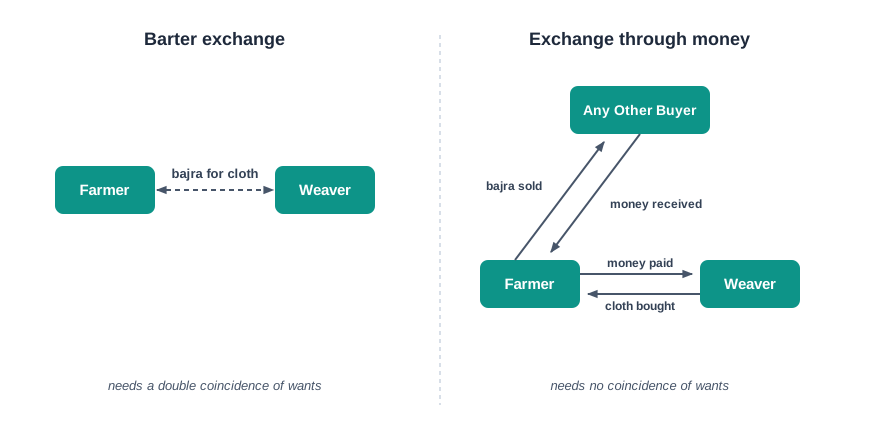
13.1 Barter System of Exchange
An economy in which people specialise must find some way of moving goods from those who make them to those who want them. Where every household produces only what it consumes, no such problem arises. It arises the moment production and consumption are separated, and the first answer societies found to it was to trade one good directly against another.
This section examines that answer. It sets out what barter exchange is, and then asks why an arrangement that served small communities for centuries broke down as economies grew larger.
13.1.1 Meaning of Barter Exchange
In the earliest phase of human society, wants were few and simple and every person was very nearly self-sufficient. He hunted or gathered his own food, prepared his own clothing and built his own shelter, so almost nothing had to be obtained from anyone else.
As civilisation advanced, wants multiplied, and producing everything oneself became neither possible nor sensible. People found it advantageous to practise division of labour, that is, to concentrate on the one or two occupations for which they were best suited. Output per worker rose, skills sharpened and the standard of living improved with them.
Specialisation, however, carries a consequence that is easily overlooked: it makes every producer dependent on others. A carpenter who spends his day making stools ends the day with stools and nothing else. Everything else he needs must be obtained by parting with the surplus he has created. Specialisation and exchange therefore arrive together.
Exchange is the act of trading the surplus goods a person holds in order to obtain the other things he requires. Before money was invented, exchange had to take the form of goods against goods, and this is what is meant by the barter system.
Barter System The barter system is the system of exchange in which goods and services are exchanged directly for other goods and services, without the use of money.
An economy that rests on such exchange is called a barter economy. Suppose the carpenter wants fish and a fisherman wants a stool. The two meet, agree on a rate and complete the exchange, and no money passes between them at any stage.
Barter is not merely a matter of history. It survives wherever the goods traded are few, the traders know one another and the exchange is settled on the spot.
Barter At The Jonbeel Mela Every January, at the Jonbeel Mela held near Jagiroad in the Morigaon district of Assam, tribal communities from the neighbouring hills bring ginger, turmeric, roots and herbs and exchange them directly for rice, cakes and other produce brought by people of the plains. No money changes hands in this part of the fair. The practice survives because the goods and the traders are few and familiar, which is precisely the condition under which barter can work.
13.1.2 Difficulties of the Barter System
Barter works, but it works badly, and it works worse the larger the economy becomes. Its difficulties are of six kinds, and every one of them is a cost imposed on the act of exchange itself.
The most serious of them concerns finding a trading partner at all. Under barter an exchange can take place only when each of two persons holds what the other wants. This condition is called the double coincidence of wants, and it fails far more often than it holds.
Double Coincidence Of Wants Double coincidence of wants is the situation in which each of two persons holds exactly what the other wants and wants exactly what the other holds, so that a direct exchange between them is possible.
The difficulty of satisfying this condition, even among only three traders, is shown in Fig. 13.1.
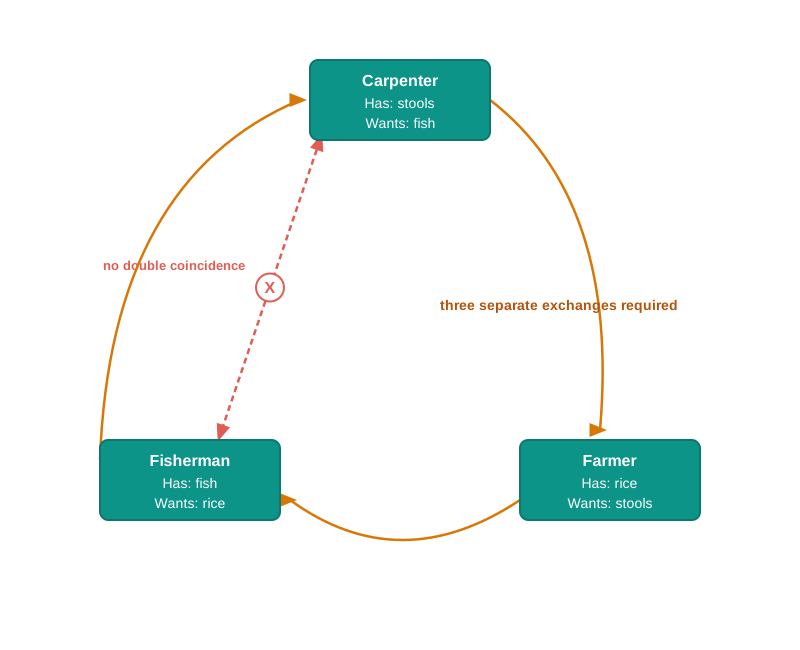
The main difficulties of the barter system of exchange are the following.
- Lack of double coincidence of wants — a person can trade only with someone who happens to want what he holds and to hold what he wants. Finding such a partner takes time and effort, and the search often fails altogether.
- Lack of a common measure of value — barter has no single unit in which the value of every good is expressed. Each pair of goods carries its own rate of exchange, so a trader must carry in his head a very large number of separate rates, and comparing the values of two goods becomes laborious.
- Indivisibility of commodities — many goods cannot be divided without destroying their usefulness. A man who owns a cow and wants a small quantity of salt cannot hand over a fraction of the animal; he must part with the whole of it or go without the salt.
- Lack of a reliable store of wealth — savings under barter have to be held in the form of goods. Grain rots, cattle fall ill and storage itself costs resources, so a person who saves loses a part of what he has saved.
- Difficulty of deferred payments — a contract that fixes a payment for a future date is hard to write in goods, because the quality of the goods to be repaid and their value on the date of repayment are both open to dispute. Lending and borrowing are therefore discouraged.
- Limited specialisation and division of labour — because exchange is slow and uncertain, a producer dare not specialise completely and continues to produce a part of what he consumes himself. The gains from division of labour are cut short at the very point where they begin to matter.
Lack of double coincidence of wants and lack of a common measure of value are different difficulties. The first is about finding a partner, the second about fixing a rate.
Taken together, these difficulties made barter a clumsy and wasteful system of exchange. It absorbed human effort that could have gone into production, it held back specialisation and it stood in the way of any expansion of the economy.
Barter could therefore function effectively only in a primitive economy in which wants were few and trade was local. As economies grew, its difficulties became more pronounced, and it was to overcome them that every society sooner or later invented some form of money.
Each difficulty listed above is answered by something money does. The correspondence is exact, and it is the reason money is conventionally defined by its functions, as Sections 13.2 and 13.4 will show.
‘Difficulties of barter’ is a standard two or three mark question. Name the difficulty first and then explain it in one line. Answers that describe barter in general without naming the difficulties earn few marks.
13.2 Meaning of Money
Everyone uses money and almost everyone can point to it, yet money is one of the harder terms in economics to define. The difficulty is that money is not a particular object. Cattle, cowries, gold, paper notes and an entry in a bank’s records have all served as money, and they have nothing physical in common.
What they do have in common is the work they perform. Money is therefore defined not by what it is made of but by what it does, and this section examines the definitions economists have built on that principle.
13.2.1 Functional Definitions of Money
Hawtrey made the point with an everyday comparison: money, like a teaspoon or an umbrella, is one of those things defined by the use to which it is put rather than by its substance. A definition framed in this way is called a functional definition of money, and it is the sense in which money is conventionally defined.
Different economists, however, have framed different functional definitions. Some of them are too wide and others too narrow, and the shortcomings are worth examining because they show what a satisfactory definition must contain.
The widest of them is Walker’s, which says simply that money is what money does. The statement is true, but it is also vague. It names no particular function, and since several of the functions of money can also be performed by other commodities, the definition gives no way of telling money apart from those commodities.
At the other extreme are definitions built on a single function. The principal ones are set out in Table 13.1, together with the function each of them stresses.
Table 13.1 — Functional Definitions Of Money And The Function Each Stresses | Economist | Money is defined as | Function stressed | |—|—|—| | Walker | Whatever money does | None in particular | | Robertson | Anything widely accepted in payment for goods or in discharge of other business obligations | General acceptability | | G.D.H. Cole | Anything habitually and widely used as a means of payment and generally accepted in the settlement of debts | Standard of deferred payments | | Kent | Anything commonly used and generally accepted as a medium of exchange or as a standard of value | Medium of exchange and measure of value | | Seligman | Anything that possesses general acceptability | General acceptability | | Crowther | Anything generally acceptable as a means of exchange that also acts as a measure and a store of value | All three principal functions together |
The first five definitions in the table are incomplete for the same reason. Robertson and Seligman rest the whole weight on general acceptability, Cole on the settlement of debts and Kent on two functions out of three. A definition that captures one function leaves out the others, and money performs all of them.
An adequate definition must therefore do two things at once. It must cover the important functions of money, and it must state the characteristic that distinguishes money from every other commodity. Crowther’s definition does both, and it is for this reason regarded as the most suitable of them.
Money Crowther defined money as anything that is generally acceptable as a means of exchange and which at the same time acts as a measure of value and a store of value.
Crowther’s definition is preferred for two reasons.
- It covers all three important functions of money — medium of exchange, measure of value and store of value — instead of resting the definition on any one of them.
- It fixes on the basic characteristic of money, namely general acceptability, and it is this characteristic that separates money from other commodities that may happen to perform one function or another.
When a question asks what money is, give Crowther’s definition and then name the three functions contained in it. A definition that mentions only the medium of exchange is marked as incomplete.
13.2.2 General Acceptability as the Basic Characteristic
General acceptability means that money is taken by everyone, from anyone, in payment for goods and services and in settlement of debts. No question is asked about who is offering it or what he intends to buy with it. This is the unique feature of money, and every other property follows from it.
Because money is accepted by everyone, holding money is holding general purchasing power — the power to buy goods and services directly in the market, at any time and from any seller. A holder of any other asset has first to find a buyer for that asset before he can buy anything at all.
General acceptability also rests on itself. A person accepts a currency note not because the paper is useful to him but because he is confident that the next person will accept it from him in turn. Money is accepted because it is accepted, and confidence of this kind is the foundation on which a monetary system stands.
The test explains why several assets that are valuable, safe and easily sold are still not money. They may store value well, but they are not handed over across a counter in settlement of a purchase.
Why Gold In The Locker Is Not Money Indian households hold a large part of their savings in gold. Gold keeps its value over long periods and can be sold quickly, so it serves very well as a store of value. It is still not money. A trader who sells rice will not part with the rice against a gold bangle; the bangle must first be sold for rupees, and only the rupees will be accepted. What gold lacks is general acceptability as a means of payment.
Two consequences follow, and both are taken up later in the chapter. Since money is whatever is generally accepted, the forms money takes can change as habits and institutions change, which is the subject of Section 13.3. And since the money held by the public can be counted, the quantity of money in an economy can be measured at a point of time, which is the subject of Section 13.6.
Money is not the same as income. Income is earned over a period of time; the money a person holds is a stock, counted at a point of time.
13.3 Kinds of Money
Since money is defined by what it does, several different things can be doing the work of money in the same economy at the same time. What matters is not whether the thing is metal, paper or an entry in a ledger, but whether people accept it in payment.
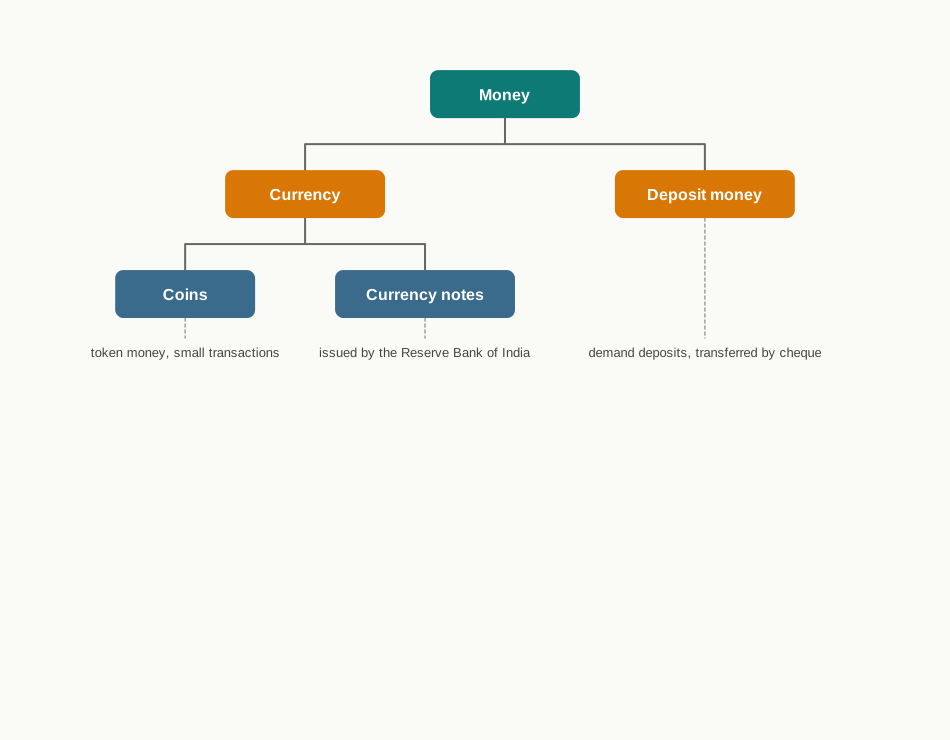
In a modern economy the quantity of money in existence has two components. The first is currency, made up of coins and paper notes; the second is deposit money, held with banks. The classification is set out in Fig. 13.2.
13.3.1 Coins and Currency Notes
Coins are metallic money. In India, coins of one, two, five, ten and twenty rupees are in circulation, and they are used mainly for transactions of small value.
The metal in a coin is worth much less than the amount printed on its face. A ten-rupee coin does not contain ten rupees’ worth of metal, and it is not meant to. Money of this kind is called token money.
Token Money Token money is money whose face value is higher than the value of the metal it contains, so that its worth as money is greater than its worth as a commodity.
The right of minting coins is the monopoly of the government. In India coins are minted by the Government of India and put into circulation through the Reserve Bank of India. Because coins serve only small payments, they form a very small part of the total money supply of the country.
Currency notes are paper money. Almost all the paper money circulating in India consists of notes issued by the Reserve Bank of India, which is the central bank of the country; the one-rupee note is issued by the Government of India. Like a coin, a note has almost no intrinsic value of its own, and each note carries a promise by the Governor of the Reserve Bank to pay the bearer the sum stated on it.
Paper money was not always of this kind. Central banks at first issued notes that could be exchanged for a fixed quantity of gold or silver, and such notes are called convertible paper money. After the First World War almost every country abandoned convertibility into gold, and paper money became inconvertible, which means that the central bank is under no obligation to exchange a note for gold.
All paper currency today is inconvertible. The promise printed on an Indian note therefore means only that the note can be exchanged for other notes or coins of equal value — it can be converted into nothing except itself.
Inconvertible paper money is accepted because it is issued on the order, or fiat, of the government, which declares it legal tender and stands behind it.
Fiat Money Fiat money is money that circulates on the order of the government and is accepted not because of any value of its own, but because the government has declared it legal tender.
Paper money has practical advantages that explain why it displaced metallic money almost everywhere.
- It is economical — printing notes costs the state far less than minting coins of equivalent value.
- It is convenient to carry — a large sum in notes weighs almost nothing, which is not true of coins.
- It is easy to store and to count, and it can be handled quickly at a counter.
- Its supply can be adjusted — the quantity of notes in circulation can be raised or lowered as the needs of the economy require, which is not possible where the supply of money depends on the stock of a metal.
Notes and coins taken together are referred to as currency.
Token money, fiat money and legal tender are three different ideas and are often confused. Token money is about face value exceeding metallic value, fiat money about the government’s order, legal tender about the duty to accept.
13.3.2 Deposit Money
The second component of the money stock is not issued by anybody in the way notes and coins are. It comes into existence when the public keeps money with banks.
Deposit Money Deposit money, or bank money, refers to the demand deposits held by the public with banks, on the basis of which cheques can be drawn and payments made.
A customer hands notes and coins to a bank for safe keeping and the amount is recorded as a credit to his account. The deposit is payable on demand, and it can be transferred to another person by an instruction to the bank. It is therefore as good as cash to the person who holds it.
That instruction is the cheque — an order to the bank to pay a stated sum, or to transfer it to the account of another person. The cheque itself is only a piece of paper carrying an order; what changes hands in substance is the deposit. It is the deposit, and not the cheque, that is money.
A cheque is not money. It is only an instruction to a bank; the money is the deposit on which the cheque is drawn.
Deposits are used most heavily in trade and business, where payments are large. Carrying a large sum in notes is risky and counting it is slow, while a cheque records the exact amount, leaves a record with the bank and cannot easily be misused if it is lost. For payments of this size, deposit money is the more convenient form.
There is, however, one respect in which deposit money differs sharply from currency, and it is worth setting the two side by side.
Compare Table 13.1 — Currency And Deposit Money | Basis | Currency | Deposit money | |—|—|—| | Meaning | Coins and currency notes held by the public | Demand deposits held with banks, against which cheques can be drawn | | Form | Physical — metal and paper that pass from hand to hand | An entry in the books of a bank, transferred by written instruction | | Legal tender | Legal tender; a creditor cannot refuse it | Not legal tender; payment by cheque can lawfully be refused | | Issued or created by | Issued by the Government and the Reserve Bank of India | Created by commercial banks when they accept deposits from the public | | Suited to | Small everyday payments | Large payments in trade and business |
13.3.3 Legal Tender Money
The distinction just drawn turns on a legal idea that has to be stated carefully, because it is not the same as general acceptability.
Legal Tender Money Legal tender money is money that a creditor is bound by law to accept in settlement of a payment, and which therefore cannot be refused in discharge of a debt.
Currency is legal tender because the government has given it legal backing. Deposit money is not, because a bank may fail to honour a cheque if the account holds too little, and the law does not require anyone to take that risk. Yet cheques are accepted every day by people who are under no obligation to accept them, which shows that general acceptability rests on confidence and habit while legal tender rests on statute.
Legal tender money is itself of two kinds, as shown in Fig. 13.3.
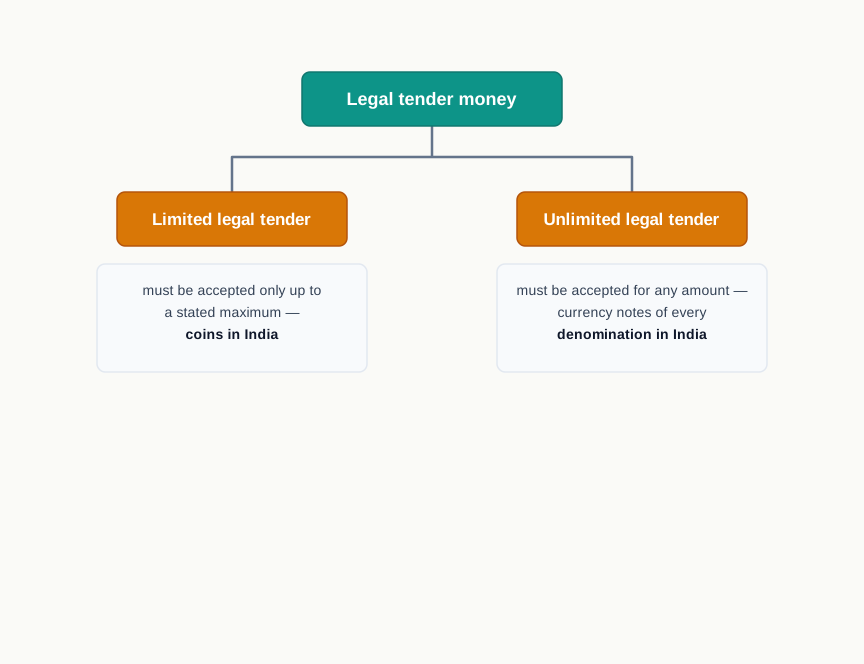
Limited legal tender is money that has to be accepted only up to a certain maximum amount, the limit being fixed by statute. Beyond that limit a person may lawfully refuse it. In India, under the Coinage Act, 2011, coins of one rupee and above are legal tender for any sum up to one thousand rupees, and the fifty paise coin for any sum up to ten rupees. A trader who is offered a large payment entirely in coins may therefore decline it.
Unlimited legal tender is money that has to be accepted without any maximum limit whatever. In India, currency notes of every denomination are unlimited legal tender, which is why no seller can refuse payment in notes on the ground that the sum is too large.
Because legal tender status is conferred by the state, it can also be taken away by the state, and the two are worth keeping apart from the physical withdrawal of a note.
Withdrawing The ₹2,000 Note In May 2023 the Reserve Bank of India announced that the ₹2,000 note would be withdrawn from circulation, and asked the public to deposit the notes with banks or exchange them. The note was not demonetised: it remained legal tender, and holders could still tender it in payment. That was quite different from November 2016, when the ₹500 and ₹1,000 notes then in circulation ceased to be legal tender.
The two components identified in this section — currency held by the public and deposits held with banks — are precisely the items that are added together when the money supply of a country is measured, a calculation taken up in Section 13.6.
13.4 Functions of Money
Money came into existence to overcome the difficulties of barter, and the work it does can be read off from those difficulties one by one. Where barter needed a double coincidence of wants, money removes the need for it; where barter had no common measure of value, money supplies one; where wealth could not be stored, money stores it.
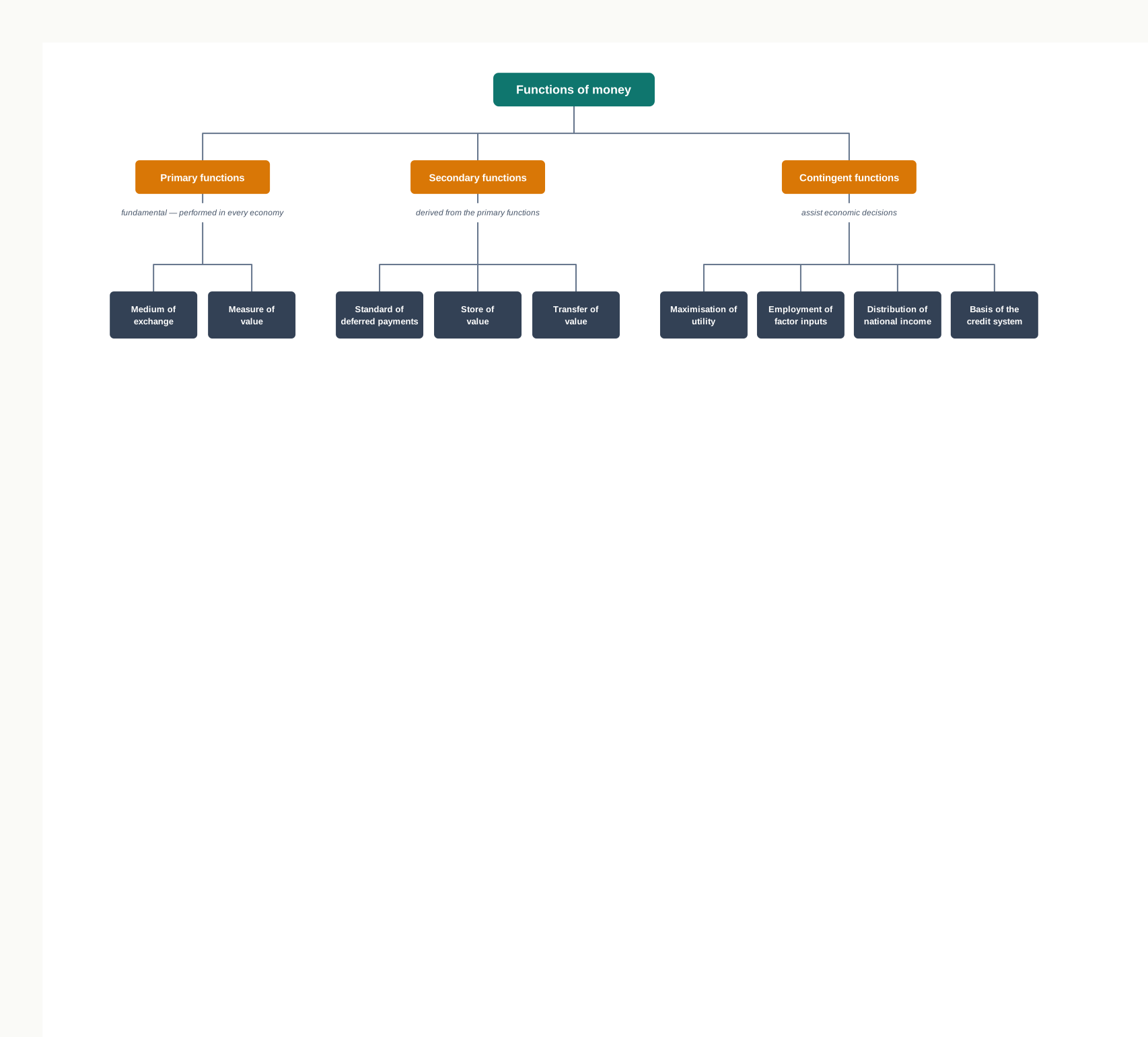
Because money is defined by what it does, its functions are not a side topic but the subject itself. Prof. Kinley grouped them under three heads — primary, secondary and contingent — and that classification is followed here. It is set out in Fig. 13.4.
13.4.1 Primary Functions
Primary functions are those that are fundamental and essential. Money must perform them in every economy and under all circumstances; anything that fails to perform them is not money at all. There are two.
- Medium of exchange — this is the most important function of money, and the one the definition of money stresses most. Goods are sold for money and money is used to buy goods, so a single barter transaction is broken into two independent halves.
- Measure of value — money acts as the common unit in which the value of every good and service is expressed, and is for that reason also called the unit of account.
Consider the first of them. Under barter a person could trade only when he found someone who both held what he wanted and wanted what he held. Money ends that search. A seller parts with his goods for money, which everyone accepts, and then spends the money wherever he pleases. The sale and the purchase need not involve the same person, the same place or even the same day.
Medium Of Exchange Money serves as a medium of exchange when goods and services are bought and sold through it, so that a single barter transaction is split into a sale for money and a separate purchase made with money.
The saving is not only in convenience. Time and effort that barter spent on finding partners are released for production, and because exchange is now easy, a producer can specialise completely instead of holding back to make part of what he consumes. Money therefore promotes efficiency in exchange and, through specialisation, in production as well.
Paying By UPI A customer at a tea stall scans a code and pays a few rupees from her bank account in a matter of seconds. The Unified Payments Interface has made money work as a medium of exchange even at very small values, where notes and coins were once the only practical option. Note that UPI creates no new money: what moves is a deposit already held with a bank, transferred from one account to another.
The second function follows from the first. Just as the kilogram is used to measure weight, money is used to measure value. When the value of a commodity is expressed in money, the result is its price, and price is nothing but the number of rupees for which a unit of the commodity is exchanged.
The gain here is a reduction in the sheer quantity of information a trader must carry. Under barter every pair of goods had its own rate of exchange, and there were a great many pairs. Once all values are quoted in a single unit, any two of them can be compared at once. If a trouser is priced at ₹1,000 and a shirt at ₹500, it follows immediately that one trouser is worth two shirts, and nobody has to remember that rate separately.
Money measures value but is not itself a fixed measure. When the price level rises, the same rupee measures less, unlike a kilogram, which never changes.
13.4.2 Secondary Functions
Secondary functions are those that are derived from the primary functions. They appear once money is already serving as a medium of exchange and a unit of account, and they matter more as an economy grows more complex. There are three.
- Standard of deferred payments — payments that are to be made at a future date are stated in terms of money.
- Store of value — wealth can be held in the form of money and carried forward to the future.
- Transfer of value — value can be moved from one person and one place to another.
A great many transactions in a modern economy are not settled on the spot. Interest, rent, salaries, pensions, instalments on a loan and insurance premia are all payments fixed now and made later, and each of them is stated in money.
Standard Of Deferred Payments Money serves as a standard of deferred payments when payments to be made at a future date, such as interest, rent, salaries or the repayment of a loan, are stated and settled in terms of money.
Contracts of this kind could in principle be written in goods, and occasionally they are. The trouble is that goods differ in quality and their value alters over time. A person who lends a quantity of rice for a year cannot be sure of getting back rice of the same quality, and the two sides are likely to disagree about whether he has. A sum of money, being general and standardised, leaves nothing to dispute except the sum itself. Money thus becomes a bridge between the present and the future.
The second secondary function concerns saving rather than borrowing. Wealth that is not spent has to be held in some form, and under barter it had to be held in goods, which rot, die or cost money to store. Money removes those losses. It is also perfectly liquid, that is, it is ready purchasing power that can be turned into any good at any time without first being sold.
Bonds, shares and deposits also store value and compete with money in doing so, and most of them earn a return that money in hand does not. What money offers instead is liquidity, and it is on this ground that money is regarded as the most convenient store of value rather than the most rewarding one.
The third function is the movement of value. Because money is accepted everywhere, value can be shifted from one person to another whenever a payment is made, and from one place to another as well. A family that sells a house in one city can carry the entire value of it to another city and buy there, which no quantity of bricks would allow.
13.4.3 Contingent Functions
Contingent functions are those in which money assists consumers, producers and the economy at large in arriving at economic decisions. They are contingent in the sense that they depend on money already performing its primary and secondary functions, and they are Kinley’s own addition to the older classification. Four are usually listed.
- Maximisation of utility — a consumer reaches equilibrium when the marginal utility obtained from the last rupee spent is the same in every use. Comparisons of this kind are possible only because the prices of all commodities are expressed in money.
- Employment of factor inputs — a producer aiming at maximum profit employs a factor up to the point where the value of its marginal product equals its price. Wages, rent and interest are quoted in money, so the comparison can actually be made.
- Distribution of national income — production is a joint effort of land, labour, capital and enterprise, and the share of each has to be settled somehow. Money allows the reward of each factor to be paid separately as rent, wages, interest and profit, which could not be done in goods.
- Basis of the credit system — credit instruments such as cheques and bills of exchange are claims to money, and would mean nothing without it. The entire structure of bank lending in a modern economy therefore rests on money.
Taken together, the four functions best known are a medium, a measure, a standard and a store, and the older textbooks group them in exactly that order.
The distinction that matters most in an examination is between the first two groups, which is set out below.
Compare Table 13.2 — Primary And Secondary Functions Of Money | Basis | Primary functions | Secondary functions | |—|—|—| | Meaning | Functions that are fundamental and essential to money | Functions that are derived from the primary functions | | Functions included | Medium of exchange and measure of value | Standard of deferred payments, store of value and transfer of value | | Necessity | Must be performed by money in every economy under all circumstances | Follow as an economy develops, and are not essential to the idea of money | | Origin | Arise directly from the need to exchange goods | Arise once money is already a medium of exchange and a unit of account |
Learn the functions under Kinley’s three heads and name the head before listing. A question on secondary functions earns nothing for the medium of exchange, which is a primary function.
Each function answers a difficulty identified in Section 13.1, and the correspondence is worth seeing whole. It is set out in Table 13.2.
Table 13.2 — Difficulties Of Barter And The Functions Of Money That Answer Them | Difficulty under barter | Function of money that answers it | |—|—| | Lack of double coincidence of wants | Medium of exchange | | Lack of a common measure of value | Measure of value | | Indivisibility of commodities | Medium of exchange, since any sum can be paid in units as small as required | | Lack of a reliable store of wealth | Store of value | | Difficulty of deferred payments | Standard of deferred payments | | Limited specialisation and division of labour | All of them together, since exchange becomes quick and certain |
13.5 Importance of Money
Every economic decision is a comparison. A household compares one good against another before spending, a firm compares one method of production against another before producing, and a government compares one head of expenditure against another before allotting funds. Comparison of this kind is impossible unless the things compared are expressed in a common unit.
Money supplies that unit, and it supplies at the same time the means by which the decision is carried out. This is why money is described as the pivot around which all economic activity turns. In a modern economy, in which almost nobody consumes what he produces, activity would stop within days if money were withdrawn from the system.
The services money performs are spread across the whole of economic life, as Fig. 13.5 shows.
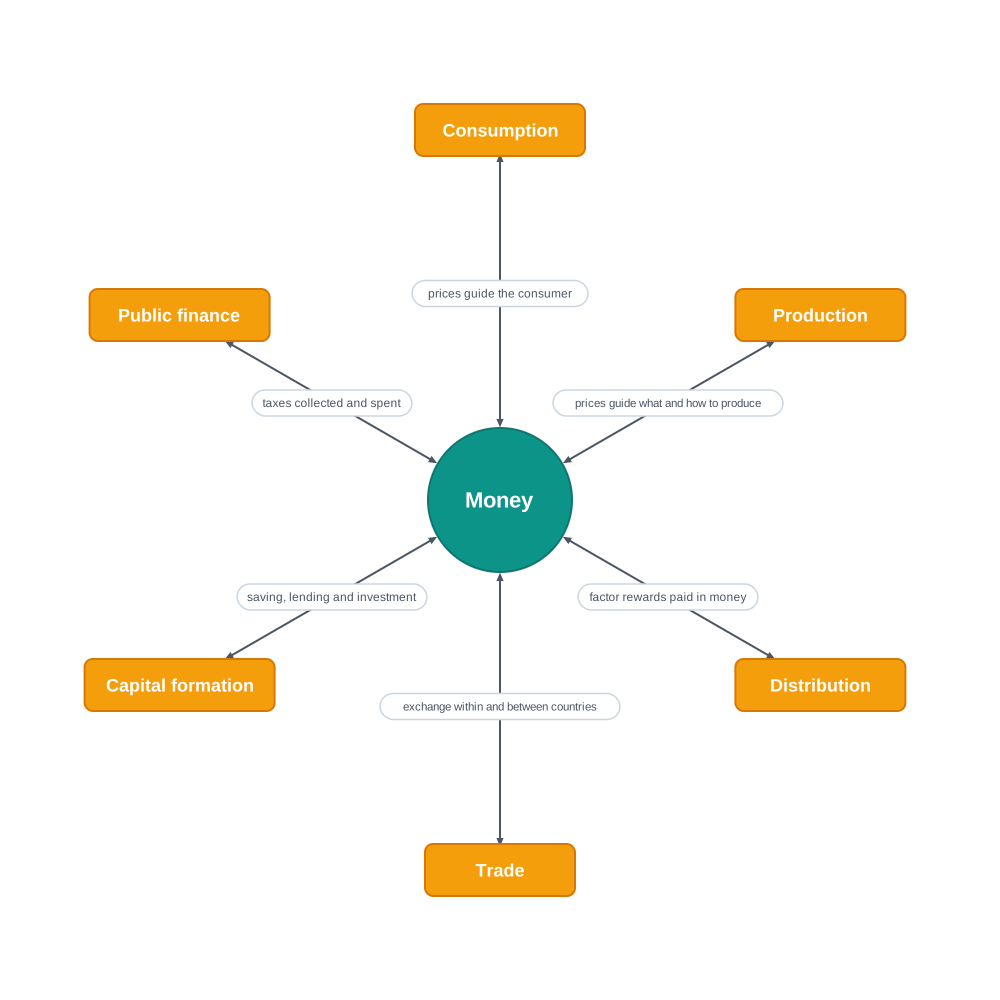
The importance of money is conveniently studied under six heads.
- Importance to consumers — households sell their factor services for a money income and spend that income on goods and services, guided by the prices they see in the market.
- Significance in production — money prices tell producers what people want and how much they want, and factor prices tell them which combination of factors to use.
- Importance in distribution — the product of a joint effort is divided among the factors of production by paying each of them a reward in money.
- Significance in trade — by removing the difficulties of barter, money has made exchange quick and certain, and has thereby promoted trade both within a country and between countries.
- Importance in capital formation — saving, the mobilisation of savings by financial institutions, lending and investment are all carried out in money.
- Importance in public finance — the revenue and the expenditure of a modern government are both realised and spent in money.
Money In Consumption And Production
A household earns by selling the services of the factors it owns — land, labour, capital and enterprise — and receives rent, wages, interest and profit in money. That money income is then spent.
How it is spent depends on prices. Prices expressed in money tell the consumer what each good costs relative to every other, so that he can arrange his purchases to obtain the greatest satisfaction from a limited income. Without money prices the comparison could not be made, and the consumer’s problem of choice would have no solution.
The producer faces the same problem from the other side. He must decide what to produce and how to produce it, and both questions are answered by prices. The prices of goods tell him what buyers want and how strongly; the prices of factors tell him which combination of land, labour and capital will produce a given output at the lowest cost.
More money is not more wealth. Wealth is the goods and services an economy produces; adding to the quantity of money only raises their prices.
Distribution follows directly. Production is a joint effort in which no factor’s separate contribution can be handed back to it in goods. Money allows each factor to be paid its own reward, in a form its owner is free to spend as he pleases.
Money In Saving And Public Finance
Capital formation means adding to the stock of capital, and it requires investment. Investment in turn requires savings, and savings are made in the form of money. Banks and other financial institutions collect these savings from the general public and lend them to producers, who use them to buy machinery and build capacity. Money is present at every stage of the sequence — saving, lending and investing — and none of the three could be organised in goods.
Public finance tells the same story on a larger scale. Taxes, fees and fines are collected in money, and the proceeds are spent in money on administration, defence and development.
Taxes And The Union Budget The Government of India collects income tax, corporation tax and the goods and services tax in money, and spends the proceeds on roads, defence, schools and subsidies. A budget of this size could not be framed in goods at all. Revenue coming from millions of taxpayers and expenditure going to thousands of separate heads can be added up, compared and planned in advance only because both are measured in rupees.
The whole of the argument can be put in one comparison. What an economy gains from money is best seen by setting it against the arrangement money replaced.
Compare Table 13.3 — Barter Economy And Money Economy | Basis | Barter economy | Money economy | |—|—|—| | Meaning | An economy in which goods and services are exchanged directly for other goods and services | An economy in which goods and services are exchanged through money | | Condition for exchange | A double coincidence of wants is necessary | No coincidence of wants is necessary, since money is accepted by everyone | | Measure of value | No common unit; every pair of goods carries its own rate of exchange | All values are expressed in one unit, so any two prices can be compared at once | | Storing wealth | Wealth has to be stored in goods, which perish and cost resources to keep | Wealth can be stored in money, which does not perish and is perfectly liquid | | Scale of the economy | Works only where goods and traders are few and trade is local | Supports specialisation, credit and trade over any distance |
The importance of money is usually a six mark question. Give six separate heads with a line of explanation each, rather than three long paragraphs, and name the head before explaining it.
None of this means that more money is always better. Money performs its services well only so long as its quantity is properly managed; when the quantity of money grows faster than the output of goods, its purchasing power falls and the comparisons it is supposed to make possible become unreliable. It is in this sense that money is said to be ‘a good servant but a bad master’.
The two questions raised by that qualification — how much money there is in an economy, and what happens when its purchasing power falls — are the subjects of the two sections that follow.
13.6 Supply of Money
The functions of money explain why an economy needs money at all. How much of it there is matters just as much. Too little money and trade is choked for want of a means of payment; too much of it and prices rise without any addition to the goods available. A country that wishes to manage its money must therefore be able to measure it.
Measuring it raises two questions at once: what is to be counted as money, and whose holdings are to be counted. The answer to the first was given in Section 13.3. The answer to the second is contained in the definition below.
Money Supply Money supply refers to the total stock of money held by the public at a point of time, available to them as a means of payment and as a store of value.
Two features of this definition need care, and questions are commonly set on both.
- Money supply is money held by the ‘public’ — the term covers all economic units that hold money to spend, namely private individuals, business firms and institutions operating in the economy. It excludes the producers of money themselves: the government, the central bank and the commercial banks. Currency lying in the government treasury, with the Reserve Bank of India or in the vaults of banks is not in circulation, and counting it would mean counting the same money twice, since the deposits it supports have already been counted.
- Money supply is a stock and not a flow — it is the quantity of money in existence at a given moment, such as the last Friday of a month, and not an amount earned or spent over a period. Income is a flow; the money a person holds is a stock.
Money supply counts only money held by the public. Cash in a bank’s vault and in the government treasury is not part of it.
13.6.1 Components of Money Supply
The total money supply of a country has two components, and they correspond exactly to the two kinds of money examined in Section 13.3.
- The currency component — notes and coins held by the public. In India, currency notes are issued by the Reserve Bank of India and one-rupee notes and coins by the Government of India. Currency is fiat money and legal tender, and it is the most liquid of all the components, since it can be spent without any intermediate step.
- The deposit component — demand deposits held by the public with the commercial banks, on which cheques can be drawn. These deposits are not legal tender, but they are widely accepted and are payable on demand, so they function as money.
Adding these two together, with one small item, gives what is called the narrow measure of money supply. It counts only those assets that serve directly as a means of payment, and it therefore emphasises the medium of exchange function of money.
Not every economist has been content with so narrow a count. Money is also held as a store of value, and time deposits with banks serve that purpose well. They are reasonably liquid too: a depositor who needs cash before maturity can obtain it by accepting a lower rate of interest. On this reasoning, a broad measure of money supply includes time deposits along with currency and demand deposits.
Neither measure is right to the exclusion of the other. Each answers a different question, as the comparison below shows.
Compare Table 13.4 — Narrow Money And Broad Money | Basis | Narrow money | Broad money | |—|—|—| | Meaning | Money supply counted so as to include only those assets that serve directly as a means of payment | Money supply counted so as to include, in addition, assets held mainly as a store of value | | Function stressed | Medium of exchange | Medium of exchange together with store of value | | Items included | Currency with the public and demand deposits with banks | The above, together with time deposits with banks | | Liquidity | Perfectly liquid throughout | Less liquid, since time deposits are payable only on maturity | | Measures used in India | \(M_1\) and \(M_2\) | \(M_3\) and \(M_4\) |
13.6.2 Measures of Money Supply in India
An economy holds a great variety of financial assets — cash, deposits of several kinds, savings held with the post office — and no single one of them is used for every transaction. Since it is hard to say where money ends and other assets begin, central banks do not publish one figure but several, each drawing the line at a different place.
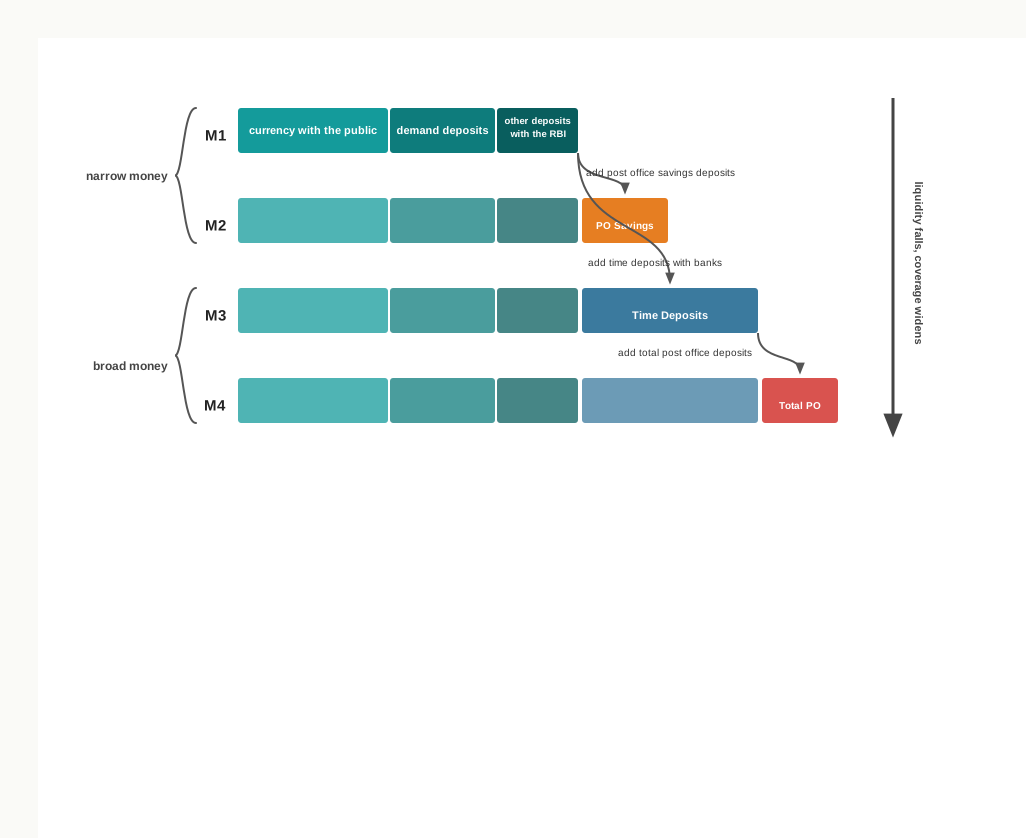
The Reserve Bank of India uses four such measures, written \(M_1\), \(M_2\), \(M_3\) and \(M_4\). They differ in the degree of liquidity of the items included, that is, in how easily those items can be turned into cash, and each measure is a total quantity of money expressed in ₹ crore.
The first and most widely used measure counts only what can be spent immediately.
\[M_1 = C + DD + OD\]
Here \(C\) is currency notes and coins held by the public, \(DD\) is demand deposits of the public with the banking system, and \(OD\) is other deposits with the Reserve Bank, a small item consisting mainly of deposits of public financial institutions, foreign central banks, foreign governments and international financial institutions. Every item in \(M_1\) is a means of payment, which is why \(M_1\) is the most liquid measure.
The remaining three measures are built from \(M_1\) by adding assets of successively lower liquidity.
\[M_2 = M_1 + SD\]
\[M_3 = M_1 + TD\]
\[M_4 = M_3 + TDP\]
Here \(SD\) is savings deposits held with post office savings banks, \(TD\) is time deposits of the public with the banking system, and \(TDP\) is total deposits with the post office savings organisation, excluding National Savings Certificates. The four measures are set out together in Table 13.3.
Table 13.3 — Measures Of Money Supply Used In India | Measure | Items included | Degree of liquidity | |—|—|—| | \(M_1\) | Currency with the public, demand deposits with the banking system, other deposits with the RBI | Highest — every item is a means of payment | | \(M_2\) | \(M_1\) together with savings deposits held with post office savings banks | High, but a little below \(M_1\) | | \(M_3\) | \(M_1\) together with time deposits of the public with the banking system | Lower, since time deposits are not payable on demand | | \(M_4\) | \(M_3\) together with all deposits with the post office savings organisation, excluding National Savings Certificates | Lowest of the four |
\(M_1\) and \(M_2\) take money in the narrow sense, while \(M_3\) and \(M_4\) take it in the wider sense. Reading down the table, coverage widens and liquidity falls, and the two move in opposite directions for a reason: an asset is included in a broader measure precisely because it is a less ready means of payment.
The relationship among the four measures is shown in Fig. 13.6.
The Measure The Reserve Bank Watches Of the four measures, \(M_3\) is the one most often quoted in India. It is wide enough to include the time deposits in which households keep the bulk of their financial savings, and it is published regularly by the Reserve Bank of India in its statistical releases. \(M_3\) is for this reason also described as aggregate monetary resources, and movements in it are followed closely when monetary policy is discussed.
Write the four measures as equations and in order. State what each symbol stands for, and remember that \(M_2\) and \(M_4\) involve post office deposits while \(M_3\) involves time deposits with banks.
13.6.3 High-Powered Money
Every rupee in the measures above began its life at the central bank. In recent years the Reserve Bank has also published a further measure, \(M_0\), which counts money at that point of origin rather than in the hands of the public.
High-Powered Money High-powered money, also called the monetary base or reserve money, is the total money issued by the central bank. It consists of currency in circulation, deposits of the commercial banks with the central bank and other deposits with the central bank.
\[M_0 = \text{Currency in circulation} + \text{Bankers' deposits with the RBI} + \text{Other deposits with the RBI}\]
Currency in circulation covers notes and coins held both by the public and by the banks. Bankers’ deposits are the balances the commercial banks keep with the Reserve Bank as reserves. Both items are liabilities of the central bank, which is why the central bank has direct control over \(M_0\) in a way it does not have over \(M_1\) or \(M_3\).
The name explains the idea. A part of the currency issued by the central bank is held by the public and is money at once; the rest sits in bank vaults and in bank balances with the Reserve Bank, and serves as the reserve on which banks build deposits. Because banks are required to hold only a fraction of their deposits as reserves, a rupee of high-powered money supports several rupees of deposits.
An addition to \(M_0\) therefore raises the total money supply by more than the addition itself, and it is this multiplied effect that makes the base ‘high-powered’. How the multiplication happens is the subject of credit creation by commercial banks, taken up in the next chapter.
The two ideas are easily confused, and the difference between them is worth fixing.
Compare Table 13.5 — Money Supply And High-Powered Money | Basis | Money supply | High-powered money | |—|—|—| | Meaning | The stock of money held by the public at a point of time | The total money issued by the central bank | | Symbol | Measured in India as \(M_1\) to \(M_4\) | Measured as \(M_0\) | | Deposits included | Demand deposits of the public with commercial banks | Deposits of the commercial banks with the central bank | | Cash held by banks | Excluded, since it is not held by the public | Included, since it has been issued by the central bank | | Created by | The central bank and the commercial banks together | The central bank alone | | Control | Not under the direct control of the central bank | Directly and fully controlled by the central bank |
Measuring the quantity of money is not an end in itself. It matters because the quantity of money bears on the purchasing power of money, and a supply that grows faster than the output of goods shows itself as a rise in the general price level. That is the subject of Section 13.7.
13.7 Inflation
Money is a measure of value, and a measure is useful only if it holds steady. When the general level of prices rises, the rupee measures less than it did, and every calculation that depends on it — a wage settled last year, a loan repayable next year, a lifetime’s savings — is quietly altered.
This is the problem of inflation. It is among the most closely watched of all economic conditions, because it works on every household and every firm at once, and because a government can do a great deal to cause it and a great deal to control it.
13.7.1 Meaning of Inflation
In ordinary speech inflation means nothing more than that things have become dearer. The economic definition is narrower, and each of its terms is there for a reason.
Inflation Inflation is a situation in which there is a persistent and appreciable increase in the general price level in an economy.
Four points contained in this definition need to be drawn out.
- Inflation is a rise in the general price level — it refers to the prices of goods and services in general and not to the price of any one commodity. When the prices of major items such as food, housing, clothing, transport and medical care are rising together, the overall price level is rising. This does not mean that every price rises, or that those which rise all rise at the same rate.
- The rise must be persistent — a single increase in the price level, followed by a fall in the next year, is not inflation, because there is no continuing movement in one direction. Inflation refers to a rise that continues year after year over a number of years.
- The rise must be appreciable — a mild increase of about two or three per cent a year is not treated as inflationary. A gentle upward movement of prices is generally regarded as healthy, since it keeps producers’ expectations of profit alive and helps to sustain a high level of output and employment. It is only when the rise becomes excessive that it is inflationary in character.
- Inflation is measured by the inflation rate — the inflation rate is the percentage increase in the average level of prices of all goods and services from one year to the next, and it is the figure quoted when inflation in a country is reported.
A rise in the price of one commodity, however sharp, is not inflation. Inflation is a rise in prices in general, sustained over a period.
Behind a rising price level lies a falling value of money. If the general level of prices doubles, a rupee buys half of what it bought before, so inflation and the purchasing power of money are two ways of describing one movement. This is why inflation damages money in its own functions, and damages the store of value function most of all: a sum saved today will command fewer goods when it is finally spent.
The words ‘persistent’ and ‘appreciable’ are what make the definition of inflation correct. An answer that says only that prices rise is treated as incomplete, however well the rest is explained.
13.7.2 Demand-Pull Inflation and Cost-Push Inflation
Prices are settled by the forces of demand and supply, so a sustained rise in prices must originate on one side or the other. Economists have traditionally explained inflation along exactly this division, and the two explanations are called demand-pull inflation and cost-push inflation.
Demand-Pull Inflation
Demand-pull inflation is inflation that originates in the demand forces of the economy. Aggregate demand is the total demand for goods and services in an economy. When aggregate demand rises rapidly and comes to exceed the aggregate supply of goods and services available at the existing price level, buyers compete for a limited quantity of goods, and prices are pulled up.
The process is easy to state: too much spending is chasing too few goods. It runs from demand to prices, and the pressure continues for as long as demand outruns the supply of goods coming forward.
The principal causes of a rise in aggregate demand are the following.
- Increase in the money supply — this is the major cause. When the quantity of money in the hands of the public grows faster than the output of goods, the additional purchasing power is spent, and prices rise. An increase of this kind often arises from deficit financing, that is, from the government meeting its expenditure by creating money.
- Increase in consumption expenditure — a rise in household incomes, or a fall in the propensity to save, raises spending on consumer goods.
- Increase in investment expenditure — firms building capacity spend on machinery and materials and pay incomes to those who supply them, and those incomes are spent in turn.
- Increase in government expenditure — spending on administration, defence and development adds directly to the total demand for goods and services.
- Increase in foreign demand — a rise in the demand of other countries for domestically produced goods leaves fewer of those goods available at home.
Cost-Push Inflation
Inflation can also be generated from the supply side, without any increase in demand at all. Cost-push inflation is inflation that originates in an increase in the cost of production; it is for this reason also called supply-side inflation. Producers who face higher costs raise their prices to protect their margins, and the general price level rises even though buyers are not spending more than before.
Three sources of rising cost are usually distinguished.
- Wage-push inflation — where trade unions are strong, workers are able to press employers into granting increases in wage rates. Wages are a major element of cost, so producers raise prices to cover them. Higher prices then provoke a fresh demand for higher wages, and a series of such rounds produces a persistent rise in prices.
- Profit-push inflation — firms in monopolistic and oligopolistic markets have some power over the prices they charge. When they use that power to widen their profit margins, prices rise on that account alone.
- Supply shock — a sharp increase in the price of an important input raises costs throughout the economy at once. Since the 1970s the leading example of such an input has been crude oil, which enters the cost of transport, power and a very large number of manufactured goods.
Crude Oil And Indian Prices India buys most of the crude oil it uses from abroad, so the price of oil in the world market feeds quickly into Indian costs. A sharp rise in that price raises the cost of running trucks, buses, tractors and factories, and producers pass the higher cost on. Prices then rise across a wide range of goods, including many that have nothing to do with oil, even when demand in the economy has not increased at all.
The two explanations are not rivals in the sense that only one of them can be true; both processes can operate in an economy at the same time. They are, however, quite different in their origin, and the difference is set out below.
Compare Table 13.6 — Demand-Pull Inflation And Cost-Push Inflation | Basis | Demand-pull inflation | Cost-push inflation | |—|—|—| | Meaning | Inflation that originates in an increase in aggregate demand | Inflation that originates in an increase in the cost of production | | Side of the market | Demand side | Supply side | | Direction of the process | Runs from higher spending to higher prices | Runs from higher costs to higher prices | | Main causes | Increase in the money supply, deficit financing, and increases in consumption, investment, government and foreign expenditure | Increase in wage rates, widening of profit margins, and a sharp rise in the price of key inputs such as oil | | Forms | Not usually subdivided | Wage-push inflation, profit-push inflation and supply shock | | Also known as | Demand-side inflation | Supply-side inflation |
Whichever of the two is at work, the outcome is the same in the respect that matters for this chapter. The purchasing power of money falls, and money performs less well the very functions for which every society invented it.
13.8 Summary
- Division of labour and specialisation raise output but make exchange unavoidable, since a specialised producer holds only what he has made and must trade for everything else.
- The barter system is the system of exchange in which goods and services are exchanged directly for other goods and services, without money; an economy resting on it is a barter economy.
- Barter suffered from six difficulties.
- Lack of double coincidence of wants.
- Lack of a common measure of value.
- Indivisibility of commodities.
- Lack of a reliable store of wealth.
- Difficulty of deferred payments.
- Limited specialisation and division of labour.
- Money is defined by what it does rather than by what it is made of, which is why definitions of money are functional definitions.
- Crowther’s definition is regarded as the most suitable: money is anything generally acceptable as a means of exchange which at the same time acts as a measure of value and a store of value. It covers all three principal functions and names the basic characteristic of money.
- That basic characteristic is general acceptability, which is what makes money general purchasing power and distinguishes it from other valuable assets such as gold or shares.
- In a modern economy money takes two forms — currency, made up of coins and currency notes, and deposit money, made up of demand deposits with banks.
- Coins are token money, since their face value exceeds the value of the metal in them. Currency notes today are inconvertible fiat money, circulating on the order of the government.
- Legal tender money is money a creditor is bound by law to accept. In India, coins are limited legal tender under the Coinage Act, 2011, while currency notes of every denomination are unlimited legal tender; deposit money is not legal tender at all.
- Kinley classified the functions of money under three heads.
- Primary functions — medium of exchange and measure of value.
- Secondary functions — standard of deferred payments, store of value and transfer of value.
- Contingent functions — maximisation of utility, employment of factor inputs, distribution of national income and basis of the credit system.
- The importance of money is studied under six heads — to consumers, in production, in distribution, in trade, in capital formation and in public finance. Money is nevertheless a good servant but a bad master, and works well only while its quantity is properly managed.
- Supply of money is the stock of money held by the public at a point of time as a means of payment and store of value. It is a stock and not a flow, and it excludes the producers of money — the government, the central bank and the commercial banks.
- The narrow measure of money supply is \(M_1 = C + DD + OD\), where \(C\) is currency notes and coins held by the public, \(DD\) is demand deposits of the public with commercial banks and \(OD\) is other deposits with the Reserve Bank of India, all in rupees at a stated date.
- The Reserve Bank of India uses four measures, arranged in falling order of liquidity.
- \(M_2 = M_1 + \text{savings deposits with post office savings banks}\)
- \(M_3 = M_1 + \text{time deposits with commercial banks}\)
- \(M_4 = M_3 + \text{total post office deposits, excluding National Savings Certificates}\)
- \(M_1\) and \(M_2\) measure money in the narrow sense and \(M_3\) and \(M_4\) in the wider sense; \(M_3\), sometimes called aggregate monetary resources, is the measure most widely watched in India.
- High-powered money, or reserve money, is the money issued by the central bank: \(M_0 = \text{currency in circulation} + \text{bankers' deposits with the RBI} + \text{other deposits with the RBI}\), where currency in circulation covers notes and coins held by the public and by the banks.
- It is called high-powered because an addition to it raises the total money supply by more than itself, through the lending of banks, and because the central bank controls it directly.
- Inflation is a situation in which there is a persistent and appreciable increase in the general price level, so that the purchasing power of money falls. The rise must be general, sustained and appreciable, and it is expressed as an inflation rate worked out from a price index.
- Demand-pull inflation originates in the demand forces, when aggregate demand exceeds aggregate supply at the existing price level; its chief causes are an increase in money supply and increases in consumption, investment, government and foreign expenditure.
- Cost-push inflation originates in an increase in the cost of production and takes three forms — wage-push inflation, profit-push inflation and inflation following a supply shock such as a sharp rise in oil prices.
13.9 Points to Ponder
- Money is accepted because everyone expects everyone else to accept it. What, then, actually holds a monetary system together — the law that declares a note legal tender, or the confidence of the people who use it? What happens to a currency when that confidence weakens while the law stays exactly as it was?
- Barter survives in some fairs and returns in others — after a currency collapses, or between countries that trade goods directly against goods. If money is so plainly superior, why does barter ever come back? What conditions make its difficulties worth bearing?
- Digital payment systems settle transactions without any notes or coins changing hands. Is currency becoming less important, or is the same money simply moving in a different way? What would have to be true of an economy before currency ceased to matter altogether?
- Money is the most liquid asset an individual can hold, but it earns nothing, while a time deposit earns interest and gives up liquidity. Why does anyone hold money at all rather than converting every spare rupee into a deposit? Would your answer change in a country where prices were rising quickly?
- The central bank controls high-powered money directly, but the total money supply depends on how much banks lend and how much the public chooses to deposit. How much control over the price level does this really leave the central bank? Where in the chain does its influence run out?
- A mild rise in prices is treated as healthy while a large one is treated as a disorder, yet the definition of inflation offers no exact figure at which one becomes the other. On what grounds should such a line be drawn, and who should draw it — the central bank, the elected government, or neither?
13.10 Objective Questions
- Which of the following is not a primary function of money? [1]
- Medium of exchange
- Measure of value
- Store of value
- Unit of account
- Currency notes issued in India today are best described as: [1]
- Convertible paper money
- Inconvertible fiat money
- Token money
- Limited legal tender
- Assertion (A): Cash lying in the vault of a commercial bank is not counted in the money supply. Reason (R): Money supply is the stock of money held by the public, and a commercial bank is not a member of the public. Choose the correct option. [1]
- Both A and R are true, and R is the correct explanation of A.
- Both A and R are true, but R is not the correct explanation of A.
- A is true but R is false.
- A is false but R is true.
- Under the barter system, an exchange between two persons is possible only when there is a ________ of wants. [1]
- Match the items in Column 1 with those in Column 2. [1]
| a. Token money |
i. Currency notes of every denomination in India |
| b. Unlimited legal tender |
ii. Money issued by the central bank, including bankers’ deposits with it |
| c. High-powered money |
iii. Money whose face value exceeds the value of the metal it contains |
13.11 Check Your Concepts
- What is meant by token money, and why are the coins circulating in India described as token money? [2]
- Distinguish between limited legal tender and unlimited legal tender, giving one example of each from India. [3]
- Distinguish between demand-pull inflation and cost-push inflation on any four bases. [4]
- Explain the primary and the secondary functions of money. [6]
13.12 Case-Based Question
- Meera Kulkarni runs a small furniture workshop. She keeps ₹8,000 in cash at the workshop, ₹1,20,000 in a current account with a commercial bank and ₹2,00,000 in a two-year fixed deposit with the same bank. Her timber supplier, Anand Traders, has lately begun to refuse payment by cheque and asks to be paid in currency notes instead.
- Which of Meera’s three holdings are counted in \(M_1\) and which enters the money supply only at \(M_3\)? Give a reason in each case. [2]
- Is Anand Traders within its rights in refusing a cheque and demanding currency notes? Answer using the idea of legal tender. [2]