Money in a modern economy is not mainly the notes and coins people carry. The larger part of it is the deposits held with banks, and those deposits are brought into existence by the banks themselves when they lend. That single fact turns banking into an economic problem rather than a matter of bookkeeping. A bank takes in money it must repay on demand and lends it out for a period, holding only a fraction of its deposits as cash — because experience tells it that all depositors will not ask for their money on the same day. That fraction is the choice on which the whole system rests: hold too much and the bank earns nothing, hold too little and it cannot meet its depositors. Since the quantity of money in circulation affects prices, output and employment, no economy leaves the choice entirely to the banks. It places above them a central bank with the authority to decide how much credit the system may create. This chapter examines what commercial banks do, how they create credit and how far they can go, and how the central bank regulates and controls them.
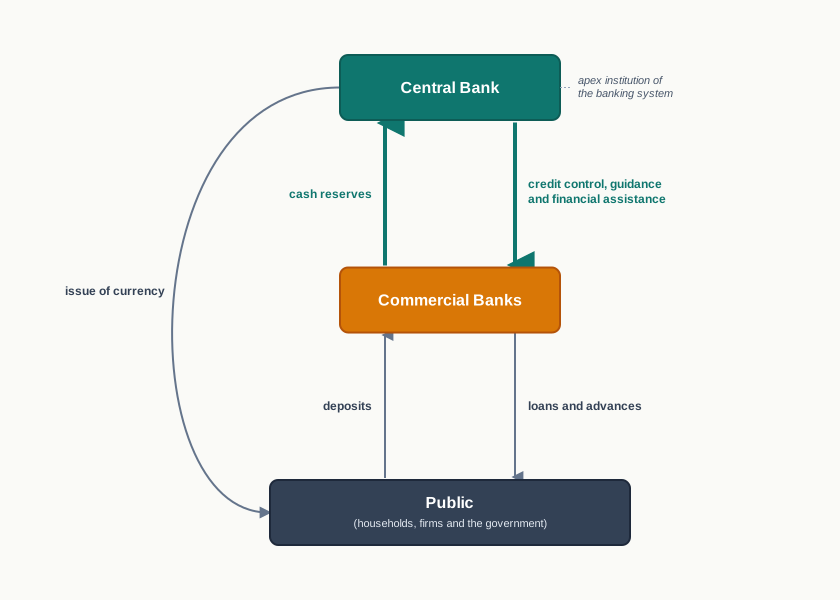
14.1 Banks and the Banking System
Every economy has to move purchasing power from those who hold more of it than they can immediately use to those who can use more of it than they hold. A household with savings has no way of finding, judging and lending to a firm it has never met, and the firm has no way of collecting small sums from thousands of scattered savers. The institution that stands between them is the bank.
A bank does this by taking on a risk that neither side would take alone. It borrows short, accepting money that must be returned on demand, and lends long, parting with that money for months or years. What allows it to do so is a simple regularity: on any ordinary day the withdrawals made by some depositors are very nearly matched by the deposits made by others.
Not every institution that handles other people’s money is a bank, however, and the distinction is not a formality. This section establishes what makes an institution a bank, separates banks from the other financial institutions working alongside them, and sets out the kinds of banks that make up the Indian banking system.
14.1.1 Meaning of a Bank
A bank is a financial institution that accepts deposits of money from the public which are repayable on demand or after a period and are withdrawable by cheque or otherwise, and uses the money so collected for lending to households, firms and the government. The Banking Regulation Act, 1949 describes banking in the same terms — accepting deposits of money from the public, repayable on demand or otherwise and withdrawable by cheque, draft or order, for the purpose of lending or investment.
Bank A bank is a financial institution that accepts deposits of money from the public, repayable on demand or otherwise and withdrawable by cheque, draft or order, uses the money so collected for lending to households, firms and the government, and creates deposit money in the process.
Three points in this description carry the whole weight of the term, and an institution must satisfy all three before it can be called a bank.
- Acceptance of deposits from the public — the bank accepts money from the public at large, and these deposits are repayable on demand or after an agreed period and can be withdrawn by cheque or otherwise. This is what makes a bank a custodian of other people’s money rather than an investor of its own.
- Lending and investment — the bank does not hold the deposits idle. It uses them to grant loans and advances and to invest in securities, and the interest it earns on these exceeds the interest it pays to depositors.
- Creation of money — because the bank’s own debts are accepted in payment, a loan granted by opening an account in the borrower’s name adds to the stock of money in the economy. Money so created is called deposit money or bank money, and its creation is the unique characteristic of a commercial bank.
‘What is a bank?’ carries all three functions — accepting deposits from the public, lending them out, and creating deposit money. Answers that stop at accepting deposits lose the mark, because that alone does not make an institution a bank.
None of the three functions is sufficient by itself. An institution that only accepts deposits is a place of safe custody; an institution that only lends is a lender of its own funds; only the combination of the three, with the power of creating deposit money resting on it, makes a bank.
14.1.2 Banks and Non-Banking Financial Institutions
The financial system contains many institutions that take in money and pass it on to those who need it, without being banks. These are the non-banking financial institutions, and comparing them with banks fixes the meaning of banking more sharply than any definition can.
Post Office Savings Banks accept deposits from the public across the country, but they do not lend those deposits to households and firms; the money collected passes to the government. Having no lending business of their own, they create no deposit money, and so, in spite of the name, they are not banks in the economic sense.
Insurance companies such as the Life Insurance Corporation of India, and mutual funds, stand at the other end. They collect money from the public and lend and invest it on a large scale, but they cannot accept deposits repayable on demand and withdrawable by cheque. Their liabilities do not circulate as money, and therefore they cannot create money either.
The main points of difference are set out below.
Compare Table 14.1 — Commercial Bank And Non-Banking Financial Institution | Basis | Commercial Bank | Non-Banking Financial Institution | |—|—|—| | Acceptance of deposits | Accepts deposits from the public that are repayable on demand and withdrawable by cheque | May collect funds from the public for a fixed period, but cannot accept deposits repayable on demand and withdrawable by cheque | | Lending | Lends to households, firms and the government out of the deposits it accepts | Lends and invests the funds it raises, and this is usually its main business | | Creation of money | Creates deposit money in the very act of lending | Cannot create money; it can lend only the funds it has already raised | | Place in the payment system | Its deposits are used to make payments, so it is part of the payment mechanism of the country | Its liabilities are not used to make payments and do not circulate as money | | Examples | State Bank of India, Punjab National Bank, ICICI Bank | Life Insurance Corporation of India, mutual funds |
The line between the two is therefore drawn by the power to create money. Accepting deposits and lending them are activities a bank shares with others; creating deposit money is what it alone can do.
14.1.3 Types of Banks in India
Banks differ in whom they serve, the period for which they lend and the purpose for which they are set up. The main types found in a country like India are the following.
- Central bank — the apex institution of the banking and financial structure of the country, which issues currency, regulates the banking system and controls the volume of credit. A country has only one central bank; in India it is the Reserve Bank of India.
- Commercial banks — the most important type, which accept deposits from the public, give mainly short-period loans to individuals, traders and business institutions, and create deposit money while doing so. They work largely for profit.
- Cooperative banks — banks run on cooperative principles, started in rural areas as cooperative societies to give farmers easy credit, and now established in urban areas as well.
- Regional rural banks — banks set up in rural areas to serve the weaker sections of the rural population, such as small farmers, agricultural labourers and rural artisans. They are called ‘small man’s banks’ and are scheduled commercial banks.
- Land development banks — banks that provide long-term credit to farmers against the security of landed property, for improvement of land, purchase of equipment and similar purposes, generally at concessional rates.
- Exchange banks — banks that finance foreign trade by purchasing, selling, discounting and accepting bills of exchange arising out of it, and by dealing in foreign exchange business.
- Exim bank — the Export-Import Bank of India, set up to provide long-term finance to exporters and importers for their international trade requirements.
- Development banks — institutions set up to promote industrial development, which grant long-term loans and provide development services such as underwriting new issues and giving technical advice.
The central bank appears in the list of types of banks, but it does not deal with the general public — it is the bankers’ bank, not a commercial bank.
14.1.4 Structure of Commercial Banking in India
Commercial banking in India began with private shareholder banks in the colonial period; the Bank of Bengal, the Bank of Bombay and the Bank of Madras were amalgamated into the Imperial Bank of India in 1921, which was nationalised as the State Bank of India in 1955. At Independence the banking sector was small, confined largely to the towns, and lending mainly to trade and industry.
The structural change came with nationalisation. Fourteen major commercial banks were nationalised in July 1969 and six more in April 1980, with the object of spreading banking into rural areas, directing cheap credit to agriculture and the weaker sections, and preventing banking capital from concentrating in a few business houses.
Why India Nationalised Its Banks Before 1969 India’s commercial banks were privately owned and lent mainly to trade and industry in the towns. In July 1969 the government took over fourteen major commercial banks, and six more in April 1980, so that branches would spread into rural areas, cheap credit would reach agriculture and the weaker sections, and banking capital would not stay concentrated in a few business houses.
Economic reform from the early 1990s opened the field again, and new private sector banks and foreign banks were permitted to begin operations. Indian commercial banks today fall into three broad categories.
- Public sector banks — banks owned and managed by the government or a government agency, comprising the State Bank of India and the nationalised banks. Successive mergers have reduced their number, and twelve public sector banks were in operation as on 31 March 2024. They hold the dominant share of branches, deposits and advances in the country.
- Private sector banks — banks owned by private shareholders, including the new-generation technology-led banks that entered after the reforms of the 1990s.
- Foreign banks — branches or wholly owned subsidiaries of banks incorporated outside India, which have brought newer banking practices and greater competition into the system.
Alongside these, the regional rural banks sponsored by public sector banks work as scheduled commercial banks in the rural areas. A bank is called a scheduled bank when it is included in the Second Schedule of the Reserve Bank of India Act, 1934, which it earns by satisfying the conditions of paid-up capital and sound management laid down in that Act. The whole classification, with the three categories of commercial banks, is brought together in Fig. 14.1.

14.2 Functions of Commercial Banks
A commercial bank exists because savers and borrowers want incompatible things. The saver wants his money safe and available at short notice; the borrower wants it committed to him for a length of time. The bank reconciles the two by pooling the money of a very large number of savers, so that the withdrawals of some are met out of the deposits of others, and by lending the balance.
Every function of a commercial bank follows from this. The two primary functions — accepting deposits and advancing loans — are the reconciliation itself. The rest grow out of the position the bank occupies once it holds the community’s money: it becomes the natural channel for making payments, for acting on a customer’s behalf and for providing services that need a trusted institution. Because modern banks provide so wide a range of them, they are often described as departmental store banks.
The Primary And Secondary Functions
The functions taken up below fall into three groups. Accepting deposits and advancing loans are the primary functions, without which an institution is not a bank at all. Facilitating payments, transferring funds, agency work and general utility services are secondary functions. Credit creation stands apart, because it is not a separate activity so much as a consequence of the first two, and it is treated in full in Section 14.4.
14.2.1 Acceptance of Deposits
The primary function of a commercial bank is to accept deposits from the public. People deposit their surplus funds with a bank for safety, for convenience in making payments, or to earn interest, and these deposits are the bank’s main resource — the money out of which its lending is done. In performing this function the bank mobilises savings that would otherwise lie idle and makes them available for productive use.
What the depositor wants from a deposit differs from person to person. A trader wants his money movable at any moment; a salaried household wants some interest without losing the ability to draw on the account; a person with funds to spare for two years wants the highest return he can get. Banks meet these different wants through different kinds of accounts.
14.2.1.1 Current Account Deposits
Money in a current account is repayable on demand, and it is for this reason that current deposits are the clearest example of demand deposits. It can be withdrawn by cheque without any restriction on the amount withdrawn or on the number of withdrawals made.
Such accounts are held mainly by traders, businessmen and firms, who use them to make and receive payments continuously. Banks pay no interest on current account deposits, because money liable to be withdrawn at any moment cannot be lent for any length of time and so earns the bank very little. Banks in fact levy service charges on these accounts for the services rendered.
Demand Deposits Demand deposits are deposits with a bank that are repayable on demand and are withdrawable by cheque. Current account deposits and saving account deposits are demand deposits, and they form the deposit money of the economy.
14.2.1.2 Saving Account Deposits
A saving account is also payable on demand and money can be withdrawn from it by cheque, but the depositor accepts certain restrictions. The bank may place a limit on the amount and the number of withdrawals in a given period, and a minimum balance has generally to be maintained, though in practice these restrictions are applied loosely.
These accounts are held by households, the salaried class and retired persons — depositors who have idle cash for a short period, want some interest income, and yet want to keep their money liquid. Interest is paid at nominal rates, so a saving deposit combines a high degree of liquidity with a modest return.
14.2.1.3 Fixed and Recurring Deposits
Money placed in a fixed deposit account is deposited for a specified period — six months, one year, two years, five years or more — and is not repayable on demand. Cheques cannot be drawn against it. Since the money cannot be withdrawn before the expiry of the agreed period, such deposits are called time deposits.
Time Deposits Time deposits are deposits placed with a bank for a specified period, which cannot be withdrawn before the expiry of that period and against which cheques cannot be drawn. Fixed deposits and recurring deposits are time deposits.
Fixed deposits carry a higher rate of interest than saving deposits, and the rate rises with the length of the period, because the longer the bank can count on the money the more freely it can lend it. In practice a bank allows premature withdrawal on the depositor’s giving up a part of the interest, and it will also lend against the fixed deposit itself, taking the deposit as security.
A recurring or cumulative deposit is a form of fixed deposit in which the depositor undertakes to deposit a fixed sum every month for an agreed period, say two years, and receives the accumulated amount with interest at the end. Such accounts are designed for the small saver, whom they encourage to save a particular amount regularly.
The four kinds of accounts and the two groups into which they fall are shown in Fig. 14.2.
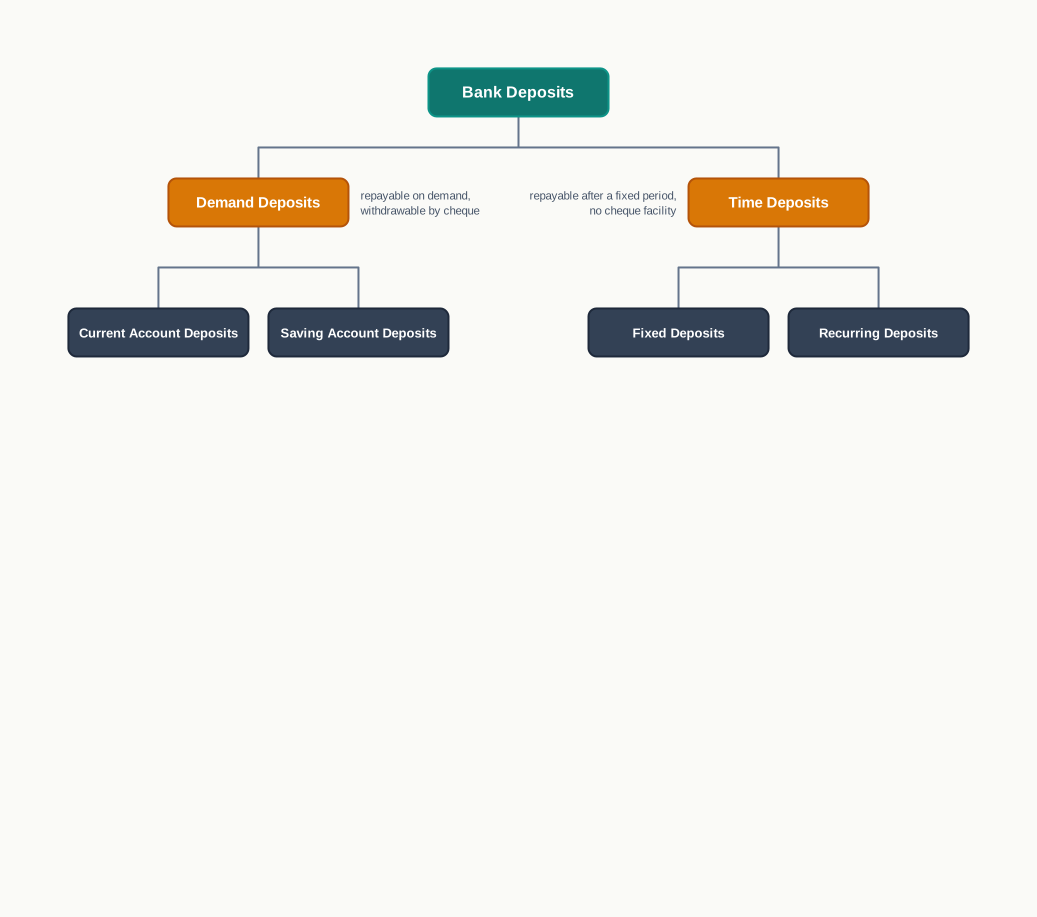
The distinction between the two groups matters beyond the counter. Demand deposits are spent by cheque and so serve as money, while time deposits do not; and it is the demand deposits that a bank must be ready to meet at any moment. The main points of difference are set out below.
Compare Table 14.2 — Demand Deposits And Time Deposits | Basis | Demand Deposits | Time Deposits | |—|—|—| | Period | Repayable on demand, with no fixed period | Repayable only after the expiry of a fixed period | | Cheque facility | Can be withdrawn by cheque | Cheques cannot be drawn against them | | Rate of interest | No interest on current accounts and a nominal rate on saving accounts | A higher rate, rising with the length of the period | | Use as money | Circulate as money and are counted in the money supply as deposit money | Do not circulate as money and are held as savings | | Kinds of accounts | Current account and saving account deposits | Fixed deposits and recurring deposits |
14.2.2 Advancing of Loans
The second primary function of a commercial bank is to extend loans and advances. This is the most profitable part of a bank’s business and the main source of its income, since the interest it charges borrowers exceeds the interest it pays depositors, and the difference between the two, after meeting costs, is its profit. In performing this function the bank acts as an intermediary between the depositor and the borrower.
A bank generally gives secured loans, that is, loans against some security which it can dispose of if the loan is not repaid, though it will lend to business firms of high credit standing without security. The forms in which the accommodation is given differ in when the borrower gets the money and on what amount he pays interest.
Advancing a loan rarely means handing over cash. The bank opens an account in the borrower’s name and lets him draw on it — which is precisely how a loan creates a fresh deposit.
14.2.2.1 Cash Credit
Cash credit is a loan given to a borrower against the security of his current assets, such as shares, bonds or stock of goods. The bank sanctions a limit, opens an account in the borrower’s name and allows him to withdraw from it as and when he needs the money.
The important feature of this arrangement is that interest is charged not on the whole amount sanctioned but only on the amount actually withdrawn. A trader whose need for funds rises and falls through the year therefore pays only for the accommodation he uses, which is why cash credit is popular with Indian businessmen.
14.2.2.2 Outright Loans and Advances
In an outright loan the whole amount sanctioned is credited in a lump sum to the borrower’s current account for a fixed period, usually short term or medium term. The borrower may draw on it as he pleases, but interest runs on the entire amount borrowed from the day it is credited, however much of it he actually uses.
14.2.2.3 Overdraft Facilities
An overdraft is a facility given to a customer who maintains a current account with the bank, allowing him to draw cheques in excess of the balance standing to his credit, up to an agreed limit. If a bank grants an overdraft limit of ₹10 lakh, the customer may draw cheques for that much more than his own deposits with it.
Interest is charged only on the amount actually overdrawn and only for the period of the overdraft, which makes this the easiest and cheapest way for a businessman to meet a short and temporary shortage of funds. Overdrafts are granted for short periods and generally to reliable customers against appropriate securities.
14.2.2.4 Discounting Bills of Exchange
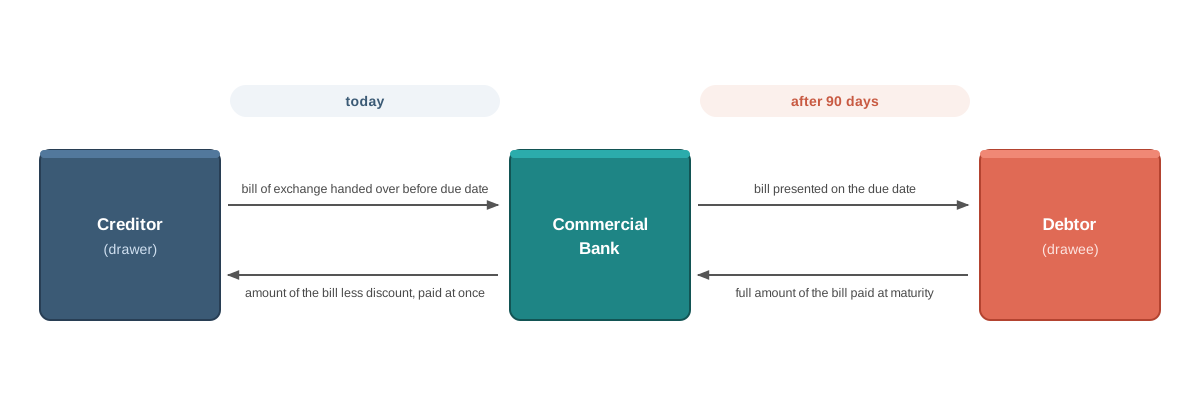
A bill of exchange is drawn by a creditor on his debtor, stating the amount owed and the date on which it becomes payable, and such bills are commonly drawn for ninety days. The creditor cannot demand the money before that date, and if he needs it earlier he sells the bill to a bank.
The bank pays him the amount of the bill less its discount, which is its charge for parting with money before the due date. When the bill matures the bank collects the full amount from the debtor’s banker. The creditor thus gets his money when he needs it, the debtor pays only when the bill falls due, and the bank has made a short, self-liquidating loan. Discounting a bill is therefore a form of bank lending, and its working is shown in Fig. 14.3.
14.2.3 Payments Through Cheques and Transfer of Funds
By providing the cheque, the bank has given the economy a means of payment that needs no movement of cash. A customer receives payment by depositing a cheque drawn on any bank, and his own bank collects the amount on his behalf; he makes payment by drawing a cheque on his account. The cheque is convenient, cheap and safe, and it is the principal method of settling business payments.
Banks also remit funds from one place to another for their customers through drafts, pay orders, mail and electronic transfers. As trade and commerce have spread, this function has grown in importance, for it allows a payment to be made across the country without either party handling currency.
Deposit Money On A Mobile Phone A shopper in India who scans a code and pays by UPI is not moving cash at all. The instruction moves money from her deposit account to the shopkeeper’s deposit account, and the two banks settle between themselves. The payment is made in bank deposits, which is why deposit money, and not currency, is now the country’s main means of payment.
14.2.4 Agency Functions
A bank also acts as the agent of its customer, charging a commission or service charge for the work. These agency functions include the following.
- Collection of payments — the bank collects the amounts of cheques, drafts, bills of exchange and other financial instruments on behalf of its customers.
- Making and receiving payments — it pays insurance premia, taxes and similar dues out of the customer’s deposit, and receives insurance claims, pensions, dividends and interest on his behalf, crediting them to his account.
- Dealing in securities — it buys and sells stocks and shares as the customer’s agent, and acts as underwriter and banker to companies making new issues to the public.
- Other agency services — it buys and sells foreign currency and other financial instruments for the customer, and acts as trustee and executor of the wills of its customers.
14.2.5 General Utility Services
Beyond banking proper, a commercial bank provides a range of services that need a large and trusted institution. It gives locker facilities for the safe custody of jewellery and other valuables, issues travellers’ cheques, gift cheques and credit cards, and offers its customers assistance in tax matters and advice on investment and finance. Banks engaged in foreign trade also issue letters of credit and give guarantees on behalf of importers and exporters, which allows a trader to deal with a distant firm that knows nothing of him but trusts his bank.
When a question asks you to explain a function, name it and then say in one line how it works — ‘overdraft: the customer may draw beyond his balance, and interest is charged only on the amount overdrawn’. A bare list of names earns only part of the marks.
14.2.6 Credit Creation as a Function
The last function is the one that separates a commercial bank from every other financial institution. When a bank grants a loan, it does not usually pay out cash; it opens an account in the borrower’s name against which he can draw cheques. That account is a new deposit, created by the act of lending, and since deposits are money, the bank has added to the money supply of the country.
Because the bank keeps only a fraction of its deposits as cash, the deposits it can create in this way are a multiple of the cash it holds. The process by which this happens, and the limits that prevent it from going on without end, are taken up in Section 14.4.
14.3 High-Powered Money
The last section ended with a claim that should not be allowed to pass without examination: that a commercial bank creates money when it lends. If banks could do this without limit, the quantity of money in an economy would be whatever the banks happened to want it to be. They cannot, and the reason is that every rupee of deposit money rests on a base of cash which the banks themselves are unable to produce.
That base is issued by the central bank alone. It is small in relation to the money supply built upon it, and a change in it moves the money supply by several times as much. Because a rupee of it carries this multiplied effect, it is called high-powered money. This section sets out what it is, what it consists of, and how the money supply of a country stands upon it.
14.3.1 Meaning of High-Powered Money
High-powered money is the total monetary liability of the central bank — the currency it has issued and the deposits held with it — measured at a point of time. It is also called reserve money, base money or the monetary base, and in India it is denoted by \(M_0\).
High-Powered Money High-powered money is the total monetary liability of the central bank of a country at a point of time, consisting of the currency held by the public, the cash reserves of the commercial banks and other deposits with the central bank. It is also called reserve money or the monetary base.
The name records what the quantity does rather than what it is. A rupee of currency in a person’s pocket is a rupee of money and nothing more. The same rupee, deposited with a bank, allows the bank to keep a small part of it as a reserve and lend the rest, and the lending creates fresh deposits which are themselves money. One rupee of the base can therefore support several rupees of money supply, which is what gives it its high power.
14.3.2 Components of High-Powered Money
High-powered money is held in three forms, and the whole of it is a liability of the central bank.
- Currency held by the public — the notes and coins in the hands of households, firms and other institutions outside the banking system. This part serves directly as money.
- Cash reserves of the commercial banks — the cash the banks hold in their own tills together with the deposits they keep with the central bank. This part does not circulate; it is the reserve against which deposits are created.
- Other deposits with the central bank — the deposits of institutions other than the government and the commercial banks, such as foreign central banks and certain financial institutions. This is the smallest of the three components.
High-powered money measures the size of this base. It is the sum of the three components, and it is measured in the same units as any other monetary aggregate.
\[H = C + R + OD\]
Here \(H\) is high-powered money, \(C\) the currency held by the public, \(R\) the cash reserves of the commercial banks and \(OD\) other deposits with the central bank, each measured in ₹ crore. The total is read as the quantity of cash the central bank has put into the system, held partly by the public and partly by the banks.
Cash lying in a bank’s own till is part of high-powered money, but as a bank reserve, not as currency with the public. Counting it in both places is a common error.
Two exclusions are worth noting. The government’s deposits with the central bank are not counted, and neither are the deposits of the commercial banks with one another, since neither is a liability of the central bank to the money-holding public.
Reserve Money In The RBI’s Accounts The Reserve Bank of India publishes reserve money every week in its Weekly Statistical Supplement, as currency in circulation, bankers’ deposits with the Reserve Bank, and other deposits with it. Currency in circulation is much the largest item, and bankers’ deposits are the part the Bank works on when it changes the cash reserve ratio to widen or narrow the base on which credit is built.
14.3.3 High-Powered Money and the Supply of Money
The money supply of a country consists of the currency held by the public and the deposits held by the public with the banks. Currency comes from the central bank; deposits are created by the commercial banks upon their cash reserves. Since both parts stand on high-powered money, the money supply is a multiple of it.
\[M = m \times H\]
Here \(M\) is the money supply, \(H\) high-powered money, both in ₹ crore, and \(m\) is the money multiplier, a pure number showing how many rupees of money supply the banking system builds on each rupee of the base. Its value is greater than one, and the reading is direct: if \(m\) is 5, then ₹1 crore of fresh high-powered money will raise the money supply by ₹5 crore.
The size of the multiplier is not fixed. It depends on two habits.
- The reserve ratio kept by the banks — the larger the fraction of deposits held as cash reserves, the less is left for lending, and the smaller is the multiplier.
- The public’s preference for currency — the more of their money people choose to hold as cash rather than as deposits, the less returns to the banks to be lent again, and the smaller is the multiplier.
Keep the three components of high-powered money apart from the components of money supply. Government deposits with the central bank are excluded from both, and \(M_0\) is not \(M_1\) — the base includes bank reserves, which the money supply does not.
The distinction between the base and the superstructure resting upon it is set out below, and the relation between them is shown in Fig. 14.4.
Compare Table 14.3 — High-Powered Money And Money Supply | Basis | High-Powered Money | Money Supply | |—|—|—| | Meaning | The monetary liability of the central bank, held as currency and as bank reserves | The stock of money held by the public, as currency and as deposits with banks | | Who creates it | The central bank alone | The central bank and the commercial banks together | | Components | Currency with the public, cash reserves of the banks and other deposits with the central bank | Currency with the public and deposits of the public with the banks | | Size | The smaller of the two, being only the base | A multiple of high-powered money | | Control | Directly under the control of the central bank | Controlled indirectly, through the base and the reserve ratio |
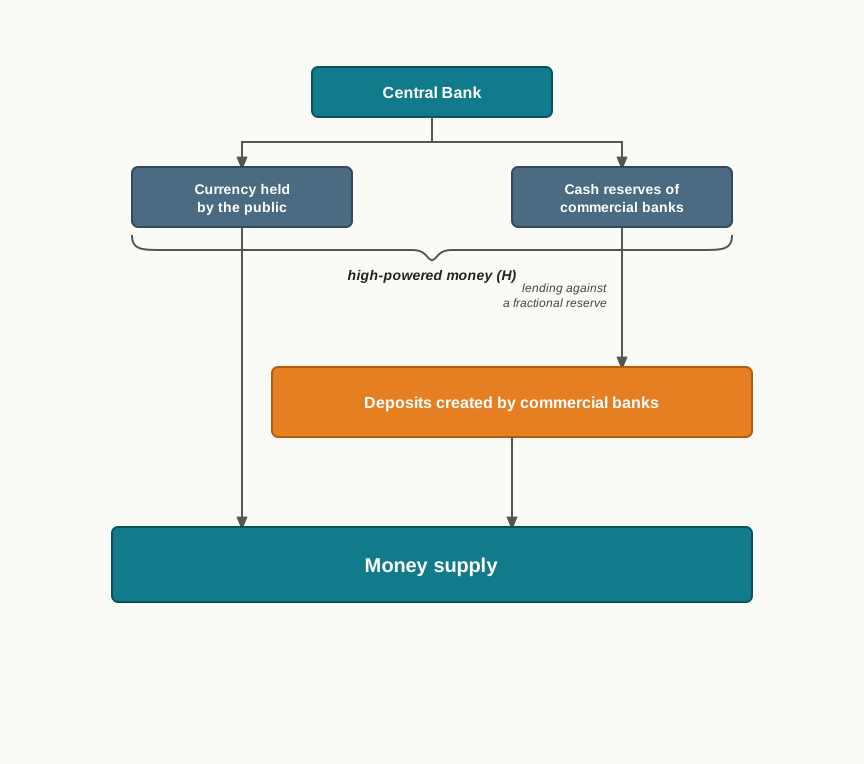
This is why the central bank, and not the commercial banks, is finally in charge of the quantity of money. It issues the base, and it fixes the reserve ratio that decides how large a superstructure the banks may raise upon it. How the banks raise that superstructure is taken up in the next section; how the central bank works upon it is the subject of Section 14.7.
14.4 Credit Creation by Commercial Banks
A bank appears, to the person standing at its counter, to be no more than a middleman. It collects money from those who have it and passes it on to those who need it, and it seems to follow that a bank can lend only what has been deposited with it. For a single bank on a single day this is very nearly true.
For the banking system as a whole it is not true at all. The system lends, and goes on lending, a multiple of the cash deposited with it, because the money a bank lends does not leave the system — it is spent, and comes back as a deposit somewhere else. Credit creation is the name given to this power, and it is the one function no other financial institution can perform.
Credit Creation Credit creation is the process by which the commercial banking system, on the basis of a given amount of cash deposits, grants loans and advances several times that amount, creating deposits in the name of borrowers and so adding to the money supply of the economy.
14.4.1 Primary Deposits and Derivative Deposits
Deposits with a bank arise in two quite different ways, and only the second of them creates money.
A primary deposit arises when a customer hands cash or currency over the counter. The bank plays a passive part here: how much is deposited is the customer’s decision, not the bank’s. Such a deposit changes the form in which money is held, from currency into deposit money, but it leaves the total quantity of money unchanged, because the currency that has gone into the bank has gone out of the public’s hands.
A derivative deposit arises when a bank grants a loan, discounts a bill or buys securities. The bank does not pay out cash; it opens an account in the borrower’s name and allows him to draw cheques on it. Nothing has been taken away from anyone, yet the borrower now holds a deposit he can spend. Deposits with the banks have risen while currency with the public is unchanged, so the money supply has risen. It is the creation of derivative deposits that is meant by the creation of credit.
The main points of difference are set out below.
Compare Table 14.4 — Primary Deposits And Derivative Deposits | Basis | Primary Deposits | Derivative Deposits | |—|—|—| | How they arise | A customer deposits currency or cash with the bank | The bank grants a loan or buys securities and opens an account for the borrower | | Role of the bank | Passive — the customer decides the amount | Active — the bank decides the amount, within its reserves | | Effect on money supply | No change; currency is merely converted into deposit money | The money supply rises, since deposits rise and currency with the public is unchanged | | Relation between the two | The base on which lending rests | Built upon the primary deposits, and a multiple of them |
14.4.2 Cash Reserves and the Basis of Credit Creation
The power to create credit rests on a fact of experience: depositors do not all come for their money on the same day. On any ordinary day some customers withdraw cash and others pay it in, and the difference between the two is small. A bank therefore needs to keep only a small fraction of its deposits in cash, and can lend the rest.
That fraction is the cash reserve ratio. Part of it is fixed by law — every commercial bank must keep a prescribed percentage of its deposits as a reserve with the central bank — and a bank may keep something more of its own accord to be safe. The reserve is not a matter of caution alone: a bank that cannot meet the cash demand of its depositors will fail, and the failure of one bank shakes confidence in the rest.
Cash Reserve Ratio The cash reserve ratio is the fraction of its total deposits that a commercial bank is required to keep in the form of cash reserves. The larger this fraction, the less of each deposit is left to be lent, and the smaller is the credit the banking system can create.
Two limiting cases fix the idea. If banks kept the whole of every deposit as cash, no credit could be created at all and a bank would be a strong-room. If they kept nothing, a single rupee would support an unlimited quantity of deposits, and no bank could survive the first withdrawal. Credit creation lives between the two, and its size is decided by where the reserve ratio is set.
How The Cash Reserve Ratio Is Kept In India Every scheduled commercial bank in India has to keep a prescribed percentage of its net demand and time liabilities as a balance with the Reserve Bank of India. The requirement is met on a fortnightly average basis, so a bank may run above or below it on a given day but not over the fortnight. The Reserve Bank pays no interest on these balances, which is why banks keep little more than they must.
14.4.3 The Process of Credit Creation
Take a banking system with many banks in it, and follow a single deposit of fresh cash through it. To keep the working clear, five assumptions are made.
- There are many commercial banks in the country, so a borrower who is paid by one bank may bank with another.
- The legal minimum cash reserve ratio is 20 per cent, and every bank keeps exactly that and no more.
- The whole of the excess over the reserve is lent out, and borrowers are available to take it.
- The amount lent by one bank reaches a second bank in full as a deposit, so no cash leaks away into people’s pockets.
- Each bank in the chain begins with a deposit made by someone who has been paid by a borrower of the previous bank.
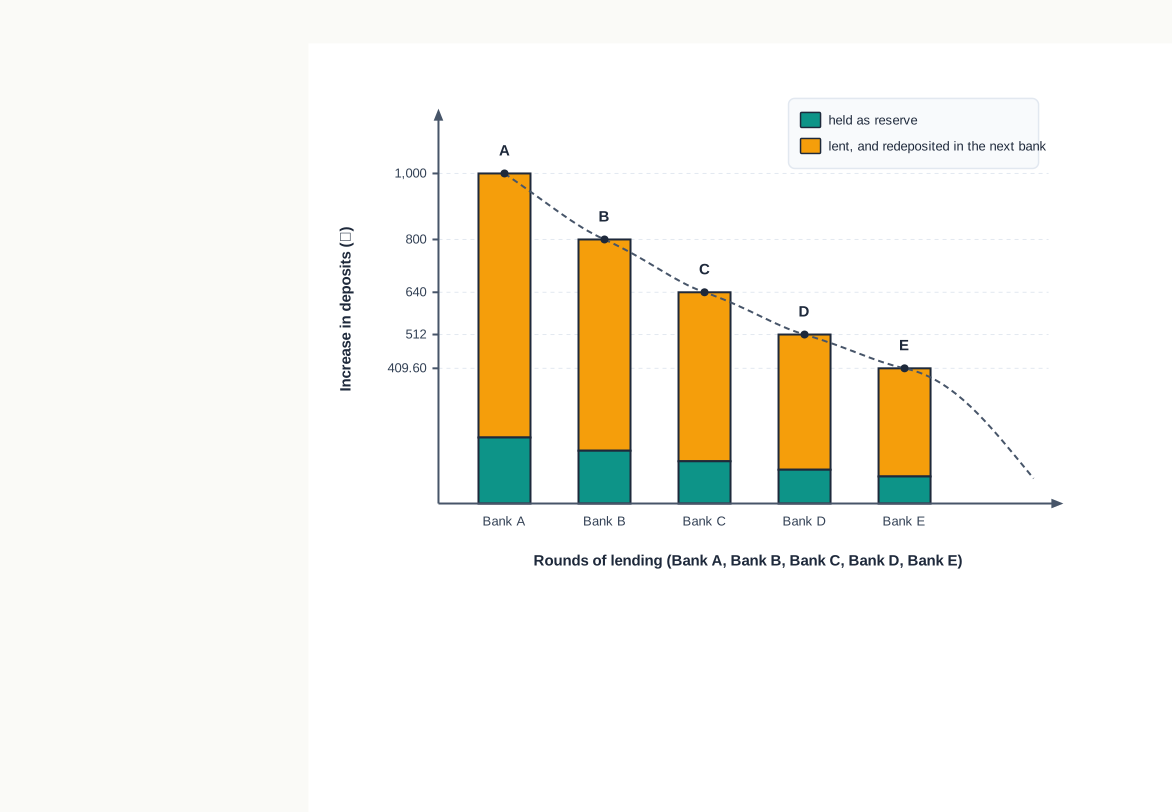
Suppose a customer deposits ₹1,000 in cash with Bank A. Bank A keeps ₹200, which is 20 per cent of ₹1,000, and lends the remaining ₹800 by opening an account in a borrower’s name. The borrower buys goods with the money and pays by cheque, and the seller deposits that cheque with Bank B.
Bank B has now received a deposit of ₹800. It keeps ₹160 as its reserve and lends ₹640, which finds its way, in the same manner, to Bank C. Bank C keeps ₹128 and lends ₹512, and the chain continues, each round being 80 per cent of the round before it. The working of the first rounds and the total for the system is set out in Table 14.1.
Table 14.1 — Working Of Credit Creation On A Primary Deposit Of ₹1,000 At A Reserve Ratio Of 20 Per Cent | Round | Increase in deposits (₹) | Cash reserve (20 per cent of deposits) (₹) | Increase in loans (deposits less cash reserve) (₹) | |—|—|—|—| | Bank A | 1,000.00 | 200.00 | 800.00 | | Bank B | 800.00 | 160.00 | 640.00 | | Bank C | 640.00 | 128.00 | 512.00 | | Bank D | 512.00 | 102.40 | 409.60 | | Bank E | 409.60 | 81.92 | 327.68 | | Later rounds | 1,638.40 | 327.68 | 1,310.72 | | Total | 5,000.00 | 1,000.00 | 4,000.00 |
The process is not endless. Each round is smaller than the one before it, because a fifth of every deposit is taken out of circulation and held as a reserve. It comes to a stop when the amount reaching a bank is too small to lend and the whole of the original ₹1,000 of cash is locked up as reserves against the deposits standing on it. At that point the system holds deposits of ₹5,000 against cash of ₹1,000, and ₹4,000 of the deposits are credit created by the banks themselves. The declining rounds are shown in Fig. 14.5.
A single bank cannot lend a multiple of its deposits; it can lend only its excess reserves. The multiple belongs to the banking system as a whole.
14.4.4 The Deposit Multiplier
The result of the whole chain can be reached without adding up the rounds. Because each bank keeps the same fraction of every deposit as a reserve, the process ends only when the total deposits are large enough for the required reserves against them to absorb the entire cash originally deposited. The total deposits are therefore the primary deposit divided by the reserve ratio.
\[D = \dfrac{1}{r} \times P\]
Here \(D\) is the total deposits created by the banking system and \(P\) the primary deposit, both in ₹, and \(r\) is the cash reserve ratio written as a fraction. The quantity \(\dfrac{1}{r}\) is a pure number called the deposit multiplier or credit multiplier, and it states how many rupees of deposits the system builds on each rupee of cash.
Deposit Multiplier The deposit multiplier is the number of times by which the total deposits of the banking system exceed the cash reserves held against them. It is the reciprocal of the cash reserve ratio, so the higher the reserve ratio, the lower is the value of the multiplier.
In the illustration above the reserve ratio was 20 per cent, so the multiplier was \(\dfrac{1}{0.20} = 5\), and the primary deposit of ₹1,000 produced total deposits of ₹5,000. The credit created is what the system has added, that is, the total deposits less the primary deposit with which it began.
Total Deposits And Credit Created By The Banking System
A customer deposits ₹2,000 crore of fresh cash with a commercial bank. The legal cash reserve ratio is 25 per cent, no bank keeps reserves beyond the legal minimum, and the whole of every loan returns to the banking system as a deposit. Calculate the total deposits created and the amount of credit created by the system.
\(P = \text{₹}2{,}000\) crore, \(r = 25\% = 0.25\)
Deposit multiplier \(= \dfrac{1}{r} = \dfrac{1}{0.25} = 4\)
\(D = \dfrac{1}{r} \times P = 4 \times 2{,}000 = \text{₹}8{,}000\) crore
Credit created \(= D - P = 8{,}000 - 2{,}000 = \text{₹}6{,}000\) crore
The system builds deposits of ₹8,000 crore on cash of ₹2,000 crore, of which ₹6,000 crore is money created by the banks.
The formula also shows why the reserve ratio is the point at which credit creation can be controlled from outside. A change in it does not alter the cash in the system by a rupee, and yet it alters the deposits that cash can carry.
Effect Of A Fall In The Cash Reserve Ratio
Primary deposits with the banking system are ₹5,000 crore and the cash reserve ratio is 20 per cent. The central bank now reduces the ratio to 10 per cent. Calculate the total deposits in each case and the increase in deposits brought about by the change.
\(P = \text{₹}5{,}000\) crore
At \(r = 20\% = 0.20\), multiplier \(= \dfrac{1}{0.20} = 5\)
\(D_1 = 5 \times 5{,}000 = \text{₹}25{,}000\) crore
At \(r = 10\% = 0.10\), multiplier \(= \dfrac{1}{0.10} = 10\)
\(D_2 = 10 \times 5{,}000 = \text{₹}50{,}000\) crore
Increase in deposits \(= D_2 - D_1 = 50{,}000 - 25{,}000 = \text{₹}25{,}000\) crore
Halving the reserve ratio doubles the multiplier, so the same cash base now carries twice the deposits — which is why the reserve ratio is used as an instrument of credit control.
In credit creation numericals, write the reserve ratio as a fraction before substituting, and remember that \(\dfrac{1}{r} \times P\) gives total deposits, not credit created. Credit created is that total less the primary deposit.
14.4.5 Limits to Credit Creation
The multiplier is an arithmetical result of the assumptions made, and every one of those assumptions can fail. The power of the banks to create credit is therefore limited, and the following are the chief limits upon it.
- Total amount of cash reserves — credit is created on a base of cash, so the quantity of cash in the country sets the size of the base. The more cash the public holds and the less it deposits, the smaller are the primary deposits and the smaller is the structure built upon them.
- The cash reserve ratio — since the multiplier is the reciprocal of this ratio, a rise in it cuts the credit the system can create and a fall in it enlarges the credit, without any change in the cash available.
- Banking habits of the people — where people settle their dues by cheque, the money lent returns to the banks and is lent again. Where they prefer to hold and pay in currency, cash leaks out of the system at every round, banks must hold larger reserves, and the multiplier is smaller than the formula suggests.
- Nature of the securities offered — banks lend against securities they can sell if the loan is not repaid. If borrowers of good standing with acceptable securities are not to be found, excess reserves lie unused. As Crowther put it, a bank does not conjure money out of nothing; it turns other forms of wealth into money.
- Business conditions — in a period of prosperity firms borrow to invest and banks lend willingly, and credit expands. In a depression the demand for loans is weak and the risk of default high, so banks lend less and credit contracts, whatever their reserves may allow.
- Monetary policy of the central bank — the central bank can alter the reserve ratio, buy and sell securities to change the cash available to the banks, and make its accommodation dearer or cheaper. Its policy is the outermost limit on credit creation, and it is examined in Section 14.7.
The first two limits fix what the system could do; the next three decide what it will actually do; the last is the deliberate control placed over it. It is because the quantity of money matters to prices, output and employment that a country does not leave this power in private hands unsupervised, and the institution that supervises it is the subject of the sections that follow.
14.5 The Central Bank
The previous section left the money supply in private hands. Commercial banks create deposits because lending is profitable, and they contract credit when lending looks risky — which means the quantity of money tends to grow fastest when trade is booming and to shrink when it is depressed, making both the boom and the slump worse than they need be. No economy can allow so general a quantity to be settled by the separate calculations of profit-seeking firms.
What is needed is an institution standing above the banks: one that does not lend for profit, that can supply cash to the system or withdraw it, and that has the authority to lay down the terms on which the banks may create credit. That institution is the central bank.
14.5.1 Meaning of a Central Bank
A central bank is the apex institution of the banking and financial structure of a country. It organises, supervises, regulates and develops that structure, and it is specifically charged with formulating the monetary and credit policy of the country. Its activities are directed at the working of the economy as a whole rather than at any earnings of its own.
Central Bank A central bank is the apex institution of the banking and financial structure of a country, which issues currency, acts as banker to the government and to the banks, and regulates and controls the supply of money and credit in the national interest rather than for profit.
Every country has a central bank, and it goes by a different name in each. It is the Bank of England in England, the Federal Reserve System in the United States, the Bank of France in France and the Reserve Bank of India in India. The Bank of England, established in 1694, is usually regarded as the first to have worked as a true central bank, a position it took on in 1844 when the sole right of note issue was concentrated in it.
14.5.2 The Reserve Bank of India
The Reserve Bank of India is the central bank of the country and its apex monetary and banking authority. It was constituted under the Reserve Bank of India Act, 1934 and began operations on 1 April 1935, at first as a private shareholders’ bank. It was nationalised with effect from 1 January 1949, and has since been owned by the Government of India.
The executive head of the Bank is the Governor. Its central office is at Mumbai, and it works through four regional offices, at Mumbai, Kolkata, Chennai and New Delhi, with offices in the state capitals and other major cities. Its work covers the issue of currency, the regulation of the banking system, the management of the government’s accounts and debt, the custody of the country’s foreign exchange reserves, and the conduct of monetary policy.
The Reserve Bank’s Surplus The Reserve Bank of India earns an income — from the government securities and foreign assets it holds — but it does not work for profit. After meeting its expenses and providing for its reserves, it transfers the surplus to the Government of India each year. The earning is a by-product of issuing currency and managing reserves, not the object of the exercise.
14.5.3 Central Bank and Commercial Bank Distinguished
Both institutions are called banks and both deal in money, but they differ in almost everything else — in what they aim at, whom they deal with, what they may issue and how many of them a country has.
They differ first in position and in purpose. The central bank is the apex institution of the banking structure, while a commercial bank is one unit within that structure, working under the central bank’s control and supervision. The commercial bank exists to earn profit; the central bank exists to regulate money and credit in the public interest, and although it may earn a surplus in the course of issuing currency, maximising that surplus is no part of its object.
They differ next in whom they deal with and in what they may issue. A commercial bank accepts deposits from the general public and lends to the public; the central bank ordinarily does neither, dealing instead with the government and with the banks, and acting as banker, fiscal agent and adviser to the government. The central bank alone has the monopoly of note issue, and the notes it issues are legal tender, whereas a commercial bank cannot issue notes at all, though it does create deposit money.
They differ, finally, in number and in what they do with credit. A country has one central bank with a few offices, owned by the government, and many commercial banks with branches everywhere, generally owned by private shareholders, though in India several are owned by the government. The relation between the two comes to this: the commercial bank creates credit, and the central bank controls the credit so created.
The main points of difference are set out below.
Compare Table 14.5 — Central Bank And Commercial Bank | Basis | Central Bank | Commercial Bank | |—|—|—| | Position | Apex institution of the banking system | A constituent unit working under the central bank | | Objective | Regulation of money and credit in the public interest | Earning of profit | | Dealings | With the government and the banks | With the general public | | Note issue | Has the sole right of note issue | Cannot issue notes, but creates deposit money | | Number in a country | One, with a few offices | Many, with a large number of branches | | Function regarding credit | Controls the creation of credit | Creates credit |
‘How does a central bank differ from a commercial bank?’ expects the bases, not a description of each. Give four — position, objective, dealings and note issue — one line each. Naming the Reserve Bank of India earns nothing by itself.
‘Not a profit-making institution’ does not mean the central bank earns nothing. It may earn a surplus; what it does not do is pursue profit as Asian object.
For all these differences the two are alike in two respects. Both are monetary institutions, dealing in money rather than in goods; and both create credit, the commercial bank by opening deposits for its borrowers and the central bank by issuing currency and lending to the banks. What separates them is that one creates credit for gain, while the other creates and controls it for the working of the economy. The specific functions through which the central bank does this are taken up next.
14.6 Functions of the Central Bank
A central bank is defined by what it does, and what it does follows from the position it occupies. It stands at the point where the currency of the country is issued, where the government keeps its accounts, where the banks keep their reserves, and where the nation’s foreign exchange is held. Each of these places gives it a function, and together the functions make it, as it is often put, the kingpin of the monetary and financial structure of the economy.
The functions taken up below are those of a central bank generally, illustrated by the working of the Reserve Bank of India. The most important of them, the control of credit, is introduced here and examined in full in Section 14.7.
14.6.1 Bank of Issue
The central bank has the monopoly of issuing currency notes, and the notes it issues are legal tender — money which a creditor cannot refuse in settlement of a debt. In India the entire note issue is made by the Reserve Bank of India through its Issue Department, with the exception of the one-rupee note and the coins, which are issued by the Government of India and put into circulation through the Bank.
The power to print money is not left unfettered anywhere. A central bank has to follow prescribed principles of note issue, and in most countries, India among them, it must hold a minimum reserve of gold and foreign exchange securities against the notes it issues. Under the minimum reserve system followed in India since 1957, the assets held against the note issue must not fall below ₹200 crore, of which not less than ₹115 crore must be in gold.
One-rupee notes and all coins are issued by the Government of India, not by the Reserve Bank. The Bank only puts them into circulation along with its own notes.
Concentrating the right of issue in one institution carries several advantages.
- Uniformity — the notes are of one design and one authority, and are therefore accepted everywhere as a medium of exchange.
- Public confidence — a single issuer of standing gives the currency a prestige that notes issued by many banks could not have, and people develop faith in it.
- Control over credit — since the banks obtain their cash from the central bank, control of the issue gives it an effective hold over the credit the commercial banks create.
- Supervision of the money supply — the government, through the central bank, is able to watch and regulate the quantity of money in the economy.
- Gain to the government — the difference between the face value of the currency issued and the cost of producing it accrues to a single authority and, in the end, to the government.
14.6.2 Banker, Fiscal Agent and Adviser to the Government
The government, like any large concern, needs a bank, and the central bank is its banker. It keeps the banking accounts of the government, receives deposits of cash, cheques and drafts on its behalf, provides cash for the payment of salaries, wages and other disbursements, and makes payments on the government’s instructions. It also gives the government short-period loans to meet a temporary shortfall in receipts, in anticipation of tax collections, and buys and sells foreign currencies on its behalf.
As fiscal agent, the central bank manages the public debt. It issues new loans for the government, receives subscriptions to them, pays the interest as it falls due and repays the loans at maturity, and it acts for the government in the administration of exchange control.
As adviser, it counsels the government on financial and monetary matters — on measures to check inflation or deflation, on the use of deficit financing, on foreign trade and budgetary policy, and on the framing of economic policy generally. No other institution has the same continuous view of monetary conditions in the country.
Ways And Means Advances A government’s receipts and its payments do not arrive on the same days, and tax collections bunch at certain dates. To bridge the gap, the Reserve Bank of India gives the Centre and the states temporary advances called Ways and Means Advances, repayable within a short period and subject to limits fixed in advance. They are meant for a mismatch of timing, not for financing the deficit.
14.6.3 Banker to the Banks
The central bank has the same relationship with the commercial banks that they have with the general public, and it performs three roles in that capacity.
First, it is the custodian of their cash reserves. Commercial banks are under a statutory obligation to keep a prescribed percentage of their deposits as reserves with the central bank, so that the cash reserves of the whole banking system are pooled in one place.
Second, it provides credit to the banks, mainly short-term. It gives them financial assistance by discounting the bills of exchange they present and through loans and advances against approved securities.
Third, it guides, regulates and supervises them. Commercial banks are required to shape their policy in accordance with the directions of the central bank, and it is through this relationship that its control over credit is exercised.
The centralisation of cash reserves in the central bank has advantages of its own.
- Settlement by book entry — since all banks hold accounts at one place, a payment by one bank to another is made by a simple adjustment of entries, without any movement of cash.
- Strength to the system — a pooled reserve is a source of strength, because it can be brought to the support of any bank that needs it.
- A more elastic credit structure — a centralised reserve supports a larger and more flexible superstructure of credit than the same cash scattered among the banks.
- Control over credit creation — the central bank can expand or contract the credit the banks create simply by altering the reserves they must hold.
- Help in emergencies — the pooled reserve can be used during seasonal strains and in times of financial crisis, when several banks need cash at once.
14.6.4 Custodian of the Nation’s Foreign Exchange Reserves
The central bank holds the foreign exchange reserves and the gold reserves of the country, and all foreign exchange transactions are routed through it. In this capacity it controls both the receipts and the payments of foreign exchange, and the reserves it holds are available to the government for meeting a deficit in the balance of payments.
It also works to keep the exchange rate steady. When the external value of the currency moves sharply, the central bank buys or sells foreign currency in the market to reduce the fluctuation. And it administers the exchange control regulations laid down from time to time; in India the Reserve Bank administers the Foreign Exchange Management Act, 1999 in this respect.
14.6.5 Lender of the Last Resort
When a commercial bank has exhausted its own resources and can borrow nowhere else, it turns to the central bank, which stands behind the system as the lender of the last resort. De Kock regarded this function as the sine qua non of central banking — the one thing without which the rest would not hold together — because the central bank is the holder of the cash reserves of the whole system.
Lender of the Last Resort The lender of the last resort is the central bank in its capacity as the final source of credit, providing financial assistance to commercial banks and other financial institutions in distress, against approved securities, when they have exhausted all other means of raising funds.
The assistance is given by discounting approved securities and by loans and advances against collateral. Its purpose is not to keep a badly run bank alive but to prevent a bank that is basically sound from failing for want of ready cash, and so to save the financial structure of the country from a collapse that would carry sound institutions down with the unsound.
14.6.6 Clearing House for the Commercial Banks
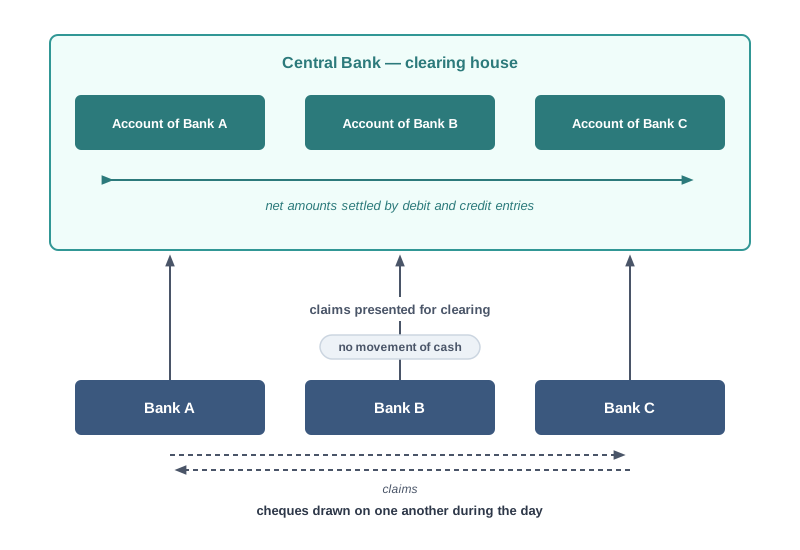
Every day the customers of each bank pay one another by cheques drawn on other banks, and by the close of the day every bank owes something to every other. Settling each of these claims separately in cash would be slow, costly and risky.
Because the banks keep their reserves with the central bank, the claims can be settled by making debit and credit entries in the accounts they hold there. The central bank therefore acts as the clearing house of the banking system: representatives of the banks meet, the mutual claims are set off against one another, and only the net difference is adjusted in the accounts at the central bank. The device is simple, economical and quick, and it works in the same way today when cheques are cleared electronically. Its working is shown in Fig. 14.6.
14.6.7 Controller of Credit
The most important function of a central bank is the control of the credit created by the commercial banks. Bank money is the major component of the money supply of a country, and the quantity of it affects prices, output and employment; the supply of credit must therefore be regulated if the economy is to work smoothly.
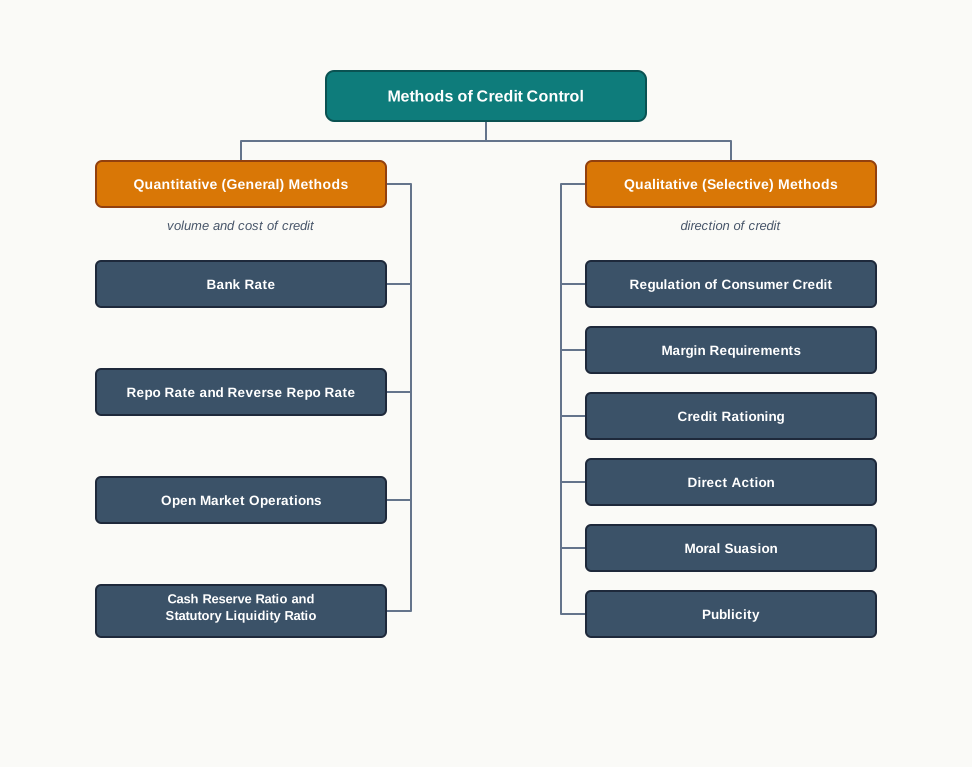
For this purpose the central bank uses two sets of instruments. Quantitative methods act on the total volume and the cost of credit and affect all sectors alike; qualitative or selective methods act on the direction of credit, encouraging its flow to some uses and restricting it to others. Both are examined in Section 14.7.
Do not let ‘banker to the banks’ and ‘lender of the last resort’ collapse into one another. The first is the ordinary, everyday relationship — holding reserves, giving guidance; the second is the emergency accommodation given when a bank can borrow nowhere else.
14.7 Credit Control by the Central Bank
Section 14.4 showed that the banking system can build a multiple of deposits upon a given base of cash, and Section 14.6 showed that the central bank supplies that base and holds the banks’ reserves. Put the two together and the position is this: the quantity of money in the economy is decided by the banks’ willingness to lend, but the terms on which they can lend are decided by the central bank.
Credit control is the use of that authority. Large movements in the volume of money produce large movements in its value, and so the problems of inflation and deflation; and since the greater part of the money supply is bank credit, the supply of money can be regulated by regulating the supply of credit. This section takes up the policy under which that is done and the instruments through which it works.
14.7.1 Monetary Policy and Its Objectives
The management of money is the most important function of a central bank, and the policy through which it is done is called monetary policy. Since bank credit forms the major part of the money supply, monetary policy is also known as credit policy.
Monetary Policy Monetary policy is the policy of the central bank to control and regulate the supply of money, the cost of money and the availability and flow of credit in the economy, so as to achieve certain predetermined objectives of economic policy.
The objectives pursued are the following, and they are not always in agreement with one another.
- Economic growth — providing enough credit to finance investment and a rising level of output.
- Price stability — keeping the general price level from rising or falling sharply, so that money keeps its value.
- Full employment — supporting a level of demand at which those willing to work at the going wage can find work.
- Balance of payments equilibrium — keeping the external accounts of the country in balance over time.
- Stability of the exchange rate — preventing violent fluctuations in the external value of the currency.
- Growth with equity — directing credit so that its benefits reach agriculture, small industry and the weaker sections.
The first two are the ones that most often pull in opposite directions. Cheap and plentiful credit encourages investment and growth, but it also raises demand faster than output can rise, and so raises prices. Much of monetary policy is the search for the point between the two.
Who Fixes The Policy Rate In India The policy repo rate in India is decided not by the Governor alone but by the Monetary Policy Committee, set up in 2016. It has six members — three from the Reserve Bank, including the Governor, and three appointed by the government — and its decisions bind the Bank. It is required to set the rate so as to keep inflation near the target notified by the government, within a band on either side of it.
14.7.2 Quantitative Instruments of Credit Control
Quantitative or general instruments act on the total volume of credit and on its cost. Their effect is indiscriminate: they fall on all sectors of the economy that depend on bank credit, without distinguishing between the uses to which the credit is put, and they lead to a general expansion or contraction of bank credit. The main instruments in use, and the selective instruments taken up later, are set out in Fig. 14.7.
14.7.2.1 Bank Rate
The bank rate is the oldest of these instruments and the one on which the others were modelled.
Bank Rate The bank rate, or discount rate, is the minimum rate at which the central bank gives loans and advances to the commercial banks, or rediscounts the approved bills of exchange and government securities held by them.
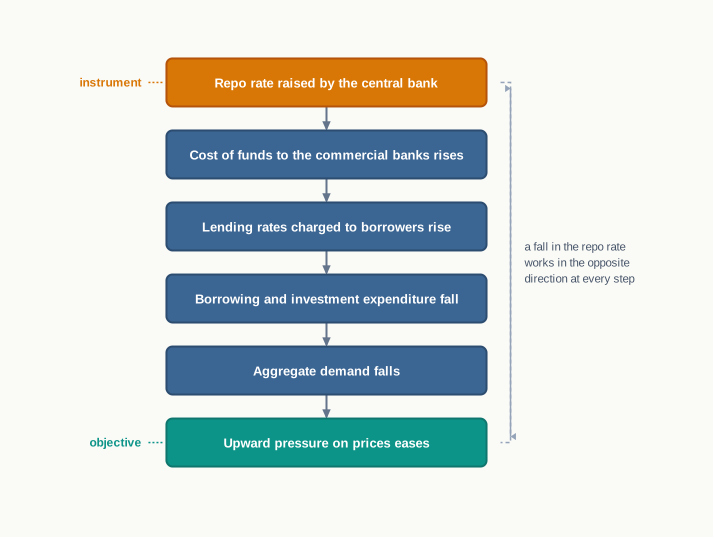
Its working rests on a simple connection: the rate at which banks can obtain funds from the central bank governs the rate at which they lend to their own customers. When the central bank raises the bank rate, borrowing from it becomes dearer, the lending rates of the commercial banks rise with it, the higher cost of credit discourages borrowing, investment expenditure falls, aggregate demand falls and the pressure on prices eases. When it lowers the bank rate the chain runs the other way: credit becomes cheaper, borrowing and investment rise, and employment and output are stimulated.
In India the bank rate is no longer the working instrument. The Reserve Bank has not been discounting commercial bills, so the rate has ceased to be active in that sense; it now serves as the penal rate charged to banks that fall short of their reserve requirements, and as a signal of the Bank’s longer-term view of interest rates. The instrument that does the day-to-day work is the repo rate.
14.7.2.2 Repo Rate and Reverse Repo Rate
A repurchase transaction, or repo, is a sale of government securities by a bank to the central bank with an agreement to buy them back at a fixed price on a fixed date. In substance it is a short-term loan against the security of government bonds, and the rate charged on it is the repo rate.
Repo Rate The repo rate is the rate of interest at which the central bank lends to the commercial banks for short periods against government securities, which the banks sell to it under an agreement to repurchase them. It is the rate at which liquidity is injected into the banking system.
The reverse repo rate is the mirror of it: the rate at which the central bank borrows from the commercial banks against government securities, allowing banks to place their short-term surplus funds with it and earn interest. A repo puts cash into the banking system; a reverse repo takes cash out of it.
The policy use follows directly. When the central bank wants to restrain credit, it raises the repo rate: borrowing from it becomes costlier, banks pass the higher cost on, and credit contracts. When it wants to encourage credit, it lowers the repo rate. Raising the reverse repo rate works in the same direction as a restraint, because a better return on funds parked with the central bank makes lending them out less attractive. In India both rates are announced in the bi-monthly monetary policy statement and are revised as conditions require, and it is the repo rate that is the policy rate. The chain of effects of a rise in it is shown in Fig. 14.8.
In a repo the central bank lends to the banks; in a reverse repo it borrows from them. Reading the two the wrong way round reverses the entire answer.
14.7.2.3 Open Market Operations
Open market operations mean the deliberate sale and purchase of government and other approved securities by the central bank in the money and capital markets. The instrument works not on the price of credit but on the quantity of cash in the hands of the banks.
When the economy faces inflationary pressure and credit is to be curbed, the central bank sells securities. The buyers pay for them by cheques drawn on their own banks, the banks lose that much of their cash reserves, and with smaller reserves they must reduce their advances — and, by the working of the multiplier, by more than the cash they have lost.
When credit is to be expanded, as in a recession, the central bank buys securities from the banks and others, paying for them with cash. The reserves of the banking system rise, and the banks are able to extend more loans on the enlarged base.
14.7.2.4 Cash Reserve Ratio
The cash reserve ratio, defined in Section 14.4.2, is the percentage of its total deposits — in India, of its net demand and time liabilities — that a commercial bank must keep as a cash reserve with the central bank. It is a direct, quick and effective instrument, because it works on the reserve base itself.
An increase in the ratio requires banks to hold more cash against the same deposits. Their excess reserves shrink, the deposit multiplier falls, and their capacity to create credit is squeezed at once. A reduction in the ratio releases cash, raises the multiplier and enables the banks to expand credit. The central bank is empowered to vary the ratio, and it does so as monetary conditions require.
14.7.2.5 Statutory Liquidity Ratio
Besides the reserve kept with the central bank, a commercial bank in India has to keep a further proportion of its deposits with itself in liquid form.
Statutory Liquidity Ratio The statutory liquidity ratio is the proportion of its total deposits that a commercial bank must keep with itself in the form of liquid assets — cash, gold and approved government securities. It is required in addition to the cash reserve ratio.
The requirement serves two purposes at once. It obliges the bank to hold assets it can turn into cash quickly, so that it can meet the demands of its depositors; and it limits the proportion of deposits that can be lent, so that raising the ratio directly reduces the credit-creating capacity of the banks and lowering it enlarges that capacity. The main points on which the two ratios differ are set out below.
Compare Table 14.6 — Cash Reserve Ratio And Statutory Liquidity Ratio | Basis | Cash Reserve Ratio | Statutory Liquidity Ratio | |—|—|—| | Meaning | The percentage of deposits that a bank must keep as a cash reserve | The proportion of deposits that a bank must keep with itself in liquid assets | | Form in which kept | Cash alone | Cash, gold and approved government securities | | Where kept | With the central bank | With the bank itself | | Return to the bank | The central bank pays no interest on these balances | The securities held earn interest for the bank | | Effect on credit | Reduces the cash base and so the deposit multiplier | Reduces the proportion of deposits available for lending |
14.7.3 Qualitative or Selective Instruments of Credit Control
Quantitative instruments say how much credit the banks may create. They cannot say what it is used for, and a restraint that falls on speculative trading falls equally on a farmer or a small manufacturer. Selective instruments were developed for this reason: they regulate the use and direction of credit, discouraging its flow to speculative and undesirable uses and channelling it towards socially and economically useful ones. The main selective instruments are the following.
- Regulation of consumer credit — hire purchase finance allows durable consumer goods to be bought with a part of the price paid down and the rest financed by bank credit. The central bank may raise the down payment required, reduce the number of instalments or shorten the period of repayment, all of which restrict such credit; relaxing the same terms encourages it.
- Regulation of margin requirements — banks lend against securities, but for less than the full value of the security, and the difference between the value of the security and the loan given against it is the margin. If the margin fixed for foodgrains is 10 per cent, a trader can borrow ₹9,000 against a stock worth ₹10,000. Raising the margin curtails the credit available for holding that commodity; lowering it makes credit easier.
- Credit rationing — the central bank may fix a ceiling on the total advances a commercial bank may make, or fix the maximum ratio of a bank’s loans and advances to its deposits, or limit the amount that may be lent for particular purposes.
- Direct action — the central bank issues directives to the banks on their lending and investment, and may act against a bank that does not follow them by refusing it rediscounting facilities, refusing it loans, or charging it a penal rate of interest. The measure is used against erring banks rather than against the system as a whole.
- Moral suasion — persuasion, request and advice, rather than compulsion. The central bank calls the heads of the commercial banks together, explains the policy it wishes followed and appeals to them to follow it, relying on its position as the leader of the financial system.
- Publicity — the central bank publishes facts and figures about monetary and credit conditions, and states its own view of them. This puts moral pressure on the banks and informs public opinion about the policy being pursued.
Keep the directions straight. To curb inflation the central bank raises the bank rate, the repo rate, the cash reserve ratio and the statutory liquidity ratio, and it sells securities in the open market. Writing ‘buys’ there loses the mark.
14.7.4 Quantitative and Qualitative Methods Compared
The two sets of instruments answer two different questions. Quantitative methods decide how much credit there shall be and what it shall cost; qualitative methods decide who shall get it and for what. The points of difference are set out below.
Compare Table 14.7 — Quantitative And Qualitative Methods Of Credit Control | Basis | Quantitative Methods | Qualitative Methods | |—|—|—| | Aim | To regulate the total volume and the cost of credit | To regulate the use and direction of credit | | Scope of impact | General — all sectors depending on bank credit are affected alike | Selective — particular uses, commodities or borrowers are affected | | Instruments used | Bank rate, repo and reverse repo rates, open market operations, cash reserve ratio and statutory liquidity ratio | Consumer credit regulation, margin requirements, credit rationing, direct action, moral suasion and publicity | | Nature of control | Chiefly through the cost and availability of funds to the banks | Chiefly through directives, terms of lending and persuasion | | Effect on the economy | Leads to a general expansion or contraction of credit | Diverts credit from some uses to others, leaving the total less affected |
Neither set can do the other’s work. A quantitative restraint applied hard enough to stop speculation would also stop production; a selective control cannot hold down the total quantity of money. A central bank therefore uses them together, and the mixture it chooses at any time is a judgement about which of the objectives listed in Section 14.7.1 stands most in need of attention.
14.8 Summary
- A bank is a financial institution that accepts deposits of money from the public, repayable on demand or otherwise and withdrawable by cheque, lends that money to households, firms and the government, and creates deposit money in the process. All three functions must be present before an institution can be called a bank.
- Post Office Savings Banks accept deposits but do not lend them, while insurance companies and mutual funds lend but cannot accept deposits withdrawable by cheque. Neither can create money, and it is the power to create money that marks a bank off from every other financial institution.
- The main types of banks in a country like India are the following.
- Central bank — the apex institution, which issues currency and regulates the banking system.
- Commercial banks — which accept deposits, lend mainly for short periods and create deposit money.
- Cooperative banks — run on cooperative lines, originally to give farmers easy credit.
- Regional rural banks — set up to serve the weaker sections of the rural population.
- Land development banks — which give long-term credit to farmers against landed property.
- Exchange banks — which finance foreign trade and deal in foreign exchange.
- Exim bank — which provides long-term finance to exporters and importers.
- Development banks — which give long-term finance and development services to industry.
- Indian commercial banking is made up of public sector banks, private sector banks and foreign banks. Fourteen major commercial banks were nationalised in July 1969 and six more in April 1980, and new private and foreign banks were permitted after the reforms of the early 1990s; regional rural banks sponsored by public sector banks work as scheduled commercial banks.
- The first primary function of a commercial bank is the acceptance of deposits, which are of four kinds.
- Current account deposits — repayable on demand, withdrawable by cheque without restriction, carrying no interest, held mainly by traders and firms.
- Saving account deposits — repayable on demand but subject to limits on withdrawals, carrying a nominal rate of interest, held mainly by households.
- Fixed deposits — placed for a specified period, carrying a higher rate that rises with the period, with no cheque facility.
- Recurring deposits — a fixed sum deposited every month for an agreed period, designed for the small saver.
- Demand deposits are repayable on demand and withdrawable by cheque, and they circulate as money; time deposits are repayable only after a fixed period, carry no cheque facility and do not circulate as money.
- The second primary function is the advancing of loans, which takes four forms.
- Cash credit — a limit sanctioned against current assets, on which interest is charged only on the amount actually drawn.
- Outright loans and advances — the whole amount credited in a lump sum, with interest on the entire amount borrowed.
- Overdraft — a facility to draw beyond the balance in a current account, with interest only on the amount overdrawn.
- Discounting of bills of exchange — the bank pays the creditor the amount of the bill less its discount and collects the full amount from the debtor at maturity.
- The secondary functions of a commercial bank are the provision of payment by cheque, the transfer of funds, agency functions performed for a commission, and general utility services such as lockers, credit cards, travellers’ cheques, letters of credit and advice on tax and investment.
- High-powered money is the money issued by the monetary authority and is the base on which bank deposits rest. It is the sum of three components, \(H = C + R + OD\), where \(H\) is high-powered money, \(C\) the currency held by the public, \(R\) the cash reserves of the commercial banks and \(OD\) other deposits with the central bank, each measured in ₹ crore.
- The money supply is a multiple of this base, \(M = m \times H\), where \(M\) is the money supply and \(H\) high-powered money, both in ₹ crore, and \(m\) is the money multiplier, a pure number greater than one. The multiplier is larger when banks keep a smaller fraction of deposits as reserves and when the public holds less of its money as currency.
- A primary deposit arises when a customer hands cash to a bank; it changes the form of money but not its quantity. A derivative deposit arises when a bank grants a loan by opening an account in the borrower’s name; it adds to the money supply, and its creation is what is meant by credit creation.
- Banks can lend because all depositors do not withdraw on the same day. They keep a fraction of deposits, fixed by the cash reserve ratio, as cash and lend the excess; if the whole of every deposit had to be held as cash, no credit could be created at all.
- Credit creation proceeds in rounds. A primary deposit of ₹1,000 at a reserve ratio of 20 per cent allows the first bank to lend ₹800; that sum returns to a second bank as a deposit, which lends ₹640, and so on in diminishing rounds until deposits of ₹5,000 stand against cash of ₹1,000, of which ₹4,000 is credit created by the banks.
- The result is given by the deposit multiplier, \(D = \dfrac{1}{r} \times P\), where \(D\) is the total deposits created and \(P\) the primary deposit, both in ₹, and \(r\) is the cash reserve ratio written as a fraction. The quantity \(\dfrac{1}{r}\) is the deposit multiplier, a pure number, and the credit created is \(D - P\).
- The power of the banks to create credit is limited by six factors.
- The total amount of cash reserves in the system, which fixes the size of the base.
- The cash reserve ratio, of which the multiplier is the reciprocal.
- The banking habits of the people, since cash held outside the banks leaks out of every round.
- The nature of the securities offered, because banks lend only against acceptable security.
- Business conditions, since the demand for loans is weak and the risk high in a depression.
- The monetary policy of the central bank, which is the decisive limit.
- A central bank is the apex institution of the banking and financial structure of a country, which issues currency, banks the government and the banks, and regulates money and credit in the public interest rather than for profit. The Reserve Bank of India began operations on 1 April 1935 and was nationalised on 1 January 1949.
- A central bank differs from a commercial bank in position, being the apex institution rather than a unit within the system; in objective, working in the public interest rather than for profit; in dealings, with the government and the banks rather than the general public; and in note issue, which it alone may make. The commercial bank creates credit and the central bank controls it.
- The functions of a central bank are the following.
- Bank of issue — the monopoly of issuing legal tender currency.
- Banker, fiscal agent and adviser to the government — keeping its accounts, managing the public debt and advising on financial policy.
- Banker to the banks — holding their cash reserves, lending to them and guiding them.
- Custodian of the nation’s foreign exchange reserves — holding the reserves and working to steady the exchange rate.
- Lender of the last resort — assisting banks in distress when they can borrow nowhere else.
- Clearing house — settling the mutual claims of the banks by book entry in the accounts they keep with it.
- Controller of credit — regulating the volume and direction of bank credit.
- Promotional and developmental functions — building the banking system, the money market and the capital market of a developing economy.
- Publication of economic and statistical information — collecting and publishing data on the economy.
- Monetary policy is the policy of the central bank to control and regulate the supply and cost of money and the availability of credit, in pursuit of economic growth, price stability, full employment, balance of payments equilibrium, exchange rate stability and growth with equity.
- Quantitative instruments act on the volume and cost of credit and fall on all sectors alike. They are the bank rate, the repo and reverse repo rates, open market operations, the cash reserve ratio and the statutory liquidity ratio; to curb inflation the central bank raises the rates and the ratios and sells securities, and to expand credit it does the opposite.
- Qualitative or selective instruments act on the direction of credit. They are the regulation of consumer credit, margin requirements, credit rationing, direct action, moral suasion and publicity, and they divert credit from speculative to productive uses without necessarily changing its total.
14.9 Points to Ponder
- The quantity of money in the economy is settled, round by round, by the lending decisions of profit-seeking firms. Is it reasonable that a quantity on which everyone’s prices and incomes depend should emerge from decisions taken on commercial grounds — and what would an economy lose if those decisions were taken by the state instead?
- A rise in the cash reserve ratio restrains credit for everyone who borrows from a bank, while a speculator working with his own funds is untouched by it. Who actually bears the cost of a tight money policy, and does the answer strengthen the case for selective instruments or weaken the case for quantitative ones?
- The deposit multiplier is largest when the public keeps none of its money as currency and banks keep the smallest possible reserves. If a country moved fully to payment by deposits, would its banking system become more efficient, more fragile, or both at once?
- Price stability and economic growth are both objectives of monetary policy, and cheap credit serves one at the expense of the other. Should a central bank be given a single objective it can be held to, or asked to weigh several against one another? Consider what is gained and what is given up in each arrangement.
- The central bank in India is owned by the government, advises it, manages its debt — and is expected to take decisions the government may find inconvenient. How much independence should such an institution have, and by what standard should a disagreement between the two be settled?
- A bank that is confident of being rescued in a crisis may lend more freely than one that is not, so the lender of the last resort may encourage the very risks it exists to contain. Can the assistance be designed so that it saves the banking system without protecting the individual banker from the consequences of his own judgement?
14.10 Objective Questions
- Which one of the following is not a feature of a current account deposit? [1]
- It is repayable on demand.
- It can be withdrawn by cheque without any limit on the number of withdrawals.
- It carries a higher rate of interest than a fixed deposit.
- It is held mainly by traders and business firms.
- Read the two statements below and choose the correct option. [1] Assertion (A): A single commercial bank cannot create deposits several times its own cash reserves. Reason (R): The amount a bank lends is spent by the borrower and reaches another bank as a deposit.
- Both (A) and (R) are true, and (R) is the correct explanation of (A).
- Both (A) and (R) are true, but (R) is not the correct explanation of (A).
- is true and (R) is false.
- is false and (R) is true.
- Fill in the blank: the deposit multiplier is the reciprocal of the ______. [1]
- State whether the following statement is true or false: a reverse repo transaction injects liquidity into the banking system. [1]
- Match each item in Column 1 with the item in Column 2 to which it relates. [1]
| a. Bank of issue |
i. A qualitative instrument of credit control |
| b. Margin requirement |
ii. Liquid assets a bank must keep with itself |
| c. Statutory liquidity ratio |
iii. Monopoly of note issue |
14.11 Check Your Concepts
- Distinguish between a primary deposit and a derivative deposit. [2]
- Explain how the central bank uses open market operations to curb inflation. [3]
- The banking system of a country receives a primary deposit of ₹6,000 crore, and the cash reserve ratio is 4 per cent. Assuming that banks keep no reserves beyond the legal minimum and that the whole of every loan returns to the banking system as a deposit, calculate (i) the deposit multiplier, (ii) the total deposits created and (iii) the credit created. State also what the total deposits would be if the cash reserve ratio were raised to 8 per cent. [4]
- Explain the mechanism by which commercial banks create credit, and state any three limits on their power to do so. [6]
14.12 Case-Based Question
- Meera Textiles is a small firm in Surat that runs its business on a cash credit limit sanctioned by Sundar Commercial Bank. In a year of rapidly rising prices, the central bank raises the cash reserve ratio and the repo rate. Soon afterwards the bank informs Meera Textiles that its cash credit limit is being reduced and that the interest charged on it will be higher.
- Explain why a rise in the cash reserve ratio should lead Sundar Commercial Bank to reduce the credit it offers to its customers. [2]
- State the effect the central bank expects these two measures to have on aggregate demand and on the price level. [2]