Chapter 18: National Income and Circular Flow of Income
Every economy must answer one plain question about itself: how much did it produce this year? The answer cannot be a list, because an economy turns out steel, haircuts, software and wheat in the same year, and these cannot be added in their own units. Economics solves the problem by valuing every item in money and adding the values together. That total is national income, the most comprehensive single measure of the level of economic activity available to us. At the end of May each year the National Statistical Office releases India’s national income estimates for the year just ended, and almost every judgement about whether the economy has grown, and by how much, rests on them. A total of this kind is only as good as the rules used to build it — which goods are counted, whose production is counted, and which transactions are left out altogether. Behind the total lies a structure. Production creates income, income is spent, and spending calls forth production again, so an economy can be pictured as a flow that circles without beginning or end between its sectors. This chapter explains the concept of national income and then traces the circular flow of income through the two-sector, three-sector and four-sector models.
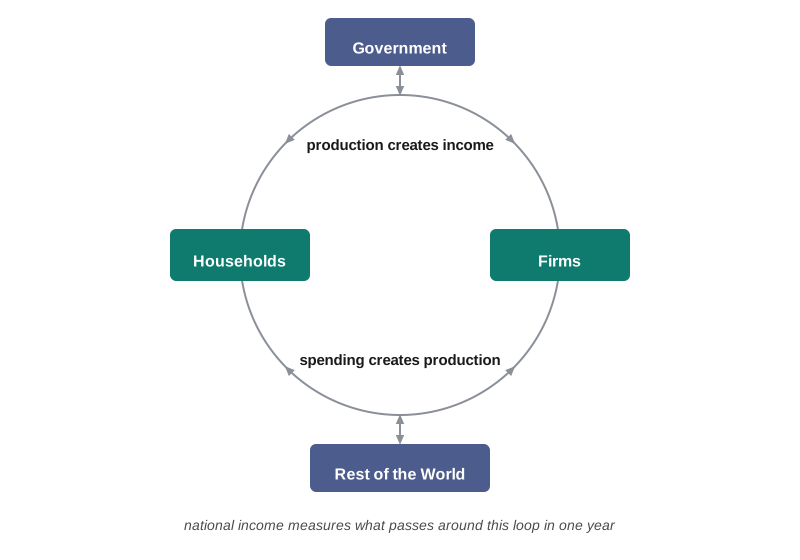
Fig. 18.0 – The economy viewed as a circular flow.
18.1 The Concept of National Income
Macroeconomics works with aggregates — national income, national product, employment, the supply of money, the government budget and the balance of payments. National income is the widest of these and the one against which the others are usually read. A country that wants to know whether it produced more this year than last, or how large its government’s spending is in relation to the economy that carries it, needs a single figure for the value of what was produced.
Building that figure is not straightforward. An economy turns out goods measured in tonnes, in litres, in metres and in numbers, and services that come in no physical unit at all. Quantities of unlike things cannot be added together. The only common denominator available is money, so economics values each item at its price and adds the values instead of the quantities.
This gives the definition that the rest of the chapter rests on.
Every phrase in the definition is doing work, and each one keeps something out of the total.
- Money value — items are valued at their prices and the values are added, because quantities of unlike goods cannot be added.
- Final goods and services — only output that has reached its final user is counted, so that no value enters the total twice.
- Produced in a year — only current production is counted, so transactions that merely pass existing wealth from hand to hand are left out.
- Normal residents — the output counted is that of the residents of the country, wherever in the world they operate.
The first two conditions are taken up in this section. The third is taken up in Section 18.2 and the fourth in Section 18.3.
18.1.1 National Income as a Money Value
National income is expressed in monetary terms. A vast number of diverse goods and services are produced in a year, and adding them requires a common denominator; the money value of each — its quantity multiplied by its price — supplies one. Output is valued at market prices and the values are summed to give the national total.
Money is a convenient measuring rod, but it is not a fixed one. The length of a metre does not change from year to year; the purchasing power of a rupee does. A national income figure can therefore rise for two quite different reasons: because more has been produced, or because the same output has been valued at higher prices.
For this reason national income is calculated both at the prices ruling in the year of measurement and at the prices of a chosen earlier year. The distinction between the two is taken up when the national income aggregates are examined in detail.
18.1.2 Final Goods and Intermediate Goods
Most products pass through several hands before they reach the person who finally uses them. Cotton becomes yarn, yarn becomes cloth and cloth becomes a shirt, and each of these is bought and sold on the way. National income counts each unit of output once, and to do that it has to separate the output that has finished its journey from the output that is still moving.
Final goods are those goods and services which are sold to their final users during the year. They are bought for final consumption by households or for investment by producers, and not for resale. All consumer goods and services that satisfy wants directly, such as food, clothing and a doctor’s visit, are final goods. So are capital goods such as machines and buildings, which producers buy for their own use in production rather than to sell again.
Intermediate goods are those goods and services which are used up by producers as inputs into a further stage of production. They are also known as ‘non-factor inputs’. Seeds and fertilisers bought by a farmer, flour bought by a baker and steel bought by a car maker are all intermediate goods: they are purchased from other producers and resold after being converted into something else.
The classification therefore rests on the use to which a good is put, not on the good itself. The same commodity can fall on either side of the line depending on who buys it and why. This is set out in Fig. 18.1.
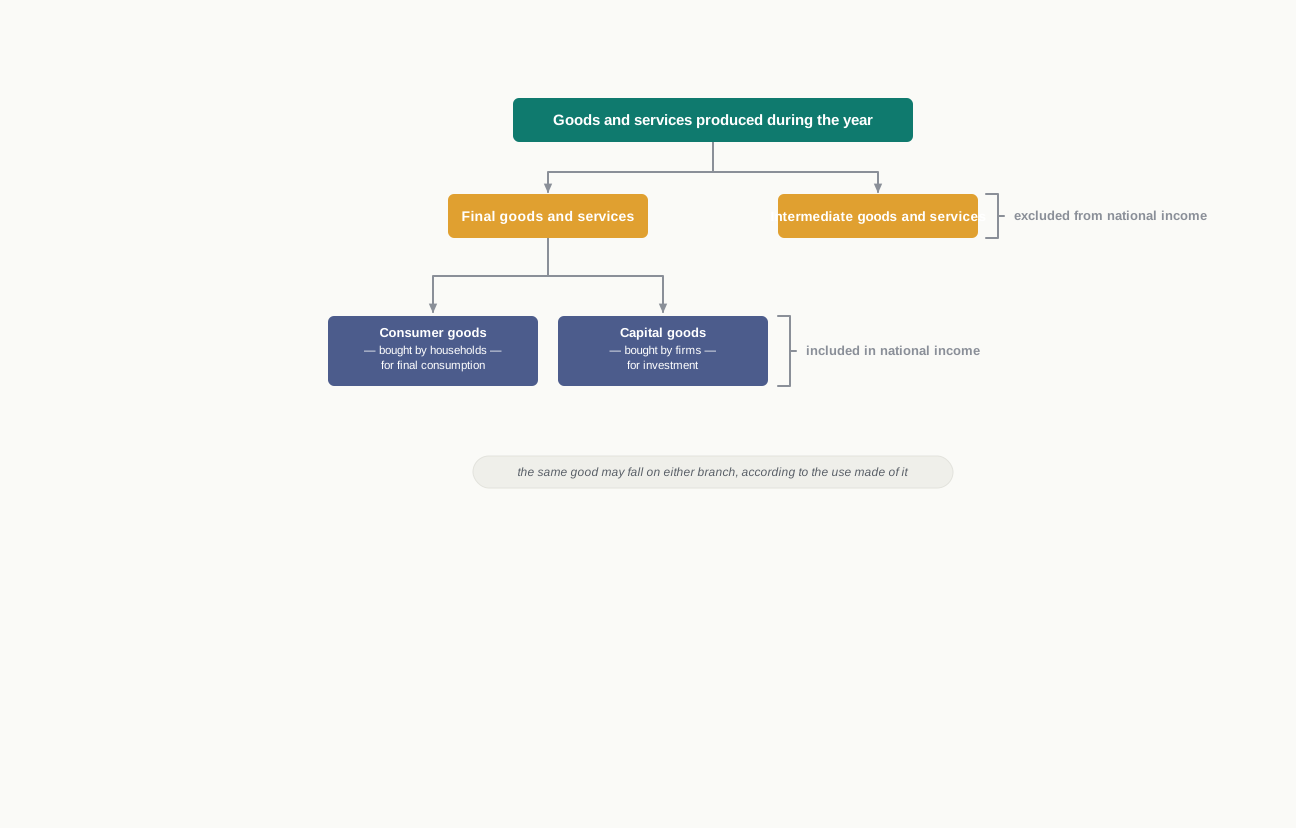
Fig. 18.1 – Classification of goods by use.
The main points of difference are set out below.
18.1.3 The Problem of Double Counting
To measure national income accurately, everything produced during the year must be counted once, but not more than once. Since the components of most products are bought and sold several times before the product is finished, adding up the sales of every producer would count the same value again and again.
The error is easiest to see in a chain of three producers, set out in Table 18.1.
Only one good has actually left the production process at the end of this chain, and that is the bread, worth ₹500. Yet the three sales add to ₹1,000. The wheat has been counted three times — once on its own, once inside the price of the flour and once inside the price of the bread — and the flour twice. The total is overstated by ₹500, which is exactly the value of the intermediate goods.
The remedy follows from the error. National income includes only the value of final goods and services, so the value of the bread is counted and the value of the flour used in making it is not. The same result is reached by counting at each stage only the value that stage has added to what it bought in, since the sum of the values added along a chain equals the value of the final product.
Intermediate products are therefore not excluded because they do not matter. They are excluded because their value is already inside the price of the final good, and to add them again would be to claim that the economy produced more than it did.
18.2 National Income as a Flow of Current Output
Two of the conditions in the definition of national income concern time. The total is a flow, which means it belongs to a stretch of time and not to a moment; and it counts only what has been currently produced, which means that transactions merely passing existing assets from one owner to another are left out however large they are.
Both conditions are easy to state and easy to forget, and most of the mistakes made in classifying a transaction come from ignoring one of them.
18.2.1 National Income as a Flow
A stock is a quantity measured at a point of time. A flow is a quantity measured over a period of time. The water standing in a reservoir on a particular morning is a stock; the water running through the canal below it is a flow, and it can only be reported as so many litres per hour. A flow figure means nothing until the length of time it refers to is attached to it.
National income is a flow variable. It tells us how many rupees worth of goods and services are moving through the economy per unit of time, and by convention that unit is one year. In India the year used is the financial year, running from 1 April to 31 March, so an estimate of national income always carries the label of the year it belongs to.
The distinction matters because the economy contains both kinds of quantity, and they are easily confused. Wealth is a stock and income is a flow; the capital installed in a factory is a stock and the investment made during the year is a flow.
18.2.2 Transactions Excluded from National Income
National income measures the value of currently produced goods and services. A great many transactions take place in an economy in which nothing new is produced and only ownership changes hands. These are called pure exchange transactions, and they are excluded from national income. Three of them need to be recognised.
- Second-hand sales — the sale of used goods does not reflect any current production. The value of the good was counted in the year it was made, and to count it again on resale would be to credit the economy with production it did not repeat.
- Sale and purchase of financial assets — dealings in shares, bonds and similar assets, whether newly issued or already in circulation, transfer purchasing power and ownership rights from one person to another. They are not payments for goods and services.
- Transfer payments — pensions, scholarships, donations, gifts and subsidies are received without any corresponding contribution to current production. They shift purchasing power from one hand to another rather than adding to output.
There is one qualification that runs through all three cases, and it is worth stating separately. The transaction is excluded, but the service of arranging it is not. The commission earned by a broker on the sale of a used car, or by an agent on the sale of an old house, is payment for a service rendered in the current year, and that service is part of current output. Fig. 18.2 sets the point out on a time line.
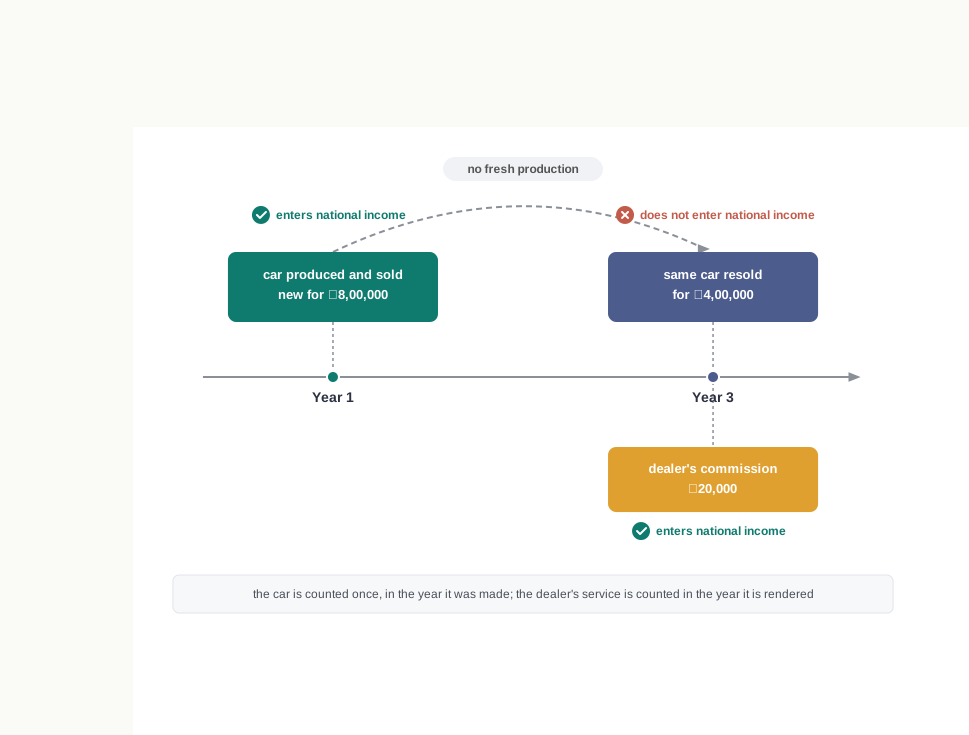
Fig. 18.2 – Exclusion of second-hand sales from national income.
Transfer payments deserve a second look, because they are large and visible and it is tempting to treat them as income earned. A pension paid to a retired employee and a salary paid to a serving employee are both money leaving the government’s account, but only the salary is a payment for a factor service rendered during the year. The pensioner renders no service in return in the current period, so the pension is a transfer.
The treatment of some common transactions is set out in Table 18.2.
Read together, the two conditions of this section fix the boundary of the measurement. National income counts production, over a stated period, and nothing else. Money changing hands is not by itself evidence that an economy has produced anything.
18.3 Normal Residents and Domestic Territory
The fourth condition in the definition settles whose production is being counted. Two answers are possible, and both are used. One counts everything produced inside the geographical boundary of the country, no matter who produced it. The other counts everything produced by the people of the country, no matter where they produced it.
The first gives domestic income and the second gives national income, and the difference between them is exactly the factor income that crosses the country’s border. Before the two totals can be separated, the terms ‘normal resident’ and ‘domestic territory’ have to be fixed.
18.3.1 Normal Residents of a Country
Normal residents are those persons who ordinarily reside in a country and whose economic interest lies in that country. They normally live there, and they earn their income by carrying out economic activities there.
Residence in this sense is not the same thing as citizenship. A person may hold the passport of one country and be a normal resident of another, and it is residence, not the passport, that decides where the output is counted. Certain categories are treated as non-residents of the country they are living in, however long they stay: foreign diplomats and their staff, the officials of international institutions such as the United Nations and the World Health Organization, and foreign visitors who come for a short period as tourists or on business.
Table 18.3 applies the test to some familiar cases.
18.3.2 Domestic Territory of a Country
Domestic territory is not simply the area shown inside the boundary on a map. It is an economic boundary, and it is drawn so that every production unit under the effective control of the country falls inside it.
The territory so defined takes in the following.
- The political frontiers of the country, together with its territorial waters and airspace.
- Ships and aircraft operated by residents of the country between two or more countries.
- Fishing vessels, oil and natural gas rigs and floating platforms operated by residents of the country in international waters.
- Embassies, consulates and military establishments of the country located abroad.
It leaves out the embassies, consulates and military establishments of foreign governments situated within the country, and the offices of international institutions situated there.
18.3.3 Domestic Income and National Income
Domestic income is the money value of all final goods and services produced within the domestic territory of a country in a year by all production units located there, whether they belong to residents or to non-residents. National income, as already defined, is the money value of all final goods and services produced by the normal residents of a country, whether they operate inside the domestic territory or outside it.
The two totals overlap heavily, because most of what residents produce, they produce at home. They differ at the edges, and Fig. 18.3 shows where.
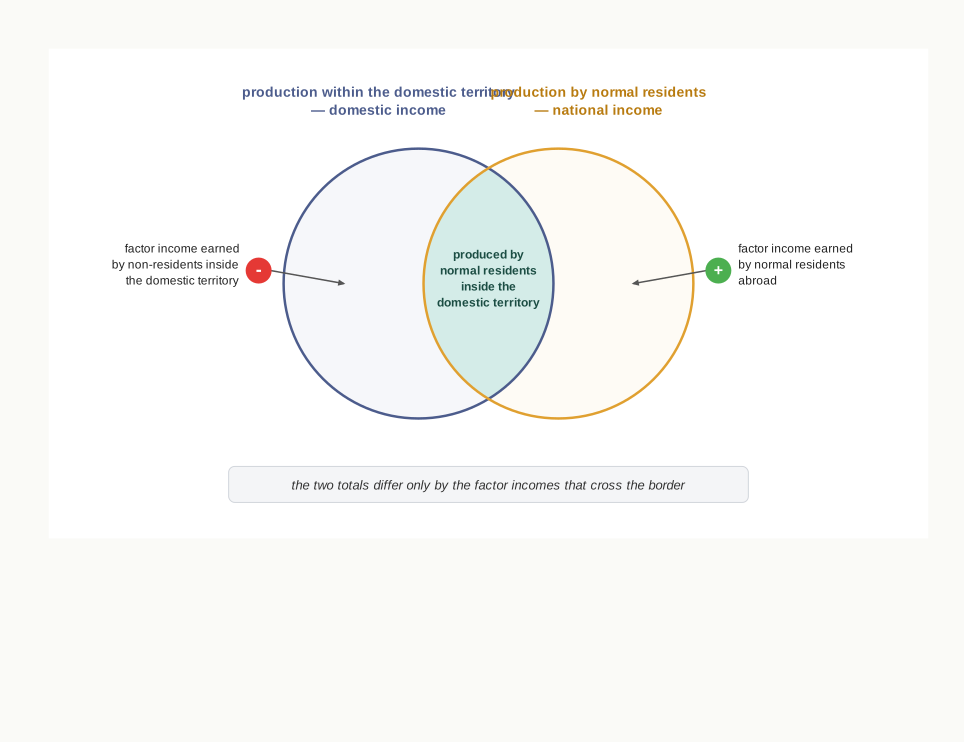
Fig. 18.3 – Domestic income and national income.
The difference between the two crescents is called the net factor income from abroad. It is what has to be added to domestic income to arrive at national income.
\[\text{National income} = \text{Domestic income} + \text{Net factor income from abroad}\]
Here domestic income is the value of output produced within the domestic territory during the year, and net factor income from abroad is the factor income earned by the normal residents of the country from the rest of the world, less the factor income earned within the domestic territory by non-residents. All three are money values for one year, measured in rupees. When residents earn more abroad than non-residents earn here, the net figure is positive and national income exceeds domestic income; when the reverse holds, the net figure is negative and national income falls short of domestic income.
The distinction is worth holding on to. Domestic income is a geographic idea, answering the question ‘what was produced on our soil?’ National income is an economic idea, answering the question ‘what did our people produce?’ The circular flow examined in the rest of the chapter traces the second of these as it moves between the sectors of the economy.
The main points of difference are set out below.
18.4 The Circular Flow of Income
Price is the basic parameter of microeconomics. Almost every question asked there — how much a consumer buys, how much a firm produces, how a market clears — is answered by looking at a price. Macroeconomics cannot work in that way, because it deals with the economy as a whole and with totals rather than with single markets.
The basic parameter of macroeconomics is the circular flow of income. People in an economy produce, exchange and consume, and in doing so they enter into transactions with one another. Those transactions make the sectors of the economy dependent on each other, and the circular flow is the picture economics draws of that dependence.
18.4.1 Meaning of the Circular Flow of Income
A large number of goods and services are produced every year, and producing them requires the services of land, labour, capital and enterprise. Producers buy these factor services from their owners and pay for them in the form of rent, wages, interest and profit. The value of what is produced is thus handed over to households as factor income.
Households then spend that income on the goods and services the producers have made. The spending returns to the production units as their receipts, and out of those receipts they again pay for factor services. Production gives rise to income, income gives rise to expenditure, and expenditure gives rise to production once more.
The flow is called circular because it has no starting point and no finishing point. Goods and services move in one direction and the money paid to acquire them moves in the opposite direction, so the two together close a loop that goes on continuously and indefinitely.
18.4.2 Real Flows and Money Flows
Every transaction in which goods or factor services are exchanged for money generates two flows at once, running in opposite directions. Economics gives them separate names.
Real flows consist of the flow of factor services from their owners to the producers, and the flow of goods and services from the producers to those who buy them. What moves in a real flow is a thing or a service, not money.
Money flows consist of the flow of factor incomes such as wages, rent, interest and profit from producers to households, and the flow of money expenditure from households to producers on the purchase of goods and services. What moves in a money flow is payment.
The two are two sides of the same coin. A tailor who works for a garment unit and earns ₹15,000 a month supplies a real flow of labour service worth that amount, and receives a money flow of ₹15,000 in wages. Neither flow can exist without the other, and each is the mirror image of the other. Fig. 18.4 shows the pair for a single transaction.
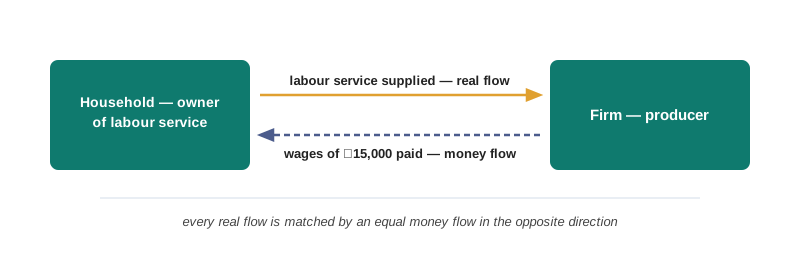
Fig. 18.4 – Real flow and money flow in a single transaction.
Underlying the whole picture is one principle: the expenditure of the buyer creates income for the seller, of exactly the same amount. This is why national income can be looked at as a flow of goods and services or as a flow of money incomes, and why the two must come to the same total.
The main points of difference are set out below.
18.4.3 Economic Sectors of an Economy
To set out the circular flow conveniently, the economy is divided into four sectors.
- Household sector — households own the factors of production. They sell factor services to producers, receive factor income in return, spend a large part of it on goods and services, save a part and pay taxes out of it.
- Business sector or firms — firms hire factor services from households and produce commodities, which they sell to households, to other firms, to the government and abroad. The business sector covers both private and government enterprises.
- Government — government is taken here in the sense of general government, so that commercial undertakings of the state are left with the business sector. It collects taxes, buys factor services and goods, and makes transfer payments.
- Rest of the world — the foreign sector, with which the economy exchanges goods, services and factor services through exports, imports and payments across the border.
What each of these sectors receives and pays is summarised in Table 18.4.
Households and firms meet each other in two sets of markets, and the circular flow passes through both of them.
The four sectors are combined in three stages to give three models of the circular flow.
- The two-sector model, consisting of households and firms alone.
- The three-sector model, which adds the government and is known as the closed economy model.
- The four-sector model, which adds the rest of the world and is known as the open economy model.
Each model is taken up in turn in the sections that follow, and each adds one new pair of flows to the picture built up before it.
18.5 The Two-Sector Model of Circular Flow
An economy has four sectors, but a picture that showed all their dealings at once would be unreadable. Economics therefore builds the circular flow in stages, beginning with the smallest economy that can still be called an economy: one made up of households and firms alone.
The two-sector model is a deliberate simplification. It assumes away the government and the rest of the world in order to show clearly what remains — the exchange of factor services for factor incomes, and of goods for expenditure — and each of the later sections puts back one of the sectors it left out.
18.5.1 The Two-Sector Model Without Savings and Investment
The simplest version of the model rests on the following assumptions.
- The economy has only two sectors, households and firms. There is no government and no dealing with the rest of the world.
- Households own all the factors of production and sell their services to firms.
- Firms produce only consumer goods, and they distribute the whole of their receipts to households as factor incomes.
- Households spend the whole of their income on the goods produced by firms, so that nothing is saved.
Under these assumptions the household sector sells factor services and receives rent, wages, interest and profit in return. Firms use those factor inputs to produce goods and services, which households buy. The money paid by firms to households is a cost to the firms and an income to the households; the money paid by households to firms is expenditure for the households and a receipt for the firms. Fig. 18.5 shows the two loops that result.
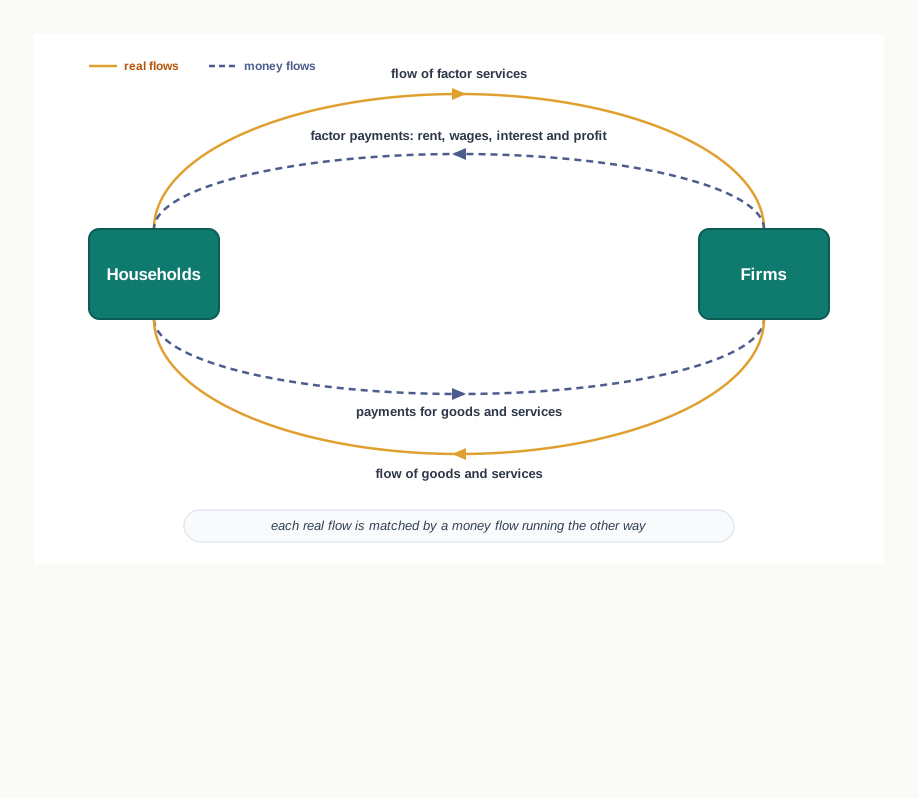
Fig. 18.5 – Circular flow in a two-sector model.
Since everything received by households is passed on to firms, and everything received by firms is passed back to households, the flow neither grows nor shrinks. It continues at an unchanged level, and the economy is in equilibrium. Three identities hold in this model.
- Total production of goods and services by firms equals total consumption of goods and services by households.
- Factor incomes of households equal factor payments made by firms.
- Income of the firms equals expenditure of the households.
18.5.2 Savings, Investment and the Capital Market
The fourth assumption is the unrealistic one. Households do not in fact spend the whole of their income; they set a part of it aside for old age, for a daughter’s education or for an expense they expect to meet later. Saving is that part of income which is not spent on consumer goods and services.
Saving reduces the expenditure that flows back to firms. Households receive their incomes in full but pass back only a part, so the flow between the two sectors would shrink year after year if nothing were added to it. Something is added, because the money saved does not stay idle.
Firms must find the funds for this expenditure, and in the main they find them in the savings of households. Households and firms rarely deal with each other directly; they meet through banks, insurance companies, mutual funds and similar financial institutions, which together make up the capital market. Households are the net lenders in this market and firms the net borrowers, so the capital market is the channel through which saving reaches investment. Fig. 18.6 adds it to the picture.
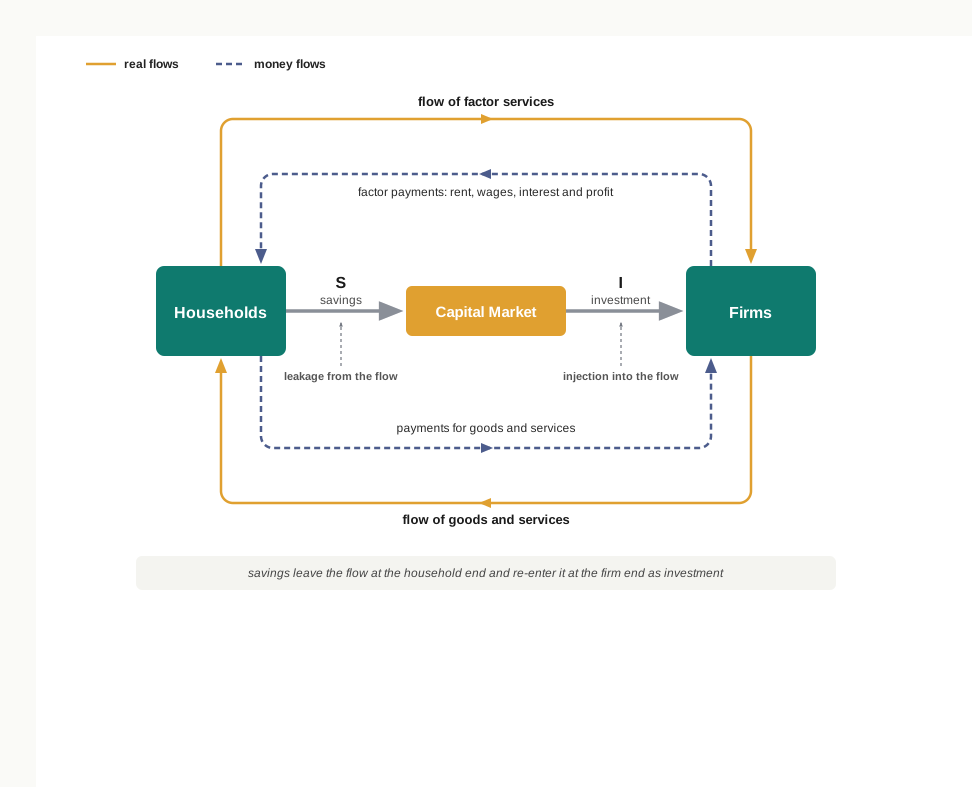
Fig. 18.6 – Circular flow with savings and investment.
18.5.3 Leakages and Injections
The two new flows are examples of the two forces that govern the level of the circular flow anywhere in this chapter.
Saving is a leakage because income that is saved is income not passed back to firms. Investment is an injection because the expenditure firms make on capital goods creates income for the firms that build those goods and for the factors employed in building them, and that income arises over and above whatever households spend.
The main points of difference are set out below.
18.5.4 Equilibrium in the Two-Sector Model
Saving pulls the level of income down and investment pushes it up. The flow will stay at the same level from year to year only when the two forces are exactly matched, that is, when the amount withdrawn from the flow equals the amount put back into it. This gives the equilibrium condition of the two-sector model.
\[S = I\]
Here \(S\) is the saving done by households during the year and \(I\) is the investment made by firms during the year, both measured in rupees for the same period. The condition says that the contraction of income caused by saving is just equal to the expansion of income caused by investment, so the circular flow neither grows nor shrinks.
There is no mechanism that makes the two equal by itself. Saving is done largely by households, out of their own reasons and plans, while investment is undertaken by firms for entirely different reasons, and the two groups decide separately. Table 18.5 sets out what follows in each case.
When savings exceed investment, the income that leaks out of the flow is not fully offset by the injection made, and the level of income declines. When investment exceeds savings, the injection more than offsets the leakage, and the level of income rises. Equilibrium is the middle case, and it is a condition to be satisfied rather than a result that can be taken for granted.
18.6 The Three-Sector Model of Circular Flow
No modern economy consists of households and firms alone. The government taxes both of them, buys from both of them and pays money to both of them, and in most countries it does so on a scale large enough to change the level of income by itself. A model that leaves it out is too thin to be useful.
Adding the government to the two-sector model gives the three-sector model, which is also called the closed economy model because it still assumes that the economy has no dealings with the rest of the world.
18.6.1 The Government in the Circular Flow
Government performs a wide variety of economic functions, and not all of them can be drawn. Three activities are enough to show how it enters the flow.
- Taxes — the government levies taxes on households and on firms.
- Government spending on commodities and factor services — it buys goods from firms and factor services from households.
- Transfer payments — it makes payments to households and firms for which no service is rendered in return.
Households pay personal taxes such as income tax, and indirect taxes on the goods they buy. Firms pay corporation tax on their earnings, so a part of what they earn is taxed away before it can be distributed. Income therefore flows from households and from firms to the government, and this flow is a leakage, because the money taxed away is no longer available for spending between the two original sectors.
The government spends what it collects. It purchases factor services from households and pays them wages and salaries, and it buys a whole range of goods and services from firms. Both are injections, since they add to the demand for what households and firms have to sell. It also makes transfer payments — pensions, scholarships and unemployment allowances to households, and subsidies to firms — which add to the purchasing power of the recipients without any output passing the other way.
The three-sector flow is drawn in Fig. 18.7.
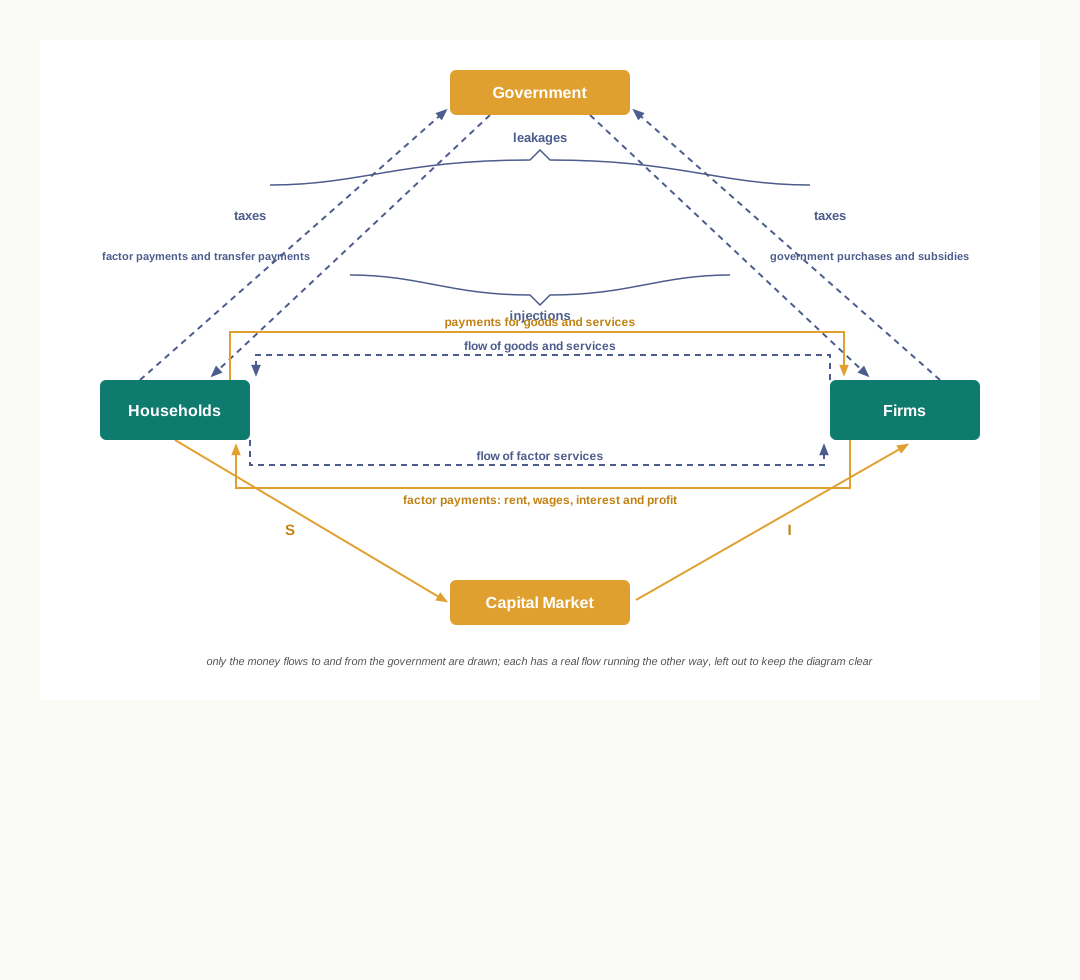
Fig. 18.7 – Circular flow in a three-sector model.
Every money flow shown between the government and the other two sectors has a counterpart real flow in the opposite direction, except the transfer payments. Those real flows are left out of the figure only to avoid crowding it.
18.6.2 Equilibrium in the Three-Sector Model
The three-sector economy now has two leakages and two injections. Saving and taxes take money out of the flow; investment and government expenditure put money in. As before, the level of income stays where it is only when the two sides balance, and this gives the equilibrium condition of the closed economy model.
\[S + T = I + G\]
Here \(S\) is the saving done by households, \(T\) the taxes paid by households and firms to the government, \(I\) the investment made by firms and \(G\) the expenditure of the government on goods and factor services, all measured in rupees for the same year. The condition says that total withdrawals from the circular flow must equal total injections into it. It does not require saving to equal investment on its own; a shortfall on one side can be made good on the other.
Two cases follow from the condition. If \(S + T\) exceeds \(I + G\), more is being withdrawn from the flow than is being returned to it, and the level of income falls. If \(I + G\) exceeds \(S + T\), the injections more than make up for the withdrawals, and the level of income rises.
The government therefore has a lever in its hands. By altering what it takes out in taxes and what it puts back in expenditure, it can raise or lower the level of the circular flow deliberately, and this is the ground on which fiscal policy stands.
18.7 The Four-Sector Model of Circular Flow
The models built so far have all been closed. Every rupee that left one sector arrived at another inside the same country, and the border played no part in the story. No real economy works like that. Goods, services, factor services and payments cross national frontiers every day, and for many countries what crosses the border is large enough to decide whether income rises or falls.
Adding the rest of the world to the three-sector model gives the four-sector model, the fullest of the three and the only one that describes an actual economy.
The main points of difference are set out below.
18.7.1 The Rest of the World in the Circular Flow
Interaction between the domestic economy and the rest of the world takes place through the trade in goods and services and through the movement of factor services across the border. Four flows are enough to show it.
- Households buy goods imported from abroad and make payments to the foreign sector for them, so expenditure flows out of the domestic economy.
- Households receive remittances in foreign exchange for factor services rendered abroad, so income flows into the domestic economy.
- Firms export goods and services — including shipping, insurance and banking services — and receive payment for them, which is an inflow of expenditure into the economy.
- Firms pay the foreign sector for the goods and services they import, which is an outflow of expenditure from the economy.
Governments also buy and sell across the border, and capital services move between the government and the rest of the world. These flows are real enough, but they are left out of the diagram so that the picture stays readable. Fig. 18.8 shows the four-sector flow.
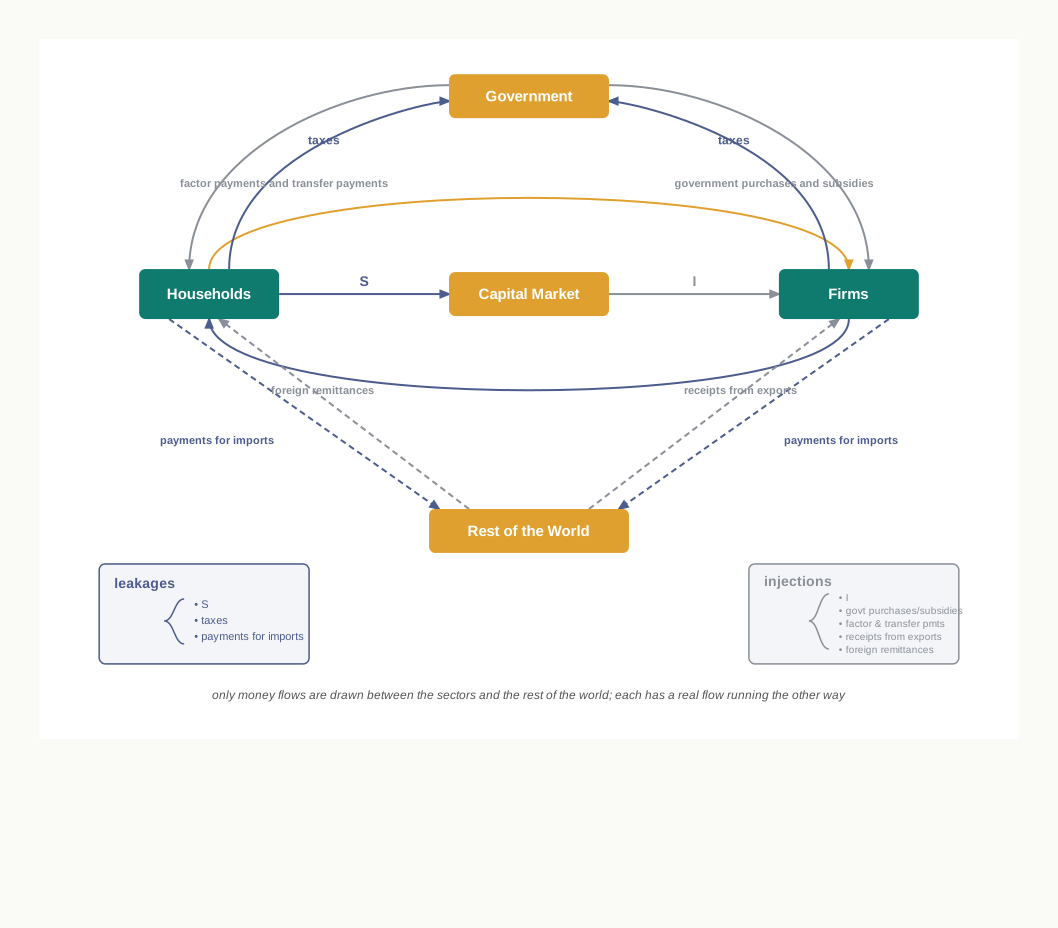
Fig. 18.8 – Circular flow in a four-sector model.
Imports constitute a leakage from the circular flow, because the money paid for them goes to producers outside the economy and does not return as income to anyone within it. Exports constitute an injection, because the payment received for them is income earned by domestic producers from outside the flow.
18.7.2 Equilibrium in the Four-Sector Model
The open economy has three leakages and three injections. The level of the circular flow stays unchanged when the three withdrawals taken together are matched by the three additions taken together, which gives the equilibrium condition of the four-sector model.
\[S + T + M = I + G + X\]
Here \(S\) is saving by households, \(T\) the taxes paid to the government, \(M\) the payments made for imports, \(I\) the investment made by firms, \(G\) the expenditure of the government, and \(X\) the receipts from exports, all measured in rupees for the same year. The left-hand side is the total withdrawal from the circular flow and the right-hand side the total injection into it. Equality between the two totals means the flow neither expands nor contracts.
Individual items need not match individually. Saving may exceed investment while exports exceed imports by enough to make up the difference; the condition is about totals, not about pairs. Table 18.7 brings the three models together.
Read down the table, the three models tell one story. Each new sector brings a fresh way of taking money out of the flow and a fresh way of putting money back in, and the condition for a steady level of income keeps its shape throughout: total leakages must equal total injections.
18.8 Importance of the Circular Flow of Income
The circular flow is not merely a way of drawing an economy. It is the framework on which the rest of macroeconomics is built, and three of the biggest questions in the subject — how the sectors of an economy hang together, how national income is measured, and what holds income at a given level — are answered from it.
Seeing The Economy Whole
The entire economic system can be viewed as a single flow of income and expenditure. The figures built up in this chapter show how households, firms, the government and the rest of the world are tied to one another, so that no sector can be treated as though it stood on its own. A change that begins in one part of the economy travels along the flow to every other part.
Measuring National Income
The magnitude of the flows determines the size of national income, and this makes the flow itself the instrument of measurement. Income can be measured wherever it can be caught passing, and the loop offers three such places, shown in Fig. 18.9.
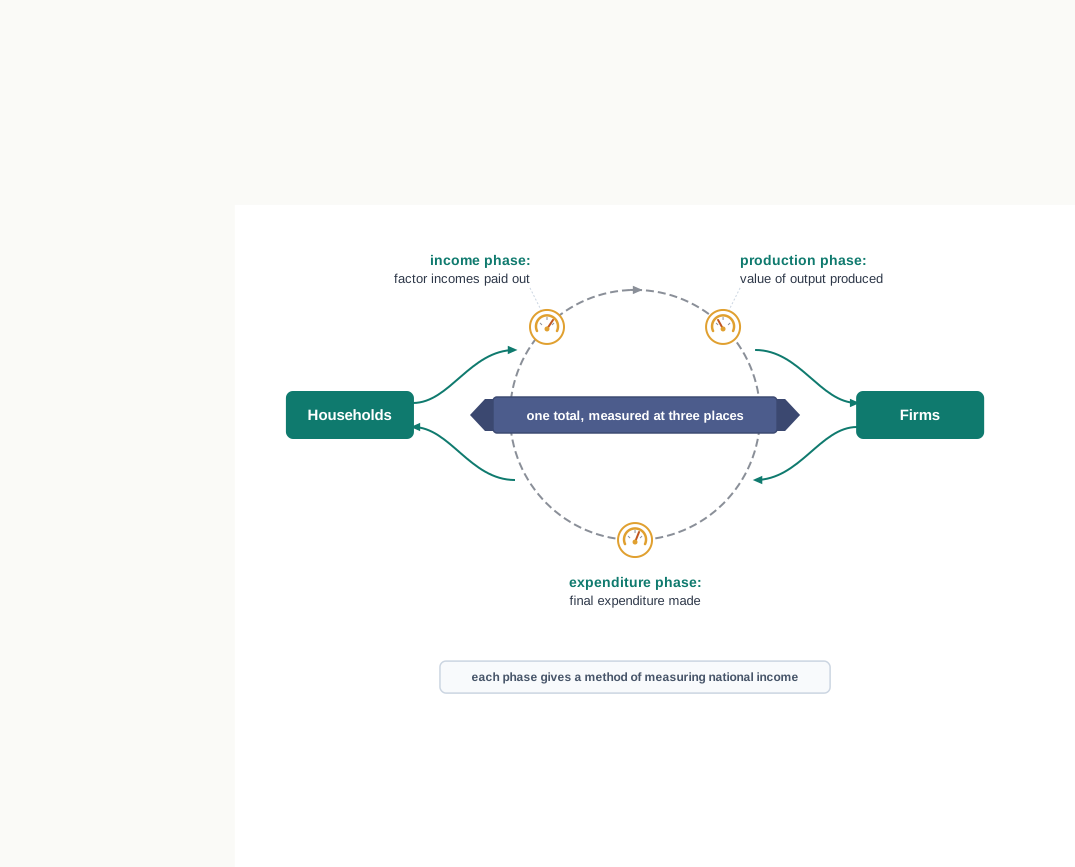
Fig. 18.9 – The three phases of the circular flow.
Because the same value passes each of the three points in turn, a measurement taken at any one of them gives the national income of that year. Each phase yields one of the three methods of measurement, as set out in Table 18.8, and those methods are worked out in detail in a later chapter.
Finding The Equilibrium
The study of the circular flow pinpoints the conditions of macroeconomic equilibrium. It spells out, model by model, what must hold if the level of income is to stay where it is: saving equal to investment in the two-sector economy, and total leakages equal to total injections once the government and the rest of the world are added. Equilibrium in macroeconomics is a statement about flows in balance, and the circular flow is what makes that statement precise.
A Basis For Policy
Once the leakages and the injections have been identified, the points at which policy can act are identified with them. A government that wants to raise the level of income can add to the flow through its own expenditure or reduce what it withdraws in taxes; one that wants to restrain it can do the reverse. The chapters on public finance and on the theory of income and employment take up that argument, and they begin where this chapter ends.
18.9 Summary
- National income is the money value of all final goods and services produced by the normal residents of a country in a year, whether they operate within the domestic territory or outside it. It is the most comprehensive measure of the level of economic activity in an economy.
- National income is expressed in monetary terms because quantities of unlike goods and services cannot be added. Output is valued at prices, which means the total can rise either because more has been produced or because prices have risen.
- Final goods are those sold to their final users during the year, for consumption by households or for investment by firms. Intermediate goods are those used up by producers as inputs in a further stage of production, and the same commodity may fall on either side depending on the use made of it.
- Double counting is the error that arises when the output of all sectors is added up instead of the output of final goods and services only. It is avoided by counting only final goods and services, or equivalently only the value added at each stage.
- National income is a flow, measured over a period of time, conventionally one year. A stock, by contrast, is measured at a point of time, so wealth is a stock while income is a flow.
- Only currently produced output is counted. Pure exchange transactions, in which nothing new is produced, are excluded:
- second-hand sales, whose value was counted in the year of production;
- sale and purchase of financial assets, which transfer ownership rather than pay for output;
- transfer payments, which are unilateral payments for which no productive service is rendered in return.
- The service of arranging an excluded transaction is itself current output, so a broker’s or an agent’s commission is included in national income even though the sale it arranges is not.
- Normal residents are persons who ordinarily reside in a country and whose centre of economic interest lies there. Residence is not citizenship, and foreign diplomats, officials of international institutions and short-term visitors are not normal residents of the country they are in.
- Domestic territory is the political boundary of a country, excluding foreign embassies and international institutions located within it and including its own embassies, ships, aircraft and rigs operated abroad.
- Domestic income counts production within the domestic territory and is a geographic concept; national income counts production by normal residents and is an economic concept. The two are linked by \(\text{National income} = \text{Domestic income} + \text{Net factor income from abroad}\), where net factor income from abroad is the factor income earned by residents from the rest of the world less the factor income earned by non-residents within the domestic territory, in rupees for the year.
- The circular flow of income is the flow of payments and receipts for goods and services and for factor services between the sectors of an economy. It is circular because production creates income, income creates expenditure and expenditure creates production again, so it has neither a beginning nor an end.
- Every transaction generates two flows in opposite directions. Real flows are the movement of factor services and of goods and services; money flows are the movement of factor incomes and of money expenditure, and each is the mirror image of the other.
- An economy is divided into four sectors — households, firms, government and the rest of the world — which meet in factor markets, where factor services are bought and sold, and in product markets, where goods and services are bought and sold.
- A leakage is money withdrawn from the circular flow and lowers the level of income; an injection is money added to it and raises the level of income. The level of income stays unchanged when the two are equal, and the three models give:
- two-sector model — \(S = I\), where \(S\) is household saving and \(I\) is investment by firms;
- three-sector or closed economy model — \(S + T = I + G\), where \(T\) is taxes and \(G\) is government expenditure;
- four-sector or open economy model — \(S + T + M = I + G + X\), where \(M\) is payments for imports and \(X\) is receipts from exports. All terms are in rupees for the same year.
- When withdrawals exceed injections the level of income falls, and when injections exceed withdrawals it rises. The condition is about the totals on each side and not about matching each pair of items.
- The importance of the circular flow lies in three things: it shows the interdependence of the sectors of an economy, it provides the basis for measuring national income through the production, income and expenditure phases, and it states the conditions for equilibrium in the level of income.
18.10 Points to Ponder
- A meal cooked at home does not enter national income; the same meal cooked in a restaurant does. Both use labour, ingredients and skill, and both satisfy the same want. Is the line between the two defensible, and what is lost from the measure when unpaid work inside the household is left outside it?
- Saving is prudent for a household and a leakage for the economy. If every family in a country decided at once to save a larger part of its income, what would happen to the level of the circular flow, and can behaviour that is sensible for one household be damaging when everyone adopts it together?
- A factory that pollutes a river adds its output to national income, and the work of cleaning the river afterwards adds to national income a second time. Does a rising flow of income always mean that a country is better off, and what would you want to know before answering?
- Imports are treated as a leakage from the circular flow. Yet a country that imports machinery, fertiliser or crude oil may produce far more with them than it could have produced without. Should a leakage that raises future production be judged in the same way as one that does not?
- Transfer payments are excluded from national income because nothing is produced in return for them, and yet an old-age pension may matter more to the person receiving it than any figure in the national accounts. Is national income the right measure to judge how well an economy is serving its people, and what would you add to it?
- The circular flow has no beginning and no end, so any point on it can be treated as the starting point. If a government wants to raise the level of income, does it matter where on the loop it acts — on the spending of households, the investment of firms, or its own expenditure — and why might the choice make a difference?
18.11 Objective Questions
- Which of the following is an injection into the circular flow of income? [1]
- Payment made by a firm for imported machinery
- Corporation tax paid by a firm
- Government expenditure on the construction of a road
- Saving deposited by a household in a bank
- Given below are two statements marked as Assertion (A) and Reason (R). Read them carefully and choose the correct option. [1] Assertion (A): The commission earned by a property agent on the sale of a ten-year-old house is included in national income. Reason (R): The sale of an old house is a pure exchange transaction.
- Both (A) and (R) are true, and (R) is the correct explanation of (A).
- Both (A) and (R) are true, but (R) is not the correct explanation of (A).
- is true and (R) is false.
- is false and (R) is true.
- Fill in the blank: the equilibrium condition of the circular flow of income in a closed economy is ______. [1]
- State whether the following statement is true or false: a person must be a citizen of a country in order to be counted among its normal residents. [1]
- Match the items in Column I with those in Column II. [1]
| Column I | Column II |
|---|---|
| a. Saving by households | i. Includes the Indian Embassy in Tokyo |
| b. Receipts from exports | ii. A leakage from the circular flow |
| c. Domestic territory of India | iii. An injection into the circular flow |
18.12 Check Your Concepts
- Distinguish between a stock and a flow, giving one example of each from macroeconomics. [2]
- Classify each of the following as a final good or an intermediate good and give a reason in each case: a printer bought by a school for its office, yarn bought by a weaving unit, and petrol bought by a taxi driver for his taxi. [3]
- Explain why saving is described as a leakage and investment as an injection, and state what happens to the level of income when saving exceeds investment. [4]
- With the help of a well-labelled diagram, show the circular flow of income in a three-sector model. State its equilibrium condition and explain what that condition means. [6]
18.13 Case-Based Question
- Meher Textiles is a garment unit in Ludhiana owned by Ranvir Sahni. During the year the unit buys yarn worth ₹40 lakh from a spinning mill and sells garments worth ₹70 lakh, of which garments worth ₹25 lakh are exported. It pays ₹15 lakh in wages to its workers, all of whom live in the town, and ₹5 lakh in corporation tax. Ranvir’s brother, who settled in Canada ten years ago, sends the family ₹2 lakh during the same year.
- Identify one leakage and one injection in the circular flow from the situation described above, giving a reason for each. [2]
- State, with a reason in each case, whether the yarn worth ₹40 lakh and the ₹2 lakh received from Canada would be included in India’s national income. [2]