Chapter 9: Forms of Market
A household in a small town buys its morning tea from any one of a dozen stalls near the bus stand. Every stall charges much the same price, and no owner can charge more without losing customers to the stall next door. The same household pays its water bill to the municipal body, which is the only supplier and fixes the tariff itself. The good differs in each case, but so does the arrangement within which it is sold. That arrangement is what economics studies here. What decides how much power a single seller has over price is the number of firms in the market, the nature of the product they sell and the ease with which new firms may enter. Where sellers are many and their product identical, none can hold out for a higher price. Where entry is closed and no close substitute exists, the seller sets it. This chapter defines a market and the factors distinguishing one market form from another, then examines perfect competition, monopoly, monopolistic competition, oligopoly and monopsony in turn, closing with the demand curve each form presents to the firm.
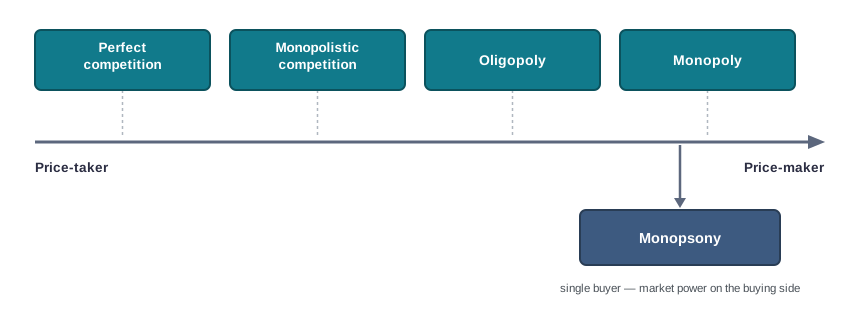
Fig. 9.0 – The range of market forms by price influence.
9.1 Concept of Market
Exchange is the act on which the whole of economics rests. A buyer parts with money to obtain a good, a seller parts with the good to obtain money, and each ends the transaction better placed than before. But no exchange can take place unless the two sides are able to find each other and agree on terms. The arrangement that brings them together is what economics calls a market.
9.1.1 Meaning of Market in Economics
In ordinary speech the word ‘market’ names a place. We speak of Chandni Chowk in Delhi, or of the fish market in a coastal town, meaning a definite spot where goods are displayed and sold. The usage carries with it the idea of a single site to which the buyer must travel if he wishes to buy.
Economics does not use the word so narrowly. Improvements in transport, the telephone and the internet have made it possible for a buyer in one city to deal with a seller in another without either leaving home, and the modern banking system allows the payment to pass between them just as easily. What matters is not that the two stand in the same place, but that they are in contact and can settle a price and a quantity between them.
On this reasoning the term is defined by the function it performs rather than by the ground it occupies.
A market is therefore always the market for some one commodity, and the area it covers depends on how widely the buyers and sellers of that commodity are scattered. Fresh vegetables have a local market, because they cannot travel far. Cement has a regional or national market. Wheat and gold have a world market, since they can be bought and sold almost anywhere at prices that move together. This spread is what is meant by the size or extent of a market.
9.1.2 Essential Features of a Market
The definition above yields a small set of conditions, each of which must hold if the arrangement is to be called a market at all.
- A commodity — every market is the market for a particular good or service. There is a market for wheat and a market for steel, but no single market for ‘goods’ in general, because a price can only be settled for a defined commodity.
- Buyers and sellers — there must be a group on each side of the exchange. Their numbers may be large or small, and it is this difference in numbers that later distinguishes one market form from another.
- An area rather than a spot — the market extends over whatever region its buyers and sellers occupy. It may be a single lane or the whole world, and the physical distance between the two sides does not by itself break the market.
- Contact between the two sides — buyers and sellers must be able to reach each other, whether in person or through correspondence, the telephone or an electronic platform. Where contact fails, exchange fails with it.
- A tendency towards one price — where the commodity is the same and information travels freely, competition drives the price charged by different sellers towards a single level, since no buyer will knowingly pay more than he must.
These conditions are common to every market, but they are not satisfied to the same degree everywhere. Buyers may be many or few, sellers may be many or one, the commodity may be identical across sellers or differ from brand to brand, and information may be complete or patchy. It is this variation, and its effect on the power of a single firm over price, that the rest of the chapter sets out to classify.
9.2 Market Structure and Its Determinants
Every seller would like a higher price for what he sells. Whether he can get it is not a matter of wishing but of the setting he sells in. A farmer carrying a sack of wheat to a mandi where a hundred others are unloading the same grain has no choice but to accept the ruling rate. The sole supplier of piped gas to a colony is in an entirely different position. The commodity is scarce in both cases; what differs is the arrangement, and it is the arrangement that decides how the scarcity is turned into a price.
9.2.1 Meaning of Market Structure
The setting within which firms produce and sell is called the structure of the market. It covers how many firms there are, what sort of product they sell, how well informed the two sides are, and how easily a new firm may join them.
The phrase ‘competitiveness of the market structure’ should be read with care, because it runs the opposite way to ordinary usage. The less power an individual firm has over the price of the commodity, the more competitive the structure is said to be. Competitiveness here measures the firm’s helplessness, not its energy.
At one extreme stands perfect competition. Sellers are so numerous, and each so small a part of the whole, that no one of them can move the price by any decision it takes. Such a firm is a price-taker: it accepts the price the market hands it and decides only how much to sell at that price. At the other extreme stands monopoly, where a single producer supplies the entire market and no close substitute exists. Such a firm is a price-maker, able to set the price within the limits its buyers will bear.
Most real markets lie between the two. A firm selling one brand among many similar brands, or one of four or five large producers in an industry, has some power over price but not a free hand. These intermediate forms — monopolistic competition and oligopoly — are grouped together as imperfect competition, which is the condition of nearly every market a student is likely to encounter.
9.2.2 Factors Determining Market Forms
If market forms are to be told apart, we need the grounds on which the distinction rests. Six characteristics do most of the work, and each of them bears in the end on the same question — how much say a single firm has over price.
- Number of buyers and sellers — the power of a seller over price depends on its share in the total supply. A firm supplying the whole of the market alters total supply whenever it alters its own output, and so alters the price. A firm supplying a thousandth part of the market alters total supply by so little that the price does not stir. Hence one seller means monopoly, a few sellers mean oligopoly, and a large number of sellers means perfect or monopolistic competition. The same reasoning applies to the buying side: a single buyer facing many sellers can press the price down, and that market is called monopsony.
- Nature of the product — where the output of every firm is identical, the buyer has no reason to prefer one seller to another, so a single price must rule and no firm can raise its own. Where products are differentiated by quality, size, design, packaging or brand name, buyers form preferences, and a firm whose brand is preferred may charge a little more without losing all its custom. The extent of product differentiation therefore fixes how much price freedom a firm enjoys.
- Knowledge about the market — if buyers and sellers know the prices being charged and the quality being offered throughout the market, one price must prevail, because no buyer will knowingly pay more than the lowest price available to him. Where knowledge is incomplete, different prices for the same or similar goods can survive side by side, and a firm may hold its price above its rivals’ simply because some buyers do not know better.
- Freedom of entry and exit — free entry means that no restriction, whether legal, natural or man-made, stops a new firm from setting up in the industry, and free exit means that none stops an existing firm from closing down. The consequence is decisive for profit. If existing firms are earning abnormal profit, new firms enter, industry output rises, the price falls and the abnormal profit is wiped out, leaving only normal profit in the long run. If firms are making losses, some leave, supply falls and the price rises until the losses end. Where entry is closed, no such correction takes place and abnormal profit can persist indefinitely.
- Degree of price influence — this is the summary characteristic into which the other four feed. A perfectly competitive firm has no influence on price at all; a monopolist has a great deal; a firm under monopolistic competition has a little, and must watch what its rivals charge; a firm under oligopoly has a good deal but must reckon with the reaction of a small number of powerful rivals.
- Extent of selling cost and advertisement — where the product is identical and every unit can be sold at the ruling price, spending on advertisement would be money thrown away, and none is undertaken. Where products are differentiated, firms compete by persuading buyers towards their own brand, and selling cost becomes a regular item of expenditure. The presence or absence of such spending is itself a mark of the market form.
9.2.3 Classification of Market Forms
Applying these characteristics together, markets are classified into five forms. The first four are distinguished by conditions on the selling side; the fifth is distinguished by a condition on the buying side. The classification is set out in Fig. 9.1.
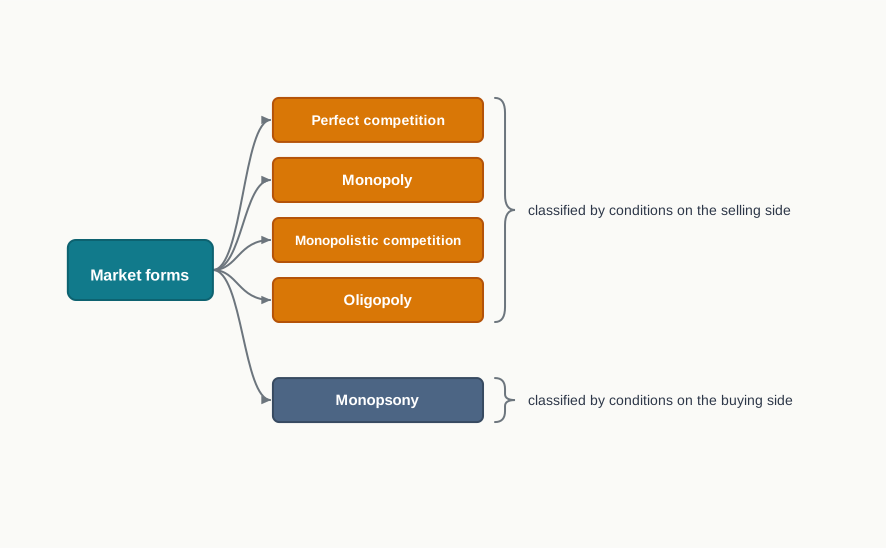
Fig. 9.1 – Classification of market forms.
Each of the five is taken up in turn in the sections that follow, in the same order: first the two extreme forms, perfect competition and monopoly, against which the others are measured; then the two intermediate forms, monopolistic competition and oligopoly, which between them describe most of the markets of a modern economy; and finally monopsony, the mirror image of monopoly.
9.3 Perfect Competition
Of the five market forms, perfect competition is the one a student is least likely to meet and the one he must understand best. It is the limiting case in which the individual firm counts for nothing in the settling of price, and it is precisely because it is a limit that it is useful. Every other market form is described by naming the ways in which it departs from this one.
9.3.1 Meaning of Perfect Competition
A market is perfectly competitive when the number of sellers is so large, and the product so uniform, that the decision of any single firm leaves the market price exactly where it was.
The definition divides the work of price-setting between two levels. Price is determined in the industry, by all the firms and all the buyers taken together, through the forces of market demand and supply. The individual firm does not take part in that determination in any way it can feel. Its own output is so small a fraction of the total that doubling it or halting it altogether would not shift the market supply curve perceptibly.
What is left to the firm, then, is a single decision: given the ruling price, how much to produce and sell. It cannot ask for more than the ruling price, because buyers would simply turn to the many other sellers offering the identical article. It has no reason to ask for less, because at the ruling price it can sell as much as it is able to produce. This is the whole content of the statement that the firm is a price-taker rather than a price-maker. The relation between the two levels is shown in Fig. 9.2.
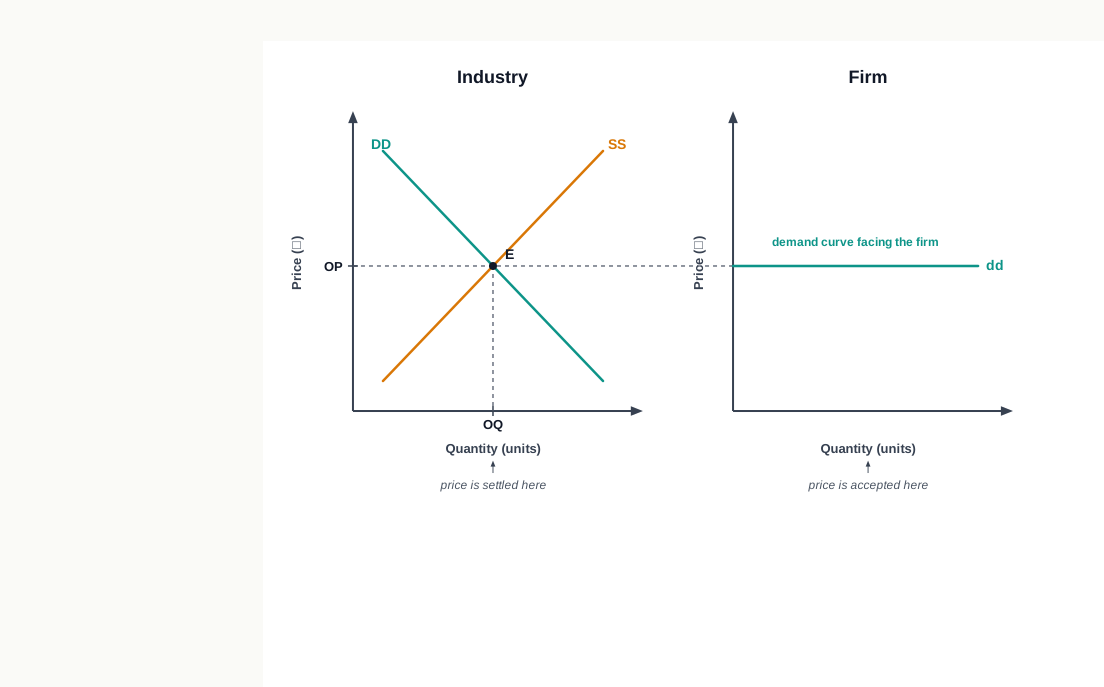
Fig. 9.2 – Price determination for the industry and the firm.
9.3.2 Features of Perfect Competition
A market must satisfy six conditions before it can be called perfectly competitive. The first three do the substantial work; the remaining three are the assumptions that keep a single uniform price from breaking down.
- Large number of buyers and sellers — there are so many sellers that each supplies a negligible share of total output, and so many buyers that each takes a negligible share of it. A change in one firm’s output has no noticeable effect on market supply, and a change in one buyer’s purchases has none on market demand. Neither side, acting alone, can move the price.
- Homogeneous product — the article sold by one firm is a perfect substitute for the article sold by any other, so the buyer has no ground for preferring a particular seller and no seller has any ground for charging more than the rest.
- Freedom of entry and exit — there is no restriction, legal, natural or man-made, on a new firm entering the industry or an existing firm leaving it. This is what forces long-run profit down to the normal level.
- Perfect mobility of factors of production — land, labour and capital can move without hindrance from one use, industry or place to another. Without this condition entry and exit would be impossible in practice, however free they were in law.
- Perfect knowledge — buyers, sellers and the owners of factors all know the prevailing price, the quality of the product and the techniques of production available. Buyers therefore refuse to pay more than the ruling price, sellers refuse to accept less, and all firms use the best technique and so face similar cost conditions.
- Absence of transport costs — the cost of moving the commodity from seller to buyer is taken to be nil. If it were not, identical goods would fetch different delivered prices at different distances, and the single uniform price assumed by the model would not hold.
Homogeneity Of The Product
Homogeneity is a stricter condition than it first appears. It refers not only to the physical characteristics of the commodity — quality, colour, size, design, chemical ingredients — but also to the environmental conditions surrounding the sale, such as the location of the shop, the courtesy of the staff or the credit offered. A buyer who would pay a little extra for the same article bought in pleasanter surroundings has, by that fact, been offered two different products.
The implication of homogeneity is a uniform price throughout the market. A firm that raised its price above the ruling level would lose every one of its customers to rivals selling the identical article at that level, and a firm that lowered its price would be giving away revenue on units it could have sold anyway.
Free Entry And Long-Run Normal Profit
Free entry and exit is the feature that gives the model its long-run result. Suppose existing firms are earning abnormal profit. Since nothing bars the way, new firms enter, industry output rises, the market supply curve shifts to the right and the price falls. Entry continues until the abnormal profit has been wiped out and each firm is left with normal profit only.
The correction works in the other direction as well. If firms are making losses, some of them leave the industry, market supply falls, the price rises, and the exodus stops when the remaining firms are back at normal profit. Free entry and exit therefore does not merely describe the market; it fixes the level of profit that can survive in it.
9.3.3 Pure Competition and Perfect Competition
A distinction is sometimes drawn between ‘perfect’ competition and pure competition, and it is worth stating precisely, since the two terms are not interchangeable.
Competition is said to be pure when the first three conditions alone are satisfied: a large number of buyers and sellers, a homogeneous product, and free entry and exit. Taken together these three remove every monopolistic element from the market, which is all that the word ‘pure’ claims. Nothing is assumed about knowledge, mobility or transport.
Competition is said to be perfect when all six conditions are satisfied together. Perfect competition therefore contains pure competition and adds to it. It is the wider term, and pure competition the narrower one; the difference between them is a matter of degree rather than of kind. The points of difference are set out below.
9.3.4 Perfect Competition as a Reference Model
Perfect competition, defined as strictly as this, does not exist. Buyers are never fully informed, factors are never perfectly mobile, and goods must always be carried somewhere at a cost. Agricultural commodities come nearest to it, since the produce of one grower is much like that of another and growers are numerous, but even there knowledge is incomplete and transport is not free.
The model is nevertheless retained, and for a reason worth stating plainly. Economics needs a standard against which real markets can be judged, and this is it. Because the perfectly competitive firm has no power over price, it cannot restrict output in order to raise price, and the outcome of such a market is the one against which the outcomes of monopoly, monopolistic competition and oligopoly are measured. When we say later that a monopolist charges more and produces less, the comparison being made is with this model.
Perfect competition is therefore best treated not as a description of the world but as a yardstick laid against it. The four sections that follow examine, one by one, the market forms that fall short of the yardstick, beginning with the form that departs from it furthest.
9.4 Monopoly
If perfect competition is the market form in which the individual firm counts for nothing, monopoly is the form in which it counts for everything. The word comes from the Greek monos, meaning single, and polus, meaning seller. One producer supplies the whole of the market, and the buyer who wants the commodity has nowhere else to go.
9.4.1 Meaning of Monopoly
Monopoly is defined by two conditions taken together, and both are needed. There must be a single seller, and the commodity that seller offers must have no close substitute. A firm that is the only maker of a particular article is no monopolist if a dozen other articles serve the buyer equally well.
An important consequence follows at once from the definition. Under every other market form the firm is one unit within a larger industry, and the two must be kept apart in the analysis. Under monopoly the distinction disappears: the firm is the industry, so the demand curve facing the firm is the market demand curve for the commodity itself.
The single seller faces a large number of buyers, and no one of them takes enough of the output to matter. Monopoly is thus one-sided — concentrated on the selling side, dispersed on the buying side. The single licensed distributor of electricity in a city is the familiar illustration: householders may number in the lakhs, but there is one supplier, and no household’s decision to switch off a light affects the tariff it pays.
9.4.2 Features of Monopoly
The main features of monopoly follow from the definition rather than adding to it.
- Single seller — there is one producer, called the monopolist, controlling the entire supply of the commodity, so that any change in his output changes total supply and therefore the price. The firm and the industry are one and the same.
- Absence of close substitutes — no other commodity is close enough in use and in price to draw buyers away, so the consumer must buy from the monopolist or go without.
- Closed entry — barriers to entry keep new producers out. They may be natural, such as sole control over a raw material or an economy of large-scale production too great for a newcomer to match; legal, such as a patent, a copyright or a government licence; or man-made, such as an agreement that excludes rivals. Because entry is closed, abnormal profit is not competed away and can survive in the long run.
- Price-maker — the monopolist can influence the price of the commodity by varying the quantity he offers for sale, and is therefore a price-maker, in contrast to the perfectly competitive firm with no power over price at all.
- Possibility of price discrimination — the monopolist may charge one price to all buyers, or, where he can keep groups of buyers apart, different prices to different groups for the same commodity.
9.4.3 Price Discrimination Under Monopoly
The fifth feature deserves separate treatment, because it is the clearest demonstration of what market power actually permits a firm to do.
The qualification at the end of the definition carries the whole weight. A shopkeeper who charges more for home delivery than for collection at the counter is not discriminating, because his own cost differs in the two cases. A hospital that charges a wealthy patient more than a poor one for the identical operation is discriminating, because the operation costs it the same either way.
Two conditions must hold before it is possible. First, the seller must have control over supply, which is why price discrimination belongs to monopoly and not to perfect competition — a price-taker has no second price to offer. Second, the sub-markets must be kept apart, so that a buyer charged the lower price cannot resell to one charged the higher. Discrimination is therefore easiest with services, which cannot be passed on, and hardest with portable goods.
The ground on which the two prices are set is the elasticity of demand in each sub-market. Where demand is less elastic, buyers cut back little when the price rises, and the monopolist charges more. Where demand is more elastic, a high price would drive buyers away, so he charges less and makes his return on volume. Charging the commercial user more than the agricultural user for the same unit of supply is an application of exactly this rule.
9.5 Monopolistic Competition
Perfect competition and monopoly are the two limiting cases, and neither is often met with. What dominates the real world is imperfect competition, and its principal form is monopolistic competition. The name is deliberately contradictory, because the market form it describes is a blend: each firm holds a small monopoly of its own brand while competing hard against the close substitutes its rivals sell.
9.5.1 Meaning of Monopolistic Competition
The setting is one of many sellers, as under perfect competition, but the article they sell is no longer identical. Each producer offers a version of the commodity that is recognisably his own, and buyers, having formed preferences, do not treat the versions as interchangeable.
Two elements are contained in the definition, and it is worth separating them. The monopoly element lies in the brand: since no rival may sell under that name, the firm is the sole supplier of its own version and can raise its price a little without losing all its custom. The competition element lies in the closeness of the substitutes: if the firm pushes its price too far above the rest, buyers who care little for the brand will move to another, and the firm’s sales will fall away.
The firm therefore has some power over price, but power hedged in on every side. It is a price-maker within narrow limits — a description that fits far more markets than either of the extreme forms does. Most consumer goods a household buys, from soap and biscuits to shoes and wall paint, are sold under competing brand names in exactly this way.
9.5.2 Features of Monopolistic Competition
- Large number of buyers and sellers — the sellers are numerous, though not as numerous as under perfect competition, and each supplies a small share of total output. A firm can therefore change its own price without provoking any noticeable reaction from rivals, and need not take their responses into account when it decides.
- Differentiated products — every firm sells a version of the commodity distinguishable from the rest, so the products of different firms are substitutes for one another but not perfect substitutes.
- Free entry and exit — new firms may enter with a brand of their own and existing firms may leave, so abnormal profit attracts entrants until it is competed away and only normal profit remains in the long run.
- Selling cost — because buyers must be persuaded towards one brand rather than another, firms incur regular expenditure on advertisement and other sales promotion.
- Non-price competition — rivalry is carried on not only by cutting price but by improving quality, altering design, offering credit or after-sale service, and advertising.
- Independent price policy — each firm sets its own price and output, and the market demand for its brand then decides how much it actually sells at that price.
Set against the perfectly competitive model, the differences run through the whole of the firm’s position — what it sells, what say it has over price, what it spends on, and what demand curve it faces. They are set out below.
9.5.3 Product Differentiation and Selling Cost
Two of the six features do the real work of defining this market form, and both are examined often enough to deserve separate statement.
Differentiation rests on two bases, shown in Fig. 9.3. The first is the product itself — its ingredients, quality, size, design, colour or packaging. Two brands of shirt may differ in the proportion of cotton to polyester; two soft drinks may differ in what they contain. The second is everything that surrounds the sale — where the shop stands, how the seller is regarded, whether credit is offered, how buyers are treated. A shirt bought at the neighbourhood store may be preferred to the identical shirt ten kilometres away, and the two have thereby become different products.
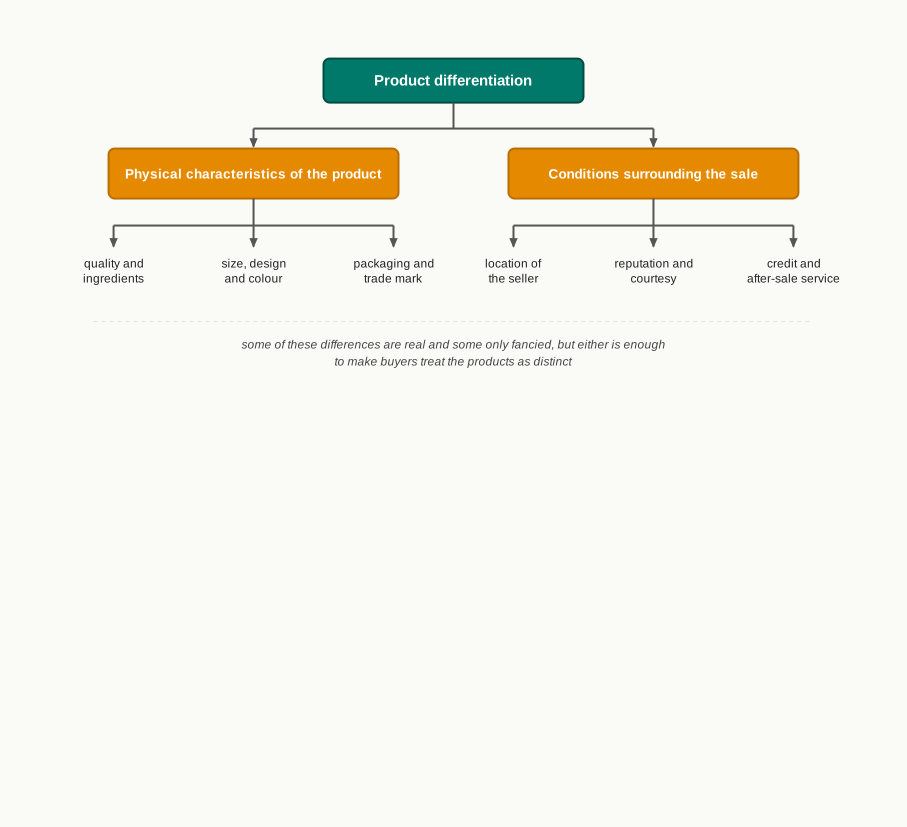
Fig. 9.3 – The two bases of product differentiation.
Some of these differences are substantial and some are slight, and it does not greatly matter which. What matters is that buyers believe the versions are different, because it is that belief which gives each firm a demand curve of its own and with it a little room on price.
Selling cost exists because differentiation exists. Its purpose is to draw buyers away from rival brands and attach them to one’s own, and the advertising through which it is chiefly spent is therefore persuasive rather than merely informative. Informative advertising tells the buyer that a product exists and what it does; persuasive advertising sets out to convince him that one brand is preferable to another that would serve him about as well.
This explains why selling cost has no place at either extreme of the classification. Under perfect competition the product is homogeneous and the firm can sell all it produces at the ruling price, so there is nothing for advertisement to achieve. Under monopoly there is no rival from whom buyers might be drawn, so sales promotion has no target. It is only where products are close substitutes and rivals are many that the expenditure begins to pay for itself.
9.6 Oligopoly
Between the monopolist who has no rival and the monopolistic competitor who has too many rivals to worry about any one of them lies the case of the firm with a handful of rivals, each large enough to matter. This is oligopoly, and it is the market form under which a great part of modern industrial output is produced.
9.6.1 Meaning of Oligopoly
The word means ‘few sellers’, and the fewness is not incidental. It is what forces every firm in the industry to think about what the others will do.
How few is few cannot be settled by a number, though it is usually said that between two and ten sellers makes an oligopoly. The special case of two sellers is called duopoly. The real test is not arithmetical: a market is oligopolistic when each firm supplies a share of total output large enough that its own decisions are noticed by the rest and answered by them.
The buyers, meanwhile, are numerous, so the fewness lies entirely on the selling side. In most modern economies oligopoly is the market form for goods produced on a large scale — cooking gas, soft drinks, cement, civil aviation and consumer electronics among them.
9.6.2 Features of Oligopoly
- Few sellers — a small number of firms dominates the industry, while the number of buyers remains large.
- Intense competition — since each firm holds a substantial share of the market, anything one firm gains is taken visibly from the others, and rivalry between them is keen.
- Interdependence — no firm can decide its price or output on its own account, because the outcome of its decision depends on how the others respond to it. This is the feature that separates oligopoly from every other market form.
- Nature of the product — the firms may sell an identical product, which is called pure oligopoly, or differentiated versions of it, which is called differentiated oligopoly. The cooking gas supplied by rival distributors is the same gas; the cars sold by rival manufacturers are not the same car.
- Importance of selling cost — with few rivals and much at stake, firms compete through advertisement, discounts and other sales promotion, and expenditure on these is heavy.
- Barriers to entry — economies of large-scale production, the cost advantage of established firms, control over essential inputs and patent rights keep newcomers out, which is what preserves the fewness over time.
- Indeterminate demand curve — because a firm cannot know how its rivals will react to a change in its price, it cannot know how much it would sell at that price, and its demand curve cannot be drawn with certainty.
9.6.3 Interdependence and the Indeterminate Demand Curve
Two of these features are really one, and it is worth following the reasoning from the first to the second.
Suppose an oligopolist lowers its price. Because the firms are few, the buyers it attracts must come largely from its rivals, whose sales fall by an amount they cannot fail to notice. Those rivals will not sit still. They may cut their own prices to win the buyers back, and if they do, the firm that moved first ends with a lower price and very little extra business. The reasoning holds for any decision the firm takes — a change in output, a new model, a fresh advertising campaign. Every move invites a countermove, which is why an oligopolist keeps a close watch on its rivals and prepares its strategy with their likely responses in mind.
The consequence for the demand curve follows directly. A demand curve shows the quantity a firm could sell at each price, and drawing one requires knowing what that quantity would be. The oligopolist does not know. If it drops its price and rivals hold theirs, its sales rise a great deal; if rivals match the cut, its sales rise very little. The same price is consistent with several different quantities, depending on a decision the firm does not control. This is what is meant by saying the demand curve is indeterminate, and Fig. 9.4 sets it out.
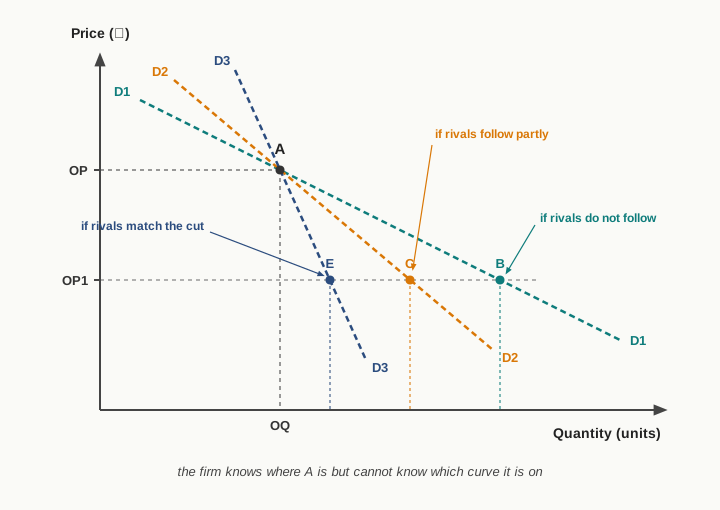
Fig. 9.4 – Indeterminate demand curve under oligopoly.
Every other market form escapes this difficulty. The perfectly competitive firm faces a definite demand curve because it has no power to disturb anybody; the monopolist faces one because it has no rival to disturb; the monopolistically competitive firm faces one because its rivals are too numerous for its own actions to move any of them appreciably. Only under oligopoly are the firms both few enough and large enough for each to be caught in the calculations of the others. The differences between the two forms of imperfect competition are set out below.
9.7 Monopsony
The four market forms taken up so far are all classified by conditions on the selling side — how many sellers there are, what they sell and whether newcomers may join them. But market power does not sit only with sellers. Where the buyers are the scarce side, it is they who name the terms, and the extreme case of this is monopsony.
9.7.1 Meaning of Monopsony
Monopsony is the mirror image of monopoly. Monopoly is a single seller facing a large number of buyers; monopsony is a single buyer facing a large number of sellers.
The single buyer is called the monopsonist, and the relation between the two forms is set out in Fig. 9.5. In both, one side of the market is single and the other is dispersed; what changes is which side that is, and therefore which way the price is pushed.
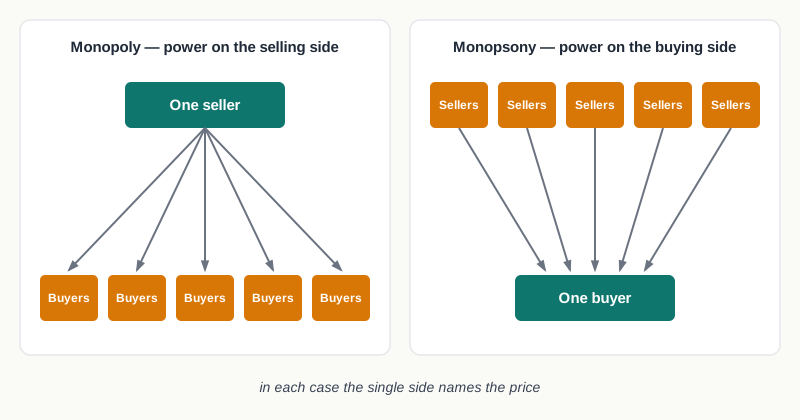
Fig. 9.5 – Monopoly and monopsony compared.
Monopsonists are relatively rare, but they exist. A government is a monopsonist when it purchases goods made to defence specifications, since no other buyer for such goods exists. A large manufacturer may be the only buyer of a component that small local firms have been set up expressly to supply. In some labour markets a single firm — a mine, or a brick kiln in a village — may be practically the only employer of a particular kind of labour, so that a large number of workers face one buyer of their services.
9.7.2 Features of Monopsony
- Single buyer — one firm or authority purchases the entire output of the product, or the whole of the factor service, that is offered for sale.
- Large number of sellers — facing that one buyer is a considerable number of suppliers or, in a labour market, of workers, none of whom is large enough to set terms.
- Specialised product or input — what the sellers supply is made to the monopsonist’s requirement and is of little use to anyone else, which is why they cannot simply take it elsewhere. A radiator built to one manufacturer’s design will not fit another manufacturer’s car.
- Lack of mobility — in a labour market the monopsony survives only because workers cannot or will not move to another place or occupation. Where they can move freely to better-paid work, the single employer must match what is paid elsewhere, and its power disappears.
- Price-maker — just as a monopolist influences the price it receives by varying the quantity it offers for sale, the monopsonist influences the price it pays by varying the quantity it buys. Suppliers must accept its price or stop supplying, which makes the situation a buyer’s market.
Set side by side, the two single-sided market forms are exact opposites at every point.
With monopsony the classification is complete. What remains is to draw together what each of these forms means for the single curve that matters most to a firm — the demand curve it faces for its own product.
9.8 Demand Curves of Firms Under Different Market Forms
Everything said so far about a firm’s power over price can be gathered into a single curve. The demand curve facing a firm shows the different quantities of its product it is able to sell at different prices. Since average revenue is total revenue divided by output, and that is simply the price obtained per unit, the demand curve facing the firm and its average revenue curve are one and the same. The shape of that curve is decided by the market form the firm operates in, and reading the shape tells us at once how much freedom the firm has.
9.8.1 Demand Curve Under Perfect Competition
The perfectly competitive firm can sell as much as it is able to produce at the ruling price, and can sell nothing at all above it. Price does not fall as the firm expands its sales, because the firm’s output is too small a part of market supply to disturb the market price.
The demand curve facing such a firm is therefore a horizontal straight line parallel to the X-axis, drawn at the height of the ruling price. It is perfectly elastic: at the ruling price the firm may sell any quantity, and at the least price above it, nothing. Since every unit fetches the same price, average revenue does not change with output, and the marginal revenue from each extra unit equals that unchanged price. Under perfect competition, therefore, the AR curve and the MR curve are the same horizontal line.
9.8.2 Demand Curve Under Monopoly and Monopolistic Competition
Under any form of imperfect competition the position is different in kind. A firm with some power over price can sell more only by asking less, since at the higher price the additional buyers were unwilling to come forward. Its average revenue therefore falls as output rises, and the demand curve slopes downward from left to right. Because each extra unit is sold only by reducing the price on all units, marginal revenue falls faster than average revenue and lies below it throughout.
Both monopoly and monopolistic competition give a downward-sloping curve, but not one of the same steepness, and the difference is instructive. The monopolist is the whole industry, so the demand curve it faces is the market demand curve for the commodity. Since no close substitute exists, buyers who dislike the higher price have nowhere convenient to go, and few of them withdraw. Demand is therefore relatively inelastic and the curve relatively steep.
The firm under monopolistic competition sells one brand among many close substitutes. If it raises its price, buyers with no strong attachment to the brand move to a rival’s version, and sales fall away sharply. Its demand curve is accordingly much flatter — more elastic — than the monopolist’s, and how much flatter depends on the number and closeness of the substitutes available and on how firmly buyers are attached to particular brands. The three curves are drawn together in Fig. 9.6.
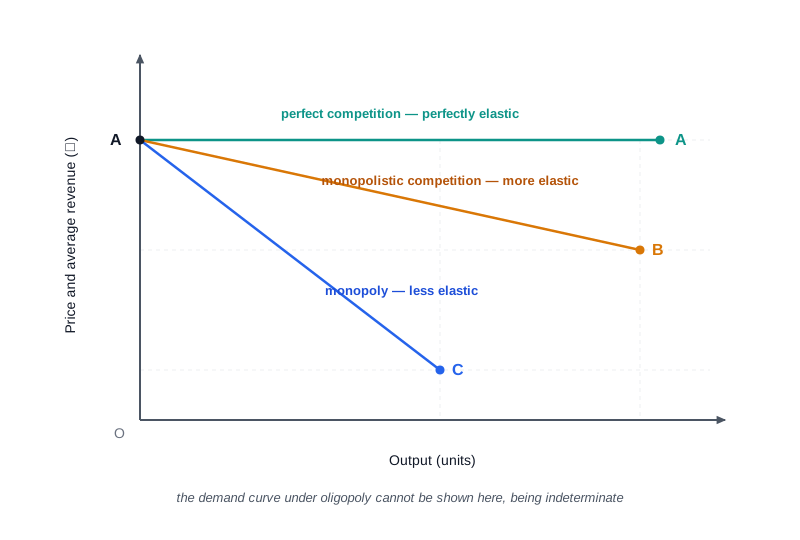
Fig. 9.6 – Average revenue curves under different market forms.
Oligopoly is the one form for which no such curve can be drawn. As shown in Fig. 9.4, the quantity an oligopolist would sell at a lower price depends on whether its rivals follow the cut, and since that is not known in advance the curve is indeterminate. This is why the diagram above carries three curves and not four.
9.9 Comparison of the Main Market Forms
The five market forms have been taken one at a time, each defined by the conditions that hold in it. Set against one another they make a single ordered scheme, and it is worth seeing the whole of it at once before the chapter closes. The comparison below runs across every basis on which the forms have been distinguished.
Reading The Table
Ten bases are listed, but they are not ten independent facts. The first four do the defining work, and the remaining six follow from them.
Begin with the number of sellers and the nature of the product. Where sellers are many and the product identical, no firm has any hold on its buyers, so control over price vanishes, the demand curve becomes horizontal, average and marginal revenue coincide, and advertisement would achieve nothing. Where there is one seller and no close substitute, every one of these results is reversed. The intermediate forms are intermediate on each count together: a differentiated product gives a firm a hold on some of its buyers, which is enough to make the demand curve slope, to pull marginal revenue below average revenue, and to make advertisement worth paying for.
Freedom of entry then settles the last row on its own. Wherever entry is free — perfect competition and monopolistic competition alike — abnormal profit calls in new firms until it has been competed away, and only normal profit survives the long run. Wherever entry is barred, whether by patent, licence, scale or agreement, no such correction occurs and abnormal profit persists.
Monopsony sits a little apart from the rest of the table, and deliberately so. It is classified by a condition on the buying side, so the entries that describe a firm’s behaviour as a seller — its demand curve, its average and marginal revenue, its selling cost — do not apply to it at all. What the monopsonist faces is the supply curve of the many sellers before it, and its power is exercised over the price it pays rather than the price it charges.
The classification, then, is not a list to be memorised but a set of consequences drawn from a few conditions. Given how many sellers there are, what they sell, and whether newcomers may join them, the rest of a firm’s position — its power over price, the curve it faces, what it spends on persuasion and what it earns in the long run — follows.
9.10 Summary
- A market in economics is not a place but the mechanism or arrangement by which buyers and sellers of a commodity contact each other and strike a deal about the price and the quantity to be bought and sold.
- Every market requires a commodity, buyers and sellers, an area rather than a spot, contact between the two sides, and a tendency towards a single price. The area covered is the size or extent of the market, and it may be local, national or worldwide.
- Market structure refers to the type of market in which firms operate. Its competitiveness means the extent to which an individual firm can influence the market price — the less power the firm has, the more competitive the structure.
- Six characteristics determine which market form a market belongs to.
- The number of buyers and sellers.
- The nature of the product, homogeneous or differentiated.
- Knowledge about market conditions.
- Freedom of entry and exit of firms.
- The degree of price influence held by a single firm.
- The extent of selling cost and advertisement.
- Markets are classified into five forms — perfect competition, monopoly, monopolistic competition, oligopoly and monopsony. The first four rest on conditions on the selling side; monopsony rests on a condition on the buying side.
- Perfect competition is a market structure in which a large number of producers sell a homogeneous product, so that no individual firm can influence the price. Price is determined for the industry by market demand and supply, and the firm is a price-taker.
- A perfectly competitive market must satisfy six conditions.
- A large number of buyers and sellers.
- A homogeneous product, in physical characteristics and in the conditions surrounding the sale.
- Freedom of entry and exit.
- Perfect mobility of factors of production.
- Perfect knowledge.
- Absence of transport costs.
- Competition is pure when the first three conditions alone are satisfied and perfect when all six are. Perfect competition is therefore the wider term and pure competition the narrower one.
- Perfect competition does not exist in reality, agricultural produce coming nearest to it. It is retained as the yardstick against which the efficiency of every other market form is judged.
- Monopoly is a market structure in which there is a single seller of a product having no close substitutes. The firm and the industry are the same, and the monopolist is a price-maker.
- The features of monopoly are a single seller, the absence of close substitutes, closed entry created by natural, legal or man-made barriers, price-making power, and the possibility of price discrimination. Because entry is closed, abnormal profit survives in the long run.
- Price discrimination is the sale of the same product to different buyers at different prices for reasons unconnected with any difference in the cost of supplying them. It requires control over supply and sub-markets that can be kept apart, and the higher price is charged where demand is less elastic.
- Monopolistic competition is the form of market in which a large number of sellers each sell a product somewhat differentiated from, but a close substitute for, the products of the others. Each firm has a monopoly of its own brand and competition from every rival brand.
- Its features are a large number of buyers and sellers, differentiated products, free entry and exit, selling cost, non-price competition and an independent price policy. Since entry is free, only normal profit survives in the long run.
- Product differentiation rests on two bases — the physical characteristics of the product, and the conditions surrounding its sale. Selling cost is the expenditure incurred to promote sales through advertisement and other sales promotion measures, and it has no place under perfect competition, where the product is homogeneous, or under monopoly, where there is no rival to draw buyers from.
- Oligopoly is that form of market structure in which a few firms sell a product, so that competition among them is intense and each must reckon with the reactions of the others. Its features are few sellers, intense competition, interdependence, a product that may be homogeneous or differentiated, heavy selling cost, barriers to entry and an indeterminate demand curve.
- Interdependence is the defining feature of oligopoly, and the indeterminate demand curve follows from it. Since the quantity a firm would sell at a lower price depends on whether rivals follow the cut, the curve cannot be drawn with certainty.
- Monopsony is a situation in which there is a single buyer of a product or service, not in competition with other buyers, and into whose market other buyers cannot enter. Its features are a single buyer, a large number of sellers, a specialised product or input, lack of mobility, and price-making power exercised over the price paid.
- The demand curve facing a firm is its average revenue curve, and its shape is decided by the market form.
- Under perfect competition it is a horizontal straight line, perfectly elastic, and AR equals MR.
- Under monopoly it slopes downward steeply, being relatively inelastic, and AR exceeds MR.
- Under monopolistic competition it slopes downward but is flatter than the monopolist’s, because close substitutes exist.
- Under oligopoly it is indeterminate and cannot be drawn.
- The whole classification turns on three conditions — how many sellers there are, what they sell, and whether entry is free. The three conditions that define each form are set out below.
9.11 Points to Ponder
- Perfect competition assumes perfect knowledge, costless transport and factors that move without hindrance. No market anywhere satisfies these conditions. Is a model that describes nothing still the right standard against which to judge real markets, or does a yardstick this far from the world mislead as often as it guides?
- Product differentiation gives buyers variety, and it gives each firm a little room on price. Where twenty brands of the same article sit on one shelf, is the buyer better off for the choice, or is he paying, in the price of every packet, for advertisement he never asked to see?
- A patent is a barrier to entry created deliberately by law, and it allows the holder to charge a monopoly price for years. If patents were withdrawn, the price of protected goods would fall at once — but what would happen to the willingness to spend on invention in the first place? Which of the two would you choose to protect, and for how long?
- Interdependence can push oligopolists into a price war that none of them wins, or hold them at a high price without any agreement being signed. In an industry of four large firms, which outcome do you think is the more likely, and what would decide it?
- Where a single firm is the only employer in a village, the workers face a monopsonist and the wage is set on the buyer’s terms. Should such a firm be left alone, on the ground that it created work where there was none, or should the wage it pays be regulated? What is given up under each answer?
- The classification in this chapter counts sellers within a market. Electronic platforms now let one seller reach buyers anywhere and let a buyer compare a hundred prices in a moment. Does cheaper information push markets towards perfect competition, or does it simply hand the market power to whoever owns the platform?
9.12 Objective Questions
- In which of the following market forms does the distinction between the firm and the industry disappear? [1]
- Perfect competition
- Monopolistic competition
- Monopoly
- Oligopoly
- Read the following statements and choose the correct option. Assertion (A): A firm under monopolistic competition incurs selling cost. Reason (R): The products sold by rival firms are close substitutes but are not identical to one another. [1]
- Both (A) and (R) are true, and (R) is the correct explanation of (A).
- Both (A) and (R) are true, but (R) is not the correct explanation of (A).
- is true, but (R) is false.
- is false, but (R) is true.
- Fill in the blank: A market situation in which a single buyer faces a large number of sellers, and into which other buyers cannot enter, is called ______. [1]
- State whether the following statement is true or false: Under perfect competition a firm spends on advertisement in order to increase its share of the market. [1]
- Match each demand curve in Column A with the market form in Column B to which it belongs. [1]
| Column A | Column B |
|---|---|
| a. A horizontal straight line parallel to the X-axis | i. Oligopoly |
| b. A curve that cannot be drawn with certainty | ii. Monopoly |
| c. A steeply sloping downward curve | iii. Perfect competition |
9.13 Check Your Concepts
- Define price discrimination and state any one condition that must hold before a monopolist can practise it. [2]
- Distinguish between monopolistic competition and oligopoly on the basis of the number of sellers, interdependence among firms, and freedom of entry. [3]
- Draw, on a single diagram, the average revenue curves faced by a firm under perfect competition, under monopoly and under monopolistic competition, and explain why the three differ in slope. [4]
- ‘Under perfect competition the seller is a price-taker, while under monopoly and under monopolistic competition he is a price-maker.’ Explain this statement, bringing out the extent of the price-making power in each of the two latter forms. [6]
9.14 Case-Based Question
- In the village of Ratanpur, about two hundred growers, among them Sushila Devi, cultivate a medicinal herb. Anvi Herbals Ltd is the only firm within reach that processes this herb, and it purchases the whole of the village’s crop; the growers have no other buyer to turn to and the herb is of little use to anyone else. The firm dries and packs the herb and sells it in city shops under its own brand name, alongside eight or nine competing brands of the same herb, each differing a little in packaging and in claimed purity.
- Identify the market form the growers of Ratanpur face when they sell their crop, and give one reason for your answer. [2]
- Identify the market form in which Anvi Herbals Ltd sells its packets in the city, and give one reason for your answer. [2]